Article
How Much Does Medicaid Pay for NEMT? 2026 Rates by State
What 12 state Medicaid schedules pay for a 10-mile wheelchair trip, who really sets your rate, and how to weigh a broker's offer.
By James O'Donnell, Cofounder and COO, Duet ·
As of October 2026, Medicaid has no national rate for non-emergency medical transportation (NEMT). In eight of the 12 states we found that publish a wheelchair van rate a company can bill, the most a standard 10-mile, one-way wheelchair trip pays is about $32 to $44, counting Illinois’s Cook County and South Dakota’s in-town rates. Most riders’ trips, though, go through a broker, the company a state or Medicaid health plan hires to arrange rides, and pay whatever your contract says.
A founder getting ready to launch in Cincinnati told me on a call in July about a meeting with roughly six people from one broker. When they gave the price, the founder read it back to be sure. “They said, that’s 18.” The founder’s first thought: “I want to end this meeting immediately because that’s ridiculous.” The reason: “we’re going to lose money every single transport.”
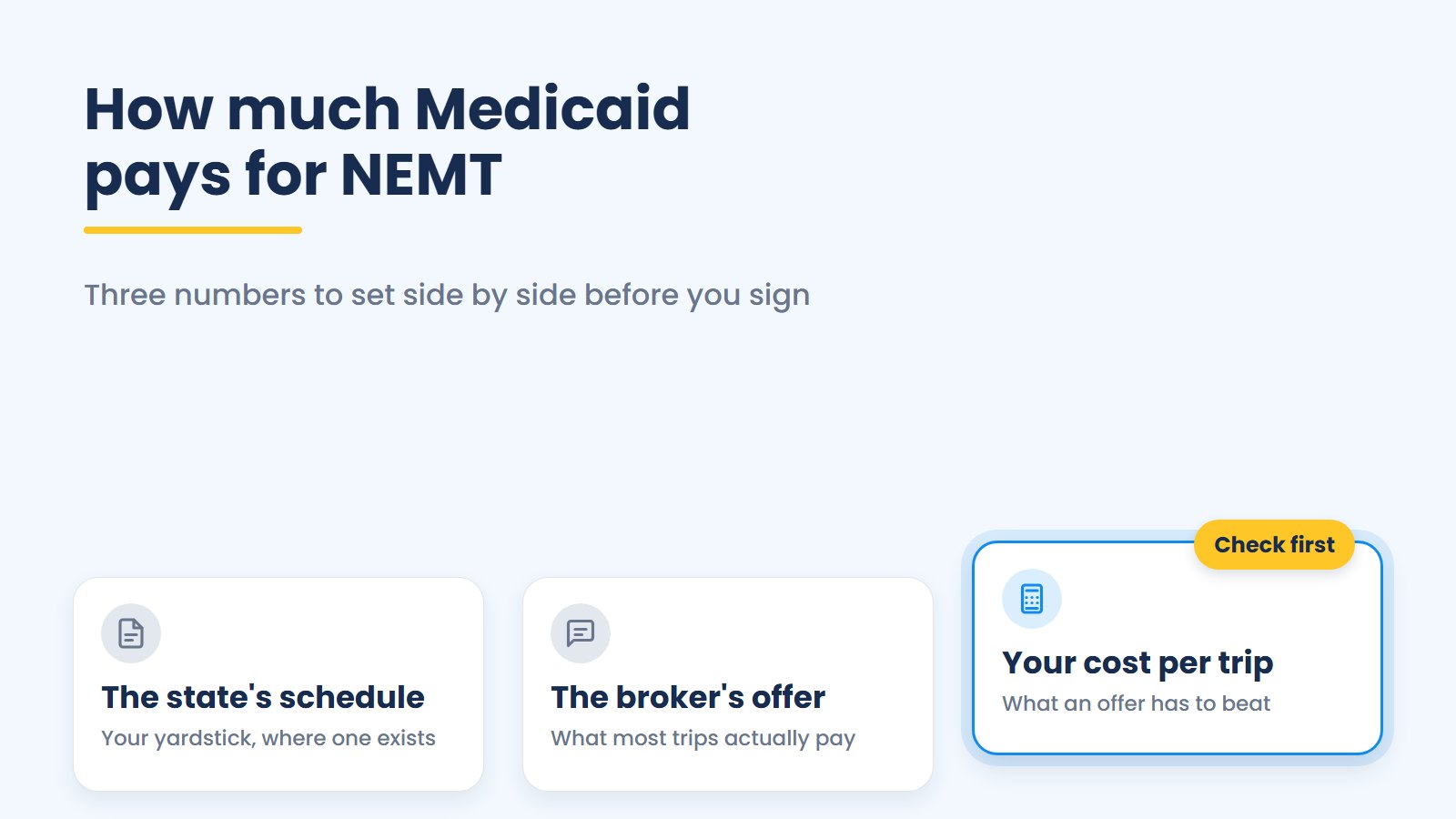
Most offers aren’t that easy to read. There’s no single Medicaid rate: most NEMT trips pay whatever a broker’s contract says, so set every offer beside your state’s published schedule and your own cost before you sign. Rachel Scholler, who ran a NEMT company in Wisconsin for 17 years, named the trap on our pricing episode with my cofounder, Jing Zhu. New owners, Rachel said, shouldn’t think they have to “accept the broker rate and then model their whole business after that.”
So this guide goes in the order you’d check an offer: what the schedules pay, who set the broker’s number, what a rate covers, what your trips come to, whether the offer beats your cost, and how to answer it.
How much does Medicaid pay NEMT providers?
We found 12 states that publish a wheelchair van rate a company can bill, and in them the most a standard 10-mile, one-way wheelchair trip pays ranges from $25.10 to $69.49 as of October 20, 2026. Michigan’s $25.10 is half of a 20-mile round trip, and South Dakota’s $69.49 needs all 10 miles outside city limits. An ambulatory trip pays less.
These amounts come from each state’s fee schedule, its published list of what it pays for each service. Most reach only fee-for-service riders, the ones Medicaid pays for ride by ride because they aren’t in a health plan. Most pay a base per one-way trip plus a rate for loaded miles, the miles with the rider aboard. The table lists all 12, plus New York’s default rates, which its broker’s negotiated rates replace:
| State | Wheelchair rate as published | 10-mile wheelchair trip, at most | 10-mile ambulatory trip, at most | Who the rate reaches |
|---|---|---|---|---|
| Michigan | $35 a round trip plus $0.76 a mile (July 1, 2026) | $25.10 a leg of a 20-mile round trip | $7.60 (mileage only, no base) | Fee-for-service outside Wayne, Oakland and Macomb Counties |
| Arizona | $11.15 plus $1.54 a mile (Oct. 1, 2026) | $26.55 ($28.81 outside the Phoenix and Tucson metros) | $19.44 | Fee-for-service, including the American Indian Health Program (about 5% of members) |
| Indiana | $31.79 a trip plus $1.67 a mile past the first 10 miles one way (Jan. 1, 2026) | $31.79 | $12.71 | Fee-for-service riders, through the broker Verida |
| Louisiana | $21.50 a leg plus $1.30 a mile from mile zero (since Jan. 1, 2022) | $34.50 (a set rate) | $24.50 (a set rate) | Fee-for-service, and the floor for the plans’ broker unless you sign for less |
| California | $20.30 plus $1.50 a mile (table updated September 2023) | $35.30 | $30.65 | Fee-for-service riders (about 5% of members) |
| Minnesota | $19.80 plus $1.92 a mile, rider’s home zip not rural (as of Oct. 12, 2026) | $39.00 | $28.20 | Riders outside the health plans (about 20% of 2024 NEMT spending) |
| Illinois | $30 plus $0.80 to $1.61 a mile by county (Jan. 1, 2026) | $40.30 in Cook County ($38.00 to $46.10 by county) | $30.30 (Cook) | Fee-for-service, prior approval required (about 22% of members) |
| South Dakota | $43.39 a trip plus $2.61 a mile outside city limits (July 1, 2026) | $43.39 in town, up to $69.49 outside city limits | $5.20 a trip in town, no mileage | Nearly every Medicaid rider; no broker |
| North Dakota | $18.05 plus $2.57 a mile from the pickup (as of Oct. 1, 2026) | $43.75 | $25.25 (mini-bus) | Traditional Medicaid; no broker |
| Ohio | $31.00 plus $1.30 a mile (since Jan. 1, 2024) | $44.00 | Not listed | Licensed wheelchair vans billing the state; plans covered at least 90% of members in 2021 |
| Massachusetts | $40.55 each way plus $1.46 a mile (Sept. 26, 2025) | $55.15 | Not listed | Public payers; broker-arranged trips may pay other rates |
| Colorado | $34.14 plus $2.74 a mile (July 1, 2026) | $61.54 | $39.55 | Companies enrolled before Oct. 1, 2026, outside nine metro counties, until Jan. 1, 2027 |
| New York (default) | New York City $52.90 plus $3.60 a mile (schedule dated April 5, 2026) | Default: $88.90 in New York City; $77 in the median county outside it | Default: $52.27 in New York City | A default; the broker MAS’s negotiated rates replace it |
Dates in the second column are when each rate took effect; where a cell says “as of”, “dated” or “updated”, it’s the schedule’s own date. Three of these states have no Duet guide yet, so here are their sources: South Dakota’s transportation fee schedule (PDF), North Dakota’s Medicaid fee schedules page and Massachusetts’ wheelchair van rate regulation.
Ten of the 13 rows are ceilings by the state’s own wording: either it pays the lower of your charge and its amount, or it calls its amount a maximum. Where the rule is the lower of the two, charge less than the state’s amount and that’s the most you’re paid. Louisiana’s is a set rate, Colorado’s schedule uses neither wording, and New York’s is a default.
Colorado’s row doesn’t reach a new company at all. MediDrive, the state’s broker, already pays providers in nine metro counties, and a company that enrolls now serves only those counties until Jan. 1, 2027. From then, every Colorado NEMT payment goes through MediDrive, at whatever your contract with it says.
Texas isn’t in the table because it has no separate wheelchair van rate. It posts one fee-for-service rate per trip, by area, for taxi and wheelchair van trips alike: $32.38 in metro areas, $59.64 in suburban ones and $76.22 in rural ones, effective Nov. 1, 2024. Fewer than one in ten Texas Medicaid members were in that fee-for-service lane in 2024.
In the other states we’ve written guides for, a contract sets the rate most riders’ trips pay:
- A broker or plan vendor sets it: Florida, Georgia, Missouri, New Jersey, Virginia and Texas, outside that fee-for-service lane.
- Counties set it for the riders they handle: North Carolina, for its Medicaid Direct riders (its health plan members’ trips go through brokers), and Pennsylvania.
Why the numbers online run higher
Online, a wheelchair trip looks far better paid, partly because the AI answers Google showed in October 2026 draw on a billing company’s 2026 rate chart. Set beside the schedules, the online numbers look like this:
| What you’ll read online | What the schedules say |
|---|---|
| A wheelchair trip pays “$25-$120” plus “$2.00-$7.00+” a mile | That’s $45 to $190 for 10 miles. On the 12 state schedules, a standard 10-mile wheelchair trip pays at most $69.49, and none pays $3 or more a loaded mile. |
| Indiana pays “$3.50” a mile for wheelchair trips | Indiana pays at most $31.79 a trip and no mileage for the first 10 miles one way, then $1.67 a mile. |
| California pays “$80-$120” for a wheelchair trip | California’s fee-for-service maximum for a standard 10-mile wheelchair trip is $35.30. |
| Michigan pays “$35 round-trip plus $0.67/mile” | Michigan has paid up to $0.76 a mile since July 1, 2026. The $0.67 comes from its 2024 schedule. |
| Waiting pays “around $25 for the first hour” | That’s a Georgia workers’ comp schedule. On the schedules we read, where Medicaid pays for waiting at all, the most it pays is $4.59 to $11.30 a half hour, under conditions. |
Price a 10-mile trip on your state’s row of the first table. We didn’t check every state, so if yours has no row, look on its Medicaid agency’s site for a transportation fee schedule. Failing that, use the $32-to-$44 middle as a gut check, since that’s where eight of the 12 published schedules land.
Who sets your rate, the state or the broker?
For most Medicaid riders, a broker or a health plan’s ride vendor sets your rate in its contract with you, and it reaches you as an offer, not a published schedule. The only broker rate sheet we’ve found posted is MTM’s for Rhode Island, which pays $41.00 for a 10-mile daytime wheelchair trip under rates effective July 1, 2023. The same broker’s Minnesota provider page says rates there are “discussed and determined with transportation providers on an individual basis.”
Tony Jackson, an Orlando operator with 35 years in the business, voiced the broker’s side of a first offer on our October 2025 episode with him: “I got this new company. They probably don’t know. I’m gonna give them $35 a wheelchair.” That’s Tony’s example, not a state’s rate. (This page is so you do know.) And Tony was fair about why brokers price that way: “because they have to make money on their end as well.”
On the broker’s end, the state often pays a fixed amount for each enrolled member every month, whether or not anyone rides. Where it does, whatever the broker pays you comes out of that amount. That’s the core of how NEMT brokers get paid. Rhode Island’s contract set MTM’s fiscal 2024 rate at $9.38 a member a month, blended across age groups. MACPAC, the commission that advises Congress on Medicaid, found that about two-thirds of fiscal 2018’s ride-days (each day a rider took at least one trip) were paid that way, through a broker or a health plan (June 2021 report).
Each state decides how far to step in. CMS, the federal Medicaid agency, says in its 2023 transportation guide that “States may direct brokers to use specific provider payment methodologies.” In the documents we read, states land in one of three places:
- The state’s rate is the rate: South Dakota and North Dakota, where companies bill Medicaid directly with no broker.
- The state steps in: In Louisiana, a health plan can’t pay you less than the fee-for-service rate unless you agree to less in your provider agreement, per the state’s managed care manual (May 28, 2026). In Indiana, the broker for fee-for-service riders, Verida, uses a schedule that “is based on” the state’s and can “negotiate higher and/or special rates,” per Indiana’s transportation services module. Massachusetts sets the rate itself for one kind of broker trip: $92.88 since April 2022 for an enhanced wheelchair trip, one that needs door-to-door or door-through-door help, with the first five miles included. Its schedule pays at most $47.85 for a standard five-mile trip.
- The broker or plan sets it: your rate is whatever you agree with the broker or plan. Missouri pays its broker a set amount per member each month “regardless of the length of the transport, the type of vehicle required, or the number of transports,” and its state plan “does not require a specific reimbursement methodology be used by the broker.” New Jersey told bidders “The State is not involved in rate negotiations” (answer 85, Dec. 9, 2025). Rhode Island and New Jersey both require at least 80% of the broker’s money to go to direct transportation, a floor on spending, not on any trip’s rate.
Before you sign with any broker or plan vendor, get its rate sheet in writing and find out whether your state puts a floor or a base under it.
What does a Medicaid rate pay for?
A Medicaid rate pays for the trip with the rider aboard, usually a base for each one-way leg plus loaded miles, and generally not the drive to the pickup, the wait or a no-show.
That last part is federal policy. The same CMS guide says “Generally, no load miles cannot be paid,” meaning the empty miles operators call deadhead, and it counts the drive back from a rider who doesn’t come out as no-load miles. Long waits generally aren’t covered “as a distinct service” either. States may build no-load miles and no-shows into their rates instead.
State rules say it plainer. Arizona’s billing manual says a company “may not submit any claim for unloaded mileage.” Ohio’s rule calls the drive to the pickup and away from the drop-off “intrinsic to the transportation service” and says “No separate payment is made for the cost of such travel.”
Take one trip on Ohio’s rate schedule. Say the drive to the pickup is 6 miles and the rider takes 15 minutes to come out. Neither gets a separate payment: the drive is part of the trip, and the schedule lists no waiting rate. The 10 miles with the rider aboard pay at most $31.00 plus 10 times $1.30, or $44.00. The empty drive to your next pickup gets nothing separate either.
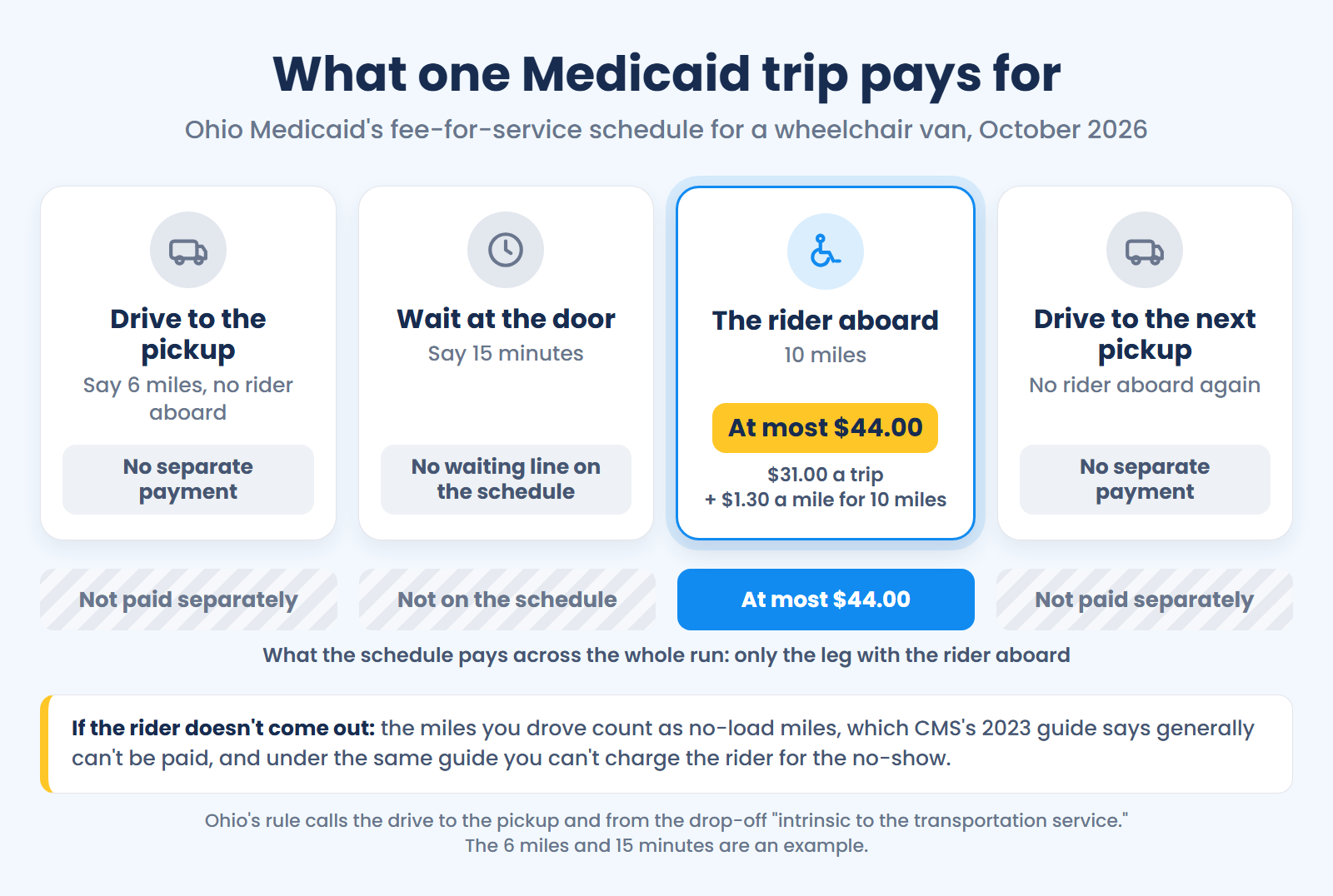
In the documents we read, a few schedules pay for some of this, or pay extras, and each comes with conditions:
- Waiting: Arizona pays up to $4.59 a half hour, but not on a one-way trip, a wait under 30 minutes or a trip of 10 miles or less. Medi-Cal, California’s Medicaid program, pays up to $11.30 a half hour past the first 15 minutes, for 90 minutes at most. Indiana pays for waiting only on trips of 50 miles or more one way, after the first 30 minutes.
- No-shows: Medi-Cal’s fee-for-service manual lets a wheelchair van bill a “dry run,” a call it answered without carrying the rider.
- A second rider: Indiana pays up to $15.90, half its base, for a second wheelchair rider carried at the same time from the same county to the same area. North Dakota, by contrast, pays for only one member per trip, however many ride together.
- An attendant: at most $2.60 in South Dakota to $20 in Illinois, where a schedule lists one.
Read five terms in every contract you’re offered: no-shows, waiting, extra riders, the claim deadline (15 days on one broker’s 2021 form, 90 on another’s 2023 form) and how the broker can change your rate.
What will your own trips pay?
Your trips pay by their length, because each schedule counts miles its own way: short trips pay best where the base is high, long ones where the mileage rate is.
Say your most common trips run 3, 10 and 25 loaded miles. The table shows the most one standard wheelchair trip of each length can bring in under six schedules that differ in base, rate per mile and which miles count, as of October 2026:
| State (how miles count) | 3 miles | 10 miles | 25 miles |
|---|---|---|---|
| Indiana (nothing for the first 10 miles one way) | $31.79 | $31.79 | $56.84 |
| Louisiana (every mile, from mile zero) | $25.40 | $34.50 | $54.00 |
| Ohio (every mile with the rider aboard) | $34.90 | $44.00 | $63.50 |
| Minnesota (every loaded mile; rider’s home zip not rural) | $25.56 | $39.00 | $67.80 |
| South Dakota, in town (no mileage inside city limits) | $43.39 | $43.39 | $43.39 |
| North Dakota (map miles from the pickup) | $25.76 | $43.75 | $82.30 |
An in-town South Dakota trip goes from the best-paying short trip to the worst-paying long one, because South Dakota adds its $2.61 a mile only once a trip leaves city limits. North Dakota climbs from fourth to first, since it pays up to $2.57 for every mile from the pickup; its January 2026 manual measures those miles on a map. Michigan doesn’t fit a one-way table, since it prices a round trip. Rural riders change the math too: Minnesota pays more per mile when the rider’s home zip code is rural, and Arizona pays more for trips that start outside the Phoenix and Tucson metros.
So ask how an offer counts miles. A former head of provider network at one of the large brokers spoke about this on a software company’s podcast in 2023. The first question, in that executive’s words, is whether the rate card is “a mileage bucket” or “a per mile rate.” A bucket pays one price for a band of distance: MTM’s Rhode Island sheet pays $28.50 for a daytime wheelchair trip’s first five miles, then $2.50 a mile.
Run your three most common trip lengths through every offer, counting only the miles with a rider aboard.
Is the broker’s offer worth taking?
A broker’s offer is worth taking when it beats what a trip costs you, and a trip below that only when it fills time you’re already paying for.
Your cost per trip is last month’s total costs divided by last month’s completed one-way trips; our operations guide shows how to work out your cost per trip. The Cincinnati founder judged on the spot that the broker’s 18 would lose money. Other offers are closer calls.
Below that line, a trip can still earn its place. If the van and driver would otherwise sit idle, a trip that pays more than its own gas, wear and any extra driver pay leaves you ahead. Josh Hagen of Careway Mobility asked me on our September episode with him how to fill slow midday hours. My first answer: “carefully sort through broker trips to see if there are any medium-paying ones instead of low-paying ones.”
None of this makes broker work a dead end. “That’s not to say you can’t build a phenomenal business based on broker rides,” Ray, one of The Doctor Ride’s founders, said on our episode with The Doctor Ride. In Ray’s read, it takes an established relationship with the broker and a lot of rides. Te’ya Miles, the Atlanta operator behind That NEMT Girl, says in a 2025 video on her YouTube channel that one van on one broker contract “did $125,000” in 2024. That’s revenue, not profit, earned by loading two or more wheelchair riders at once and picking trips.
Your own numbers decide all of this. Duet’s reporting dashboards show revenue and the average fee per ride for any period, with a breakdown of revenue by payer. You can also pull a contract’s trips and dollars into a spreadsheet and set your own costs beside them. Insurance and fuel still come from your own books.
Set each offer beside last month’s cost per trip before you answer.
How do you get a broker to pay more?
Negotiate before you sign, with the trips no one else near you can cover as your case, because the first rate tends to stick.
Rachel saw it work in rural Wisconsin, where “brokers were open to negotiate.” When she turned back a trip no other provider could take, she’d name her price, and a broker would often take it, because “they just want it done.” The catch, in Rachel’s words: “It’s a little harder when you’re newer because you don’t have the history behind you.”
The opening deal matters most. Bring last month’s cost per trip to the rate talk, so you can say what the former broker network head advised: “here’s what it cost me. I can’t do it for less than this.” The same episode adds that “when you first start with a broker, you have one chance to negotiate up front,” and a broker that’s getting a cheap rate from you has no reason to reopen it in the first year. After that, reopen it once a year, or sooner when a big cost moves, like insurance rates or the minimum wage.
Push on more than the rate. My cofounder Jing said on our pricing episode that you have to “negotiate really hard to get no show fees.” And watch for changes from the other side. MTM’s 2023 provider agreement form lets it change “compensation rates” on written notice, and the change is “deemed accepted” unless you reject it in writing within 30 days. At a broker switch, new rates can come in lower, as our guide to negotiating with a new broker explains.
Pushing can pay off over time. An owner with about 30 vehicles in Texas spoke on an operators’ call I sat in on in October. The brokers the company still works with “pay our rates,” the owner said, but “it took us a long time to get there.”
Some brokers won’t move. Two California owners who coach other operators described broker trip marketplaces on their YouTube channel in 2024. You take the price posted on the trip, “there’s no negotiating,” and one of them had seen wheelchair trips there for $14 to $17. That’s when your other lanes matter, facility-paid trips and private pay. Price private-pay rides from what other providers in your market charge, above both the broker’s rate and your own cost per trip.
This week, write three numbers on one line: what your state’s schedule pays for your most common trip, what the broker is offering for it, and what a trip cost you last month. If the offer sits below that last number and you take it anyway, don’t expect the broker to raise it. As I said on our episode with Rachel about selling a NEMT business, “They will never offer to pay you more.”
FAQ
How much does Medicaid pay for a stretcher van trip?
Seven of the 12 state schedules we found list a stretcher van, and as of October 2026 the most a standard 10-mile trip on them pays ranges from $41.29 (California’s Medi-Cal maximum) to $135.76 (South Dakota, when all 10 miles are outside city limits). Indiana lists its stretcher-van codes as not covered.
Can you charge the rider for a no-show or the drive to the pickup?
Not for a no-show, under CMS’s 2023 transportation guide: “States and providers may also not impose a charge on a beneficiary for no-shows.” Ohio’s rule covers the drive to the pickup too: no separate payment is made for it, “nor can it be billed to the medicaid-eligible individual.”
How often do Medicaid NEMT rates change?
Minnesota adjusts its mileage rates every quarter with the price of gas. Louisiana’s wheelchair and ambulatory rates haven’t moved since Jan. 1, 2022, though it added a higher wheelchair rate for an “Elevated Level of Care” on Oct. 1, 2025. North Carolina cut its fee-for-service NEMT rates 3% on Oct. 1, 2025, then reversed the cut after court rulings, per a March 3, 2026 letter to county social services directors. Since July 1, 2026, federal rule 42 CFR 447.203 has required states to post their Medicaid fee-for-service fee schedule rates online and update them within a month of a change. It covers state fee schedules, not brokers’ or plans’ rates, so in a state that runs every ride through a broker or the plans, there may be no state rate for a company to bill.
Does Medicaid pay a family member to drive a rider?
In some states, as a separate line from company rates. Michigan’s NEMT rate schedule, effective July 1, 2026, pays up to $0.76 a mile to a rider who drives themselves or to a family member or friend who does the driving, the same per-mile amount it lists for companies.
About the author
James O'Donnell cofounded Duet and leads its sales, partnerships, and growth services. He talks with NEMT operators every week, hosts the NEMT Growth podcast, and answers Duet's sales line himself. More about Duet's founders →
Want more trips and less busywork?
See how Duet runs and grows NEMT businesses in a 30-minute demo.