Article
How to Start a NEMT Business in North Carolina (2026)
A plan merger moved 281,000 North Carolinians' rides to a different broker overnight. Here's NC's map: two brokers, plus a county lane you bill directly.
By James O'Donnell, Cofounder and COO, Duet · · Updated
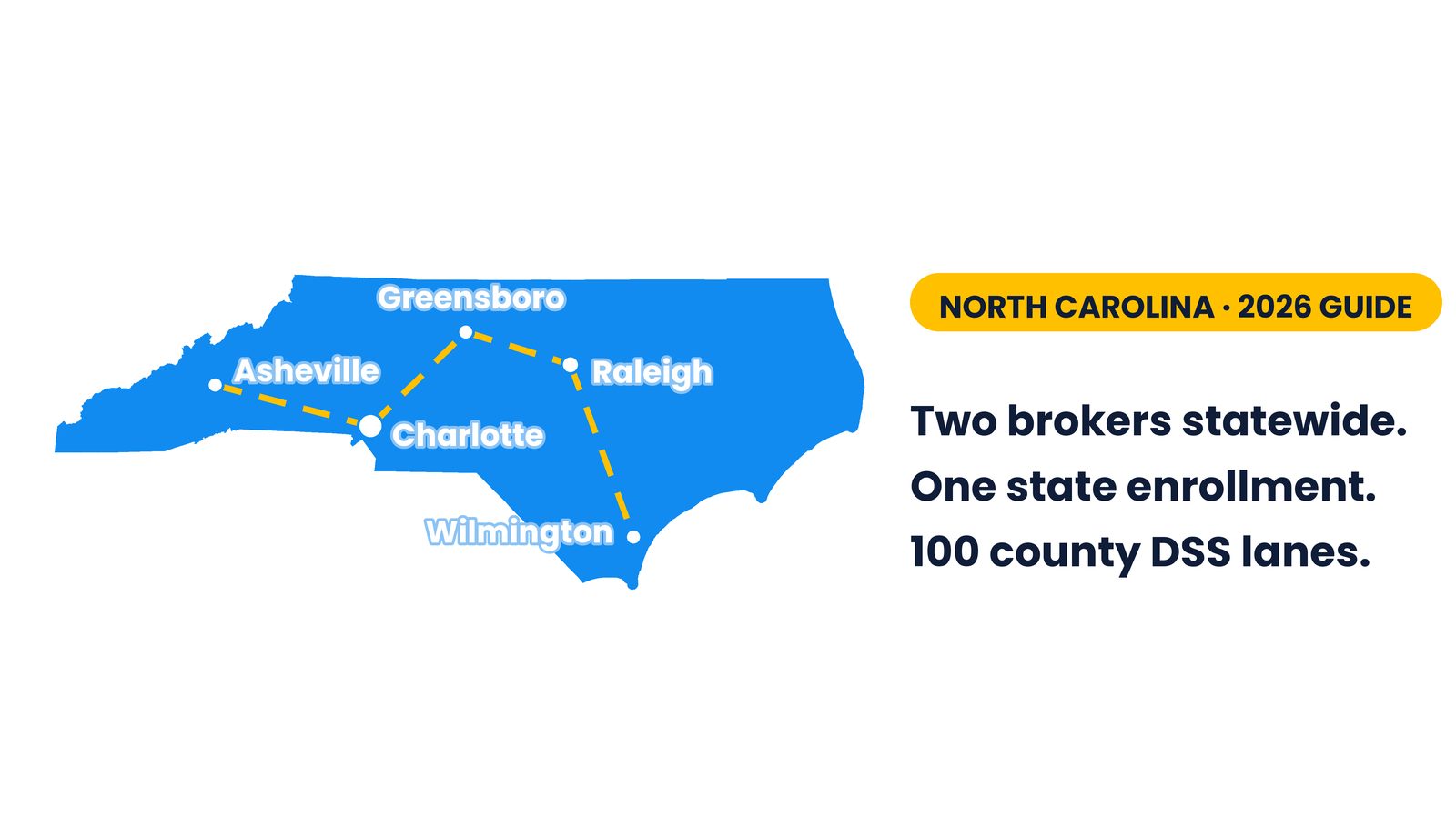
To start a NEMT business in North Carolina, form an LLC, insure the vans, enroll with NC Medicaid through NCTracks, then credential with both Medicaid brokers, Modivcare and MTM, and contract with your county Department of Social Services (DSS). No state NEMT license exists, and the county lane bills NC Medicaid directly. Plan on $15,000 to $45,000 and two to four months to first Medicaid trips.
North Carolina at a glance:
- State NEMT license: None; the state Medicaid policy says none is required. Stretcher work is the exception: legally it’s ambulance work.
- Who runs Medicaid rides: Two brokers. MTM for Carolina Complete Health and UnitedHealthcare Community Plan, Modivcare for the other managed care plans. County DSS offices arrange the rest.
- How you enroll: One NCTracks application, $850 in fees, a site visit, and training. Then both broker credentials and a county DSS contract.
- Insurance the contracts expect: Quote at the $1.5 million level the state’s Medicaid policy points at, which is also what for-hire passenger carriers must keep on file with the DMV.
- Cost to launch one van: $15,000 to $45,000, mostly the van and the insurance. State fees total less than a thousand dollars.
- Time to first Medicaid trips: Two to four months. Private-pay and facility work can start as soon as you’re insured and inspected.
On April 1, 2026, two Medicaid health plans, WellCare of North Carolina and Carolina Complete Health, merged into one statewide plan under the Carolina Complete Health name [2]. The combined plan’s rides now run through MTM [3]. Until that morning, Carolina Complete Health’s roughly 281,000 members got their rides through Modivcare [1]. Nobody driving those trips signed anything.
The trips just moved.
That’s the market you’re walking into. North Carolina Medicaid covers 3.1 million people, more than one in four residents [12]. About 2.5 million of them are covered by a managed care plan, a private health plan the state pays to cover Medicaid members [12]. A broker is the company a state or health plan hires to assign Medicaid rides to transportation providers and pay for them. Exactly two of them, Modivcare and MTM, run every one of those plans’ rides [1][12].
The other 595,000 are in what the state calls NC Medicaid Direct. Their county Department of Social Services (DSS) arranges those rides, and the companies driving them bill the state directly [1][5]. Those are your lanes: two brokers, one state enrollment, and one hundred county doors. That’s fewer doors than Florida, more than Georgia, and one door most guides never mention at all.
I run Duet, a dispatch software company, and I talk to non-emergency medical transportation (NEMT) operators every week, North Carolina included. This is the North Carolina edition of our national guide on how to start a NEMT business. It cites the actual statutes, rules, and agency pages. Where something couldn’t be verified against a primary source, I say so. Requirements change, and North Carolina’s changed twice while we researched this. Confirm against the linked sources before you spend money.
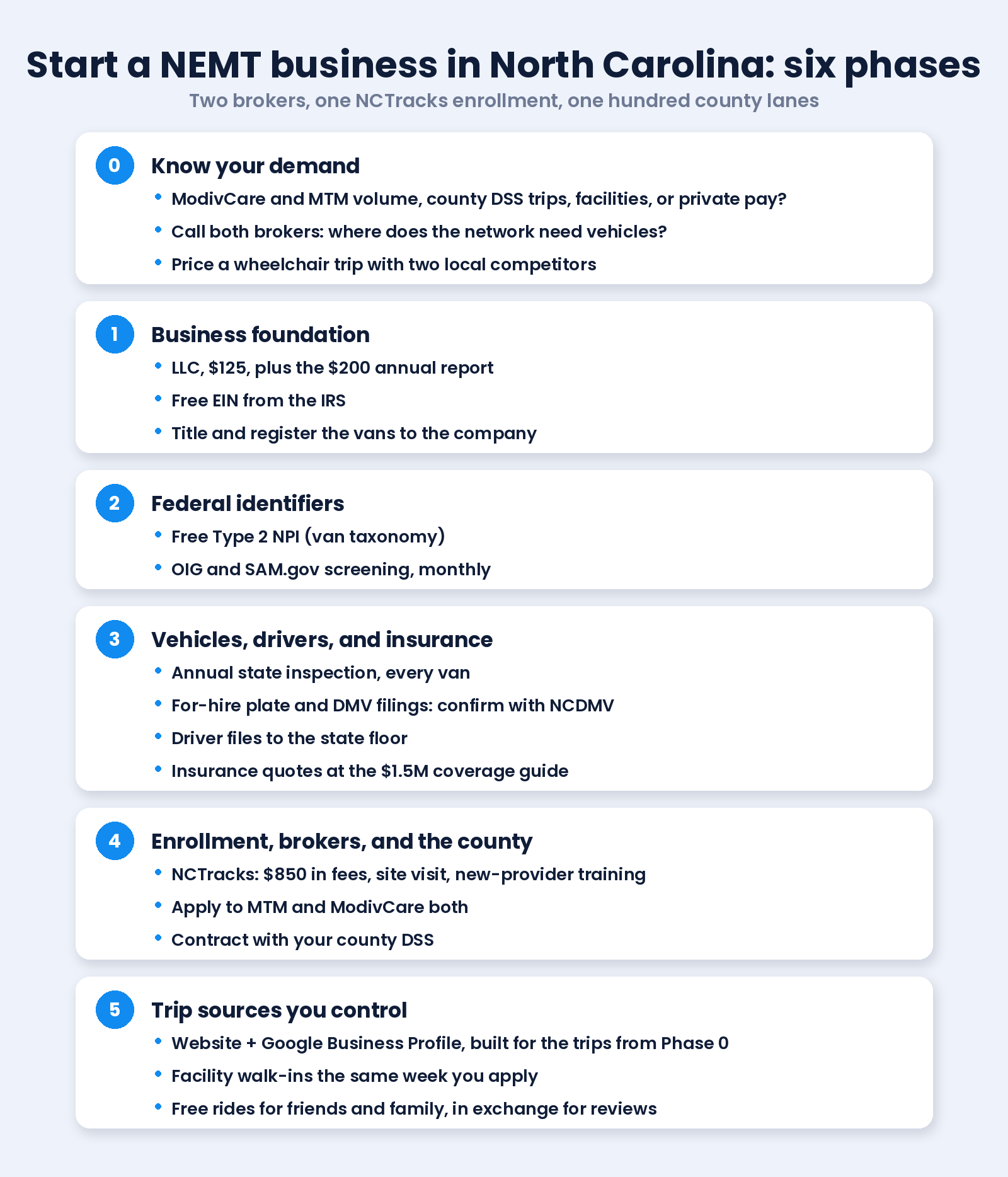
The one-page checklist: steps to start a NEMT business in North Carolina
Phase 0: know your demand
- Decide where your trips will come from: broker volume from Modivcare and MTM, county DSS trips, facility contracts, or private-pay families. They’re four different businesses.
- Call both brokers with one question: which counties need more vehicles? The state itself tells NEMT providers to contract with both [6].
- Call your county DSS and ask how they contract Medicaid Direct rides and what they pay per trip.
- Price a wheelchair trip with two local competitors. Charlotte rates and Down East rates are two different markets.
Phase 1: business foundation
- Form your LLC with the NC Secretary of State: $125 to file the Articles of Organization, then a $200 annual report each April 15 [22].
- Get a free EIN, your federal tax ID, from the IRS. Never pay a third party for this.
- Title and register the vans in the company’s name. North Carolina ties insurance to the registered owner, so an LLC policy can’t certify a personally registered van [23].
- Transfer each title within 28 days of the sale, or you’ll owe a $20 late penalty [23].
- No city business license to chase: North Carolina abolished general local business-license taxes back in 2015 [24].
Phase 2: federal identifiers
- Apply for a free Type 2 (organization) NPI at NPPES. An NPI is the ID number the healthcare system uses for your company, and it usually arrives within days [5][7].
- Use taxonomy 343900000X, Non-Emergency Medical Transport (VAN). NCTracks will enroll you without an NPI, but the brokers want it [5][7].
- Check owners and drivers against the two federal lists of people banned from Medicaid work, the OIG list and SAM.gov, and recheck monthly. The state requires it, and the brokers check too [4].
Phase 3: vehicles, drivers, and insurance
- Every van needs North Carolina’s annual state inspection, $13.60 for safety only or up to $30 in the 19 counties that also test emissions, and the Medicaid program verifies it [4][25].
- Emissions testing still applies in 19 counties as of August 2026; check yours [25].
- Plan on the for-hire registration class: $128.50 a year versus $46.25 private [26], plus the DMV’s certificate-of-exemption and insurance filings for exempt passenger carriers [29].
- Confirm both filings with NCDMV, the North Carolina Division of Motor Vehicles, before you letter a van.
- No CDL (commercial driver’s license) below 16 passengers including the driver, and no chauffeur’s license exists in North Carolina [27].
- Build each driver’s file to the state floor: 18 or older, properly licensed, a background check against the state’s disqualifying-crime list, and random drug and alcohol testing [4][5].
- Driving record: no license suspension in the past five years, and no more than two chargeable accidents or moving violations in three [4][5].
- Insure at the $1.5 million Utilities Commission level: it’s the minimum for the DMV’s exempt-carrier insurance filing and the coverage guide the state’s NEMT policy names [4][29]. Get quotes before you buy anything.
Phase 4: enrollment, brokers, and the county
- Enroll with NC Medicaid through NCTracks: online application, the NEMT driver attestation form, and $850 in fees ($750 federal for 2026 plus $100 state) [5][8][9].
- After that, a required site visit and new-provider training [7].
- Apply to both broker networks for credentialing, their own approval process before they send you trips. MTM requires NCTracks enrollment first [3]; Modivcare holds everything else [1].
- Contract with your county DSS for Medicaid Direct trips, paid through NCTracks against the county’s written authorization [5].
Phase 5: the trip sources you control
- Set up a website and Google Business Profile built around the trips from Phase 0. Add Yelp and Facebook, especially if you’re starting private-pay-first.
- Start facility outreach and your private-pay presence the same week your applications go in, not after they’re approved. Credentialing has a queue; relationships don’t.
- Offer friends and family free or discounted rides in exchange for honest Google reviews. Ten of them make strangers trust you.
Who pays for NEMT rides in North Carolina?
Four sources pay for NEMT rides in North Carolina:
- Medicaid managed care plans, through their two brokers.
- County DSS offices, arranging rides for NC Medicaid Direct members.
- Facility contracts: hospitals, dialysis clinics, and senior living communities.
- Private-pay families, booking directly.
Medicaid law here is generous on paper: the state must provide transportation to medical appointments for every person on Medicaid who needs and requests it [1].
Medicaid is the volume
Medicaid ride volume got a lot bigger. North Carolina expanded Medicaid on December 1, 2023, letting far more adults qualify. By July 2026 the state counted nearly 740,000 people covered through expansion [11]. That sits on top of a program that ended the 2025 fiscal year at 3.1 million total [12]. Managed care members book rides through their plan’s broker with as little as two days’ notice. Medicaid Direct members book through their county DSS, which typically wants more lead time [1][4].
One caution belongs next to those numbers. Federal work requirements for the expansion population start January 1, 2027, and the state estimates more than 255,000 expansion enrollees could lose coverage [13]. The riders who remain still need dialysis three times a week. But plan your growth on the program as it will be, not as it peaked.
Facilities are the stability
North Carolina has 251 Medicare-certified dialysis facilities [17], and dialysis is the steadiest work in this business: standing orders, three trips a week, every week. Then come the discharge desks of the big hospital systems, the staff who arrange rides home for patients being released:
- Atrium’s 11 hospitals around Charlotte
- UNC Health’s 20 statewide
- Duke’s 4 in the Triangle
- Novant’s 19
- ECU Health’s 9 across the rural east [18]
One facility that trusts you can fill a van’s whole day.
Private pay is the margin
North Carolina’s aging population is the argument for private pay. The state’s own demographers project 2.4 million residents 65 and older by 2030, growing three times as fast as the population overall, in a state adding people faster than almost anywhere [16].
Ray and Mac, the founders of The Doctor Ride in Charlotte, built a 100 percent private-pay business on exactly that math. Mac had watched his own grandmother struggle to find a ride service anyone in the family trusted. They charge $125 an hour for wait-and-return trips, the colonoscopies and same-day procedures where the office requires a driver to stay on site. On their wheelchair facility work they charge $125 a leg, and a leg is one one-way ride [40].
Two founders, two vehicles, and days that gross around $800 on three bookings. Their motto, borrowed from the business author Alex Hormozi: if you can solve rich people problems, you can charge rich people prices.
The geography splits the opportunity in two
Charlotte’s metro holds 2.9 million people and the Raleigh-Durham Triangle another 2.2 million [19], and that’s where the private-pay money and the facility density live. But 80 of North Carolina’s 100 counties are rural, aging faster than the national curve, with thin transit and long distances to care [20]. Out east and in the mountains you’ll compete less and deadhead more, meaning more miles driven without a rider. Price accordingly.
Who is the NEMT broker in North Carolina?
Two brokers split North Carolina Medicaid managed care. Modivcare runs rides for most plans. MTM runs rides for Carolina Complete Health, which has been the state’s biggest plan by membership since its April 1, 2026 merger with WellCare, and for UnitedHealthcare Community Plan since January 1, 2026 [43]. There’s no state-run broker you can sign up with; Medicaid Direct rides go through county DSS offices instead [1][5], the way most of Ohio’s fee-for-service rides go through its county Job and Family Services offices.
What that means for you: one MTM credential now reaches the biggest plan in the state and UnitedHealthcare’s, and one Modivcare credential reaches the rest of managed care. The state Medicaid office itself tells transportation providers to contract with both [6].
The broker map, plan by plan
This is the map as I can verify it in August 2026, from the state’s fact sheet and the plans’ own pages, with the UnitedHealthcare row corrected October 8, 2026. Treat it as a starting point, and confirm your row before you build on it:
| Who’s paying | Rides run by | Source |
|---|---|---|
| Carolina Complete Health (absorbed WellCare April 1, 2026; more than 980,000 members per Centene’s merger announcement) | MTM | CCH’s merger and transportation pages [2][3] |
| AmeriHealth Caritas NC | Modivcare | State fact sheet and plan pages [1] |
| Healthy Blue | Modivcare | State fact sheet and plan pages [1] |
| UnitedHealthcare Community Plan | MTM (since January 1, 2026) | UnitedHealthcare’s provider flyer [43] |
| Alliance, Partners, Trillium, and Vaya (the four Behavioral Health/IDD Tailored Plans, launched July 2024) | Modivcare | Launch materials and plan pages [1][10] |
| Healthy Blue Care Together (Children and Families Specialty Plan, launched December 1, 2025) | Modivcare | The plan’s NEMT fact sheet [14] |
| NC Medicaid Direct and EBCI Tribal Option (about 595,000 and 5,700 people) | County DSS arranges; providers bill NCTracks | State fact sheet and NCTracks [1][5][12] |
Three footnotes that will save you a bad decision
- The state’s own fact sheet is stale. It still carries the pre-merger table, so a search result quoting it will tell you Carolina Complete Health rides with Modivcare. The merged plan’s own pages say MTM, and they’re newer [1][2][3].
- UnitedHealthcare moved too. UnitedHealthcare’s own provider flyer names MTM Health as the broker for UnitedHealthcare Community Plan of North Carolina effective January 1, 2026, so the state’s fact sheet is out of date on this plan as well [43][1]. Check the plan’s own provider notice, not the fact sheet.
- The bottom of the table has a sell-by date. Partners and Vaya are set to merge into one Tailored Plan called Vaya Partners on October 1, 2026. And the state puts the Standard Plan contracts out to bid again for a cycle starting December 2027 [15].
Verify your row the week you build on it. Our national broker tracker logs these moves state by state.
Can I bill NC Medicaid directly for NEMT rides?
Yes, in one lane, and this is where North Carolina differs from its neighbors. About 595,000 people are in NC Medicaid Direct, the fee-for-service program: the state pays you directly per trip, with no broker or plan in the middle. The county DSS arranges or authorizes the trip, and the transportation provider bills NCTracks directly [1][5][12].
Georgia closed its direct lane in 1997, and Florida’s fee schedule prices only ambulances. North Carolina kept a real one.
The mechanics, from NCTracks’ own fact sheet [5]. To bill, you need three things:
- enrollment in NCTracks,
- a contract with the county DSS, and
- a payment authorization, the county’s written approval to pay for that trip.
Claims go in on the standard professional claim form with transportation codes A0100 through A0140, and they pay whatever amount the county authorized. Miss the authorization and the claim sits for 14 days looking for one, then denies. The county sets the rates and the county monitors its vendors, and one county’s rates tell you nothing about the next county’s.
The lane is real. One story to keep your expectations honest: in October 2025 the state cut NEMT fee-for-service rates by 3 percent as part of budget reductions. Court rulings forced a reversal in December. Rates went back to their September levels and claims were reprocessed [21]. Counties spent the winter waiting on updated guidance.
The lane is worth having because it’s yours and not a broker’s. But it’s still one payer with one budget, and the section below about not building on a single payer applies to counties too.
What licenses does a NEMT business need in North Carolina?
North Carolina has no state NEMT license, and that isn’t my inference: the state’s Medicaid transportation policy says of NEMT providers that “no certification, accreditation or license is required” [4]. What the state runs instead:
- an enrollment gate (NCTracks, with fees and a site visit),
- an insurance-and-registration layer at the DMV,
- an annual vehicle inspection, and
- city-level vehicle-for-hire permits in some metros.
The internet fills the vacuum with invented credentials, so here’s the short version against the sources:
| The claim you’ll read elsewhere | What North Carolina actually requires |
|---|---|
| ”Apply for NC Medicaid NEMT provider certification” | No certification exists. The path is NCTracks provider enrollment, then broker credentialing or a county DSS contract [4][5]. |
| ”Credential with NC Rides, your regional broker” | There’s no entity called NC Rides in NC Medicaid. Managed-care rides run through Modivcare or MTM; Medicaid Direct runs through county DSS offices [1]. |
| ”North Carolina requires a $1 million commercial auto policy” | No statute says $1 million. Exempt for-hire carriers must keep the Utilities Commission’s $1.5 million common-carrier level on file with the DMV, and the state NEMT policy points to the same level as a coverage guide [4][29]. $1 million is a broker contract number, and the brokers don’t publish their NC requirements at all. |
| ”No application fee for NEMT providers” | $100 North Carolina fee on every enrollment, re-enrollment, and reverification, plus the $750 federal fee for 2026 [8][9]. |
| ”Vehicles must be under 10 model years old” (as a state rule) | The state policy sets no vehicle age cap. It requires valid registration and the annual state inspection; age caps are broker contract terms [4]. |
| ”You’ll need your city business license first” | North Carolina repealed general local business-license taxes in 2015 [24]. What some cities do run is vehicle-for-hire permitting, which is about the van, not the business. |
| ”NC approved my single-van startup, so fleet minimums are a myth” | Correct, for once. The state policy and NCTracks set no minimum fleet size [4][5]. Broker networks decide their own needs county by county. |
The state layer: the for-hire plate and the DMV filing
Most wheelchair-van NEMT work needs no certificate from the NC Utilities Commission, the state agency that licenses bus lines and movers. The motor-carrier law exempts bona fide taxicab-style service in vehicles carrying 15 or fewer passengers, which is the shape of demand-response NEMT work: trips booked one at a time, not on a fixed route [29]. The Commission mostly regulates regular-route buses, brokers, and movers, not the demand-response trips you’ll run [29]. But North Carolina attaches two strings where other states attach none, and both run through the DMV, not the Utilities Commission.
The first string is the for-hire registration class. A vehicle transporting persons for compensation registers as a for-hire passenger vehicle at $128.50 a year instead of $46.25, with its own plate [26].
You’ll read that the law’s definitions section excludes “vehicles used for human service” and hope it covers you. Don’t lean on it. Chapter 20 never defines the term. Elsewhere in North Carolina the label means transportation run by government and nonprofit human service agencies, and nothing suggests a for-profit company hauling paid trips qualifies [26]. Treat your NEMT van as a for-hire vehicle unless NCDMV tells you otherwise in writing. Budget the plate.
The second string is a DMV filing most guides never mention, and it’s the one that catches people. The same law that exempts demand-response passenger carriers from Utilities Commission certificates still requires exempt for-hire carriers to register with the DMV for a certificate of exemption. It also requires them to keep insurance on file, at the same levels the Commission sets for regulated carriers [29]. And the DMV only sells for-hire plates to exemption-certificate holders whose insurance filing is current [29]. That chain is what puts the $1.5 million insurance figure on your desk.
The strange part: no NEMT guide mentions this regime, and the DMV publishes forms rather than explanations. So how it’s administered day to day for a two-van operator isn’t visible from the outside. Call NCDMV’s commercial registration desk, describe your exact operation, and get the filing requirements in writing before you register.
USDOT numbers: only if you cross the state line
Two federal notes while you’re speccing vehicles. A typical wheelchair van that stays inside North Carolina needs no USDOT number, the federal carrier registration number. North Carolina’s intrastate USDOT program only reaches vehicles of 26,001 pounds or more, vehicles designed for 16 or more passengers, and hazmat [30].
Cross a state line for pay in a 9-to-15-passenger vehicle, though, and federal registration and safety rules attach at the first mile [31]. Border operators in Charlotte take note: the state line is 20 minutes from uptown, and NC Medicaid does contract border-state providers within 40 miles of the line [5].
The annual inspection: $13.60 to $30 a van, every year
Every van, every year, at any licensed station, with emissions testing still layered on in 19 counties as of this writing [25]. The safety-only fee is $13.60, and the combined emissions and safety inspection in those 19 counties tops out at $30. The Medicaid program requires plans and brokers to verify your inspections are current [4], so never let one lapse.
The state has moved to end the emissions program and is waiting on federal sign-off. Mecklenburg is expected to keep testing under its own law either way, so check your county at inspection time.
The local layer: Charlotte and Durham, then call ahead
City vehicle-for-hire ordinances are where North Carolina goes city-by-city the way Florida goes county-by-county. Charlotte regulates passenger vehicles for hire, “special needs” vehicles included, through a permit program the police department runs. Its application spells out one carve-out: companies contracted directly with DSS or CMS, the federal Medicare and Medicaid agency, are exempt from the commercial for-hire plate requirement. The application also says it accepts no third-party contracts, which reads like a broker subcontract won’t qualify [32]. Durham’s ordinance covers “para-transits” by name [33].
Raleigh and Greensboro run taxi-focused permit programs, with no NEMT-specific permitting we could find. So before you buy anything, spend the week on phone calls: your city’s vehicle-for-hire office, your county DSS, and NCDMV. It’s the cheapest insurance in this guide.
What are the NEMT insurance requirements in North Carolina?
Plan your quotes around the $1.5 million level, not the state’s 50/100/50 auto minimum. It’s what exempt for-hire carriers must keep on file with the DMV, and it’s the number North Carolina’s own Medicaid policy points at. The policy tells providers to carry liability insurance that adequately protects the agency and its riders. As “a guide for minimum coverage,” it offers the amount the NC Utilities Commission requires of common-carrier passenger vehicles: $1.5 million for vehicles seating 15 or fewer passengers, $5 million above that [4][29].
Guide is the policy’s word; the DMV filing is what makes $1.5 million mandatory, and your broker contract will name its own figure. But it tells you what the state considers adequate for this work, and it’s a very different number from the ones in template guides.
The full stack, floor to bar
| Who sets it | The number |
|---|---|
| NC statutory auto minimum, policies on or after July 1, 2025 | $50,000 per person / $100,000 per accident / $50,000 property damage [28] |
| Floor for exempt for-hire carriers: NC Utilities Commission common-carrier level, filed with the DMV and referenced by the Medicaid policy as the coverage guide | $1.5 million (15 or fewer passenger seats); $5 million (16 or more) [4][29] |
| Broker bar: Modivcare and MTM credentialing in NC | Not published. Market reporting puts the broker bar around $1 million combined single limit, one limit covering injuries and property damage together, but neither broker publishes NC limits. Get the number from provider relations before you bind, and binding is the moment coverage is active [34]. |
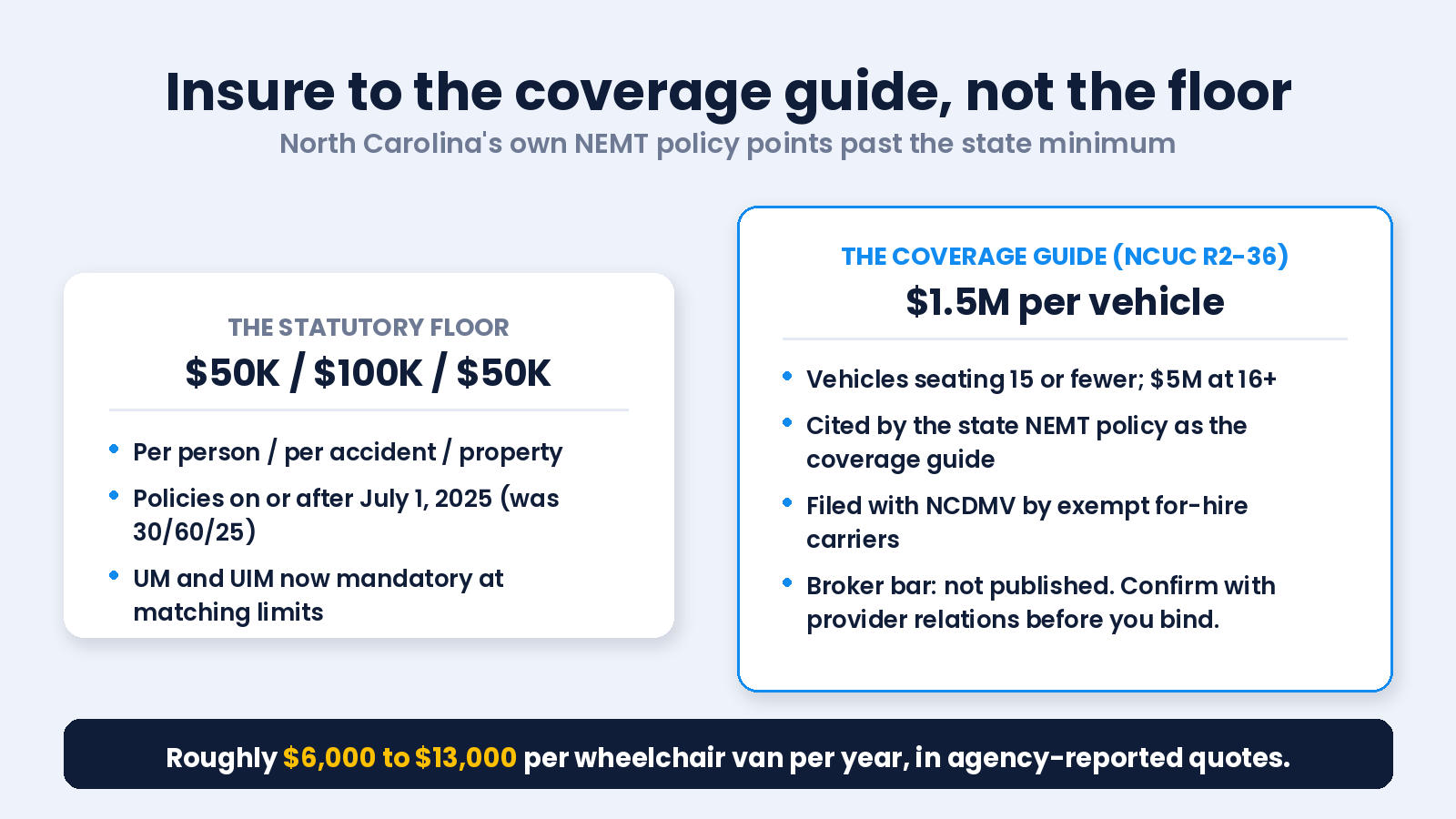
A note on that statutory floor, because half the guides online still print the old one. North Carolina raised its auto liability minimums from 30/60/25 to 50/100/50 for policies issued or renewed on or after July 1, 2025 [28]. It added underinsured motorist coverage to every new or renewed policy on the same date [28].
That minimum isn’t the number that matters, though. The exempt-carrier filing from the licenses section puts your insurance on file with the DMV at the Utilities Commission’s levels. The DMV only sells for-hire plates while that filing is current [29]. Put that together with the Medicaid policy’s guide language, and $1.5 million is the number to bring to your agent. Your broker contract’s own requirement is the last thing to confirm before you bind.
What it costs
The premiums are the bad news, and none of these numbers are official. Specialist NEMT agencies report North Carolina commercial auto quotes running roughly $4,000 to $9,000 a year for sedans and minivans, and $6,000 to $13,000 for wheelchair vans [34]. Agencies report first-year operators paying toward the top until the first clean renewal [34]. Only a handful of insurance companies cover NEMT at all, so use an agent who insures medical transport companies every week. Price the insurance before you commit to a vehicle.
Workers’ comp starts at your third employee
North Carolina requires coverage at three or more employees, and the counting rules matter. Corporate officers count toward the three even if they exempt themselves from coverage. LLC members don’t count unless they elect in [35]. So a two-member LLC with two W-2 drivers sits at two countable employees, while the same company organized as a corporation sits at four.
Your entity choice moves the threshold. Bring that to your accountant; it isn’t a reason to dodge coverage you’ll need anyway. One injury while strapping down a wheelchair makes the premium look cheap, and facility contracts commonly ask for proof of workers’ comp regardless.
What do NEMT drivers need in North Carolina?
No CDL and no special license, for almost everyone. A commercial license starts at vehicles designed for 16 or more passengers including the driver. North Carolina has no chauffeur’s license at all, so an ordinary Class C license covers a wheelchair van [27]. Guides mentioning an NC “Class D” or chauffeur permit are importing another state’s rules.
What your drivers actually need is the state policy’s floor, because the state requires plans and brokers to enforce it [4][5]:
- 18 or older, properly licensed for the specific vehicle.
- A clean recent record: no license suspension or revocation in the past five years, and no more than two chargeable accidents or moving violations in the past three. You pull driving records fresh every 12 months [5][42].
- Background checks against the disqualifying-crime lists in the state’s transportation policies, looking back ten years. You run them before hire and again every three years [4][42].
- Random drug and alcohol testing meeting Federal Transit Administration standards, and you keep the records [4].
- Monthly exclusion screening: the state requires you to check employees every month against the federal OIG list of people banned from Medicaid work [4].
The brokers layer their own credentialing on top: background check, drug screen, driving record, and trainings like CPR, first aid, defensive driving, and hands-on wheelchair securement.
Neither Modivcare nor MTM publishes its North Carolina driver requirements. So treat any specific training list you read online, including the one just above, as the industry-standard shape rather than the NC contract terms. Build your driver files from the credentialing packet the broker actually sends you [34]. Practical rule from operators who’ve onboarded with both: build every file to the strictest packet you’re pursuing and you’ll clear the rest.
Can a NEMT company run stretcher van trips in North Carolina?
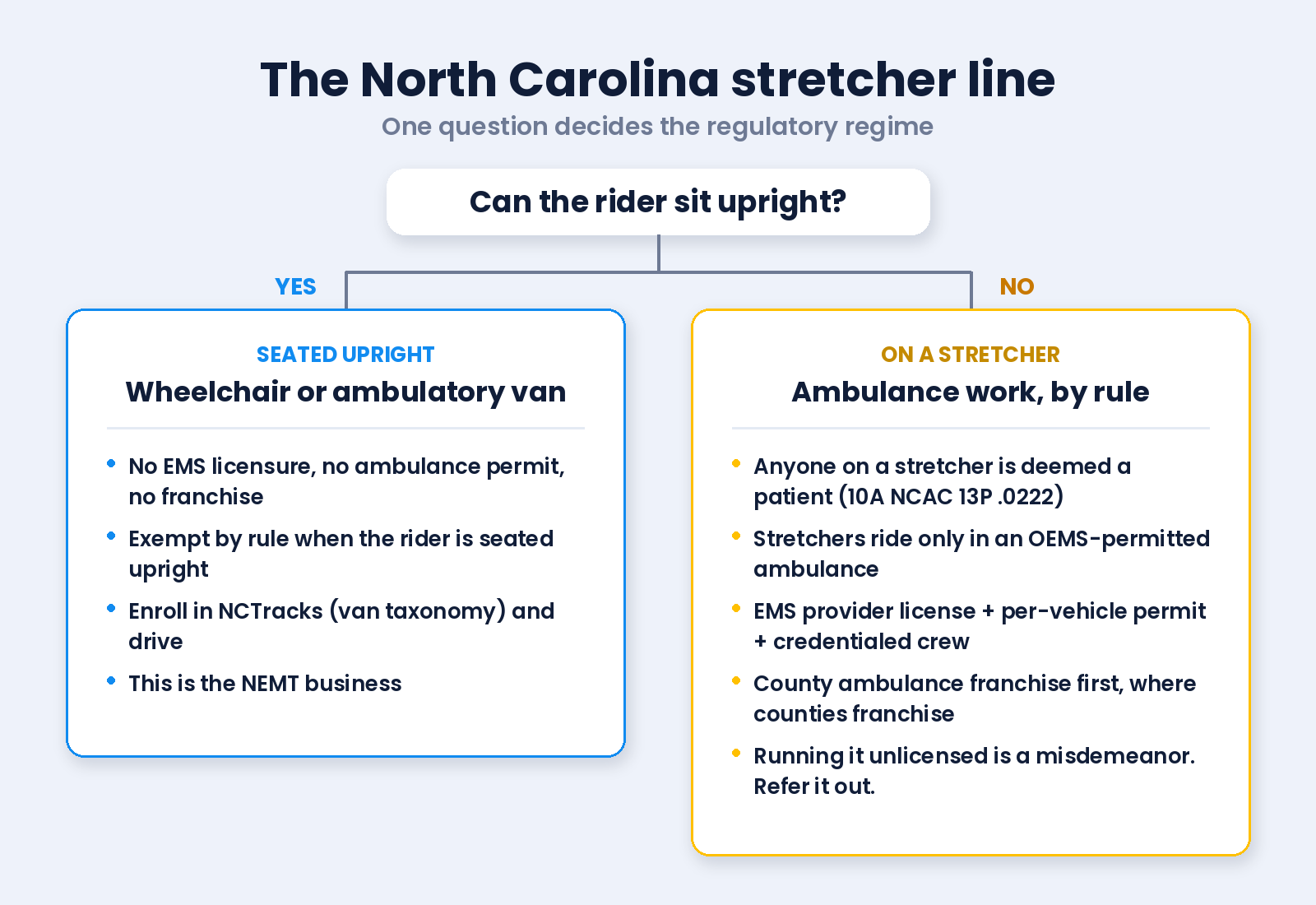
No. North Carolina draws the line harder than almost any state, and it draws it at the stretcher itself, not at the patient’s condition. State EMS rules deem anyone transported on a stretcher a “patient,” and only an ambulance permitted by the NC Office of EMS, the state’s emergency medical services office, may carry a stretcher patient [36]. It doesn’t matter if the rider is stable and needs no care on the way. There’s no stretcher van or ambulette category at all. If the rider is lying down, it’s ambulance work.
Running it anyway is a crime, twice over. Operating as an EMS provider without a license is a misdemeanor. Operating an ambulance without a vehicle permit or required staffing is a more serious one [37]. And yes, you’ll find North Carolina companies advertising “stretcher van” service, and even payer documents using the phrase. That’s either a licensed convalescent ambulance operation or a problem, because the rules have no third category.
What licensed stretcher work takes
Building the licensed version is a different business. You’d need:
- an EMS provider license,
- a per-vehicle permit in the non-emergency “convalescent ambulance” category, with vehicle specs most vans can’t meet,
- credentialed crew under the state’s staffing rule, and
- in franchising counties, an ambulance franchise from the county commissioners first [37][38].
State law lets counties franchise ambulance service, cap the number of operators, and protect the companies already there [38]. A 2025 bill to repeal that county franchise authority hasn’t passed as of this writing.
Wake County, for instance, requires a franchise specifically for non-emergency and convalescent ambulance service, with a $2,392 application fee [38]. The state’s own guidance says the county EMS office is your first stop, since the county sponsors new providers to the state [39]. A county that says no is a no.
The wheelchair side of the line
The good news: the same rule lets riders seated upright in a wheelchair travel in a vehicle with no ambulance permit [36]. And NC Medicaid enrolls wheelchair and ambulatory van providers with no EMS licensure of any kind [5]. Ambulatory means riders who can walk to the vehicle.
On the billing side the split is just as clean. Stretcher-level trips ride under NC Medicaid’s ambulance coverage policy, with ambulance codes and prior approval, meaning approval before the trip or the claim is denied [41]. The van benefit has no stretcher code at all [41].
So build the service line for wheelchair and ambulatory riders. Write the rule into your dispatch protocols in plain language, “if the rider can’t sit upright, we refer it,” and keep a licensed ambulance company’s number saved for the referrals.
The rest of the family draws the line differently. Texas bans non-EMS stretcher work too, by statute. Georgia allows it under its invalid-car exemption. California runs a litter van category with a driver-and-attendant crew. An operator moving into North Carolina from Georgia should drop the stretcher playbook, because it’s illegal here.
How do you become a NC Medicaid NEMT provider?
Becoming a North Carolina Medicaid NEMT provider is one state enrollment, then a separate contract for each source of trips you want: NCTracks first, then the brokers, then your county DSS. The state enrollment comes first for everything. The managed-care policy requires the brokers’ NEMT providers to be enrolled Medicaid providers [4], and MTM’s own Carolina Complete Health page won’t take an application without NCTracks registration [3].
Step one: NCTracks
The application runs online through the NCTracks provider portal. You apply as an organization, or as an atypical organization if you skip the NPI, under taxonomy 343900000X [5][7]. What’s distinctive:
- The documents: an NEMT driver attestation form signed by your office administrator, and disclosures for owners and managing employees [7].
- The fees: $850 for 2026, a $750 federal application fee plus North Carolina’s $100 fee, paid at submission. The application sits dead until they’re paid, with a 30-day clock before it’s abandoned. Let one die and resubmit, and the state fee is due again [8][9].
- The site visit and training: NEMT sits in Medicaid’s moderate-risk screening category, which means a required site visit and mandatory new-provider training, both run by the state’s contractor. Miss either deadline and the application is denied automatically [7].
- No fingerprinting at moderate risk [7].
The pleasant surprise is the speed: the state publishes its clean-application processing averages, and through spring 2026 they ran 10 to 12 days [9]. “Clean” is the word that matters. The applications that take months are the ones bouncing on missing documents, so treat the first submission like a final exam.
Step two: the brokers
MTM’s process runs application, interview, contracting, credentialing, training, first trip [3]. Modivcare starts with an inquiry to its provider team, then credentialing, and it has a dedicated North Carolina network contact [6]. Neither publishes a timeline. Both add providers where the network needs capacity, and a broker can still tell a fully qualified company that its county is covered. Wheelchair capacity, weekend availability, and rural counties are what networks struggle to source. If that’s what you bring, lead with it.
Step three: the county
For Medicaid Direct trips, contract directly with each county DSS you want to serve [5]. There’s no statewide application; it’s a county conversation about need, rates, and their vendor monitoring. Some counties are hungry for vans, some already have all the vendors they need, and the only way to know is the call. Since NC contracts border providers within 40 miles of the line, operators near Virginia, Tennessee, and South Carolina should ask on both sides [5].
Start with the payer that doesn’t need permission
The catch-22 every new operator hits applies in all three lanes: networks and counties like operating history, which you can’t build on trips they haven’t given you. The answer is the payer that doesn’t need permission. Private pay and facility work first, Medicaid volume layered on as credentials land. Our guides on winning facility contracts, getting your first trip from a facility meeting, and private pay are the playbook for those first months.
Don’t build the whole schedule on one payer
Everything above gets you into North Carolina Medicaid work. The last twelve months should staple one caution to every NC business plan: broker volume is borrowed volume, and this state just demonstrated it twice. In April, a merger moved a quarter million members’ rides from one broker to another with no provider’s signature on anything [2]. Last winter, the state cut fee-for-service rates 3 percent, then a court forced them back up 10 weeks later while counties waited on payment guidance [21]. None of it was any operator’s fault, and all of it hit schedules.
Ray and Mac watched that dynamic from the outside and decided not to play. They applied to brokers anyway, got accepted, and then did the math on the rates. “We’ve definitely applied to work with different brokers and we’re accepted,” they told me on our podcast. “They send us rides, but the rates for us are just… I’d almost rather not do the rides and go do more walk-ins and work on ads and just try to get a bigger private pay base.”
The blunter version from the same episode: better to run two rides and make $600 than grind out seven or eight and hand the difference to gas and traffic.
I’ll add the counterweight, because their model isn’t the only one that works. Broker and county volume is how most North Carolina operators keep vans full through the ramp-up, and a two-broker state with a county lane spreads risk better than Georgia’s single door. The lesson isn’t that brokers are villains. It’s that the operators who shrugged off April were the ones whose schedules didn’t depend on it: facility contracts, county relationships, and a private-pay pipeline nobody could reassign.
Ray and Mac built theirs before they owned a van: a website and Google presence advertising “in operation fall 2025,” with the calls that came in as proof of concept. Roughly 70 to 80 facility walk-ins later, they’ve got a contract that fills afternoons and 45-plus five-star reviews doing the selling. That’s available to you in month one, no credentialing queue required.
However you mix the payers, don’t run broker trips in one system and your own in a legal pad. Dispatch software like Duet that pulls broker trip files in alongside facility and private-pay work keeps one schedule, one driver app, and one billing trail across Modivcare, MTM, the county, and your own phone.
How much does it cost to start a NEMT business in North Carolina?
Plan on $15,000 to $45,000 to put the first wheelchair van on the road legally in North Carolina. The vehicle and the insurance dominate, and the state’s own fees add up to less than a thousand dollars. The line items:
| Line item | What it costs |
|---|---|
| LLC formation | $125, plus the $200 annual report each April [22] |
| EIN and NPI | Free; never pay a third party |
| State NEMT license | $0. It doesn’t exist [4] |
| NC Medicaid enrollment | $850 for 2026: the $750 federal fee plus the $100 state fee, paid at submission [8][9] |
| Annual state inspection | $13.60 per van per year for safety only, up to $30 in the 19 emissions counties [25] |
| For-hire plate, if NCDMV says your operation needs one | $128.50 a year versus $46.25 private [26] |
| Commercial auto insurance | Roughly $6,000 to $13,000 a year per wheelchair van in agency-reported quotes, more in year one [34] |
| Driver screening, trainings, and files | Real classes and real fees per driver, set by your credentialing packets |
| Used wheelchair van | Commonly $15,000 to $40,000 mechanically sound; price the insurance before the van |
| Working capital | 3 to 6 months of expenses; brokers pay on net terms, meaning a set number of days after you invoice, and a county payment authorization cycle isn’t instant |
Anyone quoting a $5,000 North Carolina launch hasn’t priced commercial auto, and anyone selling you a “state certification course” is charging tuition for a license that doesn’t exist.
Revenue: legs per day times your blended rate
The per-van income claims you’ll read elsewhere fail the same arithmetic here as everywhere. A realistic solo-run van does roughly 100 trip legs a month, and a maxed-out dialysis route somewhere around 250. What a leg pays depends entirely on whose trip it is: a county-authorized rate, a broker rate sheet, a facility contract, or the $125 legs Ray and Mac price themselves. Build the model on legs per day times your own blended rate, your average across all your payers. And their counterexample cuts both ways: two vehicles, three bookings, $800 days, because they chose the payer before they chose the volume.
How long does it take to start a NEMT business in North Carolina?
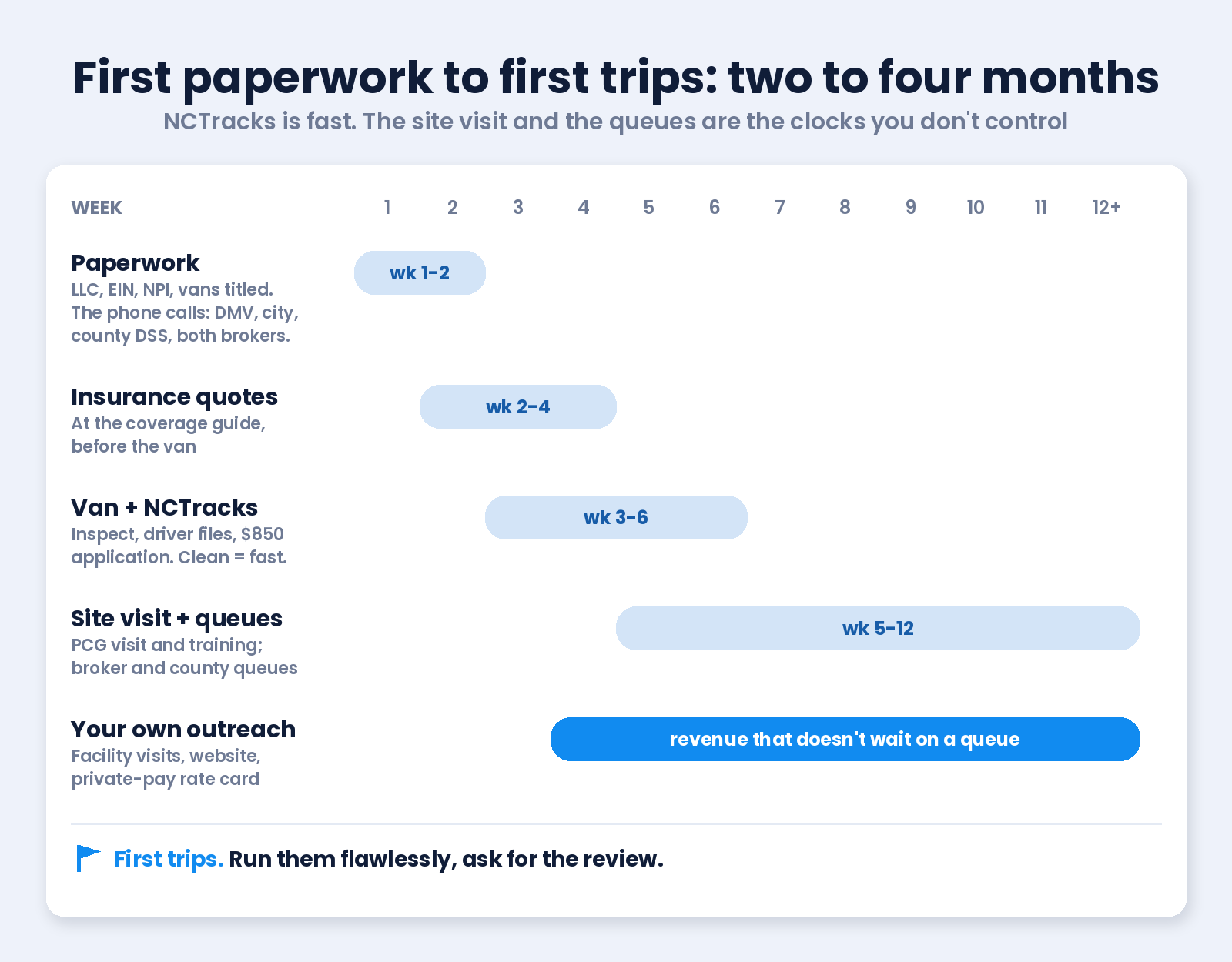
Plan on two to four months from first paperwork to first Medicaid trips, with the site visit and the broker queues as the clocks you don’t control. Private-pay and facility revenue can start as soon as you’re insured and inspected. A realistic sequence:
- Weeks 1-2. LLC ($125), EIN, NPI, vans titled to the company. Then the phone calls: NCDMV on plates and the exemption filing, your city on vehicle-for-hire permits, your county DSS on contracting, and both brokers on need. Price a trip with two local competitors.
- Weeks 2-4. Insurance quotes from an NEMT-savvy agent, sized to the $1.5 million coverage guide and whatever the brokers you’re applying to require. Pick the van after you know the premium, and get it inspected the week you buy it.
- Weeks 3-6. Driver files to the state floor, the NEMT attestation form, and a clean NCTracks submission with the $850 paid. Clean applications averaged 10 to 12 days this spring [9]. The site visit and new-provider training add weeks, so schedule both the moment they’re offered.
- Weeks 4-12. While the broker and county queues run: facility visits, website, Google Business Profile, private-pay rate card, first cash trips. Ray and Mac booked rides off a website before they owned a van, and nothing about that requires Charlotte.
- First Medicaid trips. Enrollment lands, a broker contract or a county payment authorization follows, and the schedule starts to stack. Run every early trip flawlessly and ask for the review. In this business the second trip comes from the first one.
Budget per the cost table above, and save 3 to 6 months of expenses on top. Break-even comes months after launch, and even the fast NCTracks lane doesn’t make counties or brokers pay faster.
North Carolina NEMT FAQ
Does North Carolina require a NEMT license?
No. The state Medicaid policy says outright that no certification, accreditation, or license is required for NEMT van providers [4]. What you actually need: NCTracks enrollment, with its $850 in fees and site visit [7][8], broker credentialing, insurance, the annual state vehicle inspection [25], and city vehicle-for-hire permits in Charlotte and Durham [32][33].
Who is the NEMT broker in North Carolina?
Two companies split the state. Modivcare runs rides for AmeriHealth Caritas, Healthy Blue, the four Tailored Plans, and the Children and Families Specialty Plan [1][10][14]. MTM runs rides for Carolina Complete Health, which absorbed WellCare in the April 1, 2026 merger, and for UnitedHealthcare Community Plan since January 1, 2026 [2][3][43]. NC Medicaid Direct members book through their county DSS, and providers bill NCTracks directly for those trips [1][5].
Can I bill NC Medicaid directly for NEMT rides?
Yes, in one lane. About 595,000 people are in NC Medicaid Direct, where the county DSS arranges rides and you bill NCTracks directly for each trip, with the county’s written payment authorization [1][5][12]. The other 2.5 million members are in managed care, where the brokers assign and pay trips at negotiated rates.
How much does it cost to start a NEMT business in North Carolina?
Plan on $15,000 to $45,000 to put the first wheelchair van on the road legally, and save 3 to 6 months of expenses on top. The big lines: the LLC is $125 plus a $200 annual report [22], enrollment is $850 in fees [8][9], and commercial auto runs roughly $6,000 to $13,000 a year per wheelchair van in agency-reported quotes [34]. There’s no state license fee, because no state NEMT license exists [4].
Can I start a NEMT business in North Carolina with one van?
Yes. The state policy sets no minimum fleet size, and NCTracks will enroll a single-vehicle company [4][5]. Whether a broker network adds a one-van provider depends on county need, so ask provider relations before you buy van number two. County DSS work, facilities, and private-pay riders have no fleet minimums.
Do NEMT drivers need a CDL in North Carolina?
Not for a typical wheelchair van. A commercial license starts at vehicles designed for 16 or more passengers including the driver, and no chauffeur’s license exists in North Carolina [27]. Plan instead for the state driver floor: 18 or older, a clean recent record, disqualifying-crime background checks, and random drug and alcohol testing [4][5].
Are stretcher van trips allowed in North Carolina?
No, not outside the ambulance system. State rules deem anyone transported on a stretcher a patient, and stretchers may only be used in an ambulance permitted by the NC Office of EMS, whatever the rider’s condition [36]. Stretcher work means an EMS provider license, per-vehicle permits, credentialed crew, and in most counties a county ambulance franchise [37][38]. Wheelchair work and rides for people who can walk need none of that [5][36].
How long does it take to start a NEMT business in North Carolina?
Plan on two to four months from first paperwork to first Medicaid trips. NCTracks clean applications averaged 10 to 12 days in spring 2026 [9], but the site visit and training add weeks, and the brokers only add providers where their networks need vehicles, with no published timeline. Private-pay and facility revenue can start as soon as you’re insured and inspected.
Is the North Carolina NEMT market worth entering in 2026?
The demand math says yes. 3.1 million people are on NC Medicaid [12], about 740,000 of them through expansion [11]. Add 251 dialysis facilities [17], seniors growing three times faster than the state overall [16], and 80 rural counties where rides are scarce [20]. The cautions: work requirements start trimming the expansion rolls in January 2027 [13], and April’s merger moved a quarter million members’ rides overnight [2], so enter with trip sources you control.
Key official sources
[1] NC Medicaid, Non-Emergency Medical Transportation overview fact sheet (May 5, 2025): the broker table, county DSS lane, and booking rules. https://medicaid.ncdhhs.gov/fact-sheet-non-emergency-medicaid-transportation-nemt-overview/open
[2] Carolina Complete Health, WellCare merger page for providers (2026): the April 1, 2026 merger and vendor arrangements. https://network.carolinacompletehealth.com/merger.html
[3] Carolina Complete Health, transportation services for network providers (updated April 29, 2026): MTM as transportation vendor; NCTracks registration required. https://network.carolinacompletehealth.com/resources/transportation-services.html
[4] NC Medicaid Managed Care Non-Emergency Medical Transportation Policy, version 12 (May 7, 2025): no license or certification required, driver and vehicle standards, insurance guide language, enrollment requirements. https://medicaid.ncdhhs.gov/NEMT-policy
[5] NCTracks, NEMT Fact Sheet v2 (updated July 10, 2025): enrollment, county DSS contracting, payment authorizations, billing codes, and the NEMT education handout’s driver standards. https://www.nctracks.nc.gov/content/dam/jcr:da03f62d-a65c-4b4c-91d5-c57ee4d51a99/NCTracks%20NEMT%20Fact%20Sheet%20v2.pdf
[6] NC Medicaid, transportation provider update (April 2022): broker contacts and the advice to contract with both brokers. https://medicaid.ncdhhs.gov/blog/2022/04/29/nc-medicaid-managed-care-transportation-update
[7] NCTracks, Provider Permission Matrix (August 2026) and provider enrollment pages: taxonomy 343900000X requirements, moderate risk, site visit, no fingerprinting, driver attestation form. https://www.nctracks.nc.gov/content/public/providers/provider-enrollment.html
[8] Federal Register, CMS notice CMS-6096-N (December 3, 2025): the $750 CY2026 provider application fee. https://www.govinfo.gov/content/pkg/FR-2025-12-03/pdf/2025-21877.pdf
[9] NC Medicaid provider enrollment page (updated July 2026): the $100 NC application fee under G.S. 108C-2.1 and published clean-application processing averages. https://medicaid.ncdhhs.gov/provider-enrollment
[10] NCDHHS, Tailored Plan launch announcement (2024): the four Behavioral Health/IDD Tailored Plans effective July 1, 2024. https://www.ncdhhs.gov/news/press-releases/2024/04/10/july-1-launch-behavioral-health-and-intellectualdevelopmental-disabilities-tailored-plans
[11] Office of Governor Josh Stein and NCDHHS, statement on federal Medicaid changes (July 30, 2026): nearly 740,000 expansion enrollees. https://governor.nc.gov/news/press-releases/2026/07/30/governor-stein-ncdhhs-call-cms-protect-medicaid-people-cancer-and-severe-illnesses
[12] NC Medicaid, Annual Report for State Fiscal Year 2025: total enrollment 3,110,968; Standard Plan, Tailored Plan, and Medicaid Direct splits. https://medicaid.ncdhhs.gov/medicaid-state-fiscal-year-2025-report/download?attachment=
[13] NC Medicaid, work and community engagement requirements page (updated August 2026): the January 1, 2027 start and coverage-loss estimates. https://medicaid.ncdhhs.gov/beneficiaries/impact-hr-1-and-federal-changes-medicaid/nc-medicaid-work-and-community-engagement-requirements
[14] NC Medicaid, Children and Families Specialty Plan NEMT fact sheet (December 2025): Healthy Blue Care Together and its transportation broker. https://medicaid.ncdhhs.gov/children-and-families-specialty-plan-nemt-fact-sheet/download?attachment=
[15] NC Medicaid, Standard Plan program enhancements policy paper (April 7, 2025): the re-procurement cycle beginning December 2027. https://medicaid.ncdhhs.gov/blog/2025/04/07/nc-medicaid-standard-plan-program-enhancements · Vaya Health and Partners Health Management merger announcement (May 2026): Vaya Partners effective October 1, 2026. https://www.vayahealth.com/news-and-stories/vaya-health-and-partners-health-management-merger/
[16] NC Office of State Budget and Management, Demographic Outlook: 11.2 million residents; 2.4 million adults 65+ by 2030, growing three times the overall rate. https://www.osbm.nc.gov/facts-figures/population-demographics/demographic-outlook
[17] CMS, Dialysis Facility listing (provider data, 2026): 251 Medicare-certified dialysis facilities in North Carolina. https://data.cms.gov/provider-data/dataset/23ew-n7w9
[18] System fact pages: Atrium Health (Charlotte region), UNC Health, Duke Health, Novant Health, ECU Health. https://atriumhealth.org · https://www.unchealth.org · https://corporate.dukehealth.org/clinical-care/health-system-overview · https://www.novanthealth.org · https://www.ecuhealth.org/about-us
[19] U.S. Census Bureau, Metropolitan Statistical Area population estimates, Vintage 2024. https://www2.census.gov/programs-surveys/popest/datasets/2020-2024/metro/totals/cbsa-est2024-alldata.csv
[20] NCDOT, NC FIRST Commission issue brief on rural transportation (2019): 80 of 100 counties rural; aging ahead of the national curve. https://www.ncdot.gov/about-us/how-we-operate/finance-budget/nc-first/Documents/nc-first-brief-edition-4.pdf
[21] NC Medicaid bulletins on the NEMT rate reduction and reversal (September 25, October 30, December 10, and December 19, 2025). https://medicaid.ncdhhs.gov/blog/2025/12/19/non-emergency-medical-transportation-rate-reduction-update
[22] NC Secretary of State, business registration fees: Articles of Organization and annual report. https://www.sosnc.gov/divisions/business_registration
[23] G.S. 20-309 (financial responsibility of the registered owner) and G.S. 20-73 (28-day title transfer window). https://www.ncleg.gov/EnactedLegislation/Statutes/HTML/BySection/Chapter_20/GS_20-309.html
[24] S.L. 2014-3, repealing local privilege license tax authority effective July 1, 2015 (G.S. 160A-211). https://www.ncleg.gov/EnactedLegislation/SessionLaws/HTML/2013-2014/SL2014-3.html
[25] NCDMV, vehicle emissions and safety inspections (G.S. 20-183.2; fees under G.S. 20-183.7: $13.60 safety only, up to $30 with emissions) and the NC emissions program’s 19 counties. https://www.ncdot.gov/dmv/title-registration/emissions-safety/Pages/default.aspx
[26] G.S. 20-87, passenger vehicle registration fees (for-hire versus private classes), and G.S. 20-4.01(27)f, the for-hire passenger vehicle definition and its undefined “human service” and “volunteer transportation” exclusions. https://www.ncleg.gov/EnactedLegislation/Statutes/HTML/BySection/Chapter_20/GS_20-87.html · https://www.ncleg.gov/EnactedLegislation/Statutes/HTML/BySection/Chapter_20/GS_20-4.01.html
[27] NCDMV, commercial driver licenses: CDL classes and the 16-passenger threshold. https://www.ncdot.gov/dmv/license-id/driver-licenses/commercial/Pages/default.aspx
[28] NC Department of Insurance, changes to automobile insurance policies effective July 1, 2025 (S.L. 2023-133): the 50/100/50 minimums. https://www.ncdoi.gov/changes-rating-automobile-insurance-policies-effective-july-1-2025
[29] G.S. 62-260 (exemptions from Utilities Commission regulation, the DMV certificate of exemption, and exempt-carrier insurance) and NCUC Rule R2-36 (financial responsibility levels for passenger carriers). https://www.ncleg.gov/EnactedLegislation/Statutes/HTML/BySection/Chapter_62/GS_62-260.html · https://www.ncuc.gov/ncrules/chapter02.pdf
[30] NC State Highway Patrol, commercial motor vehicle enforcement and the intrastate USDOT number program (G.S. 20-101): the 26,001-pound, 16-passenger, and hazmat thresholds. https://www.ncshp.gov/ncshp/commercial-motor-vehicle-enforcement
[31] FMCSA, federal requirements for interstate 9-to-15-passenger vehicle operations for direct compensation. https://www.fmcsa.dot.gov/registration/small-passenger-carrying-vehicles
[32] Charlotte-Mecklenburg Police Department, Passenger Vehicles for Hire program (City Code Chapter 22) and its company/vehicle applications, including the DSS/CMS direct-contract exemption. https://www.charlottenc.gov/cmpd/Our-Organization/PVH
[33] City of Durham, Passenger Vehicle for Hire program (City Code Chapter 50, Article III). https://www.durhamnc.gov/1060/Passenger-Vehicle-For-Hire-PVFH
[34] NEMT-specialist insurance agency market reporting on North Carolina premium ranges and typical broker insurance bars, 2026. Neither ModivCare nor MTM publishes NC-specific limits; figures are agency-reported, not official.
[35] NC Industrial Commission, workers’ compensation insurance requirements (G.S. 97-2): the three-employee threshold and officer/member counting rules. https://www.ic.nc.gov/wcinsrqmt.html
[36] 10A NCAC 13P .0222, transport of stretcher-bound patients: the deeming rule, the ambulance-only rule, and the upright-wheelchair exemption. http://reports.oah.state.nc.us/ncac/title%2010a%20-%20health%20and%20human%20services/chapter%2013%20-%20nc%20medical%20care%20commission/subchapter%20p/10a%20ncac%2013p%20.0222.pdf
[37] G.S. 131E-155.1 (EMS provider license; unlicensed operation a Class 3 misdemeanor, each day a separate offense), G.S. 131E-156 (ambulance vehicle permits), G.S. 131E-158 (staffing), and G.S. 131E-161 (operating without a permit or required staffing, a Class 1 misdemeanor). https://www.ncleg.gov/EnactedLegislation/Statutes/HTML/BySection/Chapter_131E/GS_131E-155.1.html
[38] G.S. 153A-250, county ambulance franchise authority, and Wake County’s non-emergency ambulance franchise process. https://www.ncleg.gov/EnactedLegislation/Statutes/HTML/BySection/Chapter_153A/GS_153A-250.html · https://www.wake.gov/departments-government/emergency-medical-services-ems/about-us/public-information/non-emergency-ambulance-service
[39] NC Office of EMS, systems FAQ: county EMS offices as the entry point for new patient-transport providers. https://oems.nc.gov/systems-faqs/
[40] Duet NEMT Growth Podcast, Episode 18 (June 12, 2026): Ray and Mac, founders of The Doctor Ride, Charlotte. https://www.youtube.com/watch?v=7syCvCKYdPE
[41] NC Medicaid Clinical Coverage Policy No. 15, Ambulance Services: non-emergency ambulance (stretcher-level) coverage and prior approval. https://medicaid.ncdhhs.gov/15-ambulance-services/download
[42] NCDHHS transportation policies MA-2910 and MA-3550: disqualifying-crime lists, the three-year background recheck, and the annual driving-record review. https://policies.ncdhhs.gov/wp-content/uploads/ma-2910-1.pdf
[43] UnitedHealthcare, “MTM Health to manage non-emergency medical transportation requests” (provider flyer coded December 22, 2025): MTM Health becomes the NEMT broker for UnitedHealthcare Community Plan of North Carolina effective January 1, 2026. https://www.uhcprovider.com/content/dam/provider/docs/public/commplan/nc/news/NC-UHCCP-NEMT-Transition.pdf
Last verified against the sources above in August 2026, with the UnitedHealthcare row corrected October 8, 2026. North Carolina requirements, broker arrangements, and Medicaid policy change; check the primary sources before acting, and treat this guide as education, not legal advice.
About the author
James O'Donnell cofounded Duet and leads its sales, partnerships, and growth services. He talks with NEMT operators every week, hosts the NEMT Growth podcast, and answers Duet's sales line himself. More about Duet's founders →
Starting in a nearby state?
Want more trips and less busywork?
See how Duet runs and grows NEMT businesses in a 30-minute demo.