Article
How to Start a NEMT Business in California (2026)
California's Medicaid program, the country's biggest, hands its rides to each health plan, not one broker. Here's how to build a company inside it.
By James O'Donnell, Cofounder and COO, Duet · · Updated
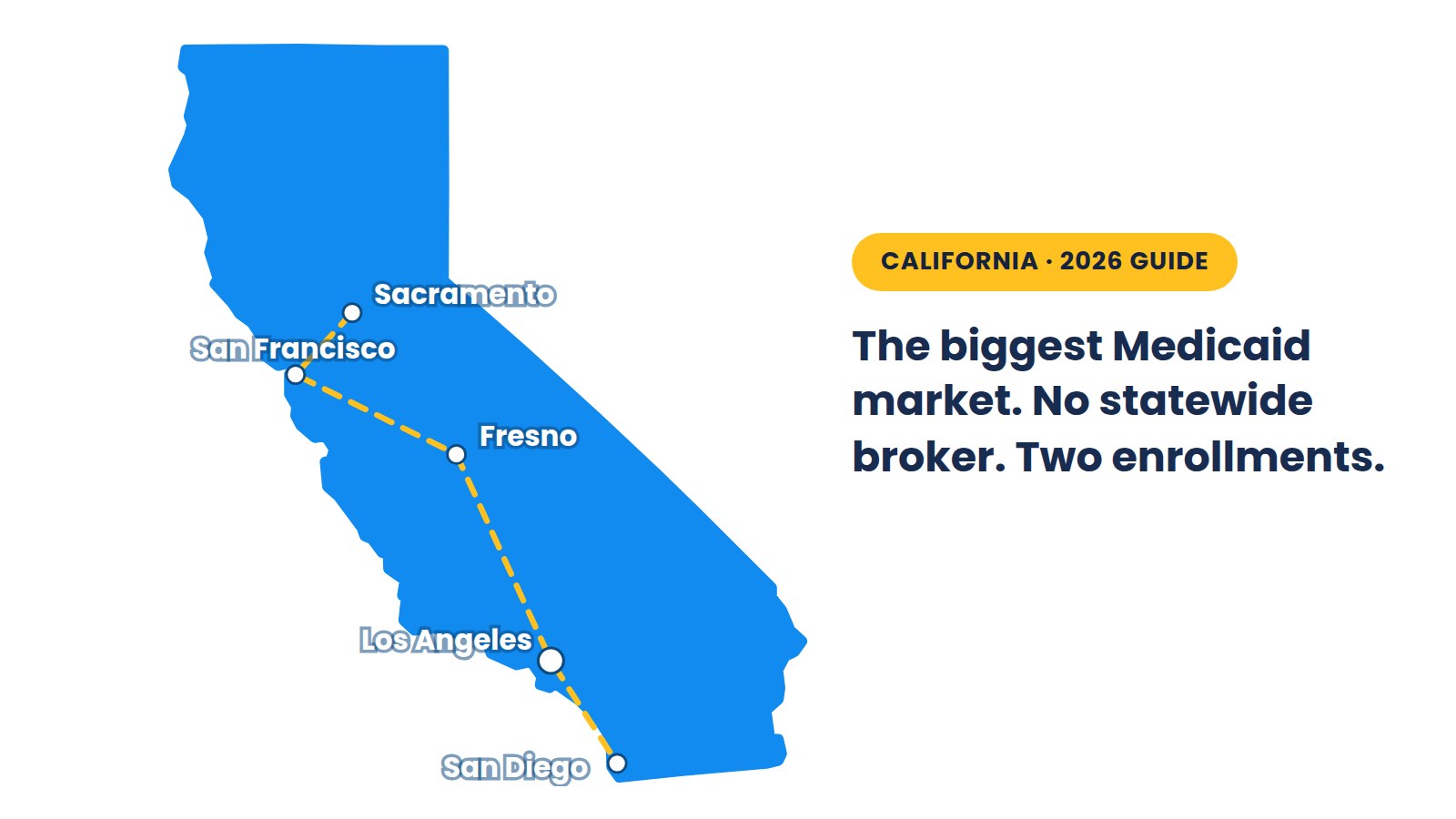
To start a NEMT business in California, form an LLC, enroll with Medi-Cal through the PAVE portal, then get approved by each of your county’s health plans and brokers. Plan on $20,000 to $50,000, four months to a year to first Medi-Cal trips, and private-pay work to carry you until then.
California at a glance:
- State NEMT license: none. Vans used only for medical transportation are exempt from CPUC charter-party licensing. The permits that bite are local.
- Who runs Medicaid rides: no statewide broker. Each Medi-Cal plan arranges its own, through brokers like Modivcare, Call the Car, and American Logistics, or in-house.
- How you enroll: two steps. Enroll with DHCS through the PAVE portal ($750 fee), then get approved by each plan or broker in your county.
- Insurance the contracts expect: brokers commonly want $1 million combined single limit. State law’s floor is $750,000 for vans seating 8 or fewer.
- Cost to launch one van: $20,000 to $50,000, mostly van and insurance ($7,500 to $12,000 a year per wheelchair van in a normal market).
- Time to first Medicaid trips: four months to a year, with the law’s 180-day provisional-enrollment backstop suspended through June 30, 2027. Private-pay revenue comes months earlier.
An operator I know in San Jose spent about seven months waiting for Medi-Cal to approve her provider enrollment. Zero trips came with the approval. The county health plan she needs then quoted five to six more months of its own approval process on top. And her commercial insurance bill started the day the policy went live, more than a year before the schedule could fill. Nothing went wrong with her application. That’s just what the clock looks like in California when nobody tells you what order to do things in.
If you’re starting a non-emergency medical transportation (NEMT) business in California, that wait is the thing to plan around. California is the biggest Medicaid market in the United States. As of April 2026, 13.9 million people are on Medi-Cal, about one in three Californians, per the monthly Fast Facts from DHCS, the California Department of Health Care Services [1].
Like 22 other states and DC, California leaves Medicaid rides to its health plans. There’s no statewide broker, no one company the state hires to assign Medicaid rides to transportation providers and pay for them. Nearly 19 of every 20 Medi-Cal members are in a managed care plan, and each plan arranges its own rides [1]. A managed care plan is a private health plan the state pays to cover Medi-Cal members.
Some plans hire their own broker. Others arrange the rides themselves. The state also keeps a direct billing lane on the side, where you bill Medi-Cal instead of a plan. The question in California isn’t which broker to sign with. It’s which of your county’s health plans you can get into, and what you’ll run on while you wait.
I run Duet, a dispatch software company, and I talk to NEMT operators every week, California included. This is the California edition of our national guide on how to start a NEMT business. It cites the actual California statutes, regulations, and agency documents. Where something couldn’t be verified against a primary source, I say so. Requirements change, and California’s have changed twice since 2025. Confirm against the linked sources before you spend money.
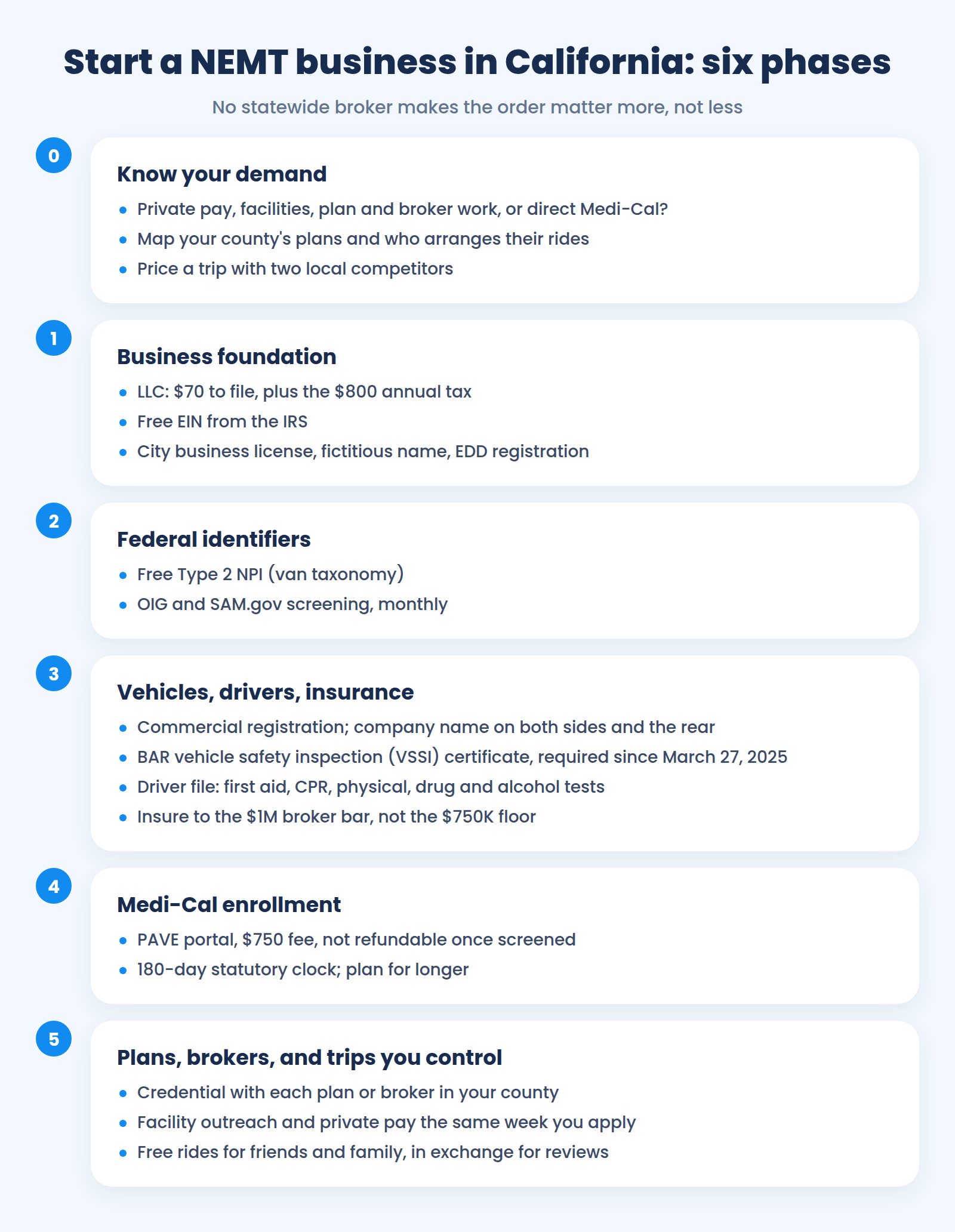
The one-page checklist
Phase 0: know your demand
- Pick your trip sources: private-pay families, facility contracts, your county’s Medi-Cal plans and brokers, or direct Medi-Cal billing. Most healthy California operators run two or three at once.
- Look up which managed care plans serve your county and who arranges their transportation. The plan-by-plan map below is your starting point.
- Price a wheelchair trip with two local competitors. California rates swing hard between metros, so you want your market’s numbers, not the internet’s.
Phase 1: business foundation
- Form your LLC with the Secretary of State: $70 to file online, plus the Franchise Tax Board’s $800 annual tax that applies to every California LLC [2].
- Get a free EIN, your federal tax ID, from the IRS. Never pay a third party for this.
- If you’ll operate under a trade name, file the fictitious business name with your county clerk within 40 days of starting business [3].
- Get the business license for the city or county where your office sits.
- Register as an employer with the EDD within 15 days of paying more than $100 in wages in a calendar quarter [4].
Phase 2: federal identifiers
- Apply for a Type 2 (organization) NPI at NPPES. The NPI is the ID number the healthcare system uses for your company. Use taxonomy 343900000X, Non-Emergency Medical Transport (VAN). It’s free, and NPPES usually issues it within days [5].
- Check owners and drivers against the OIG exclusion list and SAM.gov, the two federal lists of people banned from Medicaid work. Recheck monthly; plans and brokers check these too.
Phase 3: vehicles, drivers, and insurance
- Register vans as commercial vehicles, and put your company name on both sides and the rear. That marking rule is real regulation, not broker folklore [6].
- Get each van a Vehicle Safety Systems Inspection (VSSI) certificate from a Bureau of Automotive Repair (BAR) station. DHCS has required it with NEMT enrollment since March 27, 2025, and the old brake-and-light certificates are dead [7].
- Build each driver’s file to DHCS’s checklist: license, DMV printout, first aid and CPR certificates, a DOT-style physical (forms MCSA-5875 and 5876), and pre-employment drug and alcohol test results [8].
- Spec the van for the work: a lift or ramp and four-point wheelchair securement. Litter vans, California’s name for stretcher vans, also need gurney fasteners. Securement is among the first things plan and broker inspections check.
- Insure each van to $1 million combined single limit, the bar brokers commonly want [38]. That’s one policy limit covering injuries and property damage together. The floor state law sets for a for-hire van seating 8 or fewer including the driver is only $750,000 [9][10].
Phase 4: Medi-Cal enrollment
- Apply through the PAVE portal (pave.dhcs.ca.gov): the transportation application package plus the $750 application fee for 2026, paid inside PAVE. The fee isn’t refundable once screening starts, even if you’re denied [11].
- The statute gives DHCS 180 days to decide [12], and operators report longer waits. Assume months, not weeks, and never build a launch plan that dies if the wait stretches.
Phase 5: plans, brokers, and the trip sources you control
- As soon as your PAVE application is in, start credentialing with the plans and brokers serving your county. Credentialing is each plan’s or broker’s own approval process before it sends you trips, and each one is a separate application with its own queue.
- Set up your website and Google Business Profile the same week your PAVE application goes in.
- Start facility outreach and private pay that week too, not after approval. Enrollment buys you the right to bill. It doesn’t send you a single rider.
- Offer friends and family free or discounted rides for honest Google reviews. Ten of them make strangers trust you.
Who pays for NEMT rides in California?
Four sources pay for NEMT rides in California:
- Medi-Cal managed care plans, usually through transportation brokers.
- Direct Medi-Cal fee-for-service billing. Fee-for-service means the state pays you directly per trip, with no broker or plan in the middle.
- Facility contracts: hospitals, dialysis clinics, and senior living communities.
- Private-pay families booking directly.
Medi-Cal is the volume, and in California that means the plans. Of 13.9 million members, 94.9 percent are in managed care, per DHCS’s April 2026 Fast Facts [1]. Every plan must arrange wheelchair, gurney, and ambulance-level rides for members who can’t use ordinary transportation [13]. It must also arrange rides for ambulatory members, riders who can walk to the vehicle, with no other way to appointments. The state calls those non-medical transportation, or NMT [13].
The demand behind it is enormous:
- Seniors: 1.7 million Medi-Cal members are 65 or older [1].
- Dialysis: CMS counts 734 Medicare-certified dialysis facilities in California, 213 of them in Los Angeles County alone [14].
- Aging: the California Department of Finance projects the 65-and-over population to grow from about one in six Californians today to one in four by 2050 [15].
- Spending: the state’s own actuaries assumed managed-care transportation costs would grow 11 percent in 2026, one of the fastest-rising categories in the program [16].
- Supply: against all that demand, DHCS’s provider file lists only about a thousand enrolled NEMT providers statewide [17].
Facilities are the stability. Hospital discharge desks, dialysis clinics with standing three-times-a-week schedules, skilled nursing, rehab. One facility that trusts you can fill a van’s whole day, and facility checks don’t care which broker holds which plan contract this year.
Private pay is the margin, and the spread over Medi-Cal rates is wider in California than almost anywhere. Medi-Cal fee-for-service pays $20.30 plus $1.50 a mile for a wheelchair trip [18]. Published private-pay rate cards in Southern California run $70 to $200 and up for the same one-way trip [19]. A typical 10-mile run lands around $110 to $130 [19]. One California account on our platform bills $45 pickup plus $3.50 a mile.
But don’t lean too hard on any single number here. Prices differ wildly even between parts of the state, so call two local competitors as a customer and price your own market first.
Who is the NEMT broker in California?
Nobody is. California has no statewide Medicaid NEMT broker. Under DHCS All Plan Letter 22-008, each Medi-Cal managed care plan must arrange transportation for its own members, some through brokers, some in-house, and the assignments move around [13]. Half the articles online will tell you to “sign up with the state’s broker.” In California there’s no such door.
Here’s the map as I can verify it in August 2026, from the plans’ own documents. Treat it as a starting point, and confirm before you build your launch on any single row:
- Modivcare holds the biggest book. It covers Health Net’s Medi-Cal plans, including the CalViva counties in the Central Valley, CalOptima in Orange County since April 2024, and San Francisco Health Plan since December 2024 [21]. It also covers Alameda Alliance and Anthem Blue Cross, the latter confirmed in Anthem’s own provider manual [20][21].
- Call the Car serves L.A. Care, the biggest Medi-Cal plan in the state [22].
- IEHP (Riverside and San Bernardino) started arranging its own NEMT rides on May 12, 2026, ending Call the Car’s NEMT role there. Call the Car kept the ambulatory NMT trips [23]. New fleets deal with IEHP’s transportation team directly.
- American Logistics runs transportation for Molina and Health Plan of San Mateo [24].
- Plans that run their own front door: Central California Alliance for Health on the Central Coast and Kern Family Health Care contract transport companies directly into their networks. Santa Clara Family Health Plan takes ride requests through its own customer service without naming a broker [25].
- Kaiser, with a direct Medi-Cal contract in 32 counties since 2024, doesn’t publicly name its transportation vendor. Start with its provider line rather than guessing.
Two stability notes belong next to that map.
- Modivcare, the largest broker in the country, went through Chapter 11 bankruptcy in 2025 and came out that December as a private company with most of its debt gone [26]. Service continued throughout. It’s still context worth knowing before you bet a schedule on any single contract.
- The IEHP switch is the fresh California lesson: a broker can hold a plan’s contract for three years and lose it on a Tuesday.
Our national broker tracker follows these changes state by state. California’s version of the story is that the churn happens plan by plan instead of statewide.
Can I bill Medi-Cal directly for NEMT?
Yes, and this surprises operators coming from states with one statewide broker. California keeps a fee-for-service lane:
- Enroll with DHCS.
- For each rider, get a Treatment Authorization Request (TAR) approved with the practitioner’s prescription. The TAR is Medi-Cal’s approval form for that rider’s trips.
- Bill Medi-Cal on the standard medical claim form, the CMS-1500, at the published rates in the Medi-Cal provider manual [27].
Current fee-for-service maximums [18]:
| Service level | What Medi-Cal pays |
|---|---|
| Wheelchair van | $20.30 base plus $1.50 per mile |
| Stretcher (litter) van | $26.29 base plus mileage |
| Ambulatory (NMT) | $17.65 base plus $1.30 a mile |
Night trips pay a few dollars more [18]. One useful wrinkle: transfers out of an acute hospital into a nursing facility need no TAR at all, which makes hospital discharges the easiest direct-billing work to start with [27].
The math is thin, though. A 10-mile wheelchair trip pays about $35 at those rates, and only about 700,000 members, 5 percent of the program, are in fee-for-service rather than a plan at all [1]. You need the Medi-Cal enrollment either way, because every health plan requires it [13]. For most new operators, direct billing is a supplement: discharge transfers, fee-for-service pockets, and the credibility of being enrolled.
It can be more than that. An operator I know holds direct Medi-Cal approval and a six-county contract. He prices wheelchair round trips at $320 while informal competitors charge $150, and he wins anyway, because the cheap operators can’t get that contract or that enrollment. But he built it slowly. Nobody starts there.
The ambulatory NMT lane is worth a look too. It’s the same PAVE enrollment family with a lighter driver file, and it pays $17.65 plus $1.30 a mile [18]. Instead of practitioner paperwork, it runs on a monthly attestation, a form the rider signs [27]. If you’re starting with sedans rather than wheelchair vans, NMT is the lower-friction on-ramp.
What licenses and requirements does a NEMT business need in California?
California asks for less state licensing than you’d guess, and more city and county licensing than anyone tells you. There’s no state NEMT license. Vans used exclusively for medical transportation are exempt from CPUC charter-party licensing, the permit other for-hire passenger carriers need from the California Public Utilities Commission. The permits that actually bite are local. In the City of Los Angeles that’s LADOT, the Los Angeles Department of Transportation. LA County and San Diego County run their own programs on top.
The state layer: no NEMT license, no CPUC permit
Start with the state rules, because that’s the part the internet gets wrong most. Here’s the short version against the law itself:
| What you’ll read elsewhere | What California law actually says |
|---|---|
| ”You need a CPUC charter-party (TCP) license, $2,500+“ | No. Vehicles used exclusively for medical transportation are exempt under Public Utilities Code § 5353(i). No TCP permit, no CPUC fee [28][29]. |
| ”You need a DMV Motor Carrier Permit” | No. The Motor Carrier Permit covers property carriers; passenger-only operations are excluded under Vehicle Code §§ 34601 and 34620 [32]. |
| ”NEMT drivers need a CDL” | No. An ordinary Class C license covers vans of 10 or fewer people including the driver, per Vehicle Code § 12804.9 [42]. |
| ”The CHP inspects your vans” | No. The required Vehicle Safety Systems Inspection comes from a licensed Bureau of Automotive Repair station, not the CHP. DHCS has required the VSSI certificate with Medi-Cal NEMT enrollment since March 27, 2025 [7]. |
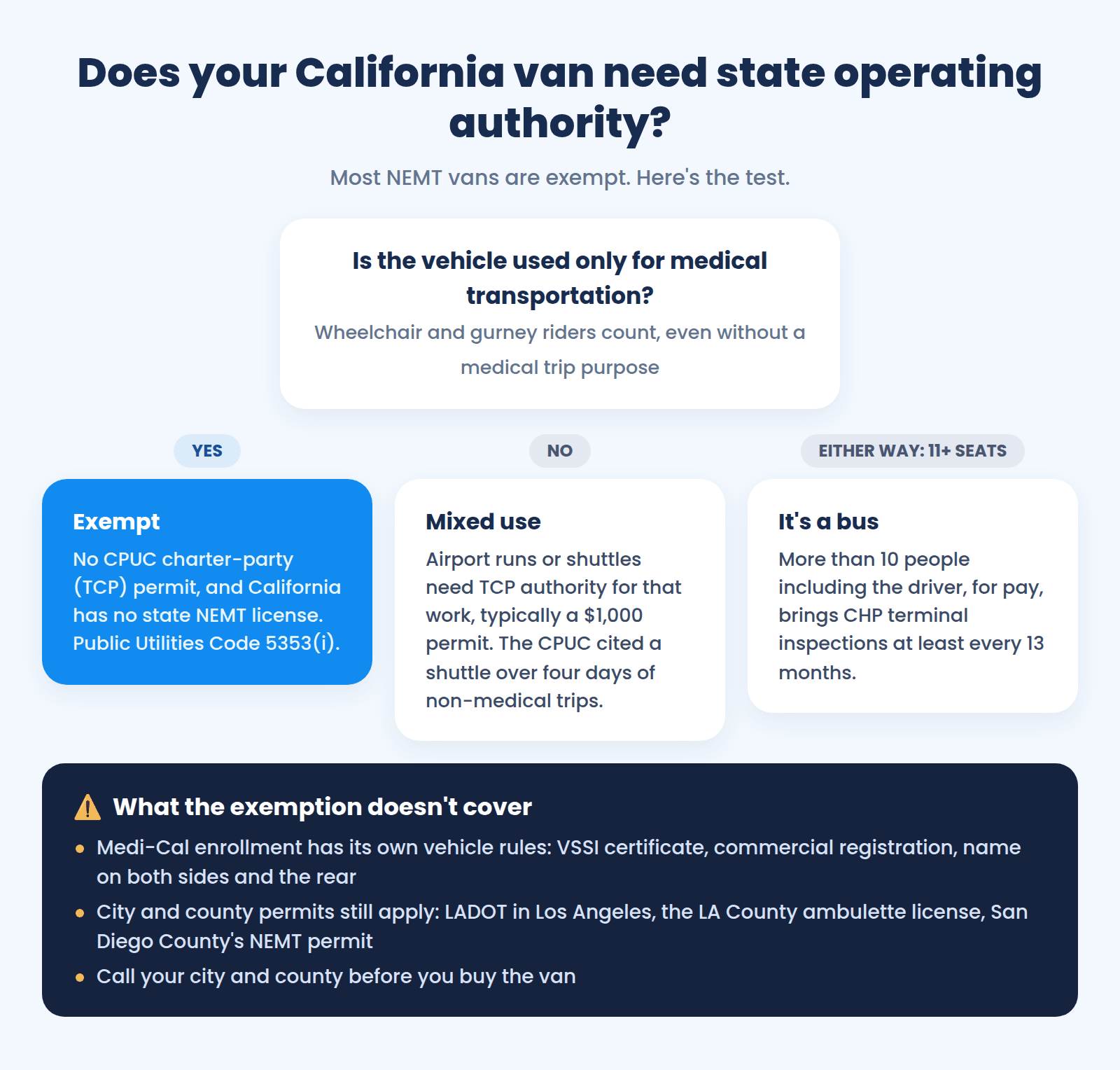
Public Utilities Code § 5353(i) exempts “vehicles used exclusively to provide medical transportation” from the Charter-Party Carriers’ Act, the law behind CPUC TCP operating authority [28]. The CPUC’s own application guide reads the exemption broadly [29]. Trips to doctors, dentists, hospitals, and clinics count, even for riders who can walk. Wheelchair or gurney passengers count even when the trip has no medical purpose. The one condition is that the vehicle does only this work [29].
So a van running only NEMT needs no TCP permit, no CPUC insurance filing, and no state NEMT license on top.
Where the CPUC exemption ends
The exemption has edges, and the CPUC enforces them:
- Exclusive use means exclusive. Add airport runs or event work and you need TCP authority for that portion: typically a $1,000 permit, plus the drug-testing, pull-notice (DMV driver-record monitoring), and insurance-filing program that comes with it [29]. In 2021 the CPUC resolved a citation against a senior-living shuttle over four days of non-medical trips. The fix was restricting the vehicle to medical transportation [30].
- Size has a separate trigger. A vehicle that carries more than 10 people including the driver, for pay, is a “bus” under the Vehicle Code [31]. That brings CHP terminal inspections at least every 13 months [31]. Typical wheelchair vans stay under that line.
- The DMV Motor Carrier Permit doesn’t apply to you. It’s for companies that haul property, not passengers. Passenger-only operations are excluded, and so is the CHP’s BIT terminal inspection program [32].
The local layer: where California actually bites
State law leaves room for cities and counties to permit medical transport vehicles, and the big markets use it:
- City of Los Angeles: LADOT permits both the vehicles and the drivers [33]. Any ambulance, litter van, or non-ambulatory (wheelchair) vehicle that picks up in the city needs a vehicle permit from the Board of Transportation Commissioners. Each driver needs an LADOT permit too, $106 per LADOT’s current brochure. Wheelchair-vehicle drivers need CPR and first aid, and litter van drivers need EMT certification. Confirm current fees with LADOT at 213-928-9600 [33]. Broker credentialing teams check for these, and missing city permits are a standard reason newly contracted LA providers sit for weeks without trips.
- LA County: the county emergency medical services (EMS) agency and the county Business License program together license wheelchair and gurney van companies as “ambulette operators.” That applies mainly to unincorporated areas, the parts of the county outside any city, plus a few contract cities. I couldn’t find a posted fee for the ambulette license itself [34], so call the EMS Agency at 562-378-1500 for the current fee and whether your service area needs it.
- San Diego County: you need an annual county permit before you offer wheelchair or gurney van service. The regional MTS For-Hire Vehicle Administration separately permits non-emergency medical vehicles for ten cities, including San Diego proper. Ask both which applies to your addresses [35].
- Everywhere else: assume nothing. Riverside County permits medi-vans through a taxicab-style county ordinance in unincorporated areas, some cities run their own NEMT permit programs, and requirements genuinely change when you cross a county line [36].
One Inland Empire operator puts it simply: every area wants something different, nobody volunteers the list, and the worst version is finding out from an inspector after the van is bought. CalGold, the state’s official permit lookup, builds the agency list for any address. Use it to draw up the call list, then budget a week of phone calls to your city, your county EMS agency, and your county business license office. It’s the cheapest insurance in this guide.
What insurance does a California NEMT company need?
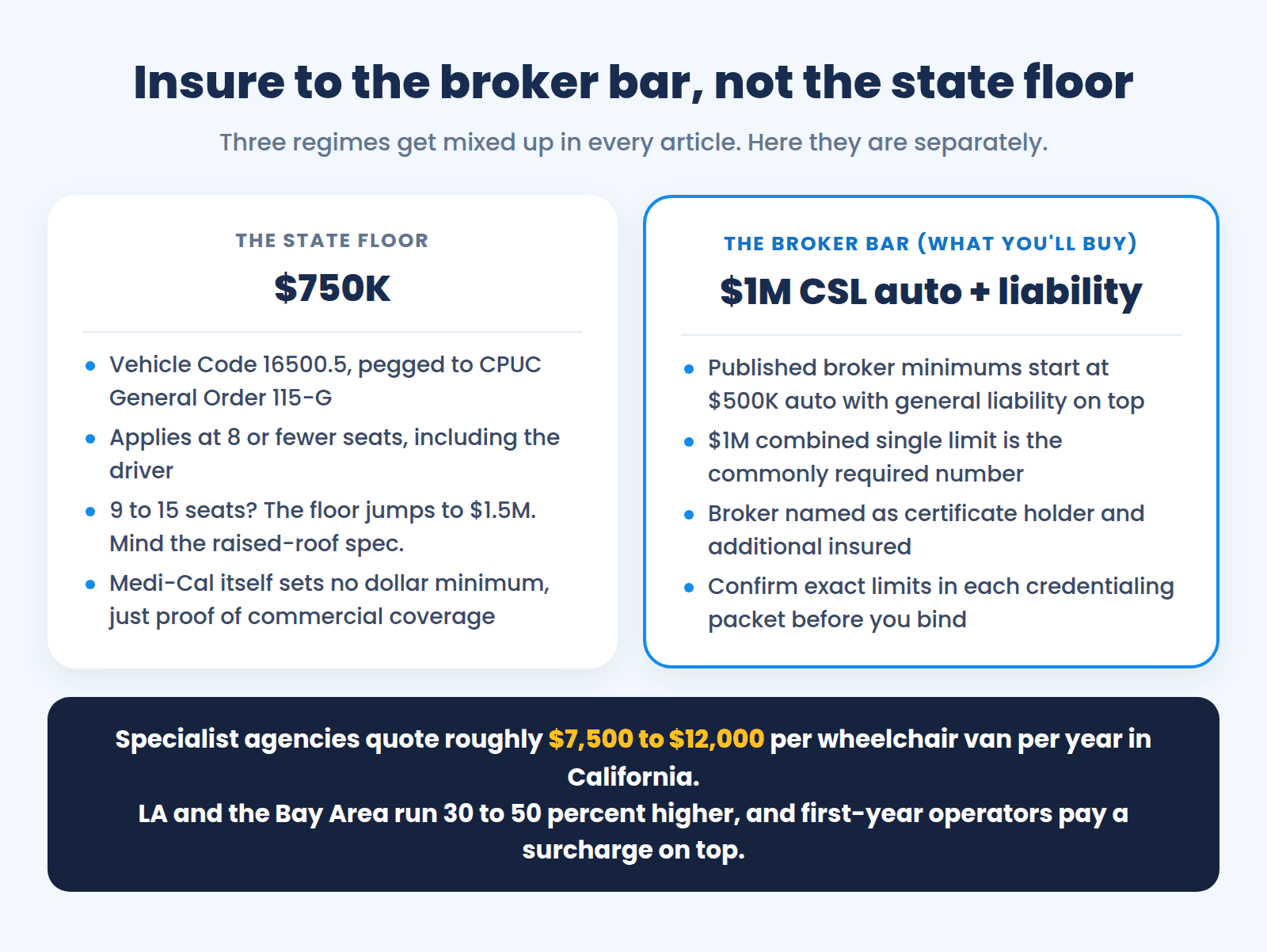
Buy a $1 million combined single limit commercial auto policy per van and you’ll clear every published bar in the state. That leaves room above the $750,000 floor state law sets for a van seating 8 or fewer including the driver. Every article about California NEMT insurance mixes up three different rules, so here they are separately.
The state floor, the Medi-Cal layer, and the broker bar
The state floor: an exempt NEMT van is a for-hire passenger vehicle outside CPUC jurisdiction. Under Vehicle Code § 16500.5, that kind of vehicle must carry insurance at the levels CPUC General Order 115-G sets for the vehicles the commission does regulate. The statute calls it financial responsibility. That’s $750,000 of liability coverage for a vehicle seating 8 or fewer people including the driver, and $1.5 million at 9 through 15 [9][10]. Mind the seat count when you spec a raised-roof van: one extra row can double your required limit.
The Medi-Cal layer: DHCS enrollment requires proof of full-coverage commercial insurance for every vehicle, with no dollar minimum of its own [8][37].
The broker bar: this is the number you’ll actually buy, and each broker sets its own [38].
| Broker | Auto minimum | Also |
|---|---|---|
| American Logistics | $500,000 combined single limit, published | Employee drivers only |
| SafeRide Health | $500,000 auto, published | General liability, which covers injuries and damage that don’t involve driving, like a fall at pickup, at $1 million per occurrence and $2 million aggregate |
| Modivcare | Commonly reported at $1 million combined single limit, sometimes reported at $1.5 million; it publishes no sheet | General liability and abuse coverage, commonly reported |
Confirm each broker’s requirements packet before you bind anyway. At 9 seats and up, the state floor alone is $1.5 million. Binding is the moment coverage is active. It’s also the moment the bill starts.
What California NEMT insurance costs
NEMT-specialist agencies quote California commercial auto at roughly these bands [39]:
- Ambulatory sedans: $5,500 to $9,000 a year.
- Wheelchair vans: $7,500 to $12,000 a year.
- LA and the Bay Area: 30 to 50 percent above rural California.
- First-year operators: a surcharge on top of that.
Treat those as the optimistic bands. Through the 2025 hard market, when carriers raised prices across the board, California operators reported quotes at double and triple those numbers. One-van operators paying around $3,000 a month is a story I hear too often to dismiss.
Only a handful of carriers write California NEMT. Use an agent who insures medical transport companies every week, and get quotes before you commit to a vehicle. Don’t bind a policy until trips are close.
Workers’ comp and California payroll rules
Two more lines for the budget, because California’s labor rules are their own subject.
- Workers’ comp: state law requires it from your very first employee, with criminal penalties for skipping it. Owner-officers and LLC managing members can waive themselves out [40].
- Payroll: California has daily overtime. Over 8 hours in a day is overtime, over 12 is double time, and a missed meal break owes an extra hour of pay. Minimum wage is $16.90 statewide in 2026, higher in many cities [41].
R.J. Morrison, who ran 65 ambulances a day in Los Angeles, walked through on our podcast how California’s labor rules reshape scheduling in ways operators from 40-hour-week states never see coming.
What do NEMT drivers need in California?
NEMT drivers in California don’t need a CDL, not for a typical wheelchair van. Under Vehicle Code § 12804.9, a driver with an ordinary Class C license can operate a van carrying 10 or fewer people including the driver. Above 10 occupants the vehicle is a passenger transportation vehicle, and the driver needs a commercial license with a passenger endorsement [42]. The heavy Class B doesn’t kick in until the vehicle tops 26,000 pounds [42]. And no, litter van drivers don’t need the DMV ambulance driver certificate. That certificate belongs to ambulances answering emergency calls [43].
What your drivers do need is the Medi-Cal file plus the regulation minimums. The state’s Medi-Cal regulations (Title 22) require [6]:
- 18 or older, with a current license.
- Red Cross-standard first aid.
- A physical exam within two years.
- No registered sex offenders, and no drug or alcohol felony within seven years.
DHCS’s enrollment checklist adds [8]:
- CPR.
- The DMV driving-record printout.
- The DOT-style medical exam forms, MCSA-5875 and 5876, renewed every two years.
- Pre-employment drug and alcohol test results.
Two staffing rules belong in your cost model. A litter van runs with a two-person crew, a driver and an attendant, while a wheelchair van runs with one driver [6]. In the City of LA, add the LADOT driver permits from the licensing section above.
One quiet tool worth using even where it isn’t required: the DMV’s Employer Pull Notice program, which flags your drivers’ tickets and suspensions automatically. State law makes it mandatory for endorsement-holding and certificated drivers, and plans and brokers like seeing every driver enrolled [44].
Can a NEMT company do stretcher trips in California?
Yes. California’s litter van category exists exactly for this: gurney transport for patients with stable conditions who don’t need the equipment or personnel of an ambulance [45]. No ambulance license, no EMT requirement at the state level, and Medi-Cal covers litter van as a service level at $26.29 plus mileage [18].
The line you can never cross is care during transport. A patient who needs monitoring, an attendant managing oxygen, IVs, or anything clinical en route is an ambulance’s trip under the EMS Act [43][45]. The CHP and the county license ambulances [43]. A rider who manages their own oxygen and just can’t sit up is litter van work. Put that line in your dispatch protocols in writing.
County rules hit gurney work harder than wheelchair work, and they genuinely vary:
- San Diego County requires its NEMT permit for gurney vans and staffs every vehicle with CPR and first aid minimums [35].
- LA County treats gurney vans as ambulettes under its licensing program, and the City of LA requires EMT certification for litter van driver permits specifically [33][34].
- Alameda County expressly exempts gurney and wheelchair vans from its ambulance licensing, provided the patients need no medical care [46].
Same state, three answers. Before you buy a gurney van, one call to your county EMS agency settles which one you’re in.
How do you enroll as a Medi-Cal NEMT provider and get broker work?
Getting Medi-Cal work in California is a two-step. First comes enrollment, which is signing up with the state Medi-Cal program itself, through DHCS’s PAVE portal. Then you credential separately with each managed care plan or broker serving your county. They run in order, and the clock is the whole game.
Step one: Medi-Cal NEMT provider enrollment through PAVE
Medi-Cal enrollment runs through DHCS’s PAVE portal. You’ll submit [7][8][11]:
- The transportation application package: application, disclosure statement, provider agreement.
- Vehicle documents: commercial registration, insurance proof, the VSSI certificate.
- Driver files, built to the checklist in the section above.
- The application fee: $750 for 2026, paid inside PAVE.
The federal government sets the fee, and it rises most years. It isn’t refundable once screening starts, even if DHCS denies the application. Incomplete applications are how new operators pay it twice. Answer everything, and use DHCS’s own transportation provider checklist.
On timing: Welfare & Institutions Code § 14043.26 gives DHCS 30 days to acknowledge your application and 180 days to approve or deny it [12]. Vendor guides cite 60 to 120 days. The San Jose operator from the top of this article waited about seven months.
Normally, if DHCS blows past day 180, the law grants you automatic provisional (temporary) enrollment so you can start. The statute suspends that safety valve from July 1, 2026 through June 30, 2027 [12]. During exactly the window you’d be applying in, there’s no legal backstop on the wait. Plan as if enrollment takes six months to a year; four months is the best case operators describe.
Step two: credentialing with the plans and brokers
You can start the plan and broker applications while your Medi-Cal application is still pending. But they only count once Medi-Cal approves you, because plans must terminate network providers whose DHCS enrollment doesn’t come through [13]. Each plan or broker is its own application: Modivcare’s network form, Call the Car’s vendor intake, American Logistics’ provider agreement, or a direct contract with plans like the Alliance or Kern that run transportation themselves.
None of them publishes a credentialing timeline. A credentialing vendor pegs Modivcare at 30 to 60 days when the county is open to new providers. Brokers in Southern California quoted one operator I talked to as long as 180 days. Before you commit to a county, ask each broker two questions: is the network open, meaning are they still taking new providers, and how long is the current queue? If the first answer is no, build on the trips brokers don’t control.
What to run on while you wait
The catch-22 every California startup hits: brokers and plans like to see months of operating history, and you can’t build operating history on trips they haven’t given you. The answer is private pay, the one payer you don’t need permission from.
One Northern California operator ran her first 18 months entirely on private pay while the state approvals ground through. Cash trips paid for her vehicles and insurance. Once the credentials landed, she grew into a real fleet. Our guides on winning facility contracts, getting your first trip from a facility meeting, and private pay are the playbook for that first year.
The PCS form, once Medicaid trips start
Managed care NEMT runs on a Physician Certification Statement (PCS), the form a rider’s practitioner signs saying what kind of vehicle the rider needs. One PCS can cover recurring trips for up to 12 months, and neither the plan nor its broker may put a rider in a lesser vehicle than the practitioner prescribed [13]. Learn the PCS flow for each plan you serve. It’s the difference between trips that bill clean and trips you argue about.
Don’t build the whole schedule on one payer
Everything above gets you into California Medicaid work. The IEHP switch is the caution every California business plan should carry: in this state, broker volume is borrowed volume, plan by plan.
Think about what May 12, 2026 meant in the Inland Empire. If your whole schedule rode on the old Call the Car contract, that morning your business changed hands without your signature on anything. If broker trips were one layer of three, the switch was paperwork. It’ll happen again somewhere in California, because plan contracts and broker assignments both churn.
Other states tell the same story:
- Georgia: Georgia’s statewide transition taught the same lesson this spring, in one piece instead of county-sized ones.
- Texas: Texas runs the same plan-by-plan model with its vendor layer squeezed down to three companies, and five of its plans traded vendors in fourteen months.
- Florida: two of Florida’s biggest plans, Sunshine Health and UnitedHealthcare, changed brokers inside fourteen months.
- North Carolina: North Carolina just watched a plan merger move a quarter million members’ rides to a different broker overnight.
Paul at Gentle Turns is my favorite proof that the insiders know this. He ran finance at a California NEMT broker before founding his own transport company in Phoenix. When he built it, he started with private pay and facility relationships, not brokers, as he told us on our podcast. Run his play: facilities and private pay as the foundation, plan and broker volume as the growth layer, direct Medi-Cal where the math works. California’s fragmented market makes this easier than a single-broker state, because there are more doors to knock on and no single contract can sink you.
However you mix payers, don’t run the plans’ trips in one system and your own in a legal pad. Dispatch software like Duet that pulls broker trip files in alongside facility and private-pay work keeps one schedule, one driver app, and one billing trail across all of it.
How much does it cost to start a NEMT business in California?
Plan on $20,000 to $50,000 to put the first wheelchair van on the road legally in California. The vehicle and the insurance eat most of it. The line items, from the sections above:
| Line item | What it costs |
|---|---|
| LLC formation | $70 to file, plus the $800 annual franchise tax [2] |
| EIN and NPI | Free; never pay a third party [5] |
| CPUC license | $0. Vans used exclusively for medical transportation are exempt [28] |
| VSSI inspection | Priced by the BAR station; call ahead [7] |
| Medi-Cal (PAVE) application fee | $750 for 2026, non-refundable once screening starts [11] |
| Commercial auto insurance | $7,500 to $12,000 a year per wheelchair van in a normal market; more in LA and the Bay Area, more in year one [39] |
| Used wheelchair van | Commonly $15,000 to $40,000 mechanically sound |
| Local permits | By city and county: many charge nothing; LADOT driver permits are $106 each; LA County’s ambulette license fee isn’t posted, so call its EMS Agency [33][34] |
| Working capital | Enough runway to cover 6 to 12 enrollment months on private-pay revenue alone |
Price the insurance before the van. Anyone quoting a $5,000 California launch hasn’t priced California commercial auto.
How do you fund a NEMT startup in California?
If the savings account doesn’t cover your NEMT startup budget, California layers its own help on top of the federal programs:
- SBA 7(a) loans and microloans finance vehicles and working capital.
- CalCAP, the state’s loan-loss-reserve program, helps banks say yes to small-business borrowers.
- The IBank Small Business Finance Center guarantees loans the bank would otherwise decline.
None of them make DHCS move faster, so borrow against the timeline you actually face, not the one you hope for.
How long does it take to start a NEMT business in California?
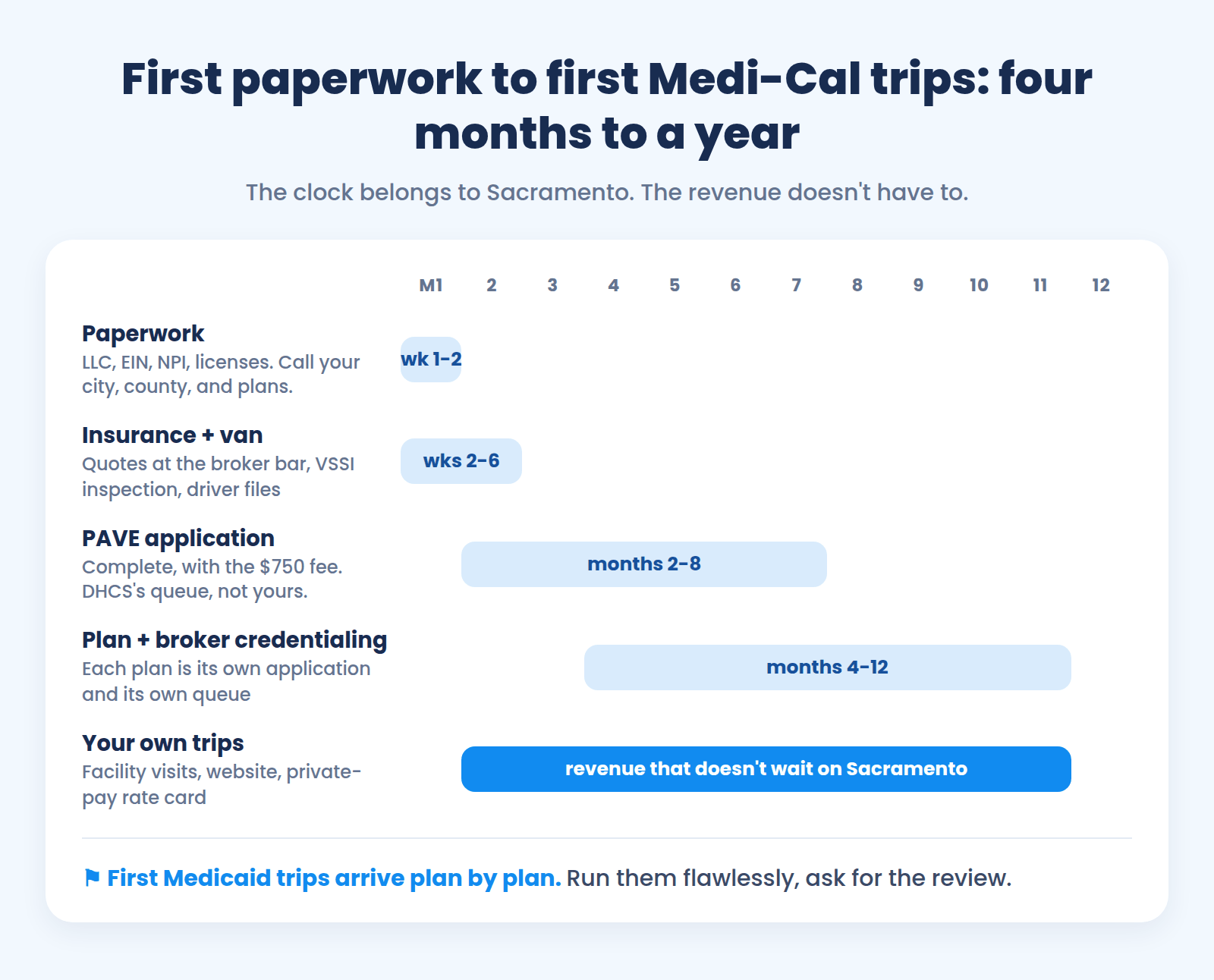
Plan on four months to a year between first paperwork and first Medi-Cal trips. Enrollment and credentialing are the two slowest steps, and the slow tail runs past a year. The San Jose operator at the top of this piece is proof. Private-pay revenue comes months earlier. A realistic sequence:
- Weeks 1-2. LLC, EIN, NPI, city business license, fictitious business name. Call your city and county about vehicle permits, and map which plans serve your county.
- Weeks 2-6. Get insurance quotes at the $1 million broker bar from an NEMT-savvy agent, and pick the van only after you know the premium. Buy used and mechanically sound. Get the VSSI inspection, commercial registration, and lettering done, and assemble driver files.
- Week 6. Submit the PAVE application, complete, with the $750 fee. Start any city or county permit applications the same week.
- Months 2-8. While DHCS processes: website, Google Business Profile, facility visits, private-pay rate card, first cash trips. This is revenue that doesn’t wait on Sacramento, and it’s also the operating history the brokers will ask for.
- Months 4-12. Medi-Cal approval lands, and plan and broker credentialing runs its own queue. First Medicaid trips arrive plan by plan. Run every early trip flawlessly and ask for the review. In this business the second trip comes from the first one.
Budget per the cost breakdown above, and save enough runway to survive the enrollment months on private-pay revenue alone.
California NEMT FAQ
Does California require a NEMT license?
There’s no state NEMT license. Vehicles used exclusively for medical transportation are exempt from CPUC charter-party licensing [28]. The real credentials are Medi-Cal enrollment through PAVE, plus whatever your city and county require. That means LADOT permits in Los Angeles, the county ambulette (wheelchair and gurney van) license in parts of LA County, San Diego County’s NEMT permit, and so on. The state asks for little. Your city and county are where the homework is.
Who is the Medicaid NEMT broker in California?
Nobody is. California has no statewide Medicaid NEMT broker. Each health plan arranges rides for its own members, either through a broker like Modivcare, Call the Car, or American Logistics, or on its own like IEHP, Kern, and the Alliance [13][20][23]. The assignments change plan by plan, so verify your county’s arrangement before building on it.
How much does it cost to start a NEMT business in California?
Plan on $20,000 to $50,000 to put the first wheelchair van on the road legally. The vehicle and insurance eat most of it. The LLC costs $70 plus an $800 annual tax [2], and the Medi-Cal application fee is $750 [11]. Commercial auto runs $7,500 to $12,000 a year per wheelchair van [39]. Local permits cost nothing in many counties, while Los Angeles adds $106 LADOT driver permits and, in parts of the county, an ambulette license [33][34]. There’s no CPUC license fee for a van used exclusively for medical transportation [28]. Then save enough runway to cover the enrollment months.
Can I bill Medi-Cal directly for NEMT rides?
Yes. Enroll with DHCS through PAVE, get a Treatment Authorization Request (TAR) approved with a practitioner’s prescription per rider, and bill fee-for-service at $20.30 plus $1.50 a mile for wheelchair van work [18][27]. Only about 5 percent of members are in fee-for-service [1], so treat direct billing as a supplement. The hospital-to-nursing-facility transfer needs no TAR, so it’s the easiest place to start.
How long does Medi-Cal NEMT provider enrollment take in California?
Welfare & Institutions Code § 14043.26 gives DHCS 30 days to acknowledge an application and 180 days to approve or deny it [12]. Operators report six months to a year in practice. Normally, if DHCS misses the deadline you get automatic provisional (temporary) enrollment. That rule is suspended from July 1, 2026 through June 30, 2027 [12]. Plan a launch that survives the wait.
Do NEMT drivers need a CDL in California?
Not for a typical wheelchair van: an ordinary Class C license covers vehicles carrying 10 or fewer people including the driver [42]. Bigger vehicles need a commercial license with a passenger endorsement. Plan instead for the Medi-Cal driver file: first aid, CPR, the DOT-style physical, DMV printout, and drug and alcohol tests [8].
Are stretcher trips allowed in California?
Yes, in a litter van, California’s name for a stretcher van, with a driver-and-attendant crew, for stable patients needing no care en route [6][45]. No state ambulance license or EMT requirement applies, but counties differ sharply. San Diego requires a county permit [35]. LA layers city and county requirements, including EMT-certified litter van drivers in the city [33]. Alameda exempts gurney and wheelchair vans from its ambulance licensing [46]. Call your county emergency medical services (EMS) agency first.
Is the California market worth entering in 2026?
The demand math says yes, louder than in any other state. California has 13.9 million Medi-Cal members [1], 734 dialysis facilities [14], and a senior population headed toward one in four residents [15]. Only about a thousand enrolled NEMT providers serve it all [17]. The caution is cost: an enrollment clock that runs to months, with the law’s backstop suspended through mid-2027 [12], and brutal insurance pricing. The operators who win enter with trip sources they control and runway to outlast the paperwork.
Key official sources
[1] DHCS, Medi-Cal Monthly Eligible Fast Facts, July 2026 edition (data for April 2026): total certified eligibles, managed care share, age 65+ enrollment. https://www.dhcs.ca.gov/wp-content/uploads/2026/07/Fast-Facts.pdf
[2] California Secretary of State, bizfile Online ($70 Articles of Organization); Franchise Tax Board, LLC annual tax ($800, every LLC organized or doing business in California). https://bizfileonline.sos.ca.gov and https://www.ftb.ca.gov/file/business/types/limited-liability-company/index.html
[3] California Business & Professions Code § 17910 (fictitious business name, 40-day filing). https://leginfo.legislature.ca.gov/faces/codes_displaySection.xhtml?lawCode=BPC§ionNum=17910
[4] California EDD, employer registration requirements. https://edd.ca.gov/en/payroll_taxes/am_i_required_to_register_as_an_employer/
[5] NPPES, National Provider Identifier application. https://nppes.cms.hhs.gov
[6] 22 CCR §§ 51231.1 and 51231.2, litter van and wheelchair van requirements (drivers, attendants, equipment, vehicle identification on both sides and rear). https://www.law.cornell.edu/regulations/california/22-CCR-51231.1
[7] DHCS, Updated Medi-Cal Non-Emergency Medical Transportation Provider Requirements (VSSI certificate effective March 27, 2025, per AB 471; the posted PDF currently carries a draft watermark and is operative per its terms). https://www.dhcs.ca.gov/wp-content/uploads/2025/12/Updated-Medi-Cal-Non-Emergency-Medical-Transportation-Provider-Requirements.pdf and https://mcweb.apps.prd.cammis.medi-cal.ca.gov/page/33800_updated-medi-cal-non-emergency-medical-transportation-provider-requirements
[8] DHCS Provider Enrollment Division, Fee-For-Service Enrollment for NMT & NEMT Providers (presentation, June 2023): driver and vehicle document checklists. https://www.dhcs.ca.gov/wp-content/uploads/2025/10/Transportation-Providers-Presentation-June-2023.pdf
[9] California Vehicle Code § 16500.5 (for-hire passenger vehicle financial responsibility, pegged to CPUC levels). https://leginfo.legislature.ca.gov/faces/codes_displaySection.xhtml?lawCode=VEH§ionNum=16500.5
[10] CPUC General Order 115-G (liability insurance tiers by seating capacity, amended March 21, 2024). https://www.cpuc.ca.gov/-/media/cpuc-website/files/uploadedfiles/cpucwebsite/content/licensing/general/go-115-g.pdf
[11] DHCS, Medi-Cal provider application fees (CY 2026 fee $750); Medi-Cal application fee bulletin (non-refundable after screening). https://www.dhcs.ca.gov/provgovpart/Pages/Application-Fees.aspx and https://mcweb.apps.prd.cammis.medi-cal.ca.gov/page/medi-cal-application-fee-requirements-for-compliance-with-42-code-of-federal-regulations-section-455-460
[12] California Welfare & Institutions Code § 14043.26 (30-day acknowledgment, 180-day determination, and subdivision (o)(1) suspension of default provisional status July 1, 2026 through June 30, 2027). https://leginfo.legislature.ca.gov/faces/codes_displaySection.xhtml?lawCode=WIC§ionNum=14043.26
[13] DHCS All Plan Letter 22-008, Non-Emergency Medical Transportation and Non-Medical Transportation Services (May 18, 2022): plan obligations, PCS form rules, provider enrollment requirement. https://www.dhcs.ca.gov/wp-content/uploads/2025/10/APL22-008.pdf
[14] CMS Provider Data Catalog, Dialysis Facilities dataset (California counts as of August 2026). https://data.cms.gov/provider-data/dataset/23ew-n7w9
[15] California Department of Finance, Population Projections (Vintage 2026): 65+ share of state population, 2025 through 2050. https://dof.ca.gov/forecasting/demographics/projections/
[16] DHCS/Mercer, Medi-Cal Managed Care CY 2026 Capitation Rate Certification (transportation PMPM trend). https://www.dhcs.ca.gov/hi/wp-content/uploads/2026/05/CY-2026-Rate-Certification-Report.pdf
[17] DHCS, Profile of Enrolled Medi-Cal Fee-for-Service Providers (CHHS Open Data, August 2026 snapshot): enrolled NEMT provider counts. https://data.chhs.ca.gov/dataset/profile-of-enrolled-medi-cal-fee-for-service-ffs-providers
[18] Medi-Cal Provider Manual, Medical Transportation - Ground: Billing Codes and Reimbursement Rates. https://mcweb.apps.prd.cammis.medi-cal.ca.gov/file/manual?fn=mctrangndcd.pdf
[19] Southern California operator rate cards, 2026 (private-pay wheelchair trip ranges; market color, not official rates). https://wcambulance.com/pricing-guide
[20] Anthem Blue Cross California Medi-Cal Provider Manual (effective July 1, 2026), transportation chapter (ModivCare delegation). https://providers.anthem.com/docs/gpp/california-provider/CA_CAID_ProviderManual.pdf
[21] Health Net California provider library, Transportation (ModivCare); CalOptima Health ModivCare transition (April 1, 2024); San Francisco Health Plan ModivCare transition (December 1, 2024). https://providerlibrary.healthnetcalifornia.com/medi-cal/provider-manual/benefits/ambulance/transportation-medi-cal.html and https://www.sfhp.org/news/for-providers/sfhp-modivcare/
[22] L.A. Care Health Plan, provider transportation and authorizations (Call the Car partnership). https://lacare.org/providers/utilization-management/authorizations/transportation
[23] IEHP provider notice, May 11, 2026: IEHP to coordinate NEMT trips directly effective May 12, 2026. https://www.providerservices.iehp.org/content/dam/provider-services-rd/en/documents/providers/plan-updates/provider_notices/2026/05-may/20260511%20-%20IEHP%20to%20Coordinate%20Non-Emergency%20Medical%20Transportation%20(NEMT)%20Trips%20Effective%20May%2012,%202026.pdf
[24] American Logistics, transportation provider FAQs (network requirements); Molina and Health Plan of San Mateo member transportation materials. https://americanlogistics.com/transportation-providers/provider-faqs/ and https://www.smchealth.org/article/new-transportation-benefit-hpsm-medi-cal-members
[25] Central California Alliance for Health, transportation services; Kern Family Health Care, transportation benefits; Santa Clara Family Health Plan, transportation services. https://thealliance.health/medi-cal-health-care/get-care/transportation-services/ plus https://www.kernfamilyhealthcare.com/medi-cal/transportation-benefits/ and https://www.scfhp.com/for-members/transportation-services/
[26] ModivCare Form 8-K, December 2025 (Chapter 11 emergence, December 29, 2025). https://www.sec.gov/Archives/edgar/data/1220754/000143774925038831/modv20251226_8k.htm
[27] Medi-Cal Provider Manual, Medical Transportation - Ground (coverage criteria, TAR requirement and the acute-to-LTC exception, NMT attestations). https://mcweb.apps.prd.cammis.medi-cal.ca.gov/file/manual?fn=mctrangnd.pdf
[28] California Public Utilities Code § 5353(i) (medical transportation exemption from the Charter-Party Carriers’ Act). https://leginfo.legislature.ca.gov/faces/codes_displaySection.xhtml?lawCode=PUC§ionNum=5353
[29] CPUC, Basic Information for Passenger Carriers and Applicants (Rev. 08/2018; current as posted): exemption interpretation, TCP classes and fees. https://www.cpuc.ca.gov/-/media/cpuc-website/divisions/consumer-protection-and-enforcement-division/documents/tlab/tcp-forms/basicinfofortcp.pdf
[30] CPUC Resolution ALJ-395 (January 14, 2021): enforcement of the exclusive-use line; mixed-use shuttle cited, medical-only operation compliant. https://docs.cpuc.ca.gov/PublishedDocs/Efile/G000/M360/K565/360565119.PDF
[31] California Vehicle Code §§ 233 and 34501(c) (bus definition at more than 10 persons including the driver; CHP terminal inspections). https://leginfo.legislature.ca.gov/faces/codes_displaySection.xhtml?lawCode=VEH§ionNum=233
[32] California Vehicle Code §§ 34601 and 34620 (motor carrier permit scope: property carriers; passenger-only transporters excluded); CHP, Motor Carrier of Property Permit FAQs. https://www.chp.ca.gov/siteassets/files/motor-carrier-of-property-permit-frequently-asked-questions.pdf
[33] Los Angeles Municipal Code §§ 71.00-71.06 (vehicle permits for ambulances, litter vans, and non-ambulatory passenger vehicles); LADOT for-hire driver permit brochure (driver permit categories, $106 fee, EMT and CPR/first aid requirements). https://ladot.lacity.gov/sites/default/files/2026-04/driver-permit-brochure-web.pdf
[34] Los Angeles County Code Title 7, Chapters 7.16-7.17 (ambulance and ambulette licensing; EMS Agency Reference No. 450, revised July 2026); LA County Treasurer-Tax Collector business license program. https://file.lacounty.gov/SDSInter/dhs/1145172_450AmbulanceOrdinance.pdf
[35] County of San Diego EMS, Ambulance Ordinance and NEMT provider permits (policy N-840); San Diego MTS For-Hire Vehicle Administration. https://www.sandiegocounty.gov/content/sdc/ems/ambulance_ordinance.html
[36] Riverside County Ordinance No. 698 (non-emergency medical van permits in unincorporated areas). https://rivcocob.org/sites/g/files/aldnop311/files/migrated/ords-600-698.1.pdf
[37] 22 CCR § 51000.30(d)(18) (transportation applicant documentation: per-vehicle commercial insurance proof, per-driver records). https://www.law.cornell.edu/regulations/california/22-CCR-51000.30
[38] American Logistics provider FAQs; SafeRide Health provider requirements; NEMT insurance market reporting on ModivCare limits (commonly reported, not published). https://www.saferidehealth.com/what-to-expect-nemt-provider
[39] NEMT-specialist insurance agency California premium ranges, 2026 (agency-published bands; market color). https://www.saberlinesins.com/nemt-insurance-california-key-requirements-for-california-operators/
[40] California Labor Code §§ 3700 and 3352 (workers’ compensation requirement and officer/LLC-member waivers); DIR employer FAQs. https://www.dir.ca.gov/dwc/faqs.html
[41] California DIR, minimum wage ($16.90 effective January 1, 2026); daily overtime rules. https://www.dir.ca.gov/dlse/faq_minimumwage.htm
[42] California Vehicle Code §§ 12804.9 and 15278 (license classes; passenger endorsement above 10 persons including the driver). https://leginfo.legislature.ca.gov/faces/codes_displaySection.xhtml?lawCode=VEH§ionNum=15278
[43] California Vehicle Code §§ 2501 and 12527 (CHP ambulance licensing and the ambulance driver certificate; both attach to emergency-call ambulances). https://leginfo.legislature.ca.gov/faces/codes_displaySection.xhtml?lawCode=VEH§ionNum=12527
[44] California Vehicle Code § 1808.1 (Employer Pull Notice program). https://leginfo.legislature.ca.gov/faces/codes_displaySection.xhtml?lawCode=VEH§ionNum=1808.1
[45] 22 CCR §§ 51151.3 and 51151.7 (litter van definition; NEMT defined as requiring no emergency services or equipment during transport). https://www.law.cornell.edu/regulations/california/22-CCR-51151.3
[46] Alameda County EMS, Ambulance Ordinance Chapter 6.114 (gurney and wheelchair van exemption from ambulance certificates). https://ems.acgov.org/ems-assets/docs/Documents-Forms/Ambulance%20Ordinance.pdf
Last verified against the sources above in August 2026. California requirements, plan contracts, and broker assignments change; check the primary sources before acting, and treat this guide as education, not legal advice.
About the author
James O'Donnell cofounded Duet and leads its sales, partnerships, and growth services. He talks with NEMT operators every week, hosts the NEMT Growth podcast, and answers Duet's sales line himself. More about Duet's founders →
Starting in a nearby state?
Want more trips and less busywork?
See how Duet runs and grows NEMT businesses in a 30-minute demo.