
Article
How to Get NEMT Contracts (and Why Facilities Come First)
Of the three kinds of NEMT contract, start with a facility agreement, and win it by asking to be the backup.
By James O'Donnell, Cofounder and COO, Duet · · Updated
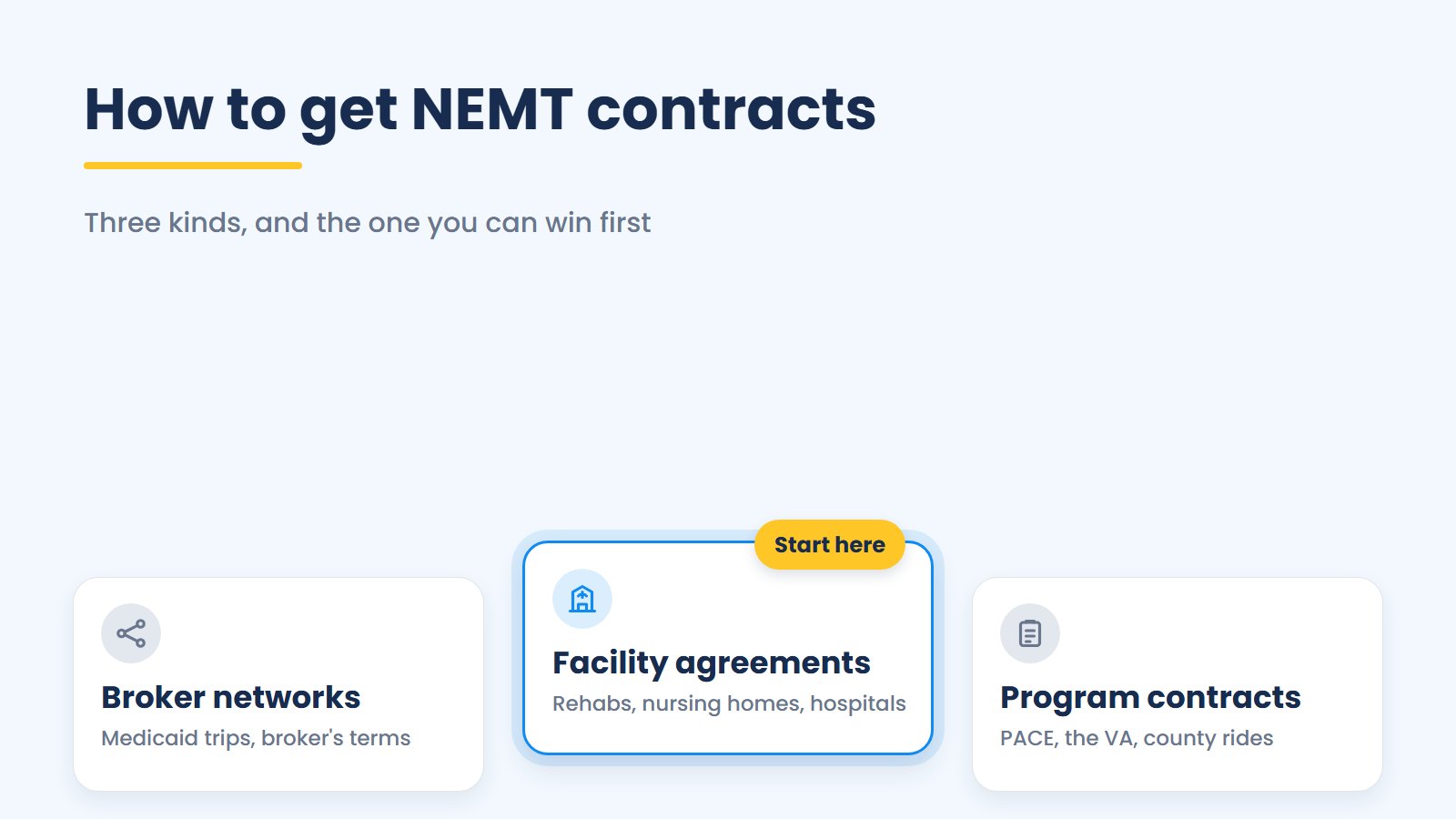
Non-emergency medical transportation (NEMT) contracts come in three kinds. You can join a Medicaid broker’s or health plan’s network, sign a service agreement with a facility, or contract with a program such as PACE (Programs of All-Inclusive Care for the Elderly), the VA (Veterans Affairs) or a county’s senior rides. The one a small company can win first is the facility agreement, with a nursing home, rehab or hospital, and the way in is asking to be its backup.
Every facility keeps a call list, written down or not: the companies its staff call for a resident’s ride, in the order they call them. Our facility outreach team calls facilities for NEMT owners every day, so I hear how these first conversations go. When Josh Hagen of Careway Mobility asked me on our podcast in September how a small company starts getting regular hospital discharge work, my answer was “Look, I’ll be the backup provider. Call me.” Owners who go in hard with “put me on the list, put me in, coach” end up as the fifth provider, and the fifth provider rarely gets called. The ones who build a relationship move “from the fifth call to the third call to the first call.”
That facility agreement is the NEMT contract you can win this quarter, and you win it as the backup who answers, not the vendor who pitches. The sections run in the order you’ll live it, from picking the contract to getting paid, then whether to make the calls yourself and how long the first facility takes.
The short version:
- Which contract first: a facility agreement. A facility can sign you on its own say-so, while brokers credential and programs buy on their own clock.
- Who pays: rarely the person who calls you. It’s the facility, the rider’s family or Medicaid, ride by ride, and Original Medicare pays for no van ride.
- Getting on the list: ask for whoever sets up transfers, then ask to cover nights, weekends and same-day trips as the backup.
- What it costs: your time, plus the money you float while you wait, because facilities pay by invoice, often 45 days or more after the trip.
- How long: the first facility takes the longest, often a month or two of backup work before real volume. Buy the next van when a facility’s trips fill the one you have.
What are NEMT contracts, and which one can you win first?
The facility service agreement is the one you can win first, because a facility can sign you on its own say-so. The other two kinds wait on a broker’s credentialing, a program’s contract process or a VA clinician’s approval.
| Contract | Who you sign with | Who pays you | How you get in | What slows it down |
|---|---|---|---|---|
| Broker or health plan network | The broker, or a health plan or the ride vendor it hires | Usually the broker or vendor, at your contract rate | Enroll where your state requires it, then pass the broker’s credentialing | Credentialing that can take months, and contracts change hands |
| Facility service agreement | The facility’s administrator or corporate office | The facility or the rider’s family, ride by ride (Medicaid rides pay through Medicaid) | Calls and visits until someone books you | Vendor paperwork at big buildings, and payment weeks after each trip |
| Program contract: PACE | The PACE organization | The PACE organization, at the rate in your written contract, and you can’t bill anyone else for the ride | A contract with your local program, which may run its own vans | No program in 17 states, per the National PACE Association (June 2026) |
| Program contract: VA wheelchair-van rides | The VA, for your local VA medical center | The VA, on your invoice | Bid when the medical center’s wheelchair-van contract comes up, or subcontract to the company holding it | Contracts one company can hold for years, and a VA clinician’s approval before each trip, except in an emergency |
| Program contract: county and senior rides | An area agency on aging, a county or a transit agency | That agency, often from senior or transit grant money | An agreement with the agency, or a subcontract under its contractor | Each agency’s own process and timeline |
If you came looking for your state’s Medicaid ride contract, a small transportation company doesn’t bid on that one. States usually pick a broker by competitive bid or leave rides to their Medicaid health plans, and you join the winner’s network instead. Our guide to NEMT brokers shows who holds it in each state.
Broker trips still have a job while the facility side builds: build your schedule around facility trips, and pull in broker trips to fill the gaps.
Who books facility rides, and who pays for them?
At most facilities, the person who calls you for a ride isn’t the person who pays for it, and who pays depends on the rider’s coverage and your state’s rules.
| Facility | Who usually calls you | Who usually pays | Rides you’ll get |
|---|---|---|---|
| Rehab and nursing home | Admissions, social workers, a transportation coordinator | The facility, the family or Medicaid, depending on the resident and the state | Admissions from the hospital, follow-ups during a rehab stay, discharges home |
| Hospital | Case managers, social workers, discharge coordinators | The patient’s Medicaid or health plan, or the family, first, then the hospital when a ride frees a bed | Discharges at any hour, often same-day |
| Assisted living | The front desk, the activities director or the family | Mostly residents and families, paying privately | Doctor visits and group outings |
| Dialysis clinic | Usually nobody at the clinic: riders book through the broker | Usually Medicaid, through the broker; some Medicare Advantage plans cover rides | Standing trips several days a week, some before dawn |
| PACE program | The PACE organization’s staff | The PACE organization, under your contract | Participants to the PACE center, sometimes several at a time |
Original Medicare doesn’t pay for any of these van rides. For wheelchair vans and every other non-ambulance ride, the claims manual from CMS, the federal agency that runs Medicare, says Medicare “simply does not provide any coverage at all.” Nursing homes have to help residents who need it arrange rides to the dentist, the lab and similar appointments, but the federal rules don’t make them pay.
Medicaid goes state by state. In some states, a nursing home resident’s Medicaid ride goes through the broker like anyone else’s. In others, the home has to provide some of those rides: Colorado’s Medicaid ride rules, for one, won’t pay for a trip to care the home’s own program requires unless the home has no vehicle available. So check your state’s rule before you count on a building’s Medicaid residents. The rides a home or a family pays for are yours to win either way. And when a Medicaid rider keeps asking the broker for your company by name, some brokers will send that rider to you, though the ask usually has to come from the rider, not from you.
Jing, my cofounder, said on our episode about private pay that hospitals “always ask patients” first whether they have a ride home and can pay for it. But Medicare pays most hospitals a set amount per stay, not per day, so a patient waiting on a ride costs the hospital a bed. In my experience, a hospital will happily pay $200 or $300 to get somebody home if the alternative is keeping them overnight.
Inside a nursing home, at least three desks book rides, and our guide to the first trip from a facility covers each one. The list you want to be on belongs to whoever books.
Which facilities should you go after first?
Start with rehabs and nursing homes that do short-term rehab, then hospital discharge desks if you can get there within two hours, and treat assisted living as a family sale and dialysis as a broker trip.
Rehab comes first for Tony Jackson, an Orlando operator with 35 years in the business, “because they’re only there for 30 days.” You bring the new admission in from the hospital, so when follow-up appointments come up during that stay, the staff call the company that resident already knows.
Hospitals pay for speed, and they discharge at all hours of the day and night. If you can be there within two hours, you’ll usually beat any ambulance company.
Assisted living is a family sale. Jing says most residents there pay privately. In 2022, Medicaid paid toward the long-term care of about 17% of residents in assisted living and similar communities, per the CDC’s National Center for Health Statistics. The building can introduce you, but the family usually books and pays, so price those trips like private pay.
Dialysis is mostly a broker trip. When owners ask me how to get dialysis clinics to call them first, the honest answer is that often you don’t: most dialysis trips are Medicaid, and most clinics leave the ride to the rider and the broker. Many clinics will let you leave flyers, though, for riders stranded after treatment who’ll pay out of pocket for a ride home.
Then build the list. CMS’s free provider data lists 14,690 nursing homes, 5,419 hospitals and 7,490 dialysis clinics with addresses, as of summer 2026, so you can sort each list down to the ZIP codes you serve. This week, pull every rehab, nursing home and hospital in your service area into a spreadsheet, with a column for who books rides at each. Every one of them has a call list you’re not on yet.
How do you get on a facility’s call list?
Ask for whoever sets up transfers, lead with something for the residents, call back, and ask to be the backup instead of the main provider.
Christopher Buell, who grew his first NEMT company to about 11 vans with no broker work, has a plain go-to question for the front desk: “Is there somebody there that sets up transfers?” Pitching the front desk rarely gets you anywhere, so ask confidently for the person in charge of transportation. At a hospital, try a case manager or a social worker. At a nursing home or senior living community, I’ve seen it work very well to ask for the activities director.
Lead with something for the residents, not a pitch. The opener I suggest starts with “we want to give back to the community,” then offers to “come in and bring some candy for bingo night.” It doesn’t set off the gatekeeper reflex, and they’ll ask what you do soon enough. At a hospital, bring cookies for the front desk and ask how transport works: “Who is doing the calling? Who is deciding who to call? Do you have a list?” Keep any gift small and for the whole building, never a thank-you for a referral.
Then call back. Christopher’s rule is that nothing happens on the first call, and the progress starts on the second and third. Don’t count a facility as a no until you’ve called it at least three times.
The mistake isn’t asking for too little. It’s asking for the whole account on the first visit. “I would love to be a backup,” Tony tells admissions staff. “That’s the key word.” Walk in cocky saying “I want to be your main person,” he said, and they think, “who is this guy?” Ask to cover the nights, weekends and same-day trips the regular company can’t.
Tony walks through his whole approach, rates conversation included, in our episode on winning NEMT facility contracts:
Relationships beat price here: which company a building calls is often more about who they like than who’s $5 cheaper. Christopher’s episode on cold-calling facilities has the rest of his script. Sooner or later, someone asks for your rates.
What should a facility contract and rate sheet say?
What a facility signs is usually called a service agreement, and it should put your rates, every fee, your payment terms and the building’s insurance minimums in writing. Keep it to one page:
- Rates on an attached price list. Tony says to put your price list in the agreement “so there’s no discrepancies on what you’re charging them.”
- Every fee. Christopher charges for cancellations and wait time: “I’m putting all that in my service agreement.” Add your no-show fee too.
- An attorney-fees clause. Tony’s version makes the facility pay your legal fees if you ever have to sue for payment. “Facilities don’t like it,” he said, but it goes in.
- Insurance limits that match theirs. Te’ya Miles, the Atlanta operator behind That NEMT Girl, warned on her episode about common NEMT mistakes that your state’s minimum “may not be that facility’s minimum.”
- No surprises in their paper. Jing has seen facility agreements that ban multi-loading their residents with other riders, she said on our dispatching episode, so read theirs first.
Ray and Mac of The Doctor Ride, a private-pay company in Charlotte, charge one facility $125 a leg for wheelchair trips, with five free miles “because most of their trips are within a pretty close proximity.” They shared it on their episode about building a NEMT business from day one in June 2026.
In Tony’s example of how the rates talk goes, the administrator volunteers what the current company charges: “$85 a wheelchair and $2.95 a mile.” His advice is to call other companies for their rates and match them: “you’re not undercutting them. You can go with the same rates.” Neither price is a benchmark for your market. Together they show how a facility rate is built: a base per leg, a mileage charge and sometimes a few free miles.
Discount only for guaranteed volume. On our pricing episode, Jing said an account that only calls you for occasional overflow shouldn’t get much off, while one that can guarantee a set number of trips a week or a month can earn a volume discount. I’d write the tier into the agreement: one rate, and a lower one once the facility passes 100 trips a month.
Facility-paid trips get billed on the agreement’s terms. A family the facility sends you pays like any private-pay rider: most providers take a card at booking and charge it at least 24 hours before pickup, or send a payment link that’s due 24 hours ahead. None of that paper books a trip, though.
How do you go from backup to first call?
Say yes to the trips the regular company can’t cover, and never promise more than you can run. Christopher learned that walking the halls handing out business cards, when someone told him, “We’ll use you on weekends,” because the company they used wouldn’t work weekends. “My heart sank,” he said. “I’m not the weekend guy. I’m the main event guy.” He had it backward: “nobody’s going to remember this is the weekend guy, this is the night guy, this is the stretcher guy. They call the guy that says yes.”
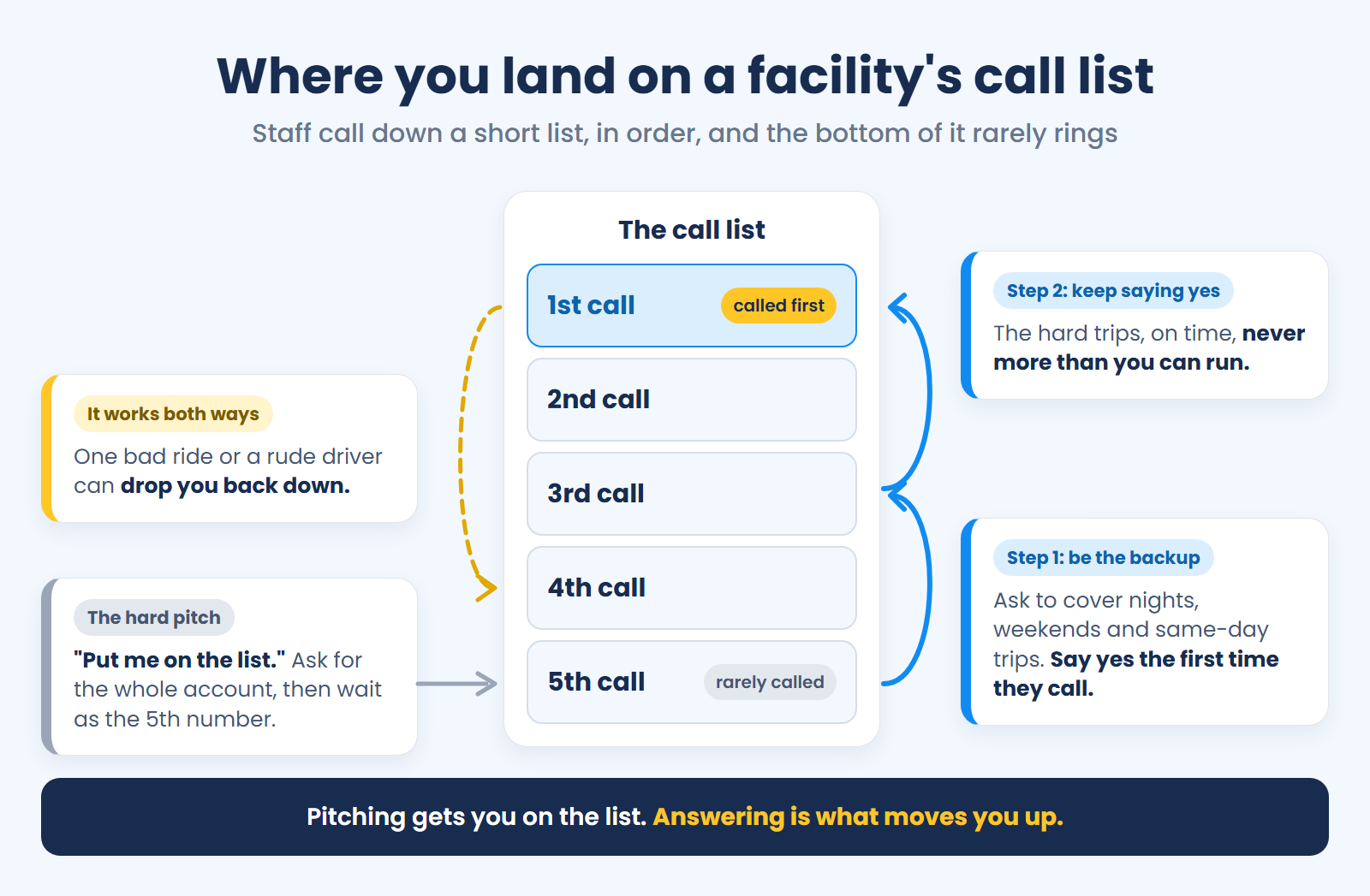
The trips that move you up are the ones nobody wants. ER discharge staff have told me how much they appreciate a company that takes the rough trip nobody else will, like a bariatric stretcher two hours out of town. The way they put it to me: “If you will take that really rough trip, I’m willing to give you all the easy short distance lucrative trips.” In a wheelchair van, the rough trip is the 5 a.m. dialysis pickup or the Sunday discharge.
Then don’t promise volume you can’t run. Tony’s rule: “If you say, ‘Hey, I can do 20,’ and you know you can only do 10, tell them I can only do 10 trips a day.” If they give you 20 and you can’t keep up, he said, “they’re never going to use you again.” The first few trips are an audition, and the first-trip guide linked above covers how to run them.
How do you get paid and keep the account?
Facilities pay by invoice weeks after the trip, so cap the credit you extend, and keep re-selling the building, because the people who keep its list keep changing.
Tony invoices twice a month on net-30 terms with a 15-day grace period. “They’re not going to pay you in 30 days,” he said, but with the grace period, “You’ll get your money in about 45 days.” Some buildings want far longer. One of the operators on our panel at NEMTAC Transform 2025, an industry conference, said facilities “are trying to push it out 90 days” with “the lowest possible rates” attached. That operator didn’t even respond to one contract that asked for it: “I cannot do 90 days.”
Christopher’s rule for those requests: “I don’t extend more credit than I’m willing to walk away from.” If you’ve got one van and can’t walk away from a couple of thousand dollars, he said, the facility doesn’t get 90 days. Put a number on it: no facility should owe you more than you could lose without missing payroll.
Re-selling matters because people move on: the average U.S. nursing home turns over 45.8% of its nursing staff in a year, per CMS’s August 2026 nursing home data. Owners change, too. Nursing homes are “notoriously known to change owners all the time,” Jing said, and new owners can “bring in their own favorite providers.”
Ownership groups can work for you, too. “Remember management companies own more than one facility,” Tony said, so once you’re in one building and its sister facility, call corporate: “Hey, I want to be a vendor of all your facilities.” Eugene Gindin of Capital Area Transport Service said on our episode about sustainable NEMT growth that if you perform well in one building, the group may call to ask, “Can you also cover this area?”
One bad ride can undo all of it. When Marqus Johnson came on the podcast to talk about turning drivers into a sales force, I told him about a software customer whose biggest facility account fell off a cliff: no calls for a couple of days. She went in with donuts and found out her brand-new driver had offended the front desk, so they’d been calling her competitor. She said she’d probably have lost the account within a month if she hadn’t gone in. If a building that calls you most days goes quiet for a couple of days, go in that week.
Should you make the calls yourself or hire it out?
You can hire out the calling, but the relationship has to be yours, because a facility trusting you with its residents wants to meet the owner. I said as much when Rachel Scholler and I talked about selling a NEMT business. Owners can hand off a lot of the boring, grindy work, but “building that relationship between you and the facility manager” is “something you as the owner have to do.”
The calling is the part Duet’s facility outreach service takes on. We build your facility list, make the calls in your company’s name and book meetings with decision-makers: activities directors, discharge planners and administrators. You get 8 meetings in your first month, guaranteed, or we keep working free until you have them. It’s $2,000 a month as of October 2026, or $1,600 with Duet software. You still run the meeting, sign the agreement and drive the first trip. Eight meetings in a month is a lot of rooms to walk into, so it fits owners who can make the time to take them.
How long until a facility contract pays off?
Your first facility takes the longest. Expect a few weeks of calls and visits before a building tries you, then a month or two as its backup before real volume. Big buildings run longer: one Texas operator, interviewed on another industry podcast, was still waiting on her first check about three months after her rides began, while her paperwork cleared. Add a van when a facility’s trips fill the one you have, not when it promises they will.
Eugene said the first facility, like any first, “takes the longest time. But that curve dramatically drops right after it because then you can show performance.”
A promise isn’t volume, though. The Doctor Ride’s founders bought a second van after their facility account said “we need more rides fulfilled,” expecting “like three rides on average per day.” On their own YouTube channel in July 2026, they said the facility hasn’t “really sent us as many rides as they said they were going to.” The van isn’t putting them in the red, and it doubles as a backup, but one of them said, “I don’t know if I would have jumped the gun.” It’s their first full year, so they can’t yet tell how much of the shortfall is seasonal.
Christopher’s 11-van company started badly. He bought it on the sellers’ word that they had 100% of a hospice’s business. After the sale, “I became the third call because they didn’t have a relationship with me.” He had about half a van’s worth of work. “It was hard,” he said. “It was really hard.” Paul Muench of Gentle Turns in Phoenix, another operator on that NEMTAC panel, put the rule simply: “don’t buy a vehicle until you know you can fill it or at least mostly fill it.”
If you’re brand new, expect the slow part to run longer. “If you’re brand new to this industry, nobody needs you,” Christopher said. “Everybody’s doing great without you.” Jing points brand-new owners to private pay first for a related reason: facilities want paperwork, insurance and experience a new company may not have yet. Start the calls anyway, and let private pay carry you while the list warms up.
The fifth number on a facility’s call list and the first number are on the same piece of paper. One asked to be put on it. The other asked to be the backup, then answered when the building called. Does anyone at the facility nearest you know to call you the day its regular company can’t make it, and would you answer on a Saturday? If either answer is no, that’s this week’s call.
All facility contract guides
Getting in the door
- NEMT Cold Calling Script for Facilities: What to SayA NEMT cold calling script for nursing homes and hospitals: who to ask for, what to say first, the fax move, the second call and the usual objections.
Agreements, rates and the first trip
- How to Get Your First Trip From a Facility MeetingThe meeting went fine. Then silence. How a champion gets you in the door, who pays for trips, who actually books rides, and how to land the first trip.
Getting paid and keeping the account
- How to Turn Your NEMT Drivers Into Your Sales ForceNEMT coach Marqus Johnson on hiring drivers for soft skills, paying commissions on the facility business they generate, and giving top drivers a region to run.
NEMT contracts FAQ
Do I need Medicaid enrollment to get facility contracts?
Not for trips the facility or a family pays for, because a service agreement is a private deal between you and the building. You need Medicaid credentials only for residents’ rides that Medicaid pays for. In most states those run through a broker or a health plan’s ride vendor, so that’s the network you’d join. A few states skip the broker: in South Dakota, for one, transportation companies enroll with Medicaid and bill it directly.
Should every facility get the same rate sheet?
Start from one standard rate, then let each building’s sheet fit how it uses you. Paul Muench of Gentle Turns in Phoenix used a base rate that included the first 10 miles, and he said on our NEMTAC panel that a rehab center whose hospital is two miles away doesn’t want to pay for 10, so he adjusts. Keep the variations on the attached price list, not in the body of the agreement.
What if a facility needs a trip before anything’s signed?
Take it, and get the OK in writing first. That’s common: Christopher Buell says a lot of facilities won’t sign an agreement until they’ve worked with you. Tony Jackson’s rule for those trips is an email from the administrator or the director of nursing saying they’re responsible for that resident’s transportation on that date. The email is your paper until the agreement is signed.
How do veterans’ rides from a nursing home get paid?
The VA pays for a wheelchair van ride only when the veteran qualifies for VA travel pay, a VA clinician finds the van clinically required, and the VA approves the trip in advance, except in an emergency. VA rules also let it pay whoever provided or paid for an approved trip, so ask each home whether it books VA rides itself and who sends the invoice. Rides the VA hasn’t approved get paid like any other resident’s.
About the author
James O'Donnell cofounded Duet and leads its sales, partnerships, and growth services. He talks with NEMT operators every week, hosts the NEMT Growth podcast, and answers Duet's sales line himself. More about Duet's founders →
Want more trips and less busywork?
See how Duet runs and grows NEMT businesses in a 30-minute demo.