Article
How to Sell a NEMT Business for What It's Really Worth
Rachel Scholler built Lakeshore Transportation for 17 years and sold it in 2025. The first numbers she was shown were far below what it was worth. Here's what buyers actually pay for, and how to be ready years ahead.
Guest: Rachel Scholler, Founder, NEMT Growth Consultants and Clear to Exit; former owner of Lakeshore Transportation (Plymouth, WI). Episode 22 of the Duet NEMT Growth Podcast.
By James O'Donnell, Cofounder and COO, Duet · · Updated
Rachel Scholler ran Lakeshore Transportation in Plymouth, Wisconsin for 17 years. Two vans in 2008. Fifteen to seventeen vehicles by the end, about twenty employees, more than half the revenue on standing contracts, and no debt. When she first thought about selling, she had a business broker value the company, one who had just sold another NEMT company a few months earlier, a company with eight or nine vans, about half her size. She handed him every report he asked for and waited. The number he came back with was so low she told her husband it wasn’t worth selling. They’d just have to work forever.
She assumed he knew more than she did. He didn’t. He wasn’t trying to rob her either. He’d priced hers off the deal he’d just closed, and what he never priced was the part she didn’t know she owned. About six months later a group of investors came calling, and when she finally paid for a real market analysis, their offer turned out to be about 60 percent of what the business was worth [1]. She sold in March 2025, for seven figures, to a buyer her second broker found.
The mistake in that story isn’t growing too slowly. It’s building a business that only works with you in it, then accepting the first number anyone puts on it.
I hear some version of “I’ll grow this to ten vans and sell it in five or ten years” almost every week. Fewer than one in ten of them, by my count, put anything into what makes the sale real: clean books, written processes, and a business that runs when they’re not in the building. Not because they’re careless. All three are invisible until a buyer asks, and nothing in the daily work of running vans surfaces them.
Rachel has been on the show before, on running a 30 percent margin and pricing trips, and she came back to walk through what she got right, what it cost her, and what she’d do differently to sell for more [2]. Here’s that conversation, organized the way a buyer reads your business.
How much is a NEMT business worth?
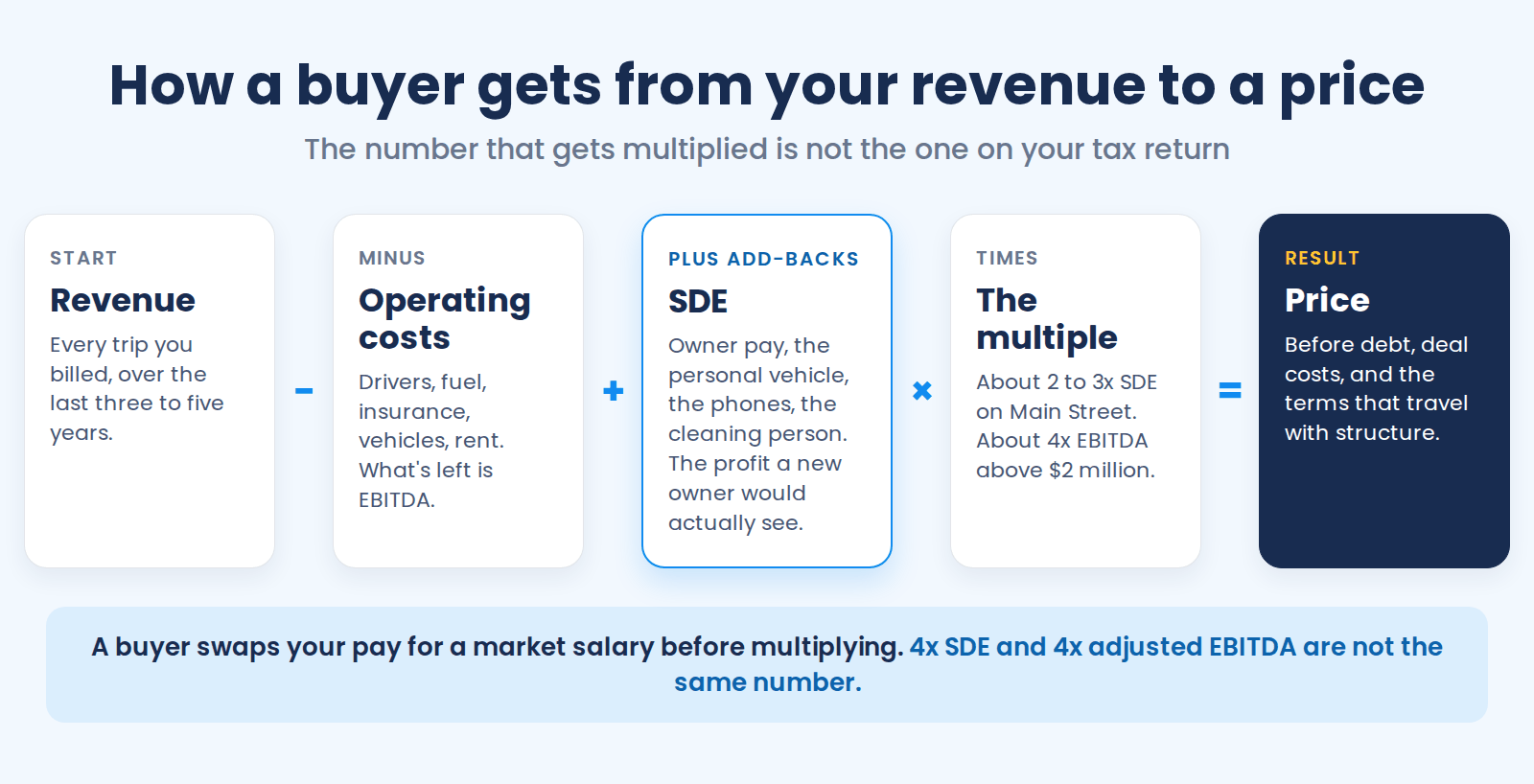
A NEMT business is usually worth a multiple of its seller’s discretionary earnings (SDE), the cash it throws off for one working owner once you add their pay and personal expenses back on top of the profit. Businesses that sold for under about $2 million went for roughly 2 to 3 times SDE in mid-2026. Above that price, buyers switch to EBITDA (earnings before interest, taxes, depreciation, and amortization) and paid about 4 times [3]. Recurring contracts and a company that runs without you push a NEMT business toward the top of that range.
What multiple does a NEMT business sell for?
Those numbers come from the brokers who close these deals. In the IBBA and M&A Source survey for the second quarter of 2026, the median multiple was 2.0 times SDE for businesses that sold under $500,000, 2.8 times between $500,000 and $1 million, and 3.1 times between $1 million and $2 million. Above $2 million the math switches to EBITDA, at 4.0 times up to $5 million and 5.8 times beyond it [3]. BizBuySell’s closed-deal data says the same thing from a different angle: an average cash-flow multiple of 2.7 across every business that changed hands that quarter [4]. Nobody publishes a multiple for closed NEMT deals. The closest sold-data row in BizBuySell’s industry table is “limo and passenger transportation,” at 2.49 times earnings over the five years through mid-2026 [5]. The same row shows 0.81 times revenue, but don’t reach for that one. A revenue multiple only holds if your margins match the sample’s, so price off earnings. The closest NEMT read is BizBuySell’s medical transportation category, where the listings on the market in September 2026 carried a median asking price of about $900,000 on median seller’s discretionary earnings of about $262,000, roughly 3.2 times [6]. Those are asking prices, and asking prices run above what closes. As Rachel put it on the show, “there’s not that many NEMT companies that have sold.”
Rachel now coaches owners through exits, and the band she teaches is wider than the medians: one to six times SDE for service businesses under about $5 million, with four to six as the target [2]. Here’s how to place yourself between the two. Start at the median for your size band, which for a company that would sell under $500,000 is 2.0 times. Then move up the band for each thing you can document: three or more years of flat-or-rising revenue, more than half of it on standing contracts, a manager who builds the schedule instead of you, books a stranger can read, and no single payer that could take the business down by leaving. Four to six is what a company with all five looks like. An eight-van owner with none of them should expect the median, and should read the rest of this as the list of what moves it.
What is SDE, and which expenses can I add back?
SDE itself is simple. Start with EBITDA. Then add back the personal expenses that run through the company: the owner’s own pay, the personal vehicle, the cell phones, the cleaning person. That’s the profit a buyer would actually see, not what your tax return shows [7].
Build that add-back list yourself, before a broker or a buyer does it for you. What usually counts on a NEMT P&L: the owner’s pay and its payroll taxes, a family member on payroll above what the job pays, the personal vehicle with its insurance and fuel, the phones, the owner’s family health insurance, one-time legal or startup costs, and any above-market rent if you own the building. Every line needs a receipt or a ledger entry you can point to, because anything you can’t document a buyer strikes. Attach the list to each of the last three years’ P&Ls and you’ve done the part of the valuation most sellers leave to the other side.
One warning about the units. A buyer I know in North Carolina prices small NEMT deals at three to four times adjusted EBITDA, or did when he priced his own NEMT purchase in 2023, and adjusted EBITDA swaps the owner’s pay for a market salary before anyone multiplies anything. An owner who adds back all of her own hours still has to be replaced by someone on payroll. And an add-back only counts if the expense is on the books to begin with: if you pay yourself in distributions and never put a real salary on your P&L, a buyer doesn’t see a lean operator. He sees a job nobody is funding yet, and he subtracts a manager’s pay before he starts. SDE includes the owner’s pay, so four times SDE and four times adjusted EBITDA aren’t the same number, and the gap between what a seller hopes for and what a buyer offers is bigger than the multiples make it look. Get both numbers on paper early.
Below the size private-equity groups look at, your buyer pool is individuals with an SBA loan, the competitor across town, or your own manager, and each of them prices the same business differently.
What do buyers actually pay for in a NEMT business?
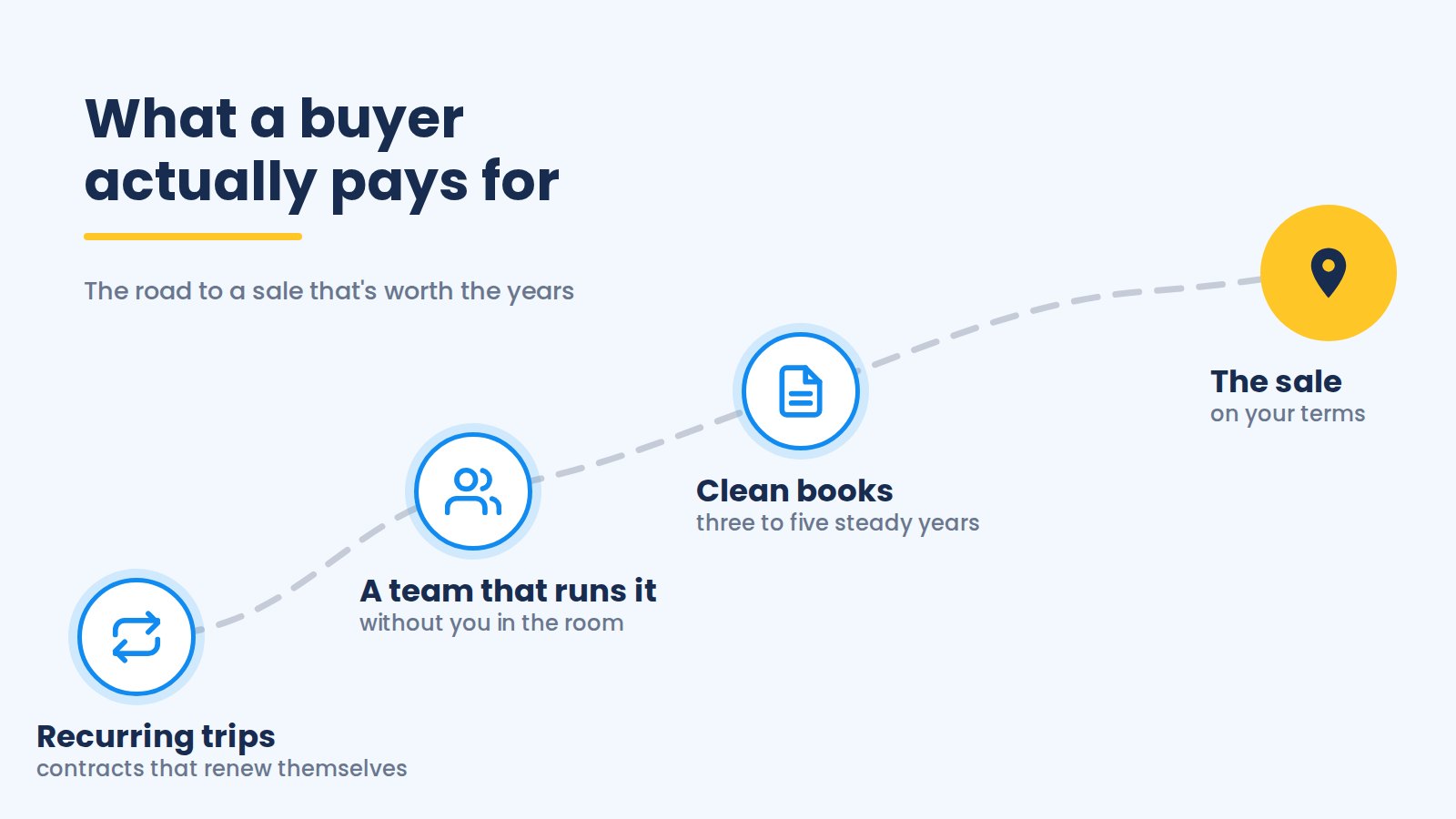
Buyers of a NEMT business pay for revenue that shows up without being sold again: standing facility contracts, riders who book five days a week, and three to five years of numbers that don’t swing. In Rachel Scholler’s sale of her Wisconsin NEMT company, a lot of the price was goodwill, the residual that’s left after the vans and equipment are valued, which in her case meant the recurring contracts the buyer expected to keep. The vans are just vans.
The most valuable revenue in a NEMT business is contracted and boring. Rachel’s company ran like a school bus. Nine or ten routes every day in E350 vans, ten riders to a vehicle, everyone going to the same day program in the morning and home in the afternoon, and every seat billed from mile one. Half or more of her revenue came from work she never had to sell twice, and some of her first riders are still on the routes today:
“50 to 60 percent, maybe even a little more, of my business was recurring, where we weren’t seeking those rides. It’s built in. And I had some clients that are still with the company today. I guess that would be almost 19 years.”
Riders at an adult day program age in from high school and can stay for decades, so a client in their twenties might ride with you for 30 or 40 years. She took every referral without exception and delivered so that nobody had a reason to look elsewhere. And she was clear-eyed about the trip that looks boring next to a long haul:
“It’s a little deceiving, because you’re thinking, oh, if I could do a 60-mile trip and I’m going to get $300 or $400 for that, versus your $50 across-town four-mile trip. But when you’re doing it five days a week, 52 weeks out of the year, that smaller trip just compounds and adds up so much more.”
Rachel didn’t know what that model was worth until the sale process priced it. If a 17-year operator can miss the value of her own contracts, so can you. If you’re mostly on-demand today, the standing contract is the asset to start building. I’ve written up how to win facility work and how to turn the first trip into a schedule.
Rachel’s mix was unusual: no broker contracts at all in her last five years. Most of the owners I talk to run the other way, and a buyer doesn’t treat broker revenue as worthless. He prices it as what it is, volume a third party can move. What makes it worth more is the same thing that makes it worth more to you: years on the contract, standing assignments instead of one-off dispatches, a scorecard the broker already keeps on your on-time rate and complaints, a rate history, and not having the whole book with one broker. Documented performance inside a broker contract transfers. A thin, one-broker book doesn’t, and a buyer prices the difference.
Consistency matters as much as the total. Buyers read your last three to five years, and a hot six months doesn’t move the multiple:
“You have to have demonstrated revenue. You can’t just have a six-month window where you really did good. That’s not enough to drive your multiple up.”
If revenue dips up and down, she said, “they’re going to take the average of your lowest.” Growth you add in the last six months barely moves the price, because the buyer is reading a five-year chart. Growth you added three years ago is load-bearing. BizBuySell’s buyer survey for the same quarter found profitability was the first thing buyers screened for, ahead of location and growth potential [4].
One more thing a buyer counts before pricing anything: how much of your revenue sits with one customer. If a single facility or broker carries a big share of the book, expect it to show up in the terms rather than the multiple, as an earnout, a holdback, or a clause that keeps you in the building for a year.
Why does founder dependency lower the price of a NEMT business?
Founder dependency lowers the price of a NEMT business because a buyer is paying for cash flow that continues after the founder leaves. If the schedule lives in the owner’s head and every driver’s question rings the owner’s phone, the buyer is buying a job plus some vans, and buyers price a job like a job. The same goes for relationships. If the facility contacts and the riders are loyal to you rather than to the company, the buyer is paying for vans and a phone number.
Rachel’s test is one question: “Can you leave your company and take a vacation? If not, you’re going to be on a for-sure path to burnout.”
Rachel carried two phones everywhere she went for two decades. She’d been off the road for a dozen of those years and still built every day’s schedule by hand, because the recurring routes were mostly the same and she was faster than anyone she could teach. Her office assistant handled billing but couldn’t touch the schedule. Long weekends were the closest thing to a vacation, and the drivers still checked in with her on those.
“I was probably the biggest asset and also the biggest liability in the business.”
She said the same thing more bluntly at NEMTAC last year: you’ll get less of a sale price when you’re deep in the day-to-day, because a buyer wants systems that run without you and profit from day one [1].
She can’t put a dollar figure on the dependency, but she can tell you what happened next. She told the buyer everything. She offered to stay and train. He came in knowing the dependency was real and up for the challenge, and it was still more than he expected. “He bought it thinking, this is easy. It’s transportation. That’s what everybody thinks.” She believes he resold the business about 15 months later, through her own broker, and to be fair to him, he grew it while he had it. The business survived him. The version of it she thought she was selling didn’t, and Rachel calls the dependency a disservice to herself, the company, and the man who bought it.
Her fix, if she could rewind to a year before the sale, is people and systems together. Hire a general manager and give them equity, “because then they have the incentive to really perform.” Accept that the hire won’t be you:
“You’re never going to probably find somebody as good as you’re going to do it, but that’s okay. If you can get somebody 80 to 85 percent as good as what you’re doing it, you’re going to be okay.”
Then write things down. Job descriptions, a real review process, and a written protocol for the burnt-out headlight and the fender bender, so eight drivers aren’t lined up at your desk every morning asking what to do. She has a friend with two drivers who had an accident and no documentation of any of it, and the insurance company dropped her over it.
Software is the other half. Rachel says routing software and integrated billing would have made the handover far simpler for her buyer, who didn’t know her roads and was working off Google Maps. Nothing ever pushed her onto a system, because she hadn’t had a broker contract in five years and nobody was demanding trip data. I’ve met owners who can hold the whole map of the city in their head and run ten vehicles on demand from it, and it’s impressive. What it never does is transfer. The buyer isn’t asking whether your head works. He’s asking what he owns on the day you stop answering the phone, and at eight vans the answer is the same as at thirty. I know a 35-vehicle fleet that was spending six hours a day scheduling by hand. On Duet it’s about half an hour, and any good dispatching software would get them most of the way there. The hours matter less than where the schedule lives afterward, which is somewhere other than one person’s memory. Put every route, rider, and rate on a dispatch board a stranger can read, and a buyer can see the business without the founder standing behind them.
If a general manager with equity is a year away for you, the Monday-sized version is this:
- Write the standing-route sheet. Every recurring rider, pickup window, destination, payer, rate, and the handling note that only lives in your head. One spreadsheet, one afternoon.
- Write the three protocols. Headlight out, missing tie-down, fender bender. Those are the calls.
- Name a backup dispatcher and let them run one full day while you stay reachable and silent.
- Put the schedule in software so the sheet stops being a sheet.
Then take a week off. Whatever happens while you’re gone is what a buyer is pricing.
When should you start preparing a NEMT business for sale?
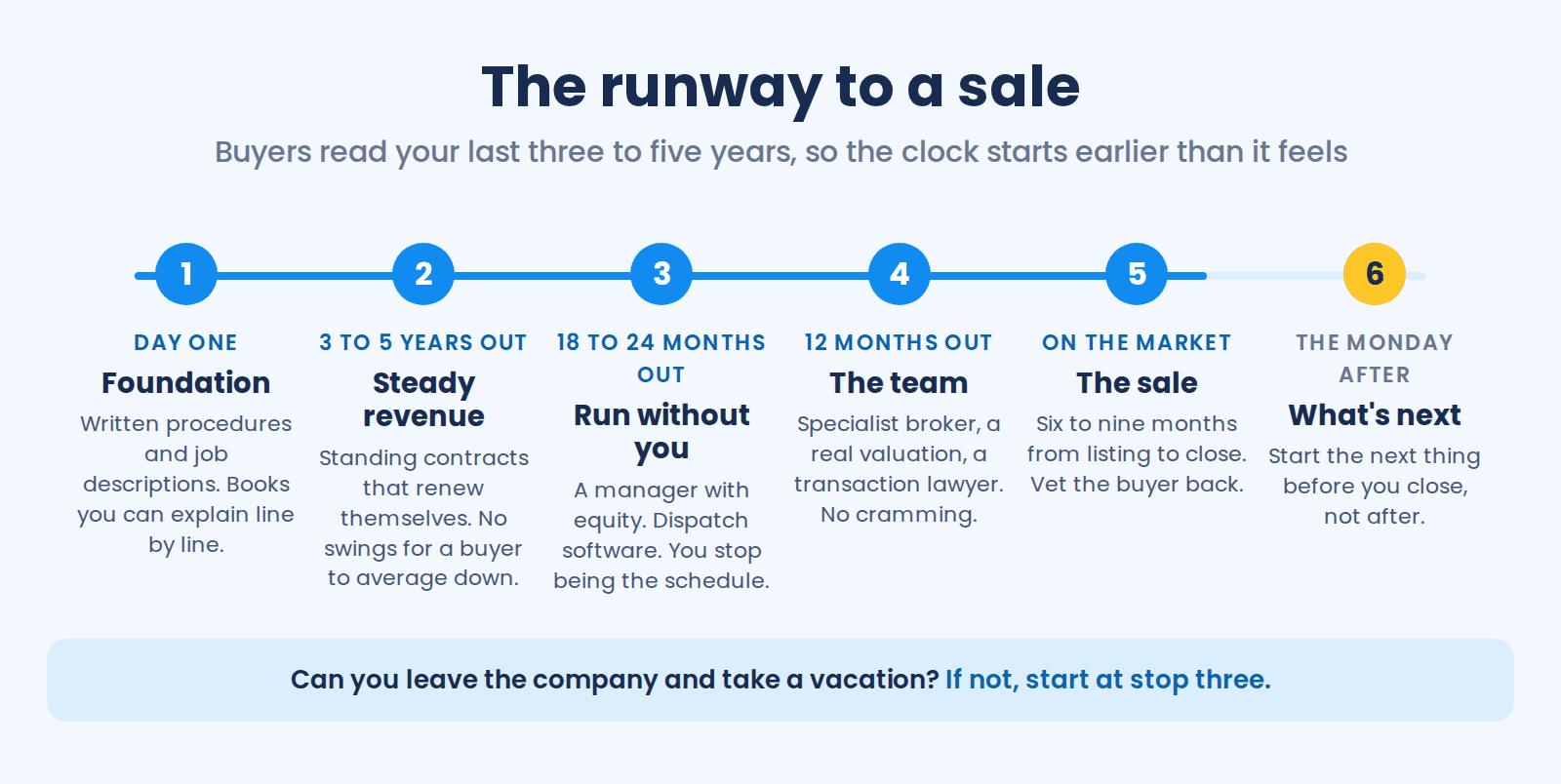
Start preparing a NEMT business for sale on the day you start the business, and no later than three years before you want to close. Unwinding owner dependency and getting books that survive diligence takes two to three years of ordinary quarters. Cramming the cleanup into the last twelve months is stressful, and it shows. Even a one-van owner-operator should have written procedures.
“I would argue you should think about it when you’re starting your business. Everything you’re building, it’s going to be a lot easier early on, when you’re a smaller company, to get your foundation strong.”
Start with the books. In her old corporate job Rachel coded purchases to ledger accounts all day. In her own company her CPA assigned every code, and she never asked what counted as an asset, what counted as an expense, or where any of it sat on the balance sheet. The first Zoom call of her life was with the investor group, three businessmen and a lawyer, while she opened her books. They zeroed in on line items and she had no answers.
“I didn’t know any better and I didn’t have anything to hide. But I didn’t realize the leverage I did have, I was giving away. And as the seller, I had a lot more leverage than I knew.”
She did have one thing perfectly clean: debt. “None. Zero.” The buyer wasn’t taking on anyone else’s payments, which matters more than usual when the buyer takes the company itself rather than just its vans and contracts, because everything on the balance sheet comes with it. (That’s a stock sale, and I’ll get to it.) So know your own balance sheet before a buyer reads it. Make sure your tax returns tie to the trip revenue in your dispatch software.
Most sellers don’t. In the IBBA survey for early 2026, 68 percent of owners who sold for under $500,000 had done no formal planning before they hired an advisor, and 86 percent of advisors said first-time sellers make up at least half their clients [8]. Add a six-to-nine-month sale process on top of the three-year window and the day to start is earlier than it feels.
Rachel’s own list, if she were doing it again for a bigger number, is short. Get management dialed in first. Add six to eight vehicles, which she thinks she could have done comfortably, and expand into the surrounding counties. Run a paid ad, which she never did once in 17 years. All of it two or three years before going to market, because the buyer will be looking at those years [2]. She didn’t do it because she was burnt out and her dad was dying, and she says so plainly. She’d run out of bandwidth, and a burnt-out seller takes the first reasonable number. The window she’d have wanted was 18 to 24 months she didn’t give herself. None of that turns seven figures into eight by itself. It turns the same company into a higher seven-figure exit at the top of the band instead of the middle, and the road to eight is the same list run for another five years.
One more thing to check early: whether anyone in the family actually wants it. Rachel assumed for a decade that her kids might take over. When she raised it in their college years, they laughed. “No, no, mom, that does not sound fun.” Find that out before you build a succession plan on it.
Should you sell a NEMT business as a stock sale or an asset sale?
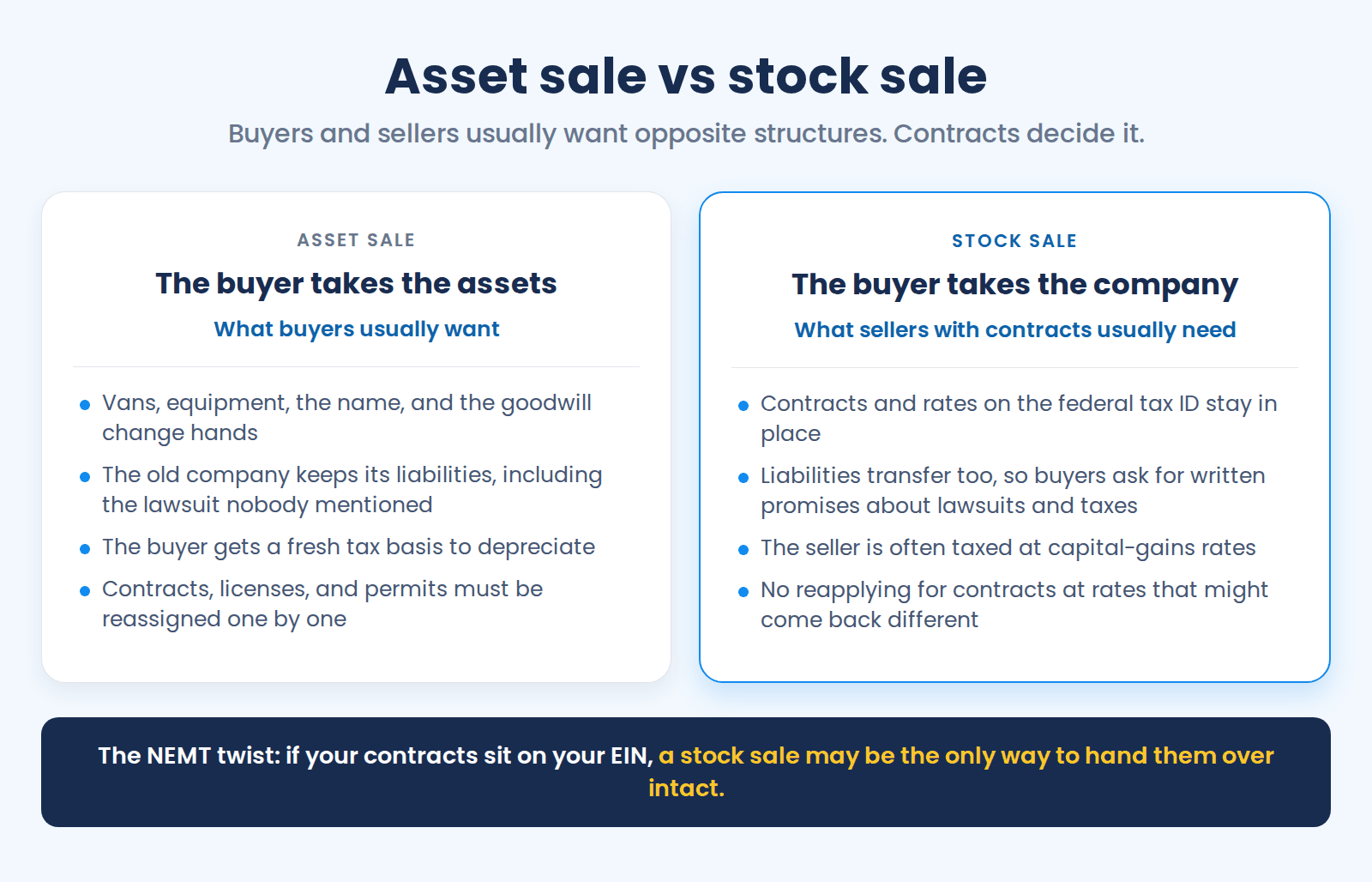
Small-business sales are commonly structured as asset sales: the buyer takes the vans, the equipment, the name, and the goodwill, and leaves the old company and its liabilities behind. A NEMT company whose contracts sit on its federal tax ID often has to sell as a stock sale instead, because the contracts are tied to that entity and a new company might not get them back at the same rates.
“We had to do a stock sale. It was the only way to keep our contracts in place, because it’s based on your federal ID number.”
If her buyer had formed a new company, he’d have had to reapply for every contract. Some might have come back at different rates. Some might not have come back at all, and the sale price would have moved with them. What sits on that tax ID is usually the expensive part: your Medicaid enrollment, your broker credentials, and any facility agreement written to the company rather than to you. A new entity applies for all of it again, and credentialing runs on the payer’s clock, not yours. Many broker and facility contracts also carry change-of-control language that needs the other side’s consent even in a stock sale, so “it’s on the EIN” is the start of the answer, not the end of it. Rachel is candid that the structure favored her: “for the buyer’s perspective, yes, an asset sale is definitely better.”
That’s exactly why buyers push the other way. A stock sale hands the buyer every liability the company ever had, including the lawsuit nobody mentioned, and I say that to anyone who tells me they’re buying a transport service: get a written statement that the seller knows of no pending claims, then take it to a lawyer, not to us. Buyers want asset sales for two reasons: the liabilities stay behind, and they get to depreciate the vans again at what they paid, not what you paid. Sellers usually want stock sales because more of the proceeds can be taxed at long-term capital-gains rates instead of as ordinary income, and because contracts and permits stay put instead of getting reassigned one at a time [9]. The tax half of that is a conversation with a CPA before you pick a structure, not after. In an asset sale, both sides allocate the price across classes of assets on IRS Form 8594, and the contracts and reputation a buyer is really paying for land in the goodwill class [10]. Goodwill is a line on a tax form, not a compliment.
Terms travel with structure. Rachel had no revenue target and no clawback in her deal, and she’s seen deals where the seller pays money back if revenue misses. What let her deal work was that there was nothing to inherit: zero debt, no litigation, books she could stand behind. A stock sale is a much harder sell when the books are messy, because you’re asking the buyer to take your word for the parts he can’t audit. Debt either comes with the entity or comes out of your proceeds. Say the price is $1.2 million and you still owe $260,000 on the vans and $40,000 on a line of credit. You walk away with $900,000 before fees and taxes, and that’s the number to negotiate against, not the headline. A financed fleet hurts twice, once in the payoff and once in the multiple. In the mid-2026 survey data, cash at close averaged 83 to 92 percent of the price depending on deal size, seller financing was under 10 percent, and earnouts, the part of the price held back and paid only if the business hits agreed numbers after you’re gone, only showed up in a meaningful way above $2 million [3]. An earnout on a book you no longer control is a number you may never see. Know which of those you’d accept before the first offer comes in, because the first offer is where a buyer finds out.
Who do you need on your team to sell a NEMT business?
To sell a NEMT business you need three specialists: an accountant who has been through an exit, a broker or valuation advisor who has sold service businesses with recurring contracts, and a lawyer who does transactions. The CPA who has done your taxes for 15 years may not be that accountant.
Rachel’s wasn’t. Her accountant had handled her books the whole time she was in business, and it didn’t matter.
“He’s never been through a business exit. So he is not the right person to analyze that and give me feedback, because he has no experience in it, even though he is a CPA.”
When the investors came, she didn’t know she needed a broker to run the sale. She’d been dealing with the banker directly, and it was the banker who told her that selling a business is a specialty and referred one. The difference showed up immediately. He produced a valuation about 30 pages long, covering where the company was weak and what to fix, and then marketed it to the right buyers. The alternative was listing it on BizBuySell herself and fielding calls she wasn’t equipped to negotiate. Specialists, she says, catch the things you’d never think of, early enough to fix them before a buyer finds them.
Two cautions on the broker. Brokers who have sold a NEMT company are rare, because so few have sold. And having sold one isn’t the same as understanding recurring revenue. Her first broker had just closed a NEMT deal and still missed it. Ask any broker how they value standing contracts before you sign an engagement.
None of the three is free, and the fees vary too much to print. Ask each one for the fee structure in writing before you engage: brokers usually charge a success fee at closing, a valuation is sometimes included in the engagement and sometimes priced on its own, and a transaction lawyer bills by the hour or a flat fee for the deal. The cheapest of the three in year one, and the one that pays off most, is the valuation, because it’s also the gap list.
On the lawyer she doesn’t hedge at all: “I would not recommend anybody do anything without a lawyer.” She has consulting clients today who have a broker engaged and no lawyer, and she tells every one of them the same thing. “I think you need to really just try to protect yourself and play devil’s advocate. Even though that might be against your nature, you really do need to protect yourself.”
When an owner asks me who can walk them through a sale, I send them to Rachel. She works with owners through NEMT Growth Consultants, and her exit process, Clear to Exit, runs in three stages: an honest valuation with the list of gaps, closing those gaps so due diligence turns up nothing, and figuring out who you are after [11]. Her book on the whole process, Both Sides of the Wire, is due out in 2026 through cleartoexit.com.
How do you vet the buyer of your NEMT business?
Vet the buyer of your NEMT business the way they vet you: references from people who have worked with them, a look at anything they’ve run before, and a written plan for the first six months. A sale is emotional, and a buyer who says what you want to hear will get past your judgment.
Rachel’s buyer wrote her a letter. His family, his kids, moving to the area, honoring what she’d built. It was everything she wanted for a company she’d hoped her own children would run one day. “Once he told me what I wanted to hear, I was like, hook, line, and sinker. This is the guy.” It wasn’t a true story. He said he’d watch and learn for six months. The changes started within 48 hours, and after closing there was nothing she could do about it.
“I would look into their character a little bit, and maybe even some people that have worked with them, get some references. I met with him several times, but of course he’s saying everything that you want to hear, and a business sale and purchase is very emotional.”
I’ve watched this from the other side too, on an earlier episode about building wealth from a NEMT company. My standing advice to anyone buying a NEMT service is to negotiate for the owner to stay on for about a year, and then actually take their advice. I’ve talked to sellers who watched the new owner wave them off, lose the biggest contract, and go hire outside consultants while the person who’d run it for 15 years sat right there [12]. Not every buyer wants that. A passive investor usually keeps you around for six months to a year, and an owner-operator sometimes wants you gone in 30 days and figures the rest out himself, so find out which one you’re selling to before you negotiate the transition clause. As the seller, write that transition into the deal. It protects your riders and your drivers, and it protects the reputation your name is still attached to in town.
What happens to you after you sell your NEMT business?
After you sell a NEMT business, the structure that ran your life for a decade or more disappears with one bank transfer. Rachel Scholler, who sold her Wisconsin NEMT company in 2025 and now coaches owners through exits, says the third stage of her process, planning who you are after the sale, is the one she skipped and the one that matters most. Start the next thing before you close, not after.
Her broker raised it in passing. She brushed it off. She’d have money, she’d travel, what kind of question was that. Then it was Monday, her husband was at his morning radio show, and for the first time in 17 years she had nowhere to be. She’d convinced herself she would cook organic meals, keep a garden, and can vegetables. She doesn’t like gardening.
“My self-worth, I guess I subconsciously tied that to productivity.”
She’s worked hard since, on things with no metric yet, and she’d have started her consulting six to eight months earlier if she’d thought harder about what her days would actually look like.
Rachel was burnt out, her father was dying, and her father-in-law had just passed. “I just wanted the sale over.” A seller with a plan for Monday negotiates differently from a seller who just wants it done, and buyers can tell which one they’re talking to. Most exit guides stop at the closing, which is convenient, because everything expensive about being unprepared happens on both sides of it.
So before you call a broker, sit with her two questions. Can you leave the company and take a vacation? And who are you if you’re not the business? A buyer will check your revenue history, your contracts, your books, and whether the company survives you leaving the room. Nobody in that room checks whether you survive leaving the company.
FAQ
How long does it take to sell a NEMT business?
Six to nine months from listing to close for a Main Street business, and nine to twelve months for one selling above $2 million, according to the brokers surveyed by IBBA and M&A Source in early 2026. Signing a letter of intent, the document where you and one buyer agree on price and rough terms and usually go exclusive, to actually closing runs two to four months on its own. Preparation is the longer clock: buyers read your last three to five years of revenue, so the real timeline starts years before the listing.
Should I take a meeting with an investor group that wants to buy my NEMT business?
Take the meeting, then get your own valuation before you talk numbers. Rachel Scholler’s unsolicited offer came in at about 60 percent of what a market analysis later said the company was worth, and she thought it was a great deal at the time. Don’t sign an exclusive with a buyer who approached you, and don’t open your books until you can explain every line in them.
Can I sell a NEMT business that runs mostly on broker trips?
Yes, but expect it to be priced differently from a business built on direct contracts and private pay. A buyer I know who acquires NEMT companies with investor money screens on contract mix first, and books that are mostly broker volume usually aren’t a fit for him, because a broker can move its volume somewhere else next quarter and a facility that signed with your company can’t be moved by a third party. Goodwill attaches to the revenue you control.
What happens to my Medicaid and broker contracts when I sell a NEMT business?
They stay with the company they were issued to. Medicaid enrollment, broker credentials, and most facility agreements are tied to the entity’s federal tax ID, so a stock sale carries them across intact, while an asset sale usually means the buyer applies again under a new entity, on the payer’s timeline and at whatever rates come back. That’s why sellers with strong contracts push for a stock sale.
What are my vans worth when I sell a NEMT business?
Less than you’d think on their own. Buyers price the earnings the fleet produces, then look at vehicle age, mileage, and how much of the fleet is financed. Two rough gates decide whether the fleet gets counted at all: is more than half the equity yours, and is more than a third of the useful life left. Miss either one and a buyer prices the business without the vans, which usually means you’re better off selling them yourself.
Sources
[1] Duet NEMT Growth Podcast, Ep. 8: “NEMT Growth Unlocked: Proven Strategies For Rapid Success” (the NEMTAC 2025 panel; Rachel Scholler on her sale and the investor group’s offer), August 28, 2025. duetinc.com/nemtac2025panel
[2] Duet NEMT Growth Podcast, Ep. 22: “How to Sell your NEMT Service for 8 Figures” (Rachel Scholler), August 13, 2026. https://www.youtube.com/watch?v=p17NmffLfRE
[3] International Business Brokers Association and M&A Source, “Market Pulse Survey, Q2 2026” highlights (median multiples by deal size; deal financing), August 2026. https://www.ibba.org/wp-content/uploads/2026/08/mp-highlights-q2-2026.pdf and the release: https://www.prnewswire.com/news-releases/the-market-pulse-survey-q2-2026-reports-the-latest-trends-in-business-sales-up-to-50m-302858664.html
[4] BizBuySell, “Insight Report, Q2 2026,” July 17, 2026. https://www.bizbuysell.com/insight-report/
[5] BizBuySell, “Business Valuation Multiples by Industry” (trailing five years, Q3 2021 through Q2 2026), accessed September 2026. https://www.bizbuysell.com/learning-center/industry-valuation-multiples/
[6] BizBuySell, “Medical Transportation Businesses For Sale” (category listing medians: asking price, revenue, cash flow), accessed September 2026. https://www.bizbuysell.com/medical-transportation-businesses-for-sale/
[7] International Business Brokers Association, “Glossary of Terms” (discretionary earnings, EBITDA, adjusted EBITDA, add-backs, goodwill). https://www.ibba.org/resource-center/glossary/
[8] International Business Brokers Association and M&A Source, “Market Pulse Survey, Q1 2026” executive summary (time to close; owners with no formal planning; first-time sellers), June 2026. https://www.prnewswire.com/news-releases/the-market-pulse-survey-q1-2026-reports-the-latest-trends-in-business-sales-up-to-50m-302813653.html
[9] Rembolt Ludtke LLP, “Asset Sale vs. Stock Sale: What Is the Difference?”, February 24, 2026. https://remboltlawfirm.com/asset-sale-vs-stock-sale-what-difference
[10] Internal Revenue Service, Publication 544, “Sales and Other Dispositions of Assets” (2025), “Sale of a Business” and the residual method; and Instructions for Form 8594, “Asset Acquisition Statement Under Section 1060.” https://www.irs.gov/publications/p544 and https://www.irs.gov/instructions/i8594
[11] Clear to Exit (Rachel Scholler), “The Clear to Exit Method,” accessed September 2026. https://cleartoexit.com
[12] Duet NEMT Growth Podcast, Ep. 9: “How To Retire Rich From NEMT,” October 15, 2025. duetinc.com/duetblog14_nemtretiredrich
About the author
James O'Donnell cofounded Duet and leads its sales, partnerships, and growth services. He talks with NEMT operators every week, hosts the NEMT Growth podcast, and answers Duet's sales line himself. More about Duet's founders →
Want more trips and less busywork?
See how Duet runs and grows NEMT businesses in a 30-minute demo.