
Article
NEMT Private Pay: What to Charge and How Families Find You
Families pay more than a broker does, and they pay before the ride. They often book whoever answers first, so spend the margin on answering.
By James O'Donnell, Cofounder and COO, Duet · · Updated
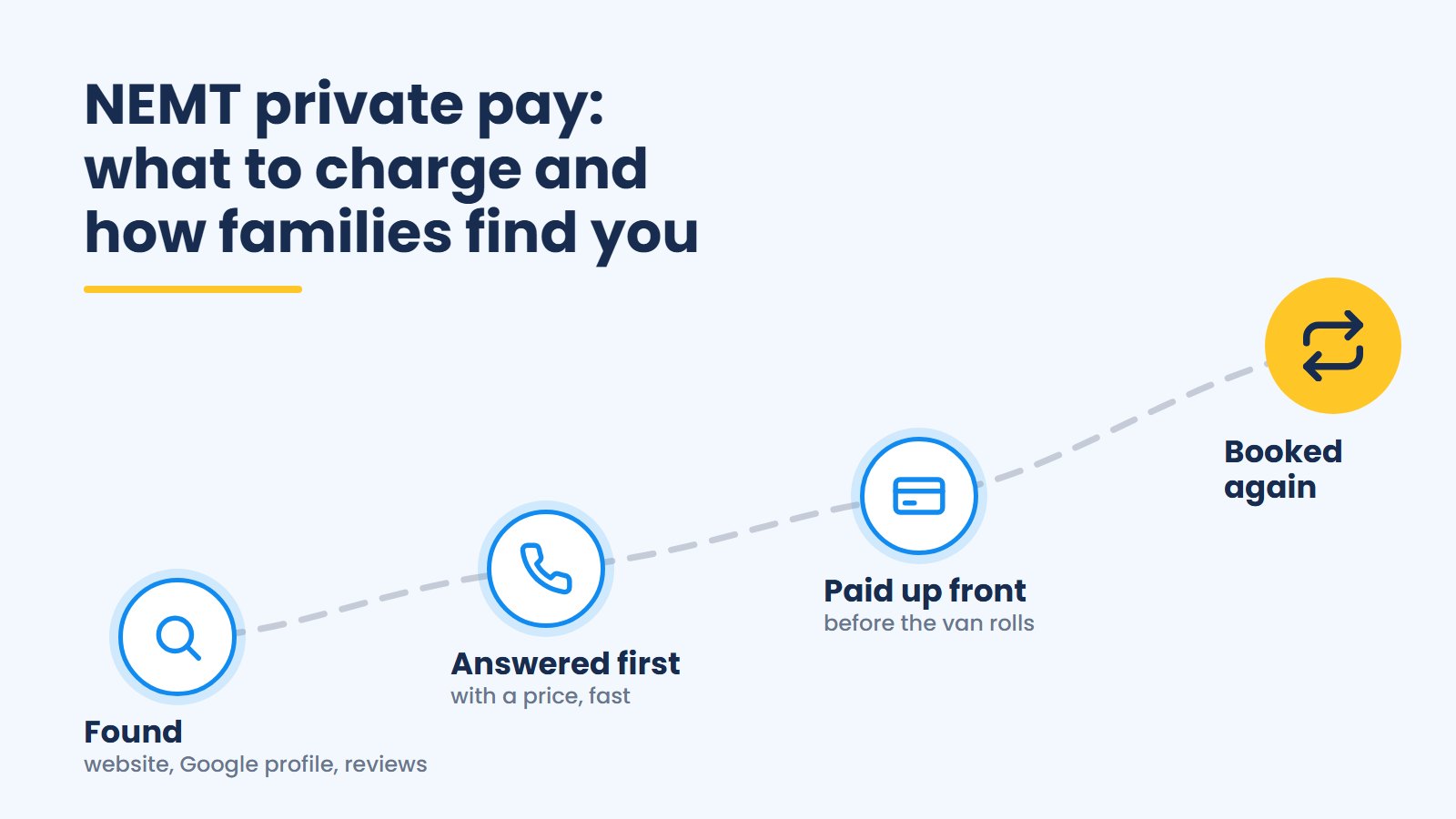
Private pay NEMT means the rider or their family books and pays you directly for a non-emergency medical ride, with no broker or insurer in between. You set the price, above what a broker pays for the same trip, and you collect it before the ride: a card at booking, charged at least 24 hours before pickup.
The owners I meet who make private pay work aren’t the cheapest company in town. They answer first, because a family calls down the list on Google and often books the first company that picks up with a price. So price above your broker rate, and spend the margin on answering.
This guide takes the steps in the order you’d build a private-pay line: who pays, whether your market has the riders, what to offer, then price, payment, getting found, answering, keeping riders and how big to let it get.
The short version:
- Who pays: the rider or their family, for rides no program covers.
- What to charge: more than a broker pays for the same trip, set by calling local providers as a customer.
- When you’re paid: before the ride. No payment, no car.
- How families find you: Google first, then your website and reviews, then a phone call.
- What wins the ride: a price back within 30 minutes, and never later than two hours.
- How big it gets: a handful of rides a month from ads in a smaller market. My cofounder Jing Zhu’s rule of thumb is to grow it to at least 10% of revenue.
Who pays for private-pay rides?
The rider or their family pays for a private-pay ride, because no program covers it. Original Medicare doesn’t pay for van rides at all. Medicare’s claims processing manual says Medicare “simply does not provide any coverage at all … for any non-ambulance forms of transportation, such as ambulette, wheelchair van, or litter van.” A litter van is a stretcher van.
That leaves a lot of people paying their own way. Four in five people on Medicare, 53.4 million in 2022, weren’t also on Medicaid, per Congress’s Medicare and Medicaid advisory commissions. Medicare Advantage plans can add rides as an extra benefit, but only 22% of people in individual plans were in plans that offered them in 2026, per health policy group KFF’s analysis of 2026 plans. Those plans arrange the rides themselves.
Medicaid’s ride benefit covers its members’ trips to covered care, per the federal Medicaid agency’s 2023 guidance to states, so even a Medicaid member’s ride to a wedding or a funeral is usually private pay. Paul Muench, who runs Gentle Turns Transportation in Phoenix, drives riders to weddings, funerals and family events, and works Christmas and Easter.
Many of the families shopping for private pay medical transportation are adult children booking for a parent: “a son or a daughter paying for their senior parent,” as Ray put it. He and Mac run The Doctor Ride, two vans in Charlotte. Other callers are coming out of a procedure under sedation, and clinics often won’t let them leave in a rideshare. Jing also sees hospitals push the cost of a discharge ride onto the family.
Dialysis is the one to be careful with. The rides are great, but most dialysis riders are on Medicaid, so their trips mostly go through brokers. Don’t count on the dialysis center as a private-pay source.
How does private pay differ from broker and facility trips?
NEMT private pay is the one lane where you both set the price and collect it before the ride. Brokers pay the rate in their contracts, as our guide to NEMT brokers explains, and facilities pay the rate you negotiated, both after the ride. When I lay out how a new NEMT business lines up its first trips, Medicaid is the volume, facilities are the stability and private pay is the margin. Here’s how the three lanes compare:
| Lane | Who books | Who sets the price | When you’re paid | What the payer needs |
|---|---|---|---|---|
| Private pay | The rider, or a son or daughter booking for a parent | You | Before the ride, usually on a card charged at least 24 hours ahead | A receipt a person can read |
| Facility | Facility staff, like a case manager or transport coordinator | Your agreement with the facility | On invoice terms. Tony Jackson, a Florida operator, offers facilities net 30 plus a 15-day grace period, so about 45 days | An invoice in the format the facility asks for |
| Medicaid broker | The broker, which assigns you the trip | The broker’s contract or the state’s fee schedule. MTM’s Rhode Island rate schedule pays $41.00 for a 10-mile daytime wheelchair trip (rates effective July 1, 2023) | After a clean claim, one with nothing missing. Modivcare’s Mississippi manual (February 2024) pays twice a month, within 30 days of receipt, and cuts 10% from invoices filed more than 60 days after the trip | A trip log with pickup and arrival times and the rider’s signature, per MTM’s 2026 Rhode Island handbook |
Whoever pays decides the lane. A trip the facility pays for is facility work, even when a family member books it. A family paying for a resident’s ride is private pay, even when the facility arranges it. In that second case, as our guide to the first trip from a facility puts it, your real buyer is often a daughter two states away.
Does your area have enough private-pay riders?
Your area likely has enough private-pay riders for ads to bring in steady trips if at least a million people live in it, public transit doesn’t cover most of their trips, and families there can afford the fare. Wheelchair riders often need you even where transit is good.
That screen comes from Harry Chambers, a digital marketing expert. On our private-pay episode with Harry and Jing, he put the ideal market for ads at “at least a million people or more in your marketplace.” In a city like Chicago, he said, people without a car will “hop on the subway or hop on the bus” to their appointment, “unless they have a wheelchair.” Then comes the money question: “do people have the money to afford the services?” He wasn’t writing off small towns, either: “Not to say that rural areas aren’t great.”
A big metro doesn’t guarantee a fast start. Te’ya Miles, the Atlanta operator behind That NEMT Girl, started with no broker contracts. On her episode about the NEMT mistakes nobody warns you about, she told me: “It was very slow getting private pay. I was getting some, but it wasn’t steady enough to help me pay the bill for the insurance or for the van.”
Before you spend on ads, check that at least a million people live in your service area; in a smaller one, lead with the wheelchair riders transit can’t carry and expect a slower start.
What should you offer families?
Offer wheelchair rides first, plus the help families can’t give themselves. Many families can drive an ambulatory parent themselves or call a rideshare or taxi, and stretcher riders more often have a facility or health plan managing their trips. With a sedan, Jing pointed out on our private-pay episode, you’re up against taxis, Uber and Lyft. Your edge is the help a rideshare driver can’t give: walking with the rider from the door to the van and helping them in.
Ray and Mac had early success at The Doctor Ride with wait-and-return trips: the driver waits through a colonoscopy or a wisdom-tooth removal and brings the rider home. Those procedures need someone waiting on site, because “the doctor’s office, they won’t let you Uber out of there.” In June 2026 they charged a flat “$125 an hour” for it. The clock starts at pickup and stops at drop-off, with no mileage charge, so a family can work out the cost without guessing how long the procedure will take.
Long-distance trips are a specialty of their own. Jeanine of SailorGirl Transport runs multi-day, cross-state senior moves, a different business from a local wheelchair run.
What should you charge for a private-pay ride?
Charge more than a broker pays for the same trip, priced from what other providers in your market charge. To find out what they charge, run what Jing calls a “secret shopper experiment.” Call a bunch of providers in your market, pretend you have a trip to book, and note what each one quotes.
Then decide where to land. Rachel Scholler built and sold a rural Wisconsin NEMT company. On our pricing episode with Rachel, she said she’s “not a fan of going undercutting and being the lowest because it’s really hard to raise those rates.” A new provider hasn’t earned premium pricing yet either, she said, so “kind of go right in the middle” until you know your true costs.
What providers charge for a short wheelchair trip can run well above what Medicaid pays for a longer one. Jing has seen a four- or five-mile wheelchair trip priced anywhere from $35 to $75 or $90, depending on the state and market. The $35 end, she said, mostly comes from providers stuck in 10- or 15-year-old contracts the other side won’t renegotiate. Minnesota’s Medicaid fee schedule pays $39.00 for a 10-mile wheelchair trip in the metro as of October 2026, and MTM’s Rhode Island rate in the table is $41.00.
The man who bought Rachel’s company planned to run broker trips. He stopped 90 days in, because brokers were “offering 30 to 40% less than what our private rates are,” she said on our episode on growing a high-margin NEMT service. My own gut check is 25 to 50 percent above your broker rate. Charge more for nights and weekends, too: Rachel charged “about 25 to 30% higher” for them, because someone has to be on call.
This week, call three to five providers as a customer and ask what they charge for a 5-mile and a 10-mile wheelchair trip; set your price in the middle, above your broker rate.
When and how do private-pay riders pay?
Private-pay riders pay before the ride. Most providers I talk to take a card at booking and charge it at least 24 hours before pickup, or send a payment link that has to be paid by then. Some also take a small nonrefundable deposit at booking to hold the spot on the schedule.
Prepayment also tells you who’s really coming. Rachel started requiring it 24 hours ahead, and if a rider wasn’t going to pay, “it was a good indication they didn’t plan on going.” A few people didn’t like that, she admitted. “But honestly, if you’re going to pay, what’s the diff?”
Jeanine takes full payment at the quote when a long trip is two or three days out. Booked a week or more out, she takes a deposit and settles the balance 24 to 48 hours before departure. When I asked whether that meant riders were paid in full before any transport happens, she said, “Absolutely. Even local.” Her rule: “Our wheels don’t move” until a trip is paid in full.
Expect exceptions. Some seniors won’t use a card and insist on check or cash, Jing has found, and Jeanine makes exceptions for riders who pay cash. Big fares get split: on bariatric stretcher trips that run $500 to $1,000, Jing has seen each family member chip in about $200. I once saw a long-distance trip where the hospital paid $250, the rider’s husband paid with a $500 check and the daughter paid $200 in cash. We’ve baked support for that kind of split into Duet’s billing.
Whatever your policy, read it to the family at booking. Jing has seen providers read their cancellation and no-show terms aloud on every booking. Rachel’s rule was simple: cancel with less than two hours’ notice, and “they’re paying the whole amount.” Broker trips work differently: the MTM and Modivcare manuals in the table bar drivers from taking money from Medicaid riders beyond any co-pay, and federal Medicaid guidance bars charging them for no-shows. A facility trip follows your agreement with the facility.
Take payment at booking and charge it at least 24 hours before pickup; no payment, no car.
How do families find a private-pay NEMT company?
Families search Google, check your website and reviews, and then call. Search “private non emergency medical transportation” and Google answers with a map of nearby companies and their star ratings, then a list of operators’ websites and Yelp pages.
Te’ya described who’s searching: “someone’s daughter or son who’s in New York trying to book transportation for their mom or their father.” That family can’t drop by your office. They judge you by your Google Business Profile and the reviews on it.
Then they open your website. Harry’s closing advice on our episode about what families check on an NEMT website was that “the website in terms of private pay is literally the face of your business.” When somebody looks you up, he said, “the only thing they can do is go to your website.”
Google Ads are the fast way to get found. On our 2025 private-pay episode, Harry’s advice was to budget for 60 to 90 days at $20 to $25 a day and start at least a week before your van is on the road. Judge the return over a full year, he said, because that’s where two to two and a half times the spend shows up. Turn the ads on once someone will answer every call they bring.
Getting found is the part of the job we do for providers through Duet’s growth services. We build and host the website, set up your Google Maps, Yelp and other listings and answer your reviews, and run your Google Ads. You still answer the call, quote the price and run the ride.
Families book whoever answers first
Spend the margin on answering: quote within 30 minutes, because after two hours the family has called someone else. That’s Harry’s rule: 30 minutes is the target, and two hours is the limit.
A missed call needs a faster answer still. On our episode with Josh Hagen of Careway Mobility, I put my own limit at about two minutes. If a call goes to voicemail and you don’t call back by then, “I guarantee you they are booking with a competitor. Nobody has time to search Google and call back the ones that didn’t respond.”
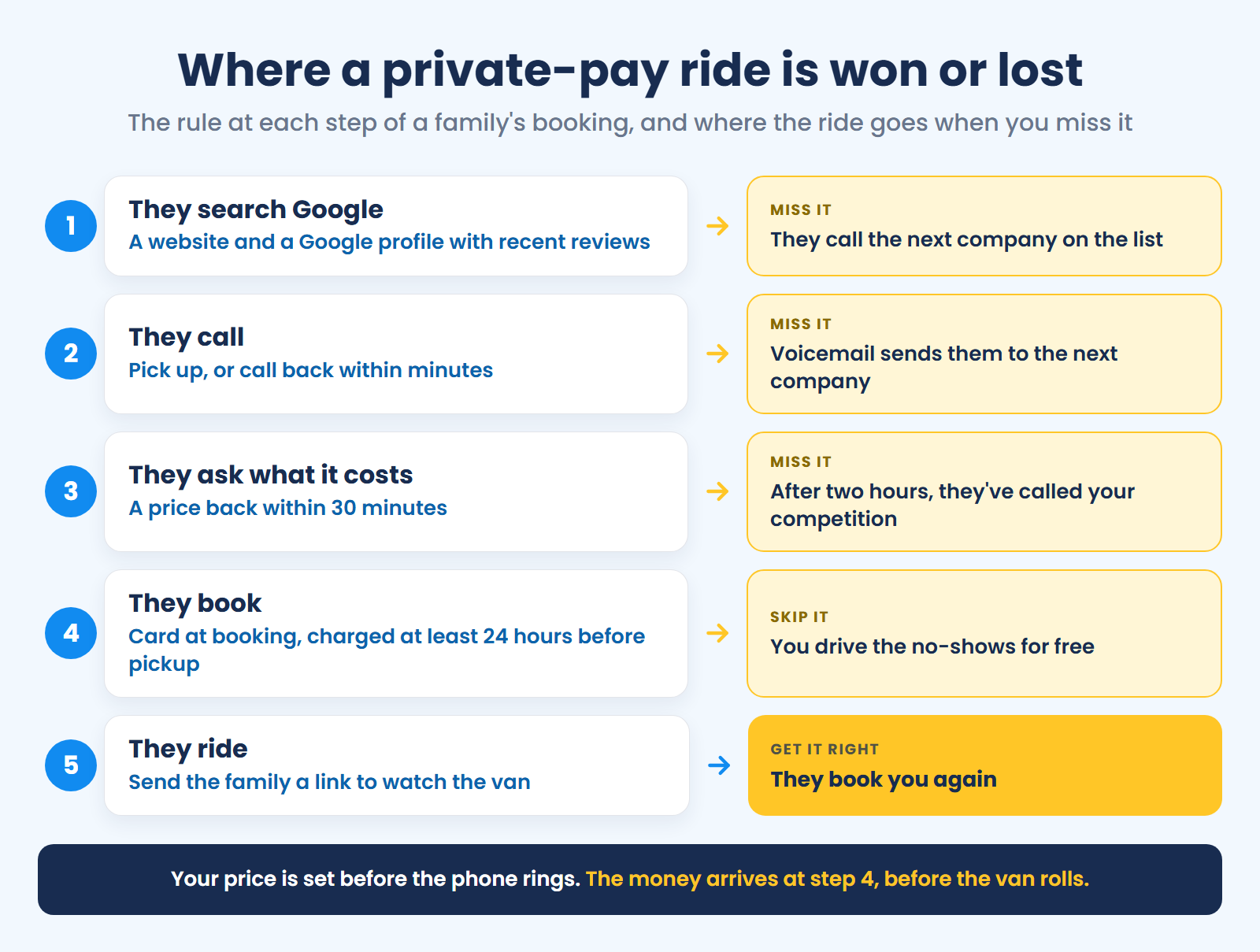
Get a price back to every caller within 30 minutes, and never let one wait two hours.
Then follow up on every quote. On their episode about building a NEMT business from day one, Ray and Mac walked me through The Doctor Ride’s process. They answer, then send the price in writing by text or email right away. If the family goes quiet, an automated follow-up goes out by text and then email over two days, and it stops the moment they reply.
They aim for 30 to 35 percent of quotes to say yes, because they price as a premium service: “I want 30% of people to say yes to our pricing. And I’m okay if 70% says no.” Most callers saying no is normal at a premium price. But a family that never hears your price can’t say yes.
To learn which kind of no they’re getting, they ask every week “how many people haven’t booked with us this week, and why have they not booked with us?” Lots of price objections means a hard look at their pricing. Lots of rides they couldn’t fit means another van.
Every week, count the callers who didn’t book and write down why.
How do you keep a private-pay rider coming back?
Run every ride the same way and let the family watch the van. Early in her career, Rachel gave private-pay riders a punch card: “every 10 trips they get 50% off.” She dropped it after a year or so, because it was a lot of extra effort and “the customers didn’t really care honestly. So they’re more interested in consistency and us showing up.”
Families who can’t see the van call instead. We built a shareable live-tracking link into Duet because private-pay family members were calling our customers every 10 minutes. Jing’s team has answered phones for some of them, and in her talk on NEMT dispatching she said riders think calling more brings the driver faster. Those calls jam the line until you miss the booking calls. Today, providers on Duet who send tracking links see 45% fewer “where’s my ride” status calls and 15% more repeat bookings (Duet customer data, 2026). The family taps a live-tracking link in a text and watches the van on a map from pickup to drop-off.
If you want to reward loyalty, Jing’s suggestion is a prepaid block: 10 trips paid up front at 10 or 20 percent off. Some riders won’t stay at a premium price, though. Riders who need a ride three times a week struggle to justify The Doctor Ride’s rates: “three times a week all month long, I mean, it really can add up.” They’ve started testing a membership for those riders and say it’s too early to know whether it works.
Before each pickup, text the family a way to watch the van, so they don’t have to call.
How much of your business should be private pay?
Get at least 10% of revenue from private pay, by Jing’s rule of thumb. Eight months in, as of June 2026, The Doctor Ride went much further, with no broker rides at all and at least 60 percent of its rides paid by riders or their families, the rest by a facility and other contract accounts. If I were starting over with five vans in 2026, I’d go after private pay and facilities first in most areas. But Jing’s other line holds too: “private pay is really easy to start with,” and on its own it’s “not enough” to grow a fleet, which is the trade-off between a high-volume and a high-margin business.
What should you expect in the first months?
Expect a slow start. When I asked Harry in 2025 what $500 a month in ads buys, he put it at five to 10 private-pay rides a month in some smaller markets, which he called the low side. Paul Muench’s phones in Phoenix “really started ringing” after about four or five months of meeting people in the industry and letting word of mouth build. His Google Ads came after that, and he went from zero to five vans in a year. Broker and facility trips keep the van moving while private pay builds.
When five to 10 rides a month is your whole private-pay book, one missed call is a real share of it. So before you spend another dollar getting found, call your own number at 4:45 on a Friday, the way a daughter booking her dad’s ride would. If it goes to voicemail, the ride goes to the next company on Google.
Private pay FAQ
Do you need a license for private-pay-only rides?
Often, yes. Private pay skips broker credentialing and Medicaid enrollment, not state or city rules. Ohio licenses companies that carry wheelchair riders to health care “regardless of whether the fee is paid by the person being transported.” In New York City, the city code calls for a Taxi and Limousine Commission license for wheelchair-accessible vans for hire, so get the commission’s answer on your van before you run it. Colorado’s Public Utilities Commission regulates walking riders who pay out of pocket but exempts vans built and used for wheelchair riders. Before your first paid ride, find out which license your state and city require for your vehicle type, whoever pays.
Can a private-pay rider share the van with a broker trip?
Read your broker contract first. MTM’s 2026 Rhode Island handbook bars drivers from carrying non-Medicaid passengers, private pay included, at the same time as a Medicaid rider on a scheduled trip. Other brokers and states write their own rules, so ask the broker before you put a private-pay rider in the van with a Medicaid rider.
Should you post your private-pay prices?
Harry Chambers’ rule is to post them only if they’re at or below what other providers in your market charge, because then the price sells for you. If you’re the premium option, keep rates off your website and get families to the quote form or the phone, where you can explain what the price includes.
Can families claim the ride at tax time?
Sometimes. IRS Publication 502 counts transportation primarily for and essential to medical care as a medical expense, but a family can deduct medical expenses only above 7.5% of adjusted gross income, and only if they itemize. Give every family a clear receipt for their records, and leave the tax question to them and their tax preparer.
All private pay guides
What to offer and where
- How to succeed in private pay: an NEMT discussionWebinar with digital marketing expert Harry Chambers on assessing the private-pay market, attracting clients, and retaining them through smart digital marketing.
Getting found by families
- What Google Ads Cost a NEMT Company, Per CallerWhat Google Ads cost a NEMT company: about $2 to $3 a click and $10 to $20 per interested caller, plus what to set up first, a first budget and what to block.
- The 5 Must-Haves for an NEMT WebsiteFive things every NEMT website needs, from a digital marketing expert: service levels, a services page, live reviews, real photos, and a short quote form.
- Getting found on Google for private-pay ridesLearn how NEMT operators can grow private-pay bookings with better websites, Google visibility, reviews, and local SEO.
- Web design, SEO and Google Ads for private-pay tripsESSIO Digital's Lana Becker on growing online NEMT bookings.
About the author
James O'Donnell cofounded Duet and leads its sales, partnerships, and growth services. He talks with NEMT operators every week, hosts the NEMT Growth podcast, and answers Duet's sales line himself. More about Duet's founders →
Want more trips and less busywork?
See how Duet runs and grows NEMT businesses in a 30-minute demo.