
Article
Long-Distance NEMT Trips: How to Price and Run Them
A 400-mile stretcher trip is 800 miles of driving and two people's whole day. Quote all of it, and get paid before you leave.
Guest: Jeanine, founder of SailorGirl Transport
By James O'Donnell, Cofounder and COO, Duet · · Updated
About 1 a.m. Eastern one night, a woman in Georgia was calling around for a ride for her brother. An Alabama hospital was ready to discharge him, and he needed to get home to Maryland. By morning one company had said yes, but only for Friday, and the family needed Wednesday. At 8 a.m. she got on a call with Jeanine Johnson, a nurse who runs SailorGirl Transport in Sarasota. Jeanine started with his medical conditions, and within 15 minutes, by my cofounder Jing’s account, the sister had picked her.
They left that evening. Jeanine had priced it on the spot, and in the rush she’d left out a line she typically includes: a gratuity for her crew. “I wish that I had,” she said later on our podcast.
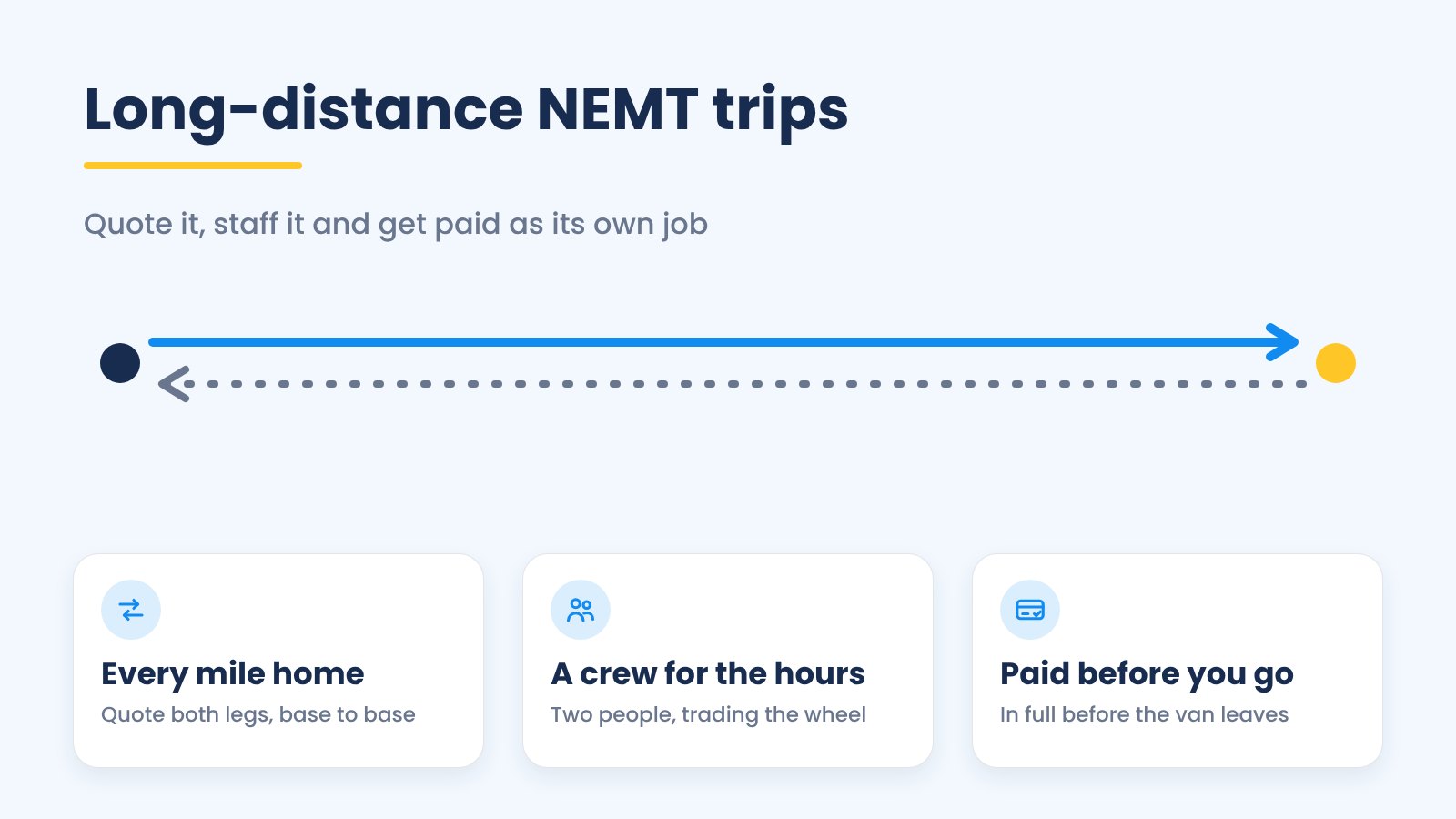
An owner in Central Florida told me on a demo that a 50- or 100-mile trip would “probably be cheaper per mile.” Not when an empty mile sits behind every loaded one. A long trip pays well only when you quote and staff it as its own job: every mile home, a crew sized for the hours, and payment before you leave.
Here’s one long trip in the order it happens, then where the next one comes from. The short answer: quote it base to base, with a load fee, every mile out and back, the crew’s gratuity, and meals, tolls and any hotel at cost. Past five or six hours, Jeanine sends a stretcher and two people who trade the wheel, and the family pays in full before the van leaves.
Should you take a long-distance trip?
Take one when you can spare a van and two people for a day or more and get paid before you go. If you can’t, refer it to a company you trust.
Most of Jeanine’s long trips are private pay, “because families want to be closer to their loved one,” she told me on Ep 19 of our podcast. If private pay is new to you, start with how private pay NEMT works. Facilities book long trips too, and so do families bringing someone home from a hospital.
“I make more on the long-distance transports than I do with seven or eight local transports,” Jeanine said, and she puts her margin on them at 40 to 50 percent, her own estimate. Local days can lose money when riders aren’t ready on time; on a long trip, “you don’t run into any of the logistical issues.”
The cost is a van and a crew gone for a day or more. A one-van owner in the Inland Empire told me on a demo that a single round trip to Orange County kept him out from 10 in the morning to almost 5 p.m., and “I was getting calls that I didn’t answer.” The owner of a company that runs only long-distance trips told an industry podcast in 2024 that you can’t just try one “and see how it goes”: it’s “very costly” and “very risky.”
Jeanine’s advice for a first one is to ride along with a company that already runs them. “It can be lucrative if you do it right,” she said. “If you do it wrong, it may not be.” She wrote an operations manual for operators getting into long trips, Beyond the County Line.
Can you take a trip across a state line?
Usually, once your insurer knows and your federal paperwork is in order. A paid trip from one state to another usually means operating authority from FMCSA (the Federal Motor Carrier Safety Administration), a USDOT number and $1.5 million of liability for a vehicle seating 15 or fewer, counting the driver.
Some taxi-style service is exempt, and FMCSA decides who qualifies, so ask FMCSA before you quote your first one. Our licensing guide covers who needs federal authority for a state-to-state trip.
Call your insurer first, though. Jeanine tells hers where the crew is going and when, then calls again when they’re back. When you buy a policy, she explained, one of the first questions is “What’s the radius of where you intend to operate?” A long trip takes the van outside that radius, so her insurer asks where she’s going and who’s going with her, to make sure everyone in the van is covered on her policy. When I asked whether it raised her rates, she said no.
Not every owner finds it that easy. The long-distance-only owner told that same podcast that a local company’s policy may cover a run into a neighboring state, but past that, “your insurance coverage might not be there.” Ask your agent before each trip.
Can this rider make the trip, and in what?
Ask for the doctor’s clearance and talk to the facility nurse before you quote, because the answers set the vehicle and the crew, and those set the price.
Jeanine wants anyone she takes long distance “cleared by their physician.” When the rider is in a facility, she talks “directly to the facility, to their nurse,” to rule out anything that should keep the rider from going by road. In Jing’s telling, those questions won the Alabama trip: Jeanine started with his conditions, the CPAP among them, and price came after.
Then the vehicle. Past five or six hours, Jeanine puts the rider on a stretcher, even one who can sit in a wheelchair. “I would not drive anybody wheelchair longer than 5 or 6 hours,” she said. She worries about blood clots in someone sitting in one position that long, and nobody rests well napping in a wheelchair. If stretcher is new to you, our episode on adding stretcher trips covers one way in. A stretcher sets the crew, too: on any stretcher trip, however short, Jeanine sends two people.
As Jeanine explains it, riders with full-on dementia or Alzheimer’s can get suddenly confused late in the day, which is called sundowning, and a nurse can give them medications as the doctor ordered. So for those riders, she wants a nurse aboard on any trip “longer than maybe 4 or 5 hours.” The Alabama rider was alert, but he used oxygen and had sleep apnea, so she sent a nurse rather than a CNA (a certified nursing assistant). “A CNA cannot assess, they cannot evaluate, they can’t implement any interventions, whereas a nurse could,” she said.
And she turns some riders down: someone so heavy her crew couldn’t give personal care on the road, extreme psychiatric issues, a medication list with six or seven psychotropics, or needs complicated enough to call for a physician aboard. Those are her lines, drawn as a nurse and as an owner. Write your own list before the next long trip calls.
How do you price a long-distance trip?
Quote it base to base: a stretcher load fee, every mile out and back, the crew’s gratuity, and meals, tolls and any hotel on top.
That’s Jeanine’s build. The baseline is “the mileage and the mode of transport,” she told me, and past five or six hours the mode is a stretcher, so she charges “the stretcher load fee” plus the miles, including “the deadhead back to base.” Deadhead is driving with nobody aboard, and on a long trip it’s the whole drive home. “It’s definitely going to be round trip,” she said. Meals, tolls and any hotel go on top.
If you pick a longer route, say to stay off mountain roads, be ready to explain why, because “just like you can look up the routes, they can too.” And tell the family before they book that anything unforeseen gets passed on to them. Jeanine tells them when she gives the quote, and “I’ve not had any family members that have given us any pushback whatsoever.”
The gratuity is the line she missed on the Alabama trip: it goes on the family’s quote and on to the crew, on top of their pay. That pay is a cost the quote has to cover. Jeanine’s drivers make $17 to $19 an hour, and on long trips she pays a bonus on top, because “I need them to be alert.”
Other owners bill the drive home too. A Midwest owner with about five vehicles told me on a demo that the company’s five or six long-distance trips a week pay very well “because we charge the deadhead miles back.”
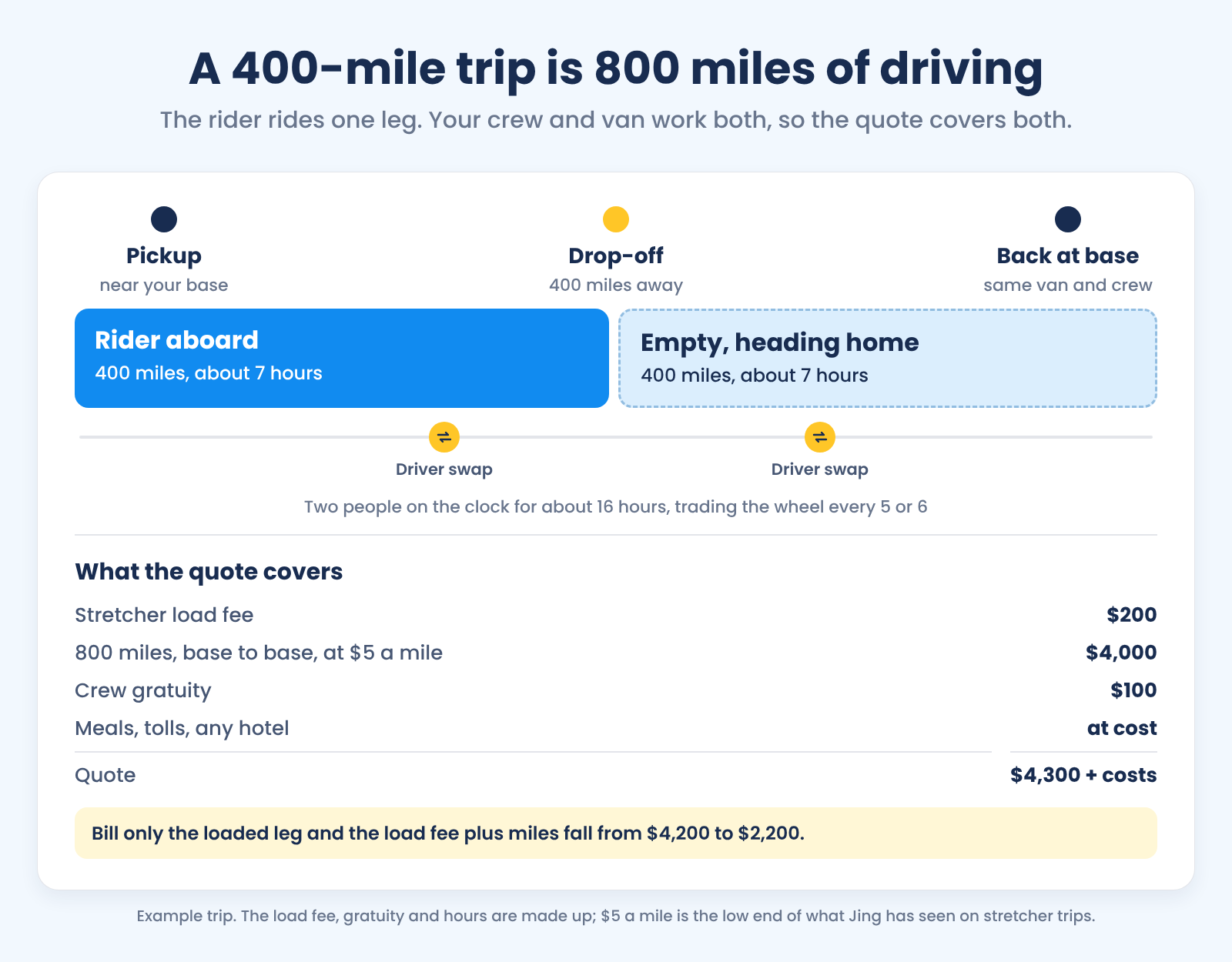
What one 400-mile stretcher trip costs, line by line
Say a hospital near your base discharges a stretcher rider to a facility 400 miles away, and your crew drives home empty. That’s 800 miles of driving, call it seven hours with the rider aboard and seven home, with a driver swap every five or six hours on both legs. Add the loading, stops and drop-off, and the van is gone about 16 hours. The load fee, the gratuity, the hours and the van’s 12 miles a gallon are made up; the other inputs name their sources.
The quote:
| Line | How it’s figured | Amount |
|---|---|---|
| Stretcher load fee | made up | $200 |
| Miles, base to base | 800 miles (400 out, 400 home) x $5 a mile | $4,000 |
| Crew gratuity | made up | $100 |
| Meals, tolls, any hotel | your actual cost, passed through | at cost |
| Quote | $4,300, plus meals and tolls at cost |
The $5 a mile is the low end of what Jing has seen stretcher trips priced at. Put your own stretcher rate there.
What the quote has to cover:
| Cost | How it’s figured | Amount |
|---|---|---|
| Crew wages | 2 people x 16 hours x $17 to $19 an hour | $544 to $608 |
| Fuel | 800 miles / 12 miles a gallon x $4.33 a gallon | about $289 |
| Crew gratuity | paid to the crew | $100 |
| Meals, tolls, any hotel | passed through | at cost |
| Direct cost | about $933 to $997 |
The wages are Jeanine’s driver pay, before any long-trip bonus. The fuel is about 66.7 gallons at $4.33, the federal Energy Information Administration’s U.S. average for regular gas the week of Oct. 12, 2026.
That leaves about $3,300 to $3,370 ($4,300 minus $997 to $933) for the long-trip bonus, the van’s wear, your insurance and your overhead.
Bill only the 400 loaded miles, the way you’d price a local run, and the load fee plus miles come to $2,200 ($200 plus 400 x $5) instead of $4,200, for the same 16 hours. The drive home is $2,000 of the price.
Then check the quote against your own hourly floor, counting every hour the van is gone, both legs. A Texas fleet owner on a call I sat in on won’t take a trip under $65 an hour, his bottom line. At $65, this trip’s 16 hours come to $1,040. Counting both legs in those hours is my method, not his.
Before you give the family a number:
- Call your insurer before each trip past your service radius, and FMCSA before your first one across a state line.
- Get the doctor’s clearance and talk to the facility nurse; past five or six hours, quote a stretcher.
- Write the quote line by line, with both legs and the crew’s gratuity on it.
- Divide the quote by every hour the van is gone, both legs, and turn down anything under your floor.
- Tell the family before they book that anything unforeseen passes through at cost.
When do you get paid?
Before the van leaves: families pay in full, facilities agree to invoice terms in writing first, and a Medicaid trip waits for whatever approval the state requires.
Families pay up front, as on any private-pay ride. Jeanine takes a deposit on a trip booked well ahead “just to make sure that they’re serious,” because a lot of work goes into preparing for one. People “stringing you along about paying you” are on her list of trips to turn down: when one trip’s date kept moving with no payment, she gave the day to other bookings. And carry a way to pay: when a headlight went out on one of her trips, the crew bought a bulb at the closest auto shop and kept going.
Facilities pay on invoice, so settle the terms in writing before the trip; our discharge guide covers how hospitals pay a transport invoice. Price short notice into the agreement, too. An owner with three vehicles told me on a demo that one of his contract clients sends long runs with little warning: “9 times out of 10, I never know what’s coming until the day of.” He negotiated a rate for those runs “so that way we didn’t really take a loss,” and bought a third vehicle to keep one free.
Medicaid trips run on state rules and broker rates, not this pricing. Each state sets its own terms for long trips: in Arizona’s fee-for-service program, for example, a member’s trips past 100 miles in a day need prior authorization.
Who goes, and what goes with them?
Two people who trade the wheel every five or six hours, a van with room for the rider’s things and power for their equipment, supplies for the whole day, and every device checked before you pull away.
On a long trip, Jeanine’s two-person crew rotates every five or six hours so the one not driving, who rides as the attendant, can rest. Mostly they drive straight through, and they book a hotel only when they have to, because “time is money,” she said, and “we’re not there to vacation.”
Jeanine runs a Ford Transit, and says RAM ProMasters work too. A long-distance rider needs “adequate room for luggage” and other belongings, and a wheelchair rider on her stretcher still needs the wheelchair along. Her vans always have auxiliary power, and she can handle oxygen from a cylinder, a portable unit or a concentrator.
Pack for the day: gloves, extra undergarments, disposable pads, trash liners, hand sanitizer and soft snacks that fit the rider’s diet. Jeanine arrives early to gather supplies, and “I always look in the bag to make sure that what I’ve requested is in the bag.”
Check the devices too, not just the bag. When her crew arrived to pick up the Alabama rider, “his oxygen concentrator was not there.” Getting into the house where he’d been staying cost “an additional 30 miles round trip.” Confirm at booking that every device the rider uses is coming along, and who can let you in if it isn’t.
When do you leave, and how does the family follow the trip?
Leave when someone’s ready at the other end, and keep the family posted with calls at breaks and a link that shows the van.
The Alabama trip was set to leave at 7 p.m. Around 5, the sister called to push it back: she was flying to Maryland and would have gotten there after the crew. With no way into his house and no hospital bed there yet, the crew would have sat waiting, at the family’s expense. The later start gave her time to get things in place, and the crew reached Maryland after she did. A facility’s arrival deadline works the other way: Jeanine drives through the night to meet one.
On the road, plan on the rider not working a phone. A lot of Jeanine’s riders don’t have cell phones or “don’t know how to work them,” so the family can call at a break to talk with them, and she sends pictures along the way.
A tracking link covers the stretches in between. Duet can text the family a link that shows the van on the map, and it opens in the phone’s browser with no app, account or login, so a daughter across the country sees the pickup, follows the trip and sees the drop-off. You still make the break calls and line up whoever’s waiting at the far end.
Where do more long-distance trips come from?
Mostly from asking: the facilities you already serve, your Chamber of Commerce, past long-distance families, a line on your website, and two or three companies you trade overflow with.
“It’s not the field of dreams,” Jeanine said. “You have to ask people for business, even if it’s your clients that you already do business with.” Start with the nursing homes you already have contracts with, or the VA: tell them you’ve added long-distance trips and ask them to send residents who fit. Then give back, with donuts during CNA Week or Nurses Week. “If people feel like all you’re doing is taking, they’ll stop giving.”
She calls her local Chamber of Commerce an excellent source of referrals. Past long-distance families have sent her others, and word of mouth, she said, is “the best form of referrals.” She lists long-distance trips on her website and ran Google Ads for a while. The long-distance-only owner said on that 2024 podcast that 90% of his business comes from Google Ads.
With facilities, I tell owners to ask to be the backup. A facility that already has a provider, or its own van, still needs someone for the weekends, the odd hours and the long distance. Take those trips well, and they’ll usually start calling you first for the rest.
Jeanine’s advice is to line up “two or three other companies that you can collaborate and work with” before you need them. This week, call two companies you trust and agree to hand each other the long trips you can’t take.
Jeanine’s crew got the Alabama rider home without incident and settled him in his bed with his oxygen and CPAP set up. The one thing she’d change is a line for the people who did the work, because “they did a job that was more than well done.” Next time a long trip calls, write the quote out line by line before you give a number, and find that line first.
Long-distance NEMT trips FAQ
How much does long-distance medical transport cost?
Operators usually quote long trips one at a time instead of posting a price, because each depends on its own miles, the vehicle and the crew it needs, and Jeanine counts the miles both ways. For one company’s numbers, a business that runs only long-distance trips told an industry podcast in late 2024 that its minimum charge was $5,000 and its average trip $8,000.
Does insurance cover long-distance medical transport?
Original Medicare pays for ambulance rides only, when riding in any other vehicle could endanger the rider’s health, and only to the nearest facility that can give the care needed. Some Medicare Advantage plans include rides, but none has to. Medicaid can pay for a long trip under each state’s own rules. Most of Jeanine’s long trips are paid for by families.
Can a ground NEMT company handle a trip by air?
Some do, as escorts on commercial flights. A Texas fleet owner on a call I sat in on in September said his company had done 16 or 18 of those trips so far this year, most of them for parents with dementia whose children are moving them closer. Jeanine’s company runs long trips by ground or by air.
About the author
James O'Donnell cofounded Duet and leads its sales, partnerships, and growth services. He talks with NEMT operators every week, hosts the NEMT Growth podcast, and answers Duet's sales line himself. More about Duet's founders →
Want more trips and less busywork?
See how Duet runs and grows NEMT businesses in a 30-minute demo.