Article
NEMT Rates in 2026: What a Trip Costs, by Who Pays
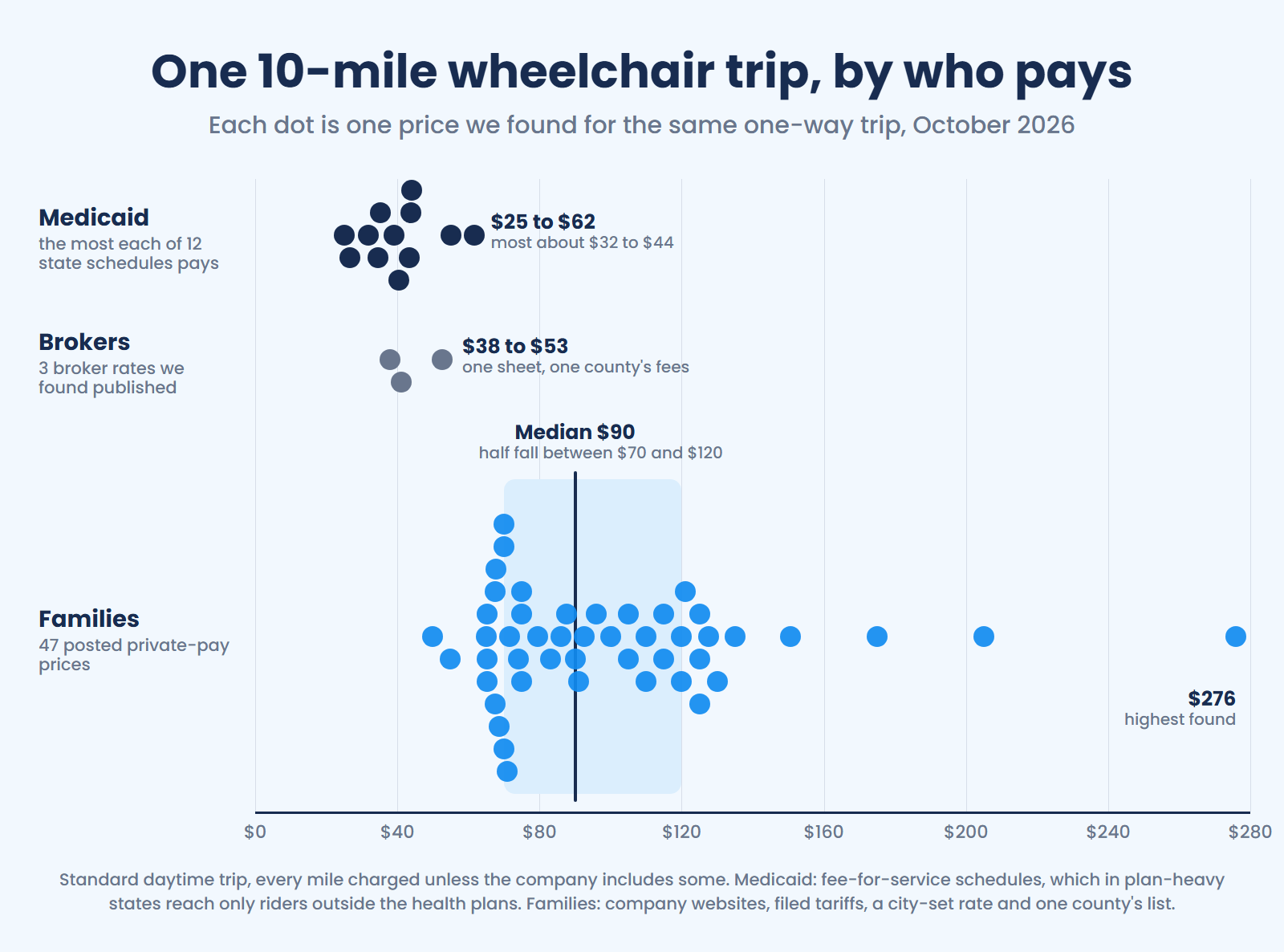
One standard 10-mile wheelchair trip, October 2026: at most about $32 to $44 on most Medicaid schedules we found; $90 median across 47 posted prices.
By James O'Donnell, Cofounder and COO, Duet ·
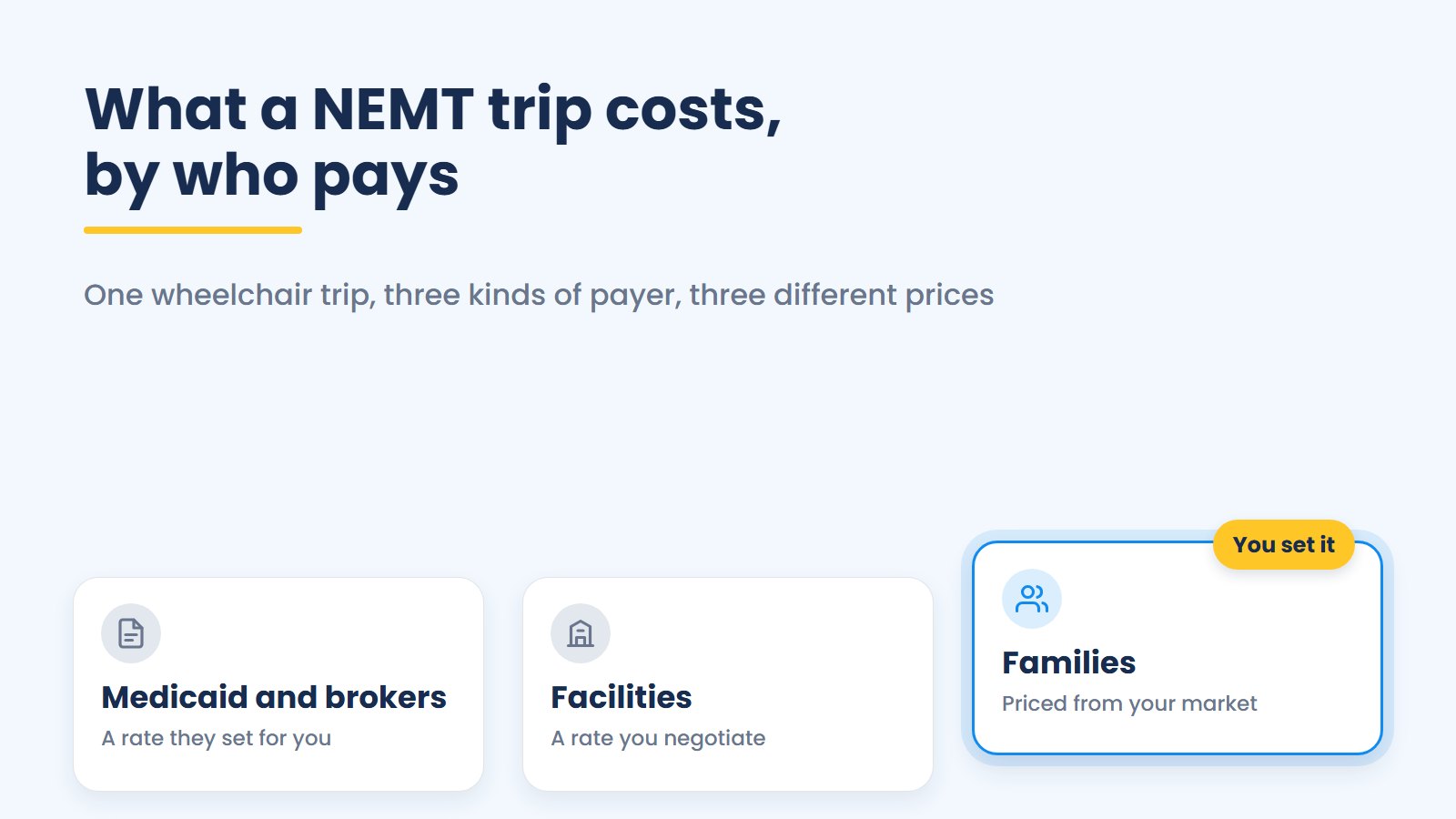
There’s no single rate for non-emergency medical transportation (NEMT). As of October 2026, the 47 private-pay prices we found posted for a 10-mile, one-way wheelchair trip have a median of $90. Medicaid allows far less: the most a standard trip like that pays is about $32 to $44 in eight of the 12 states we found that publish a wheelchair van rate a company can bill, counting Illinois’s Cook County and South Dakota’s in-town rates. The one rate sheet we found posted by a broker, the company a state or health plan hires to arrange Medicaid rides, pays $41 in the daytime.
In July, a new one-van owner east of Orlando asked me on a demo, “What’s the average per trip?” I told him it depends on the type of service. Later he told me what people were charging: base fares of $39 or $49, plus $1.50 to $3.50 a mile, or $54 to $84 for 10 miles, all under that $90 median.
Type of service was half the answer. The other half is who’s paying. Each payer prices the same trip differently, and in the ten same-state pairs we could compare, the posted family price ran about twice what Medicaid allows at the median. So set your private rates from your market, never from the broker’s rate. Here’s how the price gets set, payer by payer, then what moves it, what families pay besides the fare and how to set yours.
How much does non-emergency medical transportation cost?
As of October 2026, the posted prices we found for a 10-mile, one-way trip had medians of $74.75 ambulatory, $90 wheelchair and $249.50 stretcher. Medicaid and the one broker rate sheet we found pay less at every level:
| A standard 10-mile, one-way trip, October 2026 | Medicaid: the most a state schedule pays | One broker’s posted rate sheet (Rhode Island, daytime) | Posted private-pay prices |
|---|---|---|---|
| Ambulatory | Up to $39.55 (10 of the 12 states list it) | $26.50 | Median $74.75 (22 prices) |
| Wheelchair | $25.10 to $61.54; about $32 to $44 in 8 of the 12 | $41.00 | Median $90; half between $70 and $120 (47 prices) |
| Stretcher | Up to $123.07 (7 of the 12 list a stretcher van) | $197.50 | Median $249.50 (20 prices) |
The Medicaid column is each state’s fee-for-service schedule for a standard trip of 10 loaded miles, the miles with a rider aboard, read October 20, 2026, at Illinois’s Cook County and South Dakota’s in-town rates. Most of these amounts are ceilings; Louisiana’s is a set rate, and Colorado’s schedule doesn’t call its amount a maximum. Michigan’s $25.10 is half of a 20-mile round trip, and Colorado’s $61.54 and $39.55 reach only companies enrolled before Oct. 1, 2026, outside nine metro counties, until Jan. 1, 2027. The private column is what companies post, file or report for their own service, plus the City of Los Angeles’s set rate, read October 21, 2026, with every mile charged unless the company includes some.
By the mile, the posted wheelchair prices that charge mileage add $2.00 to $9.60 a mile to a base; the 12 Medicaid schedules pay at most $0.76 to $2.74 a loaded mile. The last column is the one you set, and our private-pay guide covers what to charge for a private-pay ride.
Why does Medicaid pay so much less?
Medicaid pays less because the state or its broker sets the rate, and that rate generally covers only the trip with the rider aboard, not the drive to the pickup or a no-show. Of the 12 state schedules, only Arizona’s, Indiana’s and Medi-Cal’s (California’s Medicaid program) pay for waiting, each under conditions.
Most Medicaid riders’ trips go through a broker, at whatever your contract with that broker says. In most of the 12 states, the state’s schedule reaches only fee-for-service riders, the ones outside the health plans; Medi-Cal uses its schedule for about 5% of members. A broker’s rate comes out of the fixed amount the state often pays the broker for each member every month, which is how NEMT brokers get paid.
The only broker rate sheet we’ve found posted is MTM’s for Rhode Island, effective July 1, 2023: $41.00 for the trip in the daytime and $47.00 after hours, for pickups within 40 miles of where you keep your vans.
One county’s fee schedule shows how differently two brokers can be billed for the same trip. For fiscal 2025/2026, Moore County, North Carolina lists what its public transportation department charges two Medicaid brokers for a 10-mile wheelchair trip: $38.00 to ModivCare, and $30.00 plus $2.25 a mile to MTM, or $52.50 if every mile is charged. That’s one public operator in one county, not what brokers pay in North Carolina.
Rachel Scholler, who ran a NEMT company in Wisconsin for 17 years, told us what that means for a new owner: “the broker rates are dictated to you in most instances, but your private pay can be a little bit higher.”
What do families pay for a wheelchair ride?
Whatever the company charges: the 47 posted prices we found for a 10-mile, one-way wheelchair trip ran $50 to $276 on October 21, 2026. Here they are beside the most each of the 12 Medicaid schedules pays for a standard trip, and the three broker rates we found published, one Rhode Island sheet and one county’s fees to two brokers:
In a few places, a regulator has the price on file. Nevada’s Transportation Authority posts medical carriers’ tariffs, the price lists they file with the state, such as one Las Vegas carrier’s accepted tariff. The five we read, accepted between January and August 2026, charge $90, $100 and $115 for that trip in Las Vegas and $105 and $110 in Reno. Pennsylvania’s Public Utility Commission keeps paratransit tariffs too, such as one carrier’s filing east of Pittsburgh. Three recent filings come to $130 around York, $135 east of Pittsburgh and $205 around Reading, as filed.
The City of Los Angeles goes furthest. A city ordinance sets the one rate every permitted wheelchair van must charge a private-pay rider for a trip that starts in the city: $46 plus $4 a mile, or $86.00 for 10 miles, in force since Sept. 16, 2022.
Even inside one county, prices spread wide. Washington County, Oregon, publishes the rates its licensed providers report, updated September 2026, and doesn’t regulate them. For the same 10 miles, the 19 wheelchair providers it lists run $65.14 to $150.50, about 2.3 times, with two providers’ posted ranges taken at their midpoints. Eighteen of the 47 prices come from that list (its 19th provider posts its own price, which we counted instead), and the 20 company websites alone also have a median of $90.
Treat each as one company’s number in one market on one date, and check your own market by phone: in ten states we searched, including Ohio, Arizona and Michigan, we found no posted price we could read.
How much more do families pay than Medicaid?
About twice at the median: in the ten same-state pairs we could compare, a posted 10-mile wheelchair price ran 1.2 to 5 times the state’s Medicaid figure for the same trip, 2.05 times at the median.
| Market | Posted price, 10-mile wheelchair trip (October 2026) | Medicaid figure, same trip | Posted price as a multiple of Medicaid |
|---|---|---|---|
| San Mateo County and San Francisco, California | $175.00 | $35.30 | 4.96x |
| San Diego, California | $125.00 | $35.30 | 3.54x |
| City of Los Angeles (the city’s set rate) | $86.00 | $35.30 | 2.44x |
| Sacramento, California | $82.98 | $35.30 | 2.35x |
| San Gabriel Valley, California | $75.00 | $35.30 | 2.12x |
| Riverside and San Bernardino, California | $70.00 | $35.30 | 1.98x |
| Cook County, Illinois | $79.50 | $40.30 | 1.97x |
| LaPorte County, Indiana | $50.00 | $31.79 | 1.57x |
| Winona County, Minnesota | $54.90 | $39.00 | 1.41x |
| Syracuse, New York | $92.50 | $77.50 (a default) | 1.19x |
Each pair sets one posted price beside the most that state’s schedule pays for a standard trip. The Chicago-area row uses the midpoint of a company’s estimated range, and Syracuse’s uses New York’s default rate, which the broker’s negotiated rates replace.
Twice isn’t a target everywhere, though. All four pairs outside California ran under twice, and the gap was narrowest in Syracuse, Winona County and LaPorte County. Minnesota’s $39.00 assumes the rider’s home zip code isn’t rural; if it is, Minnesota pays more and the gap narrows.
Write your own 10-mile, one-way wheelchair price next to your state’s Medicaid figure for the same trip. If your state doesn’t publish one, use about $32 to $44, what eight of the 12 schedules pay at most for a standard trip, counting Illinois’s Cook County and South Dakota’s in-town rates. Every posted price in these ten pairs was at least 1.19 times its state’s Medicaid figure. If yours isn’t, you’re pricing families like Medicaid riders.
Do facilities pay more than families?
Not by default: the closest public prices we found are 4% to 9% volume discounts, and one public hospital caps every rate at New Jersey’s Medicaid rate. My cofounder Jing’s rule is simple: price an account that only sends overflow “as a private pay,” and save a “volume based discount” for the one that guarantees you trips.
We found no facility contract or rate sheet with per-trip prices published for 2024 to 2026. The nearest public numbers are in Nevada, where four carriers’ accepted tariffs cut their wheelchair price 4% to 9% once a customer completes 8 to 20 or more trips in a day. Two offer it to “any person or entity” that does. A family won’t, so in practice the discount would go to a facility or a program.
One public hospital pushes the other way. University Hospital in Newark asked bidders in April 2026 for rates “no greater than the current New Jersey Medicaid rate,” applied to private-pay and self-pay transports too, and pays on Net 45 terms, within 45 days of the invoice.
Mac, one of The Doctor Ride’s founders in Charlotte, told us in June that a facility they drive for pays $125 a leg for wheelchair trips with five free miles. “That’s the only hookup we give that facility on the pricing,” he said on our episode with The Doctor Ride.
Tony Jackson, an Orlando operator with 35 years in the business, sees more room than a broker leaves you. With a facility, “you have the power,” he said on our October 2025 episode with him, and once you offer stretcher, oxygen and bariatric service, “that’s when you can charge a premium rate for it.”
Facilities also pay later. Three of the Nevada tariffs charge 1% a month on invoices unpaid after 30 days. A Fort Worth owner told me on a call in July that he charges facilities no after-hours fees and can take 2% to 3% off when they pay within 10 days. Put whatever you offer in writing; our facility guide covers what a facility rate sheet should say.
If you discount for a facility, tie it to volume or to how fast they pay, like the 4% to 9% volume tiers or 2% to 3% for payment in 10 days, never to your broker rate.
What changes the price of a trip?
Level of service first: on the posted price lists that show both levels, a stretcher trip ran a median 2.21 times the same list’s wheelchair price, and an ambulatory trip 71% of it. Jing has seen gurney trips priced at $5 a mile or more, since a stretcher trip can take two people.
Then come the clock, the wait and the extras. Here’s one 10-mile trip that starts in the City of Los Angeles, priced at the city’s set rate and at Medi-Cal’s fee-for-service maximum, one change at a time:
| One 10-mile trip starting in the City of Los Angeles | The city’s set rate (since September 2022) | Medi-Cal fee-for-service, at most (table updated September 2023) |
|---|---|---|
| Weekday wheelchair trip | $86.00 | $35.30 |
| The same trip after 7 p.m. | $105.75 | $41.43 |
| An hour’s wait at pickup or drop-off, after the first 15 minutes | Add $48.00 | Add $22.60 (only while waiting to load the rider; 90 minutes at most) |
| A stretcher trip instead | $156.50 | $41.29 |
Switch to a stretcher and Medi-Cal’s maximum rises $5.99, while the city’s rate rises $70.50.
The posted prices we found, read October 21, 2026, move the same way. After-hours surcharges ran a median 24% of the weekday leg across 13 posted charges, and weekend surcharges 28% across eight. Waiting ran a median $60 an hour across 28 posted rates, 27 of them between $20 and $120.
Included miles on the posted sheets run from none to 15, and Indiana’s Medicaid schedule pays no mileage for the first 10 miles one way. To me a ride home is just another trip, but some companies discount it: at the six we found posting both, each leg of a round trip cost 58% to 100% of the one-way price, 87% at the median.
Put it together for one family’s wheelchair trip: 10 miles to a clinic and back, with an hour’s wait. At one Winona County, Minnesota company’s posted rates, among the lowest we found, $30 a pickup plus $2.49 a mile on each leg ($54.90 a leg) and $11 per 30 minutes of additional waiting ($22), that comes to $131.80. Minnesota’s Medicaid schedule pays at most $78.00 for the same two legs as standard wheelchair trips if the rider’s home zip isn’t rural, and its provider manual counts the wait as part of the service, with no separate amount for it.
Extras add up too. Stair help runs $25 to $150 a trip on the sheets we found, and oxygen $25 to $30. Tony’s example shows how far a hard discharge can go: a hospital patient going up stairs with no elevator, where “if a trip is $250,” with the stairs “the price is going to be $625.”
Two moves for this week:
- Price the extras. Put waiting, after-hours and no-show terms on every private and facility rate sheet, with waiting priced per 15 or 30 minutes. Only three of the 12 state Medicaid schedules pay for waiting at all, each under conditions.
- Price stretcher at about twice wheelchair or more. The posted median is 2.21 times, and the trip can take two people.
What does a family pay besides the fare?
On a private-pay ride, the family pays the whole fare, and many of the posted terms we found, read October 21, 2026, collect it before the ride and charge for late cancels and no-shows.
Some posted terms take payment on delivery or at pickup. Others want it up front: a Portland company doesn’t confirm a ride until it’s paid in full, by 5 p.m. the day before, and a San Diego company takes a $40 deposit.
For rides booked ahead, most owners I talk to take a card at booking and charge it at least 24 hours before pickup, or send a payment link due by then.
Posted cancellation windows run from two hours to the day before, and wheelchair no-show fees from $30 to $100, or the whole fare. Federal Medicaid guidance bars charging a Medicaid rider for a no-show, so who pays for a no-show depends on the payer.
Original Medicare covers no “non-ambulance forms of transportation, such as ambulette, wheelchair van, or litter van,” per Medicare’s claims processing manual. A Medicare Advantage plan doesn’t have to cover rides, and when it does, the plan arranges or provides them.
The IRS counts amounts paid for “transportation primarily for and essential to medical care” as medical expenses in Publication 502. So a family may be able to pay for the ride from a health savings account or claim it from a flexible spending account, where the plan’s administrator decides.
Tell every family before they book that Original Medicare won’t pay for a wheelchair van, and when you’ll charge their card.
How should you set your own rates?
Start from your cost per trip and what three to five local companies charge a family for the same trip, never from the broker’s rate.
That’s what I told the owner east of Orlando: search for a wheelchair ride near you, call whoever comes up and ask what one trip would cost. Five quotes tell you roughly what your market charges.
Your floor is your cost per trip, and our operations guide shows how to figure your cost per trip from last month’s books.
A price near Medicaid’s can still earn its place, on a broker trip that fills an empty slot or a facility discount that buys steady volume. Below your cost per trip, take it only for hours the van and driver would otherwise sit idle, and only if it brings in more than the trip’s own gas, wear and extra driver pay. Just keep that number off your family quotes.
Set the private price high enough the first time. In an earlier episode, Rachel told us her regret from her own company: “early on I was a little bit afraid to raise my rates too much and I should have.” And on our pricing episode with Rachel Scholler, she said, “Once you lower the rates, it’s really hard to get it back up.” If a caller balks, I’d offer a first-ride discount of 10% or 20% instead of cutting the price for everyone.
Keep a separate rate sheet for each payer, so a broker’s number never lands in a family’s quote. In Duet’s billing, rates are set per contract, so the same wheelchair trip can bill differently for two different payers, and a family gets a clean, readable invoice for the trips you ran. You still set the rates, negotiate each facility’s sheet and collect from families before the ride.
The owner east of Orlando wanted one number. The honest answer to “What’s the average per trip?” starts with a question back: who’s paying? Pull up the last price you quoted a family. If it sits closer to what your broker pays than to what the companies down the road charge, you priced that family off the wrong payer.
NEMT rates FAQ
Is there a national average NEMT rate?
Not one we could find published. Google’s AI answers in October 2026 put the “national average base” for a wheelchair trip at “roughly $87,” before any mileage, but we found no source behind that figure. To compare prices, get three to five local quotes for the same trip: the same level of service, the same miles, one way or round trip, and what’s included.
What do workers’ comp and the VA pay for a wheelchair van trip?
Georgia’s workers’ comp fee schedule, in its newest free copy (April 1, 2020), allows at most $3.32 a mile plus $44.92 a trip for a lift van, or $78.12 for 10 miles. It also pays for waiting once a day’s waits add up to an hour, and up to $84.25 for a no-show. For eligible veterans, the VA pays “the actual cost of a special mode of transportation” under its travel rules, through contracts whose prices we didn’t find published.
About the author
James O'Donnell cofounded Duet and leads its sales, partnerships, and growth services. He talks with NEMT operators every week, hosts the NEMT Growth podcast, and answers Duet's sales line himself. More about Duet's founders →
Want more trips and less busywork?
See how Duet runs and grows NEMT businesses in a 30-minute demo.