Article
How to Reduce NEMT No-Shows (and Prove the Ones You Can't)
Private-pay riders confirm by paying ahead. Brokers almost never pay for a no-show, so hear about cancels early and prove the rest from the door.
By James O'Donnell, Cofounder and COO, Duet ·
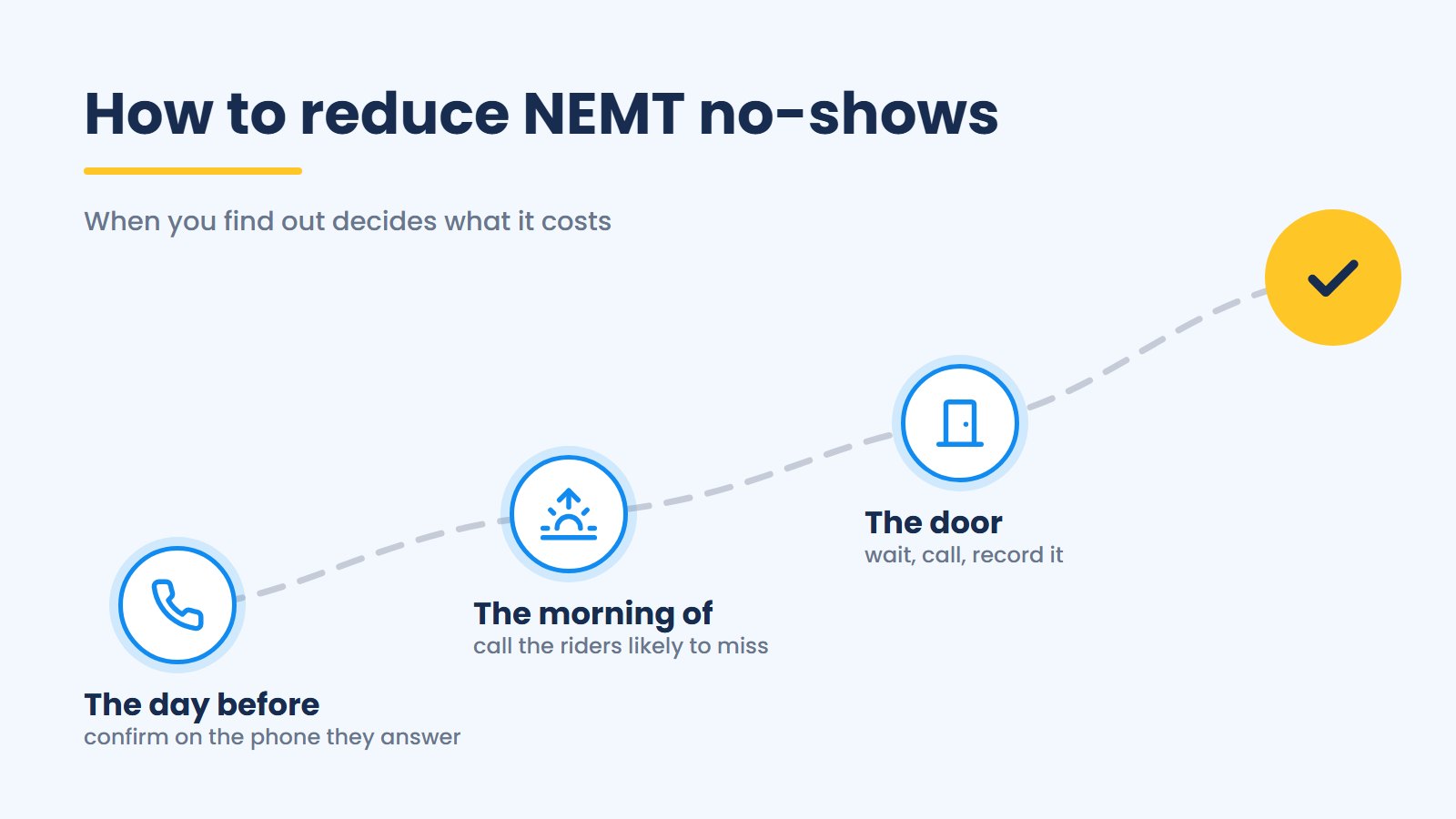
To reduce NEMT no-shows, confirm each trip the way its payer allows. Private-pay riders confirm by paying at least 24 hours before pickup, and no payment means no car. Facility trips take one call to the front desk, or none. Broker riders need a call or text the day before on the phone they actually answer, another the morning of if they’ve missed before, and a driver who records any no-show from the door.
Rachel Scholler ran a NEMT company in rural Wisconsin for 17 years, and she tried the day-before call. When I asked her on our episode about pricing NEMT trips whether calls or texts cut her no-shows, she said her office called riders the night before. “But that doesn’t matter. They’ll tell you they’re going and still no show you in the morning.” Somebody in her office was spending an hour the day before on those calls, and “it’s not alleviating the problem.”
She’s right that a yes the night before doesn’t hold for everyone. But the call’s job isn’t to make every rider show up. It’s to hear from the ones who won’t while you can still fill the slot. On a Medicaid trip, the earlier you find out, the less a no-show costs, because you almost never get paid for one. The ones you can’t head off, you prove from the door.
So this guide follows one trip’s clock: who pays for a no-show, what’s normal, why riders miss, the day-before confirmation, the morning of, the door, and the riders who keep doing it. Broker trips need every step, so most of the space goes to them.
Who pays for a NEMT no-show?
A broker almost never pays you for a Medicaid no-show. A private-pay rider has usually paid before the van leaves, and a facility pays whatever your service agreement says.
On a broker trip, what a no-show costs you depends on when you find out. CMS, the federal Medicaid agency, won’t put federal money toward transporting a rider who “does not appear for their ride,” per its 2023 Medicaid transportation guide.
MTM’s Rhode Island provider page says the broker “does not pay for no shows.” New York’s statewide broker, Medical Answering Services (MAS), answers the question in its provider FAQ with a flat “No.”
Where a Medicaid contract pays anything, it’s small. Where one of Rachel’s contracts paid a no-show fee at all, it was $10 or $15, “which doesn’t really compensate for what you’re losing, but you’re at least getting something,” and getting it was “like pulling teeth.” My cofounder Jing Zhu takes a dispatch shift for a customer every week. On the same episode, she put the cost in dispatcher terms: “your driver is literally there and you might miss other trips as well.”
Timing is the part you control. Rachel found two hours’ notice too late: “If you get 2-hour notice, like they say, I can’t fill that ride that quickly.” What a no-show costs on a broker trip, by when you hear about it:
| When you find out a broker rider isn’t going | What it costs you | What you can still do |
|---|---|---|
| The day before | Nothing, if you fill the slot | Cancel it with the broker and give the slot to another trip |
| The morning of | Maybe the slot, but not the drive | Move the van to another trip, if one’s waiting |
| Under two hours before pickup | Usually the slot, since it’s too late to refill | Cancel it with the broker so the record is clean |
| At the door | A paid driver’s drive out and back, plus the trip that slot could have carried | Prove it’s the rider’s no-show before the van leaves |
Private pay is where you set the terms, and most private-pay operators I talk to set them so the money comes first. They take a card when the ride is booked and charge it at least 24 hours before pickup, or send a payment link that has to be paid by then. No payment, no car. Some also take a small nonrefundable deposit at booking to hold the spot on the schedule. The Doctor Ride, a private-pay company, takes a deposit when it books a ride. A co-founder said on our episode about building from day one that the deposit is “to solidify that we’re going to be doing the ride right when we mark off the schedule that the van’s going to be unavailable.”
Facility trips, the ones a hospital or care home books and pays for, are the third case, and the service agreement is where their no-show terms live. Christopher Buell, who’s spent decades selling NEMT to facilities, was asked on our episode about calling facilities how he keeps no-shows and cancellations from hurting profits. “I have a cancellation fee,” he said, and he writes wait time and cancel time into his service agreements too.
What’s a normal NEMT no-show rate?
Rider no-shows at the door run around 1% of scheduled rides in Indiana’s state Medicaid reports. In Indiana’s report for May 2026, they were 0.7% of 33,535 scheduled rides, and rider cancellations were 7.6%, more than ten times as many. In Indiana’s February 2022 report, no-shows were 1,014 of 70,011 scheduled rides, about 1.4%. Those are traditional Medicaid rides, the ones the state pays for directly rather than through a health plan. The reports don’t say how many of the cancellations came late, and late is the kind that costs you.
Plenty of operators count more broadly than the state does. As Jing put it on the pricing episode, “Most people say if you cancelled within 24 hours or at least the same day, that’s a no-show.”
You’ll also see a 15% to 30% NEMT no-show rate quoted online. The pages that print it credit clinic-appointment sources or nothing at all, so don’t grade your book against it.
When you count yours, keep two numbers: riders who weren’t there when the van was, and riders who canceled the same day. They don’t have the same fix. As a gut check, if your door no-shows run well above 1% of scheduled pickups, look at your calls and your door routine before you blame the riders.
Why do riders no-show?
Riders miss when plans change and nobody tells you: the appointment moves, family drives them, or they get sick or decide not to go. Indiana’s Medicaid office gave its NEMT commission much the same list in 2019: “not presenting for the ride, declining ride at time of pick-up, member too ill, member found another ride.”
Paul Muench, who built Gentle Turns in Phoenix to five vans in a year without broker trips, told me his cancellations are “always because the doctor canceled the appointment or someone is sick.”
Some misses no call can prevent. In Indiana’s May 2026 report, more rides were missed because the rider was too sick or in the hospital (275) than were logged as rider no-shows (234).
Who pays matters too. Rachel told me on an earlier episode about growing at a 30% margin that her broker work came with “a higher rate of no-shows.” Jing’s rule, from the pricing episode, is that free-to-the-rider trips are “the time you have to really confirm.”
How should you confirm tomorrow’s rides?
Confirm every trip the day before, in the way its payer allows. A private-pay rider confirms by paying, since the charge runs at least 24 hours before pickup, so a declined card or an unpaid link tells you a day early. A facility’s trips take one call to the front desk to confirm all of that day’s rides at once, and some facilities don’t need a call at all. Broker riders need a call or text on the phone they actually answer. Some brokers already ask for it: MTM’s Rhode Island handbook says providers “will contact the members 24 hours prior,” and Modivcare’s Mississippi manual says to reach riders “no later than the night before.”
Our customers with facility contracts like to make those calls themselves, Jing said in our episode on mastering NEMT dispatching, because at “a lot of facilities, the caregivers actually confirm the pickups,” often two or three riders in one call.
For broker riders, the right phone depends on the rider:
| Rider | Confirm the day before with | Why |
|---|---|---|
| On a landline, or only a house phone on file | A phone call | A text never arrives. About one in eight adults 65 and older answer mostly or only on a landline, per a federal health survey from late 2024. |
| Reads texts | A text that says how to cancel | Texts worked about as well as calls in a 2013 review of text-reminder studies, but the studies that compared the two only enrolled people who could read texts. |
| Lives at a facility | One call to the front desk, nurse, caregiver or coordinator for all of that building’s riders | Staff often confirm several residents in one call. |
| Didn’t answer the first text or call | A second try, by a person | In a 2010 clinic trial, where reminders went out three days ahead, no-shows ran 13.6% after a staff call against 23.1% with no reminder. |
Sort tomorrow’s riders that way tonight, before anyone dials. Then expect more cancellations, not fewer: in that clinic trial, reminders raised cancellations too. A cancel the day before is a slot you can still fill. Indiana’s May report also shows 340 scheduled rides that still had no provider on the day of the trip, so ask your broker how it offers open trips to a van with a free hour.
This is the step we built a tool for. Duet’s voice AI places reminder calls or texts the day before each pickup, to the rider, a family member or a caregiver. When a rider cancels on one of those calls, Duet notes it automatically, so your dispatcher sees it in time to fill the slot. It’s included with the software at no extra cost. Your dispatcher still decides which riders get a person on the phone, and the no-show policy and the door stay yours.
What should a confirmation call ask?
Ask first whether the appointment is still on, then check the pickup time, the address, the mobility aid and how to cancel. Ask in that order, because the appointment is what moves, and its time sets the pickup.
- The appointment. Ask “Is your appointment tomorrow still on?” before anything about the ride. That’s where many of Paul’s cancellations came from.
- The pickup time. Give the window, and ask the rider to be ready 15 minutes early, which is what MTM’s Idaho rider page asks too.
- The address. Say the pickup address out loud and let the rider correct it, so a wrong door doesn’t turn into a no-show.
- The mobility aid and anyone riding along. Manual or electric wheelchair, the rider’s weight, oxygen, and any extra passenger. Te’ya Miles, who runs an Atlanta NEMT company and trains new owners on her YouTube channel, checks all of these at least 24 hours out, so the right van and driver show up.
- How to cancel. Give the number to call if plans change, make it the number they see when you call, and tell them an early cancel is fine.
Log each rider as confirmed, canceled or not reached, and pass cancellations to the broker right away. MTM tells its Minnesota providers to cancel the trip in MTM’s own system when a rider says they won’t go. The not-reached list is where tomorrow morning starts.
Should you call again the morning of?
Call riders who’ve missed before or didn’t answer yesterday again the morning of, because a night-before yes doesn’t always hold. It won’t catch every rider who changes their mind overnight, but it shrinks Rachel’s problem without redoing the whole list.
Te’ya calls riders again one hour before pickup, because some riders decide not to go and never tell you. As she put it in a 2023 live training she posted to her channel, they cancel “in their mind but they just didn’t make the act of calling.” An hour out is too late to refill the slot, but it can still save the drive.
Save the morning calls for:
- Anyone who’s no-showed before.
- Anyone you didn’t reach yesterday.
- Riders you’ve never driven, since you have no record on them yet.
- Long pickups, where a wasted trip costs the most. In the dispatching episode, Jing described customers who can’t confirm every ride choosing to confirm their out-of-town pickups.
Make each call before the van leaves for that pickup, while the answer can still change where it goes.
Does the van go if nobody answered?
On a broker trip, your contract decides whether the van goes when a rider never answered, and some contracts say it goes anyway. MAS’s provider manual requires New York providers to “dispatch a vehicle regardless of communication with enrollee,” so an unanswered call cancels nothing there.
In Rhode Island, MTM’s handbook wants any trip you can’t run handed back at least 24 hours before the appointment. Hold the van that morning without handing the trip back and MTM counts it as your no-show, and so does a hand-back with under three hours to go. Provider no-shows on 0.5% of trips put you in the red.
Not everyone sends the van. A Charlotte operator explained her rule on a 2023 podcast. Her office calls before the van goes, and “if you don’t answer the phone… we’re not going, period,” because “the broker does not pay a no-show rate.”
Her rule saves the drive. Under a contract like MAS’s, it also turns the rider’s no-show into yours. So before you copy it, find two lines in your contract: whether you must dispatch without contact, and how late you can hand a trip back.
What should the driver do when nobody comes out?
The driver’s job at the door is to make the no-show provable before the van leaves, so it goes down as the rider’s and not yours. Four rules cover it:
- Knock. Don’t just honk from the curb. Te’ya’s reason, for the owners she trains: “this is not Uber, this is not Lyft.”
- Wait the full time, from the scheduled pickup or your arrival, whichever is later. MTM’s, Modivcare’s and New York’s documents start the clock at the scheduled pickup, so a driver who’s 10 minutes early hasn’t started waiting. Verida’s Georgia rider guide counts from arrival, so a van that’s running late owes the full wait from when it pulls up.
- Call the rider, then dispatch, and the broker too if your contract wants its OK before the van leaves.
- Record it before pulling away, in the broker’s own app if it has one.
What four brokers’ documents say:
| Broker, state (document, date) | Driver waits | Clock starts | Before leaving a no-show |
|---|---|---|---|
| MTM, Rhode Island (provider handbook, July 2026) | 10 minutes | Scheduled pickup | Tell the rider by call or text that you’re outside or leaving; enter the no-show only in the MTM Link Driver app |
| Modivcare, Mississippi (provider manual, February 2024) | At least 10 minutes | Scheduled pickup | Call Modivcare’s provider line for authorization and note the attempt on the trip log |
| MAS, New York (state policy manual, 2023) | At least 15 minutes; MAS’s own manual says a provider that waits less and upsets riders may be suspended | Scheduled pickup | Document the no-show; GPS has been required on every trip since April 3, 2023 |
| Verida, Georgia (rider guide, 2022) | 10 minutes | The driver’s arrival | Not in the rider guide; ask Verida’s provider relations |
The same broker can set different waits in different states (MTM’s Idaho rider page says 15 minutes), so find the line in your own contract. On private-pay and facility trips the wait is yours to set, so put the number in your policy and your service agreements.
Don’t shave the wait. Connecticut’s state auditors found rider no-shows ran about 1% of booked trips in early 2017, when drivers waited up to 15 minutes. In early 2019, after a new broker cut the wait to 5, they ran about 3%. The auditors wrote that “the shorter wait time may have contributed” and recommended 10.
Record it from the door, because who reports it can decide whose no-show it is. Indiana’s Medicaid office told its NEMT commission that no-shows “are categorized by who reports the missed trip,” so a rider who reports that you never came makes it yours.
Te’ya adds a photo. She has the driver “snap a picture of the client’s home that you can see a visible address” and send it to dispatch, so an audit finds proof a driver was there. None of the four documents above asks for one, and it costs nothing. Keep it with the trip record, not in the driver’s camera roll.
The wait and the call protect the rider too. A 13-vehicle operator on Cape Cod described it on a 2024 industry podcast. A rider doesn’t come to the door, “you have a feeling about it,” and they call rescue for a wellness check. Rescue opens the door, and “the person’s lying on the floor.” When a rider who always comes out doesn’t, have dispatch ask for a check before the van leaves.
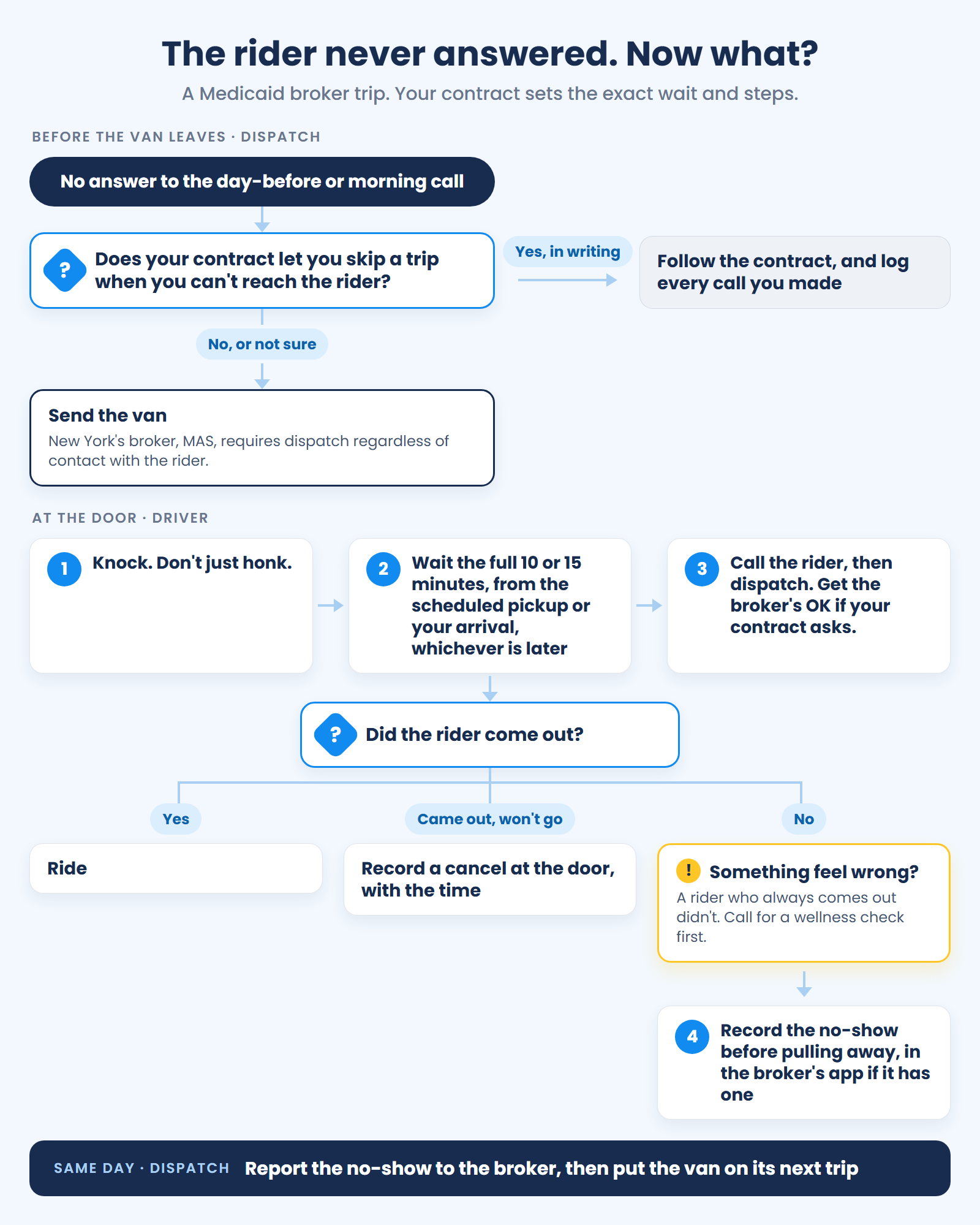
Then free the van. The rest of the day still has trips it can take, and moving it onto one on the fly is what Jing means by dispatching rather than scheduling.
What can you do about riders who keep no-showing?
On a broker trip, report every rider no-show to the broker the same day; what happens to a Medicaid rider who keeps missing is the program’s call, not yours. You can’t charge that rider. CMS’s guide says “States and providers may also not impose a charge on a beneficiary for no-shows,” and that states can’t cut off rides over them, “even if frequently occurring.” North Carolina’s current manual still suspends rides for 30 days after a third missed trip in three months, with dialysis and chemotherapy excepted. Ask your broker what happens after a rider’s third reported no-show.
Once the state has sent the rider a letter, CMS lets it add steps, including this one: “Requiring the beneficiary to confirm the ride the morning of or the night before, or the ride will not be provided.”
Vermont’s broker does a version of that: after three no-shows, a rider has to call by noon the day before to confirm, or no driver comes.
Jing’s rule of thumb from the pricing episode: “occasionally no show is fine,” because a rider’s “health conditions can change,” but three in one week is a pattern. On a broker trip, the broker can only act on a pattern it hears about.
Rachel did find something that worked, with her private-pay riders. She started requiring payment 24 hours ahead, because if a rider wasn’t going to pay, “it was a good indication they didn’t plan on going.” A Medicaid rider can’t give you that signal. On broker trips, the day-before call is how you hear it, and the door is how you prove the rest.
So pull last month’s missed trips and make the two counts: door no-shows and same-day cancels. Split each by trip source and divide by scheduled pickups. Then check how many of those riders were actually reached the day before. If most of them said yes and missed anyway, Rachel’s right about your riders, and your time belongs to the morning call and the door. If most of them never talked to anyone, you know where the next hour goes.
FAQ
Can I bill the trip anyway if my driver went out there?
Not on a Medicaid trip. CMS’s 2016 NEMT booklet for providers says that when a rider is a no-show, the provider “generally cannot bill for the trip.” It’s blunt about billing one anyway: “Claiming loaded mileage when the beneficiary was a no-show is a common form of fraud in NEMT, and is an illegal practice.” Indiana’s Medicaid office told its NEMT commission that before it hired a broker, some no-shows were billed anyway, which showed up as “transportation claims with no corresponding medical claim.” Record the no-show from the door instead, so it counts as the rider’s.
What if the rider comes out and cancels at the door?
Record it like a no-show, before the van leaves: the time and what the rider said. MTM’s driver app has its own status for a rider who cancels at the door. MTM’s Minnesota provider FAQ takes no-shows and cancels at the door in one question and answers that MTM “does not reimburse transportation providers for no shows.”
Should I overbook to make up for no-shows?
It’s a bet against your own on-time record. Overbooking pays off on days riders don’t show and backfires on days they all come out, and the late pickups that day count against you, not the rider. MTM’s Rhode Island handbook puts a provider in the red once 7% of its trips run late, on the same scorecard that grades provider no-shows, and missing those targets can bring penalties or termination.
About the author
James O'Donnell cofounded Duet and leads its sales, partnerships, and growth services. He talks with NEMT operators every week, hosts the NEMT Growth podcast, and answers Duet's sales line himself. More about Duet's founders →
Want more trips and less busywork?
See how Duet runs and grows NEMT businesses in a 30-minute demo.