
Article
How to Start a Medical Transportation Business (NEMT)
Costs, licensing, insurance, broker enrollment, and the order that wastes the least money.
By James O'Donnell, Cofounder and COO, Duet · · Updated
The new NEMT owners I meet that go on to make it are the ones that obsess about trips. Not vans. They’re asking who in their town needs rides, who pays for them, and how do they become the company that gets called. This guide will walk you through the exact steps to line up trips, file paperwork, make the right purchases, and get started.
The short version:
- Cost: $10,000 to $45,000 to get one vehicle on the road legally, plus 3 to 6 months of expenses in reserve.
- Who pays: Medicaid rides through a broker (the volume), facility contracts (the stability), and private-pay families (the margin).
- First Medicaid or broker revenue: anywhere from 2 to 18 months, because licensing, insurance, and broker approval all have queues you don’t control.
- Drivers: most states don’t require a CDL (commercial driver’s license) for a van designed for fewer than 16 people, counting the driver. California’s line is lower, and New York ambulette drivers always need one. Background checks are standard, and most brokers add drug testing and certifications like CPR.
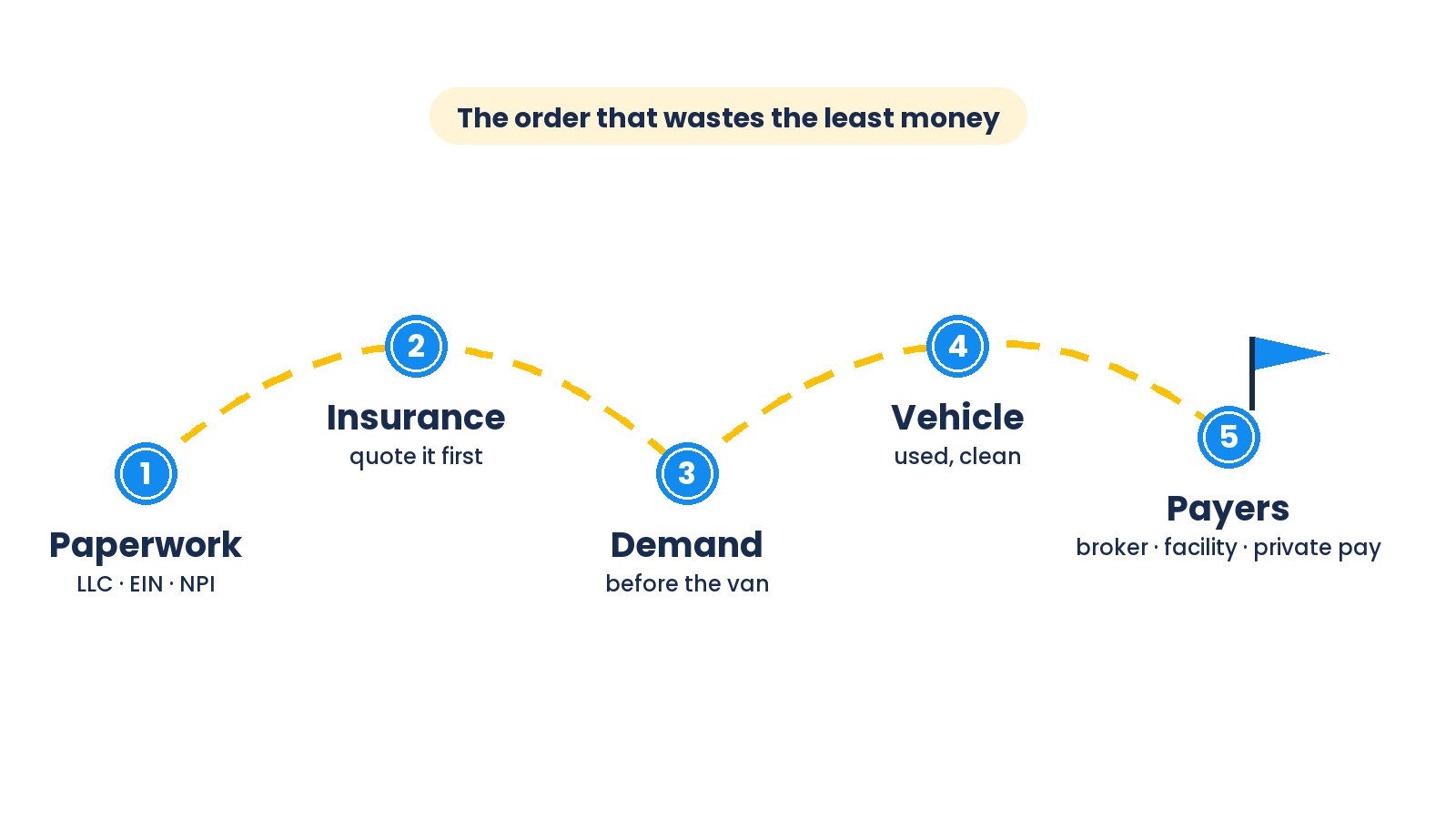
- The order: prove the trips before you buy the van. Sell facilities and private-pay families from day one; the broker is the safety net.
What does a NEMT business do, and who pays for the rides?
A NEMT (non-emergency medical transportation) company takes riders to medical appointments they’d otherwise miss. It runs wheelchair vans, ambulatory vehicles (regular cars and minivans for riders who can walk), and sometimes stretcher vans.
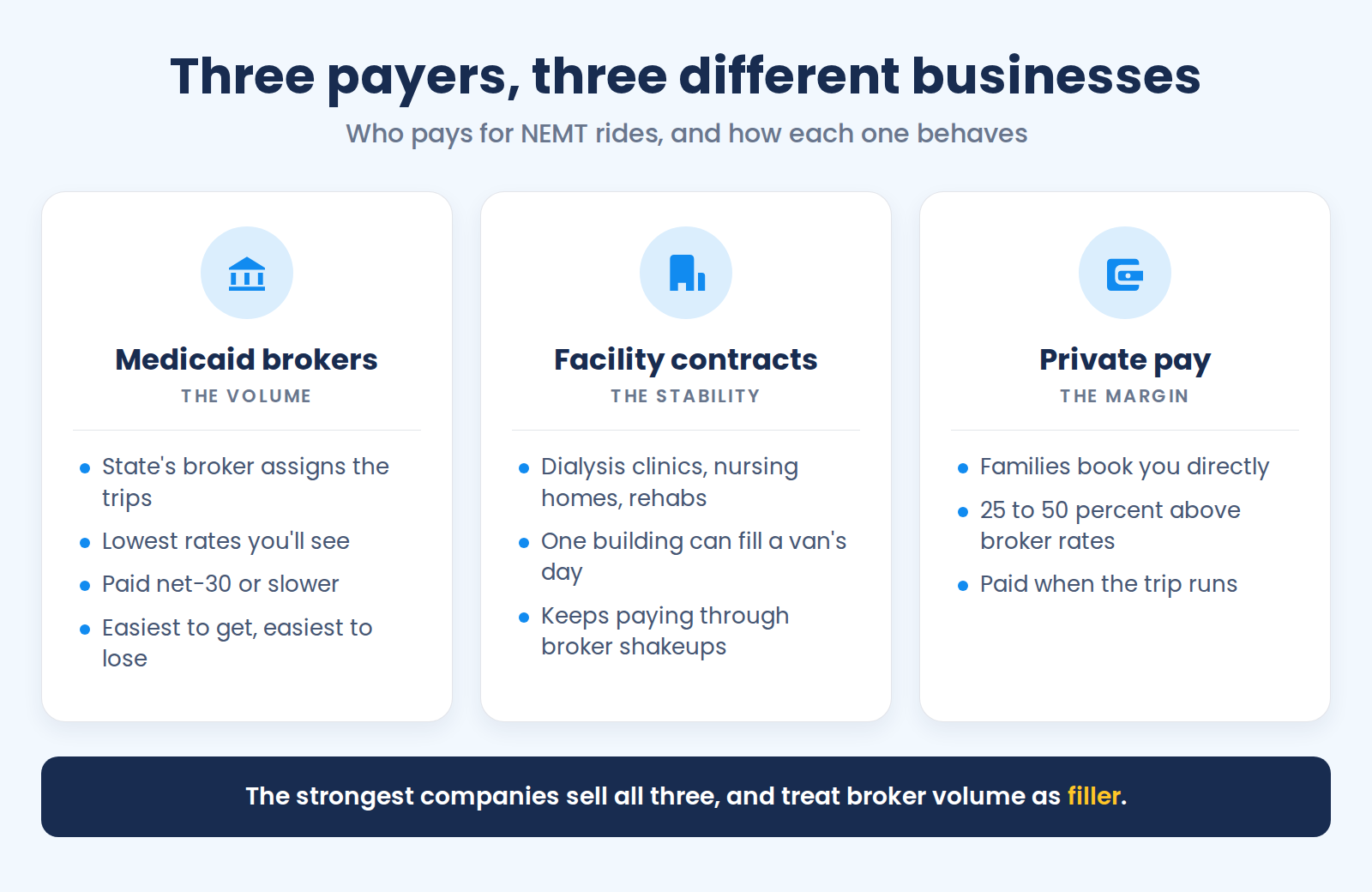
The money comes from three places:
- Medicaid trips, assigned through a broker.
- Direct contracts with facilities like dialysis clinics and nursing homes.
- Private-pay riders and families who book directly.
Some states add a fourth: a fee-for-service lane, where you bill the state directly for Medicaid members who aren’t in a health plan. California, Texas, North Carolina, and Arizona all have one; Colorado’s is closed to new companies and ends for everyone on January 1, 2027, when its new statewide broker takes every trip, and Minnesota’s covers every wheelchair and stretcher trip with no broker at all.
Medicaid is the volume. Every state’s Medicaid program has to pay for these rides [1], but in most states you can’t bill Medicaid directly for van transports. The state, or each Medicaid health plan, hires a broker instead: companies like Modivcare, MTM Health, Verida, or WellTrans; Pennsylvania, outside Philadelphia, runs its Medicaid rides county by county. A Medicaid health plan is a private health plan the state pays to cover Medicaid members. You sign up as one of the broker’s approved transportation companies. They call that enrolling in the network. The broker assigns trips and pays you, usually at the lowest rates you’ll see.
Facilities are the stability. One rehab hospital or dialysis clinic that trusts you can fill a van’s whole day, and it keeps paying straight through a broker shakeup.
Private pay is the margin. Families booking directly pay 25 to 50 percent above broker rates as a gut check [2], and often more. The Georgia and California guides below show private-pay trips at several times the Medicaid rate. And the money arrives when the trip runs, not 45 days later.
I hear this confusion on demos constantly: software companies like Duet aren’t brokers. A broker holds a state or health plan contract and assigns trips. Software is the tool you run trips on. Nobody’s software sends you riders by itself.
How much does it cost to start a NEMT business?
Plan on $10,000 to $45,000 to get one vehicle on the road legally. The low end is an ambulatory-only launch with a sedan. A wheelchair van launch starts around $15,000 in Florida, Georgia, North Carolina, and Texas, closer to $20,000 in California, and $25,000 in Arizona. Where you land in that range depends less on your state than on your model.
- Broker-first launch (the floor): a clean used vehicle, the state paperwork, driver certifications, and an insurance down payment. Branding can stay minimal because the broker sends the riders.
- Private-pay launch (costs more up front): branding, a real website, marketing spend, and a vehicle nice enough to be the product.
| Line item | Typical range |
|---|---|
| LLC, tax ID (EIN), NPI (your healthcare ID number), state and local registrations | $100 to $600 (the EIN and NPI are free), plus the $750 federal Medicaid application fee in the states that charge it (2026) |
| Driver certifications (CPR, first aid, wheelchair securement, sensitivity training) | $300 to $1,500 per driver |
| Commercial auto insurance | $14,400 to $21,600 a year ($1,200 to $1,800 a month) per wheelchair van for a new company in its first year. Each state guide carries its own band. Down payment a fifth to a quarter of the year’s premium |
| Vehicle | Used wheelchair van $15,000 to $40,000; ambulatory sedan or minivan far less |
| Website, phone system, branding | $200 to $300 a month is enough to start |
| Cash cushion (working capital) | 3 to 6 months of expenses, more where Medicaid enrollment runs long (California operators plan on 6 to 12 months). Brokers pay about 30 days after you invoice (net-30), sometimes slower |
The $10,000 to $45,000 only puts the vehicle on the road. The cash cushion is on top of it. Two numbers on that table deserve your respect.
Insurance: the number that surprises people
Only a handful of insurance companies will cover NEMT vans at all, and a new company pays extra in year one. Brokers and facilities commonly ask for a second policy on top of the auto policy: general liability, $1 million per claim and $2 million per year. General liability covers injuries and damage that don’t involve driving, like a fall at pickup. Workers’ comp arrives with your first hires in most states (the threshold varies: Georgia and Virginia at three employees, Florida at four, Colorado from the first employee, Minnesota from the first employee and as a condition of its state certificate, and Texas makes it elective). Get quotes before you buy anything.
Cash: the gap between running trips and getting paid
Your first Medicaid or broker revenue has taken operators anywhere from 2 to 18 months. The license, the insurance going active (agents call it binding), and the broker’s approval (they call it credentialing) all sit in queues you don’t control. Facilities and private-pay families are what carry you through the wait. You break even months after that, and even paying customers pay slowly: a facility may send your money 60 days after the trip. So save 3 to 6 months of expenses to cover the gap between running trips and getting paid, and keep the day job until the trips say otherwise.
What are the steps to start a NEMT business?
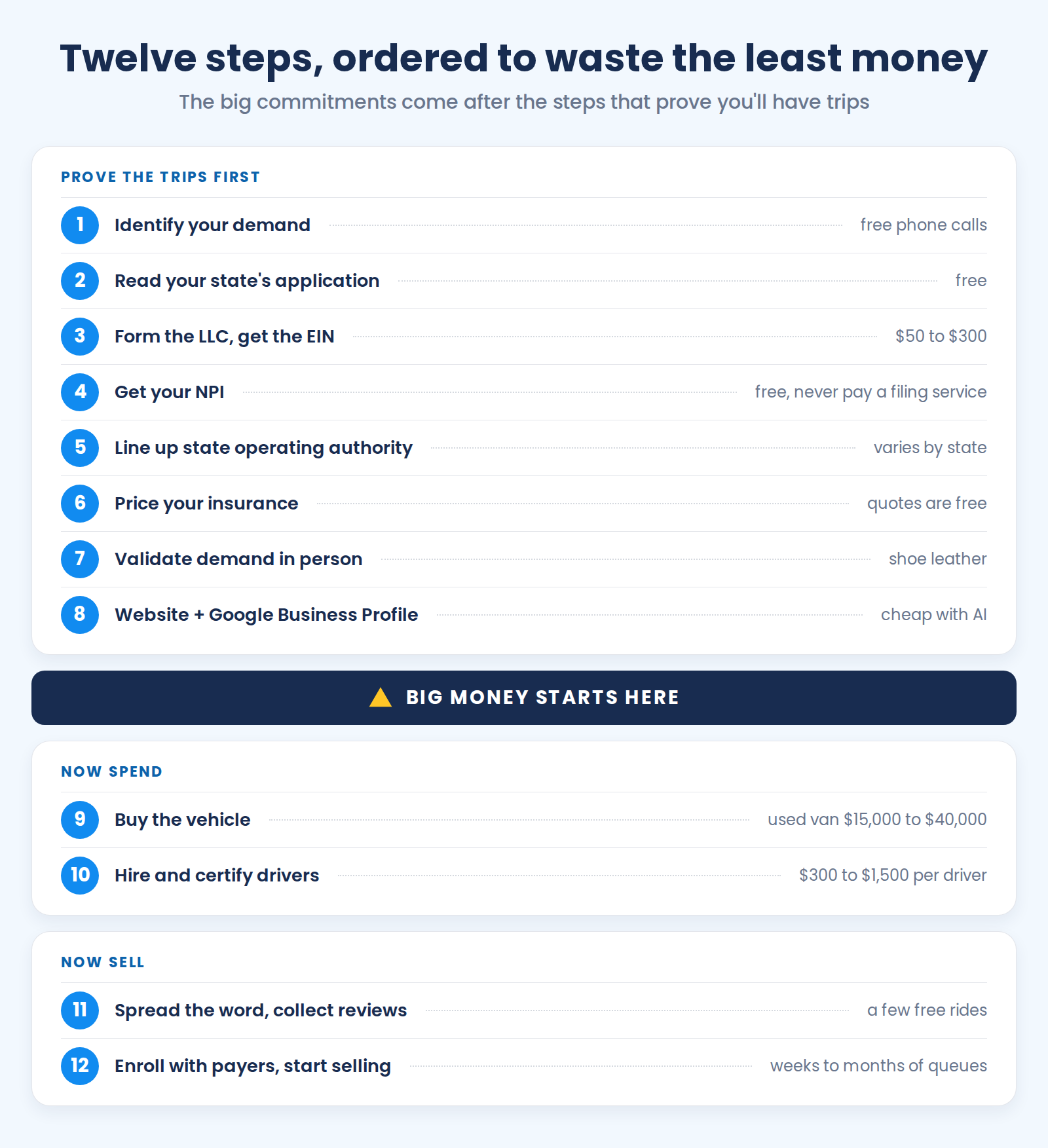
Starting a NEMT business takes twelve steps. They’re ordered so you spend the big money (the vehicle, the insurance) only after the steps that prove you’ll have trips.
Steps 1 to 8: prove the trips first
- Identify your demand. There’s no point filing paperwork until you know where your trips will come from. Are you going after broker trips? Does your area have plenty of private-pay riders? Is your cousin a nurse whose facility is desperate for a reliable transport company? Then find out what rides cost in your town: call the transport companies and ask what they’d charge for a wheelchair trip, like a customer would.
- Read your state’s actual application. Find your state’s NEMT provider application and read it before you spend a dollar. It usually lives with the state Medicaid agency, its transportation broker, or the public service commission. It tells you the insurance minimums, vehicle rules, driver requirements, and what gets an applicant turned down. The state guides below link the right one for each state we’ve covered.
- Form the business. An LLC through your Secretary of State or its equivalent, typically $50 to $300 to file (California adds an $800 annual tax). Then get a free EIN, your federal tax ID, from the IRS. Takes a day.
- Get your NPI. An NPI is the ID number the healthcare system uses for your company. Apply on the NPPES website, the federal NPI registry: pick Type 2 (organization), and for the taxonomy code choose 343900000X, non-emergency medical transport [3]. Texas’s Medicaid manual lists 343800000X for demand response providers instead. Your state’s application confirms the pairing. It’s free, and you usually get it within days. Third-party sites charge $500 or more to fill it out; don’t be the person who pays that. You can technically skip it if you’re private-pay only, but skipping it closes broker, health-plan, and VA doors, so get it anyway.
- Line up state operating authority. Many states require a permit to carry passengers for money before you can run trips. Depending on the state, it’s called motor carrier registration, operating authority, a certificate, or a permit. Some cities and counties layer their own licenses on top, and in the DC metro the permit is regional: a regional commission, WMATC, certifies van companies’ paid trips across DC and its inner suburbs. Some states exempt small medical-transport vehicles entirely. It’s the step people most often discover late, so check it now, before the vehicle.
- Price your insurance before you commit to anything. Call an agent who actually sells NEMT policies. Ask other operators who they use. Know your real premium, how much coverage the broker requires, and the down payment. Some cities and counties won’t issue your local license until insurance is active.
- Validate demand in person. Before the van, check what you found in step 1 on foot. Walk into facilities and talk to the social workers, nurses, and discharge planners who book rides. Talk to residents and their families too. Ask the broker which areas it needs more vans in. If your area already has more vans than trips, you want to know before you’re holding a $40,000 vehicle.
- Set up your website and Google Business Profile. Build both around the trips you found in step 1. If your area needs dialysis runs, say that on the homepage. If it’s private-pay families, put the booking number front and center. You can build a site yourself with AI for very cheap, or we’ll build you one optimized to show up on Google and ChatGPT. Add profiles on Yelp, Facebook, and the other directories too, especially if you’re skipping the brokers.
Steps 9 and 10: now spend the big money
- Buy the vehicle. Used and mechanically sound beats new debt for a first van. Match the vehicle to your customers: a spotless late-model van if you’re selling premium private pay, a workhorse if most of your trips will come from a broker.
- Hire and certify drivers, or certify yourself. Most states don’t require a CDL (commercial driver’s license) for a van designed for fewer than 16 people, counting the driver [4]. California’s line is more than 10 people, counting the driver, and every New York ambulette driver needs a CDL whatever the van’s size. Background checks are standard, and most brokers add drug testing and certifications like CPR, first aid, wheelchair securement, and HIPAA privacy training (the federal patient-privacy rules), even where the state doesn’t require them. Screen yourself and every driver against the OIG exclusion list and SAM.gov, the federal lists of people banned from Medicaid work, and recheck monthly. Brokers check, and the lookup is free.
Steps 11 and 12: now sell
- Spread the word and collect reviews. Tell your family and friends, and post about the business on your personal social media. Offer them free or deeply discounted rides in exchange for an honest Google review. Ten glowing reviews make it much easier to win private-pay and facility work from strangers. Your reviews are your references.
- Enroll with payers and start selling. Apply to the broker network and start calling facilities the same week. Getting approved by the broker takes weeks to months. Sell while you wait.
Should you start with broker trips, facility contracts, or private pay?
Start selling to facilities and private-pay families from day one, and treat the broker as the safety net that fills empty slots. Broker trips are the easiest to get and the easiest to lose, and the operators who build entire schedules on one broker keep learning the same lesson.
Christopher Buell, an operator I interviewed on our podcast, built his company into his state broker’s top-ranked provider, and the broker dropped him in a week. His rule now: let a broker fill about 10 percent of your capacity, maybe 15 in year two. “You’re a glorified employee of that broker,” he told me on our podcast [5]. “You get to buy the tires and deal with the employees, without the benefits.”
What broker trips are good for
Broker trips do have real value early:
- They generate revenue while your facility relationships grow.
- They teach you dispatching on someone else’s marketing dollar.
- In small markets, they may be most of the trips that exist.
One operator eleven years in keeps a 60/40 private-to-broker mix on purpose. In states with several brokers, like Ohio, where each Medicaid health plan arranges its own members’ rides, some operators run four or five broker contracts so no single loss sinks the schedule. The mistake isn’t taking broker trips. It’s building a company where one contract you don’t control decides whether you exist.
To go after facilities, start with how to win NEMT facility contracts; for private-pay families, the private pay guide covers pricing and marketing.
How long until a NEMT business is profitable?
Expect a lean first year. One owner-operator (owner and driver in one) projected $25,000 to $30,000 in year-one revenue on one van and made about half that. Nothing about the business was broken. That’s what year one looks like when you’re learning to fill a schedule.
The benchmark I give new providers: it takes a couple of months minimum to reach 100 trip legs a month (a leg is one one-way ride). A solo-run van roughly tops out there. Growing past it means a second vehicle. From there, the operators who make it grow on capacity triggers, not hope:
- Add the vehicle when you’re turning down trips.
- Add the driver when the schedule overflows.
- Take a salary when the margin supports it.
I’ve interviewed operators who went from zero to five vans in a year. And I’ve seen companies crawl for years at a vehicle or two before revenue multiplied tenfold. NEMT scales. It just scales on systems and trip sources, not on vans bought before the trips exist. And the demand is coming to meet you: by 2034, adults 65 and older are projected to outnumber children in America for the first time [6].
NEMT requirements by state
Requirements live at three levels:
- State: operating authority, insurance minimums, vehicle rules.
- Broker: whatever your state’s Medicaid broker requires of its network.
- Local: county and city business licenses and permits.
The state guides below walk all three, with the agencies, numbers, and applications linked.
More states are on the way. Need yours next? Tell us: ride@duetinc.com. And if you’re not sure who your state’s Medicaid broker even is anymore, start with who runs your state now.
More guides on starting a NEMT business
Choosing the business: costs, earnings and plan
- How Much Does It Cost to Start a NEMT Business? (2026)What it costs to start a NEMT business in 2026: a line-by-line budget for one wheelchair van, state fees, insurance down payments and a free spreadsheet.
- How to Retire Rich from NEMTNW Mutual's Daniel Baker and Jason Vanhorn on financial planning for NEMT operators: wealth-building, asset protection, benefits, and diversification.
Licenses, insurance and your first van
- NEMT Business License Requirements: What You Actually NeedThere's no national NEMT license. The approvals you need by state, van and payer, licenses that don't exist, what certification means and the order to apply.
- NEMT Insurance: What It Costs and What Brokers RequireWhat a NEMT company must carry, who sets the limit (state, brokers, facilities), what a new company pays per van, when to bind it, and how to lower it.
Your first trips and first year
- Building a Scalable NEMT Business from Day 1Ray and Mac came into NEMT from real estate with tight systems and a private-pay focus. Two vehicles and 45 five-star reviews later, here's how they did it.
- Why Most NEMT Companies Struggle to Scale (And How Duet Fixes It)Why most NEMT companies struggle to scale, and how better dispatch, operations, and backend systems reduce chaos and support long-term growth.
- Secrets of Sustainable NEMT GrowthCapital Area Transport Service's Eugene Gindin on hiring, trip sourcing, and government contracts — and why 90% of NEMT owners fail (and how to avoid it).
- From 0 to 5 vans in one yearGentle Turns owner Paul Muench on launching an NEMT service from scratch and scaling to 5 vans in 12 months — pricing, marketing, and lessons learned.
- Succeed in NEMT servicesThe Transportation Alliance webinar with Duet cofounders on five key actions to launch or scale a successful NEMT operation across multiple states.
Growing, buying and selling
- How to Sell a NEMT Business for What It's Really WorthBusinesses selling under $2 million went for about 2 to 3 times owner earnings in mid-2026. What NEMT buyers pay for, what cuts the price, and how to prepare.
Common questions
Do I need a CDL to drive a NEMT van?
Usually not. In most states, commercial driver’s licenses start at vehicles designed for 16 or more passengers including the driver, and most NEMT vans seat fewer than that. California’s line is lower: above 10 people, counting the driver, you need a commercial license with a passenger endorsement. In New York, every ambulette driver needs a CDL with a passenger endorsement whatever the van’s size, so check your state’s rules. Brokers check driving records and run background checks, and most add drug testing and certifications like CPR, first aid, and wheelchair securement, even when the state doesn’t.
Can I start a NEMT business with one van?
Yes, and most operators do. Facilities and private-pay riders don’t care how many vans you have. Some broker networks have required two vehicles, and one Florida county writes a two-vehicle minimum into its vehicle-for-hire ordinance. Several brokers only take new providers in areas where they’re short on vans. Ask your state’s broker whether it’ll take a one-van company before you buy a second van just to qualify.
Do I need medical training to run a NEMT company?
For ambulatory (walking) riders and wheelchair work, no. NEMT is non-emergency transportation, not medical care, and most states don’t require EMT certification. Stretcher service is the exception. Some states allow non-ambulance stretcher transport for stable patients, and some put any stretcher work under ambulance licensing. Confirm where your state draws that line before you build a service around it.
Does Medicare pay for NEMT rides?
Mostly no, and the confusion costs families real money. Original Medicare covers ambulance transport when it’s medically necessary, not wheelchair-van rides to appointments. Some Medicare Advantage plans add a transportation benefit, usually a set number of rides a year run through a broker. The VA (Veterans Affairs) pays for veteran transport in some regions. Build the business on Medicaid, facilities, and private pay, and treat Medicare Advantage trips as a bonus.
Is a NEMT business profitable?
It can be, on real numbers rather than the ones course sellers quote. Year one is usually thin while you build trip sources. Owner-operators commonly clear modest profits on one van, and the ones who grow do it by adding a vehicle only when they already have the trips for it. Profit follows who pays you: private-pay riders pay 25 to 50 percent or more above broker rates, and facility work beats broker rates too. That’s why the strongest companies treat broker volume as filler.
Requirements change and vary by state. Confirm against your state’s sources before you spend money, and treat this guide as education, not legal advice.
Sources
[1] KFF, Medicaid Non-Emergency Medical Transportation: Overview and Key Issues. kff.org
[2] Duet, NEMT Private Pay: What to Charge and How Families Find You. duetinc.com/nemt-private-pay
[3] NPPES, National Provider Identifier application. nppes.cms.hhs.gov
[4] FMCSA, commercial driver’s license standards; see also your state’s licensing agency. fmcsa.dot.gov
[5] Duet NEMT Growth Podcast, Ep. 14: “How to CALL Facilities with Christopher Buell,” March 3, 2026. youtube.com
[6] U.S. Census Bureau, population projections: adults 65+ projected to outnumber children by 2034. census.gov
About the author
James O'Donnell cofounded Duet and leads its sales, partnerships, and growth services. He talks with NEMT operators every week, hosts the NEMT Growth podcast, and answers Duet's sales line himself. More about Duet's founders →
Want more trips and less busywork?
See how Duet runs and grows NEMT businesses in a 30-minute demo.