Article
How to Start a NEMT Business in Florida (2026)
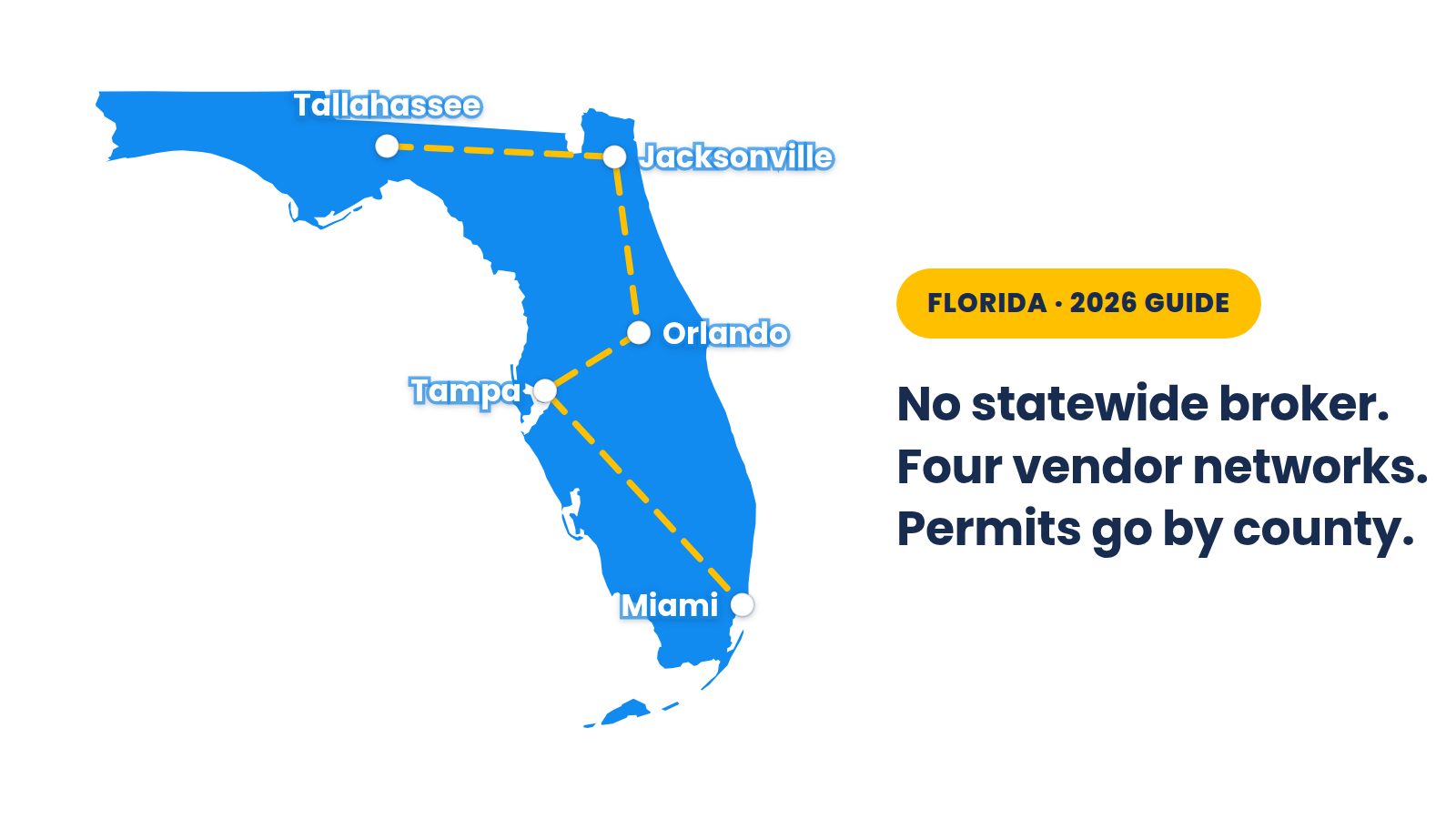
No statewide broker runs Florida's Medicaid rides: each plan hires its own, and the assignments keep changing hands. Here's how to build on that map.
By James O'Donnell, Cofounder and COO, Duet · · Updated
To start a NEMT business in Florida, form an LLC ($125), enroll with Florida Medicaid, and get approved by the brokers your counties’ Medicaid plans hire. Florida has no state NEMT license and no statewide broker; your permits come from the county. Plan on roughly $15,000 to $45,000 for one wheelchair van and two to five months to first Medicaid trips (three to six if you need Miami-Dade’s certificate). Private-pay and facility work can start as soon as you’re insured and permitted.
Florida at a glance:
- State NEMT license: None. Florida licenses only ambulances. Your permits come from the county, from a business tax receipt to Miami-Dade’s certificate.
- Who runs Medicaid rides: No statewide broker. Each plan hires its own: Alivi, Modivcare, MTM Health, or Ride2MD. Riders outside a plan: Modivcare or MTM.
- How you enroll: Sign up with Florida Medicaid online, usually the lighter limited enrollment, then apply to each broker separately.
- Insurance the contracts expect: Roughly $1 million combined single limit auto plus general liability. Florida’s legal floor is close to nothing.
- Cost to launch one van: Roughly $15,000 to $45,000 for a wheelchair van. Reported insurance quotes alone run $7,000 to $11,500 a year.
- Time to first Medicaid trips: Two to five months. County certificates and broker approval are the slow parts. Private pay can start sooner.
Between January 2025 and March 2026, two of the biggest Medicaid transportation contracts in Florida changed hands without a single van operator signing anything. Sunshine Health, the state’s largest Medicaid plan, moved its rides from Modivcare to Alivi, a Miami transportation benefit company, on January 1, 2025 [4]. Both are brokers, the companies a state or health plan hires to assign Medicaid rides to transportation providers and pay for them. UnitedHealthcare handed its Florida trips to MTM Health on March 1, 2026 [5].
In between, Modivcare, still the biggest broker in the state, went through Chapter 11 bankruptcy and came out owned by its lenders [13]. If your schedule rode on any one of those contracts, your business changed shape three times in fourteen months, and none of it was your doing.
If you’re starting a non-emergency medical transportation (NEMT) business in Florida, that churn is the market you’re walking into. It cuts both ways: every handoff gives new companies a fresh shot at the work, and the riders never stopped needing rides.
Florida runs one of the biggest Medicaid programs in the country, behind only California, New York, and Texas. It covers roughly 3.9 million people. About 73 percent of the caseload sits in managed care plans, which are private health plans the state pays to cover Medicaid members, per the Legislature’s July 2026 Social Services Estimating Conference [41].
The state signed new contracts with every plan in February 2025, under the program it calls Statewide Medicaid Managed Care 3.0, or SMMC 3.0 [1]. Each plan hires its own transportation manager. So the question in Florida isn’t “how do I sign up with the state broker.” It’s which plans cover your counties, who runs their rides this year, and what you’ll run on while credentialing grinds. Credentialing is the broker’s or plan’s own approval process before it sends you trips.
I run Duet, a dispatch software company, and I talk to NEMT operators every week, Florida included. This is the Florida edition of our national guide on how to start a NEMT business. It cites the actual Florida statutes, rules, and agency documents. Where something couldn’t be verified against a primary source, I say so. Requirements change, and Florida’s have changed twice since 2025. Confirm against the linked sources before you spend money.
The one-page checklist: steps to start a NEMT business in Florida
Phase 0: know your demand
- Decide where your trips come from. A Florida NEMT business lives or dies on this.
- Your options: your counties’ Medicaid plans and their brokers, the state’s broker lane for riders who aren’t in a plan, facility contracts, private-pay families, or your county’s Transportation Disadvantaged coordinator.
- Map your region’s plans and who runs their rides. Florida runs nine lettered regions, A through I, defined county by county in s. 409.966, Florida Statutes [2]. The broker list below is your starting point.
- Price a wheelchair trip with two local competitors. Miami rates and Panhandle rates are different businesses.
Phase 1: business foundation
- Form your LLC at Sunbiz, the Florida Division of Corporations site. It’s $125 to file: $100 plus $25 for the registered agent, the person or company that receives legal papers for the LLC.
- Then $138.75 for the annual report each spring. Miss the May 1 deadline and it’s $538.75 [46].
- No state income tax. Florida taxes neither personal income nor a pass-through LLC’s business income.
- Get a free EIN, your federal tax ID, from the IRS. Never pay a third party for this.
- Get the local business tax receipt, Florida’s name for a local business license, for your county and often your city [36]. Fees are local and modest.
Phase 2: federal identifiers
- Apply for a Type 2 (organization) NPI at NPPES, taxonomy 343900000X, Non-Emergency Medical Transport (VAN). The NPI is the ID number the healthcare system uses for your company. It’s free, and usually issued within days.
- Check owners and drivers monthly against the OIG list and SAM.gov, the two federal lists of people banned from Medicaid work. Plans and brokers check these too.
Phase 3: vehicles, drivers, and insurance
- No state vehicle inspection exists. The ones that matter come from county permit programs and broker onboarding [30][32][33].
- Spec each van with a lift or ramp, four-point wheelchair securement, and working air conditioning, which Florida plan contracts spell out in writing [40].
- Check broker vehicle standards before you buy. Brokers commonly cap model year and mileage, and a cheap older van can fail [50][51].
- Build each driver’s file the way brokers want it: background check, drug screen, driving record, CPR, first aid, defensive driving, and securement training [50].
- Screen owners and principals at Level 2 through AHCA’s Clearinghouse. AHCA is Florida’s Agency for Health Care Administration. Drivers, by statute, need only Level 1 [20].
- Insure toward the broker bar, roughly $1 million combined single limit (CSL): one policy limit covering injuries and property damage together. Florida’s own floors are far lower for a van that isn’t a taxicab [24][50].
Phase 4: Medicaid enrollment and the brokers
- Enroll with Florida Medicaid through the online wizard at the Florida Medicaid Web Portal [19]. Enrollment means signing up with the state Medicaid program itself.
- Most startups use limited enrollment, the lighter of the two lanes [18].
- Plans deny claims from companies that aren’t active on the state provider file [18].
- Apply to every broker holding a plan in your counties: Alivi, Modivcare, MTM Health, Ride2MD.
- Expect separate queues. The big brokers only take providers where they’re short on vans.
Phase 5: the trip sources you control
- Set up a website and Google Business Profile built around the trips from Phase 0. Add Yelp and Facebook, especially if you’re starting private-pay-first.
- Start facility outreach and private pay the same week your applications go in, not after they’re approved. Credentialing has a queue; relationships don’t.
- Offer friends and family free or discounted rides in exchange for honest Google reviews. Ten of them make strangers trust you.
Who pays for NEMT rides in Florida?
Four sources pay for NEMT rides in Florida, plus a fifth most guides never mention:
- Medicaid managed care plans, through the brokers they hire.
- The state’s fee-for-service lane, for riders who aren’t in a plan. Florida hires brokers directly for those rides, so you still don’t bill the state.
- Facility contracts: hospitals, dialysis clinics, and senior living communities.
- Private-pay families booking directly.
- The county-run Transportation Disadvantaged system, which gets its own section below.
Medicaid is the volume, and in Florida that means the plans. Transportation is a covered benefit every Managed Medical Assistance plan must provide under s. 409.973, Florida Statutes. The state’s Non-Emergency Transportation Services Coverage Policy sets the rules those plans have to follow [3].
Around 2.9 million of the state’s enrollees sit in SMMC plans [41]. Managed care carries 74 percent of the program’s roughly $39.6 billion forecast spend, per the July 2026 estimating conference [41].
Riders who aren’t in a plan get rides through brokers hired directly by AHCA. MTM Health covers the old numbered regions 3 through 8, and Modivcare covers the rest [7][8]. The rider pays a $1 copay each way [8].
Facilities are the stability. Florida has 533 Medicare-certified dialysis facilities, per the federal Centers for Medicare and Medicaid Services’ live provider data, and 75 of them are in Miami-Dade County alone [44]. Thirteen rural counties have none at all, which means somebody drives those patients across county lines three times a week [44]. Hospital discharge desks, skilled nursing, rehab, assisted living: one facility that trusts you can fill a van’s whole day.
Private pay is the margin. Florida is the retirement capital of America. Per the state demographers’ April 2025 estimates, 21.9 percent of Floridians are 65 or older, and Sumter County, home of The Villages, is 53.4 percent seniors [42]. The state’s own projections add another 1.5 million seniors this decade, reaching one in four residents by 2030 [43]. Families booking a parent’s appointments directly, at rates you set, are how Florida operators fund the months the broker queues eat.
And Florida demand is seasonal in a way no other state on this site needs a warning about. The winter snowbirds are exactly the riders NEMT serves, and they’re here from roughly October through April. Summer is the slow season. Size the fleet for the season, and plan cash flow for August.
There’s also less competition than you’d think. Florida Medicaid’s own provider file lists only about 295 actively enrolled NEMT van companies statewide [45]. But nearly 3,000 Florida organizations and individuals hold the NEMT provider category, the taxonomy code, in the federal NPI registry [45]. Plenty of people set up NEMT companies. Few finish the paperwork that gets them paid.
Who is the NEMT broker in Florida?
Nobody holds Florida statewide, and that one fact kills half the guides on this subject. Each Medicaid managed care plan hires its own transportation manager. Riders outside managed care go through brokers contracted directly with AHCA, under what the state calls its transportation waiver.
Here’s the list as I can verify it in August 2026, from the plans’ and brokers’ own documents. AHCA’s own vendor list is partly stale and blocks automated checks, so this table is the accessible copy, and every row names its source. Treat it as a starting point, and confirm before you build on any row:
| Plan | Rides run by | Source |
|---|---|---|
| Sunshine Health, plus its Child Welfare, SMI, HIV/AIDS, and LTC specialty plans | Alivi, since January 1, 2025 | Sunshine’s transition FAQ [4] |
| Humana Healthy Horizons | Modivcare | Modivcare’s Florida plan list [6] |
| Aetna Better Health | Modivcare | Modivcare’s Florida plan list [6] |
| Community Care Plan | Modivcare | CCP’s July 2026 member handbook [10] |
| UnitedHealthcare Community Plan | MTM Health, since March 1, 2026 | UHC’s provider manual [5] |
| Simply Healthcare, including Clear Health Alliance | Ride2MD, statewide | Simply’s July 2026 resource guide [9] |
| Florida Community Care | Ride2MD | FCC’s care resources page [11] |
| Molina Healthcare | MTM Health, the former Access2Care. Confirm with the plan | MTM’s acquisition release [14] |
| Children’s Medical Services (CMS) Health Plan | MTM via Sunshine until October 1, 2026, when Molina takes over the plan | Sunshine’s provider FAQ and transition notice [4][12] |
| No plan (fee-for-service) | Modivcare and MTM Health, split by region | The brokers’ own AHCA pages [7][8] |
What each network holds, broker by broker
- Alivi runs rides for Sunshine Health, the state’s largest Medicaid plan, and for Sunshine’s Child Welfare, Serious Mental Illness, HIV/AIDS, and Long Term Care specialty plans. Alivi took over from Modivcare on January 1, 2025 [4]. Alivi is Miami-based, and this was the biggest broker shift in the state in years.
- Modivcare holds Humana Healthy Horizons, Aetna Better Health, and Community Care Plan, which CCP’s own July 2026 member handbook confirms [6][10]. Modivcare also holds the rest of the AHCA fee-for-service lane, the old numbered regions MTM doesn’t serve [7]. On the 2025 lettered map those are roughly Regions A, G, H, and I: the Panhandle plus the Treasure Coast, Palm Beach, Broward, and Miami-Dade [2]. The brokers still publish the old numbers, so confirm your county against their own coverage pages.
- MTM Health has managed all UnitedHealthcare Community Plan rides since March 1, 2026 [5]. It runs the fee-for-service lane in the old regions 3 through 8, today’s Regions B through F, roughly Gainesville and Jacksonville down through Tampa Bay, Orlando, and Southwest Florida [2][8]. It also handles transportation for Sunshine’s Children’s Medical Services plan [4].
- Molina, through MTM. MTM bought Access2Care, the old number-three broker, in October 2024 [14], and Molina’s rides run through Access2Care under the MTM Health name. Molina’s member materials route ride booking to MTM Health at 888-298-4781. Molina’s site blocks automated checks, so confirm the arrangement with Molina provider services when you apply.
- Ride2MD serves Simply Healthcare statewide, including its Clear Health Alliance HIV/AIDS specialty plan (the same legal entity), per Simply’s own July 2026 provider resource guide [9]. Ride2MD also serves Florida Community Care [11].
Two dates to keep next to the list
Modivcare, the biggest name on it, filed for Chapter 11 bankruptcy in August 2025. It came out on December 29, 2025 with more than 85 percent of its debt gone, and it kept running trips throughout [13].
The Children’s Medical Services plan itself moves from Sunshine to Molina on October 1, 2026, and provider contracts don’t move with it [12]. That will reshuffle those rides again. Florida’s broker story is the same one our national broker tracker tells state by state: the trips never disappear, they change hands. In Florida they change hands plan by plan, which is quieter and easier to miss.
Old region numbers on official pages
AHCA’s own site still shows documents from the LogistiCare era, and the old numbered-region map. LogistiCare became Modivcare in 2021. The program reorganized into nine lettered regions, A through I, when the 2025 contracts started [1][2]. The fee-for-service brokers still describe their territories with the old numbers [8]. How the old numbers map to the new letters, for the record [2]:
| Old numbered region | 2025 lettered region |
|---|---|
| 1 and 2 | A |
| 3 and 4 | B |
| 5 through 11 | C through I, in order |
Check the date on any vendor list you find, including the state’s.
Can I bill Florida Medicaid directly for NEMT?
Effectively no, not for van work. That surprises operators coming from states that publish a Medicaid rate sheet.
No state rate exists for van work
Florida publishes no Medicaid NEMT reimbursement rates for van work. The current Transportation Services Fee Schedule, effective January 1, 2025, prices exactly one category: ambulances. Non-emergency BLS (basic life support) ambulance pays $137.96, and ALS (advanced life support) pays $192.73 [17]. Everything else on the schedule is air ambulance or “as negotiated” [17]. There’s no wheelchair van rate, no stretcher van rate, no ambulatory rate for riders who can walk to the vehicle, and no ground mileage code. Any guide quoting you “Florida’s Medicaid wheelchair rate” is reading another state’s schedule.
Your contract is the rate
Wheelchair and stretcher work in Florida pays whatever the broker or plan pays. The state’s own coverage policy says the AHCA-contracted broker and the provider settle non-ambulance NET services at “a mutually agreed upon negotiated rate”, and the same logic runs through the plan contracts [3]. Your rates get set when you negotiate the contract, so know your cost per trip before you sign one, and ask to renegotiate the rate sheet every year.
A broker rate sheet is more than a per-trip number. It sets the base rate, the loaded-mile rate, wait-time pay, no-show and late-cancellation pay, and extra pay for after-hours and stretcher trips. Loaded miles are the miles with the rider on board; the drive to the pickup pays nothing. None of those carry published Florida rates either, so any per-hour wait-time figure you read online is a guess. Get the wait-time and no-show terms in writing before you sign; they decide whether a day of facility runs pays.
You still need the state enrollment
Skipping the state enrollment is the mistake that voids everything else. Under the federal managed care rules, plans must drop network providers who aren’t enrolled with the state, and Florida plans enforce it. Sunshine Health’s provider guide lists the exact denial codes for claims from providers whose Medicaid ID isn’t active on AHCA’s provider master list [18].
Florida’s enrollment policy gives transportation companies two lanes, full and limited, and the enrollment section below walks through both [18]. It runs through the online wizard at the Florida Medicaid Web Portal [19]. Two useful rules from the policy. The state must tell you in writing if anything’s missing from your application, and you get 21 days to fix it. And once approved, your enrollment counts from the date the state received your application [18][20].
What is Florida’s Transportation Disadvantaged program, and do I have to join it?
You don’t have to join it, and knowing that puts you ahead of most of the internet. Florida runs a coordinated transportation system under Chapter 427, Florida Statutes. A state Commission for the Transportation Disadvantaged names a Community Transportation Coordinator (CTC) for every county. Agencies must spend government money for transportation-disadvantaged riders through that coordinated system [37].
That rule binds the agencies spending government transportation money, not private companies. A NEMT business running broker, facility, and private-pay trips has no CTC obligation at all. The Commission’s own annual report says plan- and agency-sponsored programs like Medicaid managed care “fall outside the Commission’s direct regulatory authority” [38][39].
For you, the coordinated system is a fifth revenue lane:
- CTCs must subcontract. The law requires them to subcontract trips to transportation operators where that’s cost-effective, and private for-profit companies count as eligible operators by statutory definition [37].
- The money is real. Per the Commission’s FY 2024-25 Annual Performance Report, the system moved 14.4 million trips on $427.6 million of revenue. About $52.9 million of it was Trip and Equipment Grant money for riders no other program covers [39].
- You get paid on a clock. The CTC must pay its subcontractors within 7 working days of getting paid itself; the rule ties this to s. 287.0585, Florida Statutes, the state’s subcontractor prompt-payment law [38].
- Insurance floor: $200,000 per person and $300,000 per incident under Rule 41-2.006, Florida Administrative Code [38][39].
- Find your coordinator in the Commission’s annual report appendix. Some are county governments, some are transit agencies, and one, in Alachua County, is a private for-profit operator [39].
One phone call tells you whether your county’s coordinator needs vans.
What licenses and requirements does a NEMT business need in Florida?
Florida has no state NEMT license. The state’s ambulance law licenses only advanced and basic life support services. Vehicles for hire carry no state permit either; counties and cities license them. What’s left is Medicaid enrollment, broker credentialing, and county permits that range from nothing to a county commission hearing.
The state layer: light, with two real rules
Two state-level rules do reach a van company.
- Motor carrier safety rules. Florida adopts the federal motor carrier safety regulations for commercial vehicles that stay inside the state, in s. 316.302, Florida Statutes. It exempts vehicles under 26,001 pounds from most of them. What’s left is a short list: safe-operation rules, parts and equipment standards, systematic maintenance, and a driver daily inspection [29]. Keep maintenance records like they matter, because contractually they will.
- A USDOT number, maybe. Whether a Florida-only carrier needs one turns on thresholds I couldn’t confirm against FLHSMV’s pages, which block automated checks. FLHSMV is the Florida Department of Highway Safety and Motor Vehicles. A typical wheelchair van fleet under 26,001 pounds almost certainly doesn’t need one. Confirm with FLHSMV before you letter the vans, and know that any trip across the state line changes the answer entirely.
One new wrinkle arrived in 2024. Florida created statewide vehicle-for-hire license reciprocity, so a permit from your home county now works everywhere. But the law expressly excludes stretcher and wheelchair transportation from that reciprocity, in s. 320.0603(4), Florida Statutes [28]. Taxi operators got portability. NEMT still permits county by county.
The county layer: where Florida bites
Counties license vehicles for hire under s. 125.01(1)(n), Florida Statutes, and the big ones use it [36]:
- Miami-Dade requires a Non-Emergency Transportation Certificate for wheelchair and stretcher transport. It’s a county certificate of public convenience and necessity (COPCN). A committee hears your application, then the full county commission votes on it, and the county’s own page says three to six months [30]. Fees per the current county fee schedule: $300 application, $625 annual certificate, $55 per driver chauffeur registration, and $38 to $70 vehicle inspections at the county station [31]. Budget the calendar, not just the money.
- Broward licenses non-emergency medical transportation companies through its Consumer Protection Division. It permits each vehicle, and registers every for-hire driver with fingerprint background checks [32]. The county board sets fees by resolution, and the county’s posted forms have moved, so call the division at 954-765-1700 for current numbers.
- Hillsborough abolished its old Public Transportation Commission in 2017, and now runs vehicle-for-hire licensing through the county tax collector. The fees: a $300 business certificate, $150 per vehicle per year, and a $65 driver badge. It also wants $125,000/$250,000/$50,000 insurance, written 125/250/50, or a $300,000 combined single limit, plus an annual inspection by an ASE-certified mechanic. Its ordinance calls NEMT vehicles “handicabs,” and handicab drivers need first aid, CPR, and defensive driving certificates [33].
- Palm Beach folds “non-medical wheelchair and stretcher transportation” companies into its vehicle-for-hire ordinance. It wants a two-vehicle fleet minimum, annual ASE inspections, and 125/250/50 or $300,000 CSL insurance. The county’s posted application also lists a $10,000 initial fee for a brand-new vehicle-for-hire business. Confirm that number with Consumer Affairs at 561-712-6600 before you pick your county [34].
- Pinellas lands in the same place by a different route. Its county commission, sitting as the EMS Authority, approves certificates even for non-medical wheelchair and stretcher van providers, and it publishes the approved list [35].
- Elsewhere, assume nothing. Orange County itself shows no vehicle-for-hire program. But the City of Orlando permits vehicles and drivers through its police department, and the airport wants its own permit on top [36]. Jacksonville regulates vehicles for hire under its municipal code. Several counties, Pinellas’s neighbors included, have no program at all. Budget a week of phone calls to your county and city before you buy anything; it’s the cheapest insurance in this guide.
Ten claims you’ll read elsewhere, checked against the sources
The internet fills the license vacuum with invented credentials:
| The claim you’ll read elsewhere | What Florida actually requires |
|---|---|
| ”Obtain a Florida NEMT Provider License from AHCA” (or a Department of Health certification, a DBPR license, or a statewide CPCN) | No such license exists. AHCA enrollment is Medicaid paperwork, not an operating license. DOH licenses only ALS/BLS ambulance services under s. 401.25, Florida Statutes. Certificates of public convenience and necessity (COPCNs, sometimes written CPCN) for NEMT are county ordinances, not state law [15][16][30]. |
| ”Sign up with LogistiCare, Florida’s statewide broker” | LogistiCare became Modivcare in 2021, and Florida has no statewide broker. Each plan hires its own, and the fee-for-service lane splits between Modivcare and MTM Health [5][6][7][8]. |
| ”Sunshine Health rides run through ModivCare” | Alivi has run Sunshine’s rides since January 1, 2025, per Sunshine’s own transition FAQ [4]. Guides dated 2026 still get this wrong. |
| ”Florida requires $100,000 general liability and 25/50/25 auto coverage” | Those numbers appear in no Florida statute, rule, or Medicaid policy. The state’s NET coverage policy sets no insurance minimums at all [3]. Enrollment asks for proof of $100,000/$200,000 liability [18]. Brokers contractually want about $1 million combined single limit [50]. |
| ”Enroll through the Florida Medicaid Web Portal and start billing trips” | Enrollment gets you a provider ID, not trips. The state fee schedule prices only ambulances [17], and the plans’ brokers assign van trips and pay negotiated rates [3]. |
| ”Vehicles must pass Florida’s required safety inspections” | Florida has no periodic state vehicle inspection. The inspections that exist come from county permit programs and broker onboarding [30][32][33]. |
| ”Florida mandates a $300,000 minimum commercial auto policy for NEMT” | No statewide $300,000 mandate exists. $300,000 combined single limit is a county alternative in Hillsborough’s and Palm Beach’s vehicle-for-hire ordinances [33][34]. The coordinated system’s floor is $200,000/$300,000 [38]. Brokers want about $1 million [50]. |
| ”Pay the $350 AHCA enrollment fee” | No such fee appears in Florida’s February 2026 Provider Enrollment Policy: the policy’s own text lists no application fee for transportation providers [18]. Confirm at submission, but don’t budget a fee no state document names. |
| ”AHCA requires Level 2 fingerprint background screening for all NEMT drivers” | By statute, no. Owners and principals need Level 2, but s. 409.907 expressly lets nonemergency transportation drivers work on a Level 1 name-based screening or an AHCA-approved equivalent [20][53]. Individual brokers can contractually require more. |
| ”Florida Medicaid pays about $25 per ambulatory trip, $45 for wheelchair, $100 for stretcher” | Template numbers appearing in no Florida document. The state fee schedule prices only ambulance codes [17], and wheelchair, stretcher, and ambulatory rates are negotiated with each broker or plan [3]. |
What are the NEMT insurance requirements in Florida?
Plan on roughly $1 million combined single limit for commercial auto plus general liability, which covers injuries and damage that don’t involve driving, like a fall at pickup. That’s the bar Florida brokers and plans enforce in credentialing. It isn’t the state floor, and it certainly isn’t the $100,000 general liability plus 25/50/25 auto figures some guides quote, which trace to no Florida source at all.
MTM publishes a $1 million combined single limit standard for auto and general liability on its provider pages [51]. Modivcare publishes the coverage types, general liability, auto, sexual abuse and molestation, and workers’ comp, with limits “varying by state” [50]. Florida plan contracts add their own requirements on top [40].
The five bars, in one place
| Who sets the bar | The number |
|---|---|
| Florida statute, for a for-hire van that isn’t a taxicab | Effectively the ordinary-vehicle floor: $10,000 PIP (personal injury protection) plus $10,000 property damage [24][26] |
| Florida Medicaid enrollment | Proof of liability insurance at $100,000 per person and $200,000 per incident [18] |
| County vehicle-for-hire ordinances (Hillsborough, Palm Beach) | $125,000/$250,000/$50,000, or $300,000 combined single limit [33][34] |
| The Transportation Disadvantaged coordinated system | $200,000 per person and $300,000 per incident [38] |
| Broker and plan credentialing | Roughly $1 million combined single limit auto plus general liability, a sexual abuse and molestation endorsement, and workers’ comp [40][50][51] |
Why the state floor is close to nothing
The statutory floor is strange enough to be a trivia question. Florida requires taxicabs to carry $125,000/$250,000/$50,000 under s. 324.032, Florida Statutes [24]. But a for-hire passenger vehicle that isn’t a taxicab or limousine can meet the state’s minimum insurance rule with an ordinary liability policy [24][25]. And Florida doesn’t even require bodily injury coverage on ordinary private vehicles, just $10,000 of PIP and $10,000 of property damage [26].
So the state floor for a wheelchair van is close to nothing. The county floors, 125/250/50 or $300,000 CSL in Hillsborough and Palm Beach, are the real legal minimums where they apply [33][34]. The coordinated system wants $200,000/$300,000 [38], and the broker bar is the number you’ll buy. Nobody in this business should insure anywhere near a floor anyway; one bad securement claim ends an underinsured company.
What it costs: the honest bad news
Florida commercial auto is among the most expensive in the country. The price ranges NEMT consultancies report from actual quotes run roughly $5,000 to $8,500 a year for ambulatory sedans, and $7,000 to $11,500 for wheelchair vans [52]. Miami-Dade operators are regularly quoted $13,000 and up [52]. First-year operators pay more until the first clean renewal.
Only a handful of carriers write Florida NEMT, so use an agent who places medical transport risks every week. Get quotes before you commit to a vehicle, and don’t bind coverage until trips are close. Binding is the moment coverage is active.
Workers’ comp arrives at your fourth employee
Florida requires workers’ compensation coverage for non-construction businesses with four or more employees, full or part time [27]. Up to 10 LLC members with at least 10 percent ownership can exempt themselves, per the Department of Financial Services [27]. A two-founder LLC with two drivers is standing exactly on the line, so plan the policy before you hire the second driver.
What do NEMT drivers need in Florida?
NEMT drivers in Florida don’t need a CDL, not for a typical wheelchair van.
No CDL for a wheelchair van
A commercial license starts at 26,001 pounds, or a vehicle designed to carry more than 15 people including the driver, under s. 322.01, Florida Statutes. An ordinary Class E license covers everything below that [23]. Florida has no chauffeur license and no Class D license at all, whatever a template guide tells you [23].
Level 2 for owners, Level 1 for drivers
Owners, officers, and anyone with 5 percent or more of a Medicaid-enrolled company need Level 2 fingerprint screening. It runs through AHCA’s Care Provider Background Screening Clearinghouse, under s. 409.907, Florida Statutes [20].
Drivers are different. The same statute expressly carves them out. It says: “Nonemergency transportation drivers who are employed or contracted with transportation companies, transportation network companies, or transportation brokers are not subject to a level 2 background screening but must comply with a level 1 background screening” or an AHCA-approved equivalent [20][53]. Level 1 is a name-based check. So “every driver needs Level 2” is wrong, and so is skipping screening entirely.
Fingerprints for the Level 2 cost $60 through the Clearinghouse, plus the fingerprint vendor’s own fee [55]. Results usually come back within 24 to 72 hours, and prints stay in the Clearinghouse for five years [21][22].
The broker file and the county registrations
What your drivers need day to day comes from four places:
- The broker file. Modivcare publishes its list: hands-on wheelchair securement (PASS) certification, current first aid and CPR, defensive driving certification, a drug screen, a clean driving record, and a background check. The other brokers ask for close variants [50][51].
- The hiring floor, which is also contract, not statute. Broker packets typically want drivers 21 or older, several years licensed, with a multi-year driving record showing few or no moving violations [50][51]. Read your packet before you post the job.
- The county layer, where it exists: Miami-Dade chauffeur registration at $55 a year [31], Broward’s fingerprint-backed driver registration [32], and Hillsborough’s $65 driver badge with first aid, CPR, and defensive driving for handicab work [33].
- The escort rule, worth writing into your driver handbook. Florida Medicaid requires you to carry an eligible rider’s escort free of charge, and the escort can’t be the driver or one of your employees [3].
Can a NEMT company run stretcher van trips in Florida?
Yes: Florida allows stretcher van trips outside the ambulance system for stable riders, and the dividing line is written into the definitions. Florida’s ambulance law, s. 401.23, Florida Statutes, defines an ambulance as a vehicle used for transporting people “requiring or likely to require medical attention during transport” [15]. It requires a state license plus a county certificate of public convenience and necessity (COPCN) only for advanced and basic life support transportation services [15]. A stable rider who needs a stretcher but no medical attention en route sits outside that definition.
Florida Medicaid agrees. Its coverage policy lists “medical vehicles (wheelchair or stretcher vans)” as their own provider category, separate from ambulances [3]. The state licenses just seven BLS providers statewide, which tells you Florida’s non-emergency stretcher market isn’t running on ambulance licenses [16].
The line you can never cross is set by the rider’s condition and what your crew does in the van. Medical attention en route, oxygen managed by an attendant, monitoring, anything clinical: that makes it an ambulance trip, which needs the Chapter 401 license. The statute also reaches companies that merely advertise medical-level service, so market stretcher work as transportation, never as care [15]. Put the line in your dispatch protocols in writing.
Then the county layer, which hits stretcher work hardest. Miami-Dade’s non-emergency certificate exists for exactly this: stretcher and wheelchair vans [30]. Broward’s license covers vehicles for riders who “do not need, nor are likely to need, immediate medical attention during transport” [32]. Pinellas puts even non-medical stretcher van providers through county commission approval [35]. Same state, different paperwork county by county. Before you buy a stretcher van, one call to your county settles which rules you’re under. And don’t budget from a phantom rate: Florida publishes no Medicaid stretcher van rate, and that trip pays whatever your broker contract says it pays [17].
How do you become a Florida Medicaid NEMT provider and get broker work?
Becoming a NEMT provider in Florida is a two-track process. Enroll with the state for your Medicaid ID, and credential separately with each broker whose plans cover your counties. Neither track sends you a single rider by itself.
Track one: the state enrollment
Florida Medicaid enrollment runs through the online wizard at the Florida Medicaid Web Portal [19]. Transportation is provider type 41. The state’s February 2026 enrollment policy gives a transportation company two lanes. Full enrollment is required if you’ll ever bill fee-for-service. Limited enrollment covers managed care network work, and it’s the lane most NEMT startups need [18].
What the application wants:
- Your LLC paperwork.
- Proof of liability insurance at $100,000 per person and $200,000 per incident [18].
- Level 2 screening for everyone disclosed on the application [18][20].
- An AHCA Medicaid provider surety bond, Form 5000-1064, which other guides never mention. A surety bond is a guarantee you buy from a bonding company. It’s on the policy’s required-documents list for non-emergency transportation, and it’s waived if you’re contracted through the transportation coordinator. For a new provider the statute caps the bond at $50,000, and what you pay is the premium on it, not the face amount [18][20].
- No site visit. The state puts non-emergency transportation in its limited screening risk category, so there’s no pre-enrollment site visit [18].
Two notes. The policy contains no application fee for transportation providers, as far as its own text goes. And the state publishes no processing-time promise at all, only your 21-day window to fix deficiencies. Observed timelines cluster around one to four months, and that range is operator-reported, not official [18].
Track two: the brokers
Every broker is its own application, its own requirements packet, and its own unpublished queue. The big ones say in plain text that they’re need-gated, meaning they only add providers where they need more vehicles:
| Broker | What it publishes about joining |
|---|---|
| MTM Health | ”If we don’t have an immediate need in your area, we’ll keep your information on file and reach out when we have opportunities”. The process runs application, interview, contracting, credentialing, training, first trip. No Florida timeline; the only waitlist number MTM publishes anywhere is 8 to 12 months, for Rhode Island [51] |
| Modivcare | Recruits for “priority areas where we urgently need support”. No Florida timeline [50] |
| Alivi | Publishes even less; network questions go through its provider team |
| Ride2MD | No published application at all. It runs rides for Simply Healthcare and Florida Community Care, so you’ll have to call or email them yourself [9][11] |
What to run on while the queues move
Every Florida startup hits the same catch-22. Brokers add providers where they’re short on vans, and they like a track record, which you can’t build on trips they haven’t given you. The answer is the payer that doesn’t need permission: private pay and facility work first, Medicaid volume layered on as the credentials land.
Our guides on winning facility contracts, getting your first trip from a facility meeting, and private pay are the playbook for those first months. Wheelchair capacity, stretcher capability, rural counties, and weekend hours are what brokers struggle to source. If that’s what you bring, say so in the application.
Don’t build the whole schedule on one payer
Everything above gets you into Florida Medicaid work. The last eighteen months should staple one caution to every Florida business plan: in this state, broker volume is borrowed volume, plan by plan.
Run the tape again:
- Sunshine’s rides moved to Alivi in January 2025 [4].
- UnitedHealthcare’s moved to MTM in March 2026 [5].
- Modivcare spent the fall of 2025 in bankruptcy court [13].
- The Children’s Medical Services rides move to Molina this October, and provider contracts explicitly don’t transfer [12].
Not one of those events asked any van operator’s permission, and every one of them reshuffled somebody’s schedule. Marqus Johnson, a Tampa operator and coach, came on our podcast this summer and said the quiet part cleanly: “If you allow a broker to send you as many trips as humanly possible, they’re happy to do so. And as long as you complete them, they could care less.” The relationship is real. The loyalty is contractual.
Florida’s structure makes spreading your risk easier than a single-broker state does. Florida has four broker networks instead of one, a fee-for-service lane, 67 county coordinators taking subcontractors, more dialysis chairs than almost anywhere, and the deepest private-pay demographics in America. Spread your trips across two or three of those, and no round of contract changes can zero your schedule.
For comparison, Georgia has exactly one broker door. California has dozens of plan doors and a state lane only about 5 percent of members use. North Carolina pairs two broker doors with a county fee-for-service lane. Florida sits between them.
However you mix payers, don’t run the brokers’ trips in one system and your own in a legal pad. Dispatch software like Duet that pulls broker trip files in alongside facility and private-pay work keeps one schedule, one driver app, and one billing trail across all of it.
How much does it cost to start a NEMT business in Florida?
Plan on roughly $15,000 to $45,000 to put the first wheelchair van on the road legally in Florida. The vehicle and the insurance dominate that number, and your county choice moves it more than anything the state charges. Start ambulatory-only with a sedan and the same math lands roughly $10,000 to $25,000, because the lift and the wheelchair-van insurance premium drop out [52]. Launch three to five wheelchair vans at once and you’re into six figures before the first trip. The line items, from the sections above:
| Line item | What it costs |
|---|---|
| LLC formation | $125 to file, $138.75 annual report each year ($538.75 if late) [46] |
| EIN and NPI | Free; never pay a third party |
| State NEMT license | $0. It doesn’t exist [15][16] |
| Florida Medicaid enrollment | The enrollment policy lists no application fee for transportation providers [18] |
| Medicaid surety bond (Form 5000-1064) | On the required-documents list for non-emergency transportation, waived if contracted through the transportation coordinator; you pay the premium, not the $50,000 face amount [18][20] |
| Level 2 screening (owners/principals) | $60 through the Clearinghouse plus the fingerprint vendor’s fee, per person screened [55] |
| County permits, unregulated counties | $0 |
| County permits, Miami-Dade | $300 application plus $625 a year plus $55 per driver [31] |
| County permits, Hillsborough | $300 plus $150 per vehicle plus $65 per driver [33] |
| County permits, Palm Beach | The posted application lists a $10,000 initial business fee; confirm before choosing that county [34] |
| Commercial auto insurance | Roughly $7,000 to $11,500 a year per wheelchair van in reported quotes, $13,000+ in Miami-Dade, more in year one [52] |
| Used wheelchair van | Commonly $15,000 to $40,000 mechanically sound. A new side-entry conversion runs near $88,700 MSRP [54], which is the argument for used. Price the insurance before the van, and check your target brokers’ vehicle-age and mileage caps before you buy [50][51] |
| Working capital (cash on hand) | 3 to 6 months of expenses; broker payments run on net terms, meaning you invoice and then wait, and facility checks can take 60 days |
Anyone quoting a $5,000 Florida launch hasn’t priced Florida commercial auto. The guides quoting $50,000 to $100,000 are pricing new vehicles at $30,000 to $60,000 each. Buy used and mechanically sound, like the table says, and the same launch runs $15,000 to $45,000.
The revenue numbers you’ll see online
You’ll see “$250,000 to $500,000 per vehicle per year” in AI-written guides, and Google’s answer box sometimes repeats it. Run the arithmetic. $250,000 a year is about $21,000 a month. A realistic solo-run van does roughly 100 trip legs a month (a leg is one one-way ride), and even a maxed-out dialysis route caps around 250. So the projection needs somewhere between $83 and $208 from every single leg, all year. No Florida broker contract pays that.
What a van really grosses depends on your payer mix, with private pay carrying the margin. Build the model on legs per day times your blended rate, the average across all the payers you carry, not on a number invented to sell a course.
How do you fund a NEMT startup in Florida?
If the savings account doesn’t cover your NEMT startup costs:
- SBA 7(a) loans and microloans (up to $50,000, averaging around $13,000) finance vehicles and working capital [47].
- The Florida SBDC Network advises for free from 40-plus offices statewide [48].
- Two stale programs. Florida repealed its Microfinance Loan Program in 2023, and folded Enterprise Florida into FloridaCommerce the same year, so guides still routing you to either are years stale.
- The Microfinance Guarantee Program survives, and backs loans of $50,000 to $250,000 for small borrowers on paper. Confirm it’s actively guaranteeing with FloridaCommerce before you count on it [49].
None of this speeds up a county hearing or a broker queue, so borrow against the timeline you face.
How long does it take to start a NEMT business in Florida?
Plan on two to five months in Florida from first paperwork to first Medicaid trips, or three to six if you need Miami-Dade’s certificate. The county certificate, where you need one, and broker credentialing are the two clocks you don’t control. Private-pay revenue can start as soon as you’re insured and permitted. A realistic sequence:
- Weeks 1-2. LLC ($125), EIN, NPI, local business tax receipt. Map your region’s plans and their brokers. Call your county about vehicle-for-hire or NEMT permits, and price a trip with two local competitors. In Miami-Dade, file the county certificate application now; it’s the slowest step in the state [30].
- Weeks 2-4. Insurance quotes at the broker bar from an NEMT-savvy agent. Pick the van after you know the premium; buy used and mechanically sound; spec lift, securement, and A/C.
- Weeks 3-6. Owners’ Level 2 screening. Driver files: Level 1, drug screen, driving record (the MVR), CPR, first aid, securement training. County driver registrations where required. Submit the Florida Medicaid enrollment and every relevant broker application in the same week.
- Months 2-4. While the queues run: facility visits, website, Google Business Profile, private-pay rate card, first cash trips. Call your county CTC about subcontracting. This revenue doesn’t wait on a broker deciding it needs you.
- Months 2-5. Your enrollment comes through. Brokers sign you where they need vans. First Medicaid trips arrive plan by plan. Run every early trip flawlessly and ask for the review; in this business the second trip comes from the first one.
Budget per the cost breakdown above, and save 3 to 6 months of expenses on top: break-even comes months after launch, and even paying customers pay slowly.
Florida NEMT FAQ
Does Florida require a NEMT license?
No. Florida has no state NEMT license for ambulatory and wheelchair service. The state ambulance law reaches only ALS and BLS transport, meaning advanced and basic life support ambulances [15][16], and Florida issues no state permit for vehicles for hire, which counties and cities license instead [36]. Your real requirements are Florida Medicaid enrollment if you want Medicaid work [18], broker credentialing, and whatever your county requires, which ranges from a business tax receipt to Miami-Dade’s board-approved certificate [30].
Who is the NEMT broker in Florida?
Nobody holds Florida statewide. Each Medicaid managed care plan hires its own transportation manager. Alivi runs Sunshine Health [4]. Modivcare runs Humana, Aetna, and Community Care Plan [6][10]. MTM Health runs UnitedHealthcare [5]. Ride2MD runs Simply Healthcare, including Clear Health Alliance, and Florida Community Care [9][11]. Riders outside managed care go through brokers hired directly by AHCA, split between Modivcare and MTM Health [7][8]. Verify your counties’ assignments, because two of the biggest changed hands since January 2025.
Can I bill Florida Medicaid directly for NEMT rides?
Effectively no, not for wheelchair van work. Florida’s current transportation fee schedule prices only ambulance codes [17]. Wheelchair, stretcher van, and ambulatory NEMT pay at rates negotiated with the broker or plan that assigns the trip [3]. You still need a Florida Medicaid provider ID, usually the limited enrollment for managed care network work, because plans deny claims from providers who aren’t on the state’s provider file [18].
What are Florida’s Medicaid NEMT reimbursement rates?
There aren’t any to look up for van work. Florida’s current fee schedule prices only ambulance codes: non-emergency BLS at $137.96 and ALS at $192.73, with no wheelchair, stretcher, ambulatory, or ground mileage rate [17]. You negotiate wheelchair and stretcher van rates with each broker or plan [3], so the per-trip schedules other guides print trace to no Florida document. Your contract is the rate.
How much does it cost to start a NEMT business in Florida?
Plan on roughly $15,000 to $45,000 to put the first wheelchair van on the road legally, dominated by the vehicle and insurance. The LLC costs $125 plus a $138.75 annual report [46]. Commercial auto runs roughly $7,000 to $11,500 a year per wheelchair van in the quotes consultancies report [52]. County permits range from almost nothing to Miami-Dade’s $300 application plus $625 a year [31]. There’s no state NEMT license fee, because no state NEMT license exists [15]. Save 3 to 6 months of expenses on top.
How much does a NEMT business make in Florida?
There’s no defensible published Florida figure, and the $250,000-per-van claims in AI-written guides fail arithmetic. Build the model honestly: legs per day, times your blended per-leg rate across payers, times working days, minus insurance, fuel, and wages. A realistic solo-run van does roughly 100 trip legs a month, a maxed-out dialysis route around 250. Payer mix decides the margin, with the private-pay work you price yourself carrying the top end.
Do NEMT drivers need a CDL in Florida?
No CDL, not for a typical wheelchair van. A commercial license starts at 26,001 pounds, or a vehicle designed for more than 15 people including the driver [23]. Florida has no chauffeur license or Class D license at all [23]. An ordinary Class E license covers the van. Plan instead for the broker’s driver file [50] and county driver registrations in Miami-Dade and Broward [31][32].
Do Florida NEMT drivers need a Level 2 background check?
By statute, no. Owners and principals of a Medicaid-enrolled company need fingerprint-based Level 2 screening. The statute expressly lets non-emergency transportation drivers work on a Level 1 name-based screening, or an AHCA-approved equivalent [20][53]. Individual brokers and plans can contractually require more, so check your credentialing packet.
What are the vehicle requirements for NEMT in Florida?
Florida has no state vehicle spec and no periodic state vehicle inspection [30][33][34]. The real requirements come from three places. County permit programs: Miami-Dade, Hillsborough, and Palm Beach inspect vehicles annually [31][33][34]. Broker onboarding standards, which commonly cap vehicle age and mileage [50][51]. And plan contracts, which put lifts or ramps, four-point securement, two-way communication, and working air conditioning in writing [40].
Are stretcher van trips allowed in Florida?
Yes: Florida allows stretcher van trips outside the ambulance system for stable riders. Florida’s ambulance law only reaches transport of people requiring or likely to require medical attention during the ride [15], and Florida Medicaid lists wheelchair and stretcher vans as their own provider category [3]. The moment a rider needs care en route it’s an ambulance trip. Several counties require a certificate for non-emergency stretcher work [30][32][35], so call your county first.
How long does it take to start a NEMT business in Florida?
Plan on two to five months in Florida from first paperwork to first Medicaid trips, or three to six if you need Miami-Dade’s certificate. The paperwork itself moves quickly. The real clocks are the county certificate and broker approval. Miami-Dade’s takes three to six months and needs a county board hearing [30]. Brokers only sign you where they need vans, and they publish no timeline [50][51]. Private-pay and facility revenue can start as soon as you’re insured and permitted.
Is the Florida NEMT market worth entering in 2026?
The demand math says yes. Florida has roughly 3.9 million people on Medicaid [41], 533 dialysis facilities [44], and one of the oldest age profiles in the country, with 1.5 million more seniors arriving this decade [42][43]. Only about 295 transportation companies are actively enrolled with Florida Medicaid [45]. The caution is churn: broker assignments moved twice in the last two years [4][5], so enter with trip sources you control.
Key official sources
[1] AHCA, Statewide Medicaid Managed Care 3.0 overview presentation (January 24, 2025): February 1, 2025 go-live, 2025-2030 contracts, region redesign, program scale. https://faba.memberclicks.net/assets/PublicPolicy/AHCA/Statewide%20Medicaid%20Managed%20Care-Behavior%20Analysis%20Presentation-1-24-2025.pdf
[2] s. 409.966(2), Fla. Stat., the nine SMMC regions (A through I) defined county by county. https://www.flsenate.gov/Laws/Statutes/2024/409.966
[3] Florida Medicaid Non-Emergency Transportation Services Coverage Policy (November 2019), incorporated by Rule 59G-4.330, F.A.C.: plan obligations, eligible provider types including wheelchair/stretcher vans, escort rule, negotiated-rate reimbursement. https://www.flrules.org/gateway/readRefFile.asp?refId=11228&filename=59G-4.330%20NET%20Coverage%20Policy_2019_FINAL.docx and https://www.flrules.org/gateway/ruleno.asp?id=59G-4.330
[4] Sunshine Health, Alivi transportation transition FAQ and provider transportation pages: Alivi effective January 1, 2025, replacing ModivCare; MTM administering the CMS Health Plan. https://www.sunshinehealth.com/members/medicaid/benefits-services/transportation-services/alivi-faq.html and https://www.sunshinehealth.com/providers/Specialty-services/MemberTransportation/Frequently-asked-questions.html
[5] UnitedHealthcare Community Plan, 2026 Care Provider Manual, Florida Statewide Medicaid Managed Care: non-emergency transportation through MTM, effective March 1, 2026. https://www.uhcprovider.com/content/dam/provider/docs/public/admin-guides/comm-plan/FL-Care-Provider-Manual-Statewide-Medicaid-Managed-Care.pdf
[6] ModivCare Florida member page: plan lines served (Humana MMA/LTC, Aetna Better Health, Community Care Plan, AHCA fee-for-service). https://www.mymodivcare.com/members/fl/
[7] ModivCare, Florida AHCA NEMT member handbook (posted May 2025): the fee-for-service broker lane, booking rules. https://www.mymodivcare.com/wp-content/uploads/2025/05/Florida-AHCA-Handbook-English.pdf
[8] MTM Health, Florida fee-for-service NEMT page: regions 3 through 8, non-managed-care riders, $1 copay. https://www.mtm-inc.net/floridaffs/
[9] Simply Healthcare Plans, SMMC provider resource guide (July 2026): Ride2MD, nonemergency transportation statewide. https://provider.simplyhealthcareplans.com/docs/gpp/FLFL_SMH_SimplyResourceGuide.pdf?v=202503032005
[10] Community Care Plan, Medicaid member handbook (dated July 1, 2026): ModivCare as the transportation vendor. https://www.ccpcares.org/wp-content/uploads/Medicaid-Member-Handbook.pdf
[11] Florida Community Care, care resources page: Ride2MD transportation. https://fcchealthplan.com/find-the-care-you-need/
[12] Sunshine Health newsroom: CMS Health Plan transitions to Molina Healthcare October 1, 2026; provider contracts don’t transfer. https://www.sunshinehealth.com/newsroom/cms.html
[13] ModivCare restructuring press releases (SEC Form 8-K exhibits): the August 20, 2025 Chapter 11 filing announcement, and the emergence December 29, 2025 with debt reduced more than 85 percent and services uninterrupted. https://www.sec.gov/Archives/edgar/data/1220754/000143774925027478/ex_855729.htm and https://www.sec.gov/Archives/edgar/data/1220754/000143774925038831/ex_902789.htm
[14] MTM Health press release: acquisition of Access2Care finalized (October 2024). https://www.mtm-inc.net/mtm-finalizes-acquisition-of-access2care-expanding-market-leadership-in-nemt-sector/
[15] ss. 401.23 and 401.25, Fla. Stat.: the ambulance definition (“requiring or likely to require medical attention during transport”) and ALS/BLS licensure with county COPCN. https://www.flsenate.gov/Laws/Statutes/2025/401.23 and https://www.flsenate.gov/Laws/Statutes/2025/401.25
[16] Florida Department of Health, EMS service provider licensing page: BLS/ALS/air licensure only, provider counts, fees. https://www.floridahealth.gov/licensing-regulations/emergency-medical-services-system/ems-service-provider/
[17] Florida Medicaid Transportation Services Fee Schedule (effective January 1, 2025), incorporated by Rule 59G-4.002, F.A.C.: ambulance codes only. https://www.flrules.org/gateway/readRefFile.asp?refId=18332&filename=Transportation%20Services%20Fee%20Schedule%20January%201%202025.pdf
[18] Florida Medicaid Provider Enrollment Policy (February 2026), incorporated by Rule 59G-1.060, F.A.C.: full vs. limited enrollment, transportation provider type 41, screening risk categories, insurance proof, 21-day deficiency window; plan-side enforcement per Sunshine Health’s AHCA enrollment guide. https://www.flrules.org/gateway/readRefFile.asp?refId=19181&filename=Florida%20Medicaid%20Provider%20Enrollment%20Policy%20February%202026.pdf and https://www.sunshinehealth.com/newsroom/mma-enrollment-guide.html
[19] Florida Medicaid Web Portal, provider enrollment (the online wizard, nine-digit provider IDs). https://portal.flmmis.com/FLPublic/Provider_ProviderServices/Provider_Enrollment/tabId/42/Default.aspx
[20] ss. 409.907, 435.03, and 435.04, Fla. Stat.: Level 2 screening for providers and principals; the Level 1 carve-out for nonemergency transportation drivers; what each screening level contains. http://www.leg.state.fl.us/statutes/index.cfm?App_mode=Display_Statute&URL=0400-0499/0409/Sections/0409.907.html and https://www.flsenate.gov/laws/statutes/2025/435.04
[21] Florida Department of Health, background screening Clearinghouse FAQs: five-year print retention, 24-72 hour results. https://flhealthsource.gov/background-screening/bgs-faqs/
[22] FDLE, criminal history record check fee schedule (effective January 1, 2025): $24 state plus $12 FBI, Clearinghouse and retention fee notes. https://www.fdle.state.fl.us/getContentAsset/113db017-5b31-49f1-a932-08e711dd560e/73aabf56-e6e5-4330-95a3-5f2a270a1d2b/Criminal-History-Fee-Chart_January2025_Final.pdf?language=en
[23] ss. 322.01 and 322.54, Fla. Stat.: commercial motor vehicle definition (26,001 lbs / more than 15 persons), CDL classes A-C only, Class E coverage. https://www.flsenate.gov/laws/statutes/2025/322.01 and https://www.flsenate.gov/laws/statutes/2025/322.54
[24] ch. 324, Fla. Stat. (ss. 324.021, 324.022, 324.031, 324.032): financial responsibility amounts, the taxicab 125/250/50 floor, and the ordinary-policy option for non-taxi for-hire vehicles. https://www.leg.state.fl.us/statutes/index.cfm?App_mode=Display_Statute&URL=0300-0399%2F0324%2F0324.html
[25] s. 627.7415, Fla. Stat.: commercial motor vehicle insurance floors beginning at 26,000 pounds. https://www.leg.state.fl.us/statutes/index.cfm?App_mode=Display_Statute&URL=0600-0699%2F0627%2FSections%2F0627.7415.html
[26] The Florida Bar, consumer pamphlet on automobile insurance: PIP/PDL requirements; bodily injury liability “generally not required.” https://www.floridabar.org/public/consumer/tip002/
[27] Florida Department of Financial Services, workers’ compensation coverage requirements and non-construction exemptions. https://myfloridacfo.com/division/wc/employee/employer-coverage-requirements and https://www.myfloridacfo.com/division/wc/employer/exemptions/non-construction
[28] ch. 2024-28, Laws of Florida (s. 320.0603, Fla. Stat.): vehicle-for-hire license reciprocity, with subsection (4) excluding stretcher and wheelchair transportation. http://laws.flrules.org/2024/28
[29] s. 316.302, Fla. Stat.: federal motor carrier safety regulations for intrastate carriers and the under-26,001-pound exemption. http://www.leg.state.fl.us/statutes/index.cfm?App_mode=Display_Statute&URL=0300-0399/0316/Sections/0316.302.html
[30] Miami-Dade County, Non-Emergency Transportation Certificate: scope, county commission approval, three-to-six-month timeline. https://www.miamidade.gov/global/license.page?Mduid_license=lic1500577699583202
[31] Miami-Dade County Implementing Order 4-136, for-hire transportation fee schedule: certificate, chauffeur registration, and inspection fees. https://documents.miamidade.gov/ao-io/IO/IO-04-136.pdf
[32] Broward County Consumer Protection Division, medical transport service licensing. https://www.broward.org/Consumer/ConsumerProtection/Pages/Medical-Transport-Service.aspx
[33] Hillsborough County Tax Collector, vehicle-for-hire business information and fees (Ordinance 17-22, the “handicab” category). https://www.hillstaxfl.gov/other-services/vehicle-for-hire/business-information/ and https://www.hillstaxfl.gov/other-services/vehicle-for-hire/payments-fees/
[34] Palm Beach County Consumer Affairs, vehicle-for-hire business application (fees, insurance, the non-medical wheelchair and stretcher category). https://discover.pbcgov.org/publicsafety/consumeraffairs/CA_PDFs/VFHBusinessApp.pdf
[35] Pinellas County, ambulance and transport services: county-approved certificates for wheelchair and stretcher transport providers. https://pinellas.gov/safety-emergency-services-transports/
[36] Florida House of Representatives, staff analysis of CS/HB 377 (2024): the county-by-county vehicle-for-hire regime, s. 125.01(1)(n) authority, City of Orlando permit fees. https://www.flsenate.gov/Session/Bill/2024/377/Analyses/h0377e.COM.PDF
[37] ch. 427, Fla. Stat. (ss. 427.011, 427.013, 427.016): the Transportation Disadvantaged coordinated system, CTC definitions, and the funds-based coordination mandate. https://www.flsenate.gov/Laws/Statutes/2025/Chapter427/All
[38] Rule 41-2.006, F.A.C.: the coordinated system’s $200,000/$300,000 minimum liability insurance (effective September 3, 2018) and the 7-working-day subcontractor payment rule tied to s. 287.0585, Fla. Stat. https://flrules.org/gateway/ruleno.asp?id=41-2.006 and https://www.law.cornell.edu/regulations/florida/Fla-Admin-Code-Ann-R-41-2-006
[39] Commission for the Transportation Disadvantaged, Annual Performance Report FY 2024-25: system trips and revenues, Trip & Equipment Grant, CTC contact list, purchasing-agency programs outside the Commission’s authority. https://fdotwww.blob.core.windows.net/sitefinity/docs/default-source/ctd/archive/studiesreports/2024-2025-ctd-annual-report.pdf?sfvrsn=f2f0e6be_1
[40] Community Care Plan, 2026 non-emergency transportation services RFP: Florida plan-contract requirements flowing down to providers (insurance, Level 1 drivers, ch. 427 and Rules 41-2/14-90 compliance, vehicle equipment). https://ccpcares.org/wp-content/uploads/2026-Transportation-RFP-03.25.2026vF.pdf
[41] Florida Legislature, Office of Economic and Demographic Research, Social Services Estimating Conference (July 2026): Medicaid caseload, managed care share, expenditure forecast. https://edr.state.fl.us/content/conferences/medicaid/execsummary.pdf and https://edr.state.fl.us/content/conferences/medicaid/managedcarefeeforservice.pdf
[42] BEBR/EDR, Florida Estimates of Population (April 1, 2025), Table 14: 65-and-older shares by county. https://edr.state.fl.us/content/population-demographics/data/Estimates2025.pdf
[43] EDR, Florida population by age group (projections to 2030/2040) and the June 2026 Demographic Estimating Conference executive summary. https://edr.state.fl.us/content/population-demographics/data/Pop_Census_Day-2023.pdf and https://edr.state.fl.us/content/conferences/population/demographicsummary.pdf
[44] CMS Provider Data Catalog, Dialysis Facilities dataset (Florida counts as of August 2026). https://data.cms.gov/provider-data/dataset/23ew-n7w9
[45] Florida Medicaid Provider Master List (FLMMIS portal download, August 26, 2026): ~295 active provider IDs with the NEMT van taxonomy; CMS NPPES NPI Registry API: 2,975 Florida NPIs with taxonomy 343900000X. https://portal.flmmis.com/FLPublic/Provider_ProviderServices/Provider_ManagedCare/tabId/61/Default.aspx and https://npiregistry.cms.hhs.gov/api/
[46] Florida Division of Corporations (Sunbiz), LLC fees and annual report deadlines. https://dos.fl.gov/sunbiz/forms/fees/llc-fees/ and https://dos.fl.gov/sunbiz/manage-business/efile/annual-report/
[47] U.S. Small Business Administration: microloans and 7(a) loan programs. https://www.sba.gov/funding-programs/loans/microloans and https://www.sba.gov/funding-programs/loans/7a-loans
[48] Florida SBDC Network, no-cost small business consulting statewide. https://floridasbdc.org/
[49] s. 288.9935, Fla. Stat. (Microfinance Guarantee Program); the companion direct-loan program (former s. 288.9934) no longer appears in the statutes. https://www.flsenate.gov/Laws/Statutes/2025/288.9935
[50] ModivCare, transportation provider requirements: driver credentials, vehicle standards, insurance coverage types. https://www.modivcare.com/transportation-providers-contact-us/
[51] MTM Health, provider onboarding pages: the six-step process, need-gated network language, published Rhode Island waitlist example. https://www.mtm-inc.net/driverswanted/ and https://www.mtm-inc.net/service-providers/
[52] Elite Med Financials, NEMT insurance cost reporting (2026): Florida premium bands as reported from quoting activity; market color, not official rates. https://elitemedfinancials.com/nemt-insurance-cost/
[53] s. 316.87, Fla. Stat.: nonemergency medical transportation services by TNCs, driver screening equivalence, and preservation of ch. 401 ambulance licensure. http://www.leg.state.fl.us/statutes/index.cfm?App_mode=Display_Statute&URL=0300-0399/0316/Sections/0316.87.html
[54] BraunAbility, wheelchair van pricing example (2026 Chrysler Pacifica base plus Power XT conversion, $88,685 total MSRP). https://www.braunability.com/us/en/help-me-buy/wheelchair-van-understanding-pricing.html
[55] Florida Clearinghouse (AHCA’s Care Provider Background Screening Clearinghouse), screening information: $60 per new applicant plus the Livescan provider’s fee, including five years of fingerprint retention. https://info.flclearinghouse.com/screening-information.html
Last verified against the sources above in August 2026. Florida requirements, plan contracts, and broker assignments change, and several of the sites that matter here (AHCA, FLHSMV, and Molina’s member pages among them) block automated verification entirely; check the primary sources before acting, and treat this guide as education, not legal advice.
About the author
James O'Donnell cofounded Duet and leads its sales, partnerships, and growth services. He talks with NEMT operators every week, hosts the NEMT Growth podcast, and answers Duet's sales line himself. More about Duet's founders →
Starting in a nearby state?
Want more trips and less busywork?
See how Duet runs and grows NEMT businesses in a 30-minute demo.