Article
How to Start a NEMT Business in Georgia (2026)
On April 1, 2026, Georgia handed all its Medicaid NEMT rides to one broker, Verida. Here's how to start a transportation company there.
By James O'Donnell, Cofounder and COO, Duet · · Updated
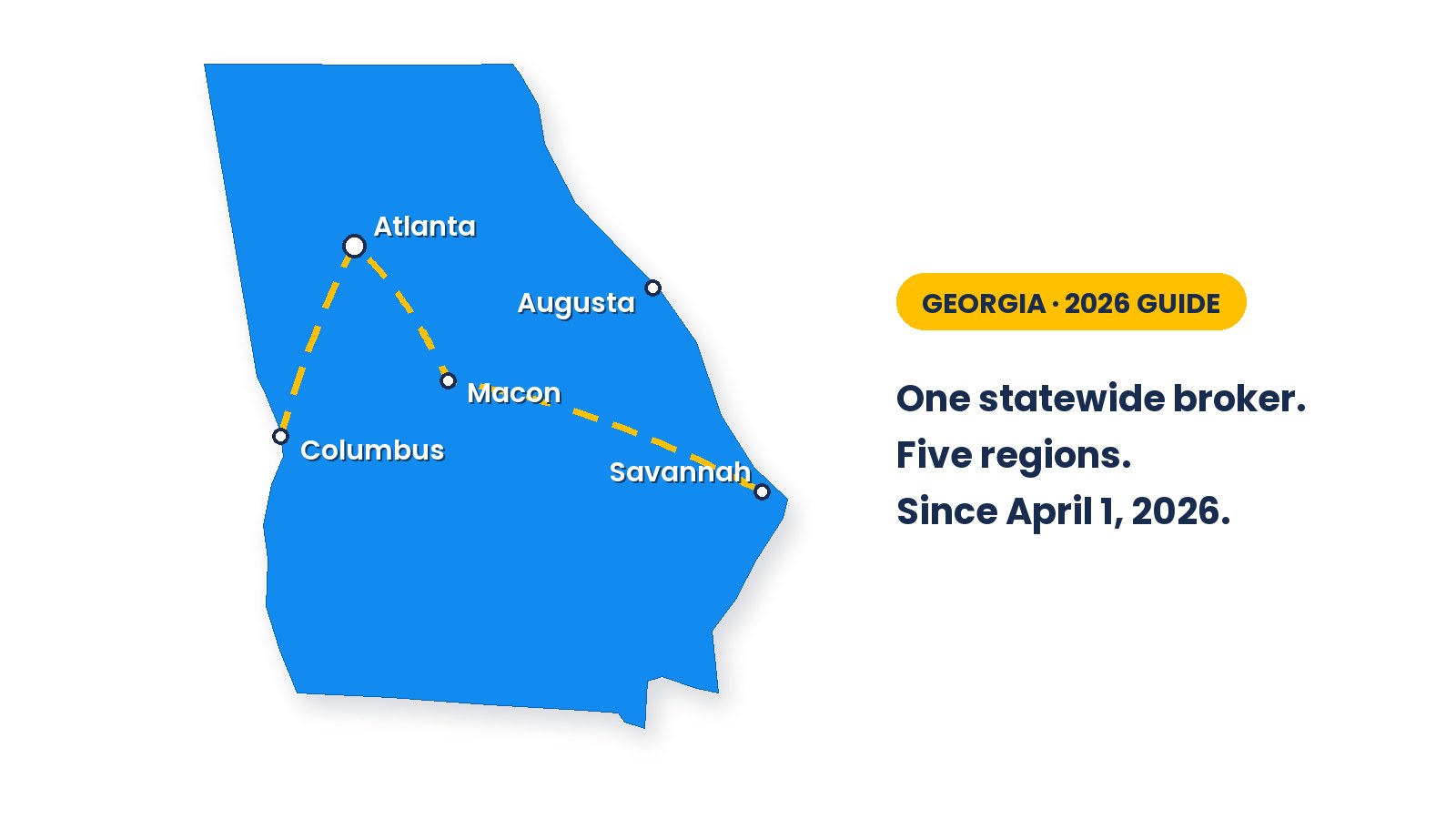
To start a NEMT business in Georgia, form an LLC ($100), get a free EIN and Type 2 NPI, and file for a local occupation tax certificate ($80 to $241). Apply to Verida, the single statewide Medicaid NEMT broker since April 1, 2026; it only adds providers where it has need. Budget $15,000 to $45,000 and two to four months to your first trips; Verida publishes no credentialing timeline.
Georgia at a glance:
- State NEMT license: none exists. Most NEMT vans are exempt from motor carrier certification too.
- Who runs Medicaid rides: Verida, the single statewide Medicaid NEMT broker for all five regions since April 1, 2026.
- How you enroll: through Verida’s Request for Qualifications. No separate Medicaid enrollment, and Verida only adds providers where it has need.
- Insurance the contracts expect: $1 million combined single limit auto plus $1M/$2M general liability, commonly reported rather than published.
- Cost to launch one van: $15,000 to $45,000, most of it the van and the insurance.
- Time to first trips: two to four months from first paperwork, with insurance and Verida credentialing the two slowest steps. Verida publishes no credentialing timeline.
Georgia pays a broker to run its Medicaid rides. A broker is the company a state or health plan hires to assign Medicaid rides to transportation providers and pay for them. Until April there were two. Verida ran the Atlanta and North regions. Modivcare held Central, East, and Southwest. On April 1, 2026, Verida took over all five regions, and Modivcare exited Georgia Medicaid [1]. Three of the five regions changed hands. Providers who had built their whole schedule on Modivcare woke up needing a new contract.
Te’ya Miles is the Atlanta operator behind That NEMT Girl. She described the fallout on our podcast that May: “We have a whole pool of providers that have to pivot either their entire business or they have to pivot their clientele in terms of who they’re marketing to. And you don’t ever want to be put in a position where you’re forced to make a decision for your business out of inconvenience.”
If you’re starting a non-emergency medical transportation (NEMT) business in Georgia right now, that shakeup is the market you’re walking into, and it cuts both ways. The paperwork is simpler than it’s ever been: one broker, one credentialing process, one contract for the whole state. Credentialing is the broker’s or plan’s own approval process before it sends you trips. And the companies already here are busy redoing contracts and replacing lost trips, while the riders never stopped needing rides.
This guide covers what Georgia actually requires (less than you’d think), what the broker requires (more than the state does), and the order that wastes the least money.
I run Duet, a dispatch software company, and I talk to NEMT operators every week, Georgia included. This is the Georgia edition of our national guide on how to start a NEMT business. It cites the actual Georgia statutes, rules, and agency pages. Where I couldn’t verify something against a primary source, I say so. Requirements change, so confirm against the linked sources before you spend money.
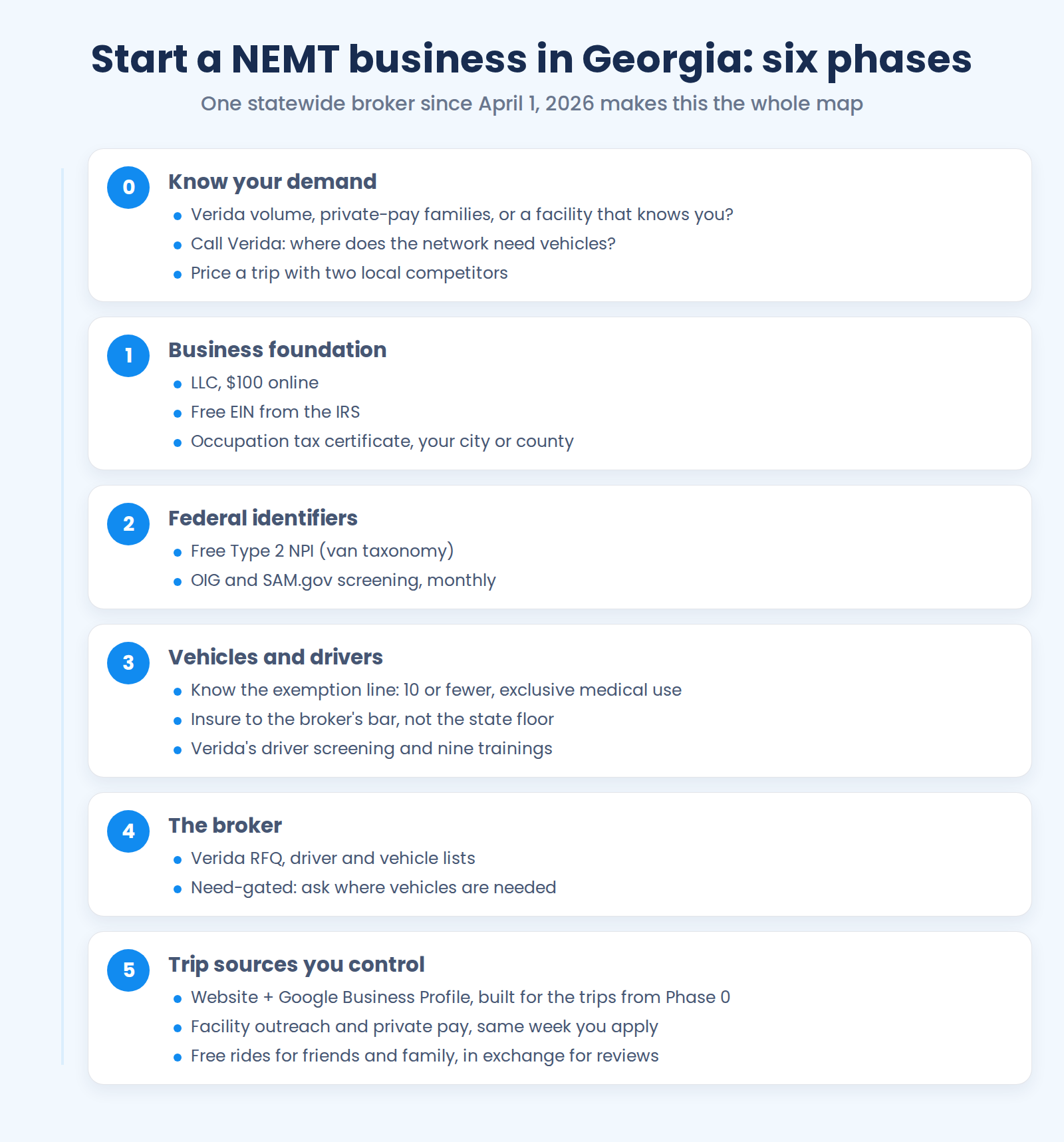
The one-page checklist: steps to start a NEMT business in Georgia
Phase 0: know your demand
- Decide where your trips will come from: Medicaid trips through Verida, private-pay families, or a facility that already knows you.
- Call Verida provider relations, the team that handles transportation companies, with one question: where does the network need vehicles?
- Call two local companies and ask what they charge for a wheelchair trip. You want the market’s rates before you set yours.
Phase 1: business foundation
- Form your LLC with the Georgia Secretary of State: $100 online at ecorp.sos.ga.gov [2]. Your LLC’s annual registration renews between January 1 and April 1.
- Get a free EIN (your federal tax ID) from the IRS. Never pay a third party for this.
- Register with the Georgia Department of Revenue through the Georgia Tax Center if you’ll have employees.
- Get the occupation tax certificate (the “business license”) for the city or county where your office sits. In Atlanta: the Business Occupational Tax Certificate through the ATLBIZ portal, $191 application fee plus a $50 flat fee [3].
Phase 2: federal identifiers
- Apply for a Type 2 (organization) NPI at NPPES. An NPI is the ID number the healthcare system uses for your company. Use taxonomy 343900000X, Non-Emergency Medical Transport (VAN). Free, and usually issued within days [4].
- Check owners and drivers against the two federal lists of people banned from Medicaid work: the OIG exclusion list and SAM.gov. Recheck monthly; Verida checks these too.
Phase 3: vehicles, drivers, and insurance
- Know whether your van is exempt: a van capable of carrying 10 or fewer people, used only for elderly, disabled, or medical-care passengers, needs no Georgia motor carrier certificate [5]. Bigger or mixed-use vehicles need one.
- Separate rule, separate count: a van designed for more than 8 passengers including the driver needs a Georgia intrastate USDOT number and vehicle markings [6]. Confirm with the Department of Public Safety (DPS) before you buy.
Then drivers and insurance:
- No CDL (commercial driver’s license) needed under 16 passengers. Budget for the broker’s driver rules instead: background checks, drug screens, MVR (driving-record) reports, and Verida’s nine trainings.
- Insure to the broker’s bar, not the state minimum. Georgia’s for-hire floor: $100,000/$300,000/$50,000 for vehicles seating 12 or fewer [7]. Broker bar, as insurance agencies report it: $1 million combined single limit auto plus $1M/$2M general liability.
- Two terms in that line: a combined single limit is one policy limit that covers injuries and property damage together. General liability covers injuries and damage that don’t involve driving, like a fall at pickup.
- Get quotes before you buy anything.
Phase 4: the broker
- Apply to Verida’s network: the Request for Qualifications form (Verida’s application) plus driver and vehicle lists at verida.com’s Georgia providers page [8].
- Ask where the need is before you pick your county. Verida only takes new providers where a region needs more vehicles, so getting in is “need-gated”.
- Have your insurance certificates, driver files, and vehicles ready for Verida’s safety inspection and provider orientation.
Phase 5: the trip sources you control
- Set up a website and Google Business Profile built around the trips from Phase 0. Add Yelp and Facebook, especially if you’re skipping the broker.
- Start visiting facilities and building your private-pay marketing the same week you apply to Verida, not after. Broker credentialing has a queue; relationships don’t.
- Offer friends and family free or discounted rides in exchange for honest Google reviews. Ten of them make strangers trust you.
Who pays for NEMT rides in Georgia?
Three sources pay for NEMT rides in Georgia. Georgia Medicaid pays through its statewide broker, Verida. Facilities pay under contract: hospitals, dialysis clinics, senior living communities. And private-pay families book directly. Three payers, three different businesses.
Medicaid is the volume. Georgia’s Department of Community Health (DCH) runs NEMT as a broker program. DCH pays Verida a capitated rate, a fixed monthly fee per member whatever the members use. Verida builds the provider network and pays providers out of that pot [1][9].
As of mid-2024, roughly 1.9 million Georgians qualified for NEMT rides, per CMS’s Medicaid managed care enrollment data [10]. Federal CMS-64 expenditure reports put Georgia’s NEMT spending near $131 million in fiscal 2024 [10]. Georgians on Medicaid health plans use the same statewide broker for in-state trips [9]. A Medicaid health plan is a private health plan the state pays to cover Medicaid members. So one Verida contract reaches essentially all of Georgia Medicaid.
Facilities are the stability. Hospitals discharging patients, dialysis clinics with standing three-times-a-week schedules, rehab centers, senior living. Georgia’s dialysis population runs in the tens of thousands, with dozens of clinics across metro Atlanta alone. One facility that trusts you can fill a van’s whole day, and those checks kept arriving straight through the April broker change.
Private pay is the margin. Families booking directly for a parent’s appointments, at rates you set. In metro Atlanta, operator rate cards published in 2023 put a private-pay wheelchair trip around $100, a base fee plus mileage. Compare broker work: industry rate reporting puts broker payouts for ambulatory riders (riders who can walk to the vehicle) at $1.25 to $1.45 a mile. On a short trip, the private-pay ride pays several times more. That gap is why the playbook I give Georgia operators is broker for volume, private pay for margin.
The Atlanta Regional Commission projects metro Atlanta’s 65-and-older population to reach roughly 975,000 by 2030, about one in five residents [11]. Rural Georgia skews even older. In this state you’ll run out of trip sources long before you run out of demand.
Who is the NEMT broker in Georgia?
Verida is Georgia’s single statewide Medicaid NEMT broker. Since April 1, 2026, Verida covers all five of Georgia’s NEMT regions: North, Atlanta, Central, East, and Southwest. The Georgia Department of Community Health’s own notice reads: “Effective April 1, 2026, Modivcare will no longer provide NEMT services” [1]. So becoming a Georgia Medicaid transportation provider means one thing: joining Verida’s network.
Some history, because half the guides online still get this wrong. Georgia ended direct Medicaid billing for NEMT back in 1997, when the broker system went live [9]. For years the state was split between two brokers. Southeastrans rebranded as Verida in 2022. LogistiCare became Modivcare. Georgia’s row in our national broker tracker has the full timeline. If an article names LogistiCare or MTM Health as Georgia brokers, or Modivcare as one you can still sign up with, it’s wrong.
Under DCH’s NEMT policy manual, the broker itself is generally barred from running the trips [9]. The program depends on companies like the one you’re about to start. Colorado made the same one-broker move three months later, with a twist: its enrollment door reopened October 1, 2026 after a three-year freeze. Verida also won DC’s fee-for-service contract, though MTM’s protest has put its start on hold.
Can I bill Georgia Medicaid directly for NEMT?
No. Every Georgia Medicaid ride goes through the broker. DCH’s policy manual is explicit: you sign a service agreement with the broker, and the broker pays you. Invoices the broker doesn’t dispute are due as agreed, or within 15 business days [9]. There’s no fee-for-service lane, where the state pays you directly per trip with no broker or plan in the middle. And per the manual, van companies in the broker’s network file no separate Georgia Medicaid enrollment application. Enrollment means signing up with the state Medicaid program itself. Your contract is with Verida.
A few 2026 guides claim you must also enroll through Georgia’s Medicaid portal (GAMMIS). The DCH manual doesn’t say that for van companies in the broker’s network. Those guides are likely mixing up NEMT with ambulance and other provider types that do bill Medicaid directly. Ask Verida provider relations during your application. It costs you one question.
What licenses and requirements does a NEMT business need in Georgia?
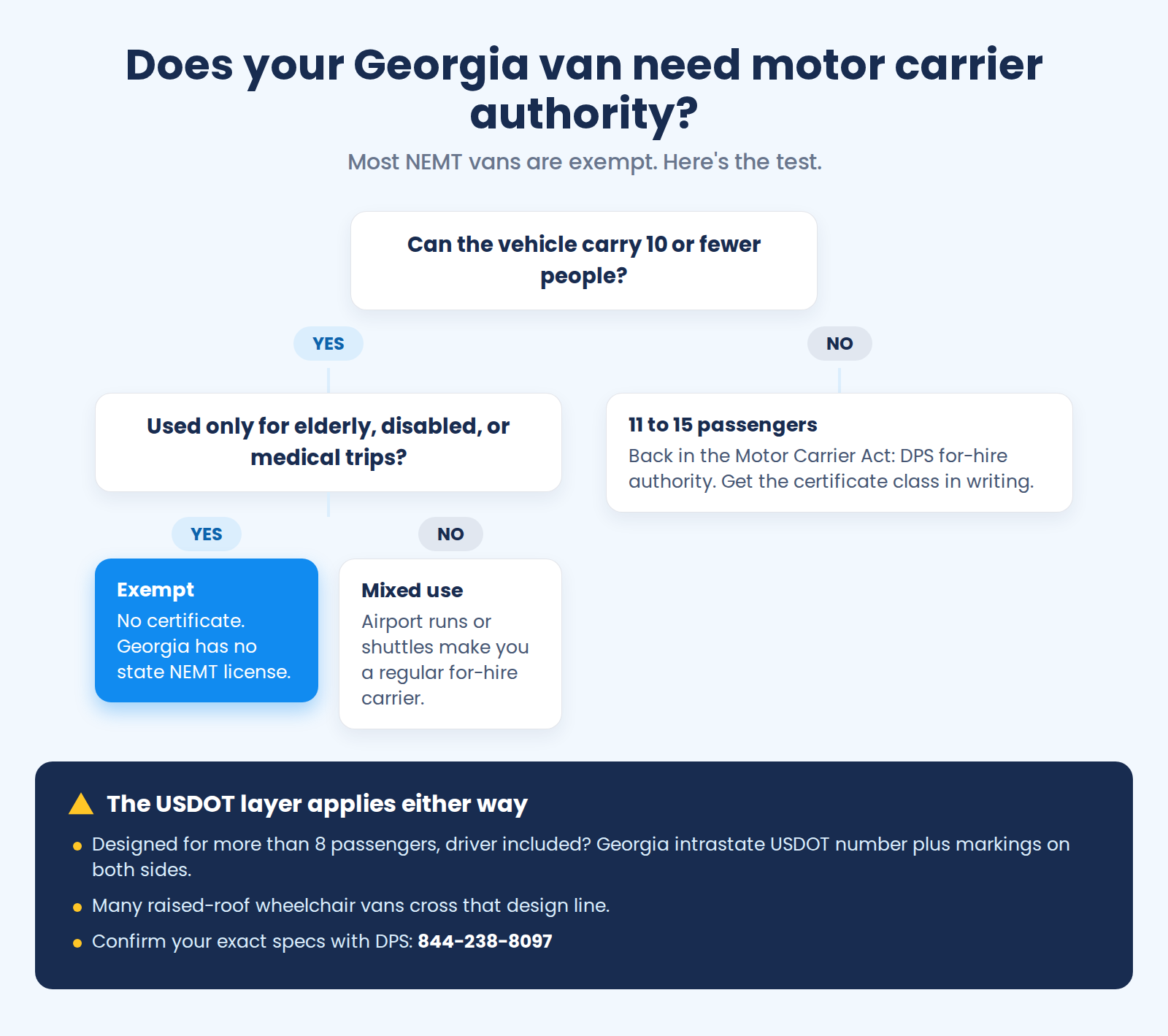
Georgia has no state NEMT license. Under O.C.G.A. § 40-1-100(12), a van carrying 10 or fewer people, used exclusively for elderly, disabled, or medical-care passengers, is exempt from motor carrier certification. That leaves your real requirements:
- The local occupation tax certificate (the “business license”).
- Possibly a Georgia intrastate USDOT number, depending on vehicle size.
- The broker’s credentialing.
That’s less licensing than almost any neighboring state. It also means the internet gets Georgia wrong constantly, so here’s the short version against the sources:
| The claim you’ll read elsewhere | What Georgia actually requires |
|---|---|
| ”Sign up with Modivcare, Georgia’s statewide broker” | Modivcare exited Georgia Medicaid NEMT on April 1, 2026. Verida is the single statewide broker for all five regions [1]. |
| ”Georgia requires a state NEMT license or provider certification” | No such license exists. O.C.G.A. § 40-1-100(12) exempts vans of 10 or fewer used exclusively for elderly, disabled, or medical-care passengers from motor carrier certification [5]. |
| ”First enroll in Georgia Medicaid through the state portal” | DCH’s NEMT manual requires only a service agreement with the broker for van providers. There’s no separate Medicaid enrollment application [9]. |
| ”Insurance: $100,000 general liability and 25/50/25 auto” | Those aren’t NEMT numbers. Georgia’s for-hire floor: $100,000/$300,000/$50,000 (Ga. Comp. R. & Regs. 570-38-4-.04) [7]. Broker bar, as agencies report it: $1 million combined single limit auto plus $1M/$2M general liability [14]. |
| ”Expect $80,000 to $135,000 per vehicle once Modivcare volume stabilizes” | Invented, and tied to a broker that left the state. A solo-run van roughly tops out near 100 trip legs a month, and a leg is one one-way ride. What it grosses depends entirely on how many of your trips are Medicaid, facility, or private pay, and no broker guarantees volume. |
The state exemption: most vans qualify
O.C.G.A. § 40-1-100(12) covers a van that carries 10 or fewer people for pay and is used only for riders who are elderly, disabled, or on their way to medical care or prescriptions. That van doesn’t count as a “motor carrier” at all [5]. A Georgia appeals court applied exactly that exemption to a wheelchair-modified van in 2015 [12]. A typical wheelchair van running only NEMT work needs no DPS motor carrier certificate, no limousine license, and no state NEMT permit, because Georgia doesn’t have one.
The exemption has edges, and they bite:
- Capacity. An 11-to-15 passenger van falls back into the Motor Carrier Act and needs a DPS certificate. DPS’s public documents don’t say which certificate class applies, so get that answer from DPS in writing.
- Exclusive use. The moment you mix in non-medical work with the same vehicle, say airport runs or event shuttles, you’re arguably a regular for-hire carrier. Keep the medical work exclusive, or get DPS’s answer in writing.
The USDOT number: a separate layer
Georgia is an intrastate USDOT number state. Intrastate means you operate only inside Georgia. This layer applies even when your van needs no certificate. What DPS says:
- A vehicle designed for more than 8 passengers including the driver, run for pay, needs a Georgia intrastate USDOT number and name-and-number markings on both sides. Many raised-roof wheelchair vans cross that 8-passenger design line [6].
- The same requirement applies to any vehicle with a gross vehicle weight rating over 10,000 pounds, regardless of seat count. That catches many E-series and Transit cutaway wheelchair vans [6].
- Georgia also applies the federal motor carrier safety rules to in-state carriers [6].
One question nobody answers in public: whether the annual Georgia Intrastate Motor Carrier registration also applies to certificate-exempt vans. So before you register anything, call DPS’s commercial-carrier registration desk (the UCR-GIMC section) at 844-238-8097 with your exact vehicle specs.
Crossing state lines changes the rules. Interstate passenger work in 9-to-15 passenger vehicles run for direct compensation brings FMCSA registration and a $1.5 million federal insurance minimum [13].
The local business license
Then there’s the local layer. Georgia law lets every city and county charge an occupation tax, and nearly every metro city and county does. You need the certificate from wherever your office sits: the city’s if you’re inside city limits, the county’s only if your address sits outside any city (what Georgia calls unincorporated).
| Where your office sits | Certificate fee |
|---|---|
| City of Atlanta | $191 application fee plus a $50 flat fee, plus a tax based on your total sales [3] |
| Gwinnett County (unincorporated addresses) | $80 flat certificate fee |
| Cobb County | $112 to $119 minimum for a new business, a $55 administrative fee included [19] |
| DeKalb County | No fee schedule published online |
Atlanta’s is the Business Occupational Tax Certificate, and the ATLBIZ portal is the only way to apply. File that renewal by February 15 and pay by April 1 [3]. For DeKalb’s fee, call 404-371-2155, option 5.
Te’ya’s advice on our podcast matches what I hear from Georgia operators who did this right: “What you should start is with your local county government… Every local county government is different. So for here in Atlanta, I have a business license with the city of Atlanta, but I also have my state articles of incorporation for my business.”
Two things to settle by phone
Two loose ends, because the sources genuinely don’t settle them. Neither should stop you; both are worth thirty minutes.
- Atlanta’s vehicle-for-hire ordinance. It defines “vehicle for hire” broadly enough to mention medical patients. I couldn’t confirm from the current city code whether the city applies its permit rules to NEMT vans. Ask Atlanta’s Office of Revenue when you get your certificate.
- Sales tax on private-pay fares. It’s a gray area. Georgia taxes “in-state transportation of individuals” but leaves medical transports out of its for-hire excise tax, and no Department of Revenue guidance addresses NEMT squarely. Ask a Georgia CPA before you set your invoice format.
What are the NEMT insurance requirements in Georgia?
Plan on roughly $1 million combined single limit commercial auto, plus general liability at $1 million per claim and $2 million per year. That’s the bar insurance agencies report Verida credentialing requires. It isn’t the state floor, and it certainly isn’t the 25/50/25 personal-auto minimums some guides quote.
Industry reporting on the Verida transition puts Georgia broker credentialing at exactly that: $1 million combined single limit auto for wheelchair and stretcher vans, plus the $1M/$2M general liability. Add the broker as certificate holder and additional insured [14]. That means the broker is named on your policy and gets proof of coverage.
Verida’s Georgia page asks for an insurance company rated A- or better and $1 million of sexual abuse and molestation coverage with a $2 million aggregate [8], but it publishes no auto or general liability limits, rates, or payment terms. Our own July 2026 sweep of published broker terms came up empty too. So treat the $1 million auto and $1M/$2M general liability figures as commonly reported rather than official. Get the real numbers from your Verida provider relations contact before you bind a policy. Binding is the moment coverage is active.
The state floor, for the record: under Ga. Comp. R. & Regs. 570-38-4-.04, for-hire passenger vehicles seating 12 or fewer passengers must carry $100,000 bodily injury per person, $300,000 per accident, and $50,000 property damage [7]. Above 12 seats, the per-accident figure rises to $500,000 [7]. That’s the floor for carriers under DPS authority. Most NEMT vans aren’t under DPS authority at all, and nobody in this business insures at the floor anyway.
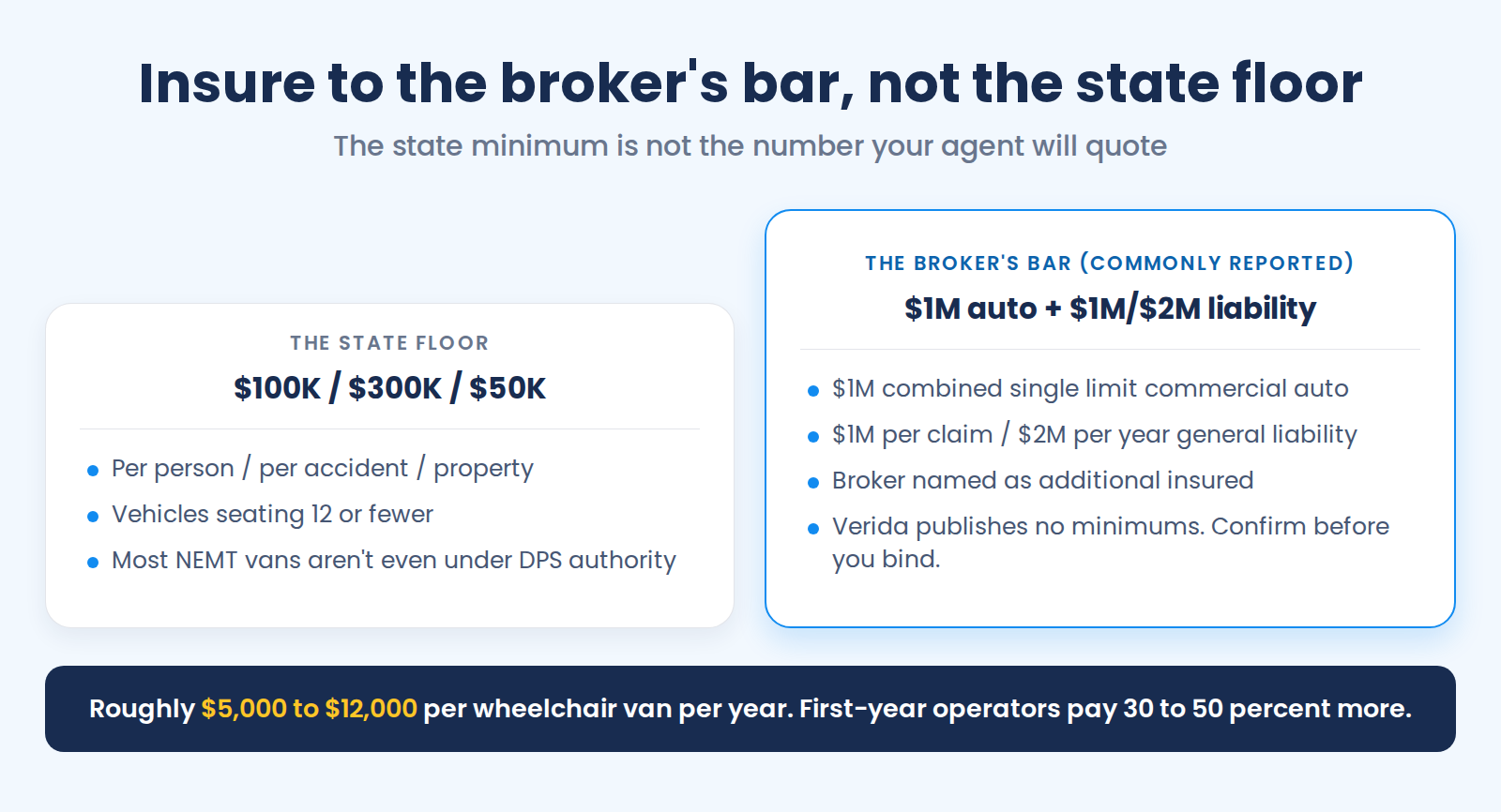
What that costs, based on what NEMT-specialist insurance agencies publish:
- Sedans: roughly $3,500 to $8,000 per vehicle per year [20].
- Wheelchair vans: roughly $5,000 to $12,000 [20].
- First-year operators: typically 30 to 50 percent more [21].
Only a handful of insurance companies cover NEMT, so use an agent who places medical transport policies every week. Price your insurance before you commit to a vehicle.
Two more lines for the budget. Georgia requires workers’ compensation once you regularly employ three or more people [15]. Corporate officers and LLC members, meaning the owners, count toward the three even if they exempt themselves from coverage [15]. And facility contracts commonly ask for the same $1M/$2M general liability the broker does, so one policy usually satisfies both the broker and the facilities.
What do NEMT drivers need in Georgia?
No CDL, for almost everyone. Georgia requires a commercial license only at 16 or more passengers including the driver [16]. Georgia also has no general chauffeur’s license, and the state’s for-hire driver endorsement is written for taxi, limo, and ride-share drivers, not NEMT. One exception: if you choose to operate under a limousine certificate, its rules apply.
What your drivers will actually need is the broker’s list. Verida’s published driver requirements are criminal background checks, current drug screens for owners and drivers, and MVR reports [8]. Then come the trainings.
What are Verida’s nine required driver trainings?
Verida requires every driver in its Georgia network to complete nine named trainings before going live [8]:
- First Aid
- CPR
- Defensive Driving
- Passenger Sensitivity
- Customer Service
- Spill Kit
- Proper Lifting Techniques
- Wheelchair Securement
- Driver Orientation
Budget money and calendar time: these are real classes.
Can a NEMT company run stretcher van trips in Georgia?
Yes. Georgia lets a non-ambulance stretcher van carry stable patients under its “invalid car” exemption. An invalid car is Georgia law’s old category for a non-emergency vehicle used only for people who are sick, recovering, or can’t walk. The ambulance rules (Ga. Comp. R. & Regs. 511-9-2-.07) say invalid cars don’t need an ambulance license [17], and there’s no separate Department of Public Health (DPH) license or inspection category for them. Georgia Medicaid’s NEMT program covers stretcher van trips as one of its trip types.
That’s one of Georgia’s advantages, because several states force stretcher work into ambulance licensing. Texas is the sharpest contrast: stretcher transport there requires an EMS provider license, no exceptions. North Carolina draws the same line by treating anyone on a stretcher as a patient.
The line you can never cross: no medical care during transport. Care means monitoring during the ride, oxygen given by an attendant, IVs, or cardiac monitoring. The moment a patient needs any of that, it’s a licensed ambulance’s trip, with two medics aboard and DPH inspection requirements. Build the service line for stable patients only, and put that line in your dispatch protocols in writing.
1013 transports: a later niche
Georgia also has its “1013” transports, the involuntary psychiatric holds named for the form. There’s no special state license for private 1013 transport. Under O.C.G.A. § 37-3-101, counties, facilities, and community mental health authorities arrange these trips, and a transport company gets the work through those arrangements [18].
The code actually prefers family or friends when the patient can be moved safely. Some Georgia operators build a high-paying niche here through facility relationships. Take on 1013 work only after your drivers have real miles behind them: an involuntary hold is nothing like a dialysis run.
How do you become a Verida provider in Georgia?
Since April 1, 2026, becoming a Verida provider is the whole of Georgia Medicaid NEMT work. It takes four steps.
One warning before step one: Verida credentialing is need-gated. Its own application language says it contacts you for an interview only if your region has need [8]. You can be fully qualified and still be told your region is full. That’s not a reason to skip Medicaid work; it’s a reason to ask early, pick your county with eyes open, and never build a launch plan that dies if the broker says “not yet.”
The sequence, as Verida publishes it [8]:
- Request for Qualifications. The RFQ form on Verida’s site, with your driver and vehicle lists attached.
- Need review, interview, and documents. If Verida has need in your region, it schedules an interview and asks for your business documents: your entity papers, insurance certificates, and the rest.
- Inspections and training. Every vehicle passes a full Verida safety inspection, and every driver completes the nine trainings and screening checks.
- Orientation and contracting. The owner completes Verida’s provider orientation, then you contract and go live.
Verida provider requirements
The requirements sheet behind those steps [8][14]:
- Your entity papers and EIN.
- Certificates of insurance issued to Verida’s exact spec, commonly reported at $1 million combined single limit auto plus $1M/$2M general liability.
- Driver files: background checks, drug screens, MVR reports, and the nine trainings.
- Vehicles that pass Verida’s safety inspection.
- The driver and vehicle lists attached to your RFQ.
How long does Verida credentialing take?
Verida publishes no timeline, so plan on weeks to a few months for the whole process, with the need review as the real gate. One Indiana operator who works with three brokers, Verida among them, calls Verida the strictest: certificates of insurance issued to Verida’s exact spec, and roughly two to three weeks for the credentialing phase once need was established.
What to ask provider relations
Three things to ask your provider relations contact directly, because Verida publishes none of them:
- The actual insurance limits for your vehicle types.
- Payment terms. Net 30 means you get paid 30 days after you invoice. It’s the industry average, with net 21 to net 45 both out there. Get yours in writing and plan cash flow for it.
- Whether you can start with one vehicle. Southeastrans, Verida’s old name, historically required two vehicles but ran a one-van subsidiary program. Nothing public says whether anything like it survives. Ask before you buy van number two.
Verida’s Georgia corporate office is in Villa Rica (678-510-4600), and its site lists regional provider relations managers. Verida also runs a separate Georgia DHS coordinated transportation program for aging and human services trips. That’s a different door from Medicaid NEMT, and a second source of trips to ask about once you’re in Verida’s network.
Rates are a contract conversation, not a public schedule. In-network trips pay per your rate sheet. Trips outside your area, and trips Verida calls you to quote, are where you have negotiating room. Ask to revisit your rates annually. Operators who never reopen the sheet leave years of increases on the table.
Don’t build the whole schedule on the broker
Everything above gets you into Georgia Medicaid work. And April taught every Georgia operator one line: broker volume is borrowed volume.
Te’ya again, from the same episode: “You may have put all your eggs into the basket of a broker, and then now they lost. I actually know a provider like that in Georgia right now. You grew with wheelchair and stretcher, and then boom, you lost that contract. You stopped doing the private-pay marketing.” The providers who sailed through April were the ones with facility contracts and private-pay customers that no state contract change could touch.
So run both plays from day one:
- Facilities first. Dialysis clinics, rehab hospitals, skilled nursing, senior living. Our guides on winning facility contracts and getting your first trip from a facility meeting walk through the whole process, and it works in Cobb County exactly like it works everywhere else.
- Private pay from your own phone, website, and Google Business Profile. Set your rates against the market: the roughly $100 Atlanta wheelchair trips from earlier run several times what short-haul broker work pays. The private pay guide covers pricing and marketing. And collect Google reviews before you need them (Phase 5 above).
In states with several brokers, operators spread the risk: run four or five broker contracts, and losing one stings without sinking the schedule. California is the extreme case, with no statewide broker at all and every Medi-Cal health plan arranging its own rides. Florida sits between: four broker networks, each holding different Medicaid plans, plus a state fee-for-service broker lane.
Georgia now has exactly one, the setup New York has run through a single broker since 2023, so there’s nothing to split, and the facility and private-pay work above matters more here, not less. Broker trips are excellent filler and a fine on-ramp. They’re a dangerous foundation.
One operational note on working with Verida: trips come with manifests (the trip lists Verida sends you), claims you file in Verida’s portal, and paperwork for every trip. Providers running dispatch software like Duet, which imports broker trip files alongside their facility and private-pay trips, keep one schedule instead of three. However you dispatch, don’t run the broker’s trips in one system and your own in a legal pad.
How much does it cost to start a NEMT business in Georgia?
Plan on $15,000 to $45,000 to put the first vehicle on the road legally in Georgia, most of it the vehicle and the insurance. The line items, from the sections above:
| Line item | What it costs |
|---|---|
| LLC formation | $100 online [2] |
| EIN and NPI | Free; never pay a third party [4] |
| State NEMT license | $0. It doesn’t exist, and most NEMT vans are exempt from motor carrier certification too [5] |
| Occupation tax certificate | $80 to $241 by jurisdiction: Gwinnett $80, Cobb $112 to $119, Atlanta $191 application plus a $50 flat fee [3][19] |
| Commercial auto insurance | Roughly $5,000 to $12,000 a year per wheelchair van, $3,500 to $8,000 for sedans, and 30 to 50 percent more in year one [20][21] |
| Driver screening and Verida’s nine trainings | Real classes with real fees, per driver, before your vehicles go live [8] |
| Used wheelchair van | Commonly $15,000 to $40,000 for one that’s mechanically sound; price the insurance before the van |
| Working capital | 3 to 6 months of expenses; a facility check can take 60 days to arrive |
Anyone quoting a $5,000 Georgia launch hasn’t priced Georgia commercial auto, the line that sinks a lot of NEMT startup budgets.
And about revenue: you’ll see projections online of $80,000 to $135,000 per vehicle tied to Modivcare trip volume. Ignore them. Modivcare left Georgia in April 2026, and no broker guarantees volume. The numbers to plan around: a solo-run van roughly tops out near 100 trip legs a month, ambulatory broker work pays $1.25 to $1.45 a mile, and the roughly $100 private-pay trips are where the margin lives. What a van grosses depends on your payer mix.
How do you fund a NEMT startup in Georgia?
If the savings account doesn’t cover it:
- SBA 7(a) loans and microloans finance vehicles and working capital.
- Georgia’s Small Business Development Center advises for free.
- Access to Capital for Entrepreneurs (ACE), a Georgia community lender, works with borrowers banks turn down.
None of them speed up Verida’s need review, so size your loan payments to the slow timeline, not the hopeful one.
How long does it take to start a NEMT business in Georgia?
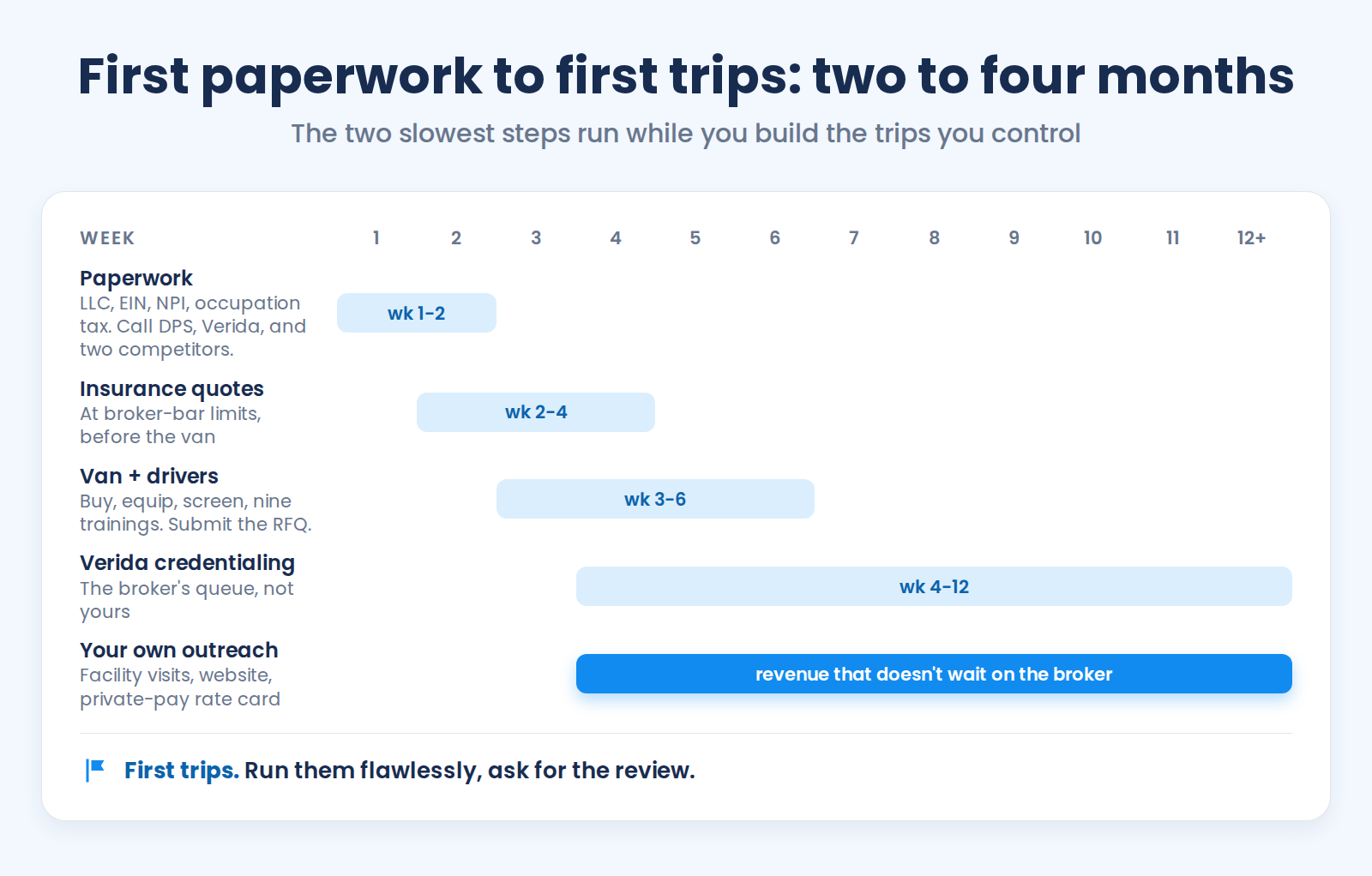
Plan on two to four months between your first paperwork and your first trips. Insurance and Verida credentialing are the two slowest steps. A realistic sequence:
- Weeks 1-2. LLC ($100), EIN, NPI, occupation tax certificate for your address. Call DPS with your vehicle specs to settle the USDOT question. Call Verida to ask where the need is. Price a trip with two local competitors (Phase 0).
- Weeks 2-4. Insurance quotes from an NEMT-savvy agent, at broker-bar limits. Pick your vehicle only after you know the premium. Let Verida’s answer about the need decide where you set up.
Then the van, the drivers, and the trips:
- Weeks 3-6. Buy the van; used and mechanically sound beats new debt. Fit it out for wheelchair securement to standard. Get drivers screened and through the nine trainings. Submit Verida’s RFQ.
- Weeks 4-12. While credentialing runs: facility visits, website, Google Business Profile, private-pay rate card.
- First trips. However the first trips arrive, run them flawlessly and ask for the review. In this business the second trip comes from the first one.
Budget per the cost table above, and save 3 to 6 months of expenses on top: break-even comes months after launch.
Georgia NEMT FAQ
Does Georgia require a NEMT license?
No. Georgia has no state NEMT license, and vans of 10 or fewer persons used exclusively for elderly, disabled, and medical-care passengers are exempt from motor carrier certification [5]. What you do need: a local occupation tax certificate, possibly a Georgia intrastate USDOT number depending on vehicle size [6], and the broker’s credentialing requirements.
Is Modivcare still a NEMT broker in Georgia?
No. Modivcare exited Georgia Medicaid NEMT on April 1, 2026. Verida holds all five regions [1].
Is Verida the only NEMT broker in Georgia?
Yes. Since April 1, 2026, Verida is the single statewide Medicaid NEMT broker for all five Georgia regions [1]. Medicaid health plan members use the same broker for in-state trips [9]. Facilities and private-pay riders need no broker at all.
How much does it cost to start a NEMT business in Georgia?
Plan on $15,000 to $45,000 to put the first vehicle on the road legally, most of it the vehicle and insurance. The LLC is $100 [2]. The occupation tax certificate runs $80 to $241 depending on your city or county [3]. Commercial auto runs roughly $5,000 to $12,000 a year per wheelchair van [20]. Verida’s nine driver trainings cost real money per driver [8]. There’s no state license fee, because no state NEMT license exists [5]. Save 3 to 6 months of expenses on top.
Can I start a NEMT business in Georgia with one van?
Legally, yes. Verida doesn’t publish whether its network takes one-van providers, and it may depend on your region’s need. Ask provider relations first. Facilities and private-pay riders have no fleet minimums.
How long does Verida credentialing take in Georgia?
Verida publishes no timeline. Plan on weeks to a few months end to end. The need review is the real gate [8], and one Indiana operator reports roughly two to three weeks for Verida’s credentialing in Indiana.
Do NEMT drivers need a CDL in Georgia?
Not below 16 passengers including the driver [16]. Plan for the broker’s background checks, drug screens, and training requirements instead.
Are stretcher trips allowed in Georgia?
Yes, under Georgia’s invalid car exemption, for stable patients needing no medical care during transport [17]. Anything that needs care during the ride is ambulance work.
Is the Georgia market worth entering in 2026?
The demand math says yes: about 1.9 million NEMT-eligible Medicaid members as of mid-2024 [10], and a metro-Atlanta senior population headed toward one in five residents [11]. The provider network also just went through a forced reshuffle. The caution: enter with trip sources you control, because Verida only adds providers where it has need, and fewer people nationally may qualify for Medicaid in the coming years.
Key official sources
[1] Georgia Department of Community Health, Non-Emergency Medical Transportation: Verida statewide for all five regions effective April 1, 2026. https://medicaid.georgia.gov/programs/all-programs/non-emergency-medical-transportation
[2] Georgia.gov, Register an LLC. https://georgia.gov/register-llc
[3] City of Atlanta (ATL311), Business Occupational Tax Certificate. https://www.atl311.com/en-us/knowledgearticle/?code=KB0015172
[4] NPPES, National Provider Identifier application. https://nppes.cms.hhs.gov
[5] O.C.G.A. § 40-1-100(12), motor carrier definition and the ten-person medical-transport exemption. https://codes.findlaw.com/ga/title-40-motor-vehicles-and-traffic/ga-code-sect-40-1-100/
[6] Georgia Department of Public Safety, MCCD Fact Sheet #29, USDOT number requirements for Georgia intrastate carriers. https://dps.georgia.gov/document/publication/usdot-requirements-ga-intrastate-cm-carriers/download
[7] Ga. Comp. R. & Regs. r. 570-38-4-.04, minimum required insurance for passenger carriers. https://rules.sos.ga.gov/gac/570-38-4
[8] Verida, Georgia transportation providers and Request for Qualifications. https://verida.com/georgia-providers/
[9] Georgia DCH, Part II Policies and Procedures for Non-Emergency Medical Transportation (NEMT), rev. July 2022. https://medicaid.georgia.gov/document/document/nemt-policy-manual-july-2022/download
[10] CMS: CMS-64 Financial Management Report data, federal fiscal year 2024 (Georgia NEMT expenditures), and the Medicaid Managed Care Enrollment report, data as of July 1, 2024 (Georgia NEMT program enrollment). https://www.medicaid.gov/medicaid/financial-management/state-expenditure-reporting-for-medicaid-chip/expenditure-reports-mbescbes
[11] Atlanta Regional Commission, aging trends in metro Atlanta. https://33n.atlantaregional.com/regional-snapshot/regional-snapshot-exploring-aging-trends-in-metro-atlanta
[12] Mornay v. National Union Fire Insurance Co., 331 Ga. App. 112 (2015), applying the NEMT exemption. Analysis: https://www.deflaw.com/insights/non-emergency-transport-vehicle-issues-under-georgias-motor-carrier-act/
[13] FMCSA, registration requirements for small passenger-carrying vehicles. https://www.fmcsa.dot.gov/registration/small-passenger-carrying-vehicles
[14] NEMT insurance market reporting on the Georgia Verida transition and broker insurance requirements, April 2026. https://nemtinsurance.com/blog/georgia-medicaid-nemt-verida-broker-transition-2026
[15] Georgia State Board of Workers’ Compensation, insurance FAQs. https://sbwc.georgia.gov/frequently-asked-questions/workers-compensation-insurance-faqs
[16] Georgia Department of Driver Services, commercial driver’s licenses. https://dds.georgia.gov/georgia-licenses-ids-and-permits/new-license-id-or-permit/how-do-i-cdl-license
[17] Ga. Comp. R. & Regs. 511-9-2-.07, ground ambulance licensure and the invalid car exemption; O.C.G.A. § 31-11-2. https://rules.sos.ga.gov/gac/511-9-2
[18] O.C.G.A. § 37-3-101, transportation of patients under involuntary holds. https://codes.findlaw.com/ga/title-37-mental-health/ga-code-sect-37-3-101/
[19] Cobb County Internal Audit Department, Report 2024-005 (December 9, 2024): the occupation tax schedule, $112 (Schedule A-1) or $119 (Schedule A-2) for a business under $100,000 in gross revenue, with the $55 administrative fee built in. https://assets.cobbcounty.gov/files/2024-12/%5B2024-005%5D%20Final%20Report%20-issued%2012-9-2024.pdf
[20] InsureLimos, Georgia NEMT insurance cost ranges for sedans and wheelchair vans. https://insurelimos.com/nemt-insurance/georgia
[21] NEMT Insurance, wheelchair van insurance costs and new-operator pricing, 2026. https://nemtinsurance.com/wheelchair-van-insurance
Last verified against the sources above in August 2026. Georgia requirements and broker arrangements change; check the primary sources before acting, and treat this guide as education, not legal advice.
About the author
James O'Donnell cofounded Duet and leads its sales, partnerships, and growth services. He talks with NEMT operators every week, hosts the NEMT Growth podcast, and answers Duet's sales line himself. More about Duet's founders →
Starting in a nearby state?
Want more trips and less busywork?
See how Duet runs and grows NEMT businesses in a 30-minute demo.