Article
How to Get Your First Trip From a Facility Meeting
Everyone's friendly. They take your brochure. They say "we'll keep you in mind." Then nothing. This is the playbook for everything between the first hello and the first trip.
By James O'Donnell, Cofounder and COO, Duet ·
Our facility outreach team cold-calls hospitals, rehabs, and nursing homes on behalf of NEMT providers every day, so I get to watch a pattern most operators only feel: the meeting is not the hard part. Getting in front of an administrator takes persistence, sure; we wrote a whole guide to getting in the facility door, and the first section below adds the warm shortcut. But the meeting itself usually goes fine. Everyone’s friendly. They take your brochure. They say “we’ll keep you in mind.”
Then nothing. No call that week. No call the next.
I’ve heard that silence described as proof that facility work is dead, that the contracts all went to brokers, that nobody gives a new provider a shot. That’s not what I see from this side of the phone. The mistake isn’t failing to impress the administrator. It’s treating the meeting as the finish line when it’s actually the starting gun.
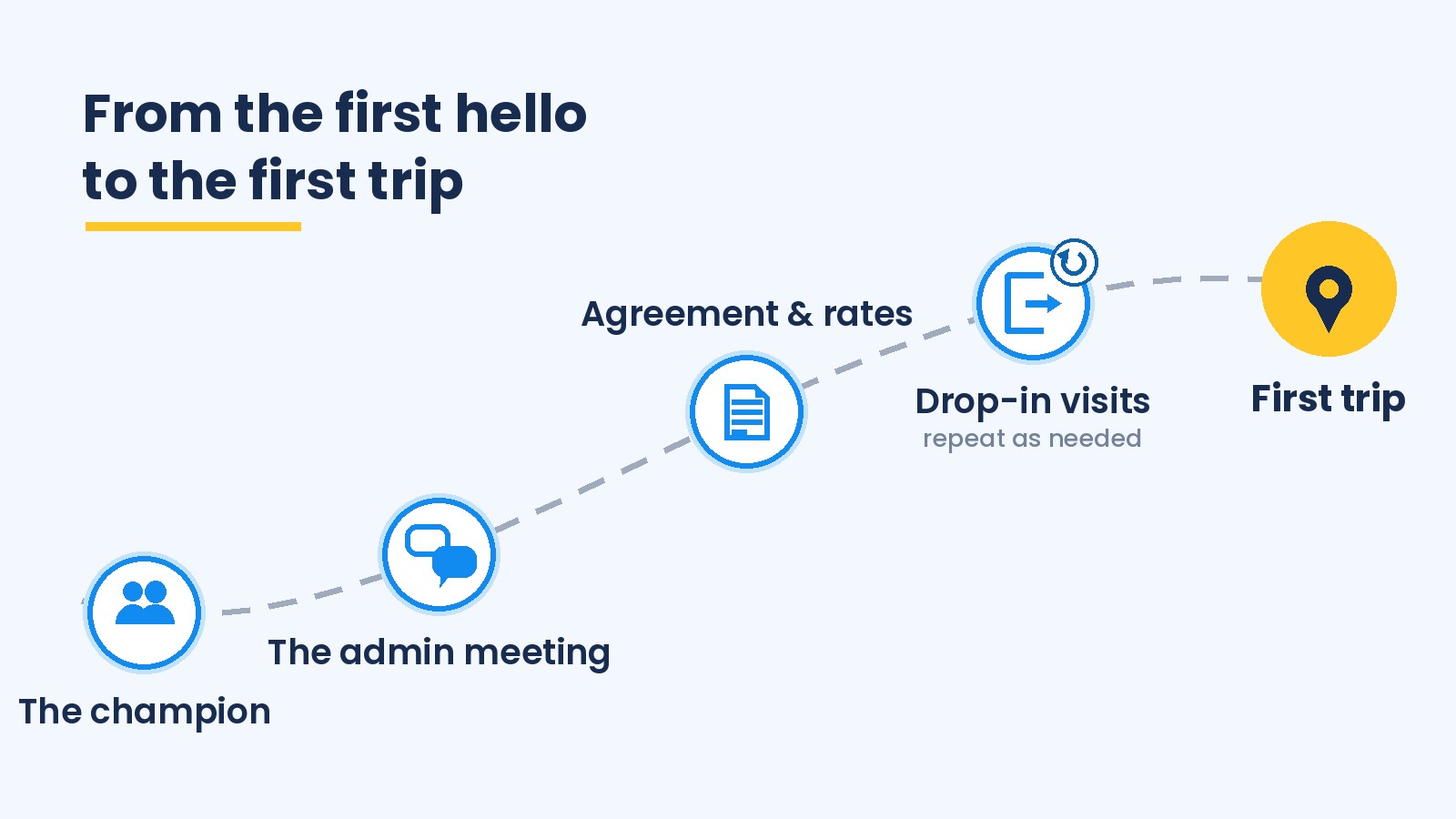
So this piece is about the stretch nobody writes about: everything between the first hello and the first trip.
How do I get a meeting with a facility administrator?
The fastest way to get a meeting with a facility administrator is a warm introduction from someone the facility already trusts: a champion. Administrators are busy people who get pitched constantly, and most won’t take a meeting with an unknown vendor unless transportation happens to be falling apart that very week. A champion turns you from unknown vendor into “oh, you’re the one she keeps telling us about.”
Champions come in more flavors than most operators realize:
- A relative who lives there. One of our customers was running 100% of a facility’s trips within a month of his dad moving in, because his dad told everyone in the building how amazing his son and his company were. The best sales rep he never hired.
- A rider you already serve. If you transport even one resident from that facility, you have a legitimate reason to be in the lobby and a name the staff recognizes.
- An administrator at another facility. Admins know each other. One who likes your work will vouch for you across town, and that vouch is worth more than any brochure.
- The front desk. Not pitched: chatted with. Stop in, be a pleasant human, and the person who answers every call in the building starts mentioning you upstairs.
- Nurses, social workers, residents. Say hello past the front desk and talk with the people who actually live and work in the building. They’re the ones living with the current provider’s misses, and they talk.
- The activities director. Offer to do something nice for the residents: prizes for bingo night, a hand with an outing. Activities directors have the run of the building, and everyone owes them a favor.
None of this is strictly required. Cold meetings happen, especially at a facility whose regular provider just left a resident stranded. But the warm path can collapse months into weeks, because the administrator’s first question about any vendor is “who are you?”, and a champion has already answered it.
What should I bring to a meeting with a facility administrator?
Bring three things to a first meeting with a facility administrator: a short service agreement you could sign that day, a folder of proof (certificate of insurance, licenses, rate sheet, vehicle photos), and a list of questions about how the facility handles transportation right now. The meeting’s real job is diagnosis.
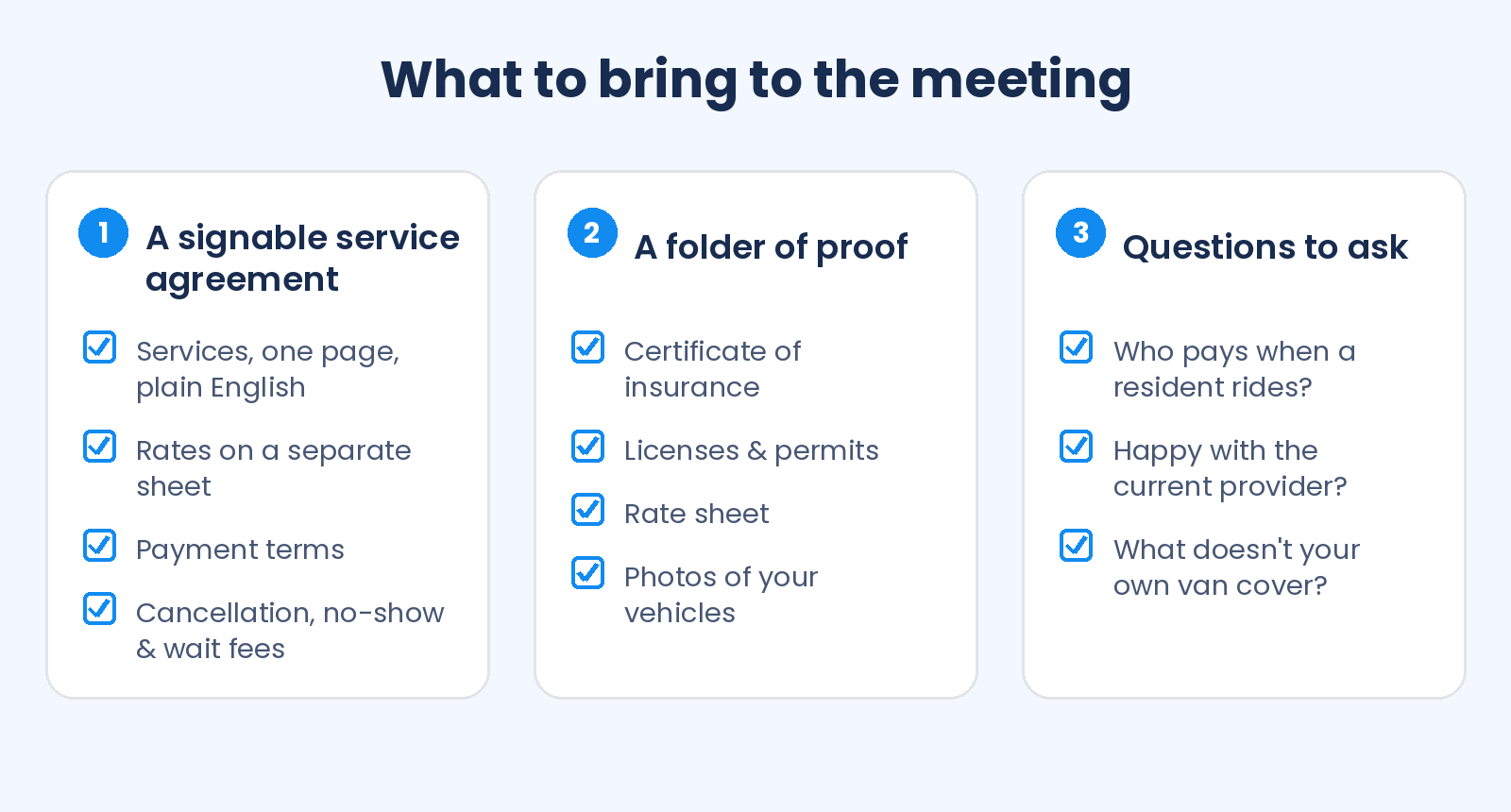
The agreement and the folder speak for themselves. The questions are where the meeting is won, because the answers tell you exactly how to sell this building. At minimum, leave knowing:
- Who actually pays when a resident rides: the facility’s budget, or the family’s?
- Are they looking for a provider right now, or happy with the incumbent?
- Do they run their own van, and what doesn’t it cover?
Then ask what’s not working with transportation today, and stop talking. You’ll hear about the company that’s chronically late, the resident who waited two hours after a doctor’s appointment, the van their own driver can’t cover on weekends. Write all of it down.
Every complaint is the job description for your first trip.
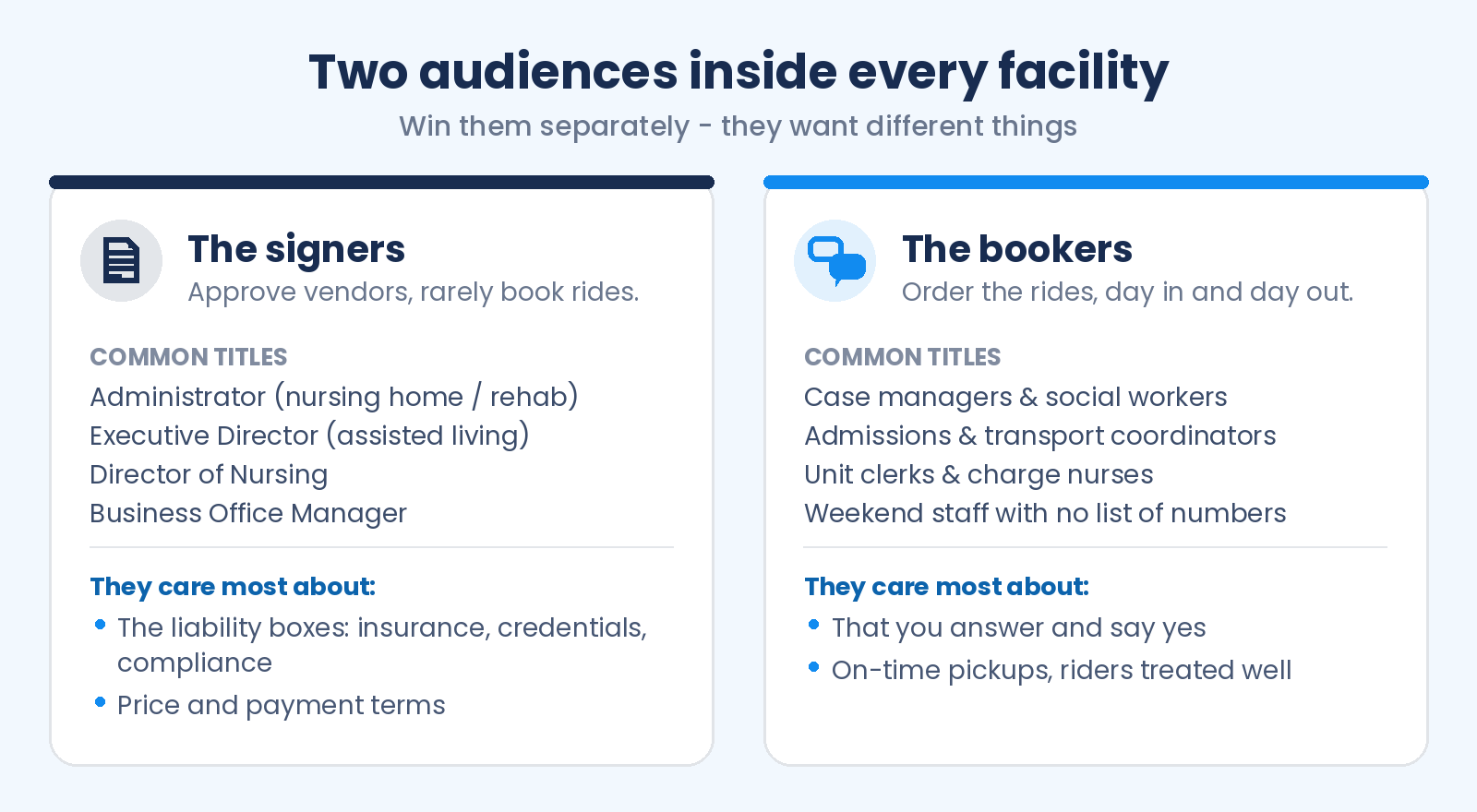
One more thing to carry in: the difference between the person you’re meeting and the people you’ll need later. The administrator across the table is a signer. Signers approve vendors; they almost never book rides. The bookers are the case managers, coordinators, and nurses you’ll meet during drop-in visits, and they care about different things entirely.
Who pays for resident transportation at a facility?
Who pays is the diagnosis that matters most, because each answer changes your pitch. Some facilities pay for resident transport out of their own budget and collect from the resident, family, or insurance on the back end. At others, residents or their families pay you directly, and the facility just coordinates. And sometimes the facility simply eats the cost, because a discharge is stuck and the open bed is worth more than the trip. Plenty of buildings run a mix.
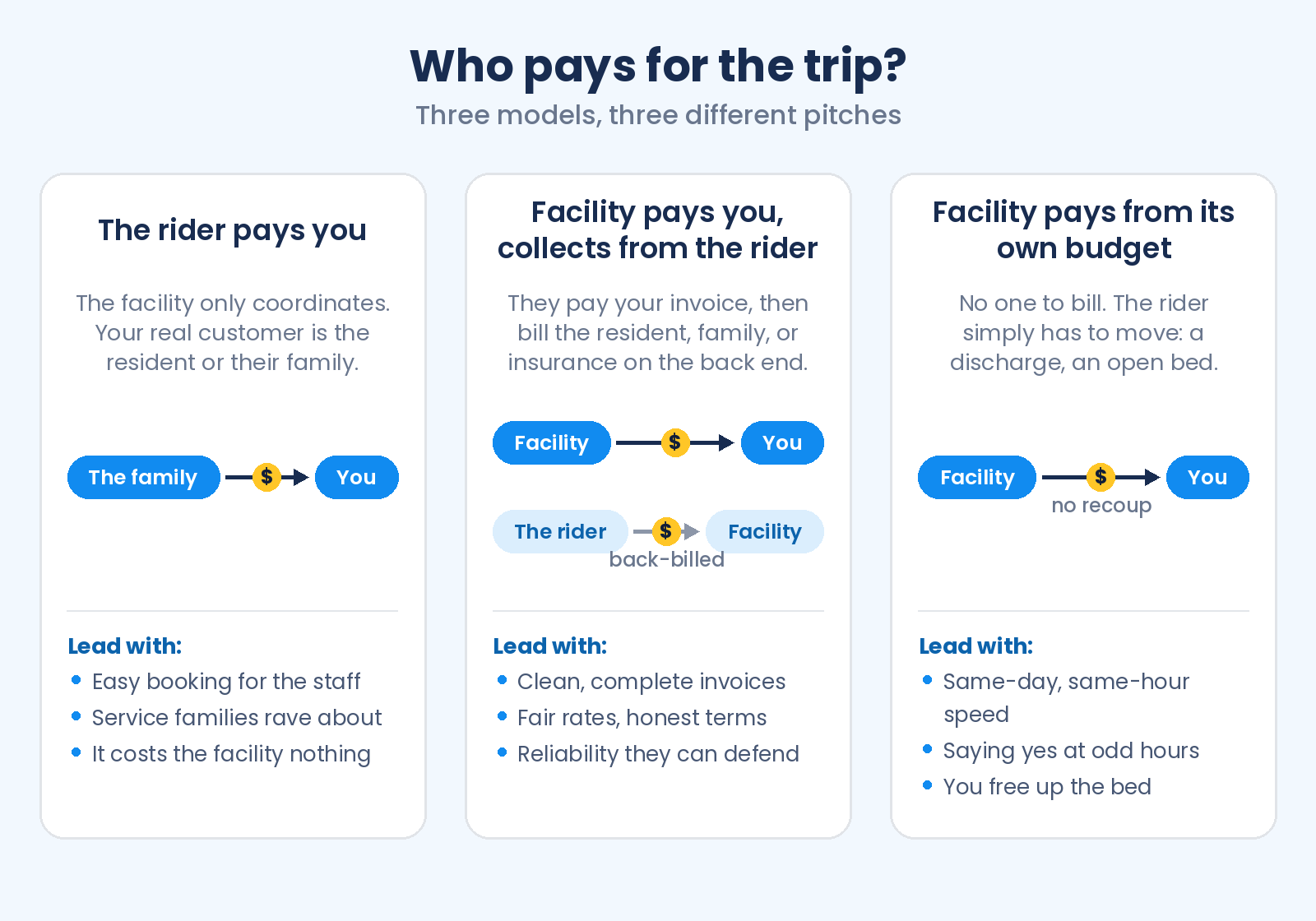
When the rider pays, your real buyer is often a daughter two states away, tired of burning PTO to drive Dad to appointments. Sell the facility on how easy you make coordination, since it costs them nothing, and sell the family on service they’ll rave about. When the facility pays, you’re in a true business-to-business sale: slower, more price-sensitive, and won on clean invoices, fair rates, and reliability the administrator can defend to their boss. And when the facility is eating the cost, price barely enters it. They’re shopping on whether you can be there this afternoon, so availability is the product. Say yes fast.
Should I ask the facility to sign a contract?
No. Don’t ask for a “contract” at all; ask for a service agreement, or something even lighter: a spot on their provider list. An administrator hears “contract” and thinks lawyers, legal review, obligation. The same person will okay a short service agreement this week. Christopher Buell, who’s spent decades selling NEMT to facilities and joined me on the podcast, puts it bluntly: “Don’t ever say contract. Nobody wants to sign contracts. People will sign service agreements.” [1]
Keep yours short: the services, the rates (on an attachment you can revise without reopening the agreement), payment terms, and your fees for cancellations, no-shows, and wait time.
How much paper you’ll need scales with the size of the building. A large corporate facility usually can’t send you a single trip until you’ve been approved as a vendor: their packet, their credentialing checklist, agreements routed through their legal team. A medium-sized facility might want nothing more than your service agreement. A small facility might skip paper entirely and start calling the day the administrator decides they like you. So don’t be surprised if the big building hands you their own vendor paperwork instead of signing yours. That’s normal. Read the payment terms before you celebrate; net-30 that quietly becomes net-60 is this industry’s oldest surprise.
Lower the bar on what you’re asking to be, too. You’re probably not displacing the incumbent in one meeting. An Alabama operator, interviewed on another industry podcast, built his facility book on a softer ask: no run at the incumbent, just an offer to be the fallback on days the regular company can’t cover. After one of those walk-ins, the facility called him with a same-day trip before he’d sat back down at his office. Backup is a low bar to clear, and backup converts. Some operators land a six-month trial agreement as the first piece of paper; take that happily. The trial is the sale.
Why isn’t the facility calling after they said yes?
A facility that said yes but never calls usually isn’t rejecting you. A signed agreement doesn’t order trips; people do, and the people who actually book rides mostly don’t know you exist yet. The administrator who approved you almost never schedules transportation.
Christopher’s version of this stuck with me: at hospitals, the person who signs the service agreement cares about the price, and the person who places the orders only cares that you say yes [1]. The same split shows up at nursing homes, just with different job titles. You’ve won the signer. You haven’t met the orderers.
There’s also a clock running that has nothing to do with your hustle. That vendor approval the big buildings require takes time: insurance certificates, business paperwork, sometimes even a TB test. Operators who’ve been through it describe roughly three months between the handshake and the first check. The facility is quietly checking you out the whole time, too. Staff Google you, read your reviews, and call around to other facilities before trusting you with a resident. Your Google reviews are your references.
Meanwhile, a typical skilled nursing facility has at least three desks that generate rides, and they generate different rides:
- Admissions books the inbound trips from the hospital.
- Case managers and social workers arrange the discharges.
- A transportation or unit coordinator schedules the recurring appointment runs.
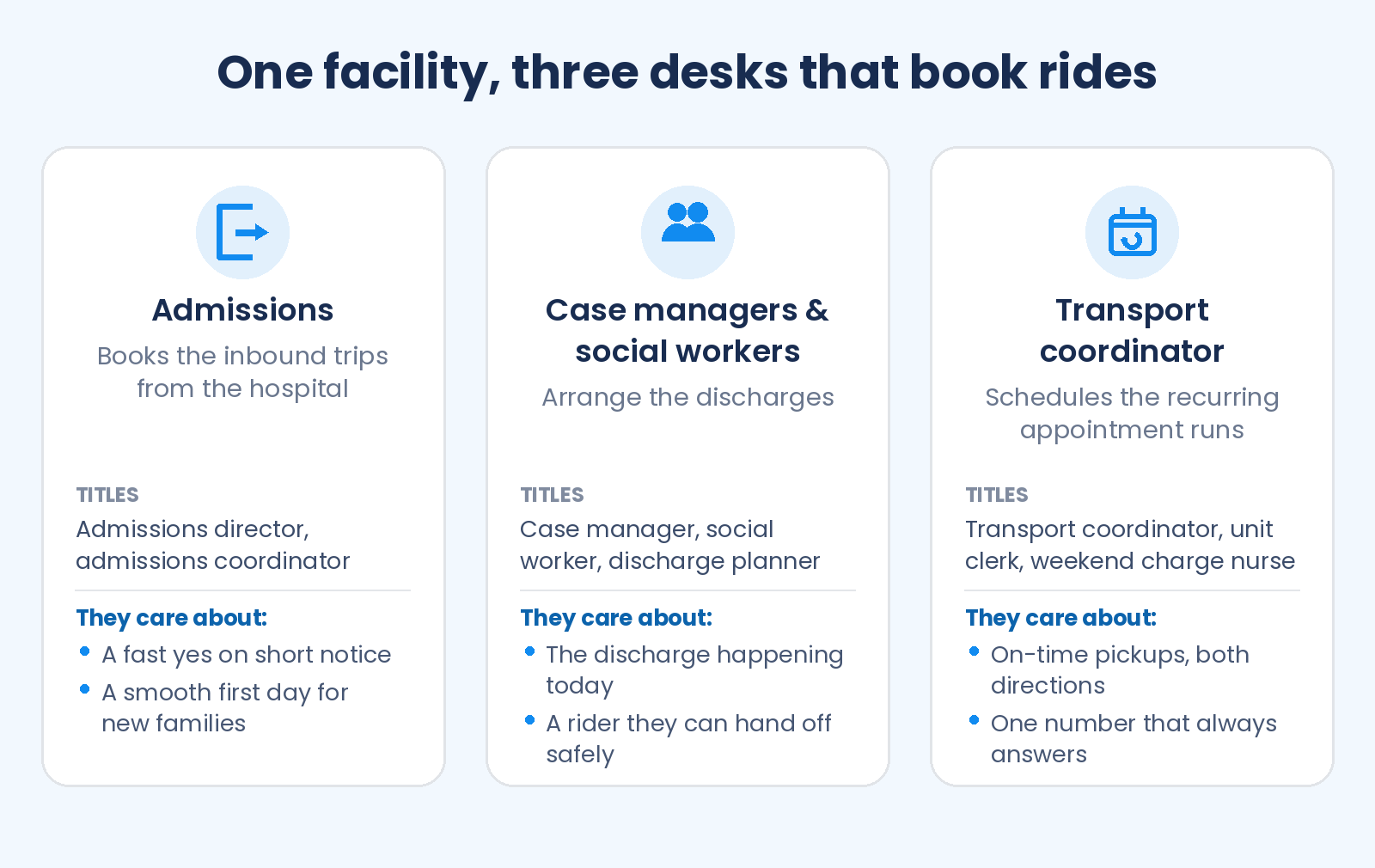
One desk calling you means you’ve sold one desk out of three.
How do I get the first trip from a nursing home or rehab?
To get the first trip from a nursing home or rehab, go back in after the paperwork and sell the people who actually book rides. The sequence:
- Do an in-service. Bring the actual van, demo the ramp and the securements, and let staff meet the drivers who’ll be showing up. Facilities buy faces, not flyers.
- Don’t pitch the front desk. One operator who described his walk-ins on an industry YouTube channel walks right past it, waves, and heads for the nurses. The front desk gets pitched constantly; the nurses hear every transportation complaint firsthand, know who really books the rides, and will walk your card to the right desk themselves.
- Meet the weekend crew. Visit on a Saturday once. Weekend charge nurses place urgent transport calls with almost no list of numbers in front of them.
- Leave direct lines everywhere. Cards, a magnet for the nurses’ station, pens. The 2 p.m. scramble can only find the numbers that are physically in the building.
- Show up with something. Tony Jackson, a 35-year NEMT veteran who came on our podcast, showed up to our recording fresh from dropping two dozen donuts and a jug of coffee on five case managers. His monthly version: “I’ll go to Publix and get the cookie tote, which is $13. $13 for 50 cookies, ladies and gentlemen. Take it up there to the case managers and let the case manager share it with the nursing staff.” [2] The tote carries a note with his company’s name. The nurses start calling him first.
- Learn one resident. Christopher’s deepest move costs a bouquet. On the way out of a visit he’ll notice a resident’s shirt: “I like your shirt. What kind of flower is that? Oh, it’s a blue bonnet.” Next visit, he walks in carrying blue bonnets: “I just happen to be around blue bonnets. I got this for such and such. Just thought I’d say hi to you. What are they going to possibly say? We don’t take sales calls?” [1] Now a resident inside the building requests you by name, and the day the incumbent drops a ball, she’s the one talking about you.
- Ask for the trips nobody wants. Same-hour discharges, 6 a.m. dialysis drops, after-hours returns, bariatric transports. One Los Angeles provider, interviewed on an industry podcast, decided same-day wasn’t fast enough and built his facility book on the same-hour calls no one else would touch. The incumbent’s driver works eight to five. Those openings are permanent, and they’re yours.
Plan on running that loop more than once. One drop-in makes you familiar for a week or two; the operator who keeps showing up is the one whose number is on the nurses’ station when the scramble hits.
Then be reachable, because the first call is usually a test. A Dallas operator interviewed on an industry podcast got asked, mid-walk-in, whether he’d really come get a patient at two in the morning. He said yes and left with a signed agreement that same visit. Another owner won a two-month, all-trips arrangement when an assisted living emailed six transport companies at 9 p.m. and he answered within minutes; the coordinator later told him most companies never replied, or took two weeks. That’s the whole bar: answer fast.
The biggest test, though, you can’t schedule. The hardest facility to win is one whose provider has never had a bad day; the easiest is one that just watched a preventable failure happen to a resident. Prevention is invisible until an incident puts a price on it. One operator, in another industry interview, spent five months on walk-ins and drop-off introductions with nothing to show for it, until the incumbent no-showed a dialysis run and the front desk called her by name. She’s had that facility ever since.
What should the first trip from a facility look like?
Treat the first trip from a new facility as an audition, because that’s how the facility grades it. Three rules:
- Drive it yourself. A one-van operator put it simply in an industry interview: the first trip a new facility gives you, take the wheel personally, so they can put a face on the company and see that the owner cares. This early, the selling isn’t a job you can hand off.
- Quote a window you can hit. If they ask for a 3:00 pickup you can’t make, say so and offer the 4:00 you can. The facility passes your window along to the family and the hospital, and a kept 4:00 beats a missed 3:00 in everyone’s memory.
- Treat the rider like the whole account. Tony targets rehab facilities first for exactly this reason [2]: you pick up the new admission, so you’re the familiar provider for every follow-up trip in a roughly month-long stay. He treats that first rider as a VIP so the staff hears about a great ride. Facilities listen to residents.
Facilities also grade the ride home as hard as the ride out. A resident who waits two hours for pickup after an appointment becomes the story the facility remembers, even if the morning run was flawless. Medicare penalizes hospitals up to 3 percent of payments for excess 30-day readmissions [3], and skilled nursing facilities are measured on readmissions too, so a follow-up appointment missed because a ride fell through gets filed under clinical risk. In this business, reliability is the product.
Within 24 hours, follow up. Thank the person who booked it, confirm the invoicing details, hand over your direct line, and ask one more thing: anything coming next week I should hold a van for?
How long until a facility sends you regular trips?
Expect a facility to test you before it trusts you. Owners describe the same arc again and again: a few scattered trips for a month or two before the facility routes real volume. Budget for it, then expect a flip that surprises most owners.
The flip comes from the facility’s own staffing. A Kansas operator, interviewed on another industry podcast, entered every building as pure overflow. Within a year, several treated him as the primary provider and their own van as the backup, because they couldn’t keep a driver in it. The numbers say his story will keep repeating. Nursing homes are the only part of health care still employing fewer people than before the pandemic, short about 26,500 workers, and nine in ten providers say recruiting is still difficult [4]. Every facility van sitting parked for lack of a driver is an outsourcing decision waiting for a phone number. Yours, if you’ve done the work above.
That same operator learned the other side of the flip the hard way. Early on he crammed the schedule to impress everyone and started canceling on facilities same-day; two of them went quiet on him for roughly two months. No complaint. Just silence. So don’t say yes to volume you can’t run. Say the truer thing: “we can handle three trips a day well right now, and here’s our plan to get to ten.” Facilities respect a provider who knows their own capacity, and they remember the one who didn’t.
Ask the case managers you meet how many transport providers stopped by or dropped off a brochure last month. Don’t be surprised if the answer is zero. None of this is complicated. All of it is showing up more times than feels reasonable, and that’s exactly why it works: almost nobody does it.
Getting the meeting is the half we’ve turned into a service. Our facility outreach team cold-calls the facilities in your territory and books the administrator meetings for you, which means I hear how these meetings go, in detail, every single week. One of those meetings, with an Encompass Health facility, recently turned into a multi-million-dollar corporate contract opportunity because the owner we booked it for followed up relentlessly. If you’re one of our facility outreach customers, consider this article the owner’s manual for the meetings we hand you.
Either way, the handshake pays nothing. The first trip is the win. Go get it, and then answer the phone at 2 a.m. when they test whether you meant it.
Sources
[1] Duet NEMT Growth Podcast, Ep. 14: “How to CALL Facilities with Christopher Buell,” March 3, 2026. https://www.youtube.com/watch?v=MhEijJdU8ys
[2] Duet NEMT Growth Podcast, Ep. 10: “How To Win NEMT Facility Contracts” (Tony Jackson), October 24, 2025. https://www.youtube.com/watch?v=it0DufVkvXk
[3] Centers for Medicare & Medicaid Services, “Hospital Readmissions Reduction Program (HRRP),” accessed July 2026. https://www.cms.gov/medicare/payment/prospective-payment-systems/acute-inpatient-pps/hospital-readmissions-reduction-program-hrrp
[4] American Health Care Association, “Nursing Home Workforce Report,” January 2026. https://www.ahcancal.org/News-and-Communications/Documents/2026-Long-Term-Care-Workforce-Report.pdf
About the author
James O'Donnell cofounded Duet and leads its sales, partnerships, and growth services. He talks with NEMT operators every week, hosts the NEMT Growth podcast, and answers Duet's sales line himself. More about Duet's founders →
Want more trips and less busywork?
See how Duet runs and grows NEMT businesses in a 30-minute demo.