
Article
NEMT Brokers: How They Work and Who Runs Each State
Brokers hold the contracts that hand out Medicaid rides, and contracts move. Here's who holds them in every state, as of October 1, 2026.
By James O'Donnell, Cofounder and COO, Duet · · Updated
Two of the questions NEMT owners ask me most on calls are about brokers: are you a broker, and can you get me in with the brokers? Both answers are no, for the same reason. A non-emergency medical transportation (NEMT) broker, sometimes called a Medicaid transportation broker, is the company a state Medicaid program hires to book riders’ trips and hand them to transportation companies like yours. In many states, each Medicaid health plan, an insurer the state pays to cover its members, hires its own. The broker doesn’t own those riders. It holds a contract that decides who drives them, and contracts change hands.
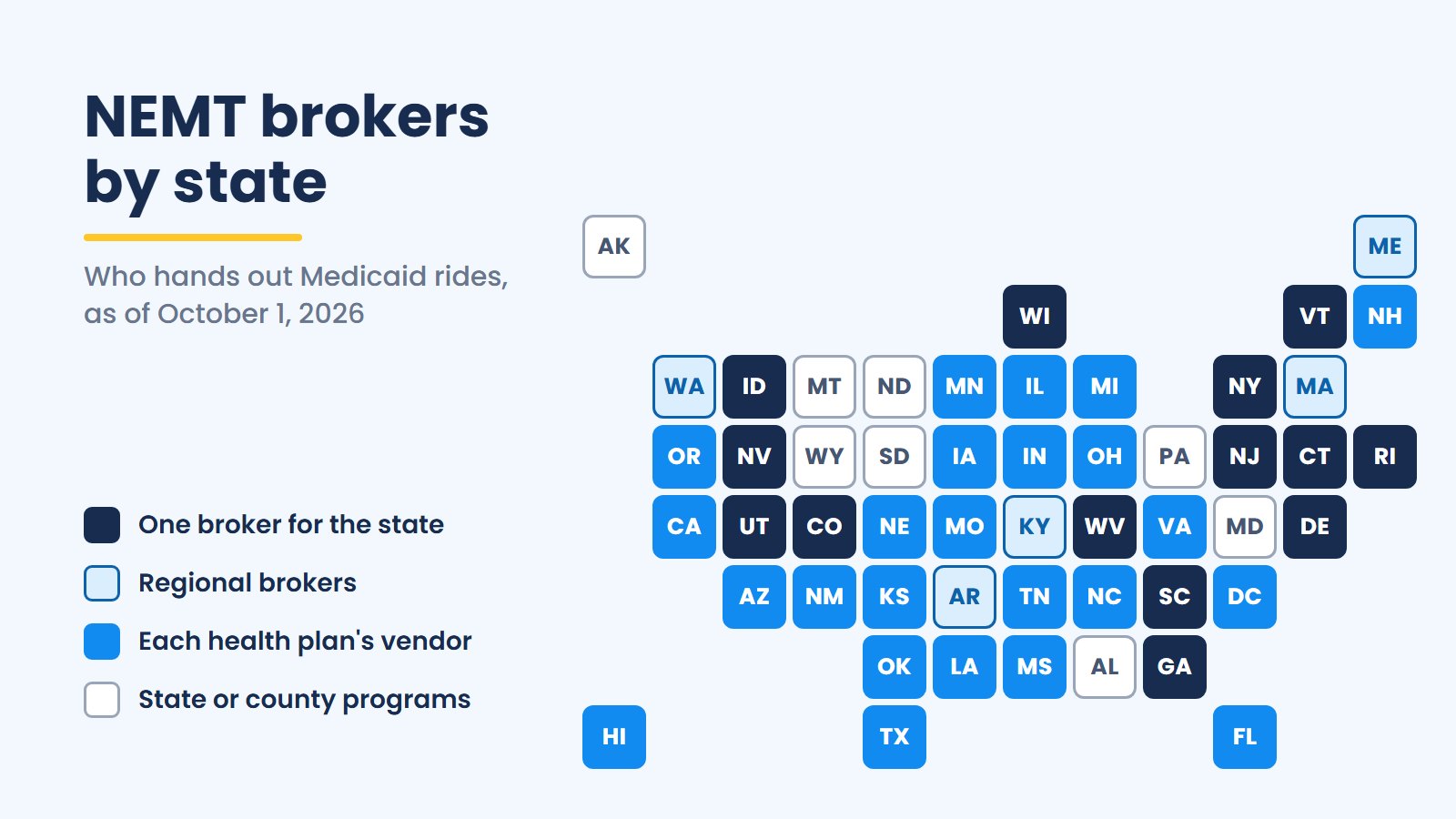
Only the company holding the contract decides who drives, so nobody else can get you in. Who that is depends on your state, and the table below names the brokers and plan vendors in every state and DC as of October 1, 2026.
What you can do is learn who holds yours, get credentialed early, and never build the company on one broker. This guide follows the order you’ll meet the system in, from what a broker does to how much of your schedule to give one.
The short version:
- What a broker does: books the trips, picks who runs each one and usually pays for it, under a contract with the state or a health plan.
- Who runs your state: as of October 1, 2026, 15 states hire one statewide broker, 5 use regional brokers, 23 states and DC leave it to each health plan’s vendor, and 7 run state or county programs.
- What you’re paid: the rate in your contract. MTM’s posted Rhode Island schedule, for one, pays $41.00 for a 10-mile daytime wheelchair trip.
- How you get in: apply yourself to every broker and plan vendor where you drive, before you need the trips.
- The risk: contracts change hands and your approval doesn’t follow, so give brokers only as much of your schedule as you could lose.
What does a NEMT broker do?
A NEMT broker books Medicaid trips, picks the transportation company that runs each one and usually pays that company, under a contract with the state or one of its health plans. Federal Medicaid rules make every state’s Medicaid agency get members the rides they need to and from care, and say how it’ll do it. Hiring a broker is one way.
A broker the state hires under the federal broker rule generally can’t run trips itself or send them to a company it has a financial tie to, and no transportation company may pay it to steer trips its way. That’s why a broker needs companies like yours.
The broker decides who drives each trip. Missouri’s provider manual says it in one line: “The broker determines which transportation provider will be assigned to provide each transport.” Rachel Scholler, who ran a rural Wisconsin NEMT company for 17 years, gave the provider’s side on our episode on growing a high-margin NEMT service: “You think, oh, I’m doing this dialysis ride for 2 years, but it doesn’t matter. You think you’ve provided a good service. If the dispatch wants to give it to another company, that’s what they’re going to do.”
The broker doesn’t own the riders, either, and riders can ask for your company. On our episode with Josh Hagen of Careway Mobility, he asked how to get dialysis clinics to call his company instead of the broker. I told him the clinics usually leave that to the rider and the broker, but you can plant the idea that riders ask for you by name, and some brokers will listen. If riders complain enough, “the broker will let them work with you. The threshold of annoyingness varies by broker.” It usually has to come from the rider, though. You can’t call the broker and ask for a rider yourself.
As for the first question: no, Duet isn’t a broker. We don’t hold a Medicaid or health plan contract, decide who runs a Medicaid trip, set your rate or take a cut of a trip. Whoever pays for a trip pays you directly.
How does Medicaid money reach a NEMT provider?
For most riders, Medicaid ride money reaches you through one of three doors: a broker the state hires, in 20 states; a vendor each Medicaid health plan hires, in 23 states and DC; or a state or county program, in the other 7. Georgia hires one broker, Verida, for the whole state, and Washington splits its counties among six regional brokers. In Texas, each health plan picks its own ride vendor. In South Dakota, you enroll with Medicaid and bill it directly.
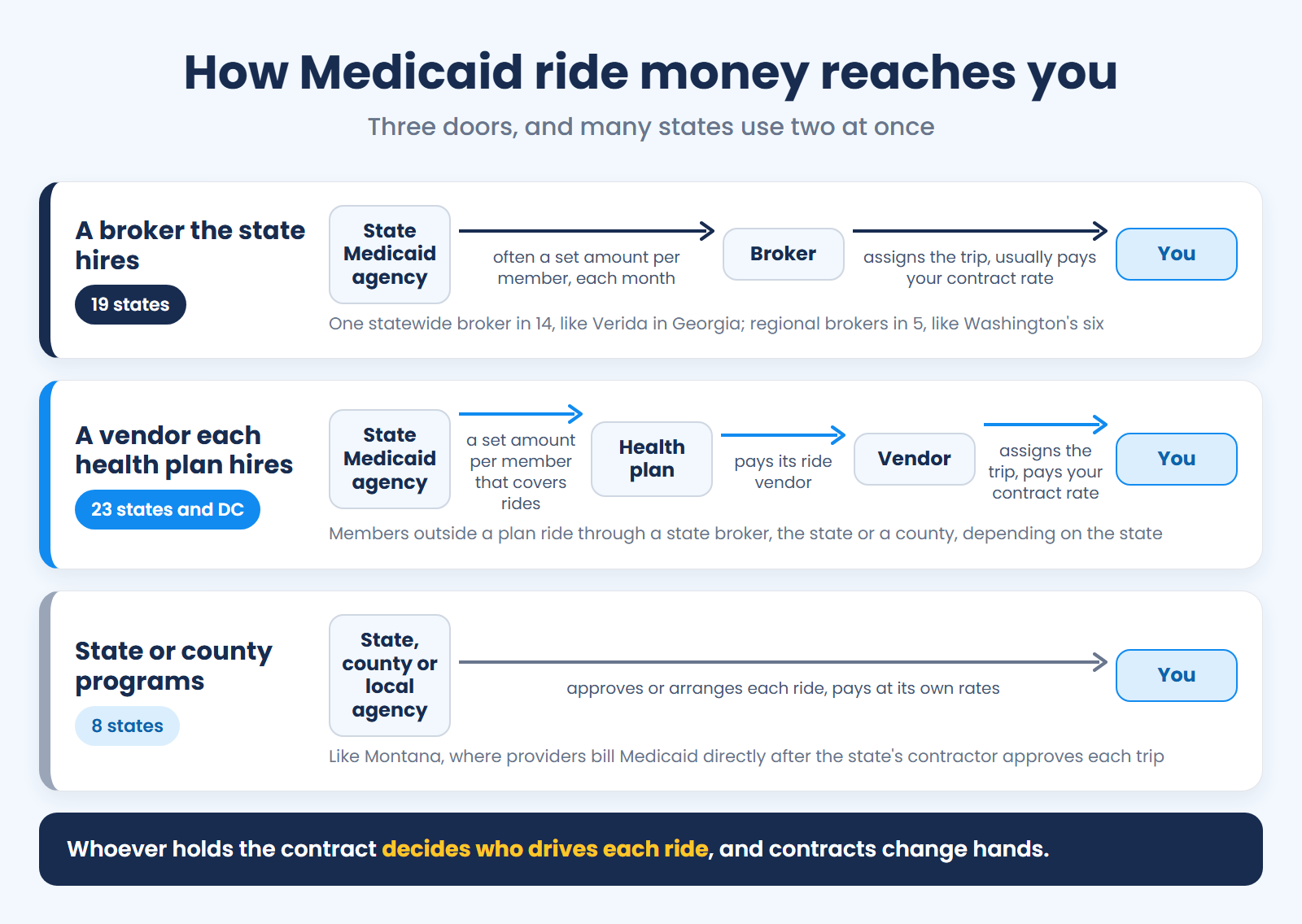
Each state is counted by how most of its riders get rides, but many use two doors at once. In Florida, riders in a health plan go through their plan’s vendor. Fee-for-service riders, the people Medicaid covers without a health plan and pays for service by service, go through one of two brokers the state hires, Modivcare or MTM, depending on the region.
One company can hold several of these contracts at once, and each can move on its own. In Iowa, MTM handles fee-for-service rides and rides for all three health plans. In Nebraska, it handles all three plans’ rides, UnitedHealthcare’s only since January 1, 2026. In Oklahoma, Modivcare runs SoonerRide, the state’s fee-for-service ride program, and, per the state’s plan guide, rides for all three SoonerSelect health plans. One credential reaches every Medicaid rider in those states today, and any one plan can still move.
Who is the NEMT broker in my state?
Modivcare and MTM are the names you’ll see most: Modivcare holds six of the 15 statewide broker contracts, counting Montana’s from October 1, 2026, MTM holds five, and one or both turn up in most states where the health plans pick. Verida in Georgia, Medical Answering Services (MAS) in New York, MediDrive in Colorado and the Vermont Public Transportation Association (VPTA) hold the other four. Illinois, Michigan, Montana, Texas and Virginia changed on October 1, 2026, the day most of this table was checked; DC’s change, due the same day, is on hold during MTM’s protest.
Where a state’s name is linked, our guide for that state covers its brokers in depth. Where a row says to ask or confirm, call that plan or agency before you apply.
| State | How rides are arranged | Who hands out the trips | Source, checked |
|---|---|---|---|
| Alabama | State-run, no broker | Alabama Medicaid’s own staff, including regional coordinators, schedule rides | Alabama rule 560-X-18-.19, Oct 1 |
| Alaska | State-run, no broker | Conduent or a Tribal entity authorizes each trip for Alaska Medicaid | Alaska DOH, Oct 1 |
| Arizona | Each health plan’s vendor; the state pays providers directly for American Indian Health Program members | Each Arizona Medicaid (AHCCCS) plan’s vendor, mostly MTM Health companies such as MTBA and Veyo; Banner-University Family Care arranges its own | AHCCCS fee-for-service manual, chapter 14, Oct 1; plan list Sept 2026 |
| Arkansas | Regional brokers | Verida (Regions A to D), Central Arkansas Development Council (E), Area Agency on Aging of Southeast Arkansas (F), Modivcare (G, since Jan 2, 2026) | Arkansas NET region map, Oct 1 |
| California | Each health plan’s vendor; enrolled providers bill Medi-Cal directly for fee-for-service | Each Medi-Cal plan’s own vendor or in-house team: Modivcare for several large plans, Call the Car for L.A. Care, American Logistics for Molina | DHCS APL 22-008, Oct 1; plan list Aug 2026 |
| Colorado | One state broker, phasing in | MediDrive: every NEMT provider must contract with it now, and all trips statewide go through it from Jan 1, 2027 | Health First Colorado provider portal, Oct 1 |
| Connecticut | One state broker | MTM | Connecticut DSS, Oct 1 |
| Delaware | One state broker | Modivcare | Delaware DMMA, Oct 1 |
| District of Columbia | Each health plan’s vendor; a broker DC’s Medicaid agency hires for fee-for-service | MTM for fee-for-service riders and the intellectual and developmental disabilities (IDD) waiver, extended through Dec 31, 2026 while MTM’s protest of Verida’s award is decided | DC Council contract CA26-1002, Oct 8 |
| Florida | Each health plan’s vendor; two state brokers for fee-for-service | Plans: Alivi (Sunshine), Modivcare (Humana, Aetna, Community Care Plan), MTM (UnitedHealthcare), Ride2MD (Simply, Florida Community Care); ask Molina; fee-for-service: Modivcare (Regions A, G, H, I) and MTM (Regions B to F) | AHCA NEMT waiver, Oct 1; plan list Aug-Sept 2026 |
| Georgia | One state broker | Verida, in all five regions since Apr 1, 2026 | Georgia DCH, Oct 1 |
| Hawaii | Each health plan’s vendor | Each Med-QUEST plan arranges rides; HMSA uses Modivcare (since July 1, 2025), and UnitedHealthcare uses MTM Health (since Jan 1, 2026) | Med-QUEST, Oct 1; UnitedHealthcare Hawaii notice, Oct 8 |
| Idaho | One state broker | MTM | Idaho DHW, Oct 1 |
| Illinois | Each health plan’s vendor; enrolled providers bill the state for fee-for-service | Each HealthChoice Illinois plan’s vendor (Blue Cross Community Health Plans moved to MTM Health effective Oct 1, 2026); Transdev approves fee-for-service trips but doesn’t schedule them | Illinois HFS, Oct 1 |
| Indiana | Each health plan’s vendor; a state broker for fee-for-service | Verida for Traditional Medicaid; WellTrans for the Healthy Indiana Plan (HIP) and Hoosier Healthwise plans (since Jan 1, 2026) | Indiana Medicaid, Oct 1 |
| Iowa | Each health plan’s vendor; a state broker for fee-for-service | MTM, for fee-for-service and all three IA Health Link plans | Iowa HHS, Oct 1 |
| Kansas | Each health plan’s vendor | SafeRide Health (Sunflower), MTM Health (Healthy Blue); ask UnitedHealthcare for its vendor | Sunflower Health Plan, Oct 1 |
| Kentucky | Regional brokers | Eight community action and transit agencies across 15 regions, under the state’s Human Service Transportation Delivery program | Kentucky DMS, Oct 1 |
| Louisiana | Each health plan’s vendor; a state broker for fee-for-service | MediTrans for every Healthy Louisiana plan; Verida for fee-for-service (legacy Medicaid) members | LDH NEMT provider page, Oct 15 |
| Maine | Regional brokers | Modivcare in most of the state; Penquis CAP in Kennebec, Penobscot, Piscataquis and Somerset counties | MaineCare broker list, Oct 1 |
| Maryland | County programs, no state broker | Each local health department (in Montgomery County, the transportation department) arranges rides, some through contractors | Maryland Medicaid notice, Oct 1 |
| Massachusetts | Regional brokers | MART and GATRA, two regional transit authorities (confirm with MassHealth) | CCAM-TAC state profiles, 2024, Oct 1 |
| Michigan | Each health plan’s vendor; a state broker for fee-for-service in three counties | Plans arrange rides for members (Molina Healthcare of Michigan moved to SafeRide Health on Oct 1, 2026); Modivcare for fee-for-service in Wayne, Oakland and Macomb; local state Medicaid offices elsewhere | Michigan Auditor General, Oct 1; MDHHS health plan ride chart, Oct 7 |
| Minnesota | Each health plan’s own ride line; counties and the state for fee-for-service (state law bars a state broker until a state-hired administrator starts, on a date not yet set) | Each health plan runs its own ride line; for fee-for-service, counties arrange walking-rider trips and the state pays wheelchair and stretcher providers directly | Minnesota DHS, Feb 2026, Sept 28 |
| Mississippi | Each health plan’s vendor; a state broker for fee-for-service | Modivcare for fee-for-service since June 8, 2024 (MTM before); MississippiCAN plans arrange their own | Mississippi Medicaid, Oct 1 |
| Missouri | Each health plan’s vendor; a state broker for fee-for-service | MTM for fee-for-service; each MO HealthNet plan arranges its own (Home State Health uses MTM) | Missouri DSS, Oct 1 |
| Montana | One state broker | Modivcare, since Oct 1, 2026: it took over the program’s administration and operations from Mountain Pacific, and provider enrollment and billing from Conduent | Montana Healthcare Programs notice, Oct 8 |
| Nebraska | Each health plan’s vendor | MTM, for all three Heritage Health plans (UnitedHealthcare since Jan 1, 2026) | Nebraska DHHS, Oct 1 |
| Nevada | One state broker; rural health plan members book through their plan | MTM for urban members and all fee-for-service riders; rural members of CareSource or SilverSummit book through their plan, which routes them to SafeRide | Nevada Medicaid, Oct 1 |
| New Hampshire | Each health plan’s vendor; a state vendor for fee-for-service | Coordinated Transportation Solutions (CTS) for fee-for-service and AmeriHealth Caritas; MTM for NH Healthy Families and WellSense | NH Medicaid bulletin, Oct 1 |
| New Jersey | One state broker | Modivcare | New Jersey DMAHS, Oct 1 |
| New Mexico | Each health plan’s vendor; enrolled providers bill the state for fee-for-service | Modivcare (Blue Cross and Blue Shield of New Mexico until Nov 1, 2026, when it moves to MTM Health; Presbyterian); ask the other Turquoise Care plans | BCBSNM Turquoise Care, Oct 1; BCBSNM provider notice, Oct 8 |
| New York | One state broker | Medical Answering Services (MAS), in all 62 counties | New York DOH, Oct 1 |
| North Carolina | Each health plan’s vendor; county social services offices for NC Medicaid Direct | Modivcare for most plans; MTM for Carolina Complete Health and, since Jan 1, 2026, UnitedHealthcare; county Departments of Social Services arrange NC Medicaid Direct rides | NC Medicaid, Oct 1; plan list Aug 2026; UnitedHealthcare NC flyer, Oct 8 |
| North Dakota | State and county offices, no broker | Human service zones and tribal offices approve trips and providers bill ND Medicaid; Blue Cross Blue Shield of North Dakota handles expansion members | ND Medicaid manual, Oct 1 |
| Ohio | Each health plan’s vendor; county Job and Family Services offices for fee-for-service | MTM Health (AmeriHealth Caritas, Anthem, Humana), SafeRide (Buckeye), Provide A Ride (CareSource); ask Molina and UnitedHealthcare | Ohio rule 5160-15-10, Sept 30 |
| Oklahoma | Each health plan’s vendor; a state broker for fee-for-service | Modivcare runs SoonerRide for fee-for-service and, per the state Medicaid agency’s plan guide, rides for all three SoonerSelect plans | OHCA SoonerRide, Oct 1 |
| Oregon | Each health plan’s ride service; county-based ride services for Open Card | Each coordinated care organization’s ride service for its members; eight county-based ride services for Open Card (fee-for-service) members | Oregon Health Authority, Oct 1 |
| Pennsylvania | County programs | County Medical Assistance Transportation Program offices, state agreements with transit agencies in 14 counties (13 in DHS’s June 2026 study, plus Dauphin from July 1), and a broker (Modivcare) only in Philadelphia | Pennsylvania DHS study, Oct 5 |
| Rhode Island | One state broker | MTM | Rhode Island EOHHS, Oct 1 |
| South Carolina | One state broker | Modivcare; the state is rebidding the contract (a new solicitation went out June 26, 2026) | SCDHHS member handbook, Oct 1 |
| South Dakota | State-run, no broker | Providers enroll with South Dakota Medicaid and bill it directly | South Dakota DSS, Oct 1 |
| Tennessee | Each health plan’s vendor | Verida (BlueCare, TennCare Select); Tennessee Carriers (UnitedHealthcare, Wellpoint) | TennCare, Oct 1 |
| Texas | Each health plan’s vendor; the state’s own program for fee-for-service | Mostly SafeRide Health or MTM Health, depending on the plan (Blue Cross and Blue Shield of Texas moved to MTM Health on Oct 1, 2026); the state’s own Medical Transportation Program for fee-for-service | TMHP manual, Oct 1; plan list Sept 2026 |
| Utah | One state broker | Modivcare for door-to-door rides, beside transit passes and paratransit vouchers | Utah Medicaid, Oct 1 |
| Vermont | One state contract | Vermont Public Transportation Association (VPTA), through regional public transit providers | Vermont DVHA, Oct 1 |
| Virginia | Each health plan’s vendor; a state broker for fee-for-service | MTM Health for fee-for-service from Oct 1, 2026 (Modivcare before); plans: Modivcare (Humana, Sentara), MTM (Anthem), MediDrive (Aetna), SafeRide (UnitedHealthcare) | DMAS, Oct 1; plan list Sept 15 |
| Washington | Regional brokers | Six brokers covering 13 regions (Hopelink in King and Snohomish, for one) | Washington HCA, Oct 1 |
| West Virginia | One state broker | Modivcare | West Virginia BMS, Oct 1 |
| Wisconsin | One state broker | MTM; the state named Verida its intended vendor on May 21, 2026 but has set no handoff date | Wisconsin DHS, Oct 1 |
| Wyoming | State-run, no broker | Medicaid’s travel assistance program; enrolled taxi and shuttle providers bill Medicaid | Wyoming Medicaid, Oct 1 |
If you need a ride rather than trips, call the member services number on your Medicaid or health plan card.
Old names still turn up on state and plan pages: LogistiCare is now Modivcare, Southeastrans is now Verida, and Access2Care and Veyo are now part of MTM.
Look up your state’s row today and write down every company that hands out Medicaid trips in your county, including each plan’s vendor where the plans pick, and any change or rebid date the row shows. A broker that just won a contract is usually still building its network.
How do NEMT brokers get paid, and what do they pay you?
You get the rate in your contract with the broker or plan vendor. MTM’s posted Rhode Island schedule, for one, pays $41.00 for a 10-mile daytime wheelchair trip, while the broker itself is often paid a fixed amount per Medicaid member each month. Here’s what two kinds of payer pay you:
| Who pays you | How your rate is set | Example |
|---|---|---|
| A broker or plan vendor | Your contract, often a base rate plus a per-mile rate | MTM’s posted Rhode Island schedule, effective July 1, 2023: $28.50 for a daytime wheelchair trip’s first five miles plus $2.50 a mile after that, and $17.75 for a daytime ambulatory trip’s first five miles plus $1.75 a mile after that |
| A state, county or local agency | A published fee schedule or the agency’s own contract | Ohio Medicaid pays enrolled wheelchair van companies at most $31.00 a trip plus $1.30 a mile with the rider aboard for fee-for-service riders, per Ohio’s fee schedule |
At those Rhode Island rates, a 10-mile ambulatory trip pays $26.50. They’re MTM’s rates for pickups within 40 miles of where the provider keeps its vehicles; farther pickups pay more. New York works differently: its broker, MAS, negotiates the rates, which “supersede the current fee schedule,” but the state’s claims system pays them, per New York’s Medicaid transportation manual.
On the other side of your contract, a broker is often paid a fixed amount for each enrolled member each month. New York pays MAS a monthly administrative fee per member plus a risk-sharing arrangement, per the state comptroller’s ruling on the contract. MACPAC, the commission that advises Congress on Medicaid, cited per-member rates of $4 to $10 a month that states pay brokers and health plans, from the Medical Transportation Access Coalition in 2021.
A broker paid that way does better when trips cost less. CMS, the federal agency that oversees Medicaid, tells states in its 2023 transportation guide to make sure a broker “does not offer payment that is so low that local transportation providers are unwilling to participate.” Policing that is the state’s job. Yours is knowing your cost per trip before you sign.
Then read the fine print on the miles and minutes nobody pays for separately. Under the same CMS guidance, empty miles, the ones you drive with no rider aboard, generally can’t be paid as a separate service, and neither can long waits, though states may build both into their rates. My cofounder, Jing Zhu, said on our episode on pricing NEMT trips that “a lot of brokers don’t pay” deadhead miles.
Before you sign, read each contract’s no-show, wait-time and empty-mile terms, and set your private-pay floor from your own cost per trip, not from the broker’s rate.
How do you get trips from a NEMT broker?
Apply to every broker and plan vendor where you drive, yourself and before you need the trips, because only the broker decides who gets in. In this order:
-
Find every door where you drive. Where each health plan picks its own vendor, list the plans that cover your county from your state Medicaid site, then find each plan’s vendor on its transportation page. Every vendor is its own contract.
-
Check whether your state wants Medicaid enrollment first. States differ. In Indiana, whose Medicaid program goes by IHCP, providers who want Verida’s Traditional Medicaid trips “must first enroll as an IHCP provider. After enrolling with the IHCP, providers must contract with Verida,” per the state’s Verida page. Missouri, whose program is MO HealthNet, goes the other way: “Transportation providers are not enrolled as MO HealthNet providers.” If your state’s Medicaid site doesn’t say, ask the broker before you apply.
-
Get each broker’s requirements and rates before your next van or insurance renewal. Credentialing, the broker’s check of your insurance, drivers, vehicles and licenses, sets its own bar. SafeRide’s provider page, for one, asks for at least $1 million of general liability per occurrence and $500,000 of auto liability, with SafeRide named as an additional insured. Ask for the rate sheet at the same time, so you know what the trips pay before you spend weeks on paperwork. If you haven’t bought a van yet, starting a NEMT business, step by step puts this in order.
Te’ya Miles, the Atlanta operator behind That NEMT Girl, warned on her episode about the NEMT mistakes nobody warns you about that “once you apply for a broker, they’re going to ask you for your insurance limits, and they have to match what they’re requiring.” Your state’s minimum may not clear it: “That may not be that broker’s minimum.”
-
Apply, then call provider relations. You can’t pay a broker for referrals, so what gets you in is coverage: brokers add providers where they’re short. MTM’s senior director of logistics said as much on an industry podcast in September: “we’re always looking for more rural providers. And I know it’s not glorious, but it’s a need.” After you apply, call provider relations within a week instead of waiting on the web form, and say which counties, hours and vehicle types you can cover. It can take months. One Indiana owner spent four months getting credentialed with a new broker after his old one lost its contract.
-
Run every broker’s trips on one board. Once you’re in with more than one broker, the trouble moves to dispatch. On Te’ya’s episode, I described a setup I sometimes see: two vans with the driver on the Modivcare app, two on the MTM app, two working with SafeRide, and the empty vans driving across town. Te’ya’s answer was that “you need to have everything centralized,” and that the apps are free “because the broker wants to be able to look at it and see it.” Duet puts broker trips on the same board as your private-pay and facility trips, whether a broker connects directly or you import its trip file. You still credential with, and answer to, each broker.
Being approved doesn’t always mean you have to take the trips you’re offered. Ray and Mac run The Doctor Ride, two vans in Charlotte. They applied to several brokers and were accepted, then passed on the ride requests because the rates didn’t work for them, and put the time into walk-ins and ads for private-pay riders instead. “Maybe we just haven’t found the right ones quite yet, but that’s just been our experience so far,” Mac said on their episode on building a NEMT business from day one. Before you count on passing, ask each broker how it scores turned-down trips: SafeRide’s provider page lists a 95% ride acceptance rate among its standards. And in New York, the state’s Medicaid transportation manual says an ambulette (wheelchair or stretcher van) company “may not refuse to provide Medicaid transportation” inside its service area.
Who else pays for NEMT rides besides Medicaid brokers?
Facilities and private-pay riders pay for trips outside every broker contract, and four programs arrange rides under contracts of their own: Medicare Advantage plans, PACE programs (all-inclusive care for older adults), the VA (Veterans Affairs) and workers’ comp insurers. Original Medicare pays for ambulances, not van rides.
For facility-paid trips and private-pay riders, start with getting the first trip from a facility and winning private-pay riders. Here’s how each of the others works:
| Payer | Who arranges the ride | How a provider gets in |
|---|---|---|
| Medicare Advantage | The plan, when it offers rides as a supplemental benefit, which it doesn’t have to (CMS’s Medicare managed care manual) | Ask the plan which ride vendor it uses |
| Original Medicare | No one, for van rides: Part B covers ground ambulance only when riding in any other vehicle could endanger the rider’s health (Medicare.gov) | It isn’t a payer for van rides |
| PACE | The PACE organization, with its own vans or a contractor (federal PACE transportation rule) | A contract with your local PACE organization |
| VA | The VA, which approves “special mode” rides, wheelchair vans included, in advance when they’re medically required and the veteran can’t cover the cost (VA travel rules) | Ask the local VA medical center |
| Workers’ comp | Each state’s law sets the rule; the federal program for federal workers pays for travel to authorized care, including “special conveyance” (federal workers’ comp rule) | Through the insurer or its transportation network |
Some of the same companies work both sides: Veyo, now part of MTM, and SafeRide say they serve Medicare Advantage plans, and MTM says it manages transportation for “Medicaid and Medicare programs.”
PACE is worth a look if there’s a program near you. A PACE organization can run its own vans or hire a contractor, and if it hires you, expect it to check that your vans are maintained to the manufacturer’s recommendations and your drivers are trained, because the federal rule makes it answer for both. On our pricing episode, Jing mentioned providers we work with who hold PACE contracts, carrying participants to their senior centers for activities, several riders a trip, which she called a good multi-load opportunity.
Every one of those trips keeps paying when a Medicaid contract moves.
How much of your schedule should come from brokers?
Give brokers only as much of your schedule as you could lose without losing the company, because broker contracts change hands. There’s no safe percentage, and your state’s setup decides how concentrated the risk is.
Christopher Buell learned this in Arkansas. His company became a broker’s number one provider, the head of the state’s human services department told him at the governor’s ball that he’d made it, and a week later the broker dropped him. On Christopher Buell’s episode on calling facilities, he put the lesson this way: “I can’t be top-heavy on a broker that may not be there tomorrow or may decide not to pay me or whatever the case is.” I’ve seen a company with 20 vehicles doing all its work for one broker. They had a disagreement on price and a falling out with the broker, and the trips went to zero. The company went under.
In a one-broker state, nearly every Medicaid trip rides on a single contract: Georgia moved three regions from Modivcare to Verida on April 1, 2026, and Verida now arranges Medicaid rides in all five of the state’s regions. Where each health plan picks a vendor, contracts move one plan at a time, often announced only in the plan’s own notices to its members and medical providers. Blue Cross and Blue Shield of Texas and of Illinois both moved their Medicaid rides from Modivcare to MTM Health on October 1, 2026, and told medical providers in notices like Texas’s August reminder and Illinois’s June announcement. Check your plans’ provider news and your state’s Medicaid bulletins every month, and if a change hits you, start with what to do when your broker changes.
The difference between that 20-vehicle company and a healthy broker-heavy one is how many contracts the trips come from. Some operators run four or five broker contracts so no single loss sinks them. As I told Josh Hagen on our podcast, “If you have 20 vans, it’s all broker trips and you just got to get in enough volume that the small margin on each broker trip adds up.” In some small or rural markets, broker trips are most of the trips there are.
If you’re mostly private pay, brokers can fill the gaps. Eugene Gindin books private-pay and facility trips first at Capital Area Transport Service and uses brokers to fill time his five wheelchair vehicles would otherwise sit, he said on our episode on sustainable NEMT growth in spring 2026.
This month, check what share of your trips your biggest broker sends. If losing it would mean missing a payroll, line up one facility contract or private-pay source before the broker’s contract comes up again.
So, back to the two questions. Nobody can get you in with a broker, but you can find out today who holds the contract where you drive. Could you name who holds your county’s Medicaid ride contract, and say what happens to payroll the month it moves?
NEMT broker FAQ
Can I become a NEMT broker?
Only by winning a broker contract. Under the federal broker option, a state picks its broker by competitive bid, judging experience, performance, references, resources, qualifications and cost, and public agencies can compete on the same terms. The winner generally can’t run trips itself or hand them to a company it has a financial relationship with. The exceptions are narrow: a rural area or a ride so specialized that no other qualified provider exists, too few providers to meet the need, or a broker that’s itself a government agency. Brokers hired other ways, like Florida’s under a federal waiver, may not face every one of these rules. So winning a state’s broker contract usually means giving up driving that program’s trips.
Can a Medicaid rider choose my company?
In New York, the state writes the order down: the rider’s choice of company comes first, then the medical provider’s choice, then rotation among companies that serve the area and have room for the trip. Elsewhere, where a broker or plan vendor holds the contract, it decides, though a rider can ask for you. In Illinois’s fee-for-service lane, riders can get a list of companies from the state’s contractor and call one themselves.
Do NEMT brokers pay for no-shows?
For Medicaid riders, usually not. CMS guidance says no federal Medicaid money pays for transporting a rider who doesn’t show up, though states may build that cost into their rates. MTM’s provider pages for Minnesota and Rhode Island and the provider FAQ of New York’s broker, MAS, all say rider no-shows aren’t paid, so read your contract before you count on it. Private-pay riders are different: most providers take a card at booking and charge it at least 24 hours before pickup. No payment, no car. Facility trips follow your agreement with the facility.
All broker and Medicaid guides
Getting and staying credentialed
- How to Become a Medicaid Transportation Provider (2026)Medicaid trips usually need the state's approval and each broker's: which comes first in 13 states and DC, what each checks, how long it takes, why it stalls.
Working with brokers, and when they change
- NEMT Broker Changes in 2026: Who Runs Your State NowThe 2026 Medicaid NEMT broker switches, state by state and plan by plan, with dates and sources, plus what's still pending and how to keep your trips.
Who the broker is in your state
- Who is the NEMT broker in Arizona?Plan-by-plan brokers, fingerprint checks
- Who is the NEMT broker in California?Plan-by-plan brokers, enroll twice
- Who is the NEMT broker in Colorado?One statewide broker, PUC-exempt vans
- Who is the NEMT broker in Florida?Each plan picks Alivi, Modivcare, MTM or Ride2MD; permits go county by county
- Who is the NEMT broker in Georgia?One statewide broker (Verida)
- Who is the NEMT broker in Illinois?Plan rides through MTM or Modivcare; fee-for-service riders pick you
- Who is the NEMT broker in Indiana?IHCP first, then Verida, WellTrans or LCP; DOR authority at $1.5M
- Who is the NEMT broker in Louisiana?MediTrans books every Medicaid plan's rides; Verida handles fee-for-service
- Who is the NEMT broker in Michigan?Plan ride vendors; a state broker in three Detroit-area counties
- Who is the NEMT broker in Minnesota?No broker, metro enrollment freeze
- Who is the NEMT broker in Missouri?No Medicaid enrollment for vans; MTM books MO HealthNet's rides
- Who is the NEMT broker in New Jersey?Health department license for wheelchair vans; Modivcare books Medicaid rides
- Who is the NEMT broker in New York?One statewide broker (MAS), NYSDOT for ambulettes
- Who is the NEMT broker in North Carolina?Two statewide brokers, county DSS lane
- Who is the NEMT broker in Ohio?No statewide broker; ambulette license for wheelchair rides to care
- Who is the NEMT broker in Pennsylvania?MATP broker only in Philadelphia; PUC authority for paid vans
- Who is the NEMT broker in Texas?Plan-by-plan brokers, no NEMT license
- Who is the NEMT broker in Virginia?Two DMV lanes, brokers never DMAS
- Who is the NEMT broker in Washington, DC?Regional WMATC license, broker switch on hold
About the author
James O'Donnell cofounded Duet and leads its sales, partnerships, and growth services. He talks with NEMT operators every week, hosts the NEMT Growth podcast, and answers Duet's sales line himself. More about Duet's founders →
Want more trips and less busywork?
See how Duet runs and grows NEMT businesses in a 30-minute demo.