Article
How to Start a NEMT Business in Virginia (2026 DMV Guide)
Virginia's NEMT certificate covers Medicaid rides only, and Medicaid never enrolls you directly. Here's how to pick the right DMV lane on day one.
By James O'Donnell, Cofounder and COO, Duet · · Updated
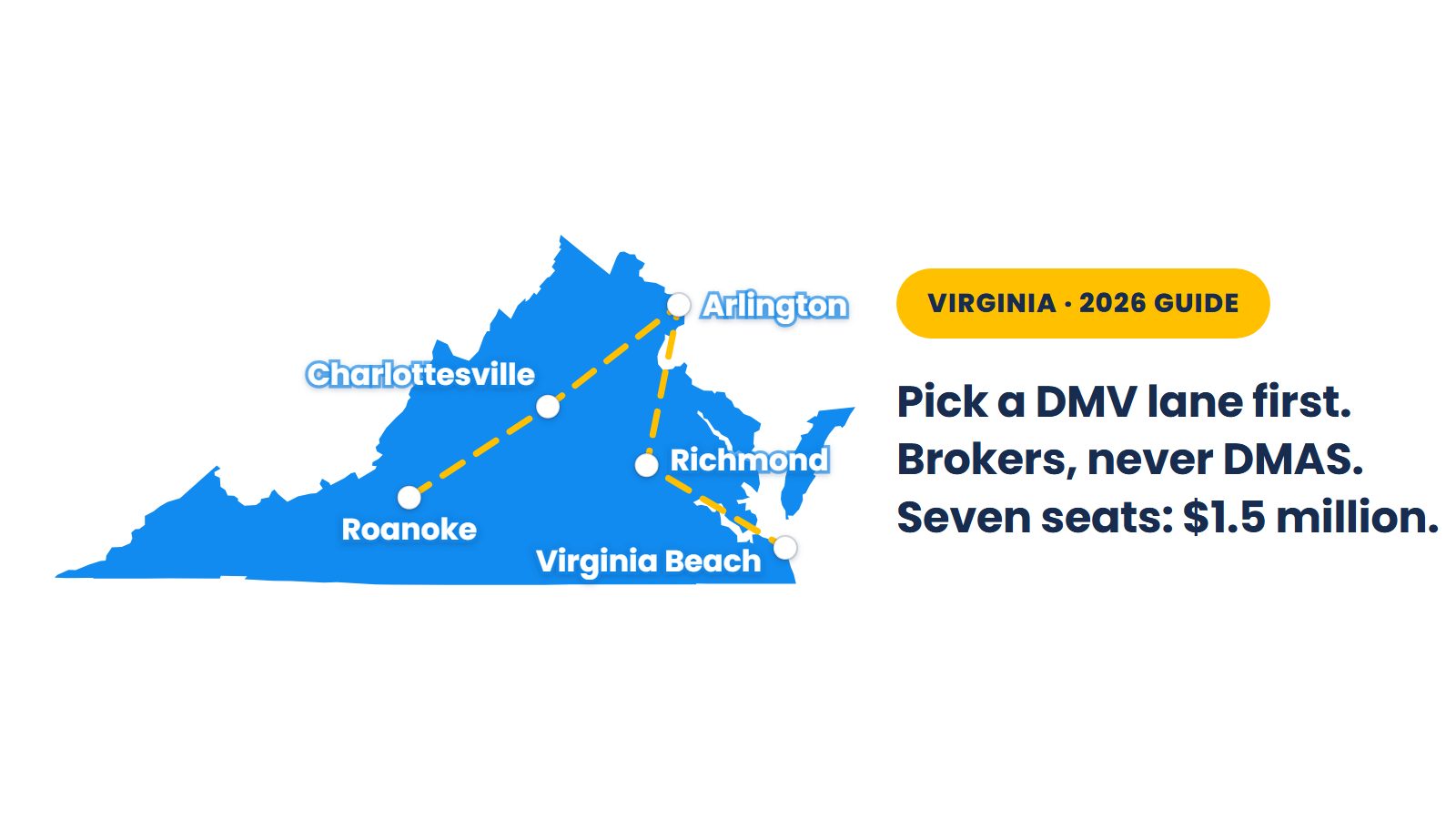
To start a NEMT business in Virginia, form an LLC, then get DMV operating authority in the right lane. The NEMT certificate covers Medicaid trips only, while Common Carrier - Irregular Routes covers Medicaid, private pay, and facility work, so most companies want that one. File with the $25,000 bond, bind insurance to the seat-count floor at approval, then credential with each Medicaid broker once the certificate issues. You never enroll with DMAS, the state Medicaid agency. Plan on $25,000 to $50,000 and two to four months to first Medicaid trips in the NEMT-certificate lane, longer on the common-carrier lane’s unpublished clock. No paid trip runs before the certificate.
Virginia at a glance:
- State NEMT license: yes, in effect. A DMV certificate of fitness for nonemergency medical transportation carriers (Form OA 151, $50 plus $3 per vehicle, a $25,000 bond held three years, for-hire plates), and by statute it covers Medicaid trips only. Private-pay and facility work needs Common Carrier - Irregular Routes authority instead, and that lane covers your Medicaid trips too, so you don’t choose between Medicaid and private pay, only between two certificates. DMAS’s own enrollment notice points providers to the irregular-route for-hire rules.
- Who runs Medicaid rides: brokers (the companies the state or a health plan hires to assign Medicaid rides to providers and pay for them), never DMAS. For fee-for-service (members the state covers directly, outside a health plan), ModivCare through September 30, 2026 and MTM Health from October 1, per DMAS. ModivCare for Humana and Sentara; Access2Care, which is moving to the MTM Health name, for Anthem. Per the plans’ own 2026 notices, SafeRide Health for UnitedHealthcare since March 1 and MediDrive for Aetna since April 1.
- How you enroll: with each broker, not the state. DMAS says so in writing. DMV authority and plated, insured vans come first, and the state’s managed-care contract gives the plans’ brokers 30 days to process a packet.
- Insurance the law requires: $350,000 for a vehicle designed for one to six people including the driver, $1.5 million at seven to 15, $5 million at 16 or more, filed only after DMV approves you. Brokers may require more and publish no Virginia number.
- Cost to launch one van: $25,000 to $50,000, mostly the van and the insurance. DMV’s fees are $53. The real license cost is the $25,000 bond (about $250 a year as a surety bond, or $25,000 of tied-up credit if you post a letter of credit) plus the insurance tier.
- Time to first Medicaid trips: two to four months in the NEMT-certificate lane. DMV publishes no processing time. The common-carrier lane adds a newspaper summary, notice to competing carriers, and protests open to any aggrieved party, on a clock DMV doesn’t publish, so ask Motor Carrier Services how long that lane is running. In Virginia every paid trip, private pay included, waits on the certificate.
Right after college I lived in DC and drove my grandmother to her appointments in Alexandria, 30 to 45 minutes each way. When I couldn’t, I hired a NEMT company. I’d call three places and nobody picked up. I’d book a ride, call back to confirm, and hear there was no record of it. The van showed up an hour late and she missed the appointment.
The complaint hasn’t changed. Three founders of a Hampton Roads company that launched in April 2026 told an industry podcast this summer that they spent two and a half months asking facilities one question before they bought anything: “What’s your pain point with transportation providers?” The answer, over and over: they show up late, or not at all.
The guides that rank for this topic tell you to get certified with DMAS, carry the personal-auto minimums (the 25/50/25 you’ll see quoted), and not worry about a state license, because Virginia doesn’t have one. The mistake isn’t skipping the license. It’s applying for the one that forbids the trips you planned to sell.
Both facts are in the state’s own documents. Virginia has had a mandatory NEMT certificate since 2011, its application makes you certify under penalty of perjury that you “will not provide any other type of for-hire passenger transportation” [1], the statute limits the carrier to NEMT through DMAS, a DMAS-contracted broker, or a Medicaid managed-care plan or its contractor [2], and DMV’s page says the carrier “may only be compensated through Medicaid reimbursement” [3]. And DMAS, the agency everyone tells you to enroll with, says in its provider notice updated July 1, 2025: “you do not enroll with DMAS directly for Fee For Service (FFS) or Managed Care Organization (MCO) NEMT programs” [4].
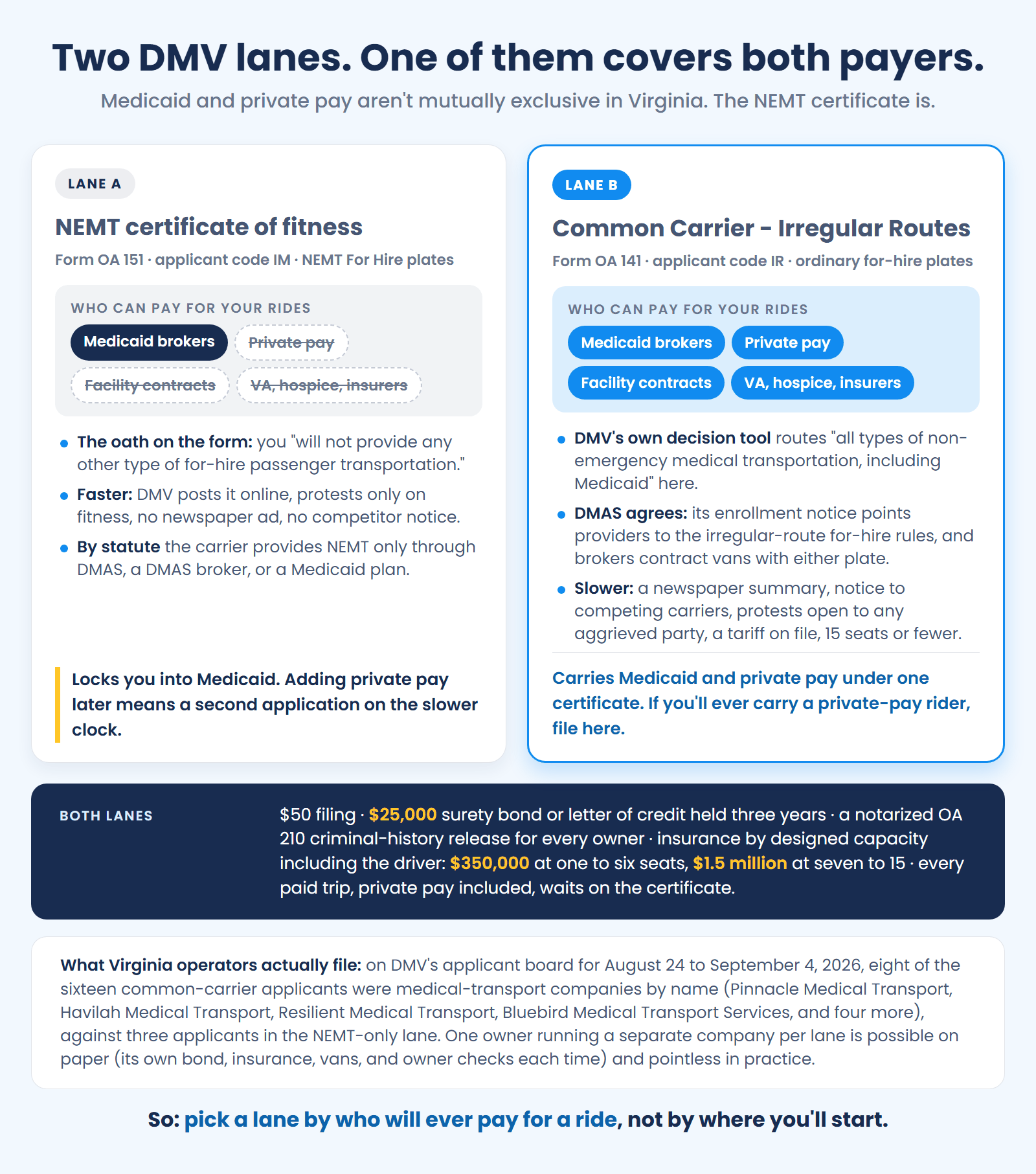
None of that makes Medicaid and private pay mutually exclusive. One authority, the common-carrier certificate, carries both: DMV’s own decision tool routes all-types NEMT there, Medicaid included [5], and DMAS’s enrollment notice points providers to the same irregular-route for-hire rules [4]. What’s exclusive is the NEMT certificate, the cheaper, faster lane some guides point everyone at. Here’s the whole decision in one picture:
The demand is large, and it’s shrinking. About 1.74 million Virginians were on Medicaid and FAMIS (the separate children’s program) on August 1, 2026, roughly 1.55 million of them in managed care, and the total is down about 6 percent in a year [6]. About 160,000 of those are limited-benefit categories (Medicare cost-sharing, emergency-only, family planning), which I read as no ride benefit [6]. CMS, the federal agency that certifies dialysis and nursing facilities, lists 206 Medicare-certified dialysis facilities and 289 certified nursing facilities in the state [7][8], and 16.2 percent of Virginians were 65 or older in 2020, headed to 20.2 percent by 2030 in the state demographer’s projections [9].
I run Duet, which builds dispatch software and runs growth services for non-emergency medical transportation (NEMT) companies, and this is the Virginia edition of our national guide on how to start a NEMT business. Confirm against the linked sources before you spend money.
“VA NEMT” searches mostly return Veterans Affairs pages. This guide is about the Commonwealth; the federal VA appears later, as a payer.
The one-page checklist: steps to start a NEMT business in Virginia
Ordered by what costs money if you do it out of sequence.
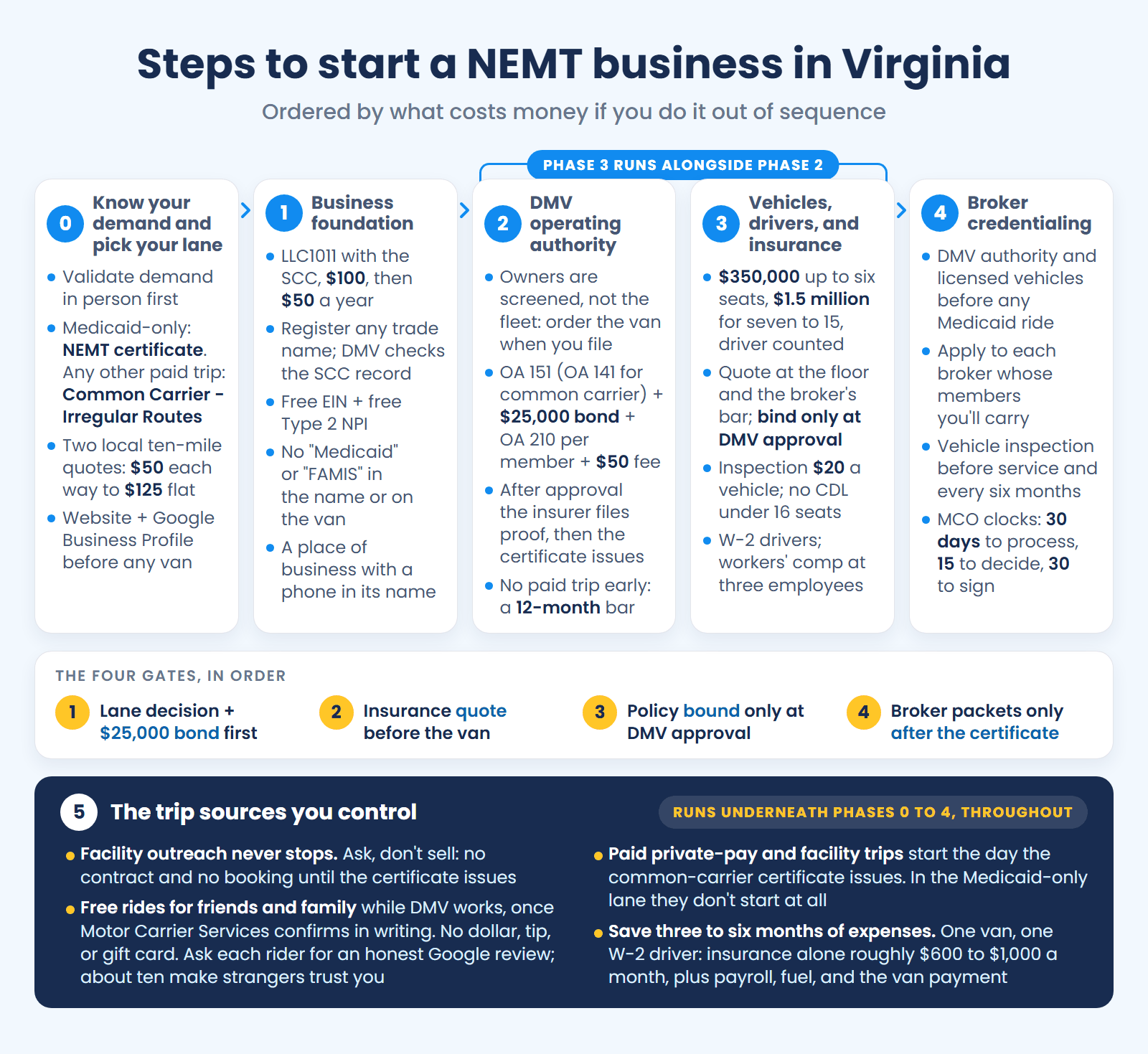
Phase 0: know your demand and pick your lane
- Validate demand in person before any filing; the Hampton Roads founders did it for two and a half months before they had a vehicle, an insurance quote, a DMV application, or an LLC.
- Your payer mix decides your DMV authority. Medicaid-only means the NEMT certificate, whose application makes you swear you’ll never run anything else [1]. Any private-pay, insurer-paid, or facility-paid trip means Common Carrier - Irregular Routes, and DMV’s own decision tool sends a mixed book there, Medicaid included [5].
- Call two local operators for a ten-mile wheelchair quote. Published cards run from $50 each way in Richmond to $125 flat in Virginia Beach [10][11].
- Put the website and Google Business Profile up right after demand validation and before any vehicle spend, plus Yelp and Facebook profiles if you’re skipping the brokers. Build it as a launch page that takes no bookings until the certificate issues: Virginia’s operating-authority statute reaches offering and advertising for-compensation transport, not just running it, and the common-carrier lane wants your certificate number in every ad [12][13].
Phase 1: business foundation
- File Form LLC1011 online with the State Corporation Commission for $100, and register any trade name there too, because DMV checks that its application matches the SCC record [14][15]. The $50 annual fee is due by the last day of your anniversary month, and a Virginia-resident member or manager can be the registered agent for $0 [14].
- Get the free EIN, your federal tax ID, and the free Type 2 NPI, the ID number the healthcare system uses for your company; the state’s managed-care contract requires one of every transportation provider [16].
- Check the name before you file it. DMAS bars the words “Medicaid” and “FAMIS” from the vehicle and from the business name [17].
- Line up a place of business you own or lease that meets local zoning, holds your records, and has a working phone listed in the company’s name; DMV won’t issue a certificate without one [18]. If that’s your house, check that zoning allows a home-based business before the address goes on OA 151.
Phase 2: the DMV operating authority
- OA 151 screens the owners, not the fleet, and the $3 per-vehicle fee comes with registration after approval [19][20], but a van must be plated within three months of the certificate issuing or DMV can revoke it [21], so order the van when you file and bind the insurance at approval.
- Apply online, available since January 1, 2026 and mandatory from February 1, 2027 [22]. The package: OA 151 (OA 141 for the common-carrier lane), a $25,000 surety bond or letter of credit held three years, a notarized OA 210 criminal-history release for every LLC member or manager, and a non-refundable $50 fee [3][1][23].
- DMV posts the application on its website. For the NEMT certificate that posting is the whole notice, with protests limited to fitness [24], and one September 2026 notice for a Petersburg applicant ran a two-week protest window [25]. The common-carrier lane adds a newspaper summary, notice to competing carriers, and protests open to any aggrieved party, on a clock DMV doesn’t publish [24].
- After approval, your insurer files proof of coverage, and nothing issues before that [22][20]. Then the $3 per-vehicle fee, for-hire plates (the NEMT For Hire plate in the Medicaid-only lane, ordinary for-hire plates for a common-carrier van), and an identification marker on every vehicle [19][26][15].
- Don’t run a paid trip early. A conviction or civil penalty for operating without authority bars you from the certificate for 12 months [12].
Phase 3: vehicles, drivers, and insurance
This phase runs alongside Phase 2.
- Count seats including the driver before you buy: a seven-seat van jumps from the $350,000 tier to $1.5 million, on design capacity, not seats in use [20][15].
- Get quotes in week one from an agent who writes Virginia NEMT, at the seat-count floor and at whatever number each broker’s enrollment line gives you, so a broker bar above DMV’s floor doesn’t mean re-binding later. Bind at DMV approval, not before [22][27].
- Annual state inspection, $20 per vehicle [28]. No commercial driver’s license (CDL) under 16 seats including the driver [29].
- Build each driver file to the DMAS floor (18 with a license held two years, the driving-record limits, a background check before the first trip, the broker’s training before any transport) and the van to the broker’s checklist in the drivers section, with the business name and phone lettered at least three inches high on both sides [17].
- W-2 drivers. Virginia presumes anyone paid for services is an employee [30], workers’ comp is mandatory at more than two employees [31], and one Virginia NEMT insurance agency says its carriers require employee drivers outright [27].
Phase 4: broker credentialing
- DMV authority and licensed vehicles come before any Medicaid member rides; DMAS says so [4].
- Apply to each broker whose members you’ll carry, using the map in the broker section.
- Expect a broker vehicle inspection before service and every six months [17], and possibly an insurance bar above DMV’s floor, which DMAS says brokers may set [4]. The managed-care contract gives the plans’ brokers 30 days to process a complete packet, 15 to decide, and 30 to execute a contract [16].
Phase 5: the trip sources you control
- Facility outreach never stops after Phase 0; the application going in is your reason to go back and say you’re weeks away. Ask, don’t sell: no contract and no booking until the certificate issues [12].
- Free rides for friends and family while DMV works, once Motor Carrier Services confirms in writing that a genuinely free ride sits outside “transport for compensation” [12] (my reading of the statute, and question 5 in the DMV section). No dollar, tip, or gift card, and check that the van’s current policy covers a passenger on the lift. Ask each rider for an honest Google review; about ten make strangers trust you. The discounted-rides advice in our other state guides doesn’t transfer.
- Paid private-pay and facility trips start the day the common-carrier certificate issues [12][5], and never under the Medicaid-only lane.
- Save three to six months of expenses. For one van with one W-2 driver, insurance alone runs roughly $600 to $1,000 a month, plus payroll, fuel, and the van payment. Neither queue is billable time.
Who pays for NEMT rides in Virginia?
Four payers cover NEMT rides in Virginia:
- Medicaid, always through a broker, for fee-for-service riders and for members of the five Cardinal Care plans alike (Cardinal Care is Virginia’s name for its Medicaid program) [32].
- Facility contracts: nursing homes, assisted living, and hospices paying out of their own budgets.
- Private-pay families booking directly, mostly by phone, at rates you set.
- The smaller lanes, covered near the end: the federal VA, hospices, and workers’ comp.
Medicaid is the volume, and it’s shrinking
The five plans since July 1, 2025: Aetna Better Health of Virginia, Anthem HealthKeepers Plus, Humana Healthy Horizons, Sentara Health Plans (formerly Optima), and UnitedHealthcare of the Mid-Atlantic. Molina left June 30, 2025 and its members moved to Humana [32].
Enrollment on August 1, 2026 was 1,736,564, down 114,930 from a year earlier, with 1,551,938 in managed care [6]. The ride-heavy core is the long-term-care rows: about 17,700 people in nursing facilities, 47,400 on home-and-community waivers, 18,400 on developmental-disability waivers, and 66,900 adults from the 2019 Medicaid expansion in managed long-term services [6], call it 150,000 people who ride a lot. DMAS’s March 2026 briefing flagged federal work requirements for the expansion population as the next change, so expect the total to keep sliding [33].
The FAMIS trap and the DD-waiver side door
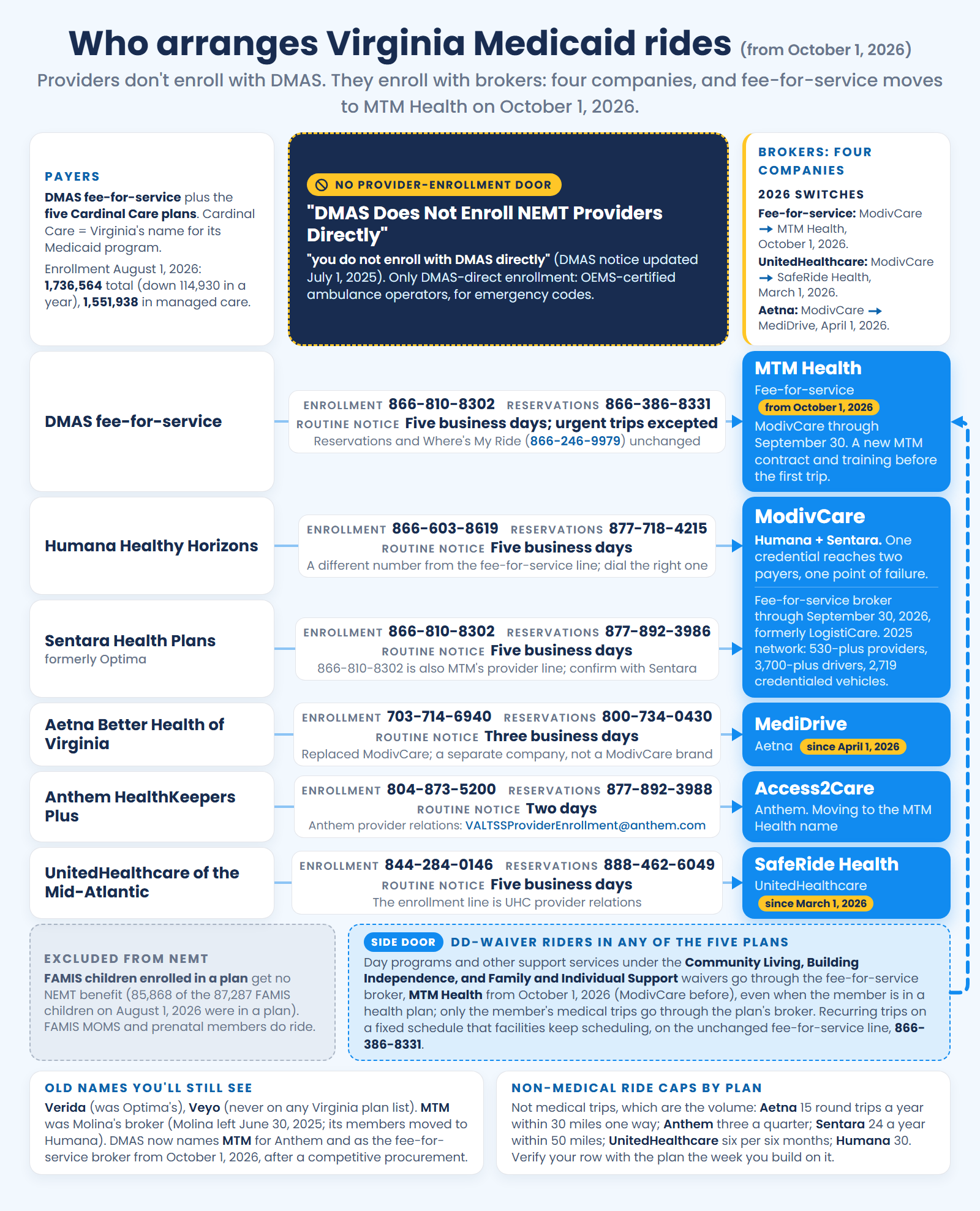
FAMIS children get no NEMT benefit when they’re enrolled in a plan, and 85,868 of the 87,287 FAMIS children on August 1 were [34][16][6]; FAMIS MOMS and prenatal members do ride [16]. Screen Medicaid versus FAMIS before promising a pediatric or OB ride.
The side door runs the other way. Rides to the day programs and support services that Virginia’s developmental-disability waivers (Community Living, Building Independence, and Family and Individual Support) pay for go through the fee-for-service broker even when the member is in a health plan; only the medical trips go through the plan’s broker [16]. That broker is ModivCare through September 30, 2026 and MTM Health from October 1 [16][89]. DMAS’s September 2026 bulletin has MTM reviewing these waivers’ standing orders, while the facilities keep scheduling them [88]. They’re recurring trips on a fixed schedule, booked on the fee-for-service line, 866-386-8331, which doesn’t change [35][88], and you get them by enrolling with the fee-for-service broker, which means MTM for trips from October 1.
Facilities are the stability
CMS’s provider data, queried September 2026: 206 dialysis facilities (DaVita runs 92, Fresenius 73) and 289 nursing facilities [7][8]. Hampton Roads has 50 dialysis clinics and 57 nursing homes, Northern Virginia 45 and 33, the Richmond metro 34 and 38, the Roanoke Valley 6 and 20 (regions are county groupings made for this guide), and Fairfax County’s 19 dialysis clinics lead every county [7][8]. Count the dialysis clinics as demand, not accounts: in my experience most dialysis riders are on Medicaid, so their standing trips come through the brokers, not the clinic.
Private pay is the margin, and Northern Virginia is unpriced
Operator-published cards, as of September 2026:
- On Time NEMT in Virginia Beach: wheelchair $125 for 1 to 10 miles, stretcher $480 [11].
- 7 CTs Transportation in Virginia Beach: $3.50 a mile for wheelchair [36].
- VIP & Associates in Richmond: $50 each way for wheelchair [10].
- Hospital To Home in Richmond: $140 round trip for 0 to 10 miles [10].
- GRTC’s subsidized CARE On-Demand in Richmond: $7 plus $1.15 a mile past six miles [10].
Same ten-mile trip, at least a 2.5x spread inside one state. Quote your own market and never copy a blog’s rate table. No Northern Virginia operator I found publishes a price, in a region where Loudoun’s median household income is $177,567 and Fairfax’s is $154,545 [37]. That lane is open.
We run Google Ads for a couple dozen NEMT companies, and in the DC, Virginia, and Maryland metro, private-pay calls come in at roughly $10 to $15 a call, eyeballed from our own campaigns rather than a benchmark. Callers phone two or three places and take the cheapest one that answers, so answer the phone, and run negative keywords so Medicaid and free-ride searchers don’t burn the budget. If all five of the next five callers sign up the moment they hear the price, the price is a little low.
The geography: Hampton Roads, Northern Virginia, Richmond, Roanoke
The aging is suburban. Loudoun’s 65-plus population triples between 2020 and 2050, from 41,497 to 130,283, and Prince William’s senior share climbs faster than any big locality but Loudoun. By 2050 Henrico, Virginia Beach, and Chesterfield each pass one in five residents over 65, Chesapeake’s 65-plus count goes from 36,045 to 58,881, and Arlington and Richmond city end below their 2020 shares [9]. Roanoke County was already 22.1 percent 65-plus in 2020, the oldest of the 16 big localities I tabulated [9]. Hampton Roads is the military market: the VA is building a $355 million outpatient clinic in Virginia Beach projected to open in 2029 [38], and Hampton’s free DAV vans are ambulatory-only, so the wheelchair gap is open [39].
Marqus Johnson made the point on our podcast, comparing Virginia and Iowa with California, Florida, and Texas: in a state like this you find trips differently, so decide whether your market is rural or urban, then learn local SEO [40].
Who is the NEMT broker in Virginia?
Providers enroll with brokers, not DMAS, and Virginia has four broker companies: ModivCare, MTM Health, MediDrive, and SafeRide Health, with Anthem’s broker, Access2Care, moving to the MTM Health name [88][91].
Fee-for-service: MTM Health from October 1, 2026, after ModivCare
The statewide fee-for-service broker enrolls providers, trains drivers, inspects vehicles, negotiates contracts and rates, assigns trips, and pays [4]. ModivCare (formerly LogistiCare) runs it through September 30, 2026 [89], on a contract that traces to a January 2018 award [41]. DMAS re-bid the brokerage as RFP 32141 with proposals due January 27, 2025 [41], and its September 15, 2026 bulletin says Medical Transportation Management, now MTM Health, “has been selected through a competitive procurement process” for fee-for-service members [88]. DMAS’s fee-for-service ride site sends trips scheduled on or after October 1, 2026 to MTM [89], and the reservation line (866-386-8331) and Where’s My Ride line (866-246-9979) stay the same [88].
For a provider it’s a new contract. MTM’s Virginia handbook, approved August 10, 2026, credentials under MTM’s own service agreement and requires DMAS and MTM training before the first fee-for-service trip [90]. Neither DMAS’s bulletin nor MTM’s handbook says a ModivCare credential carries over, so if fee-for-service volume matters to you, apply to MTM rather than waiting for a call [88][90].
The five Cardinal Care plans and their brokers
The map, verified September 2026 against DMAS’s July 2025 broker table or the plan’s own document, with the notice column cross-checked against a Hampton Roads children’s hospital’s plan guide [43]:
| Payer | Broker | Provider enrollment | Reservations | Routine notice |
|---|---|---|---|---|
| DMAS fee-for-service | ModivCare through September 30, 2026; MTM Health from October 1 [88][89] | 866-810-8302, also MTM’s Virginia provider line [90] | 866-386-8331, unchanged [88] | Five business days; urgent trips excepted [42][90] |
| Aetna Better Health | MediDrive, since April 1, 2026 | 703-714-6940 | 800-734-0430 | Three business days [44][45] |
| Anthem HealthKeepers Plus | Access2Care, moving to the MTM Health name; DMAS’s bulletin already says MTM [88][91] | 804-873-5200 [4] | 877-892-3988 [35] | Two days [43] |
| Humana Healthy Horizons | ModivCare | 866-603-8619 [4] | 877-718-4215 [46] | Five business days [43] |
| Sentara Health Plans | ModivCare | 866-810-8302; confirm from October 1 | 877-892-3986 | Five business days [4][47] |
| UnitedHealthcare | SafeRide Health, since March 1, 2026 | UHC provider relations, 844-284-0146, per DMAS’s June 2025 provider deck [48] | 888-462-6049 | Five business days [49] |
Humana’s ModivCare line is a different number from the fee-for-service line [4], and DMAS’s provider manual prints a second ModivCare enrollment line, 866-810-8305 x2645 [34]. MTM’s Virginia provider page and handbook list 866-810-8302 as MTM’s own provider line [90], the number DMAS’s 2025 table gives for ModivCare’s fee-for-service and Sentara enrollment [4], so from October 1 confirm Sentara’s enrollment line with Sentara.
The trip counts in plan documents are caps on non-medical rides, not medical trips: Aetna 15 round trips a year within 30 miles one way, Anthem three a quarter, Sentara 24 a year within 50 miles, UnitedHealthcare six per six months, and Humana 30, per the plans’ member documents and a Hampton Roads hospital’s 2025 plan guide [44][43][47][46]. The volume is in the medical trips.
Two switches in spring 2026
UnitedHealthcare’s own flyer says SafeRide Health manages all its Virginia Medicaid NEMT from March 1, 2026 [49]. Aetna’s own member FAQ says MediDrive replaced ModivCare on April 1, 2026 [44]. No provider signed anything; the trips just moved.
MediDrive is a separate company, not a ModivCare brand, its Virginia provider application is open [45], and a new broker needs vehicles, which is a window for a new entrant. I couldn’t reach Access2Care’s provider pages in September 2026, so the DMAS-published line and Anthem provider relations (VALTSSProviderEnrollment@anthem.com on DMAS’s June 2025 provider deck) are the door [48].
Old names you’ll still see
Verida was Optima’s broker on DMAS’s August 2023 contact list, and Optima is now Sentara [50]. MTM appears on that list as Molina’s broker, a plan that’s gone, but the name is current: DMAS’s September 2026 bulletin names MTM for Anthem members and as the fee-for-service broker, which takes trips from October 1, 2026 [88][89]. Veyo never appears on any Virginia plan list; ModivCare’s own Virginia page still carries retired plan names [50]. Read the DMAS sheet, not the broker’s page. Our broker tracker follows this churn nationally.
Can I enroll with DMAS or bill Virginia Medicaid directly for NEMT rides?
No. The July 1, 2025 notice is explicit, and the provider manual’s Chapter II says it with every word capitalized: “DMAS Does Not Enroll NEMT Providers Directly” [4][34]. The “DMAS NEMT certification” several vendor guides tell you to get doesn’t exist.
What the brokers do that DMAS doesn’t
Every fee-for-service and plan trip is authorized, assigned, and paid by the broker. Members can request a provider but can’t choose one, and only an enrolled provider gets assigned a trip [34]. The one direct-enrollment exception is ambulance: operators certified by OEMS, the state Office of Emergency Medical Services, sign an agreement with DMAS for emergency codes, and even the non-emergency ambulance codes are preauthorized by and billed to the broker [34].
What the broker pays, and the only rate the state publishes
Virginia publishes no NEMT trip or mileage rate for broker-assigned rides. The broker negotiates provider rates [4] and has historically been paid a flat monthly amount per member by DMAS [51]. The only state rate table is the ambulance crossover table (a crossover claim is one Medicare pays first and Medicaid finishes), which for dates of service on or after July 1, 2012 puts basic life support (BLS) non-emergency (A0428) at $84.14, marked for crossover calculations only, and the DMAS ambulance page posts nothing newer [52].
So every per-trip “Virginia Medicaid NEMT rate” table online is a guess, and none cites a broker rate sheet. Arizona has a direct-billing lane at published rates, North Carolina has one at county-set rates, Georgia closed its direct lane in 1997, and Minnesota pays wheelchair and stretcher trips directly at statutory rates; Virginia’s went to a broker a generation ago, and ModivCare says it has held the state since 2001 [53].
Price private pay off your own costs and the local cards, and negotiate each broker separately. The Hampton Roads founders put broker wheelchair trips at about $80 on that podcast, against an average near $186 on their mostly private-pay book, paid day-of versus net-30 or net-45 from the broker. Our pricing guide covers the method.
What licenses does a NEMT business need in Virginia?
Virginia has a state NEMT certificate almost nobody names, a Medicaid layer that runs through brokers, an EMS layer that only touches ambulances, and a local layer that’s mostly a business-license tax.
The claims you’ll read elsewhere, against the sources
| The claim you’ll read elsewhere | What Virginia actually requires |
|---|---|
| ”Get certified with DMAS through PRISM” | No such step. Brokers enroll you [4]. |
| ”Virginia has no NEMT license” | § 46.2-2099.44 (2011): no NEMT carrier may transport passengers intrastate without a DMV certificate of fitness [54]. |
| ”State minimums are $100,000 GL and 25/50/25 auto” | § 46.2-2053: $350,000, $1.5 million, $5 million by designed capacity including the driver [20]. |
| ”Register with the Secretary of State” | The State Corporation Commission, Form LLC1011, $100 [14]. |
| ”DPOR, VDOT, or DRPT regulate NEMT” | DMV issues operating authority; DMAS sets program rules through brokers; OEMS licenses ambulances only [54][4][55]. |
| ”Drivers must be 21 with a chauffeur license and no DUI in 7 years” | DMAS’s floor is 18 with two years licensed and names no license class. The 21 is the federal interstate rule, which only reaches a van that’s a federal commercial vehicle crossing a state line; the 25-plus rule is labeled an insurance requirement on one operator’s posting, and the 7-year record comes from the same posting [17][11][56]. |
| ”PASS is required by DMAS” | PASS (Passenger Service and Safety, the standard rider-handling course) was on the DMAS sheet through its April 2025 revision; the May 26, 2026 revision says “the broker’s driver training program” [17]. |
| ”Budget $1,000 to $3,000 in licenses” | DMV’s fees are $50 plus $3 per vehicle [19]. |
| ”You need a USDOT number” | DMV lists only the federal triggers for a USDOT number (the federal motor-carrier registration) and states no Virginia intrastate rule; confirm with FMCSA, the federal trucking-and-bus regulator [57]. |
Thresholds that don’t reach a wheelchair van: CDL, USDOT, inspection
A CDL starts at vehicles designed for 16 or more passengers including the driver, at 26,001 pounds, or with placarded hazmat [29], and Virginia’s in-state commercial-motor-vehicle rules start above 26,000 pounds or 15 passengers [56], so a typical wheelchair van sits outside the federal driver-qualification and drug-testing rules as Virginia adopts them. Cross a state line and the math changes: a van designed for nine or more people including the driver, or rated by the manufacturer at 10,001 pounds or more, becomes a federal commercial motor vehicle the moment it carries a paying rider into DC or Maryland, both minutes from Northern Virginia [57][56]. Those trips also need a regional license: WMATC, the Washington Metropolitan Area Transit Commission, certifies for-hire trips anywhere in its Metropolitan District, DC and its inner Maryland and Virginia suburbs, except those solely within Virginia, as our DC guide’s licensing section explains.
On USDOT numbers, DMV’s page lists the four federal triggers and nothing Virginia-specific [57]. I couldn’t reach FMCSA’s state list, so confirm with FMCSA.
Every vehicle gets a state safety inspection at least every 12 months at a State Police-supervised station, $20 [28]. The “semi-annual inspection” you’ll read about is the broker’s [17].
Exempt operations, and why not to build on them
The motor-carrier law’s exemption section lists nine categories the chapter doesn’t reach [58], and DMV’s exempt-operations page adds vehicles delivering passengers within the same city or town where they were picked up [58][15]. A carrier with both exempt and non-exempt operations must obtain authority, and an exempt passenger vehicle still needs for-hire registration and plates [58][15]. Don’t build on the intra-city exemption; Hampton Roads trips cross independent-city lines constantly.
The local layer: BPOL and taxi codes
The real local cost is BPOL, the business-license tax. Virginia caps it at 36 cents per $100 of gross receipts for business services; in localities over 50,000 people no license tax applies until receipts reach $100,000, though a flat fee of up to $100 can [59]. OA 151 makes you certify BPOL and workers’ comp compliance under penalty of perjury [1].
Virginia Beach licenses businesses through the Commissioner of the Revenue: $25 to $50 flat until $200,000 in receipts, renewal due March 1, in a guide dated 2022, so confirm [60]. The police issue a separate taxicab certificate (Form PD412, $50) that wants an insurance certificate attached and isn’t valid until the business license is in hand [61].
A Virginia Beach operator who launched in October 2024 told a podcast in early 2025 that she carried a policy of about $1,500 a month while still non-operational, because the city wanted insurance before the for-hire license, plus a newspaper notice that cost her about $500 and a bond. The notice and the bond match the DMV common-carrier lane’s own steps (the newspaper summary that lane requires, covered in the next section, and the $25,000 bond every lane posts [24][23]); Virginia Beach’s own vehicle-for-hire chapter, which I couldn’t read, may add its own. Count them as launch cash, and get the city’s sequence and DMV’s in writing before you buy anything.
Before you letter a van, ask the city’s for-hire office and the Commissioner of the Revenue one question: does the vehicle-for-hire chapter reach a DMV-certificated wheelchair van? For Virginia Beach, Chesapeake, Norfolk, and Richmond I couldn’t read the answer.
What I could read: state law lets localities license, tax, and cap taxicabs, and a DMV taxicab permit applies only outside incorporated cities and towns [62]. DMAS requires taxi-plated NEMT vehicles to hold local taxi authority where one exists [17]. Arlington’s code excludes Chapter 20 common carriers (the state motor-carrier law’s term) from its taxicab definition [63], which covers the private-pay lane but not the NEMT certificate, because § 46.2-2000 says “common carrier” doesn’t include a NEMT carrier [2]; a NEMT-certificate holder in Arlington should ask the county. Newport News’s 2022 ordinance, as proposed to council and effective May 1, 2022, excludes both “a common carrier” and “a nonemergency medical transportation carrier as defined in the state code” [64]; confirm that against the current city code. That’s two localities, and neither is Virginia Beach, Chesapeake, Norfolk, or Richmond.
The Hampton Roads founders said on that podcast that the DMV was their biggest launch headache because everybody they talked with gave them a different story. Expect the same from city offices.
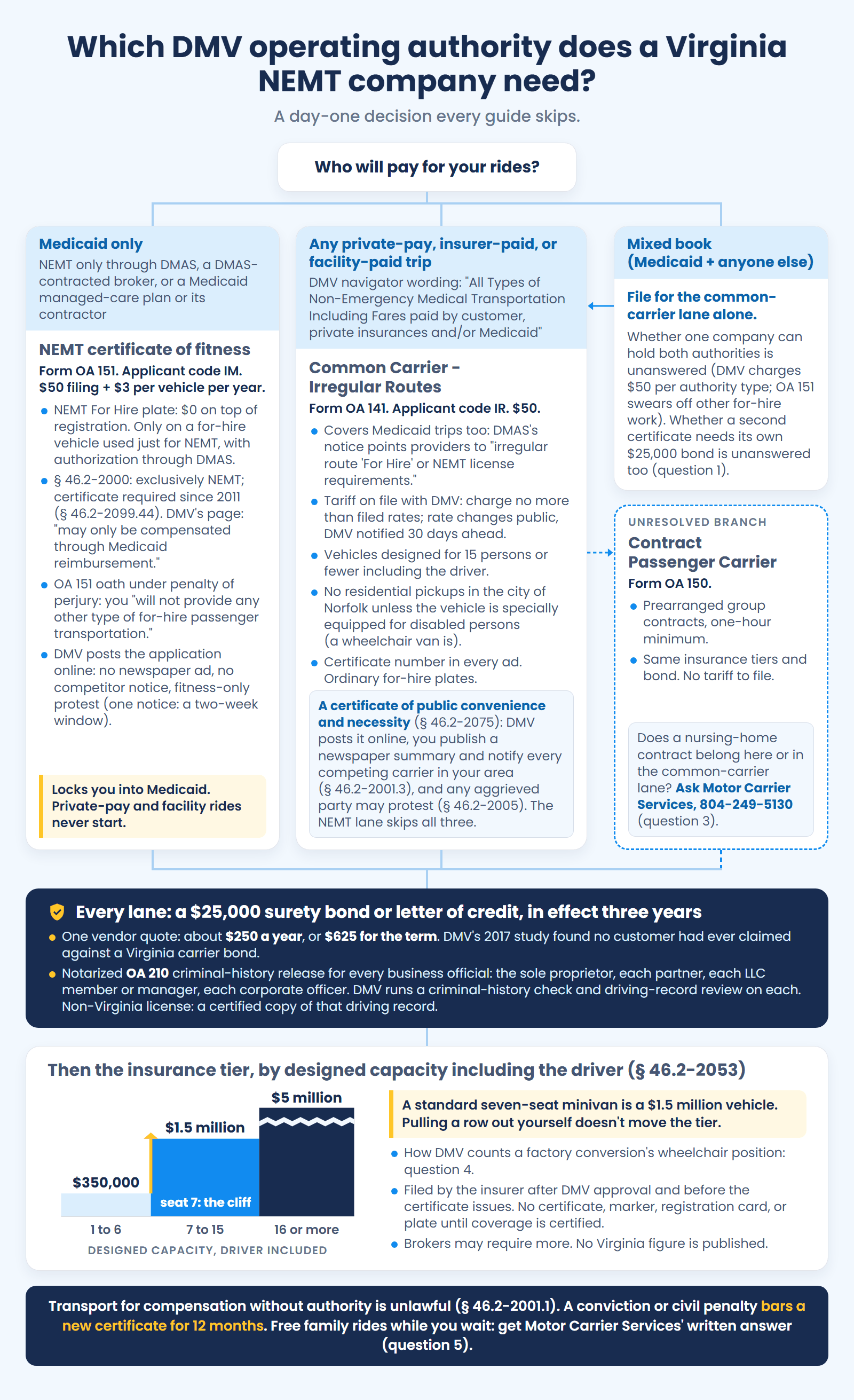
Which DMV operating authority does a Virginia NEMT company need?
Every guide I’ve read skips this decision, and it’s a day-one decision.
The certificate that locks you into Medicaid
Under § 46.2-2000 a nonemergency medical transportation carrier provides NEMT exclusively and only through DMAS, a DMAS broker, or a plan or its contractor [2], and since 2011 that carrier needs a DMV certificate of fitness before any intrastate trip [54]. OA 151 has you certify six things under penalty of perjury [1]:
- You’ll provide NEMT only through those channels.
- You “will not provide any other type of for-hire passenger transportation.”
- You’ll comply with Title 46.2.
- All taxes and judgments due the Commonwealth are paid.
- You comply with workers’ comp and BPOL.
- Everything on the form and every document you attached is true and genuine.
The private-pay lane: Common Carrier - Irregular Routes
DMV’s own decision tool routes “All Types of Non-Emergency Medical Transportation Including Fares paid by customer, private insurances and/or Medicaid” to Common Carrier - Irregular Routes, and only “Medicaid Recipients Only” NEMT to the NEMT certificate [5]. DMAS agrees: its enrollment notice points providers to “irregular route ‘For Hire’ or NEMT license requirements” at DMV [4], and the provider manual lists “NEMT Providers with NEMT tags or for Hire License plates” among the vehicles brokers contract with [34]. The common-carrier terms [13]:
- A tariff on file with DMV. Charge no more than the filed rates, and make rate changes public and notify DMV 30 days ahead.
- Vehicles designed for 15 persons or fewer including the driver.
- No residential pickups in the city of Norfolk unless the vehicle is specially equipped for disabled persons, which a wheelchair van is.
- The same $350,000 and $1.5 million tiers, the same $25,000 three-year bond, a $50 fee, Form OA 141, and your certificate number in every ad.
The difference between the lanes is the clock. § 46.2-2000 defines the certificate of fitness only for contract, sight-seeing, rideshare (TNC), and NEMT carriers, and excludes NEMT carriers from “common carrier” [2]. A common carrier needs a different instrument: under § 46.2-2075, none not otherwise exempted may run intrastate on any Virginia highway without a certificate of public convenience and necessity from DMV [24]. Under § 46.2-2001.3, every original application gets posted on DMV’s website, but an applicant for that certificate also publishes a summary in a newspaper circulating where it will serve or where its main office sits, and notice goes to every carrier holding the same certificate type in that area [24]. Then § 46.2-2005 splits the protest rule: a certificate-of-fitness application can be protested only on fitness allegations, while the common-carrier certificate can be protested by any aggrieved party, a competitor included, and that protest can force a hearing [24]. That’s almost certainly the Virginia Beach operator’s $500 newspaper line. That process is what the 2011 legislation created the NEMT authority to skip: DMAS and its broker had found the irregular-route approvals too slow, per DMV’s 2017 study [65]. DMV publishes no clock for any of it (question 2 below).
One lane, and the contract-carrier question
DMV charges $50 per authority type [22], and its applicant board shows companies in each lane, coded IM for NEMT and IR for irregular routes [25]. Over the two weeks ending September 4, 2026, eight of the sixteen irregular-routes applicants were medical-transport companies by name (Pinnacle Medical Transport, Havilah Medical Transport, Resilient Medical Transport, Bluebird Medical Transport Services, and four more), against three applicants in the NEMT-only lane [25]. That’s the mixed-book lane in use. No DMV page says whether one company can hold both certificates, OA 151 has you swear you provide no other for-hire passenger transportation [1], and whether a second certificate needs its own $25,000 bond is unanswered too [23]. So if your book is mixed, or ever will be, file for the common-carrier lane alone.
A question that comes up: can one owner run two companies, one per lane? Nothing I read in the motor-carrier law bars it. Each company would be its own carrier with its own $25,000 bond [23], its own insurance filing [20], its own OA 210 checks on the same owners [66], and its own vans, because a vehicle registers under one certificate and running under someone else’s authority is illegal here [15]. I found no Virginia operator built that way, and I can’t see the point when the common-carrier certificate already carries both payers. The one reason to consider the NEMT lane at all is speed: no newspaper, no competitor notice, fitness-only protests. Take it only if you’re certain you’ll never carry a private-pay rider, because switching later is a second application on the slower clock.
A third authority, Contract Passenger Carrier (Form OA 150), covers prearranged group contracts with a one-hour minimum, the same insurance tiers and bond, and no tariff to file [67][15]. Whether a nursing-home contract belongs there or in the common-carrier lane, I couldn’t settle from DMV’s pages (question 3 below).
Five questions for Motor Carrier Services before you file
One call, 804-249-5130, and ask for the answers in writing [1]:
- Does a mixed Medicaid-and-private book file for the common-carrier lane alone, or can one company hold both authorities, and does a second one need its own $25,000 bond?
- How long is the common-carrier lane running from filing to certificate, newspaper notice and competitor-notice period included, and how often are those applications protested?
- Where does a nursing-home contract belong: the common-carrier lane or Contract Passenger Carrier (OA 150)?
- How does DMV count a factory conversion’s wheelchair position against the seat-count insurance tiers?
- What’s the current queue for the NEMT certificate, and does a genuinely free ride for family sit outside “transport for compensation”?
What happens after you file
DMV runs a criminal-history check and a driving-record review on every business official (sole proprietor, partner, LLC member or manager, corporate officer), each of whom signs OA 210 before a notary, with a certified driving record enclosed for anyone licensed outside Virginia [1][66]. DMV’s own 2017 study found no customer had ever claimed against a Virginia carrier bond [65]; the $25,000 bond survived anyway, held three years [23], and one vendor quotes it at about $250 a year or $625 for the term [68].
DMV can approve a posted certificate-of-fitness application without a hearing unless a written protest alleges unfitness, and even then decides whether the protest earns a hearing [24][25]; the Petersburg notice was posted September 1, 2026 and gave protesters until September 15 [25]. Processing time is published nowhere for either lane; the one data point I found is a Chesapeake operator who said on a 2022 podcast that she filed that year and held the certificate about two months later.
The rules that bite after the certificate issues
- Plates and registration. The NEMT plate is free on top of registration and goes only on a for-hire vehicle used just for NEMT with authorization through DMAS; every van also carries DMV’s identification marker [26]. For-hire registration runs $40.75 a year for a van at 4,000 pounds or less and $45.75 up to 6,500, about $10 more than a private car, and the Highway Use Fee may apply on top [69].
- No leasing authority. A leased van must be on your fleet policy, under your operational control with all advertising and contracting in your name, carry the lease in the vehicle, and get its initial for-hire plates authorized by DMV headquarters. Letting others run under your certificate isn’t legal in Virginia [15], which rules out the “sub of a sub” path some operators describe unless the sub holds its own certificate.
- Renewal. Certificates run 12 months. Renewal is free and online, with a 30-day cure after a non-renewal notice; miss it and you reapply as an original applicant with a new bond and new OA 210s [21][70]. Report address, phone, legal-status, or name changes within 30 days [18].
- Revocation and suspension. Three months with no vehicle registered under the certificate is a revocation ground, alongside felony conviction, material misstatement, and failure to keep insurance on file. An insurance lapse means suspension without a hearing and $50 plus $500 to reinstate [21].
- Operating early. Transport for compensation without authority is unlawful under § 46.2-2001.1 unless exempted, and a conviction or civil penalty bars a new certificate for 12 months from final disposition [12]. Knowing and willful violation is a misdemeanor fined up to $2,500 for a first offense and $5,000 after, each day a separate offense; DMV may add civil penalties up to $1,000 per violation, and missing markers are a Class 4 misdemeanor [71].
What are the NEMT insurance requirements in Virginia?
The legal floor counts the driver
The motor-carrier insurance statute sets liability minimums by the number of passengers the vehicle is designed or manufactured to carry, including the driver: $350,000 for one to six, $1.5 million for seven to 15, $5 million for 16 or more. Taxicabs carry at least $125,000, and interstate carriers meet the federal minimum and may file once for both [20]. DMV prints “(including driver)” on every tier [15], so a standard seven-seat minivan is a $1.5 million vehicle, and pulling a row out yourself doesn’t move the tier. How DMV counts a factory conversion’s wheelchair position is question 4 above; ask your agent the same thing before you buy.
The sequence: apply, get approved, then bind
DMV requests the insurer’s filing after approval and before issuance [22], and a Midlothian NEMT agency says its carriers won’t start a policy before DMV authority exists [27]. Get quotes in week one and bind at approval; the Virginia Beach operator’s $1,500 a month on a parked van is what the other order costs. DMAS ties wheelchair and stretcher vans to “the amount required by DMV,” taxis and multi-passenger vans to the greater of DMV or the local taxi ordinance, and ambulances to the OEMS amount [17]; for a certificated carrier I read “the amount required by DMV” as the statute’s tier, because DMV won’t plate the van at less [20], and your agent should confirm that before you bind.
The broker bar is unpublished
ModivCare’s provider page lists commercial general liability, sexual abuse and molestation coverage, auto liability, and workers’ comp with no dollar figures [72]; MediDrive’s Virginia checklist lists general and auto liability and workers’ comp without amounts [45]; I couldn’t find a number from Access2Care or SafeRide. Specialist-agency reporting puts broker bars around $1 million combined single limit nationally, none of it Virginia-specific [73]. Ask each broker for its number before you bind.
What it costs
All agency- or operator-reported, none official. One specialist agency’s 2026 Virginia band is roughly $4,500 to $8,000 per vehicle per year, with the Northern Virginia and DC metro flagged as a premium zone; its national wheelchair-van band runs $6,800 to $12,000, with new-operator surcharges and fleet discounts starting around three to five vehicles [73]. On Time NEMT’s own cost explainer puts a wheelchair van at $7,000 to $12,000 a year under a commercial NEMT policy [11]. Our insurance guide covers what to ask an agent.
Where the 25/50/25 number comes from (not Virginia)
Personal-auto folklore. Virginia’s personal-auto minimum was $30,000/$60,000/$20,000 from 2022 through 2024 and has been $50,000/$100,000/$25,000 since January 1, 2025 [74]; neither is 25/50/25, and neither is the for-hire floor. The EMS regulations do point licensed EMS agencies’ nonemergency vehicles at that personal-auto section, which may be how “personal minimums” got attached to NEMT at all [74].
Workers’ comp starts at employee three, and 1099 drivers are a Virginia liability
Workers’ comp is mandatory once you regularly employ more than two part-time or full-time employees; corporate officers, LLC managers, working family members, temporary workers, and subcontractor employees doing the same work all count toward the three. The civil penalty is up to $250 a day uninsured, capped at $50,000 [31]. Since July 1, 2020, anyone performing services for pay is presumed an employee unless shown to be an independent contractor under current IRS guidelines, with a private right of action against an employer that knew; the section was amended again in 2026. Separately, the Department of Taxation may assess up to $1,000 per misclassified worker for a first offense, $2,500 for a second, and $5,000 after that [30]. Springer Insurance says its carriers require W-2 drivers outright [27], and the Hampton Roads founders ran employee drivers from day one, accepting about 14 weeks of unprofitability with payroll as the biggest expense.
What do NEMT drivers need in Virginia?
Four layers: the law, DMAS, the broker, and the insurer. Knowing which one a rule lives in keeps you from buying compliance you don’t owe.
The law layer is light
No CDL below 16 seats including the driver [29], and nothing in DMAS’s sheet or the motor-carrier law (Title 46.2, Chapter 20), which screens owners rather than drivers, names a license class. Even for a van that counts as an intrastate commercial motor vehicle, Virginia allows an 18-year-old driver operating wholly in-state; crossing into DC, Maryland, or North Carolina puts the driver back under the federal 21 rule [56].
The DMAS layer is the driver file
DMAS’s requirements sheet, updated May 26, 2026, sets the floor [17]:
- At least 18 with a valid license held two years.
- No more than two chargeable accidents or moving violations in three years, DMV points not below minus 2, and no suspension or revocation for moving violations in five years.
- No barrier crime (DMAS still cites § 37.2-314(B); the list itself now sits in § 19.2-392.02), with Virginia State Police and/or national checks including the Sex Offender Registry before the first trip.
- The broker’s training program before any member transport, and credentialing re-reviewed at least annually.
- On the road: no alcohol, drugs, or impairing prescriptions on duty “or at any time,” a uniform shirt or badge, no phones while moving, exit the vehicle to open doors, tobacco- and vape-free vehicles.
DMAS sets no drug-testing cadence; whatever you owe comes from the broker’s contract, and ModivCare’s public sheet lists a drug screen with no schedule [72].
What the broker inspects on the van
The same DMAS sheet is the vehicle checklist the broker inspects against, before service and every six months [17]:
- ADA-compliant under 49 CFR Part 38, with securement belts at every wheelchair position and a vehicle-mounted lap and shoulder belt at every wheelchair station.
- Heat and air conditioning that pass a reading taken at the rear of the vehicle: 68 degrees cooling, 74 degrees heating.
- A seat-belt cutter within the driver’s reach, an A-B-C fire extinguisher, an itemized first-aid kit, a spill kit, and a GPS or a current map of every jurisdiction you serve.
- The complaint procedure, the broker’s toll-free number, and the vehicle license number posted inside, plus NO SMOKING and seat-belt signs.
- For hospital discharge work, a spare wheelchair on board with at least a 20-inch seat, secured.
- After inspection, the broker’s sticker goes on the outside of the passenger-side rear window, lower right corner.
Add the three-inch lettering from Phase 3, and no “Medicaid” or “FAMIS” anywhere on the van [17].
The broker layer is contractual
ModivCare lists a PASS wheelchair certificate, First Aid/CPR, defensive driving, a drug screen, a clean driving record (MVR), and a background check [72]; MediDrive adds federal exclusion-list checks (OIG and SAM) and First Aid/CPR/AED [45]; the managed-care contract names PASS or equivalent, first aid, defensive driving, HIPAA, and wheelchair securement as the training set brokers must require [16]. Build every file to the strictest packet you’re pursuing.
The insurer layer is where 25-and-up comes from
On Time NEMT’s careers page requires drivers 25 and up “(insurance requirement),” a clean seven-year record, no DUIs, and no CDL [11]. That posting, not DMAS, is where the internet’s 25-and-up and seven-year rules come from. The 21 you’ll also see is the federal interstate driver rule [56] and Arlington’s minimum for a taxi driver’s license [63]; neither is a Virginia NEMT rule.
One question sits on the application itself: brokers, ModivCare included, ask what dispatching software you use (they may call it a CAD, computer-aided dispatch), and they hesitate if the answer is “I’m doing it myself.” Our dispatching guide is the primer.
Can a NEMT company run stretcher van trips in Virginia?
Virginia is the state that never decided. Medicaid’s broker runs a stretcher-van mode with a two-person crew and rules that never mention an ambulance license, while Virginia’s EMS code has no stretcher-van category and no stretcher exemption.
What Medicaid’s broker arranges
Virginia’s Medicaid regulation lists stretcher vans as a covered mode (12VAC30-50-530) [75], the fee-for-service member handbook (June 2026) lists “Van-Stretcher” (needs a stretcher, no medical care or monitoring) as a separate level from “Stretcher (Non-Emergency Ambulance)” [42], and DMAS’s requirements sheet defines the service for a medically stable member who can’t use a wheelchair and needs no monitoring, aid, care, or treatment during transport [17]. Its rules:
- A driver plus an assistant trained in first aid, bloodborne pathogens, and stretcher transfer, with the assistant riding in the passenger compartment.
- One stretcher passenger at a time. No IV, saline lock, or airway device. Self-administered oxygen only if secured.
- A cot to GSA KKK-A-1822E specs, and if the van started life as an ambulance, every ambulance marking and light comes off.
- Broker inspections twice a year, and insurance at “the amount required by DMV.”
- A diversion to an emergency department or an EMS intercept means the broker files an exception report with OEMS within two business days, and the broker files a stretcher-van implementation plan with DMAS every year [17]. So OEMS is on notice of the mode, which still isn’t a ruling.
What the EMS code says
Virginia’s EMS law (§ 32.1-111.1) is broad: anyone in the business of giving immediate medical care and transporting people who are “sick, injured, wounded, or otherwise incapacitated or helpless” is an EMS agency and needs a state license [76]. It never defines a stretcher, a wheelchair, or a nonemergency trip, and its one exemption for a private transport business, added in 2005, is wheelchair trips between medical facilities with no medical care on board [76].
The regulations list four license types: first response, ground ambulance, neonatal ambulance, and air ambulance. The only vehicle allowed to carry a patient is a real ambulance built to the federal KKK-A-1822 spec with a two-person crew including an EMT [55]. Put the word “ambulance” on a van without an EMS permit and you’ve broken the law: a willful violation is a Class 1 misdemeanor, up to 12 months in jail and $2,500, and civil penalties run up to $1,000 per offense with every uncorrected day a new offense [76][55].
The two agencies’ documents don’t reconcile, OEMS publishes no stretcher-van FAQ, and no enforcement case surfaced in my research. In practice the brokers credential stretcher vans and Hampton Roads operators publish stretcher rates; I’m describing what happens, not saying it’s legal.
What being unambiguously legal costs
The fully legal path is an ambulance company: an OEMS agency license plus a permit for each vehicle (no fee appears in the statute, the regulations, or the 2024 application guide, so confirm), an OEMS-endorsed physician as medical director under a written agreement, an ordinance or resolution from each locality you base a vehicle in naming your service area, the emergency vehicle driving course for your driver, an EMT riding along, and OEMS inspections without notice. The application runs 16 steps [77][55].
Get it in writing before you buy the cot
Before running a stretcher van without a BLS ground-ambulance license, get the regional OEMS Program Representative’s answer in writing (804-888-9100) and keep it in the file [77]. Other states decided: Arizona wrote stretcher vans into law, North Carolina treats the stretcher itself as the ambulance trigger, Texas makes non-EMS stretcher work a crime, Florida allows stretcher vans for stable riders by statute, and California runs a litter-van category.
The economics: hospices and the VA are the customers
Stretcher runs about four times wheelchair on the one published Hampton Roads card, $480 for 1 to 10 miles and $650 for 11 to 20 against $125 [11], and stretcher-van insurance runs $10,000 to $18,000 a year nationally in agency reporting [73], so both sides carry a premium. One Hampton Roads operator estimated on a 2026 industry podcast that fewer than one in ten of its local competitors can do stretcher and set itself a target of two stretcher jobs a day, a target from a shop a few months old rather than a result.
Three customers pay for stretcher work:
- Hospices. Once a patient elects hospice, Medicare’s own manual makes any ambulance transport related to the terminal illness the hospice’s cost [78], so the sale is to the hospice. Ask each hospice how it buys non-ambulance moves, because the manual’s language is about ambulances.
- The federal VA, when a VA provider orders special-mode transport [79].
- Private pay, at the $480-and-up card rates above [11].
My counterweight, from a call with a DC-area operator: hospice is mostly stretcher work and a shaky first target, so assisted living and skilled nursing are the better first facility targets for a wheelchair van.
How do you become a Virginia Medicaid NEMT provider and get broker work?
The sequence: the DMV certificate and an NPI, then each broker’s packet, then hold the broker to the clocks the state’s contract gives it.
Step one: the DMV certificate and an NPI
DMAS puts DMV operating authority and licensed vehicles ahead of any Medicaid member trip [4], and the managed-care contract requires every vehicle to be titled and licensed by Virginia DMV with proper operating authority (or to meet DMV’s exemption criteria) and every transportation provider to hold its own NPI [16]. Get the free Type 2 (organization) NPI at NPPES, the federal registry that issues them, and ask the broker which taxonomy code (the specialty label on the NPI) it expects.
Step two: each broker’s packet
Enrollment lines are in the broker table. MediDrive publishes a checklist: OIG and SAM checks, drug screen, national criminal and sex-offender checks, MVR, PASS and defensive-driving training, First Aid/CPR/AED, workers’ comp, general and auto liability [45]. ModivCare publishes requirements without amounts [72], Access2Care’s I couldn’t reach [4], and I couldn’t find a SafeRide provider sheet, so start with UHC provider relations at 844-284-0146 [48][49]. The broker inspects the van before service and every six months [17], and a Midlothian agency says ModivCare contracts can take up to three months [27].
One Northern Virginia founder said on a 2022 podcast that a broker wanted three vehicles, and a Virginia Beach founder said the same on a 2025 podcast, but no fleet minimum appears in any current Virginia broker document, and DMAS’s only fleet-shaped rule is that the broker network keep adequate backup vehicles [17]. Ask provider relations before you buy vans to meet a rumored minimum.
What the state’s contract makes every MCO broker do
The SFY2026 managed-care contract, as I read it, puts each plan’s broker on a clock [16]:
- Process a complete provider packet within 30 calendar days.
- Every document in the packet has to be dated within 90 days of the application, so don’t pull driver background checks and drug screens until the certificate is in sight.
- Notify approval or denial within 15 days.
- Execute a contract within 30 days of approval. No trips before it’s signed.
- Keep late trips and missed trips each under 0.25 percent per day, pick up will-call returns (rides the member calls in when they’re ready) within 45 minutes, and cap on-board time at 45 minutes plus direct travel, never over an hour and fifteen minutes except on long-distance trips.
- Hold monthly written performance reviews with each provider, covering service quality, on-time performance, and safety.
Most operators never see these clocks. Hold the broker to them.
ModivCare says its Virginia network is 530-plus providers, 3,700-plus drivers, and 2,719 credentialed vehicles, and it named KDK Transport, one van in Coeburn in 2019 and 75-plus vehicles by 2025, its Virginia provider of the year [53]. A one-van start is possible, in a crowded network.
Paperwork help is fine when the queue costs you revenue, but DMV’s whole fee is $53, so price it against that, and anyone selling access to a broker network or a “Virginia DMAS NEMT certification” is charging tuition for something that doesn’t exist.
Start with the payer that doesn’t need a broker
That means private pay and facilities, which in Virginia you can only carry under the common-carrier lane, and only once the certificate issues [12][5]. For facilities already contracted out, my script: be the Sunday and after-hours backup, take a couple of trips, and prove it. Our guides on winning facility contracts, getting the first trip from a facility meeting, and private pay cover this stretch.
Don’t build the whole schedule on one payer
Two MCO lanes moved in spring 2026, and fee-for-service moves October 1
Two of five plans left ModivCare a month apart in spring 2026, per the plans’ notices [49][44], and the fee-for-service program moves from ModivCare to MTM Health on October 1, 2026, after a competitive procurement, per DMAS [88][89]. One ModivCare credential reached three payers this summer and reaches two, Humana and Sentara, from October 1 [88]. That’s efficient and also one point of failure, so diversify across broker doors before the next switch. I won’t give you a safe broker percentage, because there isn’t one.
The hedges Virginia hands you
- The common-carrier lane. The only authority that lets you carry a private-pay or facility rider, which is why it belongs on day one [5].
- The DD-waiver side door. Waiver members ride the fee-for-service broker even inside a plan, a standing-order stream at 866-386-8331 [16][35].
- Facilities. 289 nursing facilities [8]. A two-founder Loudoun County startup told a podcast in 2024 that a retirement community booked a site visit off a written proposal and expected two to four rides a day once the incumbent was dropped for service quality, with more facilities in line behind it. A one-van operator working Maryland, DC, and Virginia on cash and word of mouth told me he sits on nursing-home waiting lists because the homes are contracted out; that’s where the backup-provider script applies.
- Hospice. The customer for post-election transports, covered in the stretcher section [78].
- The federal VA. VA pays for special-mode transport (an ambulance, wheelchair van, or other vehicle designed for disabled persons) only when the veteran is travel-pay eligible, a VA provider decides the condition requires it, and the trip is approved in advance [79]. Hampton VA Medical Center’s October 2025 wheelchair-transportation re-compete was a service-disabled-veteran-owned set-aside with a $19 million ceiling over five years, about 21,000 trips a year, and an ideal fleet of about 20 vehicles running about 47 trips a day, a scale target rather than a first-year one, per a bid-tracker copy of the posting [80]. Register in SAM.gov (free) under NAICS 485991, pursue SDVOSB certification if you’re eligible, and watch Network Contracting Office 6 postings for the smaller ones meanwhile [80]. A two-van Richmond operator described on a 2024 podcast running standing VA volume as two-wheelchair double loads between a veterans’ home and the VA hospital; ask your nursing homes whether they bill the VA themselves or expect you to.
- Workers’ comp networks are a slow lane: as of September 2026 Coventry’s panels are closed to new applications, One Call’s become-a-provider page is a heading and a contact link with no application form or timeline, and Sedgwick buys transport through a vendor network it may reject for any reason [81]. Plan it as a later lane.
The Medicare Advantage myth, Virginia edition
Humana’s 2026 Gold Plus Richmond-Tidewater HMO lists routine transportation as not covered, with only a kidney-failure (ESRD) carve-out of six one-way trips a month [82]. As far as I can find, MA rides in Virginia are mostly a dual-eligible story (people on both Medicare and Medicaid) flowing through the same brokers.
Both halves of the broker argument
I’ve told a DC-area operator that an all-cash private-pay base is a better way to build than working with the brokers, because reimbursements are thin, insurance runs heavier, and costs go up. The other half: broker volume is how most Virginia operators fill vans through the ramp, KDK grew to 75 vehicles on ModivCare work [53], and a four-door state spreads risk better than Georgia’s single door or Colorado’s. Brokers aren’t villains here, and no single payer should own your schedule. Christopher Buell learned that in Arizona: paying for a book of trips bought him a phone that had stopped ringing, and he rebuilt it relationship by relationship, as he told me on our podcast.
Whatever the mix, keep it in one system. Duet merges broker trip files with your facility and private-pay bookings, so broker trips and your own phone land on one schedule.
How much does it cost to start a NEMT business in Virginia?
Plan on $25,000 to $50,000 to put the first wheelchair van on the road legally; the van and the insurance dominate the line items below.
The line items
| Line item | What it costs |
|---|---|
| LLC formation | $100 to file, $50 a year [14] |
| Registered agent | $0 if a Virginia-resident member or manager serves [14] |
| EIN and NPI | Free |
| DMV certificate | $50 filing plus $3 per vehicle per year; a separate $50 per authority type if you ever need a second one [19][22] |
| $25,000 bond or letter of credit | Held three years; one vendor quotes about $250 a year or $625 for the term [23][68] |
| NEMT plate and registration | $0 plate; for-hire registration $40.75 or $45.75 a year, and possibly the Highway Use Fee [26][69] |
| State inspection | $20 a year per vehicle [28] |
| Commercial auto insurance | Roughly $7,000 to $12,000 a year for a wheelchair van, agency- and operator-reported, higher in Northern Virginia and for first-year operators; one agency’s all-vehicle Virginia band starts at $4,500; details in the insurance section [73][11] |
| Used wheelchair van | Sound rear-entry minivan conversions with 90,000 to 125,000 miles at roughly $17,000 to $30,000 in Virginia listings; 2020-or-newer units $50,000 to $80,000 [83]; the insurance quote comes first |
| Vehicle lettering | Get a sign-shop quote for the three-inch name-and-phone rule before you count it; a wrap is marketing, not compliance [17] |
| Local business license | $25 to $50 flat in Virginia Beach until $200,000 in receipts; localities vary [60] |
| Workers’ comp | Mandatory from employee three; roughly $1,200 to $2,500 per driver a year in agency reporting [31][73] |
| Working capital | Three to six months of expenses; brokers pay on net terms and packets run on 30-day clocks |
The spread is wide because van age and insurance quotes are. A $5,000 launch doesn’t survive the insurance quote, and the $53 certificate costs what it takes to hold it: the $25,000 bond plus the $350,000 insurance floor [23][68][20].
What the early ramp looks like
A Richmond solo owner-driver said on a 2024 podcast that he expected $25,000 to $30,000 in his first year and made about half, funded from a 401(k) and savings, and added a second van about 18 months in when he was turning rides away. The Hampton Roads founders passed 200 trips by about 14 weeks, mostly private pay, with employee drivers from day one. The ceiling is higher: a wheelchair van that stays busy can clear over $100,000 a year in most places. The distance between those numbers is utilization, and utilization is sales.
How do you fund a NEMT startup in Virginia?
All checked September 2026:
- The Virginia Small Business Financing Authority microloan lends up to $150,000 for 5 to 7 years, three times the SBA cap, to an operating Virginia business in good standing with the SCC and a 650-plus credit score, for a $150 fee [84]. It’s a month-two loan: form the LLC, get the certificate, then borrow for the van.
- SBA microloans up to $50,000 (FY2026 average $15,399) through intermediaries such as Community Business Partnership in Northern Virginia and People Incorporated in the Southwest [85]; the SBA’s microlender list has the rest.
- Kiva zero-interest loans up to $15,000 through the Metropolitan Business League and LISC Virginia; the 1:1 match is described on a COVID-era one-pager, so confirm it’s active [86].
- The Newport News Micro Loan Program lends $2,000 to $25,000 at 8 percent to Newport News businesses [87].
A loan doesn’t shorten DMV’s queue or the broker’s. Borrow for the months the certificate and the contract will take.
How long does it take to start a NEMT business in Virginia?
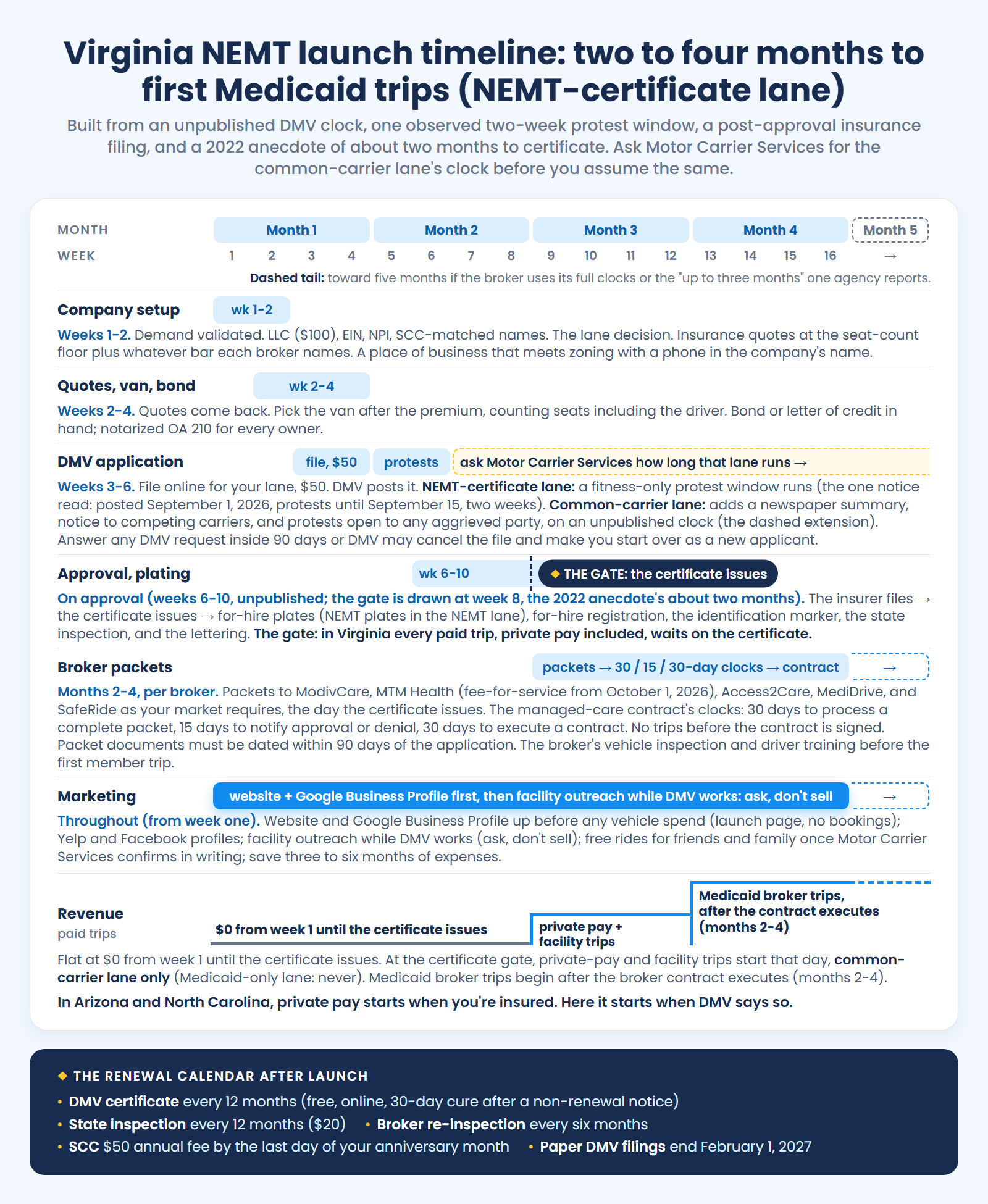
Plan on two to four months from first paperwork to first Medicaid trips in the NEMT-certificate lane, built from one observed two-week protest window, a post-approval insurance filing, and a 2022 anecdote of about two months to certificate [24][22], plus the managed-care contract’s 30-day packet, 15-day decision, and 30-day contract clocks [16]. The common-carrier lane’s newspaper and competitor-notice steps run on a clock DMV doesn’t publish, so ask Motor Carrier Services for that lane’s before you assume the same [24]. A broker that uses its full clocks, or the “up to three months” one agency reports [27], pushes the tail toward five.
Renewals after that: the DMV certificate every 12 months, free and online with a 30-day cure [21][70]; state inspection every 12 months [28]; broker re-inspection every six months [17]; the SCC’s $50 by the last day of your anniversary month [14]; and paper DMV filings end February 1, 2027 [22].
- Weeks 1-2. Demand validated. LLC ($100), EIN, NPI, SCC-matched names, the lane decision, insurance quotes at the seat-count floor plus whatever bar each broker names, and a place of business that meets zoning with a phone in the company’s name [14][18][20].
- Weeks 2-4. Quotes come back; pick the van after the premium, counting seats including the driver. Bond or letter of credit in hand, notarized OA 210 for every owner [23][66].
- Weeks 3-6. File online for your lane, $50 [22]. DMV posts it; the NEMT certificate gets a fitness-only protest window, the common-carrier lane the newspaper and competitor-notice span on its unpublished clock [24]. Answer any DMV request inside 90 days or DMV may cancel the file and make you start over as a new applicant [1].
- On approval (weeks 6-10, unpublished). The insurer files, the certificate issues, then for-hire plates (NEMT plates in the NEMT lane), for-hire registration, the marker, the state inspection, and the lettering [22][26][69][28][17].
- Months 2-4, per broker. Packets to ModivCare, MTM Health (fee-for-service from October 1, 2026), Access2Care, MediDrive, and SafeRide as your market requires, the day the certificate issues, then the contract’s 30/15/30 clocks and the broker’s inspection and training before the first member trip [4][16][17].
- Throughout. Everything in Phase 5, while both queues run. In Arizona and North Carolina, private pay starts when you’re insured; here it starts when DMV says so [12][5].
Virginia NEMT FAQ
Does Virginia require a NEMT license?
Yes, in effect. Virginia issues a DMV certificate of fitness for nonemergency medical transportation carriers [54][3]. The package is Form OA 151, $50 plus $3 per vehicle, a $25,000 bond or letter of credit held three years, NEMT plates, and a notarized criminal-history release on every owner [23][66]. By statute and by the form’s own oath, it covers Medicaid trips only [2][1]. Private-pay and facility work needs Common Carrier - Irregular Routes authority, which covers Medicaid trips as well [5].
Who is the NEMT broker in Virginia?
Never DMAS. Fee-for-service trips go to ModivCare through September 30, 2026 and to MTM Health from October 1, 2026, per DMAS [88][89]. ModivCare brokers Humana and Sentara, and Access2Care, which is moving to the MTM Health name, brokers Anthem HealthKeepers Plus [4][88][91]. Per the plans’ own notices, SafeRide Health has handled UnitedHealthcare since March 1, 2026 and MediDrive has handled Aetna since April 1, 2026 [49][44]. Verify your row with the plan the week you build on it.
Do I enroll with DMAS to become a Virginia Medicaid NEMT provider?
No. DMAS says so in writing: “you do not enroll with DMAS directly” for fee-for-service or MCO NEMT [4]. The brokers enroll providers, train drivers, inspect vehicles, negotiate rates, assign trips, and pay [4]. The only DMAS-direct enrollment is for OEMS-licensed ambulance operators [34].
How much does Virginia Medicaid pay for NEMT trips?
Virginia publishes no rate for broker-assigned trips. The broker negotiates provider rates [4], and the only state table is the 2012 ambulance crossover table [52]. Every per-trip Virginia Medicaid NEMT rate table I found online is a guess. Price private pay off your own costs and negotiate each broker separately.
Can I do private-pay or facility rides with Virginia’s NEMT carrier certificate?
No. The OA 151 oath says you “will not provide any other type of for-hire passenger transportation,” and the statute defines the carrier as Medicaid-only [1][2]. DMV routes all-types NEMT to Common Carrier - Irregular Routes [5], and DMAS’s enrollment notice points providers to the same irregular-route for-hire rules [4]. A company that will carry anyone besides Medicaid members applies for that lane instead, which covers Medicaid trips too [5], and even private pay waits on that certificate, because transporting for compensation without authority is unlawful [12].
Can a Virginia NEMT company run both Medicaid and private-pay trips?
Yes, under one certificate. Common Carrier - Irregular Routes covers Medicaid broker trips along with private-pay, facility, VA, hospice, and insurer-paid rides: DMV’s decision tool routes all-types NEMT there, Medicaid included [5], and DMAS tells providers to look up the irregular-route for-hire rules [4]. The NEMT certificate is the lane that can’t, because its oath bars any other for-hire transport [1]. Nothing I read bars one owner from running a separate company in each lane, each with its own bond, insurance, vans, and owner checks [23][20][15], but I found no Virginia operator built that way and there’s no reason to be. On DMV’s applicant board for the two weeks ending September 4, 2026, eight of the sixteen common-carrier applicants were medical-transport companies, against three in the NEMT-only lane [25].
What insurance does a NEMT business need in Virginia?
The floor is $350,000 for a vehicle designed for one to six people including the driver, $1.5 million for seven to 15, and $5 million for 16 or more, on design capacity [20][15]. It’s filed after DMV approval and before the certificate issues [22]. Brokers may require more and publish no Virginia figure [4]. A seven-seat minivan is a $1.5 million vehicle.
Do NEMT drivers need a CDL in Virginia?
Not below 16 seats including the driver or 26,001 pounds [29]. The DMAS driver floor is 18 with two years licensed, driving-record limits, a barrier-crime check, and the broker’s training program before the first trip [17]. The 25-and-up rule you’ll read about is labeled an insurance requirement on one operator’s job posting, and the seven-year clean record comes from the same posting, not from DMAS [11].
Can a NEMT company run stretcher van trips in Virginia?
Medicaid’s broker runs a stretcher-van mode with a driver and a trained assistant, and its rules never mention an ambulance license [17]. Virginia’s EMS code has no stretcher-van category, and its only carve-out for a private transport business is wheelchair interfacility transport [76][55]. The two documents don’t reconcile. Get OEMS’s position in writing before the first stretcher trip [77].
How much does it cost to start a NEMT business in Virginia?
Plan on $25,000 to $50,000, derived from the line items in this guide. DMV’s fees are $53 [19], the $25,000 bond costs about $250 a year to post [23][68], and insurance is the biggest recurring line, roughly $7,000 to $12,000 a year for a wheelchair van in agency and operator reporting [73][11]. Save three to six months of expenses on top.
How long does it take to start a NEMT business in Virginia?
Two to four months to first broker trips, by my math rather than any published figure. DMV publishes no processing time; the one notice I read ran a two-week protest window, and the insurer files after approval [24][22]. That clock is the NEMT-certificate lane’s; the common-carrier lane adds a newspaper summary, notice to competing carriers, and protests open to any aggrieved party, on a clock DMV doesn’t publish, so ask Motor Carrier Services for its current queue before you count on it [24]. Every paid trip waits on the certificate [12], and private pay starts the day it issues if you hold the common-carrier lane [5]. Broker packets then run on the contract’s 30-day clocks [16].
Is the Virginia market worth entering in 2026?
Yes, with the DMV lane and the payer mix chosen on day one. About 1.74 million Virginians are on Medicaid and FAMIS and the total is shrinking [6], while 289 nursing facilities and a 65-plus share headed to 20.2 percent by 2030 keep facility and private-pay demand growing [8][9]. Four broker doors spread the Medicaid risk better than a single-broker state [4], and no Northern Virginia operator I found publishes a price. The crowded part is the established broker network, 530-plus providers in ModivCare’s 2025 count [53], so the opening is service quality and private pay, not broker volume.
Key official sources
[1] Virginia DMV, Form OA 151, NEMT operating authority application (rev. 03-25-2022): the certifications under penalty of perjury, the owner roster, the $50 fee, the 90-day cancellation note, the Motor Carrier Services line. https://www.dmv.virginia.gov/sites/default/files/forms/oa151.pdf
[2] Code of Virginia § 46.2-2000 (amended through 2017): the NEMT carrier, common-carrier, and certificate-of-fitness definitions; “common carrier” excludes NEMT carriers. https://law.lis.virginia.gov/vacode/title46.2/chapter20/section46.2-2000/
[3] Virginia DMV, Non-Emergency Medical Transportation Carrier page (checked September 2026): Medicaid-only scope, fees, bond, insurance tiers, forms, plates. https://www.dmv.virginia.gov/businesses/motor-carriers/intrastate/medical
[4] DMAS, NEMT Provider Enrollment notice (updated July 1, 2025): no DMAS enrollment, the broker’s role, the broker table with enrollment lines, DMV first, the irregular-route for-hire pointer, brokers may require more insurance. https://www.dmas.virginia.gov/media/3scoqpd4/dmas-nemt-ffs-and-provider-enrollment_07012025a.pdf
[5] Virginia DMV, Providing Directly OA Navigator: all-types NEMT to Common Carrier - Irregular Routes, Medicaid-only NEMT to the NEMT certificate. https://www.dmv.virginia.gov/providing-directly-oa-navigator
[6] DMAS, Enrollment Report, August 2026 (Enrollment Report page for totals, limited-benefit columns, and long-term-care rows; MCO Report page for managed-care and FAMIS-in-plan counts). https://www.dmas.virginia.gov/media/0vypjhq4/dmas-enrollment-report-2026-08.pdf
[7] CMS Provider Data Catalog, dialysis facility dataset (queried September 2026): 206 Virginia facilities, chain and county counts. https://data.cms.gov/provider-data/dataset/23ew-n7w9
[8] CMS Provider Data Catalog, nursing home dataset (queried September 2026): 289 Virginia facilities and regional counts. https://data.cms.gov/provider-data/dataset/4pq5-n9py
[9] Weldon Cooper Center, Virginia population projections by age and sex (July 2025) and the 2020 Census age file: the 65-plus figures computed for this guide. https://www.coopercenter.org/virginia-population-projections
[10] Sheltering Arms, transportation resources directory (checked September 2026): Richmond operator rates. Operator-published. https://www.shelteringarms.com/transportation-resources/
[11] On Time NEMT (Virginia Beach), pricing, cost explainer, and careers pages (checked September 2026): published rates, its reported premium, its driver age rule. Operator-published. https://ontimenemt.com/pricing/
[12] Code of Virginia § 46.2-2001.1 (2017): transport for compensation without authority is unlawful; the 12-month bar. https://law.lis.virginia.gov/vacode/title46.2/chapter20/section46.2-2001.1/
[13] Virginia DMV, Common Carrier - Irregular Routes OA Navigator: tariff, 30-day rate notice, 15-person cap, Norfolk rule, insurance, bond, fee, Form OA 141. https://www.dmv.virginia.gov/common-carrier-irregular-routes-oa-navigator
[14] Code of Virginia §§ 13.1-1005, 13.1-1062, 13.1-1064, 13.1-1015, and the SCC LLC forms page: $100 to file, $50 annual fee, $25 penalty, registered agent rules. https://www.scc.virginia.gov/businesses/forms-and-fees/virginia-limited-liability-companies/
[15] Virginia DMV, OA 460, Information for Intrastate Motor Carriers (rev. 04/01/2026): SCC registration first, tiers with the driver included, leased vehicles, leasing authority, exempt carriers’ plates. https://www.dmv.virginia.gov/sites/default/files/documents/oa460.pdf
[16] DMAS, Cardinal Care Managed Care contract, SFY2026 (July 1, 2025): NEMT coverage except FAMIS children, the DD-waiver carve-out, broker clocks, the 90-day document rule, the NPI rule, training, on-board time ceiling, monthly performance reviews, performance standards. https://www.dmas.virginia.gov/media/jtujhlgt/sfy-2026-ccmc-contract-07-01-2025.pdf
[17] DMAS, FFS NEMT Driver, Attendant, and Vehicle Requirements (updated May 26, 2026): driver floor, conduct, lettering and naming, the vehicle equipment checklist, broker inspections and stickers, insurance by vehicle class, stretcher vans, the OEMS exception report and annual stretcher-van plan, FMCSA authority for out-of-state trips. https://www.dmas.virginia.gov/media/1sdhbgj4/dmas-nemt-driver-attendant-and-vehicle-requirements-05-26-2026.pdf
[18] Code of Virginia § 46.2-2011.11 (2017): the established place of business and 30-day change reporting. https://law.lis.virginia.gov/vacode/title46.2/chapter20/section46.2-2011.11/
[19] Code of Virginia §§ 46.2-2011.5 and 46.2-2011.6: the $50 filing fee and $3 annual per-vehicle fee. https://law.lis.virginia.gov/vacode/title46.2/chapter20/section46.2-2011.5/
[20] Code of Virginia § 46.2-2053 (2006): liability minimums by designed capacity including the driver, and no certificate, marker, or plate before coverage is certified. https://law.lis.virginia.gov/vacode/title46.2/chapter20/section46.2-2053/
[21] Code of Virginia §§ 46.2-2011.3, 46.2-2011.24, 46.2-2011.27, and 46.2-2054: twelve-month certificates with a 30-day cure, revocation grounds, suspension without a hearing for insurance not on file, reinstatement fees. https://law.lis.virginia.gov/vacode/title46.2/chapter20/section46.2-2011.24/
[22] Virginia DMV, How to Apply for For-Hire Intrastate Operating Authority: $50 per authority type, insurance after approval, online since January 1, 2026, paper ends February 1, 2027. https://www.dmv.virginia.gov/businesses/motor-carriers/intrastate/how-apply
[23] Code of Virginia § 46.2-2011.9 (2013): the $25,000 bond or letter of credit for three years. https://law.lis.virginia.gov/vacode/title46.2/chapter20/section46.2-2011.9/
[24] Code of Virginia §§ 46.2-2075, 46.2-2001.3, and 46.2-2005: the certificate of public convenience and necessity required of every non-exempt common carrier, website posting for every original application, newspaper and competitor notice only for CPCN applicants, fitness-only protests for certificates of fitness versus any-aggrieved-party protests for a CPCN, DMV’s discretion, the 30-day hearing request. https://law.lis.virginia.gov/vacode/title46.2/chapter20/section46.2-2075/ and https://law.lis.virginia.gov/vacode/title46.2/chapter20/section46.2-2001.3/
[25] Virginia DMV, Licensed Transportation Services applicant notices (checked September 2026): posted applications by authority code and protest deadlines. https://www.dmv.virginia.gov/businesses/motor-carriers/auth-mc
[26] Virginia DMV, Nonemergency Medical Transport For Hire plate page, and Code of Virginia § 46.2-2001.2: $0 plate, DMAS authorization as the condition, the identification marker. https://www.dmv.virginia.gov/vehicles/license-plates/search/nonemergency-medical-transport-hire
[27] Springer Insurance Agency (Midlothian), Starting an NEMT Business (checked September 2026): W-2 drivers, DMV authority before a policy, contracts up to three months. Agency-reported. https://www.nemtvirginia.com/Starting-An-NEMT-Business/
[28] Code of Virginia §§ 46.2-1158, 46.2-1163, and 46.2-1167: the 12-month inspection, State Police-supervised stations, the $20 fee. https://law.lis.virginia.gov/vacode/title46.2/chapter10/section46.2-1167/
[29] Code of Virginia § 46.2-341.4 (amended 2026): the CDL threshold. https://law.lis.virginia.gov/vacode/title46.2/chapter3/section46.2-341.4/
[30] Code of Virginia §§ 40.1-28.7:7 (amended 2026) and 58.1-1901: the employee presumption, the private right of action, the per-worker tax penalties. https://law.lis.virginia.gov/vacode/title40.1/chapter3/section40.1-28.7:7/
[31] Virginia Workers’ Compensation Commission, employer information page, and Code of Virginia § 65.2-805: coverage at more than two employees, who counts, the penalty. https://workcomp.virginia.gov/workers-compensation-insurance-information-employers
[32] DMAS, Medicaid Bulletin on the July 1, 2025 Cardinal Care contract (May 29, 2025): the five MCOs and Molina’s exit. https://vamedicaid.dmas.virginia.gov/bulletin/july-1-2025-implementation-new-cardinal-care-managed-care-contract
[33] DMAS, Director Steve Ford’s briefing deck (March 5, 2026): enrollment context and the federal work-requirement rules expected in 2026. https://www.dmas.virginia.gov/media/hixaztkx/presentation.pdf
[34] DMAS, Transportation Provider Manual, Chapters II (rev. 7/17/2025), IV (rev. 8/28/2024), and V (rev. 12/5/2025): no direct enrollment, the second ModivCare enrollment line, broker-assigned trips, the broker-contracted vehicle types, FAMIS children excluded, ambulance rules. https://vamedicaid.dmas.virginia.gov/sites/default/files/2024-08/Transportation%20Chap.%20IV%20(updated%208.28.24)_Final.pdf and https://vamedicaid.dmas.virginia.gov/sites/default/files/2025-07/Transportation%20-%20Chapter%202%20(updated%207.17.25)_Final.pdf
[35] DMAS, toll-free numbers for all NEMT services (updated October 17, 2025): reservation lines by payer. https://www.dmas.virginia.gov/media/k3gh142n/transporatation-contacts-for-reservation-and-ride-assist-english.pdf
[36] 7 CTs Transportation (Virginia Beach), rates page (checked September 2026). Operator-published. https://7ctstransportationllc.com/
[37] Census Reporter, ACS 2024 profiles for Loudoun and Fairfax Counties: median household income. https://censusreporter.org/profiles/05000US51107-loudoun-county-va/
[38] WHRO, the VA announces a new clinic in Virginia Beach (December 19, 2025). https://www.whro.org/military-veterans/2025-12-19/the-va-announces-new-clinic-in-virginia-beach-to-handle-hampton-roads-growing-veteran-population
[39] U.S. Department of Veterans Affairs, Hampton DAV vans page: ambulatory veterans only. https://www.va.gov/hampton-health-care/dav-vans-transportation-for-veterans/
[40] Duet NEMT Growth Podcast, Episode 20 with Marqus Johnson (July 10, 2026). https://www.youtube.com/watch?v=NYfnXLKhDTk
[41] DMAS, Notice of Award, RFP 2018-01 (January 16, 2018), https://www.dmas.virginia.gov/media/1554/ffs-nemt-rfp-2018-01-notice-to-award.pdf, and DMAS RFP 32141, NEMT Brokerage Services, on a public bid tracker (due January 27, 2025; DMAS’s September 15, 2026 bulletin announced MTM’s selection through a competitive procurement without naming the RFP [88]). Secondary listing. https://www.virginiabids.com/government-agencies/richmond-city/virginia-dept.-of-medical-assistance-services-207023/13820688-rfp-32141-non-emergency-medical-transport-nemt-brokerage-services.html
[42] DMAS, fee-for-service NEMT member handbook (June 2026): ModivCare named, Van-Stretcher versus non-emergency ambulance, reservation rules. https://www.dmas.virginia.gov/media/taggftgr/member-handbook-non-emergency-medicaid-transportation-nemt.pdf
[43] Children’s Hospital of The King’s Daughters, VA Medicaid FFS and Managed Care Plans Transportation Guide (effective August 4, 2025): routine-notice rules and non-medical ride caps by plan. Secondary. https://www.chkd.org/media/pf3l51id/ccc_va-medicaid-ffs-managed-care-plan-transportation-guide.pdf
[44] Aetna Better Health of Virginia, MediDrive transition FAQ (VA-26-02-04): MediDrive replaced ModivCare on April 1, 2026; unlimited medical rides, the 15-round-trip non-medical cap and 30-mile limit. https://www.aetnabetterhealth.com/content/dam/aetna/medicaid/virginia/pdf/abhva_MediDrive_Transportation_Vendor_Transition_faq.pdf
[45] MediDrive, Virginia facility and provider pages (checked September 2026): the Aetna broker role, member line, provider relations 703-714-6940, the provider checklist; ModivCare’s own brands page lists no MediDrive. https://medidrive.com/facilities/va/providers
[46] Humana Healthy Horizons in Virginia, transportation page (updated April 23, 2026): ModivCare at 877-718-4215, 30 non-medical round trips a year. https://www.humana.com/medicaid/virginia/coverage/transportation
[47] Sentara Health Plans, provider transportation flyer: ModivCare at (877) 892-3986, five business days’ notice. https://shc-p-001.sitecorecontenthub.cloud/api/public/content/934101bea322489eb74cdb2c7b5bd286?v=5a320149
[48] DMAS, Cardinal Care Managed Care provider educational session deck (revised June 16, 2025): the July 1, 2025 implementation and the MCO provider-relations contacts, including UnitedHealthcare at 844-284-0146 and Anthem’s LTSS provider-enrollment mailbox. https://www.dmas.virginia.gov/media/jeuhc405/ccmc-merged-provider-educational-session-accessible_revised-6162025.pdf
[49] UnitedHealthcare Community Plan of Virginia, broker change notification (December 24, 2025): SafeRide Health from March 1, 2026. https://www.uhcprovider.com/content/dam/provider/docs/public/commplan/va/bulletins-and-newsletters/VA-Medicaid-Transportation-Broker-Change-Notification.pdf
[50] DMAS, CCC Plus transportation contacts (August 3, 2023; historical), with ModivCare’s Virginia page (checked September 2026): the Molina-era MTM listing, Verida, and retired plan names. https://www.dmas.virginia.gov/media/6101/ccc-plus-transportation-contacts-8-3-2023.pdf and https://www.modivcare.com/facilities/va/
[51] JLARC, Performance and Pricing of Medicaid Non-Emergency Transportation, Report 477 (December 2015): the capitated payment to the broker. https://jlarc.virginia.gov/pdfs/reports/Rpt477.pdf
[52] DMAS, ambulance rate table for crossover calculations (dates of service on or after July 1, 2012), and the Ambulance Services page: A0428 at $84.14, crossover only. https://dmas.virginia.gov/media/1561/rates-for-ffs-ambulance-medicare-medicaid-crossover-claims-for-dos-on-or-after-07-01-12.pdf
[53] ModivCare, KDK Transport Company named Virginia Transportation Provider of the Year (April 24, 2025): network size and KDK’s growth. https://www.modivcare.com/news-releases/kdk-transport-company-named-modivcares-virginia-transportation-provider-of-the-year/
[54] Code of Virginia § 46.2-2099.44 (2011): the certificate of fitness required for NEMT carriers. https://law.lis.virginia.gov/vacode/title46.2/chapter20/section46.2-2099.44/
[55] 12VAC5-31, Virginia EMS Regulations, sections 210, 290, 410, 590, 810, 1230, and 1240: penalties, exclusions, license classes, medical director, KKK-A-1822 ambulances, crews. https://law.lis.virginia.gov/admincode/title12/agency5/chapter31/section410/
[56] Virginia State Police Motor Carrier Safety Regulations, 19VAC30-20-10, -80, and -120: the intrastate CMV definition, federal rules as of October 1, 2025, the 18-year-old allowance. https://law.lis.virginia.gov/admincode/title19/agency30/chapter20/section10/
[57] Virginia DMV, USDOT number page (checked September 2026): the federal triggers only. https://www.dmv.virginia.gov/businesses/motor-carriers/usdot
[58] Code of Virginia § 46.2-2000.1 (2015) and the DMV Exempt Operations page: the nine excluded categories, mixed operations need authority. https://law.lis.virginia.gov/vacode/title46.2/chapter20/section46.2-2000.1/
[59] Code of Virginia §§ 58.1-3706 and 58.1-3703 (2021): the 36-cent BPOL cap, the gross-receipts floors, and the $100 flat license-fee cap. https://law.lis.virginia.gov/vacode/title58.1/chapter37/section58.1-3706/
[60] City of Virginia Beach Commissioner of the Revenue, business license application guide (rev. 12/29/2022): interview, zoning, fee tiers, the March 1 renewal date. https://s3.us-east-1.amazonaws.com/virginia-beach-departments-docs/cor/Businesses/License/How-to-Start-a-Business-English.pdf
[61] Virginia Beach Police Department, Form PD412 (rev. 10/2024) and the department’s permits page ($50 fee): the taxicab certificate application, insurance at application, the not-valid-until-business-license rule. https://s3.us-east-1.amazonaws.com/virginia-beach-departments-docs/police/Services/Permits-Record-Checks-and-Fingerprinting/Taxi-Certificate-of-Public-Convenience-Application-PD412.pdf and https://police.virginiabeach.gov/services/permits-record-checks-fingerprinting
[62] Code of Virginia §§ 46.2-2059 through 46.2-2067: the DMV taxicab permit outside cities and towns, locality powers over taxicabs. https://law.lis.virginia.gov/vacodefull/title46.2/chapter20/article3/
[63] Arlington County Code, Chapter 25.1, Taxicabs (updated December 2025): the definition excluding Chapter 20 common carriers, the even-year window. https://www.arlingtonva.us/files/ebdbfdf4-1706-4638-af5e-2bfe9c175e21/Ch.-25.1-Taxicabs.pdf
[64] Newport News Police Department, Taxi and Towing Unit page (checked September 2026), and the City Council agenda item with the proposed ordinance amending Chapter 41 (April 12, 2022 meeting; effective May 1, 2022 as proposed): the taxicab definition excluding common carriers and NEMT carriers, and the permit fees. Confirm adoption against the current city code. https://www.nnva.gov/2399/Taxi-and-Towing-Unit and https://nngov.civicweb.net/document/32009/
[65] Virginia DMV, Passenger Carrier Study (December 1, 2017): the 2011 origin of the NEMT authority and the bond-claim finding. https://www.dmv.virginia.gov/sites/default/files/documents/passenger-carrier.pdf
[66] Virginia DMV, Form OA 210, Criminal History Records Request (rev. 11/10/2024): the notarized release for each business official. https://www.dmv.virginia.gov/sites/default/files/forms/oa210.pdf
[67] Virginia DMV, Contract Passenger Carrier page: Form OA 150, the one-hour minimum, the same tiers and bond. https://www.dmv.virginia.gov/businesses/motor-carriers/intrastate/contract-passenger
[68] Surety Bonds Direct, Virginia passenger carrier and broker bond (vendor quote, checked September 2026): $250 one year, $625 three. https://www.suretybondsdirect.com/surety-bond/passenger-carrier-and-broker-bond/va
[69] Virginia DMV, DMV 201 fee chart (rev. 08/10/2026): for-hire registration fees and the Highway Use Fee footnote. https://www.dmv.virginia.gov/sites/default/files/dmv201.pdf
[70] Virginia DMV, operating authority renewal page: no renewal fee, the $3 per-vehicle fee, reapplying after a missed renewal, the 2027 online mandate. https://www.dmv.virginia.gov/businesses/motor-carriers/intrastate/renewal
[71] Code of Virginia §§ 46.2-2011.22, 46.2-2011.23, and 46.2-2011.21: criminal fines, civil penalties, marker misdemeanors. https://law.lis.virginia.gov/vacode/title46.2/chapter20/section46.2-2011.22/
[72] ModivCare, transportation providers page (checked September 2026): credentials and coverage types, no dollar minimums. https://www.modivcare.com/transportation-providers-contact-us/
[73] Elite Med Financials, NEMT Insurance Guide 2026 and cost article (March 2026): the Virginia band, national bands, fleet discounts, the broker coverage stack. Agency-reported. https://elitemedfinancials.com/nemt-insurance-guide/
[74] Code of Virginia § 46.2-472 (2022-2024 and January 1, 2025 figures) and 12VAC5-31-490: the personal-auto minimums the EMS regulations reference; cited only to trace the 25/50/25 folklore. https://law.lis.virginia.gov/vacode/title46.2/chapter6/section46.2-472/
[75] 12VAC30-50-530, Methods of providing transportation (last amended December 10, 2008): stretcher vans and wheelchair vans among the covered modes, DMAS may contract through brokers. https://law.lis.virginia.gov/admincode/title12/agency30/chapter50/section530/
[76] Code of Virginia §§ 32.1-111.1, 32.1-111.2, 32.1-111.6, 32.1-27, and 18.2-11: EMS definitions, the 2005 wheelchair-interfacility exemption, the license and permit requirement, the ambulance marking rule, the Class 1 misdemeanor and its 12-month/$2,500 ceiling. https://law.lis.virginia.gov/vacode/title32.1/chapter4/section32.1-111.2/
[77] Virginia OEMS, Application Process to Become a Licensed EMS Agency (2024), and the Regulation and Compliance page (804-888-9100): the 16-step application, no license fee stated. https://www.vdh.virginia.gov/content/uploads/sites/23/2024/02/2024-Becoming-EMS-Agency-in-Virginia.pdf and https://www.vdh.virginia.gov/emergency-medical-services/regulations-compliance/
[78] CMS, Medicare Benefit Policy Manual, Chapter 9, § 40.1.9 (rev. March 2026): post-election transports are the hospice’s responsibility. https://www.cms.gov/Regulations-and-Guidance/Guidance/Manuals/Downloads/bp102c09.pdf
[79] U.S. Department of Veterans Affairs, travel pay page, with 38 CFR 70.2: special-mode transport and its conditions. https://www.va.gov/health-care/get-reimbursed-for-travel-pay/
[80] Network Contracting Office 6, Hampton VAMC wheelchair transportation service agreement 36C24626Q0110 (posted October 22, 2025), bid-tracker copy: the $19 million ceiling, trip volume, the 20-vehicle ideal fleet and 47 daily runs, NAICS 485991. Secondary; confirm on SAM.gov. https://console.sweetspotgov.com/federal-contracts/685ae87c-d8b2-5b23-a50e-78ac849a8827
[81] Coventry (Enlyte) provider resources, One Call’s become-a-provider page, and the Sedgwick vendor network page (checked September 2026). https://www.enlyte.com/tools/resources-provider , https://onecallcm.com/who-we-serve/become-a-provider/ , and https://www.sedgwick.com/vendor-network/
[82] Humana Gold Plus H6622-004 (HMO), 2026 Summary of Benefits: routine transportation not covered, the ESRD carve-out. https://content.medicareadvantage.com/2026/Humana-H6622004000SB26pdf-2026-SF20251001.pdf
[83] The Mobility Resource and MobilityWorks, Virginia wheelchair van listings (scanned September 2026). https://www.themobilityresource.com/wheelchair-vans/state/virginia
[84] Virginia Small Business Financing Authority, loan programs page (checked September 2026): the microloan and its conditions. https://www.sbsd.virginia.gov/loan-programs/
[85] Virginia SBDC funding resources, with NerdWallet’s SBA microloan summary (May 2026): the cap, the FY2026 average, Virginia intermediaries. https://www.virginiasbdc.org/funding-resources/
[86] LISC Virginia, Kiva loan fund one-pager (undated, COVID-era): 0 percent loans to $15,000 and the 1:1 match. https://www.lisc.org/media/filer_public/56/9f/569f9eed-a7bd-4284-a6b5-987e619698b7/kiva_loan_fund_one_pager.pdf
[87] City of Newport News, Micro Loan Program page. https://www.nnva.gov/636/Newport-News-Micro-Loan-Program
[88] DMAS, bulletin “Changes to Cardinal Care Fee-For-Service Transportation Services” (September 15, 2026): MTM selected through a competitive procurement for fee-for-service members, reservation and Where’s My Ride lines unchanged, MTM reviewing DD-waiver standing orders that facilities keep scheduling, managed-care brokers unchanged (Humana and Sentara ModivCare, Anthem MTM, Aetna MediDrive, UnitedHealthcare SafeRide). https://vamedicaid.dmas.virginia.gov/bulletin/changes-cardinal-care-fee-service-transportation-services
[89] DMAS fee-for-service NEMT ride site, home page and Healthcare Facilities FAQ (checked September 28, 2026): for trips scheduled October 1, 2026 and afterward, the site links to MTM’s Virginia page. https://transportation.dmas.virginia.gov/
[90] MTM Health, Virginia Medicaid fee-for-service NEMT pages and Transportation Provider Handbook (approved August 10, 2026; checked September 28, 2026): member line 866-386-8331, provider line 866-810-8302, MTM service agreement and credentialing, DMAS and MTM training before the first trip. https://www.mtm-inc.net/virginia/ and https://www.mtm-inc.net/virginia/transportation-providers/ and https://www.mtm-inc.net/wp-content/uploads/2018/12/VA-Provider-Handbook-2026.pdf
[91] MTM Health, Access2Care brand transition page (checked September 28, 2026): Access2Care is moving to the MTM Health name and brand. https://www.mtm-inc.net/mtm-link-a2c-intro/
Last verified against the sources above in September 2026. Virginia requirements, broker arrangements, and Medicaid policy change, DMV publishes no processing time, the state’s EMS and Medicaid documents don’t agree on stretcher vans, and several city codes couldn’t be read, so confirm the primary sources directly before acting. Treat this guide as education, not legal advice.
About the author
James O'Donnell cofounded Duet and leads its sales, partnerships, and growth services. He talks with NEMT operators every week, hosts the NEMT Growth podcast, and answers Duet's sales line himself. More about Duet's founders →
Starting in a nearby state?
Want more trips and less busywork?
See how Duet runs and grows NEMT businesses in a 30-minute demo.