Article
How to Start a NEMT Business in Arizona (2026 AHCCCS Guide)
Arizona froze new NEMT providers for a year and a half, then quietly reopened the doors. Here's how to walk through them.
By James O'Donnell, Cofounder and COO, Duet · · Updated
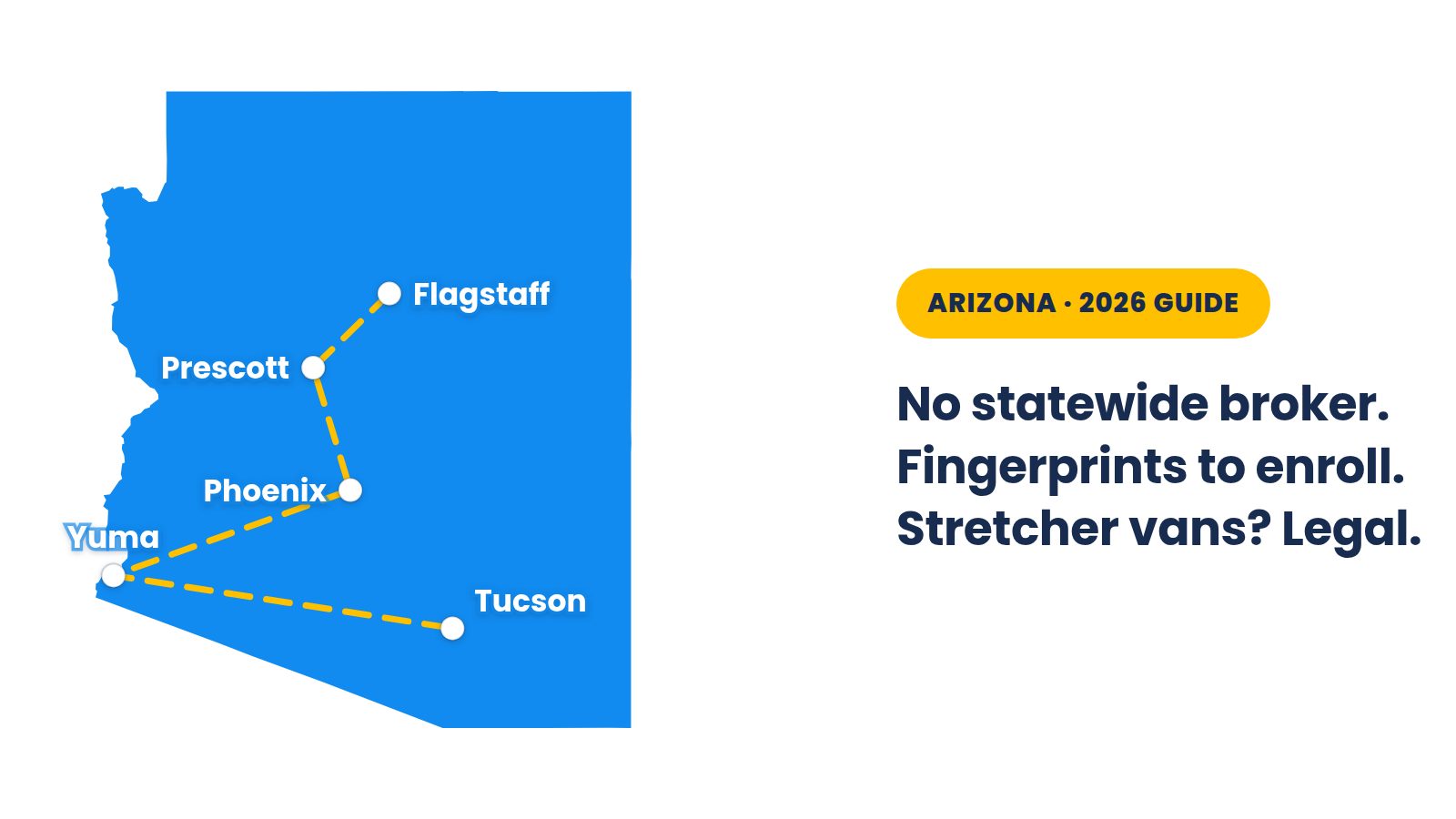
To start a NEMT business in Arizona, form an LLC, get the free ADOT Vehicle for Hire permit, then register with AHCCCS as provider type 28 and pass high-risk screening. There is no state NEMT license and no statewide broker. Plan on $25,000 to $55,000 and three to five months to first AHCCCS trips, with private pay and facility work earlier.
Arizona at a glance:
- State NEMT license: none. The one state permit is ADOT’s Vehicle for Hire permit: mandatory, essentially free, a class 2 misdemeanor to skip.
- Who runs Medicaid rides: no statewide broker. Each AHCCCS plan arranges its own members’ rides, and most route through MTM Health companies.
- How you enroll: through the APEP portal as provider type 28: a $750 fee for 2026, owner fingerprint checks, a site visit, and owner training.
- Insurance the contracts expect: $1 million combined single limit auto with matching general liability, the bar MTM and AHCCCS subcontracts of $50,000 or more write down.
- Cost to launch one van: $25,000 to $55,000, mostly the van and insurance.
- Time to first Medicaid trips: three to five months, screening the longest step. Private pay and facility work start earlier.
For a year and a half, the real answer to “how do I start a NEMT business in Arizona” was: you don’t. AHCCCS, Arizona’s Medicaid agency, froze new transportation provider enrollments on June 9, 2023, in the middle of a fraud crisis measured in billions. Operators could ask for an exemption. AHCCCS said no to most of them: of 294 requests, only 92 were approved, and 198 were denied [1].
The freeze ended December 9, 2024 [2], and a surprising share of the internet hasn’t noticed. At least one 2026 guide still tells Arizona readers the moratorium runs into this year. It doesn’t. The doors are open, and the whole path back in is public paperwork.
If you’re starting a non-emergency medical transportation (NEMT) business in Arizona, the market you’re entering was rebuilt while those doors were shut. Screening got stricter and stayed that way. The broker layer consolidated under one national company. A NEMT broker is the company a state or health plan hires to assign Medicaid rides to transportation providers and pay for them.
And the demand didn’t go anywhere. As of August 2026, 1.77 million people are on AHCCCS [3]. Arizona has 122 Medicare-certified dialysis facilities, 70 of them in Maricopa County alone [4]. More than 19 percent of residents are already 65 or older, headed toward roughly 22 percent by 2035 by the state’s own projections [5].
I run Duet, a dispatch software company, and I talk to NEMT operators every week, Arizona included. This is the Arizona edition of our national guide on how to start a NEMT business. It cites the actual statutes, policies, and agency documents. Where something couldn’t be verified against a primary source, I say so. Requirements change, and Arizona rebuilt most of its NEMT rules after 2023. Confirm against the linked sources before you spend money.
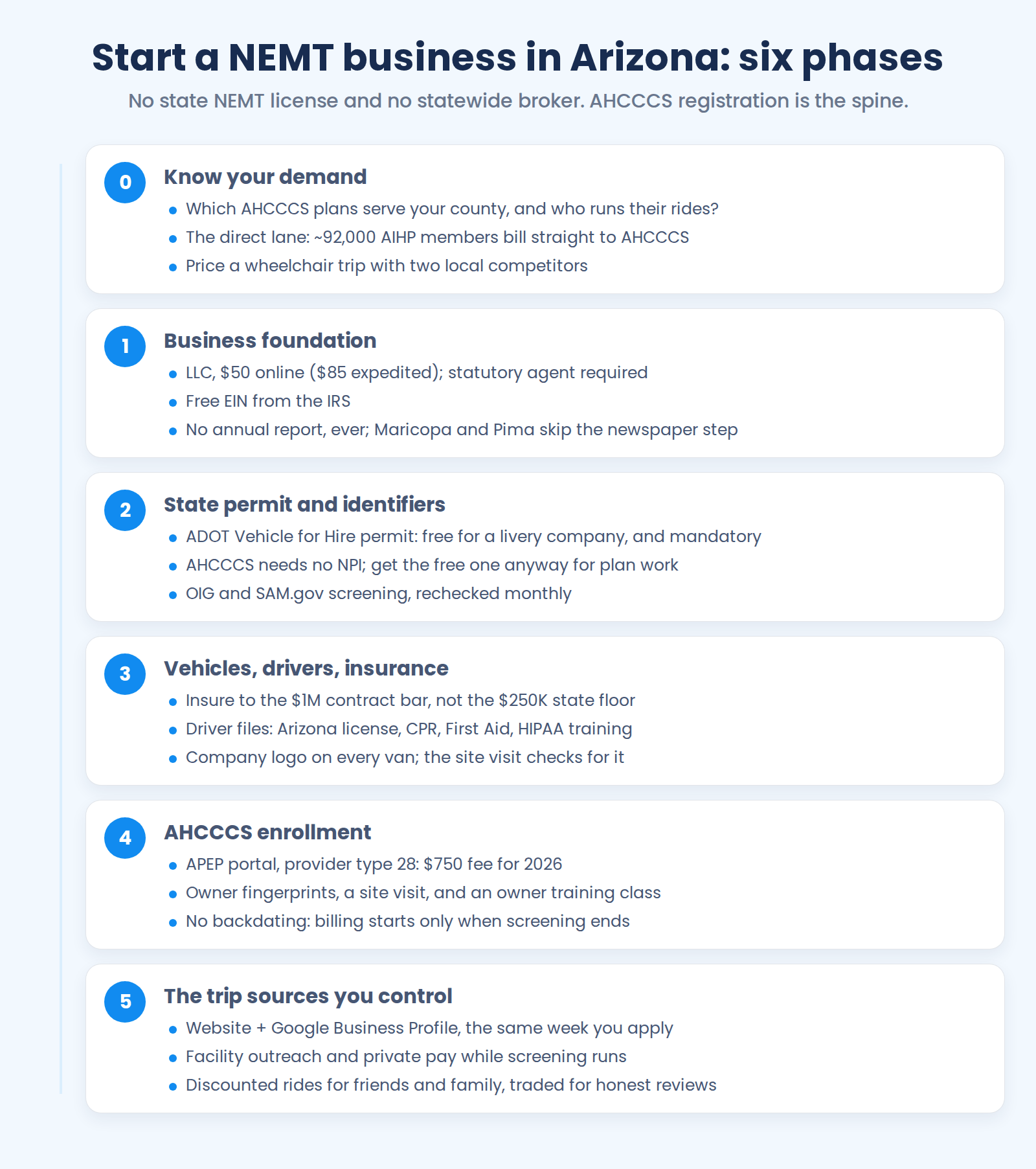
The one-page checklist: steps to start a NEMT business in Arizona
Phase 0: know your demand
- Pick your trip sources: private-pay families, facility contracts, the AHCCCS health plans and their brokers, or direct fee-for-service billing. That last one is where the state pays you directly per trip, with no broker or plan in the middle. Healthy Arizona operators usually run several at once.
- Look up which AHCCCS plans serve your county and who arranges their rides. The plan-by-plan map below is your starting point.
- Call two local companies for wheelchair-trip quotes before you set a rate card. Scottsdale money isn’t Show Low money, and no blog post knows what a Mesa dialysis run bills.
Phase 1: business foundation
- Form your LLC with the Arizona Corporation Commission: $50 to file, $85 expedited. You need a statutory agent, the person or company that receives legal papers for the LLC [6]. There’s no annual report and no annual fee, ever.
- Get a free EIN, your federal tax ID, from the IRS. Never pay a third party for this.
- Arizona makes a new LLC publish notice of the filing in a newspaper three times within 60 days [7]. If your statutory agent’s address is in Maricopa or Pima County, you skip that entirely.
Phase 2: the state permit and federal identifiers
- Apply for the Vehicle for Hire company permit from ADOT, the Arizona Department of Transportation. It’s free for a livery company (the state’s legal category for a hired car with a driver), valid three years, and required for AHCCCS enrollment. Operating without one is a class 2 misdemeanor [8][9].
- AHCCCS doesn’t require an NPI, the ID number the healthcare system uses for your company, for NEMT enrollment. Get the free Type 2 (organization) NPI at NPPES anyway, because plans and brokers will ask for it.
- Check owners and drivers against the OIG exclusion list and SAM.gov, the two federal lists of people banned from Medicaid work. Recheck monthly. AHCCCS runs your application against those same databases [10].
Phase 3: vehicles, drivers, and insurance
- Register vans as commercial vehicles.
- Put your company name or logo on every van. AHCCCS checks for it at your site visit [9].
- Buy insurance to what the contracts demand, not what state law permits. AHCCCS subcontracts and MTM both write down $1 million combined single limit, one policy limit covering injuries and property damage together [11][12].
- Build each driver’s file the way the enrollment packet requires: a valid Arizona driver’s license, CPR, First Aid, and HIPAA training certificates [9].
- Spec the van for the work: lift or ramp, four-point securement, and air conditioning maintained like a safety system. In a Phoenix summer it’s one.
Phase 4: AHCCCS enrollment
- Apply through the APEP portal (the AHCCCS Provider Enrollment Portal) as provider type 28, AHCCCS’s category for NEMT companies. Enrollment means signing up with the state Medicaid program itself [9].
- Budget for the screening: the $750 application fee for 2026, fingerprint background checks for all owners of 5 percent or more, a site visit, and the owner certification training class [9][13].
- Disclose every driver inside APEP (full legal name, date of birth, SSN, employment dates) and report changes within 30 days [9].
- Serving tribal land? Get a business license from each tribe and file it with AHCCCS, or AHCCCS denies your prior authorizations. Prior authorization is approval before the trip, or the claim is denied [32].
- AHCCCS generally won’t backdate your approval. Your effective date lands when screening finishes, and nothing before that date is billable [14].
Phase 5: the trip sources you control
- Screening time is marketing time: have the website and Google Business Profile live before AHCCCS schedules your site visit.
- Start facility outreach and private-pay work immediately. An approved application lets you bill; it doesn’t bring you a single customer.
- Run discounted rides for friends and family while screening drags, then ask each rider, no strings attached, for an honest Google review. Ten of them make strangers trust you.
Who pays for NEMT rides in Arizona?
Four sources pay for NEMT rides in Arizona:
- AHCCCS managed-care plans, mostly through brokers. A managed care plan is a private health plan the state pays to cover Medicaid members.
- Direct AHCCCS fee-for-service billing.
- Facility contracts: hospitals, hospices, and senior communities.
- Private-pay families booking directly.
AHCCCS is the volume. Its members split three ways:
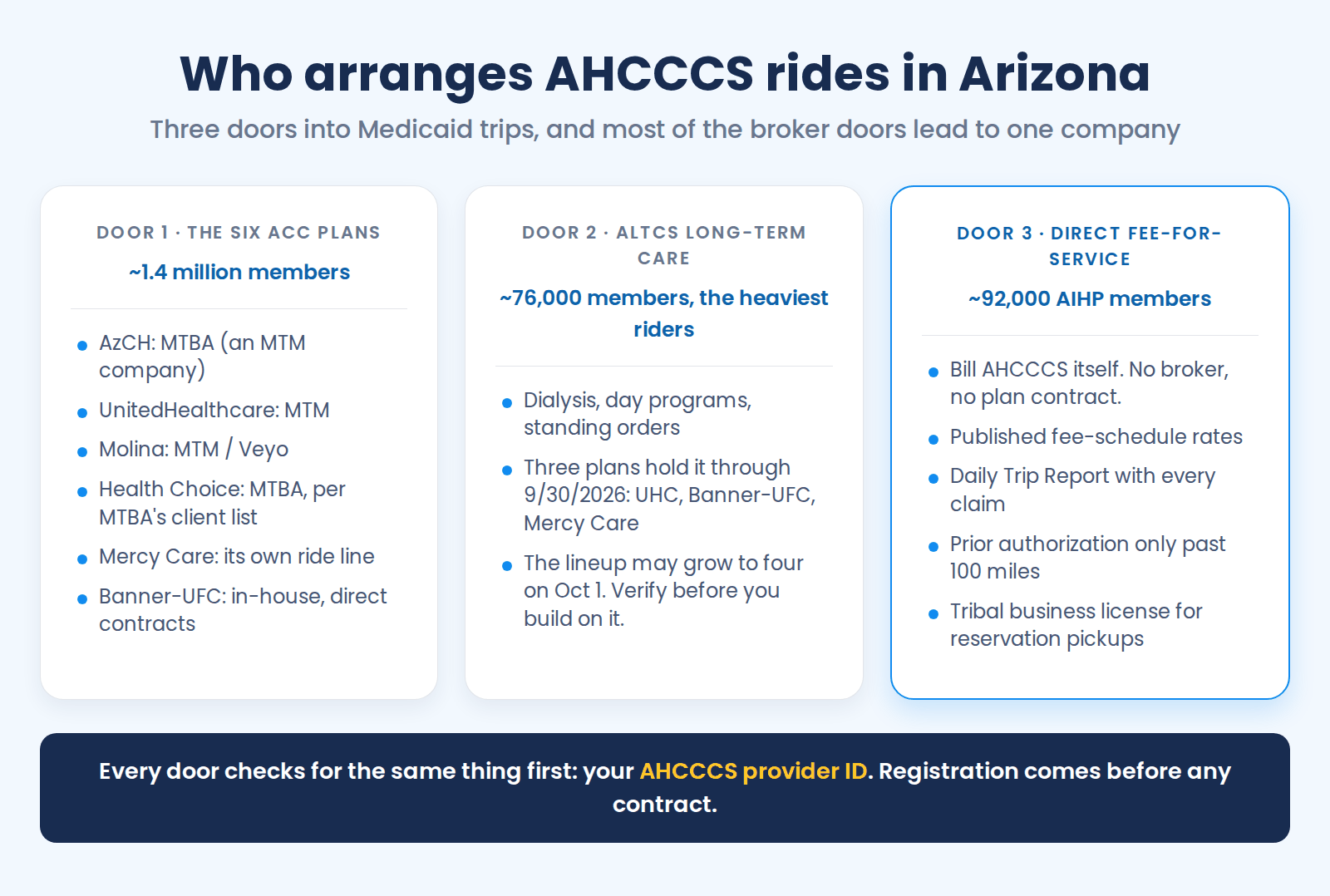
- About 1.4 million sit in the six AHCCCS Complete Care plans, which must arrange medically necessary rides for members with no other way to get to covered care [3][15].
- Another 76,000 are in ALTCS, the Arizona Long Term Care System. They’re the heaviest riders in the program: dialysis schedules, adult day programs, standing orders. ALTCS grew 3 percent last year even while total enrollment fell 9 percent [3].
- About 92,000 are in the American Indian Health Program (AIHP), a fee-for-service population whose rides bill straight to AHCCCS with no broker in the middle [16].
That third lane is the one nearly every Arizona guide misses, and it gets its own section below.
Facilities are the stability. Hospital discharge desks, skilled nursing homes, rehab centers, and hospice agencies paying for transfers out of their own per-diem [17]. Dialysis is different. Its standing schedules are great work, but in my experience most dialysis riders are on AHCCCS, so their trips come through the plans or the fee-for-service lane, not the clinic.
Private pay is the margin. AHCCCS fee-for-service pays $11.15 plus $1.54 a loaded mile (miles with the rider on board) for a wheelchair trip in the metros [18]. Arizona’s private-pay operators don’t publish rate cards, usually a sign the real number sits well above Medicaid. The third-party estimates that do circulate put an equivalent trip at several times the Medicaid number [19]. Quote your own market.
Total AHCCCS enrollment is shrinking, down about 9 percent in the year to August 2026 as pandemic-era coverage unwound [3]. The bigger numbers online are stale: guides still quoting 2.2 or 2.5 million members are describing the 2023 peak. The demand is in the mix: a long-term-care segment that kept growing, nearly one in five Arizonans already past 65, and a provider pool thinned by an 18-month freeze.
Paul owns Gentle Turns Transportation in Phoenix and built it around the senior population. He put the market’s texture well on our podcast: “Phoenix is one huge market, but inside of that are all these different pockets of cities that frankly are a little different to operate services in.”
Who is the NEMT broker in Arizona?
Arizona has no statewide NEMT broker. Each AHCCCS plan arranges transportation for its own members, and the real story of the last four years is consolidation behind those plans. MTM Health bought Veyo in August 2022, then bought MTBA, Arizona’s homegrown broker since 1987, in July 2023 [20]. MTBA alone runs about a million trips a year with a network of 600-plus vehicles [20]. So while no single company holds a statewide contract, most of the broker-run trips in Arizona now answer to one parent company. No van operator got a vote in that.
Which plan uses which broker
Here’s the map as I can verify it in September 2026, from the plans’ and brokers’ own documents. The map is a snapshot, so verify your county’s entry with the plan before you spend money:
- Arizona Complete Health, the only plan in all 15 counties, has used MTBA as its exclusive NEMT vendor since October 1, 2021, when it dropped Veyo [21].
- UnitedHealthcare Community Plan brands its ride line MTM across all four of its Arizona plans, including its ALTCS and DDD (Division of Developmental Disabilities) plans. The ride line is 1-888-889-0358, per its own provider reference guide [22].
- Molina Healthcare (Maricopa, Gila, Pinal) tells members to book through MTM/Veyo at 833-474-5060 [23].
- Blue Cross Blue Shield of Arizona Health Choice appears on MTBA’s published client list [24]. That list is stale enough to still carry the retired Care1st plan, so confirm the current arrangement with the plan.
- Mercy Care books rides through its own member line, 1-800-564-5465, with three days’ notice for routine trips. MTBA’s list names Mercy Care too, but no dated plan document confirms who fulfills the rides today, so ask Mercy Care directly when you contract [24][25].
- Banner-University Family Care is the exception. It arranges rides in-house through its Customer Care Center with 72 hours’ notice, and transportation companies join by direct contract, not through any broker [26].
Modivcare, the biggest broker in the country, holds no Arizona Medicaid plan contracts. Its own Arizona page lists a Medicare Advantage line, a retiree program, and one Medicaid ghost: Evercare Select, a plan that stopped existing years ago [27]. National directories that tell Arizona providers to go sign up with Modivcare for Medicaid work are pointing at a wall. Care1st is gone too, merged into Arizona Complete Health in 2024. Our state-by-state broker tracker follows this kind of churn nationally.
Two things that could move the map
Mercy Care started requiring prior authorization on NEMT trips over 20 miles one-way in Maricopa and Pima Counties, or over 50 miles elsewhere [28]. It added a three-day scheduling rule too, all without AHCCCS approval [28]. In March 2025 AHCCCS hit the plan with a formal Notice to Cure, an order to fix a violation. The order made Mercy Care rescind the whole thing, and AHCCCS demanded a list of every transportation provider who had quit over rates [28]. AHCCCS released the plan that September, once Mercy Care had unwound it all [28]. When a plan tries to squeeze the ride benefit, the referee sometimes actually blows the whistle.
In 2023 AHCCCS tried to pick new plans for its ALTCS elderly-and-disabled members. That procurement collapsed into protests and a settlement, and AHCCCS finally terminated the whole thing in September 2025. The replacement RFP, the state’s request for bids, went out in August 2026 [29]. New contracts are scheduled to start October 1, 2027 [29].
Until then the three current plans are expected to keep serving those members: Mercy Care, Banner-University Family Care, and UnitedHealthcare. No extension paperwork past September 2026 is public yet. If you’re building a book around ALTCS trips, put a calendar reminder on that award. The plans behind your best riders could reshuffle in fall 2027.
Can I bill AHCCCS directly for NEMT rides?
Yes, for fee-for-service members. About 92,000 people sit in the American Indian Health Program, which is fee-for-service by design. AHCCCS’s own Division of Fee-for-Service Management (DFSM) covers their transportation, and you bill it directly at published rates [16]. No other state in this series has a direct-billing lane this simple: no broker, no plan contract, and no per-trip authorization under 100 miles.
How the billing works
The mechanics come from the billing manual [14][18].
Rates are published and flat:
| Trip type | Base | Per loaded mile |
|---|---|---|
| Wheelchair van, Phoenix and Tucson metros | $11.15 | $1.54 |
| Wheelchair van, outside the metros (TN modifier) | $12.21 | $1.66 |
| Taxi level | $1.04 | $1.28 |
| Stretcher van, metros | $49.09 | plus mileage |
| Stretcher van, rural | $86.70 | plus mileage |
The TN modifier is the billing code that marks a rural trip, one starting outside the Phoenix and Tucson metros. Wait time pays $4.59 per 30 minutes, but only when all four of these hold:
- The wait ran over 30 minutes.
- The trip was a round trip.
- The destination was more than 10 miles out.
- The odometer didn’t move in between.
What decides whether a claim gets paid:
- Loaded miles only. The drive to the pickup pays nothing, ever. Bill base, mileage, and wait on one claim, because AHCCCS denies split claims.
- Prior authorization. For wheelchair and taxi-level trips it only kicks in past 100 miles, whether that’s one-way, round trip, or a day’s trips for the same member. AHCCCS checks reported mileage against the addresses, and shaving miles to duck the threshold gets the claim denied [14].
- IHS and tribal 638 transportation programs are exempt from prior authorization entirely. IHS is the Indian Health Service, and 638 programs are the tribes’ own ride programs. Stretcher trips carry their own authorization question, covered in the stretcher section below.
- The Daily Trip Report decides whether you get paid. Every claim needs the official AHCCCS form: the driver’s full name matching your filed driver list, vehicle and plate, exact pickup and drop-off addresses, clock times, and actual odometer readings. It also needs the member’s own signature, and your driver is never allowed to sign for them. A claim without one gets denied, and a sloppy one is audit bait [14].
Is the direct lane worth it?
Do the math before you build a business plan on this lane. Base plus ten loaded metro miles comes to $26.55, and the ground NEMT rate list hasn’t moved since at least October 2021, through the entire inflation run [18]. A bill to set up an industry-funded rate study passed the Arizona House 56-1 in 2025 and then died in the Senate [30].
The lane earns its keep two ways:
- Rural long-haul work, where the TN modifier and real distances make the arithmetic respectable, and where AHCCCS processed some 97,000 transportation prior authorizations in a single year [10].
- Stretcher work, which pays four times the wheelchair base.
The 2027 preliminary rate notice nudges exactly one NEMT number: rural taxi mileage to $1.63 [31]. Rural is where AHCCCS thinks its access problem is.
Tribal business licenses
If you’ll pick up or drop off on tribal land, you need one more thing: a business license from each tribe whose land you serve, filed with AHCCCS. It’s been mandatory since 2014. Without it, AHCCCS denies your prior authorizations and claws back claims it already paid [32].
The licenses themselves range from trivial to serious [33]:
| Tribe | What it costs | Also required |
|---|---|---|
| Tohono O’odham | $5 | |
| Gila River | $150 a year | A permit from Gila River Health Care first |
| Salt River Pima-Maricopa | $125, through an online portal | |
| Navajo Nation | A business registration plus a Department of Health NEMT permit, whose 2018 fee schedule ran $2,000 to $6,000 to apply plus annual renewals | Confirm current figures with the Navajo Nation’s Department of Health (NDOH) before you plan a route |
AHCCCS publishes a per-tribe contact list, and its monthly roster of tribally licensed NEMT providers ran 472 entries across ten tribes this August [34]. Treat those licenses as a real cost line and a real filter: most of your future competitors will never file them.
Is there still a moratorium on new NEMT providers in Arizona?
No. The moratorium ended December 9, 2024, and AHCCCS’s own enrollment page lists nothing in force today [2]. What’s permanent is everything the fraud crisis built around enrollment.
Starting around 2019, fake sober-living and behavioral-health operators began billing AHCCCS through its American Indian Health Program at a scale nobody believed at first. State officials said at the May 2023 announcement that outpatient behavioral claims had grown more than tenfold in three years. Investigative reporting puts total fraud losses around $2.5 billion, a figure the Attorney General describes only as running into the billions [35].
Vans were the recruiting tool. Crews trawled reservation communities and border towns, picked up vulnerable people, and delivered them to fake treatment homes that billed Medicaid for care nobody got. Federal officials called it the largest fraud scheme aimed at a single demographic group in recent U.S. history [35].
The state’s response landed directly on transportation. In May 2023, AHCCCS suspended payments to over 100 providers, moved NEMT to its high-risk screening category, and a month later froze new NEMT enrollments outright [1][13]. By the time the freeze lifted, the agency had suspended payments to more than 300 providers and terminated over a hundred more [36]. By May 2026 the Attorney General counted 140 indictments, 41 convictions, and a 92 percent collapse in billing under the codes the scheme used [36].
For you, starting clean in 2026, the legacy is concrete:
- High-risk screening is here to stay. Provider type 28 carries the $750 fee, fingerprint checks, a site visit, and owner certification training. All of it applies at first enrollment and again every four years, when you re-enroll and AHCCCS calls it revalidation. The fingerprint rule reaches listed officers as well as 5 percent owners [9][13].
- Your vans, drivers, and paperwork are the evidence. The logo-on-vehicle rule exists because the fraud ran on unmarked vans. The driver roster in APEP exists because ghost drivers billed ghost trips. The Daily Trip Report’s odometer readings exist because miles were invented.
- Run the documentation like it protects you, because it does. AHCCCS can suspend all payments on a credible allegation of fraud before anything is proven, and providers who beat suspensions did it with written records [37].
- Don’t buy trips. Offering gift cards, free meals, or cash to win member transportation is a federal felony, and the billing manual devotes a section to it [14].
Arizona is now one of the harder states to enroll in, and one of the more rewarding to be enrolled in. The screening that slows you down also cleared out the operators who couldn’t pass it.
What licenses and requirements does a NEMT business need in Arizona?
Arizona has no state NEMT license. It has one state permit almost nobody writes about, a Medicaid registration that does the real gatekeeping, and a statute that stops cities from piling on. Most guides botch this layer, so here’s each claim laid against the source that contradicts it:
| The claim you’ll read elsewhere | What Arizona actually requires |
|---|---|
| ”Get your business license from the Arizona Department of Revenue” | No general state business license exists in Arizona. ADOR issues tax licenses, not operating licenses [38]. |
| ”ADHS and ADOT oversee NEMT companies” | AHCCCS regulates Medicaid NEMT. ADHS, the Arizona Department of Health Services, licenses ambulances, which you aren’t. ADOT’s role is one permit and your registration [8][39]. |
| ”Your vans need state safety inspections” | Arizona has no periodic vehicle safety inspection. Metro Phoenix and Tucson vehicles need emissions tests, $16.15 for the common one. Your own permit obligations include an annual brake-and-tire inspection you arrange yourself [40]. |
| ”NEMT fares owe sales tax” | On paper, transporting for hire is a classification under TPT, Arizona’s sales tax, but statute exempts permitted vehicle-for-hire companies. Confirm your situation with ADOR, the state tax agency, and check your city’s code [41]. |
The one state permit: ADOT Vehicle for Hire
The permit that matters is the ADOT Vehicle for Hire permit. Under state law (A.R.S. § 28-9503), no vehicle-for-hire company may operate without one [8]. An NEMT van fits the statute’s livery definition: fifteen or fewer seats, flat or zone rates, exclusive or shared rides [8]. AHCCCS settles any doubt by listing the permit as a mandatory enrollment document for provider type 28 [9].
The statute’s only application fee is $24 per vehicle used as a taxi, capped at $1,000, so a livery-classified NEMT fleet pays nothing. If ADOT reads your by-the-mile vans as taxis instead, it’s $24 a van, so confirm the classification when you apply [8]. Either way the permit runs three years, and a copy rides in every vehicle. Operating without the permit is a class 2 misdemeanor plus civil penalties up to $1,500 [8]. Somewhere between free and pocket change, and a crime to skip.
The permit also carries ongoing duties people miss [42]:
- A criminal background check on every driver before they carry a passenger.
- An annual brake and tire inspection by a qualified party.
- A zero-tolerance drug and alcohol policy with a passenger complaint procedure.
Cities and counties can’t add their own NEMT rules
What you won’t face is a stack of city licenses. A.R.S. § 28-142 declares vehicle-for-hire regulation a statewide concern and strips cities, towns, and counties of the power to regulate it further [43]. Phoenix can’t require an NEMT company permit, and neither can Tucson or Maricopa County. The carve-out is airports: pick up at Sky Harbor and you’ll need the city’s commercial ground transportation permit, with its own inspection and tracking requirements [44]. Tribal land is the other sovereign layer, and the tribal business licenses from the direct-billing section apply there.
One distinction to keep straight: that state override covers vehicle-for-hire regulation, not ordinary business paperwork. Phoenix issues no general business license at all, while Tucson licenses every business in town at $25 to apply and $50 a year [38]. Check your own city’s rule the way you’d check it for a coffee shop, because that’s all it is.
Two vehicle rules to check before you buy
A van built to carry nine or more people, run for hire, counts as a commercial motor vehicle in Arizona even under 26,001 pounds. That drags in USDOT-number registration, a federal motor carrier number. Typical wheelchair minivans stay under the line, and raised-roof people-movers may not [45]. And in the Phoenix and Tucson metro areas, you need an emissions test before you can register the van, with new vehicles exempt for roughly their first five years [40].
What are the NEMT insurance requirements in Arizona?
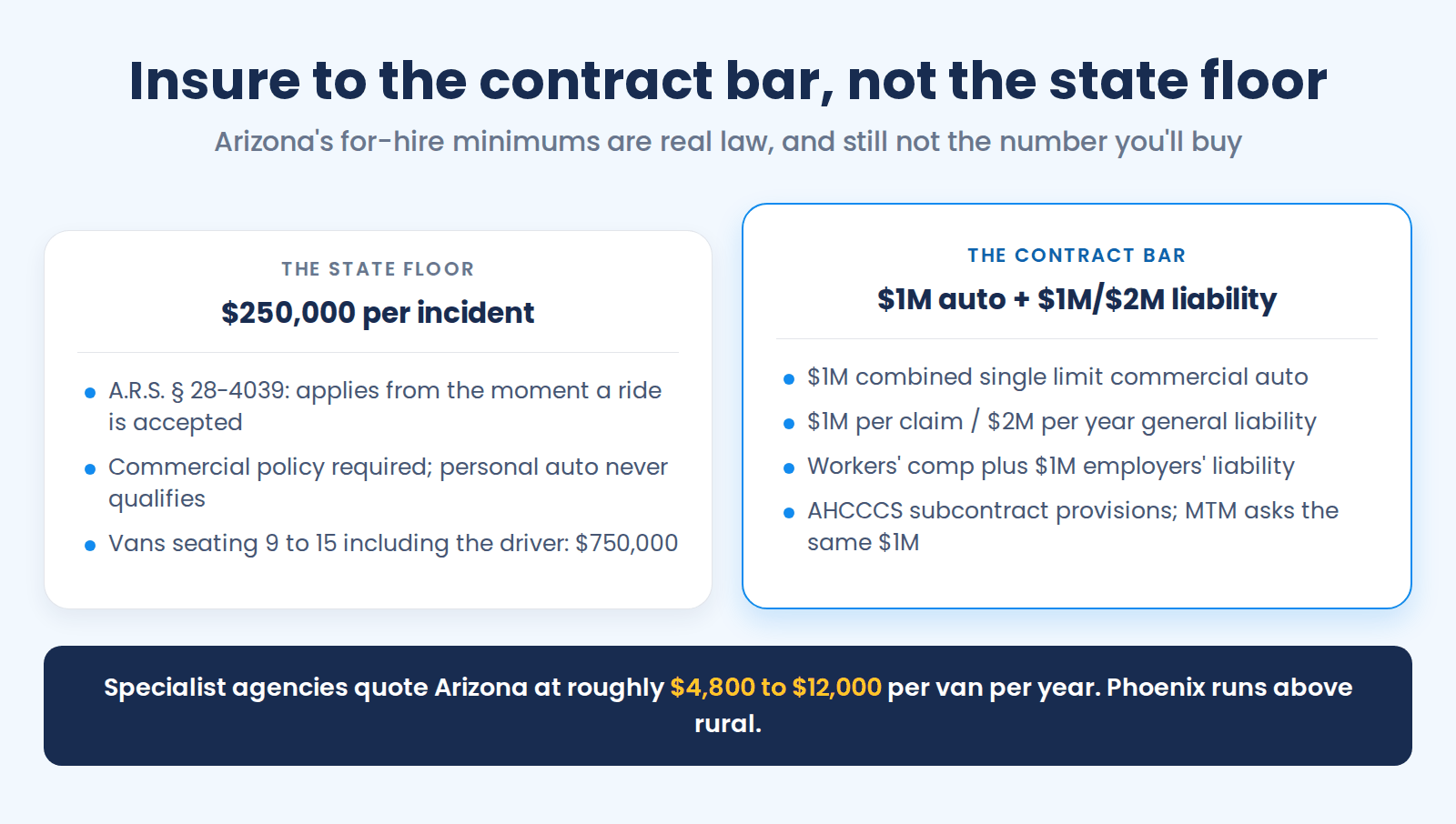
The number that matters in Arizona insurance is $1 million combined single limit, because that’s what every contract you’ll want demands. The state’s legal minimum is lower. It’s real law, and no contract will let you run at it.
The legal floor: $250,000
Under A.R.S. § 28-4039, a livery vehicle needs primary commercial coverage of $250,000 per incident from the moment you accept a ride, plus commercial uninsured motorist coverage [46]. Personal auto never qualifies. And count seats before you buy. At 9 to 15 including the driver, § 28-4033 raises the minimum to $750,000, so a bench row you’ll never use can triple your legal minimum [47].
The contract bar: $1 million
AHCCCS’s minimum subcontract provisions bind you the moment you contract with any AHCCCS plan or its broker. On a subcontract worth $50,000 or more over its whole term, they require:
- $1 million combined single limit business auto.
- $1 million per occurrence and $2 million aggregate general liability. It covers injuries and damage that don’t involve driving, like a fall at pickup.
- Statutory workers’ comp with $1 million employers’ liability.
- The State of Arizona named as additional insured, meaning it goes on your policy and gets proof of coverage.
Serve vulnerable adults, which describes most NEMT riders, and a $500,000 sexual abuse and molestation sub-limit joins the list [11]. Smaller subcontracts keep the $1 million auto limit, with lower liability limits [11]. MTM publishes the same $1 million expectation for auto and general liability as its baseline, with MTM as certificate holder and additional insured [12]. Individual contracts can run higher [12].
What it costs
The one published Arizona price range, from a specialist agency, is roughly $4,800 to $12,000 per vehicle per year [48]. Phoenix is pricier than rural, and fleet discounts arrive around five vehicles [48]. National 2026 bands for wheelchair vans run similar, with first-year operators paying a premium on top [48]. Treat all of it as rough, and get real quotes before you pick the van, from an agent who already insures a lot of wheelchair vans. A generalist quoting NEMT cold costs you a month of runway. Few carriers touch Arizona NEMT at all, and the quote decides whether your business model works.
Paul at Gentle Turns bought above the minimums from day one. Partly that was so hospital and government contracts would never force a mid-year scramble, and partly it was a recruiting pitch, since good drivers ask what covers them. As he put it on our podcast: “In any business there’s ways to cut corners, but you can’t cut corners on insurance.”
Workers’ comp starts at employee one
Arizona requires coverage for any regularly employed worker, part-time included. Going without draws escalating penalties of $1,000, $5,000, then $10,000, though a solo owner can waive coverage for themselves [49]. Calling drivers contractors when they work like employees is the known trap here. A signed agreement helps your case, but it doesn’t settle it.
What do NEMT drivers need in Arizona?
NEMT drivers in Arizona need a standard Class D license, the regular Arizona driver’s license, which covers any van up to 26,000 pounds. Each driver also needs a file holding CPR, First Aid, and HIPAA training certificates, and a listing in the AHCCCS system. A commercial driver’s license (CDL) with a passenger endorsement only enters at vehicles designed for 16 or more occupants [50]. The requirements come in three layers, and knowing which layer a rule lives in saves you from buying compliance you don’t owe.
The law layer is light
The Class D ceiling covers every van you’re likely to run [50]. The statute counts design capacity, not what’s bolted in today. A van sold as a 15-passenger was designed to seat 16 with the driver, and pulling seats out doesn’t un-design it. The vehicle-for-hire statute adds the pre-hire criminal background check on every driver [42].
The AHCCCS layer is the driver file
The provider type 28 packet has the owner attest that every driver holds a valid Arizona license, current CPR and First Aid certification, and HIPAA training. You produce the documents on request. You also list every driver inside APEP by full legal name, date of birth, SSN, and employment dates, and you update the list within 30 days of any change. AHCCCS denies a claim that names a driver who isn’t on your filed list [9].
Note what’s absent. AHCCCS doesn’t require fingerprint cards, drug testing, or minimum ages for ordinary NEMT drivers. Articles claiming its transportation policy demands them are quoting a document that doesn’t say it [15].
The broker layer is contractual
MTM’s published provider standards run to 21-or-older drivers, motor vehicle record checks, drug testing, and passenger-assistance training, and Arizona’s legacy Veyo standards required a pre-driving drug test [51]. None of that is state law. All of it is the price of the contract, so budget for it anyway.
Two fingerprint credentials, kept straight
The FCBC, a fingerprint background check through Arizona DPS, the Department of Public Safety, applies to owners of high-risk provider types at enrollment, not to your drivers [13].
The Level One Fingerprint Clearance Card is a separate credential: $67, valid six years, and your drivers need it in exactly two situations. One is transporting for Division of Developmental Disabilities contract work, where statute requires it. The other is the narrow managed-care exception that lets a driver carry an unaccompanied 16- or 17-year-old [52]. If you’re not doing either, no card is required. If you plan to serve DDD families, budget the cards from the start.
Can a NEMT company run stretcher van trips in Arizona?
Yes, and Arizona is unusually explicit about it. Statute defines a stretcher van, excludes it from the ambulance definition, and authorizes it by name. It covers routine transport for someone who’s convalescent, meaning recovering, or otherwise unable to walk, and inpatient transfers for diagnostic tests when a physician signs off [53]. No ADHS license, no ambulance paperwork. Compare that to Texas, where non-EMS stretcher work is a criminal offense, or North Carolina, which treats the stretcher itself as the trigger for ambulance rules. Arizona wrote the opposite answer into law.
It also wrote the boundary into law, and A.R.S. § 36-2223 reads like a dispatch checklist. A stretcher van may not carry anyone who:
- is on IV fluids, or was given medication that leaves them unable to care for themselves,
- needs or may need oxygen, unless a physician prescribed it as self-administered therapy,
- needs or may need suctioning,
- has an injury no physician has evaluated, or an acute or suddenly worsening condition,
- is moving between hospitals for a same-or-higher level of care, or is being medically monitored at both ends of the trip [53].
Your van can’t carry medical equipment or display anything implying medical care, and it can never take a call that originated in a 911 dispatch system [53]. The need for care during the ride is what turns a trip into ambulance work. The statute applies those criteria to wheelchair vans too, so train dispatch to walk the list before every booking, not just the stretcher ones [53].
Cross the line and, after notice and a hearing, ADHS can determine you operated an unregistered ambulance. Civil penalties run up to $350 per violation and $15,000 in total [54].
The payoff for respecting the line is the best rate on the AHCCCS fee schedule. A stretcher trip pays $49.09 base in the metros and $86.70 rural, more than four times the wheelchair base, plus mileage [18]. Meanwhile actual ambulance companies in Arizona operate under a certificate of necessity, with assigned territories and prices fixed by the state [39]. You get the premium tier of non-emergency work without any of that. Laminate the do-not list and put it on the dispatch wall.
One open question: prior authorization for stretcher trips
One statutory oddity belongs in your file before the first claim. A.R.S. § 36-2907(G) says prior authorization is required for stretcher van transport. The operative billing manual, though, lists only the 100-mile rule, and the fee schedule prices stretcher trips like any other type of trip. Ask DFSM how it wants stretcher authorizations handled before you bill your first one, and expect managed-care plans to have their own answer.
How do you become an AHCCCS NEMT provider and get broker work?
Two steps, in order: register with AHCCCS through APEP first, then take that provider ID to the plans and brokers, because every contract conversation starts by asking for it.
Step one: APEP registration as provider type 28
The application is a 15-step online wizard, and the packet tells you everything the screening will check [9]:
- Your business documents.
- Vehicle registrations and insurance.
- The ADOT permit.
- The driver roster with SSNs.
- Tribal business licenses if you’ll serve tribal land.
- The company logo already on your vehicles when the site visit happens.
The owner completes the AHCCCS NEMT certification training and uploads the certificate. That training moved to the state’s AZLearns platform in September 2026, so expect the course code in older guides to be stale [9]. Pay the $750 fee for 2026, knowing AHCCCS resets the amount each January [55]. Fingerprints for 5 percent owners and listed officers go through Arizona DPS, and an out-of-state clearance doesn’t substitute [13].
AHCCCS says applications generally process within 60 days [56]. High-risk screening has more moving parts than that number suggests, so plan in months, not weeks. And remember the rule that shapes your launch math: nothing is billable before your effective date lands.
One operator I know expanding into the Phoenix metro told me his application sat in the system for months while he ran the new market on ads, facility calls, and a dialysis route. That’s the launch sequence this state demands, and it worked.
Two notes from the same story. Facilities asked for his AHCCCS provider number before sending him trips that would never bill AHCCCS. The registration works as proof you’re legitimate even for private-pay work, because if the state screened you, the discharge planner doesn’t have to.
And on paying for help: a legitimate service that does your enrollment paperwork can be worth it when the queue is costing you revenue. Anyone charging you for access to a broker network, rather than for labor, is running a scam. Paperwork help has a real website, references, and other operators who’ll vouch, and access-sellers can’t show you any of that.
Step two: the plans and brokers
With the provider ID in hand, work the map from the broker section:
- MTM. Its network application is one process with six published steps, from application to first trip [57]. Since MTM bought both MTBA and Veyo, it’s the practical front door to the trips those two used to dispatch separately.
- Banner-University Family Care contracts directly: a Provider Interest Form to its contracting team, with up to 120 days for a response and no guarantee [26].
- Mercy Care. Start with the plan itself.
Each queue is its own wait, none of them publish timelines, and a network that’s full in your county today may need vehicles next quarter.
Brokers and plans want evidence you can run trips before they send you theirs, and the evidence has to come from somewhere. Private pay asks for no provider ID. Facility contracts ask for insurance and reliability. Our guides on winning facility contracts, getting your first trip from a facility meeting, and the private pay guide cover exactly this stretch of the launch, step by step.
Don’t build the whole schedule on one payer
All of that machinery earns you AHCCCS trips. In Arizona, though, most of the broker doors open into the same building. When one company arranges rides for most of the plans, trips under three different plan logos aren’t really three sources. A contract dispute, a rate cut, or a lost plan bid at that one company hits all three at once. If the parent company loses a plan or changes its terms, your trip volume moves with it, and nobody asked you.
Christopher Buell learned the Arizona version of this lesson before brokers were even the issue. He bought a three-van Phoenix company that came with, as the sellers told it, all of Hospice of Arizona’s business. “I wasn’t buying 100 percent of Hospice of Arizona’s business,” he told me on our podcast. “I became the third call, because they didn’t have a relationship with me.”
Paying for a book of trips bought him a phone that had stopped ringing, three vans, three insurance bills, and about half a van’s worth of work. He rebuilt it relationship by relationship into an 11-van company with no broker trips at all. The asset was never the contract. It was the trust.
The hedges Arizona hands you
Arizona hands you more ways to spread the risk than most states, and the structure of this market is the hedge:
- The AIHP direct lane bills AHCCCS itself. No middleman can lose a contract it doesn’t hold.
- Banner contracts direct, so one of the six plans is reachable without any broker at all.
- Medicare Advantage rides come on top of Medicaid. Banner’s dual-eligible plan, for people on both Medicare and Medicaid, covers 36 one-way trips a year to benefit locations Medicaid doesn’t cover, arranged through the plans’ ride vendors [58]. It’s extra volume, but it flows through the same broker networks.
- The VA buys wheelchair and stretcher transport because its volunteer van network is ambulatory-only, meaning riders who can walk to the vehicle. Those trips, which the VA calls special mode, need VA authorization. The VA’s regional contracting office has put out bids for Phoenix and Tucson NEMT contracts and signaled more to come, and registering in SAM.gov puts you in that game [59].
- Hospices and hospitals pay from their own budgets. The hospice agency itself arranges and pays for transport related to the terminal illness, which makes the agency, not a broker, your customer [17].
- Workers’ comp networks like One Call and Sedgwick, which arrange transportation for injured workers, contract transportation providers nationally, Arizona included [60].
Paul at Gentle Turns started with none of the broker volume. He grew from zero to five vans in about a year on private pay and facility relationships. He’s frank that the choice had a cost: “It took a little bit longer out the gate to get started since we weren’t using brokers, but I feel good about the relationships that that’s allowed us to generate.”
The plan-by-plan structure here rewards his patience more than a single-broker state would. Georgia now runs everything through one statewide broker, which is the opposite bet. California’s plan-by-plan churn shows what Arizona’s map looks like with dozens of plans instead of six. Texas is down to two main vendors statewide, which didn’t stop its plans from swapping them five times in fourteen months.
Whatever the mix ends up being, it should live in one place. Duet merges broker trip files with your facility and private-pay bookings, so a driver sees one day and an auditor sees one record. In this state’s enforcement climate, the record is the point.
How much does it cost to start a NEMT business in Arizona?
Plan on $25,000 to $55,000 to put the first wheelchair van on the road legally in Arizona, dominated by the vehicle and the insurance. The line items, from the sections above:
| Line item | What it costs |
|---|---|
| LLC formation | $50 to file, $85 expedited; no annual report, ever [6] |
| Newspaper publication | $0 in Maricopa and Pima Counties; roughly $60 to $300 elsewhere [7] |
| EIN and NPI | Free; never pay a third party |
| State NEMT license | $0. It doesn’t exist |
| ADOT Vehicle for Hire permit | $0 for a livery-classified fleet (at most $24 a van if classed as taxis), valid three years [8] |
| AHCCCS (APEP) application fee | $750 for 2026; resets every January [55] |
| Emissions test (metro Phoenix/Tucson) | $16.15 for the standard OBD test [40] |
| Tribal business licenses | $5 to $150 a year for most tribes; the Navajo Nation’s NEMT permit runs to thousands [33] |
| Commercial auto insurance | Roughly $4,800 to $12,000 a year per van, agency-reported; Phoenix above rural [48] |
| Used wheelchair van | $20,000 to $40,000 buys a sound used one; the insurance quote comes first |
| Vehicle lettering | $200 to $500 for the logo AHCCCS requires; a full wrap is marketing, not compliance [9] |
| Working capital | Save 3 to 6 months of expenses; screening isn’t billable time |
A $5,000 launch budget doesn’t survive first contact with an insurance quote.
What a real early ramp looks like
Ignore the template spreadsheets and use a real number. A two-van Phoenix operator on our platform booked about $11,000 in a recent month across roughly 200 completed trips, a bit over a year after starting from zero. The operator hit 100 trips a month by month four.
The ceiling is higher. As I tell operators on demo calls: if you’re fully utilizing a wheelchair van, you can get over $100,000 in most places in a year. The distance between those two numbers is utilization, and utilization is sales.
How do you fund a NEMT startup in Arizona?
When cash won’t cover the whole launch, Arizona’s financing bench is deeper than most states’:
- SBA microloans go to $50,000 for equipment and working capital [61].
- Prestamos CDFI in Phoenix, the state’s longtime SBA microlender, lends from $5,000 up and will lend to people with a thin credit history [61].
- Growth Partners Arizona posts a 9.25 percent rate once you’ve got a year of operating history. It also runs a Kiva hub with zero-interest crowdfunded loans to $15,000 that a day-one founder can actually get [61].
- The state’s own Microbusiness Loan Program lends up to $50,000 to businesses with five or fewer employees, which describes every NEMT startup ever founded, for as long as the state’s funding for it lasts [61].
A loan doesn’t shorten the screening, so borrow for the months the fingerprints will take.
How long does it take to start a NEMT business in Arizona?
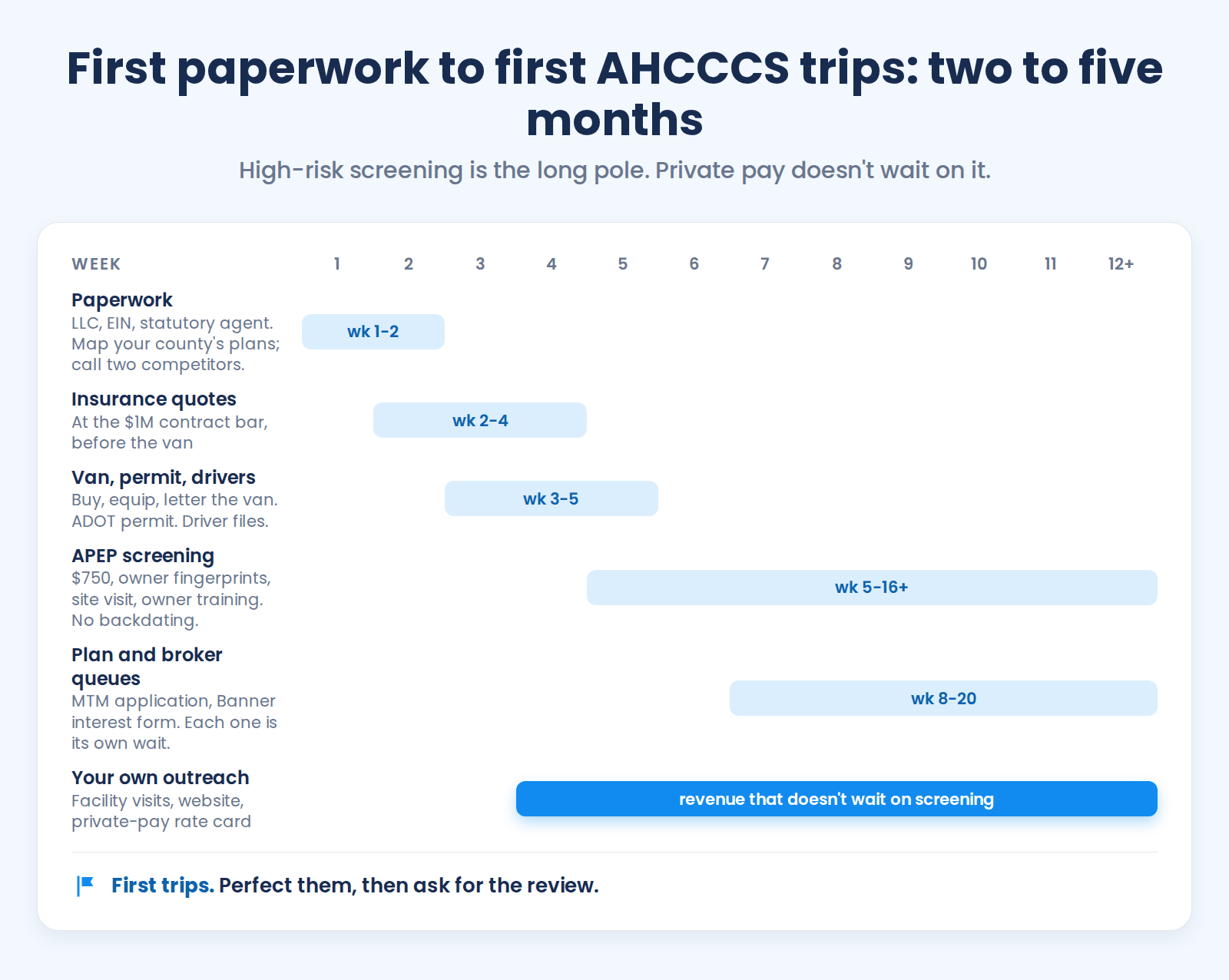
Plan on three to five months from first paperwork to first AHCCCS trips, with the screening as the longest step and private-pay revenue available months earlier. A realistic sequence:
- Weeks 1-2. LLC ($50), EIN, statutory agent. Map your county’s plans, call two competitors for quotes, and open the insurance conversations at the $1 million bar.
- Weeks 2-4. Insurance quotes come back, and now you know your real cost structure. Pick the van after the premium, not before.
- Weeks 3-5. Buy and equip the van, letter it, get the ADOT permit, pass emissions if you’re metro, and assemble the driver files.
- Weeks 5-8. Submit the APEP application, complete, with the fee, the training certificate, and every document from the packet. Screening doesn’t start until the file is whole.
- Months 2-5. Screening runs: fingerprints, the site visit, the wait. This is when you put the website live, make the facility visits, and run the first private-pay trips. AHCCCS’s 60-day figure is its own “generally” estimate, and high-risk screening can run past it [56].
- When screening finishes (month 3 to 5). The provider ID lands. Now come MTM’s application, Banner’s interest form, and the plan contracts, each on its own clock, while your own trip sources keep the vans moving.
Budget per the cost table above, and save 3 to 6 months of expenses on top: screening isn’t billable time.
Arizona NEMT FAQ
Does Arizona require a NEMT license?
No. Arizona has no state NEMT license, and state law bars cities and counties from requiring their own [43]. What you need instead: a mandatory, essentially free Vehicle for Hire permit from ADOT [8], and registration with AHCCCS as a provider type 28 through the APEP portal [9]. If you’ll serve tribal land, add a tribal business license from each tribe whose land you serve [32]. Skipping the ADOT permit is a class 2 misdemeanor, and it costs little to nothing, so just get it.
Who is the NEMT broker in Arizona?
There isn’t one, statewide. Each AHCCCS health plan arranges rides for its own members. MTM Health bought Veyo in 2022 and Arizona’s homegrown broker MTBA in 2023 [20], so most of those plan contracts now route through MTM Health companies [21][22][23]. Banner-University Family Care arranges rides in-house [26]. Mercy Care books through its own member line [25]. And about 92,000 American Indian Health Program members are fee-for-service with no broker at all [16].
Is there still a moratorium on new NEMT providers in Arizona?
No. AHCCCS froze new NEMT provider enrollments from June 9, 2023 to December 9, 2024 as part of its fraud crackdown [1][2]. Guides written in that window still say you can’t apply. You can. What survived the moratorium is high-risk screening: a $750 application fee for 2026, fingerprint background checks for owners, a site visit, and an owner training class [9][13].
How much does it cost to start a NEMT business in Arizona?
Plan on $25,000 to $55,000 to put the first wheelchair van on the road legally. The vehicle and the insurance dominate: a sound used wheelchair van runs $20,000 to $40,000, and commercial auto runs roughly $4,800 to $12,000 a year per van [48]. The paperwork is cheap by comparison. The LLC costs $50 [6], the AHCCCS application fee is $750 for 2026 [55], and the ADOT Vehicle for Hire permit is free [8]. Save 3 to 6 months of expenses on top.
Can I bill AHCCCS directly for NEMT rides?
Yes, for fee-for-service members, and Arizona has an unusually large pool of them: about 92,000 people in the American Indian Health Program [16]. You bill AHCCCS itself at published rates [18], with no broker and no plan contract. Every claim needs the AHCCCS Daily Trip Report [14]. Prior authorization for wheelchair and taxi-level trips only kicks in past 100 miles, and you need a tribal business license to pick up or drop off on tribal land [32].
Do I need an NPI to enroll with AHCCCS as a NEMT provider?
No. AHCCCS registers NEMT companies as atypical providers, businesses that don’t deliver medical care, and the provider type 28 packet says it plainly: NPI required, no [9]. Get the free Type 2 (organization) NPI anyway, because health plans and brokers outside the fee-for-service lane will ask for one. But don’t let a vendor sell you NPI help as an Arizona requirement.
Do NEMT drivers need a CDL in Arizona?
Not for a normal wheelchair van. A regular Arizona license covers vehicles up to 26,000 pounds. A CDL with a passenger endorsement starts only when a vehicle is designed for 16 or more people including the driver [50]. What drivers do need: an Arizona license, CPR, First Aid, and HIPAA training on file, and a listing in the AHCCCS system, because claims from unlisted drivers are denied [9][14].
Are stretcher van trips allowed in Arizona?
Yes, and the law says so directly. Arizona statute defines stretcher vans and excludes them from ambulance licensing [53]. AHCCCS pays a real premium for them: a $49.09 base rate in the metros and $86.70 rural, against $11.15 for a wheelchair trip [18]. The catch is a statutory do-not list. No IV fluids, no oxygen unless it’s physician-prescribed and self-administered, no unevaluated injuries, no 911 calls, and no medical markings on the van [53]. Cross it and you’ve operated an unregistered ambulance [54].
How long does AHCCCS NEMT enrollment take in Arizona?
AHCCCS says applications generally process within 60 days [56], and NEMT’s high-risk screening adds fingerprint checks and a site visit that can stretch it. Plan for three to five months from first paperwork to first AHCCCS trips. Remember that the approval generally isn’t backdated [14], and build private-pay and facility revenue while you wait.
Is the Arizona market worth entering in 2026?
The demand case is strong even though overall AHCCCS enrollment is shrinking. Arizona has 1.77 million members [3], a long-term-care program that grew through the downturn [3], 122 dialysis facilities [4], and a senior share past 19 percent and climbing [5]. The competitor set thinned out during the enrollment freeze [1]. Lasting here means arriving with trips of your own and enough cash to sit out the fingerprint queue.
Key official sources
[1] AHCCCS, provider moratorium extension notice (June 2024): the moratorium’s scope including NEMT, CMS approval, and exemption statistics. https://www.azahcccs.gov/shared/News/GeneralNews/AHCCCSReFederalApprovalExtenProvMor.html
[2] AHCCCS, Enrollment Moratoriums page (checked September 2026): no moratorium currently in force; the concluded freeze’s explicit inclusion of NEMT providers is documented in the extension notice at [1]; heightened screening continues for high-risk types. https://www.azahcccs.gov/Resources/GovernmentalOversight/EnrollmentMoratoriums.html
[3] AHCCCS, Population by Category and Population by Health Care Contractor reports (August 1, 2026 data): total enrollment 1,771,977, ALTCS 76,309, AIHP 92,141, and year-over-year changes. https://www.azahcccs.gov/Resources/Reports/population.html
[4] CMS Provider Data Catalog, Dialysis Facility listing (queried September 2026): 122 Medicare-certified dialysis facilities in Arizona, 70 in Maricopa County. https://data.cms.gov/provider-data/dataset/23ew-n7w9
[5] Arizona Office of Economic Opportunity, 2025-2060 population projections: the 65-plus share above 19 percent today, rising toward 22 percent by 2035. https://oeo.az.gov/population/projections
[6] Arizona Corporation Commission, LLC fee schedule and Business Services FAQ: $50 filing, $85 expedited, statutory agent requirement, no annual report for LLCs. https://azcc.gov/docs/default-source/corps-files/fee-schedules/fee-schedule-llcs.pdf
[7] A.R.S. § 29-3201(G): the three-publication requirement within 60 days and the exemption where the statutory agent sits in a county over 800,000 population. Publication prices are market estimates, not statutory. https://www.azleg.gov/ars/29/03201.htm
[8] A.R.S. § 28-9503 and ADOT Vehicle for Hire licensing pages: the mandatory company permit, fee-free for livery companies, three-year term; § 28-9521 (class 2 misdemeanor) and § 28-9525 (civil penalties). https://azdot.gov/mvd/services/professional-services/vehicle-hire-licensing
[9] AHCCCS, NEMT Provider Type 28 registration packet, PEP-111.28 (rev. 08/2026): high-risk designation, no NPI, required documents, driver attestations, logo rule, training, and the AZLearns migration. https://www.azahcccs.gov/PlansProviders/Downloads/ProviderRegistration/Non-EmergencyTransportationProvider.pdf
[10] AHCCCS, Behavioral Health Annual Report SFY 2024 (2025): OIG screening reviews, prior authorization volumes, and enforcement statistics. https://azahcccs.gov/shared/Downloads/Reporting/2025/2025AnnualBHReport.pdf
[11] AHCCCS, Minimum Subcontract Provisions (effective 10/01/24): the $1M auto, $1M/$2M general liability, workers’ comp, and SAM coverage requirements for plan subcontractors. https://www.azahcccs.gov/PlansProviders/Downloads/MSPs_100124.pdf
[12] MTM, transportation provider requirements (published network standards; MTM posts no Arizona-specific sheet, and per-contract requirements can run higher): the $1M combined single limit for auto and general liability with MTM as certificate holder and additional insured. https://www.mtm-inc.net/wisconsin/providers/
[13] AHCCCS, PT-28 announcement and FCBC one-pager (PEP-902): high-risk screening effective May 1, 2023, fingerprint requirements for 5 percent owners, no out-of-state reciprocity. https://www.azahcccs.gov/shared/News/GeneralNews/pt-28.html
[14] AHCCCS, Fee-For-Service Provider Billing Manual, Chapter 14: Transportation (rev. 07/31/2026): the Daily Trip Report requirement, loaded-miles-only billing, the 100-mile prior authorization threshold, no backdating, and anti-inducement rules. https://www.azahcccs.gov/PlansProviders/Downloads/FFSProviderManual/FFS_Chap14Transportation.pdf
[15] AHCCCS, AMPM Policy 310-BB, Transportation (effective 08/15/25): coverage conditions, driver and vehicle rules, the 15-mile pharmacy limit in Maricopa and Pima, unaccompanied-minor restrictions, and TNC broker-only rules. https://www.azahcccs.gov/shared/Downloads/MedicalPolicyManual/300/310-BB.pdf
[16] AHCCCS, FFS Billing Manual Ch. 14 and population reports: AIHP transportation covered through the Division of Fee-for-Service Management; AIHP enrollment. https://www.azahcccs.gov/PlansProviders/Downloads/FFSProviderManual/FFS_Chap14Transportation.pdf
[17] Medicare.gov, hospice coverage: transport related to the terminal illness is covered when arranged by the hospice team, making the hospice the paying customer. https://www.medicare.gov/coverage/hospice-care
[18] AHCCCS, FY26 Fee-For-Service Ground NEMT fee schedule (effective 10/01/2025): all base and mileage rates cited, urban and rural TN tiers; schedules unchanged since at least October 2021. https://www.azahcccs.gov/PlansProviders/RatesAndBilling/FFS/transportationground.html
[19] HealthLift NEMT of Arizona and peer company sites (checked September 2026): Arizona private-pay operators publish quote-based pricing, not rate cards; the private-pay multiples come from booking-directory estimates, not operator price lists. https://www.healthliftaz.com/
[20] MTM, acquisition announcements: Veyo (closed August 1, 2022) and MTBA (closed July 1, 2023), with MTBA’s trip and fleet volumes. https://www.mtm-inc.net/mtm-continues-growth-with-acquisition-of-arizona-based-nemt-broker-mtba/
[21] Arizona Complete Health, provider notice PU21500 (2021): MTBA as exclusive NEMT vendor effective October 1, 2021, replacing Veyo. https://www.azcompletehealth.com/newsroom/pu21500.html
[22] UnitedHealthcare Community Plan of Arizona, Quick Reference Guide (October 2024): MTM transportation line 1-888-889-0358 across all four Arizona products. https://www.uhcprovider.com/content/dam/provider/docs/public/commplan/az/references/AZ-UHCCP-Quick-Reference-Guide.pdf
[23] Molina Healthcare of Arizona, transportation services page: MTM/Veyo booking at 833-474-5060. https://www.molinahealthcare.com/members/az/en-us/mem/medicaid/member-journey/transportation.aspx
[24] MTBA, published client list, and Blue Cross Blue Shield of Arizona Health Choice member materials. https://www.azmtba.com/partners/
[25] Mercy Care, member transportation pages: rides booked through 1-800-564-5465 with three days’ notice. https://www.mercycareaz.org/
[26] Banner-University Family Care, 2026 member handbook and provider contracting pages: in-house ride arrangement, 72-hour notice, and the Provider Interest Form process. https://www.bannerhealth.com/bhpprovider/about/contact
[27] Modivcare, Arizona facilities page (checked September 2026): no AHCCCS plan contracts listed. https://www.modivcare.com/facilities/az/
[28] AHCCCS, Administrative Action Notice to Cure to Mercy Care (March 21, 2025) and Release from Notice to Cure (September 16, 2025). https://www.azahcccs.gov/Resources/OversightOfHealthPlans/AdministrativeActions/
[29] AHCCCS, ALTCS-EPD updates: procurement termination (September 2025) and the YH27-0001 RFP (published August 4, 2026; new contracts scheduled October 1, 2027). https://www.azahcccs.gov/PlansProviders/HealthPlans/YH27-0001.html
[30] Arizona Legislature, HB2584 (2025): the NEMT reimbursement-rate study bill, passed the House 56-1, held in the Senate. https://www.azleg.gov/legtext/57leg/1R/summary/S.2584HHS-APPROP.DOCX.htm
[31] AHCCCS, Preliminary Rates Notice of Public Information for FFY27 (July 24, 2026): the rural S0215-TN mileage update to $1.63 effective October 1, 2026. https://www.azahcccs.gov/AHCCCS/Downloads/PublicNotices/rates/PreliminaryRatesNoticeofPublicInformation-FFY27.pdf
[32] AHCCCS, IHS/Tribal Provider Billing Manual Ch. 11 and Claims Clues (2014): the tribal business license requirement, prior authorization denials, and recoupment for missing licenses. https://www.azahcccs.gov/PlansProviders/Downloads/IHS-TribalManual/IHS-Chap11Transport.pdf
[33] Tribal licensing sources: Gila River Ordinance GR-002-19 ($150 annual license and the Gila River Health Care permit prerequisite); Tohono O’odham Treasurer’s Office TPT license ($5); SRPMIC business license portal ($125 new, $80 renewal); Navajo Nation NEMT regulations as presented to AHCCCS (2018 fee schedule; confirm current figures with NDOH). https://www.azahcccs.gov/PlansProviders/Downloads/IHS-TribalManual/exhibit_11-3.pdf
[34] AHCCCS, Current Active NEMT Providers list (August 2026): 472 tribally licensed provider entries across ten tribes, updated monthly. https://www.azahcccs.gov/PlansProviders/CurrentProviders/NEMTproviders.html
[35] AZCIR/ProPublica reporting and AHCCCS Sober Living Fraud page: the scale of the scheme, the recruiting mechanics, and cumulative administrative actions. https://www.azahcccs.gov/Fraud/SoberLivingFraud.html
[36] Arizona Attorney General, enforcement announcement (May 14, 2026): 140 indictments, 41 convictions, and the 92 percent drop in targeted billing. https://www.azag.gov/press-release/attorney-general-mayes-announces-behavioral-health-fraud-sentence-reveals-dramatic
[37] AHCCCS Behavioral Health Annual Report SFY 2024: credible-allegation payment suspensions under 42 CFR 455.23 and rescissions on written evidence. https://azahcccs.gov/shared/Downloads/Reporting/2025/2025AnnualBHReport.pdf
[38] Arizona Commerce Authority, business licensing overview: Arizona issues no general state business license. Tucson’s $25 application and $50 annual license: Tucson City Code § 19-39. https://www.azcommerce.com/small-business/quick-links/business-licensing/
[39] A.R.S. §§ 36-2201, 36-2233, 36-2239: the ambulance definition and its stretcher-van exclusion, the certificate of necessity regime, and state-fixed ambulance rates. https://www.azleg.gov/ars/36/02201.htm
[40] A.R.S. § 49-542 and the ADEQ vehicle emissions program: metro-area emissions testing, fees, and exemptions; no periodic state safety inspection exists. https://www.myazcar.com/testing-info-and-fees
[41] A.R.S. § 42-5062(A)(1): the transporting classification and its exemptions for permitted vehicle-for-hire companies. https://www.azleg.gov/ars/42/05062.htm
[42] A.R.S. § 28-9507: pre-hire driver background checks, the annual brake and tire inspection, and the zero-tolerance policy required of permit holders. https://www.azleg.gov/ars/28/09507.htm
[43] A.R.S. § 28-142: statewide preemption of local vehicle-for-hire regulation, with the airport exception. https://www.azleg.gov/ars/28/00142.htm
[44] Phoenix City Code § 4-68: Sky Harbor commercial ground transportation permits. https://phoenix.municipal.codes/CC/4-68
[45] A.R.S. § 28-5201(1): the intrastate commercial motor vehicle definition, including for-hire vehicles designed for nine or more persons. https://www.azleg.gov/ars/28/05201.htm
[46] A.R.S. § 28-4039: insurance requirements for taxis, livery vehicles, and limousines, including the $250,000 per-incident requirement from ride acceptance. https://www.azleg.gov/ars/28/04039.htm
[47] A.R.S. § 28-4033: the $750,000 minimum for vehicles seating 9 to 15 including the driver. https://www.azleg.gov/ars/28/04033.htm
[48] InsureLimos Arizona NEMT page and Elite MED Financials 2026 rate guide (specialist agencies): the $4,800 to $12,000 Arizona band and national vehicle-type bands. https://insurelimos.com/coverage/nemt/arizona
[49] A.R.S. §§ 23-902, 23-961, 23-907: workers’ compensation coverage from the first employee, the sole-proprietor waiver, and penalties. https://www.azleg.gov/ars/23/00902.htm
[50] A.R.S. §§ 28-3101, 28-3001, 28-101, 28-3103: license classes, the commercial motor vehicle definition, the 16-passenger bus threshold, and the passenger endorsement. https://www.azleg.gov/ars/28/03101.htm
[51] MTM transportation provider handbooks and legacy Veyo Arizona driver standards (broker-published; confirm current terms with your broker). https://www.mtm-inc.net/driverswanted/
[52] A.R.S. § 36-594.01 (fingerprinting for DDD-contract service providers), A.R.S. § 41-1758.07 (Level One card standards), and AZ DPS fingerprint clearance card pages ($67, six-year term). https://www.azdps.gov/services/public-services-center/fingerprint-clearance-card
[53] A.R.S. § 36-2223: stretcher van and wheelchair van authorization, the transport criteria, the do-not list, and the equipment and dispatch restrictions. https://www.azleg.gov/ars/36/02223.htm
[54] A.R.S. §§ 36-2223(F), 36-2245(J): recharacterization as an unregistered ambulance and the civil penalty amounts. https://www.azleg.gov/ars/36/02245.htm
[55] AHCCCS, 2026 Provider Enrollment Application Fee notice: $750 for calendar year 2026, adjusted each January. https://www.azahcccs.gov/PlansProviders/Downloads/APEP/2026ProviderEnrollmentApplicationFee.pdf
[56] AHCCCS, APEP provider enrollment page: the general 60-day processing statement and effective-date rules. https://www.azahcccs.gov/APEP
[57] MTM, transportation provider network application (same page as [51]): the six-step onboarding funnel. https://www.mtm-inc.net/driverswanted/
[58] Banner Medicare Advantage Dual HMO D-SNP 2026 Summary of Benefits: 36 one-way supplemental trips to non-Medicaid-covered locations. https://www.bannerhealth.com/medicare
[59] VA, Veterans Transportation Program and Phoenix/Southern Arizona VA transportation pages: special-mode transport authorization and the DAV vans’ ambulatory-only limits. https://department.va.gov/vha/chief-operating-officer/veterans-transportation-program/
[60] One Call and Sedgwick provider network pages: workers’ compensation transportation networks accepting provider applications. https://onecallcm.com/who-we-serve/become-a-provider/
[61] SBA microloan program; Prestamos CDFI; Growth Partners Arizona; Arizona Office of Economic Opportunity Microbusiness Loan Program. https://oeo.az.gov/microbiz
Last verified against the sources above in September 2026. Arizona requirements change, and several agency sites block automated checks, so confirm the primary sources directly before acting. Treat this guide as education, not legal advice.
About the author
James O'Donnell cofounded Duet and leads its sales, partnerships, and growth services. He talks with NEMT operators every week, hosts the NEMT Growth podcast, and answers Duet's sales line himself. More about Duet's founders →
Starting in a nearby state?
Want more trips and less busywork?
See how Duet runs and grows NEMT businesses in a 30-minute demo.