Article
What Google Ads Cost a NEMT Company, Per Caller
A click costs a few dollars. A caller costs about $10 to $20, and it pays you back only if someone answers fast.
By James O'Donnell, Cofounder and COO, Duet ·
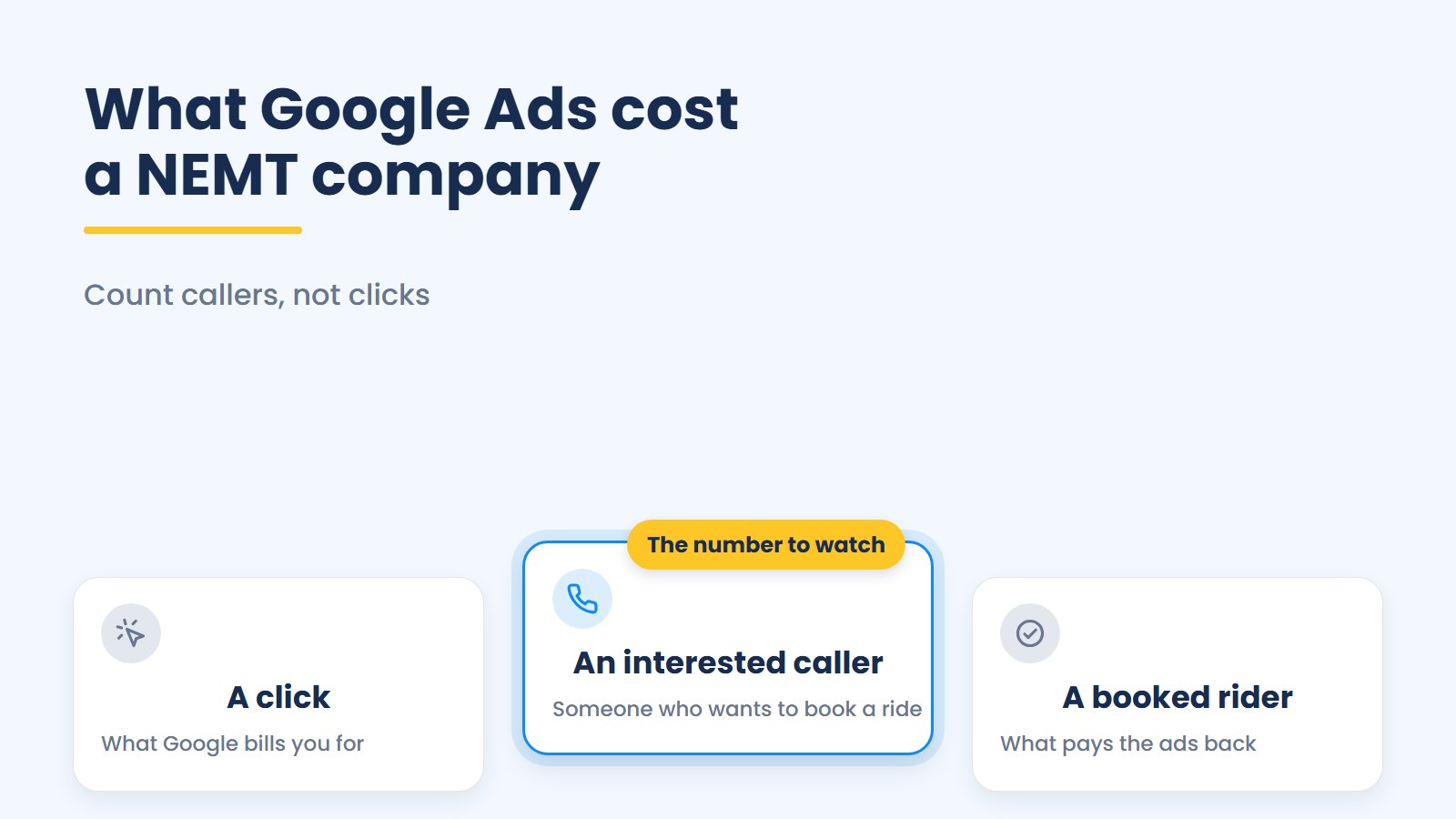
In the Google Ads campaigns we run for NEMT companies, a click usually costs $2 to $3, and it takes about $10 to $20 of ad spend to get one interested caller: someone who calls wanting to book a ride. That’s a broad national figure. It moves with your market and with the service people search for.
This spring we ran a two-week Google Ads test for an operator in Aurora, Colorado. About $290 in spend brought a stack of calls from people expecting a rideshare price, and one booking. The ads made the phone ring. What happened on those calls decided the rest.
So plan your Google Ads around callers, not clicks. What you spend on a caller comes back only if someone answers fast with a price that caller will book. This guide follows the order you’d spend the money: what you’re paying for, what to have in place first, a first month’s budget worked out, which searches to bid on and block, and how long to give it. Then come what makes a caller cost more or book less, whether Facebook ads can stand in, and whether to hire someone.
What does a click cost, and what does a caller cost?
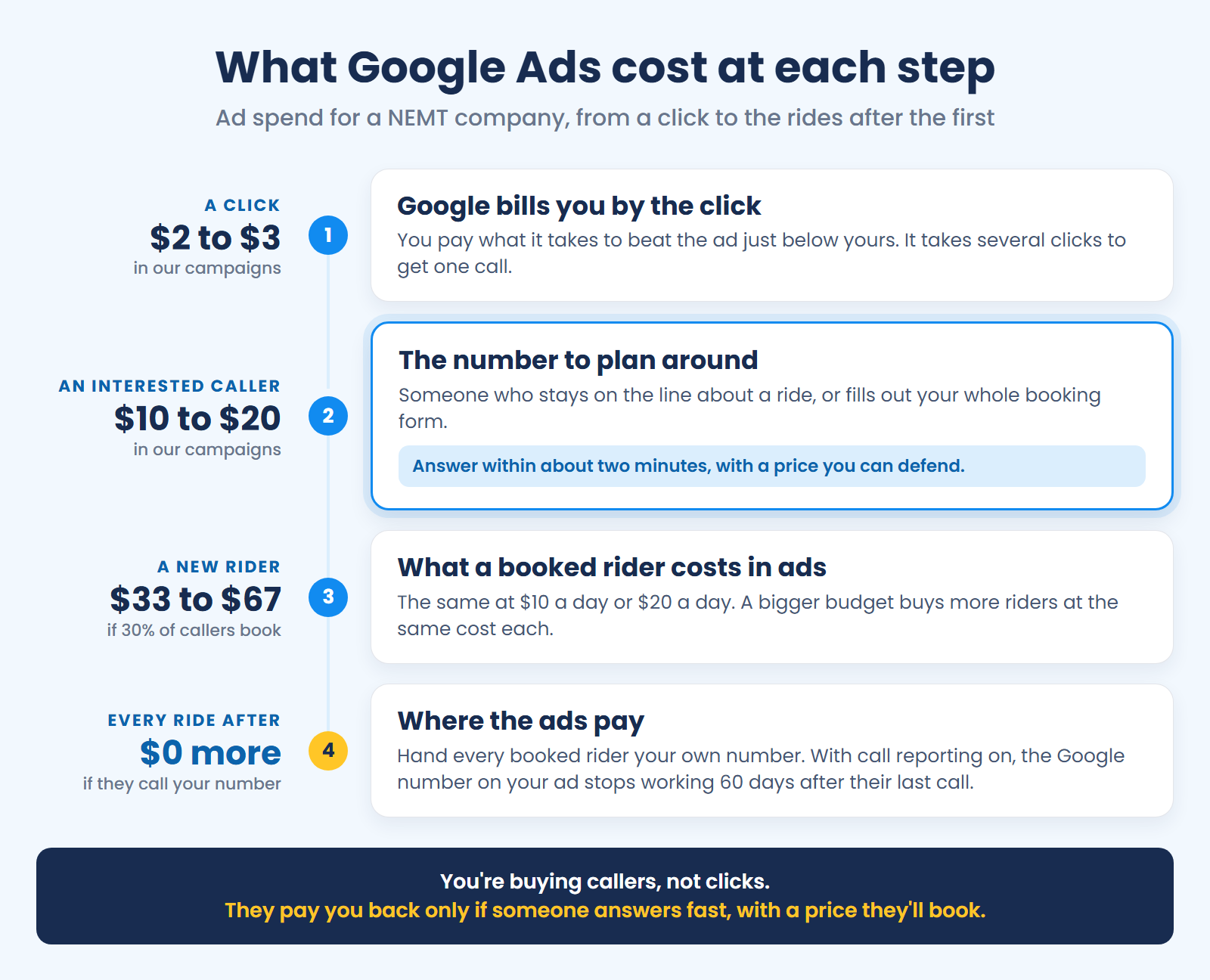
A click in our campaigns usually runs $2 to $3, and it takes several clicks to get one interested caller, at about $10 to $20 of ad spend. Those are the numbers I gave Josh Hagen of Careway Mobility on our podcast in September, “broadly generalizing nationwide,” when he asked which growth levers work fastest. For an empty van, Google Ads are “the single fastest thing you can do.” In the DC, Maryland and Virginia metro, private-pay calls from our campaigns come in at roughly $10 to $15 each, eyeballed rather than benchmarked.
Your bid is the most you’ll usually pay for a click, and you often pay less: Google charges what it takes to beat the ad ranked just below yours (Google’s explanation), so the harder others bid on a search, the more each click costs. Google’s Keyword Planner puts “the average amount you might pay for a click” higher nationally: about $4.64 for “wheelchair transportation” and $5.94 for “medical transportation,” averaged over the 12 months to September 2026. If your clicks cost closer to that, expect each caller to cost more than $10 to $20 too, so look up your own city before you set a budget.
By an interested caller I mean someone who stays on the line long enough to talk about a ride, or who fills out your whole booking form. Google Ads can count a call as a conversion once it passes a minimum length you set (Google on call conversions), so the 10-second hang-ups don’t count. Set that minimum around a minute.
What has to be in place before you spend?
Four things, and I tell owners what I told Josh: “I will not take your money for Google Ads” until they’re in place.
- A page for each service, with a phone number people can tap. The site has to look trustworthy to someone clicking in, with a number they can tap to call. Send the wheelchair ad to a wheelchair page and Google will like it. In Google’s words, “Higher quality ads can often lead to lower CPCs” (costs per click), and the quality it judges includes the page your ad sends people to (how Google ranks ads). The rest of what the site needs is in what families check on a NEMT website.
- Call tracking. Google needs to learn which clicks turned into calls and which didn’t, so it can adjust the ads. With call tracking on, Google swaps the number on your site for a Google forwarding number, only for people who clicked your ad, at no cost to you (Google on website call tracking). Google Tag Manager is one way to set it up.
- Someone who answers. If a call goes to voicemail and nobody calls back within about two minutes, I guarantee that caller is booking with someone else. Mac, one of The Doctor Ride’s founders, said the same on our episode with him and Ray: “They’re calling someone else immediately.” If nobody can answer at night, run the ads only during the hours someone can, which is what Google’s ad schedule is for. If you’re out driving, roll the line to a backup that takes the booking, not a voicemail box.
- A price you can defend. If you’re well above the market, someone on the phone has to explain what the caller gets for that rate; otherwise, price in line with your competitors. Owners running a premium service sometimes take 10% to 15% off the first ride to get a caller to try them. How to set the price itself is in our guide to NEMT private pay.
Then check that your market is big enough. Harry Chambers, a digital marketing expert, puts the line for ads at about a million people in your service area, because a market that size is how you “get consistent rides through Google.” In a smaller market, ads can still bring the wheelchair riders transit can’t carry, just more slowly.
With all that in place, the budget is arithmetic.
How much should you spend the first month?
Budget for at least 30 interested callers in your first month. At up to $20 a caller, that’s about $20 a day. Google treats a daily budget as an average: a busy day can spend up to twice it, but a month never goes over 30.4 times it (Google on daily budgets). So $20 a day tops out at $608. $10 a day can work as a start, but it caps the month at $304, about 15 to 30 callers, which is thin for judging anything.
That’s about where the starting advice I trust lands. On our 2025 private-pay episode, Harry suggested 60 to 90 days at $20 to $25 a day. Lana Becker, whose team ran the Google Ads for Paul Muench’s company in Phoenix, told us on our episode about getting found online she’d start at “$300 to $500 and then scale up.” Paul’s spend grew from $300 to about $1,500 a month, and she said a lot of his business was coming from Google Ads. Plan to keep it up for 60 to 90 days, about $1,200 to $1,800 at $20 a day, before you judge more than the cost per caller.
Here’s what a month buys at each budget. Say 30% of interested callers book. That’s the share The Doctor Ride aims for with its premium pricing: “I want 30% of people to say yes to our pricing,” Mac told us. Better yet, count your own: of the private-pay calls you already get, how many book?
| Daily budget | $10 a day | $20 a day |
|---|---|---|
| Most Google can charge in a month | $304 | $608 |
| Interested callers, at $10 to $20 each | 15 to 30 | 30 to 60 |
| New riders, if 30% book | 5 to 9 | 9 to 18 |
| Ad spend per new rider | $33 to $67 | $33 to $67 |
Those are ad dollars only. If someone else runs the ads, add their fee.
So a new rider costs about $33 to $67 in ad spend at either budget, and a bigger budget buys more riders at the same cost each. My cofounder Jing has seen a short wheelchair trip, four or five miles, priced from $35 one way, mostly by providers stuck on old contracts, up to $75 or $90 depending on the market. At $75 to $90 a leg, a round trip brings in $150 to $180, so a new rider’s ad cost is about a fifth to under half of that first round trip.
The money is in what that rider books next. Every ride after the first costs you nothing more in ads, as long as they call your own number instead of clicking your ad again. Google Ads riders aren’t cheap to win, but as I said in an interview on Te’ya Miles’s channel in May, they bring “a lot of private pay volume,” and they write Google reviews and tell their friends about you.
So hand every booked rider your own number, on a card in the van or in the confirmation text. With call reporting on, the number on your ad is a Google forwarding number, and it stops connecting calls to you 60 days after a caller’s last call (Google on forwarding numbers).
Which searches should you bid on, and which should you block?
Bid on the services you actually run, in the words families type, and block the searches from people who won’t pay you privately: Medicaid and broker names, free rides, jobs, how-to-start questions and rideshare brands. Keyword Planner counts about 4,400 searches a month nationally for “wheelchair transportation,” 5,400 for “medical transportation near me” and 3,600 for “senior transportation.” A negative keyword does the opposite of a bid: it tells Google not to show your ad when a search contains that word.
Medicaid is the big one to block. Keyword Planner counts about 8,100 searches a month for “medicaid transportation,” nearly twice the “wheelchair transportation” count, and estimates a click on either at about $5 ($5.16 and $4.64). Google Ads are for private-pay riders and the families booking for them. A Medicaid rider’s trip usually goes through the state’s broker or the health plan, so a caller looking for that ride can’t book it with you directly. Facility accounts are different again: they come mostly from calling and visiting the nursing homes and hospitals themselves, as in our guide to NEMT facility contracts.
Dialysis is the same story as Medicaid. Keyword Planner shows about 320 searches a month for “dialysis transportation” across the whole country, and in my experience most dialysis riders are on Medicaid, so their trips come through the broker. Don’t build a campaign around it.
A Virginia company walked through its Google Ads setup on an industry podcast in August. The co-owner who handles its marketing said bidding on loose matches buys clicks from people typing “medical transport jobs” and “free medical transport.” So they bid only on exact matches and block Medicaid: “I already know I’m going to lose 10 bucks if I get that click.” He called negative keywords “the biggest lifesaver of any campaign I’ve ever run,” and with a weekly review, he puts their wasted spend at “less than 2% now.”
Google won’t stretch a negative keyword to cover its synonyms or plurals, so add both forms of a word you block, such as “job” and “jobs.” Misspellings are covered for you (Google on negative keywords). A starter list:
- Medicaid and the brokers: medicaid, medi-cal in California, and your area’s broker and health-plan names.
- Free and low-cost rides: free, volunteer, volunteers, and the names of local ride programs.
- Jobs and startups: job, jobs, hiring, driver, drivers, how to start, business, certification.
- Other rides: uber, lyft, 911, air, and stretcher, stretchers and gurney if you don’t run stretcher trips.
Then read the search terms report once a week. It shows the actual searches that triggered your ads, and each one you don’t want becomes a new negative. It leaves out searches made by too few people (Google on the search terms report), so some waste never shows up there. Even with Medicaid blocked, a few callers will still ask for a Medicaid ride, so ask every ad caller early on how they plan to pay.
How long before you know if it’s working?
Calls can start in the first week. Give it a month before you judge what a caller costs, two to three months for a first read on whether the ads pay, and a year before you judge the return.
Google reviews most new ads within one business day, as long as the page the ad points to is complete (Google on ad review). Start on a Monday, and Google’s system is usually set up by Thursday or Friday. Its automatic bidding then takes a while to learn which clicks turn into calls, and Google says changes like adding or removing keywords restart that learning (Google on the learning period). So keep adding negatives every week, but make bigger changes, like new keywords or a new bidding setting, one at a time.
The return takes longer than the calls. Harry’s advice was to judge it “from an annual perspective,” because “even though someone sees your ad today they may convert the next month.” So check in on this schedule:
- Week 1: calls are coming in, and the search terms match the searches you meant to buy.
- Day 30: divide what you spent by your interested callers. $10 to $20 is on track.
- Days 60 to 90: count your new riders and the rides they’ve booked since, against everything you’ve spent. That’s a first read.
- The first year: judge the return over the full 12 months, as Harry advises.
What makes a caller cost more, or book less?
The service people search for sets what a click costs, and the kind of caller sets how many book.
Stretcher searches cost more per click. Google’s Keyword Planner estimates “stretcher transportation” at about $9.42 a click nationally, about double “wheelchair transportation.” The Virginia co-owner is willing to pay about $3 for an ambulatory click, “seven, eight bucks a click” for wheelchair, and “considerably more” for stretcher, “because the revenue’s … considerably greater.” Paying more for a click is fine when the trip pays more.
The Aurora test’s stack of calls came from people expecting a rideshare price. At The Doctor Ride, Mac described the hard customers as “the people who are trying to pay $25 for a ride like they’re trying to compare you to Uber.” Your booking rate tells you whether your price fits the callers you’re getting. As I said on our episode with Te’ya Miles, the Atlanta operator behind That NEMT Girl, if every caller who hears your price books, you’re probably underpricing. Raise it until some of them say it’s too expensive and they’ll use Uber.
Do Facebook ads work for NEMT?
Facebook ads don’t replace search ads for NEMT. Google shows your ad to someone typing “wheelchair transportation” today. Facebook shows it to an audience you pick, whenever it gets a chance to show them an ad (Meta on how ads are delivered), whether or not they need a ride that day. Lana put it simply: “your number one place to really get those new customers is going to be like Google, people who are searching for your services.”
A free Facebook or Instagram page still earns its keep, because the person booking is often a grown child. Te’ya made that point on our episode: the grandmother in the wheelchair isn’t the one scrolling Instagram, her daughter is, and the page costs nothing.
If you try Facebook ads anyway, keep the test small and judge it the same way, by cost per interested caller. As of October 2026, Meta can also put a health-related website into its “Health and wellness” category, and it can restrict a site there from sharing “specific mid and lower funnel events,” the actions you’d want your ads to produce (Meta on data-sharing restrictions).
Should you run the ads yourself or hire someone?
Run them yourself if you’ll open the search terms report every week. If you won’t, hire someone who shows you the cost per caller and the search terms every month.
Harry’s take was that “there’s always DIYers,” and if marketing is something that “piques your interest, you’re probably going to end up DIYing it.” The Virginia company runs its own ads, and the co-owner who handles marketing reads the search terms himself every week. If your whole monthly ad budget is smaller than a management fee, run it yourself and keep the weekly check to one sitting.
Whoever runs them, ask for three things every month: what you spent, how many calls passed your minimum length, and the search terms your ads showed for. A complaint we hear from owners is that a past ads vendor ran their ads for three months and never showed them a single number.
Running the ads is the part we do for owners. Duet runs Google Ads for NEMT companies: we build the campaign, negative keywords included, watch what each inquiry costs, cut what wastes money and show you what you spent and what came in. Management starts at $200 a month plus your ad budget, which goes straight to Google. The $400 setup fee is waived for Duet software customers, and it’s month-to-month. You still approve the direction, take the calls and quote the price. On Duet’s dispatch software, the trips the ads bring in land on your dispatch board, with an AI agent that answers the calls you miss.
If your day-30 number comes out well above $20, check your end of the phone before you blame Google: the calls that rang out. If the calls come but few book, check the price you quoted. The Aurora test brought plenty of calls. One of them booked.
FAQ
Can you still run call-only ads on Google?
Not new ones. In a notice dated October 3, 2025, Google said call-only ads are being replaced by regular search ads with call assets, the phone number or call button you attach to a search ad. Under that schedule, the option to create a new call-only ad went away in February 2026, and existing ones stop showing in February 2027. Add your number to a search ad as a call asset instead.
Do Google’s Local Services Ads work for NEMT?
Not as of October 2026. Google’s list of Local Services Ads categories for the United States has no medical or passenger transportation category, so regular Google Ads are the paid route on Google.
Can you retarget people who visited your website?
Don’t count on it. As of October 2026, Google’s personalized advertising policy treats health as a sensitive category, including “Disabilities, even when content is oriented toward the user’s primary caretaker,” and advertisers in a sensitive category “can’t use advertiser-curated audiences,” such as lists of your own website visitors. Whether that applies to your ads is Google’s call, so build the plan on search ads.
Should your ads reach people searching from outside your area?
Usually, yes, as long as the ride itself is in your area. Google’s default location setting, “Presence or interest,” reaches people in your area and people elsewhere who have shown interest in it, such as a daughter in another state booking her father’s ride. The “Presence” setting alone would miss her.
About the author
James O'Donnell cofounded Duet and leads its sales, partnerships, and growth services. He talks with NEMT operators every week, hosts the NEMT Growth podcast, and answers Duet's sales line himself. More about Duet's founders →
Want more trips and less busywork?
See how Duet runs and grows NEMT businesses in a 30-minute demo.