
Article
How to Run a NEMT Business: Dispatch, Drivers, Vans, Money
Every NEMT trip is service wrapped around a drive. Here's how to run the business so each one shows up on time and gets paid.
By James O'Donnell, Cofounder and COO, Duet · · Updated
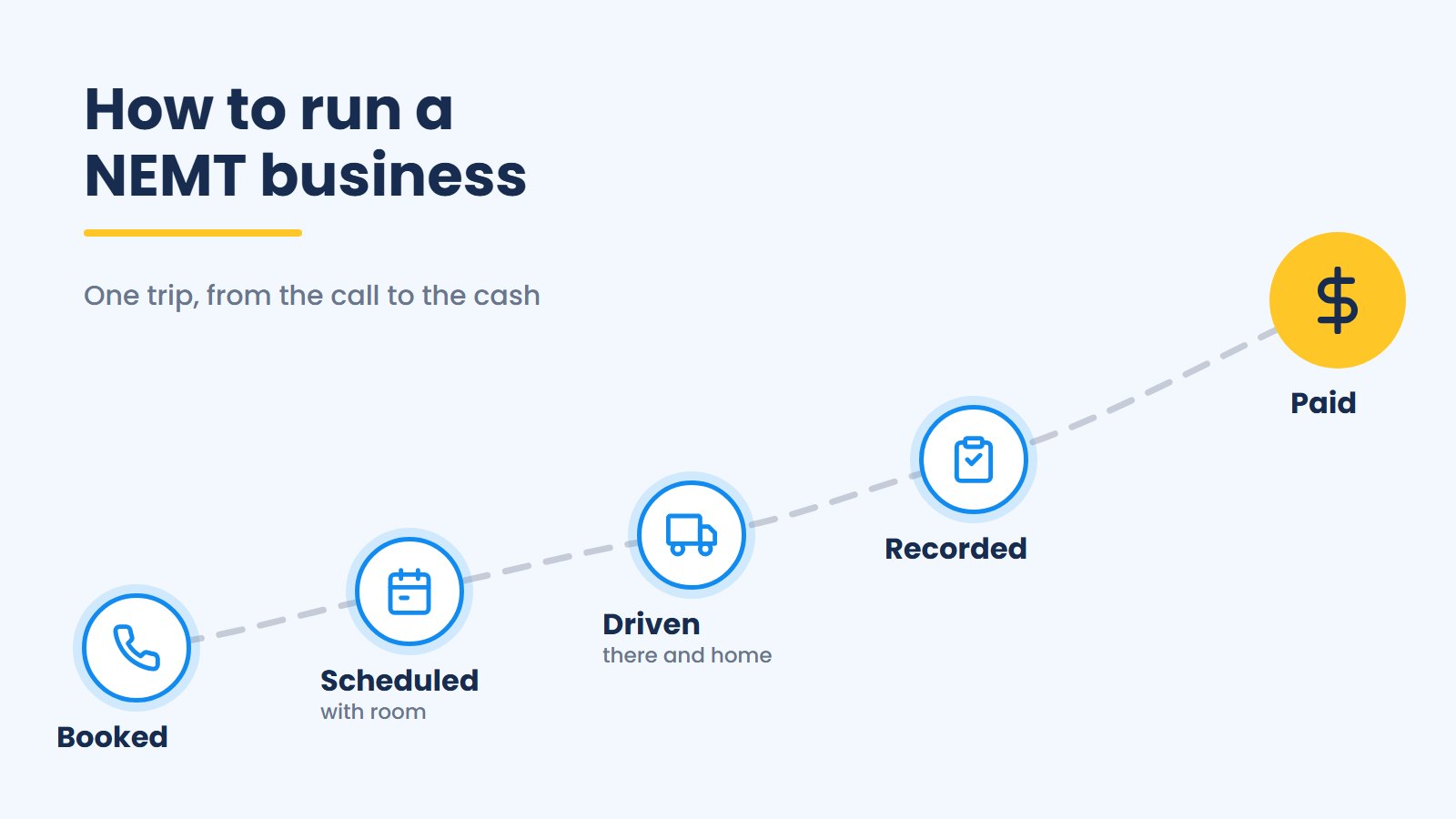
Running a NEMT business means getting every trip from the booking call to the payment on time. Book it with what the driver needs to know, and leave room in the schedule so one late pickup doesn’t make the rest of the day late. Keep credentialed drivers and inspected vans on the road. Then record the trip the way its payer requires, and get paid on that payer’s clock.
The owners I meet who stay in business treat on-time as the product. They leave room in the schedule instead of packing it, and they know what a trip costs before they chase more trips. I do demos with NEMT owners most days and host Duet’s podcast, and my cofounder Jing Zhu takes a dispatch shift for a customer every week.
This guide starts with one trip: how it gets booked, what it costs you, how it fits the schedule and how the rider gets home. Then it covers what keeps every trip on time (dispatch, drivers, vans and insurance), then the record and the money, and the numbers to check every morning and every Monday. If you haven’t run your first trip yet, start with how to start a NEMT business. If you’re getting ready to sell, read what a buyer pays for when you sell.
The short version:
- What you sell: on-time trips. A short wheelchair trip is 30 to 45 minutes of service around a few miles of driving.
- The cost: divide last month’s costs by last month’s completed one-way trips before you add volume or sign a rate card.
- The schedule: full enough to cover the van’s costs, with room so one late pickup doesn’t make every pickup after it late or keep the driver into overtime.
- Who dispatches: you, at first. Plan on a dispatcher somewhere between two and four vehicles.
- Drivers and vans: if you run broker trips, the broker’s rules are the floor. Set your own bar above them.
- The money: families pay before the ride, brokers after a clean claim (one with nothing missing), facilities on invoice terms.
- The numbers: each vehicle’s booked revenue every morning, five numbers every Monday.
What does a NEMT business actually sell?
A NEMT business sells on-time trips, and a short wheelchair trip is mostly service, not driving. In her talk on NEMT dispatching, Jing described a caller who balked at $85 for a wheelchair trip: “What? It’s only three miles.” But the driver parks, goes into the room, wheels the rider out and loads them, then drives, parks, unloads and takes the rider into the clinic. “It’s not three miles, it’s… 30 minutes to 45 minutes,” she said.
So count a van’s day in service time. Every payer is paying for that service to show up on time. Rachel Scholler, who built and sold a rural Wisconsin NEMT company, called it “the entire premise of the business” on our 2025 episode on growing a profitable NEMT service.
Brokers put their bar in writing. MTM’s Virginia handbook, approved August 10, 2026, wants on-time performance above 95%, and a provider who falls short can get a performance improvement plan, liquidated damages (penalties set in your contract) or removal from the network. Modivcare’s Mississippi manual (February 2024) expects 98% on every trip leg. Facilities and families don’t write a number down, but they grade you too:
| Payer | Who’s watching | The bar | What late costs you |
|---|---|---|---|
| Broker | The broker | A written on-time rate, usually 95% or higher | A performance plan, penalties or removal from the network |
| Facility | The nurse and the front desk | Whatever you promised | They stop calling you |
| Family | The rider and whoever booked the ride | Whatever you promised | They book someone else next time |
Marqus Johnson, a Tampa operator who coaches other owners, put the facility side bluntly on our podcast: “one bad transport can destroy an entire contract.” On private pay, families will drop you if you show up 30 minutes late.
How does a trip get booked?
Every booking, whoever pays, should end with what the driver needs: the mobility aid, the rider’s weight, the stairs at both ends and when the ride home is.
On a discharge, Jing first asks whether the rider has a wheelchair, because riders often reach the ER in little more than pajamas. Finding out at the bedside costs “an additional 20 minutes,” she said. Ask the rider’s weight, too: stretcher and wheelchair riders can weigh 300, 400, even 500 pounds, Jing says, and not every provider can carry them. On a stretcher trip, ask about oxygen: one customer lost an $800 trip because the rider needed more than the van carried.
Then it depends on who pays. Broker trips come from the broker, the company a state or health plan hires to hand out Medicaid rides. In Virginia, MTM’s 2026 handbook has it send trips to providers seven days before the appointment.
Facility staff call you or book through a portal. Some facilities need no confirmation call, and with others, one call to the front desk confirms all of that day’s trips.
Families call around, so pick up. My rule of thumb: if it goes to voicemail and you don’t call back within about two minutes, they’re booking with a competitor. Take a card at booking and charge it at least 24 hours before pickup, or send a payment link due a day ahead. No payment, no car.
The day before the ride, confirm each trip the way its payer allows.
Does each trip pay for itself?
Know what a trip costs you before you chase more of them: last month’s total costs divided by last month’s completed one-way trips.
Paul Muench, who runs Gentle Turns Transportation in Phoenix and has an accounting degree, made the case on our 2025 NEMTAC panel. Count a round trip as two trips: “It’s an A leg and a B leg.” Then “get a price per ride so that you can understand if your… cost is more than your revenue.” If it is, he said, “You’re not going to make that up with volume.”
On a call in July, a founder planning a broker-heavy launch in Southeast Michigan asked me what I’d recommend. My answer was to add up what you’ll pay the driver, for gas and for vehicle maintenance, plus all the other hidden costs, and compare the total with what the broker pays. Count the insurance and the van payment too.
Then set your number against what each payer pays for the trip. For scale, MTM’s Rhode Island rate schedule pays $41.00 for a 10-mile daytime wheelchair trip (rates effective July 1, 2023). If a payer’s rate comes in below your cost per one-way trip, that payer’s trips lose money on average. Do the math before you sign the next rate card, and before you decide how full each van’s day should be.
How full should the schedule be?
Fill each van’s day enough to cover its costs, but leave room so one late pickup doesn’t make every trip after it late.
When I asked Rachel about filling the schedule end to end, she said, “I never want to pack the schedule to be busy for the sake of being busy.” Rushed drivers start speeding, she said, or “forget to put the fourth tie down on the wheelchair.” She put her on-time rate at “probably about 97 to 98%.” Her book was mostly fixed routes for county day programs, which she found easier to schedule than one-on-one broker trips.
Paul said any on-time trouble they’ve had at Gentle Turns came when “we have gotten a little too aggressive in scheduling.”
The rule I give owners, especially on private pay, is a little downtime in each van’s day. It doubles as catch-up time. Without it, one late trip sets off a chain reaction, and every rider later in the day gets picked up late. The other cost lands on payroll: when a packed day runs late, drivers stay well past the end of their shifts, and you pay the overtime. Don’t fill those gaps with a low-paying trip.
The diagram below is an illustration, not anyone’s real schedule: one van’s day, with the same delay on the second trip. On the packed day, seven trips fill every slot, so the delay makes every later pickup late, and the last trip runs past the end of the driver’s shift. With room, the van runs one fewer trip and keeps a gap right after the second trip. The gap absorbs the delay, so every pickup after it stays on time and the driver finishes on time.
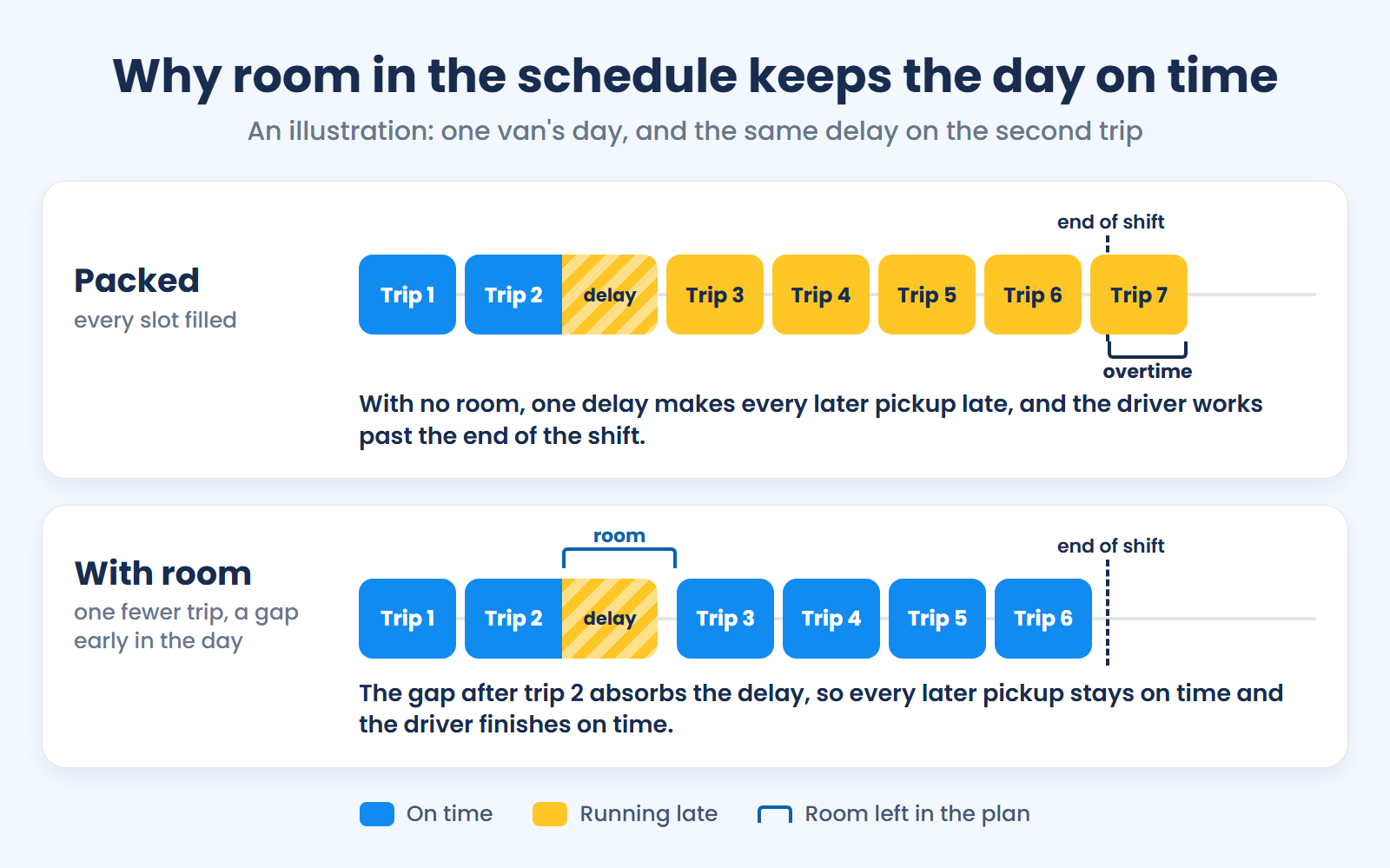
A tight schedule has its place. Running with no downtime can work well for broker trips without a lot of same-day work, and a 20-van broker shop needs enough volume that the small margin on each trip adds up. The broker still keeps score, though. And gaps can get too big: Rachel checks a schedule for “too big of gaps in the day.” Room is for catching up after a late pickup, not for idle vans.
This week, find a gap early in each van’s day that could absorb a 30-minute delay.
How do you handle will-calls and the ride home?
Plan the ride home when you book, and call ahead the moment it’ll run late. A will-call is a ride home with no set pickup time: the rider or the clinic calls when the appointment ends.
Jing calls will-calls the most stressful part of dispatching she’s handled, because “everybody want[s] to go home at the same time.” With only so many vans, someone decides who goes first. One of our customers gives the ride home to whoever calls first.
The clock for the ride home depends on the broker and the state, and it starts with the call. MTM’s 2026 Virginia handbook allows 45 minutes from the notice that the rider is ready, and three hours on a hospital discharge, where missing the window brings liquidated damages. In New York, where MAS has been the Medicaid ride broker since 2023, MAS’s 2023 manual allows an hour.
Facilities and families run on what you promised them. Paul gives riders his card and waits at a coffee shop nearby. He’s back “always within 10 minutes” of the call. If you’ll be late anyway, say so first. Tony Jackson, a Florida operator with 35 years in the business, said it on our facility contracts episode: if you’re running late on a discharge, “call the hospital. Let the bedside nurse know.” And leave a gap in at least one van’s day for the hour your will-calls usually land.
The ride home gets decided on the board, which is what NEMT dispatch software is for. Duet puts every vehicle, driver and trip on one live board with a live map, so when a will-call lands, you can see where every van is. The assignments stay with your dispatcher, so you still decide who goes first and make the call when a ride home will be late.
When should you add a dispatcher?
Add a dispatcher somewhere between two and four vehicles, once dispatching starts competing with driving. That’s where I see owners start to feel the pinch, when texting drivers where to go stops working.
Getting out of the van doesn’t get you out of dispatch. An owner near Orlando with two vehicles told me on a call in June that she doesn’t drive, but “I just do the dispatch and the scheduling and the billing,” off her own cell phone. Rachel had 14 to 15 vehicles on the road every day, built the schedule herself and couldn’t take a vacation.
Jing splits the job in two. Scheduling is what you do the day before. Dispatching is the same-day adjustment, when “things can change”: a driver stuck in traffic, a flat tire, a no-show, a rider who comes out 15 minutes late. She learned the timing the hard way the first time she dispatched for a customer, a favor that grew into Duet’s dispatching service. The customer had two stretcher vans, and Jing didn’t know how long a stretcher takes to load and unload. “By around noon time, we were an hour behind,” she said. By afternoon, one trip was three hours behind.
So the first step is getting the plan out of your head. An Atlanta operator who coaches other owners said in a 2023 video that she tries to get the next day’s rides entered by 4 p.m. so her dispatcher can assign them by 6. Whoever takes the board doesn’t have to sit in your office, either. In Duet’s own survey of more than 100 NEMT providers, more than half use remote dispatchers. If you’d rather not hire and train one yourself, Duet’s remote dispatching service puts a trained NEMT dispatcher on your board, inside your own Duet account.
How do you hire drivers, and keep them?
Hire drivers who can handle the whole trip, because a rushed or untested driver is where late pickups and skipped tie-downs start. Test candidates on a real ride, and hire the next driver once you’re turning down trips every couple of days, which was Rachel’s signal to hire.
If you run broker trips, the broker sets the floor, and it varies by broker and state. MTM’s 2026 Rhode Island handbook wants drivers who are at least 21, with no license suspension for moving violations in the past five years. It also requires a criminal background check before hire and every year after, plus random drug screens covering more than 25% of drivers a year. Modivcare’s 2024 Mississippi manual lets drivers start at 18.
That’s the floor. Rachel’s bar sat well above it. Her rule was “slow to hire, quick to fire.” She usually held two interviews and let candidates ride along for half a day at her cost, “so they could actually see what the job entails.” Most of her core drivers stayed five to eight years. To keep them, she said, “you want to pay somebody a fair wage to begin with,” and she made room for long vacations. I’d also make the application take some work, so the super lazy bounce off it.
The median wage for shuttle drivers and chauffeurs, the federal job category that includes nonemergency medical transporters, was $17.93 an hour in the Bureau of Labor Statistics’ May 2025 survey. Your town’s going rate may differ, so check local postings before you set yours. Marqus pays a base rate plus a share of the facility business a driver brings in, as he explains in his episode on paying drivers to win facilities.
How do you keep the vans running?
Check every van before every shift, and line up a backup before the day one is down.
Each broker writes its own inspection rules. MAS’s 2023 New York manual requires providers to document a driver’s inspection of each vehicle before every shift. Modivcare’s 2024 Mississippi manual won’t pay for a trip in a redlined van, one that failed inspection and didn’t pass a re-inspection within 10 days.
Michael Shank, who sells and converts wheelchair vans and arranges financing, said on our first episode, on choosing NEMT vans, that a minivan on “a very diligent maintenance program” can probably reach 150,000 miles. Without one, transmission trouble tends to start past about 100,000, and replacing a transmission ran $3,000 when we spoke in 2025.
For the day a van is down, Rachel started with two vans so she’d have a backup, “but then you’re paying the insurance on both vehicles.” Later she always kept two or three spares, because the worst thing she could tell a rider was “oh you had surgery today but we have a flat tire. I’m sorry.” A spare costs insurance, so a smaller fleet can trade overflow instead. Paul sends trips to a couple of trusted providers in Phoenix, and they sometimes send trips back.
When should you start your insurance renewal?
Start your insurance renewal 90 to 120 days out, and report every incident with a rider aboard the day it happens.
John Kecskes, who sells NEMT insurance, put the renewal at “90 to 120 days out” on our insurance episode. A lot of owners just send loss runs (their claims history) and a vehicle and driver list, which he calls “quote and pray.” He’d rather tell the carrier the full story: the safety steps in place and what’s improved.
He wants a note “after every transport, even if everything went perfect,” because claims can surface months later. Report anything with a rider aboard right away, since “late reporting usually leads to higher reserves and just worse outcomes.” Reserves are the money an insurer sets aside to pay a claim. Some carriers give small discounts for cameras, 1 to 3 percent in his experience, but cameras pay for themselves “the first time a claim happens.”
Rachel’s rushed driver who skips the fourth tie-down is the safety risk that room in the schedule guards against. For premiums and when to bind a policy, see our guide to what NEMT insurance costs. And put your renewal date on the calendar today, with a reminder 120 days before it.
When does the money come in?
Families pay before the ride, brokers after a clean claim, and facilities on invoice terms, often a month or more after the trip. Payroll doesn’t wait for any of them, so every new facility account means more payroll paid out before its first check arrives.
On a broker trip, nobody pays until the trip record is complete. Under MTM’s 2026 Rhode Island and Virginia handbooks, if any required field in the electronic trip log is missing, “the claim will be denied.” The COO of a Detroit-area NEMT company told me on a demo that when the electronic signature fails, the driver gets one on paper, “because that’s the only way we would get paid.”
| Payer | What the record must show | When you’re paid |
|---|---|---|
| Family | The payment itself, taken before pickup | Before the ride |
| Facility | An invoice on the terms you agreed | On your invoice terms, often a month or more after the trip |
| Broker | Every field the broker’s trip log requires, such as pickup and arrival times and the rider’s signature | After a clean claim, on the broker’s pay schedule |
Before a broker claim goes in, check every completed trip for the fields your broker requires; for MTM in Rhode Island and Virginia, that’s the trip ID, the scheduled and actual pickup times, the departure and arrival times, and the rider’s signature. Then know your broker’s pay schedule. Modivcare’s 2024 Mississippi manual, for one, pays twice a month, within 30 days of receiving the invoice. It pays 10% less if you invoice more than 60 days after the ride, and nothing after 120.
On facility invoices, Tony Jackson bills twice a month on net 30 (due 30 days after the invoice) plus a 15-day grace, so about 45 days. Hospitals, he says, pay in 15 days.
Facilities can also fall behind. On an operator community call I sat in on in September, an owner in North Texas with about 30 vehicles said a facility paying months late “happens all the time.” He sets credit limits, $3,000 or $5,000 depending on the company and how long it’s been in business, and puts buildings over the limit on hold. As one of their top two providers, he usually gets paid fast. With only a couple of facility accounts, put the limit in writing before the first invoice, as part of the payment terms you set with each facility.
Which numbers should you check every day and every week?
Every morning, check each vehicle’s booked revenue for the day against its daily target. Every Monday, pull five numbers from last week: late trips by payer, trips you turned down, quotes that didn’t book, no-shows by payer, and what each payer owes you.
The one number I’d check every day is revenue booked for that day, per vehicle. Give each vehicle its own daily revenue target: higher for a Ford Transit that can carry a stretcher, lower for a sedan. In Duet, each vehicle’s booked revenue shows at the top of the calendar view.
When a vehicle keeps missing its target, look at its schedule. If the day is already packed, the trips pay too little, so raise your prices. If broker trips aren’t paying enough, go after more private-pay trips: Google Ads put you in front of families searching for a ride, and Duet can run them for you. If the day has big gaps, send the driver out to fill them. Pick specific healthcare and residential facilities nearby, and have the driver drop off flyers or business cards at each front desk, with a box of cookies and a friendly sticky note on it saying who it’s from.
The Doctor Ride’s founders built their weekly list from the sales side. When they came on the podcast in June, they ran two vans in Charlotte with no broker work. On their episode on building a NEMT business from day one, they walked me through it: calls and form fills, open quotes in dollars, rides booked and completed, and “how many rides have we lost,” with the reason for each.
That’s a sales list, so add on-time, which your broker may already track: MTM’s Q4 2024 scorecard for Rhode Island lists each provider’s late percentage, and Modivcare’s 2024 Mississippi manual says it reports each provider’s timely pickups monthly. Keep your own.
| Number | Why it matters | What to do when it moves |
|---|---|---|
| Late trips, by payer | Brokers score it; facilities and families leave over it | Find the van and the hour where lateness starts, and add room there first |
| Trips you turned down, and why | Demand you couldn’t serve | Turning trips down every couple of days: hire a driver. First van close to full-time: hire a full-time driver, then buy a second van. Rerun your cost per trip with the new van’s payment and insurance first |
| Quotes that didn’t book, and why | Whether you lose families on price or on capacity | Lots of no’s on price: look at your price. Lots of rides you couldn’t fit: look at another vehicle |
| No-shows, by payer | Each payer handles a no-show differently | Check how those trips were confirmed |
| What each payer owes you, and how old it is | Facilities can fall months behind | Call before a balance passes your terms, and hold a building at its credit limit |
Start next Monday with late trips. Pull last week’s late pickups, will-calls included: count the rides home that waited past the broker’s will-call window (45 minutes in MTM’s 2026 Virginia handbook) or past what you promised the family or the nurse. If one delay keeps making the rest of a van’s day late, the fix isn’t a faster driver. It’s room in the schedule.
Running a NEMT business: FAQ
How many trips can one van do in a day?
Two real operations put it at roughly four to nine trips a van. The Doctor Ride’s founders, whose premium private-pay work includes waiting through procedures with the rider, said they run about two round trips per van per day, or about four one-way trips. An owner near Orlando told me on a call that her two vehicles run 10 to 18 trips a day between them. Plan with the 30 to 45 minutes of service that Duet cofounder Jing Zhu counts for a short wheelchair trip, instead of a benchmark.
Can you run a medical transportation business with one van?
Yes, but there’s no spare, and the day the van is in the shop is the day the calls come. A one-van owner in Northern California told me on a call that while his van was in for warranty work, two places called with trips. “When I have my van not available is when I get calls for trips.” My advice was to make friends with another small operator in your area and pass trips back and forth.
Do you have to take every trip a broker offers?
No, but handing a trip back has rules. MTM’s 2026 Virginia handbook expects you to hand back a trip you can’t run at least 24 hours before pickup. Under Modivcare’s 2024 Mississippi manual, if you don’t give 24 hours’ notice and Modivcare has to arrange another ride, you may owe the extra cost, which it can deduct from your payments. SafeRide, a ride vendor for Medicaid health plans in several states, lists a 95% ride acceptance rate among the performance standards on its provider page, as of October 2026.
All operations guides
Dispatch and scheduling
- How to Reduce NEMT No-Shows (and Prove the Ones You Can't)Who pays for a NEMT no-show, how to confirm broker, private-pay and facility trips so fewer happen, what a normal rate is, and how to prove the rest.
- The Trip You Haven't Booked YetThe messiest part of NEMT dispatch deserves its own feature: how Duet's Reservations helps dispatchers handle interruptions and price shoppers.
- Do You Dispatch Or Schedule?Scheduling vs dispatching: planning trips in advance vs adjusting them live
Hiring, training and paying drivers
- Driver Management Made EasySchedule shifts, track clock-in/out by GPS, manage appointments, and automate payroll reports — how Duet makes NEMT driver management effortless.
Vans, equipment and upkeep
- The EASIEST way to Cash In on Stretcher TripsBroda's Ed Bandas on the Traversa chair — switch between wheelchair and stretcher modes to unlock dual-service trips in any state.
- How the largest EV fleet in NEMT saves money with electric vehiclesLEAP Institute's Rey Leon on running the largest electric-vehicle fleet in NEMT — operational benefits, cost savings, and what scales (and what doesn't).
- How to pick the best NEMT vehiclesChoosing and financing NEMT vehicles with industry vet Michael Shank: full-size vs minivan, new vs used, rear vs side entry, and lease/loan tradeoffs.
Insurance, safety and compliance
- How to Lower NEMT Insurance PremiumsCommercial broker John Kecskes on cutting NEMT insurance costs: underwriting factors, claims management, telematics discounts, and renewal-timing strategy.
Costs, margins and cash flow
- The $20,000 NEMT Trip — How to Do Long DistanceJeanine of SailorGirl Transport on multi-day, cross-state senior moves: vehicles, crews, regulations, pricing, and referral sources for long-distance NEMT.
- High-Volume vs. High-Margin NEMT: Choosing the Right Business Model for Your own companyLearn whether a high-volume or high-margin NEMT business model is right for you — and how to build your entire operation around a clearly defined strategy.
- How to PRICE NEMT trips to maximize revenuePodcast from Duet: How to PRICE NEMT trips to maximize revenue.
- 30% margin and more: how to profitably grow an NEMT serviceRachel Scholler on profitable NEMT growth: pricing vs volume, picking trip sources, trimming overhead, and using driver retention as a hidden margin lever.
- Fuel cards for NEMT fleetsKhalid El-Awady of CarIQ Pay on fuel card discounts and fraud prevention
- Reporting And Billing Are Vital To Your Cash Flow ManagementWhy billing and reporting are vital to NEMT cash flow. Cover costs, balance high-margin trips, and accelerate invoice-to-payment with the right software.
About the author
James O'Donnell cofounded Duet and leads its sales, partnerships, and growth services. He talks with NEMT operators every week, hosts the NEMT Growth podcast, and answers Duet's sales line himself. More about Duet's founders →
Want more trips and less busywork?
See how Duet runs and grows NEMT businesses in a 30-minute demo.