Article
How to Dispatch NEMT Trips: From Booking Call to Day's End
Many late dispatch days are lost before the first van leaves. Here's the dispatcher's day in order, booking call to end of shift.
By James O'Donnell, Cofounder and COO, Duet ·
My cofounder Jing Zhu’s first dispatch shift was a favor. One Friday a few years ago, a customer with two stretcher vans on hospital discharges had a family emergency and asked her to cover the weekend. “I know routing,” Jing told her. “No problem.”
She started at 8 a.m. Typically “one call leads to three follow-up calls,” she said, because she kept missing information, and she didn’t know how long a stretcher takes to load and unload. By noon they were an hour behind. By afternoon one trip was three hours behind, and the case managers were “just furious.”
Nothing in her story went wrong on the road, and routing wasn’t the problem. The day was lost on the booking calls and in a plan that didn’t know its own load times. Many late dispatch days are lost before the first van leaves: at intake, where one missing answer can cost a driver 20 minutes, and in a plan with no room.
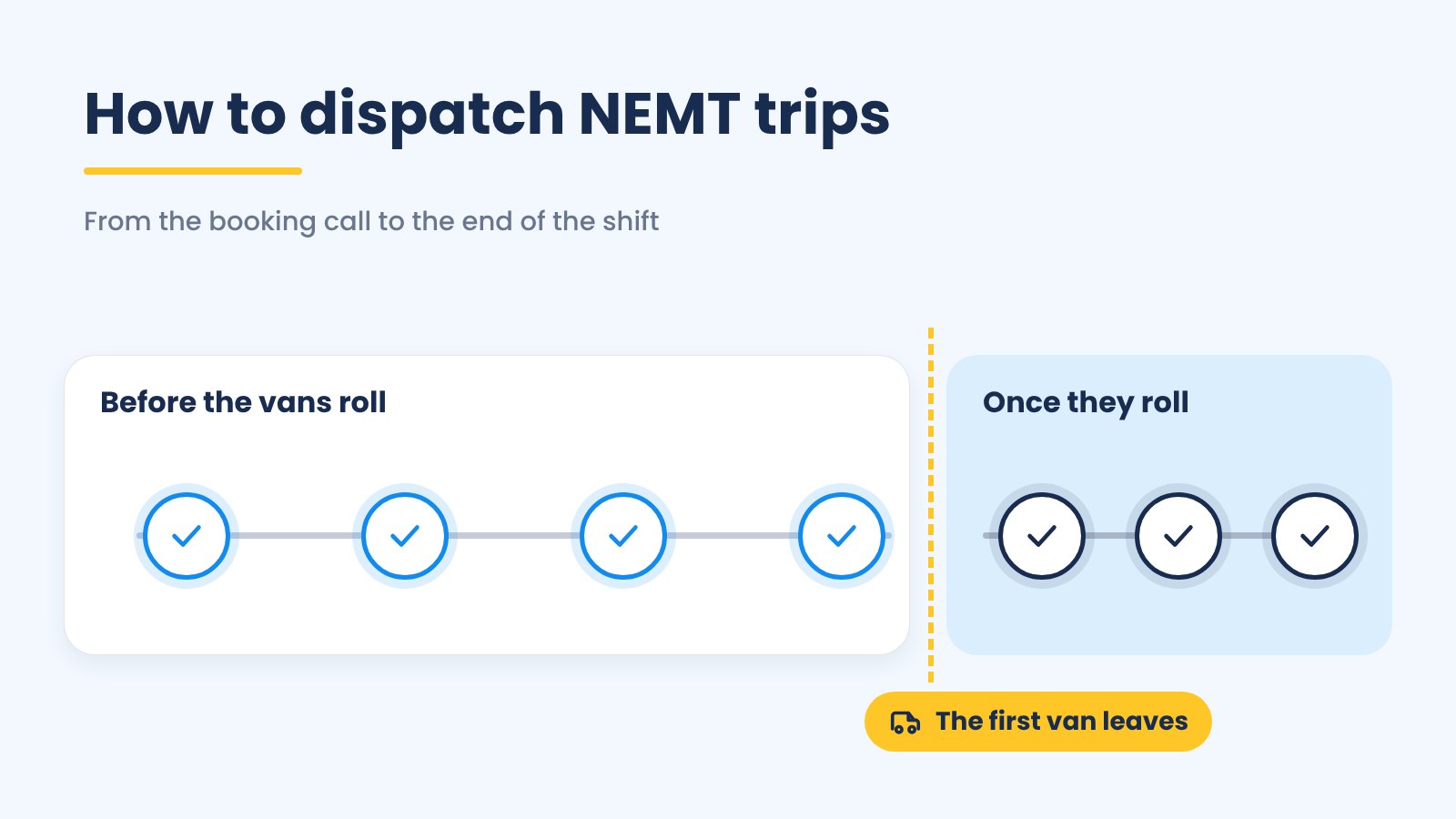
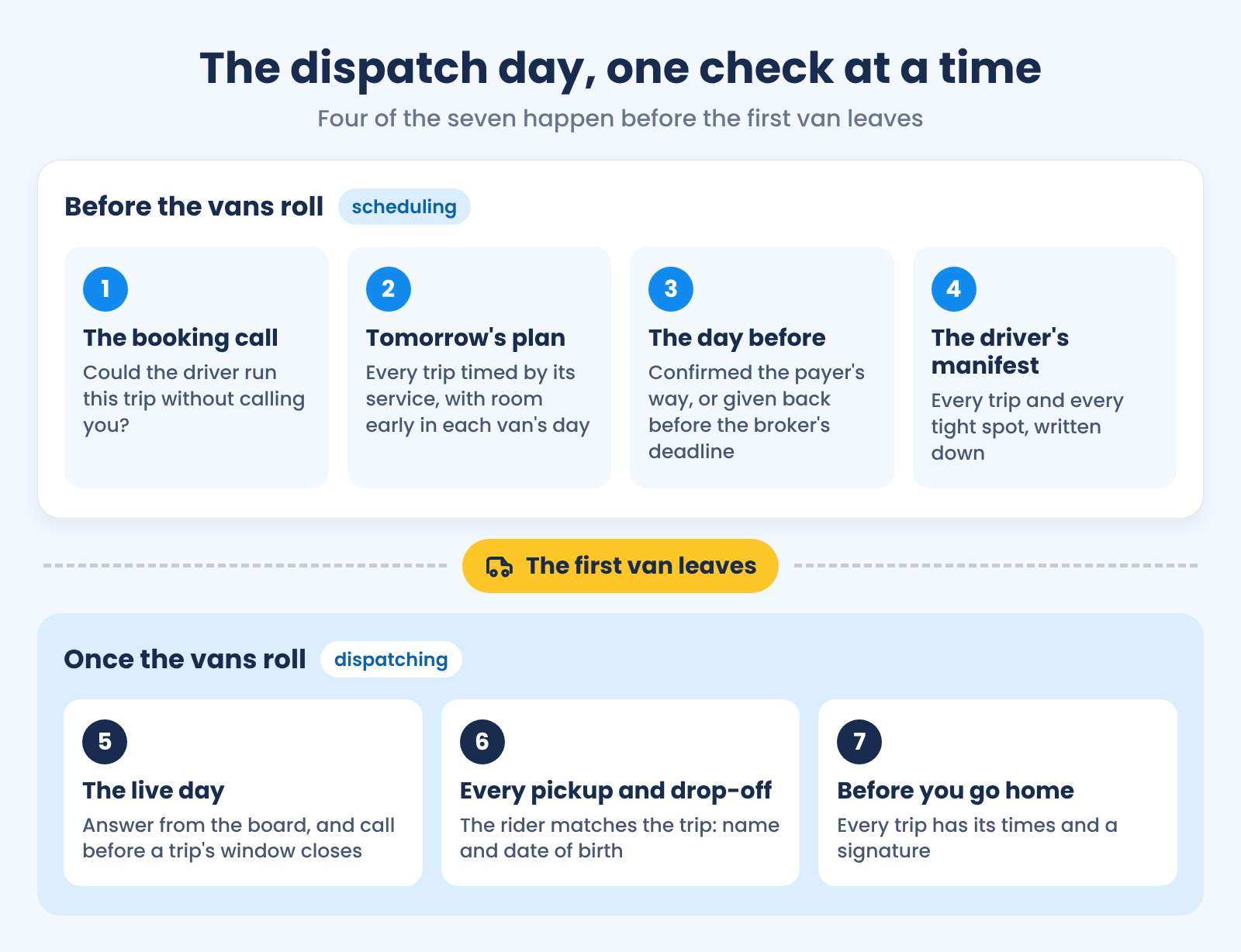
That favor grew into Duet’s dispatching service. In her conference session on mastering dispatching, Jing draws the line between the two words: scheduling is what you do the day before, and dispatching is the same-day adjustment when things change. This guide follows the dispatcher’s clock: the booking call, the night before, the live day, the late call, the trip that goes wrong anyway and the check before you go home. It covers your own vans, not the broker “dispatching” trips out to companies like yours.
What do you ask before a trip goes on the board?
Ask until the driver could run the trip without calling you: the rider’s wheelchair, weight, oxygen in liters, stairs, room, the ride home and who’s paying. Every question you skip comes back as a call from the curb.
On a discharge, start with the wheelchair. Riders who use one often reach the ER without it, and finding that out at the bedside costs “an additional 20 minutes,” Jing said. Some experienced drivers won’t even get out of the van: “If they don’t know that information, they’re going to sit in the vehicle.”
On a stretcher discharge, ask about oxygen, in liters. Jing estimates that 10 to 20% of stretcher trips need it. One of our customers lost an $800 trip because the rider needed 8 liters and the van could provide three or four. The case manager wouldn’t lend a tank, so the hospital gave the trip to an ambulance.
At an apartment address, ask about stairs. “As soon as you hear apartment numbers, immediately you have to ask are there any staircases, ramps or elevators,” Jing said on our pricing episode.
The operations manager of a Dallas company with about 40 vans said on an industry podcast in 2025 that his intake team was making mistakes on about 27% of trips in a week. His list included missing room and suite numbers and “whether they need oxygen, how much oxygen do they need.” He set a 5% ceiling and got to about 7.5%. That’s one company’s count; run yours on a week of trips.
Check a broker’s trip details the way the driver will read them, and call the broker about gaps. From a facility, get the room number, the rider’s date of birth and a callback number. Private pay starts with the money. Jing trains our dispatchers to ask “how are you planning to pay for this trip?” typically right after the greeting. Otherwise “you spend five minutes to entertain them” before learning they expected insurance to pay. Then charge the card at least 24 hours before pickup, or have the family pay a link a day ahead.
Whoever books, record the call. “You need a call recording,” Jing said on a Duet demo. “So that’s your evidence if there’s any dispute.”
How full should tomorrow’s schedule be?
Full enough to keep every van working, and loose enough that one late rider doesn’t push every trip after it. Time each trip by its service instead of its miles, put it on a van and driver that fit it, and leave room early in each van’s day.
Start with service time. As our guide to running a NEMT business day to day tells it, Jing’s three-mile, $85 wheelchair trip is “30 minutes to 45 minutes” of a driver’s day. Time your own loads, the number Jing didn’t have on her first day. As I said on one of our 2025 episodes, an experienced dispatcher also knows “the traffic’s always bad at 3 p.m. in this route. So we need to allocate a little more time.”
Then match the van. A Ford Transit with a side wheelchair lift and a stretcher in back switches between wheelchair and stretcher trips with no extra time. A minivan like a Caravan or Sienna can carry either, but the stretcher has to come out for a wheelchair run, and “you can’t leave this $10,000 piece of expensive equipment by the street side.” Plan who drives it back to the office or waits with it.
Then match the driver. When Jing starts dispatching for a customer, owners tell her which driver gets which trip: give this one to driver A (“they are really fast”), not driver B, who’d “take his sweet time.” Then a bariatric rider goes to driver B, “because he’s stronger, so he can lift it.”
Then leave room. A former broker executive starting his own company in Denver said on an industry podcast in 2025, “None of this goes to plan really ever.” He’s right, and it’s the reason to plan: the day will change by mid-morning, and the plan decides what each change costs. Rachel Scholler, who ran a NEMT company in rural Wisconsin for 17 years, put her on-time rate at about 97 to 98% on a book of mostly fixed routes, and wouldn’t pack her schedule. My rule is a gap early in each van’s day that could absorb a 30-minute delay.
Plan the room by lane. Broker pickup times may not be yours to move. Modivcare’s Mississippi manual (February 2024), for one, bars changing them after the manifests arrive without Modivcare’s OK. Discharges land the same day. On a Duet demo, Jing described a stretcher operation that keeps a two-driver crew on after its last trip, under a note on the schedule: “release if no discharge trips.” The crew stays “until 1 p.m.,” then goes home if nothing comes in. Private-pay times are yours to set, so set ones you can keep.
What do you confirm the day before?
The day before, confirm each trip the way its payer allows, give back any broker trip you can’t run before that broker’s deadline, and hand each driver a manifest they can run without calling you.
Broker trips usually show up days ahead. MTM’s Virginia handbook (August 2026) sends them seven days before the appointment and expects a turnback, MTM’s word for handing a trip back, at least 24 hours before pickup. Other documents set other deadlines:
- MTM, Rhode Island (handbook, July 2026): no same-day turnbacks, and none later than 24 hours before the appointment. MTM’s Rhode Island scorecard (Q4 2024) counts a hand-back with under three hours to the appointment as your no-show.
- Verida, Tennessee (BlueCare provider manual, October 2026): the manifest comes two days ahead, and you can reject a trip until 12:30 p.m. the day before. The same manual defines sufficient notice as no less than 24 hours, and if your short notice forces a pricier replacement, Verida deducts the extra cost from your pay, so plan on 24.
- Modivcare, Mississippi (provider manual, February 2024): re-routes at least 24 hours before pickup, or Modivcare can deduct the extra cost of a replacement ride from your pay.
Turnbacks get scored, too: under 0.5% in MTM’s Virginia handbook. Its standard for trips a provider fails to complete is tighter, under 0.25%.
Facility trips are simpler. Some facilities don’t need a confirmation call, and at others one call to the front desk covers the day. On private pay, the charge 24 hours out is the confirmation. The routine for each lane is in our guide to reducing NEMT no-shows.
Then build each driver’s manifest: pickup, drop-off, appointment time, mobility aid and equipment, room and the booking notes. Add the tight spots. A Cincinnati owner with eight vehicles, on an industry podcast in 2026, described notes his drivers read the night before, like “In your route, you’re kind of tight between here and here. So if this happens here, here’s what you need to do.” When trouble comes, “we resolve those exactly as we planned it.”
What does the dispatcher do once the vans roll?
Once the vans roll, the dispatcher spends the room the plan left, working from a board that shows every van and trip, so each change and each same-day request gets a fast, honest answer. Jing calls dispatching “the most stressful activity of the operation,” and it shapes what you earn that day and “your future revenues.”
Same-day requests are where the room pays off. I tell owners on demos that if you can answer in 30 seconds and your competitor takes three minutes, the facilities are going to call you first. The nurse has a million other things to do.
The answer still has to be honest. Paul Muench built Gentle Turns in Phoenix to five vans in a year, and his wife and co-owner does the dispatching. He never wants to say no, he said on our podcast, and she’s good at telling him, “Hey, I know you want to say yes to this, but you know, take a close look at the schedule.” MTM’s Virginia handbook builds in the same check: it won’t assign an urgent trip without your OK.
A board that shows every van is how you answer in 30 seconds. Duet’s NEMT dispatch software puts every vehicle on a live map and a drive-time estimate on every trip. When a same-day trip lands, your dispatcher sees which van is actually closest and what the assignment costs in minutes. The booking questions, the confirmations and the checks at the door are still your dispatcher’s.
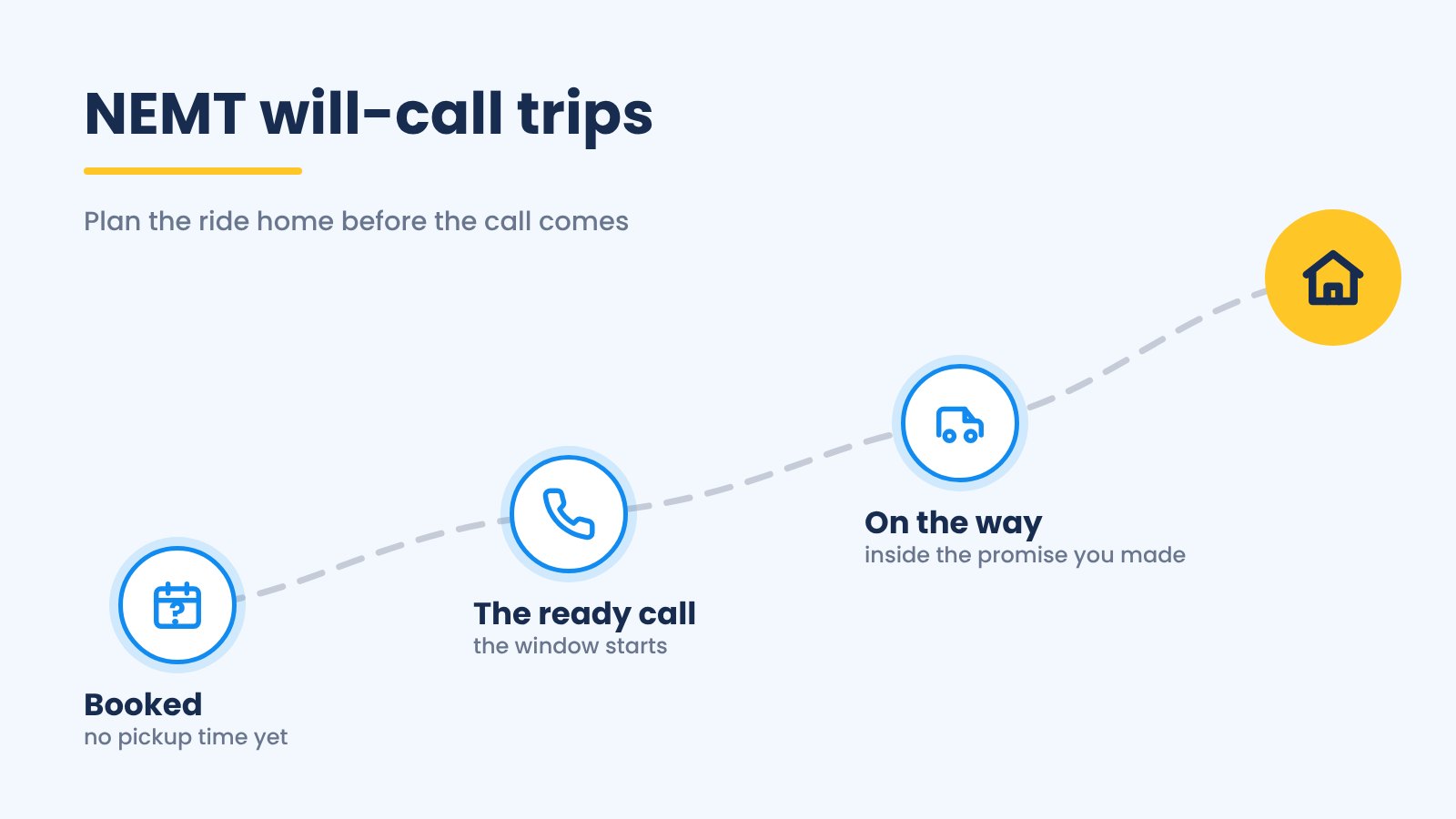
Will-calls, the rides home with no set pickup time, test the board hardest, because riders tend to call at once. Set the order before the rush: one of our customers goes first come, first served, with a timestamp on each call. Tracking links and a phone menu with its own booking line keep “where’s my driver” calls from burying the next booking.
None of this needs a board on day one. With one van and you driving it, you’re the dispatcher, and one calendar with every trip on it, the broker’s and your own, can hold the day. Somewhere between two and four vehicles, dispatching starts competing with driving, and that’s when I’d add a dispatcher.
When is a trip late, and who do you call?
A trip is late by the clock of whoever’s waiting (a broker’s pickup window, a nurse’s discharge, a family’s promised time), so call them before that window closes, not after.
On broker trips, the clock is written down, and it isn’t one number:
| Program (document, date) | On time means | Before leaving a no-show | Running late: call |
|---|---|---|---|
| MTM, Virginia (handbook, Aug 2026) | Driver arrives within 15 minutes either side of pickup time | After the pickup window, follow MTM’s no-show steps; try the rider by phone or text | Affected riders or facilities, with a new ETA, and MTM |
| MTM, Rhode Island (handbook, Jul 2026) | Within 15 minutes of the pickup time the rider was given | Not required to wait past 10 minutes; call or text the rider; enter it only in MTM’s driver app | Waiting riders at their pickup points, and MTM, which tells the facility |
| Modivcare, Mississippi (manual, Feb 2024) | Outbound pickup within 15 minutes either side; drop-off by the scheduled time | Wait at least 10 minutes; get Modivcare’s OK before leaving; note it on the trip log | Waiting riders at 15+ minutes late; Modivcare’s provider line if a drop-off will be late |
| MAS, New York (network manual, Oct 2023) | Arrival within 15 minutes either side of pickup time | Waiting under 15 minutes, if it hurts riders’ satisfaction, can bring suspension | MAS, ahead of the delay |
| Verida, Tennessee (BlueCare manual, Oct 2026) | More than 10 minutes off the scheduled time is untimely | Wait at least 5 minutes; the driver tells your dispatcher, and you tell Verida before leaving | Your dispatcher, and the rider gets a call; Verida’s dispatcher, at once |
| Missouri Medicaid (state manual, Apr 2026; MTM contract, 2022-2027) | Rider boarded no later than 5 minutes after pickup time (15 minutes’ grace on standing orders) | After 10 minutes at the right address, call the broker before leaving | Not stated; past 15 minutes late on a standing order, the facility or rider calls the broker |
| MART, Massachusetts (contract, Jul 2024) | Arrival within 10 minutes either side of pickup time; never more than 15 early | Wait at least 10 minutes; tell your dispatcher and wait for instructions | MART, before the scheduled pickup; try the rider and any facility |
Check your own broker’s current handbook, because these change. Where these documents say what they measure, it’s mostly the driver’s arrival at the pickup (MTM Virginia, MAS, MART). Missouri’s state manual counts the moment the rider boards, and TennCare’s July 2026 contract scores its health plans by whether riders arrive on time for the appointment.
Facilities run on the nurse’s clock. Running late on a discharge, call the hospital and tell the bedside nurse, as Tony Jackson, an Orlando operator with 35 years in the business, said on our facility contracts episode.
On private pay, the clock is the time you promised. Paul guarantees his riders “won’t wait more than 15 minutes for their pickup.” Miss a promise like that, and the family should hear it from you first.
No-shows run on the same clocks: wait the program’s time, call, record it before the driver leaves, and be able to prove the driver was there. As Jing put the payers’ side in her talk, “If your drivers claim this is a no-show, they better be there at the right place, right time.”
What do you do when a trip goes wrong anyway?
Two things: check the rider against the trip at every pickup and drop-off, because you can’t count on anyone else in the chain to do it, and call whoever booked it right away with what happened and what you’re changing.
“The margin of error in this business is very, very small,” Jing tells her dispatchers. One April, a broker sent one of our customers a stretcher discharge: pick up a rider in a hospital room and take them to a facility 90 minutes away. Somewhere between the nurse’s call and the booking, room 424 became room 442.
Every link in the chain missed it. The driver got there at 7 p.m. after several runs, tired, and “forgot to check with the patient.” The nurse on duty, a traveling nurse, “also forgot to check the discharge papers.” At the receiving facility it was 9 p.m., with “only a couple people around,” and nobody checked there either. Then the hospital called the company: “When are you going to come to pick up this patient?” The wrong person had already ridden 90 minutes. “A perfect storm,” Jing called it.
Her rule: “Don’t count on other people to quality control” your service. “So you always double check, triple check.” At pickup, the driver matches the rider to the trip by name and date of birth, or the hospital wristband, before the van moves. At drop-off, the driver checks the rider and the destination against the trip again. An operator-coach’s driver checklist on a NEMT training channel says it in four words: “Verify before you roll.”
The other half is the call. The morning after Jing’s own first day, her customer “brought a lot of donuts to the ER,” explained what had happened, and “everything is good,” Jing said. The lesson Jing took: deal with it “right away with your client.” As she put it, “what worries them is not what has happened, it’s whether this is going to be the experience they’re going to have for the next three or six months.” That owner has signed more than 30 contracts. Rachel worked the same way. She’d “reach out to the client before they had a chance to even complain.”
What do you check before you go home?
Before you go home, check that every trip run today has its pickup and drop-off times and a signature, every no-show has its proof, and tomorrow’s first trips are complete and confirmed.
On a broker trip, the record is the claim. MTM’s 2026 handbooks for Virginia and Rhode Island want an electronic trip log with the trip ID, the scheduled and actual pickup times, the departure and arrival times and the rider’s signature. If any of those datapoints are missing, “the claim will be denied.” Modivcare’s Mississippi manual (February 2024) denies claims “with incomplete trip log information.” Ohio’s new law, in effect since October 6, 2026, puts every NEMT provider on a state GPS verification system within 18 months, and then pays a claim if “All required GPS-based verification and timestamp data are present” and “No unresolved discrepancies about the claim exist.”
Do it tonight, while drivers still remember. Drivers “finish the trip, and then they come back to the app” to fill in the times, Jing said on a Duet demo. On a demo in July, I told a new owner that when a driver forgets to tap the drop-off, sometimes the broker won’t pay without the timestamp, and misses like that are how owners sometimes lose tens of thousands of dollars. Fix gaps only with what actually happened. For facility trips, check what each facility wants on its invoice.
Then look at tomorrow: every driver has their trips, every private-pay trip is paid, and every open return from today has someone assigned.
Where to start this week:
- Ask about the chair and the oxygen on every discharge booking: the rider’s own wheelchair, and on stretcher trips how many liters of oxygen, before the trip goes on the board.
- Time each trip by its service, not its miles: Jing counts 30 to 45 minutes of a driver’s day for a short wheelchair trip.
- Give back broker trips before the deadline: at least 24 hours before pickup for MTM in Virginia and Modivcare in Mississippi.
- Call before the window closes, the moment a trip will miss it; for MTM in Virginia, that’s more than 15 minutes past the pickup time.
- Match the rider to the trip twice, at pickup and at drop-off, by name and date of birth or the hospital wristband.
- Close every trip before you go home: times and a signature on each one run today.
Tonight, read tomorrow’s board the way each driver will. Could each of them run their first three trips without calling you? If not, you’ve found tomorrow’s late trip twelve hours early. Jing found hers at noon.
FAQ
Can I dispatch from my phone while I’m driving?
Not with the phone in your hand. With one van, you’re the dispatcher, but MTM’s Virginia handbook (August 2026) says drivers should never use a mobile device while driving, with a Bluetooth headset the only exception. Take bookings and changes at stops, and call back fast, because a family that can’t reach you calls the next company. Once dispatching starts competing with driving, it’s time to hand the phone to someone else.
Should dispatchers text trip details to drivers?
Text the logistics, not the rider’s private details. Jing sees customers coordinate on GroupMe, WhatsApp, Slack and iMessage, and that’s fine for who’s running late or which van takes a trip. Tony Jackson objected on our facility contracts episode to owners who text everything to drivers: if a driver loses the phone, every rider’s health information in those texts goes with it. Keep names, conditions and addresses in the trip itself, not in a group chat.
About the author
James O'Donnell cofounded Duet and leads its sales, partnerships, and growth services. He talks with NEMT operators every week, hosts the NEMT Growth podcast, and answers Duet's sales line himself. More about Duet's founders →
Want more trips and less busywork?
See how Duet runs and grows NEMT businesses in a 30-minute demo.