
NEMT dispatch software your whole team can actually run
By James O'Donnell, Cofounder and COO, Duet · Updated
Duet's NEMT dispatch software puts every vehicle, driver, and trip on one live board. Dispatchers see the whole day at a glance, assign a trip with a click, and watch every vehicle move on a live map. Recurring trips schedule themselves, and the same board connects booking, broker trips, the driver app, rider tracking, and billing, so one system runs the whole operation.
What is NEMT dispatch software?
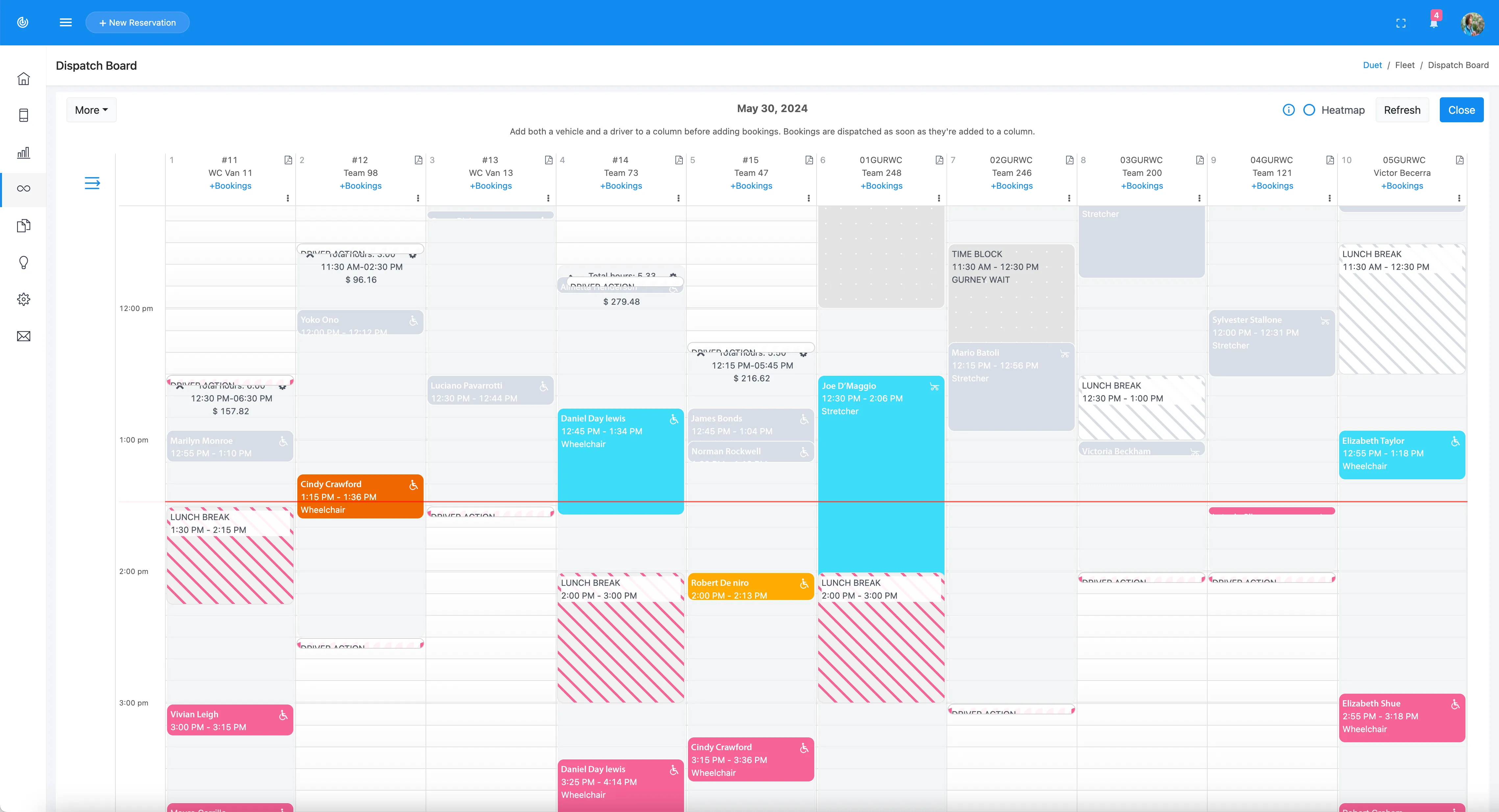
NEMT dispatch software is the live control screen of a non-emergency medical transportation operation. It shows every vehicle, driver, and trip in real time, and it's where a dispatcher assigns rides, tracks progress, and reworks the day when reality moves. In Duet, the dispatch board is the center of the whole platform: every booking channel feeds it, every driver runs from it, and every invoice starts from it.
Dispatching and scheduling get used interchangeably, but they're two jobs. Scheduling is the plan — building tomorrow's trips against your vehicles and shifts. Dispatching is game time: running today's plan live while a driver calls in sick and a hospital discharge lands at 2 pm. Medical transportation dispatch software that only does one leaves you doing the other on a whiteboard. Duet puts both on the same board. Want the full breakdown? Read our guide to dispatching vs. scheduling.
What is the best dispatch software for NEMT?
The best NEMT dispatch software is the one that fits how your trips arrive and how you want to grow. Compare five things: what a parked van costs you, whether broker trips land on the same board as private-pay and facility trips, whether claims come straight from the trip record, how fast a new dispatcher can learn it, and who answers the phone after hours. Here's how the main platforms compare on price and fit.
| Platform | Pricing model | Published price | Best fit |
|---|---|---|---|
| Duet | Usage-based, no base fee | Free under 100 trips/mo; most providers pay less than $50 per active vehicle/mo | Providers who want to grow |
| RouteGenie Full comparison → | Per-vehicle + priced add-ons | Growth plan $50/vehicle/mo before add-ons | Large broker-heavy fleets with admin staff |
| Bambi Full comparison → | Flat per active vehicle | $69/active vehicle/mo | Small fleets that want a flat monthly bill and run every van daily |
| MediRoutes Full comparison → | Base fee + per-trip | $150 to $250/mo base tiers + $0.50/trip | Broker-dependent Medicaid fleets already fluent in it |
| CTS TripMaster Full comparison → | Quote-based | Not published; third-party listings from $125/mo | County, transit-authority, and paratransit programs |
| Simpli (Momentm) | Flat per-vehicle | $52/vehicle/mo month-to-month; $49 on an annual plan | Small fleets that want a big vendor behind a flat fee |
| RoutingBox | Per-vehicle, unlimited trips | Not published (contact sales) | New York Medicaid fleets built around eMedNY billing |
Prices as each vendor published them, verified September 2026. Sources, scores, and our method are on the 2026 ranking of NEMT dispatch software.
Our answer is Duet for providers who want to grow, especially through private-pay and facility work, and for teams that want software a new dispatcher can run on day one. Two honest exceptions: county, transit-authority, and paratransit programs are usually better served by CTS TripMaster, and New York broker-heavy operations with dedicated billing staff often fit RouteGenie.
What does a NEMT dispatch board show?
Duet's dispatch board shows every vehicle, driver, and trip on one live screen, with color-coded statuses that update as the day moves. Dispatchers assign a trip with a click, check driver and vehicle availability in the same view, and see each rider's mobility needs before choosing the van. Piece by piece:
Every vehicle, driver, and trip on one screen
The whole operation, live. No whiteboard behind you, no second monitor of spreadsheets — the board is the single place the day happens.
A calendar of the day and the week
A calendar view of the schedule — work the current trip and see what's coming at the same time.
Color-coded statuses through the day
Trips change color as they move through the day, so one glance tells you what's running, what's done, and what needs attention.
Assign a trip with a click
Pick the trip, pick the driver, done. No radio round-robin, no calling three drivers to find out who's free.
Driver and vehicle availability, visible
See who's on shift and which vehicles are free right on the board, so you assign against reality instead of memory.
Mobility needs on every trip
Every trip carries the rider's mobility needs — wheelchair, stretcher & gurney, or ambulatory — so the right vehicle gets assigned the first time.
+50% trips in one year
A wheelchair and stretcher service ran seven vehicles across Slack, Outlook, Google Sheets, and Asana before moving to Duet. With every vehicle's open time visible on one board, it grew from 7 to 10 vehicles, landed 6 new contracts, and got 3+ hours a day back from data entry. Read the case study.
How does NEMT scheduling software handle recurring trips?
Recurring trips and standing orders schedule themselves in Duet. Set a rider's pattern once — dialysis three times a week is the classic — and every future trip appears on the board on the right days, at the right times, with the rider's mobility needs already on it. Most of tomorrow already exists today; the software acts like it.
Standing orders, entered once
The three-times-a-week dialysis rider is one pattern in Duet, not thirty entries a month. The trips appear on the right days by themselves.
Bulk trip upload
Trips that arrive as a spreadsheet go up in one pass. They land on the board like any other trip — nothing re-keyed row by row.
Tomorrow, already built
By the time the first driver clocks in, the recurring work is on the board. Your dispatcher's morning starts with placing the new trips, not rebuilding the known ones.
For the rest of the day, Duet's auto-scheduler builds the schedule automatically from trip times, mobility type, travel time, and load and unload time, and dispatchers fine-tune it with drag and drop. Several riders sharing one vehicle? Duet handles multi-loading too, with each rider on their own trip.
How does routing work in Duet's dispatch software?
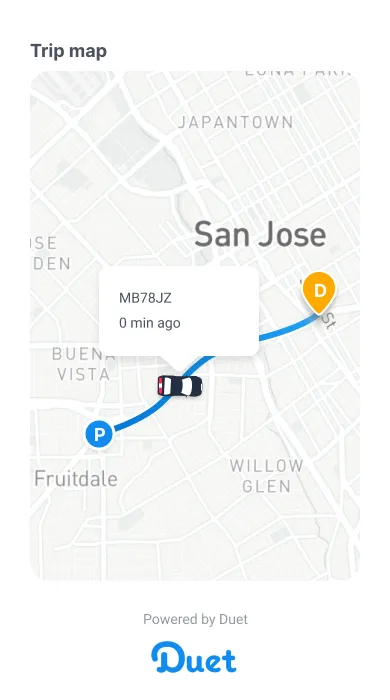
Duet's routing view is a live map with every vehicle on it, moving in real time. Alongside it, every trip carries a drive-time estimate, so a dispatcher can see what an assignment costs in minutes before making it. When a same-day trip lands, you see which van is actually closest — not which one you remember being closest.
When it's time to build the day, Duet's auto-scheduler does the routing work for you: it assigns every trip to a vehicle and driver using travel time, trip times, mobility type, and load and unload time. Dispatchers fine-tune the result with drag and drop, with the live map and drive times right in front of them.
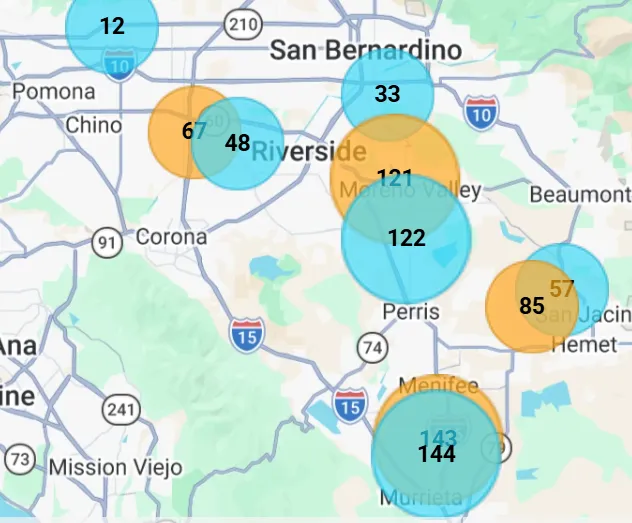
Planning happens before the day starts, too. Duet's Origin-Destination Map shows where your pickups and dropoffs cluster, and providers use it to place drivers and overnight parking closer to the work, which cuts deadhead miles.
That's the dispatcher's view. The rider's family gets their own — no app, just a link that opens in the browser and shows the van on its way. Providers on Duet who send tracking links see 45% fewer "where's my ride" status calls and 15% more repeat bookings (Duet customer data, 2026). More on the rider tracking page.
What else runs from the dispatch board?
No matter how a trip arrives, it lands on your Duet dispatch board. A rider calls and you answer — or Duet's voice AI does, 24/7, and books the trip straight onto the board. Families book through your website's booking form, discharge planners book through the facility portal, and broker trips arrive by integration or file import. One board, one trip record, nothing re-entered between systems. From that record, the rest of the platform runs:
- Trip booking from calls, email, your website, and the facility portal
- A 24/7 voice AI that answers the phone and books trips
- An auto-scheduler that builds the day's schedule
- Multi-loading: several riders in one vehicle
- Broker trips from Modivcare, MTM, Kinetik, MediDrive, and CTC
- A driver app on iOS and Android
- Rider tracking links, with no app download
- A booking portal for hospitals and facilities
- Per-contract rates, invoices, and CMS-1500 claims
- Driver shifts, payroll, and vehicle inspections
- Dashboards and full data export
And Duet isn't just software. When the board has room for more trips, the same team runs growth services — websites & on-page SEO, off-page listings & reviews, Google Ads, facility outreach — to help fill it.
What software do NEMT dispatchers use?
NEMT dispatchers use three kinds of tools. Dedicated NEMT dispatch platforms such as Duet, RouteGenie, Bambi, MediRoutes, and CTS TripMaster run booking, dispatch, and billing in one system. Broker-supplied apps such as WellRyde come with a broker relationship, but they only manage that broker's trips. And plenty of operations still run on spreadsheets, shared calendars, and a whiteboard, which works until the second broker or the tenth van.
The dispatcher isn't always in the building, either. In a Duet survey of more than 100 NEMT providers, more than half use remote dispatchers. Web-based dispatch software makes that possible, and Duet also offers remote dispatching: trained dispatchers who run your board inside your own account.
How much does NEMT dispatch software cost?
NEMT dispatch software typically costs about $49 to $69 per vehicle per month on flat per-vehicle plans. Usage plans pair a monthly base fee with a per-trip charge (MediRoutes, for example, publishes $150 to $250 a month plus $0.50 per trip), and some vendors only quote on request (vendor-published prices, verified September 2026). Always ask about add-ons: broker integration fees, texting charges, training, and setup can outgrow the sticker price.
On Duet, dispatch isn't priced separately. The board comes with the whole platform: booking, the voice AI, the driver app, rider tracking, billing, and reports. The software is free for providers running fewer than 100 trips a month, and usage-based after that — most providers pay less than $50 per active vehicle per month. There's no per-vehicle license fee, so a parked van costs nothing. No setup fee either, and no contract — Duet is month-to-month, and it never takes a cut of your trip revenue. Full software and services pricing lives on the pricing page.
Is there free NEMT dispatch software?
Yes, with limits. Duet is free for providers running fewer than 100 trips a month, with every feature included; usage pricing starts once you grow past that. Broker-supplied apps such as WellRyde are free with a broker relationship, but they only manage that broker's trips. Free trials, like Simpli's 30 days, end when the trial does.
What do NEMT providers say about Duet's dispatch software?
The schedule is the part providers mention first: seeing the whole day, and getting it from the office to every driver's phone. In their own words, from Duet's public Google reviews and the Duet Dispatch podcast:
- Hundreds of NEMT providers run on Duet
- 5.0 on Google
- Panelists at NEMTAC 2025
Eugene, three-year Duet customer — from the Duet Dispatch podcast.
"Have been using Duet dispatching software and worked with their team for three years. They also helped us with website creation and SEO and ad campaigns. This is a great one stop shop for everything we need."
"Duet makes running our business so easy! from booking to scheduling to dispatching to billing everything runs so smoothly and stress free. It was on the more affordable side compared to a couple other platforms we demoed. The best part is that they also help me get more private pay trips. They run my google ads and I'm getting twice as many booking as when I was running them myself. They are so supportive, I can get in touch with one of the founders whenever I need to and they are happy to hear what I have to say."
"We love Duet, by the way. One of the things that I love about it is the visibility of the schedule… being able to have all of that on my laptop, but then getting it over to the phone — each driver has to have that in their hands when they're out in the field. That's very seamless with Duet, and it works very well."
Every review above is public on Duet's Google profile. More reviews, podcast stories, and case studies are on the reviews & results page.
Duet at a glance: pricing, brokers, billing, and setup
The facts buyers ask for first, in one place. Full detail is on the pricing page and the broker integrations page.
- What it is
- All-in-one NEMT software: trip booking, dispatch and scheduling, a driver app, rider tracking links, a facility portal, broker integrations, billing, reporting, and a 24/7 voice AI that answers your phone.
- Price
- Free for providers under 100 trips a month. Above that, usage-based on the drive time of the trips you run; most providers pay less than $50 per active vehicle per month.
- Fees and contract
- No per-vehicle license fee, no setup fee, and no contract (month-to-month). Duet never takes a cut of your trip revenue.
- Broker integrations
- Direct integrations with Modivcare, MTM, Kinetik, MediDrive, and CTC; trip file import for SafeRide, Alivi, Verida, WellTrans, and others.
- Billing and claims
- Rates set per contract, invoices and reports shaped to each payer, and CMS-1500 claims generated from trip data.
- Your data
- Full export of trip, rider, driver, vehicle, and billing data at any time. Your data is always yours.
- Setup
- Most operations are running within a day; switchers are fully set up within about a week. Data migration and live team training are included.
- Devices
- Dispatch runs in any web browser, with nothing to install. Drivers use the Duet driver app on iOS and Android, listed in the App Store and on Google Play as "Duet for Fleet Partners."
- Trip types
- Wheelchair, stretcher and gurney, and ambulatory trips; private-pay, facility-billed, and broker trips side by side.
- Company
- Founded in 2020 and based in San Francisco. Hundreds of NEMT providers run on Duet. Panelists at NEMTAC 2025.
Who is Duet for?
Duet is built for NEMT providers who want to grow, especially through private-pay and facility work, and for teams that want software a new dispatcher can learn in one session. It runs wheelchair, stretcher, and ambulatory trips for fleets of any size.
Providers who want to grow
Duet pairs the software with growth services — websites, listings and reviews, Google Ads, and facility outreach — for providers who want more trips, not just better-run ones.
Private-pay and facility work
Providers doing, or building, private-pay and facility business who want riders, families, and discharge planners to get the best experience: tracking links, a facility portal, and a phone that always gets answered.
Broker trips on the same board
Operations that run broker trips alongside everything else. Direct integrations and trip file import put broker work on the same board as private-pay and facility trips.
Switchers from legacy software
Teams that want modern, clean, simple software a new dispatcher can run on day one — from a first van to a large multi-vehicle fleet.
Who Duet isn't for
County, transit-authority, and paratransit programs that report under public-transit compliance rules are better served by software built for those programs.
How long does it take to switch to Duet?
Most operations are running on Duet within a day, and providers switching from other software are fully set up within about a week. Duet moves your data and trains your team as part of the service, and there's no contract: you stay because it works, month to month.
- 1
See it with your own trips
Bring tomorrow's schedule to a 30-minute demo and watch it land on the board.
- 2
We move your data
Trip history, rider profiles, and driver information come across from your old software before you go live. Included, at no extra cost.
- 3
Your team gets trained
Live training on video for dispatchers and drivers, until everyone is comfortable. Also included.
- 4
You go live
Most operations are running within a day. Switchers are fully set up within about a week.
After go-live, questions go to a real person: call (650) 780-3465 and you'll reach a founder, not a phone tree. And if Duet ever stops being the right fit, you can export all of your data at any time.
Dispatch software questions, answered
What's the difference between dispatch software and scheduling software?
Scheduling is the plan: which rider, which vehicle, which time — usually built a day or more ahead. Dispatching is running that plan live: reacting when a driver calls out, a rider cancels, or a same-day trip lands. Duet does both on one board, so the plan and the day never live in separate systems. Want the deep dive? Read dispatching vs. scheduling.
Can it handle recurring dialysis schedules?
Yes — that's the pattern the scheduling was built around. Set a rider's standing order once, say Monday-Wednesday-Friday at 6:45 am, and every future trip appears on the board on the right days, with the rider's mobility needs attached. No re-entering the same trip thirty times a month.
Does Duet do routing?
Yes. Duet's auto-scheduler builds the day's schedule automatically, assigning every trip to a vehicle and driver using travel time, trip times, mobility type, and load and unload time. Dispatchers also get a live map with every vehicle on it and a drive-time estimate on every trip, and can move any trip to another vehicle with a drag and drop.
How do broker trips get on the board?
Through direct integrations with Modivcare, MTM, Kinetik, MediDrive, and CTC, or trip file import for SafeRide, Alivi, Verida, WellTrans, and others. Either way, broker trips land on the same dispatch board as your private-pay and facility trips, with nothing re-keyed from a manifest. The broker integrations page has the full picture.
Does the voice AI book trips onto the same board?
Yes. When Duet's voice AI answers a call and books a trip, the trip lands on the same dispatch board your team works from — same format as a trip a dispatcher enters by hand — and Duet saves a transcript and summary of the call. There's no separate queue to check. More on the voice AI page.
What devices does dispatch run on?
It's a web app. The dispatch board runs in the browser on any computer — nothing to install, nothing to maintain. Drivers get their own simple app on iOS and Android; dispatch itself lives wherever you can open a browser tab.
How long does it take to learn?
One session. Dispatchers learn the board fast because there's one screen to learn, and live training for your whole team is included — we stay on video until everyone's comfortable. Data migration from your old software is included too, so the board starts with your riders and trips already in it.
Can I track my drivers?
Yes. The live map shows every vehicle moving in real time, so dispatch always knows where the fleet is. Riders and their families can follow their own trip too, on a browser-based tracking link — no app download. That side of the story is on the rider tracking page.
The rest of the platform
Every feature here is one system: one login, one dispatch board, one monthly bill.
See everything the software does side by side — or how the growth team fills the schedule the software runs.
See the board with your trips on it
Bring tomorrow's schedule to a 30-minute demo and watch it land on the board — recurring riders, broker trips, and all. You'll know within the half hour whether your dispatchers would rather work this way.
Free for providers under 100 trips a month. No contracts, no setup fee. Questions? Call (650) 780-3465 and you'll get a founder, not a phone tree.