Article
NEMT Will-Call Trips: How Long You Have and How to Plan
Most will-call windows we read run 45 to 60 minutes. Riders and facilities judge the real wait, so plan each ride home before the call.
By James O'Donnell, Cofounder and COO, Duet ·
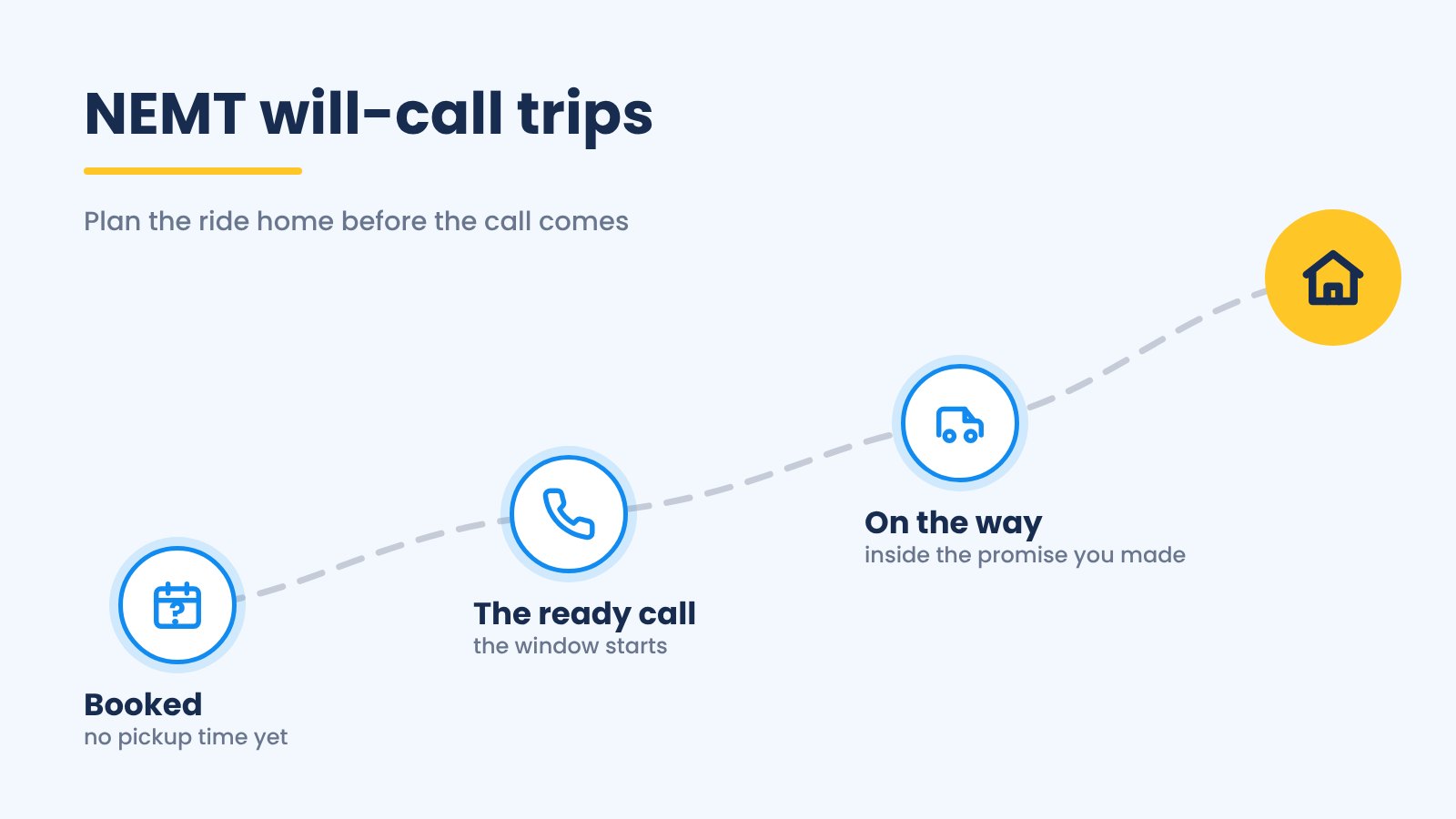
A will-call is a ride home booked without a pickup time. When the appointment ends, the rider or the clinic calls, and the van has a set window to get there. In the broker and state documents we read, that window is 45 minutes to two hours. To handle will-calls, find your own window, estimate each ride home when you book it, and leave room in the schedule for the calls you can’t plan.
An owner near Newark with about ten vehicles on broker trips told me on a call in October how he runs his will-calls. “A will-call for Modivcare is an hour,” he said. “We don’t do an hour, we do it within 20 minutes.” His reason was simple: “I have somebody ready, available.” His riders love his company for it.
It’s easy to read the broker’s hour as the standard, and a will-call as something you can only react to. But the broker’s will-call window is the longest you’re allowed, not the wait riders and facilities judge you on, so plan each ride home before the call comes. This guide starts with the rules you’re held to, then follows the ride home through your day: booking and the call ahead, the regulars who don’t need a will-call, the room in the schedule, the rush, the late call and the record. Discharges come near the end, on their own clock. The rest of the dispatch day is in our guide to running a NEMT business day to day.
How long do you have on a will-call?
In the broker and state documents we read, it’s usually 45 minutes or an hour, and the clock doesn’t always start when the rider calls. The Newark owner’s hour matches New Jersey’s broker contract: 60 minutes from when the rider tells the broker they’re ready. Modivcare’s own New Jersey facility page says the company it dispatches “will have up to ninety (90) minutes.”
Here’s the window in 14 broker and state documents. Medical Answering Services (MAS) is New York’s statewide broker, and the Montachusett Regional Transit Authority (MART) is one of the two brokers for MassHealth, Massachusetts’s Medicaid program.
| Broker or program (document, date) | Will-call window | The clock starts when |
|---|---|---|
| MTM, Virginia fee-for-service (provider handbook, August 2026) | 45 minutes | Notice that the rider is ready (sender not stated) |
| MTM, Rhode Island (provider handbook, July 2026) | 45 minutes | “The time of notification” |
| Modivcare, Mississippi (provider manual, February 2024) | 45 minutes | Modivcare activates the will-call to you (its on-time measure) |
| MTM, Idaho (provider handbook, 2023) | 1 hour | The rider calls |
| MAS, New York (network manual, October 2023) | 1 hour, on returns with no scheduled time | You’re notified the rider is ready |
| Missouri (MTM) (state broker contract CS220493001, 2022-2027) | 60 minutes | Notification (“the broker’s notification” in its scoring table) |
| Verida, Tennessee (BlueCare provider manual, October 2026) | 1 hour | You receive notice that the rider is ready |
| Tennessee Medicaid (TennCare) plans (state contract, July 2026) | 1 hour | “Notification” |
| MART, Massachusetts (provider contract attachment, July 2025) | 1 hour | The rider calls |
| Georgia (state NEMT policy manual, July 2022) | 1 hour | “Notification” |
| Modivcare, Kansas (provider manual, May 2022) | 1 hour, or the clinic’s closing if sooner | You’re notified the rider is ready |
| New Jersey (Modivcare) (state broker contract, extended to February 2027) | 60 minutes | The rider tells the broker they’re ready |
| Modivcare, New Jersey (facility web page, read October 2026) | Up to 90 minutes | You’re dispatched |
| Louisiana health plans (state managed care manual, May 2026) | 2 hours, within the clinic’s business hours | The will-call request |
The same broker sets different windows in different states, and some of these documents are years old, so your own handbook and provider agreement govern.
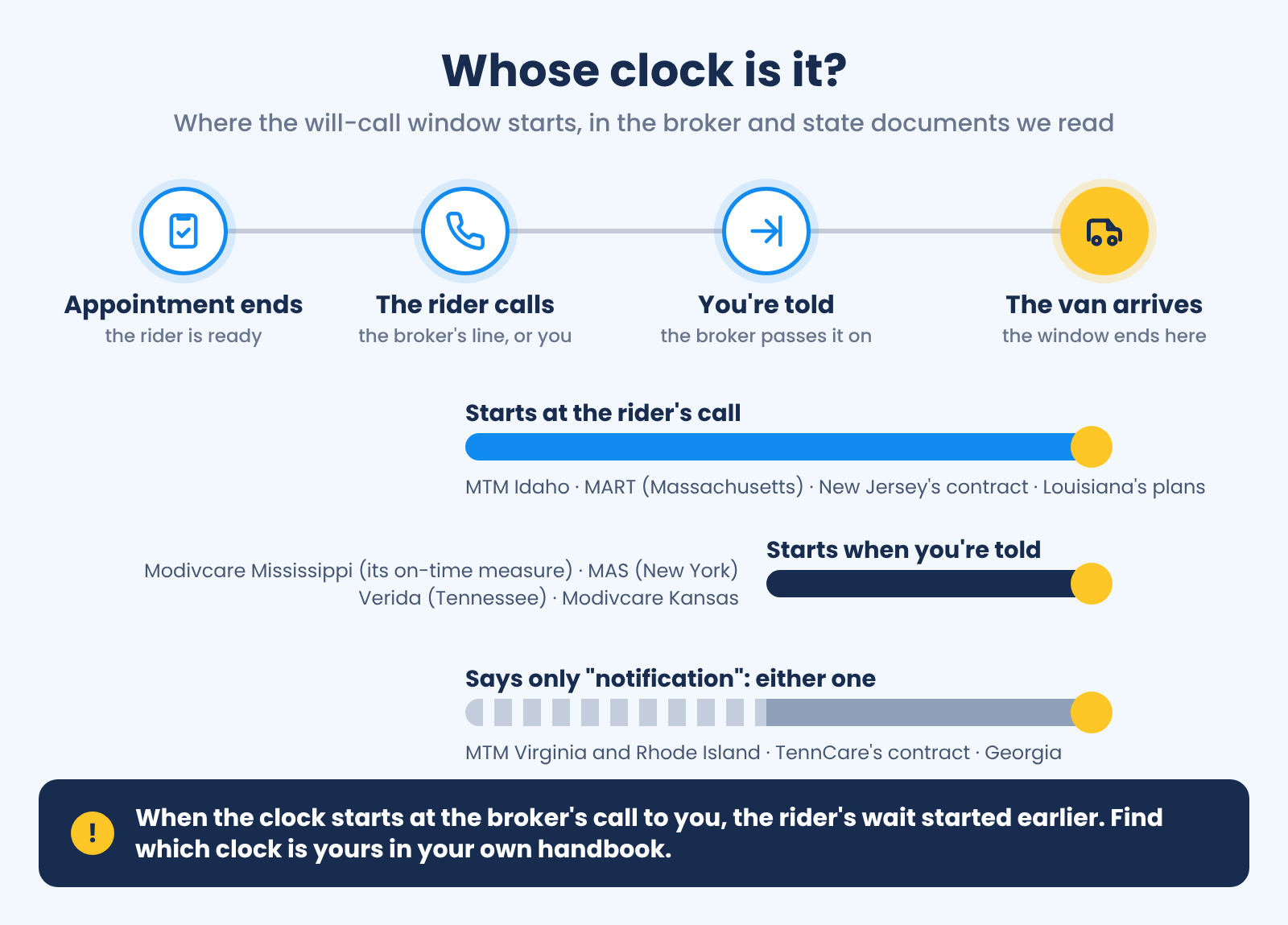
Whose clock it is matters too. Four of these documents start the clock when the rider calls: MTM’s Idaho handbook, MART in Massachusetts, New Jersey’s contract and Louisiana’s plans. Four start it when you’re told: Modivcare Mississippi’s on-time measure, MAS in New York, Verida in Tennessee and Modivcare’s Kansas manual. Four say only “notification”: MTM’s Virginia and Rhode Island handbooks, TennCare’s contract and Georgia’s manual.
The other two are Missouri’s contract, which says “notification” in its rules and “the broker’s notification” in its scoring table, and Modivcare’s New Jersey page, which starts its 90 minutes when the company “will be dispatched.” Mississippi’s manual has it both ways: one line counts the 45 minutes from the rider’s call, and the on-time measure counts from “Will Call Activation by Modivcare to Transportation Provider.” My read: when your clock starts at the broker’s notice, the rider has already waited through the call to the broker.
Two documents add a second deadline: the clinic’s hours. Modivcare’s 2022 Kansas manual wants you there within the hour “or by the close of the business day for the medical service provider, whichever is earlier.” Louisiana’s 2026 manual wants riders “picked up within the healthcare provider’s business hours.” Under those two, a 4:45 ready call at a clinic that closes at 5 gets 15 minutes.
None of these windows covers private pay or facility trips. There, the promise is whatever you told the family, or what your service agreement says.
This week, find the will-call line in your own broker’s handbook or provider agreement: the minutes, and what starts the clock.
Do will-calls count against your on-time rate?
Some brokers count them, but only once the window runs out, and riders and facilities start counting the minute they call. Modivcare’s Mississippi manual expects 98% on-time performance “for all assigned trip legs,” and says that “includes all standing orders, demand trips, will calls, and discharges.” Verida’s Tennessee manual lists “Return pick-up timeliness” as its own quality indicator: “Within 60 min of notification.”
Missouri scores the broker itself: a slice of MTM’s payment comes through in full only if at least 96.5% of will-call riders wait no more than 60 minutes “from the broker’s notification.” So MTM has its own money riding on how fast its providers get there.
Not every document counts them. TennCare’s 90% benchmark counts arrivals at appointments, not return pickups. And a sample broker contract posted by Washington’s Health Care Authority, written for 2021 to 2025, says “Will-Call trips are not held to the standards listed above.”
Riders and facilities don’t wait for a window to run out. A Kansas owner who focuses on facility work said in a 2025 podcast interview that he used to think a late pickup was fine if residents made their appointments. Then it took his company “2 hours to go back and get” one resident. “She complained and cried,” and the facility “cut us a new one.”
On private pay, a long wait costs you the next booking. As I told a founder getting ready to launch in southeast Michigan, “you don’t want people waiting for half an hour to get picked up,” because “they’re going to call somebody else next time.” Broker riders can leave too. An Indiana company’s owners said on a 2026 podcast that riders who wait more than an hour stop wanting to ride with you. Riders tired of waiting on other companies asked to switch to them, and “that’s how we got so big,” one of them said.
If your handbook doesn’t say whether will-calls count in your on-time score, or from which moment, ask your broker.
How do you plan a ride home before the call comes?
Estimate when the appointment ends while you book it, then ask the rider what time to plan on. An owner in Greensboro, North Carolina, who has grown to five vehicles in about two and a half years, said in a 2026 podcast interview: “Sometimes that appointment can be 15 minutes. Sometimes that appointment can be two hours and 15 minutes.” He estimates by appointment type, like chemotherapy or physical therapy: “I pretty much can pinpoint how long somebody’s going to be in an appointment.” Then he asks riders on the way there, because “a lot of times they know.” He aims for 30 minutes once a rider is ready, and “majority of the time we meet that goal.”
An Oregon owner with about 44 vans, in an October 2026 podcast interview, described calling riders whose return is a will-call: “Is there a certain time you want us to plan on being there?” Riders thank them for it, and the will-call becomes a time to schedule around.
How you do it depends on who’s paying:
- Broker trips. The broker still owns the leg. Modivcare’s Mississippi manual shows it as a “will call” on the trip manifest, and if a rider arranges a pick-up time change with you, you “must inform Modivcare of such changes.” Use the agreed time to plan where your van will be, and check your own handbook before you treat it as the pickup.
- Private pay. Set the expectation at booking. Two California operators who teach other owners online do it with their own riders: with no scheduled pickup time, allow the driver 30 to 45 minutes, because drivers are doing other trips in between. Even 30 minutes is longer than I’d want a private-pay rider to wait, so quote the shortest wait you can keep.
- Facility trips. Ask whoever booked the ride, the front desk or the nurse, when the appointment should end.
At every booking, ask what the appointment is and roughly when it ends, and write the estimate on the trip. Then ask each rider with a will-call leg what time to plan on, on the confirmation call you already make the day before or the morning of.
Which rides home shouldn’t be will-calls at all?
Regulars on a schedule you can guess, like dialysis or therapy: give them a set return time or a standing order (one booking that covers a recurring appointment) instead. Modivcare’s 2022 Kansas manual already expects riders picked up “at prearranged times for the return trip if the medical service provider follows a regular schedule.” MTM’s 2023 Idaho handbook gives dialysis and rehab as examples of a pre-scheduled return, where the wait “shall not exceed 15 minutes.”
A set time runs on a tighter clock, though. Modivcare’s Mississippi manual counts a scheduled return as on time only if the van is no more than 15 minutes past the pickup time, against 45 minutes for a will-call. Set it where you can keep it.
When the Michigan founder asked me about a dialysis rider in the chair for three hours, I said to schedule the return “roughly when you think the dialysis will end.” Go a little earlier where being on time matters most, like private pay, and a little later on Medicaid trips, where a driver stuck waiting costs you.
A standing order goes further, covering something like every Monday, Wednesday and Friday with one booking. Who sets it up, and who gets the trips, depends on the program:
- New Jersey. Modivcare’s facility page says standing orders “must come from the Facility representatives where the treatment is being administered,” for riders going three or more days a week, and each lasts three months.
- Missouri. The state’s April 2026 NEMT manual lets the rider or a clinician at the treating facility request one, recertified every 90 days except for dialysis, where standing orders “do not have an expiration date.”
- Virginia. MTM’s handbook says standing-order trips “pre-set with a designated provider will automatically be assigned to that provider.”
List the regulars who ride home on will-calls, and ask the rider, or whoever books their rides, about a set return time or a standing order for each.
How much room should you leave for rides home?
Enough that a ready call never waits behind a van that’s booked solid. An owner in the Tampa Bay area builds that room in. As she put it in a 2022 podcast interview, “I leave probably 30 minute to 45 minute buffers throughout each of my driver’s schedule throughout the day.” That way a driver who falls behind can catch up.
A Birmingham owner-driver set her limit trip by trip instead, in another 2022 interview: “If I can’t get to the person within 20 minutes of them calling and saying they’re ready, then I won’t take the trip in the afternoon.”
Leave no room, and one delay eats the afternoon. Another Birmingham owner, with seven vans, described in a 2026 podcast interview a facility that “kept this driver for 30 minutes longer than they were even supposed to be there.” By the next pickup, “that driver is now 30 to 45 backed up within their day.” When the board is too full, say no. After cramming in trips and calling facilities to cancel, the Kansas owner had a couple of them stop calling “for about a couple of months.” His lesson: “it’s all right to tell people no.”
A packed board is a fair choice on some work. As I told the Michigan founder, a broker shop makes its money by fitting in as many trips as it can. A Los Angeles owner who runs only stretcher discharges said in a 2025 podcast interview that leaving “as much space between patients as possible” meant “we weren’t making any money.” Now he packs the day tighter and sometimes promises a hospital a window instead of a set time: “we can’t guarantee two but we can guarantee between two and four.” The Newark owner’s 20 minutes rides on “1, 2, 3-mile trips,” and a rural company with 30-mile returns may only manage the broker’s hour. Packed or not, pick a promise you can keep.
Build buffers of 30 to 45 minutes through each driver’s day, as the Tampa Bay owner does, and turn down any afternoon trip that would leave a ready rider waiting past your promise.
Who goes first when every ride home calls at once?
Decide before the rush: the first caller goes first unless another rider’s window is about to run out, and every call gets a timestamp. My cofounder Jing Zhu has run dispatch for our customers in several states. In her conference session on dispatching, she put the rush as a question with “no straight answers”: “Who are you going to give the trip first?” One of our customers told her, “Whoever call me first, I’ll give them the trip,” and asked us for a timer. “So we actually have a timer so they can timestamp it and then they can show patients,” she said. That lets them show a rider who’s been waiting that someone else called first.
The seven-van Birmingham owner gets will-calls “at the exact same time, three or four of them.” Four rules cover that moment:
- First caller first. Write down the time of every ready call as it comes in, and serve them in that order.
- A promise about to run out jumps the line. If a later caller’s window ends sooner, they go ahead: a family you promised 20 minutes can pass a broker rider with an hour.
- On a tie, private pay goes first. A wait there costs you the next booking, which is why I told the Michigan founder, “you’ve got to prioritize the private pay.”
- Tell each rider where they stand. Give every waiting rider a time you can keep, and let the timestamps settle who called first.
Then protect the phone. Riders “think if they call you more they’ll get the driver come in faster,” Jing said, and those calls “congest your phone line,” so you “miss the important booking calls.” One fix she described is a phone menu: press 1 to book, press 2 for customer service.
The other fix is to answer the question before it’s asked. Duet can text the rider’s family a link that shows the van on its way, sent with the booking confirmation, and they see the ride end where it should, at the appointment or safely back home. Facilities that book through Duet’s facility portal track their own trips there. Providers on Duet who send tracking links see 45% fewer “where’s my ride” status calls (Duet customer data, 2026). You still answer the ready call or watch for the broker’s notice, decide who goes first, and make the call when a ride home will be late.
This week, write your who-goes-first rule where whoever answers the phone can see it, and start timestamping every ready call, even if it’s on a notepad.
What do you do when a ride home will be late?
Call the rider, the family or the front desk before they call you, and tell the broker if your handbook says to. The Oregon owner does it all day long: if the van isn’t there at 2 o’clock, the rider gets a call that says, “Hey, we’ll be there like 2:15. We’re running a little bit late.”
Several broker documents put that call in writing. MTM’s Virginia handbook tells providers running late on scheduled pickups to contact the riders or facilities affected with “the delay and updated estimated arrival time,” and to “Notify MTM Health of the delay.” MAS’s New York manual says providers “shall notify MAS of any impending delays.”
Silence is what riders remember. The Indiana company’s owners described meeting riders who’d been told someone would be right back, then waited 40 minutes to an hour.
On a facility trip, make the call to the front desk or the nurse, because they’re the ones a waiting resident asks. How you handle a late ride is part of what keeps a facility calling you. Make the call as soon as you know you’ll be late.
Is a hospital discharge a will-call?
Not in the documents we read: a discharge runs on its own clock, usually three hours, and you usually didn’t drive the rider there, so there’s no appointment time to plan from. The clocks:
- MTM, Virginia: three hours from notice that the rider is ready, and missing it “will result in liquidated damages.”
- MAS, New York: on same-day discharges, three hours from “receiving the trip reservation from MAS.”
- Missouri (MTM): three hours from the discharging facility’s notice.
- TennCare: a discharge counts as urgent, so three hours in an urban area and four elsewhere.
- Louisiana: three hours after the facility’s notice or two hours after the scheduled discharge time, whichever is later.
- Modivcare, Mississippi: “By agreed-upon commitment” between you and Modivcare.
Discharge times slip, too. Jing says that when you ask about the rider’s wheelchair, a nurse will sometimes say it was just ordered, then ask, “Can you actually come back two hours?”
Under the who-goes-first rules above, a discharge with three hours on its clock rarely needs to jump a will-call rider whose window is nearly gone. Put each one on the board as its own same-day trip, with its own deadline. And if you want more of this work, start with the case managers who book hospital discharges.
What should you write down on every will-call?
When the ready call came in, who made it, and when the rider boarded, so you can prove the window and measure your own wait. Who made it matters, because the clocks differ.
Modivcare’s Mississippi manual says providers “must document these times along with all actual pick-up and drop-off times on billing forms,” and its daily trip log has a “Will Call Time” column. Missouri’s state manual defines a pickup time as “the actual time the participant boarded the vehicle,” which rules out the time the driver meant to get there.
Next Monday, take last week’s will-calls and work out the minutes from each ready call to boarding, broker, facility and private pay separately. Then hold each number up against the window in your handbook and the promise you made.
The Newark owner’s version fits in six words: “You call, the driver is dispatched.” It works because he keeps somebody available and has “a system already set up.” When tomorrow’s first ready call comes in, is somebody ready, available?
FAQ
Does the broker pay you to wait on a will-call?
Usually not. CMS, the federal Medicaid agency, says in its 2016 NEMT booklet for providers that “in most States, they cannot receive additional payment based on wait times.” Two broker agreements pay only for waits approved in advance. Modivcare’s 2021 North Carolina provider agreement says “Only wait time specifically pre-authorized by MODIVCARE will be compensated,” and WellTrans, an Indiana broker, has the same rule in its October 2025 in-network agreement and generally approves waits only on trips over 50 miles. Of the 12 state Medicaid fee schedules we compared, only three pay for waiting at all, each under conditions.
Can a broker rider call you directly when they’re ready?
Only where the program says so. MART in Massachusetts, in its July 2025 provider standards, requires drivers to give riders written information with the company’s name and “the phone number to call for their return trip.” Special Mobility Services, a Spokane-area broker in Washington, tells riders to ask the driver for a card and call the transportation company when they’re done. Garrett County, Maryland, in its 2024 bid for Medical Assistance rides, lets riders call the company directly for local will-call returns, once the county has approved and scheduled the ride out. In most other programs we read that address it, the call goes through the broker. Modivcare’s February 2024 Mississippi manual has riders call its Ride Assist line, and the agent then contacts you. TennCare’s November 2025 FAQ for medical offices says to call the NEMT call center for the rider’s health plan.
Should the driver wait at the clinic or go do another trip?
On most broker trips, go do another trip. That was my short answer to the Michigan founder whose driver would otherwise sit outside a three-hour dialysis appointment, since brokers rarely pay for the wait. Even on a broker trip, a return from a facility can go either way. MART’s 2024 contract template for its transportation providers says that on return trips from facilities, when a rider isn’t ready, “the facility and provider can determine whether waiting for the Consumer to complete treatment or rescheduling the return trip would be more efficient.” On private pay, some companies sell the wait itself, as wait-and-return rides priced by the hour.
About the author
James O'Donnell cofounded Duet and leads its sales, partnerships, and growth services. He talks with NEMT operators every week, hosts the NEMT Growth podcast, and answers Duet's sales line himself. More about Duet's founders →
Want more trips and less busywork?
See how Duet runs and grows NEMT businesses in a 30-minute demo.