Article
How to Start a NEMT Business in Oregon (2026)
Oregon has no NEMT license. Its Medicaid trips come through one to four ride services in your county, and each one decides separately.
By James O'Donnell, Cofounder and COO, Duet ·
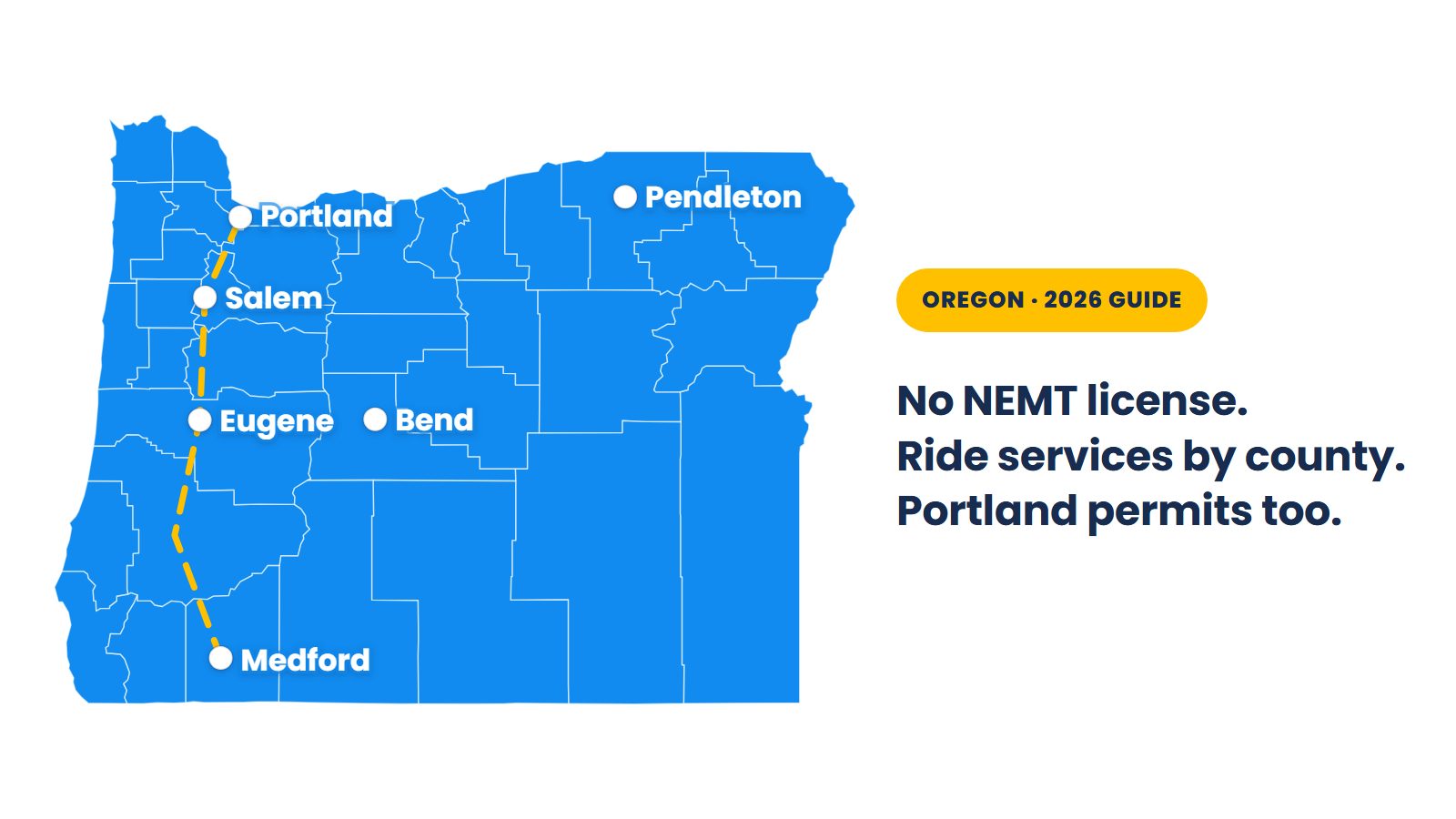
To start a NEMT business in Oregon, call your county’s one to four ride services, the brokerages that book Medicaid rides, then form an LLC ($100), insure a van and contract with each one that’s adding providers. There’s no NEMT license, but the Oregon Department of Transportation’s (ODOT) $300 passenger permit may apply, and Portland, Washington County, Salem and Eugene license vans. Budget about $25,500 for one financed used van; the ride services’ yes sets your clock.
Oregon at a glance:
- No NEMT license: the state’s motor-carrier law still reaches paid passenger trips, so ask ODOT whether your vans need its $300 Class 1R permit, for passenger carriers off regular routes [1][2].
- One to four ride services a county: the Oregon Health Plan (OHP), Oregon’s Medicaid, has no statewide broker. Each coordinated care organization (CCO), a regional OHP health plan, picks its members’ ride service, and the Oregon Health Authority (OHA) contracts eight brokerages for everyone else [3].
- Portland’s order: a brokerage contract first, then permits from the Portland Bureau of Transportation (PBOT) [4].
- Insurance: $1 million to $1.5 million on each van, the range the two ride services that publish a bar ask for [5][6].
- Pay: each ride service sets your rate with you, mode by mode, and no state schedule does [7].
A small-fleet owner based in the Portland area told me on a demo in October 2025 that only one ride service had worked out. Then it stopped taking new cars: it “doesn’t accept adding any more cars,” the owner said. “They’re at maximum.” The company had cut a couple of cars and couldn’t add them back. Most riders nearby already had OHP, so private pay didn’t fill the gap, and the owner had stopped trying to grow: “this business is stagnant.”
Oregon Medicaid doesn’t sign van companies itself: each ride service in your county contracts you separately, so ask which ones are adding providers before you buy a van.
The volume is real: OHA counted about 1.41 million OHP members in September 2026, and Portland’s Ride to Care alone “works with approximately 60 contracted transportation providers,” its site said in November 2026 [8][9].
I run Duet, which builds dispatch software and runs growth services for non-emergency medical transportation (NEMT) businesses, and this is the Oregon edition of our national guide on how to start a NEMT business. Requirements change, so confirm against the linked sources before you spend money.
The checklist runs in the order that wastes the least money, free calls first. Then come who pays, the ride services, the rules, getting in, and cost and time.
The one-page checklist: steps to start a NEMT business in Oregon
Call every ride service in your county before you buy a van, then form the company, line up van one, and file with each one. Each phase ends with the money at risk, from our national one-van budget with Oregon’s fees swapped in, for a used wheelchair minivan based in Salem.
Phase 0: count your ride services
- Your ride services: type your county into the search box on OHA’s rides page and write down every ride service on its rows, for CCO members and for Open Card, the OHP coverage for members outside a CCO [3].
- The question: call each one and ask whether it’s adding providers in your county, what it pays for each kind of trip and what insurance it wants.
- ODOT: call the Commerce and Compliance Division’s (CCD) Commercial Vehicle Account Processing Unit at 503-378-5983 and ask whether your vans need a Class 1R passenger permit [10].
- Your city: ask your city and county whether they license wheelchair vans. In Portland, that’s PBOT’s regulatory program at 503-823-7483 [4].
- Your insurance: get quotes at $1 million to $1.5 million on each van before you shop for the van.
- Money at risk: nothing yet.
Phase 1: form the company
- File Articles of Organization with the Secretary of State for $100. Oregon has no general state business license [11].
- Get a free employer identification number (EIN). A national provider identifier (NPI) under the NEMT taxonomy code, 343900000X, is free too, so ask each ride service whether it wants one.
- If you’ll work in Portland or Multnomah County, register with Portland’s Revenue Division within 60 days. The city and county business taxes exempt small gross receipts, but you still file a return each year to claim the exemption [12].
- Money at risk: about $400, counting $300 for a phone and basic marketing.
Phase 2: van one, ODOT and your city
- The van: our model prices a used wheelchair minivan at $33,000, with 20 percent down.
- The policy: bind it at the highest bar your Phase 0 calls turned up. The two Oregon ride services that publish one ask for $1,000,000 (Transdev, in its 2024 provider FAQ) to $1,500,000 (MTM, for Trillium’s tri-county members) each of general and auto liability [5][6].
- The registration: title and register the van with DMV. A vehicle that carries passengers for pay is a “commercial bus” under ORS 801.200, so ask DMV whether yours goes on its bus fee schedule, $74 a year at 8,000 pounds or less [13].
- ODOT: if CCD says the Class 1R permit applies, file its application with the $300 fee and have your insurer file at least $750,000 of coverage on a Form E [2][10].
- Your city: outside Portland, file your city or county license now. Salem’s vehicle-for-hire agency license costs $82.50 the first year, and Washington County’s wheelchair car license is $202 plus $202 a van [14][15]. In Portland, PBOT’s permits wait for your first brokerage contract.
- Money at risk: about $11,550 more ($6,600 down, $4,350 of insurance at signing, $201 of DMV fees, $300 to ODOT and Salem’s $82.50), so about $11,950 in.
Phase 3: meet each ride service’s bar
- Equipment: OHA’s rules want a first aid kit, a fire extinguisher, roadside warning devices, a flashlight, disposable gloves, tire traction devices when appropriate and everything needed to carry wheelchair riders under the Americans with Disabilities Act. CCO rides add working heat, air conditioning and ventilation [7][16].
- Inspection: Ride to Care asks for an inspection by an ASE-certified (Automotive Service Excellence) mechanic, and Portland wants one every year for most vans [9][17].
- The driver file: each driver’s first aid, CPR and blood spill course before the first CCO rider, a criminal background check under ORS 181A.195 and a check against the federal exclusion list [16].
- Money at risk: about $2,000 more for equipment, lettering, driver screening and training, so about $13,950 in.
Phase 4: file with each ride service the same week
- Apply to every ride service on your county’s rows the same week, by whatever route each one uses: an online form, an email or a phone call.
- Have the same packet ready for all of them: a Certificate of Good Standing from the Secretary of State, insurance certificates, each van’s registration and inspection, and each driver’s file [6][9].
- Money at risk: no new money.
Phase 5: from week one, line up trips you control alongside the other phases
- Your website: put up a website families can book on and claim your Google Business Profile.
- Your accounts: line up two facility accounts and post your private-pay prices in your first week, long before any ride service answers.
- Money at risk: six months of fixed bills at about $1,934 a month, counting the $15 phone line, for a total of about $25,500.
Who pays for NEMT rides in Oregon?
OHP, Oregon’s Medicaid program, is the volume, paid through about 15 ride services; facilities, Medicare plans, the VA and families are the trips you find yourself. OHP’s 15 CCOs and eight Open Card brokerages share ride services, so OHA’s list names about 15 different ones [3][26].
OHP: the volume behind your county’s ride services
OHP pays for a ride only when the member’s ride service arranges it, and only for members whose benefits include rides, so ask the ride service whether a rider qualifies. OHA’s page is blunt about the first part: “If someone other than the ride service arranges the member’s trip, OHP cannot pay for it” [3]. So an OHP rider who calls you directly is a ride service’s trip, not one you can bill.
Most of those trips run through a CCO’s ride service, since CCOs serve “over 90 percent of Oregon Health Plan members,” OHA says [18]. Ride to Care, Health Share’s ride service, says it averages “more than 1,500 completed trips per day,” though the same page’s table counts about 1,411 vehicle-provided rides a day [9]. Dialysis rides land here as well. In my experience most dialysis riders are on Medicaid, so their trips go through the ride service, not the dialysis center.
Facilities: accounts you can call this week
A facility that books you pays your invoice, and residents on Medicare alone are a reason to ask, since OHP’s NEMT benefit doesn’t cover people who have Medicare and no OHP [20]. CMS lists 128 certified nursing homes in Oregon, 55 of them in the Portland tri-county area, and 62 hospitals, 25 of them critical access hospitals [19]. That count leaves out the state’s assisted living, residential care and adult foster homes, and they’re worth calls too.
Contracts tend to follow visible work. “If you have to ask for facility contracts, then you’re not doing your job,” an owner in Salem with about 44 vehicles said on an industry podcast in October 2026. That owner’s advice is matching shirts, ID badges and the same logo on every van, not a magnet on the door. Another Oregon owner told me on a demo in October 2025 that the care facility managers behind many of the company’s private-pay rides text their ride requests to a dedicated text line. Some facilities confirm a day’s trips with one call to the front desk, and some don’t need a call at all. Our guide to who pays for nursing home transportation covers the pitch.
Families: private pay, and where it trickles
Families pay your price, by card, before the ride. Take the card at booking and charge it at least 24 hours before pickup, or send a payment link that’s due by then. No payment, no van. Some owners also take a small nonrefundable deposit to hold the spot, and our guide to when private-pay riders pay has the details.
Washington County publishes what its licensed wheelchair companies report charging. Its list, updated September 2026, has 19 wheelchair car providers, and the middle of the list comes to about $71 for a 10-mile trip [21]. The county adds its own caveat: “Rates below are not regulated by Washington County, and they are subject to change.” Shop your own area before you set prices.
Private pay starts slow where most riders already have OHP. The Portland-area owner from the opening tried it and found that “most people have an OHP.” A small-fleet owner in Southern Oregon who had hired someone to do the company’s marketing still described “the trickling in of the private pay” on an operator call I sat in on in November 2026. Our guide to finding private-pay riders has the playbook, and facilities usually come through first.
Medicare plans and the VA: ask who runs the rides
Medicare Advantage plans can add rides of their own. PacificSource’s Dual Care plan, a dual-eligible special needs plan (D-SNP) for people on both Medicare and OHP, lists NEMT at $0 in its 2026 Summary of Benefits and names no ride vendor [22]. Its 2026 service area takes in Central Oregon, the Gorge and Marion and Polk counties, so ask PacificSource who runs those rides.
Providence’s Medicare Dual Plus plan “is closed to new enrollments effective October 1, 2026,” and Providence Health Plan will “transition out of most of its health insurance lines of business beginning in 2027,” Medicare Advantage included [23]. These are 2026 plan-year documents, so check each plan’s 2027 papers before you build on one.
VA Portland’s Beneficiary Travel program covers “special mode” transport, which it describes as ambulance or wheelchair van, when it’s medically indicated [24]. Ask VA Portland how it buys those rides before you count on any.
Who is the NEMT broker in Oregon?
Oregon Medicaid has no statewide broker: each of the 15 coordinated care organizations (CCOs) arranges its members’ rides through a ride service it contracts [3][26]. Eight OHA-contracted brokerages carry Open Card (fee-for-service) riders, whose physical health care OHA covers instead of a CCO, in all 36 counties [3][25][8]. A ride service, OHA’s word for a brokerage, books each trip and picks and pays the company that drives it.
Here are the ride services by county, as OHA’s list and the CCOs’ own pages showed them in November 2026, with each CCO in parentheses [3][20][27]:
| County | CCO ride services (CCO) | Open Card ride service | Total ride services |
|---|---|---|---|
| Baker, Gilliam, Grant, Harney, Malheur, Morrow, Sherman, Umatilla, Union, Wallowa, Wheeler | GOBHI Transportation Services (Eastern Oregon CCO) | GOBHI Transportation Services | 1 |
| Lake | GOBHI Transportation Services (Eastern Oregon CCO) | TransLink | 2 |
| Hood River, Wasco | Modivcare (PacificSource Columbia Gorge) | GOBHI Transportation Services | 2 |
| Crook, Deschutes, Jefferson | Modivcare (PacificSource Central Oregon) | Cascades East Transit | 2 |
| Klamath | TransLink (Cascade Health Alliance); Modivcare or TransLink (PacificSource Central Oregon) | TransLink | 1 or 2 |
| Jackson | TransLink (Jackson Care Connect); ReadyRide (AllCare) | TransLink | 2 |
| Josephine | ReadyRide (AllCare) | TransLink | 2 |
| Coos | Bay Cities Brokerage (Advanced Health) | TransLink | 2 |
| Curry | Bay Cities Brokerage (Advanced Health); ReadyRide (AllCare) | TransLink | 3 |
| Douglas | Bay Cities Brokerage (Advanced Health, Umpqua Health Alliance); ReadyRide (AllCare); RideSource (Trillium, western Douglas) | TransLink | 4 |
| Lane | RideSource (Trillium) | RideSource | 1 |
| Benton, Lincoln | Cascades West Ride Line (InterCommunity Health Network) | Cascades West Ride Line | 1 |
| Linn | Cascades West Ride Line (InterCommunity Health Network); RideSource (Trillium, western Linn) | Cascades West Ride Line | 2 |
| Marion | Modivcare (PacificSource Marion-Polk) | Marion-Polk MedLink | 2 |
| Polk | Modivcare (PacificSource Marion-Polk); Well Ride (Yamhill Community Care) | Marion-Polk MedLink | 3 |
| Yamhill | Well Ride (Yamhill Community Care) | Tri-County MedLink | 2 |
| Clatsop, Columbia, Tillamook | NW Rides (Columbia Pacific CCO) | NW MedLink | 2 |
| Clackamas, Multnomah | Ride to Care (Health Share of Oregon); MTM (Trillium Tri-County) | Tri-County MedLink | 3 |
| Washington | Ride to Care (Health Share of Oregon); MTM (Trillium Tri-County); Well Ride (Yamhill Community Care) | Tri-County MedLink | 4 |
One ride service carries every OHP rider in 14 counties: Lane, Benton, Lincoln and 11 eastern counties where GOBHI (Greater Oregon Behavioral Health, Inc.) holds both the Open Card and the Eastern Oregon CCO trips. Washington and Douglas counties have four. In Klamath, PacificSource’s member page sends its members to Modivcare while OHA’s list sends them to TransLink, so ask PacificSource before you count Klamath as having one ride service [28][3].
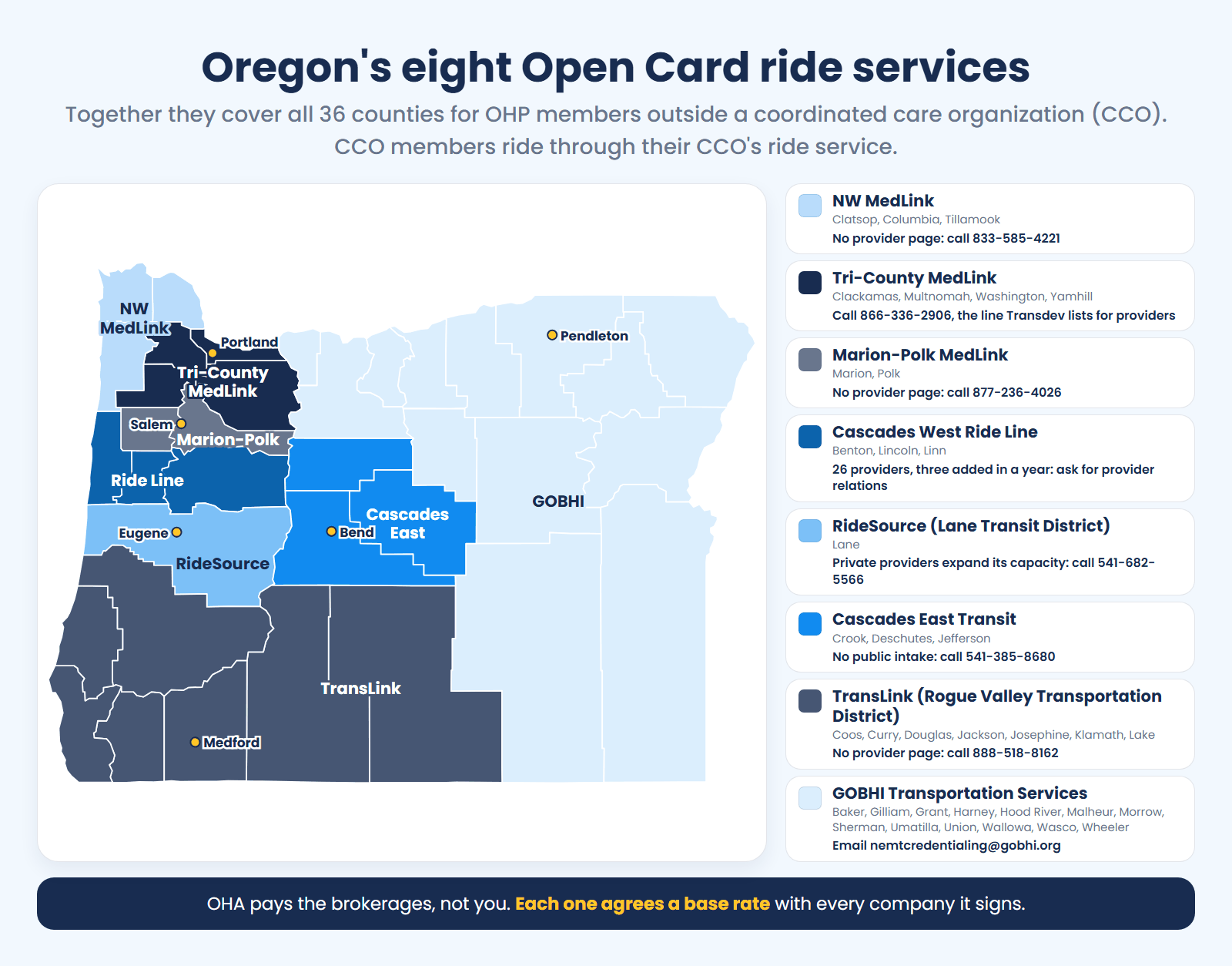
The eight Open Card ride services and how to reach each, as of November 2026:
- NW MedLink (Clatsop, Columbia, Tillamook): no provider page; call 833-585-4221.
- Tri-County MedLink (Clackamas, Multnomah, Washington, Yamhill): call 866-336-2906, the line Transdev lists for providers.
- Marion-Polk MedLink (Marion, Polk): no provider page; call 877-236-4026.
- Cascades West Ride Line, Oregon Cascades West Council of Governments (Benton, Lincoln, Linn): 26 providers in July 2026, and its advisory committee’s meetings are open to the public; call 541-924-8738 and ask for the provider relations coordinator [32].
- RideSource, Lane Transit District (Lane): outside companies add to its capacity, and MTM runs its brokerage operations, so ask at 541-682-5566 whether a new company signs with the district or with MTM [29].
- Cascades East Transit, Central Oregon Intergovernmental Council (Crook, Deschutes, Jefferson): no public intake, and its only provider link is to a web portal; call 541-385-8680 [31].
- TransLink, Rogue Valley Transportation District (Coos, Curry, Douglas, Jackson, Josephine, Klamath, Lake): no provider page; call its questions line, 888-518-8162 [30].
- GOBHI Transportation Services (Baker, Gilliam, Grant, Harney, Hood River, Malheur, Morrow, Sherman, Umatilla, Union, Wallowa, Wasco, Wheeler): email nemtcredentialing@gobhi.org.
OHA pays these brokerages, not you, and each one agrees a base rate with every company it signs [7].
Two changes carry dates. PacificSource’s Lane County CCO “ceased operations in February 2026,” OHA says, and its members went to Trillium or Open Card, which both ride with RideSource there, so ignore the PacificSource row still on OHA’s list for Lane [8][3]. And under OHA’s plan as of November 2026, Healthier Oregon members, people with full OHP coverage regardless of immigration status, leave their CCOs for Open Card on January 1, 2027, so their rides move to their county’s Open Card ride service [20][39]. We log moves like these in our 2026 tracker of broker changes.
Who are Portland’s four ride services?
Portland’s three counties share four ride services: Ride to Care for Health Share of Oregon’s members, MTM for Trillium’s tri-county members, Tri-County MedLink for Open Card riders and, in Washington County only, Well Ride for Yamhill Community Care’s members [3]. Three applications may reach all four, since Transdev runs Well Ride and lists the provider line OHA gives for Tri-County MedLink [6][3]:
- Ride to Care: CareOregon manages it for Health Share, the state’s largest CCO with about 444,000 members in September 2026, and Ride Connection “manages the reimbursement process and the network of transportation providers” [8][9]. Your contact is Ride Connection’s Provider Support, 503-528-1751 or providersupport@rideconnection.org, since Ride to Care posts no application.
- MTM: its Trillium page describes “application, credentialing, and contracting phases” with a contract representative, and it sets rates “on an individual basis” [5].
- Transdev: its Oregon site says it “manages non-emergency medical transportation (WellRide) for Yamhill CCO members,” and it takes applications online. The provider line it lists, 866-336-2906, is the number OHA lists for Tri-County MedLink, so ask on that call whether one application covers both [6].
Is MTM or Modivcare the NEMT broker in Oregon?
Neither MTM nor Modivcare is Oregon’s statewide broker: MTM is the ride service only for Trillium Community Health Plan’s members in Clackamas, Multnomah and Washington counties, and Modivcare only for PacificSource’s three CCO regions: Central Oregon, the Columbia Gorge and Marion-Polk [3][28][35]. MTM also runs RideSource’s brokerage operations for Lane Transit District, and it held Umpqua Health Alliance’s rides until Bay Cities Brokerage took over on July 1, 2023 [3][29]. OHA’s list still prints LogistiCare, Modivcare’s old name, on PacificSource’s Central Oregon row.
California also leaves Medicaid rides to each health plan, and our state-by-state table of who arranges Medicaid rides covers the rest.
Can I bill Oregon Medicaid directly for NEMT rides?
Not for van trips: OHA pays the Open Card brokerages, each CCO pays its ride service, and the ride service pays you a rate you agree with it. OHA’s rule puts it plainly: “Transportation brokerages pay subcontractors for NEMT services,” and the brokerages are the ones “enrolled as an Oregon Health Plan (OHP) provider” [7]. OHA’s brokerage manual pays for a ride only when “The transportation provider is actively enrolled with the brokerage” [36]. Open Card riders are OHP’s fee-for-service members, but their rides still come only through the county’s brokerage, so Oregon has no direct-billing lane for a van company.
Ambulance companies are the exception. They enroll with OHA, and when a ride service approves a non-emergent ambulance trip, “the ambulance companies will bill OHA for payment” [3].
For Open Card trips, OAR 410-136-3220 and OHA’s brokerage manual set how a brokerage pays you [7][36]:
- The base rate: “the rate the brokerage and its subcontractors agree on for each mode of transportation.”
- Shared rides: the full base rate for the first rider and “one-half the base rate for each additional client.”
- Miles: “only for actual miles traveled, regardless of the number of clients transported.” GOBHI’s rate form asks for a base rate plus mileage, or a flat rate [37].
- Mode: an ambulatory rider in your wheelchair van pays the ambulatory base rate.
- Waiting: no pay for waiting for riders to reach the van or for helping them in and out. A brokerage may pay for waiting in cases such as a rider on your gurney who can’t transfer to one at the medical facility, nausea after dialysis or chemotherapy, or a stop for a prescription.
- No-shows: “Transportation providers do not receive payment for no-shows,” though a trip to an appointment the medical provider canceled without telling the rider or you gets paid [36].
GOBHI spells out its own process: its “ride assignment is fundamentally rate based,” each trip is shopped for “the most appropriate and cost effective provider,” and you may ask for a new rate “no more than every 90 days” [37]. The $0.49 a mile you’ll see on OHA’s pages is what members get for driving themselves, never a provider rate [20]. Our guide to who sets your rate shows how the same split works in other states.
The Salem owner charges cost overrides on far trips: a price that counts the deadhead miles to a pickup in another city. “Every single contract says we don’t do them,” the owner said of the ride services, and they call anyway and pay it: “They call me back.”
Do I need an OHP provider number?
Not as a van company: OHA’s list of enrollable provider types, updated November 2, 2026, shows only “Air Ambulance” and “Ambulance” under Transportation Provider. Its file of active providers as of November 15, 2026 holds 227 ambulance, 48 air ambulance and nine transportation broker enrollments, plus a single “Common Carrier (Non-ambulatory)” enrollment [18].
On the CCO side, OHA’s rules make CCOs require some contracted providers to enroll with OHA as “encounter only” providers [38]. Nothing we read says a ride service’s van company is one, so ask your CCO’s ride service and OHA’s Provider Enrollment line, 800-336-6016, option 6, before you pay for any application [39]. Our guide to whether a broker needs you signed up with Medicaid first shows how other states handle it.
What licenses and requirements does a NEMT business need in Oregon?
Oregon has no NEMT license, but its motor-carrier law, ORS chapter 825, covers anyone who carries people for hire, so ask ODOT’s Commerce and Compliance Division whether your vans need a Class 1R passenger permit before the first paid trip. The licenses that certainly bite are local.
The statute is broad. A “for-hire carrier” is “Any person who transports persons or property for hire,” and ORS 825.100 bars operating “as a carrier in the transportation of persons or property” without ODOT’s certificate or permit [1]. The exemptions in ORS 825.017 cover ambulances, and vehicles seating 12 or fewer that carry people with disabilities to rehabilitation programs or child care when run by or under contract with those programs, but name no wheelchair van or NEMT service. The closest cover taxis seating five or fewer and limousines seating eight or fewer, and only when the passenger may control the destination and route and the fare runs on an initial fee, distance or waiting time. Trips a ride service assigns to set appointments may not meet that test, so get ODOT’s answer before you assume an exemption.
If the permit applies, it’s the Class 1R, for intrastate, for-hire passenger carriers other than regular-route scheduled service. The application goes in on ODOT Form 735-9751 with a motor carrier account form, proof of insurance and your Secretary of State registration, plus the $300 fee in ORS 825.180, and your insurer files at least a $750,000 single limit [2]. A permit also brings ORS 825.410’s drug and alcohol testing program, in-house under federal Part 382 or through a consortium [1]. Transdev’s Oregon manual already asks its providers to meet “the license-for-hire standards established by the State Department of Transportation (DOT)” [6].
What do other Oregon guides get wrong?
The claims below, as they read in startup guides and AI answers in November 2026, send van companies to an OHA portal with no place for them, misname the brokers and quote figures that aren’t Oregon’s. Each sits next to what Oregon actually requires:
| The claim you’ll read elsewhere | What Oregon actually requires |
|---|---|
| “No distinct state NEMT license exists; relies on local municipal permitting” | No NEMT license, but ORS chapter 825 covers carriers of people for hire, so ask ODOT whether your vans need its $300 Class 1R permit [1] |
| “NEMT businesses must apply for a Certificate of Authority” | ODOT issues a Class 1R permit to a passenger carrier that needs one, and no exemption in ORS 825.017 names wheelchair van or NEMT service [1][2] |
| “enroll with the Oregon Health Authority via the OHP Provider Enrollment portal so your NPI is linked to OHP” | OHA’s enrollable transportation types are ambulance and air ambulance; the brokerages enroll, and a van company contracts with each ride service [18] |
| “Verify your business name with the Oregon Medicaid / Health Standards NEMT Program Desk” | OHA lists no such desk; your first calls go to the ride services on your county’s rows [3] |
| “Primary Brokers in Oregon”: ModivCare and MTM Health | Oregon Medicaid has no statewide broker: Modivcare serves PacificSource’s three CCO regions and MTM Trillium’s tri-county members, two of about 15 ride services |
| “providers may submit claims directly to Medicaid for reimbursement” | Not for van trips: OHA pays the brokerages, and the brokerages pay the companies that drive [7] |
| “General liability ($100,000) and automobile liability ($25,000 per person / $50,000 per accident / $25,000 property damage)” | The car floor is $25,000/$50,000/$20,000, and the two ride services that print a bar ask for $1 million to $1.5 million [40] |
| “$300,000 to $750,000+ depending on weight class” | Weight doesn’t set the passenger floors: ODOT’s, where its permit applies, is $750,000, and interstate passenger trips usually need $1.5 million for 15 or fewer seats [10][41] |
| “Average 60-120 days” | No Oregon rule sets a credentialing clock, so ask each ride service how long its last new company took |
| “Chauffeur / Class D or CDL license” | Oregon has no chauffeur class: a regular Class C license covers a van built for fewer than 16 people, counting the driver, under 26,001 pounds [42] |
| A rate card of about $70 plus $5 a mile for wheelchair trips that “cannot drop below state Medicaid minimums” | Each ride service agrees a base rate with you for each mode, and no state schedule sets one for van trips |
| “Drivers must pass a criminal background check through the Oregon Department of Human Services (ODHS) Background Check Unit” | OHA’s NEMT rules call for a check under ORS 181A.195 and OAR 257-010, or a mass transit district’s own check when the ride service is a district [7][16] |
| “Must hold active taxi, livery, or for-hire vehicle permits from the operating city or county” | Only where a program exists: Portland, Washington County, Salem and Eugene license vans, and Bend and Medford license vehicles for hire, while Multnomah, Clackamas, Lane and Marion counties don’t [43][44] |
What does Portland require?
Portland’s Bureau of Transportation (PBOT) permits NEMT companies, vans and drivers, and a new company “must first secure a contract with the local brokerage” [4]. Portland City Code says no one may “conduct business as an NEMT company” in the city without a permit, and it defines an NEMT company by “agency-sponsored, contracted transportation” under OHA’s rule [17]. How PBOT treats a private-pay-only wheelchair company isn’t written down, so ask its regulatory program, 503-823-7483 or regulatory@portlandoregon.gov, before you run a paid trip in the city.
The permits, at rates effective July 1, 2026 and charged since October 16, 2026 [4]:
- The company: $287.50 to apply and $575.50 a year.
- Each van: $259 for its first permit and $207 a year to renew.
- Each driver: $115 a year, plus $60.50 when the city runs the yearly background screening.
- Two vans and two drivers: $1,611 to start.
The rules behind them [17]:
- Insurance: a $500,000 combined single limit on autos, general liability of $1 million per occurrence and $2 million aggregate, workers’ comp, the city as an additional insured and insurers rated A.M. Best A- or better.
- Vans: none may run as an NEMT vehicle more than 15 years after its manufacture date, though a lift-equipped wheelchair van can stay eligible up to 20 years under the city’s age-exemption rule. Each needs a yearly ASE inspection once it’s more than a year old or has 10,000 miles [4].
- Drivers: 21 or older, licensed at least 365 days in the past 18 months, a yearly background check and no street hails.
PBOT says new companies “can take up to 60 days to process,” and its page lists Ride Connection, Ride to Care’s network manager, among the brokerages to call first [4]. Ride to Care’s own page agrees: providers picking up “within the city of Portland must carry necessary permits for their drivers, vehicles and companies” [9].
Do other Oregon cities and counties license NEMT vans?
Washington County licenses every paid wheelchair car, whoever pays, at $202 plus $202 a van a year, Salem and Eugene license vans too, and Bend and Medford license vehicles for hire [15][14][44][45]. Here’s what each wants:
- Washington County: a “wheelchair car” is a vehicle for hire for riders in wheelchairs who don’t need an ambulance, and nobody may run one in the county without a provider license and a license for each van. The county inspects vans, wants first aid and CPR for staff, applies OHA’s vehicle and subcontractor standards, OAR 410-136-3040, to every licensed wheelchair car and bars charging “any fee not on file” with its EMS office. It sets its own limits for vehicle, general and errors-and-omissions coverage and sends its application on request, so call 503-846-8699.
- Salem: its code lists “wheelchair coaches” among vehicles for hire. The agency license is $40 to apply, $25 a year, a $12.50 processing fee and a $5 surcharge. The city wants $1,000,000 of auto liability, general liability of $1,000,000 per occurrence and $2,000,000 aggregate, drivers 21 or older and a criminal check before driving and every year. Coaches paid only by third parties for medical trips skip the taximeter and posted rates.
- Bend and Medford: each licenses vehicles for hire. Bend’s definition excludes vans that nonprofits run solely for elderly or disabled riders, and Medford’s names no wheelchair exclusion. Both want $1 million of auto liability and drivers 21 or older, so ask each city how it treats a for-profit wheelchair van.
- Eugene: it registers “medical transport vehicles,” and its code says operators must be certified at least as an “emergency medical technician B, first responder, or certified nursing assistant.” It bars stretchers and oxygen-administration equipment in those vehicles, and those sections name no fee and leave the type and level of insurance to city manager rules, so call the city.
- Springfield: its code still licenses “first aid vehicles” and requires drivers certified as emergency medical technicians, so ask the city whether it applies those sections to wheelchair vans today.
Multnomah, Clackamas, Lane and Marion counties license no wheelchair vans. Multnomah’s EMS office licenses ambulances and sends for-hire vans to PBOT, Clackamas “does not regulate the provision of non-emergency ambulance services,” Lane’s plan leaves out transports without an EMT, and Marion franchises only ambulance services [43]. OHA’s EMS office sends the question back to you: “Contact your local city or county governmental agency” [46]. Budget a week of calls for every city you’ll serve, and our guide to what cities and counties require shows how the local layer works elsewhere.
What are the NEMT insurance requirements in Oregon?
Plan on $1 million to $1.5 million of liability on each van, the range the two Oregon ride services that publish a bar ask for, not the $25,000/$50,000/$20,000 car floor in ORS 806.070. MTM’s Trillium page says, “All transportation providers must have general and automobile liability policies of no less than $1,500,000 each,” with MTM as certificate holder and additional insured on both [5]. Transdev’s 2024 provider FAQ asks for $1,000,000 combined single limit each for general liability, which must cover sexual abuse and molestation, and for auto, from an insurer rated at least B+, with Transdev as an additional insured [6].
Transdev’s own January 2024 manual prints a lower split, $500,000 for one person and $1,000,000 for two or more, so ask which one your contract uses. Ride to Care and GOBHI leave the limits to your contract, and Ride to Care wants that coverage in place before your first trip [9][37].
For the record, the other numbers you’ll see:
- The state car floor: $25,000 per person, $50,000 per accident and $20,000 of property damage, under ORS 806.070 [40].
- ODOT’s filing floor: a $750,000 single limit, if the Class 1R permit applies [2].
- Portland: a $500,000 combined single limit on autos, plus $1 million per occurrence and $2 million aggregate of general liability [17].
- Salem, Bend and Medford: $1 million combined single limit on autos [14][44].
- Washington County: vehicle, general and errors-and-omissions coverage at limits it sets in its application [15].
- Trips across a state line: $1.5 million for a vehicle seating 15 or fewer, counting the driver, under federal rules [41].
I don’t have an Oregon premium figure to give you. Our national model prices a new company’s wheelchair van at about $17,400 a year for about $1 million of auto liability: $4,350 at signing, then ten installments of $1,305. A $1.5 million bar or general liability on top costs more. Our guide to what a brand-new company pays for coverage shows the method. Renewals move, too. The Salem owner said on the podcast that “Insurance went up 22%” at the December renewal, with an extra $17,000 due up front, and workers’ comp rose about $2,000 a month after the company gave raises.
Oregon requires workers’ comp from your first employee. The state’s Workers’ Compensation Division says, “If you employ one or more workers, you are an employer” [47]. OHA’s Open Card rule requires it of subcontractors that employ workers, and Portland lists it among its permit insurance [7][17]. Our model budgets the $500 minimum premium of SAIF Corporation, a workers’ comp insurer, for a first policy [47].
What do NEMT drivers need in Oregon?
NEMT drivers in Oregon don’t need a commercial driver’s license (CDL) for a typical wheelchair van: a regular Class C license covers it, and a CDL starts at 16 or more people, counting the driver, or 26,001 pounds [42]. ORS 807.031 says a Class C license covers “any vehicle for which a commercial driver license is not required.”
OHA’s rule for CCO rides, OAR 410-141-3925, and its Open Card rule, OAR 410-136-3040, share the core of the driver file [16][7]:
- The license: the right class for the vehicle. The Open Card rule asks for “a valid Oregon DMV-issued drivers license.”
- The background check: under ORS 181A.195 and OAR chapter 257, division 10, at hire. For Open Card rides through a ride service that’s a mass transit district, the district’s own check, which takes fingerprints, applies instead.
- Exclusions and disclosures: the CCO rule adds a check against the federal Office of Inspector General’s exclusion list and has drivers disclose drug-law violations and their driving history.
Each ride service stacks its own requirements on top:
- Transdev: drivers 21 or older with two years of continuous U.S. driving, and drug and alcohol tests before hire and at random [6].
- Ride to Care: an Oregon or Washington license and a yearly review of each driver’s record and background check [9].
- GOBHI: a license from Oregon, Washington, Idaho or California, a yearly background check and driving record, and an 8-panel lab drug screen at credentialing when it asks for one [37].
Ask each ride service for its list before you hire. Our guide to whose rules decide who can drive for you sorts out which list wins.
What training do Oregon’s NEMT rules require?
Oregon’s two NEMT rule sets require the same three courses: first aid and CPR before a driver’s first CCO rider and the other two within three months, or six months for each on Open Card, so meet the faster clock [16][7]:
- Defensive driving: the National Safety Council course or an equivalent within three months of hire for CCO riders, six months for Open Card, then every three years.
- First aid, CPR and blood spill procedures: Red Cross-approved courses or equivalents before a driver’s first CCO rider, or within six months for Open Card, kept current.
- Passenger Service and Safety: within three months for CCO riders, six for Open Card, then every three years.
- Ride services’ extras: CareOregon’s template manual has wheelchair van drivers complete the securement portion, and GOBHI wants defensive driving and a passenger assistance (PASS) course before credentialing [48][37].
Can a NEMT company run stretcher van trips in Oregon?
OHA pays a stretcher-car mode for riders who need no medical care on the way, but where you may run one depends on the county and the city. OHA’s brokerage manual describes stretcher cars as vehicles that carry a rider “in a prone or supine position” who “does not require any medical care or observation” [36]. The line to an ambulance is care: OHA’s rules require an ambulance when a medical facility or provider says the rider’s condition “requires the presence of a health care professional” [7][16].
The Open Card pay rule matters too. A reclining wheelchair pays the wheelchair rate, since “wheelchairs do not qualify as stretchers or gurneys,” and an ambulance used as a stretcher car gets the stretcher rate unless the trip runs past two hours [7].
Local rules split four ways [15][43][45][14]:
- Washington County: stretcher cars are banned. The county’s rules say, “The use of a stretcher car as defined above is not allowed in Washington County.”
- Multnomah County: stretcher cars have been allowed since a December 2021 rule change, except for stretcher trips between two health care facilities, which need a licensed ambulance. A stretcher car needs at least one driver and carries no attendant in back.
- Lane County and Eugene: Lane’s ambulance plan leaves stretcher cars out of its rules, but Eugene bars “any type of stretcher, gurney, or cot” in a medical transport vehicle.
- Salem: a wheelchair coach “may transport a person on a stretcher if the person is not in acute medical distress.”
Multnomah spells out the care line: a licensed ambulance is required whenever the rider needs medical observation or care, “such as when the transportation provider must administer oxygen, monitor an IV, or other medical devices.” Put that line in your dispatch protocols in writing. The Salem owner runs wheelchair and stretcher vans, which fits Salem’s code, and our guide to when to add stretcher covers whether it pays.
How do you become a Medicaid transportation provider in Oregon?
You contract with each ride service that serves your county, one at a time, and each has its own intake, bar and clock. Each also hands out trips by its own measure: OHA’s rule lists cost first among the factors an Open Card brokerage weighs when it assigns a ride, ahead of your capabilities, availability and past performance [7].
Step one: ask every ride service if it’s adding providers
Call every ride service on your county’s rows before you buy, since ride services add companies when they need capacity and hold steady when they don’t. Cascades West Ride Line, for one, told its advisory committee in July 2026 that it had added three providers since the year before [32]. MTM’s national provider page says, “If we have a need in your area, you’ll hear back quickly,” and otherwise keeps your information on file [5]. Don’t count on volume, either: “Contracted providers are not guaranteed a specific volume of trips,” GOBHI’s manual says [37].
Ask each one the same questions:
- Capacity: is it adding providers in your county, and for which kinds of trips?
- Pay: what’s the base rate for each mode, and how often does it pay?
- Insurance: what limits, and who goes on the certificate as an additional insured?
- Trips: how does it offer them, and how far ahead?
- Time: how long did its last new company take, application to first trip?
Eastern Oregon is simpler: in 11 counties GOBHI holds both the Open Card and the CCO trips, so “call every ride service” is one email. And none of this makes OHP optional. It’s the volume, even where a ride service like ReadyRide drives part of the work itself.
Step two: file where the ride service has an intake
- Transdev, for Well Ride: submit the online application; if Transdev selects you to continue, a full review with compliance forms, staff and fleet information follows [6]. Its provider FAQ also wants an ownership and control form every year.
- GOBHI: email nemtcredentialing@gobhi.org, and send rate questions to NEMTrates@gobhi.org [37].
- MTM, for Trillium’s tri-county members: work through its application, credentialing and contracting phases with a contract representative [5].
- Modivcare, for PacificSource: its PacificSource provider page sends you to Modivcare’s national provider page and its network form, and its line for providers’ trip and billing questions is 1-844-287-6697 [49].
- Ride to Care: call or email Ride Connection’s Provider Support.
- Bay Cities Brokerage, for Advanced Health and Umpqua Health Alliance: its site posts a vendor application that asks for your counties, vehicle types and insurance limits, with your certificate of insurance attached; its line is 877-324-8109 [34][3].
- Everyone else: call, since none posts an application on the pages we read. Tillamook County Transportation District runs NW Rides: 888-793-0439 [33][3]. ReadyRide, AllCare’s ride service, runs a fleet of its own, so ask at 800-479-7920 or 541-479-7920 whether it books outside companies in your county [27][3].
How long does credentialing take?
No Oregon rule sets a credentialing clock, and Transdev’s, for Well Ride, is the only published one I’ve seen: an answer on the application within a week, then a reply within two weeks of complete documents, which may bring follow-up questions [6]. Ask the others how long their last new company took, application to first trip.
That’s the catch-22: ride services want insured vans, trained drivers and a clean file before your first trip, and you need trips to pay for all of it. The facility and private-pay rides from the who-pays section are what carry you. Our guides to winning a nursing home or rehab account and getting from a facility meeting to its first ride cover that stretch.
Don’t build the whole schedule on one payer
In Oregon the payer behind your trips can stop paying or change, so keep trips you control. Portland’s biggest Medicaid ride program has already shown how. In the fall of 2019, GridWorks, the company running Ride to Care for Health Share, stopped paying the “mom-and-pop transportation companies” behind about 4,000 rides a day, Willamette Week reported that December [50]. Health Share had already announced in October that it would move the program to CareOregon [51]. In December, GridWorks went into receivership, unable to pay for past rides, and Health Share’s board approved a one-time payment to providers for what GridWorks owed for October and November.
Ride Connection’s role dates from that handover: CareOregon picked it for network management in November 2019 and split the call center and dispatch into separate jobs, a model it expected to be fully running by April 1, 2020 [51]. A dispatcher who worked Ride to Care trips back then remembered it on a December 2025 call with my cofounder Jing and me: the contractor went under “like the second year of the contract.”
Credentials can close a door, too. An Oregon owner told me on a demo in October 2025 that four companies in the owner’s area “just got dropped” by a ride vendor that works with Medicare and private plans “because they couldn’t credential.” And the payer behind a rider can change on a set date. Under OHA’s plan, Healthier Oregon’s move to Open Card on January 1, 2027 takes about 100,000 members out of their CCOs, and in counties where the Open Card ride service is a different one, those trips change ride services [39][20].
However you dispatch, keep every payer’s trips on one schedule. Dispatch software like Duet keeps MTM’s and Modivcare’s trips on one board with your facility and private-pay rides. MTM and Modivcare are among Duet’s direct integrations, and if your county’s ride service isn’t on that list but its system exports a trip file, Duet can usually import that file instead. You still apply to each ride service, meet its bar and run every trip yourself.
How much does it cost to start a NEMT business in Oregon?
Budget about $25,500 for one financed used wheelchair minivan in Salem with six months of bills, or about $52,300 for two in Portland, before payroll for the one driver you’d hire. Oregon’s inputs are its own fees, line by line [11][1][14][12][4][13]. The rest comes from our national startup model, whose inputs are national dealer prices and our own assumptions, not Oregon quotes: a $33,000 used wheelchair minivan, 80 percent financed at 14 percent over 60 months, and $17,400 a year of insurance per van.
| Line item | One used van, Salem | Two used vans, Portland |
|---|---|---|
| LLC Articles of Organization | $100 | $100 |
| EIN and NPI | $0 | $0 |
| “NEMT license” | $0 | $0 |
| ODOT Class 1R passenger permit, if it applies | $300 | $300 |
| Salem vehicle-for-hire agency license, first year | $82.50 | Not needed |
| Portland and Multnomah County business taxes, under the exemptions | Not needed | $0 |
| PBOT NEMT permits: application, company, 2 vans, 2 drivers | Not needed | $1,611 |
| Van down payments, 20 percent of $33,000 | $6,600 | $13,200 |
| Title, first-year registration and plates | $201 | $514 |
| Vehicle privilege tax on a used van | $0 | $0 |
| Equipment and lettering | $1,000 | $2,000 |
| Driver screening and training | $1,000 | $2,000 |
| Phone and basic marketing | $300 | $300 |
| Insurance due at signing | $4,350 | $8,700 |
| Workers’ comp, minimum premium | None until you hire | $500 |
| Six months of fixed bills | $11,606 | $23,121 |
| Total | About $25,500 | About $52,300 |
The fixed bills are insurance at $1,305 a month per van, the van payment ($614 a month on each $26,400 loan) and $15 of phone. Insurance is already the biggest cost: about $12,200 of the one-van total. The DMV line assumes DMV registers a paid van as a commercial bus: $74 a year at 8,000 pounds or less, a $101 title and $26 plates, plus Multnomah County’s $14 a quarter in Portland. Ask DMV which class your van falls in. A new van from an Oregon dealer would owe the 0.5 percent vehicle privilege tax, though not on its wheelchair conversion [13]. Outside the totals sit payroll, ASE inspections and year-two renewals.
Van prices move the total most. The one used wheelchair van older than 2024 that MobilityWorks listed in Wilsonville on November 25, 2026, a 2019 Chrysler Pacifica Touring L, was priced at $49,990. At that price the Salem start comes to about $30,800, about $5,300 more [52].
Anyone quoting an Oregon launch without $1 million of coverage on each van hasn’t priced the bars Oregon’s ride services publish.
Size doesn’t guarantee a margin, either. The Salem owner’s company, with about 44 vehicles, had about $5 million in revenue and about $60,000 in profit last year, the owner said on that industry podcast. That’s about 1.2 percent. The same owner counted six local NEMT companies that had closed: “Six that I can think of just this year in my city.”
How do you fund a NEMT startup in Oregon?
Business Oregon’s two loan programs, the Oregon SBDC Network and the SBA fit a van company this size [53]:
- The Entrepreneurial Development Loan Fund: Business Oregon’s direct loans for start-ups and small businesses run up to $1,000,000 over a borrower’s lifetime, at a fixed rate of at least prime plus 2 percent. You apply through a counselor at a Small Business Development Center or another certified entity.
- The Capital Access Program: Business Oregon matches a participating bank’s or credit union’s loan-loss reserve, up to $35,000 per borrower, and the lender sets the rate and terms.
- The Oregon SBDC Network: its regional centers offer no-cost advising, and their counselors take the loan fund’s applications.
- The Small Business Administration (SBA): its Portland District Office serves 30 Oregon counties, with the easternmost six served from Boise, and MESO, a Portland lender, is an SBA microlender.
None of them speeds up a ride service’s review, so borrow for the months you’ll actually wait.
How long does it take to start a NEMT business in Oregon?
The paperwork takes weeks; the ride services’ yes sets the clock, and in Portland, PBOT’s permit, which can take up to 60 days for a new company, only starts after your first brokerage contract. Here’s the order:
- Week one: form the LLC, get your EIN, call every ride service on your county’s rows, call CCD and your city, and start insurance quotes.
- When van one’s policy binds: title and register the van with DMV and, if CCD says the Class 1R permit applies, send ODOT the application with your insurer’s filing.
- The same week: apply to every ride service on your rows. Transdev answers an application within a week and replies within two weeks of complete documents, and the others give no clock.
- Before the first CCO rider: finish each driver’s first aid, CPR and blood spill training, with defensive driving and Passenger Service and Safety inside three months.
- In Portland, after your first brokerage contract: apply for PBOT’s company, van and driver permits, and allow up to 60 days.
- The first ride-service trip: it comes when a ride service signs you, checks your van and offers you work.
Outside Portland, facility and private-pay trips can start the week your policy, your local licenses (Washington County’s provider and van licenses included) and, if CCD says it applies, your Class 1R permit are in place, so run them through all of it [15][2]. In Portland, ask PBOT which permit a private-pay ride needs before your first one, since its NEMT permit is written for agency-sponsored trips. Budget for six months of fixed bills, because the ride services’ yes is the step you can’t schedule.
The Portland-area owner from the opening had one door, and when it stopped adding cars, there was nothing else to grow into. Before van two, call every ride service in your county and ask whether it’s adding cars, then check that facility and private-pay trips would cover that van’s roughly $1,920 a month of payment and insurance if they all said no.
Oregon NEMT FAQ
Can a Vancouver, Washington company take Oregon trips?
Yes, with the right paperwork for each kind of trip. A paid trip across the state line is interstate, which usually means federal operating authority, a USDOT number and $1.5 million of liability for a vehicle seating 15 or fewer, counting the driver [41]. A trip inside Oregon brings Oregon’s rules, and PBOT’s permit checklist says companies “must be registered in all states they operate in” [4]. Drivers are a separate question: Ride to Care takes Washington licenses, but OHA’s Open Card rule asks for “a valid Oregon DMV-issued drivers license,” so ask each ride service first. Our Washington guide covers the trip in the other direction.
What changes for Healthier Oregon members on January 1, 2027?
As of November 2026, OHA’s plan moves about 100,000 Healthier Oregon members, people with full OHP coverage regardless of immigration status, from their CCOs to Open Card on January 1, 2027 [39]. Their rides then come through the Open Card ride service for their county. Open Card brokerages could take bookings for 2027 trips from October 1, 2026, and OHA’s memo names five CCOs whose ride service already serves Open Card riders too [54]. OHA counted 96,371 Open Card members in September 2026, so the move roughly doubles Open Card [8].
Does OHP pay for rides to Washington, Idaho or California?
Yes, when the care is covered and the service location is no more than 75 miles from the Oregon border, under OHA’s Open Card rule [7]. Farther trips count as out-of-state transportation, which the ride service arranges only after OHA or the member’s CCO has authorized the out-of-state care. Either way the trip goes through the member’s ride service, and a paid crossing usually brings federal authority, as any interstate trip does.
Does Medicare pay for NEMT rides in Oregon?
Original Medicare doesn’t. CMS’s claims manual says Medicare covers no “non-ambulance forms of transportation, such as ambulette, wheelchair van, or litter van” [55]. A rider with both Medicare and OHP rides through OHP. A rider with Medicare and no OHP doesn’t: OHA says members “with Medicare only are unfortunately not eligible for NEMT” [20]. Some Medicare Advantage plans add rides, so ask each plan who runs them before you count on its members.
Do Uber and Lyft take OHP rides?
Only as a backstop. OHA approved Uber and Lyft in 2024 for a pilot that let ride services use them when “Regular NEMT providers cannot provide timely rides” [56]. The recommended riders were “ambulatory members who do not need hand-to-hand assistance,” and the pilot was set to run through the end of 2025. Cascades West Ride Line still booked 177 such rides in the third quarter of 2026, against 47,479 completed trips [32]. That’s well under 1 percent, so ask your ride service how it fills its ambulatory trips.
How do OHP riders schedule a ride?
They call their county’s ride service at least two days before the appointment, OHA’s 2026 Open Card handbook tells members, and they can book up to 90 days ahead [25]. A rider who calls later may not get a ride. When a ride is booked more than 48 hours ahead, the ride service contacts the rider at least two days before it. The handbook says the driver waits up to 15 minutes after the pickup time and drops the rider off at least 15 minutes before the appointment, though Transdev’s 2024 manual tells its companies they needn’t wait more than 10 [6].
What does an Oregon NEMT company owe each year?
The Secretary of State’s $100 LLC renewal, plus each local license you hold [11]. Washington County renews wheelchair car licenses every year, Salem’s licenses expire each December 31, and Portland renews its NEMT permits each year at $575.50 for the company, $207 a van and $115 a driver [15][14][4]. In Portland and Multnomah County you file a business tax return each year to claim the small-business exemption, and Transdev wants a fresh insurance certificate every six months. Your insurance and workers’ comp renew on their own dates.
Is Oregon a good state to start a NEMT business?
It can be, if you start with trips you control. OHA counted about 1.41 million OHP members in September 2026, and Oregon had 850,217 residents 65 or older in 2024 [57]. The field is filling in: 149 active NPIs in Oregon carry the NEMT van code, and 71 of them were first issued in 2023 or later, by our count of the July 2026 federal NPI file [58]. An NPI is a registration, not a working company. The caution is the doors, since each ride service in your county decides on its own whether to add you.
Key official sources
[1] ORS chapter 825, Motor Carriers, 2025 edition on the Oregon Legislature’s site (read November 25, 2026): the for-hire carrier definition in ORS 825.005, the compliance rule in 825.010, the certificate or permit requirement in 825.100, the exemptions in 825.017, the $300 permit fee in 825.180 and the drug and alcohol testing rule in 825.410. https://www.oregonlegislature.gov/bills_laws/ors/ors825.html
[2] OAR 740-035 and 740-040, ODOT Commerce and Compliance Division rules, official text (read November 25, 2026): the Class 1R passenger permit, its application requirements and the $750,000 single-limit insurance filing. https://secure.sos.state.or.us/oard/displayDivisionRules.action?selectedDivision=3478 and https://secure.sos.state.or.us/oard/displayDivisionRules.action?selectedDivision=3479
[3] Oregon Health Authority (OHA), “Oregon Health Plan (OHP) and Travel Help” page, with all 25 rows of its ride-service list and its rides FAQ (read November 25, 2026): ride services as “brokerages”, NEMT only for OHP Plus members, OHP paying only for rides the ride service arranges, the eight Open Card brokerages and 16 CCO rows with their counties and phones, the stale PacificSource Lane and LogistiCare rows, Umpqua Health Alliance’s July 1, 2023 move from MTM to Bay Cities Brokerage, and ambulance companies billing OHA for approved non-emergent trips. https://www.oregon.gov/oha/hsd/ohp/pages/nemt.aspx
[4] Portland Bureau of Transportation (PBOT), Private For-Hire Permit Application Resources and Fees page, TRN-3.450 Exhibit F fee schedule (effective July 1, 2026), company permit application requirements (updated July 1, 2026), TRN-14.28 vehicle age exemption (amended effective October 10, 2026) and Transportation Regulatory Program page (read November 25, 2026): the brokerage contract first, up to 60 days for new companies, the NEMT fees and their October 16 start, registration in each state, the 20-year limit for lift-equipped vans, and PBOT’s contacts. https://www.portland.gov/transportation/regulatory/pfht-resources, https://www.portland.gov/transportation/documents/trn-3450-exhibit-f-regulatory-fees-rates-and-charges-1/download, https://www.portland.gov/transportation/regulatory/documents/private-hire-transportation-company-permit-application-0/download, https://www.portland.gov/policies/transportation/private-hire-transportation/trn-1428-administrative-rule-private-hire and https://www.portland.gov/transportation/regulatory/private-hire
[5] MTM Health, Trillium Community Transportation Providers page (modified November 3, 2026) and its national service providers page (read November 25, 2026): the application, credentialing and contracting phases, rates set individually, no pay for no-shows, $1,500,000 each of general and auto liability, and how it answers new providers. https://www.mtm-inc.net/oregon-trillium/transportation-providers/ and https://www.mtm-inc.net/service-providers/
[6] Transdev Health Solutions, Oregon pages, Provider Manual - Oregon (January 2024) and OR Provider Information FAQ (January 19, 2024) (read November 25, 2026): Well Ride for Yamhill CCO members, the provider line, the application and review clocks, application documents, insurance amounts and additional insureds, driver age, experience and drug testing, licensing standards, payment terms and the 10-minute pickup wait. https://transdevhealthsolutions.com/oregon/, https://transdevhealthsolutions.com/oregon/join-the-network/, https://transdevhealthsolutions.com/oregon/wp-content/uploads/sites/8/2024/01/OR-Provider-Manual.pdf and https://transdevhealthsolutions.com/oregon/wp-content/uploads/sites/8/2024/01/OR-Provider-Information-FAQ-2024-01-19.pdf
[7] OAR chapter 410, division 136, Medical Transportation Services, official text on the Secretary of State’s Oregon Administrative Rules Database (read November 25, 2026): brokerages enrolled as OHP providers and paying subcontractors, ride assignment with cost listed first, rides to covered care within 75 miles of the border and out-of-state transportation, vehicle equipment, driver training within six months, an Oregon DMV license and background checks, workers’ comp for subcontractors with employees, the base rate and the shared-ride, mileage, mode, waiting and stretcher payment rules, and when an ambulance is required. https://secure.sos.state.or.us/oard/displayDivisionRules.action?selectedDivision=1723
[8] OHA, OHP enrollment report downloadable file (data updated October 8, 2026) and its Medicaid enrollment page (read November 25, 2026): about 1.41 million OHP members on September 15, 2026, including 96,371 in Open Card and 443,644 in Health Share of Oregon, Open Card as coverage by OHA rather than a CCO, and PacificSource Lane CCO’s closure in February 2026. https://www.oregon.gov/oha/HPA/ANALYTICS/Documents/OHP-Enrollment-Report-Downloadable-File-Current.xlsx and https://www.oregon.gov/oha/HPA/ANALYTICS/Pages/medicaid-enrollment.aspx
[9] Ride to Care, Transportation Providers and About pages (read November 25, 2026): its partner organizations, Ride Connection’s role and Provider Support contacts, about 60 contracted providers and more than 1,500 completed trips a day, driver and vehicle requirements, insurance limits by contract and Portland permits. https://www.ridetocare.com/transportation-providers and https://www.ridetocare.com/about
[10] ODOT Commerce and Compliance Division, Insurance Requirements page (read November 25, 2026): the $750,000 minimum for intrastate carriers, Form E filings and the Commercial Vehicle Account Processing Unit’s phone. https://www.oregon.gov/odot/MCT/Pages/Insurance-Requirements.aspx
[11] Oregon Secretary of State, Business Registry fee schedule and state license requirements page (read November 25, 2026): $100 Articles of Organization and $100 annual renewal for an LLC, and no general state business license. https://sos.oregon.gov/business/Documents/business-registry-forms/br-fee-schedule.pdf and https://sos.oregon.gov/business/information-center/Pages/check-state-license-requirements.aspx
[12] City of Portland Revenue Division, business tax page, and Portland City Code 7.02.400 (read November 25, 2026): registration within 60 days, the gross-receipts exemptions and the yearly return to claim them. https://www.portland.gov/revenue/business-tax and https://www.portland.gov/code/7/02/400
[13] Oregon DMV, vehicle title and registration fees page, vehicle types page and Form 735-6013 fee schedule (rev. 6-26), with ORS 801.200 and Oregon Department of Revenue’s vehicle privilege and use tax page (read November 25, 2026): the commercial bus definition, the bus schedule’s $74 a year at 8,000 pounds or less, title and plate fees, county fees, and the 0.5 percent privilege tax on new vehicles with ADA modifications excluded. https://www.oregon.gov/odot/DMV/pages/fees/vehicle.aspx, https://www.oregon.gov/odot/DMV/pages/vehicle/vehicletypes.aspx, https://www.oregon.gov/odot/forms/dmv/6013.pdf, https://www.oregonlegislature.gov/bills_laws/ors/ors801.html and https://www.oregon.gov/dor/programs/businesses/Pages/Vehicle-Privilege-and-Use-Taxes.aspx
[14] Salem Revised Code chapter 30 on Municode and the City of Salem’s business license pages (read November 25, 2026): wheelchair coaches as vehicles for hire, the agency license fees and December 31 expiration, insurance, driver age and background checks, the stretcher exception, and the taximeter exception for coaches paid by third parties. https://library.municode.com/or/salem/codes/code_of_ordinances?nodeId=PTIICOOR_TITIIIBUVO_CH30LI_S30.700LIAPFE, https://cityofsalem.net/business/business-resources/licenses/determine-if-you-need-a-business-license and https://www.cityofsalem.net/business/business-resources/licenses/business-license-fees
[15] Washington County, Oregon: county code chapter 8.32 on Municode, EMS administrative rules (November 2023), Vehicle Licensing page and Ambulance and Wheelchair Car Licensing Fee Structure FY 2026-27 (read November 25, 2026): the wheelchair car definition, provider and vehicle licenses and fees, inspections, first aid and CPR, fees on file, insurance in the application, the stretcher car ban and the EMS office’s phone. https://library.municode.com/or/washington_county/codes/code_of_ordinances?nodeId=TIT8HESA_CH8.32EMMETRSE, https://www.washingtoncountyor.gov/ems/documents/administrative-rules-nov-2023/download?inline, https://www.washingtoncountyor.gov/ems/vehicle-licensing and https://www.washingtoncountyor.gov/ems/documents/fy26-27-ambulance-and-wheelchair-car-licensing-fee-structure/download?inline
[16] OAR 410-141-3925, with 410-141-3920 and 410-141-3945, official text (read November 25, 2026): CCO NEMT vehicle standards including heat, air conditioning and ventilation, the exclusion-list check, background checks, drug-law and driving-history disclosure, defensive driving and Passenger Service and Safety within three months of hire, first aid and CPR before driving members, and when an ambulance is required. https://secure.sos.state.or.us/oard/view.action?ruleNumber=410-141-3925 (and the neighboring rules at the same address pattern)
[17] Portland City Code chapter 16.40, Private For-Hire Transportation (definitions amended effective July 23, 2026; read November 25, 2026): the NEMT company definition and permit requirement, insurance, vehicle age limits and inspections, and driver requirements. https://www.portland.gov/code/16/40
[18] OHA, Active FFS Providers file (as of November 15, 2026), Enrollable Provider Types and Specialties workbook (updated November 2, 2026) and OHP Provider Enrollment page (read November 25, 2026): ambulance and air ambulance as the only enrollable transportation specialties, the counts of active transportation enrollments, and CCOs serving over 90 percent of OHP members. https://www.oregon.gov/oha/HSD/OHP/DataReportsDocs/Active%20FFS%20Providers.xlsx, https://www.oregon.gov/oha/HSD/OHP/Tools/Enrollable%20Provider%20Types%20and%20Specialties.xlsx and https://www.oregon.gov/oha/HSD/OHP/Pages/Provider-Enroll.aspx
[19] CMS Provider Data Catalog, nursing home Provider Information (October 2026) and Hospital General Information datasets, Oregon rows (read November 25, 2026): 128 certified nursing homes, 55 in Clackamas, Multnomah and Washington counties, and 62 hospitals, 25 of them critical access hospitals. https://data.cms.gov/provider-data/dataset/4pq5-n9py and its Hospital General Information dataset
[20] OHA, “NEMT Access for Healthier Oregon Members” (last updated September 29, 2026; read November 25, 2026): CCO and Open Card brokerages by county, Healthier Oregon members’ move to Open Card on January 1, 2027 with a new brokerage for some, member mileage at $0.49 a mile, and Medicare-only members’ ineligibility for NEMT. https://www.oregon.gov/oha/HSD/OHP/Tools/Healthier-Oregon-NEMT-Guide.pdf
[21] Washington County, Oregon, Transport Base Rate Schedule of Licensed Providers in Washington County (updated September 2026; read October 21, 2026): the 19 wheelchair car providers’ reported rates and the county’s note that it doesn’t regulate them. https://www.washingtoncountyor.gov/ems/documents/transport-base-rate-schedule-licensed-providers-2025-2026/download
[22] PacificSource Medicare, Dual Care (HMO D-SNP) 2026 plan page and Summary of Benefits (read November 25, 2026): $0 NEMT with no vendor named, and the 2026 service area. https://medicare.pacificsource.com/Find/2026/DSNP/PacificSourceDualCare
[23] Providence Health Plan, “An important update about your Providence health coverage” (August 20, 2026, updated October 2026) and its Medicare Dual Plus plan page (read November 25, 2026): the D-SNP closed to new enrollments from October 1, 2026, and the exit from Medicare Advantage beginning in 2027. https://www.providencehealthplan.com/about-providence/providence-news/status-update and https://www.providencehealthplan.com/medicare/medicare-advantage-plans/2026/medical-plans/providence-medicare-dual-plus-hmo-dsnp
[24] VA Portland Health Care System, Portland VA Medical Center page (read November 25, 2026): Beneficiary Travel’s “special mode” transport by ambulance or wheelchair van when medically indicated. https://www.va.gov/portland-health-care/locations/portland-va-medical-center/
[25] OHA, Oregon Health Plan Open Card Member Handbook 2026, page 24 and Appendix A (read November 25, 2026): the eight Open Card brokerages and their counties, scheduling at least two days ahead and up to 90 days ahead, the contact two days before a ride booked more than 48 hours ahead, and the 15-minute pickup and drop-off rules. https://www.oregon.gov/oha/HSD/OHP/Tools/Open-Card-Handbook-EN.pdf
[26] OHA, Coordinated Care Service Area Map (03/2026; read November 25, 2026): the 15 CCOs. https://www.oregon.gov/oha/HSD/OHP/Documents/CCO-Map-0326.pdf
[27] CCO member pages for Eastern Oregon CCO, AllCare (ReadyRide) and Columbia Pacific CCO (NW Rides) (read November 25, 2026): Eastern Oregon CCO’s 12 counties and ride line, ReadyRide’s own fleet and phone lines, and NW Rides’ service. https://www.eocco.com/members/your-resources/non-emergent-medical-transportation, https://www.allcarehealth.com/medicaid/services/readyride and https://www.colpachealth.org/members/more-services/transportation
[28] PacificSource Community Solutions, “Get a ride” page (read November 25, 2026): Modivcare’s ride lines for Crook, Deschutes, Jefferson and Klamath counties, Hood River and Wasco, and Marion and Polk. https://pacificsource.com/medicaid/get-care/get-ride
[29] Lane Transit District, RideSource and glossary pages (read November 25, 2026): OHP rides through RideSource, private providers “Primarily used to expand capacity”, and MTM as the contractor providing RideSource brokerage operations. https://www.ltd.org/accessibility/ridesource/ and https://www.ltd.org/glossary/mtm/
[30] Rogue Valley Transportation District, TransLink page (read November 25, 2026): the organizations TransLink serves and its questions line. https://rvtd.org/accessible-transportation/translink/
[31] Cascades East Transit and Central Oregon Intergovernmental Council pages (read November 25, 2026): COIC’s operation of Cascades East Transit and its provider portal login. https://cascadeseasttransit.com/nemt/ and https://www.coic.org/faqs/
[32] Oregon Cascades West Council of Governments, Cascades West Ride Line page and Transportation Brokerage Advisory Committee packet for October 15, 2026, with its July 16, 2026 minutes and third-quarter 2026 reports (read November 25, 2026): 26 providers with three added since the year before, the provider relations coordinator, public meetings, and third-quarter completed trips and TNC rides. https://orcw.gov/transportation/cascades-west-ride-line/ and https://orcw.gov/wp-content/uploads/2026/10/26-10-15-TBAC-Meeting-Agenda_PACKET.pdf
[33] Northwest Oregon Transit Alliance, NW Rides page (read November 25, 2026): Tillamook County Transportation District’s operation of NW Rides for Columbia Pacific CCO. https://nwconnector.org/nw-rides/
[34] Advanced Health, Rider’s Guide (January 2026), and Bay Cities Brokerage’s Vendor Application (rev. 2023) on its site, bca-ride.com (both read November 25, 2026): Bay Cities Brokerage as Advanced Health’s ride service, its phone numbers and site, and the application’s county, vehicle-type and insurance questions. https://advancedhealth.com/wp-content/uploads/2026/01/Advanced-Health-Final-Redacted-Riders-Guide.pdf and https://bca-ride.com/wp-content/uploads/2023/07/BCB-Vendor-Application-1.pdf
[35] Trillium Community Health Plan, transportation page (read November 25, 2026): RideSource for Lane, western Douglas and western Linn counties, and MTM for Clackamas, Multnomah and Washington counties. https://www.trilliumohp.com/members/oregon-health-plan/Benefits-and-Services/transportation.html
[36] OHA, Non-Emergency Medical Transportation (NEMT) Brokerage Operations Manual (August 2024; read November 25, 2026): payment only for a provider “actively enrolled with the brokerage”, no pay for no-shows and the canceled-appointment exception, and the stretcher car definition. https://www.oregon.gov/oha/HSD/OHP/Tools/Transportation%20Brokerage%20Manual.pdf
[37] GOBHI, NEMT Providers page, its Non Emergent Medical Transportation Provider Manual (revised July 2025) and its NEMT Rate Request and Approval Form (read November 25, 2026): the credentialing email, rate-based ride assignment, rate requests every 90 days, the rate form’s base rate plus mileage or flat rate, no guaranteed volume, insurance set in the contracted agreement, accepted driver licenses, yearly checks, drug screens and courses before credentialing. https://www.gobhi.org/nemt-providers, https://www.gobhi.org/_files/ugd/a5cb16_2d71f25f15ba47eba126971c431ba7bf.pdf and https://www.gobhi.org/_files/ugd/a5cb16_03cd34c570d84a91b9c5682475ae2b47.pdf
[38] OAR 410-141-3510 and OAR 410-120-1260, official text (read November 25, 2026): enrollment of atypical providers with the Authority, and of encounter-only providers contracted with and credentialed by a managed care entity. https://secure.sos.state.or.us/oard/displayDivisionRules.action?selectedDivision=1728 and https://secure.sos.state.or.us/oard/view.action?ruleNumber=410-120-1260
[39] OHA, “How will providers be affected by federal changes to Oregon Health Plan (OHP)?” provider FAQ (September 2026; read November 25, 2026): Healthier Oregon’s full OHP coverage regardless of immigration status, about 100,000 members moving from CCOs to Open Card in January 2027, and the Provider Enrollment line, 800-336-6016, option 6. https://www.oregon.gov/oha/HSD/OHP/Tools/HR1-Provider-FAQ.pdf
[40] ORS 806.070, on the Oregon Legislature’s site (read November 25, 2026): the $25,000/$50,000/$20,000 liability floor. https://www.oregonlegislature.gov/bills_laws/ors/ors806.html
[41] 49 USC 13501 (GovInfo, 2023 edition; read October 6, 2026), 49 CFR 387.33T (LII; read September 25, 2026) and FMCSA’s Form OP-1(P) instructions (read October 6, 2026): federal jurisdiction over passenger trips between states, operating authority and a USDOT number for most interstate carriers, and $1.5 million for vehicles seating 15 or fewer, counting the driver. https://www.govinfo.gov/content/pkg/USCODE-2023-title49/pdf/USCODE-2023-title49-subtitleIV-partB-chap135-subchapI-sec13501.pdf, https://www.law.cornell.edu/cfr/text/49/387.33T and https://www.reginfo.gov/public/do/DownloadDocument?objectID=106413101
[42] ORS 807.031 on the Oregon Legislature’s site and Oregon DMV’s “Getting a Commercial Driver License” page (read November 25, 2026): what a Class C license covers and when a CDL is required. https://www.oregonlegislature.gov/bills_laws/ors/ors807.html and https://www.oregon.gov/odot/DMV/Pages/DriverID/CDLget.aspx
[43] Multnomah County EMS rule definitions and FAQs (December 2021) and administrative rules (January 2022), Clackamas County Code chapter 10.01, Lane Code chapter 18 and Marion County Code chapter 5.20 (read November 25, 2026): who licenses what, Multnomah’s stretcher car rules and care-en-route line, and the counties that don’t license wheelchair vans. https://multco.us/file/ems_rule_change_definition_and_faqs_(december_2021)/download, https://multco.us/file/ems_administrative_rules_(v._january_2022)/download, https://www.clackamas.us/code/title10, https://cdnsm5-hosted.civiclive.com/UserFiles/Servers/Server_3585797/File/Government/County%20Departments/County%20Counsel/Lane%20Code/LC18.pdf and https://www.codepublishing.com/OR/MarionCounty/html/MarionCounty05/MarionCounty0520.html
[44] Bend Code chapter 7.35 and Medford Municipal Code 8.320 to 8.380 (read November 25, 2026): vehicle-for-hire definitions and exclusions, $1 million of auto liability and drivers 21 or older. https://bend.municipal.codes/BC/7.35.010 and https://medford.municipal.codes/Code/8.320
[45] Eugene Code 3.005 and 3.862 to 3.866, and Springfield Municipal Code 7.240 to 7.258 (read November 25, 2026): medical transport vehicle registration, operator certification, the stretcher and oxygen-equipment bans, and Springfield’s first aid vehicle license with EMT drivers. https://eugene.municipal.codes/EC/3.862, https://eugene.municipal.codes/EC/3.005 and https://ecode360.com/44420013
[46] OHA Emergency Medical Services program, Ambulance Services and Agencies page (read November 25, 2026): local cities and counties as the contact for NEMT service rules. https://www.oregon.gov/oha/PH/PROVIDERPARTNERRESOURCES/EMS/Pages/Ambulance-Services-and-Agencies.aspx
[47] Oregon Workers’ Compensation Division, insurance overview page, and SAIF Corporation’s 2026 workers’ compensation rates and minimum premiums (read November 25, 2026): employers with one or more workers need coverage, and SAIF’s $500 voluntary minimum premium. https://wcd.oregon.gov/employer/Pages/compensation-insurance-overview.aspx and https://www.saif.com/documents/AgentGuide/Rate%20information/01-01-26_WC_Rate_Information_revised_08-26.pdf
[48] CareOregon, Transportation Provider Manual, Version 1.3 (February 2024), as linked on Ride to Care’s site (read November 25, 2026): the template’s wheelchair securement training for wheelchair van drivers. http://www.ridetocare.com/docs/default-source/nemt/nemt-provider-manual.pdf?sfvrsn=ae201d45_5
[49] Modivcare, PacificSource NEMT site pages (read November 25, 2026): Modivcare’s management of PacificSource’s NEMT benefit, the line for providers’ trip and billing questions, and how to join. https://pacificsourceride.modivcare.app/, https://pacificsourceride.modivcare.app/transportation-providers/overview/, https://pacificsourceride.modivcare.app/transportation-providers/faqs/ and https://www.modivcare.com/who-we-serve/transportation-provider-driver/
[50] Willamette Week, “Health Share Says It Will Make Payments to Non-Emergency Transportation Providers GridWorks Stiffed” (December 23, 2019; read November 25, 2026): GridWorks’ receivership, the unpaid October and November rides, about 4,000 rides a day through small companies, and Health Share’s one-time payment. https://www.wweek.com/news/2019/12/23/health-share-says-it-will-make-payments-to-non-emergency-transportation-providers-gridworks-stiffed/
[51] CareOregon news release, “Health Share of Oregon and CareOregon announce plans to improve non-emergent medical transportation for members” (November 7, 2019; read November 25, 2026): the October announcement, Ride Connection’s selection for network management, separate call center and dispatch functions, and the April 1, 2020 target. https://careoregon.org/news/news-and-stories-archive/2019/11/07/health-share-of-oregon-and-careoregon-announce-plans-to-improve-non-emergent-medical-transportation-for-members
[52] MobilityWorks, Oregon wheelchair vans for sale, Wilsonville store listings (read November 25, 2026): a used 2019 Chrysler Pacifica Touring L at $49,990. https://www.mobilityworks.com/wheelchair-vans-for-sale/oregon/
[53] Business Oregon, Entrepreneurial Development Loan Fund and Capital Access Program pages; the Oregon Small Business Development Center Network’s home page; the SBA’s Portland District Office page; and MESO’s About page (read November 25, 2026): EDLF eligibility, limits, rate and application through an SBDC counselor, CAP’s loan-loss reserve match, no-cost advising, the district’s counties and MESO’s SBA microlender status. https://www.oregon.gov/biz/programs/edlf/pages/default.aspx, https://www.oregon.gov/biz/programs/cap/pages/default.aspx, https://oregonsbdc.org/, https://www.sba.gov/district/portland and https://www.mesopdx.org/about
[54] OHA memo to CCOs, “Non-Emergency Medical Transportation Data Guidance for the Healthier Oregon Transition” (September 28, 2026; read November 19, 2026): Open Card brokerages ready to accept 2027 service dates from October 1, 2026, and five CCOs whose brokerage also serves Open Card members. https://www.oregon.gov/oha/HSD/OHP/Announcements/final%202026%20TOC%20Guidance_HOT%20v%2009%2028%202026%20-%20NEMT.pdf
[55] CMS, Medicare Claims Processing Manual, chapter 6, section 20.3.1 (read October 2, 2026): Medicare covers no non-ambulance transportation, such as an ambulette, wheelchair van or litter van. https://www.cms.gov/Regulations-and-Guidance/Guidance/Manuals/downloads/clm104c06.pdf
[56] OHA, “Non-Emergent Medical Transportation (NEMT) and the Transportation Network Companies (TNC) Pilot” (last updated September 24, 2024; read November 25, 2026): the pilot’s start and its planned run through the end of 2025, Uber’s and Lyft’s approvals, when brokerages may use them and the recommended riders. https://www.oregon.gov/oha/HSD/OHP/Tools/NEMT-TNC-Pilot.pdf
[57] Census Bureau, American Community Survey 2024 1-year, table B01001, Oregon, via Census Reporter (read November 25, 2026): 850,217 residents 65 or older. https://api.censusreporter.org/1.0/data/download/latest?table_ids=B01001&geo_ids=04000US41&format=csv
[58] CMS, NPPES Data Dissemination file for July 2026, counted November 25, 2026: active NPIs carrying the NEMT taxonomy 343900000X with an Oregon practice location, and the year each was first issued (our count, organizations and individuals). https://download.cms.gov/nppes/NPI_Files.html
Last verified against the sources above in November 2026. Oregon requirements, ride services and the Healthier Oregon transition change; check the primary sources before acting, and treat this guide as education, not legal advice.
About the author
James O'Donnell cofounded Duet and leads its sales, partnerships, and growth services. He talks with NEMT operators every week, hosts the NEMT Growth podcast, and answers Duet's sales line himself. More about Duet's founders →
Starting in a nearby state?
Want more trips and less busywork?
See how Duet runs and grows NEMT businesses in a 30-minute demo.