Article
How to Start a NEMT Business in Washington State (2026)
Washington's Medicaid rides go through one broker per county, each with its own bar and rates, and some cities license vans too. Check both first.
By James O'Donnell, Cofounder and COO, Duet ·
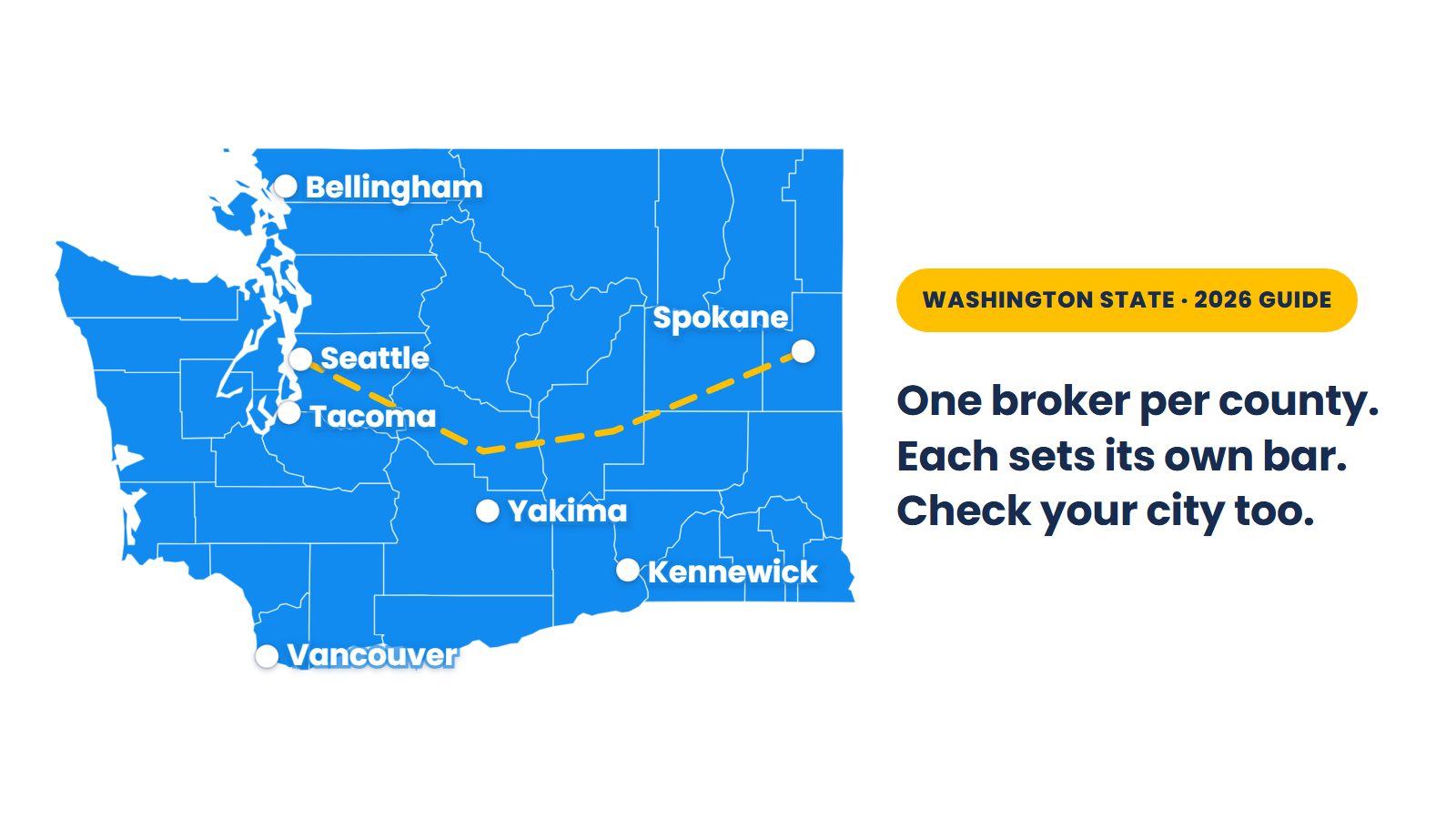
To start a NEMT business in Washington State, form an LLC ($200 online), insure each van for at least $100,000/$300,000/$25,000 and add the Vehicle for Hire endorsement to your business license, $55 a year per van. A $110 permit applies only if your city or county doesn’t license for-hire businesses like yours. There’s no NEMT license, but Seattle, Tacoma, Spokane and others license vans or drivers. Apple Health (Medicaid) uses one broker per county, each with its own bar and rates. Budget about $23,500 to $51,700 for one used wheelchair van and six months of fixed bills.
Washington State at a glance:
- One broker per county: six regional brokers arrange Apple Health’s nonemergency rides across 39 counties, under Health Care Authority (HCA) contracts [1][2].
- No HCA enrollment for van companies: HCA enrolls ambulance services and brokers; your county’s broker signs and pays you under a subcontract [3][4].
- Each broker’s own bar: Hopelink wants a year of NEMT work, five or more vehicles and a Washington office; Community in Motion, two years of paid passenger work; Paratransit Services, $1 million of auto coverage [5][6][7].
- No state rate: HCA pays brokers a fixed administrative rate, passes trip money through and sets no NEMT rate; each broker negotiates its own [8].
- The for-hire endorsement: $55 a van every year, the $110 permit only if your city or county answers “No” on the For Hire Addendum, and an insurance certificate naming the Department of Licensing (DOL) [9][10].
- Cities: Seattle and King County’s code runs for-hire vehicles as taxicabs under capped medallions, so ask before private-pay work there; Tacoma, Spokane and others license vehicles or drivers [11][12][13][14].
- Drivers: 18 or older, a commercial driver’s license (CDL) only at 16 passengers counting the driver or 26,001 pounds, and the $58 Washington State Patrol (WSP) fingerprint check brokers ask for [15][16][17][18].
- Stretcher riders: no stretcher-van license exists, and state law keeps riders who must be carried on a stretcher in ambulances, with two narrow exceptions [19].
An owner in the Seattle area registered a company in February 2024, bought a van and went to get a business license, “only to realize that you actually need insurance” first, the owner told an industry podcast in late 2025. An admissions director gave the company its first ride “as soon as we had all the documents.” By late 2025 it ran six vans for nursing homes, hospitals and private clients, and a broker took it on “just to provide the stretcher transportation.”
Buying the van before the policy cost that owner a detour. In Washington, two other gatekeepers can cost more. Your county’s Medicaid broker sets its own entry bar and negotiates its own rates, and your city may license your van itself. Check both before you buy one. The checklist below runs in that order, and the sections after it cover who pays, the brokers, the rules, getting on a broker’s list, costs and timing.
I run Duet, which builds dispatch software and runs growth services for non-emergency medical transportation (NEMT) companies, and I talk to NEMT owners on demos every week, Washington State operators included. This is the Washington State edition of our national guide on how to start a NEMT business. Requirements change, so confirm against the linked sources before you spend money. If you’re starting in the District of Columbia, our Washington, DC guide is the one you want.
The one-page checklist: how to start a medical transportation business in Washington State
Before you buy a van, check your county’s Medicaid broker and your city’s for-hire code. Each phase ends with what it puts at risk and the running total.
Phase 0: pick your county, your city and your vans
- Your county’s broker: find your county on HCA’s broker list, then read what that broker asks of a new company. Some post a packet of requirements, others only a phone number [1][7][20].
- Your vans: a typical wheelchair van needs no CDL, which starts at 16 passengers counting the driver, or 26,001 pounds [16]. As I told the owner of a handful of sedans in Seattle on a demo in October 2025, “a lot of people start with ambi” (ambulatory riders), “and then they move up.”
- Stretchers: riders who must be carried on a stretcher go by ambulance, with two narrow exceptions, so plan your first vans for wheelchair and ambulatory riders [19].
- State lines: near Portland or Idaho, a paid trip across the line is interstate and brings federal rules [21].
- Three questions this week: ask your county’s broker what it requires and whether it’s adding companies near you. Ask your city’s licensing office, in writing, whether a van like yours needs its for-hire license; for Seattle and the King County cities that contract with the county, ask King County Records and Licensing Services and the City of Seattle [22]. Ask the five nearest nursing homes, rehabs or hospital discharge planners who books and pays for their rides.
- Money at risk: none yet.
Phase 1: form the company
- File your LLC with the Secretary of State, $180 on paper or $200 online. The initial report is free with it, and a $70 annual report follows every year [23].
- Get a free employer identification number (EIN) from the IRS and a free national provider identifier (NPI). Hopelink’s application and Paratransit Services’ packet don’t ask for an NPI [24][7], but the owner of a two-driver company north of Seattle, working to get paid by a private Medicare plan, told me on a demo it was “very essential to start the process.”
- Money at risk: about $200.
Phase 2: quote insurance at two limits before you buy the van
- Get quotes on the exact van at the state’s for-hire floor, $100,000 per person, $300,000 per accident and $25,000 of property damage, or $325,000 combined, and at $1 million of auto liability, the only auto limit a Washington broker posts [25][9][7].
- The floor is the legal minimum for every paid trip that stays in Washington [25]. Ask each facility what it requires, and plan on $1 million before you apply to a broker. In Paratransit Services’ nine counties, add its $1 million/$2 million general liability and errors and omissions lines [7].
- Ask whether each agent writes for-hire vans and can issue a certificate listing each van’s year, make and VIN, with DOL as holder [9]. The Seattle-area owner called the insurance search “a whole other problem,” so start early.
- Money at risk: nothing new (about $200 so far).
Phase 3: buy the van, bind the policy and file for hire in the same week
- Register the van in the “CAB” use class if it carries only riders and their belongings, or “F/H” if it also carries goods for pay [26][27]. At six seats or fewer, that’s a $30 for-hire license fee and a $15 seating fee, plus standard registration fees; above six, the registration fee goes by weight [28][29].
- Pay sales tax of 6.5% plus local tax plus 0.5% on motor vehicles: 11.05% in Seattle and 9.40% in Spokane through December 2026 [30].
- Bind the policy and file one Business Licensing Service application ($50) with the Vehicle for Hire endorsement. It takes the For Hire Addendum signed by your city (or county, outside city limits), the insurance certificate, $55 a van, and the $110 permit only on a local “No” [31][9][10].
- Keep each van’s certificate in the van [25], and apply for any city license. Tacoma’s is $100 a vehicle and $75 a driver, with the fees waived for ramp or lift vans, and Spokane’s driver license is $55 a year [13][14].
- Money at risk: about $15,900 more with the van financed, so about $16,100 in. Fixed bills then run about $1,934 a month.
Phase 4: clear every driver through the State Patrol check
- Run each driver through a WSP fingerprint check, $58 by mail. HCA’s model broker contract asks for one for every new driver, lets an $11 name search on WSP’s online WATCH system cover a driver who starts before it comes back, and repeats it every three years with WATCH searches in between [17][18].
- Train to your broker’s list: Paratransit Services and Community in Motion both require CPR and First Aid [7][6].
- Money at risk: about $1,000 for one driver’s screening and training in our model, so about $17,100 in.
Phase 5: run facility and private-pay trips, then apply to your broker
- Put up a website families can book from and a Google Business Profile.
- Visit nursing homes, rehabs and hospital discharge planners, and take private-pay riders from the first month, with a card at booking.
- Apply to your county’s broker when you meet its bar: in Paratransit Services’ counties once your packet is complete, in Hopelink’s after a year of NEMT work with five vehicles, in Community in Motion’s after two years of paid passenger work [32][5][6]. The other three brokers post no bar, so apply when yours says you qualify.
- Money at risk: about $300 for a phone and basic marketing, so about $17,400 in, plus about $1,934 a month of fixed bills until your trips cover them. Six months of those is about $11,600, for a total of about $29,000 before fuel, maintenance and your own living costs.
If you’re already running vans, check four things this month. You need the Vehicle for Hire endorsement on your business license ($10 to add one), F/H or CAB registration with a $55 certificate in every van, an insurance certificate naming DOL that lists each VIN, and your city’s answer in writing [31][9][27]. A company that never wants Apple Health trips needs all of that too; it just skips the broker.
Who pays for NEMT rides in Washington State?
Apple Health pays only through your county’s broker; facilities and families can pay you from your first month.
Apple Health is the volume, through your county’s broker
Every Apple Health ride you’ll run comes through the broker for the rider’s county, managed care or not. HCA pays for nonemergency transportation for Apple Health clients “including persons enrolled in an agency-contracted managed care organization (MCO),” through the same county brokers [4]. HCA’s dashboard counted 1,916,285 eligible Apple Health clients in September 2026, a total that takes in state-funded programs and some groups with no brokered ride benefit [33][4]. “Clients may not select the transportation provider or the mode of transportation,” and riders book at least two business days ahead, except for urgent care and hospital discharges [4].
Don’t count on dialysis clinics as facility accounts, though. In my experience most dialysis riders are on Medicaid, so their rides come through the county’s broker, not the clinic.
Facilities are the stability
Facilities book and pay on their own terms, and they don’t wait on a broker’s network decision. The broker’s after-hours capacity is thin: “Brokers do have after-hour transportation providers for discharges, but resources are very limited,” HCA told the Legislature in 2024 [8].
Some rides sit outside the broker by rule. When the care is tied to a rider’s hospice diagnosis, the hospice pays, since its daily rate includes medical transportation [4][34]. Adult day health programs and PACE, the all-inclusive care programs for older adults, arrange the rides to their own services, so call on them as you would a facility [4]. HCA’s rules for broker rides (sections 182-546-5000 through 6200 of the Washington Administrative Code, or WAC) never mention nursing homes, so ask each home who books its residents’ rides and who pays [4].
The Seattle-area owner built the company on this lane. Hospital case managers and discharge planners “know who we are, so they just call us,” the owner said, and many have the company “set up in their systems as vendors” without a signed agreement.
Speed is most of the sale. On that October demo, I told the sedan owner that a case manager clearing a discharge mostly wants it handled fast. “If you can take their call in a minute,” then “even if you’re a little more expensive, they’ll prefer to work with you.”
Ask who pays before the first ride, though. The owner of the two-driver company north of Seattle told me home care providers wanted its rides but “don’t want to pay out of their pocket.” The company wasn’t yet set up to bill a private Medicare plan, so those providers were “looking for other service providers.”
Private pay is the margin
Families who call you directly pay up front, at the price you set. The Seattle-area owner has “a very good clientele” of private clients, built on reviews, Google Ads and well-branded vans. If you treat riders right and run the books well, I think you can grow very quickly on private pay. Most owners I talk to take a card at booking and charge it at least 24 hours before pickup.
Facilities and families pay from your first trip. The broker pays from the day it signs you.
Two smaller payers: Labor and Industries and disability waivers
Washington’s Department of Labor and Industries (L&I) and the state’s developmental disabilities waivers both buy rides without a broker. L&I lets transportation services bill it directly, so ask how to open a provider account for injured workers’ trips [35]. Those waivers, run by the Department of Social and Health Services (DSHS), pay for rides in a person’s service plan, but “The provider of transportation must be an entity contracted with DDA,” its Developmental Disabilities Administration [34].
Who is the NEMT broker in Washington State?
Six regional brokers arrange Apple Health’s nonemergency rides under Health Care Authority (HCA) contracts, and each county has exactly one. HCA’s May 2025 list, which matched its member page on October 28, 2026, assigns them this way [1][36]:
| Broker | Counties | Door for new companies |
|---|---|---|
| Northwest Regional Council | Island, San Juan, Skagit, Whatcom | Email its contracts office [37] |
| Hopelink | King, Snohomish | Application: a year of NEMT work, five or more vehicles, a Washington office [5] |
| Paratransit Services | Pierce, Clallam, Jefferson, Kitsap, Mason, Pacific, Grays Harbor, Thurston, Lewis | Request for qualifications packet; $1 million of auto coverage [32][7] |
| Community in Motion | Clark, Cowlitz, Klickitat, Skamania, Wahkiakum | Letter of interest; two years of paid passenger work [38][6] |
| People for People | Chelan, Douglas, Okanogan, Benton, Columbia, Franklin, Kittitas, Yakima, Walla Walla | No provider application posted; call its NEMT office [20] |
| Special Mobility Services | Ferry, Stevens, Pend Oreille, Lincoln, Grant, Adams, Spokane, Whitman, Garfield, Asotin | Call its regional manager [39] |
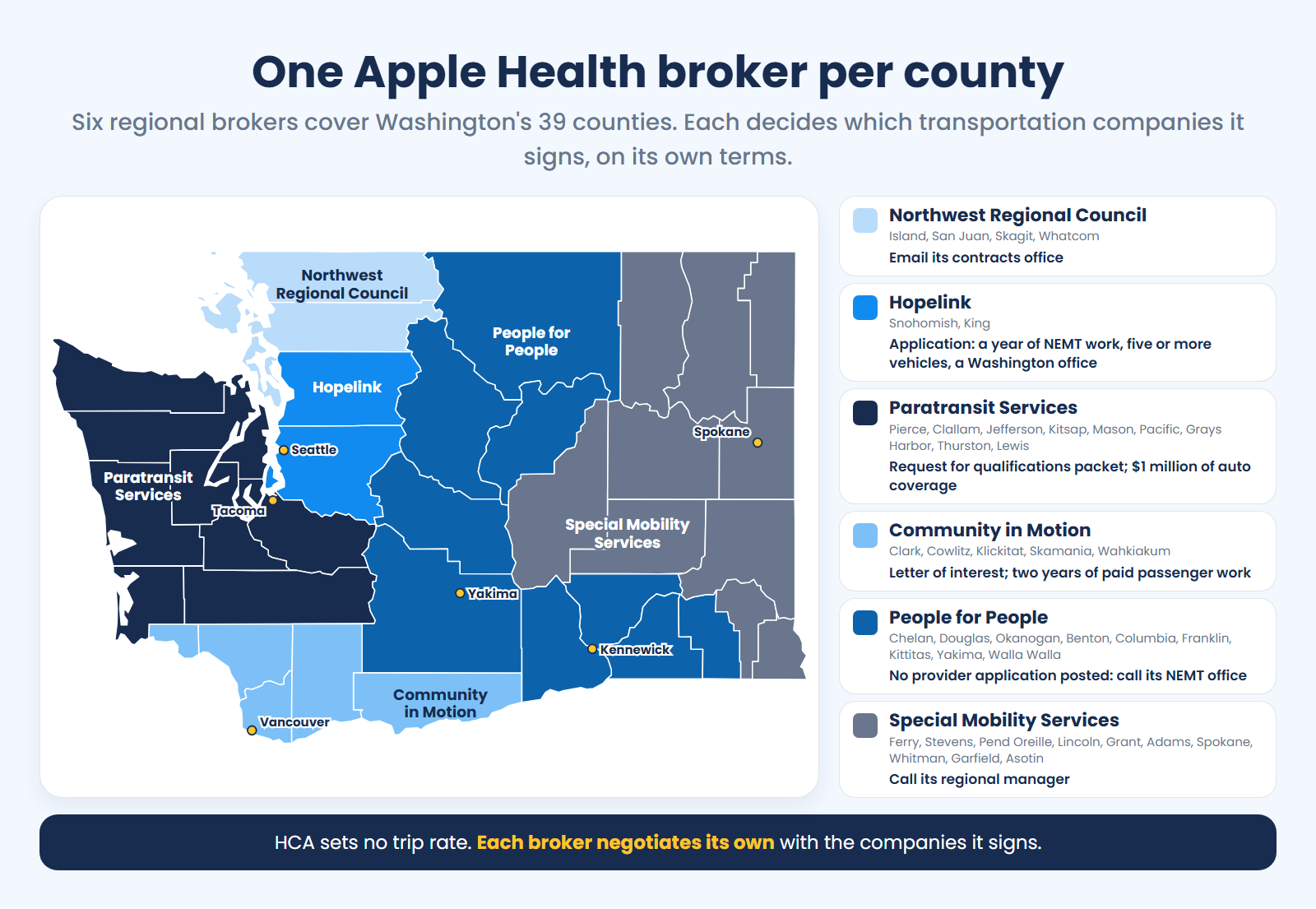
Washington has run NEMT through brokers since 1989 [40], and HCA told the Legislature in 2024 that “Five brokers are nonprofit community organizations and one is an Area Agency on Aging (AAA)” [8]. Community in Motion was Human Services Council until 2021, so older pages still use that name [41].
HCA’s posted sample broker contract ran through June 30, 2025, and can be extended in two-year steps, but HCA hasn’t posted the current term [18]. Before you plan years around one broker, ask HCA’s NEMT program (HCANEMTTRANS@hca.wa.gov) when the current contracts end [36]. Contracts do change hands, and what happened to providers in other states’ broker changes this year shows how fast trips move.
How does an Apple Health trip reach your company?
A rider calls the county’s broker, and the broker decides how the rider travels and who drives. Brokers “Must select the lowest cost available mode or alternative that is both accessible to the client and appropriate to the client’s medical condition and personal capabilities” [4]. Their own pages lead with cheaper options. Hopelink’s most common are “ORCA cards and gas card reimbursements,” meaning transit fare cards and gas money, and People for People says “A primary goal” is gas vouchers or mileage reimbursement for riders with their own transportation [5][20]. A van company gets the riders those can’t serve.
- Authorization: “Nonemergency medical transportation, other than ambulance, must be prior authorized by the broker” [4].
- After hours: when the broker is closed and a rider needs urgent care or a ride after a hospital discharge, you either run the trip under the broker’s after-hours instructions and request retroactive authorization within two business days, or turn it down [4].
- Canceled discharges: when the rider or the facility finds another ride and doesn’t tell the broker, “the transportation provider experiences a no-show and cannot be paid” [8].
- Trip lists: an owner in southwest Washington running about ten vans told me on a demo in August that trips come from “my Medicaid broker that gives me a PDF.”
- Pay timing: HCA’s model contract has brokers pay subcontractors within ten calendar days of HCA’s reimbursement; ask your broker for its actual cycle [18].
Can I bill Apple Health (Medicaid) directly for NEMT rides?
No: HCA enrolls ambulance services and transportation brokers, not van companies, so your broker pays you a rate you negotiate with it. HCA’s list of provider types names “Ambulance services (ground and air)” and “Transportation brokers,” with no van, taxi or wheelchair-van type [3]. The ride rules add that “Nonambulance providers must be subcontracted with the broker” to be paid [4].
That settles ProviderOne, HCA’s payment system, too. Nothing in HCA’s ride rules, its NEMT pages or its sample broker contract requires a company that drives for a broker to hold its own ProviderOne ID [4][40][18]. The sample says “NEMT payments are not scheduled to be paid through ProviderOne as of the contract start date but may be in the future” [18]. A broker’s subcontract may still ask for more. Our guide to whether a broker needs you signed up with Medicaid first covers that question state by state. Some AI search answers add a step to contract with DDA; that’s the developmental disabilities waivers’ transportation, a separate program [34].
Who sets the rate for a broker trip?
You and your broker do, by negotiation; HCA runs no fee schedule for broker trips. Its 2024 report says: “The administrative rate is a set negotiated amount that cannot change without legislative action. Service is 100 percent pass through to transportation providers.” And: “HCA does not set rates for NEMT services because geography is a major factor in the reasonable cost of transportation” [8].
HCA’s sample contract tells brokers what subcontracts must include: negotiating a fair rate when an appointment falls through “due to no fault of the subcontractor,” “rate adjustments at least quarterly” and “an appeals process” [18]. It’s a 2021-2025 template, so ask your broker how its current subcontract handles each. Two brokers publish how they price:
- Paratransit Services: “Paratransit Services does not set subcontractor’s rates.” You submit the rates you need, and if they’re “significantly higher than acceptable,” it negotiates [7].
- Community in Motion: you propose a pick-up fee and a per-mile rate for each mode, and its 2026 form says “Per Mile Rate cannot exceed $3.50 per mile.” That’s the most a proposal may ask, not what a mile pays. The form also asks for your private-pay and other contract rates, which “cannot be reimbursed at a lower rate than that reimbursed by Community in Motion,” so your family prices can’t undercut what it pays you [6].
The owner in southwest Washington told me the company’s contracts bill “a pickup fee, and then we have a per mile rate,” with flat rates on others. Our guide to how a broker sets your rate when the state doesn’t covers the negotiation. Work out what a trip costs you before you send a rate sheet, because the broker reads it as your offer.
What licenses and requirements does a NEMT business need in Washington State?
Washington State has no NEMT license, but a for-profit van company needs the state’s Vehicle for Hire endorsement. That’s a $55 certificate for each van every year, plus the Department of Licensing’s $110 permit unless your city or county licenses your kind of for-hire business. The for-hire law, chapter 46.72 of the Revised Code of Washington (RCW), covers “all vehicles used for the transportation of passengers for compensation.” Its only exemption tied to disability is for “nonprofit transportation providers for persons who are aging or persons with a disability” under chapter 81.66 RCW [25]. Running without the permit and certificate is a gross misdemeanor [25].
Here’s what circulates about Washington State, next to what the state and the brokers actually require:
| The claim you’ll read elsewhere | What Washington State actually requires |
|---|---|
| A “Washington State Department of Health NEMT Provider License” | No license has that name. The Department of Health licenses ambulance services; a van company needs the Vehicle for Hire endorsement and a $55 certificate for each van [19][9] |
| “Register your company in Washington’s ProviderOne system,” or “become an Apple Health provider” | HCA enrolls ambulance services and brokers, not van companies; your county’s broker signs and pays you [3][4] |
| “CPR Certification: Mandatory in Washington State” | HCA’s model broker contract lists CPR and First Aid as recommended training; Paratransit Services and Community in Motion require them of their drivers [18][7][6] |
| Insurance with “a minimum of $1 million in liability coverage” | The legal floor for a for-hire vehicle is $100,000/$300,000/$25,000, or $325,000 combined; $1 million is Paratransit Services’ bar [25][9][7] |
| “don’t forget mod care,” or brokers like “Paratransit Services as well as MTM” | Neither ModivCare nor MTM is one of HCA’s six Apple Health brokers [1] |
| Washington Medicaid “compensates transportation providers primarily through managed care organizations” | Managed-care members ride through the same county brokers, and the broker pays you [4] |
| A stretcher van as one more vehicle choice | State law keeps riders who must be carried on a stretcher in ambulances, with two narrow exceptions [19] |
What does the for-hire endorsement take?
The Vehicle for Hire (Taxi) endorsement goes on one Business Licensing Service application. The Department of Revenue (DOR) says it’s “required for any business that transports passengers for a fee in for-hire vehicles,” including cabulances, the state’s word for vehicles carrying wheelchair riders who are stable and need no oxygen or medical attention en route [9][27]. You’ll need:
- The For Hire Addendum: the local official where your business is located (the city, or the county outside city limits) answers whether it licenses or regulates “the For Hire business type” you check: taxi, cabulance or other. A “No” means you pay DOL’s $110 permit, and a city that licenses only taxis may well answer “No” for a cabulance [10].
- Insurance: a certificate showing a $325,000 combined single limit or $100,000/$300,000/$25,000 split limits, each van’s year, make and VIN, and DOL as certificate holder [9][27].
- Registration: each van in the “F/H” or “CAB” use class, in the same owner name as the application and the insurance [9].
- Fees: $50 for a new business license application, $55 a van, $110 for the permit on a local “No,” and $5 for a trade name [31][9].
The certificate “must be carried in a conspicuous place in the vehicle,” and it renews every year [25][27]. DOL can refuse a policy with a clause restricting the insured’s age, and one with a deductible clause unless it states that the insurer pays claims in full, deductible included [27]. Show your agent that rule.
Do Seattle, King County and other cities license NEMT vans?
Several cities license for-hire vehicles or drivers in codes broad enough to reach a NEMT van, and Seattle and King County’s shared code is the hardest to read. It covers trips from Seattle, unincorporated King County and 16 other cities that contract with the county, Bellevue, Kent and Renton among them [22]. In it, a “for-hire vehicle” is any vehicle carrying passengers for hire off a fixed route, and the exceptions cover nonprofit 81.66 providers but no medical or broker trips [11][12].
Since April 1, 2026, “all for-hire vehicle medallions shall become taxicab medallions,” and “All for-hire vehicles must be operated as taxicabs using a smart taximeter system and must be affiliated with a regional dispatch agency” [11][12]. Medallions are capped at 1,300, with wheelchair accessible taxicab medallions outside the cap [11]. Drivers need a regional for-hire driver’s license, plus a wheelchair endorsement to drive a wheelchair accessible vehicle [11].
The code has one opening: a “person” under it doesn’t include “An entity operating exclusively under contract with a government entity” [11][12]. It doesn’t say whether a Medicaid broker subcontract counts. King County licenses the drivers and Seattle licenses the vehicles for both the county and the city [22]. The yearly fees, county and Seattle shares together, are $400 a medallion, waived for a wheelchair accessible medallion when the director finds you eligible, and $50 a driver’s license [22][12].
Your For Hire Addendum gives you the first written answer. In Kent or Bellevue, the city signs it, and the form asks whether the city licenses or regulates your business type “either alone or by agreement with another jurisdiction (e.g., King County)” [10]. A Yes means you’re locally regulated, and the official also says if you’re authorized to operate there; a No means DOL’s $110 permit [10]. Either way, ask King County Records and Licensing Services and the City of Seattle in writing whether your vans need a medallion [22]. I wouldn’t run a private-pay or facility trip there until both have answered, and if you’re already running, I’d ask this week.
Here’s what other cities’ codes say on their face. None names NEMT, Medicaid or brokers, so get your city’s answer in writing before your first paid trip:
| City | What its code licenses | Fee or next step |
|---|---|---|
| Tacoma, and unincorporated Pierce County | For-hire vehicles and drivers [13][42] | $100 a vehicle a year and $75 for a two-year driver license, waived for ramp or lift vehicles and their drivers |
| Spokane | All for-hire drivers and operators, “by whatever name” [14] | $55 a year per driver; operator fees are listed only for taxi and ride-hail companies, so ask about yours |
| Bellingham | Each taxicab or for-hire vehicle [43] | $50 a vehicle a year |
| Lacey | Each for-hire vehicle [44] | $30 a vehicle a year, $10 with an Olympia or Tumwater license |
| Olympia | Each for-hire driver, by occupational permit [45] | Set by the city manager |
| Yakima | Each vehicle used to haul passengers for hire [46] | In the city’s fee schedule |
| Vancouver, Everett, Kennewick, Richland, Pasco | Taxicab and ride-hail companies [47] | Ask whether a van like yours needs a license |
Where a city licenses only taxicab and ride-hail companies, as in the last row, the state’s endorsement may be all you need. Pasco’s code still bars any for-hire business without a city license, though, and Kennewick’s requires company markings on every for-hire vehicle [47].
Your city’s general business license is a separate license. You can add 223 cities’ endorsements to your state application, but Seattle, Tacoma, Bellevue, Everett, Kent and Renton aren’t on DOR’s list, so apply to each directly; Seattle’s 2026 license is $73 under $20,000 of taxable revenue [48][49]. At the airport, Sea-Tac’s tariff says “All Commercial Ground Transportation Operators must have an Operating Agreement,” so ask the Port of Seattle before a paid pickup or drop-off there [50].
What if you drive riders into Oregon or Idaho?
A paid trip across a state line is interstate, and two of Washington’s biggest metros sit at its borders: Vancouver faces Portland across the Columbia River, and Spokane sits near the Idaho line. Interstate work usually means operating authority from the Federal Motor Carrier Safety Administration (FMCSA), a USDOT number and $1.5 million of liability for a vehicle seating 15 or fewer, driver included [21]. Community in Motion’s subcontractor profile asks which Oregon areas you’ll serve, the Portland metro counties among them [6]. Don’t count on an exemption for short metro trips; ask FMCSA before your first paid crossing. Our table of every state’s Medicaid ride broker shows how Oregon and Idaho run their Medicaid rides.
What are the NEMT insurance requirements in Washington State?
The legal minimum for a for-hire van is $100,000 per person, $300,000 per accident and $25,000 of property damage, or $325,000 combined, and Paratransit Services, the one broker that posts a limit, asks for $1 million [25][9][7]. Its insurance file, last modified in April 2024, asks for [7]:
- Auto liability: “$1,000,000 per occurrence, using a Combined Single Limit,” on owned, hired and non-owned vehicles.
- General liability: $1 million per occurrence and $2 million in aggregate.
- Errors and omissions: $1 million per claim and $2 million in aggregate, plus privacy breach coverage.
- Additional insureds: Paratransit Services and HCA as primary additional insureds, with an admitted insurer rated B++ VII or better by A.M. Best.
- Workers’ comp: a certificate of compliance with Washington’s industrial insurance law, Title 51 RCW.
The same file repeats the model contract’s line that for-hire carriers regulated under RCW 46.72 need “no less than the minimum insurance standards set by law,” so ask Paratransit Services which bar applies to you [7][18]. The other five brokers post no limits; Community in Motion points to “local, state, and federal liability insurance and CIM contract standards” [6]. Until your broker answers, price broker work at $1 million.
On day one, for facility and private-pay trips that stay in Washington, the state floor is the legal minimum, well above a private car’s $25,000/$50,000/$10,000 [25][51]. As I put it on our podcast, a lot of brokers require $1 million of coverage, but “you might be able to do 300k or the state level and do private pay.” Quote the same van at both limits, ask each facility what it requires, and step up before you apply to a broker.
Insurance wins accounts, too. The Seattle-area owner asked one facility, now one of the company’s major clients, to keep it on “as plan B just in case.” Then an employee of one of the facility’s major transportation providers told the facility that the provider itself was “operating without insurance.” The facility “terminated their contract right away” and called the owner. “We were ready,” the owner said.
What will insurance cost a new Washington company?
Start from our national model: $17,400 a year for a new company’s wheelchair van at about $1 million of liability, with about $4,350 due at signing, then get Washington quotes against it at $1 million and at the floor. Our insurance guide shows what a brand-new NEMT company’s first policy runs.
Do you need workers’ comp in Washington State?
Yes, from your first employee [52]. L&I runs Washington’s workers’ comp through its own state fund, though some employers self-insure [53]. Class 1404-12, “Cabulance and paratransit,” covers prearranged, nonemergency trips in vans equipped for riders with mobility limitations. Its 2026 base rate is $2.0322 per hour worked, with up to $0.43155 of it withheld from the worker [54][55]. For one full-time driver, that’s about $4,227 a year, up to about $898 of it from the driver’s pay. An ambulatory-only company in ordinary cars may land in another class, so ask L&I [54].
Owners can sit outside mandatory coverage: the law leaves out sole proprietors, partners, qualifying LLC members and owners who drive their own for-hire vehicle, though an owner can elect it [52]. Paratransit Services still wants a Title 51 certificate [7].
Payroll adds two premiums: Paid Family and Medical Leave, 1.13% of wages in 2026, with employers under 50 employees excused from the employer’s share, and WA Cares, 0.58% withheld from wages [56][57]. The minimum wage is $17.13 an hour in 2026 and $17.73 from January 1, 2027; Seattle’s is $21.30 [58].
What do NEMT drivers need in Washington State?
A typical wheelchair van’s driver in Washington State needs no commercial license and must be 18 or older; brokers add a State Patrol fingerprint check. State law bars anyone under 18 from driving “a motor vehicle transporting persons for compensation,” and a CDL starts at 16 or more passengers, including the driver, or 26,001 pounds [15][16]. The for-hire law and its rule set no driver license of their own [25][27].
HCA’s posted model broker contract, a 2021-2025 template, lays out this screening [18]:
- Before a driver serves riders: a valid license, a driving abstract and insurance [18].
- Fingerprints: a fingerprint-based WSP check for every new driver, with a WATCH name check allowed while it’s pending, repeated every three years with WATCH checks in between. WSP charges $58 for the fingerprint check by mail and $11 for WATCH online [18][17].
- Unsupervised access: the checks have to clear the driver for unsupervised access to children and vulnerable adults. Under the statute’s definition, a driver alone in the van with a rider, with no coworker or relative present, is unsupervised [18][59].
- Disqualifying crimes: a review against the DSHS Secretary’s List in WAC 388-113-0020 [18][60].
In Seattle and King County, if the for-hire code reaches your vans, each driver also needs the regional for-hire driver’s license, and a wheelchair endorsement to drive a wheelchair accessible vehicle [11].
What does Paratransit Services require of its drivers?
Paratransit Services’ driver file, last modified in April 2024, is the longest any Washington broker publishes, and if you’ll serve its nine counties, I’d train every driver to it from day one [7]:
- Age and license: 21 or older, with a valid Washington license and at least five years as a licensed driver.
- Driving record: no more than one moving violation or at-fault accident in the last three years, and a complete DOL driving abstract no older than 30 days when submitted.
- Background: a WSP fingerprint check before service, with a WATCH report allowed while you wait. Any felony conviction disqualifies a driver, and so does a DUI or DWI in the past ten years, or more than one ever.
- Drug and alcohol: a pre-employment drug test, and membership in a drug and alcohol consortium, or an equivalent program, that follows federal testing procedures [7][61].
- Training: ADAPTS or PASS passenger assistance, a defensive driving course of at least four hours, First Aid and CPR, fire suppression, child safety restraints, and blood and airborne pathogens, plus HIPAA training every year for staff who handle riders’ health information.
- Other: E-Verify, English and a road test in the type of vehicle the driver will run.
Community in Motion requires Child Safety Seat Training, CPR and First Aid, Defensive Driver and Passenger Assistance, and reviews each driver’s abstract, background check and drug and alcohol testing [6]. HCA’s template labels CPR and First Aid, passenger assistance, fire suppression and defensive driving “recommended training,” but it still tells brokers to make sure every driver gets it [18]. Our licensing guide covers which NEMT certifications are actual requirements.
Can a NEMT company run stretcher van trips in Washington State?
Only narrowly: RCW 18.73.180 keeps riders who must be carried on a stretcher in licensed ambulances, with two exceptions, and a rider’s own reclining chair or gurney doesn’t count as a stretcher. The statute says other vehicles “shall not be used for transportation of patients who must be carried on a stretcher or who may require medical attention en route.” The exceptions are a disaster that licensed ambulances can’t serve, and a rider whose own mobility aid can’t be secured in the van and whose physician authorizes the move to a stretcher in writing [19].
A “stretcher” doesn’t include “personal mobility aids that recline at an angle or remain at a flat position,” owned or leased for at least a week by the rider or the rider’s guardian or representative, “such as wheelchairs, personal gurneys, or banana carts” [19]. There’s no Department of Health license for a stretcher van; the department licenses ambulance and aid services [19].
HCA’s broker rules list “Stretcher vans or cars” as a mode, meaning a vehicle “that can legally transport a client in a prone or supine position when the client does not require medical attention en route” [4]. “Legally” sends you back to the statute; the mode doesn’t widen it. HCA’s brokers started a stretcher pilot with private companies in May 2021. In December 2024 HCA told the Legislature the pilot was continuing, and that “The biggest barrier to expansion is the cost of insurance and low or inconsistent trip volume.” There aren’t enough trips, it added, to justify specialized vehicles “that would require at least two drivers to staff” [8].
The Seattle-area owner sees the same thing from the road. Stretcher work in Washington “is being done mostly by ambulance companies,” the owner said, and under Medicaid’s classification a trip in a reclining chair can’t be claimed as a stretcher transport. The owner’s company does run stretcher trips, for a broker that took it on just for that lane, and a stretcher means “we have to find a second person,” where a chair takes one driver. The owner didn’t say on the podcast which of the statute’s routes those trips use. In a van, each has to fit one: a rider lying on their own personal gurney, a transfer the rider’s physician authorizes in writing when the rider’s own aid can’t be secured, or a disaster [19].
The owner in southwest Washington with about ten vans put the default plainly on our demo: “We do wheelchair, but not stretcher.” Launch wheelchair and ambulatory. Before you carry anyone lying down, ask your broker how it uses the stretcher mode and get the Department of Health’s reading in writing. And put one line in your intake script: a rider who may need medical attention on the way belongs in an ambulance.
How do you become a Medicaid transportation provider in Washington State?
Sign a subcontract with your county’s Apple Health (Medicaid) broker once you meet its bar; HCA has no application for van companies. HCA’s NEMT 101 says: “If you are interested in becoming a transportation service provider, contact the regional transportation broker that is responsible for the counties where you want to do business” [62]. If the counties where you want to do business belong to two brokers, that means both. In HCA’s rules, a transportation provider is “A person or company under contract with a broker to provide trips to eligible clients,” and the broker screens you against federal exclusion lists before contracting and after [4].
Find your county’s broker and its door
- Hopelink (King, Snohomish): download its application, and send everything about it to transportationcontracts@hopelink.org [5].
- Paratransit Services (Pierce and eight more): its request for qualifications packet and an interest form are on its WA State NEMT site, which warns that “Packets that are submitted incomplete, inaccurate or illegible will not be considered for processing.” Its posted subcontracting line is (800) 933-3468, extension 362 [32].
- Community in Motion (Clark and four more): email its Letter of Interest form to JessicaM@CommunityInMotion.org. “Requests for Qualification (RFQs) are opened when there is a need for specific transportation types or in specific counties we serve,” and interested companies stay on file [38].
- People for People (nine counties in central and southeastern Washington, covering Yakima and the Tri-Cities): its NEMT page names “cabulance and taxi companies” among its contracted providers but posts no application, so call the NEMT office listed there [20].
- Special Mobility Services (ten eastern counties, Spokane among them): its undated FAQ lists “commercial providers such as taxi and cabulance” among the providers it works with and says it’s “always looking for” organizations that use volunteers. It asks interested organizations to call its Regional Manager at (509) 534-9760 or (800) 892-4817 [39].
- Northwest Regional Council (Whatcom, Skagit, Island, San Juan): contracting questions for its NEMT program go to NWRCContracts@dshs.wa.gov [37].
What do Washington’s brokers ask of a new company?
Hopelink, Community in Motion and Paratransit Services publish real requirements:
- Hopelink: three minimums: “A minimum of one year of Non-Emergency Medical Transportation (NEMT) experience, along with all required licensing to operate in Washington State,” “A Vehicle fleet of five or more vehicles,” and “An established physical office located within Washington State” [5]. Its application asks for your state business license number, federal tax ID and “For Hire License #,” plus each vehicle type you run [24].
- Community in Motion: “A minimum of two years of demonstrated experience transporting persons for compensation,” with preference for medical or social service transportation. Add state and city business licenses, insurance certificates, three letters of reference, a driver training program, a vehicle maintenance schedule, disaster, complaint, ADA and Title VI policies, and your “Last Financial Audit.” Its contract’s special terms are “non-negotiable” [6].
- Paratransit Services: no minimum operating history in its packet. It wants a signed questionnaire, your business license, a criminal background request, references and a confidentiality agreement. Every van needs F/H or CAB registration, the for-hire certificate and insurance aboard, a mounted GPS, your company name and number on both sides in letters at least 3 inches tall, and its inspection [7]. With no history bar, its nine counties are where a new company with the right insurance and driver file can apply early.
No Washington broker posts a rate table, and People for People, Special Mobility Services and Northwest Regional Council post no requirements, so ask them directly.
How long does credentialing take?
No Washington broker posts a clock from application to first trip. Community in Motion’s FAQ says committee review “will take approximately four months” after the application deadline, and its RFQs open only when it needs companies [6]. Hopelink’s application says to expect its review “to take up to 30 days,” then a notice on whether you “qualify to proceed to the next step” [24]. The other brokers publish no review time.
The longer wait is the experience bar, and that experience has to come from somewhere. A year of facility and private-pay work isn’t a wait for the broker; it’s the business. Ask Hopelink whether facility and private-pay trips count toward its year, and ask each broker whether your own years of paid driving count or only the company’s, before you count on either. Our guides to getting on a facility’s call list, what the first trip from a nursing home should look like, how hospitals pick a discharge transportation company and what to charge families and how to collect up front cover that year.
Don’t build the whole schedule on one payer
Each county has one Apple Health broker, which books the lowest-cost ride that fits, so your backup is facility and private-pay work. You can’t spread Apple Health trips across brokers inside one county, and two brokers say in writing that volume isn’t promised. Paratransit Services: “Rides are allocated on a ‘cost’ basis. Therefore, there is no guarantee of any amount of work for the Subcontractor.” Community in Motion: “We cannot guarantee any particular volume of service to providers” [32][6].
Broker volume is real, though. Paratransit Services “contracts with over 50 transportation providers in the state of Washington,” with fleets as small as one vehicle and as big as 30-plus [32]. The owner in southwest Washington runs about ten vans on a mix that’s “probably like 60 is Medicaid, but the other 40 is various private payers,” with Community in Motion as its Medicaid broker.
Contracted work can also crowd out private pay. The sedan owner in Seattle told me, “I’ve been having folks reach out to me already,” but every sedan was committed to contracted trips: “I would have to get another vehicle at least to start running private.”
Whatever the mix, run it on one schedule. Dispatch software like Duet puts your county broker’s trips on the same board as your facility and private-pay rides. If your broker’s portal can export a trip file, its trips usually come in by trip file import or bulk upload; ask us about your broker. Each trip bills at the rate its contract sets. Your for-hire endorsement and van certificates, any city license, each broker’s credentialing and rates, and invoicing each payer through its own process stay with you.
How much does it cost to start a NEMT business in Washington State?
Budget about $23,500 to $51,700 for one used wheelchair van and six months of fixed bills in Washington State. The typical case, a 2016-2019 van at our national model’s $33,000, financed, takes about $29,000: the $6,600 down payment, about $10,800 of one-time costs and about $11,600 for six months of fixed bills. Paying cash for the same van takes about $51,700, and an older $20,000 van, financed, about $23,500.
Washington’s inputs are its fees and Seattle’s 11.05% sales tax. Everything else comes from the national startup model behind these numbers, including insurance at about $1 million of liability, not a Washington quote, and what used wheelchair vans sell for in 2026 sits behind the van line. The totals leave out fuel and maintenance, which rise and fall with trips, and what you live on for those six months.
| Line item | Washington State amount | Note |
|---|---|---|
| LLC filing | $200 online | $180 on paper; a $70 annual report every year [23] |
| EIN and NPI | $0 | Free from the agencies that issue them |
| “NEMT license” | $0 | No state license by that name |
| Apple Health enrollment | $0 | HCA enrolls brokers and ambulance services, not van companies [3] |
| Business license application | $50 | For a new business; $10 to add an endorsement later [31] |
| For Hire Permit | $110 | Only if your city or county answers “No” on the For Hire Addendum [10] |
| For Hire Vehicle Certificate | $55 | Per van, every year [9][27] |
| For-hire plate fees | $45 | $30 license fee and $15 seating fee at six seats or fewer, plus standard registration fees [28] |
| Used wheelchair van, 2016-2019 | About $33,000, or $6,600 down if financed | National model: 80% financed at 14% over 60 months, $614 a month |
| Sales tax | $3,646.50 | 11.05% in Seattle; about $545 less in Spokane at 9.40% [30] |
| Insurance due at signing | About $4,350 | National model: a quarter of $17,400 a year at about $1 million |
| Equipment and lettering | About $1,000 | National model |
| Screening and training | About $1,000 | National model; one driver, WSP check included |
| Phone and basic marketing | About $300 | National model |
| Six months of fixed bills | About $11,600 financed, $7,920 bought outright | $1,934 a month financed: a $1,305 insurance installment, a $614 van payment and $15 for a phone |
| Total, owner driving | About $29,000 financed, $51,700 bought outright | An older $20,000 van, financed, comes to about $23,500 |
City for-hire licenses sit outside the totals, and so does Seattle’s $73 business license. After year one, the state’s yearly items for one van come to about $175: the $70 annual report, $55 for the van’s certificate, $45 of for-hire plate fees and the $5 license renewal, plus standard registration fees [23][9][27][28][31]. Once you hire, workers’ comp runs about $4,227 a year for one full-time driver, up to about $898 of it withheld from pay, on top of wages of at least $17.13 an hour [55][58].
Insurance is already about $12,200 of the $29,000 in the financed case, more than the van’s down payment and six payments put together. Skip the revenue figures you’ll see online for Washington, like one guide’s claim that successful companies “average $250,000-$500,000 in annual revenue within the first 3 years.” What a NEMT business really clears depends on your payer mix.
How do you fund a NEMT startup in Washington State?
Small Business Administration (SBA) 7(a) loans, up to $5 million, and microloans, up to $50,000 through nonprofit intermediary lenders, are the main federal options, and the SBA doesn’t give grants for starting a business [63]. Washington’s Small Business Flex Fund 2 is pausing new loan applications [64]. None of them speeds up a broker’s decision, so borrow for the months you’ll actually wait.
How long does it take to start a NEMT business in Washington State?
Your paperwork takes weeks, but Hopelink wants a year of NEMT experience and Community in Motion two years of paid passenger work. The Seattle-area owner registered the company in February 2024 and was “up and running” by June, about four months later.
- Week 1: make Phase 0’s three calls to your county’s broker, your city’s licensing office and the five nearest facilities.
- Month 1: form the LLC, get the EIN and NPI, and get insurance quotes at the floor and at $1 million before you pick the van.
- Months 1 to 3: buy the van, bind the policy, register it F/H or CAB, and file the business license application with the endorsement and the signed Addendum. Apply for any city license and run each driver’s WSP check.
- From month 2 or 3: carry facility and private-pay riders. From the week you buy the van, about $1,934 a month of fixed bills runs until your trips cover them.
- Any time: in Paratransit Services’ counties, apply once your packet is complete; in Community in Motion’s, send your Letter of Interest so you’re on file; in the other three brokers’ counties, apply when yours says you qualify.
- About a year in: in Hopelink’s counties, apply if you meet its three minimums, after asking whether your facility and private-pay work counts.
- About two years in: in Community in Motion’s counties, answer its next RFQ, and plan on about four months of review.
The Seattle-area owner at the top of this guide bought the van before the policy and built the company on facilities and private clients; a broker came in only for stretcher trips. Before you buy a van in Washington State, write down three things: your county’s broker and what it asks of a new company, what your city’s code says about a van like yours, and the facility that will give you your first ride. If any of the three is still blank, the van can wait.
Washington State NEMT FAQ
Can I get trips from a neighboring county’s broker?
Yes, if that broker signs you for its counties. HCA sends companies to the broker responsible for each county where they want to work, so a company that wants trips in two brokers’ counties applies to both [62]. Each broker sets its own bar: Paratransit Services’ packet sets no minimum history, while Hopelink wants a year of NEMT work [7][5].
Is ModivCare or MTM a broker for Apple Health?
No. HCA’s list names six Apple Health brokers: Northwest Regional Council, Hopelink, Paratransit Services, Community in Motion, People for People and Special Mobility Services [1]. MTM was Idaho’s statewide broker in HCA’s 2024 comparison with other states [8], and the owner in southwest Washington told me ModivCare is “out here” too, though the company does little work with it. If a national broker offers you trips in Washington, ask which program pays for them.
Can an Apple Health rider call my company directly for a ride?
Not for a ride Apple Health pays for. Under HCA’s rules, riders can’t pick their transportation company or how they travel, and the broker authorizes each trip, normally before the rider travels [4]. HCA’s model broker contract also has brokers’ subcontracts bar subcontractors from seeking payment from HCA or its clients for services under the subcontract [18]. Send the rider to their county’s broker, whose booking line is on HCA’s member page [36].
Does Medicare pay for NEMT rides in Washington State?
Original Medicare doesn’t. CMS’s claims manual says Medicare doesn’t cover “any non-ambulance forms of transportation, such as ambulette, wheelchair van, or litter van” [65]. Some Medicare Advantage plans add rides as an extra benefit: KFF found 22% of enrollees in individual plans were in a plan offering transportation in 2026, down from 28% in 2025 [66]. Ask each plan who runs its rides.
Can I start a NEMT business in Washington State with a minivan or sedans?
Yes. A sedan or minivan carrying paying riders is a for-hire vehicle like any van, so it takes the same endorsement, F/H or CAB registration and $55 certificate [25][9]. HCA’s ride modes include taxis and shared rides as well as wheelchair vans [4]. Two details differ: L&I’s cabulance class is written for specialized vans, so your drivers may fall in another class [54], and Paratransit Services’ 2021 packet capped sedans and vans at 10 years old and wheelchair vans at 15 [61]. Ask L&I and your broker about each. In Seattle and King County, the for-hire code’s question applies to sedans as much as to vans [11].
Do I pay B&O tax on NEMT fares in Washington?
DOR’s guide for taxicabs puts fare income under the public utility tax instead of the business and occupation (B&O) tax: 0.642% for urban transportation (trips entirely within a city or within five miles of its limits) and 1.926% for other motor transportation [67]. There’s no tax in a month when gross income is under $2,000, and none on trips across the state line [67]. That guide is written for taxis, so ask DOR how it classifies broker-paid and facility trips. Seattle’s own B&O tax starts above $2 million of taxable revenue in 2026 [49].
Does a NEMT company need a UTC permit in Washington?
Not for door-to-door NEMT trips in a van. The Utilities and Transportation Commission (UTC) regulates airport shuttles, charter and excursion buses and nonprofit buses, among others, and its charter page lists for-hire drivers licensed through DOL, taxis and non-emergency medical transportation among them, as not needing its permit [68]. Nonprofit providers serving people with special transportation needs answer to the UTC under chapter 81.66 RCW [69]. If you’d carry a group traveling together under one contract in a larger van, ask the UTC first, since state law treats that as a charter [70].
Can NEMT vans use Washington’s HOV lanes?
Possibly, through a pilot. Washington’s 2025-27 transportation budget tells DOL to “continue to issue nonemergency medical transportation vehicle decals under the high occupancy vehicle lane access pilot program” [71]. The decal costs $5 and goes on a for-hire vehicle that provides NEMT, and the owner attests to at least one contract or service agreement for medical trips, such as with a hospital, a health insurer or a broker [71]. Tolls still apply in express toll lanes when you don’t meet their occupancy rules. Ask DOL for the current form before you count on it.
Is Washington State a good place to start a NEMT business?
It can be, if you start with trips you control. Apple Health’s volume is real, but your county’s broker decides when you get any of it, and you negotiate the rate with it [1][8]. Facilities and private-pay families don’t wait on that.
Key official sources
[1] Health Care Authority (HCA), HCA contracted NEMT transportation brokers (May 2025; read October 28, 2026): the six brokers and the counties each serves, with Community in Motion listed as formerly Human Services Council. https://hca.wa.gov/assets/billers-and-providers/ContractedBrokers.pdf
[2] HCA, Transportation Broker Regions map (modified July 2021; read October 28, 2026): 13 regions in all. https://www.hca.wa.gov/assets/billers-and-providers/NEMTbrokermap.pdf
[3] WAC 182-502-0002, eligible provider types (effective September 5, 2026; chapter certified September 9, 2026), and HCA’s Eligible provider types page (read October 28, 2026): ambulance services and transportation brokers are the only transportation types that may request enrollment with HCA. https://app.leg.wa.gov/WAC/default.aspx?cite=182-502&full=true&pdf=true and https://www.hca.wa.gov/billers-providers-partners/become-apple-health-provider/eligible-provider-types-and-requirements
[4] Chapter 182-546 WAC, Transportation services (certified May 13, 2026; read October 28, 2026): riders may not select the provider or the mode; the modes, including stretcher vans or cars, taxis and shared rides; the definitions of a stretcher car or van and of a transportation provider; brokers screening subcontractors against federal exclusion lists, picking the lowest cost available mode and paying only subcontracted providers; after-hours trips with retroactive authorization requested within two business days; managed-care enrollees covered; two business days’ notice; broker prior authorization; exclusions for adult day health, hospice-related care and PACE; programs without a brokered benefit; and no mention of nursing facilities in its nonemergency transportation sections (182-546-5000 through 6200). https://app.leg.wa.gov/WAC/default.aspx?cite=182-546&full=true&pdf=true
[5] Hopelink, Medicaid Transportation page and its Partner With Hopelink section (modified June 4, 2026; read October 28, 2026): the counties it brokers, ORCA cards and gas card reimbursements as its most common transportation options, the application for transportation companies, its three minimum requirements and its contracts email address. https://www.hopelink.org/programs/medicaid-transportation/
[6] Community in Motion, RFQ FAQ document (May 2025), Pricing Proposal, Mileage Rates (revised January 28, 2026) and Subcontractor Profile (effective January 1, 2026), linked from its Our Vendors page (read October 29, 2026): two years of experience transporting persons for compensation, licenses, insurance per its contract standards and the documents an application needs, about four months of committee review, required driver certifications and reviews, no guaranteed volume, contracting in its five counties and contiguous areas including Oregon’s, a per-mile rate that cannot exceed $3.50, and private-pay and other contract rates no lower than what it pays. https://communityinmotion.org/download.php?d=1f7c64076f06c476e071d89e0788b644.pdf%7CRFQ-FAQ-Document-5_2025.pdf, https://communityinmotion.org/download.php?d=80095b44cdde5f7a10ea0cbddacf8077.pdf%7CSection%20VI.A%20-%20Pricing%20Proposal%20-%20Mileage%20Rates%20updated%202026.pdf and https://communityinmotion.org/download.php?d=f9c302f59a0f09b1a1585a48ed5a5d7e.pdf%7C2026%20SECTION%20V%20-%20Subcontractor%20Profile.pdf
[7] Paratransit Services, Transportation Provider Resources Word files (insurance and driver requirements modified April 22, 2024; rate structure modified September 20, 2021; vehicle, licensing and checklist files; read October 28 and 29, 2026): $1 million combined single limit auto liability, $1 million/$2 million general liability and errors and omissions, Paratransit Services and HCA as primary additional insureds, the minimum set by law for RCW 46.72 for-hire providers and the Title 51 certificate; drivers 21 or older licensed five years, at most one moving violation or at-fault accident in three years, a driving abstract no older than 30 days, a WSP fingerprint check, disqualifying convictions, a pre-employment drug test and the required trainings; F/H or CAB registration with the for-hire certificate and insurance in the vehicle, GPS and lettering; the mandatory application documents; and rates the subcontractor proposes and Paratransit Services negotiates. https://www.wanemt.com/transportation-provider-resources
[8] HCA, Non-Emergency Medical Transportation (NEMT) Overview and gap analysis, report to the Legislature (December 1, 2024; read October 28, 2026): six regional brokers serving 13 regions, five of them nonprofit community organizations and one an Area Agency on Aging; a fixed administrative rate, with the service money passed through to transportation providers; HCA setting no NEMT rates; very limited after-hours discharge resources; unpaid no-shows when facilities don’t tell the broker of a change; the 2005 and 2007 stretcher law changes; the stretcher pilot begun in May 2021, still continuing in December 2024, and its barriers; and Idaho’s statewide broker, MTM. https://www.hca.wa.gov/assets/program/nemt-leg-report-20241201.pdf
[9] Department of Revenue, Vehicle for Hire (Taxi) endorsement page (no date on the page; read October 28, 2026): the endorsement required of any business carrying passengers for a fee in for-hire vehicles, including cabulances; its exemptions; the For Hire Addendum, registration and insurance requirements, including the VIN of each car and DOL as certificate holder; and the $110 permit (only if the city or county doesn’t endorse for-hire businesses), $55 vehicle certificate and $5 trade name fees. https://dor.wa.gov/manage-business/state-endorsements/vehicle-hire-taxi
[10] Department of Revenue, For Hire Addendum, form BLS 700 200 (revised May 14, 2024; read October 29, 2026): the local jurisdiction official’s answer on whether the city or county licenses or regulates the for-hire business type checked (taxi, cabulance or other) under RCW 81.72, either alone or by agreement with another jurisdiction (e.g., King County), and whether the applicant is authorized to operate there; and the $110 permit fee when the answer is no. https://dor.wa.gov/sites/default/files/2022-02/700200.pdf
[11] King County Code chapter 6.65, for-hire transportation (code page updated September 8, 2026; read October 28, 2026): the definitions of for-hire vehicle, operate and person; the regional for-hire driver’s license and its wheelchair accessible vehicle endorsement; the 1,300-medallion cap with wheelchair accessible taxicab medallions outside it; for-hire vehicle medallions becoming taxicab medallions on April 1, 2026; and for-hire vehicles operated as taxicabs with a smart taximeter system and a regional dispatch agency. https://aqua.kingcounty.gov/council/clerk/code/09_Title_6.htm
[12] Seattle Municipal Code chapter 6.311, for-hire transportation (Ordinance 126977, 2023; read October 28, 2026): the same definitions, medallion cap and taxicab rules for trips from a point in Seattle, and Seattle’s share of the fees, with the wheelchair accessible taxicab medallion fee waived when determined eligible by the Director. https://library.municode.com/wa/seattle/codes/municipal_code?nodeId=TIT6BURE_SUBTITLE_IVNELICO_CH6.311FRETRAXFREVEDR_6.311.040DE
[13] Tacoma Municipal Code chapter 6B.220, for-hire regulations, on eCode360 (through Ordinance 29045, 2025; read October 28, 2026): Tacoma’s licensing of for-hire vehicles and drivers under chapters 46.72 and 81.72 RCW, the $75 driver and $100 vehicle license fees, and their waiver for accessible for-hire vehicles and their drivers. https://ecode360.com/48386763
[14] Spokane Municipal Code chapter 10.34A, for-hire transportation (read October 28, 2026): the chapter’s reach to all drivers and operators of for-hire vehicles, by whatever name, the license required to act as a for-hire driver or operator, and, in fee section 08.02.0210, the $55 annual driver license fee, with operator fees stated only for taxi operators and TNCs. https://my.spokanecity.org/smc/?Chapter=10.34A and https://my.spokanecity.org/smc/?Section=08.02.0210
[15] RCW 46.20.045 (certified July 12, 2024; read October 28, 2026): no one under 18 may drive a motor vehicle transporting persons for compensation. https://app.leg.wa.gov/RCW/default.aspx?cite=46.20.045&pdf=true
[16] RCW 46.25.010 (certified August 15, 2025; read October 28, 2026): a commercial motor vehicle at a gross vehicle weight rating of 26,001 pounds or more, or designed to transport 16 or more passengers, including the driver. https://app.leg.wa.gov/RCW/default.aspx?cite=46.25.010&pdf=true
[17] Washington State Patrol, Request for Conviction Criminal History Record, form 3000-240-569 (R 4/26; read October 28, 2026): $58 for a fingerprint-based record, $32 by name and date of birth by mail, and $11 online through WATCH. https://wsp.wa.gov/wp-content/uploads/2026/04/Request_for_Conviction_Criminal_History_Record-1.pdf
[18] HCA, sample NEMT broker contract (template, 2021-2025; read October 28, 2026): a term extended to June 30, 2025 and extendable in two-year increments; NEMT payments not scheduled through ProviderOne; brokers paying subcontractors within ten calendar days of HCA’s reimbursement; a valid license, driving abstract and insurance before service; a fingerprint-based WSP check for every new driver, with a WATCH report allowed while it’s pending, and every three years, with WATCH reports between; and review of the DSHS Secretary’s List; CPR and First Aid, passenger assistance, fire suppression and defensive driving as recommended training; the minimum insurance set by law for subcontractors regulated under RCW 46.72; no seeking payment from HCA or its clients; and subcontract terms on a fair rate when an appointment falls through at no fault of the subcontractor, rate adjustments at least quarterly and an appeals process. https://www.hca.wa.gov/assets/billers-and-providers/SampleContract.pdf
[19] Chapter 18.73 RCW, emergency medical care and transportation services (certified July 15, 2026; read October 28, 2026): licenses for ambulance and aid services; the definition of a stretcher and its exclusion of riders’ own reclining or flat mobility aids; the 2005 legislative finding; and RCW 18.73.180’s bar on other vehicles carrying patients who must be carried on a stretcher, with its two exceptions. https://app.leg.wa.gov/RCW/default.aspx?cite=18.73&full=true&pdf=true
[20] People For People, Need Non-Emergency Medical Transportation? page (modified October 9, 2026; read October 29, 2026): gas vouchers or mileage reimbursement as a primary goal for riders with their own transportation, then contracted providers including cabulance and taxi companies, and its NEMT call center. https://www.mypfp.org/services/transportation/nemt/
[21] 49 USC 13501 (GovInfo, 2023 edition; read October 6, 2026), 49 CFR 387.33T (LII; read September 25, 2026) and FMCSA’s Form OP-1(P) instructions (read October 6, 2026): federal jurisdiction over passenger trips between states, operating authority and a USDOT number before interstate operations, and the $1.5 million floor for vehicles seating 15 or fewer including the driver. https://www.govinfo.gov/content/pkg/USCODE-2023-title49/pdf/USCODE-2023-title49-subtitleIV-partB-chap135-subchapI-sec13501.pdf, https://www.law.cornell.edu/cfr/text/49/387.33T and https://www.reginfo.gov/public/do/DownloadDocument?objectID=106413101
[22] King County Records and Licensing Services, for-hire transportation Regulations and notices and Regulatory fees pages (read October 28, 2026, summary): the places where King County approves taxi and TNC companies and drivers (unincorporated King County, the Port of Seattle and 17 cities, Seattle included), the county licensing drivers and Seattle licensing vehicles for both, and annual fees of $400 a medallion, waived for a wheelchair accessible taxicab medallion when determined eligible by the Director, and $50 for a regional for-hire driver’s license, county and Seattle shares combined. https://kingcounty.gov/en/dept/executive-services/certificates-permits-licenses/records-licensing/for-hire-transportation/regulations-notices and https://kingcounty.gov/en/dept/executive-services/certificates-permits-licenses/records-licensing/for-hire-transportation/regulations-notices/regulatory-fees
[23] Chapter 434-112 WAC, Secretary of State corporations and charities fees (effective October 1, 2023; read October 28, 2026): $180 for a business entity’s public organic record, a $20 online processing fee, no fee for an initial report filed with it, and a $70 annual report. https://app.leg.wa.gov/WAC/default.aspx?cite=434-112&full=true&pdf=true
[24] Hopelink, Partner Application for Transportation Service (form footed October 12, 2015; read October 28, 2026): a review of up to 30 days before Hopelink says whether an applicant qualifies to proceed to the next step, and questions on the state business license number, federal tax ID, for-hire license number and fleet. https://www.hopelink.org/wp-content/uploads/2023/03/Partner-Application.pdf
[25] Chapter 46.72 RCW, transportation of passengers in for hire vehicles (certified July 12, 2024; read October 28, 2026): the for hire vehicle definition and its exceptions, including nonprofit transportation providers under chapter 81.66 RCW; the permit from the director of licensing except for operators regulated by cities or counties under chapter 81.72 RCW; the $100,000/$300,000/$25,000 bond or insurance; a certificate for each vehicle, carried in it; and the gross misdemeanor penalty. https://app.leg.wa.gov/RCW/default.aspx?cite=46.72&full=true&pdf=true
[26] WAC 308-96A-099, Use class descriptions (certified February 20, 2023; read October 29, 2026): the two for hire use classes, CAB on passenger license plates for vehicles used exclusively for transporting passengers and their possessions, and F/H on truck license plates for vehicles that also transport commodities for compensation. https://app.leg.wa.gov/WAC/default.aspx?cite=308-96A-099&pdf=true
[27] Chapter 308-89 WAC, transportation of passengers in for hire vehicles (certified February 20, 2023; read October 28, 2026): insurance certificates listing each vehicle’s year, make and VIN, the policy clauses DOL may refuse, the vehicle certificate carried in the vehicle at all times, the cabulance definition, the CAB or F/H use class, yearly certificate renewal, and the $110 business application and $55 vehicle certificate fees. https://app.leg.wa.gov/WAC/default.aspx?cite=308-89&full=true&pdf=true
[28] Chapter 46.17 RCW, vehicle fees (certified July 15, 2026; read October 28, 2026): the $30 license fee for a for hire vehicle with six seats or less and the $15 seating capacity fee. https://app.leg.wa.gov/RCW/default.aspx?cite=46.17&full=true&pdf=true
[29] RCW 46.16A.455, declared gross weight for trucks, buses and for hire vehicles (certified July 12, 2024; read October 29, 2026): a for hire vehicle other than a taxicab with a seating capacity of more than six is registered by declared gross weight, figured at 150 pounds a seat, driver included, plus its scale weight. https://app.leg.wa.gov/RCW/default.aspx?cite=46.16A.455&pdf=true
[30] RCW 82.08.020 (certified July 15, 2026) and the Department of Revenue’s local sales and use tax rates for car dealers, October through December 2026 (read October 28, 2026): the 6.5% state rate, the additional 0.5% on motor vehicles, and combined state and local rates of 10.55% in Seattle and 8.90% in the City of Spokane. https://app.leg.wa.gov/RCW/default.aspx?cite=82.08.020&pdf=true and https://dor.wa.gov/sites/default/files/2026-08/Q426_MVET-flyer-by-county.pdf
[31] Department of Revenue, Variable business license processing fees page (no date on the page; read October 28, 2026): $50 to open a new business, $10 for other filings such as adding endorsements, and a $5 annual renewal fee plus endorsement fees. https://dor.wa.gov/open-business/apply-business-license/variable-business-license-processing-fees
[32] Paratransit Services, WA State NEMT site: Transportation Providers, home and About pages (read October 28 and 29, 2026): over 50 contracted transportation providers whose fleets run as small as one vehicle and as large as over 30, rides allocated on a cost basis with no guarantee of work, the request for qualifications packet and interest form, and the subcontracting contact line. https://www.wanemt.com/transportation-providers and https://www.wanemt.com/
[33] HCA, Apple Health client eligibility dashboard (September 2026 view; read October 28, 2026): 1,916,285 total eligible clients across all the programs in its filter, state-funded ones included. https://www.hca.wa.gov/about-hca/data-and-reports/apple-health-client-eligibility-data-dashboard
[34] WAC 182-551-1210, hospice covered services, and WAC 388-845-2200 and 388-845-2205, DDA waiver transportation (read October 28, 2026): medical transportation included in the hospice daily rate, and waiver transportation paid to a provider that must be an entity contracted with DDA. https://app.leg.wa.gov/WAC/default.aspx?cite=182-551&full=true&pdf=true and https://app.leg.wa.gov/WAC/default.aspx?cite=388-845&full=true&pdf=true
[35] Chapter 296-20 WAC, Department of Labor and Industries medical aid rules (certified July 8, 2026; read October 28, 2026): transportation services bill L&I on its statement for miscellaneous services, and medical transportation is among its ancillary provider types. https://app.leg.wa.gov/WAC/default.aspx?cite=296-20&full=true&pdf=true
[36] HCA, Transportation services (nonemergency) page for Apple Health members (no date on the page; read October 28, 2026): brokers schedule rides for eligible clients, a current ProviderOne services card among the eligibility requirements, requests made less than two business days ahead that may not be scheduled, the broker and booking lines for each county, and the NEMT program’s email address. https://www.hca.wa.gov/free-or-low-cost-health-care/i-need-medical-dental-or-vision-care/transportation-services-nonemergency
[37] Northwest Regional Council, Non-Emergency Medical Transportation and Contract Opportunities pages (read October 29, 2026): Non-Emergency Medical Transportation among the programs it contracts, with NWRCContracts@dshs.wa.gov for contracting questions. https://nwrcwa.org/non-emergency-medical-transportation and https://nwrcwa.org/contract-with-us
[38] Community in Motion, Our Vendors page (no date on the page; read October 29, 2026): the Letter of Interest emailed to its contracts contact, RFQs opened when there is a need for specific transportation types or counties, and interested companies kept on file. https://communityinmotion.org/our-vendors
[39] Special Mobility Services, Medicaid transportation FAQ (no date on the page; read October 29, 2026): the kinds of transportation providers it works with, “commercial providers such as taxi and cabulance” among them, and organizations interested in providing Medicaid transportation asked to call its Regional Manager. https://sms1.org/medicaid-transportation/frequently-asked-questions
[40] HCA, Transportation services (nonemergency) page for providers (no date on the page; read October 28, 2026): Washington established a brokerage model for NEMT in 1989. https://www.hca.wa.gov/billers-providers-partners/program-information-providers/transportation-services-nonemergency
[41] The Columbian, Vancouver nonprofit rebrands as Community in Motion for rides (July 5, 2021; read October 28, 2026): the group formerly called Human Services Council changing its name to Community in Motion. https://columbian.com/news/2021/jul/05/vancouver-nonprofit-rebrands-as-community-in-motion-for-rides
[42] Pierce County Code chapter 5.26, for-hire transportation (read October 29, 2026): Tacoma’s driver and vehicle licenses required in unincorporated Pierce County. https://pierce.county.codes/PCC/5.26
[43] Bellingham Municipal Code chapter 6.54, taxicabs and for-hire vehicles (read October 29, 2026): a vehicle license for each taxicab or for-hire vehicle, $50 a vehicle a year. https://bellingham.municipal.codes/BMC/6.54
[44] Lacey Municipal Code chapter 5.24, for-hire vehicles (read October 29, 2026): a license for each for-hire vehicle, $30 a year, or $10 with a paid Olympia or Tumwater license. https://lacey.municipal.codes/LMC/5.24
[45] Olympia Municipal Code chapters 5.68 and 5.10 (read October 28 and 29, 2026): an occupational permit for each driver of a for-hire vehicle picking up passengers in the city, with a fee the city manager sets. https://codepublishing.com/WA/Olympia/html/Olympia05/Olympia0568.html and https://codepublishing.com/WA/Olympia/html/Olympia05/Olympia0510.html
[46] Yakima Municipal Code chapter 5.78, taxicabs and vehicles for hire, on eCode360 (read October 29, 2026): a for-hire vehicle license for each vehicle used in the business of hauling passengers for hire, with fees in the city’s master fee schedule. https://ecode360.com/50552149
[47] Vancouver Municipal Code chapter 5.76, Everett Municipal Code chapter 5.68, Kennewick Municipal Code chapter 6.44, Richland Municipal Code chapter 5.22 and Pasco Municipal Code chapter 5.110 (read October 28 and 29, 2026): city for-hire licensing written for taxicab companies and transportation network companies, with Vancouver’s and Everett’s taxicab definitions including fares set by a special contract rate, Pasco’s bar on operating a for-hire business without a city for-hire (taxicab/TNC) business license (5.110.030) and Kennewick’s marking rule for every for-hire vehicle (6.44.085). https://vancouver.municipal.codes/VMC/5.76, https://everett.municipal.codes/EMC/5.68, https://library.municode.com/wa/kennewick/codes/code_of_ordinances?nodeId=TIT6LI_CH6.44TATRNECOCO, https://www.codepublishing.com/WA/Richland/html/Richland05/Richland0522.html and https://pasco.municipal.codes/PMC/5.110
[48] Department of Revenue, City endorsements page (read October 29, 2026): the 223 cities whose business license endorsements can be added to the state filing, a list without Seattle, Tacoma, Bellevue, Everett, Kent or Renton. https://dor.wa.gov/manage-business/city-endorsements
[49] City of Seattle, business license tax certificate and Seattle Shield B&O tax pages (read October 29, 2026, summary): the 2026 license fee of $73 for a business with under $20,000 of taxable revenue, and the B&O tax threshold of $2 million from January 1, 2026. https://www.seattle.gov/city-finance/business-taxes-and-licenses/business-licenses and https://www.seattle.gov/city-finance/business-taxes-and-licenses/business-taxes/seattle-shield-business-and-occupation-(bando)-tax-changes
[50] Port of Seattle, Sea-Tac Airport Tariff No. 1 (effective September 1, 2026; read October 29, 2026): an Operating Agreement for all commercial ground transportation operators that pick up or drop off at Seattle-Tacoma International Airport. https://www.portseattle.org/sites/default/files/2026-08/SEA%20Tariff%20No%201%20(effective%2009012026).pdf
[51] RCW 46.29.090 (certified July 12, 2024; read October 28, 2026): liability limits of $25,000 for one person, $50,000 for two or more and $10,000 of property damage. https://app.leg.wa.gov/RCW/default.aspx?cite=46.29.090&pdf=true
[52] RCW 51.12.020 (certified July 12, 2024; read October 28, 2026): sole proprietors, partners, qualifying LLC members and for hire vehicle operators who own or lease the vehicle excluded from mandatory workers’ comp coverage, with owners and lessees of for hire vehicles able to elect it. https://app.leg.wa.gov/RCW/default.aspx?cite=51.12.020&pdf=true
[53] Department of Labor and Industries, workers’ comp fundamentals page (read October 28, 2026, summary): L&I administers its own workers’ compensation benefits, with a public State Fund and self-insured employers. https://lni.wa.gov/patient-care/workshops-training/attending-provider-resource-center/workers-comp-fundamentals
[54] WAC 296-17A-1404, classification 1404-12, Cabulance and paratransit (read October 28, 2026): prearranged nonemergency transportation in specialized vans or buses equipped for passengers with mobility limitations, as opposed to passenger automobiles. https://app.leg.wa.gov/WAC/default.aspx?cite=296-17A-1404&pdf=true
[55] Department of Labor and Industries, 2026 Hourly Rates by Risk Classification Code and Fund (read October 28, 2026): class 1404 at $2.0322 an hour, with up to $0.43155 deducted from the worker, at an experience factor of 1.0000. https://lni.wa.gov/insurance/_docs/2026RatesByClassCodeFund.pdf
[56] Employment Security Department, Paid Family and Medical Leave 2026 premium rate release (October 29, 2025; read October 28, 2026, summary): a 1.13% premium from January 1, 2026, split 28.57% employer and 71.43% employee, with employers under 50 employees not required to pay the employer share. https://esd.wa.gov/node/1109
[57] RCW 50B.04.080 (certified July 15, 2026; read October 28, 2026): the WA Cares premium, .58 percent of wages initially and capped at .58 percent from 2026, collected by the employer through payroll deductions. https://app.leg.wa.gov/RCW/default.aspx?cite=50B.04.080&pdf=true
[58] Department of Labor and Industries, Minimum wage and Local minimum wage rates pages (read October 28, 2026, summary): $17.13 an hour in 2026, $17.73 from January 1, 2027, and Seattle’s $21.30 in 2026. https://lni.wa.gov/workers-rights/wages/minimum-wage/ and https://lni.wa.gov/workers-rights/wages/minimum-wage/local-minimum-wage-rates
[59] RCW 43.43.830 (certified August 15, 2025; read October 28, 2026): the definitions of unsupervised and of a vulnerable adult for background checks. https://app.leg.wa.gov/RCW/default.aspx?cite=43.43.830&pdf=true
[60] WAC 388-113-0020 (read October 28, 2026): the DSHS list of convictions and pending charges that bar unsupervised access to minors or vulnerable adults in its programs. https://app.leg.wa.gov/WAC/default.aspx?cite=388-113-0020&pdf=true
[61] Paratransit Services, Request for Qualifications packet (scan made September 21, 2021, still linked; read October 28, 2026): membership in a drug and alcohol consortium following federal testing procedures, and vehicle age limits of 10 years for sedans and vans and 15 years for wheelchair vans and buses. https://www.wanemt.com/s/UpdatedRFQ.pdf
[62] HCA, NEMT 101, An introduction to the NEMT program and Washington State Apple Health (July 19, 2017; read October 28, 2026): six brokers serving 13 regions and all 39 counties, and new transportation service providers told to contact the regional broker for the counties where they want to do business. https://www.hca.wa.gov/assets/billers-and-providers/NEMT101.pdf
[63] U.S. Small Business Administration, 7(a) loans, microloans and grants pages (read September 25, 2026): 7(a) loans up to $5 million, microloans up to $50,000 through nonprofit intermediary lenders, and no SBA grants for starting and expanding a business. https://www.sba.gov/funding-programs/loans/7a-loans, https://www.sba.gov/funding-programs/loans/microloans and https://www.sba.gov/funding-programs/grants
[64] Washington Small Business Flex Fund (read October 29, 2026, summary): Small Business Flex Fund 2 pausing the processing of new loan applications. https://www.smallbusinessflexfund.org/
[65] CMS, Medicare Claims Processing Manual, chapter 6, section 20.3.1 (read October 2, 2026): Medicare covers no non-ambulance transportation, such as an ambulette, wheelchair van or litter van. https://www.cms.gov/Regulations-and-Guidance/Guidance/Manuals/downloads/clm104c06.pdf
[66] KFF, Medicare Advantage in 2026: Premiums, Out-of-Pocket Limits, Supplemental Benefits, and Prior Authorization (June 5, 2026; read October 2, 2026): 22% of enrollees in individual Medicare Advantage plans were in plans offering transportation benefits in 2026, down from 28% in 2025. https://www.kff.org/medicare/medicare-advantage-in-2026-premiums-out-of-pocket-limits-supplemental-benefits-and-prior-authorization/
[67] Chapter 82.16 RCW, public utility tax (certified July 15, 2026), and the Department of Revenue’s Taxicabs industry guide (updated November 2016) (read October 28, 2026): fare income taxed under the public utility tax’s urban or motor transportation classifications at 0.642% and 1.926%, no tax in a month with gross income under $2,000, and no tax on carrying people across the state’s boundaries. https://app.leg.wa.gov/RCW/default.aspx?cite=82.16&full=true&pdf=true and https://dor.wa.gov/education/industry-guides/taxicabs-may-also-apply-limousines
[68] Utilities and Transportation Commission, Transportation and Charter and Excursion Buses pages (read October 29, 2026, summary): the passenger companies the UTC regulates, and for-hire drivers licensed through DOL, taxis and non-emergency medical transportation among them, listed as not needing a charter and excursion permit. https://www.utc.wa.gov/node/131 and https://www.utc.wa.gov/node/232
[69] Chapter 81.66 RCW, transportation for persons with special needs (certified July 12, 2024; read October 28, 2026): the Utilities and Transportation Commission regulating private, nonprofit transportation providers. https://app.leg.wa.gov/RCW/default.aspx?cite=81.66&full=true&pdf=true
[70] Chapter 81.70 RCW, charter party and excursion service carriers (certified July 12, 2024; read October 28, 2026): a charter as a group that acquires the use of a motor vehicle under a single contract to travel together, in a vehicle seating seven or more besides the driver. https://app.leg.wa.gov/RCW/default.aspx?cite=81.70&full=true&pdf=true
[71] Washington session laws, 2025-27 transportation budget, ESSB 5161 (chapter 416, Laws of 2025), sections 208, 217 and 905, carried forward by ESSB 6005 (chapter 257, Laws of 2026) (read October 28, 2026): DOL’s high occupancy vehicle lane decals for for-hire NEMT vehicles, the $5 fee, the owner’s attestation of a contract or service agreement for medical transportation, and tolls still owed in express toll lanes. https://lawfilesext.leg.wa.gov/biennium/2025-26/Htm/Bills/Session%20Laws/Senate/5161-S.SL.htm and https://lawfilesext.leg.wa.gov/biennium/2025-26/Htm/Bills/Session%20Laws/Senate/6005-S.SL.htm
Last verified against the sources above in October 2026. Washington State requirements, brokers, programs and rates change; check the primary sources before acting, and treat this guide as education, not legal advice.
About the author
James O'Donnell cofounded Duet and leads its sales, partnerships, and growth services. He talks with NEMT operators every week, hosts the NEMT Growth podcast, and answers Duet's sales line himself. More about Duet's founders →
Starting in a nearby state?
Want more trips and less busywork?
See how Duet runs and grows NEMT businesses in a 30-minute demo.