Article
How to Start a NEMT Business in New Mexico (2026)
New Mexico licenses NEMT companies through NMDOT, sets a $1.5 million insurance floor and has no statewide Medicaid broker. Here's what comes first.
By James O'Donnell, Cofounder and COO, Duet ·
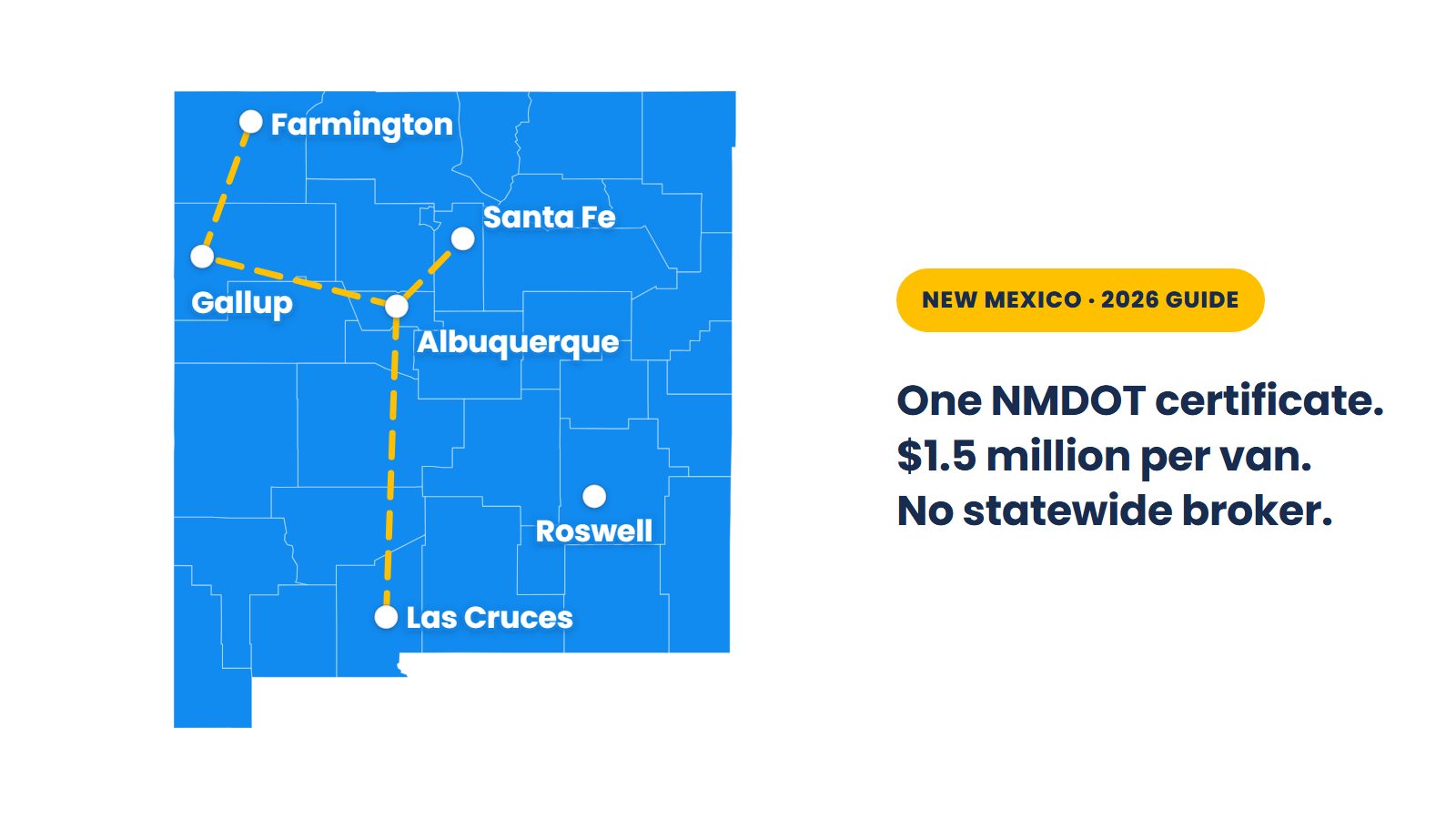
To start a NEMT business in New Mexico, form an LLC ($50), insure each van for $1.5 million and get the New Mexico Department of Transportation’s (NMDOT) $300 non-emergency medical transport certificate. Your tariff, the price list NMDOT approves, must be on file before any paid ride. Then enroll with Medicaid and each health plan’s ride network while facility and private-pay trips run. Budget at least $22,100 for one financed used wheelchair van and six months of bills.
New Mexico at a glance:
- The certificate: NMDOT, not the Public Regulation Commission (PRC), has certified passenger carriers since July 1, 2024. A non-emergency medical transport certificate costs $300 [1][2].
- The tariff: outside government programs you join, you can charge only the rates you file, so file the private-pay prices you mean to use [1].
- Insurance: $1.5 million of auto liability per van seating 15 or fewer, counting the driver, filed by your insurer on a Form E [3].
- Medicaid: as of November 2026, there’s no statewide broker. Each of the four health plans in Turquoise Care, New Mexico’s Medicaid managed care program, books its members’ rides its own way [4][24].
- Direct billing: the Health Care Authority (HCA), New Mexico’s Medicaid agency, pays enrolled companies for fee-for-service riders, by the mile: $1.78 for a wheelchair van under the rates set for January 2025 [5].
- Time: NMDOT can’t act on your application until 20 days after it publishes notice, and service must start within 30 days of the certificate [1].
At HCA’s February 26, 2026 hearing on its NEMT rule, the agency’s record notes one attendee who “opened a transportation services business and is not receiving referrals from Managed Care Organizations (MCO)” [6]. A company in Santa Fe told an industry podcast in June 2024 that its main broker was “searching for more carriers in New Mexico.” Even so, the company was leaning into facilities, invoicing them weekly, most of them at its private-pay prices.
New Mexico licenses the van company first. Get NMDOT’s certificate, tariff and $1.5 million policy, then run facility and private-pay trips while each plan’s ride network credentials you.
HCA counted 825,287 Medicaid members in July 2026, and about one New Mexican in five is 65 or older [7][8]. NMDOT’s public list held 82 NEMT tariffs from 81 companies and programs on November 12, 2026, 30 of them posted since it took over in July 2024 [9].
I run Duet, which builds dispatch software and runs growth services for non-emergency medical transportation (NEMT) businesses, and I talk to NEMT owners on demos every week. This is the New Mexico edition of our national guide on how to start a NEMT business. Requirements change, so confirm against the linked sources before you spend money.
The checklist runs in the order you’ll spend money, and the payers follow in the order a new company meets them: facilities and families, then Medicaid. The rest is the detail behind each step.
The one-page checklist: steps to start a NEMT business in New Mexico
Form the company, insure and inspect a van, file NMDOT’s certificate application with your tariff, and line up riders during the notice period. Each phase ends with what it puts at risk, from our national one-van budget with New Mexico’s fees swapped in.
Phase 0: ask the bureau five questions before you buy
Call NMDOT’s Transportation Regulation Bureau (TRB) at (505) 827-4519 before you spend anything, and get the answers in writing where you can [10]:
- Van size: ask how the 2025 safety rule’s eight-passenger limit, counting the driver, applies to the wheelchair van you have in mind [11].
- Stretchers: ask whether a NEMT certificate covers a stretcher van at all.
- Facility rates: ask whether a facility contract’s rates have to appear in your tariff.
- Timing: ask how long a complete application is taking right now.
- Facility agreements: ask whether you can sign one that starts the day your certificate issues.
- Money at risk: nothing yet.
Phase 1: form the company
- File articles of organization online with the Secretary of State: $50 [12].
- Register with the Taxation and Revenue Department (TRD) for a New Mexico Business Tax Identification Number (NMBTIN). It’s free and generally issued within a business day, and NMDOT’s application still asks for it by its old name, the “CRS No.” [13][14].
- Get a free employer identification number (EIN) and a free national provider identifier (NPI) under the NEMT van taxonomy code, 343900000X [15].
- Get your city or county business license, which HCA asks for when you enroll. Albuquerque’s is $36.75 a year [15][16].
- Money at risk: about $390, counting about $300 for a phone and basic marketing.
Phase 2: line up, insure and inspect van one
- Line up van one before you file. The application asks for each van’s VIN and seating capacity, counting the driver, plus a current annual inspection report from NMDOT or a certified mechanic. Its vehicle list covers vans “owned (or to be purchased),” so ask the bureau whether a van under contract will do [14].
- Have your insurer file a Form E with NMDOT for at least $1.5 million. The insurer has to send it to NMDOT directly [3].
- Write a preventive maintenance program, which the application also asks for [14].
- NMDOT’s carrier rules don’t set a lift or securement spec, so ask each plan’s ride network for its standard and train every driver on wheelchair securement.
- Money at risk: about $10,200 more, so about $10,600 in. That’s $4,000 down on our model’s older $20,000 wheelchair van, about $870 of excise tax, title and registration, $4,350 of insurance at signing and $1,000 for equipment and lettering. From here, fixed bills run $1,692 a month.
Phase 3: build each driver’s file
- Before anyone drives, run a national fingerprint-based background check and a nationwide driving record, and repeat both every five years [11].
- Put every driver, you included, in a drug and alcohol testing program. The application asks for a policy that meets federal motor carrier requirements [11][14].
- Copy each driver’s medical card, license and driving record for the application [14].
- Check the company and every driver against the federal exclusion list before hire. New Mexico’s Medicaid state plan requires that no NEMT provider or driver be excluded from federal health care programs [38].
- Money at risk: about $1,000 for one driver’s screening and training in our model, so about $11,600 in.
Phase 4: file, then work the notice
- File NMDOT’s notarized Certificate Application with a $300 check or money order. Check “Non-Emergency Medical,” choose statewide service or list your counties, and give the street address where your vans park and you take calls [14].
- Attach the vehicle list and inspection reports, the maintenance program, the drug and alcohol policy, the driver copies, your workers’ comp certificate or exemption, and your proposed tariff [14].
- Make the file complete. Notice and review wait for the fee and a complete application, and if it isn’t complete 60 days after you file, the $300 is forfeited [17].
- Use the notice period, at least 20 days. You can’t carry a paying rider yet, so visit facilities, get two ready to book you, and line up your first private-pay families for the week the certificate issues.
- Money at risk: $300 more, so about $11,900 in.
Phase 5: the week your certificate issues
- Letter the right and left doors with your company name and NM operating authority number (shown as “NM 123”), in letters at least 2 1/2 inches high, and post your tariff rates in each van [11][1].
- Start service within 30 days of the certificate [1].
- Enroll with HCA at YES.NM.GOV, and call every plan’s ride network the same week.
- Put up a website families can book from, claim your Google Business Profile and ask your first riders for reviews.
- Mark March 1 on next year’s calendar, when NMDOT’s annual report is due [10].
- Money at risk: six months of fixed bills at $1,692 a month, for a total of about $22,100.
Who pays for NEMT rides in New Mexico?
Facilities and families can pay you the week your certificate issues; Medicaid brings the volume later, through four health plans and a fee-for-service lane. A 2023 legislative fiscal note cited an estimate that Medicaid would spend about $59.3 million on non-emergency transportation in fiscal 2024 [18].
Facilities usually pay first
Nursing homes, rehabs and hospitals can buy rides directly, and none of that waits on a plan’s network. New Mexico had 68 nursing homes with about 6,900 certified beds in CMS’s October 2026 data, 18 of them in Albuquerque [19]. Who pays for a resident’s ride varies, though. HCA’s rule lists transportation “provided by nursing facilities (NF) or other residential centers” among the free alternatives Medicaid expects first, while Blue Cross’s member FAQ covers a resident’s trip to an approved appointment and back [20][4]. Ask each home who pays before you quote. Our guide to nursing home transportation contracts covers that conversation.
InnovAge runs New Mexico’s one Program of All-Inclusive Care for the Elderly (PACE), in Albuquerque, and it advertises rides to its center, so ask who drives them [21].
Facilities have a reason to ask for your certificate: NMDOT can fine anyone “knowingly using a motor carrier not properly authorized” up to $10,000 [1]. Once it issues, bring a copy to every meeting. Our guide to winning facility contracts covers the rest of the pitch.
Don’t count on dialysis clinics as accounts. Dialysis rides are great, but in my experience most dialysis riders are on Medicaid, so their trips come through Medicaid, not the clinic.
Families pay your tariff price
Families pay you directly, at the rates in your tariff and no others. The Motor Carrier Act bars a tariffed carrier from charging “a different or additional rate” than its approved tariff, except rates set by government programs it joins voluntarily [1].
So it’s worth seeing what other companies filed, and the Motor Carrier Act has NMDOT post every approved tariff online [1]. Fourteen of the 25 NEMT tariffs NMDOT posted from January 2025 through September 2026 carry private-pay rates. For a weekday one-way wheelchair ride, here’s what they show [9]:
| Wheelchair, weekday, one way | Low | Median | High | Tariffs |
|---|---|---|---|---|
| Base or load fee | $15 | $75 | $150 | 11 |
| Per mile, billed from pickup | $2.35 | $2.50 | $7.50 | 9 |
| A 10-mile trip, priced by each tariff’s own rules | $40 | $80 | $225 | 11 |
The trip median sits below the base plus 10 miles because three of those tariffs charge a flat fare that covers the first 15 to 25 miles. It’s arithmetic on filed rates, not a survey of what riders pay.
Most private-pay owners I talk to charge a card at least 24 hours before pickup, or send a payment link due by then. No payment, no van. Write any deposit, cancellation or no-show fee into the tariff, since its terms of service are on file too [2]. Our private-pay guide covers pricing and marketing.
Who is the NEMT broker in New Mexico?
New Mexico has no statewide NEMT broker: each of the four Turquoise Care health plans books its members’ rides its own way. Turquoise Care, the managed care program HCA runs, replaced Centennial Care on July 1, 2024 [24].
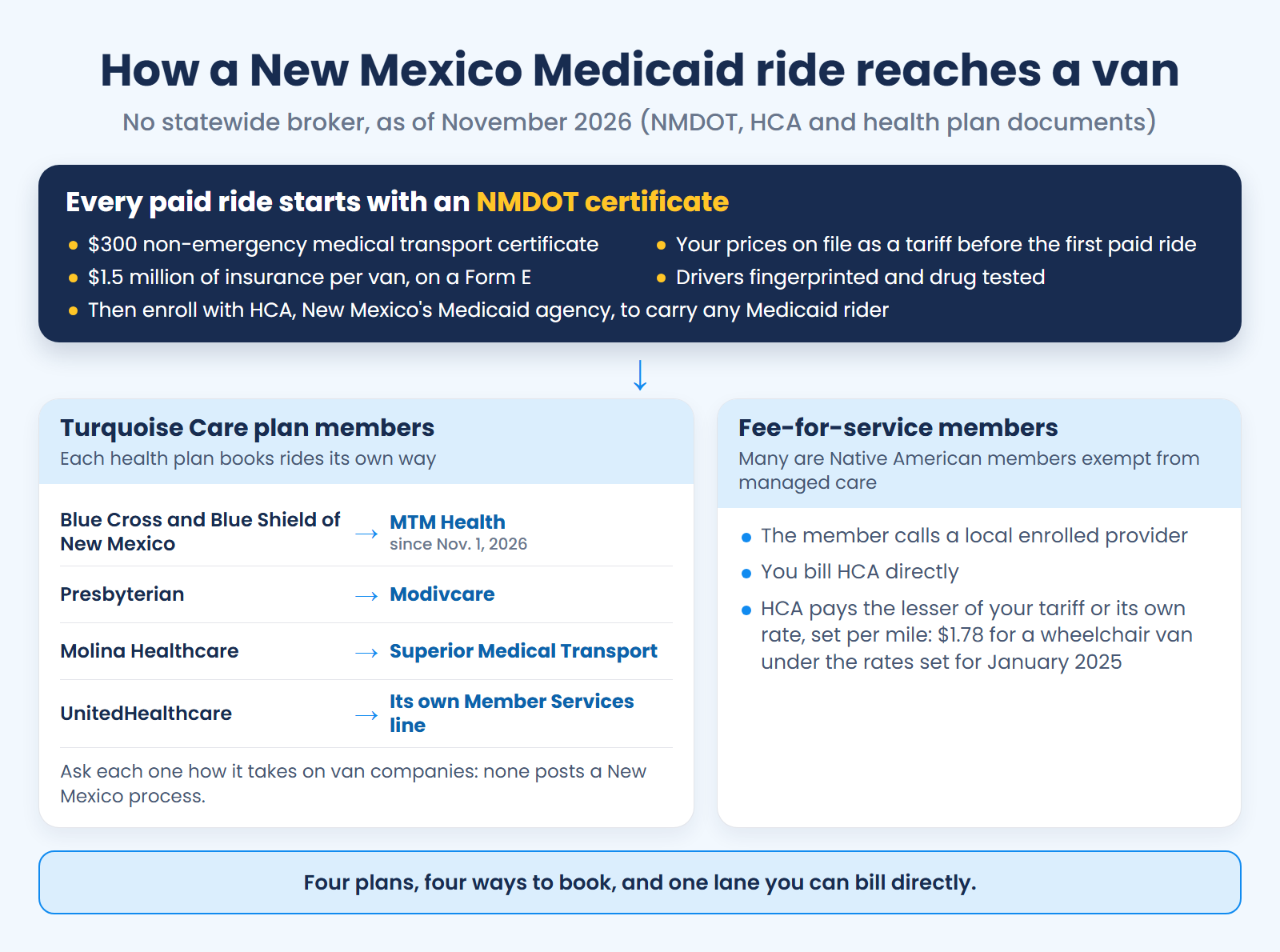
Here’s the map as of November 12, 2026. Confirm before you build on any row [4]:
| Health plan | Who books its members’ rides | Member ride line | Notice to book |
|---|---|---|---|
| Blue Cross and Blue Shield of New Mexico | MTM Health, since November 1, 2026 (Modivcare before) | 1-866-913-4342 | 3 working days, up to 2 weeks ahead |
| Presbyterian | Modivcare | 505-923-6300 or 1-855-774-7737 | 48 hours |
| Molina Healthcare of New Mexico | Superior Medical Transport | (833) 707-7100 | 3 business days; 5 for a visit more than 5 hours away |
| UnitedHealthcare Community Plan of New Mexico | UnitedHealthcare’s own Member Services line | 1-877-236-0826 | 3 business days, up to 2 weeks ahead |
Superior Medical Transport is the transportation-management division of Superior Ambulance Service, an Albuquerque ambulance company in business since 1974 [25]. UnitedHealthcare’s October 2026 member handbook says the plan “coordinates your transportation benefit” and names no outside ride company [4].
HCA’s rules reach every one of these networks. Plans can’t pay below HCA’s fee-for-service rate, and HCA told them in 2025, “This includes rates negotiated between MCOs and sub vendors or sub-contractors” [5]. HCA’s contract with Blue Cross, for one, makes the plan require every company in its network, a subcontractor’s included, to enroll with HCA. The same contract sets the pickup window at 15 minutes either side of the scheduled time, and the plan can lose up to 5% of its monthly payment from HCA if it misses its general ride standards [23].
The vendors keep their own rules too. Modivcare’s New Mexico page says “trip assignment will be based on routing criteria that includes provider compliance,” and a facility booking a ride can name a provider it prefers, though Modivcare doesn’t guarantee the match [25]. So once you’re in Modivcare’s network, a facility that likes your work can ask for you by name.
Plans switch vendors, and our log of 2026 broker changes tracks them. Our state-by-state map of who arranges Medicaid rides shows the rest of the country. Colorado, by contrast, has one statewide broker, taking every trip in the state from January 1, 2027.
Can I bill New Mexico Medicaid directly for NEMT rides?
Yes, for fee-for-service members: once you’re certified and enrolled, the Health Care Authority pays you directly, at the lesser of your tariff or its rate [20]. Fee-for-service covers Medicaid members outside the four plans, many of them Native American members exempt from managed care [22]. HCA counted 46,336 Native American members in full-benefit fee-for-service in December 2024 [26].
No broker sits between those riders and you. HCA tells them to contact “Local transportation providers for routine and nonemergency appointments,” and its August 2025 deck listed 17 such companies for San Juan and McKinley counties alone [22].
HCA pays by the mile, and the rate includes gross receipts tax [20][27]. Under the rates HCA set for January 1, 2025, a wheelchair van trip (code A0130) pays $1.78 a mile and a taxi trip (A0100) pays $2.06 [5]. Yes, the taxi code pays more per mile. Say a rider goes 10 miles in your wheelchair van: that’s $17.80. HCA pays nothing for miles without the rider aboard, and it caps what it pays per one-way trip, so ask its Medical Assistance Division at (505) 827-3100 for the current cap [20][22].
Your tariff matters here too. HCA pays “the lesser of their approved tariff or the MAD rate” (MAD is the Medical Assistance Division), so if your tariff’s price for a trip comes out below HCA’s, HCA pays your tariff’s price [20].
Long trips carry paperwork. For care more than 120 miles from the rider’s home community, keep written verification from the referring or treating provider in your billing records, renewed every 12 months [20]. From Farmington, a specialist visit in Albuquerque is past that line. U.S. cities within 100 miles of the border, such as El Paso, Texas, and Chinle, Arizona, count as in-state, and out-of-state trips need prior authorization [20][22]. Our guide to running long-distance trips covers the private-pay side of long runs.
HCA checks the records. After a federal payment audit found NEMT claims with “incomplete supporting documentation” and unit counts that didn’t match, HCA ordered every NEMT provider’s management and billing staff into a training on September 15, 2026 [27]. Our guides to billing Medicaid for NEMT and what Medicaid pays for NEMT go further.
In San Juan and McKinley counties, the fee-for-service lane may be your fastest Medicaid door, at a low rate. Across the line, Arizona runs a direct-billing lane for its American Indian Health Program.
What licenses and requirements does a NEMT business need in New Mexico?
One state license matters: NMDOT’s non-emergency medical transport certificate, required before any paid ride, private pay included. The Motor Carrier Act says “no person shall offer or provide a transportation service for hire within the state without first obtaining an appropriate operating authority from the department” (NMSA 1978, 65-2A-7) [1]. NMDOT’s rules list non-emergency medical transport as a specialized passenger service, and an authority for one type of service doesn’t cover another [17]. Our guide to NEMT license requirements shows how other states compare.
That department has been NMDOT since July 1, 2024, when Senate Bill 160 of 2023 moved motor carrier regulation from the PRC [1]. HCA’s rule, amended September 1, 2026, still describes carriers as “certified by the NMPRC,” the agency that held those duties before NMDOT [20].
There’s no need test. A passenger certificate issues to a carrier that’s “fit and able,” meets the safety and insurance rules and has filed a tariff; only an ambulance applicant has to show public need [1]. Only full-service carriers, such as municipal taxicabs and ambulances, can file a protest, which forces a hearing; anyone can file an objection [1][17]. Running without a certificate is expensive: NMDOT can fine up to $10,000 a violation, and each day of a continuing violation counts separately [1].
What goes in your tariff?
Your tariff is your price list and your terms of service, and once NMDOT approves it, it’s the only price list you can use. NMDOT’s rule says, “Prior to the performance of any operations, a tariff containing rates, terms and conditions, and any applicable time schedules of service must be approved by, and on file with, the department” [2]. It has to state “specific rates, not ranges of rates” [2].
A private-pay schedule usually prices each level of service with a base or load fee and a rate per loaded mile, plus wait time, after-hours trips and no-shows. Ten of the 25 NEMT tariffs NMDOT posted from January 2025 through September 2026 list only lines modeled on Medicaid’s fee schedule, and one is a clinic program that bills insurance [9].
Facility contracts are a question for the bureau. One approved tariff on NMDOT’s list points its contract rates to “contract(s) on file with NMDOT Transportation Regulation Bureau” instead of printing them [9]. Ask before you sign a facility at a rate your tariff doesn’t show. Whether a health plan’s network rates fall under the statute’s government-program exception is another question for the bureau [1].
What does the certificate require of your vans?
Every van needs an inspection before its first trip and at least once a year after that [11]. Your company name and NM operating authority number go on the right and left doors, permanently affixed, in letters at least 2 1/2 inches high, so plan on a sign shop, not magnets [11].
Then there’s the line to check before you buy. Since June 24, 2025, the rule has barred a transportation service from using a passenger vehicle “designed to carry more than eight passengers, including the driver” [11]. If the van you want seats more than eight counting the driver, get the bureau’s reading in writing before you buy it.
What do other New Mexico guides get wrong?
Here’s what circulates about New Mexico, next to what the state actually requires:
| The claim you’ll read elsewhere | What New Mexico actually requires |
|---|---|
| ”obtain a Certificate of Public Convenience and Necessity from the New Mexico Public Regulation Commission” | NMDOT has issued carrier certificates since July 1, 2024, and a NEMT applicant shows no public need [1] |
| “The New Mexico Human Services Department is your primary contact for transport permits” | NMDOT issues the certificate; HCA, formerly the Human Services Department, runs Medicaid [1][23] |
| “New Mexico Medicaid (Centennial Care)“ | Turquoise Care replaced Centennial Care on July 1, 2024 [24] |
| “Rides are coordinated through MTM Health / LogistiCare” | Each plan books its own way, and Blue Cross moved from Modivcare to MTM Health on November 1, 2026 [4] |
| “state-designated transportation brokers such as Modivcare or MTM” | No state broker: four plans, four ways to book [4] |
| “submit the required NEMT application fee (typically $79)“ | HCA’s enrollment matrix and FAQ list no application fee; NMDOT’s certificate costs $300 [15][2] |
| “trips exceeding 65 miles from the client’s home” | The paperwork trigger is travel “over 120 miles” from the rider’s home community [20] |
| “out-of-state travel (defined as more than 100 miles from the state border)“ | U.S. cities within 100 miles of the border count as in-state [20] |
| “$1 million in liability coverage per vehicle” | $1.5 million for a van seating 15 or fewer, counting the driver [3] |
| “CPR and Basic Life Support (BLS) certification” | NMDOT’s safety rule requires neither; Modivcare’s national list asks for First Aid and CPR [11][25] |
What do New Mexico cities and counties add?
Mostly a business license. HCA’s enrollment asks for a city or county license, and Albuquerque requires one of most businesses in city limits, home-based ones included [15][16]. Ask your city or county clerk what yours costs.
In Bernalillo County, “Emissions testing is required of motor vehicles registered or commuting in Bernalillo County,” every two years for 1991 and newer vehicles up to 10,000 pounds [28]. Before you pick riders up at the Albuquerque Sunport, ask the city’s Aviation Department what it requires.
Gross receipts tax generally applies to your fares, and TRD’s list of deductions has none for medical transportation. The rate follows the pickup point: from July 1, 2026 to June 30, 2027, it’s 7.625% in Albuquerque, 8.1875% in Santa Fe and Farmington and 8.39% in Las Cruces [13].
What are the NEMT insurance requirements in New Mexico?
Plan on $1.5 million of auto liability per van: that’s New Mexico’s floor for passenger carriers, and your insurer files it on a Form E with NMDOT. NMDOT’s rule adopts the federal limits in 49 CFR 387.33: $1.5 million for a vehicle seating 15 or fewer, counting the driver, and $5 million at 16 or more [3]. So in New Mexico the state, not a broker, sets your coverage bar.
If your coverage isn’t on file with NMDOT, your authority can be suspended immediately, and reinstatement after an insurance lapse costs $100 [3][2]. NMDOT’s 2024 insurance sheet still lists a $1 million limit for small taxicabs, but that exception expired June 30, 2025, and a NEMT van isn’t a taxicab anyway [3].
HCA’s enrollment adds a line of its own: “Proof of malpractice, professional liability, or medical liability insurance” [15]. Ask your agent which policy satisfies it.
Get quotes at the $1.5 million limit before you buy the van. Frank Ciccarella, a NEMT consultant, said it plainly on our episode about startup paperwork: “I always recommend to people to get two or three quotes on insurance.” Our national budget prices a year at about $17,400 for roughly $1 million of coverage, so New Mexico’s higher limit will likely cost more. Our guide to NEMT insurance shows where that number comes from.
Do you need workers’ comp in New Mexico?
Yes, once you have three workers, and owners count. “All employers of three or more workers are required to carry workers’ compensation coverage,” and an LLC member who owns 10% or more counts toward the three, even after opting out of coverage [29]. NMDOT’s application asks for your certificate of coverage or of exemption [14].
What do NEMT drivers need in New Mexico?
No commercial driver’s license (CDL) for a typical wheelchair van, but NMDOT sets the driver file: a fingerprint check, a nationwide driving record, drug and alcohol testing and a medical card. A CDL starts at a vehicle designed for 16 or more passengers, including the driver, or one of 26,001 pounds [30].
NMDOT’s safety rule, in effect since June 24, 2025, covers every driver, owners included [11]:
- Background: “a national fingerprint based background check and a nationwide motor vehicle report (MVR)” before hire, and again every five years.
- Disqualifiers: more than three moving violations in three years, or one for evading police, reckless driving or driving on a suspended or revoked license. So do convictions in the past seven years for a felony or a driving-related, violent or sexual misdemeanor, and more than three misdemeanors of any kind, a sex offender listing, no valid license or an age under 18.
- Testing: drug and alcohol testing under the federal rules in 49 CFR Parts 40 and 382.
- Hours: no more than 12 hours of driving in any 24.
- Qualification: the federal driver qualification and medical exam sections of 49 CFR Part 391. NMDOT’s application asks for copies of each driver’s medical card [14].
Neither the safety rule nor the application asks for CPR or Basic Life Support training. The plans’ ride networks may, so train to the strictest list you’ll work under.
What do the plans’ ride vendors add?
Modivcare and MTM Health post their own requirements, and the ones posted are national, not New Mexico’s [25]:
- Modivcare: a PASS wheelchair certificate (hands-on wheelchair transport training), First Aid and CPR certification, a defensive driving certificate, a drug screen, a motor vehicle report and a background check.
- MTM Health: fraud, waste and abuse training and HIPAA training, “completed by every employee of each provider annually.”
- Superior Medical Transport and UnitedHealthcare: nothing posted for van companies, so ask when you call.
Can a NEMT company run stretcher van trips in New Mexico?
Not clearly on a NEMT certificate, so get NMDOT’s answer in writing before you buy a stretcher. The certificate bars riders “who require medical monitoring or intervention to maintain their level of response, airway, breathing and circulatory status, with the exception of self-administered oxygen not to exceed six liters per minute via a nasal cannula” [17]. Put that line in your intake script.
New Mexico’s stretcher-van language sits in NMDOT’s ambulance rule, in a section setting out what an ambulance service providing non-emergency and interfacility transport shall do [31].
Stretcher work exists. UnitedHealthcare’s provider manual takes “Nonemergent stretcher and ambulance requests” from 8 a.m. to 5 p.m. [4]. UNM Hospital told bidders in 2024 that a provider awarded the whole contract would need “One dedicated stretcher van with crew for 12 hours per day 7 days per week” [32]. Our guide to hospital discharge contracts covers that kind of work.
How do you become a Medicaid transportation provider in New Mexico?
Through three doors, in order: NMDOT’s certificate, HCA enrollment at YES.NM.GOV, then each plan’s ride network. HCA’s enrollment asks for the certificate itself, so the first door has to come first.
Step one: enroll with HCA at YES.NM.GOV
Apply as provider type 403, “Handivan,” under the NEMT van taxonomy, 343900000X, or as type 404 for taxi work [15]. HCA asks a NEMT van company for:
- NMDOT’s certification for non-emergency medical transportation;
- a city or county business license;
- proof of malpractice, professional liability or medical liability insurance;
- the IRS letter showing your federal tax ID, and a W-9.
There’s no site visit and no fingerprinting for these provider types, and you revalidate every three years [15]. HCA’s matrix and FAQ list no application fee. Ask its enrollment help line, 1-800-299-7304, whether the federal enrollment fee, $750 for applications in 2026, applies to a van company [15][33].
Check every attachment before you file. Frank Ciccarella has walked several companies across the country through Medicaid applications, and he has yet to see one “go on the first try.” Our state-by-state guide to becoming a Medicaid ride provider shows how other states order these steps.
Step two: call every plan’s ride network the same week
Each network runs its own application and checks, and none can take you before HCA enrolls you [23]. Frank’s advice on the same episode was to “make contact with the local … guy in charge,” and say, “I’m a new service coming on board. I want to get certified to be a provider for you.”
- MTM Health (Blue Cross): no New Mexico provider page as of November 2026. Its national page lists six steps, from a provider application and an interview through contracting, credentialing and training to a first trip [25].
- Modivcare (Presbyterian): its network companies “schedule their transports based on the information we send out in their daily manifest.” Apply through its transportation provider page [25].
- Superior Medical Transport (Molina): nothing posted for outside van companies. Call 505-341-0042 and ask whether it uses them [25].
- UnitedHealthcare: ask its provider services line, 1-888-702-2202, how a van company joins [4].
How long does credentialing take?
HCA’s enrollment FAQ gives no processing time, and each network sets its own, so ask HCA and every network for a timeline on your first call [15].
What if a plan’s vendor doesn’t call back?
Keep running the trips you control. Frank’s advice: if you have the vehicle and the insurance, “you can always do private trips, private pay.” In New Mexico, add the certificate to that list. Private-pay goodwill, he said, “ultimately will probably pay you more money than you would on the broker side.”
Facilities take time too. The Santa Fe company said its newer facilities started small, then sent all their rides “after about a month or two” of testing. Our guide to turning a facility meeting into a first trip covers that stretch.
A thin market can also work in your favor. That Santa Fe company’s broker was hunting for carriers in 2024, so if a network calls back fast, take the trips. Being one of few options helps on price too: Rachel Scholler, who ran a rural Wisconsin NEMT company for 17 years, told me on our pricing episode that she had room to negotiate “because there wasn’t a lot of options in my area.”
Don’t build the whole schedule on one payer
Blue Cross and Blue Shield of New Mexico moved its Medicaid rides from Modivcare to MTM Health on November 1, 2026, recurring trips included. The plan’s notice said recurring trips and trips already scheduled after November 1 “will be fulfilled by MTM Health” [4]. If you drove Blue Cross riders for Modivcare, keeping them meant getting into MTM’s network. Texas’s Blue Cross plan made the same move a month earlier.
In New Mexico the hedge is the other three plans, the fee-for-service lane, facilities and families. An El Paso owner with about 15 vehicles told me on a demo in April 2026 that the company works “with brokers as well,” alongside contracts with nursing homes and rehab centers and a lot of private-pay families. Back in its one-van days, the work included “trips to Albuquerque and stuff like that.” Tony Jackson, an Orlando operator with 35 years in the business, builds on facility trips, and when those run slow, “you fill in those gaps with the broker work,” as he told me on our episode about winning facility contracts.
However you dispatch, keep every payer’s trips on one schedule. Dispatch software like Duet keeps MTM’s and Modivcare’s trips on one board with your facility and private-pay rides. MTM and Modivcare are among Duet’s direct integrations, and if a vendor isn’t on that list but its portal exports a trip file, Duet can usually import that file instead. You still credential with each network, keep your tariff current as your prices change and keep the trip logs HCA audits.
How much does it cost to start a NEMT business in New Mexico?
Budget at least $22,100 for one financed used wheelchair van and six months of bills; the certificate is $300 of it. A 2016-2019 wheelchair van, financed, takes about $26,600, and each added older van and driver adds about $21,300 before wages.
New Mexico’s inputs are its filing fees, the excise tax and registration. Everything else comes from our national one-van startup budget, including insurance:
| Line item | New Mexico amount | Note |
|---|---|---|
| LLC articles of organization | $50 | Online with the Secretary of State [12] |
| NMBTIN (state tax ID) | $0 | Free from TRD [13] |
| EIN and NPI | $0 | Free from the agencies that issue them |
| NMDOT certificate | $300 | No per-vehicle or yearly fee in NMDOT’s fee rule [2] |
| City business license | $36.75 a year | Albuquerque’s, from July 1, 2026 [16] |
| HCA enrollment | $0 | No fee listed; ask about the federal fee [15] |
| Used wheelchair van, older | About $20,000, or $4,000 down | National model: 80% financed at 14% for 60 months, $372 a month |
| Motor vehicle excise tax | $800 | 4% of the price, taken here as the taxable value [28] |
| Title and registration | $67.25 | $5 at titling plus $62.25 a year for a van in its sixth model year or older [28] |
| Vehicle property tax | $0 | ”Automobiles and inventories are exempt” [13] |
| Insurance due at signing | About $4,350 | A quarter of the model’s $17,400 year, priced near $1 million of coverage |
| Equipment and lettering | About $1,000 | National model |
| Screening and training | About $1,000 | National model; one driver |
| Phone and basic marketing | About $300 | National model |
| Six months of fixed bills | About $10,200 | $1,692 a month: $1,305 insurance, $372 van, $15 phone |
| Total, owner driving | About $22,100 financed | A 2016-2019 $33,000 van, financed: about $26,600 |
Treat $22,100 as a floor. The model prices insurance near $1 million of coverage, below New Mexico’s $1.5 million, and each extra $1,000 a year of premium adds $250 at signing and $75 a month. If HCA charges a van company the federal enrollment fee, add it: $750 for applications in 2026.
Here’s what those fixed bills ask of one van. Say your first trips are all 10-mile private-pay wheelchair rides at the filed median of $80: it takes 22 a month to cover the $1,692 of fixed bills, before fuel, repairs, gross receipts tax and anyone’s wages. At HCA’s fee-for-service rate of $17.80 for the same trip, it takes 96.
Outside the totals: gross receipts tax on your fares, workers’ comp once you reach three workers, a professional liability policy, yearly inspections and payroll. Shuttle drivers and chauffeurs earned a median $16.81 an hour in New Mexico in May 2025, per the federal Bureau of Labor Statistics [34].
Anyone quoting a $5,000 New Mexico launch hasn’t priced $1.5 million of commercial auto.
How do you fund a NEMT startup in New Mexico?
These lenders and programs serve New Mexico small businesses:
- SBA microloans: up to $50,000 through the Small Business Administration’s program [35].
- WESST: one of three SBA microlenders in New Mexico, lending $500 to $150,000, start-up loans included [36].
- The Loan Fund: an Albuquerque community development financial institution (CDFI) lending $5,000 to $350,000 [36].
- The state’s Collateral Assistance Program: cash support of up to 50% of a loan’s principal when you’re short on collateral, through approved lenders [36].
- Native Community Capital: a Native CDFI serving New Mexico and Arizona, whose small business loans were typically capped at $250,000 in 2023 [36].
- The New Mexico Small Business Development Center: counseling at 18 service centers [13].
None of them speeds up NMDOT’s notice or a plan’s credentialing, so borrow for the months you’ll actually wait.
How long does it take to start a NEMT business in New Mexico?
The certificate sets the only fixed clocks: at least 20 days of notice after a complete application, then 30 days to start service. Everything else depends on how fast you move and how fast each office answers:
- The company: file the LLC online and get your NMBTIN, generally issued within one business day [12][13].
- The van: line it up, insure it and get it inspected before you file, since the application wants the inspection report and your insurer’s Form E [14].
- The application: file it complete. NMDOT can’t act until 20 days after it publishes notice, and it generally issues an uncontested certificate after the notice period [1][17].
- Service: start within 30 days of the certificate [1].
- Medicaid: enroll with HCA that week, then apply to every plan’s network and ask each for its timeline.
The owner at HCA’s February hearing had a business and no referrals from the plans. File for the certificate, line up two facilities and a few families while the notice runs, and your first paid ride won’t wait on anyone’s referral.
New Mexico NEMT FAQ
Is a certificate the PRC issued before July 2024 still good?
Yes. NMDOT’s transition FAQ says, “All motor carriers’ warrants and certificates will remain in force,” and the operating authority number stays the same [10]. Permits didn’t carry over: “All permits expire July 1, 2024.” Senate Bill 160 also made old references to the PRC in law and rules count as references to NMDOT [1].
Can one NMDOT certificate cover the whole state?
Yes. The Certificate Application lets you choose “Statewide service to and from all counties” or list the counties you’ll serve [14]. Your stationing points, the street addresses where your vans are kept and calls come in, are printed on the certificate [14][17].
Can I give a free first ride or a senior discount?
You can offer a senior discount, but not a free ride. The Motor Carrier Act says “A motor carrier shall not furnish free transportation to persons” except its own owners, officers, employees and their dependents, and reduced rates for riders 65 or older “shall not be considered discriminatory” [1]. Put the senior rate in your tariff, since you can charge only what’s on file.
How do I change my prices, territory or base later?
File with NMDOT before the change. A tariff change costs $200, and a rate increase needs a side-by-side comparison of your current and proposed rates; if no hearing is called, it’s approved by default 20 days after a complete filing [2]. A certificate change, such as new counties, is also $200, and a stationing point can’t be added, dropped or moved until a new certificate shows it [2][17].
Who pays the gross receipts tax on a Medicaid ride?
It depends on who pays. HCA’s fee-for-service rates are “inclusive of gross-receipts taxes,” so the tax comes out of the rate [20]. For plan work, Senate Bill 249 of 2025 makes a plan reimburse “all applicable gross receipts taxes” to a health care provider that contracts with it, from January 1, 2026 [37]. Whether a ride vendor’s subcontractor gets that isn’t settled, so ask TRD at 1-866-285-2996, and the vendor, before you price a contract [13].
Can an El Paso, Durango or Arizona company run New Mexico trips?
Yes, with the right authority for each trip. A paid trip within New Mexico needs NMDOT’s certificate, like any carrier’s [1]. A paid trip across the state line is interstate, which brings in federal motor carrier rules, with the same $1.5 million floor for a van seating 15 or fewer, counting the driver [3]. For Medicaid, HCA treats U.S. cities within 100 miles of the border as in-state, and out-of-state trips need prior authorization [20]. Call the bureau at (505) 827-4519 before you plan regular runs.
Can Uber or Lyft drivers give Medicaid rides in New Mexico?
Yes. Since July 1, 2023, Senate Bill 485 has let a transportation network company “connect a driver to a rider for the purpose of providing non-emergency medical transportation services,” Medicaid rides included, after criminal background and exclusion checks [18]. Those companies need NMDOT’s permit, $10,000 a year, and their drivers use personal vehicles, so it isn’t a route for a van company [1][18].
Does Medicaid pay for meals, lodging or an attendant on long trips?
Yes, when the trip requires it. HCA’s rule covers lodging when the rider must travel more than four hours one way and stay overnight, and meals when the rider is away from home eight hours or more. It also covers the transportation, meals and lodging of one attendant when a medical provider certifies the need in writing [20]. The authorization forms come from county Income Support Division offices. That money covers the rider’s costs, so don’t count it as trip revenue.
Is New Mexico a good place to start a NEMT business?
It can be, if you start with trips you control. New Mexico had 825,287 Medicaid members in July 2026, and about one resident in five is 65 or older [7][8]. The catch is the front end: a $300 certificate with filed prices, a $1.5 million insurance floor, and four plans that each let companies in on their own clock. Facilities and families don’t wait on any of that once your certificate issues.
Key official sources
[1] New Mexico Legislature, Senate Bill 160 of 2023 (Laws 2023, chapter 100), final text (read November 12, 2026): the transfer of motor carrier regulation from the Public Regulation Commission to NMDOT on July 1, 2024 and the clause making old references to the commission references to NMDOT; the operating authority requirement in 65-2A-7; the 20-day notice period, the certificate test with no public-need showing outside ambulance service, and service within 30 days; filed rates only, the government-program exception, tariffs posted online and rates posted in each vehicle (65-2A-20); no free rides and reduced rates for riders 65 or older; fines of up to $10,000; and the $10,000 transportation network company permit. https://www.nmlegis.gov/Sessions/23%20Regular/final/SB0160.pdf
[2] 18.3.5 and 18.3.6 NMAC, NMDOT’s fee and tariff rules (effective July 1, 2024; read November 12, 2026): $300 for a new certificate, $200 for a certificate or tariff change and $100 to reinstate after an insurance lapse, with no per-vehicle fee; a tariff with rates, terms and conditions approved and on file before any operations, specific rates rather than ranges, a side-by-side comparison for a rate increase, and approval by default 20 days after a complete filing. https://srca.nm.gov/parts/title18/18.003.0005.pdf and https://srca.nm.gov/parts/title18/18.003.0006.pdf
[3] 18.3.3 NMAC, NMDOT’s financial responsibility rule (effective July 1, 2024), the federal limits it adopts in 49 CFR 387.33, and NMDOT’s Financial Responsibility Requirements sheet (posted June 24, 2024), all read November 12, 2026: $1.5 million for passenger vehicles seating 15 or fewer, including the driver, and $5 million at 16 or more; insurers filing the Form E directly with NMDOT; immediate suspension without coverage on file; and the taxicab exception that expired June 30, 2025. https://srca.nm.gov/parts/title18/18.003.0003.pdf, https://www.law.cornell.edu/cfr/text/49/387.33 and https://api.realfile.rtsclients.com/PublicFiles/f260a66b364d453e91ff9b3fedd494dc/fe4f40b9-af45-4060-a4db-518803265470/Financial%20Responsibility%20Requirements%20for%20an%20Operating%20Authority.pdf
[4] Health plan documents (read November 12, 2026): Blue Cross and Blue Shield of New Mexico’s Turquoise Care transportation page, its July 15, 2026 provider notice (updated September 9, 2026) and its member transportation FAQ (October 30, 2026); Presbyterian’s Turquoise Care transportation page; Molina Healthcare of New Mexico’s Medicaid benefits page; and UnitedHealthcare Community Plan of New Mexico’s Turquoise Care member handbook (October 2026) and 2026 provider manual. They support who books each plan’s rides, the member ride lines and booking notice, the November 1, 2026 move to MTM Health with recurring trips included, nursing home trips, stretcher requests and UnitedHealthcare’s provider services line. https://www.bcbsnm.com/turquoise-care/benefits-and-coverage/transportation, https://www.bcbsnm.com/provider/education-reference/education/news/2026/7-15-2026-well-have-a-new-medical-transportation-provider-for-medicaid-members, https://www.bcbsnm.com/turquoise-care/pdf/tc-transportation-faq-nm.pdf, https://www.phs.org/health-plans/turquoise-care-medicaid/transportation, https://www.molinahealthcare.com/medicaid/nm/benefits-services, https://www.uhc.com/communityplan/assets/plandocuments/handbook/en/NM-Medicaid-TurquoiseCare-Handbook-EN.pdf and https://www.uhcprovider.com/content/dam/provider/docs/public/admin-guides/comm-plan/NM-UHCCP-Provider-Manual.pdf
[5] New Mexico Health Care Authority (HCA), Letters of Direction 36-1 (December 30, 2024) and 36-2 (February 27, 2025) to the Turquoise Care plans (read November 12, 2026): rates effective January 1, 2025, including $1.78 for code A0130 and $2.06 for A0100, and the rule that plans can’t pay below HCA’s fee-for-service rate, including with sub-vendors and subcontractors. https://www.hca.nm.gov/wp-content/uploads/LOD-36-1-State-Fiscal-Year-2025-Payment-Rate-Increases.pdf and https://www.hca.nm.gov/wp-content/uploads/Final-LOD-36-2-State-Fiscal-Year-2025-Payment-Rate-Increase-RR-LOD-36-1-3-1.pdf
[6] HCA, Human Services Register, Volume 49, Register 31, final rule (August 18, 2026; read November 12, 2026): the February 26, 2026 public hearing on 8.324.7 NMAC, HCA’s summary of the comments, and the September 1, 2026 effective date. https://www.hca.nm.gov/wp-content/uploads/Final-Register-31.pdf
[7] HCA, press conference slides on H.R. 1 (August 31, 2026; read November 12, 2026): 825,287 Medicaid members as of July 2026. https://www.hca.nm.gov/wp-content/uploads/FINAL_HR1_Press_Conference_083126.pdf
[8] Census Bureau, American Community Survey 2024 1-year, table B01001, via Census Reporter (read October 19, 2026): 429,233 of New Mexico’s 2,130,256 residents 65 or older, about 20%. https://api.censusreporter.org/1.0/data/download/latest?table_ids=B01001&geo_ids=040|01000US&format=csv
[9] NMDOT Transportation Regulation Bureau, Non-Emergency Medical Transport tariff list, and the 25 tariffs posted on it from January 2025 through September 2026 (read November 12, 2026): 82 tariff files, 30 posted since July 1, 2024, and the filed rates behind this guide’s price figures, which are arithmetic on filed rates, not a survey of what riders pay. https://www.dot.nm.gov/trb/non-emergency-medical-transport/
[10] NMDOT Transportation Regulation Bureau, “About the Move” FAQ and bureau page (read November 12, 2026): certificates and warrants remaining in force after the transfer, permits expiring July 1, 2024, operating authority for non-emergency medical transport carriers, the bureau’s phone line, and annual reports due March 1. https://www.dot.nm.gov/trb/faqs/ and https://www.dot.nm.gov/trb/
[11] 18.3.4 NMAC, Safety Requirements, as published in the New Mexico Register, Volume XXXVI, Issue 12 (effective June 24, 2025; read November 12, 2026): fingerprint-based background checks and nationwide driving records before hire and every five years, driver disqualifications and the minimum age of 18, drug and alcohol testing under 49 CFR Parts 40 and 382, 12 hours of driving in 24, the Part 391 qualification and medical exam sections, inspections before first use and yearly, door markings, and the bar on vehicles designed for more than eight passengers, including the driver. https://www.srca.nm.gov/wp-content/uploads/2025/06/xxxvi12.pdf
[12] New Mexico Secretary of State, Business Services page and its Articles of Organization form for a domestic limited liability company, as filed online in February 2025 (both read November 12, 2026): online-only business filings and the $50 nonrefundable application fee. https://www.sos.nm.gov/business-services/
[13] New Mexico Taxation and Revenue Department, FYI-102, Information for New Businesses (Rev. 07/2025), FYI-105, Gross Receipts Tax Overview (2025-26 edition), and the gross receipts tax rate schedule for July 1, 2026 to June 30, 2027 (a county-posted copy), read November 12, 2026: the free NMBTIN, generally issued within one business day; the call center; automobiles exempt from property tax; the Small Business Development Center’s 18 service centers; receipts taxable unless an exemption or deduction applies, with no deduction for medical transportation; the rate set where the rider enters the vehicle; and the Albuquerque, Santa Fe, Farmington and Las Cruces rates. https://realfile.tax.newmexico.gov/FYI-102.pdf, https://realfile.tax.newmexico.gov/FYI-105.pdf and https://www.sierraco.org/wp-content/uploads/GRT-Rate-Schedule-July12026-June-30-2027-.pdf
[14] NMDOT Transportation Regulation Bureau, Certificate Application and checklist (posted July 23, 2024; read November 12, 2026): the $300 fee by check or money order, the CRS number, the non-emergency medical service type, statewide or listed territory, stationing points, the insurer’s Form E, a workers’ comp certificate or exemption, the vehicle list and inspection reports, the maintenance program, the drug and alcohol policy, drivers’ medical cards, licenses and driving records, the proposed tariff and the notarized oath. https://api.realfile.rtsclients.com/PublicFiles/f260a66b364d453e91ff9b3fedd494dc/aed5a25b-40dc-4274-a0d7-e1083f05cb51/Certificate%20Application.pdf
[15] HCA, Provider Enrollment Matrix (modified October 7, 2026) and Provider and PED Enrollment System FAQs 2.0, read November 12, 2026: provider types 403 and 404, taxonomy 343900000X, the documents a NEMT van company files, no site visit or fingerprints, no application fee listed, revalidation every three years, and the enrollment help line. https://www.hca.nm.gov/wp-content/uploads/Copy-of-Provider-Enrollment-Matrix-10.1.26.xlsx and https://www.hca.nm.gov/wp-content/uploads/Provider-and-PED-Enrollment-System-FAQs-2.0.pdf
[16] City of Albuquerque, Business License FAQs (read November 12, 2026): a business license for most businesses in city limits, home-based ones included, and the $36.75 annual fee from July 1, 2026. https://www.cabq.gov/planning/planning-faqs/business-registration-faqs
[17] 18.3.1 and 18.3.2 NMAC, NMDOT’s general provisions and operating authority rules (effective July 1, 2024; read November 12, 2026): non-emergency medical transport as a specialized passenger service, one authority for each type of service, stationing points printed on the certificate, complete applications before notice, the fee forfeited after 60 days, uncontested certificates issued after the notice period, protests by full-service carriers only, and the limit on riders who need medical monitoring. https://srca.nm.gov/parts/title18/18.003.0001.pdf and https://srca.nm.gov/parts/title18/18.003.0002.pdf
[18] New Mexico Legislature, Senate Bill 485 of 2023, final text, and the Legislative Finance Committee’s fiscal impact report on it (March 8, 2023), read November 12, 2026: transportation network companies allowed to provide non-emergency medical transportation, Medicaid included, after background and exclusion checks and in drivers’ personal vehicles, effective July 1, 2023; and the Human Services Department’s estimate of about $59.3 million of Medicaid spending on non-emergency transportation in fiscal 2024. https://www.nmlegis.gov/Sessions/23%20Regular/final/SB0485.pdf and https://www.nmlegis.gov/Sessions/23%20Regular/firs/SB0485.PDF
[19] Centers for Medicare & Medicaid Services (CMS), Nursing Home Provider Information dataset, New Mexico rows (October 2026 processing; read November 12, 2026): 68 nursing homes with about 6,900 certified beds, 18 of them in Albuquerque. https://data.cms.gov/provider-data/api/1/datastore/query/4pq5-n9py/0?conditions%5B0%5D%5Bproperty%5D=state&conditions%5B0%5D%5Bvalue%5D=NM&conditions%5B0%5D%5Boperator%5D=%3D&properties%5B0%5D=cms_certification_number_ccn&properties%5B1%5D=citytown&properties%5B2%5D=number_of_certified_beds&properties%5B3%5D=processing_date&limit=150&count=true&results=true&schema=false&keys=true
[20] HCA, 8.324.7 NMAC, Transportation Services and Lodging (as amended effective September 1, 2026; read November 12, 2026): carriers “certified by the NMPRC,” free alternatives including nursing facilities’ own transportation, prior authorization, border cities within 100 miles, written verification for travel over 120 miles, payment at the lesser of the approved tariff or HCA’s rate with gross receipts tax included, no payment for any part of a trip without the rider, and lodging, meals and attendants. https://www.hca.nm.gov/wp-content/uploads/8.324.7-NMAC-Transportation-Svcs-and-Lodging.pdf
[21] National PACE Association, PACE in the States (September 2026), and InnovAge’s Albuquerque page (read November 12, 2026): New Mexico’s one PACE program, InnovAge New Mexico PACE in Albuquerque, and its transportation to and from the center. https://www.npaonline.org/docs/default-source/public-files/public_pace_in_the_states_9-26.pdf?sfvrsn=83e6fc30_1 and https://www.innovage.com/locations/nm-albuquerque
[22] HCA, Client Medical Travel presentation to the National Indian Health Board (August 20, 2025; read November 12, 2026): fee-for-service members, including Native American members exempt from managed care, told to contact local transportation providers; the Medical Assistance Division’s phone line; border cities such as Chinle and El Paso treated as in-state; and the fee-for-service transportation providers listed for San Juan and McKinley counties. https://www.nihb.org/wp-content/uploads/2025/08/05-Theresa-Belanger_Client-Medical-Travel-for-AAIHS-8.20.25.pdf
[23] HCA, Turquoise Care managed care contract with Blue Cross and Blue Shield of New Mexico, Amendment 5, amended and restated (signed December 31, 2025; read November 12, 2026): HCA as the former Human Services Department, every network provider, subcontractors’ included, enrolled with HCA, rates no lower than HCA’s fee-for-service rate, the 15-minute pickup window, and up to 5% of a monthly capitation payment for missed transportation standards. https://www.hca.nm.gov/wp-content/uploads/TCBCBS_24-630-8000-0029_CA5_Signed.pdf
[24] HCA, Turquoise Care section 1115 demonstration report for demonstration year 12, July 1 to December 31, 2024 (April 30, 2025; read November 12, 2026): Turquoise Care’s first demonstration year, under contracts that replaced Centennial Care 2.0’s. https://www.hca.nm.gov/wp-content/uploads/NM_1115_DY12Q2_CMS-Quarterly-Monitoring-Report_20250430.pdf
[25] Ride vendors’ own pages (read November 12, 2026, except MTM’s, read October 28, 2026): Superior Ambulance Service’s About and MyRide pages, on Superior Medical Transportation as its transportation-management division and its phone line; Modivcare’s New Mexico facility page, on daily manifests, routing criteria and preferred providers, and its national transportation provider page, on driver requirements; and MTM Health’s national provider page, on its six onboarding steps and yearly training. https://www.superior-nm.com/about/, https://www.superior-nm.com/myride, https://www.modivcare.com/facilities/nm/, https://www.modivcare.com/transportation-providers-contact-us/ and https://www.mtm-inc.net/driverswanted/
[26] HCA, Native Americans by Managed Care Organization and Fee for Service (December 2024; read November 12, 2026): 46,336 Native American members in full-benefit fee-for-service. https://hca.nm.gov/wp-content/uploads/MER-Native-Americans-by-Managed-Care-Organization-Fee-for-Service-24.pdf
[27] HCA, Supplement 26-05, HCA Training for NEMT Providers (September 3, 2026; read November 12, 2026): the federal payment audit’s findings on documentation and service units, and the mandatory September 15, 2026 training for NEMT management and billing staff. https://www.hca.nm.gov/wp-content/uploads/Supplement-26-05-HCA-Training-for-NEMT-Providers.pdf
[28] New Mexico Motor Vehicle Division, Vehicle Procedures Manual chapter 6, MVD Fees Manual (revised August 24, 2026) and Emission Testing page (read November 12, 2026): the 4% motor vehicle excise tax, title and registration fees, and emissions testing for vehicles registered or commuting in Bernalillo County. https://www.mvd.newmexico.gov/chapter-6-fees-penalties-and-excise-tax/, https://www.mvd.newmexico.gov/wp-content/uploads/2020/12/MVD-Fee-Manual-Revised-08_24_26Vehicles1.pdf and https://www.mvd.newmexico.gov/vehicles/emission-testing/
[29] New Mexico Workers’ Compensation Administration, FAQs (read November 12, 2026): coverage required for employers of three or more workers, with an LLC member owning 10% or more counted even when excluded from coverage. https://www.workerscomp.nm.gov/faqs/
[30] 49 CFR 383.5 and 383.91, 2024 edition, on GovInfo (read October 6, 2026): a commercial motor vehicle at 26,001 pounds or designed to transport 16 or more passengers, including the driver. https://www.govinfo.gov/content/pkg/CFR-2024-title49-vol5/pdf/CFR-2024-title49-vol5-part383.pdf
[31] 18.3.14 NMAC, Ambulance Services (effective July 1, 2024; read November 12, 2026): the stretcher and wheelchair van language inside NMDOT’s ambulance rule. https://srca.nm.gov/parts/title18/18.003.0014.pdf
[32] University of New Mexico Hospitals, RFP P495-24, Patient Transport Services, Addendum 2 (March 11, 2024; read October 20, 2026): one dedicated stretcher van with crew, 12 hours a day, seven days a week. https://unmhealth.org/about/bids-proposals/2024-current-bid-proposals/rfp-p495-24-patient-transport-services-addendum-2-3-11-24.pdf
[33] CMS, notice of the calendar year 2026 provider enrollment application fee (Federal Register, December 3, 2025; read October 22, 2026): $750 for applications from January 1 through December 31, 2026. https://www.govinfo.gov/content/pkg/FR-2025-12-03/html/2025-21877.htm
[34] Bureau of Labor Statistics, Occupational Employment and Wage Statistics, May 2025, shuttle drivers and chauffeurs (53-3053), New Mexico (read November 12, 2026): a median of $16.81 an hour. https://api.bls.gov/publicAPI/v1/timeseries/data/OEUS350000000000053305308
[35] U.S. Small Business Administration, Microloans page (read October 19, 2026): microloans up to $50,000. https://www.sba.gov/funding-programs/loans/microloans
[36] New Mexico lenders and programs (read November 12, 2026): WESST’s lending page ($500 to $150,000, start-up loans, one of three SBA microlenders in New Mexico), The Loan Fund’s About page ($5,000 to $350,000, a CDFI in Albuquerque), the Economic Development Department’s Collateral Assistance Program 2.0 page (cash support up to 50% of principal through approved lenders), and the Federal Reserve Bank of Kansas City’s February 13, 2023 article on Native Community Capital (small business loans typically capped at $250,000). https://www.wesst.org/lending, https://loanfund.org/about-the-loan-fund/, https://edd.newmexico.gov/programs-and-services/business-development/nm-collateral-assistance-program/ and https://www.kansascityfed.org/community/community-connections/sunflower-bank-and-native-cdfi-connect-to-boost-opportunities/
[37] New Mexico Legislature, Senate Bill 249 of 2025, final text (read November 12, 2026): managed care organizations reimbursing all applicable gross receipts taxes to health care providers they contract with, effective January 1, 2026. https://www.nmlegis.gov/Sessions/25%20Regular/final/SB0249.PDF
[38] HCA, New Mexico Medicaid state plan, Attachment 3.1-D, Methods of Providing Transportation (TN 21-0014; read October 1, 2026): NEMT paid to Medicaid-enrolled specialized transportation providers regulated by New Mexico motor carrier regulations, and the requirement that no NEMT provider or driver be excluded from federal health care programs. https://www.hca.nm.gov/wp-content/uploads/21-0014-Transportation-Coverage-STATE-PLAN-PAGE.pdf
Last verified against the sources above in November 2026. New Mexico requirements, health plans’ ride vendors and rates change; check the primary sources before acting, and treat this guide as education, not legal advice.
About the author
James O'Donnell cofounded Duet and leads its sales, partnerships, and growth services. He talks with NEMT operators every week, hosts the NEMT Growth podcast, and answers Duet's sales line himself. More about Duet's founders →
Starting in a nearby state?
Want more trips and less busywork?
See how Duet runs and grows NEMT businesses in a 30-minute demo.