Article
Nursing Home Transportation Contracts: Why Rehab Comes First
Original Medicare pays none of a rehab patient's van rides, so the home or family can hire you. Which buildings to call, and who pays.
By James O'Donnell, Cofounder and COO, Duet ·
Jeanine was the admissions nurse for the largest rehab in her city, covering every hospital in her county and the county north of it. The rides were the problem. “I could never get them out because there wasn’t enough transport,” she said on a conference panel I moderated in 2025. So she started SailorGirl Transport, in Florida.
In CMS’s 2024 cost reports, the median nursing home logged 231 admissions, about four a week.
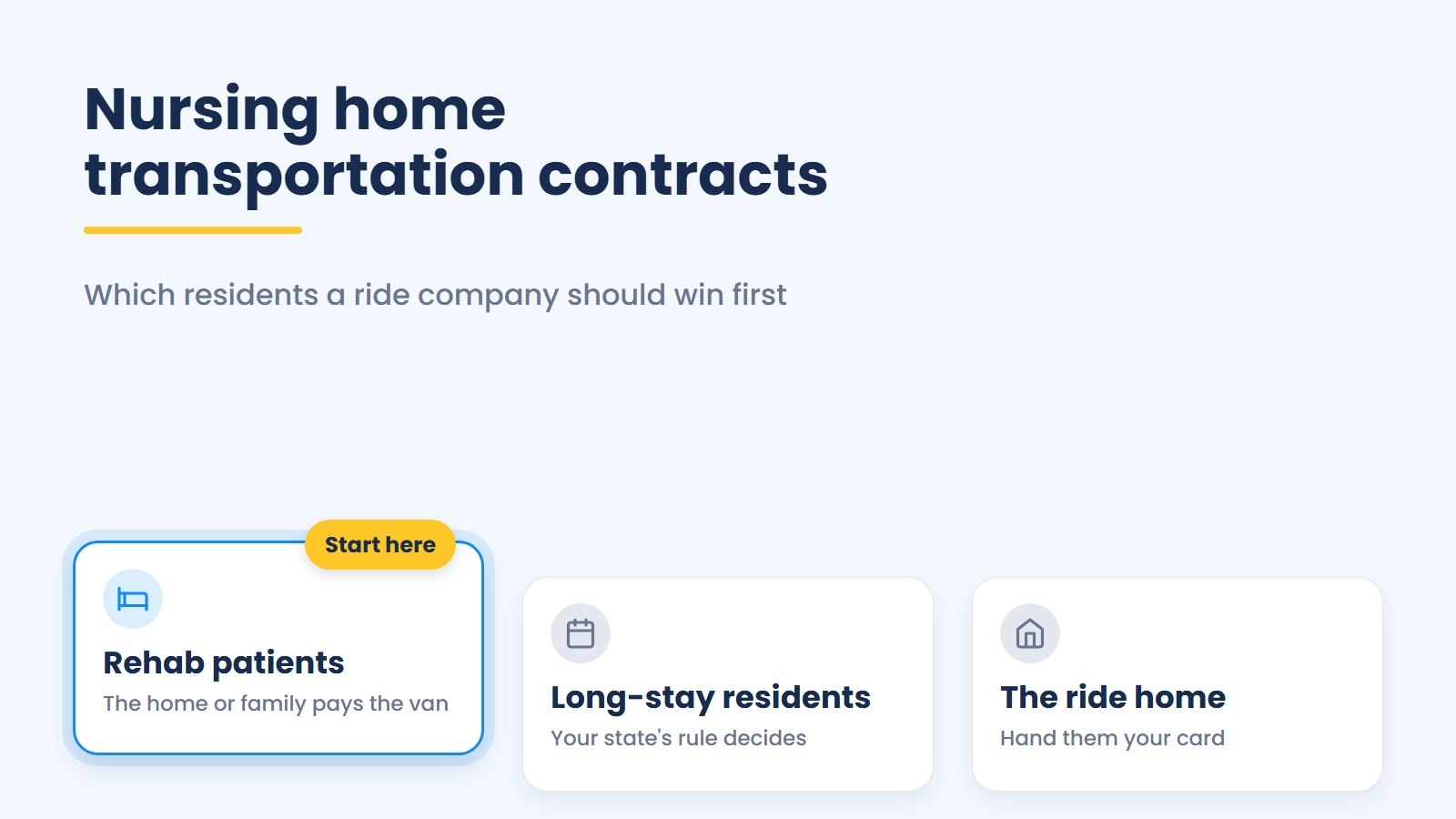
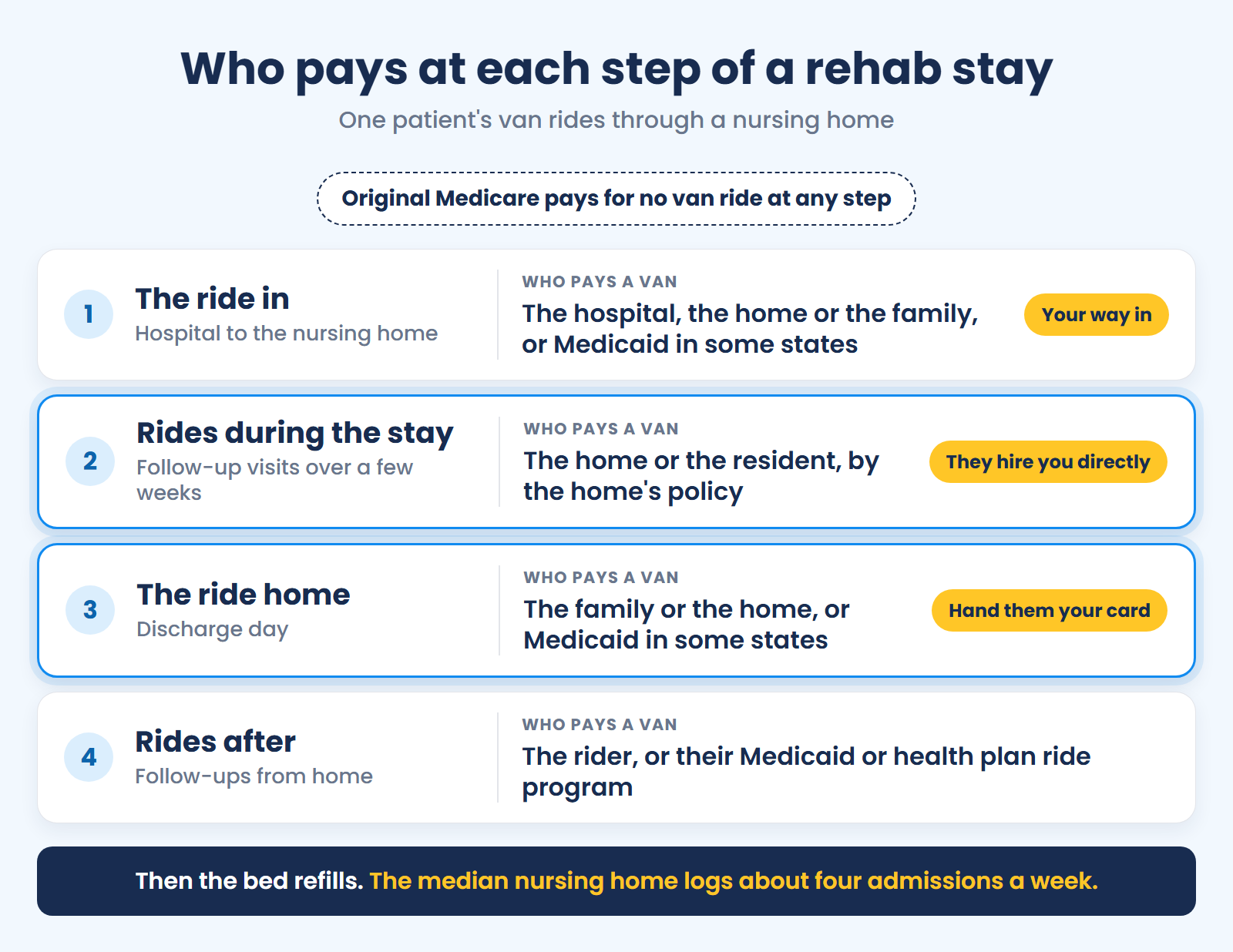
A nursing home transportation contract is usually a short service agreement with the building for the rides it books or pays for, which is a separate deal from joining a Medicaid broker’s network. Start with the short-stay rehab patients, the ones a skilled nursing facility (SNF) takes for a few weeks after a hospital stay. As of October 2026, Original Medicare (not a Medicare Advantage plan) pays for none of their van rides, so in every state the building or the family can hire you directly. Our guide to NEMT contracts covers the agreement itself and the rate sheet that goes with it.
For the rides a building or a family pays for, you don’t need a broker’s credential, though your state’s license rules still apply. Long-stay residents on Medicaid are a separate question, and your state’s rule decides who pays for their rides.
Here’s the work in order: who to win, who pays and whether the home drives its own residents, which buildings to call, getting in and staying on the building’s call list, the ride home, the owner’s other buildings, and what to do when one sells.
Why start with rehab instead of long-term care?
A rehab patient’s van rides have no Original Medicare payer, so the building or the family can give them to you directly, and new patients arrive every week. That’s rehab inside a skilled nursing facility, not a rehab hospital.
Medicare’s claims manual says Original Medicare covers no “non-ambulance forms of transportation, such as ambulette, wheelchair van, or litter van” (a litter van is a stretcher van). It lists a van ride among the noncovered services a resident “may be financially liable” for, which the home has to disclose, and nothing in Medicare’s rules makes the home pay.
Tony Jackson, an Orlando operator with 35 years in the business, puts rehab first for another reason. Bring a new admission in from the hospital, say a broken hip, and “you are familiar with that patient,” he said on our episode about winning facility contracts. When the follow-ups come up, the staff call you: “They don’t want to call another company.”
The beds keep turning over, too. By the count of MedPAC, the commission that advises Congress on Medicare, an Original Medicare SNF stay averaged 30.7 covered days in 2024, about a month. Rachel Scholler, who ran a NEMT company in Wisconsin for 17 years, told me on her episode about keeping a 30% margin that “there’s always new people moving.” The social workers at those buildings were “constantly giving us referrals.”
Rehab isn’t the whole building. Medicaid paid for only about one admission in six nationally in those cost reports, but counted by days in the bed, the median nursing home was 64% Medicaid. So most of the people in its beds on a given day are long-stay residents, and whether their rides are the building’s to give is your state’s call. If private-pay work is all you want, I’ve told owners on calls that assisted living “can be pretty good as a starting point.”
Who pays for nursing home transportation?
The kind of stay decides who pays for a nursing home resident’s ride, and for a long-stay resident on Medicaid, so does your state. As of October 2026, a resident’s van ride usually gets paid like this:
| Kind of stay | Who usually pays for a van ride | What to ask the building |
|---|---|---|
| Original Medicare rehab stay | The building or the resident, by the building’s policy | Does it pay for rehab patients’ rides, or bill them? |
| Medicare Advantage stay | The plan, if its ride benefit covers the trip and it arranges the ride; otherwise the building or the resident | Which plans its rehab patients use |
| Long-stay resident on Medicaid | Your state’s rule: the home in some states, the state’s Medicaid ride program in others | Who handles those rides in this building |
| Private-pay resident | The resident or the family, paying you or the building | How it bills residents for rides |
| Veteran placed by the VA | The VA, for a ride it approves in advance; otherwise, like any other resident | Does it book VA rides itself, and who sends the invoice? |
| Hospice resident | Generally the hospice, for rides tied to the terminal illness | Which hospice, and who books its rides |
For Medicare Advantage, CMS’s managed care manual says a plan “is not obligated to provide transportation” but may offer it as an extra benefit. The VA pays for the rides it approves in advance under its beneficiary travel directive. For hospice, Medicare’s benefit manual puts ambulance trips “related to the terminal illness” on the hospice, and Ohio’s Medicaid rule says a hospice “is obligated to provide or arrange” rides for that care.
Here’s who’s responsible for a long-stay Medicaid resident’s van ride in 14 states whose rules spell it out, as of October 2026:
| Who’s responsible for the ride | States |
|---|---|
| The nursing home provides or pays for it | Indiana, Louisiana, Michigan, Nevada, North Carolina, Pennsylvania, South Carolina, South Dakota |
| The state’s Medicaid ride program, like anyone else’s | Georgia, Illinois, Minnesota, New Jersey |
| Split | Ohio (wheelchair vans and ambulances bill Medicaid; the home furnishes other rides), Colorado (for care the home’s own program requires, the state’s Medicaid ride program won’t pay unless the home has no vehicle available) |
Michigan’s Medicaid manual (October 2026) puts routine rides for long-term care residents in “the facility’s per diem rate,” meaning its daily rate. It adds: “This includes transportation for medical appointments, dialysis, therapies, or other treatments not available in the facility.” And South Carolina’s state plan (2022) says “Nursing homes are responsible for arranging and paying for all NEMT transportation costs for their residents.”
In the second row’s states, a resident’s ride goes through the state’s Medicaid ride program, the same as anyone’s; our state-by-state guide to NEMT brokers shows who runs it. In New Jersey, Modivcare’s broker contract, extended through February 2027, says it “shall schedule nursing home and hospital trips using the facilities’ preferred providers,” so a home can pick your company if you’re in that network.
If your state isn’t listed, ask the administrator, and read your state’s Medicaid transportation manual.
In the first row’s eight states, long-stay residents’ recurring rides are the building’s to give too, dialysis included in Michigan, and those residents fill most of its days. Call those buildings about them as well.
Before you call, look up your state’s rule for residents’ Medicaid rides. Then ask each building who pays a rehab patient’s van ride and who pays a long-stay resident’s, and write both answers next to its name on your call list.
Do nursing homes provide transportation to doctor appointments?
Nursing homes have to help residents arrange rides to outside appointments, but federal rules don’t make them pay for those rides. The federal rules for nursing homes (2025 edition) tell a home to “assist the resident in making transportation arrangements” for lab work and X-rays, and to arrange rides for dental, vision, hearing and foot care. For the lab and X-ray rules, CMS’s guidance for inspectors adds that “this standard is not requiring a facility to defray or cover the costs of transportation.”
The first-row states above put those rides on the home. Some homes also drive residents in their own van: North Carolina’s Medicaid transportation policy (March 2026) says a home “may contract with providers … or may provide transportation services using its own vehicles, whichever is more cost effective.” Ask to be the backup for the trips that van can’t take.
Which nursing homes should you call first?
Call the nursing homes near you with the most rehab patients first, and CMS publishes nearly every building’s Original Medicare stays for free.
- Pull the counts. CMS’s Medicare post-acute file for skilled nursing facilities lists Original Medicare stays by building for fiscal 2024. Filter its viewer by state or city and sort by total stays, the column CMS labels TOT_EPSD_STAY_CNT. The median building had 80 stays that year, and the top quarter had 148 or more. Medicare Advantage plans add about as many admissions again (1.5 million in 2023), so use the file to rank buildings, not to count patients.
- Skip the thin ones. On Care Compare, Medicare’s site for comparing nursing homes, a building whose short-stay quality measures read “Limited Data” has too few short-stay residents to rate. That was 2,677 of 14,690 nursing homes, 18%, in CMS’s September 2026 data. Rehab-first doesn’t fit those, though in a first-row state their long-stay residents may still be worth a call.
- Call the top five. Rank by stays, not beds: a ride-marketplace founder, interviewed on an industry podcast, pointed out that a 200-bed building might have only 20 or 30 Medicare patients. Of the nursing homes inside your service area, call the five with the most stays first.
How do you get in the door at a rehab?
Start at the admissions desk, then ask for one meeting with the administrator and the admissions staff, because admissions brings patients in and the administrator signs. Tony’s opener is “Hey, can I speak to your admission director?” Once they ask for your rates, ask for a meeting “with you, your administrator, and all your admission staff,” he said. “Because remember, the administrator is the one who signs off.” The desks are where rides get booked, though, and our guide covers who books rides inside a nursing home.
Every ride in is a door, whoever pays for it. Tony goes back into admissions “even if the hospital pays for a trip that’s going to that certain facility,” to say he just brought one in. An owner in North Texas with about 30 vehicles, on an operator community call I sat in on in September, put the admissions side simply: “They’ve got numbers to meet.” Christopher Buell, who grew his first NEMT company to about 11 vans, has a script for the first call to a rehab.
What makes a nursing home keep calling you?
A nursing home keeps calling the company that shows up professional, more than the cheapest or the fastest one. With a nursing home, “I can’t stress it enough,” Christopher said: “your drivers have to come across as someone that is professional.” His list of what loses a building is short: a dirty van, a driver who cut somebody off on the way over, a driver who smells of smoke. “The administrator doesn’t care what the price is.”
Speed sells hardest at hospitals, as I said on our September episode with Josh Hagen of Careway Mobility: “the thing you can sell yourself on is speed with a hospital.” Skilled nursing is different.
Price still counts when the building pays. An Arizona company’s customer-relations director, interviewed on an industry podcast in 2025, said its skilled nursing accounts keep its prices low, since the rides come out of the building’s bottom line. When the building pays, price can get you the first call; being professional keeps you on its list.
Then plan for a rider who isn’t ready. Marqus Johnson runs a wheelchair and stretcher company in Tampa. On his episode on drivers who win facility work, he said that in nursing facilities “the nurses are so overwhelmed, they’re not even aware” a resident has an appointment. So ask each building how it wants rides confirmed: some want one call to the desk for the day’s riders, and some want none. Put a wait-time fee in your agreement for the days a resident still isn’t ready.
How do you keep rehab riders after they go home?
Be the company that drove the rider in, and hand over your card on the ride home, because after discharge the riders who pay their own way pick their own company. Eugene Gindin’s Capital Area Transport Service ran five wheelchair vehicles in the DC area at the time of his April 2026 episode on sustainable growth. He said “the main point is actually the point when they’re leaving,” so his team hands over a business card on the discharge ride. “They already know our drivers,” he said, and waiting costs you: “if you do this a week or two there’s a chance somebody else is already kind of taking over.”
A van home has no Original Medicare payer, so the family or the building pays, unless the state’s Medicaid covers it, as Minnesota’s 2025 manual does. At the median facility, about half of Original Medicare’s rehab patients go home and don’t land back in the hospital within a month, by MedPAC’s count.
When a discharge planner books the ride home, or a coordinator books a resident’s ride to an appointment, Duet’s facility portal lets them book it with you directly, with no phone tag. The trip lands on your dispatch board, and the portal is included with Duet’s NEMT software at no extra cost. You still set up each building’s access, take or decline each request, drive the ride and hand over the card. Any building that would rather call still can.
Not all of those riders are yours to win after discharge. A Medicaid rider’s follow-ups go through the state’s ride program, and a Medicare Advantage rider’s go through the plan if it offers rides, since the plan arranges its own. That leaves Original Medicare riders and private payers choosing for themselves. Take payment the way you’d collect from any private-pay rider: a card at booking, charged at least 24 hours before pickup, or a payment link paid 24 hours ahead.
How do you win the owner’s other buildings?
Win the owner’s other buildings through the one you already serve: about seven in ten nursing homes belong to a chain, and half those chains operate in one state. In CMS’s chain data for September 2026, 305 of the 611 chains ran buildings in a single state, and the median chain ran nine.
Care Compare shows a building’s chain on its page, with a link to the chain’s size and ratings, but no list of its buildings. For the list, filter CMS’s Provider Information file by chain name and state. A management company that runs several buildings often shows up under “Ownership Details” with “operational/managerial control,” but banks and accounting firms can hold that label too, so check who it is before you call.
Don’t let one owner’s buildings become most of your schedule, though: if that owner sells or switches companies, most of your trips can go with it. Buyers notice too. As our guide on how buyers price a NEMT business explains, a single facility carrying a big share of the trips shows up in the terms of a sale, such as part of the price paid later.
Find your best building’s chain on Care Compare and list every sister building inside your service area, ranked by its Original Medicare stays.
What should you do when a nursing home changes owners?
Treat a sale as a reason to tighten credit (how much you’ll let the building owe you) and to introduce yourself again: a new owner may bring its own vendors and pay from a corporate office elsewhere. CMS’s ownership-change file shows 615 nursing homes changed owners in the 12 months to September 2025, about 4% of all of them. In its September 2026 data, Care Compare’s line “Ownership has changed within the last 12 months” caught fewer than half of the sales CMS’s own file showed for those months, so read the “since” dates under Ownership Details too.
Lower-rated homes sell more often. From 2016 to 2021, an average of 5% of 1-star homes sold each year, against 2% of 5-star homes, by a 2022 analysis from HHS’s planning office. So check your 1- and 2-star buildings first. None of that means a new owner will pay late; treat the credit step as a precaution.
The North Texas owner from that community call has watched investment groups buy up nursing homes in his market. “I have to be very careful,” he said, when a new company takes over. The bill usually goes to “a corporate somewhere, an AP department,” meaning accounts payable, in another state. When a building falls behind, he finishes what’s booked, so residents’ treatments aren’t disrupted: “We will complete these trips, but we’re not taking any more new trips.” He also says to “get to know your AP people,” because they push the payments through.
Once a quarter, check Ownership Details for every building you invoice. When one sells, give the new owner a firm credit limit; the North Texas owner sets his at $3,000 or $5,000, depending on the company. If a bill runs past your terms, finish the booked trips and take no new ones until it’s paid.
Jeanine’s answer to a rehab short of rides was to start a transport company. This week, pick the rehab near you with the most Original Medicare stays and ask its admissions desk who drives its patients in from the hospital, and who it calls when that company can’t.
Nursing home transportation FAQ
Who pays for the ride from the hospital into rehab?
Often the hospital or the nursing home, and sometimes the family. As of October 2026, Original Medicare pays only for a medically necessary ambulance on that trip, billed by the ambulance company. Some states’ Medicaid programs cover a member’s ride in: Minnesota’s 2025 manual and North Dakota’s 2026 manual both do. In Indiana, an April 2024 bulletin has the hospital arrange a new admission’s ride with the state’s fee-for-service broker.
Who pays for a nursing home resident’s dialysis ride?
For a long-stay resident on Medicaid, your state’s rule decides, the same as for any other ride. During a stay Original Medicare covers, an ambulance to dialysis is billed by the ambulance company as of October 2026, and a van has no Original Medicare payer. Either way, CMS’s 2025 inspector guidance says the home must help arrange safe transportation to dialysis. In my experience, the dialysis clinic itself won’t be the one paying you.
Is there a standard nursing home transportation contract?
Not one every building uses. What a nursing home signs is usually a short service agreement; keep yours to one page, with your price list attached. It should set your rates by level of service, every fee you charge (cancellations, wait time and no-shows), your payment terms and the insurance limits the building requires. If the building hands you its own paper instead, read it for surprises, like a ban on carrying its residents with other riders.
About the author
James O'Donnell cofounded Duet and leads its sales, partnerships, and growth services. He talks with NEMT operators every week, hosts the NEMT Growth podcast, and answers Duet's sales line himself. More about Duet's founders →
Want more trips and less busywork?
See how Duet runs and grows NEMT businesses in a 30-minute demo.