Article
How to Start a NEMT Business in South Carolina (2026)
South Carolina licenses NEMT vans. The state approves most applicants in weeks; the test is the 90 days after.
By James O'Donnell, Cofounder and COO, Duet ·
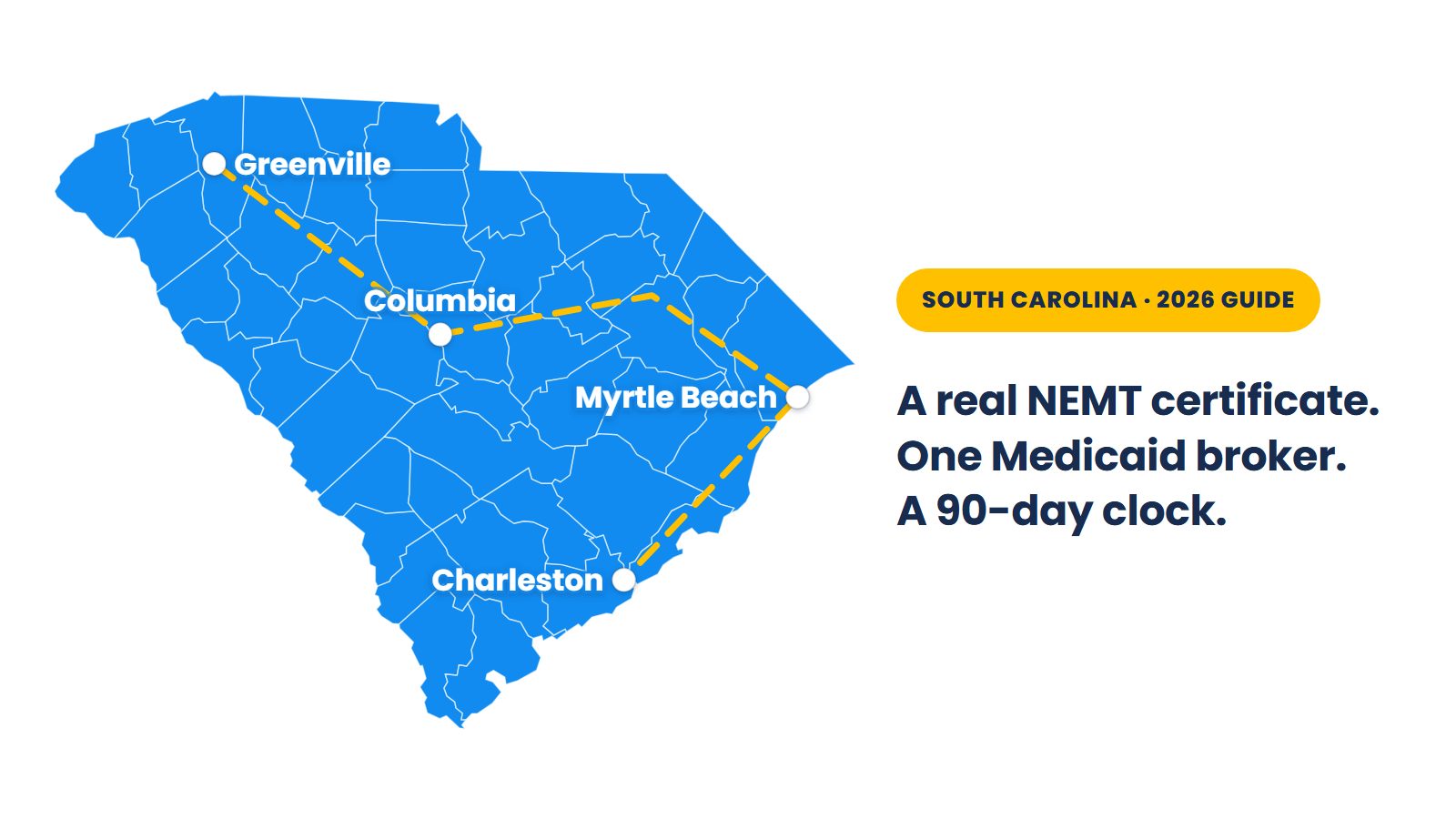
To start a NEMT business in South Carolina, form an LLC ($110) and file for a Class C Non-Emergency certificate. The Public Service Commission (PSC) usually approves within about three weeks. You then get 90 days to pass the Office of Regulatory Staff’s (ORS’s) inspection and show a $1 million policy. Start with nursing homes and private pay, not Modivcare, the one Medicaid broker. Budget about $27,300 for one financed used wheelchair van and six months of fixed bills.
South Carolina at a glance:
- The certificate: the PSC approves it and ORS issues it, for any vehicle carrying riders to or from medical facilities for pay, whoever pays [1][2].
- Nothing public first: advertising before you hold the certificate is its own offense, with fines from $100 [2].
- Modivcare: one broker in all 46 counties, three regional phone lines and a contract being rebid, with an award posting set for March 1, 2027 [4][5].
- First paid trips: nursing homes buy their residents’ rides themselves [6], and families pay by card at least 24 hours ahead.
- Insurance: $1,000,000 combined per occurrence plus $1,000 of medical payments per person, filed by your insurer on Form E, the state’s proof-of-insurance form [1][10].
- Money and time: about $115 to file, about $27,300 for the van and six months of fixed bills, and about 70 days to a certificate for those who finished [3].
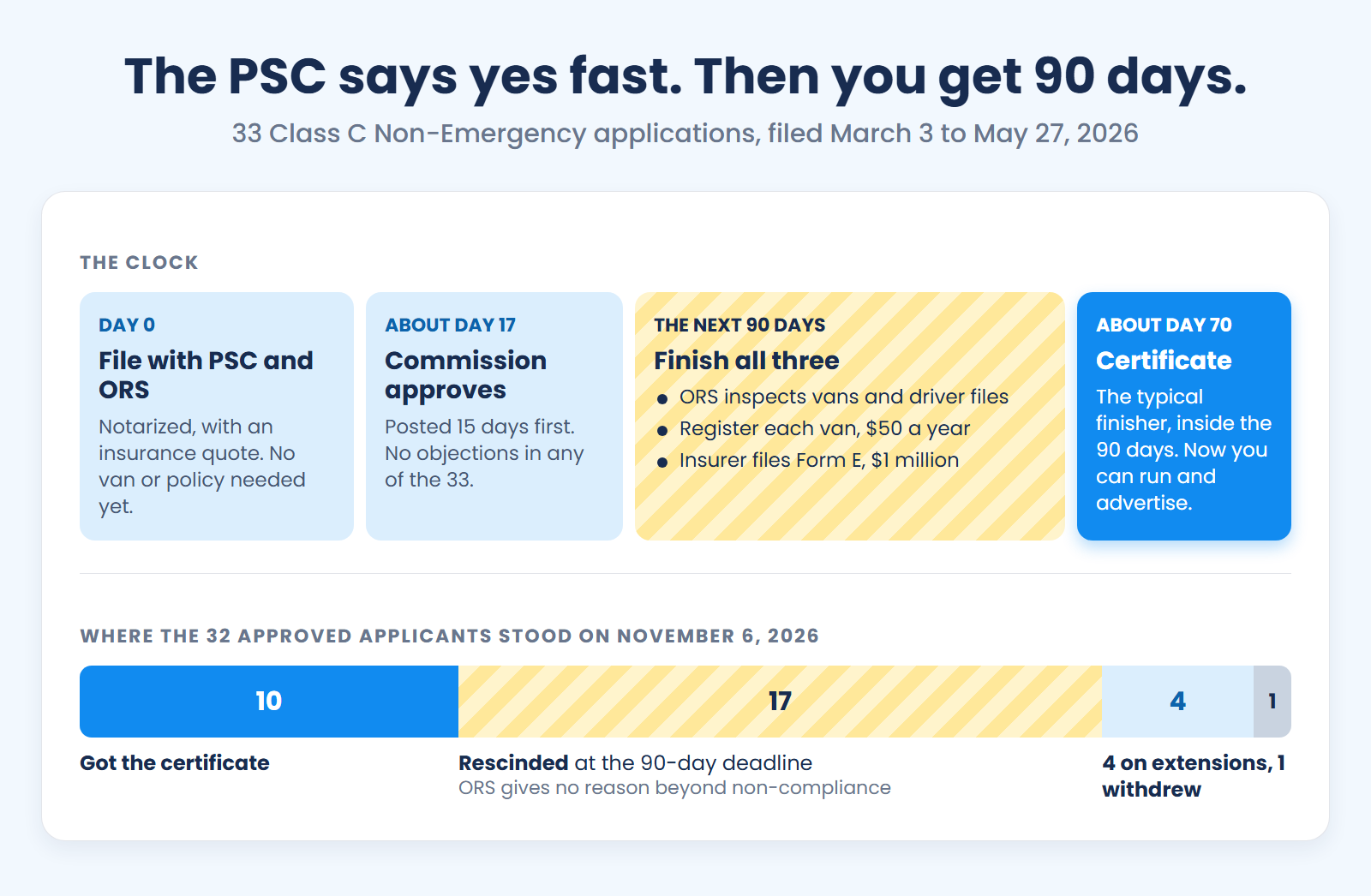
Between March 3 and May 27, 2026, 33 applications came in for a Class C Non-Emergency certificate. Nobody objected to any of them. The PSC approved 32, half within 17 days. By November 6, ORS had rescinded 17 of those approvals for missing the 90-day deadline, and only 10 had gotten a certificate [3]. South Carolina’s real gate is the 90 days after approval, so file only when you can finish, then build on nursing homes and private pay, not Modivcare.
I run Duet, which builds dispatch software and runs growth services for non-emergency medical transportation (NEMT) companies, and I talk to NEMT owners on demos every week, South Carolina operators included. This is the South Carolina edition of our national guide on how to start a NEMT business. Requirements change, so confirm against the linked sources before you spend money.
A coastal South Carolina owner walked me through his own start on a demo in December 2025. “I just started with doing the state approvals, getting everything sorted out,” he said. Then he started with his own car, until “I was getting so many calls for wheelchair transportation.” About three months after he began the approvals, he was giving wheelchair van rides, mostly on private pay.
The checklist comes first, in the order that risks the least money. After it come who pays, Modivcare and the rebid, the rules, drivers and stretcher vans, getting on Modivcare’s list, and last, money and time.
The one-page checklist: how to start a medical transportation business in South Carolina
Price the policy and the van before you file, because PSC approval starts a 90-day clock. Each phase ends with the money it puts at risk, for one financed used wheelchair van.
Phase 0: price the van and the policy, and find your riders
- Your two prices: get one insurance quote at $1,000,000 combined plus $1,000 of medical payments, and one price on the van you’d buy. Ask your county auditor whether a business van pays 10.5% or 6%. Approval can land about 17 days after you file, and the 90 days runs from there.
- Your riders: call five nursing homes and two adult day centers this week and ask who books and pays for their rides, what a wheelchair trip pays and how fast. You’re asking questions and selling nothing, since you can’t advertise yet.
- Modivcare: ask its South Carolina network team, before you spend anything, whether it needs vans in your county.
- Scope and seats: the application asks for your counties or “Statewide,” with no added charge in the packet, so I’d pick Statewide. It also asks for 1-7 or 8-15 passengers, counting the driver [7].
- Money at risk: nothing yet.
Phase 1: filing day
- The company: file articles of organization with the Secretary of State for $110 [8]. Leave “Medicaid” out of the name, because the draft of the next broker contract bars the word on the vehicle “or in the name of the business” [9].
- Federal IDs: get a free employer identification number (EIN) and a free Type 2 national provider identifier (NPI) under the NEMT taxonomy code, 343900000X. Check yourself and each driver against the federal exclusion lists, the Inspector General’s and SAM.gov, and recheck monthly, as the next broker contract’s draft expects [9].
- The packet: send the PSC’s cover sheet and notarized application, your LLC papers and an insurance quote to both the PSC and ORS. “You are not required to own a vehicle to file an application,” the packet says, and of the insurance form, “THIS IS ONLY A QUOTE” [7].
- The fee: the packet lists none, and a 2012 PSC guide says, “The Commission does not require filing fees” [55]. Confirm with the PSC’s Clerk at 803-896-5100.
- Money at risk: about $115, the LLC plus up to $5 for the notary.
Phase 2: wait for approval, about 17 days
- Stay dark: keep the website and Google listing offline until the certificate’s in hand. S.C. Code 58-23-40 wants the certificate before you may “advertise as an operator,” and doing it anyway is a misdemeanor with a fine of “not less than one hundred dollars for a first offense” [2]. It’s the one stretch of a startup where doing nothing online is the right marketing plan.
- Your address: the application posts on the PSC’s docket system for 15 days with your address showing, and only the insurance quote stays private [7]. Use an address you don’t mind seeing online.
- Money at risk: nothing new.
Phase 3: directive to day 90
- The date: the Commission’s approval comes as a directive. Write down its date and count 90 days from it. If you’ll miss it, ask for an extension in writing before day 90.
- The van and the policy: buy the van you priced, then the policy. Your insurer files a Form E in the name on your order [10].
- Equipment: every vehicle needs seat belts, a foot stool or extra step, a 4-pound ABC fire extinguisher with proof of annual inspection, a two-way radio or phone, and your name on “both sides and the rear” in three-inch letters [1].
- Lift and securement: a wheelchair van adds “a lift or ramp” and fasteners strong enough to keep the chair from rotating or leaving the floor. A lift defect fails the inspection.
- Drivers and inspection: build each driver’s file, then call your ORS inspector. The typical finisher in spring 2026 took about eight weeks from directive to certificate [3].
- Money at risk: about $15,700 in all, mostly $6,600 down on a $33,000 van and $4,350 of insurance at signing.
Phase 4: certificate day
- Your front door: put up a website families can book from and a Google Business Profile.
- Reviews: ask friends, family and your first riders for Google reviews.
- The homes you called: go back with your certificate.
- Money at risk: about $1,934 a month of fixed bills, until trips cover them.
Phase 5: first paid trips, then Modivcare
- Trips, then Modivcare: take the nursing-home and private-pay rides you lined up. If your county needs vans, send Modivcare’s form.
- Keep the certificate: ORS’s $50 per vehicle is due before January 1 every year [2]. In August 2026, the Commission revoked the certificates of carriers still out of compliance on that fee or on insurance [11].
- Money at risk: six months of fixed bills, about $11,600, for a total of about $27,300.
All of that goes out before a trip pays, so the next question is who pays.
Who pays for NEMT rides in South Carolina?
Nursing homes and families can pay you first, but Medicaid is the volume.
| Lane | Who pays and who picks you | Size | The catch |
|---|---|---|---|
| Nursing home residents | The home pays out of its Medicaid rate, and the home picks | 187 homes and 19,589 certified beds across all payers, October 2026 [12] | Some say they have their own transportation, and the money may move in 2027 |
| Private pay | The family pays by card, and the family picks | 1,082,724 residents 65 or older in 2024 [13] | Not every family can pay, and some markets support only a few vans |
| Adult day | Medicaid pays through Modivcare, which can contract with a center to provide the rides | 34% of rides on the state’s fiscal 2025 treatment chart, which counts differently from the next row [14] | The money still runs through Modivcare |
| Medicaid | Modivcare pays, and Modivcare picks | 2,204,855 paid trip legs (one-way rides) in fiscal 2025 [15]; about 950,000 full-benefit members in September 2026 [16] | Openings depend on need, and the contract’s being rebid |
Do nursing homes really pay for their residents’ rides?
Yes, out of their own Medicaid rate. South Carolina’s state plan says, “Nursing homes are responsible for arranging and paying for all NEMT transportation costs for their residents,” and since January 1, 2018 their rates have carried a ride component so they can buy from “any qualified transportation provider” [6].
The South Carolina Department of Health and Human Services (SCDHHS), the state’s Medicaid agency, laid out the options in a January 2018 answer to a public comment. A home can have healthcare providers call the home for a trip, let those who sign a memorandum of agreement call their preferred ride company directly, or hire a company to manage its scheduling. Prices “will be determined by each individual nursing facility based upon negotiations with their individual NEMT provider(s)” [17]. The state assumed $25 a trip plus $1.75 a mile for wheelchair rides when it set those 2018 rates, but that isn’t current and nobody has to pay it. Our guide to who pays for nursing home rides covers other states’ versions.
Here’s the other side. The plan makes homes pay; it doesn’t make them pick you. And it may change: SCDHHS’s fall 2026 concept paper targets Summer 2027 for moving nursing facility services into managed care, without a word about rides [53]. Ask each home again as that gets closer.
How do you win a nursing home’s rides?
Win a nursing home’s rides by asking who books them, then asking to be the backup. Start with this week’s calls to five homes. Ask which of those three routes the home uses, because that tells you who to see. Federal nursing home data show 132 of the 187 homes carrying a chain name, and the top four chains hold 81 [12], so ask whether the building or the management group picks vendors.
Expect the brush-off, and keep going. The coastal owner told me on a call in July 2026 that facilities “always tell you, like, we have our own transportation,” and “I’ve been to almost all of them.” Still, he told me on our December 2025 demo that a facility with “their primary company that they use” calls him when that company can’t cover. Tony Jackson, an Orlando operator with 35 years in the business, said on our episode about facility contracts, “when you go in, you say backup and then they start using you.”
Backups get real openings. One nursing home the coastal owner works with saw its ride company close “without even informing anyone,” and “the phone number is not going through.” Be the number that answers. Once you’re running a home’s rides, some facilities want one front-desk call to confirm the day’s trips, and some want none. Our guide to the first trip after a facility says yes picks up from there.
How does private pay work?
Private pay is yours to price. Most owners I talk to take a card at booking and charge it at least 24 hours before pickup, or send a payment link due by then, and some add a small nonrefundable deposit to hold the spot. No payment, no car. Nobody approves your price, either: state law says the Commission “may not fix or approve the rates, fares, or charges” for Class C, and carriers “need only file maximum rates” [2][1]. A filing is a ceiling you set, so set it above your top price. Few South Carolina prices are posted, so call two local companies and ask what a wheelchair trip costs.
Expect a limit on what families can pay. A Midlands owner running broker, VA and state-agency contracts told me on a demo in May 2026 that private-pay prices stayed low because “a lot of them just did not have the funds like that.” Our guide to pricing private pay and getting paid up front has the method. Some hospitals and other facilities buy rides under their own contracts as well, and our guides to hospital discharge contracts and facility service agreements cover those.
Dialysis belongs with Medicaid here. It was 19% of the state’s fiscal 2025 treatment chart [14]. Dialysis rides are great, but most dialysis riders are on Medicaid, so their trips come through Modivcare, not the clinic.
Here’s how far apart the two lanes can sit. The owner of a large, broker-heavy fleet in South Carolina told me on a call in March 2026 that Modivcare was “offering $1.55 a mile right now,” against about $3.50 on private pay. That’s one owner’s account of a per-mile figure, with no word on a base fee or the level of service.
Two of the four lanes skip the broker and two run through it, so here’s the broker.
Who is the NEMT broker in South Carolina?
Modivcare is South Carolina’s one Medicaid broker as of November 2026, in all 46 counties, and the state is rebidding the contract. A broker is the company a state pays to arrange Medicaid rides and hand them to transportation companies. The March 2026 handbook for Healthy Connections, the state’s Medicaid program, says, “To ask for a ride, call the Healthy Connections transportation broker, ModivCare” [4]. The state plan bars the broker from driving riders itself, so van trips go to companies like yours [6]. Riders call one line per region:
| Region | Ride line | Counties |
|---|---|---|
| 1 | (866) 910-7688 | Abbeville, Anderson, Cherokee, Edgefield, Greenville, Greenwood, Laurens, McCormick, Oconee, Pickens, Saluda, Spartanburg |
| 2 | (866) 445-6860 | Aiken, Allendale, Bamberg, Barnwell, Calhoun, Chester, Clarendon, Fairfield, Kershaw, Lancaster, Lee, Lexington, Newberry, Orangeburg, Richland, Sumter, Union, York |
| 3 | (866) 445-9954 | Beaufort, Berkeley, Charleston, Chesterfield, Colleton, Darlington, Dillon, Dorchester, Florence, Georgetown, Hampton, Horry, Jasper, Marion, Marlboro, Williamsburg |
The next contract’s draft never uses regions, and the state told bidders in 2025 that it has no rights to the incumbent’s phone lines, so don’t assume these regions or numbers last [9][25]. SCDHHS’s managed care contract lists “Medical (Non-Ambulance) Transportation” among its excluded services, so plan members call Modivcare too [19]. Our map of who arranges Medicaid rides in every state shows how others split the job, and this year’s broker changes show how fast a contract can move.
Where does the rebid stand?
South Carolina is on its third solicitation since January 2025, and as of November 6, 2026, the state’s page shows no award. The last competitive award went to LogistiCare, now Modivcare, in 2011, the state’s Chief Procurement Officer (CPO) wrote, and the company has provided the service since [20]. The state’s July 2025 intent to award to MTM was overturned on Modivcare’s protest [21], and the CPO denied Modivcare’s protest of the third solicitation, 5400029919, on August 5, 2026 [20].
Amendment 1, posted September 11, set proposals for December 3, 2026, an award posting for March 1, 2027, and an estimated contract running March 11, 2027 through March 10, 2032 [5]. As of November 6, 2026, the Procurement Review Panel’s page lists two pending Modivcare cases without saying what they concern [22]. Any of those dates could move, so check the solicitation’s page on the state’s procurement site before you plan around one [23].
What would a new contract change for you?
South Carolina’s draft contract for the next broker, posted June 26, 2026, is a proposal, and it may differ from what Modivcare requires today. It calls for one award, at least a weekly payment cycle with undisputed invoices paid within 30 days, no vehicle-age limit, and a broker inspection of every vehicle before you sign and yearly after [24][9]. A new broker signs its own agreements, and no clause guarantees an existing provider a contract or a rate [9]. On its 2025 try, the state expected about eight months from award to full operation [25]. If that holds, a March 2027 award wouldn’t move your trips until late 2027. That’s my inference; the state hasn’t set a date. Whoever holds the contract, the broker pays you, not the state.
Can I bill South Carolina Medicaid directly?
No, not for van rides: the state plan has the broker process and pay transportation providers [6]. SCDHHS’s provider list of August 26, 2026 has a broker type, ambulance types and a contractual transportation row for Community Alternative Program agencies, and none named for a NEMT van company [26]. The next contract’s draft credentialing list wants an NPI, not a Medicaid provider ID [9].
Today’s Modivcare contract isn’t in SCDHHS’s online contract library, though, so ask before you pay anyone to “enroll” you. Call SCDHHS’s Provider Service Center at (888) 289-0709, option 4 [27], and ask Modivcare’s network team the same question.
Ambulance companies are the exception. They have their own provider type, and ambulance trips for plan members stay with the health plans [28]. Our look at Medicaid ride enrollment in other states shows how they order the same steps. The paper that matters here comes from the PSC and ORS.
What licenses and requirements does a NEMT business need in South Carolina?
Outside a few narrow exemptions, you can’t run or advertise paid medical rides in South Carolina without a state certificate, and the class built for them is Class C Non-Emergency, whoever pays. Reg 103-102(7) says the certificate is “required to be held by service providers engaged in passenger for hire transportation using any motor vehicle for transportation over irregular routes, to or from medical facilities only in non-emergency situations” [1]. S.C. Code 58-23-40 says a carrier “shall obtain a certificate from the Office of Regulatory Staff” first [2]. ORS’s pages and the PSC’s August 2026 revocation order still call it a Certificate of Public Convenience and Necessity (CPCN), and it’s the same paper [11]. ORS’s Transportation Department is at 803-737-0800 and Transportation@ors.sc.gov.
What are the steps to get a Class C Non-Emergency certificate?
The PSC decides and ORS issues, with a clock on each stretch:
- File with both agencies. Send the notarized packet to the PSC and ORS by mail, PDF email or fax. Incomplete applications come back [7].
- Wait out the posting. You get a docket number by email or letter [7]. The PSC posts the application for 15 days, and anyone affected may object in writing within 14 days [2].
- Get the vote. With no objection, the Commission votes at a Thursday meeting, and the test is “fit, willing, and able.” You certify that you’ve got no outstanding judgments, that you’re financially fit and that you know the rules, and you don’t file financial statements. You also show you’ve “purchased, leased, or otherwise arranged” for equipment, plus a quote [1]. The packet says you don’t have to own a vehicle yet, so ask ORS what to list if you haven’t bought one [7]. A yes comes as a directive, a median of 17 days after filing in spring 2026, and between 15 and 35 [3].
- If someone objects, go to a hearing. It must be “scheduled within 60 days of the filing of the objection,” and an LLC or corporation needs a South Carolina attorney once a case is opposed [1][7]. None of the 33 dockets drew an objection [3].
- Finish with ORS inside 90 days. That’s where applicants drop out.
- Get the certificate from ORS. “Operation without the Certificate is prohibited,” the packet says [7]. If the Commission denies you, you can’t reapply for six months [2].
When does the 90-day clock start?
Count 90 days from the directive date on your order, not from the line that says it becomes the order 30 days later. Each directive says it “SHALL SERVE AS THE ORDER OF THE COMMISSION 30 DAYS AFTER ISSUANCE.” The packet says 90 days “from the date of the Order,” and Reg 103-150 says after the order “becomes final,” so it’s easy to start counting at day 30 [29][7][1]. Don’t.
One directive issued June 4, 2026 prints July 4 as that date. ORS rescinded it on September 1, 89 days after June 4, when a reader counting from July 4 would’ve planned on October 2 [30]. Rescissions from the spring 2026 dockets all land 89 to 91 days after the directive [3], and ORS’s sample compliance letter, written for a Charter applicant, pairs a June 26, 2025 order with a September 24 deadline, exactly 90 days [10]. Some land on day 89, so plan to finish before then. If you think you have longer, get it from ORS in writing.
ORS wants three things, and you don’t get your PSC/ORS number until all three are done [10]. Its 2022 letter said they don’t have to be done “IN ANY PARTICULAR ORDER” [31]:
- Inspection and records audit: an ORS inspector reviews your vehicles and driver files. Call to schedule, and ask what to letter on the van before your number exists.
- Registration: register each vehicle and pay the $50 through ORS’s portal.
- Form E: your insurer files it. ORS won’t take the policy instead.
The packet also mentions cargo insurance and rates, and ORS’s sample compliance letters list neither [31][10]. But Reg 103-150 does list a rate filing before you operate, so ask your inspector what ORS wants on both [1].
As of November 6, 2026, the 32 approvals stood like this: 10 with certificates, 17 rescinded, 4 on extensions with no certificate and 1 withdrawn. The 33rd withdrew the day it filed [3]. ORS gives no reason beyond non-compliance [32]. My read: the packet lists no fee and asks for a quote, not a van or a policy, so plenty of people file before they can pay for either. The mistake isn’t waiting to file. It’s filing before you can finish.
What if you’ll miss day 90?
Ask for an extension in writing before day 90. The Commission can give more time for good cause, up to 12 months from the order, and its form offers three, six or nine months or another period you name [33][1]. Send it to both the PSC and ORS, with your deadline and your reason. Ask early: the five granted in the spring 2026 dockets took nine to 17 days, and one of those five has since gotten its certificate [3].
Miss it with no extension and your order is “deemed null and void,” with the application “dismissed without prejudice” [34]. You can refile, since the six-month bar applies to denials. One company lapsed on January 2, 2026, refiled 11 days later and held a certificate 70 days after that [3]. So a lapse won’t end you if you haven’t spent anything. But if you’ve already bought the van and the policy, you’re paying about $1,934 a month on a van that can’t carry a paid trip while you start over.
What do other guides get wrong?
Here’s what circulates about South Carolina, next to what the state actually requires:
| The claim you’ll read elsewhere | What South Carolina actually requires |
|---|---|
| NEMT falls under “regulations set by the South Carolina Department of Health and Environmental Control (DHEC)“ | The PSC and ORS license vans. The EMS law’s “Department” now means the Department of Public Health, and that law governs ambulances [2][35] |
| Regional brokers handle transportation coordination | One broker, Modivcare, with three regions and three ride lines [4] |
| NEMT payment is primarily managed through MCOs (managed care plans) | Van rides are excluded from the health plans, and the broker pays you [19][6] |
| You must be “certified by the South Carolina Department of Health and Human Services (SCDHHS),” or “receive your official South Carolina Medicaid Provider ID” | You hold a PSC certificate and contract with the broker. SCDHHS’s provider list has no van-company type, and the next contract’s draft asks for an NPI and no provider ID [26][9] |
| A “599 application” that takes about 30 days | The PSC packet lists no fee [7]. $599 was the 2021 federal fee for institutional providers, and SCDHHS’s list of those has no transportation type [27] |
| A Class C Charter certificate lets you run wheelchair vans | The medical-trip class is Non-Emergency, in any vehicle, and its rule carries the lift and securement list. Charter’s insurance floor is far lower [1][36] |
| The state is certifying you as a needed provider | The test since 2022 is “fit, willing, and able.” Nobody rules on whether your market needs another van [2] |
| An ORS minimum of $500,000, a $1.5 million South Carolina minimum, or Charter’s $25,000/$50,000/$25,000 | ”Notwithstanding the requirement of Regulation 103-172,” $1,000,000 combined each occurrence plus $1,000 of medical payments per person [1] |
Which certificate fits your vehicles?
Class C Non-Emergency fits any vehicle on medical trips, and the passenger box you check on the application is the part to watch. The rule says “any motor vehicle,” and ORS’s November 5, 2026 list shows 155 sedans and 168 SUVs on Non-Emergency certificates [37]. That public list has 217 Non-Emergency names and 1,810 vehicles, so anyone can check a competitor, and a facility can check you.
Non-Emergency directives read “RESTRICTED TO: SEVEN (7) PASSENGERS, INCLUDING DRIVER” when you check the 1-7 box [34]. The packet counts seatbelts, while the rule counts seats “as assigned by the original manufacturer” and says altering them “will not absolve the carrier” [7][1]. If you’re buying a converted Transit or an eight-seat minivan, ask ORS which box you need.
Charter’s words overlap with yours, since it covers vehicles “accepting passengers exclusively on a pre-arranged basis” [1], so ask ORS in writing before you build on Charter.
One limit catches private-pay companies. Non-Emergency is “medical facilities only,” so a grocery or wedding ride sits outside it. If families ask for those, ask ORS which certificate would cover them.
Do cities and counties add anything?
Yes: your certificate is no shield from a city’s business license. S.C. Code 58-23-620 says “the fee required of a holder of a certificate C is in addition to any license tax or license fee charged by a municipality” [2]. Cities’ standard class schedules put transportation in Class 2 [38], and I read a NEMT company as falling there. Greenville’s Class 2 rate is $45 plus $1.65 per $1,000 of income over $2,000 [39].
Taxi rules are the question to ask. Columbia has a Vehicles for Hire chapter, and Myrtle Beach has its own taxi certificate [40][41]. State law says a van serving “a specific group of people to a specific destination over a continuing period of time,” where the service is “not available to the general public,” isn’t a taxi [2]. Whether your trips fit that isn’t settled, so call your city’s license office. Our national licensing guide shows what other states do.
What are the NEMT insurance requirements in South Carolina?
Plan on $1,000,000 combined per occurrence plus $1,000 of medical payments per person: that’s South Carolina’s own floor, not a broker’s add-on. Reg 103-133(5)(E) says, “Notwithstanding the requirement of Regulation 103-172,” limits can’t be less than “Liability Combined Each Occurrence $1,000,000” and “Medical Payments/Each Person $1,000” [1]. By its words that’s per occurrence, not per vehicle. “A Form E is the only proof of insurance we can accept,” ORS tells carriers [10]. A lapse brings automatic suspension [1].
Wrong numbers circulate for a reason. The $25,000/$50,000/$25,000 table is real, for Charter and Taxi [36][10]. The $1.5 million was a proposal ORS showed in October 2022 that never took effect, and it’s also the federal floor for most interstate trips in vehicles seating 15 or fewer, driver included [31][42].
Modivcare’s number matched the state’s floor in early 2025, with more on top. A Modivcare senior director who oversaw part of South Carolina said in a January 2025 interview that it was a million, on every vehicle, plus general liability and sexual-abuse cover. Modivcare’s national provider page names those coverages and prints no dollar figure [43], so get its numbers in writing before you buy.
When do you buy the policy?
Get the quote at filing and buy after approval. The packet says, “You will not be required to purchase insurance until your application has been approved and an order has been issued by the PSC,” and it keeps your quote off the public docket [7]. The quote’s job is to tell you, before you file, whether you can carry the policy.
What will it cost a new company?
Plan on about $14,400 to $21,600 for your first year on one wheelchair van until you’ve got a South Carolina quote. That’s the band in our guide to what a new company pays for NEMT insurance, at about $1 million of liability, and the budget here uses $17,400. For a dated South Carolina data point, an owner who launched in 2020 said on her own channel in 2022 that she first paid about $1,200 to $1,500 a month to insure herself and one other driver.
Do you need workers’ comp?
Yes, once you regularly employ four people. State law exempts an employer with “less than four employees,” and the Workers’ Compensation Commission says, “Part-time workers and family members are counted as employees.” Paying on a 1099 doesn’t settle it [44].
Without a Form E there’s no certificate, and the next question is who’s driving.
What do NEMT drivers need in South Carolina?
NEMT drivers in South Carolina don’t need a commercial driver’s license (CDL) for a typical van, but ORS audits a long driver file. A CDL starts at a vehicle “designed to transport sixteen or more persons, including the driver,” or 26,001 pounds [45]. The file has to sit at your “primary place of business within South Carolina,” and it has to be ready for the ORS audit inside your 90 days. Reg 103-133(5) sets most of it [1], and ORS’s July 2021 sheet fills in the rest [46]:
- Age and license: 18 or older, with a valid license from South Carolina or the driver’s home state.
- Medical card: a current Medical Examiner Certificate, which ORS’s sheet calls the DOT card, sedan drivers included.
- First aid and CPR: American Red Cross Standard First Aid and CPR or its equivalent.
- Training: “12 hours of in-service training annually 6 of which must be CPR and First Aid, and 6 of which must be in the area of safety.”
- Driving record: a certified three-year record from the SC DMV and any prior state. ORS’s sheet wants it updated yearly.
- Background check: the rule says “A national criminal history background check.” ORS’s sheet says a state check from the State Law Enforcement Division (SLED), $25, and “County or city record checks are not acceptable.” Ask ORS which it wants.
- Registry check: nobody on a sex offender registry. A printed name search is the proof ORS asks for.
- Uniform and badge: “a professional uniform and photo identification badge.”
- Drug screens: “Pre-employment, post-accident, and random drug screens shall be mandatory.”
- Ability: able to assist wheelchair users and trained on the vehicle’s equipment.
For wages, the Bureau of Labor Statistics put the South Carolina median for shuttle drivers and chauffeurs at $14.66 an hour in May 2025, across all industries [47].
What does Modivcare’s driver list add?
Modivcare’s national page adds defensive driving and a PASS (Passenger Assistance Safety and Sensitivity) wheelchair certificate, and PASS isn’t in the state’s rule [43]. In that January 2025 interview, the Modivcare director said Modivcare treated drug screens and physicals as good for only 30 days, while a contract may take six weeks, so she’d leave them for last. If your ORS file is older than that, expect to redo them.
The next contract’s draft is stricter on records: no suspension for a moving violation in five years, at most two chargeable accidents or moving violations in three, and random 5-panel drug screens [9]. That’s proposed, but I’d hire to it now.
A stretcher trip takes two drivers.
Can a NEMT company run stretcher van trips in South Carolina?
Yes, on its own Class C Stretcher Van certificate, with two people on every trip and no medical care. The rule says, “Stretcher vans are not required or authorized to provide medical monitoring, medical aid, medical care or medical treatment of passengers during their transport.” Every van must be “staffed by both a primary and an assistant driver,” with the assistant riding in back [1]. A stretcher van can’t take a rider who needs monitoring, IV fluids or suctioning, can’t carry a second stretcher, and can’t answer a request from a public dispatch system.
The line between a stretcher van and an ambulance is medical monitoring. State EMS law defines nonemergency ambulance transport service as one for patients “that require medical monitoring,” under the Department of Public Health [35]. Put that line in your intake script.
ORS’s list shows 38 Stretcher Van names and 130 vehicles [37]. A second certificate means a second application and a second clock [48]. North Carolina, next door, has no stretcher van category at all. One open question: nothing public I’ve read settles who pays for a health plan member’s stretcher trip, so ask the plan and Modivcare before you buy the stretcher [49][50].
How do you become a Modivcare provider in South Carolina?
Ask whether your county needs vans, get the certificate, then send Modivcare’s form and wait to be invited: Modivcare adds providers by need, and its web form only gathers information. A South Carolina owner who launched in 2020 said on her own channel in 2023 that the certificate comes before anything else, including applying to Modivcare. The Modivcare director’s January 2025 interview is the plainest account of the rest. That was then, so confirm each step.
Step one: ask whether your county needs vans
Ask Modivcare’s South Carolina network team whether it needs vans in your county before you spend. The director’s advice was to contact the broker before you buy anything, even the state certificate, because a reply can read, “we’re not even needing you in this area.” SCDHHS’s July 2025 adult day scope lists SCNetwork@modivcare.com and (866) 910-7684 for transportation contract questions [51]. That’s an adult day contact, so ask it to route you to whoever handles your county.
Step two: send the form and wait to be invited
Modivcare’s form, on its transportation providers page [43], gathers your vehicles and your area, and signing up isn’t approval. The director said it doesn’t guarantee you’ll become a provider. She told people to wait at least a month for a reply, then follow up, and said a no today can turn into a contracting round in three to six months.
Step three: pass Modivcare’s inspection, then sign
Modivcare runs its own inspection on top of the state’s. The director described its inspectors coming out once your paperwork’s ready, and allowing about 15 days to fix what fails, before you submit the contract. Ask for its inspection sheet first, so you aren’t paying to fix the wrong things.
What does Modivcare ask for?
Modivcare’s national list asks for current registration, state inspection and insurance for the vehicle, and general liability, sexual abuse and molestation, auto and workers’ comp coverage for the company. “Insurance limits vary by state,” it says, so ask for South Carolina’s limits [43].
You’ll hear that Modivcare wants five vans. The coastal owner told me, “you need a fleet of at least five,” and that stays one owner’s understanding. Modivcare’s provider page shows no minimum. The director’s own example started with three vehicles and grew past 30.
How long does credentialing take?
Plan on one to three months to a contract and about six months to a first broker paycheck, going by two dated voices. The director’s number was six weeks. The owner who launched in 2020 said in 2022 that contracting can take 30 to 90 days, and advised planning on six months before that first paycheck. Ask for today’s number.
That’s the catch for a new company: the paperwork can ask about a track record you don’t have. The same owner remembered the broker’s form asking how many rides she was doing when she was just starting out and had none. My answer is the one I gave the coastal owner on our December 2025 demo: if I were starting a company, I’d go after the private pay side and the facilities and not worry about the brokers.
Where does adult day fit?
Adult day won’t get you around Modivcare, because the money still runs through it. Trips within 15 miles moved to Modivcare on July 1, 2022, and SCDHHS said centers “will have the option to contract directly with Modivcare” [52]. The next contract’s draft says the broker “must give preference to the use of atypical providers,” a group that includes adult day centers, when that “best fits the needs of the Member” [9]. The split between center-run and outside vans isn’t in anything I’ve seen, so ask your two centers who drives, and whether they ever buy outside vans.
Whichever door opens first, don’t let it be the only one.
Don’t build the whole schedule on one payer
One South Carolina owner had 30 trips on her first day with Modivcare and later closed her company. She’s the owner who launched in 2020, and she’s told the story on her own channel, down to calling Modivcare to try to give some of those trips back. In October 2022 she described her company as all Modivcare work. In 2023 she said, “I went out of business because of driver problems,” and in 2024 that she lost her Modivcare contract over the same kind of trouble. She blames drivers first, and she was there. My read is that with one payer, a driver problem had nothing to fall back on.
Two of your lanes have 2027 dates on them: the broker award posting on March 1, and the Summer 2027 target for nursing facility services. Contracts move elsewhere too. Next door, Modivcare left Georgia’s Medicaid program on April 1, 2026, and owners who’d built on it needed a new contract. Wisconsin named its next vendor without setting a date.
Broker work has built real companies here, including the director’s three-vehicle provider. Eugene Gindin, a DC-area operator, told me on our podcast about sustainable growth that “the safety net of a broker” matters “especially for somebody that’s starting.” Tony Jackson put it this way: “the broker stuff will keep you from being completely dead.” If you’ve got the capital and your county needs vans, apply too.
Whatever the mix, run it on one schedule. Modivcare is one of Duet’s direct integrations, so broker trips sit on the same calendar as your private-pay and facility trips, and your dispatcher works one board. Your certificate, driver files, inspections and Modivcare agreement stay with you.
How much does it cost to start a NEMT business in South Carolina?
About $27,300: one financed used wheelchair van plus six months of fixed bills. Filing takes about $115, and launch cash through the first driver comes to about $15,700. An older $20,000 van takes about $22,800 in all, if a lender will finance it, and paying cash for the $33,000 van takes about $50,000. Everything but South Carolina’s own fees comes from our national one-van budget, with the $33,000 van at September 2026’s median dealer asking price.
| Line item | South Carolina amount | Note |
|---|---|---|
| LLC articles of organization | $110 | Online filing may add about $15 [8] |
| Notary on the application | Up to $5 | A notary may add a travel fee [54] |
| PSC application | $0 | None listed; confirm with the Clerk [7] |
| Medicaid application | $0 | Van companies contract with the broker; confirm with Modivcare and SCDHHS |
| EIN and NPI | $0 | Both free |
| ORS vehicle fee | $50 a van a year | Due before January 1 [2] |
| Used wheelchair van, 2016-2019 | About $33,000, or $6,600 down if financed | National model: 80% financed at 14% over 60 months, $614 a month |
| Title, infrastructure fee and registration | $581 | $15 title, $500 fee cap, $66 for two years at an assumed 6,000 pounds; ask the DMV which plate class applies [56] |
| County vehicle tax, year one | About $1,212 | Hypothetical: $33,000 at 10.5% and the state’s average 349.8 mills [57] |
| Equipment and lettering | About $1,214 | National list plus three faces of lettering |
| First driver’s file and training | About $1,284 | SLED check, driving record, exam, CPR, uniform and the model’s training line |
| Phone and basic marketing | About $300 | National model |
| Insurance at signing | $4,350 | A quarter of the model’s $17,400 year |
| Launch cash | About $15,700 | |
| Six months of fixed bills | About $11,600 | $1,934 a month: $1,305 insurance, $614 van, $15 phone |
| Total | About $27,300 | Older $20,000 van financed, about $22,800; $33,000 van bought outright, about $50,000 |
Anyone quoting a $5,000 South Carolina launch hasn’t priced a $1 million policy.
Divide that $1,934 by the wheelchair price you got on your local calls, and you’ve got the trips a month that just cover the fixed bills, before driver pay, gas and maintenance. Our look at what a NEMT business makes has the rest of that math.
Call your county auditor before you buy the van, because a business van may owe county property tax at 10.5%, against 6% for a personal one. South Carolina’s Department of Revenue says vehicles “used for business” are assessed at 10.5% [57], but the Association of Counties’ summary prints “Motor vehicles - 6.0%” [58]. At 10.5% on a $33,000 van, hypothetically, the bill is about $880 a year in Myrtle Beach and about $1,840 in Columbia, before credits. The taxable value comes from the state’s guide, so it may differ from your price. It’s due before plates, or within 120 days of a dealer sale [59].
Your city license sits outside the totals, about $207 in Greenville on $100,000 of gross. So do fuel, maintenance, a hired driver’s wages, your own living costs and a lawyer, who’s required only if someone objects. After year one, an LLC not taxed as a corporation files no state annual report, so one van’s yearly state items come to about $83, the $50 to ORS plus half the two-year registration, plus the county tax [60].
How do you fund a NEMT startup in South Carolina?
Small Business Administration (SBA) microloans run up to $50,000, about $13,000 on average, and 7(a) loans up to $5 million through lenders [61]. South Carolina’s Small Business Development Center offers free consulting. CLIMB Fund, CommunityWorks and the SC Community Loan Fund lend to small businesses statewide, and the Appalachian Development Corporation covers Upstate counties, so ask each for terms [62]. None of this speeds up the PSC’s clock, so have the money lined up before you file.
How long does it take to start a NEMT business in South Carolina?
About 70 days to a certificate if you finish, which is the part most applicants in the spring 2026 window didn’t. These numbers come from one three-month window of dockets, so treat them as a snapshot [3]:
- Day 0: file with the PSC and ORS.
- About day 17: the Commission’s directive. Write down the date.
- The next 90 days: the van, the policy, the driver file, the inspection and registration.
- About day 70: a certificate for the typical finisher, with the 10 finishers ranging from 39 to 120 days.
- That week: go public, then start private-pay and nursing-home trips.
- Later: Modivcare, if your county needs vans, on the timelines above.
You can’t run a paid trip before the certificate, so use the wait to make calls. The coastal owner’s order fits: he was giving wheelchair van rides about three months after he started.
Seventeen of those 32 applicants got their yes and lost it to the calendar. So before you file, put day 90 on a calendar, about 107 days from filing. Beside it, write a name and a dollar figure for the van, the policy, the driver file, the inspection and your first paid trip’s home or family. If every line’s filled in, file. If not, the $115 can wait.
South Carolina NEMT FAQ
Can I start a NEMT business in South Carolina with one van?
Yes. The rule sets no minimum fleet, and ORS’s November 5, 2026 list shows 45 of its 217 Non-Emergency names with one vehicle and 40 with two [37]. The harder question is whether one van can carry the bills, so know who your first home or family will be before you file.
Can I run NEMT in South Carolina with a sedan?
Yes, on the same certificate. One 2025 applicant listed a single 2001 sedan with no lift and got a statewide certificate [34]. A sedan skips the lift and securement list. It still needs the rest of the equipment list, the lettering, the $1,000,000 policy and the full driver file, DOT card included. Ask ORS about your exact plan, since a sedan-only company’s other certificate options aren’t spelled out.
Can I put up a website before I have the certificate?
Not one that advertises rides, since S.C. Code 58-23-40 covers advertising as well as driving. You can buy the domain and build the site offline. Whether a coming-soon page with no offer counts as advertising isn’t spelled out, so ask ORS at 803-737-0800 before you publish one.
Can a Charlotte or Augusta company take South Carolina trips?
Probably, with care on both sides of the line. The rule calls a trip intrastate when it’s “wholly within this State,” so a Georgia van running Aiken to Columbia looks like it needs the certificate [1]. Aiken to Augusta looks interstate, which usually means federal operating authority, a USDOT number and $1.5 million of liability [42]. That’s my reading, so ask ORS and the Federal Motor Carrier Safety Administration (FMCSA). An out-of-state LLC files a $110 certificate of authority [8]. Medicaid’s service area also reaches past the line: “Charlotte, Augusta and Savannah are considered within the service area” [63].
What does Modivcare pay in South Carolina?
I haven’t seen a public South Carolina rate card. The state’s actuary projected an average cost of about $39 a trip leg for its “Mini-Bus” category, likely ambulatory, and about $56 for wheelchair vans, in a preliminary 2024 report [64]. Those are projections of average program cost, and they don’t show what a van company gets. So ask Modivcare for your county’s rate sheet, in writing, before you sign.
Is LogistiCare or MTM the NEMT broker in South Carolina?
LogistiCare is Modivcare’s old name. MTM isn’t a Healthy Connections broker as of November 2026: the state’s July 2025 intent to award to MTM was overturned, and Greenville, Spartanburg and the other Region 1 counties book through Modivcare like everyone else [21][4]. Other payers may use MTM, so ask them directly. The open rebid could change this, so check the state’s page.
What’s the Medicaid ride number in South Carolina?
It depends on the county. Region 1, which includes Greenville and Spartanburg, is (866) 910-7688. Region 2, which includes Richland and York, is (866) 445-6860. Region 3, which includes Charleston and Horry, is (866) 445-9954. The lines are open 8 a.m. to 5 p.m., Monday through Friday, and riders must call “at least three business days, and up to 30 days,” before an appointment [4]. If a ride is more than 15 minutes late, Modivcare’s Ride Assist lines are 866-910-7689, 866-445-9962 and 866-445-9964, in the same order [18].
Does Medicare pay for NEMT rides in South Carolina?
Original Medicare doesn’t. Medicare’s claims manual says it doesn’t cover “any non-ambulance forms of transportation, such as ambulette, wheelchair van, or litter van” [65]. Some Medicare Advantage plans add rides, and Modivcare’s South Carolina page has listed a few, so ask each plan who runs its rides [66]. For people with both Medicare and full Medicaid, the broker covers trips to a pharmacy for Part D drugs, unless the pharmacy delivers or can mail them [6].
Is South Carolina a good state to start a NEMT business?
It can be, if you can finish the 90 days and you start with trips you control. Demand is there: 1,082,724 residents were 65 or older in 2024 [13]. So is competition: ORS’s November 5, 2026 list shows 217 Non-Emergency names and 1,810 vehicles [37]. The catches are a $1,000,000 insurance floor from day one, a broker that adds companies by need, and a broker contract being rebid.
Key official sources
[1] S.C. Code of Regulations, Chapter 103, Public Service Commission (amended through State Register 49-5, effective May 23, 2025; read November 6, 2026): Reg 103-102(5), (7), (8), (15) and (31) on certificate classes, intrastate commerce and “equipped to carry”; 103-133(3) on “fit, willing, and able”; 103-133(5) on driver, vehicle, drug testing and insurance requirements; 103-133(7) on stretcher vans; 103-134 on hearings; 103-140 on extensions; 103-150 on beginning operations; 103-175 on suspension for a lapse; 103-190(3) on maximum rates; 103-805 on representation. https://www.scstatehouse.gov/coderegs/Chapter%20103.pdf
[2] S.C. Code Title 58, Chapter 23, Motor Vehicle Carriers (read November 1, 2026): 58-23-20 on rates, 58-23-40 on the certificate before transporting or advertising, 58-23-80 on penalties, 58-23-210 on applications, objections and the six-month bar, 58-23-560 on the $50 vehicle fee, 58-23-620 on local license taxes, and 58-23-1215 on what isn’t a taxi. https://www.scstatehouse.gov/code/t58c023.docx
[3] Public Service Commission Docket Management System, docket pages for every Class C Non-Emergency application in docket numbers 2026-60 through 2026-135, opened March 3 to May 27, 2026, plus dockets 2025-170-T and 2026-23-T (read November 6, 2026): opened, directive, certificate, extension and withdrawal dates, ORS’s rescission reports filed there, and no objection, outside intervenor or hearing in any of the 33. https://dms.psc.sc.gov/Web
[4] SCDHHS, Healthy Connections Medicaid Member Handbook (March 2026; read November 6, 2026): Modivcare as the broker, the booking rule, hours and the three regions’ lines and counties. https://www.scdhhs.gov/sites/dhhs/files/pdf/links/Medicaid%20Handbook%203.24.26%20Final.pdf
[5] State Fiscal Accountability Authority, Amendment 1 to solicitation 5400029919 (issued September 11, 2026; read November 6, 2026): offers due 12/03/2026, award posted 03/01/2027, estimated contract March 11, 2027 through March 10, 2032. https://apps.sceis.sc.gov/SCSolicitationWeb/attachmentDisplay.do?attachName=Amendment+1&attachType=DOCX&phioClass=BBP_P_DOC&phioObject=005056AC75401FE1ABC1C552A6C42C9E&type=S&solicitNumber=5400029919&dateModified=09%2F11%2F2026+02%3A30%3A07+PM
[6] South Carolina Medicaid State Plan, Attachment 3.1-D, Methods of Provider Transportation (pages effective 2017 through 2022; read November 1, 2026): the broker model, the bar on the broker providing rides, the broker processing and paying providers, nursing homes arranging and paying outside the broker, and Part D pharmacy trips. https://scdhhs.gov/sites/dhhs/files/Attachment%203.1-D_3.pdf
[7] Public Service Commission, Class C Non-Emergency application packet (revised October 26, 2026; read November 6, 2026): filing with the PSC and ORS, notarization, the 15-day posting, the 90 days, “You are not required to own a vehicle to file an application,” the insurance quote, scope and passenger boxes. https://psc.sc.gov/sites/psc/files/Documents/Forms/transprtation/Class%20C%20Non-Emergency%20Application%20Amended%202026-10-26.pdf
[8] S.C. Code 33-44-1204 and the Secretary of State’s LLC forms page (read November 6, 2026): $110 for articles of organization and $110 for a foreign LLC’s certificate of authority; a 2020 online receipt shows a $15 electronic records charge, today’s charge unconfirmed. https://www.scstatehouse.gov/code/t33c044.docx and https://businessfilings.sc.gov/BusinessFiling/Home/DownloadForms?pdfCategoryId=1&category=Starting+a+Business+in+South+Carolina
[9] ATTM 010, draft contract for the next NEMT coordinator, solicitation 5400029919 (posted June 26, 2026; read November 6, 2026; proposed terms): NPI, exclusion checks, inspections, weekly payment cycle, driver record and drug rules, the bar on “Medicaid” in a business name, atypical providers, and transition language. https://apps.sceis.sc.gov/SCSolicitationWeb/attachmentDisplay.do?attachName=ATTM+010+CONTRACT+FOR+NON-EMERGENCY+MEDICAL+TRANSPORTATION+COORD&attachType=DOCX&phioClass=BBP_P_DOC&phioObject=005056AC75401FE19CB3FE81AEBA4C8F&type=S&solicitNumber=5400029919&dateModified=06%2F26%2F2026+05%3A04%3A27+PM
[10] Office of Regulatory Staff, Taxi/Charter Transportation Forum deck (Fall 2026; read November 6, 2026): registration opening November 15 at $50 a vehicle, Form E as the only accepted proof of insurance, and a sample compliance letter for a Charter applicant, with its order date, deadline and three steps. https://ors.sc.gov/sites/scors/files/Documents/2026/regulated-utilities/transportation/documents/taxi-and-charters-forum-presentation-2026.pdf
[11] Public Service Commission, Order No. 2026-373, Docket 2026-117-T (August 7, 2026; read November 6, 2026): certificates of carriers in default on registration fees or insurance revoked and cancelled. https://dms.psc.sc.gov/Attachments/Order/494f2caf-ef8d-4fd4-b56b-2c35d0654499
[12] CMS Provider Data Catalog, Nursing Home Provider Information (October 2026 file; read November 6, 2026): 187 South Carolina nursing homes, 19,589 certified beds, all 46 counties, and chain names. https://data.cms.gov/provider-data/api/1/metastore/schemas/dataset/items/4pq5-n9py
[13] Census Bureau, American Community Survey 2024 1-year, table B01001, via Census Reporter (read November 6, 2026): South Carolina residents 65 and older. https://api.censusreporter.org/1.0/data/show/latest?table_ids=B01001&geo_ids=04000US45
[14] Solicitation 5400029919, Procurement Library PL 001, Historical Volume of Service (posted June 26, 2026; read November 6, 2026): fiscal 2025 rides by treatment, including adult daycare 1,288,159 and dialysis 731,143; the categories sum to 3,788,276, which doesn’t reconcile with PL 002’s paid claims. https://apps.sceis.sc.gov/SCSolicitationWeb/attachmentDisplay.do?attachName=PL+001+HISTORICAL+VOLUME+OF+SERVICE&attachType=PDF&phioClass=BBP_P_DOC&phioObject=005056AC75401FE19CB40C8FBE62AC8F&type=S&solicitNumber=5400029919&dateModified=06%2F26%2F2026+05%3A04%3A34+PM
[15] Solicitation 5400029919, Procurement Library PL 002, Relative Frequency of Services (posted June 26, 2026; read November 6, 2026): 2,204,855 paid claims in fiscal 2025, one per trip leg. https://apps.sceis.sc.gov/SCSolicitationWeb/attachmentDisplay.do?attachName=PL+002+RELATIVE+FREQUENCY+OF+SERVICES&attachType=XLSX&phioClass=BBP_P_DOC&phioObject=005056AC75401FE19CB40E07FE7C6C8F&type=S&solicitNumber=5400029919&dateModified=06%2F26%2F2026+05%3A04%3A36+PM
[16] SCDHHS, Medicaid Enrollment workbook, September 2026 (run October 14, 2026; read November 6, 2026): 950,566 full-benefit members, managed care plus fee-for-service. https://www.scdhhs.gov/sites/dhhs/files/Current%20Medicaid%20Enrollment_September%202026.xlsx
[17] SCDHHS, Comments from Proposed NEMT Services for Nursing Facility Residents Public Notice (PDF created January 23, 2018; read November 6, 2026): the three ways a nursing home can schedule rides, the state’s pricing inputs for the rate add-on, and prices negotiated by each facility. https://www.scdhhs.gov/sites/dhhs/files/Comments%20regarding%20proposed%20NEMT%20Services.pdf
[18] Modivcare, South Carolina facility brochure (printed copyright 2023; read November 6, 2026): the Ride Assist lines. https://www.mymodivcare.com/wp-content/uploads/2025/06/South-Carolina-Modivcare-Facility-Brochure.pdf
[19] SCDHHS, model managed care contract including Amendment VI (dated July 1, 2026; read November 6, 2026): medical non-ambulance transportation as an excluded service, available only to eligible beneficiaries who can’t obtain transportation on their own. https://www.scdhhs.gov/sites/dhhs/files/MCO%20Contract%202024%20Amendment%20VI.pdf
[20] State Chief Procurement Officer, File No. 2027-201, protest decision (August 5, 2026; read November 6, 2026): the solicitation history, the last competitive award to Logisticare in 2011, and the protest denied. https://procurement.sc.gov/files/cpo/CPO_File_2027-201_Decision_Protest_of_ModivCare.pdf
[21] State Chief Procurement Officer, File No. 2026-104, protest decision (October 2, 2025; read November 6, 2026): the intent to award to MTM overturned. https://www.procurement.sc.gov/files/cpo/File_2026-104_CPO_Dec_Protest_ModivCare_10-2-2025.pdf
[22] Procurement Review Panel, Public Notices (updated October 19, 2026; read November 6, 2026): In re ModivCare Solutions, LLC, Panel Case Nos. 2026-3 and 2026-6, listed as pending with no subject given. https://prp.sc.gov/index.php/node/12
[23] South Carolina procurement site, solicitation 5400029919 page (read November 6, 2026): submission ending 12/03/2026 11:00 AM, 22 attachments, and “No contracts found!” under awards. https://apps.sceis.sc.gov/SCSolicitationWeb/contractSearch.do?solicitnumber=5400029919
[24] Solicitation 5400029919 (posted June 26, 2026; read November 6, 2026): “Award will be made to one Offeror” and “a single qualified NEMT broker.” https://apps.sceis.sc.gov/SCSolicitationWeb/attachmentDisplay.do?attachName=Solicitation+5400029919&attachType=DOCX&phioClass=BBP_P_DOC&phioObject=005056AC75401FE19CB3D51F7676CC8F&type=S&solicitNumber=5400029919&dateModified=06%2F26%2F2026+05%3A03%3A50+PM
[25] ATTM 013, bidder questions and state answers on the earlier solicitations (posted 2025; read November 6, 2026): no rights to the incumbent’s toll-free numbers and the eight-month start-up assumption. https://apps.sceis.sc.gov/SCSolicitationWeb/attachmentDisplay.do?attachName=ATTM+013+Q+%26+A&attachType=XLSX&phioClass=BBP_P_DOC&phioObject=005056AC75401FE082CF5B7069494C68&type=S&solicitNumber=5400028336&dateModified=05%2F02%2F2025+04%3A29%3A33+PM
[26] SCDHHS, South Carolina Medicaid Provider Enrollment type and specialty listing (August 26, 2026; read November 6, 2026): a Transportation Broker type, ambulance types and a Contractual Transportation row for Community Alternative Program agencies, with no row named for a NEMT van company. https://www.scdhhs.gov/sites/dhhs/files/documents/Prov%20Type-Specialty%20Listing%20for%20Website%2008.26.26.pdf
[27] SCDHHS, Medicaid Alert on the 2021 enrollment application fee (December 2, 2020; read November 6, 2026): $599 for calendar year 2021, only for institutional providers, with the list of those providers and the Provider Service Center line. https://www.scdhhs.gov/sites/dhhs/files/%282020-12-2%29%20Provider%20Alert%20-%202021%20PE%20Application%20Fee.pdf
[28] SCDHHS, Managed Care Policy and Procedure Guide (July 2024; read November 6, 2026): ambulance services as the responsibility of the plan. https://www.scdhhs.gov/sites/dhhs/files/managedcare/MCO%20POLICY%20AND%20PROCEDURE%20MANUAL_Finalized_Bla-compressed.pdf
[29] Public Service Commission, Directive Order No. 2026-278, Docket 2026-118-T (June 4, 2026; read November 6, 2026): the directive serving as the order 30 days after issuance, July 4, 2026. https://dms.psc.sc.gov/Attachments/Matter/8807d021-1a72-42da-b9fd-655c56e1814d
[30] Office of Regulatory Staff, updated report of applicants whose orders are rescinded (September 10, 2026; read November 6, 2026): Order 2026-278 in Docket 2026-118-T, rescinded September 1, 2026. https://dms.psc.sc.gov/Attachments/Matter/b57b04ad-ee96-4b4b-b4c8-5dffe93824db
[31] Office of Regulatory Staff, Passenger Carrier Forum deck (October 18, 2022; read November 6, 2026): compliance requirements in no particular order, and the proposed $1,500,000 limit for 1 to 15 passengers. https://ors.sc.gov/sites/scors/files/Documents/Regulatory/transportation/Passenger%20Carrier%20Forum%202022.pdf
[32] Office of Regulatory Staff, letter to the PSC’s Clerk on rescinded orders (July 13, 2026; read November 6, 2026): entities that failed to comply with Commission regulations within 90 days. https://dms.psc.sc.gov/Attachments/Matter/1013c234-ead1-4222-8afa-20b9291ecc0a
[33] Public Service Commission, Request for Extension of Time to Comply with Commission Order (read November 6, 2026): three, six, nine months or other, and nothing beyond 12 months from the order. https://psc.sc.gov/sites/psc/files/Documents/Forms/transprtation/Request%20for%20Extension%20of%20Time%20to%20Comply%20with%20Commission%20Order.pdf
[34] Public Service Commission, Directive Order No. 2025-310 and certificate application, Docket 2025-144-T (May 22, 2025; read November 6, 2026): the seven-passenger restriction, statewide authority, the application listing one sedan, and an order “deemed null and void” if the applicant doesn’t comply or get more time. https://dms.psc.sc.gov/Attachments/Order/b7022292-5226-41e1-a182-9ef7689d0708
[35] S.C. Code Title 44, Chapter 61, Emergency Medical Services (read November 1, 2026): “Department” as the Department of Public Health, and nonemergency ambulance transport service for patients that require medical monitoring. https://www.scstatehouse.gov/code/t44c061.docx
[36] Public Service Commission, Class C Charter application packet (revised October 26, 2026; read November 6, 2026): the $25,000/$50,000/$25,000 limits for 1 to 7 passengers. https://psc.sc.gov/sites/psc/files/Documents/Forms/transprtation/Class%20C%20Charter%20Application%20Amended%202026-10-26.pdf
[37] Office of Regulatory Staff, Active Vehicle Report (November 5, 2026; read November 6, 2026): 217 Non-Emergency certificate names and 1,810 vehicles, fleet sizes and body types; 38 Stretcher Van names and 130 vehicles. https://ors.sc.gov/sites/scors/files/Documents/Regulatory/transportation/Active%20Vehicle%20Reports/active_vehicle_report_20261105.xlsx
[38] City of North Charleston, Ordinance 2025-048, Exhibit A, business license class schedule (read November 6, 2026): NAICS 48-49, transportation and warehousing, in Class 2. https://cms2.revize.com/revize/cityofnorthcharleston/Documents/Finance/BUSINESS%20LICENSE%20CLASS%20SCHEDULE%20BY%20NAICS%20CODE.pdf?t=202603171401360
[39] City of Greenville Code, Chapter 8, Appendix A, business license rate schedule (read November 6, 2026): Class 2 at $45 plus $1.65 per $1,000 over $2,000. https://content.civicplus.com/api/assets/115af066-bc52-4122-8ac0-42db24e8d316
[40] City of Columbia, Ordinance No. 2024-049, amending Chapter 24, Vehicles for Hire (August 16, 2024; read November 6, 2026). https://citycouncil.columbiasc.gov/?p=975906
[41] City of Myrtle Beach, business license FAQ (read November 6, 2026): taxi owners’ city certificate. https://www.cityofmyrtlebeach.com/careers/business/business_faq.php
[42] 49 USC 13501 (GovInfo, 2023 edition; read October 6, 2026) and 49 CFR 387.33T (LII; read September 25, 2026): federal jurisdiction over passenger trips between states, and the $1.5 million floor for vehicles seating 15 or fewer including the driver. https://www.govinfo.gov/content/pkg/USCODE-2023-title49/pdf/USCODE-2023-title49-subtitleIV-partB-chap135-subchapI-sec13501.pdf and https://www.law.cornell.edu/cfr/text/49/387.33T
[43] Modivcare, transportation providers page (read October 19, 2026): the national driver, vehicle and insurance lists, with “Insurance limits vary by state.” https://www.modivcare.com/transportation-providers-contact-us/
[44] S.C. Code 42-1-360 and the Workers’ Compensation Commission’s employer FAQ (read November 6, 2026): the four-employee threshold, with part-time workers and family members counted, and 1099 pay not decisive. https://www.scstatehouse.gov/code/t42c001.docx and https://www.wcc.sc.gov/employer-faqs
[45] S.C. Code 56-1-2030 (read November 6, 2026): a commercial motor vehicle as one designed to transport sixteen or more persons including the driver, or rated at 26,001 pounds or more. https://www.scstatehouse.gov/code/t56c001.docx
[46] Office of Regulatory Staff, Driver File and Vehicle Requirements for Class C Non-Emergency and Stretcher Van Certificates (revised July 2021; read November 1, 2026): the driver file, the DOT card, the SLED check and the registry proof. https://ors.sc.gov:443/sites/scors/files/Documents/Regulatory/transportation/Class%20C/Non%20Emerg%20%20Stretcher%20Van%20Driver%20File%20%20Vehicle%20Requirements%20revised%207-26-21.pdf
[47] Bureau of Labor Statistics, Occupational Employment and Wage Statistics, Shuttle Drivers and Chauffeurs (53-3053), South Carolina, May 2025 (read November 6, 2026): an hourly median of $14.66. https://api.bls.gov/publicAPI/v1/timeseries/data/OEUS450000000000053305308
[48] Public Service Commission, Class C Stretcher Van application packet (revised October 26, 2026; read November 6, 2026): a separate application on the same posting and 90-day steps. https://psc.sc.gov/sites/psc/files/Documents/Forms/transprtation/Class%20C%20Stretcher%20Van%20Application%20Amended%2020226-10-26.pdf
[49] Humana Healthy Horizons in South Carolina, transportation page (updated December 30, 2025; read November 6, 2026): prior authorization for non-emergency ambulance or stretcher services. https://www.humana.com/medicaid/south-carolina/benefits/transportation
[50] Modivcare, South Carolina Level of Service Certification of Medical Necessity (read November 6, 2026): a form required for riders using stretcher transport. https://www.mymodivcare.com/wp-content/uploads/2025/06/SC-Level_of_Service-Form.pdf
[51] SCDHHS, Adult Day Health Care Scope of Services (July 1, 2025; read November 6, 2026): Modivcare’s transportation contract contact lines, and centers providing transportation through contract with Modivcare. https://scdhhs.gov/sites/dhhs/files/documents/Adult%20Day%20Health%20Care%20Scope%20Final%20Draft%207-1-25.pdf
[52] SCDHHS, Medicaid Bulletin MB# 22-010, Updates to Adult Day Health Care Transportation (June 21, 2022; read November 1, 2026): trips within 15 miles moved to Modivcare from July 1, 2022, and centers’ option to contract directly. https://scdhhs.gov/sites/dhhs/files/%282022-06-21%29%20Medicaid%20Bulletin%20-%20Updates%20to%20Adult%20Day%20Health%20Care%20Transportation.pdf
[53] SCDHHS, Phase II concept paper (PDF created October 30, 2026; read November 6, 2026): Summer 2027 as the targeted go-live window, and nursing facility services moving to managed care; a concept, not a rule, with nothing on rides. https://www.scdhhs.gov/sites/dhhs/files/Phase%20II%20Concept%20Paper%2011022026.pdf
[54] S.C. Code 26-1-100 (read November 6, 2026): a notary’s maximum fee for a jurat, five dollars per signature, and travel fees. https://www.scstatehouse.gov/code/t26c001.php
[55] Public Service Commission, Pro Se Litigant Guide (February 2012; read November 6, 2026): “The Commission does not require filing fees.” https://psc.sc.gov/sites/psc/files/Documents/Pro%20Se%20Litigant/Pro_Se_Litigant_Guide_Download.pdf
[56] S.C. Code 56-3-627 and 56-3-640, and SCDMV’s fees page (read November 6, 2026): the 5% infrastructure maintenance fee capped at $500, the for-hire registration table, and the $15 title. https://www.scstatehouse.gov/code/t56c003.docx and https://dmv.sc.gov/fees
[57] S.C. Department of Revenue, South Carolina Tax Incentives for Economic Development, Chapter 4 (September 2025; read November 6, 2026): vehicles used for business assessed at 10.5%, and an average millage of 349.8. https://dor.sc.gov/resources-site/lawandpolicy/Documents/SCTIED-2025/Chapter%204-Business%20Property%20Tax%20and%20Exemptions.pdf
[58] South Carolina Association of Counties, property tax rates by county (revised February 2026; read November 6, 2026): “Motor vehicles - 6.0%” and the 2025 millage behind the Myrtle Beach and Columbia examples. https://www.sccounties.org/sites/default/files/uploads/publications/property-tax-rates-by-county-2025.pdf
[59] S.C. Code 12-37-2610 and following (read November 6, 2026): vehicle tax paid before registration, due 120 days from a dealer’s sale, and assessed value from the state’s guide. https://www.scstatehouse.gov/code/t12c037.docx
[60] S.C. Department of Revenue, corporate FAQs (read November 6, 2026): an LLC not taxed as a corporation isn’t subject to the annual report or license fee. https://dor.sc.gov/business-income-taxes/corporate/corporate-faqs
[61] U.S. Small Business Administration, microloans page (read October 19, 2026) and 7(a) loans page (read September 25, 2026). https://www.sba.gov/funding-programs/loans/microloans and https://www.sba.gov/funding-programs/loans/7a-loans
[62] South Carolina’s lenders’ and advisers’ own pages (read November 6, 2026): SC SBDC, CLIMB Fund, CommunityWorks, SC Community Loan Fund and the Appalachian Development Corporation; loan sizes aren’t on the pages read. https://www.scsbdc.com/, https://www.climbfund.org/, https://communityworkscarolina.org/, https://www.sccommunityloanfund.org/ and https://www.scacog.org/adc
[63] SCDHHS, Hospital Services Provider Manual (October 1, 2026; read November 6, 2026): the South Carolina Medicaid Service Areas (SCMSA), with areas within 25 miles of the border, and Charlotte, Augusta and Savannah within it. https://provider.scdhhs.gov/internet/pdf/manuals/Hospital/Manual.pdf
[64] Milliman preliminary rate development report in the state’s second solicitation’s Procurement Library (August 21, 2024; read November 6, 2026): projected fiscal 2026 units and cost per trip leg by mode; weighted averages are our arithmetic. https://apps.sceis.sc.gov/SCSolicitationWeb/attachmentDisplay.do?attachName=Procurement+Library&attachType=ZIP&phioClass=BBP_P_DOC&phioObject=005056ACB0A01FE089F17EAC7BD76C73&type=S&solicitNumber=5400028336&dateModified=05%2F02%2F2025+04%3A30%3A35+PM
[65] CMS, Medicare Claims Processing Manual, chapter 6 (read October 23, 2026): Medicare covers no non-ambulance transportation, such as an ambulette, wheelchair van or litter van. https://www.cms.gov/Regulations-and-Guidance/Guidance/Manuals/downloads/clm104c06.pdf
[66] Modivcare, South Carolina Facility Resources (no date on the page; read November 6, 2026): lines for plans including Medicare Advantage programs. https://www.modivcare.com/facilities/sc/
Last verified against the sources above in November 2026. South Carolina requirements, brokers, programs and rates change; check the primary sources before acting, and treat this guide as education, not legal advice.
About the author
James O'Donnell cofounded Duet and leads its sales, partnerships, and growth services. He talks with NEMT operators every week, hosts the NEMT Growth podcast, and answers Duet's sales line himself. More about Duet's founders →
Starting in a nearby state?
Want more trips and less busywork?
See how Duet runs and grows NEMT businesses in a 30-minute demo.