Article
How Much Does It Cost to Start a NEMT Business? (2026)
About $23,000 to $51,000 for one used wheelchair van. Budget insurance and six months of bills first; they're what run new owners short.
By James O'Donnell, Cofounder and COO, Duet · · Updated
Plan on about $23,000 to $51,000 in cash to start a NEMT business with one used wheelchair van in 2026, counting six months of fixed bills before payments arrive steadily. The low end is an older van, financed. The high end is a 2016-2019 van bought outright; finance that same van and you’ll need about $28,300. A 2020-or-newer van bought outright takes about $82,700.
Te’ya Miles started her Atlanta NEMT company in 2019 with money she’d saved as a property manager. It came to roughly $8,000, she’s said on her YouTube channel. Then, as she told me on episode 17 of our podcast, “I bought the wrong van, James.” It was a 15-passenger van with no ramp and no high roof. She had no broker contracts yet, and the private pay she did get “wasn’t steady enough to help me pay the bill for the insurance or for the van.”
New owners end up “strapped for cash because you put all of it into the van,” she said, and I told her I see it all the time. People come to me saying, “I’m paying insurance on this expensive van that I financed and I don’t have any trips. What do I do?” They budgeted for the van and ran short on what comes after it: insurance due at signing and months of bills before the first payment. Budget those first.
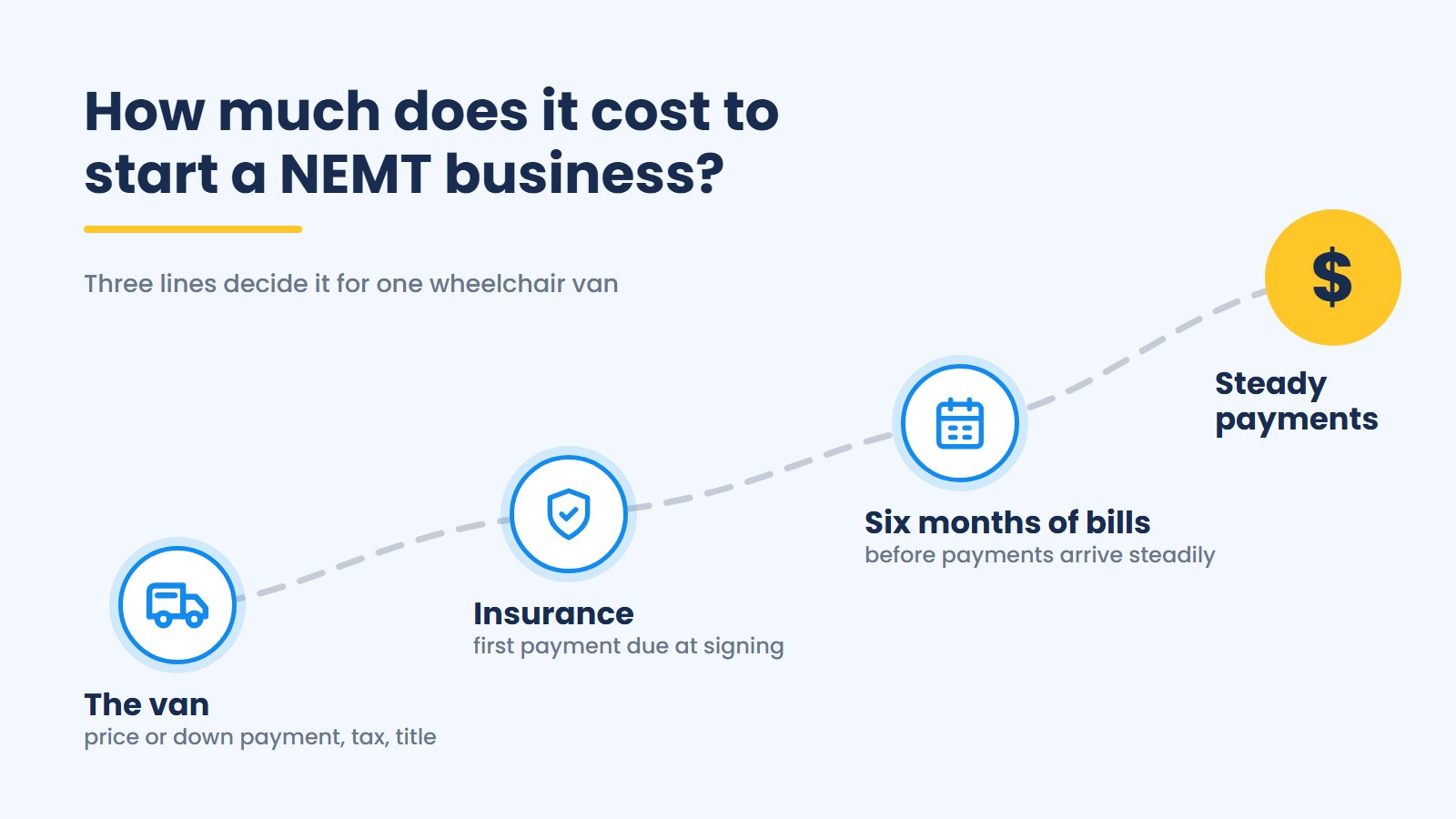
This guide follows the money in the order it leaves your account: paperwork, the van, insurance, the rest of the gear and training, then the months before payments arrive steadily. After that come a worked one-van budget, what changes it, and how owners pay for it. The steps themselves, in order, are in our guide on how to start a medical transportation business.
What goes into a NEMT startup budget?
A one-van startup budget has eleven launch lines and a few monthly bills, and new owners usually price only the van. As Te’ya put it, “The van is just the tool.”
Launch cash is everything you pay before the first trip. The monthly bills are the fixed ones you keep paying until payments arrive steadily: the insurance installment, any van payment and a phone line. Here’s the one-van NEMT startup budget, line by line, in the order the money leaves your account, at 2026 prices:
| Line | What it covers | 2026 range |
|---|---|---|
| LLC and state filing | Forming your limited liability company (LLC) | $50-$300 (California adds an $800 annual LLC tax for LLCs formed in 2026) |
| EIN and NPI | Your federal tax ID (EIN) and national provider identifier (NPI) | $0 |
| Medicaid application fee | Enrolling with your state’s Medicaid program | $0-$850, by state |
| Permits and owner screening | State or city permits, plus any owner background check a permit requires | $0-$700; a few places charge far more |
| Van | The price, or the down payment if you finance | Older, high-mileage: $15,000-$25,000. 2016-2019: about $33,000. 2020 or newer: about $62,600. Financed: 10%-25% down |
| Tax, title and registration | Paid when you buy the van | About 3%-10% of the price (a bit more in Los Angeles) |
| Insurance due at signing | The first payment on the policy | A fifth to a quarter of a $14,400-$21,600 yearly premium, sometimes all of it |
| Equipment and lettering | What a used van may be missing | $850-$1,300, plus $550-$780 per wheelchair position if securement is missing |
| Your screening and training | You, as the first driver: drug test, background check, CPR, a physical where required and wheelchair-securement training | $250-$1,200 |
| Phone and basic marketing | A business line, cards, a Google Business Profile | $0-$700 |
| Dispatch software | Scheduling your trips | $0 to start |
| Monthly: insurance installment | The rest of the premium | About 10 payments |
| Monthly: van payment | Only if you financed | Depends on the loan |
| Monthly: phone line | Your business number | $10-$19 |
Two things are left out on purpose: fuel, because it rises and falls with trips, and your own living costs.
Plan on paying the monthly bills for three to six months before payments arrive steadily. Leave them out and the number shrinks fast. So when someone quotes you a low startup number, ask whether it covers those months.
How much do the licenses and fees cost?
The paperwork is the cheap part: $50 to $300 for an LLC (plus California’s $800 LLC tax), a free EIN and NPI, and a Medicaid application fee of $0 to $850 by state, as of September 2026.
The Medicaid application fee is set federally: $750 in 2026, under the federal fee notice. CMS (the federal Medicaid agency) lists NEMT companies among the providers states charge it to. We’ve written guides for nine states: Arizona, California, Colorado, Florida, Georgia, Minnesota, North Carolina, Texas and Virginia. Six of them charge the fee, and North Carolina adds $100 of its own. Georgia and Virginia don’t, because NEMT providers there credential with the broker instead of enrolling with the state, and Florida publishes no fee for transportation providers. So if a guide tells you Medicaid enrollment is free, check your state. The fee comes due again at revalidation, at least every five years, and for each new location.
For a medical-only wheelchair van, state permit fees are small or zero. Virginia charges $53 for operating authority on one van, whether it’s the Medicaid-only NEMT certificate or the common-carrier authority private-pay and facility work needs, and Minnesota $45 a van a year for its STS (special transportation service) decal. Most of the others charge nothing. Cities and counties add their own in places like Denver and Charlotte. Te’ya’s advice on finding your list: start with “your local county government,” because “every state and every locality is different.”
Then there are the fees you’ll be told you owe, and what the rules actually say:
| What you’ll read | What the rules say |
|---|---|
| ”You need a USDOT number and MC authority, $300.” | The U.S. Department of Transportation (USDOT) number is free. The Federal Motor Carrier Safety Administration (FMCSA) fee schedule has no charge for it; the $300 is for MC (motor carrier) operating authority, which you need only to carry riders for pay across state lines. Of the nine states we’ve covered, only Minnesota requires a USDOT number for an intrastate wheelchair minivan, and it’s free there too. |
| ”Budget for UCR every year.” | UCR (Unified Carrier Registration) covers interstate carriers. The UCR Plan’s own questionnaire says a carrier that stays in one state doesn’t register. A minivan isn’t a UCR commercial vehicle anyway; that takes 10,001 lb or more, or more than 10 passengers including the driver. |
| ”NEMT companies need an EVV system.” | EVV (electronic visit verification) is required for Medicaid personal care and home health visits in the home. CMS’s EVV guidance doesn’t mention transportation. Any trip checks a broker asks for come from its contract, not from the EVV law. |
| ”Pay a service to get your EIN and NPI.” | Both are free. The IRS’s EIN page says you never have to pay a fee for an EIN, and the federal NPI rule says the law behind the NPI gives no authority to charge for one. |
So never pay a filing service for a USDOT number, EIN or NPI. The first big number is the van.
How much does a wheelchair van cost?
A used 2016-2019 wheelchair minivan lists for about $33,000 at dealers in September 2026, and a 2020-or-newer wheelchair van for about $62,600, plus about 3% to 10% in tax, title and registration (a bit more in Los Angeles). Those are median asking prices on 157 dealer listings in eight states, most on the BLVD marketplace, on September 25, 2026. For the 63 vans from 2016 to 2019, the middle half ran about $30,000 to $42,000. A new commercial rear-entry minivan conversion listed at $64,409 at one national dealer the same month.
Cheaper vans are out there, mostly with high miles. Nine of the 157 listings were under $25,000, most with 79,000 to 200,000 miles on them, and only 3 were under $15,000.
Two checks before you buy:
- Commercial ADA compliance. Michael Shank, who’s sold about 8,500 wheelchair vans, warned on our podcast that personal-use conversions aren’t compliant with the Americans with Disabilities Act (ADA). Using one for paid rides can come back on you as negligence (more in our guide on how to pick the right NEMT vehicle). Only 7 of the 157 listings said ADA, commercial or fleet, so the vans behind that $33,000 median were mostly sold as personal-use conversions, and the median doesn’t tell you what a compliant one costs. The two that said ADA outright were $35,990 (a 2022 rear-entry minivan with about 119,000 miles) and $56,900 (a 2020 full-size Transit). Before you count on any price, get the dealer to say in writing whether the van is ADA-compliant. Virginia’s Medicaid program won’t approve a vehicle without it.
- Vehicle age. Published state NEMT rules in Arizona, Colorado, Florida, Minnesota, North Carolina, Texas and Virginia don’t cap a van’s age. A broker’s contract or credentialing rules can, and those aren’t public, so ask the broker in writing before you buy.
For the example budget in the rest of this guide, say you buy at about the $33,000 median with 20% down and a 60-month loan at 14% interest. Both sit inside what startup lenders publish: 10% to 25% down at an equipment finance company (April 2026), and 12% to 20% interest at a commercial-vehicle finance broker. That’s $6,600 down, $2,310 in tax and title at 7%, and $614 a month on the $26,400 loan.
Paul Muench, who went from one van to six in a year and a half in Phoenix, would tell you to wait on the van. On our 2025 conference panel on NEMT growth, he said, “don’t buy a vehicle until you know you can fill it or at least mostly fill it.” John from Fenton Mobility, a family company that builds wheelchair vans, agreed against his own interest. On our episode on what a van manufacturer won’t usually tell you, he said, “if they’re new, I would recommend getting the clients first before they’re buying their van.”
So price three 2016-2019 vans and add your state’s tax and title before you look at new ones. And line up your first riders, or a facility, before you sign for any of them. Next is the line that surprises people: insurance.
Why does insurance break so many startup budgets?
A new NEMT company pays startup rates, about $1,200 to $1,800 a month for one wheelchair van, and carriers often want a fifth to a quarter of the year’s premium at signing. Te’ya told a consultation caller on her YouTube channel in August 2026 to expect $1,200 to $1,500 a van a month. The caller had been insured before, and Te’ya said brand-new companies pay more. Rachel Scholler, who sold her Wisconsin NEMT company in 2025, told me on our podcast in 2026 that her consulting clients are “getting quotes at 1,500, 1,800.”
Price the policy at the liability limits payers want. Te’ya told me that once you apply for state licensing or with a broker, “they’re going to ask you for your insurance limits.” A state-minimum policy “may not be the hospital’s minimum.” The broker MTM’s Minnesota provider requirements ask for general and auto liability policies of at least $1 million each, where Minnesota’s own floor is $500,000. John Kecskes, an insurance broker, told me a million in auto liability is “very standard for any [NEMT].”
Then there’s the lump at signing. One premium finance company (a lender that pays the insurer and bills you monthly) describes about 25% down, then 10 monthly payments, in a 2026 guide. Some carriers want the whole year from a new company: the two California owners behind the MJ Business Academy channel have said they paid about $15,000 up front in 2019.
The example budget picks $1,450 a month from inside that $1,200-to-$1,800 range. That’s $17,400 a year: $4,350 at signing, then ten payments of $1,305. Paying the year in full would take $13,050 more at signing. Premium finance can also add a finance charge, which the example leaves out, so treat its insurance line as a floor.
Time in business brings the rate down. Rachel was paying about $500 a month per van when she sold. R.J. Morrison, who ran about 65 ambulances a day in California, said on the same 2025 panel as Paul that new operators are “stuck paying the higher rates” for “the first five years.” So if a budget you’re reading shows a much lower premium, check whether it’s a new company’s.
Shop with more than one agent, carefully. Kecskes explained on our episode about how to lower NEMT insurance premiums that when several agents submit you to the same carrier, “they’re going to take the first submission that they get and then the market’s blocked.” Before you commit to a van, get these from two agents:
- Quotes at broker-grade limits. $1 million in auto liability, not your state minimum.
- The amount due at signing. And the monthly payment after it.
- The carriers each agent will approach. Don’t let two agents submit you to the same one.
What else do you need before the first trip?
The rest of the launch list adds about $2,300 in the example budget: your own screening and training as the first driver, equipment the van may be missing, and a phone line with basic marketing. Dispatch software can be $0. Sellers’ list prices as of September 2026:
- You, as the first driver (about $1,000 in the example). What’s required depends on the state. Colorado’s NEMT rule wants a drug screen before hire and CPR certification. California’s 2023 Medi-Cal enrollment guidance asks for those plus a Department of Transportation (DOT) physical, which Minnesota requires too. Figure $60-$90 for a drug test, $30-$95 for a background check, about $75-$100 for American Heart Association CPR and first aid, and $150 for a DOT physical. The PASS classroom course (Passenger Assistance Safety and Sensitivity), with hands-on wheelchair securement, is $600-$750 depending on membership. Ask your broker which training it accepts.
- What the van may be missing (about $1,000). A NEMT safety kit is about $110 and a small fire extinguisher about $63. A belt cutter, two seatbelt extensions, a flashlight and a step stool come to about $241, and Virginia’s Medicaid rules require the cutter and extensions. A dash camera is about $350. Lettering runs from about $90 for a pair of magnets to $300-$500 at a sign shop. Virginia wants lettering permanently affixed and at least 3 inches high, which rules out magnets, and Texas’s 6-inch letters won’t fit on a standard magnet pair. If a used van lacks securement, add $550-$780 per wheelchair position; new commercial conversions include it.
- Getting found ($300 one-time in the example). A business phone line is $10-$19 a month, and a Google Business Profile is free. Te’ya on our podcast: “you may not have it to spend $300 a month on marketing, right? But don’t forget about it.”
Dispatch software is the one line here where I’m biased, because it’s ours. Duet is free for providers doing fewer than 100 trips a month, with nothing feature-locked. Past 100 trips, usage pricing kicks in, and most providers land under $50 per active vehicle a month; Duet’s pricing for small providers has the details. It won’t pay the insurance deposit or find your first riders, and every other line on this page is still yours to fund, whatever software you use.
That’s the end of the launch list, but the bills keep coming until the payments do.
How much cash do you need before the first check?
Plan on six months of fixed bills before payments arrive steadily: about $11,600 with the example’s financed van, two-thirds of it insurance, or about $7,900 if you own the van outright. The $1,305 insurance installment plus a $15 phone line is $1,320 a month. Add the $614 van payment and it’s $1,934.
Te’ya described this stretch on our podcast: “you’re sitting at home and you’re looking out the window and you’re frustrated because you see the van there, but you can’t do anything with it.”
Six months covers three waits that stack: your state’s enrollment clock, then broker credentialing, then the lag before payments arrive. The state clocks alone vary a lot:
- North Carolina cleared clean applications in about 10 to 12 days from April to June 2026, per NC Medicaid’s provider enrollment page.
- Arizona generally processes applications within 60 days.
- Texas applications are mostly taking 90 to 120 days, per the state enrollment contractor’s June 2026 notice.
- California has up to 180 days to decide.
- Minnesota won’t enroll new NEMT providers in the seven-county Twin Cities metro until Jan. 27, 2027, under Minnesota’s metro enrollment freeze.
Broker credentialing comes on top, and brokers don’t publish an end-to-end timeline for it. You usually can’t finish it without the van, either. Brokers credential the van itself (the broker SafeRide’s provider checklist asks for its registration and insurance), and Virginia and Minnesota want proof of insurance before they issue their permits. Ask each broker how long credentialing is taking right now. Then ask the state and each broker which steps you can finish before you own the van, and buy it as late as that allows.
Once trips flow, brokers pay every week or two. MTM pays weekly for trips submitted 9 to 15 days earlier, per its 2018 Mississippi provider handbook, and MediDrive pays every two weeks in Colorado. Facilities that pay by invoice often take 30 to 60 days. Private-pay riders usually pay the day of the ride, which is one reason to consider starting with private-pay rides.
Te’ya’s rule is a three-month cushion, she’s said on her YouTube channel. Paul told me the phones “really started ringing” after about four or five months. A Lubbock owner said in a 2023 Zenpath Radio interview that you have to “function for a minimum of six months expecting that you might not see much reimbursement.” The first trip doesn’t end the wait. The first steady month of payments does.
What does a one-van startup budget add up to?
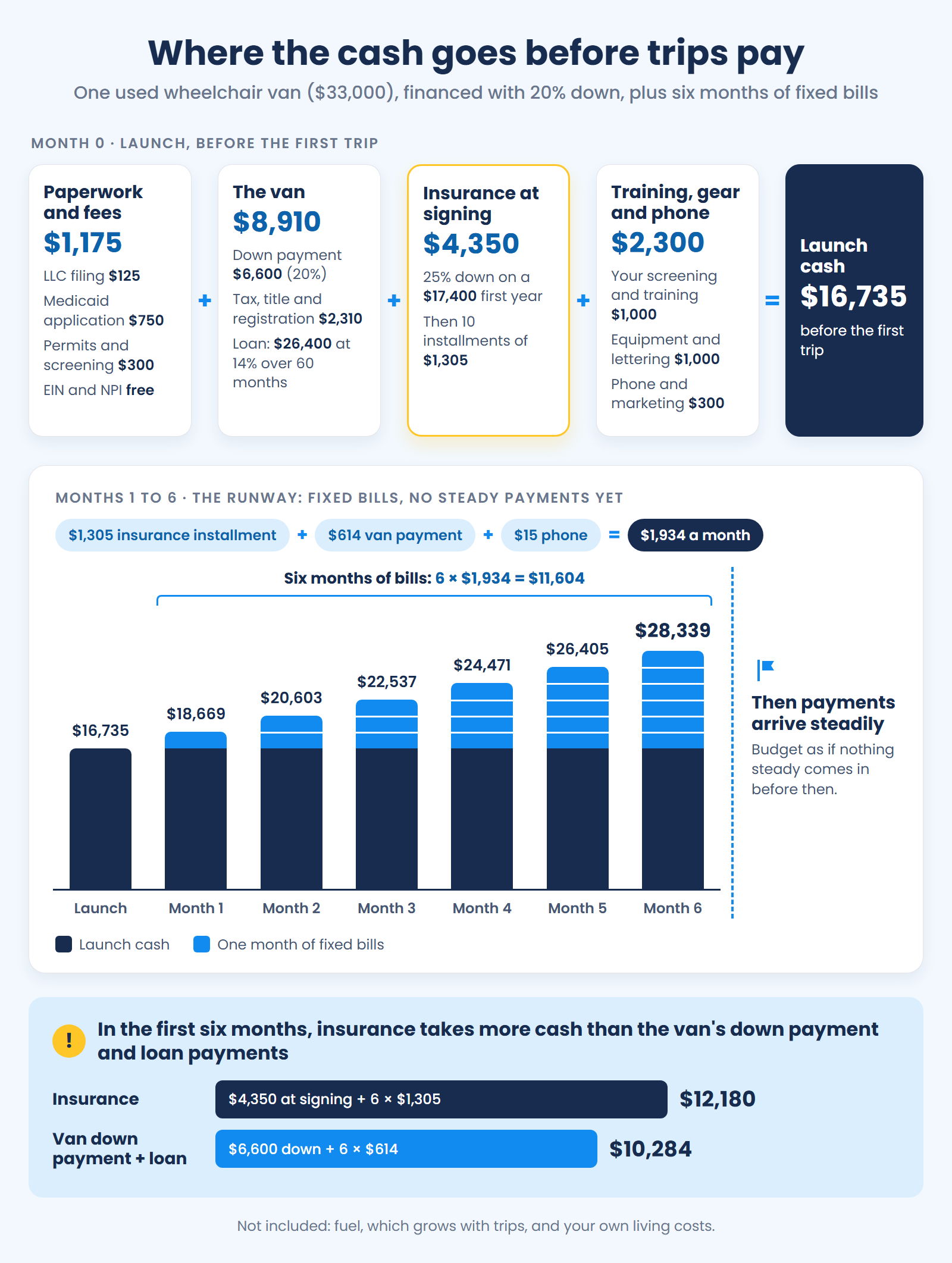
Financed at 20% down, the example’s $33,000 van takes about $28,300 in cash, launch plus six months of bills; bought outright, the same van takes about $51,100. Here’s the example budget for one used wheelchair van, financed and bought outright, with you driving:
| Line | Financed (20% down, 14%, 60 months) | Bought outright |
|---|---|---|
| LLC and state filing | $125 | $125 |
| EIN and NPI | $0 | $0 |
| Medicaid application fee | $750 | $750 |
| Permits and owner screening | $300 | $300 |
| Van (down payment or price) | $6,600 | $33,000 |
| Tax, title and registration (7%) | $2,310 | $2,310 |
| Insurance due at signing | $4,350 | $4,350 |
| Equipment and lettering | $1,000 | $1,000 |
| Your screening and training | $1,000 | $1,000 |
| Phone and basic marketing | $300 | $300 |
| Dispatch software | $0 | $0 |
| Launch cash | $16,735 | $43,135 |
| Insurance installment | $1,305 | $1,305 |
| Van payment | $614 | $0 |
| Phone | $15 | $15 |
| Monthly bills | $1,934 | $1,320 |
| Six months of bills | $11,604 | $7,920 |
| Total cash needed | $28,339 | $51,055 |
The financed column borrows $26,400 for the van. In that column, insurance takes $12,180 of cash in the first six months, more than the van’s down payment and six loan payments combined ($10,284, before tax and title).
For a real comparison, Ray and Mac of The Doctor Ride built their Charlotte business from day one around a facility they met before they owned a van, as they told me on our podcast. They’ve shared the numbers on their YouTube channel. They started in 2025 on “a little over 10 grand” of launch cash, including the down payment on a financed new van. That’s less than the example’s $16,735, mostly because the van’s tax went into the loan, their insurance was billed monthly, and their tally doesn’t list filing, training or equipment. And even with riders already calling, they ran a small net loss for their first three months.
What makes it cost more or less?
The van you pick moves the total by tens of thousands of dollars, and your state moves it by a few thousand. By van, with six months of bills at 2026 prices, the total cash needed for one van looks like this:
| Van | Financed, 20% down | Bought outright |
|---|---|---|
| Older, high-mileage ($20,000) | $23,377 | $37,145 |
| 2016-2019 ($33,000, the example) | $28,339 | $51,055 |
| 2020 or newer ($62,600) | $39,637 | $82,727 |
Three months of bills instead of six brings the financed total to $22,537, which only works where enrollment is fast and trips start early.
Cash or a loan is a real trade-off. Rachel told me on our podcast, “I have purchased every single vehicle I’ve ever had outright. I have never financed a vehicle, which really saved me during COVID.” With those payments, she thinks she “would have went under.” She often bought at auction and kept two or three spares for breakdowns. Te’ya’s cap if you pay cash, from her YouTube channel in 2023: “no more than twenty thousand dollars for a wheelchair van.”
The cheapest honest start is ambulatory only, in a vehicle you already own, where your state and payers accept ambulatory-only providers. You skip the van and the conversion, but you still need commercial insurance. A Virginia owner said in a 2025 interview on the MJ Business Academy channel that she was paying $1,500 a month on an ambulatory-only van. You also give up wheelchair riders, so ask the broker first.
Each of the nine states adds its own fees, checked September 2026:
| State | LLC filing | 2026 Medicaid application fee | Tax when you buy the van | Permits and local fees worth knowing |
|---|---|---|---|---|
| Arizona | $50 | $750 | 5.6% state plus county and city (6.3% state and county in Maricopa) | ADOT (Arizona’s transportation department) vehicle-for-hire permit: $0 for livery (non-taxi) service, $24 a van if classed as a taxi |
| California | $70, plus the $800 annual LLC tax for a 2026 formation | $750 | 7.25% plus district tax (9.75% in Los Angeles) | No state permit for a medical-only van; a $1,000 CPUC (California Public Utilities Commission) permit, per its fee sheet last revised in 2018, if it also carries non-medical riders |
| Colorado | $50 | $750 | 2.9% state plus local (4.75%-9.25% combined in Adams County) | No Public Utilities Commission authority needed for a van built and used only for wheelchair riders, though trips for walking riders paid privately or by a facility need it, and the owner files a DMV insurance certificate; Denver $180 for the company with one van, plus $50 a driver; HCPF, Colorado’s Medicaid agency, reopened enrollment to new NEMT providers on October 1, 2026 |
| Florida | $125 ($100 filing plus $25 registered agent) | None published; confirm with AHCA, Florida’s Medicaid agency | 6% plus county surtax on the first $5,000 | No state license; Level 2 screening (a fingerprint background check) for each owner, about $85-$145; Hillsborough $300 plus $150 a van; Palm Beach $10,000 up front and a two-vehicle minimum |
| Georgia | $100 | $0: no state enrollment; you credential with Verida, the statewide broker | 7% one-time title ad valorem tax (TAVT) | No state license for a medical-only van seating 10 or fewer; occupation tax certificate from $80 (Gwinnett) to $241 or more (Atlanta) |
| Minnesota | $155 | $750 per location | 6.875%, with the wheelchair conversion’s value excluded | STS (special transportation service) decal $45 a van a year; $57.50 background study per owner; no new NEMT enrollments in the seven-county metro until Jan. 27, 2027 |
| North Carolina | $125 | $850 ($750 plus $100 state) | 3% highway use tax | For-hire plate $128.50 a year; Charlotte $400 for the company, $15 a van and $80 a new driver, unless your service is exempt |
| Texas | $300 | $750 | 6.25% | No state NEMT license and no Texas DMV registration for a van seating 15 or fewer including the driver; Austin operating authority $159 (whether it covers wheelchair vans is unsettled) |
| Virginia | $100 | $0: no DMAS (Virginia Medicaid) enrollment; you credential with the broker | 4.15% | DMV operating authority $50 filing plus $3 a van, and a $25,000 bond (about $250 a year at one bond seller’s posted price): the NEMT certificate covers Medicaid trips only, so private-pay or facility work needs Common Carrier - Irregular Routes, which also takes a tariff and a published notice |
Before you shop for a van, look up your own state’s three fixed costs: the LLC fee, the Medicaid application fee and any city or county permit.
Can I plug in my own numbers?
Yes: the one-van NEMT startup budget spreadsheet (.xlsx) has every line from the example, the nine states’ fees and a month-by-month cash plan, with the 2026 numbers filled in. To use it:
- Pick your state from the dropdown on the first tab, or leave it on “Example / other state” and type your own LLC and Medicaid fees.
- Enter the van’s price and, if you’re financing, the down payment, rate and term.
- Enter your insurance quote: the yearly premium, the share due at signing and the number of installments.
- On the cash-plan tab, set the months until payments arrive steadily (six by default).
It returns your launch cash, your monthly bills and the total cash to line up. At its defaults it shows the example’s $28,339, and $51,055 if you switch financing off.
How do new owners pay for it?
Expect to pay with savings plus a vehicle loan, because grants rarely pay for a launch. Michael Shank told me in 2025 that banks “got burned during COVID” and are “kind of skittish on loaning money on startups.” And if 70 to 80 percent of your trips come from brokers, he said, “the banks get a little funny and wonky on that.” A mostly private-pay book from your own local relationships is, in his words, “really the ultimate scenario.” If no lender will finance your van, your number is the bought-outright column: $51,055 for the example’s van, or $37,145 for an older $20,000 one.
A loan backed by the Small Business Administration (SBA) usually won’t get you out of putting money in. Under SBA 7(a) rules other than SBA Express, where the lender decides, a business with a year or less of revenue puts in at least 10% of the project cost. SBA’s updated lending procedures, which take effect Oct. 1, 2026, keep that. SBA microloans are smaller: up to $50,000 through nonprofit lenders, about $13,000 on average, generally at 8% to 13% interest. Their rules name equipment and working capital, not vehicles, so ask the lender whether a van counts.
What about NEMT grants?
Grants almost never fund a NEMT launch. SBA’s grants page says it doesn’t provide grants for starting or expanding a business. Section 5310, the Federal Transit Administration’s program for seniors and people with disabilities, pays states, nonprofits and public agencies. A for-profit NEMT company can work for one of them as a paid contractor. It can receive the grant money itself only if it runs shared-ride service open to the public, or to a whole group such as seniors. Vehicle money also needs a 10% to 20% local match.
Progressive and Hello Alice gave twenty $50,000 commercial-vehicle grants in 2024 and again in 2025, and Progressive hadn’t announced a 2026 round as of September 2026.
Te’ya’s grants came once she was operating. On her YouTube channel, she’s described $20,000 from an Invest Atlanta small-business grant in 2022 and a $50,000 pitch-competition award in 2024, after she’d grown to four vans. On our podcast she put the point where you “qualify for business funding grants” at “five to 10 vehicles.”
Never pay anyone for “grant information.” The Federal Trade Commission’s grant-scam warning says government agencies that award grants won’t demand that you pay to get one. (The only sure money in that deal is the seller’s.) And for anyone hoping to start with nothing, the MJ Business Academy owners put it plainly in 2023: “you cannot start this business with zero dollars.”
Can you afford the van?
You can afford the van if you can cover the whole launch list plus six months of fixed bills with no trips coming in, and still pay your own living costs for those months. In the example, that’s $28,339 before your living costs, and insurance takes $12,180 of it. Work out your own number in the spreadsheet this week, before you shop.
If yours comes up short, the cheaper routes above bring it down. An older $20,000 van, if a lender will finance it, takes about $23,400. Pair it with three months of bills, where enrollment is fast, and it’s about $18,300. Ambulatory-only is cheaper still, where your state and payers allow it. And line up riders before you sign for any van, starting with landing your first trip from a facility.
Te’ya found her own cheaper route without planning to. She put the wrong van to work taking seniors to casinos. “I was able to build some capital up from there,” she told me. “And then I was able to get a wheelchair van.”
FAQ
How much does it cost to hire a driver instead of driving yourself?
The median wage for shuttle drivers and chauffeurs, the federal job category that includes nonemergency medical transporters, was $17.93 an hour in the Bureau of Labor Statistics’ May 2025 survey. At that national median, a full-time driver costs about $3,560 a month once you add payroll taxes and workers’ comp. At state medians, that’s about $3,100 in North Carolina and about $4,635 in California. Workers’ comp is the line that swings: the median California rate for the bus-company class was $15.86 per $100 of payroll in the state insurance department’s March 2026 comparison.
How much more does a second van cost?
The van and its tax and title again, plus insurance that’s cheaper than the first van’s but not free. In an August 2026 consultation call on her YouTube channel, Te’ya Miles put insurance at $1,200 to $1,500 a vehicle a month. With two vans on one policy, she said, figure about $1,200 for the first and $900 to $1,000 for the second. Add per-van fees where they exist: Minnesota’s $45 decal, Virginia’s $3, Denver’s $30 and Hillsborough County’s $150. A second van at the same address shouldn’t bring a second Medicaid application fee, since states charge it per application or location. Rachel Scholler started with two vans so she’d have a backup for breakdowns, she told me on our podcast, “but then you’re paying the insurance on both vehicles.”
What does a van cost to run each month once trips start?
Fuel is about $509 a month if the van drives 2,500 miles, using the 2026 Chrysler Voyager’s 22 mpg and the Energy Information Administration’s weekly gas price of $4.478 a gallon for the week of Sept. 21, 2026. Maintenance adds about $276 a month at AAA’s 2025 figure of 11.04 cents a mile, an average for newer vehicles, so a high-mileage van runs more. Both start when trips do, on top of the insurance installment and any van payment.
About the author
James O'Donnell cofounded Duet and leads its sales, partnerships, and growth services. He talks with NEMT operators every week, hosts the NEMT Growth podcast, and answers Duet's sales line himself. More about Duet's founders →
Want more trips and less busywork?
See how Duet runs and grows NEMT businesses in a 30-minute demo.