Article
NEMT Business License Requirements: What You Actually Need
Most states we've checked issue no NEMT license. Where you drive, what you drive and who pays decide what you need.
By James O'Donnell, Cofounder and COO, Duet ·
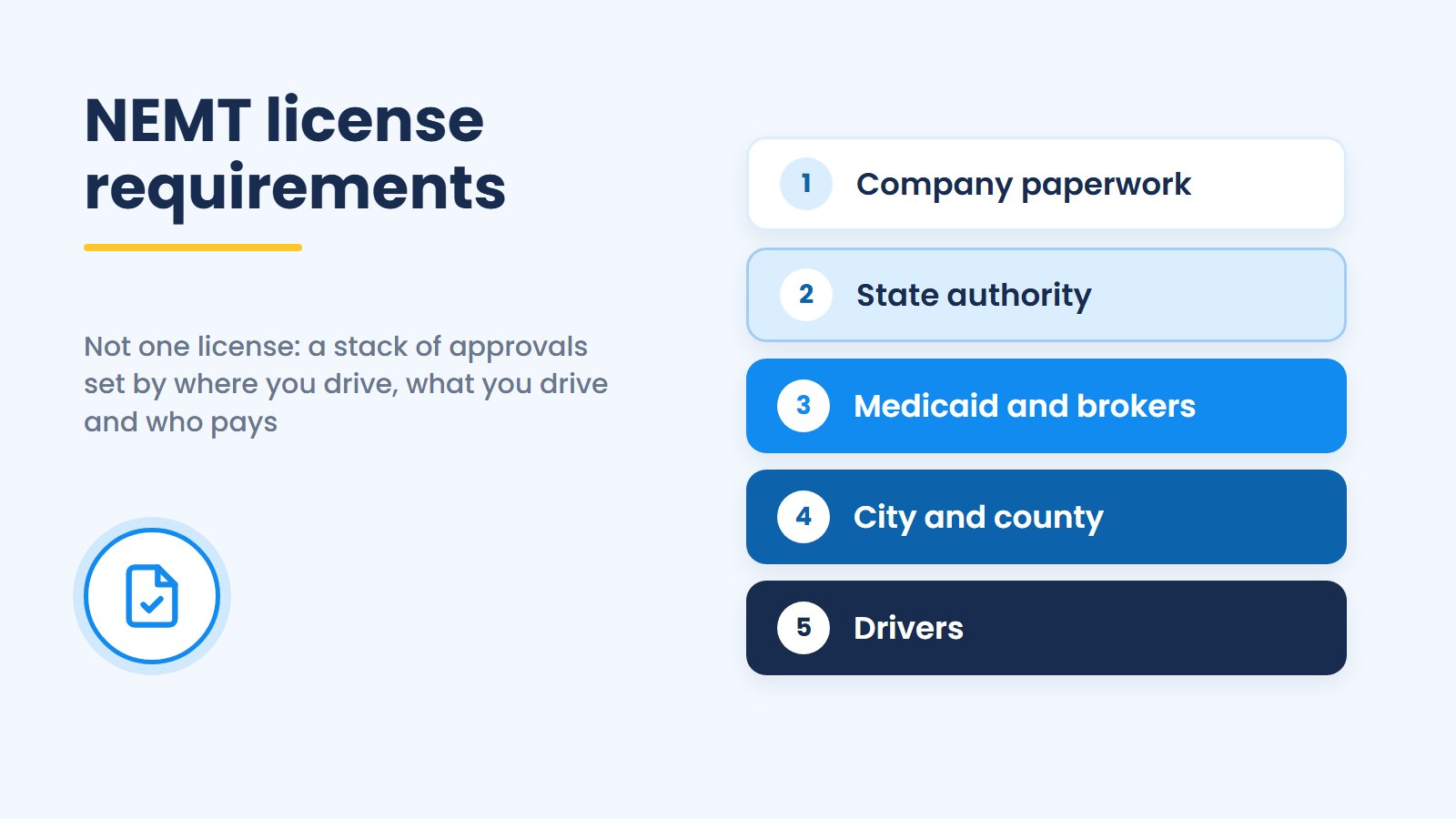
There’s no national NEMT license, and of the 13 places we’ve written guides for (12 states and Washington, DC), only Virginia and Ohio license NEMT work itself. Everywhere, being licensed means a stack of approvals. You’ll need company paperwork, any state authority to carry riders for pay, Medicaid enrollment and approval from the brokers that hand out Medicaid rides (only if you’ll take those trips), city and county permits, and qualified drivers.
An owner with one wheelchair van in the Bay Area told me on a demo this summer that Medi-Cal, California’s Medicaid program, took about seven months to approve her. The approval brought no Medi-Cal trips. The next queue was the county’s Medi-Cal plan, which she expected to take “five to six months.” A year and a month in, she was still paying insurance on the van and waiting. She’d give it five or six more months, she said, then decide “if I want to keep going or if I want to just close it.”
Medi-Cal’s yes was one of several, and she learned about the next one only after it came. Where you drive, what you drive and who pays decide which approvals you need, so settle all three before you buy anything. Below: what your state asks of your van, the licenses you’ll read about that don’t exist, what Medicaid and the brokers ask, what your city and county ask, what “certified” and “accredited” mean, and the order to apply in.
Is there a NEMT business license?
There’s no national NEMT business license. Federal motor-carrier authority covers only trips that cross a state line, under 49 U.S.C. 13501, and CMS, the federal Medicaid agency, leaves driver and vehicle standards to the states beyond a short federal list.
Te’ya Miles, the Atlanta operator behind That NEMT Girl, described the trap on our episode about the NEMT mistakes nobody warns you about. “You may have gotten one door knocked down,” she said, and think you’re finished. “No, you still got something else to do.”
The stack has five layers, and our full guide to starting a NEMT business fits them into the rest of the launch:
- Company paperwork. An LLC ($50 to $300 to file in most states; California adds an $800 yearly tax), a free EIN (Employer Identification Number, your federal tax ID) and a free NPI (National Provider Identifier, the ID healthcare payers use).
- State authority. Whatever your state requires to carry riders for pay, which can be nothing at all or a license.
- Medicaid and brokers. Only for Medicaid trips: enrollment with your state, then credentialing, each broker’s check of your insurance, drivers, vans and licenses.
- City and county. An ordinary business license in many places, and a vehicle-for-hire or NEMT permit in some.
- Drivers. A regular driver’s license for most vans, plus the background checks and training certificates brokers ask for.
What does your state require of your van?
What your state asks depends more on your van and who pays than on the word NEMT. Across the 12 states and DC in our guides:
- Two license NEMT work itself: Virginia and Ohio.
- One requires a special transportation certificate: Minnesota.
- Five make van companies get or register general for-hire authority: Arizona, New York, North Carolina, Pennsylvania and Washington, DC.
- Five require no state operating authority for a medical-only wheelchair van: California, Colorado (unless you carry walking riders who aren’t on Medicaid), Florida, Georgia and Texas.
Who pays clearly matters at the state level in only three of them: Colorado exempts Medicaid trips, Virginia gives Medicaid-only carriers a lighter certificate, and Minnesota’s certificate is triggered by public money like Medicaid. Everywhere else, the authority follows the van and the trip, whoever pays.
Here’s what each of the 13 asks of a wheelchair van, as of October 2026:
| State | What the state requires | Who it covers | Cost |
|---|---|---|---|
| Arizona | A vehicle-for-hire permit from ADOT, the state transportation department | Any payer | $0 with flat or zone fares; $24 a van if you charge by distance, capped at $1,000; good for three years |
| California | No state authority if the van does only medical work | Any payer; non-medical rides for walking riders need a CPUC (state utilities commission) permit | $0; the CPUC permit is $1,000 (2018 fee sheet) |
| Colorado | No PUC (utilities commission) authority for Medicaid trips or a van used solely for wheelchair riders; a wheelchair van’s owner files a DMV insurance certificate | Walking riders who pay you privately need PUC authority | No PUC fee for exempt trips |
| Florida | No state license or permit for a van | Some counties license instead | No state permit fee |
| Georgia | Nothing for a van built for 10 or fewer and used only for medical, elderly or disabled riders | Any payer; whether the driver counts toward the 10 is unsettled. Separately, a van built for more than 8 people counting the driver needs a free USDOT number (the federal carrier ID) | $0 |
| Minnesota | A special transportation service (STS) certificate from MnDOT, the state transportation department | Any provider paid with public money, Medicaid included | $45 a van a year |
| New York | Operating authority from NYSDOT, the state transportation department, for ambulettes (wheelchair and stretcher vans) | Any payer; cars and minivans built for fewer than 11 people counting the driver are exempt, so ask NYSDOT about a wheelchair minivan | No NYSDOT filing fee published |
| North Carolina | No Utilities Commission certificate for taxi-style service, but you register that exemption with the DMV and run for-hire plates | Any payer; confirm with the state DMV that your service counts as taxi-style | $128.50 a year for each for-hire plate |
| Ohio | A certificate from PUCO, the state utilities commission, plus the state EMS (emergency medical services) board’s ambulette license for paid wheelchair rides to medical care | Any payer, Medicaid included | PUCO $30 a van; ambulette license $100 a year, plus a $50 permit and a $50 inspection per van each year |
| Pennsylvania | A certificate of public convenience for paratransit service from the PUC, the state utilities commission | Any payer; ask the PUC whether work done only under a county Medicaid ride contract needs one | $350 to file, once |
| Texas | Nothing for a van designed for 15 or fewer passengers counting the driver and under 26,001 pounds | Any payer; stretcher trips need an EMS provider license | $0 |
| Virginia | A DMV certificate of fitness for NEMT carriers, or common-carrier authority | The NEMT certificate covers Medicaid trips only; private-pay or facility trips need the common-carrier lane | $50 to file plus $3 a van and a $25,000 bond, either lane |
| Washington, DC | A regional certificate of authority from WMATC (the Washington Metropolitan Area Transit Commission) | Any paid trip inside the Washington metro district, DC-only trips included, except trips solely within Virginia | A filing fee and a yearly fee |
Which NEMT licenses don’t exist?
Most of the “state NEMT licenses” you’ll read about don’t exist in the places we’ve checked, so before you pay for one, ask which agency issues it and which law requires it. Four that circulate now:
| What you’ll read | What the rules say |
|---|---|
| A licensing directory’s template, repeated for Colorado, Arizona, New York and other states (October 2026): a “Colorado NEMT Provider License” at “$850 initial, $510 renewal” | Colorado, Arizona and New York issue none. Colorado’s PUC exempts Medicaid trips and wheelchair-only vans, Arizona’s one state permit is ADOT’s, and New York’s is NYSDOT operating authority for ambulettes. |
| Google’s AI answer for “nemt business license” (Oct. 6, 2026): “State provider certification typically costs between $500 and $3,000 initially, with ongoing annual renewals” | The state fee most new NEMT companies meet is Medicaid’s application fee: $750 in 2026 where your state charges it, due again at revalidation, at least every five years. |
| A 2025 Texas startup guide: “The first step is to obtain a non-emergency medical transportation license” | Texas issues none. Its motor-carrier registration starts at vehicles over 26,000 pounds or designed for more than 15 passengers counting the driver, and its EMS license is for stretcher transport. |
| Older Colorado guidance still repeated online in 2026: get a PUC “Medicaid Client Transport” permit | Colorado repealed that permit in 2021. |
AI answers repeat what ranks. On Oct. 6, 2026, that directory’s template sat in Google’s top 10 for at least five of eight NEMT licensing searches, and three of Google’s eight AI answers on those searches cited it.
Even founders who dodge the fakes collect more than they need. A Tampa-area founder said in a 2026 YouTube podcast interview that when he registered his company in 2022, he “got way more things than I needed,” because “you don’t know.” Some sellers also charge for registrations that are free, like a USDOT number or an EIN, and the fee myths in our startup-costs guide cover those. If a seller can’t name the agency and the law, don’t pay.
Do you need Medicaid enrollment and broker approval?
Only for Medicaid trips, and they’re the slowest layer: your state screens you, and each broker or health plan you work with credentials you on its own clock.
Federal rules make every state screen its Medicaid providers, but CMS leaves the risk level for NEMT companies to each state. Arizona, Colorado, Minnesota and Ohio put new NEMT companies at high risk, which means fingerprints from every owner of 5% or more and a site visit. Where your state charges the federal application fee, that’s $750 in 2026.
Most of our 13 enroll you with the state, and each broker or health plan you work with also credentials you against its own list. In New York the broker comes first: the state rejects an application without a letter of support from MAS (Medical Answering Services), its statewide broker. Georgia, Pennsylvania and Virginia skip state enrollment for van rides, so a broker’s credentialing, or in Pennsylvania a county program’s contract, is the whole Medicaid layer.
When a broker asks for “your license,” it means whatever your state and city require. MTM’s provider agreement, for one, has you keep “any and all licenses, permits, certificates, and registrations” the law requires. Even with every license in hand, a yes isn’t automatic. Verida, Georgia’s statewide broker, reviews applications “to determine if there is a need for new transportation providers in the region.”
That’s the Bay Area owner’s year: the state’s queue, then the plan’s, with insurance running through both. As I said on our live show on Oct. 1, these applications can sometimes take six months, a year.
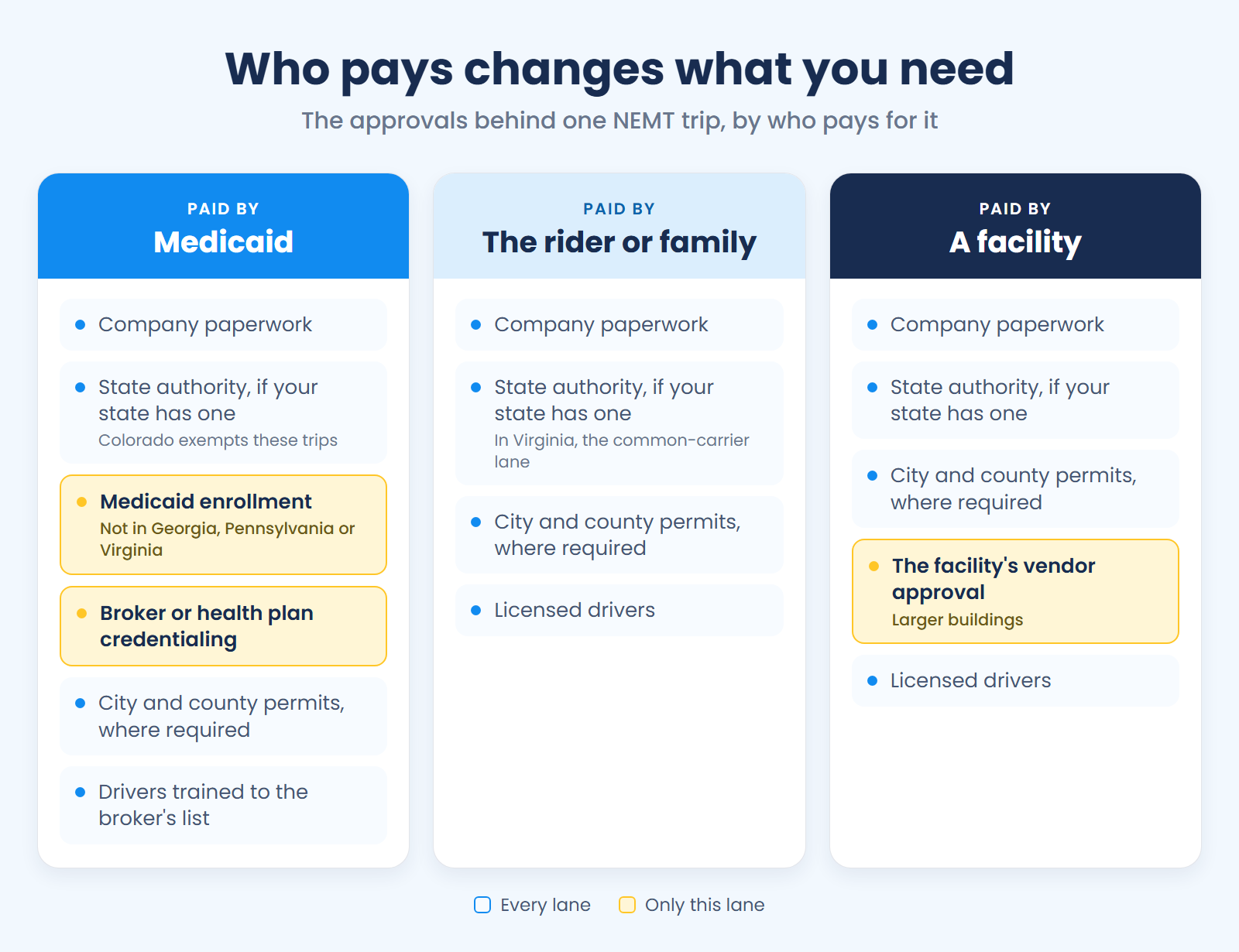
Private-pay and facility trips skip this layer, not your state’s or city’s rules:
- Medicaid trips need the whole stack: company paperwork, any state authority (Colorado’s PUC exempts these trips) and Medicaid enrollment (except in Georgia, Pennsylvania and Virginia). Then add credentialing with each broker or health plan, local permits where required, and drivers trained to the broker’s list.
- Trips the rider or family pays for skip enrollment and credentialing, not the state authority. Colorado’s PUC regulates walking riders who pay you, and Virginia sends private-pay trips to its common-carrier lane. You still need local permits and licensed drivers.
- Facility-paid trips need what private pay needs, plus the facility’s own vendor approval at the larger buildings.
What do your city and county require?
Many cities and counties want the ordinary business license or tax certificate they ask of every business, and some license wheelchair or stretcher vans themselves. Atlanta’s ordinary license is an occupation tax certificate. In the places we’ve checked, most licenses with “non-emergency” or “wheelchair” in their names are local. Te’ya’s advice on that same episode was to skip the Facebook group full of owners in other states and start with “your local county government.” Her own Atlanta stack is “a business license with the city of Atlanta” plus her state articles of incorporation.
Local licenses NEMT companies run into, as of October 2026:
- Denver licenses non-emergency medical vehicle companies based in the city: $180 for the company with one van.
- Miami-Dade County requires a Non-Emergency Transportation Certificate for wheelchair and stretcher transport, approved by a county commission vote. The county says three to six months.
- Broward County licenses non-emergency medical transportation companies.
- Hillsborough County licenses NEMT vans as “handicabs”: $300 for the business plus $150 a van.
- Palm Beach County wants $10,000 up front and a two-vehicle minimum for new wheelchair and stretcher companies, per the county’s 2020 application.
- Los Angeles County licenses ambulette operators under its own code.
Some states shut that door instead. Arizona bars cities and counties from adding their own vehicle-for-hire rules (airports aside), and Minnesota’s STS certificate stands in for any other state or local permit for the vans it covers.
This week, call your county clerk and your city’s licensing office. Ask whether they license wheelchair vans or vehicles for hire, and whether they want insurance on file before they issue anything.
Do you need NEMT certification?
Your company doesn’t, though it may still need the licenses and authority above. None of our 13 places certifies NEMT companies beyond that authority, and North Carolina’s Medicaid transportation policy says so outright for enrollment: “No certification, accreditation or license is required.” Brokers don’t ask for one either: the manuals and agreements we’ve checked want licenses, insurance and driver files. NEMTAC, the industry’s accreditation commission, isn’t mentioned in any of the 17 broker, state and federal Medicaid documents we read, dated 2018 to 2026.
When people say “NEMT certification,” they usually mean one of three things:
- Driver training certificates, which brokers require.
- A state authority that happens to be called a certificate, like Virginia’s certificate of fitness, Minnesota’s certificate of compliance or WMATC’s certificate of authority.
- Broker credentialing, the approval each broker gives you before it sends trips.
The one thing in our set actually called a NEMT certification is a course for owners in Arizona. AHCCCS, Arizona’s Medicaid program, requires business owners to complete its NEMT Certification Training, and per its provider packet, the owner must also provide CPR, first aid and HIPAA (health privacy) training for every driver.
For drivers, a regular license covers a van designed for fewer than 16 people counting the driver. That’s the federal commercial driver’s license (CDL) line, and it applies inside one state too. Two exceptions stand out in our set. In New York, every ambulette driver needs a CDL with a passenger endorsement. In California, a for-hire vehicle built or used to carry more than 10 people counting the driver is a bus, which takes a commercial license. Brokers add the rest, in varying mixes: PASS (Passenger Assistance, Safety and Sensitivity) training, CPR, first aid, defensive driving, wheelchair securement, background checks and drug screens.
My cofounder Jing put it simply on our private-pay episode: contract payers want to see a ton of paperwork, families paying privately won’t ask, and you should get “the trainings” anyway. So before you hire, ask each broker for its driver training list, and put every driver’s certificates in their file before the first trip.
Is NEMTAC accreditation worth it?
Not for most startups, at least not yet. It’s a nice-to-have, and almost nobody in healthcare knows NEMTAC.
NEMTAC, the Non-Emergency Medical Transportation Accreditation Commission, is a nonprofit standards body, and its accreditation is separate from its annual conference, where Duet has a booth every year. Per NEMTAC’s accreditation page in October 2026, the review covers seven areas, including driver credentialing and vehicle maintenance, takes about 90 days and lasts three years. It costs $3,000, including a $600 application fee, or $3,600 on a monthly plan. About 20 companies have been awarded it, per NEMTAC’s own list.
I like what accreditation stands for. It means your training, paperwork and vehicles are in order, which lowers your odds of an accident or legal trouble. But it’s expensive and time-consuming, and right now telling a facility you’re “NEMTAC certified” is unlikely to win you trips. An established owner in Silicon Valley told me on a demo in July that “nobody cares about accreditation.” I told him I agree with NEMTAC’s mission, but “nobody knows who they are outside of the industry.”
There’s another side. If you’re building a premium brand and have the profit to spend, it can be worth it now. NEMTAC’s outgoing board chair said in a 2025 interview that its standards give owners “things you can point to” when a client asks why they’re better than a cheaper company, and that the accident numbers are still coming: “we’re collecting data.” If healthcare starts recognizing the accreditation, the way other industries recognize theirs, it’ll be worth getting. For a typical 2026 startup pinched for cash, I’d spend that $3,000 on things that get trips.
What order should you apply in?
Map your stack first, file everything that needs no van now, and buy and insure the van when an application asks for proof of it:
- Map the stack. Call the agency in your state’s row above. In a state we haven’t covered, call the transportation department or DMV, the utilities commission and the state EMS office, and ask whether a wheelchair van carrying riders for pay needs authority. If you’ll take Medicaid trips, ask your Medicaid agency and each broker in your county what proof they need (a van, insurance, an inspection) and how long they take.
- File what needs no van. Form the company, get the EIN and NPI, make the county and city calls, and send broker letters of interest. Te’ya’s first rule for new owners: “Don’t go buy that van this month.” (I know. The van is the fun part.)
- Quote insurance on the van you’ll actually buy, without binding the policy yet. Our NEMT insurance guide covers when to bind and what it costs.
- Buy and insure the van when an application demands proof. In some states that comes early. California’s Medi-Cal enrollment needs a safety inspection certificate for each van, and Arizona’s asks for vehicle insurance and registration. Minnesota’s STS certificate and Virginia’s DMV certificate issue only after your insurer files.
- Run private-pay or facility trips while the Medicaid queues finish, where your state’s authority covers them.
If the van is already in your driveway, insure it for paid trips, file everything else this week and put the van to work where your authority allows.
The opposite order is expensive. In a 2025 YouTube interview, a senior director at one of the national brokers described founders who buy first. The broker writes back “we’re not even needing you in this area,” but “you’ve already gone out got your business license,” your insurance and your state certificate. Where the state needs the van first, a long, insured wait can’t always be avoided. It can be planned for.
A Redding-area owner said in a 2026 interview that her company was “100% private pay for 18 months” while California approved it. That works only where your state’s authority covers private pay; in Colorado and Virginia, as above, it takes more.
Once broker trips start, you’re running them beside your private-pay and facility work. NEMT software like Duet runs private-pay, facility-billed and broker trips side by side, with rates set per contract, and once you’re credentialed, broker trips land on the same board. What stays with you is holding every approval and keeping each one current.
The Bay Area owner told me she “didn’t get all the information” before she started. Before you buy the van, write down every office that has to say yes before your first paid trip, what each one wants to see and how long it takes. Any line you can’t fill in is your next phone call.
FAQ
Do I need federal authority to carry riders across a state line?
Usually. A paid trip into another state, or between two points in one state by way of another, falls under federal motor-carrier rules. Most companies then need FMCSA (Federal Motor Carrier Safety Administration) operating authority, a USDOT number and $1.5 million in liability insurance for a van with 15 or fewer seats, counting the driver. Some taxi-style service is exempt, so ask FMCSA.
Do stretcher trips need a different license?
Often. Texas requires an EMS provider license for any stretcher transport, North Carolina treats stretcher work as ambulance service, and no Ohio license fits a stretcher van. Arizona, Colorado and Florida allow stretcher vans for riders who need no medical care on the way. Find your state’s line before you buy a stretcher van.
Do my drivers need their own city permits?
In some places. Denver licenses each driver of a non-emergency medical vehicle ($50, with CPR and first aid cards), Charlotte charges $80 for a new driver unless your service is exempt, and Hillsborough County requires a $65 badge for every vehicle-for-hire driver. Ask about driver permits in the same call as the company license.
About the author
James O'Donnell cofounded Duet and leads its sales, partnerships, and growth services. He talks with NEMT operators every week, hosts the NEMT Growth podcast, and answers Duet's sales line himself. More about Duet's founders →
Want more trips and less busywork?
See how Duet runs and grows NEMT businesses in a 30-minute demo.