Article
How to Start a NEMT Business in Colorado (2026)
Colorado reopened Medicaid NEMT enrollment on October 1 after a three-year freeze, and one broker takes every ride from January. Here's how to get in.
By James O'Donnell, Cofounder and COO, Duet · · Updated
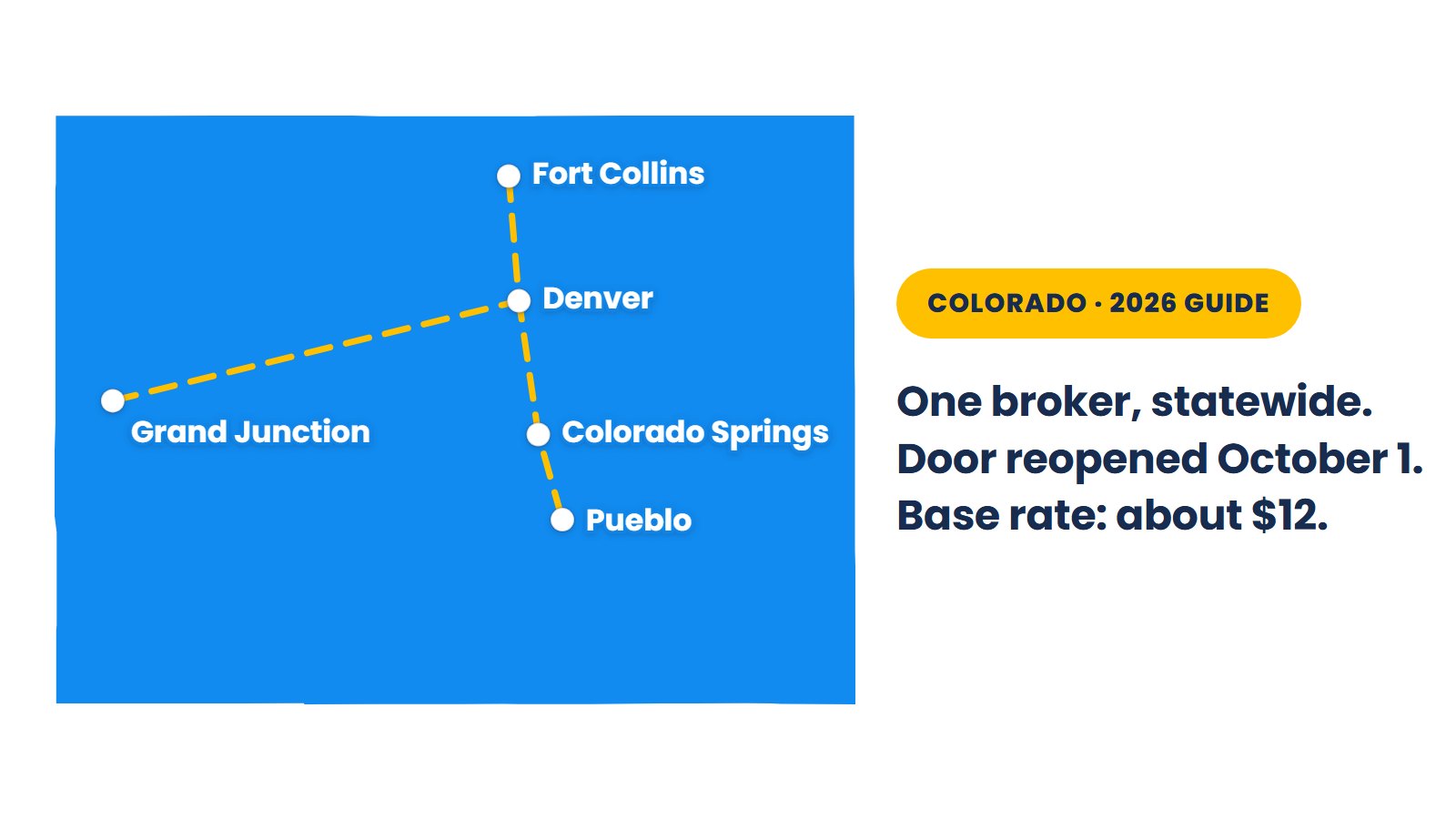
To start a NEMT business in Colorado, form an LLC, insure a wheelchair van, and carry private-pay and facility riders the week you’re covered. No state NEMT license exists: state law exempts wheelchair vans and Medicaid trips from the Public Utilities Commission. Medicaid trips take longer. Health First Colorado enrollment reopened to new companies on October 1, 2026, after a three-year freeze. Once you’re enrolled, you send one application to MediDrive, the single statewide broker, which handles your contract and the credentialing of your drivers and vehicles. Plan on $35,000 to $60,000 for a used van. First Medicaid trips come two to four months after you apply at the fastest, by my math, and outside the nine metro counties not before January 1, 2027.
Colorado at a glance:
- State NEMT license: none. Medicaid rides need Health First Colorado enrollment plus a MediDrive contract. State law exempts Medicaid trips and wheelchair vans used for wheelchair riders from PUC regulation, so a wheelchair van needs no state permit for any payer, and Medicaid and private pay aren’t mutually exclusive. Walking riders paying out of pocket are the exception: that’s a PUC common carrier or contract carrier trip. Denver licenses the company and its drivers on its own.
- Who runs Medicaid rides: MediDrive, the statewide broker, since July 1, 2026 in the nine Denver-metro counties, with statewide contracting open now and every trip through the broker from January 1, 2027. Outside the metro, providers enrolled before the reopening still bill the state directly until January 1, 2027; a company that enrolls now doesn’t get that lane.
- How you enroll: HCPF, the state Medicaid agency, reopened NEMT enrollment to new companies on October 1, 2026, after a freeze that began October 1, 2023. Apply to Health First Colorado first. NEMT is a high-risk provider type: fingerprints for every owner and a site visit. Once you’re enrolled, send MediDrive one application; its checklist asks for your state Medicaid ID, and it handles your contract and your driver and vehicle credentialing. HCPF wants credentialing finished before you enroll with MediDrive, and MediDrive lists the contract first, so ask its Provider Relations which it wants.
- Insurance the rule requires: $300,000 per person, $600,000 per accident, $50,000 property damage, from an A-rated carrier (the broker’s addition). Title 42 also tells the owner of a wheelchair-loading vehicle to file a $100,000, $300,000, $50,000 insurance certificate with the Department of Revenue; no form for it is published, so ask the DMV. PUC lanes carry $500,000 for eight seats or fewer.
- Cost to launch one van: $35,000 to $60,000 used, $75,000 and up new, mostly the van and the insurance, before three to six months of runway. State fees are under $100. No dash cameras until your sixth vehicle, unless the broker asks.
- Time to first Medicaid trips: private-pay wheelchair trips the week you’re insured; Medicaid trips two to four months after you apply, at the fastest, by my math. With three years of applicants queued, a company that applies in October more likely starts in the first quarter of 2027. Outside the nine metro counties, a new provider’s first Medicaid trip waits for January 1, 2027.
A Denver operator with three bariatric vans told me on a call in June that she’d billed Colorado Medicaid for fifteen years, never took a private-pay ride, and never needed a website. Her extra-wide wheelchair trips had paid about $260 each. Then the state corrected a billing code it had handed out itself, and the same trips paid “$12 and $34 pickups.” Her words: “they dropped my income 95%.” She had an SBA loan, one driver working six-hour days to get paid for three, and bankruptcy on the table. By late August she wrote that she’d been out of business for three months.
She wasn’t the fraud, just the person standing next to it. Colorado’s NEMT spending went from $70 million in the 2021-22 fiscal year to $303 million in 2023-24 [1]. Monthly spend peaked at about $43 million in August 2023, “largely driven by fraudulent billing,” in the words of the legislature’s fiscal analysts [2]. The state’s response landed on everyone. A freeze on new providers from October 2023 to October 2026, 64 suspensions, more than 600 blocked applicants [3], two federal indictments [4], a base rate cut from $36.40 to $12.15 [1][78]. And a new law that puts every ride through one broker and cameras in every fleet over five vehicles [6].
The guides that rank for this topic send you to DORA for a license that doesn’t exist and to the PUC for a permit repealed in 2021, and none of the three that rank first mention that you couldn’t enroll at all. The line that decides your permits here isn’t Medicaid versus private pay. It’s whether your rider uses a wheelchair.
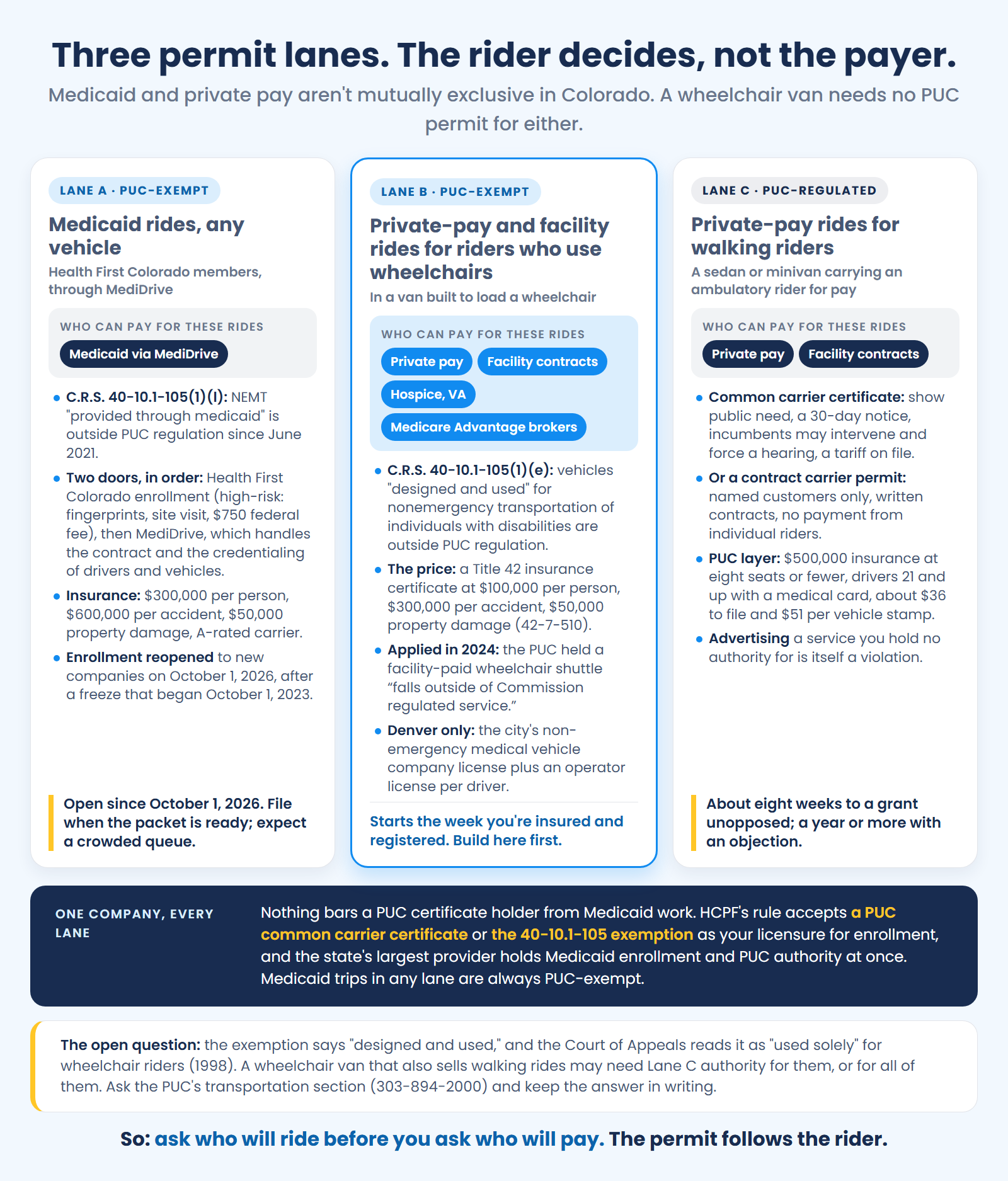
Colorado’s motor carrier law exempts nonemergency medical transportation “provided through medicaid” and “motor vehicles designed and used for the nonemergency transportation of individuals with disabilities,” a vehicle built to load wheelchairs under Title 42 [7][8][9]. And HCPF’s NEMT rule accepts that exemption as your licensure when you enroll [10]. So Medicaid and private pay aren’t mutually exclusive in Colorado, and for a wheelchair van neither one needs a permit. What needs a permit is the walking rider who pays you directly. The whole decision in one picture:
The demand is large and aging fast. Health First Colorado covered 1,210,638 people in June 2025, and people who are elderly or disabled are 15 percent of enrollment and 52 percent of the spending, per the Joint Budget Committee’s staff briefing [11]. The state demographer counted 962,147 Coloradans 65 and older in 2023, growing 3.5 percent a year, and expects 230,000 more people over 75 within ten years [12]. CMS, the federal agency that certifies dialysis and nursing facilities, lists 83 dialysis facilities and 210 nursing facilities in the state [13].
I run Duet, which builds dispatch software and runs growth services for non-emergency medical transportation (NEMT) companies, and this is the Colorado edition of our national guide on how to start a NEMT business. Confirm against the linked sources before you spend money. One reading note: HCPF’s website blocks automated readers, so where I cite its bulletins I quote them as they appear in search results, and I say so.
The one-page checklist: steps to start a NEMT business in Colorado
Ordered by what costs money if you do it out of sequence.
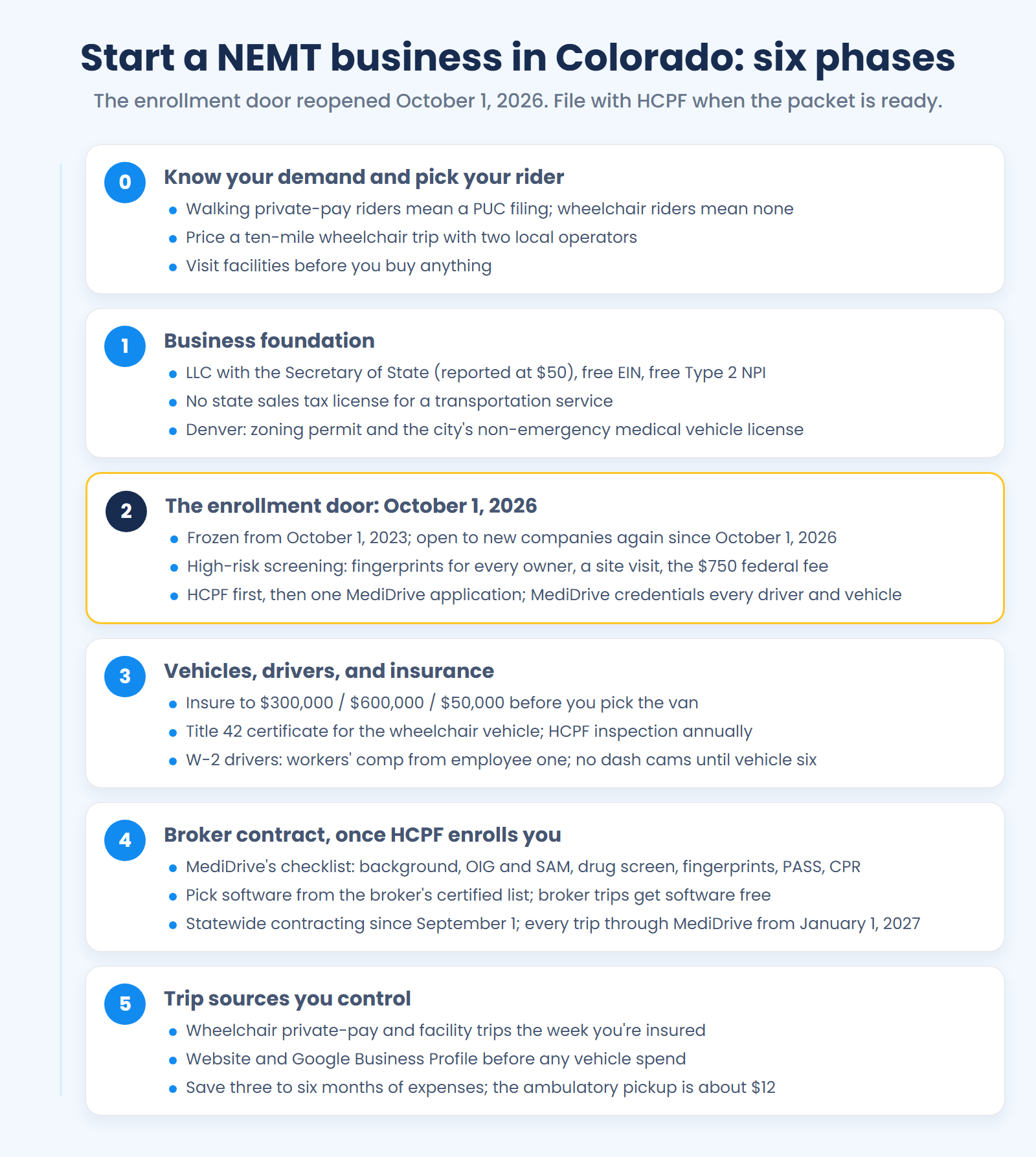
Phase 0: know your demand and pick your rider
- Decide whether you’ll carry walking riders for private pay. If yes, you’re filing with the PUC, on a 30-day notice period with incumbents allowed to object [14][15]. If your private-pay book is wheelchair riders, there’s no PUC filing at all [7].
- Call two local operators for a ten-mile wheelchair quote. Published cards run from $20 plus $3 a mile in Fort Collins to $89 plus $4.75 a mile on a Denver marketplace [16].
- Visit facilities before you buy anything. A Denver-area operator with 14 or 15 vehicles told me losing one big facility account left five or six of them sitting, and a lost VA contract cut 30 to 40 percent of his volume in a week and a half.
- Put the website and Google Business Profile up before any vehicle spend. A wheelchair-van service can take bookings the day it’s insured; a walking-rider service advertises nothing until its certificate issues, because advertising without PUC authority is itself a violation [17].
Phase 1: business foundation
- File Articles of Organization with the Secretary of State, reported at $50 with a $25 periodic report each year; the fee page couldn’t be read, so confirm [18]. A Colorado-resident member can be the registered agent for $0.
- Get the free EIN, your federal tax ID, and the free Type 2 NPI, the healthcare system’s ID for your company. MediDrive’s application asks for both plus your state Medicaid ID [19].
- No state sales tax license: Colorado taxes four categories of service and transportation isn’t one [20]. A wage withholding account is free.
- Denver only: a $20 home-occupation zoning permit if the business address is your house, and the city’s non-emergency medical vehicle company license, which the city scopes to companies based in Denver [21][22].
Phase 2: the enrollment door
- HCPF reopened NEMT enrollment to new companies on October 1, 2026, after a three-year freeze [23]. Have the packet ready before you file: insurance certificates and a site that will pass a visit, with every owner of 5 percent or more ready to submit fingerprints within 30 days of a request [10][23][24].
- Budget the federal application fee, $750 for 2026 [25], and the fingerprint fee for every owner with 5 percent or more.
- MediDrive comes second. Once your HCPF enrollment is complete, send MediDrive one application. It contacts you to finish the contract, and it credentials every driver and vehicle [23]. HCPF’s page wants credentialing finished before you enroll with MediDrive, so build the driver and vehicle files now [23].
Phase 3: vehicles, drivers, and insurance
This phase runs alongside Phase 2, and its insurance certificates go in the packet you file there.
- Buy the wheelchair van after the insurance quote, not before; agency-reported bands for a new operator’s wheelchair van run roughly $11,000 to $16,000 a year [26].
- Ask the DMV where the Title 42 insurance certificate for the wheelchair vehicle is filed, since the statute requires it and publishes no form [9]. Get the HCPF inspection, annual for any wheelchair vehicle [10].
- W-2 drivers: workers’ comp applies from the first employee, part-time included [27][28]; the 1099 question is in the insurance section.
- Skip the dash cameras until vehicle six: the camera mandate “does not apply to transportation providers operating fleets of five or fewer vehicles” [6], unless MediDrive’s manual asks for them; ask.
Phase 4: broker contracting
- MediDrive contracts statewide now; HCPF’s fiscal agent tells every existing provider to “begin contracting with MediDrive immediately” [29]. If you’re new, MediDrive’s checklist asks for a state Medicaid ID you won’t have until HCPF enrolls you, so HCPF comes first [19][23]. The per-driver and per-vehicle checklist is in the drivers section.
- Expect to pick dispatch software from the broker’s certified list. A rural transit agency counted eight platforms in June, and at least one wouldn’t demo to a fleet under 21 vehicles. The statute makes the broker supply software at no cost to you [6].
- Provider Relations: 720-844-9615 [19].
Phase 5: the trip sources you control
- Facility outreach never stops after Phase 0. In a wheelchair van you can take a facility’s private-pay trips before HCPF ever answers you.
- Free rides for friends and family in exchange for honest Google reviews, once your policy covers a passenger on the lift. Ten reviews make strangers trust you.
- Save three to six months of expenses. Broker trips pay on a schedule you don’t control, the ambulatory rate just fell by two thirds, and the enrollment queue isn’t billable time.
Who pays for NEMT rides in Colorado?
Four payers: Medicaid, facility contracts, private-pay families, and the smaller lanes covered near the end (the federal VA, hospices, workers’ comp, and Medicare Advantage brokers).
Medicaid is the volume, and the ambulatory rate just fell by two thirds
NEMT is a state-administered benefit for every full-benefit Health First Colorado member; PACE members are carved out [10]. The scale: about $25 million a month as of 2026, per the fiscal note on HB26-1328 [2]. The state’s largest provider ran about 16 percent of all trips before a settlement that ended the court fight capped it at 1,400 a day [30].
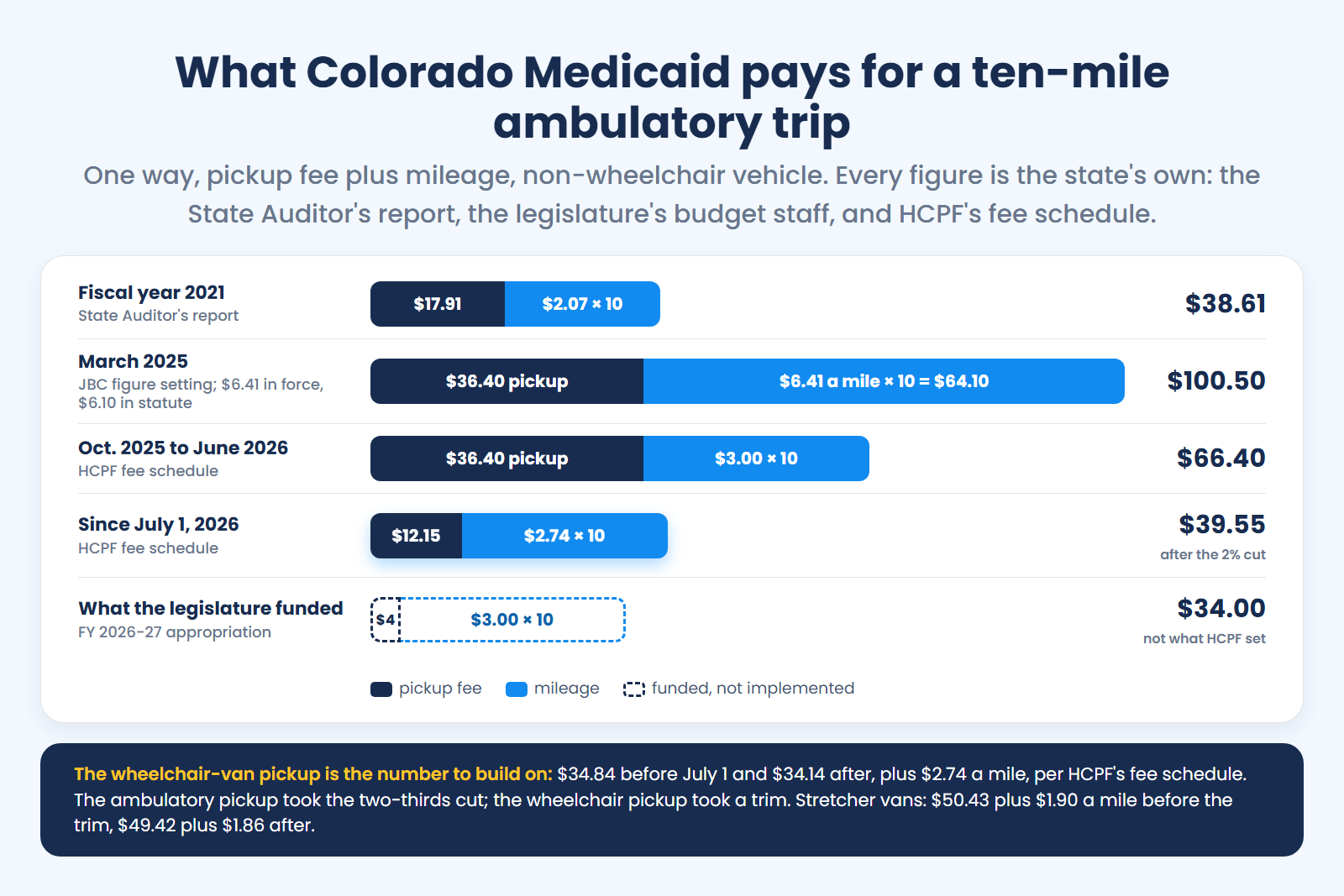
What a trip pays changed on July 1, 2026. In March the JBC’s figure-setting document put the ambulatory pickup at $36.40 plus $3.00 a mile, mileage having already been cut in July 2025 from $6.10 in statute ($6.41 as paid, after across-the-board increases) [1][31]. The legislature’s final appropriation assumed a $4.00 pickup with mileage unchanged [31]. HCPF, which sets the fee schedule, cut the pickup to $12.40 and mileage to $2.80 instead, then applied a 2 percent across-the-board cut on top, per its rate-reduction fact sheet [78]. Its posted NEMT fee schedule pays $12.15 for the ambulatory pickup and $2.74 a mile from July 1, 2026 [78]. The Grand Junction Daily Sentinel reported the pickup as “just over $12” [5]. The wheelchair-van pickup took only the 2 percent, from $34.84 to $34.14, and its mileage fell from $3.00 to the same $2.74, so a ten-mile wheelchair trip pays $61.54 [78].
In July the JBC rejected HCPF’s proposal to lift the pickup to about $19 and asked for a rural rate structure; nothing I could read has changed since [5].
Waiting time and cancellations are non-covered, and the rule bars carrying more than one member at a time except escorts, an accompanying child, or an at-risk adult [10], which is why rural operators asked the JBC for multi-loading [5]. Price your book knowing the state pays about $40 for a ten-mile ambulatory trip, and that the number may move again.
The mileage lane, and why it may not last
Colorado pays members to drive themselves or ride with family, 46 cents a mile on MediDrive’s Colorado page and 48 cents on its mileage page [32], and MediDrive runs that program in all 64 counties since July 1 [33]. HB26-1328 reclassifies NEMT as a medical service to draw a higher federal match. The bill’s first fiscal note said that change “will curtail NEMT mileage reimbursement paid directly to Medicaid members” once federal approval lands, assumed January 1, 2027; the final note dropped the line without saying why [2]. Members who lose the mileage check become your riders.
Facilities are the stability
CMS’s provider data, queried September 2026: 83 Medicare-certified dialysis facilities, 80 of them chain-owned, and 210 nursing facilities with 19,757 certified beds [13]. Jefferson and Arapahoe counties lead with 11 dialysis clinics each; Denver and Jefferson each hold 23 nursing facilities, El Paso 20, Arapahoe 19 [13]. Count the dialysis clinics as demand, not accounts: in my experience most dialysis riders are on Medicaid, so their trips come through Health First Colorado and MediDrive, not the clinic.
Private pay is the margin, and Denver price-shops
Operator-published and reported cards, as of September 2026 [16]:
- Colorado Springs: $45 to $75 per one-way wheelchair trip, from an operator that takes Medicaid and private pay.
- Fort Collins: $20 pickup plus $3 a mile; Loveland and outlying areas $30 plus $3, reported in 2024.
- Denver marketplace listing: wheelchair $89 plus $4.75 a mile, stretcher from $249.
- Grand Junction: $40 minimum plus $4 a mile, from a search listing I couldn’t open.
From my own calls this year: an Aurora owner-operator charges $55 plus $5.50 a mile for wheelchair, a Denver wheelchair-only startup $45 plus $3.50, and the 14-vehicle facility operator $72 for any pickup within 20 miles of his office plus $3.50 a mile beyond. Same ten-mile trip, a 2x spread inside one metro.
The Denver caller price-shops against Uber. We ran a two-week Google Ads pilot for that Aurora operator this spring: about $290 in spend, a stack of calls from people expecting a rideshare price, one booking. Private pay is real here, and whoever answers the phone has to explain why a lift van costs more than a Corolla.
The geography: 90 percent of the growth is on the Front Range
The state demographer projects Colorado at 7.4 million people by 2050, with 1.4 million of the 1.5 million new residents landing on the Front Range [12]. The rural map is the opposite problem. A rural mountain-town nonprofit told me it never has more than half its small fleet on the road, its drivers are retirees, and long runs to Denver appointments are routine. When a Grand Junction operator running about 600 Medicaid trips a day pulled out of Rifle, Meeker, Craig, and Gunnison in June over the rate cut, its general manager told the Sentinel “No one else would be able to afford to step in” [5].
Who is the NEMT broker in Colorado?
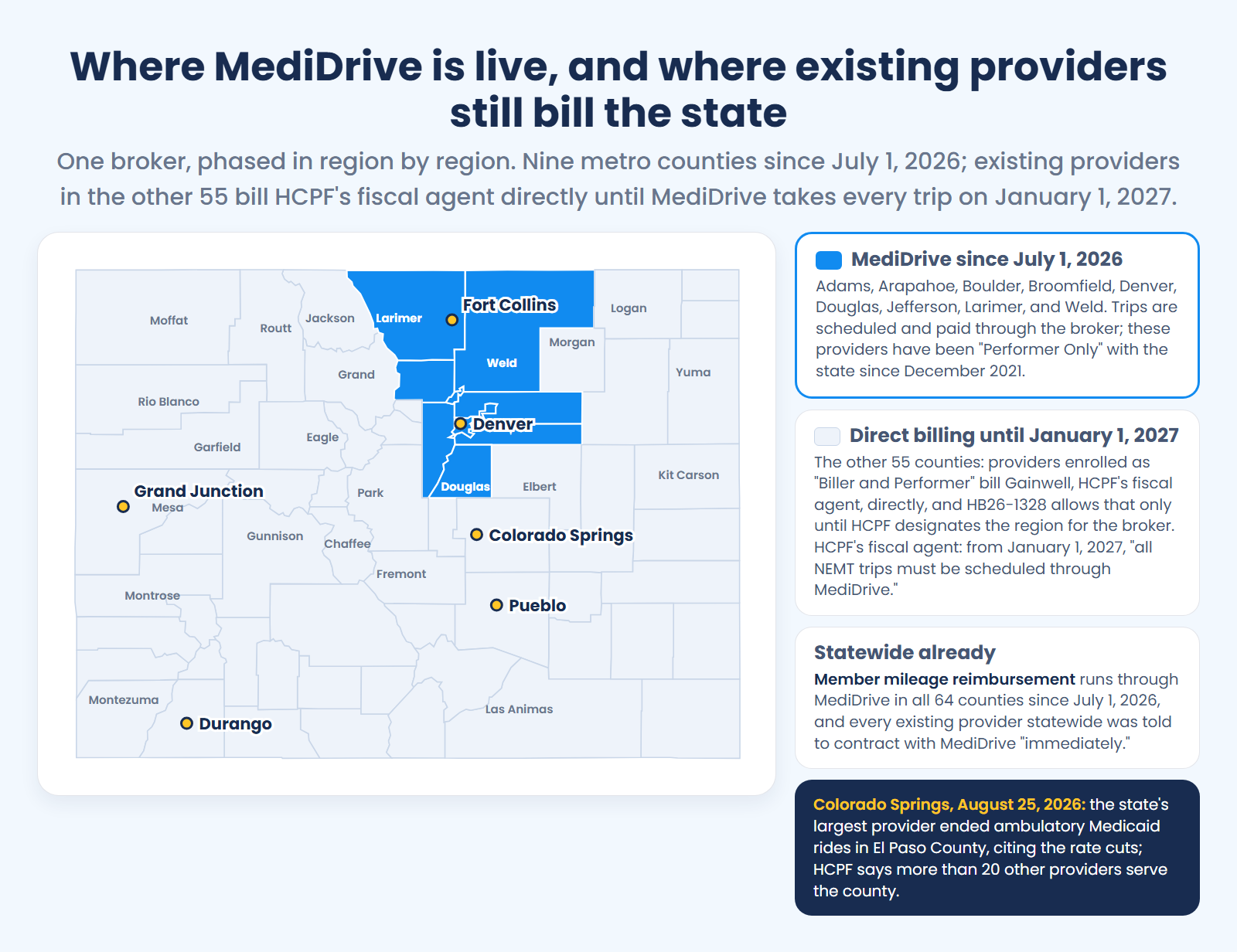
MediDrive is Colorado’s single statewide NEMT broker, live in the nine Denver-metro counties since July 1, 2026 and taking every trip in the state from January 1, 2027.
What’s live today, and what HCPF says comes next
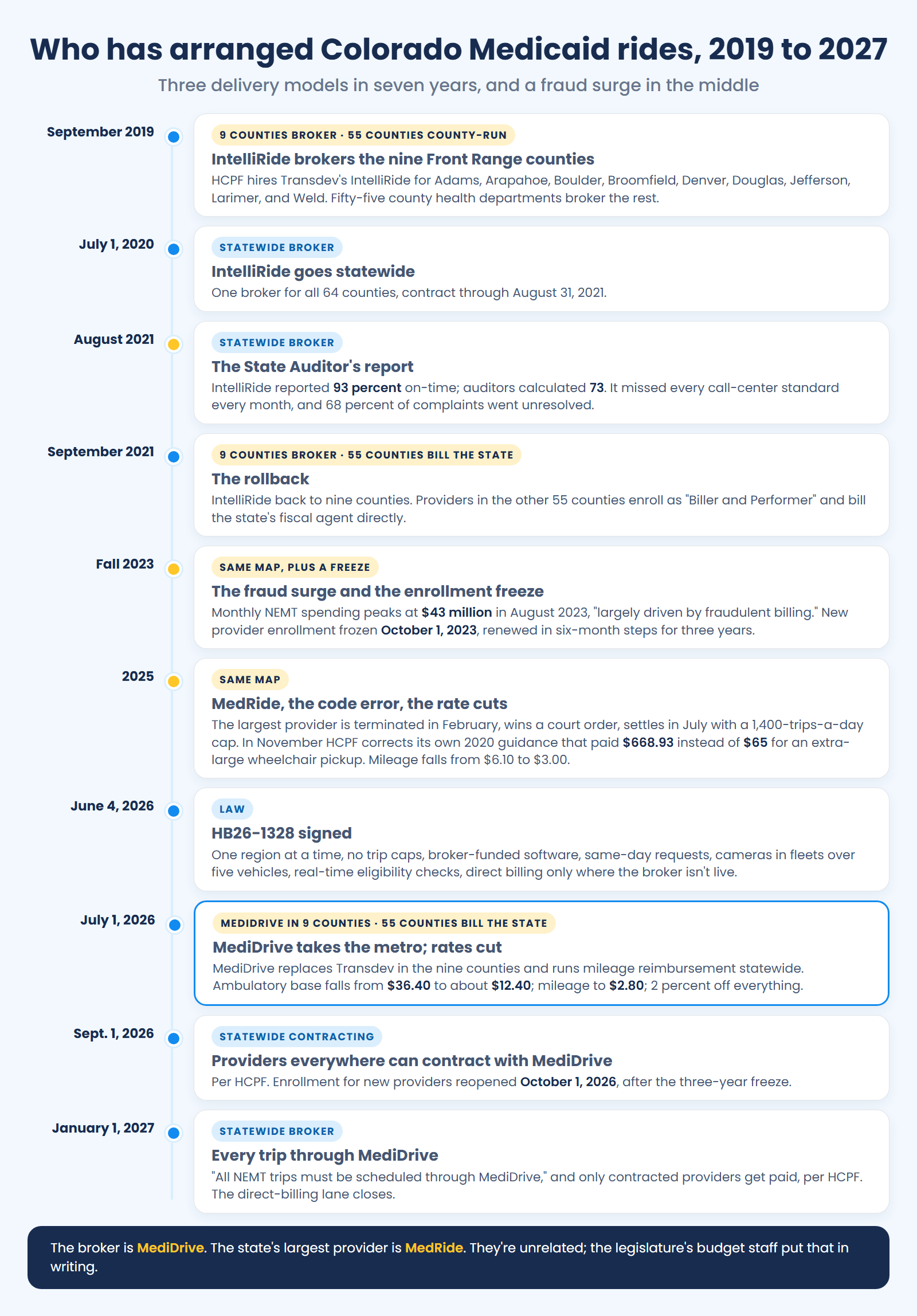
MediDrive’s own page: “Starting July 1, 2026, MediDrive is Colorado’s new partner for medical rides,” first in Adams, Arapahoe, Boulder, Broomfield, Denver, Douglas, Jefferson, Larimer, and Weld counties [33]. Transdev’s page confirms the handoff [34].
The notice HCPF’s fiscal agent posts for providers gives the dates that matter to you: “All existing Non-Emergent Medical Transportation (NEMT) providers, including those outside the nine (9) metro counties, must begin contracting with MediDrive immediately. Beginning January 1, 2027, all NEMT trips must be scheduled through MediDrive. All provider payments will go through MediDrive” [29]. HCPF’s NEMT page dates the start of statewide contracting to September 1, 2026 [23]. Not every region is live: a southwest Colorado nonprofit wrote on July 31 that MediDrive “does not provide or schedule transportation in our region at this time” [35].
The award took two tries: HCPF announced MediDrive in August 2025, the award was appealed, and a new evaluation committee picked MediDrive again around January 2026, per the JBC’s staff [30]. The same staff put in writing that MediDrive “shares a similar name but no relation to MedRide,” the state’s largest provider [30].
How Colorado got here
IntelliRide, Transdev’s brand, brokered the nine Front Range counties from September 2019 and the whole state from July 2020 [36]. The State Auditor’s August 2021 report found a real on-time rate of 73 percent against a reported 93, and 68 percent of complaints unresolved [36]. HCPF pulled IntelliRide back to nine counties that September, and providers in the other 55 have billed the state directly since [37].
The fraud surge peaked in fall 2023 [2] and HCPF froze new enrollment on October 1, 2023 [23]; HB24-1146 let it suspend any provider tied to an organized fraud scheme from February 2024 [38]. In February 2025 HCPF terminated MedRide, a Denver court blocked it, and a July settlement capped MedRide at 1,400 trips a day [30][39]. HB26-1328 was signed June 4, 2026 [40]; MediDrive and the rate cut both went live July 1.
What the new law makes the broker do
HB26-1328 rewrote the relationship [6]:
- The broker “shall not require transportation providers to pay the cost of software licensing, implementation, maintenance, upgrades, or training.”
- It “shall not restrict the number of vehicles a transportation provider can utilize or restrict the areas where or types of services a transportation provider operates,” and HCPF’s rules must bar trip caps and market-share limits except as individualized corrective action.
- It must “accept and make reasonable efforts to fulfill same-day and next-day transportation requests,” allow recurring rides, and “shall not direct members away from their preferred transportation provider,” though members can name a provider only “after all service regions have been implemented.”
- It verifies eligibility in real time at scheduling; if its information was wrong, HCPF “shall not deny payment solely because” of it, provided you followed the rules.
- It “shall not operate, own, or control an NEMT transportation provider that operates in Colorado.” Each region gets a provider toolkit from HCPF and training from the broker at least 90 days before go-live, and no new region starts until the last one is “fully implemented.”
Our broker tracker follows this switch alongside the year’s others. Colorado is the year’s second single-broker consolidation after Georgia’s April 1 move to Verida.
Is there still a moratorium on new NEMT providers in Colorado?
No. HCPF’s NEMT page says the moratorium has expired and that “Beginning on October 1, 2026, new NEMT provider enrollment is available” [23]. HCPF had blocked new NEMT provider enrollment since October 1, 2023 under a CMS-approved moratorium renewed in six-month steps [23][41][42]. For a new company the order is Health First Colorado first, then one application to MediDrive, which contacts you to finish the contract; the enrollment section has the steps [23]. The wheelchair-van lane never waited on HCPF, and it still doesn’t.
What the freeze was for
The fiscal analysts’ summary: “billing for transportation services that were not provided, overstated mileage or trip distances, and claims submitted without sufficient documentation,” peaking at $43 million a month in August 2023 [2]. HCPF called it “the fraud event in the fall of 2023” [30]. The mechanics, per a Colorado Springs station in 2024: riders hauled to distant Denver clinics instead of nearby ones, multiple riders billed per trip, member IDs used to bill rides that never happened [43]. By February 2026 the state counted 64 providers suspended and more than 600 applicants blocked [3], and between July and November 2025 HCPF denied $8 million in claims across 105 providers [2].
Two operators are under federal indictment. One is accused of billing more than $1 million, including $450,000 for rides of 400-plus miles per patient per day; the other about $3.3 million, including $165,000 billed for one member’s rides after that member had died [4]. Neither case has a public outcome yet.
An owner-operator in Aurora told me she started her company in 2022 and has never billed Colorado Medicaid: the broker wasn’t taking new providers, then the state froze enrollment. “Everything is behind the door.”
What’s permanent
- High-risk screening. Fingerprints for every owner with a 5 percent stake and a pre-enrollment site visit, as in the enrollment section [24]. Federal rule adds that anyone blocked by a moratorium who applies within six months of its end is screened as high risk regardless [42].
- The trip log. Since October 1, 2024 every ride goes on HCPF’s standardized trip log, submitted with the claim and signed by the member or escort, per HCPF’s page as it reads in search results [23]. Missing signatures, dates, and times were among the deficiencies cited in MedRide’s corrective action plan [39].
- The 25-mile form. Since May 1, 2024, per HCPF’s page as it reads in search results, a trip over 25 miles one way needs the medical provider’s verification form [23], and the rule sends members to the closest provider within 25 miles [10].
- Payment withholding on a credible allegation. HCPF can withhold payments without warning, sending notice within five days after the fact, and demand original source documents including provider and patient signatures [44].
- The camera and the dispatch record. Fleets over five vehicles need two-way video dash cameras. Every provider, or the broker, will need a digital dispatch system. It must be one that “automatically records pick-up and drop-off addresses, GPS coordinates, times of pick-up and drop-off, routes driven, miles driven, and the driver and vehicle that performed the trip,” once HCPF writes the rule the statute orders [6].
Our cofounder Jing tells the Colorado version on our podcast: a rider says take me to Walmart, the driver says that’s not authorized, and the rider answers that last week’s driver did it [45].
Can I bill Health First Colorado directly for NEMT rides?
Not as a new company. If you enrolled before the October 1, 2026 reopening, you can bill Health First Colorado directly only where MediDrive isn’t live yet, and only until it is. Since the 2021 rollback, providers in the 55 non-metro counties are enrolled as “Biller and Performer” and bill the state’s fiscal agent, Gainwell, directly. Metro providers were set to “Performer Only” on December 14, 2021 and have gone through the broker since [37].
HB26-1328 keeps the direct lane open exactly that long: providers in regions HCPF hasn’t yet designated “may continue to provide transportation services and bill the state department directly.” After designation, “Direct billing outside of these circumstances is not permitted”; the circumstances are a region’s implementation window and a broker termination [6]. HCPF’s fiscal agent already tells providers outside the metro that from January 1, 2027 “All provider payments will go through MediDrive” [29]. A company that enrolls after the reopening doesn’t get that lane. HCPF says new providers serve the nine metro counties once contracted with MediDrive and credentialed, and any county from January 1, 2027 [23].
What the state pays, and what it paid
The FY2021 fee schedule in the State Auditor’s report: mobility vehicle $17.91 base plus $2.07 a mile, wheelchair van $31.72 plus $1.05, stretcher van $45.91 plus $1.73 [36]. The state raised mileage to $6.10 in July 2022, and spending quadrupled [1]. In July 2025 it cut non-ambulance mileage to $3.00 and raised wheelchair-van mileage from $1.19 to the same $3.00 [31].
Then it found its own 2020 billing guidance had metro providers billing an extra-large wheelchair pickup at $668.93, the specialty ambulance code, instead of $65. The November 2025 correction is worth $60.5 million a year [30]. Then came the July 1, 2026 cuts to $12.15 and $2.74 [78]. Stretcher vans went from $50.43 plus $1.90 a mile to $49.42 plus $1.86 the same day [78].
Whether MediDrive passes the state schedule through or pays its own rate is stated nowhere I could read. The old metro broker passed the full state payment through [37], the broker sits on a fixed-rate contract [1], and the statute gives HCPF the payment standards [6], so I’d expect pass-through. Ask Provider Relations, in writing.
Arizona keeps a permanent direct-billing lane, so does North Carolina, Virginia never had one, and Minnesota pays every wheelchair and stretcher trip directly with no broker in the lane. Colorado’s closes to every provider for trips on or after January 1, 2027 [23].
What licenses and requirements does a NEMT business need in Colorado?
Colorado has no state NEMT license. The layers: Health First Colorado enrollment plus a MediDrive contract for Medicaid work, PUC authority only for walking private-pay riders, and Denver’s own company and driver licenses if you’re based there. The Medicaid Client Transport permit the internet still describes was repealed by HB21-1206, signed and effective June 29, 2021 [8].
The claims you’ll read elsewhere, against the sources
| The claim you’ll read elsewhere | What Colorado actually requires |
|---|---|
| ”Obtain a business license from the Colorado Department of Regulatory Agencies (DORA)“ | No such license. The Secretary of State registers the entity; DORA’s PUC exempts wheelchair vans and Medicaid trips [7]. |
| ”The Colorado PUC will issue the transport permits you need” / “apply for a Medicaid Client Transport (MCT) permit” | Repealed in 2021. HB21-1206 struck the permit and moved oversight to HCPF [8]. |
| ”IntelliRide is the transportation broker” / “credential with Transdev” | MediDrive replaced Transdev on July 1, 2026 [33][34]. |
| ”MTM Health is Colorado’s broker” | It never was. County departments, then IntelliRide, then MediDrive [36][33]. |
| ”General liability ($100,000) and automobile liability ($25,000 per person / $50,000 per accident / $25,000 property damage)“ | HCPF’s rule: $300,000 per person, $600,000 per accident, $50,000 property damage [10]. Colorado’s personal-auto floor is 25/50/15, and it isn’t the provider floor. |
| ”Colorado requires $500,000 combined single limits for NEMT vehicles” | Transdev’s old contract term and the PUC’s tier for its own carriers [34][46]; HCPF’s rule is 300/600/50 [10]. |
| ”Drivers must be 21+ (25+ for many brokers) and hold a Chauffeur / Class D or CDL license” | HCPF’s floor is 18 with a standard Colorado license [10]. No chauffeur class exists. 21 is the PUC’s rule for PUC carriers only [47]. |
| ”Estimated NEMT annual expense: $9.3 million, 642,804 trips” | A 2013 estimate from a federal transit research profile [48]. Spending is about $25 million a month [2]. |
| ”Ambulatory ~$30 base + $2 to $6 per loaded mile” | $36.40 plus $3.00 in March 2026, cut to $12.15 and $2.74 on July 1 [1][78]. |
| Silence on the moratorium | New enrollment was frozen from October 1, 2023 and reopened to new companies on October 1, 2026 [23]. |
| ”Medicaid fee-for-service: direct reimbursement for eligible trips” | Only in undesignated regions, and only for providers enrolled before the October 1, 2026 reopening; statute bars direct billing otherwise, and HCPF ends it for trips on or after January 1, 2027 [6][23]. |
| ”Uber Health is a Colorado NEMT option” | Rideshare may take a trip only when the assigned provider fails and no enrolled provider is available, documented by the broker [6]. |
Which PUC lane does your rider put you in?
The PUC’s motor carrier statute regulates anyone carrying passengers for compensation, then lists what it doesn’t reach [7]. Two exemptions carry this business.
Medicaid trips, any vehicle. Paragraph (l): “transportation by motor vehicles when those motor vehicles are being used for nonmedical transportation and nonemergency medical transportation provided through medicaid pursuant to section 25.5-1-802” [7]. HB21-1206 added it and handed safety oversight to HCPF [8]. A Medicaid-only provider files nothing with the PUC.
Wheelchair riders, any payer. Paragraph (e): “transportation by motor vehicles designed and used for the nonemergency transportation of individuals with disabilities as defined in section 42-7-510 (2)(b)” [7]. That definition is a vehicle “designed to facilitate the loading of individuals with physical disabilities confined to a wheelchair” [9]. The exemption has a price in the same section: before operating, the owner files a certificate of insurance at $50,000 property damage, $100,000 per person, and $300,000 per accident with the Department of Revenue, and skipping it is a class A traffic infraction [9]. No DMV form implements that filing that I could find; ask the DMV.
The PUC applied the exemption to a facility-paid service in October 2024. Reviewing MedRide’s Mesa County application, the commissioners held that its medical shuttle for a PACE program “falls outside of Commission regulated service under subsections (e) and (l),” leaving only non-Medicaid hospital rides to regulate [49].
Walking riders who pay you. A sedan or minivan carrying an ambulatory private-pay rider is a for-hire passenger trip, and the statute says nobody may “operate or offer to operate as a common carrier in intrastate commerce” without a PUC certificate of “public convenience and necessity” [14]. Two routes:
- Common carrier certificate. The PUC posts a 30-day notice, and existing carriers may intervene and force a hearing before an administrative law judge. For non-taxi call-and-demand service the legislature’s own staff call the standard “regulated monopoly,” where “a new entrant must prove a public need and that existing services are substantially inadequate” [15]. Unopposed, one 2025 application went from filing on October 10 to a grant on December 5 and a certificate on April 1 [50]. You file a tariff and charge only those rates, you insure to $500,000 for eight seats or fewer [46], and from August 12, 2026 the PUC must act within the statute’s clocks or the application “constitutes an approval” [51].
- Contract carrier permit. For named customers under written contracts, no payment from individual riders, rates no lower than a common carrier’s [14]. The state’s largest NEMT company filed for one in Mesa County in September 2024, drew an intervention from the local taxi company, settled, and got its permit in December 2025 [52].
Filing fees are small, $36 plus $51 per vehicle stamp per year, from PUC pages I could read only in search results [53]. The cost is the clock and the objection risk.
The trap between the lanes. The wheelchair exemption says “designed and used.” In 1998 the Court of Appeals agreed with the PUC that an exempt vehicle “must be designed to transport individuals confined to wheelchairs, and actually must be used solely to transport such individuals”; the case was about wheelchair-equipped casino buses carrying the public [54]. So a wheelchair van that also sells walking rides needs PUC authority for those rides, and maybe for all of them. The PUC’s rules are split on whether holding authority pulls your exempt vans into its stamp, inspection, and 21-and-up driver rules [55]. That’s question one for the PUC’s transportation section at 303-894-2000, in writing.
One company, every lane. HCPF’s rule lists “PUC common carrier certificate as a Taxicab” and “Exemption from licensure requirements in accordance with PUC statute at C.R.S. § 40-10.1-105” as equally valid licensure for enrollment [10]. MedRide holds Health First Colorado enrollment, a common carrier certificate, and a contract carrier permit at once [52][49]. The PUC’s July 2024 list shows one other medical-transport carrier with an active common carrier certificate, Heart & Soul Paratransit in Fort Collins; three other medical names on it sit on its cancelled or revoked pages [56]. Verify any carrier at the PUC’s permit search.
What operating without authority costs
Operating without a required certificate or permit is a class 2 misdemeanor [17]. Civil penalties run up to $1,100 per violation, each day a separate violation, up to $11,000 for driving without the required insurance, and $500 for advertising a service you hold no authority for. They can double for a repeat within 24 months and triple for a third [17]. Under the PUC’s rules, “Advertising to provide transportation service … is an offer to provide the advertised service” [17]. So the website for a walking-rider service goes up as a launch page.
The Denver license nobody mentions, and almost nobody holds
The City and County of Denver licenses a “Non-emergency medical vehicle company” under Chapter 17 of its municipal code: $100 application, $50 license, $30 per vehicle, renewed annually [21]. It wants a zoning use permit, a CBI name check, and insurance of at least $100,000 per person, $200,000 per accident, and $50,000 property damage [21]. Each driver holds an operator license, $25 plus $25, with a physical within 60 days or a DOT card, CPR and first-aid cards, and a CBI check [21]. The driver page says “class A driver’s license”; the health board’s rules under the same chapter ask only for “a valid Colorado driver’s license,” so treat class A as a page error until Licensing says otherwise [57].
Two things the pages don’t say. The city’s public health department scopes the license to companies “based in the City and County of Denver” [21]. The 2007 rules define a non-emergency medical vehicle as one equipped “to transport sick or disabled persons and to provide non-emergency medical service,” a phrase they never define [57]. And the city’s own license roll, updated August 1, 2026, shows one active non-emergency medical vehicle company license in the whole city, against four ambulance companies and eleven secure-transport companies [58]. Call Denver 311 (720-913-1311), ask for Licensing and Consumer Protection, and keep the answer.
Denver also charges the occupational privilege tax, $9.75 a month per employee earning $500 or more in the city and $4 a month per owner [59]. The $20 home-occupation permit is personal to the resident, not the LLC, and the zoning code won’t allow “commercial parking” as a home occupation, so ask where the van sleeps [22].
Elsewhere the layer is thinner. Aurora requires a general business license of anyone doing business or employing people in the city; Colorado Springs publishes a closed list of twelve licensed business types with no vehicle-for-hire or medical-transport category; Fort Collins’ clerk licenses liquor and marijuana and nothing else [60]. Grand Junction and Lakewood use a sales tax license as their business registration. No county I checked licenses wheelchair NEMT; counties touch only ambulances, through an optional authorization now that CDPHE issues the license [61].
Thresholds that don’t reach a wheelchair van
No CDL below 16 passengers including the driver or 26,001 pounds [62]. No intrastate USDOT number: Colorado’s own commercial vehicle line is 16,001 pounds or 16 passengers, not the federal 10,001 [63]. Cross a state line for pay and the federal rules start at 10,001 pounds or nine passengers. Emissions testing applies in the nine-county Front Range program area, $35 every two years for a gasoline vehicle over seven model years old (four for diesel) [64].
What are the NEMT insurance requirements in Colorado?
The broker bar and the state rule are the same number
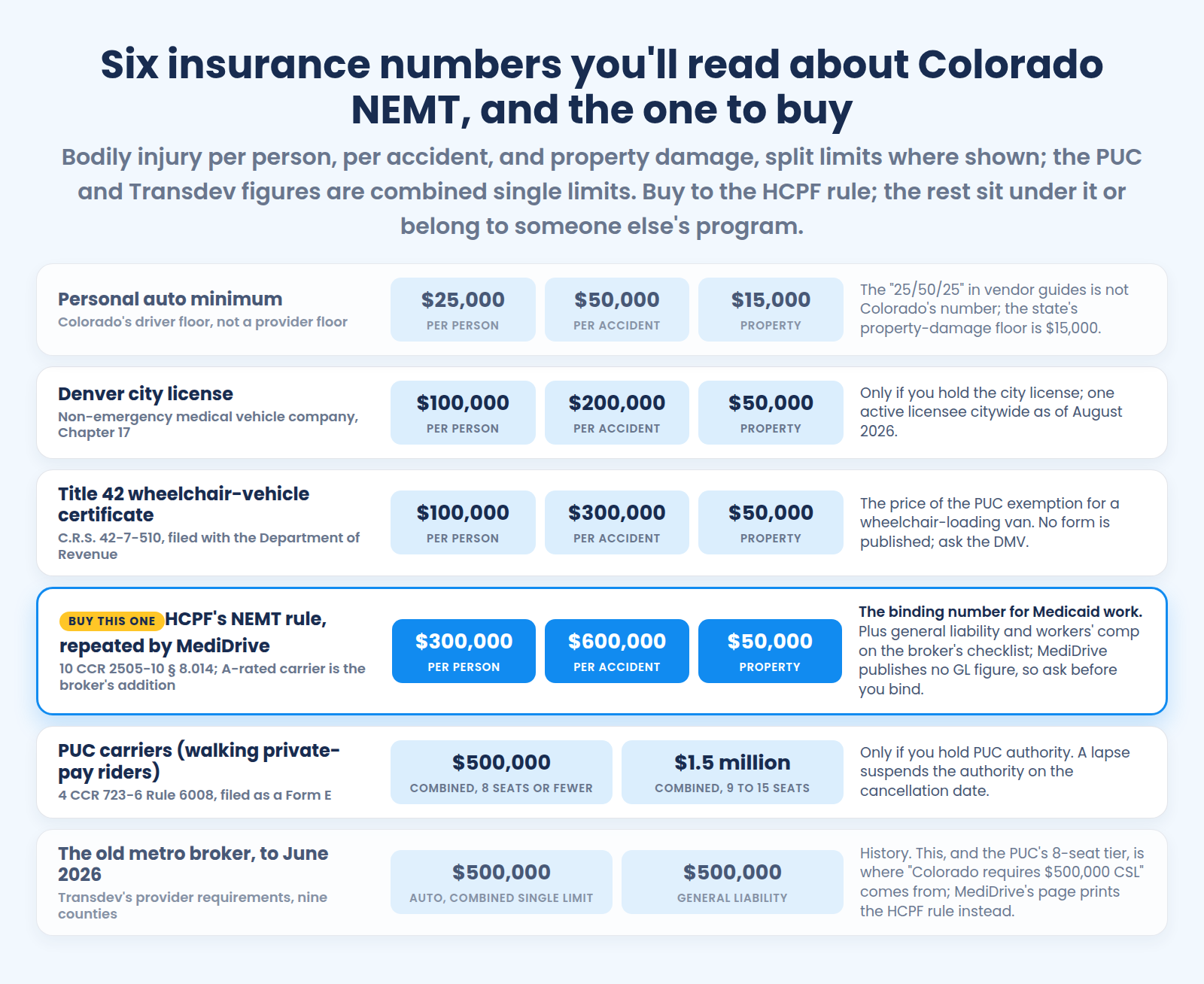
Plan on $300,000 per person and $600,000 per accident in bodily injury liability plus $50,000 property damage, from an insurer rated A or better. The dollar figure is in HCPF’s NEMT rule [10] and repeated word for word on MediDrive’s provider page, which adds the A rating and lists general liability and workers’ comp [19]. The broker it replaced asked for more: Transdev wanted $500,000 combined single limit on the auto policy and $500,000 general liability, with the broker and HCPF as additional insureds [34]. MediDrive publishes no general liability figure. Ask before you bind.
The two floors underneath
Two statutes sit below the rule. The wheelchair vehicle’s Title 42 certificate, $100,000 per person, $300,000 per accident, and $50,000 property damage, is lower than the Medicaid rule, so the rule governs a Medicaid provider [9]. Keep the certificate in the van; the DMV filing question is in Phase 3. If you hold PUC authority for walking riders, the PUC’s floor is $500,000 for eight seats or fewer and $1.5 million for nine to 15, filed by your insurer as a Form E. A lapse suspends your authority on the cancellation date [46].
What it costs
All agency-reported, none official, none Colorado-specific. One specialist agency’s March 2026 bands: ambulatory vehicles $4,200 to $7,500 a year, wheelchair vans $6,800 to $12,000, stretcher vans $10,000 to $18,000, general liability $800 to $1,500, workers’ comp $1,200 to $2,500 per driver, with new operators paying 30 to 50 percent more [26]. A Denver wheelchair-only startup told me on a call it pays about $1,200 a vehicle a month. Our insurance guide covers what to ask an agent.
Where the 25/50/25 number comes from (not Colorado)
Personal-auto folklore, and not even Colorado’s: the state’s personal-auto minimum is $25,000 per person, $50,000 per accident, and $15,000 property damage. Every guide quoting a $25,000 property-damage figure for Colorado is quoting something other than Colorado law.
Workers’ comp starts at employee one
Colorado requires workers’ comp from the first employee, part-time included [27][28], with fines up to $250 a day for a first violation and $250 to $500 a day after [27]. The independent-contractor test asks whether the driver is “free from control and direction” and “customarily engaged in an independent trade,” a written contract needs notarizing to earn a presumption, and since August 2025 misclassification fines run $5,000 to $50,000 per violation [65].
Then HB26-1328 hands providers, as against the broker, “sole authority over driver scheduling, vehicle dispatching, and driver management” [6], the opposite, by my reading, of what a 1099 relationship needs. Add the state minimum wage, $15.16 for 2026 as the state’s pay order reads in search results (Denver $19.29) [66], daily overtime after 12 hours, and paid sick leave at one hour per 30 worked. Then the FAMLI premium, 0.88 percent of wages with the employer half waived under ten employees, per FAMLI’s page as it reads in search results [67]. Run W-2 drivers.
What do NEMT drivers need in Colorado?
NEMT drivers in Colorado don’t need a CDL for a wheelchair van; the line is 16 passengers including the driver or 26,001 pounds [62]. Below that, four layers set the driver file: HCPF’s rule, the broker, the PUC if you hold its authority, and Denver if you’re based there.
The rule layer is the driver file
HCPF’s NEMT rule, as amended through September 2024 [10]:
- At least 18, with a valid Colorado license and at least one year of driving experience.
- A seven-year motor vehicle record.
- A Colorado or national criminal history check and state and national sex-offender checks, before hire and annually.
- A 10-panel drug screen before hire and every year after.
- Certification in CPR and in naloxone administration.
- Disqualifiers include any Class 1 or 2 felony, crimes of violence or substance-abuse convictions within seven years, a DUI within two years, and any sexual offense against a child.
Trips by “noncompliant or noncredentialed drivers or in noncompliant or noncredentialed vehicles are not eligible for reimbursement,” by statute [6].
What the broker adds
MediDrive’s per-driver list: license and motor vehicle report, national criminal and sex-offender checks, OIG and GSA/SAM exclusion checks, a current drug screen, fingerprint verification, training in PASS (the standard rider-handling course), wheelchair securement and defensive driving, and First Aid/CPR/AED. Per vehicle: registration, inspection, and the liability policies [19]. The old broker’s bar was 20 years old with five years of driving; the rule’s floor is 18 with one. Build every file to the broker’s list, since the statute lets it impose “additional credentialing, training, or safety requirements” [6].
The vehicle checklist
The rule keys inspections to age: none for a vehicle five years old or newer, every 24 months at six to ten years, annually at eleven and up. Any wheelchair vehicle is inspected annually regardless of age, by an independent Colorado repair shop to the PUC’s standard [10]. HCPF’s page, as it reads in search results, says MediDrive schedules virtual inspections since July 1, with an in-person inspection after any accident [23].
Securement follows the federal standard: the chair moves no more than two inches in any direction, with a lap belt and shoulder harness at every securement position [68]. Expect the old broker’s on-board list, approved wheelchair straps, a full first-aid kit, a GPS device, and two-way communication [34], until MediDrive publishes its own. Denver adds its own operator license with a physical or DOT card [21].
The PUC layer, only if you hold PUC authority
PUC-regulated carriers need drivers 21 or older with a medical certificate valid no more than two years, an annual driving-record review, and 12 consecutive on-duty hours as the daily ceiling [47]. Fingerprint checks attach to taxi and limited-regulation carrier drivers (limousine, charter) and, from August 12, 2026, to contract-carrier drivers [51]. None of it reaches an exempt wheelchair van.
MediDrive’s form asks whether you use dispatch software; a brand-new Aurora provider called me in June because of it. Its own trips ride on software it must supply free [6]; what you buy is for private-pay and facility work. Our dispatching guide covers that choice.
Can a NEMT company run stretcher van trips in Colorado?
Yes, inside a carve-out the ambulance law writes out in plain words, and illegally the moment care is given en route.
The exemption
Since July 1, 2024, no one may operate an ambulance service without a license from CDPHE, the state health department; operating without one is a petty offense with civil penalties up to $500 per violation or per day [61]. The same section exempts “a vehicle used or designed for the scheduled transportation of convalescent patients, individuals with disabilities, or individuals who would not be expected to require skilled treatment or care while in the vehicle” [61], and CDPHE’s rule repeats the exemption [69].
HCPF’s rule defines a stretcher van as “a vehicle that can legally transport a member in a prone or supine position when the member does not require medical attention en route” and pays it on its own codes [10].
So: scheduled, stable, no treatment or monitoring. “Scheduled” and “skilled treatment or care” aren’t defined, passenger-owned oxygen isn’t addressed, and CDPHE publishes no stretcher-van guidance I could read. Two more edges. The statute’s word is “convalescent,” and a hospice patient isn’t convalescing, so the hospice lane rests on the “skilled treatment or care” clause alone. And the carve-out is from the ambulance law, not the motor carrier law: a private-pay stretcher rider isn’t “confined to a wheelchair,” so a strict reading puts that trip outside both PUC exemptions. Put the no-care line in your dispatch protocols, and get CDPHE’s reading in writing (cdphe_groundambulance@state.co.us), and the PUC’s.
What being an ambulance costs
A CDPHE ground ambulance license runs two years. Every transport carries at least one Colorado-certified EMS provider plus a driver, vehicles are built to a national ambulance standard and permitted individually, and a Colorado-licensed physician is the medical director. Owners are fingerprinted, and general liability must at least equal the damage caps in the state’s governmental immunity act [69]. The rule’s fee section still reads “Reserved”; the 2022 fiscal note estimated a $725 license fee [61].
The economics
FY2021 rates paid a stretcher van $45.91 plus $1.73 a mile against $130.97 for a BLS non-emergency ambulance [36]. A Denver marketplace lists private stretcher rides from $249 plus $4.75 a mile [16]. Hospices pay for moves once a patient has elected hospice: Medicare’s manual makes transports “related to the terminal illness and which occur after the effective date of election” the hospice’s responsibility [70]. The VA pays for a “special mode of transportation” that includes vehicles “specially designed to transport disabled persons” when VHA approves it in advance as medically required [71]. Other states decided this differently: Texas makes non-EMS stretcher work a crime, Florida allows stretcher vans by statute, Virginia never decided.
How do you become a Health First Colorado NEMT provider and get MediDrive work?
You enroll with Health First Colorado, open to new companies again since October 1, 2026, then send MediDrive one application. MediDrive handles your contract and your driver and vehicle credentialing, and you hold HCPF and the broker to the statute’s clocks.
Step one: Health First Colorado enrollment, open since October 1
Enrollment runs through the Provider Web Portal operated by Gainwell, the state’s fiscal agent. NEMT applicants are screened at the “high” risk level: fingerprint-based background checks for every person with a 5 percent or greater ownership or control interest, a site visit, revalidation at least every five years, and the federal application fee, $750 for 2026 [24][25]. Your licensure line is either a PUC certificate or the exemption [10].
Step two: one application to MediDrive
HCPF puts its own enrollment first: “Once your HCPF enrollment is complete, providers can submit their MediDrive enrollment application.” Send one application per company; MediDrive contacts you to finish the contract [23]. MediDrive has managed driver and vehicle credentialing statewide since July 1, 2026, with the records in the ProCredEx system, and a driver or vehicle that fails credentialing can’t carry Health First Colorado riders [23]. HCPF and MediDrive don’t agree on when credentialing happens: HCPF’s NEMT page says to finish it in ProCredEx before you enroll with MediDrive, while MediDrive’s onboarding checklist in HCPF’s September 15 webinar puts the contract first [23]. Ask MediDrive’s Provider Relations which it wants first, and build every driver and vehicle file to MediDrive’s list in the meantime; the list is in the drivers section [19].
MediDrive’s Colorado page lists the business documents (W-9, state Medicaid ID, NPI) and limits joining to providers already registered with HCPF [19]. Contracting for existing metro providers opened in May, per a dispatch vendor’s post, and HCPF’s fiscal agent now tells every existing provider in the state to contract “immediately” [23][29]. Pay is bi-weekly, the network is non-exclusive, and the broker may not restrict your vehicle count or service area [19][6]. The statute also owes you 30 days’ notice from HCPF before any new billing or documentation requirement, on top of the 90-day toolkit and training [6]. Hold HCPF and the broker to them.
How long does it take?
HCPF’s enrollment page says its fiscal agent averages eight business days on a new application [23], but NEMT’s high-risk screening is the slow part. My math, and it’s a floor. Fingerprints run about 30 business days by one billing firm’s account, a site visit gets scheduled after that, and MediDrive’s contract and credentialing follow, so first Medicaid trips land two to four months after you apply at the fastest. With three years of applicants queued, a company that applies in October more likely starts in the first quarter of 2027. Outside the nine metro counties, January 1, 2027 is the earliest a new provider can take a Medicaid trip anyway [23].
Start with the payer that doesn’t need a queue
A wheelchair van can carry private-pay and facility riders the week it’s insured, registered, and, in Denver, city-licensed. For facilities already contracted out, my script: be the Sunday and after-hours backup, take a couple of trips, and prove it. Our guides on winning facility contracts, the first trip from a facility meeting, and private-pay guide cover this stretch.
Don’t build the whole schedule on one payer
The state cut the ambulatory rate by two thirds, and the operators who left were the biggest
The three-van operator in the open isn’t an outlier. The owner of a 16-vehicle Denver-area fleet running 300 trips a day told me in May that the new requirements landed together, dispatch software, dash cams, tracking, different insurance, “at the same time, they took away our money.”
The same Grand Junction operator by late July kept only dialysis and chemotherapy runs. Its general manager told a Grand Junction station: “One rate was cut 50% a year ago. The other rate in this program was cut 66% this July 1” [5]. On August 25 the state’s largest provider ended ambulatory Medicaid rides in El Paso County, citing the cuts; HCPF answered that more than 20 other providers serve the county [72]. Colorado Medicaid is a single payer with a single broker and a rate the state resets once a year. I won’t give you a safe percentage, because there isn’t one.
The hedges Colorado hands you
- The wheelchair exemption. No PUC gate on private-pay or facility wheelchair work, which is why it belongs on day one [7].
- Facilities. 210 nursing facilities [13]. The Denver-area operator with 14 or 15 vehicles bills facilities almost exclusively: “they pay more in Mississippi than they do Colorado,” he said of Medicaid on our call.
- Denver’s transit agency. RTD’s Access-on-Demand pays a $20 subsidy per trip, 60 trips a month per eligible rider, through Uber, Lyft, and two local ride providers [73]. A local contract is a real payer.
- Medicare Advantage brokers. Both the Aurora owner-operator and the Denver wheelchair startup told me a Medicare Advantage broker was their first broker payer while Medicaid was closed. The startup gets 70 percent of its revenue from that one broker, which its founder calls “not sustainable.”
- Hospice and the VA. Covered in the stretcher section [70][71].
Both halves of the broker argument
I’ve told operators that an all-cash private-pay base is a better way to build than working with brokers, because reimbursements are thin and insurance runs heavier. The other half: Medicaid is where the volume is, the new law bars trip caps and vehicle limits and gives you the software free [6], and a state that just purged 64 providers and blocked 600 applicants has a thinner network than it needs. A rural transit nonprofit told me its Medicaid trips fund the local match on its federal transit grant. Brokers aren’t villains here, and no single payer should own your schedule.
Whatever the mix, keep it in one system. Duet merges broker trip files with your facility and private-pay bookings, so broker trips and your own phone land on one schedule.
How much does it cost to start a NEMT business in Colorado?
Plan on $35,000 to $60,000 to put one used wheelchair van on the road legally, and $75,000 or more with a new conversion; the van and the insurance dominate the line items below. Add the three to six months of runway the Medicaid queue demands, roughly $15,000 to $35,000 for one van and one driver by my math, and the real number is $50,000 to $90,000.
The line items
| Line item | What it costs |
|---|---|
| LLC formation | Reported at $50 to file, $25 a year; the Secretary of State’s fee page couldn’t be read [18] |
| Registered agent | $0 if a Colorado resident serves |
| EIN and NPI | Free |
| State NEMT license | $0. None exists [7] |
| PUC authority for a wheelchair van | $0. Exempt for any payer [7] |
| PUC authority for walking private-pay riders | About $36 to file plus $51 per vehicle per year; the real cost is the 30-day notice and any objection [53] |
| Title 42 insurance certificate | $0 filing; sets the $100,000, $300,000, $50,000 floor [9] |
| Health First Colorado enrollment | $750 federal application fee for 2026, plus fingerprinting for every owner [24][25] |
| MediDrive contracting | No fee published; software for broker trips is free by statute [19][6] |
| Denver license, if based there | $180 for the company with one vehicle, $50 per driver, annually [21] |
| Commercial auto insurance | Roughly $11,000 to $16,000 a year for a new operator’s wheelchair van, agency-reported [26] |
| Used wheelchair van | Denver listings from about $15,000 for an older full-size to $65,000 for a 2020 minivan conversion; new minivan conversions $52,000 to $92,000 in a national dealer’s inventory, with its Aurora store listing a new 2026 minivan conversion at $64,990 [74] |
| Registration and ownership tax | About $1,100 in year one on a $60,000 van (specific ownership tax at 2.1 percent of 85 percent of MSRP), falling each year [75] |
| Emissions test | $35 every two years once the van is over seven model years old, Front Range only [64] |
| Dash cameras | $0 until your sixth vehicle, unless the broker’s manual asks [6] |
| Workers’ comp | From the first employee; roughly $1,200 to $2,500 per driver a year in agency reporting [27][26] |
| Working capital | Three to six months of expenses, roughly $15,000 to $35,000 for one van and one driver; the ambulatory pickup is $12.15 and the queue isn’t billable |
The spread is the van. A $5,000 launch doesn’t survive the insurance quote, and the “$140,000 to $300,000 a year per van” figures on financing blogs don’t survive a $12.15 base rate.
How do you fund a NEMT startup in Colorado?
All checked September 2026:
- The Colorado Startup Loan Fund lends $10,000 to $150,000 at 4 percent over prime for up to ten years to businesses with 25 or fewer employees that banks turned down, through 14 partner lenders [76].
- Colorado Enterprise Fund, a nonprofit lender, does SBA 7(a) and microloans up to $1 million and runs BUILD Denver, $10,000 to $350,000 at 4.99 percent for Denver businesses, open since June 1, 2026 [76].
- The SBA’s Colorado district office in Denver covers all 64 counties [77], and the state’s 14 SBDC centers consult for free.
A loan doesn’t shorten HCPF’s screening. Borrow for the months the screening and the broker will take.
How long does it take to start a NEMT business in Colorado?
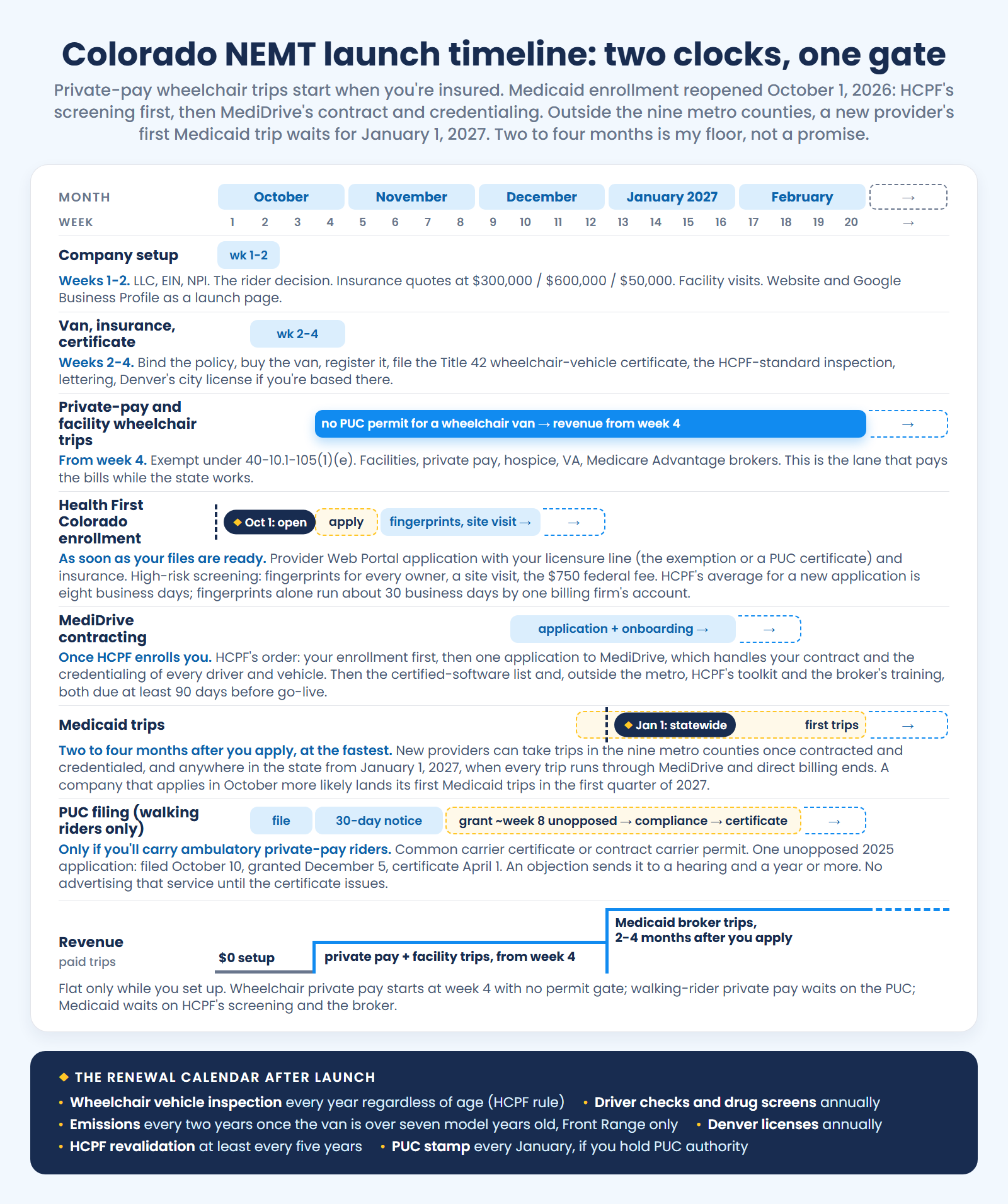
Two clocks. Private-pay and facility wheelchair trips start the week you’re insured and registered, because no PUC permit applies [7]; in Denver add the city license, reviewed within seven business days [21]. Medicaid trips start with HCPF enrollment, open to new companies since October 1, 2026 [23], then take two to four months at the fastest by my math.
- Now. LLC, EIN, NPI, insurance quotes at the rule’s floor, the rider decision, the van after the quote.
- Weeks 2-4. Insure, register, file the Title 42 certificate, HCPF-standard inspection, lettering, Denver license if applicable. First private-pay and facility wheelchair trips.
- When your files are ready. Enrollment application through the Provider Web Portal with the licensure line and insurance; fingerprints for every owner; expect a site visit [24].
- Once HCPF enrolls you. One application to MediDrive, which handles your contract and the credentialing of every driver and vehicle [23]. In the nine metro counties, trips can start once you’re contracted and credentialed [23]. Outside the metro, HCPF owes providers a toolkit and the broker owes them training, both at least 90 days before go-live [6].
- January 1, 2027. Every trip in the state runs through MediDrive, per HCPF’s fiscal agent [29], and new providers can take trips in the other 55 counties from this date [23]. A company that applies in October more likely lands its first Medicaid trips in the first quarter of 2027.
- Throughout. Everything in Phase 5, while both queues run. Walking-rider private pay only after a PUC certificate issues.
Colorado NEMT FAQ
Does Colorado require a NEMT license?
No state NEMT license exists. For Medicaid rides you enroll with Health First Colorado, then contract with MediDrive, the statewide broker. New enrollment was frozen from October 1, 2023 and reopened to new companies on October 1, 2026 [23]. The Public Utilities Commission exempts Medicaid trips and wheelchair-loading vehicles, so a wheelchair van needs no PUC permit for any payer [7]. Walking riders for private pay need a PUC common carrier certificate or contract carrier permit [14]. Denver licenses non-emergency medical vehicle companies and drivers on its own [21].
Who is the NEMT broker in Colorado?
MediDrive. It took over the nine Denver-metro counties from Transdev’s IntelliRide on July 1, 2026, and the member mileage-reimbursement program for all 64 counties the same day [33][34]. HCPF’s fiscal agent tells every existing provider in the state to contract with MediDrive now, and from January 1, 2027 every NEMT trip must be scheduled through MediDrive [29]. Until a region goes live, providers enrolled there before the October 1, 2026 reopening keep billing the state directly [6][23].
Is there still a moratorium on new NEMT providers in Colorado?
No. HCPF’s NEMT page says the moratorium has expired and new NEMT providers can enroll from October 1, 2026 [23]. HCPF had blocked new NEMT providers since October 1, 2023 under a CMS-approved moratorium renewed in six-month steps [23][41][42]. New companies enroll with HCPF first, as a high-risk provider type with fingerprints for every owner and a site visit [24], then send MediDrive one application [23].
Can I bill Health First Colorado directly for NEMT rides?
Not as a new company. Providers enrolled before the October 1, 2026 reopening can, but only in counties MediDrive hasn’t reached yet, and only until it does. Outside the nine metro counties they’re enrolled as biller and performer and bill the state’s fiscal agent directly [37]. HB26-1328 keeps that lane open until HCPF designates a region for the broker; after that, direct billing is allowed only during a region’s implementation or a broker termination [6]. HCPF says new providers serve the nine metro counties once contracted with MediDrive and credentialed, and any county from January 1, 2027, when all provider payments go through MediDrive [23][29]. The July 1, 2026 cuts set the ambulatory base at $12.15 a trip and mileage at $2.74 [78].
Can a Colorado NEMT company run both Medicaid and private-pay trips?
Yes, and for a wheelchair van the two lanes need no PUC permit at all. The PUC exempts trips paid by Medicaid and vehicles designed and used to carry people who use wheelchairs [7], HCPF’s rule accepts that exemption for enrollment [10], and the state’s largest provider holds Medicaid enrollment and PUC authority at once [52]. The rider decides your permits, not the payer. Walking riders paying out of pocket are a PUC-regulated for-hire trip [14], and the Court of Appeals reads the wheelchair exemption as covering vans used solely for wheelchair riders [54], so ask the PUC before you sell ambulatory rides out of a wheelchair van.
What insurance does a NEMT business need in Colorado?
For Medicaid work, $300,000 per person and $600,000 per accident in bodily injury plus $50,000 property damage, from an A-rated carrier. The dollar figure is in HCPF’s rule [10] and word for word on MediDrive’s provider page, which adds the A rating [19]. The old metro broker asked for $500,000 combined single limit [34]. A wheelchair-loading vehicle also files its own statutory certificate at $100,000 per person, $300,000 per accident, and $50,000 property damage [9]. If you hold PUC authority for walking private-pay riders, the PUC floor is $500,000 for eight seats or fewer [46].
Do NEMT drivers need a CDL in Colorado?
Not below 16 passengers including the driver or 26,001 pounds [62]. HCPF’s rule sets the Medicaid driver floor at 18 with a Colorado license and a year of experience, a seven-year driving record, criminal and sex-offender checks, a 10-panel drug screen at hire and every year, and CPR and naloxone certification [10]. The 21-and-up rule you’ll read about is the PUC’s and reaches only PUC-regulated carriers [47].
Can a NEMT company run stretcher van trips in Colorado?
Yes, inside a statutory carve-out. Colorado’s ambulance law exempts vehicles used for the scheduled transportation of convalescent patients, people with disabilities, or people not expected to need skilled treatment or care while in the vehicle [61]. HCPF’s rule defines a stretcher van as a vehicle that can legally carry a member lying down [10]. The moment anyone treats or monitors the rider en route, you’re an unlicensed ambulance service, a petty offense with civil penalties up to $500 a day [61]. Get CDPHE’s reading in writing before the first hospice contract.
How much does it cost to start a NEMT business in Colorado?
Plan on $35,000 to $60,000 to put one used wheelchair van on the road legally, and $75,000 or more with a new conversion, from the line items in this guide. The state’s own fees are tiny: $50 to form the LLC [18], no state NEMT permit, no PUC fee for a wheelchair van [7]. Insurance is the big recurring line, roughly $11,000 to $16,000 a year for a new operator’s wheelchair van in agency reporting [26], and the federal Medicaid application fee is $750 [25]. Add three to six months of runway, roughly $15,000 to $35,000 for one van and one driver, and the real number is $50,000 to $90,000.
How long does it take to start a NEMT business in Colorado?
Private-pay and facility wheelchair trips can start the week you’re insured and registered, because no PUC permit applies [7]. Medicaid trips start with Health First Colorado enrollment, open to new companies since October 1, 2026 [23]. Then come high-risk screening with fingerprints and a site visit [24], then MediDrive’s contract and credentialing: two to four months by my math, at the fastest. That puts a company that applies in October on first Medicaid trips no earlier than winter, and outside the nine metro counties no earlier than January 1, 2027 [23].
Key official sources
[1] Joint Budget Committee staff, HCPF FY 2026-27 figure setting document (March 9, 2026): NEMT spending from $70 million to $303 million, the mileage rate history, the $36.40 pickup fee, the broker’s fixed-rate contract. https://content.leg.colorado.gov/sites/default/files/FY2026-27_hcpfig1_0.pdf
[2] Legislative Council Staff, HB26-1328 fiscal notes (initial March 20, 2026; final September 2, 2026): the $43.0 million August 2023 peak, about $25 million a month now, $8.0 million in denials across 105 providers, the federal-match reclassification, the member mileage-reimbursement consequence, the assumed January 1, 2027 approval. https://leg.colorado.gov/bill_files/117693/download and https://leg.colorado.gov/bill_files/113550/download
[3] Colorado Politics, Colorado Medicaid probe uncovers millions of dollars in alleged transport fraud ring (February 21, 2026): 64 suspensions, 600-plus blocked applicants. https://www.coloradopolitics.com/2026/02/21/colorado-medicaid-probe-uncovers-millions-of-dollars-in-alleged-transport-fraud-ring/
[4] Colorado Attorney General and U.S. Attorney’s Office, charges filed in two cases involving Medicaid non-emergent medical transportation fraud (February 10, 2026). https://coag.gov/press-releases/charges-filed-in-two-cases-involving-medicaid-non-emergent-medical-transportation-fraud/
[5] Grand Junction Daily Sentinel, Sunshine Rides suspends Medicaid non-emergency medical transportation nearby, plans full suspension (June 3, 2026, updated July 15) and Sunshine pauses decision as state reviews payment reductions (June 27, 2026); KKCO, Sunshine Taxi says Medicaid transportation cuts leave rural Coloradans with fewer options (July 27, 2026): the rate history, the July 1 cuts, the JBC review, the operator’s quotes. https://www.gjsentinel.com/news/western_colorado/sunshine-rides-suspends-medicaid-non-emergency-medical-transportation-nearby-plans-full-suspension-ahead-of-unsustainable/article_d938627f-37cf-4a58-beb6-43cf4ce7fc00.html and https://www.kkco11news.com/2026/07/27/sunshine-taxi-says-medicaid-transportation-cuts-leave-rural-coloradans-with-fewer-options/ Also Grand Junction Daily Sentinel, Some non-emergency medical transport providers halt services while Medicaid rates remain in the air (July 15, 2026, updated July 17): the JBC’s rejection of HCPF’s $19 pickup proposal. https://www.gjsentinel.com/news/western_colorado/some-non-emergency-medical-transport-providers-halt-services-while-medicaid-rates-remain-in-the-air/article_f1d6a66e-036d-4c31-a2a3-73529240a321.html
[6] HB26-1328, signed act: C.R.S. 25.5-1-801 through 25.5-1-806 and 25.5-5-102 as enacted, including the credentialing, camera, digital-dispatch, trip-cap, software, scheduling, phase-in, direct-billing, eligibility-verification, and audit provisions quoted in this guide. https://leg.colorado.gov/bill_files/117170/download
[7] Colorado Revised Statutes § 40-10.1-105, Transportation not subject to regulation (2024 edition, mirror current through 2025): paragraphs (e) and (l). https://colorado.public.law/statutes/crs_40-10.1-105 and the Office of Legislative Legal Services Title 40 PDF https://content.leg.colorado.gov/sites/default/files/images/olls/crs2024-title-40.pdf
[8] Colorado General Assembly, HB21-1206, Medicaid Transportation Services (signed and effective June 29, 2021), and the signed act repealing the Medicaid Client Transport permit. https://leg.colorado.gov/bills/hb21-1206 and https://leg.colorado.gov/bill_files/54573/download
[9] C.R.S. § 42-7-510, insurance or bond required for vehicles designed and used for the nonemergency transportation of individuals with disabilities: the definition, the $50,000, $100,000, $300,000 certificate filed with the Department of Revenue, and the class A traffic infraction. https://colorado.public.law/statutes/crs_42-7-510 and the Office of Legislative Legal Services Title 42 PDF https://content.leg.colorado.gov/sites/default/files/images/olls/crs2024-title-42.pdf
[10] 10 CCR 2505-10 § 8.014, Non-Emergent Medical Transportation (Medical Services Board rule, amended through September 15, 2024; Cornell LII mirror because the Secretary of State’s site blocks automated readers): definitions, eligibility, provider licensure options, insurance, inspections, driver requirements, non-covered services, the 25-mile rule. https://www.law.cornell.edu/regulations/colorado/10-CCR-2505-10-8.014
[11] Joint Budget Committee staff, HCPF FY 2026-27 budget briefing (December 10, 2025): June 2025 enrollment, the enrollment forecast, the elderly and disabled share of enrollment and spending. https://content.leg.colorado.gov/sites/default/files/fy2026-27_hcpfbrf1.pdf
[12] Colorado State Demography Office, 2023 Population Summary (January 15, 2025) and the state demographer’s September 18, 2025 budget conference deck: the 65-plus count and growth, the 75-plus projection, the Front Range share of growth. https://spl.cde.state.co.us/artemis/locserials/loc615019internet/loc6150192023internet.pdf and https://assets.bouldercounty.gov/wp-content/uploads/2025/09/watkins-10-county-budget-conference-9-18-2025.pdf
[13] CMS Provider Data Catalog, Dialysis Facility listing (dataset 23ew-n7w9, refreshed June 2026) and Nursing Home Provider Information (dataset 4pq5-n9py, refreshed August 2026): Colorado facility and county counts computed for this guide. https://data.cms.gov/provider-data/dataset/23ew-n7w9 and https://data.cms.gov/provider-data/dataset/4pq5-n9py
[14] C.R.S. §§ 40-10.1-201 and 40-10.1-202 (the common carrier certificate and the contract carrier permit), § 40-10.1-206 and 4 CCR 723-6 Rule 6210 (contract carrier terms), and § 40-6-108 (the thirty-day notice period on applications). https://colorado.public.law/statutes/crs_40-10.1-201 , https://colorado.public.law/statutes/crs_40-10.1-202 , https://colorado.public.law/statutes/crs_40-10.1-206 , https://www.law.cornell.edu/regulations/colorado/4-CCR-723-6-6210 , and https://colorado.public.law/statutes/crs_40-6-108
[15] Legislative Council Staff, State Regulation of Passenger Carrier Services, Taxis, and Transportation Network Companies (October 25, 2018) and the January 9, 2017 memo: the application process, interventions, the regulated-monopoly standard for non-taxi call-and-demand service. https://content.leg.colorado.gov/sites/default/files/update_taxi_and_tnc_ip_memo_10092018.pdf and https://content.leg.colorado.gov/sites/default/files/17update_memo_on_regulation_of_carrier_service_and_tncs.pdf
[16] Operator and marketplace rate cards (checked September 2026): Axel Medical Transportation, Colorado Springs; Heart and Soul Paratransit rates as reported by Visiting Angels Loveland (July 2024); MedicalRide, Denver marketplace listing; Med Lift, Grand Junction (search listing only). https://www.axtransit.com/affordable-wheelchair-transportation-near-me-colorado-springs , https://www.visitingangels.com/loveland/articles/transportation-options-for-loveland-seniors-who-dont-drive/25031 , and https://medicalride.org/medical-transport/co/denver
[17] C.R.S. §§ 40-10.1-113 and 40-7-113, and 4 CCR 723-6 Rules 6016 and 6018: the class 2 misdemeanor, civil penalty maxima, advertising as an offer. https://colorado.public.law/statutes/crs_40-10.1-113 , https://colorado.public.law/statutes/crs_40-7-113 , https://www.law.cornell.edu/regulations/colorado/4-CCR-723-6-6016 , and https://www.law.cornell.edu/regulations/colorado/4-CCR-723-6-6018
[18] Colorado Secretary of State business fee schedule (the page blocks automated readers) as reported by LLC University (June 2026): $50 Articles of Organization, $25 periodic report, $20 trade name. Secondary. https://www.llcuniversity.com/colorado-llc/costs/
[19] MediDrive, Colorado transportation providers page (checked September 2026, re-read October 2, 2026): the driver, vehicle, and business checklist, insurance minimums and the A-rating rule, bi-weekly pay, non-exclusivity, Provider Relations 720-844-9615. https://medidrive.com/facilities/co/providers
[20] C.R.S. § 39-26-104: the four categories of taxable services. https://colorado.public.law/statutes/crs_39-26-104
[21] City and County of Denver, Non-emergency medical vehicle company license and Non-emergency medical vehicle operator license pages (checked September 2026): fees, insurance, CBI checks, physicals, review times. https://denvergov.org/Government/Agencies-Departments-Offices/Agencies-Departments-Offices-Directory/Business-Licensing/Business-licenses/Non-emergency-medical-vehicle-company/New and https://denvergov.org/Government/Agencies-Departments-Offices/Agencies-Departments-Offices-Directory/Business-Licensing/Business-licenses/Non-emergency-medical-vehicle-operator/New Denver Department of Public Health and Environment, medical vehicle services page: the “based in the City and County of Denver” scope. https://www.denvergov.org/Government/Agencies-Departments-Offices/Agencies-Departments-Offices-Directory/Public-Health-Environment/Public-Health-Investigations/Healthy-Families-Healthy-Homes/Medical-Vehicle-Services
[22] City and County of Denver, home businesses page, Community Planning and Development fee schedule ($20 home occupation permit), and Denver Zoning Code Article 11, Division 11.9 (republished February 25, 2025): the resident-only rule and the uses barred as home occupations. https://www.denvergov.org/Government/Agencies-Departments-Offices/Agencies-Departments-Offices-Directory/Community-Planning-and-Development/Plan-Review-Permits-and-Inspections/Zoning-Permits/Apply-for-Commercial-Zoning-Permits/Home-Businesses and https://denvergov.org/files/assets/public/community-planning-and-development/documents/zoning/denver-zoning-code/denver_zoning_code_article11_use_limitations.pdf
[23] Colorado Department of Health Care Policy and Financing (HCPF), Non-Emergent Medical Transportation program page (read October 2, 2026): the expired moratorium, new NEMT enrollment from October 1, 2026, HCPF enrollment before the one MediDrive application, the advice to finish credentialing before enrolling with MediDrive, the September 1, 2026 contracting date, and the dates through January 1, 2027; the September 15, 2026 provider webinar slides linked from that page: new providers serve the nine metro counties once contracted and any county from January 1, 2027, when direct billing ends, and MediDrive’s onboarding checklist (contracting, then credentialing); HCPF’s provider enrollment page (read October 2, 2026): the eight-business-day average for new applications, site visits for every NEMT provider, and fingerprints within 30 calendar days of a request; the NEMT billing manual (revised July 17, 2026): MediDrive’s statewide driver and vehicle credentialing in ProCredEx. Also provider news and the September 2026 provider bulletin B2600542 (seen only as an indexed headline). HCPF’s site blocks automated readers, so its NEMT page, enrollment page, and billing manual were read in a browser on October 2, 2026, and the webinar slides through the Google Drive link on the NEMT page. The moratorium’s October 1, 2023 start, the trip log, the 25-mile form, and virtual inspections are quoted as they appear in search results. https://hcpf.colorado.gov/non-emergent-medical-transportation , https://hcpf.colorado.gov/provider-enrollment , https://hcpf.colorado.gov/nemt-billing-manual , https://hcpf.colorado.gov/provider-news , and https://hcpf.colorado.gov/sites/hcpf/files/Bulletin%200926_B2600542_0.pdf
[24] 10 CCR 2505-10 § 8.125, Provider Screening (amended effective February 15, 2025): NEMT as a high categorical-risk provider type, fingerprints, site visits, revalidation, the application fee. https://www.law.cornell.edu/regulations/colorado/10-CCR-2505-10-8.125
[25] NC Medicaid, federal provider enrollment application fee increase for 2026 (December 8, 2025), citing 90 FR 55738: $750 for 2026; and MedSole RCM, Colorado Medicaid provider enrollment (June 25, 2026): the fingerprint processing time. Secondary; the Federal Register page blocks automated readers. https://medicaid.ncdhhs.gov/blog/2025/12/08/federal-provider-enrollment-application-fee-increase-year-2026 and https://medsolercm.com/blog/colorado-medicaid-provider-enrollment
[26] Elite Med Financials, NEMT insurance cost guide (March 16, 2026): the national premium bands and new-operator loading. Agency-reported. https://elitemedfinancials.com/nemt-insurance-cost/
[27] C.R.S. §§ 8-44-101 and 8-43-409: workers’ compensation coverage and the daily fines for failure to insure. https://colorado.public.law/statutes/crs_8-44-101 and https://colorado.public.law/statutes/crs_8-43-409
[28] Pinnacol Assurance, Colorado workers’ compensation laws: the one-employee threshold. https://www.pinnacol.com/workers-compensation/workers-compensation-laws
[29] Health First Colorado Provider Web Portal (Gainwell Technologies, HCPF’s fiscal agent), Provider Portal News (undated notice, read September 9, 2026 and again October 2, 2026): all existing NEMT providers, including those outside the nine metro counties, must begin contracting with MediDrive immediately; from January 1, 2027 all NEMT trips are scheduled through MediDrive and all provider payments go through MediDrive. https://colorado-hcp-portal.coxix.gainwelltechnologies.com/hcp/provider/
[30] Joint Budget Committee staff, HCPF FY 2025-26 supplemental budget request document (January 27, 2026): the MediDrive award and appeal, the MedRide settlement and cap, the extra-large wheelchair billing error and its correction. https://content.leg.colorado.gov/sites/default/files/CY26_hcpsup1.pdf
[31] Joint Budget Committee staff, Appropriations Report FY 2025-26 (August 27, 2025) and Appropriations Report FY 2026-27 (July 9, 2026): the July 2025 mileage changes ($6.10 to $3.00 non-ambulance, $1.19 to $3.00 wheelchair van) and the FY 2026-27 appropriation’s assumption of a $4.00 ambulatory pickup fee with mileage unchanged. https://content.leg.colorado.gov/sites/default/files/FY25-26AppRept-accessible.pdf and https://content.leg.colorado.gov/sites/default/files/FY26-27ApprRept_0.pdf
[32] MediDrive, Colorado member page and Colorado mileage reimbursement page (checked September 2026): the 46-cent and 48-cent figures. https://medidrive.com/facilities/co and https://medidrive.com/facilities/co/mileage-reimbursement
[33] MediDrive, Colorado about page (checked September 2026): the July 1, 2026 start, the nine counties, mileage reimbursement in all 64 counties, the Fall 2026 expansion. https://medidrive.com/facilities/co/about
[34] Transdev Health Solutions, Colorado pages (checked September 2026): the July 1, 2026 vendor transition, the former nine-county insurance and driver requirements, and the on-board vehicle list. https://transdevhealthsolutions.com/colorado/ , https://transdevhealthsolutions.com/colorado/join/ , and https://transdevhealthsolutions.com/colorado/transportation-providers/
[35] Community Connections Inc., Transportation challenges (July 31, 2026): MediDrive not yet scheduling in southwest Colorado, the remaining rural providers. https://www.communityconnectionsco.org/blog/transportation-challenges
[36] Colorado Office of the State Auditor, Medicaid Non-Emergent Medical Transportation, Performance Audit, Report 2152P (August 2021): the broker history, the on-time and complaint findings, the FY2021 rate table. https://content.leg.colorado.gov/sites/default/files/documents/audits/2152p_medicaid_non-emergent_medical_transport.pdf
[37] HCPF, NEMT audit implementation status report to the Office of the State Auditor (September 12, 2022, forwarded October 15, 2022): Performer Only versus Biller and Performer enrollment, the broker’s pass-through payment, the Gainwell approval process. https://content.leg.colorado.gov/sites/default/files/4d_-_nemt_status_report.pdf
[38] Colorado General Assembly, HB24-1146, Medicaid Provider Suspension for Organized Fraud (signed and effective February 20, 2024). https://leg.colorado.gov/bills/HB24-1146
[39] Denver7 Investigates, Colorado terminates contract with Medicaid transportation provider MedRide after brief suspension (February 2025), and the earlier suspension report: the corrective action plan’s missing signatures, dates, and times, the termination, the court order. https://www.denver7.com/news/investigations/colorado-terminates-contract-with-medicaid-transportation-provider-medride-after-brief-suspension
[40] Colorado General Assembly, HB26-1328, Medicaid Nonemergency Medical Transportation: history, sponsors, signed June 4, 2026, effective July 1, 2026, Session Law Chapter 388. https://leg.colorado.gov/bills/HB26-1328
[41] Medicaid Provider Rate Review Advisory Committee, 2024 report (November 19, 2024): the moratorium on all new and pending NEMT applications and the prospective payment reviews. https://content.leg.colorado.gov/sites/default/files/mprrac_report-11-19-24.pdf
[42] 42 CFR 455.450 and 455.470: high-risk screening for providers that apply within six months after a moratorium ends, and the six-month term of an enrollment moratorium. https://www.law.cornell.edu/cfr/text/42/455.450 and https://www.law.cornell.edu/cfr/text/42/455.470
[43] KRDO, State lost millions in Medicaid transportation fraud scheme; patients, drivers still feeling the effect (May 6, 2024). https://krdo.com/news/2024/05/06/state-lost-millions-in-medicaid-transportation-fraud-scheme-patients-drivers-still-feeling-the-effect/
[44] 10 CCR 2505-10 § 8.076, Program Integrity (LII mirror): payment suspension on a credible allegation of fraud and the records HCPF may demand. https://www.law.cornell.edu/regulations/colorado/10-CCR-2505-10-8.076
[45] Duet NEMT Growth Podcast, Episode 12, Mastering NEMT Dispatching (December 29, 2025), Jing Zhu. https://www.youtube.com/watch?v=5j-t582MNk8
[46] 4 CCR 723-6, Rule 6008, Financial Responsibility (PUC transportation rules, LII mirror): the seating-capacity tiers and the Form E filing; Rule 6009 on suspension at cancellation. https://www.law.cornell.edu/regulations/colorado/4-CCR-723-6-6008
[47] 4 CCR 723-6, Rules 6107, 6109, and 6110 (LII mirror): PUC driver age, medical certification, driving-record review, hours of service. https://www.law.cornell.edu/regulations/colorado/4-CCR-723-6-6107
[48] Transportation Research Board, TCRP Report 202 companion state profiles (Colorado profile, March 2017): the 2013 NEMT trip and expense estimates other guides copy. https://onlinepubs.trb.org/onlinepubs/tcrp/tcrp_rpt_202_companion.pdf
[49] Colorado PUC, Decision C24-0735 in Proceeding 24A-0402BP-ETA (issued October 11, 2024) and Decision R25-0439 in Proceeding 24A-0401BP (June 6, 2025): the Commission’s application of the Medicaid and wheelchair-vehicle exemptions to MedRide’s facility-contract medical shuttle, and MedRide’s common carrier certificate 55980. https://www.dora.state.co.us/pls/efi/efi_p2_v2_demo.show_document?p_dms_document_id=1029136 and https://www.dora.state.co.us/pls/efi/efi_p2_v2_demo.show_document?p_dms_document_id=1043206
[50] Colorado PUC e-filings, Proceeding 25A-0423CP: an unopposed common carrier application filed October 10, 2025, granted December 5, 2025, certificate issued April 1, 2026. https://www.dora.state.co.us/pls/efi/EFI.Show_Docket?p_session_id=&p_docket_id=25A-0423CP
[51] Colorado General Assembly, HB26-1326 (signed May 29, 2026, effective August 12, 2026), signed act: the PUC decision clock and deemed approval, fingerprinting for contract-carrier drivers. https://leg.colorado.gov/bill_files/116854/download
[52] Colorado PUC e-filings, Proceeding 24A-0401BP: MedRide, LLC’s Mesa County contract carrier permit, filed September 20, 2024, intervention November 6, 2024, settlement approved June 6, 2025, issued December 16, 2025. https://www.dora.state.co.us/pls/efi/EFI.Show_Docket?p_session_id=&p_docket_id=24A-0401BP
[53] Colorado Public Utilities Commission, common and contract carriers industry page and passenger carrier FAQ. The PUC’s site blocks automated readers; the $36 filing fee, $51 vehicle stamp, 30-day notice, and the exemption list are quoted as they appear in search results. https://puc.colorado.gov/common-and-contract-carriers-industry-info and https://puc.colorado.gov/passenger-carrier-frequently-asked-questions
[54] Black Hawk-Central City Ace Express, Inc. v. Entrup, 983 P.2d 9 (Colo. App. 1998), No. 97CA0075 (February 19, 1998): the Court of Appeals adopting the PUC’s “used solely” reading of the disability-vehicle exemption. https://caselaw.findlaw.com/co-court-of-appeals/1428375.html
[55] 4 CCR 723-6, Rules 6100 and 6102 (LII mirror): the reach of the PUC’s safety rules over a carrier’s motor vehicles, and the vehicle identification stamp and its annual fee. https://www.law.cornell.edu/regulations/colorado/4-CCR-723-6-6100 and https://www.law.cornell.edu/regulations/colorado/4-CCR-723-6-6102
[56] Colorado PUC, Operating Rights System, carriers with permits, active common carriers (July 2024 list, state publications library). https://spl.cde.state.co.us/artemis/regserials/reg744internet/reg744202407internet.pdf
[57] Denver Board of Environmental Health, Rules and Regulations Governing Emergency Medical Vehicles (May 10, 2007; the rules also cover non-emergency medical vehicles), adopted under DRMC § 17-17: the non-emergency medical vehicle definition, the “based” definition, driver minimums (a valid Colorado driver’s license), the vehicle equipment standard. https://www.denvergov.org/files/assets/public/v/1/public-health-and-environment/documents/phi/emv-regulations-2007.pdf
[58] Colorado Information Marketplace, City and County of Denver business licenses dataset (rows updated August 1, 2026): one active Non-Emerg Med Vehicle Co license, four Emergency Med Vehicle Company licenses, eleven Secure Transport Company licenses. https://data.colorado.gov/resource/s9wt-dsfz.json
[59] City and County of Denver, Tax Guide Topic 61, Occupational Privilege Taxes (revised January 2021). https://www.denvergov.org/files/assets/public/v/2/finance/documents/treasury/tax-guides/taxguidetopic61_occupationalprivilegetaxes.pdf
[60] City of Aurora, business licensing; City of Colorado Springs, business navigator FAQ and sales tax FAQ (checked September 2026). https://www.auroragov.org/business_services/licenses___permits/business_licensing and https://coloradosprings.gov/COSBusinessNavigatorFAQs City of Colorado Springs, business licensing (the closed list of licensed business types), and Fort Collins City Clerk’s Office. https://coloradosprings.gov/BusinessLicensing and https://fortcollins.gov/Department-Directory/City-Clerks-Office/
[61] Colorado General Assembly, SB22-225, Ambulance Service Sustainability and State Licensing (signed June 1, 2022; licensing effective July 1, 2024), the signed act with C.R.S. § 25-3.5-314 and its exemptions and penalties, and the 2022 fiscal note’s fee estimate. https://leg.colorado.gov/bills/sb22-225 , https://leg.colorado.gov/bill_files/102934/download , and https://leg.colorado.gov/bill_files/103161/download
[62] C.R.S. § 42-2-402 and § 42-2-404: the commercial driver’s license thresholds and the intrastate exception for drivers 18 to 20. https://colorado.public.law/statutes/crs_42-2-402 and https://colorado.public.law/statutes/crs_42-2-404
[63] C.R.S. § 42-4-235 (the 16,001-pound commercial vehicle definition) and 8 CCR 1507-1, Colorado State Patrol motor carrier safety rules (LII mirror): the intrastate USDOT number rule and its reach. https://colorado.public.law/statutes/crs_42-4-235 and https://www.law.cornell.edu/regulations/colorado/title-8/agency-1507/division-1
[64] Air Care Colorado, what you need to know (fees), and Jefferson County, emissions testing (the model-year exemptions and the program area). https://aircarecolorado.com/need-know and https://www.jeffco.us/845/Emissions-Testing
[65] C.R.S. § 8-40-202 (the independent-contractor test and the notarized document rule) and HB25-1001 (misclassification fines, effective August 6, 2025). https://colorado.public.law/statutes/crs_8-40-202 and https://leg.colorado.gov/bills/HB25-1001
[66] Denver Labor, citywide minimum wage (2026 and 2027 rates); Colorado Department of Labor and Employment 2026 PAY CALC Order (the $15.16 figure as it appears in search results; the CDLE site blocks automated readers). https://denvergov.org/Government/Agencies-Departments-Offices/Agencies-Departments-Offices-Directory/Auditors-Office/Denver-Labor/Citywide-Minimum-Wage
[67] Colorado FAMLI Division, small business corner (the site blocks automated readers; the 0.88 percent premium and the under-ten-employee waiver as they appear in search results), and C.R.S. § 8-13.3-403 (paid sick leave accrual). https://famli.colorado.gov/employers/small-business-corner and https://colorado.public.law/statutes/crs_8-13.3-403
[68] 49 CFR 38.23, mobility aid accessibility (LII mirror): lift, securement, and belt standards. https://www.law.cornell.edu/cfr/text/49/38.23
[69] 6 CCR 1015-3, Chapter Four, Licensure of Ground Ambulance Services (adopted December 20, 2023, effective July 1, 2024; copy hosted by the San Luis Valley RETAC because CDPHE’s site blocks automated readers): the ambulance definition, the exemption, staffing, vehicle permits, the reserved fee section. https://slvretac.org/wp-content/uploads/2024/02/6-CCR-1015-3-Chapter-4_Licensure-of-Ground-Ambulance-Services.pdf
[70] CMS, Medicare Benefit Policy Manual, Chapter 9, § 40.1.9: transports after the hospice election are the hospice’s responsibility. https://www.cms.gov/Regulations-and-Guidance/Guidance/Manuals/Downloads/bp102c09.pdf
[71] 38 CFR 70.2, special mode of transportation. https://www.law.cornell.edu/cfr/text/38/70.2
[72] KKTV, MedRide to end ambulatory rides in El Paso County (August 19, 2026): the August 25 exit and HCPF’s response. https://www.kktv.com/2026/08/20/medride-end-ambulatory-rides-el-paso-county/
[73] RTD, Access-on-Demand (checked August 27, 2026): the $20 per-trip subsidy, the 60-trip monthly cap, the participating providers. https://www.rtd-denver.com/other-services/access-a-ride/access-on-demand
[74] MobilityWorks, wheelchair vans for sale in Colorado, and Denver-area classified listings (scanned September 2026). https://www.mobilityworks.com/wheelchair-vans-for-sale/colorado/
[75] C.R.S. §§ 42-3-107 and 42-3-306: specific ownership tax rates by vehicle year and registration fees by weight. https://colorado.public.law/statutes/crs_42-3-107 and https://colorado.public.law/statutes/crs_42-3-306
[76] CEDS Finance, Colorado Startup Loan Fund terms (November 5, 2024), and Colorado Enterprise Fund, BUILD Denver Loan Fund (open June 1, 2026). https://www.cedsfinance.org/technical-assistance-capital-access-oedit/colorado-startup-loan-fund/ and https://coloradoenterprisefund.org/BUILD-Denver-Loan-Fund Colorado Enterprise Fund lending page: https://coloradoenterprisefund.org/
[77] U.S. Small Business Administration, Colorado District Office. https://legacy.sba.gov/district/colorado
[78] Colorado Department of Health Care Policy and Financing (HCPF), NEMT fee schedule, “NEMT Rates (07/26)”, with rates effective July 1, 2025, October 1, 2025, and July 1, 2026 (read in a browser October 18, 2026): the ambulatory pickup ($12.15), mileage ($2.74), wheelchair van ($34.14) and stretcher van ($49.42 plus $1.86) rates from July 1, 2026, and the rates before them. HCPF, “Medicaid Provider Rate Reductions, FY 2025-26 and FY 2026-27” fact sheet (read in a browser October 8, 2026): the July 1, 2026 cut to $12.40 a pickup and $2.80 a mile, and the additional 2 percent across-the-board decrease. https://hcpf.colorado.gov/sites/hcpf/files/21B_CO_Fee%20Schedule_NEMT_07.2026_V1.0.xlsx and https://hcpf.colorado.gov/sites/hcpf/files/Budget%20Reductions%20Fact%20Sheet-AC.pdf
Last verified against the sources above in September 2026; the enrollment status, the enrollment order, and MediDrive’s dates were re-checked on HCPF’s own pages on October 2, 2026, and the NEMT rates against HCPF’s posted fee schedule on October 18, 2026. MediDrive’s rollout and the NEMT rates are still moving, several HCPF and PUC statements are quoted from search results, and the wheelchair exemption’s edge is unsettled, so confirm the primary sources directly before acting. Treat this guide as education, not legal advice.
About the author
James O'Donnell cofounded Duet and leads its sales, partnerships, and growth services. He talks with NEMT operators every week, hosts the NEMT Growth podcast, and answers Duet's sales line himself. More about Duet's founders →
Starting in a nearby state?
Want more trips and less busywork?
See how Duet runs and grows NEMT businesses in a 30-minute demo.