Article
NEMT Broker Changes in 2026: Who Runs Your State Now
When a Medicaid broker changes, the trips don't disappear. They go to providers the new broker already approved. Here's 2026's map and the playbook.
By James O'Donnell, Cofounder and COO, Duet · · Updated
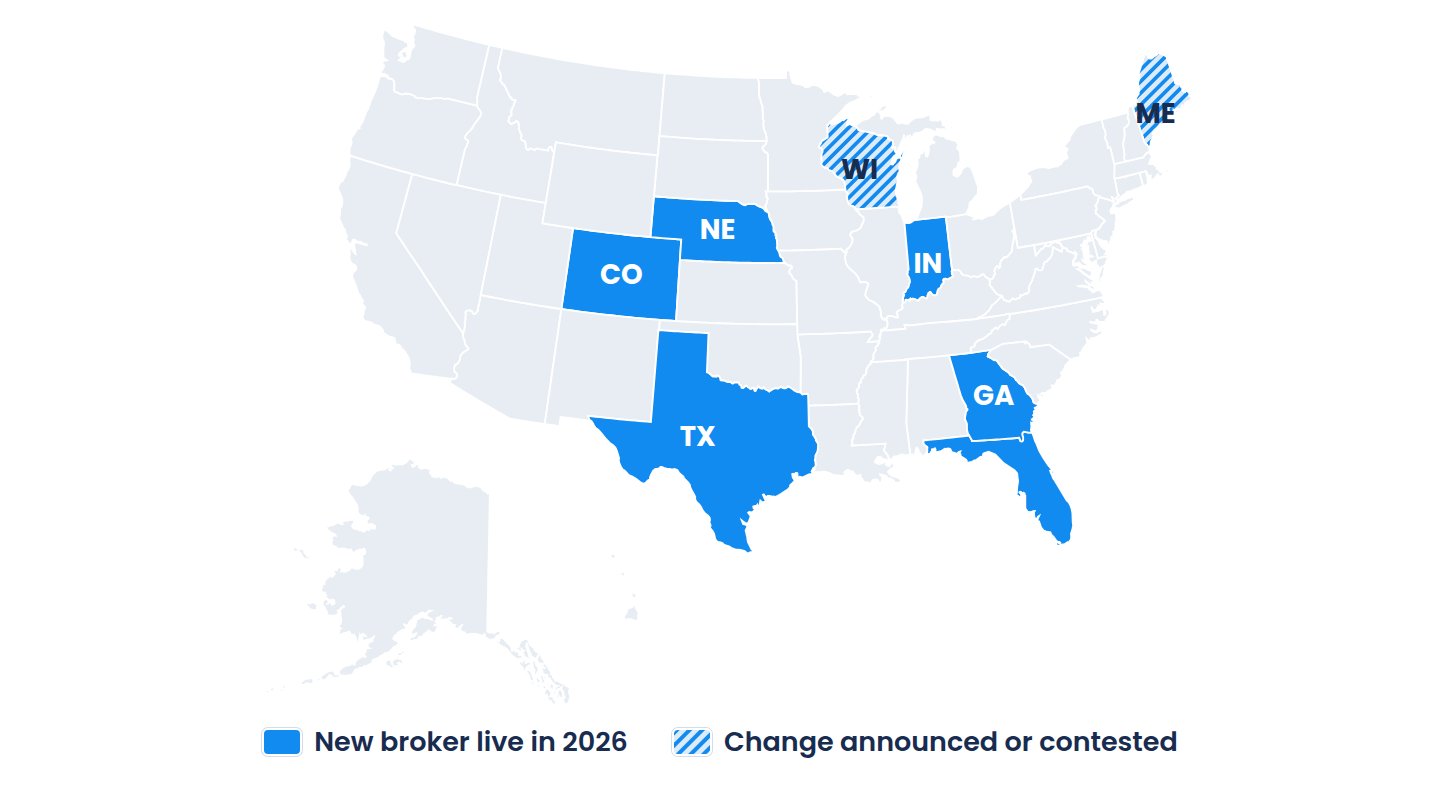
In 2026, at least 17 states changed who arranges some of their Medicaid rides. Some were state decisions, like Georgia moving to Verida on April 1, Colorado’s Denver metro to MediDrive on July 1 and Montana to Modivcare on October 1. Most were a single health plan switching ride vendors, usually announced in the plan’s own notice rather than a state bulletin. If your broker changes, your credentialing doesn’t carry over. Call the incoming broker’s provider relations the week it’s announced, have your insurance and driver files ready, be ready for lower rates at first, and keep running for your current broker until the switch happens.
Adam, who runs A.S. Reliable Transport in Fort Wayne, Indiana, went through his switch at the start of 2025, a year before this wave, so his story already has an ending. He’d been averaging about 500 trips a month. Then, as he tells it, while MTM was buying Access2Care, the Access2Care contract he ran went to WellTrans, a broker he wasn’t credentialed with. For the next four months he ran under 50 a month. By July 2026 he was running over 1,000.
The trips never disappear in a broker change. They change hands, and the providers already credentialed with the incoming broker get them first. Below is the map, what changed and what’s still coming, with the longer timelines for Colorado, Minnesota and Arizona, then a provider’s path through a switch: what happens to you, getting credentialed fast, rates, and making the next switch survivable.
Which states changed NEMT brokers in 2026?
At least 17 states changed who arranges some of their Medicaid rides in 2026: seven through a state or county decision, and ten more only through their health plans. UnitedHealthcare’s plans alone switched in six states, and each of those rows covers that plan’s members, not the whole state. The tables are current as of October 8, 2026, and every row links its source; for the full current map, see who runs NEMT in each state today.
Seven came from a state or county decision:
| When | Who it covers | Change | Source |
|---|---|---|---|
| Jan 2, 2026 | Arkansas Region G (Little Rock area), all Medicaid riders | Verida to Modivcare, same ride number | AFMC’s Medicaid ride page; region map, revised Dec 2025 |
| Apr 1, 2026 | Georgia, all Medicaid riders (the Central, Southwest and East regions changed) | Modivcare to Verida, which now covers all five regions | Georgia Medicaid NEMT page |
| July 1, 2026 | Maine’s midcoast: Waldo, Knox, Lincoln and Sagadahoc counties, plus Brunswick and Harpswell | To Modivcare | MaineCare provider bulletin, June 24, 2026 |
| July 1, 2026 | Pennsylvania: Dauphin County’s Medical Assistance Transportation Program (MATP) riders | Center for Community Building to rabbittransit, as program administrator | Dauphin County release, May 21, 2026 |
| July 1, 2026 | Colorado: Health First Colorado riders in the nine-county Denver metro area | Transdev’s IntelliRide to MediDrive | Colorado Medicaid (HCPF) NEMT page; Transdev’s transition notice |
| Oct 1, 2026 | Montana, all Medicaid NEMT and Specialized NEMT riders | State-run (Mountain Pacific approved trips; Conduent handled enrollment and claims) to Modivcare as statewide broker | Montana Healthcare Programs notice, Oct 1, 2026 |
| Oct 1, 2026 | Virginia: Cardinal Care fee-for-service riders, mostly Medicaid members not in a health plan (plan members’ medical rides unaffected) | Modivcare to MTM Health; phone lines unchanged | Virginia Medicaid (DMAS) bulletin, Sept 15, 2026 |
Thirteen more switches came through health plans, in 11 states (Texas and Virginia had two each):
| When | Who it covers | Change | Source |
|---|---|---|---|
| Jan 1, 2026 | Indiana: Healthy Indiana Plan and Hoosier Healthwise members of Anthem, CareSource and Managed Health Services (fee-for-service stays with Verida) | MDwise left both programs, and its broker, Modivcare, went with it; all three remaining plans’ members ride with WellTrans | Indiana Medicaid bulletin BT202608, Jan 15, 2026; transportation module, Aug 19, 2025 |
| Jan 1, 2026 | Texas: UnitedHealthcare Community Plan of Texas (STAR, STAR Kids, STAR+PLUS) | To SafeRide Health | UnitedHealthcare Texas provider news, Nov 2025 |
| Jan 1, 2026 | Nebraska: UnitedHealthcare Community Plan of Nebraska | To MTM Health, booking from Dec 10, 2025 | UnitedHealthcare Nebraska provider news, Nov 2025 |
| Jan 1, 2026 | North Carolina: UnitedHealthcare Community Plan of North Carolina | To MTM Health | UnitedHealthcare North Carolina flyer, Dec 2025 |
| Jan 1, 2026 | Hawaii: UnitedHealthcare Community Plan of Hawaii | To MTM Health | UnitedHealthcare Hawaii provider news |
| Jan 1, 2026 | Nevada: rural members, now in CareSource or SilverSummit plans | MTM to SafeRide, booked through the plan; MTM keeps urban and fee-for-service riders | Nevada Medicaid web announcement 3882, Apr 2, 2026 |
| Mar 1, 2026 | Florida: UnitedHealthcare Community Plan’s Medicaid managed care members | To MTM | UnitedHealthcare Florida provider manual, 2026 |
| Mar 1, 2026 | Virginia: UnitedHealthcare Community Plan of Virginia | To SafeRide Health | UnitedHealthcare Virginia notice, Feb 11, 2026 |
| Apr 1, 2026 | Virginia: Aetna Better Health of Virginia | Modivcare to MediDrive | Aetna Better Health of Virginia FAQ |
| May 12, 2026 | California: Inland Empire Health Plan (IEHP) Medi-Cal members | Call the Car to IEHP’s own Transportation Department; Call the Car keeps non-medical (NMT) trips | IEHP provider notice, May 11, 2026 |
| Oct 1, 2026 | Texas: Blue Cross and Blue Shield of Texas Medicaid members | Modivcare to MTM Health | Blue Cross Texas provider news, June 26, 2026 |
| Oct 1, 2026 | Illinois: Blue Cross Community Health Plans members | Modivcare to MTM Health | Blue Cross Illinois provider news, June 26, 2026 |
| Oct 1, 2026 | Michigan: Molina Healthcare of Michigan Medicaid members | To SafeRide Health | Michigan Medicaid health plan ride chart, rev. Oct 1, 2026 |
Ten of those 13 came out in the plan’s own provider news, flyer, FAQ or manual rather than a state bulletin, so watch both channels.
California, Texas and Florida have no statewide broker for most riders, so their changes come one plan at a time. In California each Medi-Cal plan either picks its own ride vendor or, like IEHP, arranges rides itself; our guide shows how each California plan arranges rides. In Texas, since Blue Cross and Blue Shield of Texas moved on October 1, SafeRide Health and MTM Health arrange nearly all Medicaid managed care rides; see who runs NEMT for each Texas health plan. In Florida, the Children’s Medical Services plan moved from Sunshine to Molina on October 1, 2026, on the state Medicaid agency’s schedule. MTM ran its rides under Sunshine, so ask Molina which vendor runs them now; our guide to who is the NEMT broker in Florida has each plan’s vendor.
Behind the switches, the brokers consolidated. MTM announced in August 2024 that it would buy Access2Care and had closed the deal by October 8, 2024, after buying Veyo in 2022 and MTBA, an Arizona broker, in 2023. Adam traces his switch to that deal, and the Access2Care name retired from Texas Medicaid plans on May 14, 2026. Modivcare filed for Chapter 11 on August 20, 2025 and emerged on December 29, 2025 with its funded debt cut by more than 85 percent, per its emergence release. And Verida, Georgia’s broker and Louisiana’s fee-for-service NEMT broker, is the company formerly called Southeastrans.
Which NEMT broker changes are still coming?
An award isn’t a start date. Five more changes have start dates, the next on November 1, 2026, when Blue Cross and Blue Shield of New Mexico moves its Medicaid rides to MTM Health. Two of the five, Michigan’s and Arizona’s, are rebids whose winners aren’t picked yet. Five others are stuck on a protest, an open bid or a missing date:
| When | Who it covers | Change | Source |
|---|---|---|---|
| Nov 1, 2026 | New Mexico: Blue Cross and Blue Shield of New Mexico Medicaid members | Modivcare to MTM Health | Blue Cross New Mexico provider news, July 15, 2026 |
| Jan 1, 2027 | Colorado: every Health First Colorado ride | The other 55 counties join MediDrive (contracting opened Sept 1, 2026), and direct billing to the state ends | Colorado Medicaid bulletin B2600542, Sept 2026 |
| 2027, per local news | Maine: Kennebec, Somerset, Penobscot and Piscataquis counties, served by Penquis CAP | To Modivcare: one region on Feb 1, 2027, the other two counties after June 30, 2027, per local news reports. The same reports say the state’s top court upheld Modivcare’s award on Aug 4, 2026. The state’s own forms put the next bid a decade out, for a contract starting July 1, 2036. | Maine procurement justification form, 2026; WABI, Aug 31, 2026 |
| Aug 1, 2027 | Michigan: fee-for-service riders in Wayne, Oakland and Macomb, or statewide by Oct 1, 2027 if so awarded | Modivcare’s contract rebid; proposals due Nov 6, 2026 | Michigan Medicaid RFP-491-260000002254, Aug 27, 2026 |
| Oct 1, 2027 | Arizona: elderly and physically disabled members of the Arizona Long Term Care System | New plan contracts (award due January 2027); plans arrange their members’ rides | Arizona Medicaid (AHCCCS) bid page, YH27-0001 |
| Contested | District of Columbia: DC Medicaid fee-for-service riders and riders on the intellectual and developmental disabilities (IDD) waiver | Verida’s contract has been under a stop-work order since Aug 6, 2026, after MTM’s Aug 5 protest. MTM continues under an extension through Dec 31, 2026, and the booking line (866-796-0601) hasn’t changed. | DC Council CA26-1002, deemed approved Sept 27, 2026; DC Medicaid member handbook, Sept 29, 2026 |
| No date | Wisconsin Medicaid and BadgerCare Plus riders | Verida named intended vendor May 21, 2026; MTM still serves; the state “does not have a time frame” | Wisconsin NEMT vendor page, rev. Aug 25, 2026 |
| No award | South Carolina, all Medicaid riders | Third broker solicitation since 2025; proposals were due Sept 14, 2026; no award posted by Oct 8; Modivcare still serves | South Carolina procurement decision, Aug 5, 2026 |
| No notice | Minnesota, all Medicaid riders, health plan members included | A state-hired administrator, statewide or by region, required by law. Today’s county ride lane, state rate table and ban on a state broker end only when it starts, after six months’ notice to counties and plans; none was published as of Oct 8. | Laws 2026, chapter 121 |
| Pick due Oct 30, 2026 | California: Alameda Alliance for Health Medi-Cal members | Broker request for proposals covering about 60,000 trips a month; no go-live date printed | Alameda Alliance request for proposals, amended June 2026 |
DC’s switch slipped past October 1 on a protest. New Jersey named MTM for its statewide NEMT broker contract in August, then canceled that award on Modivcare’s protest and sent it back for award to Modivcare. Colorado’s award was appealed and picked again, and Maine’s went to the state’s top court. Wisconsin named Verida in May and set no date, and South Carolina is on its third solicitation. Even the dates you’re told can be soft. A rural Colorado transit operator told me in July that for the rural counties “we only have an estimate,” and the estimate was “sometime in September.” HCPF, Colorado’s Medicaid agency, now says every trip goes through MediDrive from January 1, 2027.
So get credentialed with the incoming broker as soon as it’s named, and keep running your current broker’s trips until the new contract actually starts.
How Colorado, Minnesota and Arizona got here
Colorado, Minnesota and Arizona all have changes in motion, and their records show how long the road from an award or a law to a start date can run:
| State | Date | What changed | Source |
|---|---|---|---|
| Colorado | Sept 2019 | IntelliRide (Transdev) brokers nine Front Range counties | Auditor report 2152P |
| Colorado | July 1, 2020 | IntelliRide goes statewide | Same audit |
| Colorado | Aug-Sept 2021 | Audit: 73% on time, not the 93% reported; IntelliRide back to nine counties | Same audit |
| Colorado | Aug 2023 | Monthly NEMT spending peaks near $43.0 million, “largely driven by fraudulent billing” | HB26-1328 fiscal note |
| Colorado | Aug 2025-Jan 2026 | MediDrive picked, appealed, then picked again | Budget staff report |
| Colorado | June 4, 2026 | HB26-1328 signed: NEMT becomes a medical service; the broker may not own a provider or charge for software | HB26-1328 bill page |
| Colorado | Oct 1, 2026 | New-provider enrollment reopens after a federally approved freeze, extended in six-month steps | HCPF NEMT page; HCPF Provider News 141 |
| Minnesota | 2009 | Law bars DHS, the Medicaid agency, from using a broker | Statute 256B.0625 |
| Minnesota | June 2025 | Law orders a state-hired administrator, health plans included | Same statute |
| Minnesota | Jan 27, 2026 | Federally directed freeze on new providers in 13 high-risk services, NEMT included | DHS news, Jan 2026 |
| Minnesota | Jan-May 2026 | Revalidation of 5,583 high-risk providers, NEMT among them: 3,411 disenrollment notices (no NEMT-only count) | DHS release, June 2026 |
| Minnesota | May 27, 2026 | Switchover waits for the administrator, after six months’ notice | Laws 2026, chapter 121 |
| Minnesota | July 23, 2026 | NEMT freeze, now seven metro counties only, runs to Jan 27, 2027 | DHS news, July 2026 |
| Arizona | Oct 1, 2021 | Arizona Complete Health-Complete Care Plan moves rides from Veyo to MTBA | Plan notice PU21500 |
| Arizona | 2022-2023 | MTM buys Veyo (Aug 2022), then MTBA (July 1, 2023) | MTM release on MTBA |
| Arizona | Sept 18, 2025 | AHCCCS ends its long-term care plan procurement for elderly and physically disabled members | AHCCCS termination notice |
What happens to providers when the broker changes?
Your credentialing doesn’t transfer: the incoming broker vets you from scratch, and the trips, even rides already booked past the switch date, go to providers it has already approved. Blue Cross Community Health Plans in Illinois and Blue Cross and Blue Shield of New Mexico told providers that recurring trips and trips already scheduled past the switch “will be fulfilled by MTM Health.” Michigan’s rebid says the winner “will be required to establish their own network,” though it “may consider adopting existing providers.”
Montana went further. Modivcare took over enrollment itself, and Montana’s July 2026 Tribal NEMT Program Overview told providers they “must complete enrollment with the new vendor” to keep delivering NEMT through Montana Medicaid after October 1.
That’s what Adam ran into. When the contract he ran went to WellTrans, he had to register with the state and go through WellTrans’s verification before he could take a trip. “The onboarding is very different,” he told me. “It wasn’t easy.” It was close to four months before WellTrans gave him his first trip.
Here’s the other side, though: a switch can reset incumbency for everyone, including whoever had the inside track before you. In October 2025, with Modivcare in Chapter 11, I said on our episode on how to retire rich from NEMT that owners on my demos kept telling me their contracts had moved. I called it a “chaotic time” and said the riders were “the same set of people.” Somebody drives them after the switch, and it can be you.
None of this makes brokers villains. They answer to contracts, penalties and procurement calendars, not to any one provider. Marqus Johnson, a Tampa operator and coach, put it plainly on our July 2026 episode about turning drivers into a sales force: “If you allow a broker to send you as many trips as humanly possible, they’re happy to do so. And as long as you complete them, they could care less.”
How do you get credentialed with a new broker fast?
Start the week the change is announced, not the day your trips stop. The dates on 2026’s notices and awards ran from about ten months before a switch to two weeks after one.
Here they are, by the date printed on each provider notice or bulletin. IEHP’s is dated May 11 for its May 12 switch: one day. Maine’s midcoast bulletin came June 24 for July 1, a week. Virginia’s fee-for-service bulletin came September 15 for October 1, 16 days. Montana’s July 9 provider notice came 84 days before October 1. The Blue Cross notices in Texas and Illinois, June 26 for October 1, gave 97 days, and New Mexico’s, July 15 for November 1, gives 109. Colorado named MediDrive in August 2025, ten to eleven months before its July 1, 2026 start, though the re-pick came by late January 2026. Indiana’s bulletin naming WellTrans came out January 15, two weeks after the switch.
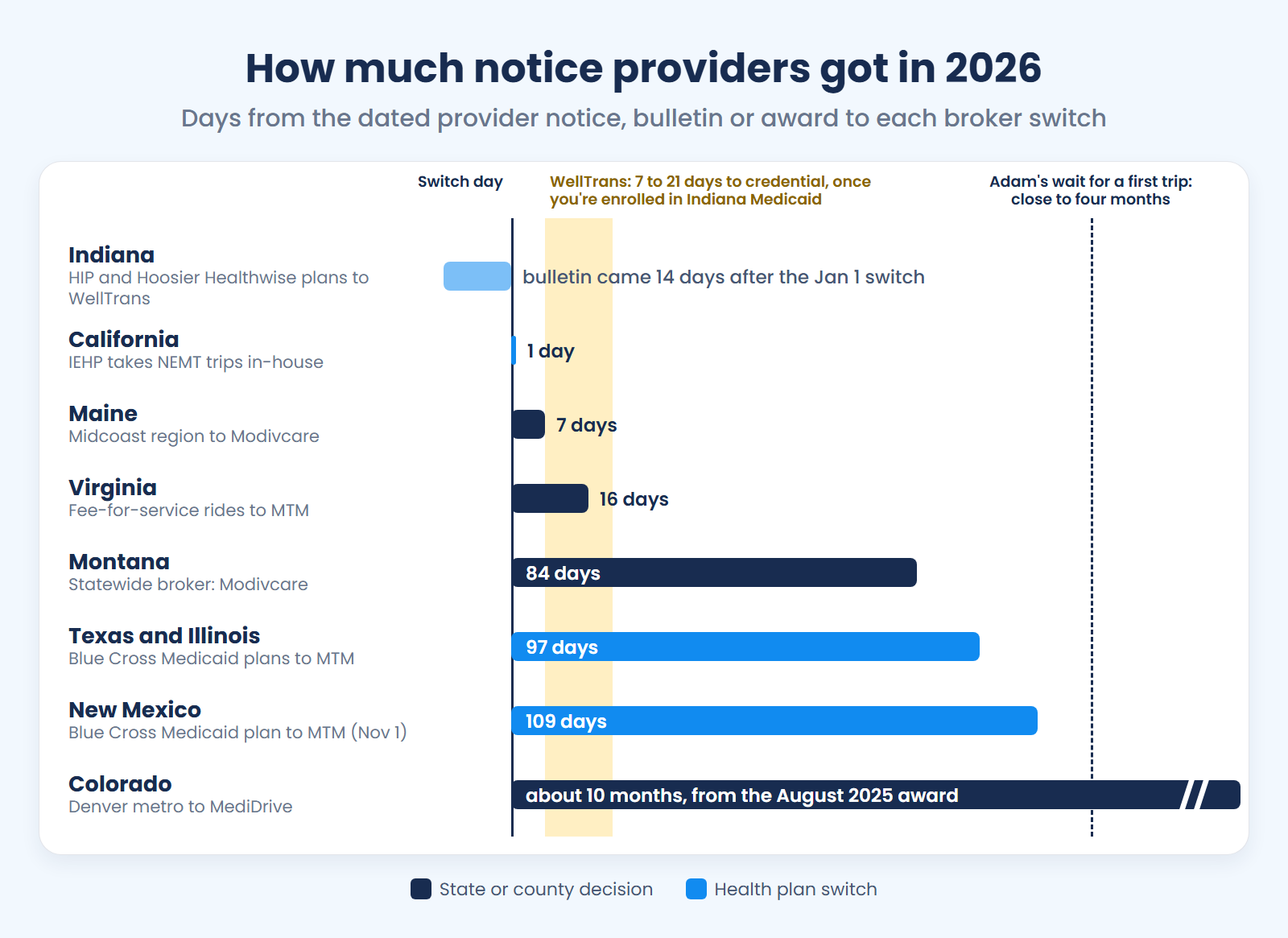
Now put the other clock next to it. WellTrans’s 2026 seminar deck for Indiana providers says its credentialing “can range from 7-21 calendar days” once you’re enrolled in Indiana Medicaid, and that enrollment “can take from 1-3 months.” Adam’s took close to four months. On our live episode on October 1, I said these applications “can sometimes take 6 months, a year,” and you don’t want to pay insurance on a van that sits that long. Of all those windows, only Colorado’s ran past four months.
The incoming broker often books before go-live, and it can only send those trips to providers it has already credentialed. UnitedHealthcare’s Texas plan took reservations “after Dec. 15, 2025” for January 1 service, and MTM took bookings for UnitedHealthcare’s Nebraska members from December 10.
So don’t wait on the web form. Call the incoming broker’s provider relations team and tell them your fleet, hours, counties and how many more trips you can take. On our October 1 episode I agreed with a guest that knowing the person who reviews applications “helps make sure you get trips.”
Have the paperwork ready before anyone asks. Each broker sets its own insurance limits and certificate wording, so a policy the old broker accepted can fall short with the new one. Our guide covers what brokers require on your insurance certificate.
What to do this week:
- Sign up for both channels: your state Medicaid agency’s provider bulletins and every plan’s provider notices.
- Call provider relations the week a change is announced, not the week your trips stop.
- Get the new broker’s requirements sheet before your next insurance renewal, and compare the certificate wording and limits line by line.
- Keep one credential folder: insurance certificate, driver roster with checks and cert dates, vehicle list with inspections, W-9 and licenses.
Can you negotiate rates with a new broker?
At the switch, not if the outgoing broker was your only one, and new rates can come in lower; bargaining power comes back later, from a clean record and from capacity the broker can’t find elsewhere.
WellTrans’s rates came in lower, and Adam signed anyway, because the vans couldn’t sit. “If you were only working with Access2Care, you don’t have any other brokers to work with,” he told me, and “you can’t even negotiate any price.” The moment you finally get through is the worst moment to bargain.
So set up the later conversation now. Before you sign, price the rate card against your own cost per trip. On calls I tell owners to add up what they pay the driver, gas and maintenance, then compare that with what the broker pays. Read the fine print too, because no-show windows, wait times, submission deadlines and on-time penalties are where a transition year leaks money. Then ask for the rate sheet again after a year of clean on-time work, and lead with what’s scarce where you drive: wheelchair vans, stretcher capacity, rural coverage, weekend hours.
How do you broker-proof your NEMT business?
Make sure no single broker contract can sink you: limit what any one payer can do to your schedule, build trips you control, and keep records any broker or auditor can read on day one.
On our episode about calling facilities for contracts, Christopher Buell said he gives any one broker 10 percent of his time and effort to start, maybe 15 after a year of doing business together. Rachel Scholler kept her broker availability at 10 percent when she still took broker trips, as she said on our episode about growing a high-margin NEMT business. Plenty of good operators run far more, and some markets leave no choice. On the Buell episode I described a case I’ve seen: a 20-vehicle company doing all its work for one broker, a disagreement on price, zero trips, and the company went under.
The trips you control are the hedge. A private-pay rider books and pays you directly, and a facility that pays for its own transfers pays you under your agreement with it. Neither moves when a procurement office scores proposals. Our guides cover starting and pricing private pay and winning facility contracts.
Then keep records any broker can read. Colorado’s HB26-1328 orders HCPF to adopt rules requiring providers, the broker or both to use digital dispatch software that records each trip’s pickup and drop-off addresses, GPS coordinates and times. In New York, the statewide broker, MAS, won’t release the approval number you bill with until the trip’s GPS checks out, and MAS doesn’t pay you; the state does, through eMedNY. On calls I warn owners that many brokers ask which dispatch software they run. And Ray Hagan, then a vice president at WellTrans, said in early 2025 that electronic trip records cut one to two weeks off the time WellTrans took to pay providers.
Hagan also described Indiana in early 2025, where four brokers each covered all 92 counties and none could see what the others sent the same provider: “You’re sending out your trips and hoping that they take your stuff.” His advice to every provider, however big or small, was to run software that takes in trips from all its brokers. That’s what Duet does: it brings broker trips onto one board. MTM, Modivcare and MediDrive trips land there through direct integrations, and SafeRide, Verida and WellTrans trips come in by trip file import, beside your private-pay and facility work. You still credential with, and answer to, each broker.
Seven of 2026’s switches landed on January 1 or 2, so here’s the test: if your biggest broker vanished on January 1, would you still make payroll in April? Adam came back bigger, at about double his old volume. But when he told me about the switch, he said, “We had to switch everything over,” and “It’s not easy to start.” Build so you never have to start over.
About the author
James O'Donnell cofounded Duet and leads its sales, partnerships, and growth services. He talks with NEMT operators every week, hosts the NEMT Growth podcast, and answers Duet's sales line himself. More about Duet's founders →
Want more trips and less busywork?
See how Duet runs and grows NEMT businesses in a 30-minute demo.