Article
How to Start a NEMT Business in Washington, DC (2026)
DC has no NEMT license. Van companies need a regional WMATC certificate, and Verida's Medicaid broker contract is on hold during a protest.
By James O'Donnell, Cofounder and COO, Duet · · Updated
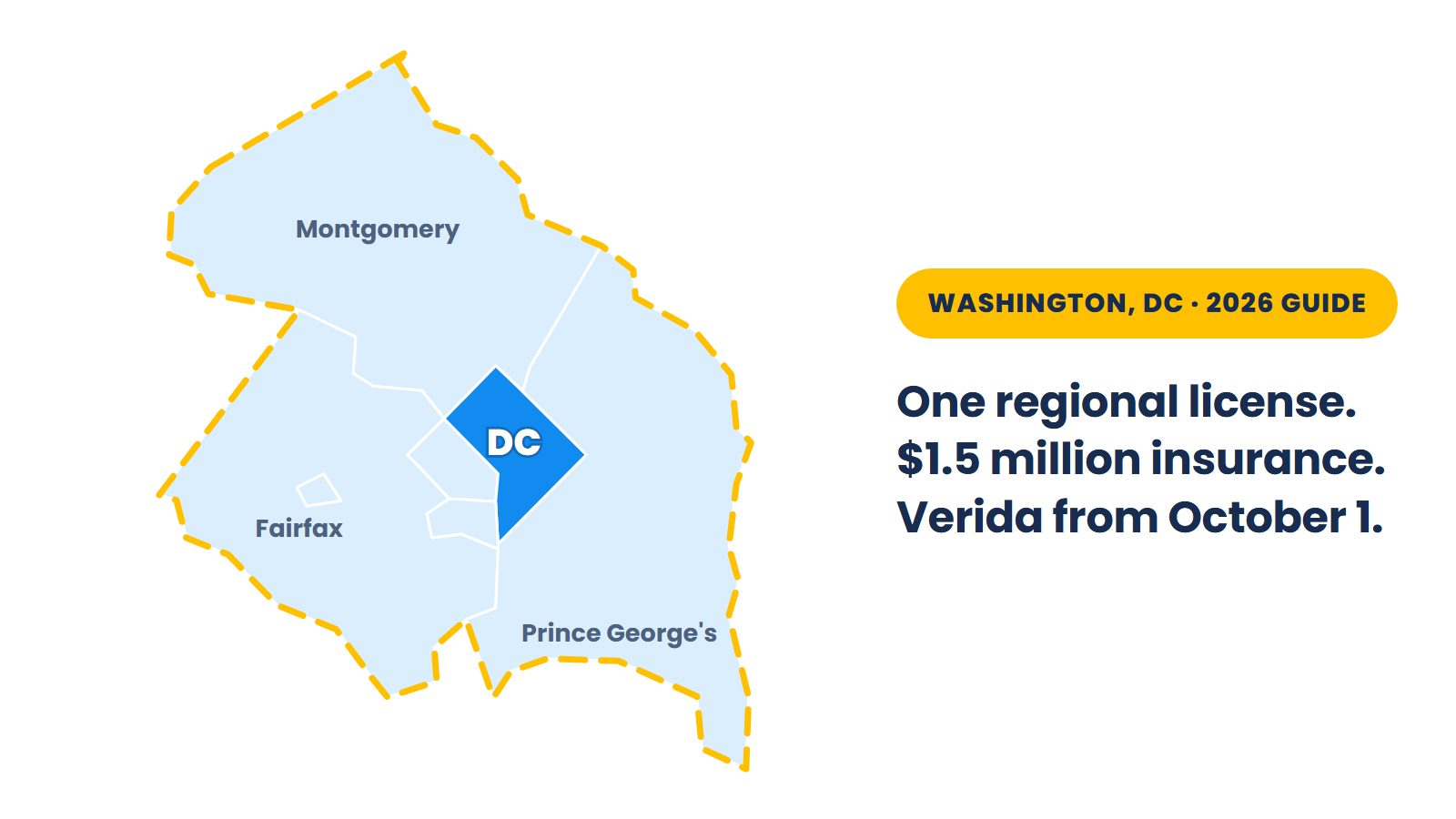
To start a NEMT business in Washington, DC, form a DC LLC ($99), get a basic business license ($99), and apply to the Washington Metropolitan Area Transit Commission (WMATC) for a certificate of authority ($300). DC has no NEMT license. WMATC’s certificate is what covers paid van trips that touch DC or its inner suburbs. Insure each van at $1.5 million, then apply to the health plans’ ride vendors and DC’s fee-for-service broker, which is MTM through December 31, 2026 while Verida’s new contract is under protest. Budget $25,000 to $50,000 and two to four months.
DC at a glance:
- DC NEMT license: none. The one that counts is a WMATC certificate of authority: $300 to file, $175 a year.
- Who runs Medicaid rides: MTM, through December 31, 2026, for fee-for-service riders (Medicaid members not in a health plan) and riders on the waiver for intellectual and developmental disabilities (IDD). Verida won the next contract, but it’s on hold during MTM’s protest. Each health plan runs its own members’ rides.
- How you get Medicaid trips: a transportation provider service agreement with the broker or a plan’s vendor, with your WMATC certificate in hand.
- Insurance the contracts expect: $1.5 million combined single limit auto (one limit for injuries and property damage together) on a WMATC certificate restricted to vehicles seating 15 or fewer, plus the $1.5 million general liability Verida’s contract requires.
- Cost to launch one van: about $25,000 to $50,000 for a used van run for private pay, before working capital; more for a broker-ready lift van.
- Time to first paid trip: two to four months. Every paid trip, private pay included, waits on the WMATC certificate.
MTM’s run as the District of Columbia’s fee-for-service Medicaid ride broker began in 2007 [1]. Verida won the contract to take over, and the DC Council deemed it approved on July 6, 2026, at up to $34 million for the first year [2]. Then MTM protested, DC stopped Verida’s contract on August 6, and MTM’s contract was extended through December 31, 2026 [59]. Verida’s contract spells out the license every van company in its network will need, and it isn’t a DC license. It’s a certificate from WMATC, a regional regulator created in 1960 that licenses for-hire carriers working DC and its inner Maryland and Virginia suburbs [2][3].
So in DC the order is WMATC first, insurance second, the broker third, and the 180 days after your WMATC grant are where new companies stall. I run Duet, which builds dispatch software and runs growth services for non-emergency medical transportation (NEMT) companies, and I talk to NEMT owners on demos every week, DC-metro operators included. This is the Washington, DC edition of our national guide on how to start a NEMT business. Requirements change, so confirm against the linked sources before you spend money.
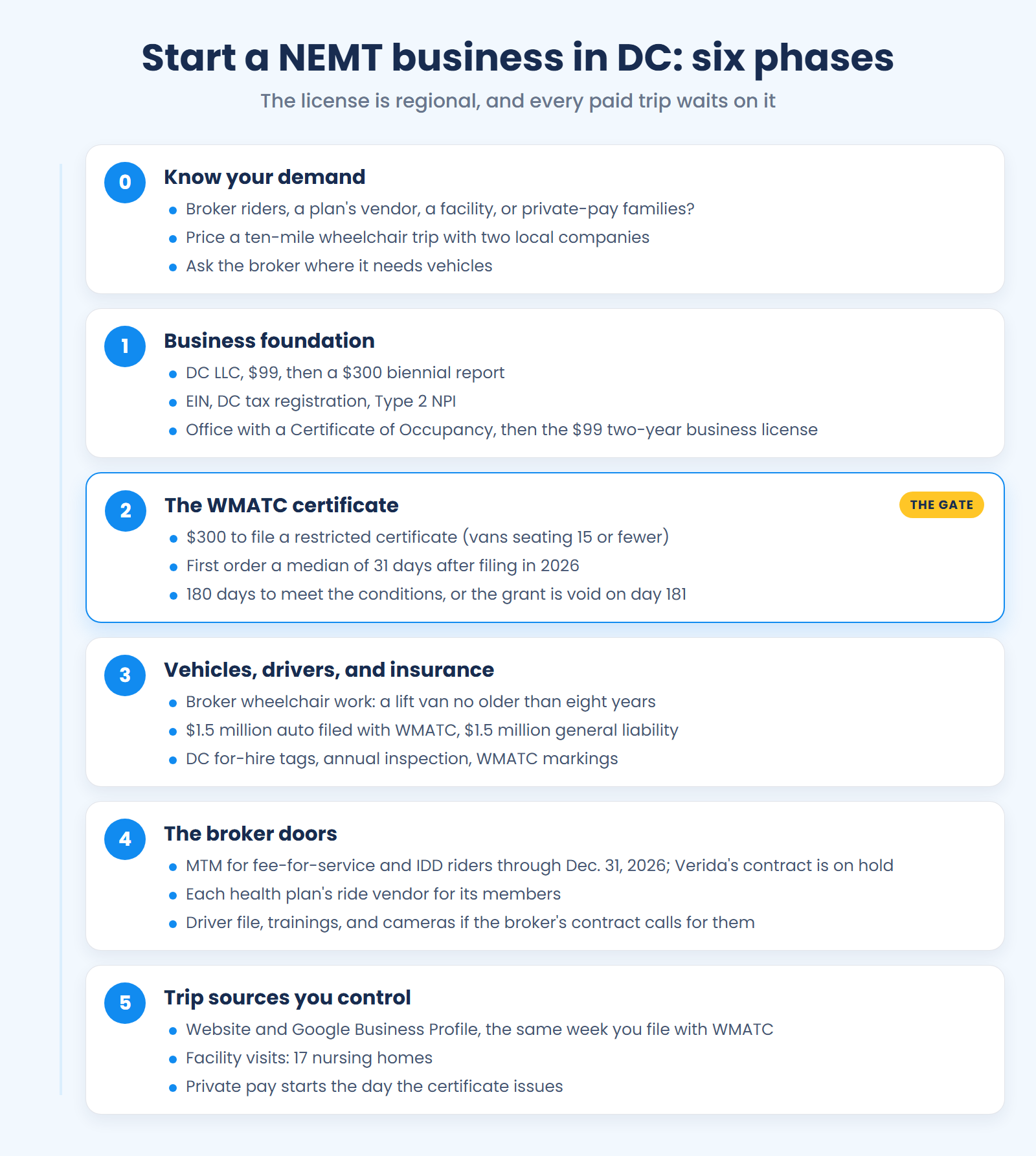
The one-page checklist: steps to start a NEMT business in Washington, DC
The phases go in the order the gates open: your company, the WMATC certificate, the van and the policy, then the broker doors, and the private-pay and facility riders who never need a broker.
Phase 0: know your demand
- Decide where your trips come from: DC’s fee-for-service riders (through MTM while Verida’s award is under protest), a health plan’s vendor, a facility, or private-pay families. Every one of those trips runs on the same WMATC certificate.
- Call two local companies for a ten-mile wheelchair quote, and set your own rates before you file them, because a WMATC carrier can only charge the rates in its filed tariff, the rate sheet it files with the commission [3].
- Before you pick a van, ask the provider relations teams at MTM and at Verida (its DC contract is on hold during MTM’s protest) whether they’re adding DC providers. In Georgia, Verida adds providers only where a region needs vehicles, and DC’s contract has it run a selection that asks each company for its price [2].
Phase 1: business foundation
- Form a DC LLC through BOSS, the DC business portal that replaced CorpOnline on August 10, 2026: $99 to file, then a $300 biennial report due April 1 of the year after you form and every second year after that [4][5]. You need a registered agent with a DC street address.
- Get a free EIN, register for DC taxes with the Office of Tax and Revenue [6], and get a free Type 2 NPI, the ID number healthcare payers use for your company, with taxonomy 343900000X, Non-Emergency Medical Transport (VAN).
- Line up an office. The basic business license needs a Certificate of Occupancy for a commercial address or a Home Occupation Permit [7]. DC’s zoning rules cap a home occupation at two business vehicles and two employees who don’t live there, so a growing fleet needs a real address [8].
- Get the basic business license from DC’s Department of Licensing and Consumer Protection (DLCP): $99 for two years, $49 for six months, or $198 for four [7]. Its license finder has no transportation activity, so ask DLCP which one to file under. You’ll need a Certificate of Clean Hands, which DC issues if you owe the District no more than $1,000 [9].
- Check owners against the OIG exclusion list and SAM.gov, the two federal lists of people banned from Medicaid work. Verida’s contract checks drivers against the federal exclusion list monthly [2].
Phase 2: the WMATC certificate
- File for a certificate restricted to vehicles seating 15 or fewer including the driver: $300, plus any publication cost, with a certificate of good standing for your LLC dated within six months [10]. You don’t need the van yet; the form asks only that you can buy or lease one.
- WMATC posts your application for a protest period, when other carriers can object, then issues a conditional grant. You have 180 days to meet its conditions, including the insurance filing [11].
Phase 3: vehicles, drivers, and insurance
- For broker wheelchair work under Verida’s contract, buy a lift-equipped van no more than eight years old; the contract caps any vehicle at ten years [2].
- Keep it to eight seats or fewer including the driver if you can; at nine or more, WMATC applies the federal motor carrier safety rules [11].
- Register a DC-based van with for-hire tags ($225 to $450 a year for typical van weights), pass the annual for-hire inspection, and budget for DC’s title excise tax [13][14][15].
- Bind $1.5 million combined single limit auto, file WMATC’s insurance endorsement, and carry the $1.5 million general liability Verida’s contract requires [11][2].
- Letter both sides with your name and “WMATC” plus your number [11]; the broker wants your name and phone at least three inches high on the front doors [2].
Phase 4: the broker doors
- Apply to DC’s fee-for-service broker for fee-for-service and IDD-waiver riders: MTM through December 31, 2026, or Verida if its contract starts. Then apply to the vendor of each health plan whose members you’ll carry: Access2Care for MedStar, SafeRide for UnitedHealthcare’s dual plan, and AmeriHealth’s credentialing team, since AmeriHealth names no vendor.
- Have the driver file and the trainings ready before the broker’s first inspection, plus in-vehicle cameras if Verida says your vans need them [2].
Phase 5: the trip sources you control
- Put up a website and Google Business Profile built for the trips from Phase 0, plus Yelp and Facebook. Take no paid bookings until the certificate issues.
- Visit facilities and build your private-pay marketing the same week you file with WMATC, not after. Broker credentialing has a queue; relationships don’t.
- Once the certificate issues, ask your first riders and the facilities you serve for honest Google reviews. About ten make strangers trust you. If you want a friends-and-family rate, put it in your tariff before you file.
Who pays for NEMT rides in Washington, DC?
Three payers cover NEMT rides in DC. DC Medicaid pays through the District’s broker for fee-for-service riders, the members who aren’t in a health plan, and through each plan’s ride vendor for everyone else. Facilities pay under contract. Private-pay families book directly. And the District runs its own cheap ride programs, which set the price you’re competing with.
Medicaid is the volume, and most of it is in health plans
DHCF, the DC Department of Health Care Finance, counted 253,148 Medicaid members in January 2026, a preliminary count, and about 87 percent of them were in managed care [16]. Two groups have no ride benefit at all: the DC Healthcare Alliance, DC’s own coverage for residents who don’t qualify for Medicaid, which lost non-emergency transportation on October 1, 2025, and the new Healthy DC Plan [17][18].
The fee-for-service book is small and busy. Per DHCF’s February 2026 answers to the DC Council, the broker ran 139,997 one-way trip legs for 4,134 fee-for-service riders in fiscal 2025 and paid transportation companies an average of $41.63 per one-way leg, one average for the whole book and not a wheelchair rate [19]. Another 92,674 legs went to 459 people on the IDD waiver, at $32.15 a leg [19].
Facilities are the stability
CMS’s provider data lists 18 dialysis facilities in DC (DaVita runs 10, Fresenius 5), 16 of them with in-center hemodialysis, and 17 nursing homes with 2,485 certified beds [20]. Nursing homes mean appointments and discharges every week, and 17 buildings is a list you can work through in a month. Dialysis means three-times-a-week standing trips, but in my experience most dialysis riders are on Medicaid, so those trips come through the broker or the health plans, not the clinic.
Private pay is the margin, and DC’s public programs set the price
DC riders have cheap options, and your private-pay price has to beat them on service, not cost. MetroAccess, the paratransit service of WMATA (the Metro transit agency, a different body from WMATC), charges up to $4.50 a trip [21]. DC’s Transport DC program gives MetroAccess customers taxi rides at $7 each, up to ten one-way trips a month, with unlimited dialysis trips available on approval [22]. And the District’s aging agency runs Senior MedExpress, free round trips to medical appointments like chemotherapy or dialysis for residents 60 and older with a certified condition [23].
So the private-pay rider in DC is the one those programs don’t serve: a wheelchair rider who needs help to the door, a return trip that won’t wait an hour, a discharge on a Saturday, or a ride to a specialist in Montgomery or Fairfax. The demand is aging. DC had 90,674 residents 65 and older in 2024, and the University of Virginia’s Weldon Cooper Center projects the 75-plus group to reach 46,338 by 2030, up from 35,570 at the 2020 Census [24].
Few DC-area companies post prices. One Northern Virginia company that serves the DC metro lists wheelchair trips at $88 one way plus $3 a mile, and a company serving Maryland and the DC metro lists one-way trips from $65 [25][26]. Call around before you file your tariff.
I lived in DC for a few years after college, and when I couldn’t drive my grandmother to Alexandria, the companies I called didn’t pick up. In our own Google Ads campaigns in the DC, Maryland, and Virginia metro, private-pay calls come in at roughly $10 to $15 a call in ad spend, eyeballed from our campaigns rather than benchmarked. Callers phone two or three private companies and book the cheapest one that answers, so answer the phone.
Who is the NEMT broker in Washington, DC?
MTM is still DC’s fee-for-service Medicaid NEMT broker, for riders on the IDD waiver too, under a series of contracts dating to July 2007 [1][19][59]. Verida won the next contract, with a base year set to start October 1, 2026 [2]. MTM protested the award on August 5, 2026, DC stopped Verida’s contract the next day, and MTM’s contract was extended through December 31, 2026 [59]. In mid-September DC told the Council it didn’t expect a ruling on the protest for at least two months, so check DHCF for the live date [59].
A broker is the company a state or health plan hires to assign Medicaid rides to transportation companies and pay for them. DC’s health plan members don’t ride through the District’s broker. Each plan arranges its own members’ rides, through its own transportation line or a vendor [19].
Here’s the map as of September 2026, with the fee-for-service row rechecked October 8:
| Riders | Who arranges the ride | Rider booking line (not for provider applications) |
|---|---|---|
| DC fee-for-service and IDD waiver (DHCF) | MTM, extended through December 31, 2026; Verida’s contract is on hold during MTM’s protest (as of October 8, 2026) | MTM, 866-796-0601 [27][59] |
| MedStar Family Choice DC | Access2Care, owned by MTM | 866-201-9974 [28][29] |
| AmeriHealth Caritas DC | AmeriHealth’s own transportation line; its 2026 materials name no vendor | 800-315-3485 [30] |
| Health Services for Children with Special Needs (HSCSN) | Verida | 866-991-5433 [31] |
| UnitedHealthcare Dual Choice (for people on both Medicare and Medicaid) | SafeRide | 888-462-6051 [32] |
| DC Healthcare Alliance and Healthy DC Plan | No NEMT benefit | None [17][18] |
Two plan changes matter if you’re reading older guides. CareFirst’s DC Medicaid plan ended in 2023, and Wellpoint DC (formerly Amerigroup) left on July 31, 2026, when DHCF assigned its members, about 49,000 in January, to AmeriHealth [33][34][16]. On January’s counts, AmeriHealth plus Wellpoint’s members add up to more than half of DC Medicaid, and members can switch to MedStar until January 31, 2027 [34][16]. Ask AmeriHealth’s credentialing team (dcprovidernetwork@amerihealthcaritasdc.com, 877-759-6186) who runs its transportation line [34].
Our national broker tracker follows switches like this one.
Can I bill DC Medicaid directly for NEMT rides?
No, not for ambulatory, wheelchair, or stretcher van trips, unlike New York, where you bill Medicaid yourself for each trip the broker approves. DHCF pays the broker a fixed monthly amount per eligible rider (a capitated rate), and the broker pays you under a transportation provider service agreement, the contract every network company signs [2]. Verida’s contract gives the broker 30 business days to pay an undisputed invoice unless your agreement sets different terms [2].
DC’s Medicaid regulations no longer carry NEMT carrier rules; the old ones were repealed years ago, so the carrier standards are WMATC’s and the broker contract’s [1][35][2].
One question to settle before you sign: whether you also enroll with DHCF. Verida’s contract describes its network as “active NEMT Providers currently enrolled in the District’s Medicaid program” [2]. The same contract calls the current 19-company network its “Actively Enrolled Transportation Providers,” so the phrase may mean that list rather than a DHCF enrollment [2]. Ask the fee-for-service broker and each plan’s vendor whether they want a DC Medicaid provider enrollment from you, and get the answer in writing.
DHCF does pay non-emergency ambulance from its fee schedule, $261.14 for basic life support (A0428) from April 1, 2026, but that’s ambulance money with ambulance licensing behind it [36].
What licenses and requirements does a NEMT business need in Washington, DC?
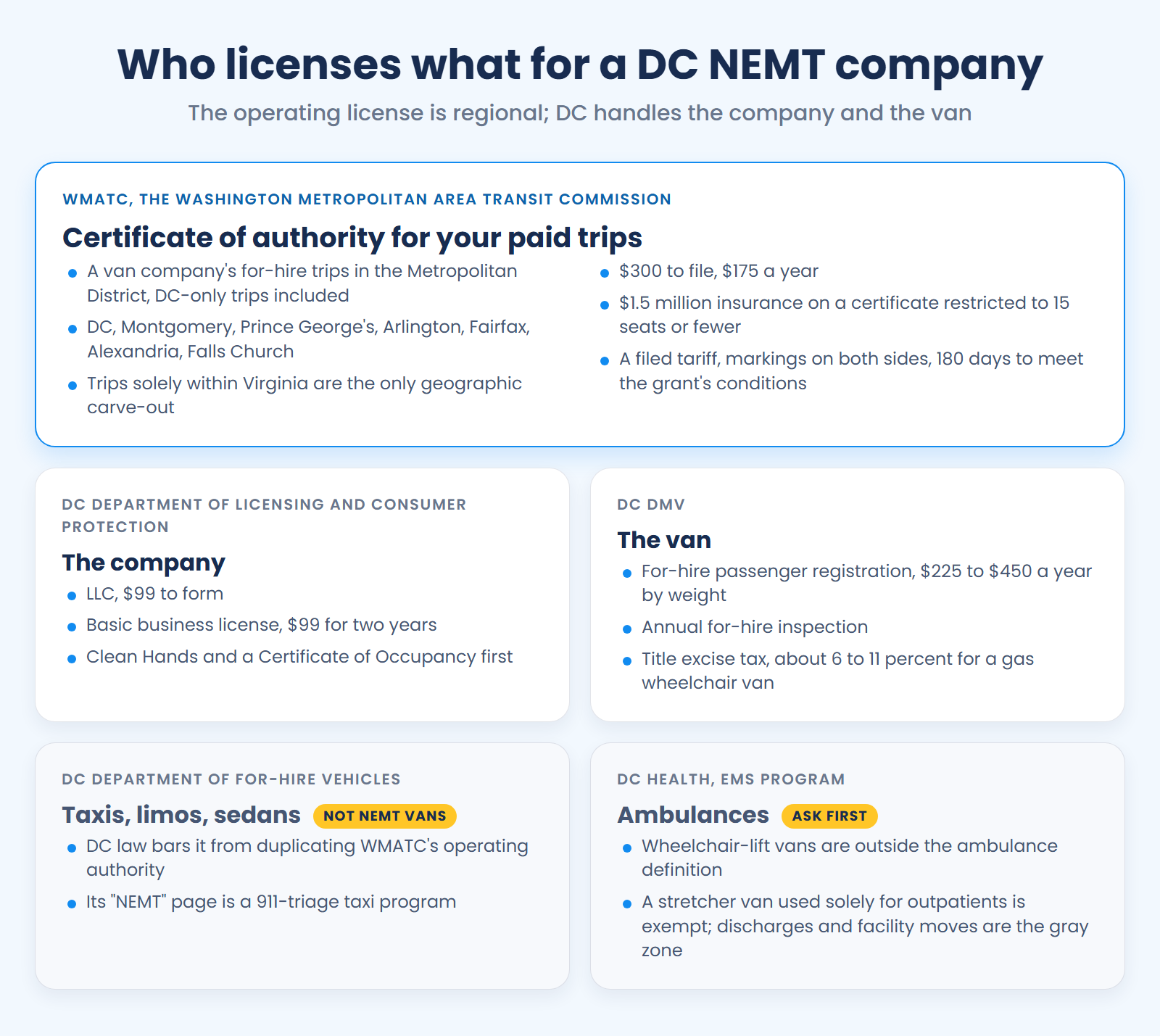
DC has no NEMT license of its own. What a van company needs is a WMATC certificate of authority, because the regional compact codified at D.C. Code § 9-1103.01 bars carrying passengers for hire between points in the Metropolitan District without one [3]. Taxis and government-run service are carved out; a NEMT van company isn’t [3]. A DC-based company also needs a DC basic business license and DC for-hire registration on each van.
The Metropolitan District is DC; Alexandria, Falls Church, and Fairfax City; Arlington and Fairfax counties; the Dulles airport; and Montgomery and Prince George’s counties [37]. The only trips WMATC carves out by geography are those solely within Virginia [37]. A DC-only trip is still inside the Metropolitan District, so it still needs the certificate, and so does a trip that stays inside Montgomery or Prince George’s County.
The internet gets DC wrong in a few specific ways:
| The claim you’ll read elsewhere | What DC actually requires |
|---|---|
| ”The DC Department of For-Hire Vehicles (DFHV) handles NEMT licensing” or “you need a DFHV taxicab operating authority” | DFHV regulates taxis, limousines, and sedans (D.C. Code § 50-301.07), and DC law bars it from requiring operating authority that duplicates WMATC’s (§ 50-301.13(h)(2)). Its “NEMT” page is a free 911-triage taxi program, and the taxicab-authority line is the eligibility rule of a 2019 DFHV taxi grant [38][39][40]. |
| ”WMATC authority only covers DC pickups headed outside the District” | The compact covers for-hire trips between any points in the Metropolitan District, DC-only trips included. The only geographic carve-out is trips solely within Virginia [3][37]. |
| ”How to start a NEMT business in Washington: register with the Secretary of State; the Health Care Authority runs NEMT” | That’s Washington State. A DC company forms with DLCP through BOSS, DC Medicaid belongs to DHCF, and Medicaid rides run through DC’s fee-for-service broker and the plans’ vendors [4][5][59]. |
| ”MTM (or ModivCare) is DC’s Medicaid transportation broker” | MTM, yes, for now: its fee-for-service run, which dates to 2007, is extended through December 31, 2026 while its protest of Verida’s award is decided. ModivCare holds neither contract [59][19]. |
| ”Call Verida at 866-991-5433 to join DC’s network” | That’s HSCSN’s rider booking line. Use the provider contact on Verida’s Washington, DC provider page instead [31]. |
| ”Start with a medical transportation provider application package at the DMV” | DC DMV registers and inspects the van. The operating authority comes from WMATC [13][3]. |
| ”Brokers require $1 million auto and $1M/$2M general liability” | DC’s bar is higher: WMATC requires $1.5 million combined single limit on a certificate restricted to vehicles seating 15 or fewer, and Verida’s contract requires $1.5 million general liability [11][2]. |
| ”DC wheelchair rides run $90 to $150 plus $4 to $8 a mile” | Those ranges come from an out-of-state operator’s estimate page with no DC source. DC-area companies that post prices land nearby: one lists wheelchair trips at $88 one way plus $3 a mile, another one-way trips from $65. Medicaid pays far less: DC’s broker averaged $41.63 per one-way leg across all trip types in fiscal 2025 [25][26][19]. |
What the WMATC certificate costs and how long it takes
WMATC’s fees are small: $300 to file for a new certificate, $175 a year after that, due January 31, and $150 late fees if you miss the annual report or the fee [11][10]. The restricted certificate limits you to vehicles seating 15 or fewer including the driver, and in exchange your insurance minimum drops from $5 million to $1.5 million [11].
On WMATC’s status board as of September 25, 2026, 101 applications showed both a filing date and an order. The first order, usually the conditional grant, came a median of 31 days after filing, and 10 of the 101 waited more than two months [12].
Then the grant’s 180 days start. WMATC’s regulation is blunt: a conditional grant is void on the 181st day if you haven’t met every condition, with one extension of 31 days at most, and three voided grants in a row bar an applicant from reapplying for a year [11]. The board lists 12 grants voided this way (it says “deemed denied”) between August 26 and September 23, 2026, half of them from applicants with medical, health-care, or transportation names [12]. The conditions that cost money, the van and a $1.5 million policy, come due after the grant. If I were starting in DC, I’d file only when I could fund both within six months.
WMATC can also grant temporary authority, $150, when you can document an immediate need for service nobody else is providing, backed by notarized statements from the people or facilities who’d use it [10][11]. That’s a hard case to make in DC right now: of the 13 applications on WMATC’s notice board in late September 2026, seven listed Medicaid or private-pay wheelchair and ambulatory service [12]. You’ll have company.
The rules that come with the certificate
- A filed tariff. Under the compact, a WMATC carrier can’t charge any rate except the one in its tariff on file, broker and facility contract rates included [3]. Ask WMATC how to file contract rates.
- Markings. Your name and “WMATC” with your certificate number on both sides of every vehicle, at least 2.5 inches high and legible from 50 feet [11].
- Wheelchair vehicles. Lifts or ramps, securement devices, and the federal ADA vehicle specifications in 49 CFR Part 38 [11].
- Vehicles seating eight or fewer including the driver: a daily pre-trip check, a for-hire safety inspection within the last 12 months, drivers 21 and older, and a certified ten-year driving record and ten-year criminal history on every driver before hire, refreshed every 12 months [11].
- Vehicles seating nine or more: WMATC adopts the federal motor carrier safety rules for them, driver qualification files, hours of service, and inspection and maintenance included, whether or not the trip crosses a state line [11].
- Never let the insurance lapse. If your insurance endorsement isn’t replaced before it terminates, your authority is suspended automatically [11].
DFHV, DMV, and the local layer
DFHV’s H-tags and L-tags are taxi and limousine registrations, not a wheelchair van’s [41]. The DMV side fits: register a DC-based van under the for-hire passenger class, $225 a year for a 3,500-to-4,999-pound van and $450 for one between 6,000 and 6,999 pounds, and pass the annual for-hire inspection [14][13]. Titling it in DC brings an excise tax based on weight and fuel economy: about 6 to 11 percent of fair market value for most gas wheelchair vans, less for a hybrid [15].
DC sales tax doesn’t apply to your fares, because the District’s sales tax excludes transportation services [42].
Already running vans in Maryland or Virginia?
You still need the WMATC certificate for any Metropolitan District trip that touches DC or Maryland, because Maryland and Virginia authority doesn’t cover those trips [43][37]. You don’t need a DC company: WMATC wants good standing from the state where you formed [10]. Trips that stay inside Virginia fall under Virginia’s own DMV authority, which our Virginia guide covers lane by lane. Trips that stay inside Maryland are a Maryland Public Service Commission question too, and Montgomery County’s Medicaid transportation contract asks for both a PSC and a WMATC certificate [43][44].
A trip past the Metropolitan District, say DC to Baltimore, is generally interstate carriage under the Federal Motor Carrier Safety Administration (FMCSA): registration and a $1.5 million federal minimum for vehicles seating 15 or fewer [45]. WMATC’s application asks for a USDOT number only if you already hold one [10].
What are the NEMT insurance requirements in Washington, DC?
Plan on $1.5 million combined single limit auto on every van, plus $1.5 million general liability. WMATC sets the auto number for a certificate restricted to vehicles seating 15 or fewer, and Verida’s contract sets the general liability number, with Verida named on your policies [11][2]. That’s well above DC’s personal-auto minimum and the $1 million national figure most guides quote.
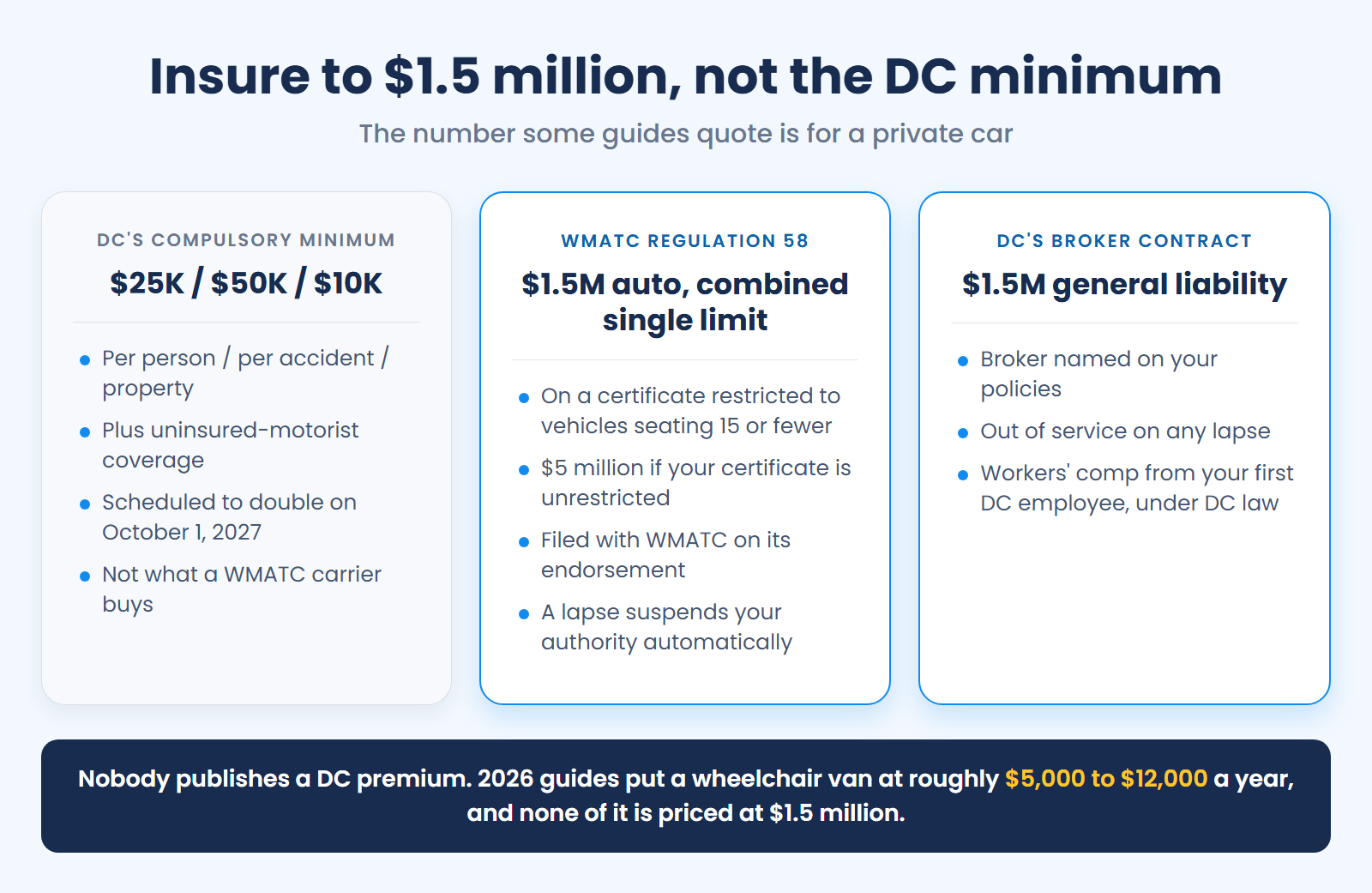
Your insurer files WMATC’s Certificate of Insurance and Policy Endorsement for you, and your certificate isn’t valid while that filing is out of date [11][3]. Confirm the exact limits in your broker agreement before you bind.
For the record, DC’s compulsory minimum for any registered car is $25,000 per person and $50,000 per accident for injuries and $10,000 for property damage, plus uninsured-motorist coverage, and it’s scheduled to double on October 1, 2027 [46]. Neither number is what a WMATC carrier buys.
What that costs is harder to pin down, because nobody publishes a DC figure. Bridgeway Insurance Agency, a Southeast agency, puts a wheelchair van at roughly $5,000 to $8,000 a year on a $1 million policy, and Elite Med Financials, a billing company, puts one at $6,800 to $12,000 [47][48]. Our Virginia guide cites a Virginia Beach operator, On Time NEMT, at $7,000 to $12,000, and flags Northern Virginia as higher. None of it is priced for DC’s $1.5 million minimum, so treat them as a floor, get quotes from agents who already file WMATC endorsements, and price the insurance before you pick the van.
Two more lines for the budget:
- Workers’ comp from employee one. DC requires every employer to carry it, with no headcount threshold, and fines run $1,000 to $10,000; a corporation’s officers can be held personally liable [49]. Verida’s contract also asks for $500,000 of employer’s liability, so have your agent quote it [2].
- Payroll costs more here. DC’s minimum wage is $18.40 an hour from July 1, 2026, and employers pay 0.75 percent of wages for DC’s paid leave program [50][51].
What do NEMT drivers need in Washington, DC?
NEMT drivers in DC don’t need a CDL for a typical wheelchair van. Under D.C. Code § 50-401, a commercial license starts at a vehicle designed for more than 15 passengers including the driver, or rated over 26,000 pounds [52]. What your drivers do need comes from two places: WMATC’s safety rules and the broker’s contract.
Verida’s contract sets this driver file [2]:
- At least 21, with a DC, Maryland, or Virginia license that hasn’t been revoked or suspended in the past five years.
- No convictions in the past seven years for any crime on the contract’s list, which includes assault, theft, fraud, and drug distribution, and no felony during the contract.
- No drug treatment or positive drug screen in the past five years, fewer than three moving violations or accidents in the past seven, and fluent English.
- FBI background checks before the first trip and every year after.
- Current first aid and CPR certificates, which the driver or your company pays for, not the broker.
- A negative drug screen before starting and random screens at least once a quarter, which the broker provides and pays for, plus post-accident drug and alcohol testing.
- Out of service after two moving violations or at-fault accidents in 12 months.
The contract also puts every driver under a drug and alcohol testing program that follows the federal rules (49 CFR Parts 40 and 382), with pre-employment, random, reasonable-suspicion, and post-accident tests, and it calls for DOT physical exams for drivers “transporting passengers” and, in its insurance section, a DOT medical card “as applicable” [2]. WMATC’s own rules don’t require medical cards for a van seating eight or fewer [11]. Ask Verida what it will want before you hire.
Add WMATC’s certified ten-year driving record and criminal history from the rules above, and build one file that satisfies both [11].
What are the ten trainings DC’s broker contract requires?
Verida’s DC contract requires every driver and attendant to finish ten trainings, most of them sponsored by the broker, before the first Medicaid ride, unless DHCF approves Verida’s own standards in their place [2]:
- Driver training, including defensive driving
- First aid and CPR
- Spill kit
- Removal of biohazards
- A passenger assistance orientation program
- Driver reporting requirements
- A safety and sensitivity program
- Emergency and accident procedures
- Customer service
- Training courses from DC’s Department on Disability Services (DDS)
Companies that carry IDD-waiver riders also take the broker’s IDD course, and every IDD-waiver trip needs an attendant, yours or one the family designates [2]. The contract also requires in-vehicle video cameras covering the driver and passenger compartments in all vehicles used to transport eligible riders, with footage kept 12 months. That clause sits under a heading about IDD riders, so ask Verida whether it applies to your whole fleet before you price it [2].
Can a NEMT company run stretcher van trips in Washington, DC?
Yes, if the van carries only outpatients. DC’s EMS law exempts validly licensed vehicles operated solely to carry non-emergency patients to and from treatment facilities as outpatients, as long as the vehicle isn’t held out as an emergency vehicle (D.C. Code § 7-2341.02(b)(5)), and DC’s EMS regulations repeat the exemption [53][54]. The broker contract buys “bariatric and stretcher vans,” non-emergency vans built to carry a gurney with two stretcher staff aboard [2].
The exemption follows the vehicle, not the trip. Outside it, DC’s EMS regulations define an ambulance as any vehicle designed or equipped to carry people who are sick, injured, wounded, or incapacitated, and they carve out only hydraulic-lift vans used exclusively for wheelchair riders who need no ambulance equipment or crew. Stretcher vans aren’t carved out [54]. A patient moved by ambulance between facilities with a DC starting point can only ride with a certified DC EMS agency [54]. So a stretcher van that also runs hospital discharges or hospital-to-nursing-home moves may lose the exemption for every trip. Before it takes one, email DC Health’s EMS program (EMS.HEPRA@dc.gov), ask the same about a ramp van that runs discharges, and keep the answer in your file.
The broker’s stretcher van spec: no older than eight years, a gurney rated for at least 500 pounds on proper floor mounts, three body straps, and two stretcher staff [2].
The line you can never cross: no medical care during transport. Verida’s contract sends riders who need life support equipment, such as oxygen given by trained medical personnel, to a non-emergency ambulance [2], and a basic life support ambulance in DC carries two DC-certified EMTs under a licensed EMS agency [54]. Put that line in your dispatch protocols in writing.
How do you become a Medicaid transportation provider in Washington, DC?
Becoming a DC Medicaid transportation provider means signing a transportation provider service agreement with DC’s fee-for-service broker or with a health plan’s ride vendor. That broker is MTM through December 31, 2026, while Verida’s contract is on hold during MTM’s protest [59]. If Verida starts, its DC contract requires your WMATC certificate first [2].
How do you become a Verida provider in DC?
Four steps:
- The WMATC certificate and the insurance behind it. The contract tells Verida to recruit transportation companies “licensed and certified by WMATC,” with proof of insurance and a WMATC certificate on file for as long as you’re in the network [2].
- Verida’s application. In Georgia it’s a Request for Qualifications with driver and vehicle lists, reviewed for need. DC’s contract has Verida run a selection that asks each company how it’ll run the trips and what it’ll charge [2]. Ask where the need is before you apply, and whether you also need a DC Medicaid enrollment.
- Inspections and driver files. Verida inspects every vehicle before its first trip and at least once a year after, and checks the driver file and trainings above [2].
- The agreement. You sign the transportation provider service agreement, which carries your vehicle and driver requirements, your rates, and the payment terms [2].
Verida provider requirements
The contract’s checklist, condensed [2]:
- A WMATC certificate of authority and WMATC insurance filing, $1.5 million general liability, and Verida on your policies.
- Vehicles no older than ten years; wheelchair and stretcher vans no older than eight.
- Wheelchair vans with a powered lift rated for 600 pounds that can be raised and lowered by hand in a power failure, at least 56 inches of interior height and door clearance, and an ADA tie-down tested to the 30 mph, 20 g standard. Minivan conversions use ramps, so they fit WMATC and private pay but not this spec; Verida may still class one for ambulatory trips, so ask before you buy one for broker work.
- In-vehicle cameras (ask whether the rule covers your whole fleet or only IDD trips), two fire extinguishers, two first aid kits, a spill kit, tire chains, GPS covering DC, Maryland, and Virginia, and three triangle reflectors in every vehicle.
- Your name and phone on the front doors in three-inch letters, WMATC information on the outside, and nothing on the van or in your company name that suggests Medicaid riders.
- On-time pickups: no more than 2 percent of trips late or missed in a day, and a company with more than 5 percent of trips 20 minutes late comes out of service.
How long does Verida credentialing take?
No clock is published. The contract has Verida write a selection plan that draws on the full pool of companies already active in the District’s program, and MTM had 19 of them when DC put the contract out to bid [2]. As a gut check, don’t count on broker trips for a few months after your certificate issues, and have private pay running before you do.
The plan vendors, and a certification to ask about
- Access2Care for MedStar Family Choice. MTM owns it, so ask MTM’s provider onboarding team whether Access2Care is adding MedStar providers [28][29].
- SafeRide for UnitedHealthcare’s dual plan. Its riders get 36 one-way trips or unlimited trips, depending on the plan, so ask SafeRide’s provider team whether it contracts DC companies [32].
- AmeriHealth Caritas DC. The biggest plan in DC, and bigger since Wellpoint left; start with the credentialing contact above [34].
- DC small business certification. Verida’s contract carries a small-business subcontracting plan worth $11,996,910, 35 percent of the contract, but the plan named its subcontractors when Verida bid, and changes need District approval [2]. Certification needs a principal office in DC plus one more DC tie, such as most of your employees or owners living in DC, and the small-business category has a size limit. It takes up to 45 business days and lasts three years [55][56]. Ask Verida whether transportation companies count toward the plan and whether it’s adding any.
Brokers want a track record, and a track record takes trips. The way out is the payer that doesn’t need a broker. Our guides on winning facility contracts, getting the first trip from a facility meeting, and private pay cover that stretch.
Don’t build the whole schedule on one payer
DC’s fee-for-service riders have one broker door, and its first handoff since 2007, from MTM to Verida, was set for October 1, 2026 and is on hold during MTM’s protest [59]. In the year before that date, the Alliance lost its ride benefit and DHCF moved Wellpoint’s members to AmeriHealth [17][34]. Changes like these move or erase trips without asking a single transportation company.
Eugene, who ran five wheelchair vans at Capital Area Transport Service when we recorded, put the alternative plainly on our podcast: “When I look back on this now, [I] think that the most profitable and lucrative contracts that I received was always from me walking into a facility.” Brokers come last in his schedule: “We use brokers mostly, at this point, as a fill-in for a space that we’re not transporting anyone.” His advice for government contracts in the DC metro is to start as a subcontractor under a prime, because he’s watched primes fail as often as they succeed, and “the DC metro area is pretty aggressive in the way they treat primes.”
Facilities and private pay run on the same WMATC certificate as your broker trips, so going after them takes no extra license, and no contract award can take them away. Keep the broker where Eugene keeps his: filling the gaps in a schedule you already own.
Whatever the mix, keep it in one schedule. Dispatch software like Duet that pulls broker trip files in alongside facility and private-pay work saves you from running the broker’s trips in one place and your own in another, but the rate negotiation and the facility visits are still yours.
How much does it cost to start a NEMT business in Washington, DC?
Plan on $25,000 to $50,000 to put one used wheelchair van on the road for private pay in DC, before working capital. A $17,000 to $30,000 minivan conversion, $1,000 to $3,300 of DC excise tax on it, $5,000 to $12,000 for a year of insurance, and about $1,000 in filings and registration add up to roughly $24,000 to $46,000. Lettering, workers’ comp, and a $1.5 million premium that runs above those bands can take it to $50,000 or past it. Broker wheelchair work costs more: get two dealer quotes on a lift-equipped van no more than eight years old before you budget the broker path.
| Line item | What it costs |
|---|---|
| LLC formation | $99 to file; $300 biennial report [4] |
| EIN and NPI | Free |
| DC NEMT license | $0. It doesn’t exist [3] |
| DFHV license | $0. DFHV doesn’t license NEMT vans [38] |
| Basic business license | $99 for two years [7] |
| WMATC certificate | $300 to file, $175 a year, plus any publication cost [11][10] |
| For-hire registration and inspection | $225 to $450 a year for typical van weights, plus the annual inspection [14] |
| DC title excise tax | About 6 to 11 percent of the van’s value for a gas wheelchair van [15] |
| Used wheelchair van | Roughly $17,000 to $30,000 for a used rear-entry minivan conversion in September 2026 listings, per our Virginia guide; broker work needs a lift van eight years old or newer |
| Commercial auto at $1.5 million | No DC figure is published; 2026 guides put a wheelchair van at $5,000 to $12,000, none of it priced at $1.5 million [47][48] |
| Cameras, extinguishers, chains, GPS | Quote them for broker work [2] |
| Workers’ comp | Required from your first employee [49] |
| Working capital | Three to six months of expenses; the broker pays on your agreement’s terms, or within 30 business days of an undisputed invoice [2] |
Anyone quoting a $5,000 DC launch hasn’t priced a $1.5 million policy.
How do you fund a NEMT startup in Washington, DC?
If the savings account doesn’t cover it:
- SBA 7(a) loans and microloans finance vans and working capital through banks and community lenders.
- LEDC, a certified community development lender listed by the DC Small Business Development Center, makes loans of $5,000 to $50,000 to start-ups that have trouble getting bank credit [57].
- The DC Small Business Development Center, headquartered at Howard University, advises small businesses and points to lenders [57].
None of them speed up WMATC’s review or the broker’s selection, so size your loan payments to the slow timeline, not the hopeful one.
How long does it take to start a NEMT business in Washington, DC?
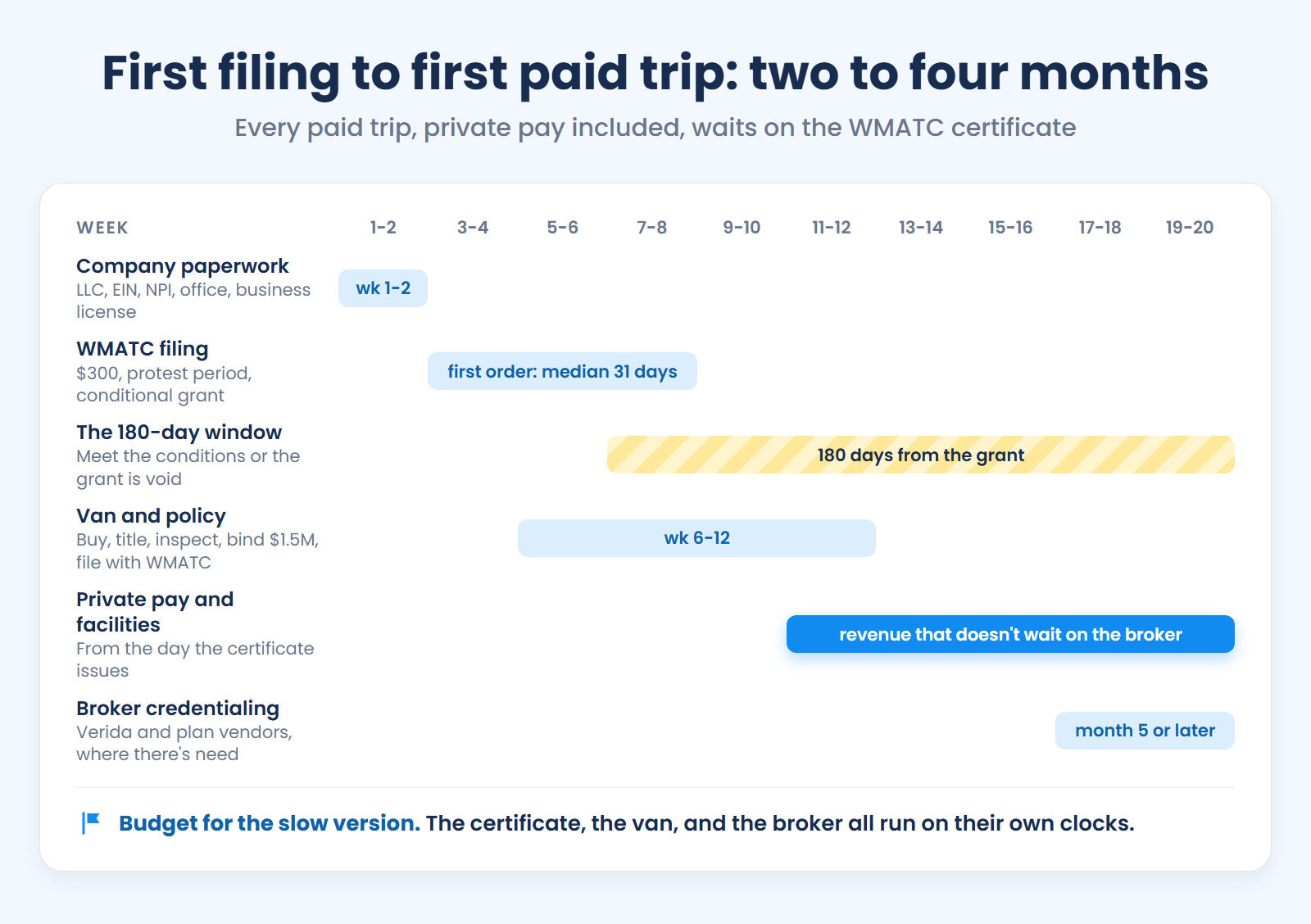
Plan on two to four months between your first filing and your first paid trip, and longer before broker trips arrive. On WMATC’s September 2026 status board, the first order came a median of 31 days after filing, and everything after that runs at the speed you buy, insure, and inspect the van [12]. A realistic sequence:
- Weeks 1-2. LLC ($99), EIN, NPI, DC tax registration, an office, the basic business license, and insurance quotes at $1.5 million.
- Weeks 2-3. File with WMATC ($300) with your good-standing certificate. Pick the van only after you know the premium and the broker’s rules.
- Weeks 3-8. The protest period and the conditional grant. The 180-day clock starts.
- Weeks 6-12. Buy and title the van, bind the policy, file WMATC’s insurance endorsement and your tariff, and ask DC DMV whether for-hire tags need your WMATC order first. Then pass the for-hire inspection and letter the van. WMATC issues the certificate after it accepts your compliance filings.
- From the certificate on. Private-pay and facility trips can start. Apply to the fee-for-service broker and the plan vendors, with drivers screened and trained.
- Month 5 or later. Broker inspection, the service agreement, and the first Medicaid trips, once the broker or a plan vendor has need. Until then, private pay and facilities are the business.
If Verida adds companies after its first network, it will want ones whose certificate and young van are already in hand.
Washington, DC NEMT FAQ
Does Washington, DC require a NEMT license?
DC has no NEMT license of its own. What a van company needs is a WMATC certificate of authority, which the regional compact requires for for-hire passenger trips between points in the Metropolitan District, DC-only trips included [3]. A certificate restricted to vehicles seating 15 or fewer costs $300 to file and $175 a year [11]. A DC-based company also needs a DC basic business license and DC for-hire registration on each van [7][13].
Do I need a WMATC certificate for trips that stay inside DC?
Yes. The compact covers for-hire trips between any points in the Metropolitan District, and the only trips it carves out by geography are those solely within Virginia [3][37]. DC’s for-hire vehicle agency licenses taxis, limousines, and sedans, and DC law bars it from requiring operating authority that duplicates WMATC’s [39].
Can I use my Virginia or Maryland authority for DC trips?
No. A Virginia DMV certificate covers trips that stay inside Virginia, and Maryland’s Public Service Commission tells applicants they’ll also need WMATC authority to work the Washington metro [43]. Any paid trip between points in the Metropolitan District needs the WMATC certificate, including one that stays inside Montgomery or Prince George’s County. Only trips solely within Virginia are carved out [3][37].
Is MTM still DC’s Medicaid transportation broker?
Yes, for fee-for-service and IDD-waiver riders, through December 31, 2026. DC awarded the next contract to Verida, but MTM protested on August 5, 2026, DC stopped Verida’s contract the next day, and MTM’s contract was extended through December 31 [2][59]. MTM still reaches MedStar Family Choice members through Access2Care, which it owns [28][29]. HSCSN uses Verida, UnitedHealthcare’s dual plan uses SafeRide, and AmeriHealth Caritas DC runs its own transportation line [31][32][30].
How much does it cost to start a NEMT business in DC?
Roughly $25,000 to $50,000, more if your $1.5 million quote runs high, to put one used wheelchair van on the road for private pay, before working capital. The filings are cheap: $99 for the LLC, $99 for a two-year business license, and $300 for WMATC [4][7][11]. The van, DC’s title excise tax, and insurance at WMATC’s $1.5 million minimum are the money. Broker wheelchair work costs more, because Verida’s contract wants a lift-equipped van no more than eight years old [2].
Can I run a DC NEMT business from home?
For a van or two, possibly. DC’s zoning rules let a home occupation use at most two business vehicles and two employees who don’t live there, and the home can’t be a gathering point for workers heading to another job site [8]. Once drivers start their shifts at your house, plan on a commercial address. The business license needs a Certificate of Occupancy or a Home Occupation Permit [7].
Do NEMT drivers need a CDL in Washington, DC?
Not for a typical wheelchair van. DC’s CDL line is a vehicle designed for more than 15 passengers including the driver, or rated over 26,000 pounds [52]. Verida’s contract sets the real driver file: at least 21, a license with no revocation or suspension in five years, FBI background checks, first aid and CPR, and quarterly random drug tests [2]. Ask Verida whether it will also want DOT medical cards.
Can a NEMT company run stretcher van trips in DC?
Yes, if the van carries only outpatients. DC’s EMS law exempts licensed vehicles operated solely to carry non-emergency outpatients to and from treatment, and Verida’s contract buys stretcher van trips with two stretcher staff [53][2]. The exemption follows the vehicle, not the trip, so get DC Health’s EMS program’s answer in writing before a stretcher van takes a discharge or a move between facilities [54].
Is the DC market worth entering in 2026?
For a company that plans for WMATC and private pay, yes. DC had about 253,000 Medicaid members in January 2026, 18 dialysis facilities, and a 75-plus population projected to reach about 46,000 by 2030 [16][20][24]. It’s also filling up: 79 organizations with a DC practice address carry the NEMT taxonomy in the federal NPI registry, 13 of them new in 2026, and MTM had 19 active transportation companies when DC put its broker contract out to bid [58][2].
Key official sources
[1] DC Office of the Inspector General, Re-Audit of Non-Emergency Transportation Provider Compliance, OIG No. 12-2-16HC (March 21, 2014): MTM’s July 20, 2007 award, the WMATC requirement in the earlier contract, the repeal of the District’s old NEMT rules. https://oig.dc.gov/sites/default/files/Reports/OIGNo12216HCReAudit_0.pdf
[2] Council of the District of Columbia, CA26-0885, Proposed Contract No. CW135340 with Verida, Inc. (deemed approved July 6, 2026): the Mayor’s transmittal, contract summary, and contract text, including the October 1, 2026 to September 30, 2027 base period, the $34,010,636 not-to-exceed amount, fee-for-service and IDD scope, readiness review, WMATC and insurance requirements, vehicle, driver, training, and camera rules, provider payment terms, the 19 active providers, and the subcontracting plan. https://lims.dccouncil.gov/Legislation/CA26-0885
[3] D.C. Code § 9-1103.01, the Washington Metropolitan Area Transit Regulation Compact: coverage of for-hire passenger transportation between any points in the Metropolitan District, its exclusions, the certificate of authority, tariffs, insurance. https://code.dccouncil.gov/us/dc/council/code/sections/9-1103.01
[4] DC Department of Licensing and Consumer Protection, Corporations Division fees for limited liability companies: $99 certificate of organization, $300 biennial report. https://dlcp.dc.gov/node/1621921
[5] DLCP, BOSS business portal (launched August 10, 2026, replacing CorpOnline and the DC Business Center). https://dlcp.dc.gov/BOSS
[6] DC Office of Tax and Revenue, New Business Registration. https://otr.cfo.dc.gov/page/new-business-registration
[7] DLCP, Business Licensing FAQs: $49, $99, and $198 license terms; Certificate of Occupancy or Home Occupation Permit. https://dlcp.dc.gov/node/1614551
[8] DC Zoning Regulations, Subtitle U § 251, home occupations: vehicle, employee, and gathering-point limits. https://dcoz.dc.gov/sites/default/files/dc/sites/dcoz/publication/attachments/Subtitle%20U.pdf
[9] DC Office of Tax and Revenue, Certificate of Clean Hands: the $1,000 threshold. https://otr.cfo.dc.gov/page/certificate-clean-hands
[10] WMATC, Application to Obtain, Transfer, or Amend Irregular Route Authority (online form, checked September 2026): the $300 and $150 fees, restricted and unrestricted certificates, service types, other authorities held, good-standing attachment. https://www.wmatc.gov/forms?view=article&id=52:application-form&catid=2
[11] WMATC, Rules and Regulations: Regulation Nos. 54-06 (temporary authority), 58 (insurance), 61 (markings), 64 (safety rules by seating capacity and ADA specifications), 66 (the 180-day deadline and the one-year bar), and 67 (fees). https://www.wmatc.gov/pdf/rules-regs.pdf
[12] WMATC, Notice of Applications and Application Status (checked September 25, 2026): pending applications and their services, filing and order dates for 123 cases, deemed denials. https://www.wmatc.gov/pending-proceedings and https://www.wmatc.gov/application-status
[13] DC DMV, Vehicle Inspections: annual inspection for commercial and for-hire vehicles. https://dmv.dc.gov/inspections
[14] D.C. Code § 50-1501.03: registration fees for passenger-carrying vehicles for hire by weight. https://code.dccouncil.gov/us/dc/council/code/sections/50-1501.03
[15] DC DMV, Vehicle Title and Excise Tax Fees (table effective February 17, 2025). https://dmv.dc.gov/book/dmv-fees/vehicle-title-and-excise-tax-fees
[16] DHCF, Monthly Enrollment Report, February 2026 (data through January 2026, preliminary): Medicaid, managed care, and plan counts. https://dhcf.dc.gov/sites/default/files/dc/sites/dhcf/page_content/attachments/MCAC%20Enrollment%20Report%20-%20February%202026.pdf
[17] DHCF, Alliance and ICP Program Changes Effective October 1, 2025 (resource document, September 9, 2025): no non-emergency transportation. https://dhcf.dc.gov/sites/default/files/dc/sites/dhcf/service_content/attachments/2025-09-09_Alliance_Changes_Resource_Document.pdf
[18] AmeriHealth Caritas DC, “Healthy DC Plan is Now Live” (January 13, 2026): NEMT not covered. https://www.amerihealthcaritasdc.com/content/dam/amerihealth-caritas/acdc/pdf/provider/forms/2026/healthy-dc-plan-now-live.pdf.coredownload.inline.pdf
[19] DHCF, FY2025 Performance Oversight Pre-Hearing Responses to the DC Council Committee on Health (February 2026), Questions 98-99: the broker model, MTM as vendor, fiscal 2025 trip legs, riders, average cost per trip, spending, and plan rides inside capitation. https://dccouncil.gov/wp-content/uploads/2026/02/DHCF-FY25-26-Performance-Oversight-Responses.pdf
[20] CMS Provider Data Catalog, dialysis facility and nursing home datasets (queried September 2026): 18 DC dialysis facilities, 16 with in-center hemodialysis, 17 nursing homes, 2,485 beds. https://data.cms.gov/provider-data/dataset/23ew-n7w9
[21] WMATA, MetroAccess: fares up to $4.50. https://www.wmata.com/service/accessibility/metro-access/
[22] DC Department of For-Hire Vehicles, Transport DC: $7 rides, ten a month, unlimited dialysis trips on approval. https://dfhv.dc.gov/service/transport-dc
[23] DC Department of Aging and Community Living, Transportation: Senior MedExpress. https://dacl.dc.gov/service/transportation
[24] U.S. Census Bureau, American Community Survey 2024 1-year (table B01001, via Census Reporter), and the University of Virginia Weldon Cooper Center, National Population Projections V2026. https://www.coopercenter.org/national-population-projections
[25] H&M Transport (Gainesville, Virginia), wheelchair transport cost page (updated September 24, 2026). Operator-published. https://hmtransport.com/wheelchair-transport-cost/
[26] Medical Transport Express (Maryland and the DC metro), transport page (checked September 2026). Operator-published. https://www.medicaltransportandnursing.com/transport.htm
[27] DHCF, Medicaid Fee-for-Service Member Handbook (2025): the broker’s booking line and notice rules. https://dhcf.dc.gov/sites/default/files/dc/sites/dhcf/page_content/attachments/FFS%20Handbook%20vs%202025%20(2).pdf
[28] MedStar Family Choice DC, General Benefits: transportation by Access2Care. https://www.medstarfamilychoicedc.com/enrollees/general-benefits
[29] MTM Health, “MTM Finalizes Acquisition of Access2Care”: MTM’s purchase of Access2Care from Global Medical Response. https://www.mtm-inc.net/mtm-finalizes-acquisition-of-access2care-expanding-market-leadership-in-nemt-sector/
[30] AmeriHealth Caritas DC, DC Healthy Families Enrollee Handbook: the transportation line. https://www.amerihealthcaritasdc.com/content/dam/amerihealth-caritas/acdc/pdf/member/medicaid-handbook.pdf.coredownload.inline.pdf
[31] Health Services for Children with Special Needs, Transportation Services: Verida. https://hscsnhealthplan.org/enrollees/transportation-services
[32] UnitedHealthcare, District of Columbia Dual Choice 2026 Care Provider Manual: NEMT through SafeRide, trip limits. https://www.uhcprovider.com/content/dam/provider/docs/public/admin-guides/comm-plan/DC-Dual-Choice-Care-Provider-Manual.pdf
[33] DHCF and Qlarant, District of Columbia Managed Care Programs 2025 Annual Technical Report (April 2026): CareFirst’s contract ended March 31, 2023. https://dhcf.dc.gov/sites/default/files/dc/sites/dhcf/page_content/attachments/2025%20District%20of%20Columbia%20Annual%20Technical%20Report_.pdf
[34] DHCF, Transmittal 26-19 (rev.), Managed Care Plan Transition (August 6, 2026): Wellpoint DC members assigned to AmeriHealth effective August 1, 2026, the January 31, 2027 switch window, and the plans’ provider enrollment contacts. https://dhcf.dc.gov/sites/default/files/dc/sites/dhcf/publication/attachments/Transmittal%2026-19%20%28rev.%29%20-%20Managed%20Care%20Plan%20Transition.pdf
[35] DCRegs, Title 29 DCMR Chapter 9 (Medicaid Program) rule list (checked September 2026). https://dcregs.dc.gov/Common/DCMR/RuleList.aspx?ChapterNum=29-9
[36] DHCF, Transmittal 26-09, Reimbursement Rate Updates for Non-Emergency Ambulance Services (effective April 1, 2026). https://dhcf.dc.gov/sites/default/files/dc/sites/dhcf/publication/attachments/Transmittal%2026-09%20-%20Reimbursement%20Update%20for%20Non-Emergency%20Ambulance%20Services.pdf
[37] WMATC, Jurisdiction: the Metropolitan District and the excluded transportation. https://www.wmatc.gov/jurisdiction
[38] D.C. Code § 50-301.07: DFHV’s charge over limousines, sedans, and taxicabs. https://code.dccouncil.gov/us/dc/council/code/sections/50-301.07
[39] D.C. Code § 50-301.13(h)(2): no DFHV operating authority that duplicates WMATC’s jurisdiction; and DFHV’s NEMT page (the FEMS nurse-triage taxi program). https://code.dccouncil.gov/us/dc/council/code/sections/50-301.13 and https://dfhv.dc.gov/page/nemt
[40] DFHV, FY 2020 NEMT “Right Care, Right Now” grant RFA (September 6, 2019): eligibility limited to DFHV-licensed taxicab companies and digital dispatch services. https://dfhv.dc.gov/sites/default/files/dc/sites/dc%20taxi/page_content/attachments/FY%202020%20NEMT%20GRANT%20PROGRAM%20RFA%20.pdf
[41] DFHV, Company Operating Authority and H-Tag/Taxicab and Limousine Vehicle Registration pages. https://dfhv.dc.gov/page/company-operating-authority and https://dfhv.dc.gov/page/h-tagtaxicab-vehicle-registrationlimousine-vehicle-registration
[42] D.C. Code § 47-2001(n)(2)(A): transportation services excluded from “retail sale.” https://code.dccouncil.gov/us/dc/council/code/sections/47-2001
[43] Maryland Public Service Commission, Obtaining Passenger Carrier Operating Authority FAQ: WMATC authority also needed in the Washington metropolitan area. https://psc.maryland.gov/wp-content/uploads/sites/6/FAQs-for-Passenger-Authority.pdf
[44] Montgomery County Department of Transportation, Open Solicitation #1171472, Medicaid Transportation Services (2025): Maryland PSC and WMATC certificates required. https://assets.montgomerycountymd.gov/files/dot-transit/resources/files/Open%20Solicitation_1171472_approved%20(1).pdf
[45] 49 CFR 387.33T and 49 U.S.C. § 13901: federal minimums and registration for interstate for-hire passenger carriers. https://www.law.cornell.edu/cfr/text/49/387.33T
[46] D.C. Code § 31-2406: compulsory minimums and uninsured-motorist coverage, with D.C. Law 26-155’s increase applying October 1, 2027. https://code.dccouncil.gov/us/dc/council/code/sections/31-2406
[47] Bridgeway Insurance Agency, NEMT Insurance Coverage Guide 2026: premium bands for the Southeast states it serves. Agency-reported. https://bridgewayins.com/nemt-insurance-coverage/
[48] Elite Med Financials, “How Much Does NEMT Insurance Cost in 2026?” (March 16, 2026): wheelchair van premium band. Industry-reported. https://elitemedfinancials.com/nemt-insurance-cost/
[49] D.C. Code §§ 32-1534 and 32-1539, and DOES Office of Workers’ Compensation FAQs: coverage from one employee, fines, officer liability. https://does.dc.gov/sites/default/files/dc/sites/does/page_content/attachments/OWC_FAQs.pdf
[50] DOES, 2026 Minimum Wage Increase Notice: $18.40 from July 1, 2026. https://does.dc.gov/sites/default/files/dc/sites/does/publication/attachments/2026%20Minimum%20Wage%20Increase%20Notice_0.pdf
[51] D.C. Code § 32-541.03: the 0.75 percent paid-leave contribution. https://code.dccouncil.gov/us/dc/council/code/sections/32-541.03
[52] D.C. Code § 50-401: the commercial motor vehicle definition for CDL purposes. https://code.dccouncil.gov/us/dc/council/code/sections/50-401
[53] D.C. Code § 7-2341.02(b)(5): the EMS Act’s exemption for vehicles carrying non-emergency outpatients. https://code.dccouncil.gov/us/dc/council/code/sections/7-2341.02
[54] 29 DCMR §§ 500, 549, 551, and 599: the outpatient-vehicle exemption, EMS staffing, inter-facility transport by certified EMS agencies, and the ambulance definition with its wheelchair-lift exclusion. https://dcregs.dc.gov/Common/DCMR/RuleList.aspx?ChapterNum=29-5
[55] D.C. Code § 2-218.31: local business enterprise eligibility, including the principal office and the four DC-tie alternatives. https://code.dccouncil.gov/us/dc/council/code/sections/2-218.31
[56] DC Department of Small and Local Business Development, CBE Certification FAQs: three-year certification, up to 45 business days to process. https://dslbd.dc.gov/page/cbe-certification-frequently-asked-questions-faqs
[57] DC Small Business Development Center, Obtain Financing. https://dcsbdc.org/obtain-financing/
[58] CMS NPPES NPI Registry API (queried September 25, 2026): 79 organizations with taxonomy 343900000X and a DC practice location, 13 enumerated in 2026. An NPI isn’t a credentialed-provider count. https://npiregistry.cms.hhs.gov/api/?version=2.1&state=DC&taxonomy_description=Non-emergency%20Medical%20Transport&limit=200
[59] Council of the District of Columbia, CA26-1002, Proposed Contract No. CW89317 with Medical Transportation Management, Inc. (deemed approved September 27, 2026): the sole-source extension of MTM’s fee-for-service and IDD-waiver contract from October 1 through December 31, 2026, after MTM’s August 5, 2026 protest of the Verida award (CAB No. P-1231) and the August 6 stop-work order on Verida’s contract. https://lims.dccouncil.gov/Legislation/CA26-1002
Last verified against the sources above in September 2026, with the fee-for-service broker status rechecked on October 8, 2026. DC requirements and broker arrangements change; check the primary sources before acting, and treat this guide as education, not legal advice.
About the author
James O'Donnell cofounded Duet and leads its sales, partnerships, and growth services. He talks with NEMT operators every week, hosts the NEMT Growth podcast, and answers Duet's sales line himself. More about Duet's founders →
Starting in a nearby state?
Want more trips and less busywork?
See how Duet runs and grows NEMT businesses in a 30-minute demo.