Article
How to Start a Medical Transportation Business in Texas
Texas has no statewide NEMT broker: each Medicaid plan hires its own ride vendor, and yours can change overnight. Here's how to start anyway.
By James O'Donnell, Cofounder and COO, Duet · · Updated
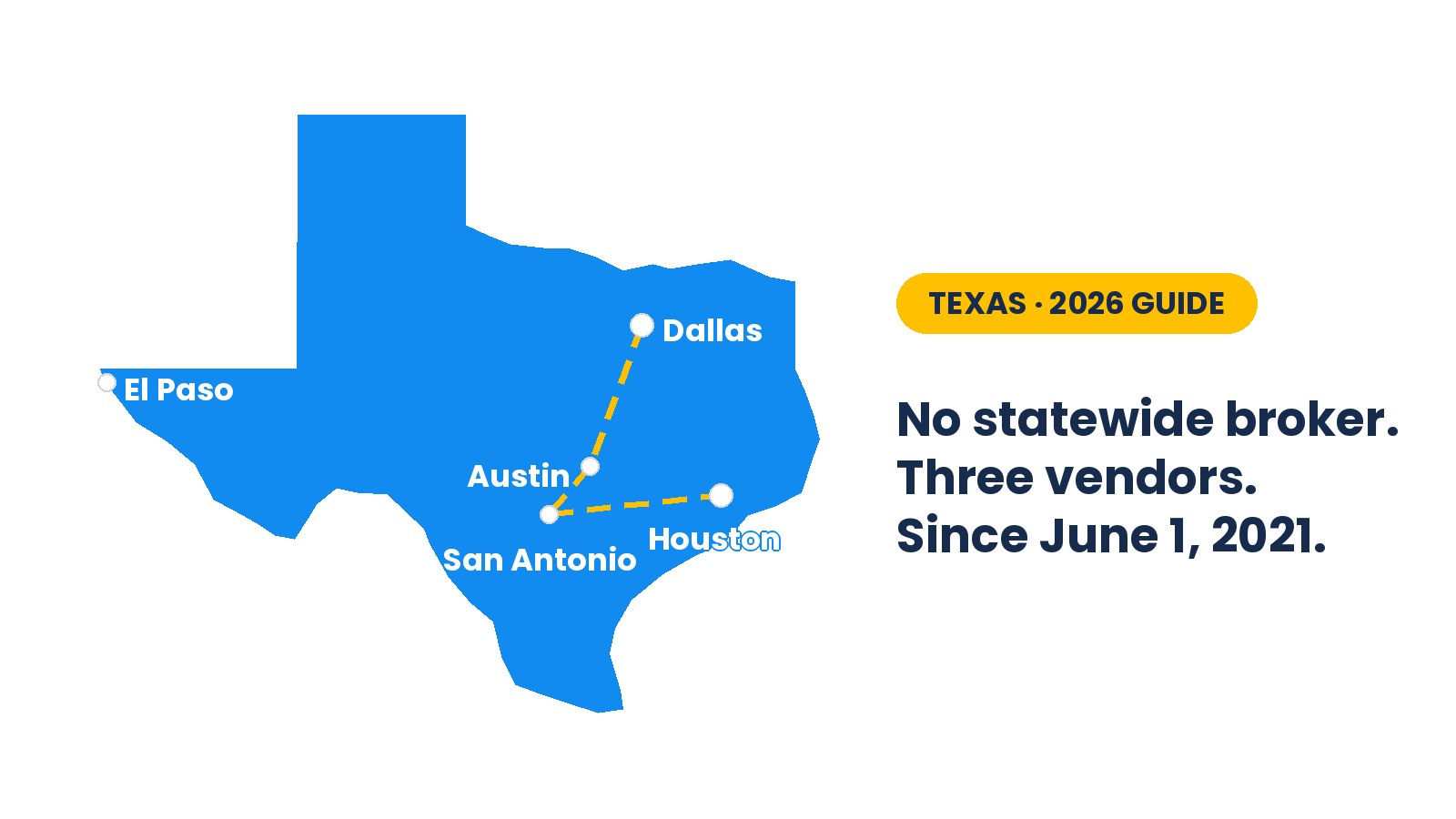
To start a NEMT business in Texas, form an LLC ($300), enroll in Medicaid through TMHP’s PEMS portal, then get approved by the vendors your counties’ Medicaid health plans hire, mostly SafeRide Health and MTM Health. Budget $15,000 to $45,000 for the first van and two to four months to first Medicaid trips.
Texas at a glance:
- State NEMT license: none. A typical wheelchair van needs no TxDMV motor carrier registration either. Stretcher trips need an EMS provider license.
- Who runs Medicaid rides: no statewide broker since 2021. Each health plan hires its own vendor: SafeRide Health or MTM Health, plus Modivcare for Blue Cross and Blue Shield of Texas until October 1, 2026.
- How you enroll: Texas Medicaid first, through TMHP’s PEMS portal ($750 application fee for 2026). Then each vendor.
- Insurance the contracts expect: roughly $1 million combined single limit commercial auto, plus $1 million per occurrence and $2 million aggregate general liability.
- Cost to launch one van: $15,000 to $45,000, mostly the van and the insurance.
- Time to first Medicaid trips: two to four months. Private-pay revenue can start earlier.
Between April 2025 and this summer, at least five Texas Medicaid health plans changed the company that arranges their members’ rides. Community First in San Antonio moved to SafeRide Health on April 1, 2025 [16]. Texas Children’s Health Plan followed [14]. UnitedHealthcare’s Texas plans switched to SafeRide on January 1, 2026 [1]. Molina has been moving its members over during 2026. And on May 14, 2026, the Access2Care name retired from Texas Medicaid entirely, folded into MTM Health after an acquisition [19].
None of it came with a press conference. Each change arrived as a notice to providers. Every operator whose schedule leaned on the old contract found out overnight how much of that volume was borrowed.
If you’re starting a non-emergency medical transportation (NEMT) business in Texas, that churn is the market you’re walking into. It traces to one decision most guides still haven’t caught up with. On June 1, 2021, Texas retired its regional transportation brokers and made rides the job of each Medicaid health plan [2][3]. In Texas, a health plan means a private plan the state pays to cover Medicaid members.
There’s no state broker to sign up with, no one company the state hires to assign Medicaid rides to transportation providers and pay for them. What you get instead is health plans, the vendors they hire, and a small state-run lane for the members left over. Those left-over members are the fee-for-service side: the state pays you directly per trip, with no plan or vendor in the middle. So the questions that matter here are which plans cover your counties, and which vendor each of them uses this year.
I run Duet, a dispatch software company, and I talk to NEMT operators every week, Texas included. This is the Texas edition of our national guide on how to start a NEMT business. It cites the actual Texas statutes, rules, and agency documents. Where I couldn’t verify something against a primary source, I say so. Requirements change, and the Texas vendor map has changed five times since spring 2025 and changes again on October 1, 2026. Confirm against the linked sources before you spend money.
In Texas, demand is the easy part. About 4 million Texans were on Medicaid or CHIP as of spring 2026, per CMS’s monthly enrollment data [20]. And the Texas Demographic Center projects the 65-and-over population to grow from 3.9 million in 2020 to 6.8 million by 2040 [23]. The order of operations is what this guide is for.
The one-page checklist: steps to start a NEMT business in Texas
Phase 0: know your demand
- Pick your trip sources: your county’s Medicaid health plans and their vendors, facility contracts, private-pay families, or the state’s fee-for-service lane. Healthy Texas operators usually run two or three at once.
- Map plans to vendors: which plans serve your area, and which vendor each one uses. Start from the map below, and verify every row on the plan’s own site.
- Price a wheelchair trip with two local competitors. Houston rates aren’t Lubbock rates.
- Write the one-page plan first: your counties, your payer mix, the trip math per van, and the runway number from the cost table below. That last one is the months of expenses you’ll hold in reserve. Every lender in the funding section asks for exactly that and nothing fancier.
Phase 1: business foundation
- Form the LLC: $300 to file the certificate of formation with the Texas Secretary of State [4].
- Ongoing state cost is near zero. No annual report fee. Below $2.65 million in revenue you owe no franchise tax, and file only a free Public Information Report each year [5].
- Assumed name certificate: $25, if you’ll operate under a trade name [4].
- Get a free EIN, your federal tax ID, from the IRS. Never pay a third party for this [6].
- Call your city and ask what applies to your vans. No Texas city has an NEMT permit category by name, but the big-city vehicle-for-hire rules are vague enough that one phone call beats one citation. Details in the licensing section.
Phase 2: federal identifiers
- Get a Type 2 (organization) NPI at NPPES. The NPI is the ID number the healthcare system uses for your company. Free, usually issued within days.
- One Texas wrinkle on the taxonomy code. The state’s Medical Transportation Program (MTP) handbook lists provider specialty TS with taxonomy 343800000X for demand response providers, the taxi and wheelchair van category. That isn’t the 343900000X code most national guides quote [3]. Your Medicaid application confirms the right pairing at enrollment.
- Screen owners and drivers against the two federal lists of people banned from Medicaid work: the OIG exclusion list and SAM.gov. Recheck monthly, because every plan and vendor checks them too.
Phase 3: vehicles, drivers, and insurance
- Spec the van: a lift or ramp plus four-point securement to the federal accessibility standard [24]. That standard holds an occupied wheelchair to no more than 2 inches of movement in any direction. Vendor inspections check securement first.
- Build each driver’s file: license, MVR (a driving-record report), background check, drug screen, and the training topics in Texas’s MTP driver rule [12].
- No CDL below 16 passengers including the driver [11]. No state chauffeur license exists either; a regular Class C license covers a typical wheelchair van.
- Insure to the vendor bar: roughly $1 million combined single limit, one limit covering injuries and property damage together. The insurance section has the real numbers.
Phase 4: enrollment, then credentialing
- Enroll in Texas Medicaid first, through PEMS, the Provider Enrollment and Management System run by TMHP (Texas Medicaid & Healthcare Partnership). Enrollment means signing up with the state Medicaid program itself. No managed care network can approve you until you’re enrolled [7].
- Application fee: $750 for 2026, waived if you’ve already paid it to Medicare or another state’s Medicaid program [8].
- Then credential with each vendor serving your target plans: SafeRide’s provider application and MTM’s network form. Credentialing is the vendor’s approval process before it sends you trips, and each is a separate queue [17].
- MTM is need-gated: it only adds providers where it needs more vehicles in your area [18].
Phase 5: the trip sources you control
- Set up a NEMT website and Google Business Profile around the trips from Phase 0.
- Start facility outreach and private pay the same week your PEMS application goes in, not after approval. Enrollment buys you the right to bill. It doesn’t send you a single rider.
- Trade rides for reviews. Offer friends and family free or discounted rides in exchange for honest Google reviews. Ten of them make strangers trust you.
- Set up dispatch and billing before the first vendor trip. Vendors send trip files from day one, and matching them by hand is how new operators fall behind in week two.
Who pays for NEMT rides in Texas?
Four sources pay for NEMT rides in Texas:
- Medicaid health plans, through the transportation vendors they hire.
- The state’s fee-for-service Medical Transportation Program.
- Facility contracts: hospitals, dialysis clinics, and senior living communities.
- Private-pay families booking directly.
Medicaid is the volume, and in Texas that means the plans. Since June 1, 2021, every Medicaid managed care organization must arrange and provide nonemergency transportation for its members, a duty that now sits in Texas Government Code chapter 540A [2]. More than nine in ten of Texas’s roughly 4 million Medicaid and CHIP members are in managed care [20][21]. They sit across the STAR, STAR+PLUS, STAR Kids, and STAR Health programs [13].
STAR+PLUS is the program for adults with disabilities or age 65 and older. It held roughly half a million members in CMS’s 2024 plan-level data [21], and that’s the group that rides most. For scale: the last time CMS counted NEMT-covered lives in Texas separately, in 2020, more than 4 million people had the benefit [21].
Facilities are the stability. Dialysis clinics run standing three-times-a-week schedules, and Texas has 745 Medicare-certified dialysis facilities: 137 in Harris County, 68 in Dallas County, 57 in Bexar, 53 in Tarrant [22]. Hospital discharge desks, skilled nursing homes, and rehab centers add more. One facility that trusts you can fill a van’s whole day, whatever the health plans do with their vendor contracts this year.
Private pay is the margin. Families book a parent’s appointments directly, at rates you set against your own market. Secret-shop two local competitors before you print a rate card. Published Texas rates swing hard between metros, and the internet’s numbers aren’t your market’s.
Medicare: no NEMT enrollment to file
One payer other guides keep listing doesn’t belong here: Medicare. Original Medicare pays for ambulance transport and doesn’t cover routine NEMT. So there’s no Medicare NEMT enrollment to file, whatever a template checklist tells you.
What does exist is Medicare Advantage, and some plans offer rides as an extra benefit. In Texas those rides go through the same transportation vendors. Community First’s move to SafeRide covered its Medicare members alongside Medicaid [16]. Get approved by the vendor once, and both come through the same door.
A caution on market size
Texas removed about 2 million people from Medicaid during the 2023 to 2025 unwinding, and enrollment now sits roughly a third below the March 2023 peak [20][25]. The demand math above still works, and dialysis patients didn’t stop needing rides. But any guide quoting 5-plus million Texas Medicaid members is quoting a market that no longer exists.
Same for the $500 million Texas NEMT market growing 6.5 percent a year that template guides cite. No dataset I can find produces either number. And most of the pages quoting that projection went up after the years it covered were already over.
Who is the NEMT broker in Texas?
Texas has no statewide NEMT broker. It’s the most important fact about this market. Since June 1, 2021, each Texas Medicaid health plan arranges rides for its own members through its contracted transportation vendor [2][3]. In 2026 those vendors come down to three names: SafeRide Health, MTM Health, and Modivcare. On October 1, 2026, Blue Cross and Blue Shield of Texas, the one Texas Medicaid plan confirmed as using Modivcare, moves its Medicaid rides to MTM Health [32][60]. The state’s own Medical Transportation Program, run by the Texas Health and Human Services Commission (HHSC), covers only the members not in managed care [2][3]. Half the articles online still tell you to sign up with the state’s broker. In Texas, that door closed in 2021.
The 2026 plan-to-vendor map
What makes 2026 unusual is how far the vendors have consolidated. Here’s the plan-to-vendor map as I can verify it from the plans’ and vendors’ own pages in August 2026. Treat it as a starting point, and confirm before you build on any single row.
| Health plan | Vendor in 2026 | Since, and notes |
|---|---|---|
| Superior HealthPlan, including the statewide STAR Health foster care plan | SafeRide Health | June 1, 2021 [13][26] |
| UnitedHealthcare Community Plan | SafeRide Health | January 1, 2026 [1] |
| Texas Children’s Health Plan | SafeRide Health | [14] |
| Driscoll Health Plan, South Texas | SafeRide Health | [15] |
| Community First Health Plans, San Antonio | SafeRide Health | April 1, 2025 [16] |
| Molina’s STAR and STAR+PLUS members | SafeRide Health | Transitioning during 2026, per Molina’s member materials |
| Wellpoint (formerly Amerigroup) | MTM Health | [27] |
| Community Health Choice, Houston | MTM Health | [28] |
| Cook Children’s Health Plan | MTM Health | [29] |
| Aetna Better Health | MTM Health | [18] |
| El Paso Health | MTM Health | [30] |
| Parkland Community Health Plan, Dallas | MTM Health | [31] |
| Dell Children’s | MTM Health | Per MTM’s own Texas client list [18] |
| Blue Cross and Blue Shield of Texas (Medicaid) | Modivcare, then MTM Health | Moves from Modivcare to MTM Health on October 1, 2026 [60]. The one Texas Medicaid plan whose own page confirmed Modivcare as of August 2026 [32] |
| Baylor Scott & White and FirstCare | MTM Health | Leaving Texas Medicaid managed care. Plan codes end August 31, 2026, per an HHSC provider notice, so their members move to other plans this fall |
What the table can’t show: SafeRide Health has been the fastest-growing network, and MTM holds the widest list, much of it the former Access2Care accounts it acquired. The Access2Care brand retired for Texas Medicaid plans on May 14, 2026, and MTM kept the phone numbers and provider networks [19]. Modivcare, the largest broker in the country, went through Chapter 11 bankruptcy in 2025 and emerged that December as a private company [33]. Know that before you bet a schedule on any single contract.
These pairings move: five changed in the fourteen months before this guide published. Our national NEMT broker changes tracker follows the changes state by state. Texas’s version of the story is that the churn happens plan by plan, vendor by vendor, and the only warning is a provider notice.
Can I bill Texas Medicaid directly for NEMT?
You can bill Texas Medicaid directly only in the fee-for-service lane, and it’s a narrow one. Everyone else is in managed care, where a health plan’s transportation vendor pays you, not the state. Fewer than one in ten Texas Medicaid members sit in fee-for-service [21], so treat this lane as a supplement, not a foundation.
HHSC’s Medical Transportation Program (MTP) arranges rides for the fee-for-service Medicaid members, plus CSHCN Services Program and Transportation for Indigent Cancer Patients clients [3]. MTP prior-authorizes every one of those trips, which means it approves the ride before it happens or the claim is denied [3]. The TMHP manual is explicit that the MTP handbook doesn’t apply to managed care [3].
How the fee-for-service lane works
The mechanics, from the current MTP handbook [3]:
- Enroll with TMHP through PEMS as a Demand Response Transportation Service (DRTS) provider, the category covering taxi and wheelchair van work.
- Booking: members book through the statewide MTP line at least 2 business days before the appointment, 5 for out-of-county trips, with same-week exceptions for discharges, prescriptions, and urgent care.
- Claims go to TMHP on procedure code T2003, with a 95-day filing deadline.
Texas also runs two smaller lanes worth knowing about. Registered individual transportation participants get paid mileage for driving themselves or family members. And state law let transportation network companies, the rideshare firms, into NEMT in 2019, with drivers qualified under the TNC statute rather than Medicaid enrollment [2].
One wrinkle to settle by phone. HHSC materials also reference contracted full-risk brokers coordinating fee-for-service trips in the Dallas-Fort Worth and Houston/Beaumont areas. The current TMHP handbook describes no broker step at all. And older guides route West Texas fee-for-service trips through a named regional contractor too. Before you count on fee-for-service volume in any of those regions, ask MTP directly how trips in your county get assigned. It costs you one call.
How much does Texas Medicaid pay for a NEMT trip?
What Texas Medicaid pays for a trip depends on the lane, and only one lane publishes a number.
- Fee-for-service: demand response trips bill procedure code T2003 at TMHP’s published fee schedule rate. TMHP sets that rate through public rate hearings and last updated it effective November 1, 2024. Look up the current amount by procedure code on TMHP’s Online Fee Lookup before you build a budget on it [59].
- Managed care: no published rate at all. Each vendor negotiates per-trip and per-mile rates into your contract, and two operators in the same county can carry different numbers.
- Private pay: whatever your market bears, which is why you price against two local competitors first.
The base-plus-mileage rate cards you’ll find online, $40 to $55 plus $2.00 to $3.50 a mile for wheelchair trips, cite no fee schedule anywhere. And any Texas rate card quoting stretcher prices is pricing a criminal offense.
What licenses and requirements does a NEMT business need in Texas?
Texas issues no NEMT license. A typical wheelchair van needs no motor carrier registration from TxDMV, the Texas Department of Motor Vehicles, either. Under Transportation Code chapter 643, only vehicles that meet the commercial motor vehicle definition in section 548.001 have to register [9][10]. That definition starts at more than 26,000 pounds, or a vehicle designed or used to carry more than 15 passengers including the driver. It also covers household goods movers of any size, which isn’t this business.
The real Texas NEMT requirements:
- Medicaid enrollment, through TMHP’s PEMS portal. The enrollment section below has the steps.
- Vendor credentialing, one queue per vendor, in that same section.
- The local layer: whatever your city’s vehicle-for-hire office decides. The calls are below.
That’s less state licensing than almost anywhere, and it’s why the internet gets Texas wrong so often. The claims you’ll read, against the sources:
| The claim you’ll read elsewhere | What Texas requires |
|---|---|
| ”You must obtain a NEMT business license from the state of Texas” | No such license exists. TDLR, the state licensing agency, has no NEMT category on its program list [34], and TMHP enrollment is an enrollment, not a license [7]. (Several websites will sell you help getting it anyway.) |
| ”Texas requires NEMT providers to be licensed by the TxDOT” / “Your vehicles must comply with Texas Department of State Health Services regulations” | Wrong agency, both times. Motor carrier registration lives at TxDMV under Transportation Code chapter 643, and it only reaches vehicles over 26,000 pounds or designed for more than 15 passengers [9][10]. TxDOT licenses nothing here. DSHS regulates EMS providers and their vehicles, not wheelchair vans [48]. |
| ”There is a $599 fee with this application” / “The state NEMT provider registration fee is $599” | That’s the 2021 version of the same Medicaid application fee, fossilized in old guides. The federal screening fee resets every year, which is why every stale guide quotes a different number. The 2026 Texas Medicaid application fee is $750, and it’s waived if you already paid it to Medicare or another state [8]. |
| ”Get your NEMT license by registering with the state’s Medical Transportation Program” | Two errors in one sentence. MTP enrollment is a Medicaid enrollment through TMHP’s PEMS portal, not a license [7]. And MTP covers only the fee-for-service lane, fewer than one in ten members [21]. A guide routing you through MTP points you at the smallest lane in the market and skips the health plan vendors holding the volume. |
| ”Your vehicles need TxDMV livery plates” | Texas has no livery plate class, no legal category for a hired car with a driver. That’s another state’s rule pasted into Texas content. Standard registration by weight applies [10]. |
| ”Sign up with LogistiCare (or Modivcare), the state’s NEMT broker” | LogistiCare became Modivcare in 2021, and Modivcare isn’t Texas’s broker either. Blue Cross and Blue Shield of Texas, the one Texas Medicaid plan whose own page named Modivcare in 2026, moves its rides to MTM Health on October 1, 2026 [32][60]. Texas hasn’t had a statewide broker since June 1, 2021; each health plan contracts its own vendor [2][3]. |
| ”Dallas NEMT permits run $100 to $200 per vehicle, Houston $50 to $150, Austin $75 to $125” | Invented. No Texas city has an NEMT permit category, so no Texas city publishes an NEMT fee schedule. Houston’s Chapter 46 lists eight vehicle-for-hire categories and medical transport isn’t one [39]. Austin’s real published numbers are a $159 operating authority license and a roughly $36 chauffeur permit [40]. Call the for-hire office and get its answer in writing. |
| ”Add stretcher vans as a premium service tier” / “Qualifying NEMT vehicles in Texas include stretcher vans” | Not in Texas. Transporting a patient by stretcher without an EMS provider license is a Class A misdemeanor under Health and Safety Code 773.041 and 773.064 [35]. The stretcher section below has the whole story. |
When a van is big enough to need TxDMV registration
Texas draws its commercial motor vehicle line at more than 26,000 pounds gross weight, or a vehicle designed or used to carry more than 15 passengers including the driver [9]. Below both thresholds, for trips inside Texas, there’s no TxDMV number, no USDOT number requirement, and no state operating authority [10]. Cross either line and all of it applies at once. That means TxDMV registration built on an intrastate USDOT number, an insurance filing from your carrier, and the adopted federal safety rules [10][36]. A 16-plus passenger shuttle is regulated very differently from a six-passenger wheelchair van, so decide what you’re buying before you buy it.
Two federal rules can catch even a small van:
- Interstate trips. Carry paying riders across a state line in a vehicle designed or used for 9 or more passengers, or 10,001 pounds or more, and you’re a federal commercial motor vehicle. That means FMCSA (federal motor carrier) registration and, for hire, a $1.5 million liability floor [36][37]. That matters in El Paso and Texarkana and almost nowhere else in Texas NEMT.
- The weight sticker. On bigger vans, read the weight rating (GVWR) sticker on the door jamb rather than the model name. Many heavier cutaway builds cross 10,001 pounds, which changes nothing inside Texas but makes any interstate trip federally regulated [36].
On inspections: since January 1, 2025, Texas no longer requires the annual safety inspection for non-commercial vehicles, and charges a $7.50 registration fee instead [38]. The commercial inspection program uses the same over-26,000-pound definition, so a typical NEMT van sits outside it. Being for hire doesn’t change that on its own; what counts is the vehicle’s size, not how the van earns. A typical NEMT van’s only test is emissions, in the seventeen metro counties that require it, with Bexar County added in 2026 [38]. Confirm your county with your inspection station.
What are the NEMT vehicle requirements in Texas?
Texas publishes no vehicle certification list for NEMT, but it does have an equipment standard written into rule: 1 TAC 380.501, the Medical Transportation Program’s motor vehicle rule. TAC is the Texas Administrative Code, the state’s rulebook. Vendor inspections check that list plus their own [58]. The rule’s requirements, since the official rule viewer is hostile to automated readers:
- Company name and vehicle number on the vehicle, in letters at least six inches high.
- Functioning, clean, accessible seat belts at every passenger position.
- Two exterior rear view mirrors plus an interior mirror.
- Working interior lights, heating, cooling, and ventilation.
- Adequate sidewall padding and ceiling covering, clean inside and out.
- Working speedometer and odometer.
- A functional fire extinguisher, secured within the driver’s reach and visible to passengers.
- A first aid kit including latex gloves, hazardous waste bags, scrub brush, disinfectant, and deodorizer.
- Three posted signs: no smoking, eating or drinking; all passengers must wear seat belts; concealed weapons prohibited.
Add the federal securement standard from the checklist: a lift or ramp with four-point securement that holds an occupied wheelchair to no more than 2 inches of movement in any direction [24]. With that, your van is ready for any vendor inspection in the state.
City permits: no NEMT category, so make the calls
Not one of Texas’s six biggest cities has an NEMT or wheelchair-van permit category by name, which surprised me. Houston’s Chapter 46 vehicle-for-hire ordinance lists eight categories, none of them medical transport [39]. Dallas’s Chapter 47A, San Antonio’s Chapter 33, Fort Worth’s Chapter 34, and El Paso’s transportation-for-hire code all regulate for-hire vehicles in general terms that never mention NEMT. Whether a wheelchair van falls inside them is unsettled city by city.
Austin comes closest to having a category. It licenses vehicle-for-hire operating authority at $159 [40]. It also runs a separate medical transfer franchise program, but in practice that one covers private ambulance companies staffed by EMTs, not wheelchair vans [41].
So skip the fee tables you’ll find online for Texas cities. The precise ones are invented. So is the $1,000-to-$3,000 “licensing and permits” line in template budgets, a budget for fees no Texas agency charges a wheelchair van operator. Some guides state flatly that Dallas providers must register with the city’s transportation regulation office. Chapter 47A never names medical transport. Get the city’s answer about your own vans instead of trusting a template guide, or this one.
And if you see “COPCN barriers” attributed to Dallas or Fort Worth, that’s ambulance-franchise territory, the same licensed-EMS line the stretcher section draws. A wheelchair van asks the for-hire office, not the EMS office.
Before your first trip, call the vehicle-for-hire office in each city you’ll serve, describe your vehicles and service exactly, and get the answer in writing.
- Houston: the Administration and Regulatory Affairs department.
- Dallas: the Transportation Regulation Division.
- San Antonio: the police Ground Transportation Unit.
- Austin: Transportation and Public Works, 512-974-7857.
Budget a week of phone calls. It’s the cheapest insurance in this guide.
What are the NEMT insurance requirements in Texas?
What the vendors require
For a Texas NEMT company, plan on roughly $1 million combined single limit commercial auto, plus $1 million per occurrence and $2 million aggregate general liability. General liability covers injuries and damage that don’t involve driving, like a fall at pickup. That’s the bar the transportation vendors and facility contracts set, not anything in Texas law.
SafeRide Health, now the vendor behind the biggest block of Texas Medicaid plans, publishes its floor. It wants $1 million general liability per occurrence, $2 million aggregate, and a minimum of $500,000 auto liability. SafeRide also goes on the certificate as additional insured, which means it’s named on your policy and gets proof of coverage [17]. MTM publishes a $1 million combined single limit for general and auto liability on its state provider pages, with MTM as certificate holder and additional insured [42].
Modivcare publishes no figure. Roughly $1 million combined single limit is commonly reported, so get the real number from provider relations before you bind a policy, which is the moment coverage is active. A policy at $1 million combined single limit clears every published Texas bar with room.
One line item you can strike: professional liability, which some guides list as required for NEMT. Neither vendor requirement sheet cited here asks for it [17][42], and a non-medical transport service has no professional act to insure. Ask your agent, and don’t let a template sell you a policy no contract demands.
Why Texas law sets no floor for a typical van
For a typical NEMT van, there’s no state insurance floor above ordinary personal-auto minimums. The passenger rows of the TxDMV filing table in 43 TAC 218.16 start at vehicles designed or used for more than 15 passengers, at $500,000. They run to $5 million at 27 or more [43]. And that table only applies to carriers required to register at all. Below those thresholds, the only law on the books is the ordinary personal-auto minimum (30/60/25) every Texas driver carries. The Department of Insurance itself warns that minimum may be too low for a multi-car accident [44].
So when a guide tells you “Texas law requires $500,000 for NEMT,” it’s quoting a table that doesn’t apply to your van. When it tells you 30/60/25 is fine, it’s quoting a law no broker, facility, or plaintiff’s lawyer will accept. The vendor bar is the real number. Buy to it.
What the coverage costs
One insurance agency that quotes Texas policies published its own numbers in a December 2025 guide. It put standard vehicles at around $6,000 to $10,000 a year, and wheelchair vans at around $8,000 to $15,000, with first-year operators toward the top of that range [45]. Those are published agency ranges, not filed rates. Treat them as the shape of the market, and get your own quotes from an agent who insures medical transport companies every week, before you commit to a vehicle.
Workers’ comp is optional in Texas
One Texan wrinkle: workers’ compensation is elective here. Texas doesn’t require most private employers to carry it [46], the only state that leaves it broadly optional. Read the fine print before you celebrate the savings.
An employer that opts out, a non-subscriber, must file annual notices with the state, and post and give written notice to employees. If an injured worker sues, that employer also loses the classic defenses: you can’t argue the employee’s own negligence, a coworker’s negligence, or that they knew the risk [46]. Many vendor contracts require workers’ comp or occupational accident coverage anyway. Price both paths with your agent instead of assuming bare is cheaper.
What do NEMT drivers need in Texas?
NEMT drivers in Texas don’t need a CDL, not for a typical wheelchair van. Texas adopts the federal thresholds through Transportation Code section 522.003. A commercial license starts at vehicles designed for 16 or more passengers including the driver, or 26,001 pounds or more [11]. Mind the label trap: a “15-passenger van” seats 15 plus the driver, which is 16, which is CDL territory.
Below the line, an ordinary Class C license drives the van, and there’s no state chauffeur license on top. Where a for-hire driver permit exists at all, it’s a city permit, like Austin’s roughly $36 chauffeur permit [40].
The driver file
What your drivers need is the file your vendors and the state’s MTP rule expect. Texas’s own driver standard for Medicaid transportation, 1 TAC 380.502, requires a valid driver’s license, a DPS driving record check, and a criminal history clear of the rule’s disqualifiers. Those include any DWI within seven years, and more than one moving violation in twelve months [12].
What driver training does Texas require?
Texas has no state NEMT certification, for companies or for drivers. What it has is the training-topics list in 1 TAC 380.502, the MTP driver rule. Since the official rule viewer is hostile to automated readers, here’s the full list [12]:
- Passenger safety, annually.
- Passenger assistance, annually.
- Assistive devices, including wheelchair lifts, tie-downs, and child safety seats, annually.
- Non-discrimination, sensitivity, and diversity.
- Customer service.
- Defensive driving, every 2 years.
- Prohibited behaviors, including offensive language, tobacco, alcohol, drugs, and sexual harassment.
- Whatever additional training HHSC decides is necessary. The rule keeps a catch-all.
Notice what’s not on it: CPR, first aid, and PASS (CTAA’s Passenger Assistance Safety and Sensitivity course). Those come from the vendors, by contract. MTM, for instance, describes CPR certification, ADA education, HIPAA training, drug testing, and multi-level background checks across its network [42].
Two rules you’ll see presented as Texas law that aren’t in any Texas rule:
- The “21 years old with a 3-year clean license” rule. It’s a common vendor contract term. The only age minimum written into Texas transportation statute is 18, on the rideshare pathway [2].
- The “finish your state-mandated training within 30 days of hire” deadline circulating online is the same kind of thing. The rule sets topics and refresh cadences, not an onboarding clock. Where a 30-day window exists, it’s your vendor contract talking [12].
Build your driver files to the strictest vendor you want to join, and you’ll clear the rest. Two more items for the file while you’re at it:
- A signed HIPAA training acknowledgment, because vendor contracts make you a business associate handling member health information [42].
- Printouts from the Texas Employee Misconduct Registry and the national sex offender site. Vendor audits ask about those screens, and the rideshare statute already writes them into its own lane [2].
Do Texas NEMT drivers need PASS or NEMTAC certification?
Not by law. No Texas statute or rule requires PASS or NEMTAC certification for NEMT drivers. The state’s list is the 1 TAC 380.502 topics above, and PASS isn’t on it [12]. What makes PASS, and sometimes NEMTAC’s transport specialist credential, feel mandatory is vendor contracts. Securement, first aid, CPR, and passenger assistance training all run through the big networks’ credentialing [17][42]. A PASS card is the usual way a driver proves the passenger assistance piece.
One more thing you don’t need: federal drug-and-alcohol testing programs only apply to CDL drivers [47]. Vendors require testing by contract, so you’ll do it anyway, but it’s their rule, not FMCSA’s, for a standard van.
Can a NEMT company run stretcher van trips in Texas?
No. Online guides get this wrong more than anything else about Texas, so here’s the statute. Under Health and Safety Code section 773.041(a-1), “a person may not transport a patient by stretcher in a vehicle unless the person holds a license as an emergency medical services provider” [35].
DSHS, the state health department, closes the loop by rule: licensed providers must make sure every stretcher patient rides in a department-authorized EMS vehicle [48]. The authorized vehicle levels start at basic life support ambulance and go up from there. There’s no stretcher-van category, and no invalid car or ambulette lane like some other states allow. If the rider can’t sit, it’s ambulance work.
The consequences aren’t theoretical. Unlicensed stretcher transport is a Class A misdemeanor [35], and DSHS can stack administrative penalties up to $7,500 per violation, per day [35].
On the billing side, Texas Medicaid’s NEMT benefit has no stretcher mode. The MTP handbook covers wheelchair vans and taxis and never mentions stretchers [3]. Bed-confined members, the ones who can’t sit up, are covered as nonemergency ambulance transport instead. DSHS-licensed, Medicare-enrolled ambulance providers bill those trips, and the requesting physician or facility submits the prior authorization [49].
So when a national guide tells you to “add stretcher vans as a premium tier” and quotes per-mile stretcher rates for Texas, it’s pricing a service that would be a criminal offense for you to run. In Texas the stretcher question isn’t a pricing decision. It’s a licensing decision, with two ways to go:
- Build a licensed EMS operation. That’s a different business, with a $500 provider application, $180 per vehicle, and medical staffing rules [48].
- Build for wheelchair and ambulatory riders, the ones who can walk to the vehicle, and refer stretcher requests to a licensed partner.
Other states draw this line differently. Georgia lets a non-ambulance invalid car carry stable stretcher patients. California runs a litter van category with a driver-and-attendant crew. Texas allows neither, and North Carolina lands in the same place by a different route, deeming anyone on a stretcher a patient by rule. An operator moving here from Georgia or California should assume their stretcher playbook is illegal until a lawyer says otherwise. Put the wheelchair-only rule in your dispatch procedures, in writing.
How do you become a Texas Medicaid NEMT provider?
Becoming a Medicaid transportation provider in Texas is a two-step. Enroll with the state through TMHP’s PEMS portal first. Then credential separately with each transportation vendor whose plans you want to serve. The order matters, because TMHP requires Texas Medicaid enrollment before any managed care network can approve you [7]. And your enrollment has to be renewed every three to five years, most providers at five; a missed revalidation disenrolls you from every plan at once [7].
Step one: Texas Medicaid enrollment through PEMS
Everything runs through PEMS at tmhp.com: the application, the disclosure-of-ownership forms, the provider agreement, and the fee [3][7].
The 2026 application fee is $750. The federal government sets it and adjusts it most years. It’s waived if you’ve already paid it to Medicare or another state’s Medicaid or CHIP program, as long as you attach proof of that payment to the application [8]. Claim the waiver without the proof and you’ve created exactly the kind of deficiency, a missing or wrong item, that stalls the whole application.
You’ll also read that enrollment takes a $50,000 surety bond per location. TMHP’s enrollment manual and the MTP handbook list no such bond for transportation providers [3][7]. PEMS tells you at application exactly what it wants, so let the portal set your checklist, not a blog.
TMHP says processing typically takes up to 60 days once it has everything it needs [7]. That last clause is the trap. The clock starts when your application is complete, and HHSC’s inspector general says a deficiency found in its screening can delay an application another 25 business days, plus however long you take to answer it [61].
The backlog is real. A 2025 legislative review found nearly 9,000 Texas Medicaid provider applications processing for more than 60 days as of December 2024 [50]. TMHP has been giving providers extra time on their renewals, rolling revalidation extensions, since late 2025 to work it down. You can’t speed up the queue, but you can refuse to join the slow lane: a complete application, every document, first submission.
Step two: credentialing with the vendors
Once enrollment is in motion, apply to each vendor that serves your counties.
- SafeRide: its provider application collects your NPI, EIN, Medicaid ID, fleet details, and insurance certificates to its published limits. Its network standards include full background checks, MVR, drug screening, first aid, CPR, defensive driving, and wheelchair securement training [17].
- MTM: takes applications through its network portal, and tells you plainly that it moves forward where it has need in your area and keeps your file otherwise [18].
- Modivcare: runs an inquiry form and assigns a partner relationship manager [51]. Its one confirmed Texas Medicaid plan, Blue Cross and Blue Shield of Texas, moves its Medicaid rides to MTM Health on October 1, 2026 [32][60], so ask Modivcare what Texas work it still has in your counties.
None of them publishes a credentialing timeline, and the week-by-week onboarding windows quoted elsewhere trace to no vendor page I could find. Operators report weeks to months, and need-gating means a fully qualified company can still be told its county is full.
While you wait: the payer that doesn’t need permission
Which brings up the catch-22 every new Texas operator hits: vendors like operating history, and you can’t build operating history on trips they haven’t given you. The answer is the payer that doesn’t need permission. Private pay and facility work come first, with Medicaid volume layered on as each vendor approves you. Our guides on winning facility contracts, getting your first trip from a facility meeting, and private pay are the playbook for those first months.
Don’t build the whole Texas schedule on one payer
Everything above gets you into Texas Medicaid work. The last fourteen months should staple one lesson to every Texas business plan: in this state, broker volume is borrowed volume, plan by plan. Five plans have traded vendors since spring 2025, and Blue Cross and Blue Shield of Texas joins them on October 1, 2026. If your whole schedule rode on an Access2Care contract in Dallas or an MTM contract in San Antonio, there was a morning in the last two years when your business changed hands. Your signature wasn’t on anything. The operators who shrugged through it were the ones with facility contracts and private-pay customers no vendor swap could touch.
Texas makes diversification easier than most states. The vendor consolidation means one SafeRide credential now reaches a half-dozen plans, and MTM’s network reaches another half-dozen, with Blue Cross joining on October 1, 2026. Add two dialysis clinics and a private-pay pipeline from your website and Google Business Profile, and no single provider notice can sink the schedule. Georgia operators learned this the hard way when the whole state flipped to one broker in April 2026. California operators live the plan-by-plan version like Texas, just with dozens of plans instead of a handful of vendors, and Ohio adds a county-arranged fee-for-service lane beside its plans’ ride vendors.
However you mix payers, don’t run the vendors’ trips in one system and your own in a legal pad. Dispatch software like Duet that pulls broker trip files in alongside facility and private-pay work keeps one schedule, one driver app, and one billing trail across all of it.
How much does it cost to start a NEMT business in Texas?
Plan on $15,000 to $45,000 to put the first wheelchair van on the road legally in Texas, most of it the vehicle and the insurance. The line items, from the sections above:
| Line item | What it costs |
|---|---|
| LLC formation | $300; assumed name certificate $25 if you want one [4] |
| Franchise tax and annual report | $0 below $2.65 million revenue; the annual Public Information Report is free [5] |
| EIN and NPI | Free; never pay a third party [6] |
| State NEMT license | $0. It doesn’t exist [34] |
| TxDMV motor carrier registration | $0 for a typical van; only vehicles over 26,000 lbs or 16-plus passengers register [9][10] |
| State safety inspection | No inspection for a typical van since 2025, just a $7.50 replacement fee at registration; emissions testing only, in the metro counties that require it [38] |
| Medicaid (PEMS) application fee | $750 for 2026; waived if already paid to Medicare or another state [8] |
| Commercial auto insurance | Roughly $8,000 to $15,000 a year per wheelchair van from Texas-quoting agencies; standard vehicles $6,000 to $10,000 [45] |
| Used wheelchair van | Commonly $20,000 to $35,000 on the mobility marketplaces, plus 6.25% motor vehicle sales tax [52] |
| City permits | Likely $0 to a few hundred dollars, but unsettled: no Texas city has an NEMT category, so call your city’s for-hire office and get its answer in writing |
| Working capital | 3 to 6 months of expenses; vendor payments and facility checks both take weeks to arrive |
Anyone quoting a $5,000 Texas launch hasn’t priced Texas commercial auto. Anyone quoting $50,000 to $150,000 is reciting a template: that range circulates through AI-generated state guides with no source behind it. So do the same guides’ 15 to 20 percent profit margins, 12 to 18 month break-evens, and $50,000-to-$60,000-per-van owner incomes. Nobody can trace those numbers to a rate sheet, a payer mix, or a single real operator. Your economics are your payer mix.
Two Texas-specific notes for the model. Fares for transporting people aren’t on the Comptroller’s list of taxable services, so you won’t collect sales tax on trips [53]. That kills the “Texas seller’s permit” step on some checklists: no taxable service, no permit. And Texas has no state income tax on your profits.
How do you fund a NEMT startup in Texas?
If the savings account doesn’t cover it, Texas has an unusually deep bench of lenders:
- SBA 7(a) loans and microloans finance vehicles and working capital [54].
- LiftFund, the San Antonio-born nonprofit community lender (a CDFI), lends to borrowers banks decline and lists vehicles among its loan uses [55].
- PeopleFund does the same from Austin [56].
- The Texas Small Business Credit Initiative backs loan guarantees through participating banks [57].
- Texas SBDC network: the small business development centers advise for free.
The template guides also list “grants and subsidies for healthcare businesses” as a funding option. I looked, and I couldn’t find a Texas grant program a NEMT startup can apply to for vans or working capital. Budget as if grant money is zero. The community lenders above are the real version of that promise, and none of them speeds up PEMS or a vendor’s need review, so borrow against the timeline you face.
How long does it take to start a NEMT business in Texas?
Plan on two to four months in Texas between the first paperwork and the first Medicaid trips. PEMS enrollment and vendor credentialing are the two slowest steps, and private-pay revenue is available months earlier. A realistic sequence:
- Weeks 1-2. LLC ($300), EIN, NPI. Map your counties’ plans and vendors, make the city vehicle-for-hire calls, and price trips with two local competitors.
- Weeks 2-4. Insurance quotes at the vendor bar from an NEMT-savvy agent. Pick the van after you know the premium.
- Weeks 3-6. Buy the van, used and mechanically sound, and equip it to the securement standard. Build driver files to your strictest target vendor. Submit the PEMS application complete, with the fee, the first time.
- Months 2-4. While TMHP processes: vendor applications to SafeRide and MTM for your counties, plus website, Google Business Profile, facility visits, and a private-pay rate card.
- First trips. However they arrive, run them flawlessly and ask for the review. The second trip comes from the first one.
Step 4 is revenue that doesn’t wait on a queue in Austin. Budget per the cost table above, and keep 3 to 6 months of expenses in reserve: the PEMS backlog is real, vendor credentialing is need-gated, and facility checks take weeks. The operators who fail in Texas mostly fail for one reason: the runway ran out before the queues cleared.
Texas NEMT FAQ
Does Texas require a NEMT license?
No. Texas issues no NEMT license or certification [34]. A typical wheelchair van needs no TxDMV motor carrier registration either, because that only starts at vehicles over 26,000 pounds or designed or used for more than 15 passengers [9][10]. What you need is Texas Medicaid enrollment through TMHP’s PEMS portal [7], credentialing with each health plan’s transportation vendor, and whatever your city’s vehicle-for-hire office says applies to your vans.
Who is the NEMT broker in Texas?
Nobody is, statewide. Since June 1, 2021, each Texas Medicaid health plan arranges rides for its own members through its contracted vendor [2][3]. In 2026 those vendors have consolidated to three names. SafeRide Health serves Superior, UnitedHealthcare, Texas Children’s, Driscoll, and Community First, with Molina moving over [1][13][14][15][16]. MTM Health serves Wellpoint, Community Health Choice, Cook Children’s, Aetna, El Paso Health, Parkland, and the former Access2Care accounts [18][19]. Modivcare’s one confirmed Texas Medicaid plan, Blue Cross and Blue Shield of Texas, moves its Medicaid rides to MTM Health on October 1, 2026 [32][60]. Verify your region’s pairings before you build on any of them.
Is LogistiCare or Access2Care still a NEMT broker in Texas?
No. LogistiCare became Modivcare in 2021. Its one confirmed Texas Medicaid plan in 2026, Blue Cross and Blue Shield of Texas, moves its rides to MTM Health on October 1, 2026 [32][60]. MTM Health bought Access2Care, and the Access2Care name retired for Texas Medicaid plans on May 14, 2026 [19]. Guides that route you to either name are running on a pre-2021 map.
How much does it cost to start a NEMT business in Texas?
Plan on $15,000 to $45,000 to put the first wheelchair van on the road legally, most of it the van and the insurance. The LLC is $300 [4] and the Medicaid application fee is $750 for 2026 [8]. Commercial auto runs roughly $8,000 to $15,000 a year per wheelchair van [45]. There’s no state NEMT license fee, because no such license exists [34]. The $50,000 to $150,000 range circulating online is template content with no source behind it.
What insurance does a NEMT business need in Texas?
For a Texas NEMT company, plan on roughly $1 million combined single limit commercial auto, plus $1 million per occurrence and $2 million aggregate general liability. That’s the bar the transportation vendors set, not anything in Texas law. SafeRide publishes a $500,000 auto minimum with $1 million/$2 million general liability [17], and MTM a $1 million combined single limit [42]. For a typical van there’s no state floor above the 30/60/25 every Texas driver carries [43][44], so the vendor bar is the real number. Buy to it.
Can I bill Texas Medicaid directly for NEMT rides?
Only in the fee-for-service lane, the members who aren’t in a health plan, and it covers fewer than one in ten [21]. HHSC’s Medical Transportation Program arranges those trips and approves each one in advance. You serve them by enrolling with TMHP through PEMS as a demand response transportation service provider [3]. The rest are in managed care, where you get paid by each health plan’s transportation vendor, not the state.
How long does Texas Medicaid NEMT enrollment take?
TMHP says the process typically takes up to 60 days once your application is complete [7]. But HHSC told the Texas Legislature it had nearly 9,000 Medicaid provider applications stuck past 60 days as of December 2024 [50]. HHSC’s inspector general adds that a deficiency found in its screening can delay an application another 25 business days, plus however long you take to answer it [61]. Then each transportation vendor’s credentialing runs its own queue on top. Plan on two to four months end to end, and submit a clean application the first time.
Do NEMT drivers need a CDL in Texas?
Not for a typical wheelchair van. Texas adopts the federal CDL thresholds: a commercial license starts at vehicles designed for 16 or more passengers including the driver, or 26,001 pounds or more [11]. Careful with the ‘15-passenger van’ label, because 15 passengers plus a driver is 16 and does require a CDL. Plan instead for the driver file your vendors require: background checks, MVR driving records, drug screens, and the training topics in Texas’s MTP rule [12].
What vehicles qualify for NEMT in Texas?
Texas publishes no NEMT vehicle certification list. A wheelchair van qualifies by meeting two standards. First, the MTP vehicle rule’s equipment standard [58]: seat belts at every position, mirrors, fire extinguisher, first aid kit, working climate control, company name and vehicle number in six-inch letters, and posted signs. Second, the federal securement standard [24]: a lift or ramp with four-point securement that holds an occupied wheelchair to no more than 2 inches of movement. Standard four-door vehicles work for ambulatory riders. Stretcher vans don’t qualify: transporting a patient by stretcher without an EMS provider license is a Class A misdemeanor [35], whatever a national template says.
Are stretcher van trips allowed in Texas?
No, not without an EMS provider license. Texas Health and Safety Code 773.041 says a person may not transport a patient by stretcher in a vehicle unless licensed as an emergency medical services provider [35]. DSHS rules require stretcher patients to ride in an authorized EMS vehicle [48]. Unlicensed stretcher transport is a Class A misdemeanor [35]. Wheelchair and ambulatory trips are fine; the moment a rider needs to lie down, it’s ambulance work.
Is the Texas NEMT market worth entering in 2026?
The demand math is strong. About 4 million Texans were on Medicaid or CHIP in CMS’s spring 2026 enrollment data [20]. CMS counts 745 Medicare-certified dialysis facilities, 137 in Harris County alone [22]. And the Texas Demographic Center projects the 65-and-over population to grow from 3.9 million in 2020 to 6.8 million by 2040 [23]. The cautions are real too: enrollment shrank by about a third during the 2023 to 2025 unwinding [20][25], and broker volume moves plan by plan. Enter with trip sources you control.
Key official sources
[1] UnitedHealthcare provider news: SafeRide Health manages UnitedHealthcare Community Plan of Texas NEMT effective January 1, 2026. https://www.uhcprovider.com/en/resource-library/news/2025/tx-medicaid-nemt-transportation-vendor.html
[2] H.B. 1576 (86th Legislature, 2019), enrolled text (the managed care NEMT carve-in and TNC provisions); Texas Government Code § 540A.0101 (current MCO duty to arrange and provide nonemergency transportation). https://capitol.texas.gov/tlodocs/86R/billtext/html/HB01576F.HTM and https://codes.findlaw.com/tx/government-code/gov-t-sect-540a-0101/
[3] TMHP, Texas Medicaid Provider Procedures Manual: Medical Transportation Program Handbook (July 2026): the FFS/managed-care split, DRTS and TNC provider types, booking rules, T2003 billing, taxonomy table. https://www.tmhp.com/sites/default/files/file-library/resources/provider-manuals/tmppm/pdf-chapters/2026/2026-07-july/2_14_med_transport_program.pdf
[4] Texas Secretary of State, certificate of formation instructions ($300) and assumed name certificate ($25). https://www.sos.state.tx.us/corp/instructions/205.shtml and https://www.sos.state.tx.us/corp/instructions/503.shtml
[5] Texas Comptroller, franchise tax: 2026 no-tax-due threshold $2,650,000; Public Information Report filing. https://comptroller.texas.gov/taxes/franchise/
[6] IRS, employer identification number (free; the IRS warns against paid EIN sites). https://www.irs.gov/businesses/small-businesses-self-employed/get-an-employer-identification-number
[7] TMHP, Texas Medicaid Provider Procedures Manual Vol. 1, Section 1: Provider Enrollment (March 2026): enrollment before managed care participation, 60-day processing expectation, revalidation and disenrollment rules. https://www.tmhp.com/sites/default/files/file-library/resources/provider-manuals/tmppm/pdf-chapters/2026/2026-03-march/1_01_provider_enrollment.pdf
[8] TMHP news, December 19, 2025: 2026 provider enrollment application fee set at $750; exemption for fees already paid to Medicare or another state. https://www.tmhp.com/news/2025-12-19-2026-provider-enrollment-application-fee-set-750
[9] Texas Transportation Code § 548.001 (commercial motor vehicle definition) and chapter 643 (motor carrier registration). https://statutes.capitol.texas.gov/Docs/TN/htm/TN.548.htm and https://statutes.capitol.texas.gov/Docs/TN/htm/TN.643.htm
[10] TxDMV, TxDMV Number and motor carrier registration criteria; Motor Carrier Handbook (May 2025). https://www.txdmv.gov/motor-carriers/txdmv-number and https://www.txdmv.gov/sites/default/files/body-files/Motor_Carrier_Handbook.pdf
[11] Texas Transportation Code § 522.003 (adopting the federal CDL definition at 49 CFR 383.5); Texas DPS, commercial driver license classifications. https://statutes.capitol.texas.gov/Docs/TN/htm/TN.522.htm and https://www.dps.texas.gov/section/driver-license/how-do-i-apply-commercial-driver-license
[12] 1 Texas Administrative Code § 380.502, Medical Transportation Program standards for motor vehicle operators (driver file and training topics; unofficial mirror, since the official SOS TAC viewer blocks automated readers). https://txrules.elaws.us/rule/title1_chapter380_sec.380.502
[13] Superior HealthPlan, Medical Ride Program (SafeRide; STAR, STAR Health, STAR Kids, STAR+PLUS). https://www.superiorhealthplan.com/members/medicaid/resources/transportation.html
[14] Texas Children’s Health Plan, transportation assistance (SafeRide Health). https://www.texaschildrenshealthplan.org/benefits/transportation-assistance
[15] Driscoll Health Plan, transportation (SafeRide Health partnership). https://driscollhealthplan.com/services/transportation/
[16] Community First Health Plans, SafeRide Health transition effective April 1, 2025. https://medicaid.communityfirsthealthplans.com/2025/03/12/new-saferide-health-to-provide-transportation-services-for-community-first-medicaid-and-medicare-members-beginning-april-1-2/
[17] SafeRide Health, what to expect as a NEMT provider (application, insurance minimums, driver credentialing, performance standards). https://www.saferidehealth.com/what-to-expect-nemt-provider
[18] MTM Health, Texas client list and join-our-network pages (need-gated onboarding). https://www.mtm-inc.net/texas/ and https://www.mtm-inc.net/service-providers/
[19] MTM Health, completion of the Access2Care acquisition from Global Medical Response, and the Access2Care brand transition for Texas Medicaid plans (May 14, 2026). https://www.mtm-inc.net/mtm-finalizes-acquisition-of-access2care-expanding-market-leadership-in-nemt-sector/ and https://www.mtm-inc.net/mtm-link-a2c-intro/
[20] CMS, State Medicaid and CHIP Applications, Eligibility Determinations, and Enrollment Data (Texas rows; April 2026 preliminary and March 2023 peak). https://data.medicaid.gov/dataset/6165f45b-ca93-5bb5-9d06-db29c692a360
[21] CMS, Managed Care Enrollment by Program and Population, and by Program and Plan (Texas, 2024 report year; 2020 transportation-covered lives). https://data.medicaid.gov/dataset/e2ce0d2f-07c5-5213-947a-31e19bc649f6
[22] CMS Provider Data Catalog, Dialysis Facility listing (Texas counts as of the June 2026 data refresh). https://data.cms.gov/provider-data/dataset/23ew-n7w9
[23] Texas Demographic Center, Vintage 2024 population projections (65+ growth, October 2025 projections briefing). https://demographics.texas.gov/Resources/TDC/Presentations/29f2de6b-4625-4620-aa9e-2e14ab1fd139/20251022_TDCProjectionWebinar.pdf
[24] 49 CFR § 38.23, mobility aid accessibility: lifts, ramps, and securement (2-inch movement limit, 30-by-48-inch clear floor area). https://www.law.cornell.edu/cfr/text/49/38.23
[25] Texans Care for Children, review of the Texas Medicaid unwinding (citing HHSC’s end-of-continuous-enrollment dashboard). https://txchildren.org/looking-back-on-medicaid-unwinding-in-texas-and-forward-to-strategies-for-a-more-effective-enrollment-system-for-families/
[26] SafeRide Health, Texas (supporting Texas Medicaid NEMT beginning June 1, 2021). https://www.saferidehealth.com/texas
[27] Wellpoint Texas, Medicaid transportation benefits (MTM Health). https://www.wellpoint.com/tx/medicaid/extras/transportation
[28] Community Health Choice, MTM transportation for STAR members. https://www.communityhealthchoice.org/texas-star-medicaid-plan/member-resources/mtm-transportation/
[29] Cook Children’s Health Plan, STAR benefits (MTM Health). https://www.cookchp.org/members/star/benefits/
[30] El Paso Health, member transportation (Access2Care, now MTM Health). https://www.elpasohealth.com/members/transportation.html
[31] Parkland Community Health Plan, nonemergency medical transportation (MTM Health). https://parklandhealthplan.com/nemt1
[32] Blue Cross and Blue Shield of Texas, STAR transportation services (Modivcare, as the page read in August 2026). https://www.bcbstx.com/star/plan-details/transportation-services
[33] Modivcare Form 8-K, December 2025 (Chapter 11 emergence, December 29, 2025). https://www.sec.gov/Archives/edgar/data/1220754/000143774925038831/modv20251226_8k.htm
[34] Texas Department of Licensing and Regulation, programs licensed and regulated by TDLR (no NEMT or medical transport program). https://www.tdlr.texas.gov/licenses.htm
[35] Texas Health and Safety Code §§ 773.041, 773.064, and 773.065 (EMS licensure for stretcher transport; Class A misdemeanor; administrative penalties). https://statutes.capitol.texas.gov/Docs/HS/htm/HS.773.htm
[36] Texas DPS, A Texas Motor Carrier’s Guide to Highway Safety (MCS-9): intrastate versus interstate commercial motor vehicle definitions, marking, insurance tables. https://www.dps.texas.gov/internetforms/forms/mcs-9.pdf
[37] 49 CFR § 387.33T, schedule of insurance limits for for-hire motor carriers of passengers in interstate commerce. https://www.law.cornell.edu/cfr/text/49/387.33T
[38] Texas DPS, vehicle safety inspection changes effective January 2025 (HB 3297; commercial inspections continue; emissions counties). https://www.dps.texas.gov/news/vehicle-safety-inspection-changes-take-effect-january-2025
[39] City of Houston, Chapter 46 vehicle-for-hire categories and Administration and Regulatory Affairs vehicle-for-hire division. https://www.houstontx.gov/ara/vfh/
[40] City of Austin, operating authority license ($159) and chauffeur permit. https://www.austintexas.gov/services/apply-operating-authority-license and https://www.austintexas.gov/services/apply-chauffeur-permit
[41] Austin-Travis County EMS, medical transfer franchise findings (private ambulance companies; City Code chapter 10-2). https://services.austintexas.gov/edims/document.cfm?id=416017
[42] MTM, transportation provider insurance requirements ($1 million combined single limit, certificate holder and additional insured, per MTM’s state provider pages) and network driver standards. https://www.mtm-inc.net/wisconsin/providers/ and https://www.mtm-inc.net/healthcare/nemt/
[43] TxDMV, 43 TAC § 218.16 as adopted December 2024 (motor carrier insurance filing table by vehicle type). https://www.txdmv.gov/sites/default/files/body-files/Chapter-218-Adopt-2024.pdf
[44] Texas Department of Insurance, automobile insurance guide (30/60/25 minimums and their limits). https://www.tdi.texas.gov/pubs/consumer/cb020.html
[45] Aquatree Insurance, NEMT insurance in Texas (December 2025 agency-published premium ranges; market color, not filed rates). https://aquatreeinsurance.com/2025/12/15/nemt-insurance-texas/
[46] Texas Department of Insurance, workers’ compensation guide and non-subscriber requirements. https://tdi.texas.gov/pubs/consumer/cb030.html and https://www.tdi.texas.gov/wc/nonsubscriber.html
[47] Texas DPS, controlled substance and alcohol use and testing (49 CFR Part 382 scope: CDL drivers). https://www.dps.texas.gov/section/highway-patrol/controlled-substance-and-alcohol-use-and-testing
[48] 25 Texas Administrative Code § 157.11, EMS provider licensing (stretcher patients in department-authorized EMS vehicles; license and vehicle fees). https://www.law.cornell.edu/regulations/texas/25-Tex-Admin-Code-SS-157-11
[49] TMHP, Texas Medicaid Provider Procedures Manual: Ambulance Services Handbook (February 2026): nonemergency ambulance criteria, prior authorization by the requesting provider. https://www.tmhp.com/sites/default/files/file-library/resources/provider-manuals/tmppm/pdf-chapters/2026/2026-02-february/2_01_ambulance_services.pdf
[50] Texas Legislature, S.B. 1266 (89th Legislature, 2025) bill analysis: nearly 9,000 applications processing beyond 60 days as of December 2024. https://capitol.texas.gov/tlodocs/89R/analysis/html/SB01266F.htm
[51] Modivcare, transportation providers (network inquiry process). https://www.modivcare.com/who-we-serve/transportation-provider-driver/
[52] Texas Comptroller, motor vehicle sales and use tax (6.25 percent). https://comptroller.texas.gov/taxes/motor-vehicle/sales-use.php
[53] Texas Comptroller, Publication 96-259, taxable services (transportation of persons not among the enumerated taxable services). https://comptroller.texas.gov/taxes/publications/96-259.php
[54] SBA, 7(a) loans and microloans. https://www.sba.gov/funding-programs/loans/7a-loans and https://www.sba.gov/funding-programs/loans/microloans
[55] LiftFund, small business loans (San Antonio-based CDFI; vehicle loans). https://www.liftfund.com/about
[56] PeopleFund, Texas CDFI small business lending. https://peoplefund.org/
[57] Office of the Texas Governor, Texas Small Business Credit Initiative. https://gov.texas.gov/news/post/governor-abbott-announces-texas-small-business-credit-initiative
[58] 1 Texas Administrative Code § 380.501, Medical Transportation Program standards for motor vehicles (equipment, signage, and identification requirements; unofficial mirror, since the official SOS TAC viewer blocks automated readers). https://txrules.elaws.us/rule/title1_chapter380_sec.380.501
[59] TMHP news, reimbursement rate changes for MTP procedure code T2003 effective November 1, 2024; current rates via TMHP’s Online Fee Lookup. https://www.tmhp.com/news/2025-01-28-reimbursement-rate-changes-and-updates-mtp-procedure-code-t2003-effective-november and https://public.tmhp.com/FeeSchedules/Default.aspx
[60] Blue Cross and Blue Shield of Texas provider news, “MTM Health To Provide Medical Transportation for Medicaid Members” (June 26, 2026) and “We’ll Have a New Medical Transportation Provider for Medicaid Members, Effective Oct. 1, 2026” (August 26, 2026): Medicaid rides move from Modivcare to MTM Health on October 1, 2026. https://www.bcbstx.com/provider/education/education/news/2026/6-26-2026-mtm-health-to-provide-medical-transportation-for-medicaid-members and https://www.bcbstx.com/provider/education/education/news/2026/8-26-2026-new-medical-transportation-provider-for-medicaid-members
[61] Texas HHSC Office of Inspector General, provider enrollment (page Rev. 02/2024): a deficiency found in screening can delay an application another 25 business days, not counting the provider’s response time. https://oig.hhs.texas.gov/resources/providers/provider-enrollment
Last verified against the sources above in August 2026. Texas requirements, health plan contracts, and vendor assignments change; check the primary sources before acting, and treat this guide as education, not legal advice.
About the author
James O'Donnell cofounded Duet and leads its sales, partnerships, and growth services. He talks with NEMT operators every week, hosts the NEMT Growth podcast, and answers Duet's sales line himself. More about Duet's founders →
Starting in a nearby state?
Want more trips and less busywork?
See how Duet runs and grows NEMT businesses in a 30-minute demo.