Article
How to Start a NEMT Business in Ohio (2026)
Ohio has no NEMT license, but paid wheelchair rides to medical care need an ambulette license. Here's the order that wastes the least money.
By James O'Donnell, Cofounder and COO, Duet ·
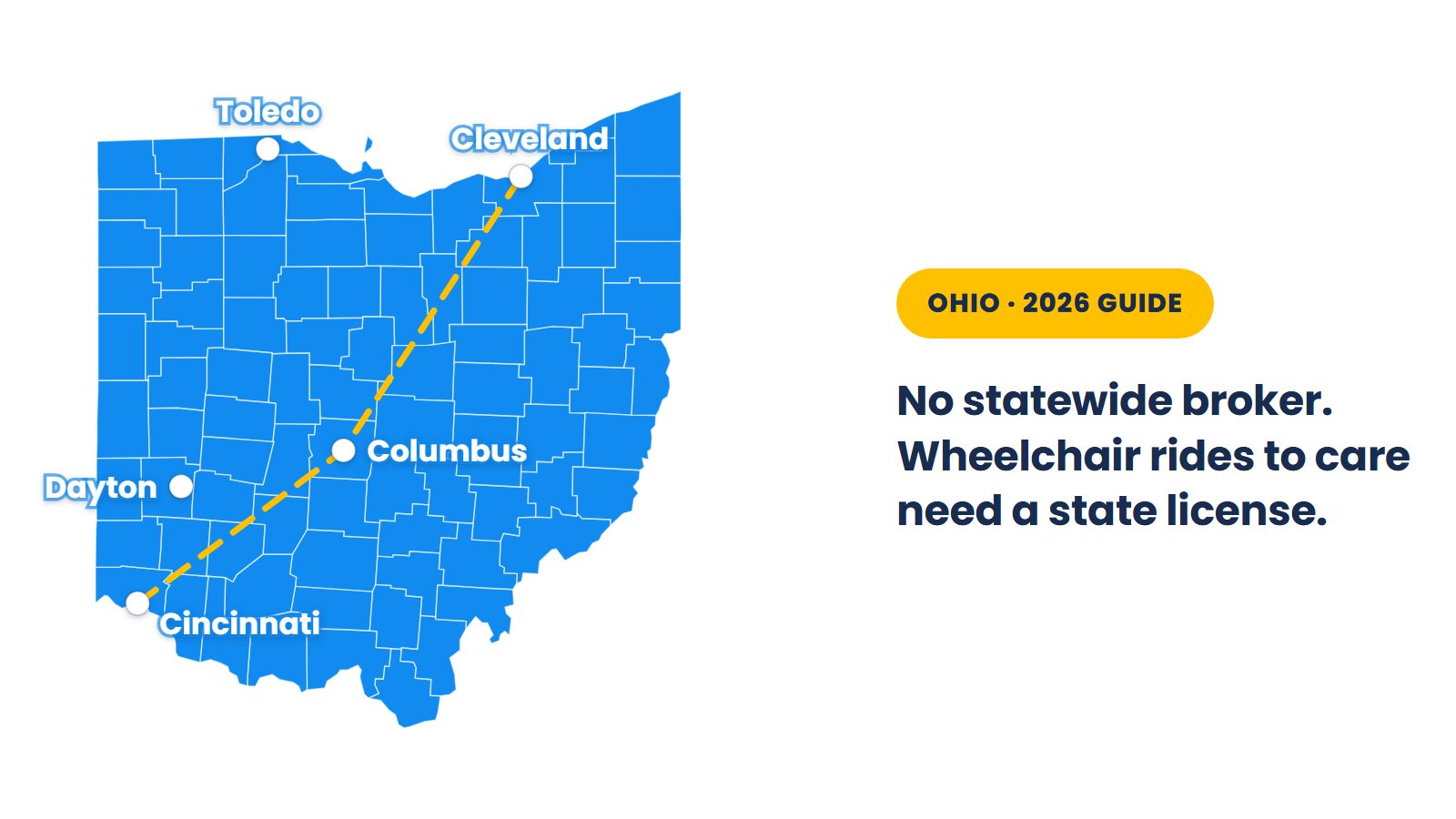
To start a NEMT business in Ohio, form an LLC ($99) and get a Public Utilities Commission of Ohio (PUCO) certificate with $1.5 million of liability insurance. There’s no NEMT license, but paid wheelchair rides to medical care need an ambulette (wheelchair van) license, $200 a year for one van, whoever pays. Walking riders need only PUCO. Medicaid trips, through plan vendors, county bids or direct billing, take months. Budget $24,000 to $51,000 or more for one used wheelchair van.
Ohio at a glance:
- Who runs Medicaid rides: no statewide broker. Health plans use their own ride vendors (MTM Health, SafeRide Health or Provide A Ride for five of the seven plans). County Job and Family Services offices arrange most fee-for-service rides, the ones for members outside the plans.
- Ambulette license: issued by the State Board of Emergency Medical, Fire, and Transportation Services, which sits within the Ohio Department of Public Safety’s Division of EMS.
- Direct billing: licensed wheelchair vans enroll as provider type 83 and bill the Ohio Department of Medicaid (ODM) up to $31 a trip plus $1.30 a loaded mile.
- Waiver transportation (non-medical rides for Aging and developmental-disability waiver members): new enrollments are frozen from May 14 to at least November 14, 2026.
- Insurance: $1.5 million of liability for a van seating 15 or fewer including the driver, and workers’ comp only through the state fund.
- License clock: the EMS board must decide a complete license application within 60 days and a van permit within 45.
An Ohio operator 18 years in said on a 2022 industry podcast that she works Medicaid waiver programs without a broker. She’s “grandfathered in,” she said, while “the new companies” go through brokers. For a new company in 2026, that’s half right. At least nine in ten Ohio Medicaid members were in health plans by the state’s 2021 count, and the plans’ vendors hand out their trips [1]. Her own door, waiver transportation, is closed to new enrollments until at least November 14 [30]. But a new company with an ambulette license can still skip the brokers: it can enroll with Ohio Medicaid and bill it directly for wheelchair van trips [2].
In Ohio, wheelchair rides to medical care need an ambulette license whoever pays, and only that license lets a van company bill Medicaid directly for NEMT. So choose your riders first. The checklist below runs in the order that wastes the least money. First comes who you’ll carry and where the first trips come from, then the van and the policy, the two state gates and the Medicaid doors. After it come the payers, the rules, the money and the calendar.
I run Duet, which builds dispatch software and runs growth services for non-emergency medical transportation (NEMT) companies, and I talk to NEMT owners on demos every week, Ohio operators included. This is the Ohio edition of our national guide on how to start a NEMT business. Requirements change, so confirm against the linked sources before you spend money.
The one-page checklist: how to start a medical transportation business in Ohio
Decide who you’ll carry before you buy anything, because in Ohio the rider and the trip decide your license. The six phases below follow the order the gates open, and each ends with the money it puts at risk.
Phase 0: decide who you’ll carry, and line up the first trips
- Wheelchair riders going to medical care need the ambulette license plus PUCO’s certificate, whoever pays [3][4].
- Walking riders, and wheelchair riders on non-medical trips, need PUCO’s certificate alone [4].
- Stretcher riders go by ambulance. No Ohio license fits a stretcher van, which leaves a private-pay one in a gray zone [5].
- Call two or three local companies for a ten-mile wheelchair quote, and ask a nearby dialysis center who drives its patients.
- Line up a first trip source, a facility or a private-pay referral, before you buy the van, and pitch it as service that starts once you’re licensed. Hold off advertising wheelchair rides to care until the license issues: the statute bars anyone unlicensed from professing to run that business [3].
- Money at risk: none yet. Skip this phase and you risk a van bought before you know which license it needs. A used 2016 to 2019 wheelchair van runs about $33,000, the September 2026 dealer median in our national cost model.
Phase 1: form the company
- File articles of organization for an LLC with the Ohio Secretary of State: $99 under Ohio Revised Code (ORC) section 111.16, plus $39 for each trade name you’ll use [6].
- Get a free employer identification number (EIN) from the IRS; the ambulette application asks for it [5].
- Money at risk: $99, plus $39 a name.
Phase 2: get the federal numbers
- Get a free Type 2 national provider identifier (NPI), the ID health payers know your company by, with taxonomy 343900000X for a van company.
- Get a free U.S. Department of Transportation (USDOT) number before you apply to PUCO, whose rule says an applicant “should obtain” one first [4].
- Check every owner and manager against the two federal exclusion lists, the Office of Inspector General’s and SAM.gov, and recheck monthly; ODM runs the same checks before and after enrollment [7].
- Money at risk: $0 if you file yourself, so skip the filing services.
Phase 3: buy the van, insure it, qualify the drivers
- Buy the van once you’ve picked your lane and lined up a first trip source. Both state applications need it: the ambulette application lists each van’s VIN, odometer reading and photo [5].
- Check a used van against the EMS board’s inspection form before you pay: the door clearance, the ramp or lift and four-point wheelchair tie-downs. A van past 12,000 miles also needs a certified mechanic’s safety inspection before its first permit, and every ambulette carries permanent 3-inch lettering on both sides [5].
- Bind $1.5 million of liability, PUCO’s floor for vehicles seating 15 or fewer including the driver, on a certificate that lists every van’s VIN [4][5].
- Open an account with the Ohio Bureau of Workers’ Compensation (BWC) before your first driver’s first shift: $120 a year at minimum [9].
- Screen each driver to the EMS board’s rule: 18 or older, two years of driving, fewer than six points, a background check and a drug test [5].
- Money at risk: the van, about $33,000, or $6,600 down if you finance it. Add about $4,350 of insurance due at signing at national rates, more at Ohio’s $1.5 million floor.
Phase 4: file for both gates
Both certificates need an insured van, which is why the van and the policy come first.
- PUCO certificate. Apply online. PUCO approves you once your insurer files proof of coverage and you pay $30 a van, then $30 a van every May or June [4].
- Ambulette license. Apply in MTLS, the EMS board’s online system, with your headquarters’ street address, each van’s VIN and photo, and an insurance certificate listing every van. It’s $100 for the license, then $50 for each van’s permit and $50 for its inspection, every year [5].
- Inspections. The board inspects your headquarters before you may operate, then each van [5].
- Plates. Register each van with “Ambulette” plates: the regular registration tax, any local tax and $7.50 more [8].
- Money at risk: about $240 in state fees, small next to the van and the policy they depend on.
Phase 5: open the Medicaid doors, keep booking your own trips
- Once licensed, enroll your wheelchair vans with ODM as provider type 83, and pay the $750 application fee [7][10][11].
- Apply to the three vendors the plans name: MTM Health, SafeRide Health and Provide A Ride. Ask your county Job and Family Services transportation coordinator when the next bid opens.
- Put up a NEMT website and a Google Business Profile once you’re licensed, and keep the facility visits going. Vendor credentialing has a queue; relationships don’t.
- Money at risk: the $750 fee, plus about $1,934 a month in fixed bills for a financed van (national model) while ODM and the vendors process you.
Who pays for NEMT rides in Ohio?
Medicaid is the volume, facilities are the stability and private pay is the margin, and the ambulette rule applies to all three. A wheelchair ride from a nursing home to a doctor’s office needs the license whether a health plan, the nursing home or a daughter pays for it [3].
Medicaid is the volume, and most of it runs through plans
ODM counted at least 90% of Medicaid-eligible Ohioans in managed care, its health plans, in 2021 [1]. Plans arrange their members’ wheelchair van rides, long rides and extra trips through their own vendors. Fee-for-service members ride through their county, or with a wheelchair van that bills ODM directly. CMS, the federal Medicaid agency, counted 2,597,852 Ohioans in Medicaid and the Children’s Health Insurance Program (CHIP) in June 2026. That’s a preliminary figure in its monthly Performance Indicator data, down from 2,698,937 in January [12].
Facilities are the stability
Facilities pay for their residents’ rides under their own contracts. A health care facility that drives only its own patients needs no ambulette license, but the company it hires does [3]. Dialysis centers are the steadiest source of repeat riders. CMS lists 312 in Ohio, including 35 in Cuyahoga County, 34 in Franklin and 30 in Hamilton, in a listing updated June 16, 2026 [13].
An Ohio cofounder running eight vehicles said on a 2026 industry podcast, “we’ve never done broker work.” His company runs on facility contracts and some private pay, and a couple of senior communities have told him they’re “actually getting rid of our transportation.”
Private pay is the margin
Private-pay families book directly, and Ohio has 2,271,397 residents 65 and older, 19.1% of the state, in the Census Bureau’s 2024 one-year survey [14]. Most private-pay operators I talk to take a card at booking and charge it at least 24 hours before pickup, or send a payment link due by then. No payment, no car. Some also take a small nonrefundable deposit to hold the spot.
Who is the NEMT broker in Ohio?
Nobody is: Ohio has no statewide Medicaid NEMT broker. County Job and Family Services offices arrange most fee-for-service rides, and each of the state’s seven Medicaid health plans arranges its own members’ rides, most through a hired ride vendor [15][16].
A broker is the company a state or health plan hires to assign Medicaid rides to transportation companies and pay for them. Ohio’s Medicaid agency doesn’t use one, unlike Michigan’s, which hires one for fee-for-service rides in three Detroit-area counties. Its rule, Ohio Administrative Code (OAC) 5160-15-10, says ODM meets its federal ride duty “in large measure through three-way subgrant agreements.” The other two parties are the Ohio Department of Job and Family Services and each county office. Each county picks the most cost-effective help for each rider: gas vouchers, bus fare, mileage or a ride from a contracted livery company [15].
The county lane is still running. The rule is in force, and ODM’s January 2026 review draft keeps the county model and renames it for NEMT [17], the same conclusion Pennsylvania’s human services department reached about its own county-run Medicaid rides in June 2026. Hancock County put its 2026 Medicaid transportation contract out to bid on September 19, 2025 [18], and 2026 plan manuals still point members to their county office for short trips [19].
The plans carry the rest. Every plan must arrange any necessary wheelchair van or ambulance ride regardless of distance, and car rides when the nearest network provider is at least 30 miles away. Shorter car trips are plan extras, and members who use them up go back to the county [16]. Minnesota runs a similar three-way split of counties, direct billing and plan ride lines.
Which ride vendor does each Ohio Medicaid plan use?
Here’s the map as of September 2026, from the plans’ own documents. Vendors change, so confirm before you build on any row.
| Plan | Ride vendor | Evidence |
|---|---|---|
| AmeriHealth Caritas Ohio | MTM Health | Claims and billing manual, updated June 2026: the plan “contracts with MTM” for NEMT [19] |
| Anthem Blue Cross and Blue Shield | MTM Health | Ohio Medicaid provider manual, October 2025 [19] |
| Buckeye Health Plan | SafeRide Health | Buckeye’s SafeRide provider guide (2024 file), for its Medicaid members [19] |
| CareSource | Provide A Ride | Provider notice effective May 1, 2021, replacing ModivCare; still the booking route in a February 2026 notice [20] |
| Humana Healthy Horizons in Ohio | MTM Health | 2026 provider manual [19] |
| Molina HealthCare | Ask the plan | ODM’s April 2024 plan guide listed Access2Care; ask the plan which vendor books its rides now [21] |
| UnitedHealthcare Community Plan | Ask the plan | Not named in its 2026 provider manual; its transportation line is 1-800-269-4190 [19] |
Our national broker tracker follows switches like CareSource’s across the states.
Can I bill Ohio Medicaid directly for NEMT rides?
Yes, for wheelchair van trips once you hold the ambulette license: the Ohio Department of Medicaid pays up to $31 a trip plus $1.30 a mile. The fee schedule adds $15 for an attendant. None of the three has changed since January 1, 2024; the appendix filed July 10, 2026 kept them for the rule in effect since August 1 [22].
A ten-mile wheelchair trip pays at most $44.00 one way: $31 plus ten loaded miles at $1.30. ODM pays the lesser of your charge or that maximum. The drive to the pickup isn’t paid, and mileage past 50 miles needs documentation [22][2].
To bill, you enroll as provider type 83, and Ohio Medicaid counts only a licensed ambulette as a wheelchair van. The rider has to need a wheelchair or other mobility device from pickup to drop-off; a cane, crutch or walker alone doesn’t qualify. A practitioner certifies that need on form ODM 03452, for up to 90 days or for a year, and the rider signs for each trip [2]. ODM’s own flyer tells fee-for-service riders who need a wheelchair van that they “may contact a provider directly” [23]. No grandfathering is involved.
Walking riders have no fee-for-service rate [22]. Counties buy those rides by contract, and a county’s vendor “is not considered to be a medicaid transportation provider” [2]. That makes Ohio’s lane narrower than North Carolina’s county DSS lane, where companies bill the state directly for trips a county social services office authorizes. It’s narrow in volume too. Fee-for-service covered at most about one member in ten in ODM’s 2021 count [1], so direct billing tops up plan and county work rather than replacing it.
What licenses and requirements does a NEMT business need in Ohio?
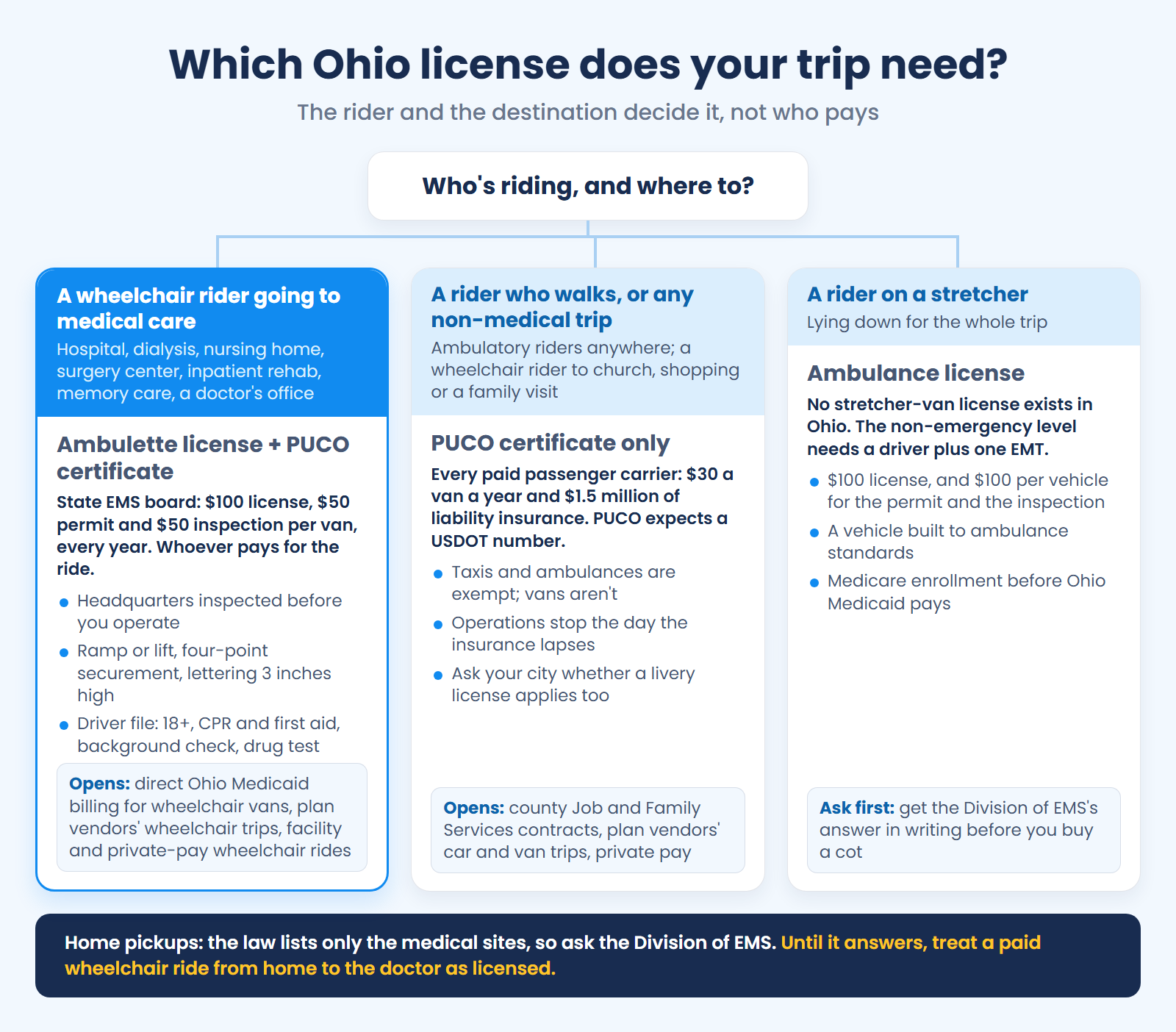
Ohio has no NEMT license, but every paid carrier needs PUCO’s certificate, and paid wheelchair rides to medical care need the EMS board’s ambulette license. ORC 4921.03 bars any for-hire motor carrier from operating in Ohio without a certificate of public convenience and necessity. The law’s passenger exemptions, in ORC 4921.01(B), cover taxis in their usual taxi service, ambulances, hearses, school buses and cost-sharing rideshares. Wheelchair vans and broker trips aren’t among them [4].
The second gate is the ambulette license, and I’d treat it as the license a wheelchair business runs on, not a Medicaid formality. Under ORC 4766.04(A)(2), no one may run, or profess to run, a business carrying riders who use a wheelchair or other mobility aid between listed medical sites without it [3]. The list covers hospitals, emergency departments, dialysis centers, nursing homes and other long-term care, surgical facilities, inpatient rehab, memory care, practitioners’ offices and other licensed inpatient facilities. The statute defines the licensed business by its fee, “regardless of whether the fee is paid by the person being transported.” Running without the license is a minor misdemeanor the first time and a fourth-degree misdemeanor after that [3].
What circulates online often gets these gates wrong:
| The claim you’ll read elsewhere | What Ohio actually requires |
|---|---|
| ”Ohio just killed the county system” | Counties still arrange fee-for-service rides under OAC 5160-15-10, and ODM’s January 2026 review draft of that rule keeps them [15][17] |
| Contact “state transportation brokers (such as Provide A Ride)“ | Ohio has no state broker. Provide A Ride is CareSource’s ride vendor, since May 1, 2021 [20] |
| “You must obtain an Ambulette Service License” to run any NEMT company | Only for paid rides carrying wheelchair or mobility-aid riders between listed medical sites, whoever pays; home pickups are unsettled, so treat them as covered. Walking riders and non-medical trips need PUCO alone [3][4] |
| Get licensed by the “Ohio Medical Transportation Licensing Board” | The State Board of Emergency Medical, Fire, and Transportation Services licenses ambulettes [3] |
| You need a “PUCO TCP permit,” or broker trips are “historically exempted” from PUCO | PUCO issues a certificate of public convenience and necessity; its passenger exemptions are taxis, ambulances, hearses, school buses and cost-sharing rideshares, not broker trips [4] |
| “$500,000 per incident” for vans under 16 seats, or 25/50/25 limits | $1.5 million for a vehicle seating 15 or fewer including the driver, and $5 million at 16 or more [4] |
| A “$100” ambulette permit, and a PUCO certificate that “costs $500” | $200 a year for one van: a $100 license, plus a $50 permit and a $50 inspection for each van. PUCO’s statute sets a $30 tax per vehicle; ask PUCO about any other fee [5][4] |
| Shop for comp like any other policy: “Workers’ Comp: NCCI Code 7370” | Ohio workers’ comp comes only from the Bureau of Workers’ Compensation’s state fund, not an insurance company. BWC assigns your class, which may or may not be 7370 [9] |
What the ambulette license doesn’t cover
The ambulette rule doesn’t reach walking riders, wheelchair riders on non-medical trips like church or shopping, or a health care facility carrying only its own patients [3]. A van company in those lanes still needs PUCO’s certificate.
Two edges are unsettled. The statute’s list names medical sites, not homes, but it defines the licensed business by regular paid rides “to receive health care services” [3]. Treat a paid wheelchair ride from home to the doctor as licensed until the state’s Division of EMS tells you otherwise in writing. And “other mobility aid” isn’t defined. Medicaid’s walker rule from the billing section is a payment rule, not the license [2], so ask about walker riders in the same letter.
City licenses in Columbus, Cincinnati and Cleveland
Columbus’s vehicle-for-hire owner application covers livery and “Wheelchair Taxicab” licenses: $20 to apply, $32 for the background check and $225 for the license. Cincinnati licenses drivers of “handicapped livery” vehicles at $38, then $20 a year, with a first aid course and a physician’s certificate. Cleveland’s taxicab license is only for companies with at least 15 vehicles [24]. State law may cut the other way. ORC 4921.19(I) calls local license fees on PUCO carriers “illegal” and “superseded,” and says local ordinances “cease to be operative” for carriers in compliance [4]. It keeps an exception for “reasonable local police regulations,” so ask each city in writing what a licensed, PUCO-certified ambulette needs before your first pickup there. Start with Columbus’s License Section (614-645-8366), Cincinnati’s chief of police and Cleveland’s Division of Assessments and Licenses (216-664-2264).
What are the NEMT insurance requirements in Ohio?
Plan on $1.5 million of liability, PUCO’s floor for a van seating 15 or fewer, and more than most brokers ask elsewhere. OAC 4901:2-13-03(C) sets that floor for passenger carriers whose vehicles seat 15 or fewer including the driver, and $5 million at 16 or more. If the policy is canceled or lapses, all operations under your certificate “shall cease immediately” until a replacement is on file [4].
| Who sets it | Minimum | Rule |
|---|---|---|
| PUCO, any van seating 15 or fewer including the driver | $1.5 million of public liability | OAC 4901:2-13-03(C) [4] |
| PUCO, 16 or more seats | $5 million | OAC 4901:2-13-03(C) [4] |
| EMS board, every ambulette licensee | $500,000 per occurrence and in aggregate, plus $100,000/$300,000 bodily injury and $50,000 property per vehicle, with 30 days’ cancellation notice to the board | ORC 4766.06 [3] |
| SafeRide Health’s network | $1 million per occurrence and $2 million aggregate general liability, $500,000 auto, SafeRide as additional insured | SafeRide’s provider page [25] |
That flips the usual advice. Elsewhere you insure your vans to the broker’s roughly $1 million, not the state minimum; in Ohio the state minimum is the bigger number. Nobody publishes a current Ohio premium. Our national model budgets $1,200 to $1,800 a month for a new company’s wheelchair van at broker-grade limits of about $1 million, as of September 2026. Treat that as a floor at $1.5 million. I’d get that quote before I priced a single van. Our guide to lowering NEMT insurance premiums covers how to shop at these limits.
Workers’ comp in Ohio comes from the state, not an insurance company. ORC 4123.35 has every private employer pay its premium “into the state insurance fund” that BWC runs, and the minimum is $120 a year even with no payroll. BWC assigns your class. The July 1, 2026 base rates for three classes worth asking about, 7370, 7380 and 7382, run $3.30 to $4.42 per $100 of payroll before assessments [9]. Ohio’s median wage for shuttle drivers and chauffeurs was $16.12 an hour in May 2025 federal data [26]. One full-time driver at that wage, about $33,530 a year, adds roughly $1,100 to $1,500 of comp. Ohio’s 2026 minimum wage is $11.00 an hour, though employers grossing under $405,000 may pay the $7.25 federal minimum [27].
What do NEMT drivers need in Ohio?
Ohio NEMT drivers don’t need a CDL for a typical wheelchair van, but ambulette drivers need the EMS board’s driver file. A commercial driver’s license (CDL) starts at a vehicle designed for 16 or more passengers including the driver, or rated at 26,001 pounds [28].
What does an Ohio ambulette driver need?
The EMS board’s rule, OAC 4766-3-13, sets the file [5]:
- Age and experience: 18 or older, with two years of driving and a valid license.
- Driving record: a Bureau of Motor Vehicles abstract dated within 14 days of the application, then yearly. Six or more points disqualify.
- Background check: from the state Bureau of Criminal Identification and Investigation, or the FBI for anyone who hasn’t lived in Ohio for five years.
- Drug and alcohol test: from a federally certified (CLIA) lab, THC included, and again after any crash while driving.
- Medical statement: from a physician, nurse practitioner or physician assistant, or a Department of Transportation (DOT) physical.
- CPR and first aid: hands-on adult CPR, plus basic first aid or certification as an emergency medical responder, emergency medical technician (EMT), advanced EMT or paramedic.
- Passenger assistance: a course with hands-on wheelchair securement, at least every three years.
New hires can start on a provisional basis while they finish: 60 days for CPR, first aid, the passenger course and the background check, and 14 days for the rest. But the same rule says every ambulette must be staffed by a driver who meets the statute’s requirements, so ask the Division of EMS before a provisional hire drives. If you drive, your own file comes first [5].
Insurers can be stricter than the state. A new Ohio provider told a 2022 federal listening session that, with a son who was 20, “the insurance would not pick him up until he hit 21.”
Can a NEMT company run stretcher van trips in Ohio?
Not in a van: Ohio’s ambulette license covers seated wheelchair riders, so stretcher riders go by non-emergency ambulance with an EMT aboard. Every ambulette must be “specifically designed to transport one or more patients sitting in wheelchairs” [5]. Ohio’s ambulance definition excludes vehicles “designed and used solely for the transportation of nonstretcher-bound persons” [3].
Stretcher work means starting an ambulance company: the licensed lane is a basic life support ambulance at the non-emergency-only level. Since July 6, 2022, ORC 4765.431 has let a non-emergency ambulance run with one driver, who needn’t be an EMT, plus at least one EMT, advanced EMT or paramedic. That crew is for riders who need no monitoring or care on the way. It costs $100 each for the license, each vehicle’s permit and its inspection, and the vehicle carries “Non-emergency transports only” lettering [29]. It also has to meet a national ambulance construction standard [3].
Medicaid pays for a non-emergency ambulance only when the rider needs EMT treatment or supervision, oxygen given by someone else, or supervised restraint. It pays only a company also enrolled in Medicare as an ambulance provider, up to $203.75 for basic life support plus $5.05 a mile [2][22]. Those needs appear to fall outside the one-EMT rule’s definition of a nonemergency transport, so ask the Division of EMS what crew a Medicaid-paid rider needs [29]. Ohio Medicaid counts a reclining “wheelbench” as a mobility device, so its rider can qualify for a wheelchair van [2].
A private-pay stretcher van sits in a gray zone. Before August 1, 2018, the license law covered transporting anyone “seriously ill, injured, or otherwise incapacitated”; today it bars only unlicensed emergency transports and wheelchair medical trips [3]. Get the Division of EMS’s answer in writing before you buy a cot. And tell your dispatchers in writing where the van’s job ends: wheelchair van service “does not involve medical treatment” [2].
How do you become a Medicaid transportation provider in Ohio?
Through three doors with three applications: the Ohio Department of Medicaid’s portal for licensed wheelchair vans, each plan vendor’s network and your county’s bid. A fourth door, waiver transportation, is closed to new companies until at least November 14, 2026 [30].
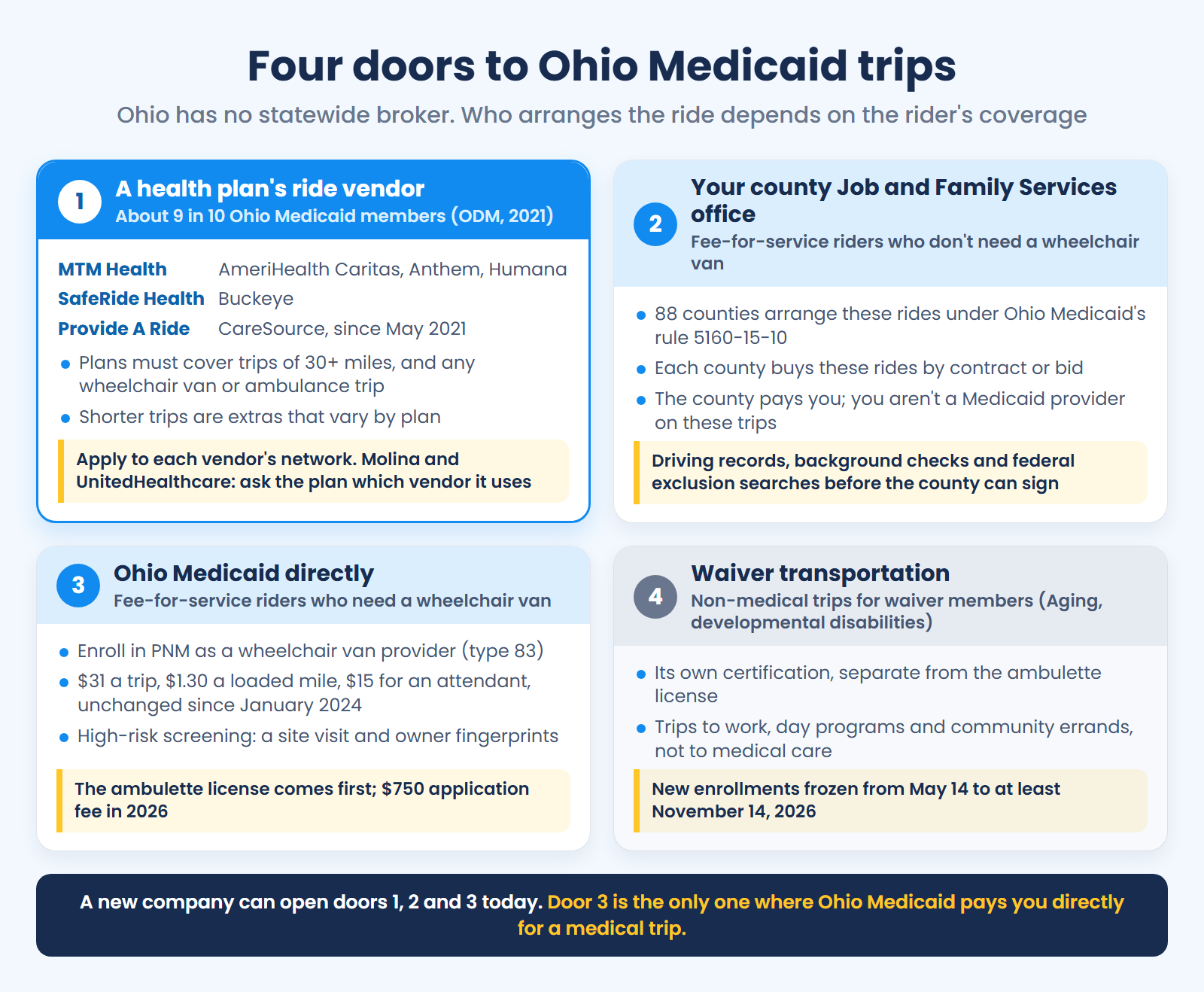
The order matters. ODM’s enrollment FAQ says every provider serving plan members must be credentialed by ODM for its provider type, then “contract with each managed care plan” on terms negotiated separately [10]. For a wheelchair van company, ODM comes first.
Step one: enroll in PNM
Enroll in ODM’s Provider Network Management (PNM) portal as provider type 83, wheelchair van, once your ambulette license is in hand [10].
- Logins: everyone who works in PNM needs an OH|ID, the state’s login, and an unfinished application expires after “10 calendar days” [10].
- Fee: $750 in 2026, the federal amount, and an application without proof of payment is rejected [11][7].
- Screening: wheelchair vans get “High” risk screening at first enrollment, which means site visits plus fingerprints within 30 days for anyone owning 5% or more [7].
- Back-dating: if you were properly licensed, your start date can reach back up to 12 months, so tick the retro-coverage box [7][10].
- Senate Bill 315, from October 6, 2026: a signed fraud-disclaimer form, disclosure of every 5% owner, and a payment suspension for “a suspicious increase” in claims in your first 60 days [31].
Step two: apply to each plan’s ride vendor
Each plan contracts separately, so each vendor’s network is its own application:
- MTM Health (AmeriHealth Caritas, Anthem and Humana): AmeriHealth’s manual points companies without an MTM contract to MTM’s provider network page [19].
- SafeRide Health (Buckeye): its provider page asks for your NPI, EIN and Medicaid ID, the insurance in the table above, and 95% ride acceptance and on-time performance [25].
- Provide A Ride (CareSource): it takes applications on its transportation partner page [32].
Vendor rates are set by contract. Ohio’s fee schedule covers fee-for-service trips only, and the rule leaves payment for plan trips to the managed care arrangement, so no standing state rate floor applies [22][16]. If you’ll run only cars, ask ODM’s provider hotline (800-686-1516) which provider type you’d enroll under, since SafeRide asks for a Medicaid ID [21][25].
Step three: bid for your county’s rides
County vendors contract with the county, not ODM, and the rules don’t treat them as Medicaid providers [2]. The county can sign you only after driver license, driving record, background and federal exclusion checks [33]. Hancock County’s 2026 bid shows how it works: a 12-month contract with two 12-month renewals and unit rates you propose. Budget and pricing are worth 20 of its 40 points, with a minimum score of 30. One line to plan around: the county’s agency “is not able to pay for no-shows” [18].
New waiver transportation enrollments are frozen until at least November 14, 2026
ODM froze new enrollments in provider types 45 and 55 from May 14 to November 14, 2026, unless CMS extends the freeze [30]. Those are the types waiver transportation runs through: the non-medical rides the Departments of Aging and Developmental Disabilities certify providers for [34][10]. Types 82 (ambulance) and 83 (wheelchair van) aren’t frozen. Ask the provider hotline whether a type 83 applicant can add waiver work during the freeze.
How long does enrollment take?
ODM’s enrollment FAQ gives ODM no deadline to decide a new enrollment [10], so ask ODM and each vendor how long applications are taking. Plan for months, and fill them with trips that don’t wait on anyone.
County bids weigh a track record: Hancock scores prior experience and qualifications at 10 of its 40 points [18]. Facilities and private-pay families need no enrollment, so they’re where a new company’s record starts. Our guides on winning facility contracts, getting your first trip from a facility meeting and private pay cover that stretch.
Don’t build the whole schedule on one payer
Ohio’s Medicaid doors move under you: plans change vendors and trip limits mid-year, and county contracts can run just 12 months. CareSource cut its extra trips under 30 miles from 30 round trips a year to 15 on April 15, 2026, though dialysis, wheelchair van and hospital discharge trips stay unlimited [20]. Hancock County’s contract runs a year at a time, with renewals based on performance and “the availability of funds” [18].
Senate Bill 315, signed July 7, 2026, adds a new kind of watch [35]. Within 18 months of its October 6, 2026 effective date, around April 2028, ODM must put every NEMT provider on a GPS system. The system records pickup, drop-off, timestamps, route and distance, and has to be able to send that data straight to ODM “as a condition of payment.” The law’s definition of NEMT leaves out trips run by organizations the EMS board licenses, ambulette companies included [31]. As written, that keeps a licensed wheelchair van company outside the GPS rule, and ODM’s rules will fill in the details.
An Ohio founder who left corporate finance told a 2025 industry podcast he’d grown from two vans to 13 in about a year and a half. Most of the trips came from one vendor, and his next goal was balance, because “it’s nice to have your own pipeline.” Ohio’s churn isn’t unusual: Texas’s plans switch vendors too. Book one facility and one private-pay source before the van payments start.
Whatever the mix, keep it on one schedule. Dispatch software like Duet brings plan-vendor and county trips onto the board beside your facility and private-pay work. Duet’s direct MTM integration pulls in MTM Health’s trips, and trip file import handles SafeRide, Provide A Ride and county trip lists, each at the rate its contract sets. The two licenses, each vendor’s credentialing and rate talks, and the county bids stay with you.
How much does it cost to start a NEMT business in Ohio?
Budget about $24,000 to $51,000 or more for one used wheelchair van in Ohio, counting six months of fixed bills at national insurance rates. The low end, about $23,500, is an older $20,000 van financed with 20% down; the high end, about $51,350, is a $33,000 van from 2016 to 2019 bought outright. Ohio’s own inputs are the $99 LLC, $237.50 of state permits, Franklin County’s 8% sales tax and Ohio’s title and registration fees; the rest comes from our national cost model. The “or more” is mostly insurance, which the model prices for about $1 million of coverage, not Ohio’s $1.5 million.
| Line item | Ohio amount | Note |
|---|---|---|
| LLC | $99 | Plus $39 per trade name [6] |
| EIN, NPI and USDOT number | $0 | Free from the federal agencies that issue them |
| Ohio NEMT license | $0 | None exists |
| PUCO certificate | $30 a van, then $30 a year | Ask PUCO about any other fee [4] |
| Ambulette license, permit and inspection | $200 a year for one van | $100 license, $50 permit, $50 inspection; $50 per reinspection [5] |
| Ambulette plates | Regular registration and local tax, plus $7.50 | ORC 4503.49 [8] |
| City license | $277 if it applies; ask the city | Columbus: $20 application, $32 background check, $225 license [24] |
| Medicaid application fee | $750 (2026) | Waived if already paid to Medicare or another state [7] |
| Used wheelchair van, 2016-2019 | About $33,000, or $6,600 down if financed | September 2026 dealer median; the national model finances 80% at 14% APR over five years |
| Tax, title and registration | About $2,700 on that van | 5.75% state rate plus county tax, 8% in Franklin County, plus $18 title and about $36 registration [36] |
| Insurance due at signing | About $4,350 | A quarter of the national model’s $17,400 year ($1,450 a month) |
| Workers’ comp | $120 minimum a year | About $1,100-$1,500 a year per full-time driver [9] |
| Equipment and lettering | About $1,000 | Plus the EMS inspection list: mounted extinguisher, oxygen cylinder mount, biohazard kit, back-up alarm [5] |
| Screening and training | About $1,000 | CPR, first aid, drug test, background check, passenger-assistance course |
| Phone and basic marketing | About $300 | National model |
| Six months of fixed bills | About $11,600 financed, $7,900 bought outright | $1,934 a month financed: a $1,305 insurance installment, a $614 van payment and $15 for a phone; $1,320 with no van payment |
| Total, owner driving | About $28,600 financed, $51,350 bought outright | Before workers’ comp or a city license; an older $20,000 van, financed, comes to about $23,500 |
Skipping the ambulette license saves about $200 a year and costs you the paid wheelchair rides to care.
On the revenue side, ODM’s fee-for-service maximum is the yardstick: $31 a trip plus $1.30 a loaded mile, or $44.00 for a ten-mile trip [22]. At that rate, the financed van’s $1,934 a month of fixed bills takes 44 ten-mile trips to cover, before fuel or a driver’s pay. Divide the same $1,934 by your own ten-mile private-pay price to see how many private-pay rides carry the van. Rates of $60 to $90 plus $4 to $6 a mile circulate online as typical Ohio wheelchair rates, but they aren’t on ODM’s fee schedule. Vendor and county rates are set by contract.
How do you fund a NEMT startup in Ohio?
Ohio’s own lenders and programs sit beside the SBA’s:
- Small Business Administration (SBA) 7(a) loans and microloans, covered in our national cost model.
- ECDI, the Economic and Community Development Institute, a Columbus-based SBA microlender, lists an average loan of $21,000. Its loan page lists working capital, equipment, inventory and construction as uses, so ask whether a van counts [37].
- The Ohio Capital Access Program backs participating banks’ loans to businesses with under $10 million in sales; the borrower pays 1.5% to 3% into a reserve [37].
- The Minority Business Direct Loan doesn’t fit a startup van: it requires three years of revenues and excludes “rolling stock (such as over the road trucks, cars and vans)” [37].
- Ohio’s Small Business Development Centers give “no-cost, confidential” advice at 20-plus locations [37].
None of them speed up the EMS board or ODM, so size your loan payments to the slow timeline.
How long does it take to start a NEMT business in Ohio?
Budget six months of fixed bills, about $11,600 with a financed van, before Medicaid trips run steadily. The EMS board is the only gatekeeper with a legal clock: 60 days to decide a complete license application and 45 for a van permit [3]. PUCO’s rules and ODM’s enrollment FAQ set none for their own decisions [4][10].
That runway covers the gap between the van and the first trip. The founder who left corporate finance waited three to four months between his first vans and his first trip, which came as overflow from a one-van company nearby.
Here’s the sequence for a wheelchair van company, with the clocks that apply:
- Before you file: pick your riders and line up a first trip source, form the company, get the federal numbers, then buy and insure the van.
- Filing day: PUCO online with your insurer’s filing, and the ambulette license in MTLS. Every document has to be in within 30 days, or the board can deem the application incomplete [5].
- Within 60 days of a complete application: the board’s decision on the license, and within 45 days, on each van’s permit [3]. The board inspects your headquarters before you may operate, then each van [5].
- The week the license issues: PNM, finished within its 10-day window, then the three vendors and your county’s next bid.
- After that: Medicaid volume builds on the vendors’ and the county’s timetables, so facility and private-pay trips carry you.
Walking riders give you a faster parallel track: a van, car or minivan carrying ambulatory private-pay riders needs only PUCO’s certificate, so it can earn while the ambulette paperwork runs [4].
The 18-year operator at the top of this guide thought working Medicaid without a broker was a privilege you had to be grandfathered into. For wheelchair vans in 2026, it’s a process: the ambulette license, then provider type 83 and ODM’s screening. Paid wheelchair rides to care need that license anyway, and it’s the key to the one open Medicaid door that needs no vendor’s or county’s yes. Plan for it from the day you pick your riders.
Ohio NEMT FAQ
Is ModivCare still a Medicaid ride broker in Ohio?
Not for any plan that names its ride vendor in its 2025 or 2026 provider materials. ModivCare ran CareSource’s rides until April 30, 2021, when Provide A Ride took over [20]. UnitedHealthcare’s 2026 manual names no vendor and Molina’s current one is unconfirmed, so ask those two plans [19].
What is needed to do non-medical transportation in Ohio?
Non-medical transportation is a waiver service: rides to work, day programs and community activities for people on Aging or Developmental Disabilities waivers. The Department of Aging or the Department of Developmental Disabilities certifies you, and new waiver enrollments are frozen from May 14 to at least November 14, 2026 [34][30]. The work needs no ambulette license, but a paid carrier still needs PUCO’s certificate [4].
How do NEMT companies get paid in Ohio?
It depends on the payer. ODM pays licensed wheelchair vans the lesser of their charge or $31 plus $1.30 a loaded mile, with a signed ODM 03452 on file and the rider’s signature for each trip [22][2]. Plan trips pay what your vendor contract says. County trips pay your contract’s unit rates; Hancock County takes monthly billing and doesn’t pay for no-shows [18]. Private-pay riders pay by card before pickup, and facilities pay under their own contracts.
How much do NEMT owners make in Ohio?
It depends on how many paid rides each van runs and at what rate, so do the math for your own van before you buy. ODM’s fee-for-service maximum for a ten-mile wheelchair trip is $44.00 [22]; plan-vendor, county and private-pay rides pay whatever your contracts and prices say. Fuel, maintenance, drivers’ pay and the van’s fixed bills come out before you do.
Can I start an Ohio NEMT business with my own car?
For walking riders, yes, once the car is on a PUCO certificate with $1.5 million of liability insurance [4]. Ask each plan vendor and your county whether it takes cars. A car can’t carry paid wheelchair rides to care, though: an ambulette has to be “specifically designed to transport one or more patients sitting in wheelchairs” [5].
Can I run an Ohio NEMT business from home?
Maybe, but settle it before you file. The ambulette application needs a physical headquarters address, no post office box, and the board inspects that headquarters before you may operate [5]. Ask the Division of EMS whether a home qualifies. From October 6, 2026, ODM also investigates a new applicant that shares an address or phone number with a current provider [31].
Does a bigger van change the rules in Ohio?
Yes, at a few lines. At 16 or more seats including the driver, PUCO’s insurance floor rises from $1.5 million to $5 million, and drivers need a CDL [4][28]. At 10,001 pounds, or more than eight passengers including the driver, the federal safety rules PUCO adopts apply [4][28]. And an ambulette longer than 22 feet needs 68 inches of door clearance instead of 56 [5].
How often do Ohio NEMT licenses renew?
Every year for the state gates. The ambulette license and each van’s permit expire a year after they’re issued, and a permit renewal needs proof of the annual inspection [3]. PUCO’s annual update and $30-a-van tax are due between May 1 and June 30 [4]. Ohio Medicaid revalidates credentialed providers every three years, under a rule that allows at most five [10][7].
Is the Ohio market worth entering in 2026?
The demand is there: 2,597,852 Ohioans in Medicaid and CHIP in June 2026 (a preliminary count), 2,271,397 residents 65 and older and 312 dialysis facilities [12][14][13]. The cautions: enrollment fell 3.7% from January to June 2026, Senate Bill 315 puts new providers under closer watch, and waiver work is frozen for now [12][31][30]. Enter with trip sources you control.
Key official sources
[1] Ohio Department of Medicaid, Medicaid Transportation Services Overview (May 20, 2021): the managed care share. https://dam.assets.ohio.gov/image/upload/medicaid.ohio.gov/About%20Us/AdvisoryCommittee/2021/RESHETT-TRANSPORTATION.pdf
[2] OAC 5160-15-01, -21, -22, -23, -26 and -27: Ohio Medicaid’s transportation definitions, provider conditions, necessity, ambulance criteria, limits and documentation. https://codes.ohio.gov/assets/laws/administrative-code/authenticated/5160/0/15/5160-15-01_20210701.pdf, https://codes.ohio.gov/assets/laws/administrative-code/authenticated/5160/0/15/5160-15-21_20210701.pdf, https://codes.ohio.gov/assets/laws/administrative-code/authenticated/5160/0/15/5160-15-22_20210701.pdf, https://codes.ohio.gov/assets/laws/administrative-code/authenticated/5160/0/15/5160-15-23_20210701.pdf, https://codes.ohio.gov/assets/laws/administrative-code/authenticated/5160/0/15/5160-15-26_20210701.pdf and https://codes.ohio.gov/assets/laws/administrative-code/authenticated/5160/0/15/5160-15-27_20260801.pdf
[3] ORC Chapter 4766: ambulette licensing, insurance, permits, exemptions and penalties, and the 2013 version of 4766.04. https://codes.ohio.gov/ohio-revised-code/chapter-4766 and https://codes.ohio.gov/assets/laws/revised-code/authenticated/47/4766/4766.04/7-1-2013/4766.04-7-1-2013.pdf
[4] ORC Chapter 4921 and OAC Chapters 4901:2-21, 4901:2-13 and 4901:2-5: PUCO’s certificate, tax, insurance and safety rules. https://codes.ohio.gov/ohio-revised-code/chapter-4921, https://codes.ohio.gov/ohio-administrative-code/chapter-4901:2-21, https://codes.ohio.gov/ohio-administrative-code/chapter-4901:2-13 and https://codes.ohio.gov/ohio-administrative-code/chapter-4901:2-5
[5] OAC Chapter 4766-3 and the EMS 4019 ambulette inspection form: applications, fees, inspections, vehicles and drivers. https://codes.ohio.gov/ohio-administrative-code/chapter-4766-3 and https://dam.assets.ohio.gov/image/upload/ems.ohio.gov/links/ems4019.pdf
[6] ORC 111.16: Secretary of State filing fees. https://codes.ohio.gov/assets/laws/revised-code/authenticated/1/111/111.16/4-3-2025/111.16-4-3-2025.pdf
[7] OAC 5160-1-17.8 and its appendix, and OAC 5160-1-17.4: screening levels, the application fee and effective dates. https://codes.ohio.gov/assets/laws/administrative-code/authenticated/5160/0/1/5160-1-17-8_20200131.pdf, https://codes.ohio.gov/assets/laws/administrative-code/pdfs/5160/0/1/5160-1-17$8_PH_FF_A_APP1_20200121_1137.pdf and https://codes.ohio.gov/assets/laws/administrative-code/authenticated/5160/0/1/5160-1-17-4_20210417.pdf
[8] ORC 4503.49: ambulette plates. https://codes.ohio.gov/assets/laws/revised-code/authenticated/45/4503/4503.49/7-1-2017/4503.49-7-1-2017.pdf
[9] ORC 4123.35, OAC 4123-17-26 and OAC 4123-17-06 Appendix A: the state fund, the minimum charge and July 1, 2026 base rates. https://codes.ohio.gov/assets/laws/revised-code/authenticated/41/4123/4123.35/3-24-2021/4123.35-3-24-2021.pdf, https://codes.ohio.gov/assets/laws/administrative-code/authenticated/4123/0/17/4123-17-26_20240701.pdf and https://codes.ohio.gov/assets/laws/administrative-code/pdfs/4123/0/17/4123-17-06_FF_A_APP3_20260526_1321.pdf
[10] Ohio Department of Medicaid, Provider Network Management FAQ and form ODM10234 (Rev. 3/2024). https://dam.assets.ohio.gov/image/upload/managedcare.medicaid.ohio.gov/PNM/PNM-FAQ.pdf and https://dam.assets.ohio.gov/image/upload/medicaid.ohio.gov/Resources/Publications/Forms/ODM10234Fillx.pdf
[11] CMS, 2026 provider enrollment application fee, Federal Register (December 3, 2025). https://www.govinfo.gov/content/pkg/FR-2025-12-03/html/2025-21877.htm
[12] CMS, Medicaid and CHIP enrollment data (Performance Indicator dataset, September 2026 release). https://data.medicaid.gov/api/1/metastore/schemas/dataset/items/6165f45b-ca93-5bb5-9d06-db29c692a360
[13] CMS, Dialysis Facility Listing by Facility (modified June 16, 2026). https://data.cms.gov/provider-data/api/1/metastore/schemas/dataset/items/23ew-n7w9
[14] Census Bureau, American Community Survey 2024 1-year, table B01001, via Census Reporter. https://api.censusreporter.org/1.0/data/show/latest?table_ids=B01001&geo_ids=04000US39
[15] OAC 5160-15-10: county Job and Family Services ride assistance. https://codes.ohio.gov/assets/laws/administrative-code/authenticated/5160/0/15/5160-15-10_20210701.pdf
[16] Ohio Medicaid 2026 plan comparison (updated September 24, 2025) and managed care provider agreement (Rev. 7/2025): the seven plans and their transportation duties. https://ohfiles.blob.core.windows.net/public/OhioMHWebsite/Documents/Ohio%20Medicaid%20Managed%20Care%20Health%20Plan%20Comparison%202026.pdf and https://dam.assets.ohio.gov/image/upload/medicaid.ohio.gov/Providers/ProviderTypes/Managed%20Care/Provider%20Agreements/2025_07_MCO_Final.pdf
[17] Ohio Department of Medicaid, MTL 3336, five-year review draft (January 28, 2026): the county rule kept. https://dam.assets.ohio.gov/image/upload/medicaid.ohio.gov/Stakeholders,%20Partners/LegalandContracts/Rules/ERF218450.pdf
[18] Hancock County Job and Family Services, NET RFP 2025 (released September 19, 2025). https://www.co.hancock.oh.us/DocumentCenter/View/1526/NET-RFP-2025
[19] Plan provider documents: AmeriHealth Caritas Ohio (June 2026), Anthem (October 2025), Humana Healthy Horizons (2026), Buckeye’s SafeRide guide and UnitedHealthcare Community Plan (2026). https://www.amerihealthcaritasoh.com/content/dam/amerihealth-caritas/acoh/pdf/provider/claims-billing-manual.pdf.coredownload.inline.pdf, https://providers.anthem.com/docs/gpp/OH_CAID_ProviderManual.pdf?v=202210032112, https://assets.humana.com/is/content/humana/2025_OH_Provider_Manualpdf, https://www.buckeyehealthplan.com/content/dam/centene/Buckeye/WebsitePDFs/saferide/SafeRideBuckeyeProviderv7%20(2).pdf and https://www.uhcprovider.com/content/dam/provider/docs/public/admin-guides/comm-plan/OH-Care-Provider-Manual.pdf
[20] CareSource provider notices effective May 1, 2021 and April 15, 2026. https://www.caresource.com/documents/oh-multi-p-565485-odm-enhanced-services-network-notification.pdf and https://www.caresource.com/documents/oh-med-p-5050461_nemt-caresource-network-notification.pdf
[21] Ohio Department of Medicaid, Managed Care Transportation Benefit Resource Guide (April 2024). https://ohiopharmacists.org/aws/OPA/asset_manager/get_file/518532
[22] OAC 5160-15-28 (effective August 1, 2026) and its appendix (filed July 10, 2026): payment rules and fee-for-service maximums. https://codes.ohio.gov/assets/laws/administrative-code/authenticated/5160/0/15/5160-15-28_20260801.pdf and https://codes.ohio.gov/assets/laws/administrative-code/pdfs/5160/0/15/5160-15-28_PH_FF_A_APP2_20260710_1407.pdf
[23] Ohio Department of Medicaid, Transportation Assistance flyer (2025). https://dam.assets.ohio.gov/image/upload/medicaid.ohio.gov/transport_assistance.pdf
[24] Columbus vehicle-for-hire owner application, Cincinnati Municipal Code Chapter 408 and Cleveland’s taxicab license sheet (rev. 5/2023). https://www.columbus.gov/files/sharedassets/city/v/5/bzs/business-licenses/vfh-owner-application-with-info_08-27-26.pdf, https://www.cincinnati-oh.gov/finance/linkservid/8C9130E5-FD8C-3323-5E8C7E2C5204D7E4/showMeta/0/ and https://www.clevelandohio.gov/sites/clevelandohio/files/finance-docs/licenses-permits/Taxicab%20Vehicle%20License%20.pdf
[25] SafeRide Health, what to expect as a NEMT provider. https://www.saferidehealth.com/what-to-expect-nemt-provider
[26] Bureau of Labor Statistics, Occupational Employment and Wage Statistics, Ohio shuttle drivers and chauffeurs (May 2025). https://api.bls.gov/publicAPI/v1/timeseries/data/OEUS390000000000053305308
[27] Ohio Department of Commerce, 2026 minimum wage poster. https://dam.assets.ohio.gov/image/upload/com.ohio.gov/DICO/WageAndHour/2026_Minumum_Wage_Poster.pdf
[28] 49 CFR 383.5 and 390.5: CDL and commercial motor vehicle thresholds. https://www.govinfo.gov/content/pkg/CFR-2024-title49-vol5/pdf/CFR-2024-title49-vol5-sec383-5.pdf and https://www.govinfo.gov/content/pkg/CFR-2024-title49-vol5/pdf/CFR-2024-title49-vol5-sec390-5.pdf
[29] ORC 4765.431 (effective July 6, 2022) and OAC Chapter 4766-2: non-emergency ambulance staffing, fees and lettering. https://codes.ohio.gov/assets/laws/revised-code/authenticated/47/4765/4765.431/7-6-2022/4765.431-7-6-2022.pdf and https://codes.ohio.gov/ohio-administrative-code/chapter-4766-2
[30] Ohio Department of Medicaid, enrollment moratorium bulletin (May 14 to November 14, 2026). https://dam.assets.ohio.gov/image/upload/medicaid.ohio.gov/Home/Hospice_and_Home_Health_Moratorium_annoucement_2026.pdf
[31] ORC 5164.40, 5164.401, 5164.303, 5164.305, 5164.331 and 5164.332, enacted by Senate Bill 315, effective October 6, 2026. https://codes.ohio.gov/assets/laws/revised-code/authenticated/51/5164/5164.40/10-6-2026/5164.40-10-6-2026.pdf, https://codes.ohio.gov/assets/laws/revised-code/authenticated/51/5164/5164.401/10-6-2026/5164.401-10-6-2026.pdf, https://codes.ohio.gov/assets/laws/revised-code/authenticated/51/5164/5164.303/10-6-2026/5164.303-10-6-2026.pdf, https://codes.ohio.gov/assets/laws/revised-code/authenticated/51/5164/5164.305/10-6-2026/5164.305-10-6-2026.pdf, https://codes.ohio.gov/assets/laws/revised-code/authenticated/51/5164/5164.331/10-6-2026/5164.331-10-6-2026.pdf and https://codes.ohio.gov/assets/laws/revised-code/authenticated/51/5164/5164.332/10-6-2026/5164.332-10-6-2026.pdf
[32] Provide A Ride, become a transportation partner. https://providearide.com/become-a-transportation-partner/
[33] OAC 5160-15-14: conditions for county transportation vendors. https://codes.ohio.gov/assets/laws/administrative-code/authenticated/5160/0/15/5160-15-14_20220701.pdf
[34] OAC 173-39-02.18 and OAC 5123-9-18: Aging and Developmental Disabilities non-medical transportation. https://codes.ohio.gov/assets/laws/administrative-code/authenticated/173/0/39/173-39-02-18_20250201.pdf and https://codes.ohio.gov/assets/laws/administrative-code/authenticated/5123/0/9/5123-9-18_20250102.pdf
[35] Ohio Senate, Senate Bill 315 (136th General Assembly) status. https://ohiosenate.gov/legislation/136/sb315/status
[36] ORC 5739.02, the Ohio BMV’s fees page and the Ohio Department of Taxation’s rate-change bulletin effective April 1, 2025: sales tax, title, registration and Franklin County’s 8% rate. https://codes.ohio.gov/ohio-revised-code/section-5739.02, https://www.bmv.ohio.gov/doc-fees.aspx and https://content.govdelivery.com/accounts/OHTAX/bulletins/3c678f3
[37] ECDI’s loans page, ORC 122.602 and the Ohio Capital Access Program lender form, the Minority Business Direct Loan guidelines (October 30, 2025) and the Ohio SBDC. https://www.ecdi.org/loans, https://codes.ohio.gov/ohio-revised-code/section-122.602, https://dam.assets.ohio.gov/image/upload/development.ohio.gov/business/minority/07172023_OCAP_PreApprovalForm.pdf, https://dam.assets.ohio.gov/image/upload/v1764619183/development.ohio.gov/business/minority/Minority-Business-Direct-Loan-Guidelines.pdf and https://www.ohiosbdc.net/about/
Last verified against the sources above in September 2026. Ohio requirements, plan vendors and county contracts change; check the primary sources before acting, and treat this guide as education, not legal advice.
About the author
James O'Donnell cofounded Duet and leads its sales, partnerships, and growth services. He talks with NEMT operators every week, hosts the NEMT Growth podcast, and answers Duet's sales line himself. More about Duet's founders →
Starting in a nearby state?
Want more trips and less busywork?
See how Duet runs and grows NEMT businesses in a 30-minute demo.