Article
How to Start a NEMT Business in Illinois (2026)
Illinois has no NEMT license, but every Medicaid ride starts with IMPACT, a high-risk screening for NEMT. Here's the order that wastes the least money.
By James O'Donnell, Cofounder and COO, Duet ·
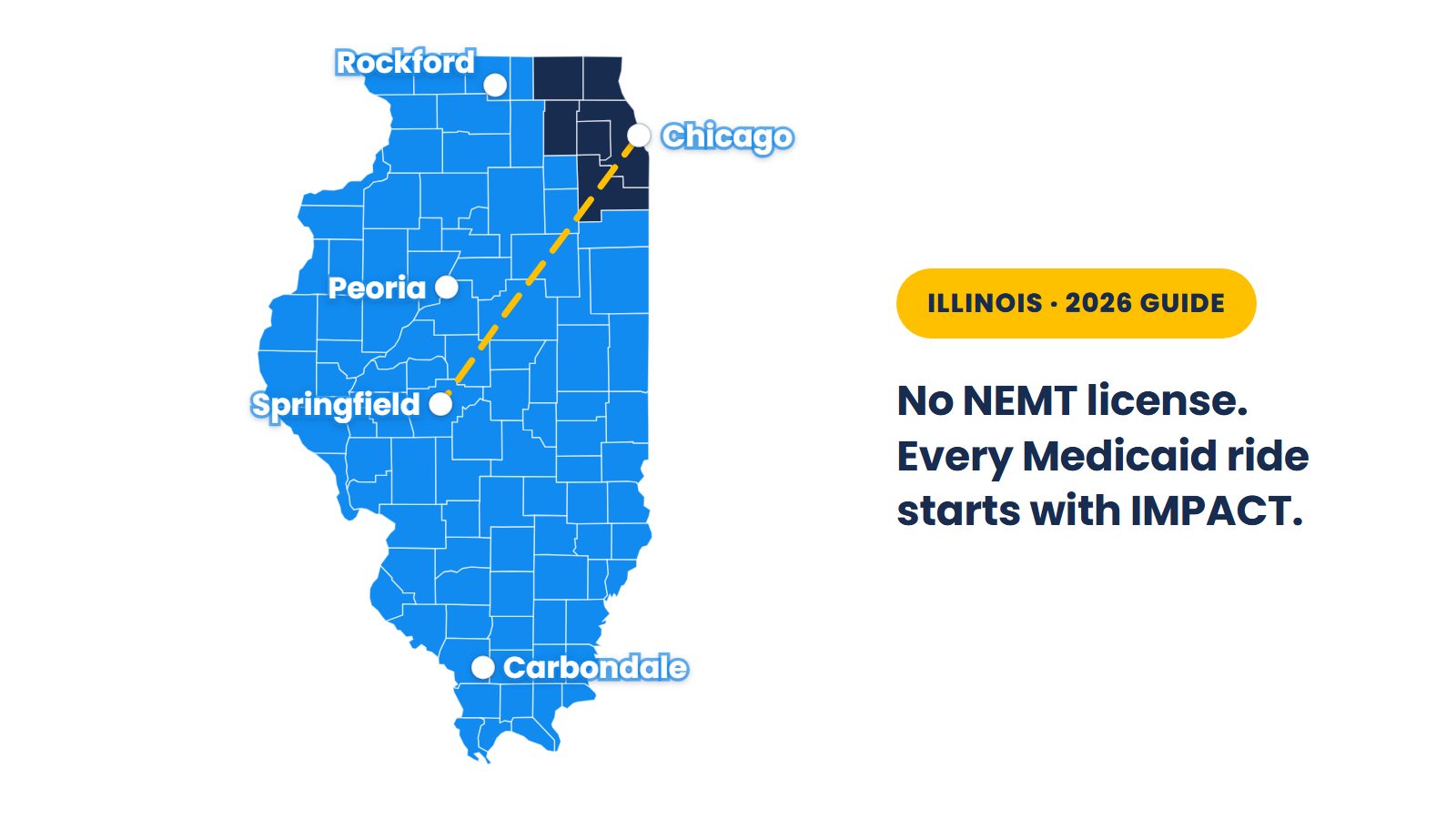
To start a NEMT business in Illinois, form an LLC ($150) and register each wheelchair van with the Secretary of State as a medical carrier, with insurance on file and a safety test every six months. There’s no NEMT license. Every Medicaid ride needs enrollment in IMPACT, and Medicaid volume takes months to build, so your first paid trips come from facilities and private-pay families. Budget about $22,500 to $50,100 for one used wheelchair van, counting six months of fixed bills.
Illinois at a glance:
- Who runs Medicaid rides: each HealthChoice Illinois plan hires MTM or Modivcare; for fee-for-service riders, who aren’t in a plan, Transdev approves each trip and the rider picks a company from its list [1][2][3][4].
- State registration: medical carrier plates, insurance on file and an Illinois Department of Transportation (IDOT) safety test every six months for each wheelchair van [5][6].
- Medicaid enrollment: IMPACT, run by the Department of Healthcare and Family Services (HFS), which screens NEMT companies as high risk, with fingerprints and an inspector general’s site visit [7][8].
- Direct billing: HFS pays a wheelchair van up to $30 a fee-for-service trip plus $0.80 to $1.61 a loaded mile, by the county your van is based in [8][9].
- Insurance: plan on about $1 million for broker work; the state’s floor is $250,000/$250,000/$50,000 or $300,000 combined, and Chicago’s is $350,000 [10][11].
- Drivers: no commercial driver’s license (CDL) below 16 seats, and an HFS-approved safety course for Medicaid drivers and employee attendants [8][12].
- Chicago: a $600-a-year license for each wheelchair van, which the city calls a medicar, and drivers with a Chicago chauffeur license or a CDL [11].
A first-year Illinois founder told me on an October 2026 demo that she wasn’t taking riders yet. She’d finished her state requirements a few months earlier and had been working on “the whole IMPACT application because I thought I had to go through it.” It was taking “five to seven weeks just for one application to go through,” she said. I told her private riders paying by card, or a nursing home paying by invoice, are “pretty lightweight to get going once you have a vehicle” and insurance on it. Her answer: “I wish I would have done that, you know, a few months ago.”
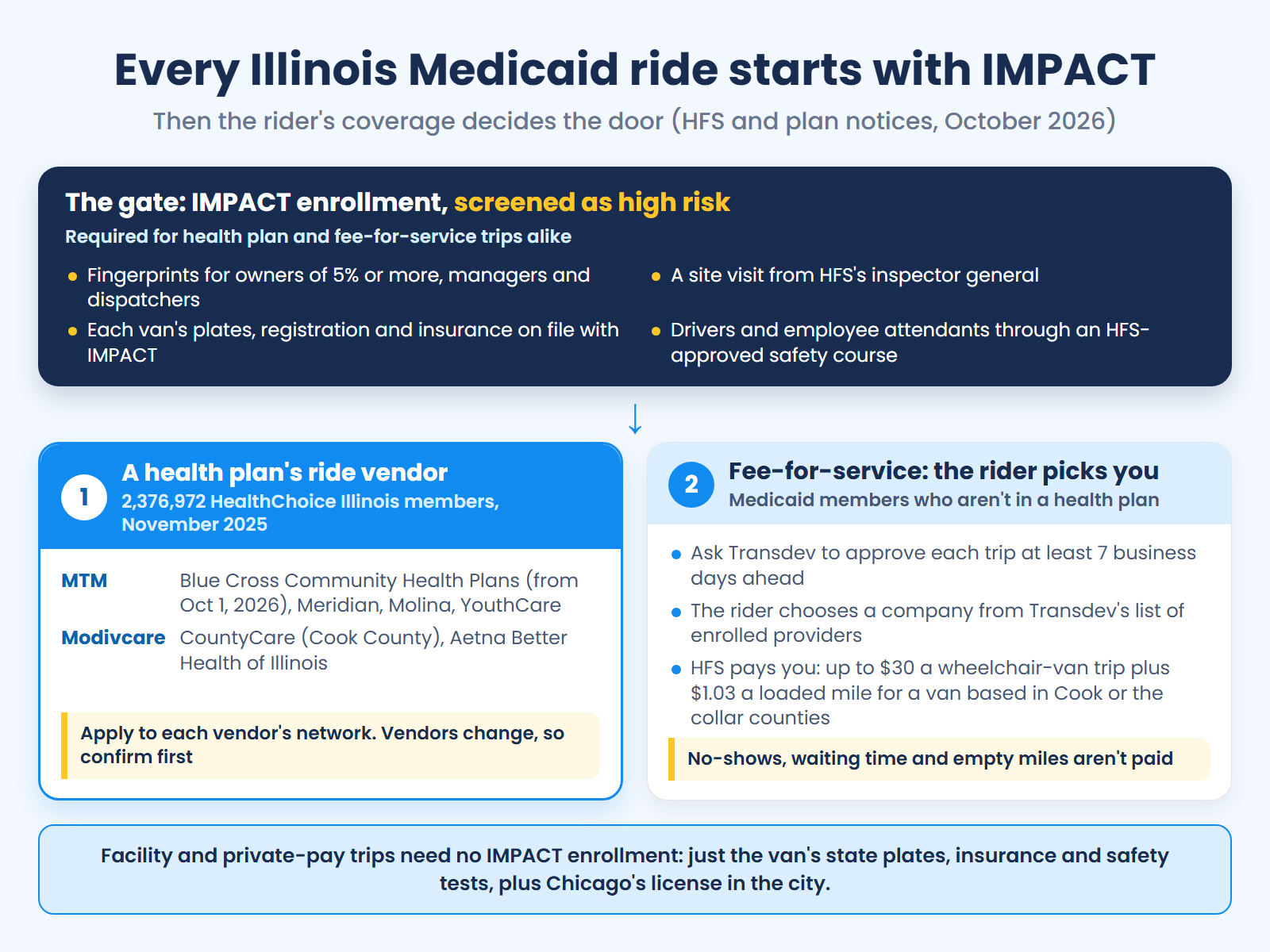
It’s an easy mistake, and not her fault. In Illinois, every Medicaid ride waits on IMPACT, a high-risk enrollment that wants your van plated and insured first, so facilities and private pay, which don’t need IMPACT, have to carry the early months [7][8]. The checklist below runs in the order that wastes the least money. After it come Illinois’s two Medicaid doors, because they decide where you apply, then the rules for vans and drivers, IMPACT, costs and timing.
I run Duet, which builds dispatch software and runs growth services for non-emergency medical transportation (NEMT) companies, and I talk to NEMT owners on demos every week, Illinois operators included. This is the Illinois edition of our national guide on how to start a NEMT business. Requirements change, so confirm against the linked sources before you spend money.
The one-page checklist: how to start a medical transportation business in Illinois
In Illinois your first riders come before the van, and the van comes before Medicaid, because IMPACT wants each vehicle’s plates, registration and insurance before it will enroll you [7]. Medicaid then takes months, so plan your first trips around facilities and families. Each phase below ends with the money it puts at risk.
Phase 0: pick your riders, your van and your city
- Van type: a wheelchair van with a lift or ramp is a medical carrier. A sedan or plain minivan is what HFS calls a service car, licensed “as livery or public transportation,” so ask the Secretary of State which plate fits (217-782-2475) [5][8][10].
- Stretcher riders: carrying them takes a stretcher van license from the Illinois Department of Public Health (IDPH) on top of the plates [13].
- Chicago: a company in the city also needs the city’s medicar license for each van [7][11].
- Medicaid: this week, pull your county’s row from HFS’s latest HealthChoice Illinois enrollment report and note which ride vendor serves its biggest plans [14].
- First trips: line up one facility and one private-pay source for the van’s first plated week.
- Money at risk: none yet.
Phase 1: form the company and certify your W-9
- File articles of organization with the Secretary of State: $150, plus $75 for each annual report [10].
- Get a free employer identification number (EIN) from the IRS and a free national provider identifier (NPI).
- Register with the Illinois Department of Revenue through MyTax Illinois (Form REG-1) before you buy or hire [15].
- Send a W-9 to IMPACT for the Comptroller’s certification, which takes about three weeks by HFS’s 2021 manual; the IMPACT application can’t start until it’s done [7].
- Money at risk: $150.
Phase 2: quote insurance, then buy, test and plate the van
- Get insurance quotes before you sign for the van. The Secretary of State wants a certificate of insurance before it issues medical carrier plates [10].
- Have the van safety-tested at an official IDOT testing station within six months before you register it, then at least every six months [5].
- Pay the 6.25% state sales tax on a dealer sale (local taxes add to it), the $165 title fee and the plates, about $151 a year for a van of 8,000 pounds or less [10][15].
- In Chicago, book an intake appointment with the city’s Department of Business Affairs and Consumer Protection (BACP), pay $600 a van and allow at least 14 business days [11].
- Money at risk: about $14,300 on a financed $33,000 van, our national model’s price for a 2016-2019 wheelchair van: $6,600 down, about $2,380 in tax, title and plates, $4,350 of insurance due at signing and about $1,000 for equipment and lettering.
Phase 3: train drivers and run your first private-pay and facility trips
- Put every driver and employee attendant through an HFS-approved safety course now, and calendar the three-year renewal. Medicaid trips require it, and IMPACT’s document package asks for the certificates and a court-certified driving abstract for each driver [7][8].
- Buy workers’ comp the day you employ anyone [16].
- In Chicago, each driver needs a chauffeur license or a CDL [11].
- Put up a website families can book from and a Google Business Profile, then start the facility and private-pay trips.
- Money at risk: about $1,000 for screening and training and $300 for a phone and basic marketing.
Phase 4: enroll in IMPACT
- File the week the van is plated, as an atypical agency, the enrollment type HFS uses for NEMT companies [7].
- Within 30 days of applying, every owner of 5% or more, every manager and every dispatcher submits fingerprints [7][17].
- Expect a site visit from HFS’s Office of the Inspector General [8].
- HFS names no application fee for NEMT; confirm at 877-782-5565.
- Money at risk: the fingerprint fees, which your company pays [17].
Phase 5: open the Medicaid doors and keep booking your own trips
- The week you file IMPACT, apply to MTM and Modivcare for your county’s plans, and ask each vendor’s provider relations team whether it will start credentialing before IMPACT approves you [18].
- Once IMPACT approves you, your company can appear on Transdev’s list for fee-for-service riders [2].
- Price each Medicaid trip against the fee-for-service maximum before you set driver pay.
- Money at risk: about $1,934 a month in fixed bills for a financed van, by our national model, while the doors open.
A company that will never carry Medicaid riders can stop after Phase 3.
Who pays for NEMT rides in Illinois?
Medicaid is the volume in Illinois, but facilities and private-pay families can pay you before IMPACT approves you.
Medicaid is the volume, and the health plans hold most of it
In November 2025, 2,376,972 of Illinois’s 3,038,514 Medicaid and Children’s Health Insurance Program (CHIP) members were in HealthChoice Illinois health plans, about 78%, by HFS’s monthly report and the federal Medicaid agency’s count [14][19]. Medicaid members who aren’t in any health plan ride fee-for-service, the second door.
Two owners who bought a small fleet north of Chicago in 2026 told me they work with “pretty much everything in the state of Illinois”: Modivcare, a workers’ comp network, the VA, facilities and private-pay riders, with their MTM contract on its way back. An established Rockford-area operator told me she gets “the majority of our trips” through riders’ insurance plans, which she bills herself.
Facilities are the stability
Facilities pay on invoice, under their own agreements, and they don’t wait on IMPACT. A central Illinois owner whose company has run on private pay for more than a decade said on a 2024 industry podcast that his “biggest group is contracting with nursing homes and hospitals.”
HFS’s own handbook names some of the rides facilities pay for. A hospital inpatient’s round trip to another facility, for an outpatient service the hospital doesn’t offer, isn’t billable to HFS: “the transportation provider must seek payment from the inpatient hospital.” A state-operated developmental or mental health center pays for its residents’ rides the same way. And when a nursing home resident rides to a sheltered workshop or a day training center, HFS won’t pay. Its rule for long-term care (LTC) residents: “The transportation provider must verify reimbursement source (i.e., the day training center, sheltered workshop or LTC facility) prior to transport” [8].
One distinction before you quote a nursing home: Medicaid covers a Medicaid resident’s rides to medical appointments, through HFS or the resident’s health plan, with prior approval and a physician certification statement (form HFS 2270) [8]. So ask which residents’ rides the facility pays for itself. Dialysis clinics are the exception to the facility pitch. In my experience most dialysis riders are on Medicaid, so their trips come through the plans’ vendors or the fee-for-service list, not the clinic.
Private pay is the margin
Private-pay families book you directly and pay up front. The usual setup among the private-pay owners I talk to: a card on file when the ride is booked, charged at least 24 hours before pickup, or a payment link that has to be paid by then. No payment, no ride. A few also ask for a small nonrefundable deposit to hold the time slot. Illinois has 2,274,582 residents 65 and older, 17.9% of the state, in the Census Bureau’s 2024 one-year survey [19].
Private pay is quick to start, but not always quick to fill. Outside the big metro it can be thin. The Rockford-area operator told me she’d love more private pay, but “it’s a struggle bus for a lot of people right now.”
Who is the NEMT broker in Illinois?
Illinois has no statewide NEMT broker: each HealthChoice Illinois health plan hires a ride vendor, MTM or Modivcare, and Transdev only approves fee-for-service trips [1][2][3][4]. A broker is the company a state or health plan hires to assign Medicaid rides and pay for them, and MTM and Modivcare do that for the plans. Transdev, called First Transit until September 2023, reviews prior approvals for HFS. Its own page says it doesn’t arrange transportation; it keeps a list of enrolled providers that riders choose from [2].
So when a coaching video tells you MTM is Illinois’s broker, it’s half right: MTM is one of two plan vendors, and fee-for-service riders don’t go through a broker at all. Our state-by-state guide to NEMT brokers counts Illinois with the plan-vendor states.
Which ride vendor does each Illinois Medicaid plan use?
MTM serves four of the six HealthChoice Illinois plans, about 70% of members counting Blue Cross’s move to MTM, and Modivcare serves Aetna Better Health of Illinois and CountyCare, Cook County’s plan [1][3][4][14]. The table below comes from HFS’s January 2024 vendor list and the plans’ 2024-2026 notices, with members from HFS’s November 2025 report [1][3][4][20]. Vendors change, so confirm before you build on any row. New HealthChoice contracts are expected to start January 1, 2027, with Humana joining the plans, so check again then [3][21].
| Plan | Ride vendor | Members, November 2025 |
|---|---|---|
| Blue Cross Community Health Plans | MTM Health, effective October 1, 2026 (Modivcare before) | 704,702 |
| Meridian Health Plan of Illinois | MTM | 636,519 |
| CountyCare (Cook County only) | Modivcare, since August 1, 2024 | 394,615 |
| Aetna Better Health of Illinois | Modivcare | 330,697 |
| Molina Healthcare of Illinois | MTM | 276,995 |
| YouthCare (youth in state care, run by Meridian) | MTM | 33,444 |
| All six plans | 2,376,972 |
Which vendor should you apply to first?
Apply to both the week you file IMPACT, and follow up first with the vendor whose plans hold most of your county’s members. In Cook, the four MTM plans held 633,712 of 1,130,176 members in November 2025, about 56%, counting Blue Cross with MTM, and Modivcare’s two held 496,464, about 44% [3][14]. Outside Cook, on the same count, the tilt is toward MTM: about 76% of members in Winnebago County (Rockford) and about 80% in Peoria and Sangamon (Springfield) [14].
Can I bill Illinois Medicaid directly for NEMT rides?
Yes: for Medicaid members who aren’t in a health plan, Transdev approves the trip, the rider picks a company from its list, and HFS pays you directly, up to $30 a wheelchair-van trip plus mileage [8][9]. HFS’s documents call this lane NETSPAP, after the prior-approval program Transdev runs, and it needs no vendor contract, only your IMPACT enrollment.
How does a fee-for-service trip reach you?
The rider, a medical provider or your company asks Transdev for prior approval at least seven business days before the trip, or for a standing approval when the rider goes to the same place more than three times a month [8]. Riders choose the company. One who already has a company in mind can find it in Transdev’s list of enrolled providers, by phone at 877-725-0569 or through the ZIP-code lookup on its site [2]. One who asks for help can get, in HFS’s words, a “random selection of transportation providers enrolled with the Department in the customer’s geographic area” [8]. A trip for a health plan member isn’t billable to HFS; it goes through the plan’s vendor [8].
Being on the list doesn’t guarantee a trip, since the rider does the choosing. A one-van owner said in a 2024 video interview that her area’s list had “only five transportation companies and only three of them got wheelchair,” and her first Medicaid rider found her there. So the riders who already know your name matter in this lane too.
What does a fee-for-service trip pay?
HFS pays a wheelchair van (a “medicar” in its schedule) up to $30 a trip and a service car up to $20, plus $0.80 to $1.61 a loaded mile, depending on the county your van is based in [8][9]. Those maximums haven’t changed since January 1, 2023, when Public Act 102-1037 raised the bases [9]. The schedule effective January 1, 2026:
| HFS maximum, effective January 1, 2026 | Cook, DuPage, Kane, Lake, McHenry and Will | Madison and St. Clair | The other 94 counties |
|---|---|---|---|
| Wheelchair van (medicar), base per trip | $30 | $30 | $30 |
| Service car, base per trip | $20 | $20 | $20 |
| Mileage, per loaded mile | $1.03 | $1.61 | $0.80 |
| Attendant | $20 | $20 | $20 |
| Stretcher add-on, IDPH-licensed providers only | $9.31 | $11.64 | $11.64 |
HFS pays the lower of your usual charge or the maximum, on claims filed electronically within 180 days. It doesn’t pay for no-shows, empty miles, waiting time or tolls [8].
Say your van is based in Cook County and the rider lives 10 miles from the clinic. Each loaded leg pays up to $30 plus 10 times $1.03, or $40.30, and the round trip $80.60. The same leg for a van based in one of the 94 other counties pays up to $38.00. California keeps a fee-for-service lane too, beside its health plans’ vendors.
What licenses and requirements does a NEMT business need in Illinois?
Illinois has no NEMT license, but a paid wheelchair van needs medical carrier plates, insurance on file and an IDOT safety test every six months [5][6]. The state’s First Stop business information center puts it plainly: Illinois has no specific license for this service [22]. The ICC stays out too. Its passenger rules exempt “carriers transporting passengers without fixed routes or schedules and charging on a time or distance basis,” and vehicles seating fewer than 8 people counting the driver [6].
Who pays doesn’t change any of it: private-pay and facility trips need the same plates, insurance and safety tests, plus Chicago’s license in the city [5][6][11].
Much of what circulates online gets Illinois wrong. Some of it traces to a directory template that repeats a phantom fee for states without a NEMT license.
| The claim you’ll read elsewhere | What Illinois actually requires |
|---|---|
| ”Illinois is a broker state” and “MTM is the broker” | No statewide broker. Each health plan hires MTM or Modivcare, and Transdev approves fee-for-service trips without scheduling them [1][2][3][4] |
| First Transit as a “State-contracted broker” | First Transit renamed itself Transdev in 2023, and it reviews prior approvals for HFS rather than arranging rides [2] |
| Apply to “all three major Illinois MCOs,” including “IlliniCare Health Plan” | HFS’s 2024 plan list has no IlliniCare; the six plans and their vendors are in the table above [1] |
| “PT/MC (Public Transportation/Motor Carrier) plates” “issued by the Illinois Commerce Commission (ICC)“ | MC means medical carrier [22], the Secretary of State issues the plates, and the ICC doesn’t regulate trips priced by time or distance [5][6] |
| “The Illinois Commerce Commission (ICC) requires a minimum of $350,000 combined single limit for NEMT vehicles.” | $350,000 is Chicago’s medicar minimum. The state floor is $250,000/$250,000/$50,000 or $300,000 combined [10][11] |
| “IDPH inspects every NEMT vehicle” | Official IDOT testing stations test medical carriers every six months; IDPH licenses and inspects stretcher vans [5][13] |
| An “Illinois NEMT Provider License” at “$850 initial, $510 renewal” | No such license exists [22] |
| “In FY2024, Illinois increased NEMT reimbursement rates by approximately 40%.” | The wheelchair-van and service car bases rose on January 1, 2023 and haven’t moved since [9] |
| States cap NEMT vans at “10 years in New York and Illinois” | No age limit for medical carriers appears in the Vehicle Code’s plate and safety-test sections, IDOT’s test rules or HFS’s handbook; ask each vendor about its own [5][8][23] |
| Fingerprints “for all owners, drivers, and attendants” | HFS fingerprints owners of 5% or more, managers and dispatchers; drivers bring a safety-training certificate and a driving abstract [7] |
Which plates does your van need?
A wheelchair van is a medical carrier, a vehicle “specifically designed, constructed or modified and equipped” to carry people for pay to medical services (625 ILCS 5/1-142.1) [5]. The Secretary of State issues medical carrier plates from a reserved number range, and only with proof of insurance on file; its plate guide asks for a certificate of insurance. The state then issues a certificate for each van to display in a window, “visible to the passengers” [5][6][10].
The van also needs IDOT’s safety test before you register it and at least every six months after [5]. The Secretary of State wants proof of that test for medical carriers “regardless of weight,” and driving without a current certificate is a petty offense with a fine of $95 to $250 [5][10]. Calendar the next test the day you plate the van. IDOT’s rules reject a lift or ramp van that’s missing its wheelchair securements [23].
For bigger vans, Illinois’s intrastate motor carrier safety rules may apply at 10,001 pounds or more, or at 9 to 15 seats counting the driver when the riders or someone acting on their behalf pay for the trip. Ask the Illinois State Police before you buy one [24].
What does Chicago’s medicar license require?
Chicago licenses medicars itself, at “$600 per vehicle for a one-year term,” July 1 to June 30 [11]. BACP’s rules also bring [11][25]:
- Tax: the Ground Transportation Tax, “$3.50 per taxable day” for vans carrying 10 or fewer.
- Insurance: $350,000 combined single limit for vans of up to nine seats, naming the City of Chicago as an additional insured.
- Drivers: a Chicago restricted public chauffeur license or a CDL. The chauffeur license costs $40 for two years, and the driver must be 21 or older, licensed for at least a year, fingerprinted and through a city-approved course.
- An address: a place of business in Chicago, which can’t be a virtual mailbox.
- Paperwork: an intake appointment, an IDOT inspection form for any van older than the current model year, a city sticker and at least 14 business days.
The license applies whoever pays, private-pay trips included [11]. A suburban company picking riders up in the city should ask BACP (312-746-4200) whether it needs one.
Can another Illinois city license your vans?
Any Illinois city or village can: state law lets every municipality “license, tax, and regulate” for-hire carriers, from “hackmen” and “cabmen” to “all others pursuing like occupations” (65 ILCS 5/11-42-6). Whether yours does is a local question. Rockford’s license page, for one, covers taxicabs [26]. Call your city or village clerk before the first paid trip.
What are the NEMT insurance requirements in Illinois?
Plan on about $1 million of combined single limit liability per van if you’ll take broker work, well above Illinois’s $300,000 floor. In my experience a lot of brokers require $1 million, while a company doing only private pay might get by at the state level. MTM and Modivcare set their own figures by contract, so ask each one for its number in writing before you buy a policy. For the record, the Secretary of State’s floor for medical carrier plates is $250,000 for any one person, $250,000 for any one crash and $50,000 of property damage. A $300,000 combined single limit also works, with proof of insurance on file [6][10]. Chicago wants $350,000 naming the City [11].
When should you buy the policy?
Get quotes before you sign for the van, then bind the policy when the van arrives. An owner planning an eight-vehicle Chicago launch told me in August 2026 she’d been “waiting for about six or seven months for a quote.” When one did come back, it wasn’t “the hired non-owned policy that I need”: her drivers would use their own cars. That model has a second catch in Illinois, since HFS won’t pay for a fee-for-service trip in a vehicle the company doesn’t own or lease [8].
She isn’t the only one. A Chicago owner said in a 2025 video interview that, when he opened, his EIN and NPI were done and insurance was the one thing keeping him from operating. Once you do bind, put the van to work: you don’t want to pay insurance on a van sitting in a parking lot for six months.
What will it cost?
Start from our national model: $1,200 to $1,800 a month for a new company’s wheelchair van at about $1 million of liability, with about a quarter of the year, roughly $4,350, due at signing. Our guide to what NEMT insurance costs a new company shows where those numbers come from and how to shop.
What do workers’ comp and pay rules add?
Illinois’s Workers’ Compensation Act applies automatically to every employer, and all its employees, in a business that uses gasoline or other power-driven equipment, which a van company does; sole proprietors, partners and LLC members can opt themselves out [16]. Knowingly going without coverage is a Class 4 felony, and the Workers’ Compensation Commission can add civil penalties of at least $10,000 [16].
The state minimum wage is $15 an hour; Chicago’s is $17.05 from July 1, 2026, for employers with four or more employees [16][27]. Illinois’s Paid Leave for All Workers Act gives employees up to 40 hours of paid leave a year, and Chicago’s ordinance has its own paid leave and paid sick leave [16][27].
What do NEMT drivers need in Illinois?
Illinois NEMT drivers need no CDL below 16 seats, but every driver and employee attendant on Medicaid trips needs an HFS-approved safety course before the first ride and every three years after [8][12].
Who can drive which van?
- License class: an ordinary Class D license covers a vehicle of up to 16,000 pounds that isn’t built for 16 or more people; a CDL starts at 16 or more seats counting the driver, or 26,001 pounds [12].
- Age and experience: a driver must be 21, with at least a year of driving, to carry people for pay in a second-division vehicle, one designed for more than 10 people or for carrying cargo. In a first-division vehicle designed for 10 or fewer, the floor is 18 [5][12].
- Chicago: medicars need drivers with a Chicago restricted public chauffeur license or a CDL [11].
- Medicaid file: IMPACT wants each driver’s license and a court-certified driving abstract [7].
What does the HFS safety course cover?
Every approved course has three parts, under 89 Ill. Adm. Code 140.490(f) [17]:
- Passenger assistance: courteous treatment, an understanding of different disabilities, and loading and unloading riders, including riders with disability devices.
- Vehicle operation and passenger safety: vehicle inspection, seatbelts, child restraints and lock-down devices.
- Emergency procedures: emergency equipment, what to do after an accident or breakdown, and cleanup of bloodborne pathogens.
HFS doesn’t teach the course. Its list has seven entries, among them two ambulance companies, a Chicago driving school and the Illinois Rural Transit Assistance Center at Western Illinois University; Southern Illinois University Carbondale keeps a list of independent trainers instead [28]. Since January 1, 2022, only providers licensed by IDPH may run their own course, with HFS’s approval, and HFS takes back payment for trips driven by an uncertified driver or attendant [8]. Drivers with an emergency medical technician (EMT) license, providers with federal transit grants under 49 U.S.C. 5307 or 5311, and school-bus permit holders driving for a school district are exempt [17].
Can a NEMT company run stretcher van trips in Illinois?
Yes, with an IDPH stretcher van provider license: $25 a vehicle, two trained attendants on every trip, and no rider who needs care on the way [13]. The Emergency Medical Services (EMS) Systems Act requires every stretcher van provider to hold the license, and IDPH inspects licensed providers every year (210 ILCS 50/3.86).
A stretcher van can’t carry anyone who “needs active medical monitoring, including isolation precautions, supplemental oxygen that is not self-administered, continuous airway management, suctioning during transport, or the administration of intravenous fluids during transport.” That rider needs an ambulance. IDPH’s rules add the rest [13]:
- Crew: at least two trained attendants, one staying with the rider, all CPR-certified and trained on stretchers.
- Vehicle: not a passenger sedan, limousine or recreational vehicle, and no red or blue emergency lights.
- Riders: one stretcher rider at a time.
HFS pays a stretcher add-on to the wheelchair-van trip, $9.31 in Cook and the collar counties and $11.64 elsewhere, only to providers holding the IDPH license [8][9]. Put the screening question in your dispatch protocol in writing: will this rider need oxygen they can’t manage themselves, airway care, suction, an IV line, isolation precautions or monitoring on the way? If yes, it’s an ambulance trip.
How do you become a Medicaid transportation provider in Illinois?
In Illinois, certify a W-9 with the Comptroller, enroll in IMPACT once the van is plated, and apply to MTM and Modivcare the same week. HFS’s own manual sets expectations: “The enrollment into IMPACT is not a contract - it is an opportunity to bill Medicaid” [7]. Our national guide to becoming a Medicaid transportation provider covers the steps in other states.
Step one: certify your W-9
Email the W-9 to IMPACT.Help@Illinois.gov with the subject line “W9 approval needed.” IMPACT forwards it to the Comptroller, the approval takes about three weeks by HFS’s 2021 manual, and the enrollment can’t begin until it’s certified [7].
Step two: enroll in IMPACT as an atypical agency
HFS requires every transportation provider to enroll in IMPACT, plan-only companies included [8]. Choose Atypical Agency, the enrollment type HFS uses for NEMT companies, then provider type Transportation-AA and the specialty your plates show: medicar, service car, taxicab or livery, or private auto. Finish the application in one stretch: its ID expires after 30 calendar days [7]. Then:
- The document package: after you apply, the documents on HFS’s transportation checklist go back in one package, by email, within 30 business days. It holds your organizational chart and owners, a workers’ comp policy or an explanation, a trip ticket and a dispatch log page (samples if you aren’t running yet) and a phone bill under 30 days old. Add each driver’s license, court-certified abstract and safety-training certificate, and each vehicle’s registration, plates and insurance [7].
- Fingerprints: by LiveScan (electronic fingerprinting), within 30 days of applying, for each owner of 5% or more, each managing officer or employee and each dispatcher [7][17].
- The site visit: “NEMT providers are subject to on-site visits by the Office of the Inspector General (OIG)” [8].
- The first year: enrollment is conditional for a year, and IMPACT runs automated criminal background checks on the company and everyone listed every month [8][29].
- Every year: update each van’s plate expiration date, or the account goes inactive [7].
HFS puts NEMT in its high-risk category, which is why the fingerprints and the site visit apply: “Non-Emergency Transportation Providers are categorized as high-risk providers” [7][29].
Step three: apply to MTM and Modivcare
Apply through each vendor’s network application the same week you file IMPACT [18]. Then ask each one’s provider relations team three things: whether it will start credentialing before IMPACT approves you, whether its Illinois network is taking companies in your county and vehicle type, and for its rate sheet. Doors do close. An operator in Quincy writes on its own website that it has tried for about two years to reach terms with the vendors. In its words, “MTM claims that there is no need in this area.” It accepts Transdev’s fee-for-service riders within 10 miles of Quincy.
How long does IMPACT take?
HFS publishes no processing time for IMPACT. The founder at the top of this guide said her applications were taking five to seven weeks apiece, one after another. The one-van owner whose first Medicaid rider found her on Transdev’s list said in her 2024 interview that after “a virtual site visit,” “in two days I was approved.” In my experience, Medicaid and broker applications can sometimes take six months, or a year. Plan for the slow case.
That leaves a gap. Every Medicaid door opens on someone else’s schedule, while the van payment and the insurance start the week you buy. Facilities and private-pay families don’t ask for an enrollment number, so they carry the wait. For that stretch, read our guides on signing facility contracts, turning a facility meeting into a first trip and building private pay.
Don’t build the whole schedule on one payer
Illinois’s Medicaid doors move one plan at a time, so keep the facility and private-pay work running beside them. Blue Cross’s switch to MTM, effective October 1, 2026, is one example, and the new plan contracts expected to start January 1, 2027 could bring more [3][21]. Our running list of 2026 broker changes tracks moves like these.
The fee-for-service lane has its own history. A Chicago-area operator said in a 2026 podcast interview that his fee-for-service Medicaid trips were “eating up 80% of our labor cost” while “only providing 20% of our gross income.” He dropped them, kept his broker work, and was back to his old volume “within literally a two to three month period” on private-pay and facility rides. Back then, before the 2023 increase, HFS paid a wheelchair van $14.45 a trip plus mileage in Cook and the collar counties; that base has been $30 since January 1, 2023 [9]. He still gives Medicaid its due: “Medicaid is what kept the doors open in the early years.”
None of this argues against Medicaid. The wheelchair-van base more than doubled in 2023, and outside Chicago riders’ health plans can be most of the work, as they are for the Rockford-area operator. The advice is about order and cash: file IMPACT the week the van is plated, and don’t let the van sit waiting on it.
Book one facility and one private-pay source before the van payments start.
Then put every lane on one schedule. Dispatch software like Duet brings MTM’s and Modivcare’s trips onto the board beside your fee-for-service, facility and private-pay work. MTM and Modivcare are direct Duet integrations, any other trip list comes in by trip file import or bulk upload, and each trip bills at the rate its contract sets. Your IMPACT enrollment, each vendor’s credentialing and rates, and invoicing each payer through its own process stay with you.
How much does it cost to start a NEMT business in Illinois?
Budget about $22,500 to $50,100 for one used wheelchair van in Illinois, counting six months of fixed bills, and up to about $2,200 more in the first year if the van is licensed in Chicago. In the middle, a 2016-2019 van at our national model’s $33,000, financed, takes about $27,400 through month six: the $6,600 down payment, about $9,200 of one-time costs and six months of fixed bills, van payments included. An older $20,000 van financed with 20% down brings that to about $22,500, and paying cash for the $33,000 van takes about $50,100. Fuel, which scales with trips, and your own living costs come on top. Illinois’s own inputs are its fees and its 6.25% sales tax.
| Line item | Illinois amount | Note |
|---|---|---|
| LLC articles of organization | $150 | Plus $75 for each annual report [10] |
| EIN and NPI | $0 | Free from the federal agencies that issue them |
| Illinois NEMT license | $0 | None exists [22] |
| ICC operating authority | $0 | Demand-response rides and vehicles under 8 seats are exempt [6] |
| IDPH license for a wheelchair van | $0 | IDPH licenses stretcher vans, not wheelchair vans [13] |
| Medicaid application fee | None named for NEMT | Confirm with the IMPACT help desk at 877-782-5565 |
| Used wheelchair van, 2016-2019 | About $33,000, or $6,600 down if financed | National model: 80% financed at 14% over 60 months, $614 a month |
| Tax, title and plates | About $2,380 | 6.25% state sales tax on a dealer sale ($2,062.50 before any local tax), the $165 title and $151 medical carrier plates at 8,000 pounds or less [10][15] |
| IDOT safety tests | Twice a year | A small fee at an official testing station, at rates IDOT regulates by region [23] |
| Insurance due at signing | About $4,350 | A quarter of the national model’s $17,400 year |
| Equipment and lettering | About $1,000 | National model |
| Screening and training | About $1,000 | National model; in Illinois it covers the HFS-approved course, fingerprints and driving abstracts |
| Phone and basic marketing | About $300 | National model |
| Six months of fixed bills | About $11,600 financed, $7,920 bought outright | $1,934 a month financed: a $1,305 insurance installment, a $614 van payment and $15 for a phone; $1,320 with no van payment |
| Chicago only | $600 medicar license, up to $1,277.50 a year of Ground Transportation Tax, a $105.18 to $247.50 city sticker, $40 per chauffeur license | The tax figure assumes every day of the year is a taxable day [11][25] |
| Stretcher van only | $25 a vehicle | IDPH license [13] |
| Total, owner driving | About $27,400 financed, $50,100 bought outright | An older $20,000 van, financed, comes to about $22,500 |
How much of a Medicaid trip can go to the driver?
Less than the trip pays: the van’s fixed bills come out of the same money, so price each Medicaid leg against the fee-for-service maximum ($30 plus mileage for a wheelchair van) before you set driver pay. The adviser to a three-van Chicago company told me in September 2026 that the owner was paying drivers “for each leg what he’s actually being paid,” so “he is only making the mileage.” I told her: “Mileage is not going to cover all that.”
Run it on the 10-mile Cook leg above. If the company keeps only the $10.30 of mileage, $1,934 of monthly fixed bills takes about 188 legs to cover, before fuel. An owner who drives the van and keeps the whole $80.60 round trip covers the same bills with 24 round trips. Never hand a driver a leg’s whole base rate, the $30 here.
How do you fund a NEMT startup in Illinois?
Illinois’s help with a van loan runs through banks. Advantage Illinois, from the Department of Commerce and Economic Opportunity, works only through enrolled lenders, with loan participations and guarantees from $10,000 up to $2,000,000, so ask your bank whether it’s enrolled [30].
- SBA loans: Small Business Administration 7(a) loans and microloans, covered in our startup cost model.
- Illinois Small Business Development Center Network: free, confidential one-on-one advising [30].
None of them speeds up IMPACT, so size the loan for months without Medicaid trips.
How long does it take to start a NEMT business in Illinois?
Plan on weeks to your first private-pay or facility trip and months to steady Medicaid volume. The clocks that exist: about three weeks for the W-9, at least 14 business days for a Chicago medicar license, and 30-day windows to finish an IMPACT application and to submit fingerprints [7][11][17]. IMPACT publishes no processing time, and neither do the vendors.
- Before you buy: line up your first facility and private-pay source, pick your van, pull your county’s plan numbers, form the LLC, send the W-9 and get insurance quotes.
- Van week: buy, insure, safety-test and plate the van, then file IMPACT and apply to the vendors; in Chicago, start BACP’s intake.
- The next few weeks: put drivers through the safety course, run the first private-pay and facility trips, and send IMPACT’s fingerprints and document package.
- After IMPACT approval: your company can appear on Transdev’s list for fee-for-service riders, and vendor trips start as each network takes you.
The one-van owner from the 2024 interview shows how long the ramp can run, even after a fast approval. She started in June 2023 and was, in her words, “drowning in debt” before the business first covered its expenses the next spring, about 11 months in. Her advice to new owners: don’t rush out to buy the van and its insurance.
The founder at the top of this guide was doing the right things in the wrong order, and in Illinois that’s an easy mistake: IMPACT is where Medicaid starts, not where the business starts. Before you file anything with IMPACT, name the facility and the family who’ll pay for the van’s first plated week, and the day each said yes.
Illinois NEMT FAQ
Are MTM and Modivcare taking new NEMT providers in Illinois?
MTM doesn’t post Illinois openings, and Modivcare’s join page shows only a map of the areas where it most needs providers. Check the map, then ask each one’s provider relations team by county and by vehicle type, and ask again in a few months if the answer is no. MTM’s application page says it follows up quickly where it needs providers and keeps other applications on file [18]. Transdev’s fee-for-service list is different: it draws on the providers HFS has enrolled, so it needs only your IMPACT enrollment [2][8].
How do NEMT companies get paid in Illinois?
It depends on the payer. For fee-for-service trips, HFS pays enrolled providers on electronic claims filed within 180 days, at the lower of their usual charge or its maximum [8]. Plan vendors pay under their own contracts, so ask each for its rate sheet. Meridian, for one, has providers send medicar and service car claims to MTM, through MTM’s portal, on a 1500 form or as an 837 file [20]. Facilities pay on invoice under their own agreements, and private-pay riders usually pay by card or payment link before pickup.
Can I start an Illinois NEMT business with my own car or minivan?
Yes, as a service car. A sedan or minivan without a lift isn’t a medical carrier, and HFS wants service cars licensed “as livery or public transportation,” so ask the Secretary of State which plate fits [8][10]. The insurance floor is the same as for a medical carrier [10]. HFS pays a service car up to $20 a trip plus mileage, but only in vehicles the company owns or leases, so a car in your own name needs a lease to the company, and so does a driver’s car used for fee-for-service trips [7][8][9].
Can an Illinois NEMT company take riders into Missouri, Iowa, Indiana or Wisconsin?
Yes, under federal rules as well as Illinois’s. A paid trip across a state line falls under the Federal Motor Carrier Safety Administration (FMCSA), and most companies then need operating authority, a U.S. Department of Transportation (USDOT) number and a $1.5 million insurance floor for vehicles seating 15 or fewer, driver included [31]. Some taxi-style service is exempt, so ask FMCSA [31]. Fee-for-service trips leaving Illinois need Transdev’s prior approval and an HFS review [8]; for a plan member, ask the plan’s vendor. Out-of-state companies can enroll in IMPACT with their home state’s license, after registering the company with the Illinois Secretary of State [7][17].
Can I buy an existing NEMT company instead of starting one?
You can, but the Medicaid enrollment doesn’t come with it. HFS’s handbook says “Enrollment approval is not transferable”: the buyer enrolls in IMPACT under its own NPI or provider number and requests new prior approvals, with 90 days from its enrollment to revise the old ones [8]. Vendor contracts can lapse in a sale too, so confirm each one’s status before you close.
What changes for Illinois NEMT providers on January 1, 2027?
The new HealthChoice Illinois contracts are expected to start then, with six plans: Aetna Better Health of Illinois, Blue Cross and Blue Shield of Illinois, Humana, Meridian, Molina and, in Cook County, CountyCare [3][21]. Humana’s Illinois Medicaid page names MTM for rides today [20]. Ask each plan which vendor it will use under the new contract.
Who arranges rides for people on both Medicare and Medicaid in Illinois?
Ask the rider’s plan. The Medicare-Medicaid Alignment Initiative (MMAI), which covered many of them, ended December 31, 2025. Since January 1, 2026, HFS has offered fully integrated dual eligible special needs plans (FIDE SNPs) instead, Medicare Advantage plans for people on both programs [32]. HFS’s page doesn’t name their ride vendors, so ask each plan who handles its members’ rides, and treat any guide that still sends you to MMAI as out of date.
Is the Illinois non-medical transportation waiver service the same as NEMT?
No. The developmental disabilities waiver run by the Illinois Department of Human Services pays for “Non-Medical Transportation (55T),” and its bulletin says the service can’t be used for rides to and from medical appointments [33]. It’s a separate program with its own provider rules and a $500 monthly cap per person, so don’t plan a Medicaid NEMT business around it.
Is the Illinois market worth entering in 2026?
Yes, with trip sources you control. The demand is there: 2,932,625 Illinoisans in Medicaid and CHIP in June 2026 (a preliminary count) and 2,274,582 residents 65 and older [19]. So is the crowding: by our count of CMS’s July 2026 provider file, 1,334 active NPIs with an Illinois practice address carried the NEMT taxonomy, individuals included, which measures crowding, not companies running trips [34]. The cautions: enrollment is down from 3,211,905 in January 2025, the new plan contracts are expected to start January 1, 2027, and vendor networks can be closed by county [3][19][21].
Key official sources
[1] HFS, HealthChoice Illinois health plans and their subcontractor contact information (revised January 2024): each plan’s ride vendor. https://hfs.illinois.gov/content/dam/soi/en/web/hfs/sitecollectiondocuments/healthchoiceillinoismcosubcpontractorlist.pdf
[2] HFS, Medical Transportation (Non-Emergency) page (read October 2026), Transdev’s NETSPAP home and Find a Provider pages (read October 2026), and HFS’s notice of September 19, 2023: fee-for-service riders call Transdev, which approves trips without scheduling them and keeps a list of enrolled providers; First Transit’s new name. https://hfs.illinois.gov/medicalclients/medicaltransportationnonemergency.html, https://transdevhealthsolutions.com/netspap/, https://transdevhealthsolutions.com/netspap/find-a-provider/ and https://hfs.illinois.gov/medicalproviders/notices/notice.prn230919a.html
[3] Blue Cross and Blue Shield of Illinois provider news (June 26, July 1 and August 26, 2026): its Medicaid members’ rides move from Modivcare to MTM Health effective October 1, 2026, and coverage under the new HealthChoice Illinois contracts is expected to start January 1, 2027. https://www.bcbsil.com/provider/education/education-reference/news/2026/6-26-2026-mtm-health-to-provide-medical-transportation-for-medicaid-members, https://ccpa.bcbsil.com/provider/education/education-reference/news/2026/7-1-2026-blue-cross-and-blue-shield-of-illinois-recommended-once-again and https://ccpa.bcbsil.com/provider/education/education-reference/news/2026/8-26-2026-new-medical-transportation-provider-for-medicaid-members
[4] CountyCare provider notice (July 2, 2024) and care-management webinar (June 2026): Modivcare as CountyCare’s ride vendor since August 1, 2024. https://countycare.com/wp-content/uploads/Modivcare-Provider-Notice-June-2024-FINAL_7.2.24.pdf and https://countycare.com/wp-content/uploads/June-CM-Webinar2026.pdf
[5] Illinois Vehicle Code, 625 ILCS 5/1-142.1, 1-146, 3-412, 13-101, 13-109 and 13-111: the medical carrier definition, the two vehicle divisions, medical carrier plates, and the six-month safety test and its penalty. https://www.ilga.gov/legislation/ILCS/details?ActID=1815&ChapterID=49&ChapAct=625+ILCS+5%2F&SeqStart=100000&SeqEnd=34800000, https://www.ilga.gov/Documents/legislation/ilcs/documents/062500050K3-412.htm and https://www.ilga.gov/legislation/ILCS/details?ActID=1815&ChapterID=49&ChapAct=625+ILCS+5%2F&SeqStart=156400000&SeqEnd=159700000
[6] Illinois Vehicle Code, Chapter 8 (8-101.1, 8-109, 8-114 and 8-115) and 625 ILCS 5/18c-6102: insurance on file for medical transport vehicles, the minimum limits, the window certificate and the ICC’s exemptions. https://www.ilga.gov/legislation/ILCS/details?ActID=1815&ChapterID=49&SeqStart=114500000&SeqEnd=116300000 and https://www.ilga.gov/legislation/ILCS/details?ActID=1815&ChapterID=49&SeqStart=196000000&SeqEnd=198000000
[7] HFS, Manual for enrolling NETSPAP providers into IMPACT (2021) and New Provider Checklist for transportation providers (December 2019): the W-9 step, atypical agency enrollment, the high-risk category, fingerprints, the document package, plate types and Chicago’s medicar process. https://hfs.illinois.gov/content/dam/soi/en/web/hfs/impact/documents/finalmanualforenrollingnetspapproivdersintoimpact.pdf and https://hfs.illinois.gov/content/dam/soi/en/web/hfs/sitecollectiondocuments/npvchecklisttransportation12062019.pdf
[8] HFS, Handbook for Providers of Transportation Services (March 11, 2024): IMPACT for plan and fee-for-service providers, eligible vehicles, safety training, fingerprints and site visits, prior approval through Transdev, the trips HFS won’t pay for and the facilities that pay instead, claims and buy-outs. https://hfs.illinois.gov/content/dam/soi/en/web/hfs/sitecollectiondocuments/transportationhandbook.pdf
[9] HFS, Non-Ambulance Transportation Fee Schedule effective January 1, 2026, the archived schedules from July 1, 2012 through 2025, and HFS’s notice of December 19, 2022 (Public Act 102-1037): maximum rates by county group and the 2023 increase. https://hfs.illinois.gov/content/dam/soi/en/web/hfs/medicalproviders/medicaidreimbursement/transportation/nonambulancefs01012026.xlsx, https://hfs.illinois.gov/medicalproviders/medicaidreimbursement/transportation/archivedtransportationfeeschedules.html and https://hfs.illinois.gov/medicalproviders/notices/notice.prn221220a.html
[10] Illinois Secretary of State, VSD 387.28, Public Transportation/Medical Carrier License Plates (September 2025), VSD 381.27, Taxi/Livery License Plates (September 2023), the vehicle fee page and the LLC fee table: the certificate of insurance and its limits, the six-month inspection for every medical carrier, the non-standard plates desk, and plate, title and LLC fees. https://www.ilsos.gov/content/dam/publications/pdf_publications/vsd387.pdf, https://www.ilsos.gov/content/dam/publications/pdf_publications/vsd381.pdf, https://www.ilsos.gov/departments/vehicles/basicfees.html and https://www.ilsos.gov/publications/business-services/llc.html
[11] City of Chicago, Department of Business Affairs and Consumer Protection: the Public Passenger Vehicle License Information page (medicar section), the new-applicant checklist (February 13, 2026), the Medicar Vehicle Company Application, the public chauffeur page and new-chauffeur checklist (January 6, 2025), Chicago’s Guide to Licensing Public Passenger Vehicles and the place-of-business notice (November 15, 2024): the medicar license and its term, tax, insurance, drivers, address and processing time. https://www.chicago.gov/content/city/en/depts/bacp/supp_info/livery_owners_information.html, https://www.chicago.gov/content/dam/city/depts/bacp/publicvehicleinfo/liveryowners/newapplicantforpublicvehiclelicensechecklist02132026.pdf, https://www.chicago.gov/content/dam/city/depts/bacp/publicvehicleinfo/liveryowners/medicarlicenseapplicationcorporation.pdf, https://www.chicago.gov/content/city/en/depts/bacp/provdrs/vehic/svcs/publicchauffeur.html, https://www.chicago.gov/content/dam/city/depts/bacp/publicvehicleinfo/publicchauffer/newapplicantforpublicchauffeurlicensechecklistjan62025.pdf, https://www.chicago.gov/content/dam/city/depts/bacp/publicvehicleinfo/passengerinfo/chicagoguidetolicensingpublicpassengervehicles.pdf and https://www.chicago.gov/content/dam/city/depts/bacp/publicvehicleinfo/liveryowners/placeofbusinessaddressinchicagorequirement11152024.pdf
[12] 625 ILCS 5/6-104 and 6-500, and 92 Ill. Adm. Code 1030.30: the CDL threshold, Class D, and the age rules for carrying people for pay. https://www.ilga.gov/legislation/ILCS/details?ActID=1815&ChapterID=49&ChapAct=625+ILCS+5%2F&SeqStart=84800000&SeqEnd=89600000, https://www.ilga.gov/Documents/legislation/ilcs/documents/062500050K6-500.htm and https://www.ilga.gov/agencies/JCAR/EntirePart?titlepart=09201030
[13] 210 ILCS 50/3.86, 77 Ill. Adm. Code 515.835 to 515.845, and IDPH’s Stretcher Van Provider Application: the stretcher van license, fee, crew, vehicle and rider rules. https://www.ilga.gov/Documents/legislation/ilcs/documents/021000500K3.86.htm, https://www.ilga.gov/agencies/JCAR/EntirePart?titlepart=07700515 and https://dph.illinois.gov/content/dam/soi/en/web/idph/files/forms/formsoprstretchervanproviderapplication.pdf
[14] HFS, HealthChoice Illinois and MMAI enrollment by county and plan, November 2025 (printed December 5, 2025): members by plan and county, and the county shares each ride vendor serves. https://hfs.illinois.gov/content/dam/soi/en/web/hfs/sitecollectiondocuments/mcoaggregatedreport112025.pdf
[15] 35 ILCS 120/2-10 and the Illinois Department of Revenue’s business registration page: the 6.25% state sales tax and REG-1 registration through MyTax Illinois. https://www.ilga.gov/Documents/legislation/ilcs/documents/003501200K2-10.htm and https://tax.illinois.gov/businesses/registration.html
[16] 820 ILCS 305/3 and 305/4, 820 ILCS 105/4 and 820 ILCS 192/15: workers’ compensation coverage and penalties, the state minimum wage and paid leave. https://www.ilga.gov/Documents/legislation/ilcs/documents/082003050K3.htm, https://www.ilga.gov/Documents/legislation/ilcs/documents/082003050K4.htm, https://www.ilga.gov/Documents/legislation/ilcs/documents/082001050K4.htm and https://www.ilga.gov/Documents/legislation/ilcs/documents/082001920K15.htm
[17] 89 Ill. Adm. Code 140.490, 140.491 and 140.498, via LII: out-of-state providers, the safety course’s content and exemptions, prior approval, and the fingerprint deadline and costs. https://www.law.cornell.edu/regulations/illinois/Ill-Admin-Code-tit-89-SS-140.490, https://www.law.cornell.edu/regulations/illinois/Ill-Admin-Code-tit-89-SS-140.491 and https://www.law.cornell.edu/regulations/illinois/Ill-Admin-Code-tit-89-SS-140.498
[18] MTM Health’s service providers page and Modivcare’s transportation provider contact page (read October 2026): each vendor’s network application. https://www.mtm-inc.net/service-providers/ and https://www.modivcare.com/transportation-providers-contact-us/
[19] CMS Medicaid and CHIP enrollment data, Illinois rows through June 2026 (dataset updated September 2026), and the Census Bureau’s American Community Survey 2024 1-year, table B01001, via Census Reporter: enrollment counts and residents 65 and older. https://data.medicaid.gov/api/1/metastore/schemas/dataset/items/6165f45b-ca93-5bb5-9d06-db29c692a360 and https://api.censusreporter.org/1.0/data/show/latest?table_ids=B01001&geo_ids=04000US17
[20] Meridian Health Plan of Illinois billing notice (December 5, 2025), Aetna Better Health of Illinois transportation flyer (2023), and Modivcare’s Illinois facilities page and Humana Healthy Horizons in Illinois’s transportation page (both read October 2026): MTM for Meridian and Humana, Modivcare for Aetna, and how MTM takes claims. https://www.ilmeridian.com/newsroom/changes-to-billing-for-medicar---service-car-services---effectiv.html, https://es.aetnabetterhealth.com/content/dam/aetna/medicaid/illinois/pdf/ABHIL_Transportation_Benefit_ENG.pdf, https://www.modivcare.com/facilities/il and https://www.humana.com/medicaid/illinois-medicaid/extras/transportation
[21] HFS news release (June 15, 2026): new HealthChoice Illinois contracts awarded June 8 to six plans, Humana among them. https://www.illinois.gov/content/dam/soi/en/web/illinois/iisnewsattachments/32620-601526.15.26-hci-contract-announcement-release-final.pdf.pdf
[22] Illinois First Stop business information center, answer 597, Non-Emergency Medical Transportation (updated June 23, 2026): no specific license for this service. https://firststop.custhelp.com/app/answers/detail/a_id/597/~/non-emergency-medical-transportation
[23] 92 Ill. Adm. Code 438, Appendix I, and 92 Ill. Adm. Code 454.310 (IDOT): the safety test for medical carriers and the regional test rates. https://www.ilga.gov/agencies/JCAR/EntirePart?titlepart=09200438 and https://www.ilga.gov/agencies/JCAR/EntirePart?titlepart=09200454
[24] 625 ILCS 5/18b-101 and 92 Ill. Adm. Code 3320 (Illinois State Police): which vans fall under Illinois’s intrastate motor carrier safety rules. https://www.ilga.gov/legislation/ILCS/details?ActID=1815&ChapterID=49&ChapAct=625+ILCS+5%2F&SeqStart=176100000&SeqEnd=178100000 and https://www.ilga.gov/agencies/JCAR/EntirePart?titlepart=09203320
[25] Office of the Chicago City Clerk, City Sticker FAQs (2026 prices): city sticker prices by vehicle type. https://chicityclerk.com/node/8710
[26] 65 ILCS 5/11-42-6 and the City of Rockford’s Taxi Cab License page: cities’ power to license for-hire carriers, and Rockford’s taxicab license. https://www.ilga.gov/Documents/legislation/ilcs/documents/006500050K11-42-6.htm and https://rockfordil.gov/340/Taxi-Cab-License
[27] City of Chicago, minimum wage and paid leave pages (2026): Chicago’s $17.05 minimum wage and its paid leave accrual. https://www.chicago.gov/city/en/depts/bacp/supp_info/minimumwageinformation.html and https://www.chicago.gov/city/en/depts/bacp/supp_info/paidsickleaveinfo.html
[28] HFS, Safety Training page and its list of approved safety training providers (read October 2026): who may train Medicaid drivers and attendants. https://hfs.illinois.gov/impact/safetytraining.html and https://hfs.illinois.gov/content/dam/soi/en/web/hfs/impact/documents/safetytraininglist.pdf
[29] HFS, Chapter 100 handbook and its General Appendix 6, Vendor Category of Risk (September 2017): transportation as a high-risk vendor, screening of managers and dispatchers, and monthly criminal background checks. https://hfs.illinois.gov/content/dam/soi/en/web/hfs/medicalproviders/handbooks/Chapter100GeneralHandbook.pdf and https://hfs.illinois.gov/content/dam/soi/en/web/hfs/sitecollectiondocuments/chapter100appendices.pdf
[30] Illinois Department of Commerce and Economic Opportunity, Advantage Illinois page, and the Illinois SBDC Network’s About Us page (both read October 2026): lender-only state loan programs and free advising. https://dceo.illinois.gov/smallbizassistance/advantageillinois.html and https://sbdc.illinois.gov/about-us.html
[31] 49 USC 13501 and 13506, 49 CFR 387.33 via LII, and FMCSA’s Form OP-1(P) instructions: federal jurisdiction over trips across state lines, the taxicab exemption, the $1.5 million insurance floor, operating authority and USDOT numbers. https://www.govinfo.gov/content/pkg/USCODE-2023-title49/pdf/USCODE-2023-title49-subtitleIV-partB-chap135-subchapI-sec13501.pdf, https://www.govinfo.gov/content/pkg/USCODE-2023-title49/pdf/USCODE-2023-title49-subtitleIV-partB-chap135-subchapI-sec13506.pdf, https://www.law.cornell.edu/cfr/text/49/387.33 and https://www.reginfo.gov/public/do/DownloadDocument?objectID=106413101
[32] HFS, Medicare Medicaid Alignment Initiative (MMAI) End Date page (read October 2026): MMAI’s end on December 31, 2025, and the dual plans HFS offers from January 1, 2026. https://hfs.illinois.gov/medicalproviders/cc/mmai.html
[33] IDHS Division of Developmental Disabilities, Information Bulletin DD.21.020, Non-Medical Transportation (55T) (effective September 28, 2021): the waiver service, its monthly limit and its exclusion of medical appointments. https://www.dhs.state.il.us/page.aspx?item=117870
[34] CMS, NPPES Data Dissemination file of July 13, 2026, from the NPI files page: active Illinois NPIs carrying the NEMT taxonomy 343900000X, by practice location (our count of the full file, primary or secondary taxonomy, organizations and individuals; downloaded August 7, 2026). https://download.cms.gov/nppes/NPI_Files.html
Last verified against the sources above in October 2026. Illinois requirements, plan vendors and rates change; check the primary sources before acting, and treat this guide as education, not legal advice.
About the author
James O'Donnell cofounded Duet and leads its sales, partnerships, and growth services. He talks with NEMT operators every week, hosts the NEMT Growth podcast, and answers Duet's sales line himself. More about Duet's founders →
Starting in a nearby state?
Want more trips and less busywork?
See how Duet runs and grows NEMT businesses in a 30-minute demo.