Article
How to Start a NEMT Business in New Jersey (2026)
New Jersey licenses wheelchair van companies before their first ride, and one broker books Medicaid's rides statewide. Here's the order that wastes the least money.
By James O'Donnell, Cofounder and COO, Duet ·
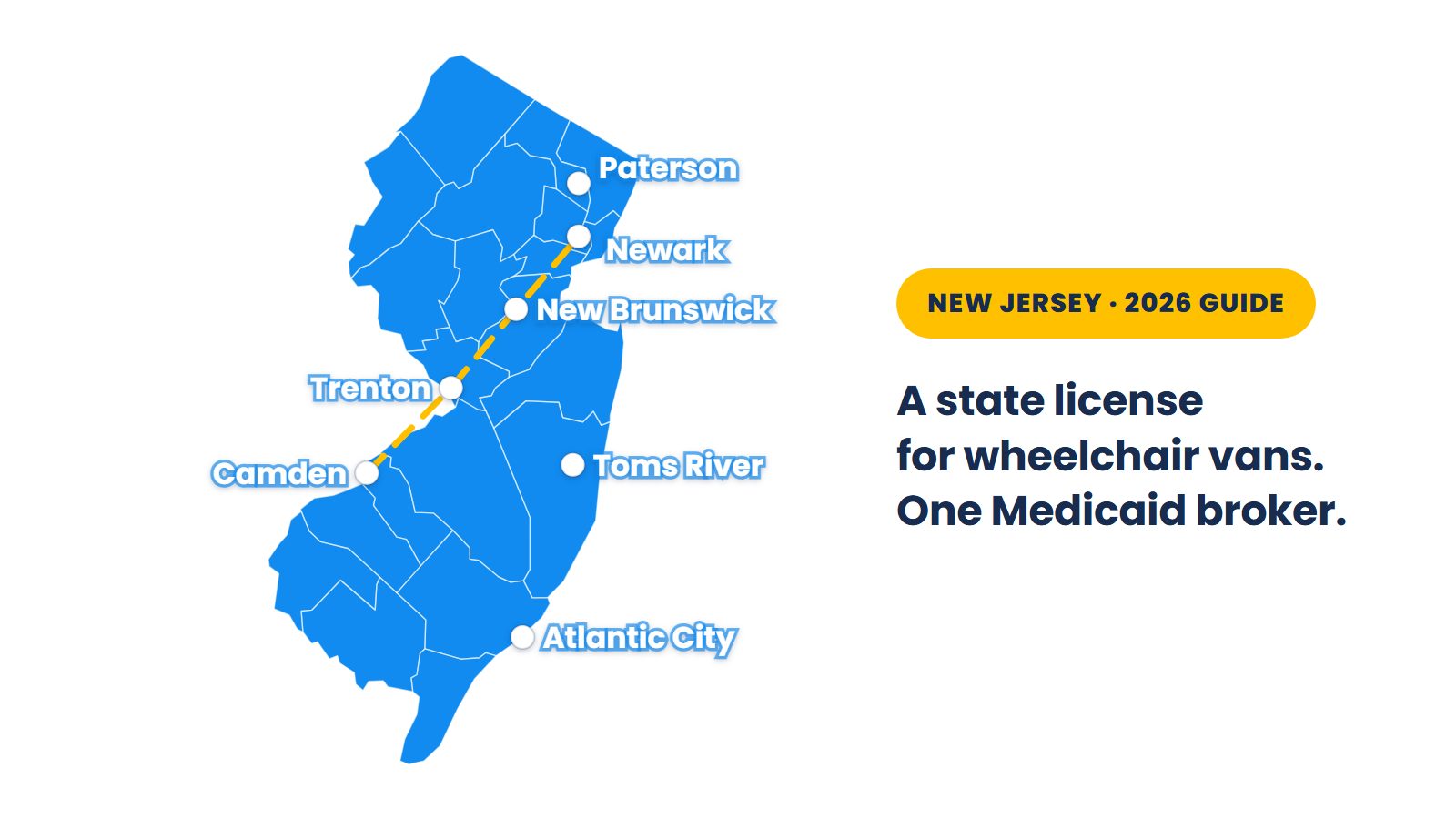
To start a NEMT business in New Jersey, pick your riders first, because they decide your license, then form an LLC ($100). A wheelchair van company needs the Department of Health’s mobility assistance vehicle (MAV) license, $1,500 plus $100 a van, before its first ride, whoever pays. One broker, Modivcare, books Medicaid’s non-emergency rides statewide and decides who joins its network, so your first paid trips should come from facilities and private-pay families. Budget about $24,000 to $51,600 for one used wheelchair van, counting six months of fixed bills.
New Jersey at a glance:
- Medicaid rides: Modivcare books them for fee-for-service members and all five NJ FamilyCare health plans [1][2][3].
- The 2026 rebid: the state named MTM in August, canceled that award on Modivcare’s protest, and affirmed on August 28 that the next contract goes to Modivcare. Today’s contract runs through February 27, 2027 [4][5][6].
- Wheelchair vans: a Department of Health MAV license for the company and each van, renewed every two years [7].
- Sedans for ambulatory (walking) riders: livery, licensed by your town, with Motor Vehicle Commission (MVC) “Limousine” plates and $1.5 million of liability [8][9].
- Rates: none published. Modivcare negotiates each company’s rates, and its state contract has it pay within 30 days of a clean claim [10][6].
- Insurance: $1.5 million for livery by law; for a MAV, $500,000 a van plus $300,000 of general liability by rule; and $2 million of auto for any vehicle under Modivcare’s next contract [8][7][11].
- Drivers: a basic Class D license for a typical van; MAV crews add CPR and a passenger assistance or MAV technician card [12][7].
- Stretcher riders: basic life support (BLS) ambulance only. New Jersey has no stretcher van [7].
An owner who runs a small wheelchair-only company in northern New Jersey told me in July 2026 that getting started was “a lengthy process here in New Jersey.” He’d needed “a lot of licenses and stuff” before he could start, and “the correct insurance.” Four years on, his riders mostly pay privately, two vans cover most days, and he isn’t adding another, because “paying for insurance would be, like, kind of hurtful for us.”
New Jersey’s rule is why the licenses had to come first. The Department of Health won’t license a wheelchair service until it has a van ready to license, insurance “purchased and … in force,” a written procedures manual, trained crew files and a background check request for each owner of 5% or more. The $1,500 plus $100 a van is due at filing. That holds whether Medicaid, a facility or a family pays for the ride.
The Medicaid door is narrower. In September 2026, a two-vehicle company in northern New Jersey, three months old with no trips yet, told my cofounder Jing on a Duet demo that it had applied to a couple of ride brokers, among them Modivcare, the Medicaid broker. It had heard back that they didn’t have “contracts available for now.”
So New Jersey makes you license and insure a wheelchair van before its first ride, and its one Medicaid broker can say no. Build your first schedule on facilities and private-pay families. The checklist below runs in the order that wastes the least money, starting with which riders you’ll carry. After it come who pays, the broker and its rates, licenses, insurance, drivers, getting in, costs and timing.
I run Duet, which builds dispatch software and runs growth services for non-emergency medical transportation (NEMT) companies, and I talk to NEMT owners on demos every week, New Jersey operators included. This is the New Jersey edition of our national guide on how to start a NEMT business. Requirements change, so confirm against the linked sources before you spend money.
The one-page checklist: how to start a medical transportation business in New Jersey
Pick your riders, then insure a van and train its crew, because New Jersey’s Department of Health won’t license wheelchair work until the van, its insurance and its crew files are in place [7]. Each phase ends with the money it puts at risk.
Phase 0: pick your riders, your van and your county
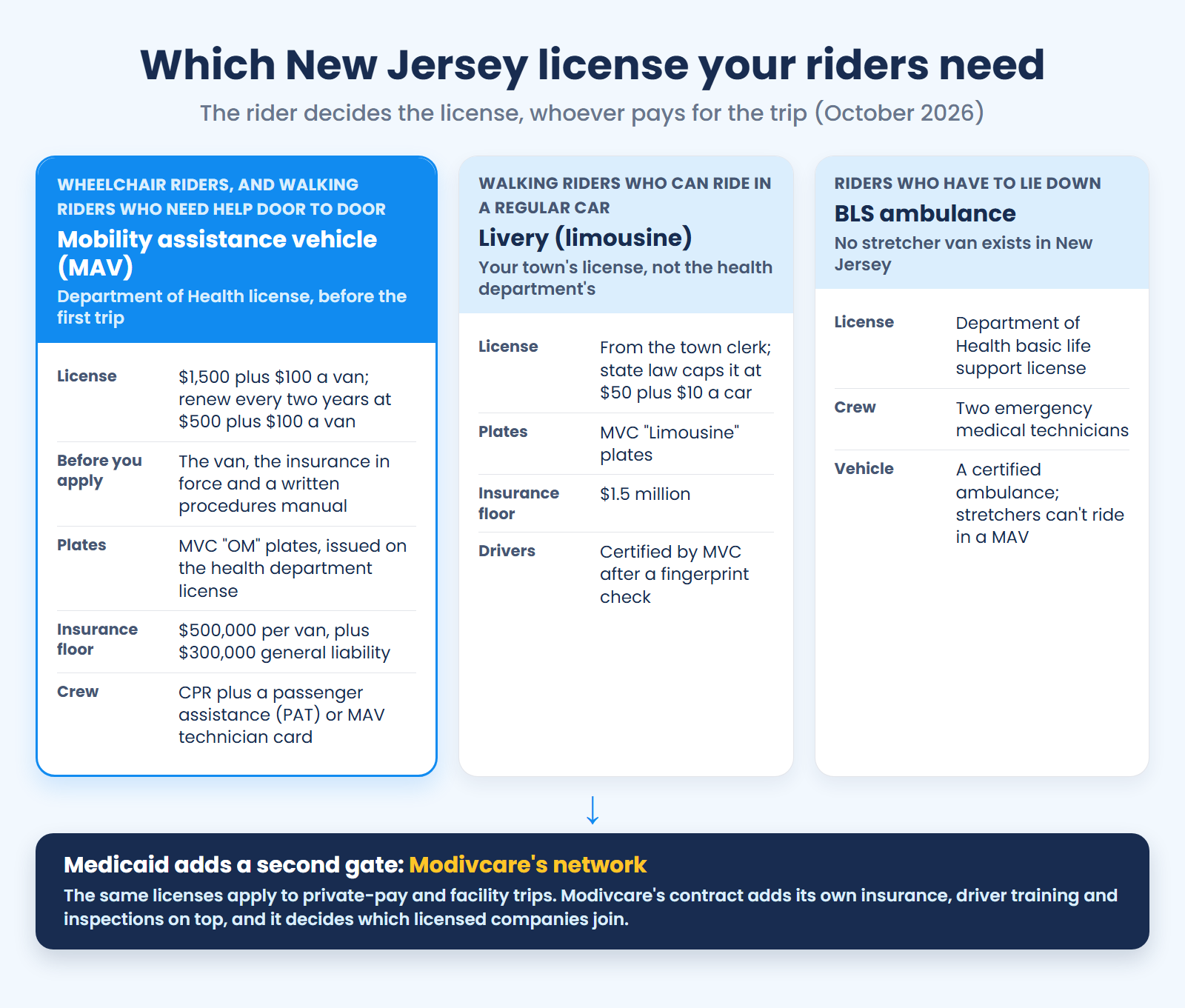
- Wheelchair riders, or ambulatory riders who need help door to door: that’s MAV work, under the Department of Health license.
- Ambulatory riders who can ride in a regular car: that’s livery, under your town’s license [8].
- Riders who have to lie down: that’s an ambulance company’s work, not a van company’s.
- Nursing homes: Modivcare’s contract calls for at least the ambulatory MAV (A-MAV) level when a skilled nursing facility resident rides, so a livery-only company won’t carry those residents’ Medicaid trips [6].
- Two calls this week: ask the five nearest nursing homes which transportation company they name as their preferred provider, and ask Modivcare whether it’s adding your level of service in your county.
- Money at risk: none yet.
Phase 1: form the company and write your manual
- File a certificate of formation with the Division of Revenue and Enterprise Services: $100, plus $75 for each annual report [13].
- Get a free employer identification number (EIN) from the IRS and a free national provider identifier (NPI) under the NEMT van taxonomy, 343900000X.
- Register with the state on Form NJ-REG; public contracts, like University Hospital’s in Newark, ask for the Business Registration Certificate that comes with it [13][14].
- Write your standard operating procedures (SOP) manual against the areas N.J.A.C. 8:40-3.5 lists, because the MAV application needs it [7].
- Money at risk: about $100.
Phase 2: quote insurance, then buy the van
- Get quotes before you sign for the van: $2 million of auto for any vehicle on Modivcare’s next contract, and at least $1.5 million for any livery sedan [11][8].
- Before you buy a minivan to license as a MAV, ask the Office of Emergency Medical Services (OEMS) at (609) 633-7777 whether it can pass. The rule wants at least 58 inches of headroom at each wheelchair position and two doorways [7].
- Title the van and pay New Jersey’s 6.625% sales tax [15].
- Money at risk: about $14,300 on a financed $33,000 van, the 2016-2019 wheelchair van in our national startup cost model. That’s $6,600 down, about $2,340 in tax, title and registration, $4,350 of insurance due at signing and about $1,000 for equipment and lettering. The insurance figure assumes about $1 million of liability; $2 million will cost more.
Phase 3: train your crew, then license the service and plate the van
- Put each MAV driver through CPR and a passenger assistance techniques (PAT) or MAV technician course, because the application’s crew files need both cards [7].
- Send OEMS the application with the manual, crew files, your incorporation papers and an SBI 212B criminal history request for each owner of 5% or more, show it a licensable van, and have your insurer send OEMS its certificate of insurance [7].
- Pay $1,500 plus $100 a van by certified check or money order. It isn’t refundable [7].
- Register the van with MVC for “OM” plates, which it issues on the Department of Health license [16].
- For livery, get your town clerk’s license on a $1.5 million policy, then MVC “Limousine” plates [8][9].
- Money at risk: about $1,000 for screening and training, plus $1,600 for the license and one van.
Phase 4: book the trips you control
- Visit nursing homes, rehab centers and hospital discharge planners, and ask what it takes to become their preferred transportation company.
- Take a card when a family books a private-pay ride, and charge it a day or more before pickup.
- Put up a website families can find on Google and book from and a Google Business Profile.
- Money at risk: about $300 for a phone and basic marketing.
Phase 5: apply to Modivcare
- Start with the form on Modivcare’s transportation provider page, have your license, plates, insurance and driver files ready, and ask what it needs for your level of service [17].
- Ask the provider enrollment desk of NJMMIS, New Jersey’s Medicaid billing system, at (609) 588-6036, whether your company also needs the state’s own approval [18].
- Money at risk: about $1,934 a month in fixed bills for a financed van, by our national model, while you wait.
A company that will only carry private-pay and facility riders can stop after Phase 4. It can’t skip Phase 3.
Who pays for NEMT rides in New Jersey?
Medicaid is the volume in New Jersey, but facilities and private-pay families can start paying you before Modivcare lets you in, and in New Jersey a facility matters twice.
Medicaid is the volume, and Modivcare books it
NJ FamilyCare, the state’s Medicaid program, counted 1,791,141 members in September 2026 [19]. Their non-emergency rides go through Modivcare: about 3 million vehicle trips in 2024, roughly 8,300 a day, most of them ambulatory riders on livery [10].
Facilities choose who carries their Medicaid trips
A nursing home or hospital in New Jersey picks which company in Modivcare’s network carries its residents’ and patients’ Medicaid trips. Modivcare’s contract says it “shall schedule nursing home and hospital trips using the facilities’ preferred providers,” and facilities must choose one inside its network. A facility can even book those trips on less than 48 hours’ notice, and Modivcare assigns them to its preferred company [6][11]. So the facility account you build for private-pay work can become Medicaid volume once you’re in the network.
Some facilities handle rides themselves. Partial care day programs provide, and pay for, their clients’ ambulatory and A-MAV rides to the program, outside the broker [11][10]. Hospitals buy transport too, though the big contracts suit established companies. University Hospital in Newark asked in April 2026 for bids on its wheelchair, ambulance and nurse transport, open to companies that bid on a single service. It asked every contractor for five years of non-emergency and specialty care transport, a Department of Health license, New Jersey Medicaid enrollment and Medicare certification, a list that fits an ambulance company that also runs vans [14].
Dialysis clinics are the exception to the facility pitch. In my experience most dialysis riders are on Medicaid, so their trips come through Modivcare, not the clinic.
Private pay is the margin
Private-pay families book you directly and pay before the ride. New Jersey had 1,706,665 residents 65 or older, 18% of the state, in the Census Bureau’s 2024 survey [20]. The wheelchair owner from the top of this guide gets some of his through facilities, which call him when a resident needs a ride and “their insurance didn’t kick in yet.”
Most private-pay owners I talk to take a card when the family books and run it at least a day before pickup, or send a payment link that has to be paid by then. If it isn’t paid, the van doesn’t roll.
Who is the NEMT broker in New Jersey?
Modivcare is New Jersey’s NEMT broker, the company the state pays to book non-emergency Medicaid rides statewide for fee-for-service members and all five NJ FamilyCare health plans. A broker assigns and pays for the rides; the plans keep emergency ambulance trips [2].
The plans are Aetna Better Health of New Jersey, Fidelis Care, Horizon NJ Health, UnitedHealthcare Community Plan and Wellpoint, formerly Amerigroup New Jersey [3]. Horizon’s member page says it directly: “Modivcare is the transportation vendor for people enrolled in Medicaid or NJ FamilyCare” [21]. Our state-by-state map of who brokers Medicaid rides counts New Jersey among the states with one statewide broker.
LogistiCare, now Modivcare, became the state’s broker on July 1, 2009, at first for fee-for-service ambulance and MAV trips statewide and livery in Essex and Hudson counties [22]. Its current contract began September 1, 2017 [6].
What happened in the 2026 rebid?
The state rebid the contract and kept Modivcare. It sought “a primary single-source Contractor” for managed care and fee-for-service members and opened three quotes on March 4, 2026. On August 6 it announced its intent to award the contract to MTM. Modivcare protested, and on August 20 the state canceled that award and sent the contract back for award to Modivcare [4]. On August 28 it affirmed that decision and turned down MTM’s request for a stay [5].
Today’s contract runs through February 27, 2027 [6]. The new one runs four years, with up to two more, and has to start within 120 days of its award. Its terms, like the $2 million of auto liability, govern trips from that start, and Modivcare has to credential its network against them before then [11]. On October 16, 2026, NJSTART, the state’s procurement site, showed no award on the bid and still listed only today’s contract [10][6]. Brokers change, so confirm before you build on any of this; our log of 2026 broker moves shows how often they do.
How does a Medicaid trip reach your company?
A Medicaid trip reaches you through Modivcare, at a level of service that decides which license you need. Here’s how the levels map, as of October 2026 [23][10]:
| Level of service | Who rides | License your company needs | Share of 2024 vehicle trips |
|---|---|---|---|
| Livery | Ambulatory riders, curb to curb | Your town’s limousine license | 67% |
| Ambulatory MAV (A-MAV) | Ambulatory riders who need help door to door | Department of Health MAV license | 8% |
| MAV (wheelchair) | Wheelchair riders, door to door, some on oxygen | Department of Health MAV license | 21% |
| BLS | Riders who can’t sit up | Department of Health ambulance license | 4% |
Riders book by noon two business days ahead, except for urgent trips and hospital discharges [21][11]. When a hospital discharges a rider, the company Modivcare dispatches has three hours to pick them up [23]. A will-call return is due within 60 minutes under the current contract, though Modivcare’s facility page gives the company up to 90 [6][23].
A rider who goes to the same place three or more days a week can get a standing order from the facility that treats them, good for three months [23].
Can I bill New Jersey Medicaid directly for NEMT rides?
No: Modivcare pays New Jersey’s van and sedan companies, at rates it negotiates and doesn’t publish. Only ambulance companies enroll with the state and bill fee-for-service on their own; N.J.A.C. 10:50 calls them “independent transportation providers” [2].
The state’s contract tells Modivcare to negotiate rates, by competitive bidding or other means [6]. In its December 2025 answers to bidders, the state wrote: “The State is not involved in rate negotiations between the Contractor and its providers” [10]. So there’s no fee schedule to look up. Ask Modivcare what it pays for your level of service in your county, and price your own cost per trip against it, before you buy a van.
Payment timing is set, though. Modivcare has to pay “all authorized trips” within 30 days of a clean claim, and resolve incomplete ones within 60 [6]. And a Medicaid rider who calls you directly goes back to Modivcare: its contract, today’s and the next, bars companies in its network from taking riders’ direct requests [6][11].
What licenses and requirements does a NEMT business need in New Jersey?
New Jersey’s Department of Health licenses wheelchair van companies before their first ride, whoever pays, and sedans for ambulatory riders run as livery under your town’s license. There’s no single “NEMT license.”
The rule is N.J.A.C. 8:40, readopted in September 2023 and good to 2030. Anyone “providing mobility assistance … in any form or manner, where the transport originates within the State of New Jersey, shall first be licensed by the Department.” A MAV service carries people too sick or disabled to ride a taxi or bus safely, but not sick enough for an ambulance, and the rule covers riders “who are either ambulatory or wheelchair-bound.” A sedan can’t be licensed as a MAV, because the rule wants a ramp or lift for wheelchairs [7].
What does the MAV license take?
The Department of Health’s Office of Emergency Medical Services licenses the company and each van [7]. It needs:
- Owners: every owner listed, and a criminal history request (SBI 212B) for each one with 5% or more.
- A real address: a principal place of business on real property, not a post office box.
- A van and its insurance: at least one licensable van, with insurance “purchased and … in force” and the insurer’s certificate on file.
- Paperwork: your SOP manual, crew files and incorporation papers.
- The fee: $1,500 plus $100 a van, by certified check or money order, and non-refundable.
Licenses run up to 24 months on a fixed cycle, and renew at $500 plus $100 a van. Companies whose trade names start with A through L renew by December 31 of even years, and M through Z by December 31 of odd years [7].
That cycle changes a new company’s first bill. An A-L company applying in 2026, its cycle’s second year, pays the second-year rate, $1,250 plus $50 a van, then $500 plus $100 a van to renew by December 31, 2026. For one van, that’s $1,300 and then $600; an M-Z company pays $1,600 for a license good through 2027. Confirm your number with OEMS. Department staff can give a new van a 30-day Certificate of Inspection to run on while its license prints, and the department can inspect each van at least once a year [7].
Expect your manual to be read closely. I think New Jersey asks a new company for a lot of information that isn’t actually needed to run a safe service.
Frank Ciccarella, a NEMT consultant, said on our live episode on Oct. 1, 2026, that when he took a client through New Jersey’s review, the reviewers “loved” the client’s policies and procedures but “wanted to add their own.” They went as far as saying a driver who comes upon an accident on the road should be able to “stop and offer assistance.”
The department enforces the license. In September 2026 it ordered a company that had run wheelchair trips under a Modivcare contract since April to stop; OEMS had told it in July that it needed the license. In 2024 it fined another company $51,000 for running one unlicensed van on 51 days [24]. A broker contract isn’t a license.
Much of what circulates online gets New Jersey wrong, sometimes with a phantom license fee that turns up in states with no such license.
| The claim you’ll read elsewhere | What New Jersey actually requires |
|---|---|
| “New Jersey doesn’t require a separate NEMT license, but you must be registered as a business and approved by Modivcare” | Wheelchair service also needs the Department of Health’s MAV license, whoever pays; sedans need a town license [7][8] |
| A “NEMT Provider License” at “$850 initial, $510 renewal” | The MAV license costs $1,500 plus $100 a van, then $500 plus $100 a van to renew [7] |
| “Verify your business name with the New Jersey Medicaid / Health Standards NEMT Program Desk” | New Jersey has no such desk; Medicaid trips come through Modivcare [1][2] |
| “Register your business at the Official NJ FamilyCare Provider Portal” | Van and sedan companies contract with Modivcare; only ambulance companies bill fee-for-service themselves [1][2] |
| “Apply for Logisticare” | LogistiCare is now Modivcare, New Jersey’s broker since 2009 [22][6] |
| Brokers “such as Modivcare, MTM, or LogistiCare/Veyo” | The state canceled its August 2026 award to MTM; Modivcare is the one broker [4][5] |
| “Some MCOs, such as Horizon and UnitedHealthcare, manage their own NEMT” | The plans’ non-emergency rides go through Modivcare; the plans keep emergency ambulance trips [2][21] |
| “General Liability: Carry a minimum of $100,000” | A MAV needs $500,000 a van plus $300,000 of general liability; livery needs $1.5 million [7][8] |
| Vans need “at least 4-passenger seating” and extra checks “over 150,000 miles” | Those come from bills that haven’t become law [25] |
| “Get Your Certificate of Public Convenience and Necessity (CPCN)” | MVC registers a MAV on its Department of Health license; the CPCN is for bus service [9] |
What if you start with private pay?
Private pay doesn’t get you out of the license in New Jersey. The MAV rule applies “in any form or manner,” and a sedan carrying ambulatory riders for pay runs as a limousine, or as a taxi with each town’s consent [7][8]. Private pay skips only Modivcare’s network: its credentialing, its insurance bar and its rates.
What do towns require?
Your town licenses livery. The clerk of the town where you base the company issues the limousine license once your $1.5 million policy is on file, and state law caps that fee at $50 a company plus $10 a vehicle [8]. MVC won’t issue “Limousine” plates without that license, a $1.5 million certificate naming MVC and a power of attorney, and it fingerprints and certifies limousine drivers [9][26]. Many towns also want a mercantile license and a zoning check, so call the municipal clerk before you sign a lease [27].
What if you drive riders into New York or Pennsylvania?
A paid trip into New York, Pennsylvania or Delaware falls under federal rules. Most companies then need operating authority from the Federal Motor Carrier Safety Administration (FMCSA), a U.S. Department of Transportation (USDOT) number and $1.5 million of liability for vehicles seating 15 or fewer, driver included [28]. Modivcare’s riders do cross the line: in 2022 the broker ran about 10,700 paid trips to New York City and about 19,900 to Philadelphia [11].
What are the NEMT insurance requirements in New Jersey?
Plan on $2 million of combined auto liability for any vehicle, van or sedan, that will carry Modivcare’s riders under its next contract; a livery sedan needs at least $1.5 million by state law, whoever pays [11][8]. The Department of Health’s own floor for a MAV is lower: $500,000 a van plus $300,000 of general liability [7].
Modivcare’s next contract, the one the state has said it will award to Modivcare, also asks for $1 million of general liability per occurrence and $2 million aggregate. The State of New Jersey must be named as an additional insured on the general liability and auto policies. The next contract also wants workers’ comp and $1 million of employers’ liability [11]. Ask Modivcare which limits it wants from you today, then quote to the new ones. For facility work, a hospital contract like University Hospital’s wants $1 million of auto plus a $1 million excess layer [14].
Two more rules from the Department of Health: the insurer sends its certificate before licensing, and if any required coverage lapses, the service has to stop [7]. For the record, New Jersey’s minimum auto liability limits are $35,000 per person, $70,000 per accident and $25,000 of property damage on policies issued or renewed from January 1, 2026, except the state’s basic policy [29].
What will insurance cost a new New Jersey company?
For a new company’s wheelchair van at about $1 million of liability, our national model uses $17,400 a year, from new-company quotes of $1,200 to $1,800 a month: about $4,350 due at signing, then installments of $1,305. Our guide to pricing a new NEMT company’s first policy shows where those numbers come from. A $2 million policy for Modivcare’s next contract will cost more.
Don’t expect New Jersey to come in under them. New Jersey drivers spent an average of $1,573.21 per insured car in 2023, fifth of 51 jurisdictions, against $1,281.92 countrywide, in the National Association of Insurance Commissioners’ (NAIC) latest report [30]. Those are personal-auto figures, and NAIC warns that comparisons between states “should be treated with a high degree of caution.”
The field says the same. A southern New Jersey owner who once ran about 50 vehicles said in a 2026 video interview that her premium went from $5,800 a vehicle to about $19,000 at its peak, with “so little amount of carriers in New Jersey” in the market. Insurance was one of the main reasons she cut her fleet to about 12.
Do you need workers’ comp in New Jersey?
Yes, from your first employee. New Jersey requires it of “Every employer,” with no headcount floor, and misrepresenting employees as independent contractors is an offense, and a crime if it’s knowing [31]. The state’s ABC test for unemployment insurance treats anyone you pay for services as an employee unless you can show three things, so talk to an accountant before you pay drivers on a 1099 [32]. The minimum wage is $15.92 an hour in 2026 for most employees, and $15.23 at seasonal and small employers [33].
What do NEMT drivers need in New Jersey?
New Jersey NEMT drivers need a basic Class D license for a typical wheelchair van or sedan; MAV crews add CPR and a passenger assistance or MAV technician card [12][7].
The MAV rule sets the crew file: 18 or older, a valid driver’s license, a CPR card, and a PAT technician card or a MAV technician card from the Medical Transportation Association of New Jersey or an approved equivalent [7]. If the van carries its own oxygen, the crewmember needs emergency medical technician (EMT) and CPR certifications; a rider’s own portable oxygen doesn’t call for an EMT, as long as the crew doesn’t monitor or adjust it. A second crewmember has to help when a wheelchair rider goes up or down five or more steps, or weighs 200 pounds or more and goes up or down two or more.
Modivcare’s contract adds its own driver file. Drivers must be 18 or older, with a New Jersey license or one from New York, Pennsylvania or Delaware, no more than three chargeable accidents or moving violations in three years and no drunk-driving conviction in five. They also go through background checks, drug testing and driving record reviews [6][11].
A commercial driver’s license (CDL) starts at 16 seats counting the driver, or 26,001 pounds. One New Jersey trap: MVC’s own CDL page also lists any for-hire vehicle designed for 8 to 15 people, driver included, while the statute limits that band to daily commuter service, so call MVC before you buy a van that size [12]. Limousine drivers go through MVC’s fingerprint certification instead [26].
What training do New Jersey MAV drivers need?
Plan on two layers before a driver’s first wheelchair trip, and a third for Medicaid work:
- CPR: a current card, from the MAV rule [7].
- PAT or MAV technician: the passenger assistance course the rule names, or the state association’s MAV technician course [7].
- Modivcare’s 20 hours, for Medicaid trips: classroom and behind-the-wheel training in defensive driving, wheelchair securing, lift operation, disability sensitivity, passenger assistance, first aid, child safety laws, handling disruptive behavior and customer service. The contract wants them before a driver carries Medicaid riders, though it gives new hires 45 days to finish, and a refresher comes every two years [6].
A bill introduced in March 2026, A4601, would add a state MAV operator certification, with state and FBI criminal history checks. It isn’t law [34].
Can a NEMT company run stretcher van trips in New Jersey?
No: in New Jersey a rider who has to lie down goes by basic life support (BLS) ambulance, and “Stretchers and/or patient litters shall not be carried on, or within, any MAV” [7]. A BLS ambulance company needs its own Department of Health license, two EMTs on each run and a certified ambulance [7].
Modivcare books those riders at its BLS level, for riders “unable to be transported in any manner other than a stretcher,” and its current contract wants Medicare-approved companies for that work [23][6]. Write it into your intake script: when a caller says the rider has to lie down, it’s an ambulance trip, not yours.
How do you become a Medicaid transportation provider in New Jersey?
You become a New Jersey Medicaid transportation provider by joining Modivcare’s network, once your license, plates and insurance are in place. Modivcare decides who joins: its contract says it “retains the right to approve new providers,” and the next one lets it drop a company “when there is insufficient demand in an area,” with an appeals process [6][11]. The state itself can stop enrolling new companies by type and area [2].
The network is narrow. About 157 companies a month carried subcontracted Medicaid trips in 2022, by the state’s count [11]. By our count of the federal provider file, 878 active national provider identifiers (NPIs) with a New Jersey practice address carried the NEMT van taxonomy in July 2026, individuals included [35]. An NPI is a registration, not a company running trips.
The state’s approval step is the part nobody spells out. N.J.A.C. 10:50 says companies contracted with the broker must be “approved by the Division of Medical Assistance and Health Services,” and the state told bidders the intent is for all network companies to be “Medicaid approved” [2][10]. Yet the enrollment packets on NJMMIS include none for van or sedan companies [18]. When LogistiCare took over in 2009, the state told providers that “DMAHS authorized providers will not automatically become a LogistiCare provider” [22]. Your license gets you to the door; Modivcare opens it.
What does Modivcare check?
Modivcare’s provider page lists a Passenger Assistance, Safety and Sensitivity (PASS) wheelchair certificate, first aid and CPR, defensive driving, a drug screen, a driving record and a background check for drivers, and registration, inspection and insurance for each vehicle [17]. The state’s rule names a PAT or MAV technician card, not PASS, so ask Modivcare whether yours counts. Its New Jersey contract, today’s and the next, adds its own yearly inspection of every MAV and livery vehicle, on top of the state’s, plus random checks [6][11].
How long does it take to get approved?
New Jersey publishes no clock for either gate. The MAV rule sets no processing time, so ask OEMS, and Modivcare adds companies when it needs them. In my experience, a Medicaid or broker approval can take half a year or more, which is why the cost section carries six months of bills.
While you wait, you can carry facility and private-pay riders without a broker contract, though not without your license. Our guides on how facility agreements get signed, turning a facility meeting into a first trip and pricing private-pay rides cover that stretch. Our national walk-through of Medicaid transportation enrollment shows how other states order these steps.
Don’t build the whole schedule on one payer
With one Medicaid broker in New Jersey, your hedge is facilities and private-pay families, not a second broker. Where a state has several brokers, some operators spread Medicaid work across them; New Jersey’s Medicaid program has one.
The volume is real if you’re in. An owner who has run Modivcare trips around Newark for about six years, with about ten vehicles, told me in October 2026, “So I only deal with broker work,” and “at least here in New Jersey, we have plenty of work.”
The southern New Jersey owner who once ran about 50 vehicles put her rule simply in the same interview: “if you use brokers, use brokers to fill in.” On our podcast I’ve pushed hard for going after private pay, and I’ve also said I know people who’ve been extremely successful with broker volume.
The 2026 rebid showed how close a statewide broker change can come: for two weeks in August, MTM held the state’s notice of intent to award. Whoever holds the contract, a company with its own facility and private-pay accounts loses less when it changes.
New York, too, sends almost every Medicaid ride through one statewide broker, Medical Answering Services (MAS). Next door in Pennsylvania, Medicaid rides run county by county, with Modivcare only in Philadelphia.
Then run every lane from one schedule. Dispatch software like Duet puts Modivcare’s trips on the board beside your facility and private-pay rides. Modivcare is one of Duet’s direct integrations, and so is MTM, so the board wouldn’t have changed if the contract had gone to MTM. Any other trip list comes in by trip file import or bulk upload, and each trip bills at the rate its contract sets. The Department of Health license and inspections, Modivcare’s credentialing and rates, and invoicing each payer through its own process stay with you.
How much does it cost to start a NEMT business in New Jersey?
Budget about $24,000 to $51,600 for one used wheelchair van in New Jersey, counting six months of fixed bills, with insurance at about $1 million of liability. Modivcare’s next contract asks $2 million, which will cost more, so price both before you buy. Those totals are cash out the door through month six, so a financed van counts as its down payment plus six payments.
In the typical case, a 2016-2019 van at our national model’s $33,000, financed, takes about $28,900: the $6,600 down payment, about $10,700 of one-time costs and six months of fixed bills. Paying cash for the same van takes about $51,600.
New Jersey’s own inputs are its fees and its 6.625% sales tax; the rest, insurance included, comes from our national model. The totals leave out fuel, your own living costs and the State Police fee for each owner’s background check, and carry no Medicaid application fee, since the state posts no enrollment packet for van companies.
| Line item | New Jersey amount | Note |
|---|---|---|
| LLC certificate of formation | $100 | Plus $75 for each annual report [13] |
| EIN and NPI | $0 | Free from the federal agencies that issue them |
| “NEMT Provider License” | $0 | None exists |
| Department of Health MAV license, company plus one van | $1,600 | $1,500 plus $100; an A-L trade name applying in 2026 pays $1,300, then $600 to renew by December 31, 2026 [7] |
| Each added van | $100 | $50 in the second year of the license cycle |
| Used wheelchair van, 2016-2019 | About $33,000, or $6,600 down if financed | National model: 80% financed at 14% over 60 months, $614 a month |
| Sales tax, title and registration | About $2,340 | 6.625% sales tax ($2,186 here), a $60 title and about $92 to register; confirm current MVC fees [36] |
| Insurance due at signing | About $4,350 | A quarter of the national model’s $17,400 year, at about $1 million of liability |
| Equipment and lettering | About $1,000 | National model; the MAV rule also wants a flashlight, a mounted fire extinguisher and three reflective triangles in each van |
| Screening and training | About $1,000 | National model; CPR plus a PAT or MAV technician course |
| Phone and basic marketing | About $300 | National model |
| Six months of fixed bills | About $11,600 financed, $7,920 bought outright | $1,934 a month financed: a $1,305 insurance installment, a $614 van payment and $15 for a phone; $1,320 with no van payment |
| Livery sedan instead | Town license capped at $50 plus $10 a car | Needs $1.5 million of liability; not in the totals [8] |
| Total, owner driving | About $28,900 financed, $51,600 bought outright | An older $20,000 van, financed, comes to about $24,000 |
On the revenue side, New Jersey gives you no public yardstick for Medicaid, because Modivcare’s rates live in your contract. Run the same count for each payer: the price you charge families, the rate each facility agrees to and Modivcare’s rate for your level of service. Then work out how many trips a month each takes to cover $1,934 of fixed bills before fuel or a driver’s pay.
If someone quotes you a New Jersey launch for a few thousand dollars, ask where the insurance deposit and the $1,600 license are.
How do you fund a NEMT startup in New Jersey?
The New Jersey Economic Development Authority funds microloans through participating lenders: $10,000 to $100,000, at no more than 5% interest, for businesses with fewer than 10 full-time employees [37]. The New Jersey Small Business Development Centers give free one-on-one help [37], and Small Business Administration (SBA) 7(a) loans and microloans are the federal options. None of them speeds up the Department of Health or Modivcare, so borrow against the timeline you actually face.
How long does it take to start a NEMT business in New Jersey?
Plan on half a year or more, in my experience, before Modivcare’s trips are steady, and start facility and private-pay trips as soon as the license, plates and policy are in place. Neither the Department of Health nor Modivcare publishes a timeline, and a new van can run on a 30-day Certificate of Inspection, if OEMS staff issue one, while the printed license is on the way [7].
- Before you buy: pick your riders, form the LLC, get the EIN, NPI and state registration, write the manual, call the nearest nursing homes and Modivcare, and collect insurance quotes.
- Van week: train your first drivers (CPR plus a PAT or MAV technician card), buy and insure the van, then file the MAV application with OEMS, or for livery, get the town license.
- When the license comes: register for “OM” plates and run the first facility and private-pay trips.
- Then: apply to Modivcare, and ask NJMMIS whether you need the state’s own approval.
The owner at the top of this guide took about two years to reach “a steady flow,” and he got there on families and the facilities that call him. When we talked in July, I told him what I’d do if I were starting a NEMT company myself: “I would do probably private pay only,” because “that’s where you build the brand and the service matters.” Before you send Modivcare anything, name the facility that would call you next week.
New Jersey NEMT FAQ
Do I need a license to start a NEMT business in New Jersey?
Yes, though not one called a “NEMT license.” Wheelchair work needs the Department of Health’s MAV license, $1,500 plus $100 a van, whoever pays [7]. Sedans for ambulatory riders need a town limousine license and $1.5 million of insurance [8], and stretcher riders need a licensed ambulance [7].
Do I need a MAV license for ambulatory riders?
Only for ambulatory riders who need a crew’s help door to door. Modivcare books them at its A-MAV level, in a licensed MAV [7][23]. A rider who can ride a taxi or bus safely can go by livery on a town license instead [8].
Can a minivan be licensed as a wheelchair van in New Jersey?
Ask OEMS at (609) 633-7777 before you buy one. The MAV rule wants at least 58 inches of headroom at each wheelchair position, a compartment at least 56 inches wide and two doorways, and the department can waive a requirement on written request [7].
Is Modivcare still New Jersey’s Medicaid ride broker after the 2026 rebid?
Yes. The state named MTM in August 2026, canceled that award on Modivcare’s protest, and on August 28 affirmed that the new contract goes to Modivcare [4][5]. Today’s contract runs through February 27, 2027 [6].
What if Modivcare says it has no contracts available?
Keep running facility and private-pay trips, which don’t need Modivcare, and ask Modivcare which level of service and county it’s short of. Then ask the nursing homes and hospitals you already serve to name you as their preferred company once you’re in, because Modivcare assigns their Medicaid trips to that company [6].
How much does New Jersey Medicaid pay for a NEMT trip?
There’s no public rate for van or sedan trips. Modivcare negotiates each company’s rates, and the state told bidders it isn’t involved in those negotiations [10]. Ask Modivcare what it pays for your level of service in your county before you sign anything.
Do New Jersey NEMT drivers need a CDL?
Not for a typical wheelchair van or sedan, which a basic Class D license covers. A CDL starts at 16 seats counting the driver, or 26,001 pounds, but MVC’s page also lists for-hire vans designed for 8 to 15 people, so call MVC before buying one that size [12].
Is New Jersey a good state to start a NEMT business?
It can be, if you start with trips you control. The demand is there: 1,791,141 New Jerseyans were on NJ FamilyCare in September 2026, and 1,706,665 were 65 or older in 2024 [19][20]. New Jersey isn’t crowded by registrations, with 5.1 active NEMT van NPIs for every 10,000 people on Medicaid and the Children’s Health Insurance Program (CHIP), against 5.8 nationally, by our count [35][38]. The catches: a license before the first ride, insurance at the high end, and one broker that picks who joins.
Key official sources
[1] New Jersey Department of Human Services, Division of Medical Assistance and Health Services (DMAHS), Medical Transportation page (read October 2026): Modivcare as the state’s medical transportation broker for NJ FamilyCare members anywhere in the state, and its booking lines. https://www.nj.gov/humanservices/dmahs/individuals-families/transportation/
[2] N.J.A.C. 10:50, Transportation Services, the DMAHS rule, on the Legal Information Institute’s copy (read October 16, 2026): non-emergency rides through a broker under contract with the state, the health plans responsible for emergency transports, DMAHS approval of the broker’s network companies, the state’s power to stop enrolling new providers by type and area, and fee-for-service billing only for ambulance companies. https://www.law.cornell.edu/regulations/new-jersey/title-10/chapter-50
[3] DMAHS, NJ FamilyCare health plans page (read October 16, 2026): the five plans under contract. https://nj.gov/humanservices/dmahs/individuals-families/familycare/health-plans
[4] New Jersey Department of the Treasury, Division of Purchase and Property, final agency decision on Modivcare’s protest, Bid Solicitation #24DPP01040, T2503 Transportation Broker Services (August 20, 2026): the bid for one statewide broker for managed care and fee-for-service members, the August 6 notice of intent to award to MTM canceled, and the contract sent back for award to Modivcare. https://www.nj.gov/treasury/purchase/pdf/decisions/2026/IMOBidSolicitation24DPP01040-T2503TransportBrokerModivcare8.20.26.pdf
[5] Treasury, Division of Purchase and Property, final agency decision on MTM’s request for reconsideration (August 28, 2026): the August 20 decision affirmed, the contract to be awarded to Modivcare, the stay denied, and the three quotes opened March 4, 2026. https://www.nj.gov/treasury/purchase/pdf/decisions/2026/MTMReconsiderationIMOBidSolicitation24DPP01040-%20T2503TransportBroker8.28.2026.pdf
[6] NJSTART, Contract 19-PROS1-00439 with Modivcare Solutions, LLC (formerly LogistiCare), with RFP 17-X-23318 and Change Order #18 of August 12, 2026 (the only T2503 broker contract NJSTART listed on October 16, 2026): the current broker contract since September 1, 2017, extended to February 27, 2027; rate negotiation; facilities’ preferred providers; the lowest level of service for nursing home residents; driver qualifications and 20 hours of training; vehicle inspections; approving new providers; no direct requests from riders; will-call pickups; payment within 30 days of a clean claim; Medicare-approved BLS providers. https://www.njstart.gov/bso/external/purchaseorder/poSummary.sda?docId=19-PROS1-00439&releaseNbr=0&external=true&parentUrl=close
[7] N.J.A.C. 8:40, Mobility Assistance Vehicle and Basic Life Support Ambulance Services, the Department of Health’s posted copy, and its 2023 readoption notice (effective September 25, 2023, expiring September 25, 2030): who needs the MAV license, the application, fees, license terms and inspections, insurance, crew, vehicle and stretcher rules, and penalties. https://www.nj.gov/health/ems/documents/reg-enforcement/njac840r.pdf and https://www.nj.gov/health/legal/documents/adoption/NOR%208_40.pdf
[8] N.J.S.A. 48:16-3, 48:16-13, 48:16-14 and 48:16-17 on FindLaw: the taxicab consent, the limousine definition, the $1,500,000 policy filed with the town clerk, and the cap on the town’s license fee. https://codes.findlaw.com/nj/title-48-public-utilities/nj-st-sect-48-16-13/, https://codes.findlaw.com/nj/title-48-public-utilities/nj-st-sect-48-16-14/, https://codes.findlaw.com/nj/title-48-public-utilities/nj-st-sect-48-16-17/ and https://codes.findlaw.com/nj/title-48-public-utilities/nj-st-sect-48-16-3/
[9] New Jersey Motor Vehicle Commission (MVC), Commercial Bus and Passenger Vehicle Transportation page, and Commercial Vehicle Registration page (read October 16, 2026): MAV registration on the Department of Health license, limousine registration on a town license with $1.5 million of insurance and a power of attorney, yearly inspection, and the CPCN for bus service. https://www.nj.gov/mvc/business/commbus.htm and https://www.nj.gov/mvc/vehicles/commvehinfo.htm
[10] Treasury, Bid Amendment #8 to Bid Solicitation #24DPP01040 (December 9, 2025), with its revised Attachment 7 utilization data, both listed on the bid’s NJSTART page, which showed no award on October 16, 2026: the State’s answers to bidders on provider rates, insurance and Medicaid approval, partial care rides, and 2024 trips by level of service. https://www.njstart.gov/bso/external/bidDetail.sdo?docId=24DPP01040&external=true&parentUrl=close
[11] Treasury, Revised Bid Solicitation #24DPP01040, T2503 Transportation Broker Services (February 20, 2026): the terms of the next broker contract, including its term and start, network companies’ insurance, driver screening and training, vehicle inspections, approving and dropping companies, no direct requests from riders, facilities’ preferred providers, partial care rides, booking notice and 2022 network data. https://www.njstart.gov/bso/external/document/attachments/attachmentFileDetail.sda?fileNbr=1366981&docId=24DPP01040&docType=B&releaseNbr=0&parentUrl=/external/bidDetail.sdo&external=true
[12] MVC, commercial driver license page, and N.J.S.A. 39:3-10.11 on FindLaw: the basic Class D license, the CDL classes, and the statute’s commercial vehicle definition. https://www.nj.gov/mvc/drivertopics/cdl.htm and https://codes.findlaw.com/nj/title-39-motor-vehicles-and-traffic-regulation/nj-st-sect-39-3-10-11/
[13] Division of Revenue and Enterprise Services, fee schedule (updated July 1, 2026) and Getting Registered page: the $100 LLC certificate of formation, the $75 annual report, Form NJ-REG and the Business Registration Certificate. https://www.nj.gov/treasury/revenue/fees.shtml and https://www.nj.gov/treasury/revenue/gettingregistered.shtml
[14] University Hospital (Newark), Request for Proposals P26-005, Non-Emergency Patient Transportation Services (April 1, 2026): wheelchair, ambulance and nurse transport, with multiple contractors possible and bids on a single service allowed; a Department of Health license, Medicaid enrollment, Medicare certification and five years of experience; a Business Registration Certificate; and insurance limits. https://www.uhnj.org/wp-content/uploads/2026/04/UH-P26-005-NON-EMERGENCY-PATIENT-TRANSPORTATION-SERVICES.pdf
[15] Division of Taxation, sales tax page and limousine operators page: the 6.625% rate, and no sales tax on limousine transportation since May 1, 2017. https://www.nj.gov/treasury/taxation/salestax.shtml and https://nj.gov/treasury/taxation/limousine-operators.shtml
[16] MVC Advisory 2014-05, PVT Initiative (July 1, 2014): “OM” plates for mobility assistance vehicles. https://nj.gov/mvc/pdf/about/MVC_Advisory_2014-05.pdf
[17] Modivcare, transportation providers page (read October 9, 2026): its contact form for transportation providers, its requirements for drivers and vehicles, and insurance limits that vary by state. https://www.modivcare.com/transportation-providers-contact-us/
[18] NJMMIS (New Jersey Medicaid Management Information System), provider enrollment page (read October 16, 2026): the enrollment packets offered and Provider Enrollment’s number, 609-588-6036. https://www.njmmis.com/providerEnrollment.aspx
[19] DMAHS, NJ FamilyCare Enrollment Summary, September 2026: 1,791,141 members. https://nj.gov/humanservices/dmahs/documents/news/reports/enrollment_2026_09.pdf
[20] Census Bureau, American Community Survey 2024 1-year, table B01001, via Census Reporter: New Jersey residents 65 and older. https://api.censusreporter.org/1.0/data/show/latest?table_ids=B01001&geo_ids=04000US34
[21] Horizon NJ Health, Need medical transportation? page (read October 16, 2026): Modivcare as the transportation vendor for its Medicaid and NJ FamilyCare members, and the noon, two-day booking rule. https://www.horizonnjhealth.com/membersupport/resources/how-horizon-nj-health-works/need-medical-transportation
[22] DMAHS, Medicaid Communication No. 09-15, Transportation Services (September 21, 2009), with DMAHS Newsletter Volume 19 No. 17 (May 2009): LogistiCare’s start as broker on July 1, 2009, its 2009 scope, and that authorized providers would not automatically become LogistiCare providers. https://www.nj.gov/humanservices/dmahs/documents/providers-stakeholders/resources/medicaid/2009/09_15_Transportation_Services.pdf
[23] Modivcare, New Jersey facility page (read October 16, 2026): levels of service, standing orders, hospital discharge pickups and will-call pickups. https://www.modivcare.com/facilities/nj
[24] Department of Health, Office of Emergency Medical Services, cease-and-desist order in Investigation # 26-0529 (September 16, 2026) and penalty notice in Investigation # 23-0453 (April 23, 2024), both posted on the department’s website: an unlicensed MAV service working under a Modivcare contract ordered to stop, and a $51,000 penalty for one unlicensed van.
[25] New Jersey Legislature, Assembly Bill A985 (2026 session, as introduced): proposed broker and provider standards, including vehicle seating and mileage inspection rules. https://pub.njleg.gov/Bills/2026/A1000/985_I1.PDF
[26] MVC, limousine requirements page: fingerprint-based certification of limousine drivers. https://www.nj.gov/mvc/business/limorequir.htm
[27] New Jersey Business Action Center, Non-Medical Transport quick start guide (2019): local mercantile licenses through the municipal clerk, and zoning through the town’s zoning officer. https://www.nj.gov/state/bac/assets/pdf/quick-start/non-medical-transport-2019-09-R1.pdf
[28] 49 USC 13501, 49 CFR 387.33 via LII, and FMCSA’s Form OP-1(P) instructions: federal jurisdiction over trips across state lines, operating authority and USDOT numbers, and the $1.5 million insurance floor. https://www.govinfo.gov/content/pkg/USCODE-2023-title49/pdf/USCODE-2023-title49-subtitleIV-partB-chap135-subchapI-sec13501.pdf, https://www.law.cornell.edu/cfr/text/49/387.33 and https://www.reginfo.gov/public/do/DownloadDocument?objectID=106413101
[29] New Jersey Department of Banking and Insurance, Bulletin 25-06 (signed July 31, 2025): auto liability minimums of $35,000 per person, $70,000 per accident and $25,000 of property damage for policies issued or renewed from January 1, 2026, except the basic policy, under P.L.2022, c.87. https://www.nj.gov/dobi/bulletins/blt25_06.pdf
[30] National Association of Insurance Commissioners, 2022/2023 Auto Insurance Database Report (released February 13, 2026), Tables 4 and 5: average personal auto spending by state in 2023, and NAIC’s caution on comparisons. https://content.naic.org/sites/default/files/publication-aut-pb-auto-insurance-database.pdf
[31] N.J.S.A. 34:15-71 and 34:15-79 on FindLaw: workers’ compensation for every employer, and the penalties for going without or for misclassifying employees as independent contractors. https://codes.findlaw.com/nj/title-34-labor-and-workmens-compensation/nj-st-sect-34-15-71/ and https://codes.findlaw.com/nj/title-34-labor-and-workmens-compensation/nj-st-sect-34-15-79/
[32] N.J.S.A. 43:21-19(i)(6) on FindLaw: the ABC test for who counts as an employee under the unemployment compensation law. https://codes.findlaw.com/nj/title-43-pensions-and-retirement-and-unemployment-compensation/nj-st-sect-43-21-19/
[33] New Jersey Department of Labor and Workforce Development, release of October 1, 2025: the $15.92 minimum wage from January 1, 2026. https://www.nj.gov/labor/lwdhome/press/2025/20251001_Minimum_Wage.shtml
[34] New Jersey Legislature, Assembly Bill A4601 (introduced March 10, 2026): a proposed state certification for MAV operators. https://pub.njleg.gov/bills/2026/A5000/4601_I1.HTM
[35] CMS, NPPES Data Dissemination file of July 13, 2026 (downloaded August 7, 2026), from the NPI files page: active NPIs carrying the NEMT taxonomy 343900000X, by practice location, in New Jersey and nationally (our count of the full file, primary or secondary taxonomy, organizations and individuals). https://download.cms.gov/nppes/NPI_Files.html
[36] MVC fee table (2017): the $60 title fee and the $91.50 registration for vehicles carrying fewer than 19 passengers. https://www.nj.gov/mvc/pdf/about/feetable.pdf
[37] New Jersey Economic Development Authority, Main Street Lenders Grant page, and the New Jersey Small Business Development Centers’ home page (read October 16, 2026): microloans of $10,000 to $100,000 at no more than 5% through participating lenders, for businesses with fewer than 10 full-time employees, and free one-on-one help. https://www.njeda.gov/main-street-lenders-grant/ and https://www.njsbdc.com/
[38] CMS Medicaid and CHIP enrollment data, all states, June 2026 (preliminary, read October 15, 2026): the enrollment counts behind the per-10,000 comparison. https://data.medicaid.gov/api/1/datastore/query/6165f45b-ca93-5bb5-9d06-db29c692a360/0?conditions%5B0%5D%5Bproperty%5D=reporting_period&conditions%5B0%5D%5Bvalue%5D=202606&conditions%5B0%5D%5Boperator%5D=%3D&properties%5B0%5D=state_abbreviation&properties%5B1%5D=reporting_period&properties%5B2%5D=preliminary_or_updated&properties%5B3%5D=total_medicaid_and_chip_enrollment&limit=150
Last verified against the sources above in October 2026. New Jersey requirements, health plans, brokers and rates change; check the primary sources before acting, and treat this guide as education, not legal advice.
About the author
James O'Donnell cofounded Duet and leads its sales, partnerships, and growth services. He talks with NEMT operators every week, hosts the NEMT Growth podcast, and answers Duet's sales line himself. More about Duet's founders →
Starting in a nearby state?
Want more trips and less busywork?
See how Duet runs and grows NEMT businesses in a 30-minute demo.