Article
How to Start a NEMT Business in Missouri (2026)
Missouri doesn't enroll van companies with Medicaid: one company, MTM, decides who gets those trips. Here's what the state does license, in order.
By James O'Donnell, Cofounder and COO, Duet ·
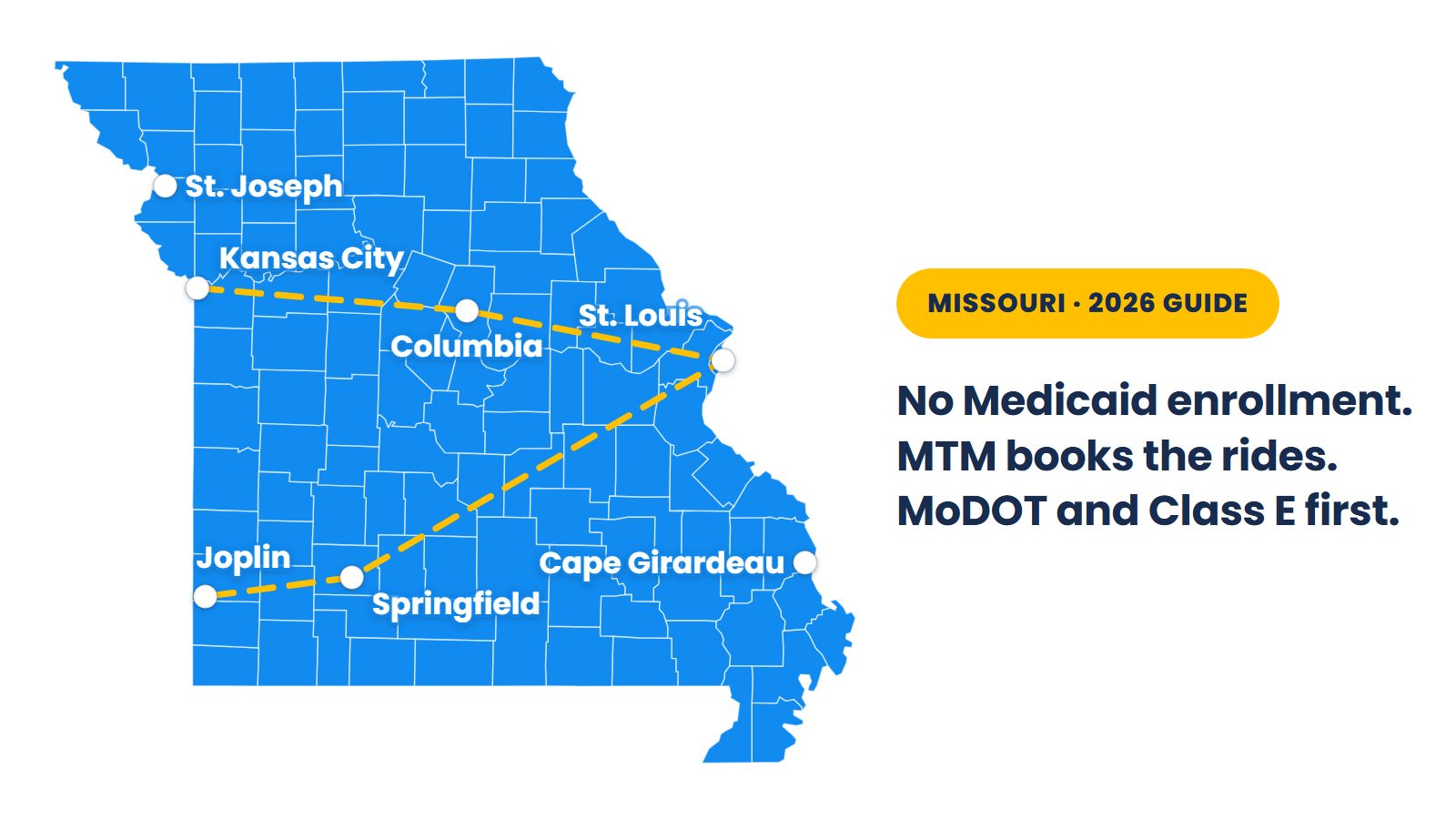
To start a NEMT business in Missouri, form an LLC ($50 online), get a free USDOT number and, unless an exemption fits, Missouri Department of Transportation (MoDOT) authority at $10 a van a year. Paid drivers, you included, need a for-hire Class E license ($24). You don’t enroll with Medicaid: MTM, the state’s ride broker, decides who gets those trips and wants $2 million each of auto and general liability. Budget about $22,800 to $50,700 for one used wheelchair van, counting six months of fixed bills.
Missouri at a glance:
- Medicaid rides: MO HealthNet, Missouri’s Medicaid program, sends rides for fee-for-service members (the ones not in a health plan) through MTM, its statewide broker, and all four health plans name MTM as their ride vendor too [1][2][3].
- No enrollment: van companies aren’t enrolled as MO HealthNet providers for NEMT, so there’s no Medicaid application or fee [4].
- MoDOT authority: most for-hire passenger carriers need it for trips wholly inside Missouri, whoever pays, unless the vehicle or the route fits an exemption [5][6].
- Drivers: a Class E license for every paid NEMT driver, owners included; a commercial driver’s license (CDL) only at 16 passengers counting the driver, or 26,001 pounds [7][8].
- Stretcher riders: a stretcher van license from the Department of Health and Senior Services (DHSS), whoever pays [9].
- Cities: Kansas City licenses livery vans and Springfield has its own NEMT license, while a 2017 law keeps the St. Louis taxicab commission out of medical transportation [10][11][12].
- Insurance: MTM wants $2 million of general liability and $2 million of auto; MoDOT’s floor is $100,000/$300,000/$50,000 [13][6].
- Rates: none published. MTM sets them with each company [13][14].
In a 2026 video for an operators’ community, a Kansas City owner-operator described starting out in an industry where “you can’t get anything,” not even a clear list of what’s required. While building private pay, the owner asked MTM for rides and was “told the market was saturated in Kansas City.” The company “never signed up with a broker” and moved into facility work instead. Its first ride came the last week of November 2025. By the time the video went up in June 2026, the company was coming off its record month: about $12,000 brought in, by the owner’s count.
That first year is Missouri’s Medicaid ride program in miniature. The state’s NEMT provider manual says it in two lines: “Transportation providers are not enrolled as MO HealthNet providers,” and “The broker determines which transportation provider will be assigned to provide each transport” [4]. So get legal, build your first schedule on facilities and families, and file with MTM the week MoDOT’s answer is in writing. The checklist runs in the order that wastes the least money: vehicles and city, the company and your first customers, an insured van, MoDOT, drivers, then MTM. After it come who pays, the broker, the rules, costs and timing.
I run Duet, which builds dispatch software and runs growth services for non-emergency medical transportation (NEMT) companies, and I talk to NEMT owners on demos every week, Missouri operators included. This is the Missouri edition of our national guide on how to start a NEMT business. Requirements change, so confirm against the linked sources before you spend money.
The one-page checklist: how to start a medical transportation business in Missouri
Start with your vehicles and your city, because they decide which Missouri licenses you need. The Kansas City owner’s first months were “all basically paperwork,” so here’s that paperwork in order, each phase ending with the money it puts at risk.
Phase 0: pick your riders, your vehicles and your city
- Seats: five riders or fewer besides the driver may fit MoDOT’s taxicab exemption; 9 or more people counting the driver brings federal safety rules, and 16 or more takes a CDL [15][16][7].
- Stretchers: riders who travel lying down need a company with a DHSS stretcher van license [9].
- Your city: Kansas City licenses livery vans, Springfield licenses NEMT companies, and the City of St. Louis wants a business license [10][11][17].
- The van and the policy: when a St. Louis founder asked me in July which to buy first, I said, “Don’t buy either of them right away.” Line up the trips before the bills, starting in Phase 1.
- Three questions this week: ask MoDOT Motor Carrier Services (866-831-6277, option 3) whether your vehicles and routes need authority [6]. Ask the five nearest rehab and nursing facilities who books and pays for their residents’ rides. Ask MTM, through its Missouri transportation-providers page, what it pays for your level of service in your county [13].
- Money at risk: none yet.
Phase 1: form the company and line up your first trips
- File articles of organization with the Secretary of State: $50 online or $105 on paper, with no annual report afterward [18].
- Get a free employer identification number (EIN) from the IRS and a free national provider identifier (NPI) under the NEMT van taxonomy, 343900000X.
- Get a USDOT number. MoDOT’s application starts with it [6].
- Register with the Department of Revenue, online or on Form 2643, once you have employees to withhold for [19].
- Put up a website a family can find and book from and a Google Business Profile.
- Visit rehab centers, nursing facilities and hospital discharge planners, and line up who’ll call you once your van is legal.
- Money at risk: about $350: $50 for the LLC and about $300 for a phone and basic marketing.
Phase 2: quote insurance, then buy, title and plate the van
- Get quotes on a specific van. A St. Louis founder told me in July that the insurance agent needed information about the car first.
- Quote at MTM’s $2 million of auto and general liability and at $1 million, so you know what the broker’s bar adds [13].
- Title the van within 30 days and pay Missouri’s 4.225% sales tax plus your city’s or county’s rate. The title is $17.50, and passenger plates $27.25 to $60.25 a year by taxable horsepower [20][21].
- Money at risk: about $15,000 with the van financed. That’s $6,600 down on the 2016-2019 wheelchair van in our national one-van startup budget, about $3,040 in tax, title and plates at Kansas City’s rate, $4,350 of insurance at signing and about $1,000 for equipment.
Phase 3: file for MoDOT authority unless you’re exempt
- Apply online through MoDOT Carrier Express with your USDOT number, your insurer’s Form E, a financial statement and your rates or contracts [6].
- Pay $10 a van for the year, and put “MO” after your USDOT number on each van [6][22].
- Money at risk: $10 a van.
Phase 4: license and screen your drivers
- Put every paid driver, yourself included, on a Class E license: $24 for up to three years [7][8].
- Register each driver with the Family Care Safety Registry (FCSR), the state’s background screening registry for care workers, for $16, or $16.57 online. MTM’s contract and the state’s manual require the check [23][2][4].
- Plan on fingerprint background checks through the Missouri State Highway Patrol and the FBI if you’ll carry MTM’s riders [2].
- Money at risk: about $1,040 for one driver: $24, $16 and about $1,000 of screening and training in our model.
Phase 5: file with MTM and run your first trips
- Apply through MTM’s Missouri transportation-providers page the week your van is insured and MoDOT’s answer is in writing [13].
- Run the facility and private-pay trips you lined up in Phase 1 while MTM reviews you.
- Money at risk: $1,934 a month of fixed bills with the van financed, until your trips cover them.
A company that never carries a Medicaid rider can skip the MTM step. It can’t skip Phase 3 unless an exemption fits.
Who pays for NEMT rides in Missouri?
Medicaid is Missouri’s volume, facilities are its stability, and private pay is its margin.
Medicaid is the volume, and MTM arranges it
The Department of Social Services (DSS) counted 1,256,699 MO HealthNet enrollees in September 2026 [24]. Their non-emergency rides mostly run through MTM, as the state’s broker for fee-for-service members or as their health plan’s ride vendor [1][3]. The state’s 2022 request for broker bids shows how much riding the fee-for-service side alone does: 1,096,108 trips in 2021, under the previous broker. Of those, 45.3% went in multi-passenger vans, 22.5% in wheelchair (para-lift) vans, 17.6% as gas reimbursement, 11.2% by taxi and 2.0% in stretcher vans, with transit, volunteer drivers and ambulances under 1% each [2].
Facilities are the stability
Some rides sit outside Missouri’s broker program altogether. The NEMT manual leaves out discharges from a nursing home, hospital-to-hospital transfers (an ambulance benefit) and, for riders enrolled in hospice, trips tied to the terminal illness [4]. Ask each facility who pays for the rides it needs.
Facility work can fill a schedule fast. Most of the Kansas City owner’s work comes from rehab facilities: residents going home after a stay, then their recurring doctor visits. Between three doctor’s appointments, a sick day and a broken tooth, the owner said, “one person is almost five” trips.
Don’t count on dialysis clinics as facility accounts. In my experience most dialysis riders are on Medicaid, so in Missouri their rides come through MTM.
Private pay is the margin
Private-pay riders and their families call you directly and pay up front. Missouri had 1,169,201 residents 65 or older in the Census Bureau’s 2024 survey [25]. The Kansas City owner-operator quoted $160 to $180 for a private-pay wheelchair round trip of six miles each way in 2026, and about $140 to facilities for the same trip. Those are one owner’s prices, not a market rate. The catch, in the owner’s words: you have to advertise, and “you got to chase them down.”
The usual practice among the owners I talk to: take a card at booking and charge it at least 24 hours before pickup, or send a payment link that’s due by then. No payment, no van.
Who is the NEMT broker in Missouri?
MTM Health is Missouri’s fee-for-service NEMT broker, and all four MO HealthNet health plans name MTM as their ride vendor too. A broker is the company the state, or a health plan, pays to arrange Medicaid rides and hand them to transportation companies. DSS puts it simply: “MO HealthNet’s NEMT program is managed by Medical Transportation Management (MTM) Health” [1].
The state’s contract with MTM began service on December 1, 2022 and runs through June 30, 2027, with “NO RENEWAL OPTIONS” [2]. MTM, headquartered in Lake St. Louis, took over from LogistiCare, renamed Modivcare, whose state contract ran through November 30, 2022 [2]. That’s why some older pages, brochures and videos still name Modivcare.
On paper, each plan runs its own rides: “NEMT services for participants enrolled in Managed Care health plans are arranged by the health plan” [4]. In practice, Healthy Blue, Home State Health, Show Me Healthy Kids and UnitedHealthcare each name MTM in their own documents [3]. Our map of who arranges Medicaid rides in every state shows how other states split the job.
| Rider | Who arranges the ride | Booking line |
|---|---|---|
| Fee-for-service MO HealthNet member | MTM, as the state’s broker | (866) 269-5927 |
| Healthy Blue member | MTM, as the plan’s vendor | (888) 597-1193 |
| Home State Health member | MTM, as the plan’s vendor | (855) 694-4663 |
| Show Me Healthy Kids member | MTM, as the plan’s vendor | (877) 236-1020 |
| UnitedHealthcare member | MTM, as the plan’s vendor | (844) 529-1801 |
The booking lines are the ones DSS gives riders, as of October 2026 [1].
Both layers are up for change. MO HealthNet’s rebid of its health plan contracts closed September 2, 2026, and on October 18 the state’s bid board still showed no award; today’s plan contracts run through June 30, 2027 [26]. MTM’s state contract ends the same day. Our tracker of 2026 broker changes follows moves like these.
How does a Medicaid trip reach your company?
MTM assigns each trip and sends it to you electronically [4][13]. The manual has four levels of service: ambulatory, wheelchair, stretcher and non-emergency ambulance. Ambulatory includes riders with a manual wheelchair who can stand or pivot on their own, and stretcher trips are booked with a Stretcher Assessment Form [4]. Riders book at least two business days ahead in the urban counties (Clay, Greene, Jackson, Jefferson, St. Charles, St. Louis and St. Louis City) and three elsewhere, though hospital discharges and urgent trips can go the same day [4].
The state’s contract with MTM sets the clock you’ll work to [2]:
- Arrive no later than the pickup time, and no more than 15 minutes early.
- Wait 10 minutes at the address, then call MTM before you leave.
- Drop riders off no more than 30 minutes before their appointment.
- Pick up will-call returns within 60 minutes, and hospital discharges within three hours of the facility’s call.
- Give MTM at least a day’s notice to turn a trip down.
MTM doesn’t pay for no-shows, and it asks you to confirm each ride with the rider the day before [13]. Standing orders are recertified every 90 days, except dialysis orders, which don’t expire [4]. And a dissatisfied rider can ask MTM to stop sending your company to them, which takes only one substantiated complaint [2].
Can I bill Missouri Medicaid directly for NEMT rides?
No: Missouri doesn’t enroll van companies for Medicaid’s non-emergency rides, so those trips reach you as subcontracts from MTM.
That surprises people already in health care. A St. Louis home-care owner whose clients are “Majority Medicaid” told me in September about a plan to add one van and “fully set up the nonemergent medical transportation and be able to bill Medicaid.” In Missouri, that ride runs through MTM, whether the client is fee-for-service or in a health plan.
The state doesn’t set the rate either. Missouri’s state plan pays the broker a fixed amount per member each month and “does not require a specific reimbursement methodology be used by the broker when subcontracting with transportation providers” [14]. The state’s contract does require MTM to pay, deny or suspend each claim by the 45th day after it arrives [2]. MTM’s own page says rates are “discussed and determined with transportation providers on an individual basis” [13].
That leaves nothing to look up. Ask MTM what it pays for your level of service in your county before you buy the van, and price your own cost per trip against it.
Two lanes do enroll, each under its own rules. Ambulance companies enroll with a DHSS license, Medicare certification and a participation agreement [27]. A transportation company can carry riders in the developmental disabilities waiver under a Department of Mental Health contract, and that program arranges its own rides outside the broker [28][4].
What licenses and requirements does a NEMT business need in Missouri?
Missouri has no license called a NEMT license, but most for-hire van companies need MoDOT intrastate operating authority, whoever pays for the ride.
MoDOT’s FAQ puts it plainly: “All for-hire motor carriers transporting property or passengers in intrastate commerce (wholly within) are required to apply for authority to operate in Missouri” [6]. Chapter 390 of the state’s statutes lists 12 exemptions, and none mentions medical, Medicaid or wheelchair service [5]. Running without authority is a misdemeanor, at $100 to $2,000 per offense, with each day a separate one [29].
Most of what you’ll read about Missouri gets at least one of these wrong:
| The claim you’ll read elsewhere | What Missouri actually requires |
|---|---|
| “In Missouri, you don’t need a specific license or permit to operate an NEMT business” | No license has that name, but most van companies need MoDOT authority, stretcher vans need a DHSS license, and Kansas City and Springfield license their own [5][9][10][11] |
| A “MO HealthNet/state provider enrollment fee (around $688…)” | Van companies aren’t enrolled with MO HealthNet, so there’s no Medicaid application or fee; you apply to MTM’s network instead [4][30] |
| Modivcare as the “Primary NEMT broker” for MO HealthNet fee-for-service members | MTM has been the fee-for-service broker since December 1, 2022; LogistiCare, renamed Modivcare, held the job until November 30, 2022 [2] |
| “a minimum of $1,000,000 combined single limit” | MTM’s Missouri bar is $2 million of general liability and $2 million of auto [13] |
| Drivers need a “Chauffeur, Class D, or CDL depending on vehicle size” | Missouri’s for-hire class is Class E; a CDL starts at 16 passengers counting the driver, or 26,001 pounds [7][8] |
| “you must comply with the regulations set by the Missouri Department of Health and Senior Services (DHSS)” | DHSS licenses stretcher vans and ambulances, and state law says a wheelchair van isn’t an ambulance [9] |
Does your van need MoDOT authority?
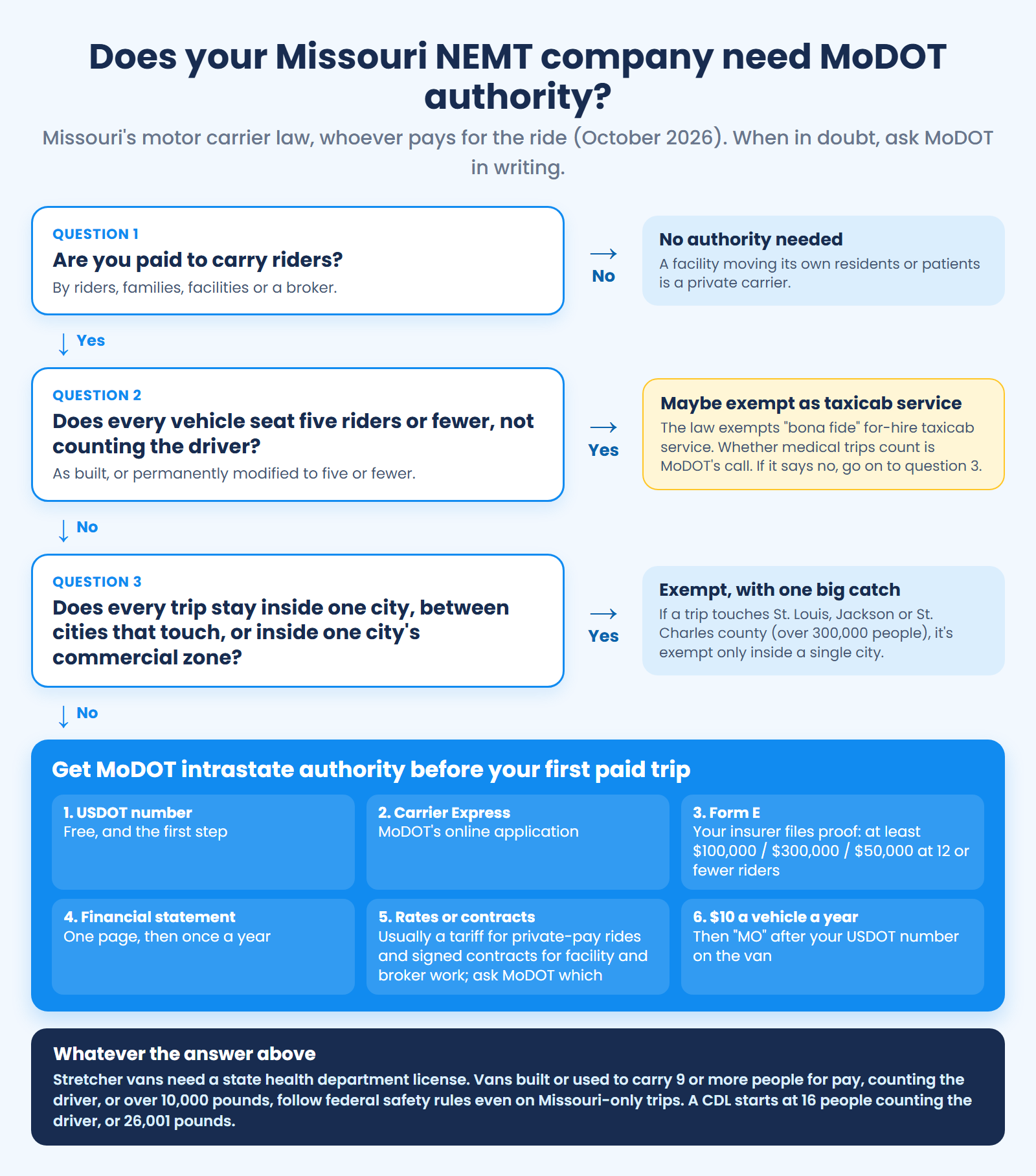
If you’re paid to carry riders, you need MoDOT authority unless an exemption fits. Three questions settle it, and on two of them MoDOT has the last word, so get its answer in writing.
First, are you paid to carry riders, by riders, families, facilities or a broker? If not, you need no MoDOT authority: a nursing home or day program moving its own residents or clients counts as a private carrier [5]. A company paid per trip is a motor carrier.
Second, does every vehicle seat five riders or fewer, not counting the driver? The law exempts taxicabs and defines one as a vehicle “performing a bona fide for-hire taxicab service having a capacity of not more than five passengers, exclusive of the driver” [5]. MoDOT counts the vehicle’s manufactured seating and adds: “If a larger passenger capacity vehicle has been permanently modified to this level, the operation would be exempt” [15]. Whether prearranged medical trips count as taxicab service is MoDOT’s call, not yours.
Third, does every trip stay inside one city, between cities that touch, or inside one city’s commercial zone? Those trips are exempt, with one big catch for passenger carriers: between different cities, the exemption is lost when a point sits in a county of more than 300,000 people, which MoDOT’s sheet calls the St. Louis and Kansas City area [5][15]. St. Louis, Jackson and St. Charles counties are all past the line, so a trip touching one of them is exempt only inside a single city [31]. Elsewhere, ask MoDOT how the line falls.
A fourth exemption covers work under your own contract with the state, a county or a city, when it pays you directly [5]. MTM’s subcontracts don’t fit it on their face, since MTM pays you. If no exemption fits, you need authority before your first paid trip. Whatever the answers, three more lines apply:
- Stretcher vans need the DHSS license either way [9].
- Vans built or used to carry 9 or more people for pay, counting the driver, or over 10,000 pounds, follow the federal safety rules even on Missouri-only trips [16][32].
- A CDL starts at 16 people counting the driver, or 26,001 pounds [7].
Call MoDOT Motor Carrier Services at 866-831-6277, option 3, this week, describe your vehicles and the trips you’ll run, and ask for the answer in writing.
What does MoDOT’s application take?
MoDOT’s application takes six things, starting with a USDOT number and ending with $10 a van:
- A USDOT number first, then a new-customer account in MoDOT Carrier Express, the online system you apply through [6].
- Proof of insurance (Form E), filed by your insurer, at no less than MoDOT’s floor: $100,000 per person, $300,000 per accident and $50,000 of property damage for vehicles of 12 or fewer passengers [6].
- A one-page financial statement, with a column for new companies, and another statement every year after the grant [6].
- Your rates or your contracts. A common carrier sells rides to the public, as a private-pay service does, and without interstate authority it files a tariff before the grant; MoDOT’s sample shows a minimum charge, a per-mile rate and waiting time [6]. A contract carrier works under individual contracts, as facility and broker work does, and files a copy of each signed contract [5]. Ask MoDOT which you are, or whether you need both.
- Good standing and workers’ comp: the rule also lists Secretary of State good standing and “Certification of workers’ compensation coverage” [22]. State law requires comp only from five employees, so ask MoDOT how it handles a smaller company.
- $10 a van for the year, January 1 to December 31, then “MO” right after your USDOT number on each van [5][22].
What do St. Louis, Kansas City and Springfield require?
Kansas City licenses livery vans and Springfield licenses NEMT companies, while a 2017 law keeps the St. Louis taxicab commission out of medical transportation:
- St. Louis: that law says nothing in sections 67.1800 to 67.1822 grants the regional taxicab commission “the authority to license, supervise, or regulate medical transportation” [12]. The commission still licenses non-medical rides in vehicles of eight or fewer, counting the driver, inside the city and county, so if you’ll sell those too, ask it in writing at 314-535-7700 [33].
- City of St. Louis: its Graduated Business License is $200, or $100 if you start after January 1, for a year running June 1 to May 31 [17]. Its ambulance chapter leaves out vehicles carrying people between home and “normally scheduled medical and clinic appointments” [34].
- St. Louis County: it issues no business license for a service company [35].
- Kansas City: a van for six or fewer, counting the driver, hired in advance by written or electronic agreement, is a “livery vehicle” under the city’s vehicles-for-hire code, whose only medical carve-out is for ambulance services [10]. A livery company pays $250 a year for each vehicle permit, $12.50 a vehicle for an occupation license and $25.50 for each owner’s background check [36].
- Kansas City drivers and insurance: drivers need a city certificate and a Class E or a CDL, the policy needs $50,000/$100,000/$25,000 plus $50,000 of uninsured-motorist coverage, and fares go on file two days before you charge them [10]. Ask Regulated Industries, (816) 513-4561, about vans seating more than six with the driver [36].
- Springfield: no one may run “a nonemergency medical transportation service” in the city without its license, written for riders who stay upright in a wheelchair, in vehicles used only for NEMT, booked at least an hour ahead [11]. It’s $100 to file plus the $25 fee in the city’s schedule, then $50 plus $25 to renew each calendar year. Ask the License Division, 417-864-1617, whether the $25 is per van [11].
Columbia’s and Joplin’s codes, like Springfield’s taxicab rules, step aside for carriers the state regulates, and Jefferson City exempts livery services from its three-vehicle minimum [37][11]. Confirm with each city before you sign a lease.
What if you drive riders into Kansas or Illinois?
MO HealthNet treats medical providers in its eight border states, Kansas and Illinois among them, like Missouri’s, so a ride to a Kansas-side appointment needs no out-of-state approval [4]. The van is a different matter. MoDOT’s authority covers only trips wholly inside Missouri, and its FAQ adds the reverse: “Your interstate operating authority does not authorize intrastate commerce within Missouri” [6].
A paid trip across the line is federal. Our licensing guide covers what a trip across a state line takes: usually operating authority from the Federal Motor Carrier Safety Administration (FMCSA), a USDOT number and $1.5 million of liability for a van seating 15 or fewer, counting the driver [38]. Both metros sit in federal commercial zones, but for passengers that exemption holds only if you’re also lawfully carrying passengers within each state along the entire route, under that state’s own laws [38]. Ask FMCSA before you count on it.
What are the NEMT insurance requirements in Missouri?
Plan on MTM’s bar, $2 million of general liability and $2 million of auto liability, not the state’s floor. MTM must be listed as certificate holder and additional insured on both policies, and you need workers’ comp “that meets state requirements” [13]. The state’s contract with MTM also names the State of Missouri as an additional insured on your policies [2].
The floors sit far below that. MoDOT’s is $100,000 per person, $300,000 per accident and $50,000 of property damage at 12 or fewer passengers, so MTM’s auto bar is more than six times its per-accident line [6]. Missouri’s minimum for any car is $25,000/$50,000/$25,000 [20], and a stretcher van needs $250,000/$500,000/$100,000 [9].
When should you bind the policy?
As late as you can and still file on time. MoDOT won’t grant authority until your insurer has filed the Form E, and MTM wants its name on both policies [6][13]. Ask MTM whether it needs the $2 million policies in force when you apply or only when you sign its contract. Frank Ciccarella, a NEMT consultant, explained the cost of going early on our podcast episode about startup paperwork: “if I buy insurance in the very beginning and my van sits there, you may not get accredited with the state or your broker for a while.” He’d line up everything else first and buy the insurance “kind of at the last part of it.” So collect quotes early, on the van you’ll buy, and bind when the van and the MoDOT filing are both ready.
What will insurance cost a new Missouri company?
For a new company’s wheelchair van at about $1 million of liability, our national model uses $17,400 a year, from new-company quotes of $1,200 to $1,800 a month: about $4,350 at signing, then ten installments of $1,305. Our guide to how insurers price a new NEMT company’s first policy shows where those numbers come from. MTM’s $2 million bars will cost more, so price both.
When a St. Louis founder asked me about premiums in July, I said, “A wheelchair vehicle can easily be more than $1,000 a month to do insurance for.” I added that Missouri shouldn’t run as high as Florida or California, since the “Midwest tends to be a little bit lower.” That’s my impression, not an insurer’s number.
Do you need workers’ comp in Missouri?
From your fifth employee. Missouri’s law covers employers with “five or more employees,” counting family members who work for you [39]. Knowingly going without is a class A misdemeanor plus a penalty of up to three times the annual premium or $50,000, whichever is greater [39]. MTM and MoDOT’s rule both ask about workers’ comp, so ask each what it accepts from a smaller company [13][22].
Missouri’s minimum wage is $15.00 an hour in 2026, and its unemployment law treats a driver as your employee if you control the manner and means of the work. Talk to an accountant before you pay drivers on a 1099 [39].
What do NEMT drivers need in Missouri?
Every paid NEMT driver in Missouri, owners included, needs a Class E license, the state’s for-hire class. State law sets a separate class for anyone who “receives compensation” for carrying people or property, “or who as an owner or employee operates a motor vehicle carrying passengers or property for hire” [7]. The Department of Revenue calls Class E the “for-hire” or “chauffeur” license; Class F is the basic one. Its driver guide exempts ride-hail and taxicab drivers in vehicles of 12,000 pounds or less, who can drive on a Class F, but whether a NEMT driver ever counts as a taxicab driver is a question for the department, so plan on Class E [8].
You must be 18, and the written exam draws mainly on the driver guide’s commercial vehicles chapter, plus vision and road-sign tests. There’s no driving test if you already hold a Class F. It costs $24 for up to three years, or $48 for up to six [8].
A CDL starts only at 16 or more passengers counting the driver, or 26,001 pounds [7]. Between the two sits a band that’s easy to miss: a van built or used to carry 9 to 15 people for pay, counting the driver, or any vehicle of 10,001 pounds or more. Missouri applies the federal motor carrier safety rules, with their driver files, medical cards, hours of service and maintenance records, to those vehicles even on in-state trips [16][32]. A minivan isn’t in that band.
MTM’s contract adds its own driver file, met before a driver’s first Medicaid ride and at least once a year after [2]:
- Background: a fingerprint criminal history check through the Missouri State Highway Patrol and the FBI.
- Registry: no FCSR “hit” unless DHSS grants a good cause waiver [2], and the state’s manual bars a hit too [4].
- Driving record: no conviction for driving while intoxicated or under the influence, and no license revocation, in the past three years.
- Offenses: none of the offenses the contract lists, including any offense of a sexual nature or involving violence.
- On the job: random drug and alcohol screening, and hands-free phones only.
What training does MTM’s contract require?
The state’s contract with MTM lists 12 topics that driver training must cover [2]:
- Defensive driving
- Driver sensitivity, awareness and communication
- Mobility equipment, like walkers, canes and crutches
- Handling wheelchairs
- Hands-on help with moving, lifting and transfers
- Lifts, ramps and wheelchair securement
- Using a fire extinguisher
- Keeping accurate records and reports
- Problem situations, such as seizures and vehicle breakdowns
- Basic first aid
- When to try first aid and when to do something else
- Universal precautions for body fluids
CPR isn’t on that list, though MTM’s Missouri provider page mentions CPR in its FAQ on training standards, and a stretcher crew needs it under the DHSS rule [13][9]. The Kansas City owner-operator took CPR, defibrillator (AED), wheelchair and stretcher courses, then PASS, a passenger assistance course, and said tracking down instructors “took a couple of months.” Ask MTM which courses it accepts before you pay for any.
Can a NEMT company run stretcher van trips in Missouri?
Yes, with a stretcher van license from the Missouri Department of Health and Senior Services (DHSS), whoever pays for the ride. A stretcher van carries passengers who travel lying down and need no medical monitoring on the way, with self-administered oxygen as the one exception. It can’t carry patients, which the law defines as sick or injured people who may need medical monitoring or care on the way, or anyone currently admitted to a hospital or going to one for admission or emergency treatment [9]. The law and the DHSS rule add the rest [9]:
- Crew: two people on every trip, an automated external defibrillator (AED) with at least one person trained to use it, and CPR for the crew.
- Drivers: Class E plus a driver safety or vehicle operations course.
- Vehicle: stretchers that meet KKK-A-1822 or AMD Standard 004, and no emergency lights, “ambulance” lettering or Star of Life.
- Insurance: $250,000 per person, $500,000 per accident and $100,000 of property damage.
- License: five years, applied for 30 to 120 days ahead, with a DHSS inspection. No fee is published, so ask the Bureau of EMS at (573) 751-6356.
Licensed ambulance services can run stretcher vans too [9]. In unincorporated St. Louis County, add the county’s license: $1,000 a van a year, a crew member licensed as an EMT, nurse or physician, and $1 million of general liability plus $2 million each of professional and excess liability [40]. Springfield’s NEMT license, written for upright wheelchair riders, doesn’t fit stretcher work [11].
Fee-for-service riders took 22,319 stretcher van trips in 2021, about 2% of the total [2]. Put the line in your intake script: a rider who needs monitoring on the way, or who’s still admitted to a hospital, is an ambulance’s trip.
How do you become an MTM provider in Missouri?
Apply through MTM’s Missouri transportation-providers page the week your van is insured and MoDOT’s answer is in writing; MTM decides who joins. Its page describes “application, credentialing, and contracting phases,” and says, “We are always seeking transportation providers to join our statewide network” [13]. The state’s contract also pushes MTM to recruit where companies are scarce: in “low access areas of the state,” the broker “shall develop additional transportation providers” [2]. That can favor a company outside the two big metros.
Where MTM already has enough, the answer can be no for now, which is what the Kansas City owner-operator heard. MTM’s senior director of logistics described the same thing in a September 2026 podcast interview: some markets need providers constantly, others reach the point where “the market’s saturated,” and there are only so many trips to go around. Adding companies where the trips don’t grow would only spread the same rides thinner.
Asked on our podcast about a viewer still waiting on a broker in another state after a few months, Frank Ciccarella advised asking for a meeting: “I would reach out to try and have a face-to-face meeting with the person that you sent it to.” When I called that universal advice for any paperwork, Frank said, “we just did that in St. Louis for a client as well.”
While you wait, you can carry facility and private-pay riders without MTM, though not without the licenses above. Our guides on landing facility contracts, getting the first trip out of a facility and pricing and selling private-pay rides cover that stretch, and our rundown of how brokers and states admit new companies shows how other states order these steps.
What does MTM check?
MTM’s checks come from the state’s contract [2]:
- Vehicles: legally licensed, through a state safety inspection where the law requires one, clean and in good repair, with a seat belt for every rider.
- Equipment: spare fuses, a fire extinguisher, three reflective triangles or a flare kit, a spare tire and jack (unless you can call for help by radio or phone), a flashlight, an ice scraper, a first-aid kit and a blood-borne pathogen kit.
- Vans and buses: emergency exits that meet Federal Motor Vehicle Safety Standard 217, and a step that holds 300 pounds.
- Wheelchair riders: vehicles that meet 49 CFR Part 38 for riders who stay in their chairs.
- Records: accidents, breakdowns, inspections, preventive maintenance and daily pre- and post-trip inspection reports.
- Spot checks: random safety and cleanliness checks by MTM every six months.
Missouri’s own safety inspection comes every two years once a vehicle is more than 10 model years old or has 150,000 miles, at up to $12 [20].
How long does MTM take?
MTM publishes no clock for Missouri. Its national page says that without an opening it will “keep your information on file and reach out when we have opportunities for you” [41]. I told the St. Louis founder that broker approvals can “take six or nine months sometimes,” which is why a launch budget should carry at least six months of fixed bills, and facility and private-pay trips should start before MTM’s answer.
Don’t build the whole schedule on one payer
Missouri’s broker contract and its health plans’ contracts all end June 30, 2027, so hedge with facilities and families now. Today one company arranges essentially every MO HealthNet NEMT ride, and its state contract has no renewal options [2][26]. Whoever wins the next round, the companies with their own facility and private-pay accounts will feel it least.
A larger St. Louis company described that hedge in a 2025 video interview: “33% private pay, 33% facility paid, and 33% brokers,” with broker trips filling gaps in the schedule. “Not that there’s anything wrong with brokers,” the owner said, but they can pull a company toward volume.
Private pay has a ceiling, though. I told the St. Louis founder in July that I know owners who’ve filled two vans with nothing but private pay. Past that, at five or ten vehicles, “you start to need the facility or the broker trips to get enough volume.”
One company for every plan is how Missouri and its health plans chose to buy rides. Next door in Illinois, each Medicaid health plan picks MTM or Modivcare as its ride vendor, so a company there can work for both.
Then run every lane from one schedule. Dispatch software like Duet keeps MTM’s trips on the same board as your facility and private-pay work. MTM is one of Duet’s direct integrations, any other trip list comes in by trip file import or bulk upload, and each trip bills at the rate its contract sets. Your MoDOT authority, MTM’s credentialing and rates, and invoicing each payer through its own process stay with you.
How much does it cost to start a NEMT business in Missouri?
Budget about $22,800 to $50,700 for one used wheelchair van in Missouri, counting six months of fixed bills. The typical case, a 2016-2019 van at our national model’s $33,000, financed, takes about $28,000: the $6,600 down payment, about $9,800 of one-time costs and six months of fixed bills. Paying cash for the same van takes about $50,700, and an older $20,000 van, financed, about $22,800.
Missouri’s inputs are its fees and sales tax; the rest, insurance at about $1 million of liability included, is our national model, so MTM’s $2 million will add to it. The totals leave out fuel, your living costs, fingerprint fees and any city license.
| Line item | Missouri amount | Note |
|---|---|---|
| LLC articles of organization | $50 online | $105 on paper; no annual report [18] |
| EIN, NPI and USDOT number | $0 | Free from the agencies that issue them |
| “NEMT license” | $0 | No state license by that name |
| MO HealthNet enrollment and application fee | $0 | Van companies aren’t enrolled [4] |
| MoDOT regulatory license | $10 a van a year | January 1 to December 31 [5][22] |
| Class E license | $24 | Up to three years; $48 for up to six [8] |
| Family Care Safety Registry | $16 | One time; $16.57 online [23] |
| Used wheelchair van, 2016-2019 | About $33,000, or $6,600 down if financed | National model: 80% financed at 14% over 60 months, $614 a month |
| Sales tax, title and plates | About $3,040 | 4.225% state tax plus Kansas City’s 4.75% local rate as the example ($2,962), a $17.50 title and $60.25 plates [21] |
| Insurance due at signing | About $4,350 | A quarter of the national model’s $17,400 year, at about $1 million of liability |
| Equipment and lettering | About $1,000 | National model |
| Screening and training | About $1,000 | National model; one driver |
| Phone and basic marketing | About $300 | National model |
| Six months of fixed bills | About $11,600 financed, $7,920 bought outright | $1,934 a month financed: a $1,305 insurance installment, a $614 van payment and $15 for a phone; $1,320 with no van payment |
| City license | Not in the totals | Kansas City about $288 for one livery van; Springfield $125 the first year; City of St. Louis $100 or $200 [36][11][17] |
| Total, owner driving | About $28,000 financed, $50,700 bought outright | An older $20,000 van, financed, comes to about $22,800 |
The Kansas City rate comes from the Department of Revenue’s February-March 2024 chart, the edition its link still served in October 2026, so check your own city’s rate. The Kansas City owner-operator’s first van, a Ford Transit with about 150,000 miles, cost “under 20,000,” close to the older-van line.
For a revenue yardstick, take that owner’s $140 facility price for a wheelchair round trip of six miles each way: about 14 such trips a month cover the financed van’s $1,934 of fixed bills, before fuel or a driver’s pay. That’s one owner’s 2026 price, so run the same math with MTM’s rate for your county and your own prices.
If a guide prices a Missouri launch in the low thousands, ask it where the $4,350 insurance deposit went.
How do you fund a NEMT startup in Missouri?
Small Business Administration (SBA) 7(a) loans and microloans are the federal options. Missouri adds MOBUCK$, the State Treasurer’s linked-deposit program, which lowers the interest rate on a loan from a participating lender; the 2026 small-business window opened April 1 with $100 million, first come, first served [42]. Borrowers must be for-profit, headquartered in Missouri, under 100 full-time employees and current on state and local taxes. The uses it lists include equipment purchases, so ask a lender whether a van counts and whether any 2026 money is left [42].
The Missouri Small Business Development Centers, funded in part by the SBA, offer confidential one-on-one counseling and low-cost training [43]. None of these moves MoDOT or MTM any faster, so size the loan to the wait you’ll really have.
How long does it take to start a NEMT business in Missouri?
Missouri publishes no processing time for MoDOT authority or for MTM, so plan on months, not weeks: the Kansas City owner-operator started in July and gave a first ride in late November. In between came the paperwork, a couple of months of tracking down training courses, and a van bought in September.
The few clocks that do exist:
- MoDOT publishes notice of your application, and for 15 days any interested party, such as a carrier already serving under its own authority, can ask to join the case. If no one opposes it, MoDOT can grant it without a hearing [5].
- MoDOT can also grant temporary authority for up to 90 days where there’s “an immediate and urgent need” that no existing carrier can meet [5].
- Once MoDOT receives your application, its rule gives you 45 days to get every required document in, or it stops considering the request [22].
- DHSS wants a stretcher van application 30 to 120 days ahead, and asks you to “allow 30 business days for processing” [9].
Put the steps in this order:
- Before you buy: pick your vehicles and city, form the LLC, get your EIN, NPI and USDOT number, ask MoDOT, MTM and the nearest facilities your questions, put up your website, and collect insurance quotes.
- Van week: buy and title the van, bind the policy, and file with MoDOT Carrier Express, or get your exemption confirmed in writing.
- While MoDOT reviews: get your drivers’ Class E licenses and FCSR registrations, and line up your first facility and private-pay riders.
- When MoDOT’s answer is in writing: apply to MTM that week, and run your facility and private-pay trips while it reviews you.
In July a St. Louis founder asked me whether to focus on private pay or the broker first. I said that if I were starting tomorrow, “I would submit the broker application,” then “focus on the private pay side.” The Kansas City owner-operator never waited on MTM at all. File with MTM the week MoDOT’s answer is in writing. Before you do, name the facility that will call you first.
Missouri NEMT FAQ
Do I need a license to start a NEMT business in Missouri?
Not one called a NEMT license, but most for-hire van companies need MoDOT intrastate operating authority, $10 a van a year, unless an exemption like the taxicab-size or single-city one fits [5][6]. Paid drivers need a Class E license, stretcher service needs a DHSS license, and Kansas City and Springfield add their own [7][9][10][11].
Do I have to enroll with MO HealthNet or pay a $688 fee?
No. MO HealthNet doesn’t enroll van companies, so there’s no Medicaid application or fee to pay; you apply to MTM’s network instead [4][30]. Two lanes do enroll: ambulance companies, and transportation companies with a Department of Mental Health contract for the developmental disabilities waiver [27][28].
Is Modivcare still a Missouri Medicaid ride broker?
Not for MO HealthNet. MTM has run the state’s fee-for-service program since December 1, 2022, and all four health plans name MTM as their ride vendor [2][3]. LogistiCare, renamed Modivcare, held the job through November 30, 2022, so some older pages, brochures and videos still name it.
How much insurance does MTM require in Missouri?
General and auto liability of $2 million each, with MTM as certificate holder and additional insured on both, plus workers’ comp that meets state rules [13]. The “$1,000,000 combined single limit” you’ll see online isn’t MTM’s Missouri number, and MoDOT’s floor of $100,000/$300,000/$50,000 sits far below it [6]. Ask MTM whether the policies must be in force when you apply or only when you sign its contract.
Do Missouri NEMT drivers need a Class E license or a CDL?
A Class E, for every paid NEMT driver, owners included. It costs $24 for up to three years, after a written test drawn mainly from the driver guide’s commercial vehicles chapter, plus vision and road-sign tests [8]. A CDL starts only at 16 or more passengers counting the driver, or 26,001 pounds [7].
Can I start a NEMT business in Missouri with just a minivan or SUV?
Yes, for ambulatory riders, a level that in MO HealthNet’s manual includes riders with a manual wheelchair who can stand or pivot on their own [4]. Five riders or fewer besides the driver may fit MoDOT’s taxicab exemption, but whether medical trips are “bona fide” taxicab service is MoDOT’s call [5][15]. Your drivers need a Class E unless the Department of Revenue treats them as taxicab drivers, who can drive vehicles of 12,000 pounds or less on a basic Class F [8]. Kansas City can treat a vehicle that size as a livery vehicle [10].
How much does MTM pay per mile in Missouri?
MTM publishes no Missouri rate. Its page says rates are set “on an individual basis,” and the state requires no rate method for the broker’s subcontracts [13][14]. Ask MTM for its rate for your level of service in your county, then check it against your own cost per trip before you buy a van.
Can a Missouri NEMT company take riders into Kansas or Illinois?
Yes, under federal rules for the trip across the line: usually operating authority from the Federal Motor Carrier Safety Administration (FMCSA), a USDOT number and $1.5 million of liability for a van seating 15 or fewer, counting the driver [38]. MO HealthNet treats medical providers in all eight border states like Missouri’s, so those appointments need no out-of-state approval [4]. The demand is real: in a June 2026 video for an operators’ community, a Kansas City owner-operator described a new account covering five facilities on the Kansas side.
Is Missouri a good state to start a NEMT business?
It can be, if you start with trips you control. The demand is there: 1,256,699 Missourians were on MO HealthNet in September 2026, and 1,169,201 were 65 or older in 2024 [24][25]. Registrations are thinner than average, with 467 active NEMT van NPIs, 3.8 for every 10,000 people on Medicaid and the Children’s Health Insurance Program (CHIP), against 5.8 nationally, by our count [44][45]. An NPI is a registration, not a company running trips. The catch: one company, MTM, decides who gets Medicaid’s non-emergency rides, and its state contract ends June 30, 2027.
Key official sources
[1] Missouri Department of Social Services (DSS), NEMT FAQs for participants (read October 18, 2026): MTM manages MO HealthNet’s NEMT program, and the booking lines for fee-for-service members and each health plan. https://dss.mo.gov/non-emergency-medical-transportation-nemt-faqs-participants
[2] Missouri Office of Administration, Division of Purchasing, Awarded Bid & Contract Document Search (read October 18, 2026): contract CS220493001 with Medical Transportation Management, Inc. (MTM), including RFP RFPS30034902200493, the May 2022 notice of award and Amendment 01 (December 2022), and the prior broker contract CS160467001 (LogistiCare Solutions, listed as ModivCare Solutions from 2021) with Amendment 15 (September 19, 2022): the contract period through June 30, 2027 with no renewal options; MTM’s rates effective December 1, 2022; the prior contract’s extension through November 30, 2022; pickup, wait, discharge and will-call times; complaint blocks; vehicle, inspection, driver screening and training requirements; rate negotiation and claim deadlines; additional insureds; the low-access network duty; MTM’s Lake St. Louis headquarters; and the 2019-2021 fee-for-service trips by mode. https://awardedsearch.oa.mo.gov/PublicAccess/index.html
[3] DSS, MO HealthNet Bulletin Volume 49 Number 12 (August 25, 2026), naming the four managed care plans; Healthy Blue’s Missouri provider site, Benefits Partners page; Home State Health’s transportation services page for Home State Health and Show Me Healthy Kids members (approval date February 24, 2025); and UnitedHealthcare Community Plan’s 2026 Missouri Care Provider Manual (all read October 18, 2026): each plan names MTM for its members’ non-emergency rides. https://dss.mo.gov/sites/mydss/files/media/file/2026/08/20260825-Participation-Requirements-for-MO-HealthNet-Managed-Care-Participation-49-12docx.docx, https://provider.healthybluemo.com/missouri-provider/eligibility/benefits-partners, https://www.homestatehealth.com/members/medicaid/health-management/transportation-services.html and https://www.uhcprovider.com/content/dam/provider/docs/public/admin-guides/comm-plan/MO-Care-Provider-Manual.pdf
[4] MO HealthNet Division, Non-Emergency Medical Transportation Provider Manual (dated April 16, 2026; the version DSS linked on October 18, 2026): one statewide broker that assigns each trip, transportation providers not enrolled as MO HealthNet providers, health plans arranging their members’ rides, licensing and Family Care Safety Registry rules, trips outside the program, border-state providers, levels of service, booking windows and the urban counties, and standing orders. https://dss.mo.gov/sites/mydss/files/media/file/2026/04/NEMT-Manual.docx
[5] RSMo 390.020, 390.030, 390.051, 390.061, 390.062, 390.081 and 390.136 on the Missouri Revisor of Statutes’ site (read October 18, 2026): definitions (taxicab, private carrier, commercial zone), the exemptions, certificates for common carriers and permits for contract carriers, filing contracts, notice and intervention, temporary authority, and the $10 regulatory license. https://revisor.mo.gov/main/OneSection.aspx?section=390.020, https://revisor.mo.gov/main/OneSection.aspx?section=390.030, https://revisor.mo.gov/main/OneSection.aspx?section=390.051, https://revisor.mo.gov/main/OneSection.aspx?section=390.061, https://revisor.mo.gov/main/OneSection.aspx?section=390.062, https://revisor.mo.gov/main/OneSection.aspx?section=390.081 and https://revisor.mo.gov/main/OneSection.aspx?section=390.136
[6] MoDOT Motor Carrier Services, Missouri Operating Authority page, its Frequently Asked Questions (June 2026), its intrastate insurance requirements sheet, and the passenger financial statement, statement of rates and sample tariff forms (read October 18, 2026): who needs intrastate authority, the USDOT number and Carrier Express application, Form E filed by the insurer, the passenger insurance minimums, financial statements, tariffs filed before the grant, $10 a power unit, interstate authority not covering trips within Missouri, and the toll-free number. https://www.modot.org/MOPA, https://www.modot.org/sites/default/files/documents/MCS_FAQ%20FINAL%205282026.pdf, https://www.modot.org/media/18347, https://www.modot.org/media/37787, https://www.modot.org/media/37788 and https://www.modot.org/media/4547
[7] RSMo 302.015 and 302.700 (read October 18, 2026): the license class for anyone paid to carry passengers or property, owners included, and the commercial motor vehicle lines of 16 or more passengers including the driver or 26,001 pounds. https://revisor.mo.gov/main/OneSection.aspx?section=302.015 and https://revisor.mo.gov/main/OneSection.aspx?section=302.700
[8] Missouri Department of Revenue, Missouri Driver Guide (PDF modified September 8, 2026), driver license fee chart (August 2025) and license classes page (read October 18, 2026): Class E as the for-hire or chauffeur license, the exception for ride-hail and taxicab drivers in vehicles of 12,000 pounds or less, its minimum age, tests and fees. https://dor.mo.gov/forms/Driver%20Guide.pdf, https://dor.mo.gov/driver-license/documents/feechart.pdf and https://dor.mo.gov/driver-license/resources/license.html
[9] RSMo 190.100, 190.525 and 190.528, 19 CSR 30-40.528 on LII, and DHSS’s EMS applications page (read October 18, 2026): wheelchair vans excluded from the ambulance definition; the stretcher van license; passengers, patients and prohibited transports; crew, AED, CPR and driver rules; stretcher and marking rules; insurance; five-year licenses, application timing, inspection and processing; and ambulance services running stretcher vans. https://revisor.mo.gov/main/OneSection.aspx?section=190.100, https://revisor.mo.gov/main/OneSection.aspx?section=190.525, https://revisor.mo.gov/main/OneSection.aspx?section=190.528, https://www.law.cornell.edu/regulations/missouri/19-CSR-30-40-528 and https://health.mo.gov/providers/emergency-medical-services/applications-forms
[10] Code of Ordinances, Kansas City, Missouri, chapter 76, Vehicles for Hire Code, on Municode (version of June 25, 2026; read October 18, 2026): the livery vehicle definition, the code’s exemptions, vehicle permits, driver’s certificates, insurance and fare filing. https://library.municode.com/mo/kansas_city/codes/code_of_ordinances?nodeId=COORKAMIVOII_CH76VEHI
[11] Code of the City of Springfield, Missouri, chapter 118, Article IV, Division 3, Nonemergency Medical Transportation Services, with section 70-84(4), on Municode (version of August 13, 2026), and the city’s business licensing page (read October 18, 2026): the license, its conditions, fees and term, and the License Division’s number. https://library.municode.com/mo/springfield/codes/code_of_ordinances?nodeId=PTIICO_CH118VEHI_ARTIVMETR_DIV3NOMETRSE and https://www.springfieldmo.gov/345/Business-Licensing
[12] RSMo 67.1809, Missouri Revisor of Statutes (current version effective August 28, 2017, read with the 2005 version; read October 18, 2026): the regional taxicab commission’s reach over vehicles of eight or fewer within the district, and subsection 6 on medical transportation. https://revisor.mo.gov/main/OneSection.aspx?section=67.1809
[13] MTM Health, Missouri transportation providers page (read October 18, 2026): the application, credentialing and contracting phases, statewide recruiting, an FAQ on driver and training standards that names CPR, electronic trip assignments, no payment for no-shows, day-before confirmations, rates set with each provider, and general and auto liability of no less than $2 million each with MTM as certificate holder and additional insured, plus workers’ comp. https://www.mtm-inc.net/missouri/transportation-providers/
[14] Missouri State Plan Amendment 13-13 (approved December 2, 2013, effective July 1, 2013; read October 18, 2026), Attachment 3.1-A pages 9-6 and 9-7: the broker paid a fixed rate per participant per month, and no reimbursement method required for the broker’s subcontracts. https://medicaid.gov/State-resource-center/Medicaid-State-Plan-Amendments/Downloads/MO/MO-13-13-MSPA.pdf
[15] MoDOT, Intrastate Operating Authority Exemptions (the sheet MoDOT’s authority page links; read October 18, 2026): taxicab seating counted as the vehicle’s manufactured capacity or a vehicle permanently modified to five or fewer passengers, and the St. Louis and Kansas City area carve-out from the municipal exemption. https://www.modot.org/media/21845
[16] RSMo 307.400 (read October 18, 2026): the federal motor carrier safety rules, Parts 390 through 397, apply to commercial motor vehicles in intrastate as well as interstate transportation. https://revisor.mo.gov/main/OneSection.aspx?section=307.400
[17] City of St. Louis License Collector, business license and Graduated Business License fee pages (read October 18, 2026): who needs a license, the $200 or $100 initial fee and the June-to-May license year. https://www.stlouis-mo.gov/government/departments/license/business-license-info/apply-business-license.cfm and https://www.stlouis-mo.gov/government/departments/license/business-license-info/Graduated-Business-License-Information-and-Fees-Schedule.cfm
[18] Missouri Secretary of State, schedule of fees (01/2025) and business FAQ (read October 18, 2026): $50 online or $105 on paper for LLC articles, and no LLC annual report. https://www.sos.mo.gov/CMSImages/Business/fees.pdf and https://www.sos.mo.gov/business/faqs
[19] Department of Revenue, business tax registration requirements (read October 18, 2026): registering for withholding online or on Form 2643. https://dor.mo.gov/taxation/business/registration/requirements.html
[20] RSMo 307.350, 307.365 and 303.190, and the Department of Revenue’s titling and registration FAQ (read October 18, 2026): safety inspections and their fee, the $25,000/$50,000/$25,000 minimum policy, the 4.225% state sales tax and titling within 30 days. https://revisor.mo.gov/main/OneSection.aspx?section=307.350, https://revisor.mo.gov/main/OneSection.aspx?section=307.365, https://revisor.mo.gov/main/OneSection.aspx?section=303.190 and https://dor.mo.gov/faq/motor-vehicle/titling-registration.html
[21] Department of Revenue, Form 5113 Customer Fee Schedule (revised 10-2026), and the Motor Vehicle Sales Tax Rate Chart for February and March 2024 (the edition DOR’s link served on October 18, 2026): title and plate fees, and Kansas City’s 4.75% local rate on top of the state’s 4.225%. https://dor.mo.gov/forms/5113.pdf and https://dor.mo.gov/pdf/localsales.pdf
[22] 7 CSR 265-10.015, 10.020 and 10.025, Missouri Highways and Transportation Commission rules, on LII (read October 18, 2026): the documents required before a decision, including Secretary of State good standing, contracts, a tariff and certification of workers’ comp coverage; the 45-day limit; the January-to-December license year; and the MO marking after the USDOT number. https://www.law.cornell.edu/regulations/missouri/7-CSR-265-10-015, https://www.law.cornell.edu/regulations/missouri/7-CSR-265-10-020 and https://www.law.cornell.edu/regulations/missouri/7-CSR-265-10-025
[23] Missouri Department of Health and Senior Services, Family Care Safety Registry pages, and DSS’s notice of September 21, 2026 (read October 18, 2026): the $16 registration fee from October 1, 2026, $16.57 online. https://health.mo.gov/safety/fcsr/, https://health.mo.gov/providers/family-care-safety-registry/how-register-family-care-safety-registry and https://dss.mo.gov/mhd/hot-tips/fcsr-registration-fee-increase
[24] DSS caseload counter (read October 18, 2026): 1,256,699 MO HealthNet enrollees in September 2026. https://dss.mo.gov/mis/clcounter
[25] Census Bureau, American Community Survey 2024 1-year, table B01001, via Census Reporter (read October 18, 2026): Missouri residents 65 and older. https://api.censusreporter.org/1.0/data/show/latest?table_ids=B01001&geo_ids=04000US29
[26] State of Missouri MOVERS bid board, RFP STATE 0000000463SL, MO HealthNet Managed Care Program (close date September 2, 2026; shown closed, with no award, on October 18, 2026), and DSS’s managed care page (current plan contracts effective July 1, 2022 through June 30, 2027; read October 18, 2026). https://ewqg.fa.us8.oraclecloud.com/fscmUI/redwood/negotiation-abstracts/view/abstractlisting?prcBuId=300000005255687 and https://dss.mo.gov/business-processes/managed-care/
[27] MO HealthNet Ambulance Provider Manual (production date September 1, 2026; read October 18, 2026): enrolled ambulance providers need a DHSS license, Medicare certification and a participation agreement. https://dss.mo.gov/sites/mydss/files/media/file/2026/09/Ambulance-Provider-Manual-09-01-2026.docx
[28] MO HealthNet Developmental Disabilities Waiver Provider Manual, section 6.35, Transportation (the version DSS served on October 18, 2026): waiver transportation providers licensed under RSMo chapter 302 with a Department of Mental Health contract. https://dss.mo.gov/sites/mydss/files/media/file/2026/08/DD-Waiver-Manual-%204-9-26-c_0.docx
[29] RSMo 390.171 and 390.176 (read October 18, 2026): violations are a misdemeanor, with a penalty of $100 to $2,000 per offense and each day a separate offense. https://revisor.mo.gov/main/OneSection.aspx?section=390.171 and https://revisor.mo.gov/main/OneSection.aspx?section=390.176
[30] MO HealthNet Division, Non-Emergency Medical Transportation program page (read October 18, 2026): rides booked two to three days ahead depending on the county, and providers sent to MTM. https://dss.mo.gov/mhd/nemt
[31] Census Bureau, American Community Survey 2024 5-year, table B01003, via Census Reporter (read October 18, 2026): populations of St. Louis County (995,569), Jackson County (719,976) and St. Charles County (414,535). https://api.censusreporter.org/1.0/data/show/latest?table_ids=B01003&geo_ids=050|04000US29
[32] 49 CFR 390.5, definitions (GovInfo, 10-1-24 edition; read October 6, 2026): a commercial motor vehicle includes one of 10,001 pounds or more, or one designed or used to carry more than 8 passengers, including the driver, for compensation. https://www.govinfo.gov/content/pkg/CFR-2024-title49-vol5/pdf/CFR-2024-title49-vol5-sec390-5.pdf
[33] St. Louis Metropolitan Taxicab Commission, contact page (read October 18, 2026): 314-535-7700. https://www.stl-taxi.com/contact
[34] Revised Code of the City of St. Louis, chapter 8.14, Ambulances, on Municode (version of June 17, 2026; read October 18, 2026): the definitions that leave out scheduled medical appointment trips. https://library.municode.com/mo/st._louis/codes/code_of_ordinances?nodeId=TIT8BUTALIRE_CH8.14AM
[35] St. Louis County, business license FAQ (read October 18, 2026): no county business license for a service company, and registration with the Assessor. https://stlouiscountymo.gov/st-louis-county-departments/transportation-and-public-works/commercial-building/commercial-guides/business-information/how-do-i-obtain-a-business-merchant-or-manufacturing-license-from-the-county/
[36] Kansas City Regulated Industries Division, business vehicle licenses page and its Checklist for Livery (9-20-2024) (read October 18, 2026): the $12.50 occupation license per vehicle, the $250 annual vehicle permit, the $25.50 background check, fares filed two days ahead, and (816) 513-4561. https://www.kcmo.gov/city-hall/departments/neighborhood-services/regulated-industries/business-vehicle-licenses-and-forms and https://www.kcmo.gov/home/showpublisheddocument/13571/638626137816570000
[37] Columbia (chapter 28), Joplin (chapter 126) and Jefferson City (chapter 34, article V) vehicle-for-hire codes on Municode (read October 18, 2026): carve-outs for carriers the state regulates, and Jefferson City’s livery exceptions. https://library.municode.com/mo/columbia/codes/code_of_ordinances?nodeId=COORCOMI_CH28VEHI, https://library.municode.com/mo/joplin/codes/code_of_ordinances?nodeId=PTIICOOR_CH126VEHI and https://library.municode.com/mo/jefferson_city/codes/code_of_ordinances?nodeId=CD_ORD_CH34TR
[38] 49 USC 13501 and 13506 (GovInfo, 2023 edition; read October 6, 2026), 49 CFR 387.33T (LII; read September 25, 2026) and Appendix A to 49 CFR Part 372 (LII; read October 18, 2026): federal jurisdiction over trips across a state line, the commercial-zone exemption’s condition for passenger carriers, the $1.5 million floor for vehicles seating 15 or fewer including the driver, and the St. Louis and Kansas City commercial zones. https://www.govinfo.gov/content/pkg/USCODE-2023-title49/pdf/USCODE-2023-title49-subtitleIV-partB-chap135-subchapI-sec13501.pdf, https://www.govinfo.gov/content/pkg/USCODE-2023-title49/pdf/USCODE-2023-title49-subtitleIV-partB-chap135-subchapI-sec13506.pdf, https://www.law.cornell.edu/cfr/text/49/387.33T and https://www.law.cornell.edu/cfr/text/49/appendix-A_to_part_372
[39] RSMo 287.030, 287.128 and 288.034, and the Department of Labor’s minimum wage page (read October 18, 2026): workers’ comp from five employees with family members counted, the penalty for going without, the right-to-control test for unemployment insurance, and the $15.00 minimum wage for 2026. https://revisor.mo.gov/main/OneSection.aspx?section=287.030, https://revisor.mo.gov/main/OneSection.aspx?section=287.128, https://revisor.mo.gov/main/OneSection.aspx?section=288.034 and https://labor.mo.gov/dls/minimum-wage
[40] St. Louis County Revised Ordinances, chapter 822, Stretcher Vans, on Municode (version of May 12, 2026; read October 18, 2026): scope in unincorporated areas, crew, insurance, per-vehicle licenses and the $1,000 annual fee. https://library.municode.com/mo/st._louis_county/codes/code_of_ordinances?nodeId=TITVIIIOCBULI_CH822STVA
[41] MTM Health, join-our-network page (read October 18, 2026): applications kept on file until MTM has an opening. https://www.mtm-inc.net/service-providers/
[42] Missouri State Treasurer, MOBUCK$ small business page and the release announcing the April 1, 2026 opening (read October 18, 2026): eligibility, uses, the $100 million 2026 window, first-come review and participating lenders. https://treasurer.mo.gov/content/low-interest-loans/small-business and https://www.treasurer.mo.gov/newsroom/news-and-events-item?pr=1c26021d-ae7a-4713-a9f2-5ecd953bf2fd
[43] Missouri Small Business Development Centers, Who we are (read October 18, 2026): funded in part by the SBA, confidential one-on-one counseling and low-cost training. https://sbdc.missouri.edu/about/who-we-are
[44] CMS, NPPES Data Dissemination file of July 13, 2026 (downloaded August 7, 2026), from the NPI files page: active NPIs carrying the NEMT taxonomy 343900000X, by practice location, in Missouri and nationally (our count of the full file, primary or secondary taxonomy, organizations and individuals). https://download.cms.gov/nppes/NPI_Files.html
[45] CMS Medicaid and CHIP enrollment data, all states, June 2026 (preliminary, read October 15, 2026): the enrollment counts behind the per-10,000 comparison. https://data.medicaid.gov/api/1/datastore/query/6165f45b-ca93-5bb5-9d06-db29c692a360/0?conditions%5B0%5D%5Bproperty%5D=reporting_period&conditions%5B0%5D%5Bvalue%5D=202606&conditions%5B0%5D%5Boperator%5D=%3D&properties%5B0%5D=state_abbreviation&properties%5B1%5D=reporting_period&properties%5B2%5D=preliminary_or_updated&properties%5B3%5D=total_medicaid_and_chip_enrollment&limit=150
Last verified against the sources above in October 2026. Missouri requirements, health plans, brokers and rates change; check the primary sources before acting, and treat this guide as education, not legal advice.
About the author
James O'Donnell cofounded Duet and leads its sales, partnerships, and growth services. He talks with NEMT operators every week, hosts the NEMT Growth podcast, and answers Duet's sales line himself. More about Duet's founders →
Starting in a nearby state?
Want more trips and less busywork?
See how Duet runs and grows NEMT businesses in a 30-minute demo.