Article
How to Start a NEMT Business in Kentucky (2026)
Kentucky has no NEMT license, but its Medicaid ride program wants three vehicles and three drivers from a new company. Here's what to run first.
By James O'Donnell, Cofounder and COO, Duet ·
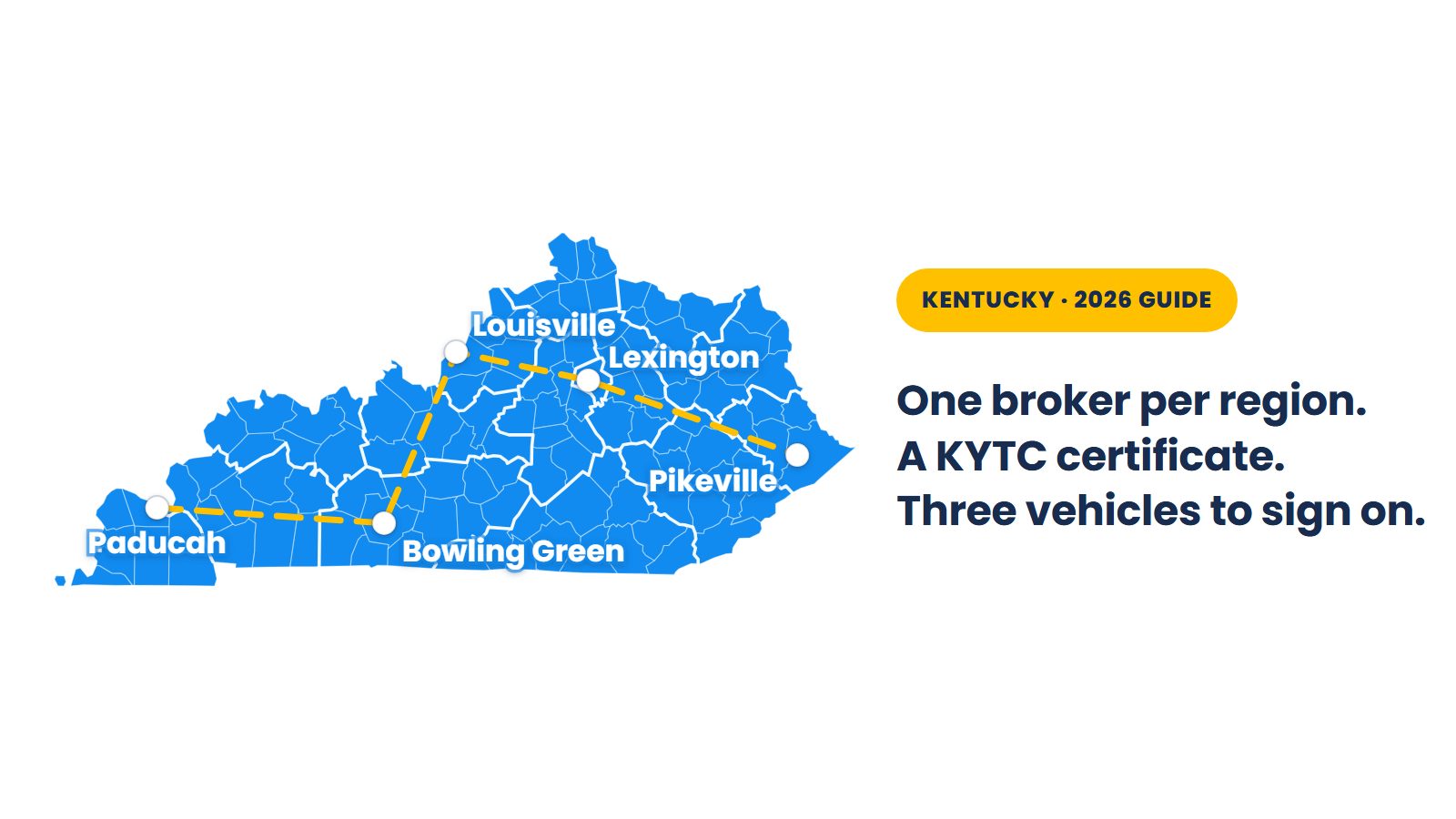
Kentucky has no NEMT license. To start a NEMT business in Kentucky, form an LLC ($40), get a Taxi or Disabled Persons Vehicle certificate from the Transportation Cabinet ($250 plus $30 a vehicle, up to 14 business days), and start on private-pay and facility trips. Medicaid rides go through one broker in each of 15 regions, and the Cabinet asks new companies for three vehicles and three drivers. Budget about $27,200 for one financed wheelchair van and six months of bills.
Kentucky at a glance:
- No NEMT license: a Taxi or Disabled Persons Vehicle (DPV) certificate from the Transportation Cabinet’s Division of Motor Carriers costs $250 plus $30 a vehicle [1][2].
- One broker per region: as of November 2026, eight Kentucky community action and transit agencies hold the 15 regions, and no national broker holds one [3].
- Three and three: the Cabinet asks new companies in its Medicaid ride program for three active, approved drivers and three operational vehicles [4], though the program’s regulation doesn’t list that minimum [5].
- State-set pay: one Cabinet rate per certificate type in each region, the same for every company, paid within three business days of the Cabinet paying the broker [5][6].
- Insurance floor: $100,000/$300,000/$50,000 for seven or fewer regular seats, filed by your insurer on a Form E [7][15].
- The 2026 law: HB 2 gave brokers GPS duties, a loss-ratio floor and a 2% withhold, made hospitals and nursing homes that drive their own patients eligible for broker pay, and ordered a study due December 31, 2026 [8][9].
My rule of thumb is three vans before you apply to a broker. Kentucky’s Transportation Cabinet writes its own version down: every new company in its Medicaid ride program “must maintain a minimum of three (3) active, approved drivers,” to go with three operational vehicles [4]. The certificate that lets you carry paying riders is quick by comparison. So in Kentucky, your first paid trips come from hospitals, nursing homes and families, and van three is what opens the broker’s door.
There’s real volume behind that door. Kentucky Medicaid had 1,350,962 members in August 2026, per the Department for Medicaid Services (DMS), and its broker program carried 3,363,272 trips in the 2025 state fiscal year [10][11].
I run Duet, which builds dispatch software and runs growth services for non-emergency medical transportation (NEMT) businesses, and this is the Kentucky edition of our national guide on how to start a NEMT business. Requirements change, so confirm against the linked sources before you spend money.
The checklist comes first, then who pays and how the broker lane works, then the rules, then getting into the broker lane, and last, cost and time.
The one-page checklist: steps to start a NEMT business in Kentucky
Run one certified van on your own trips, and sign with the broker at three vans and three drivers. Each phase ends with the money at risk, from our national one-van budget with Kentucky’s fees swapped in, and a count of vans toward the Cabinet’s three.
Phase 0: find your broker and your first riders
- Your broker: look up your county on the Cabinet’s broker listing and call that broker. Ask whether it’s signing new subcontractors [3].
- Your first riders: call five nursing homes and two hospital discharge planners near you, and ask who books their weekend and evening rides.
- Your vehicle: it picks your certificate. A sedan or minivan for riders who walk runs on a Taxi certificate, and a van with a lift or ramp runs on a DPV certificate [4].
- Money at risk: nothing yet. Vans: 0 of 3.
Phase 1: form the company
- File articles of organization with the Secretary of State for $40. The annual report costs $15 a year [12].
- Get a free employer identification number (EIN) and a free national provider identifier (NPI) under the NEMT taxonomy code, 343900000X. Your Medicaid applications will ask for both [13].
- Money at risk: about $340, counting $300 for a phone and basic marketing. Vans: 0 of 3.
Phase 2: line up van one and its Form E
- Pick the van before you apply. Motor Carriers wants “at least one vehicle available” before it grants a certificate [2].
- Insure it, and have your insurer file a Form E, its proof of your coverage, with Motor Carriers before you apply [2].
- Title the van with your county clerk and pay the 6% usage tax on the price [14].
- Money at risk: about $14,000 more with the van financed, so about $14,300 in. That’s $6,600 down on our model’s $33,000 wheelchair van (2016-2019), about $2,010 of usage tax, title and registration, $4,350 of insurance at signing and $1,000 of equipment. Vans: 1 of 3.
Phase 3: get the certificate
- Have an automotive technician certified by the National Institute for Automotive Service Excellence (ASE) inspect the van, and keep the form for three years [15].
- Run a nationwide background check on everyone who’ll drive, you included, through a company on the Cabinet’s approved list [16].
- Get a USDOT number, a free federal carrier ID, if the van is 10,001 pounds or more or carries more than eight passengers for pay, counting the driver [15].
- Apply for Taxi or DPV authority on the Cabinet’s Motor Carrier Portal, or call Motor Carriers at 502-564-1257, and allow up to 14 business days [2][4].
- Money at risk: $280 for the certificate and the van’s license, plus about $1,000 for one driver’s screening and training, so about $15,600 in. Vans: 1 of 3.
Phase 4: run private-pay and facility trips
- Start once your certificate and vehicle credentials arrive.
- The same week, put up a website families can book on, claim your Google Business Profile and visit the facilities you called in Phase 0.
- Take a card at booking and charge it at least 24 hours before pickup.
- Market only the rides facilities and families pay for. The broker program’s rule says, “A subcontractor shall not solicit for assignment of nonemergency Medicaid trips” [5].
- Money at risk: six months of fixed bills, about $11,600 with the van financed, for a total of about $27,200. Vans: 1 of 3.
Phase 5: add vans two and three, then go to the broker
- Add a van when your trips fill the last one. In our model, each added van and driver costs about $26,500 with six months of its bills.
- Have workers’ comp in place before your first hire, because Kentucky requires it from the first employee [17].
- With three vans and three drivers, ask your broker for its review [4].
- Money at risk: about $80,200 for the three-van start, before payroll and workers’ comp. Vans: 3 of 3.
That’s about $53,000 more than one van, which is why the broker comes last.
Who pays for NEMT rides in Kentucky?
Three payers buy NEMT rides in Kentucky: Medicaid, through the broker in each of 15 regions; hospitals and nursing homes; and families paying out of pocket. This section takes them in the order a one-van company can reach them: hospitals and nursing homes, families, then Medicaid at van three.
Hospitals and nursing homes: the rides outside the broker program’s hours
Kentucky’s broker rides run on a set schedule, and the hours outside it are where I’d look for a new company’s first facility calls. Apart from urgent care, which runs around the clock, broker rides run 6 a.m. to 8 p.m. on weekdays and 8 a.m. to 1 p.m. on Saturdays, and they stop on six holidays [5]. Hospital discharges skip the usual 72 hours’ notice, but only inside those hours. Brokers can add after-hours trips for special cases, like dialysis or chemotherapy offered only on nights and weekends.
So a Saturday-afternoon discharge, a Sunday appointment or an 8:30 p.m. ride home falls outside routine broker hours. Who pays for those rides is between the hospital and the family, which makes the discharge planner your first call. In Louisville, Norton Healthcare tells its patients a wheelchair van costs $45 or the meter rate, whichever is higher, paid at the time of transport [18].
Nursing homes are the other half. Kentucky has 266 of them with 25,380 certified beds, 39 of the homes in Jefferson County, by CMS’s October 2026 count [19]. A 2026 law makes a nursing home or hospital that drives its own residents or patients eligible for the broker’s mileage rate on their Medicaid rides [8]. So ask what the home’s own van can’t cover, and pitch only rides the facility or the family pays for. Kentucky’s nine PACE programs (the Program of All-Inclusive Care for the Elderly), all opened since 2022, are worth the same call [20].
Don’t count on dialysis centers as accounts. Dialysis rides are great, but in my experience most dialysis riders are on Medicaid, so their trips go through the broker.
That’s why Phase 0 has you calling five nursing homes and two discharge planners this week: ask each who books its Saturday-afternoon, Sunday and evening rides. Our guides to whether nursing homes drive residents to appointments and who pays for a hospital discharge ride go deeper.
Families: the price to beat is the broker’s own public fare
Families pay you directly, at your price, and in much of rural Kentucky they already know a cheap ride: the broker’s own public transit. Bluegrass Community Action Partnership charges the general public $1.75 a mile with a $5 minimum. Rural Transit Enterprises Coordinated charges $1 a mile with a $4 minimum, and GRITS $1.10 a mile with a $4 minimum inside Region 3 [21]. Those are public-transit fares, not NEMT company rates, but they’re the number a rural family may compare you to.
Price above them by what you add, like a lift or a ride at 6 p.m. on a Saturday. I said as much on our 2025 episode about running a 30 percent margin. When you’re the first NEMT company in a rural area, “it may come down to what you think you can offer and then you adjust from there.”
Take the card at booking and charge it at least 24 hours before pickup, or send a payment link that’s due by then. No payment, no van. Our guide to pricing and collecting private-pay fares has the rest.
Medicaid: the volume, waiting at van three
Medicaid is the biggest payer, and Kentucky carves its Medicaid van rides out of the health plans and runs them through the brokers. Kentucky’s capitated payments for the program, a set amount per member each month, came to $174,953,006 in the 2025 state fiscal year, for 3,363,272 trips [11].
Almost every member rides through the broker, in a health plan or not. The regulation leaves out “a qualified Medicare beneficiary (QMB) or a Phase 3 KCHIP recipient,” KCHIP being the Kentucky Children’s Health Insurance Program, and stretcher riders sit outside the program [5]. Riders book at least 72 hours ahead. One who owns a car can still qualify with a note from a clinician, employer, school, mechanic or transportation authority saying the car isn’t operable or usable [22].
Private companies carry a big share of those trips. In fiscal 2023, 39% were taxi-class trips, the class for-profit companies run, against 35% on nonprofit transit, and wheelchair trips were another 15% [23]. That volume is what waits for van three.
Who is the NEMT broker in Kentucky?
Eight Kentucky community action and transit agencies are the state’s Medicaid NEMT brokers, one in each of 15 regions, under contract to the Transportation Cabinet, as of November 2026 [3]. No national broker holds a Kentucky region. DMS contracts with the Cabinet to run the Human Service Transportation Delivery program, and the Cabinet hires one broker per region through competitive bids [11]. DMS pays a capitated amount per member each month, set region by region [22].
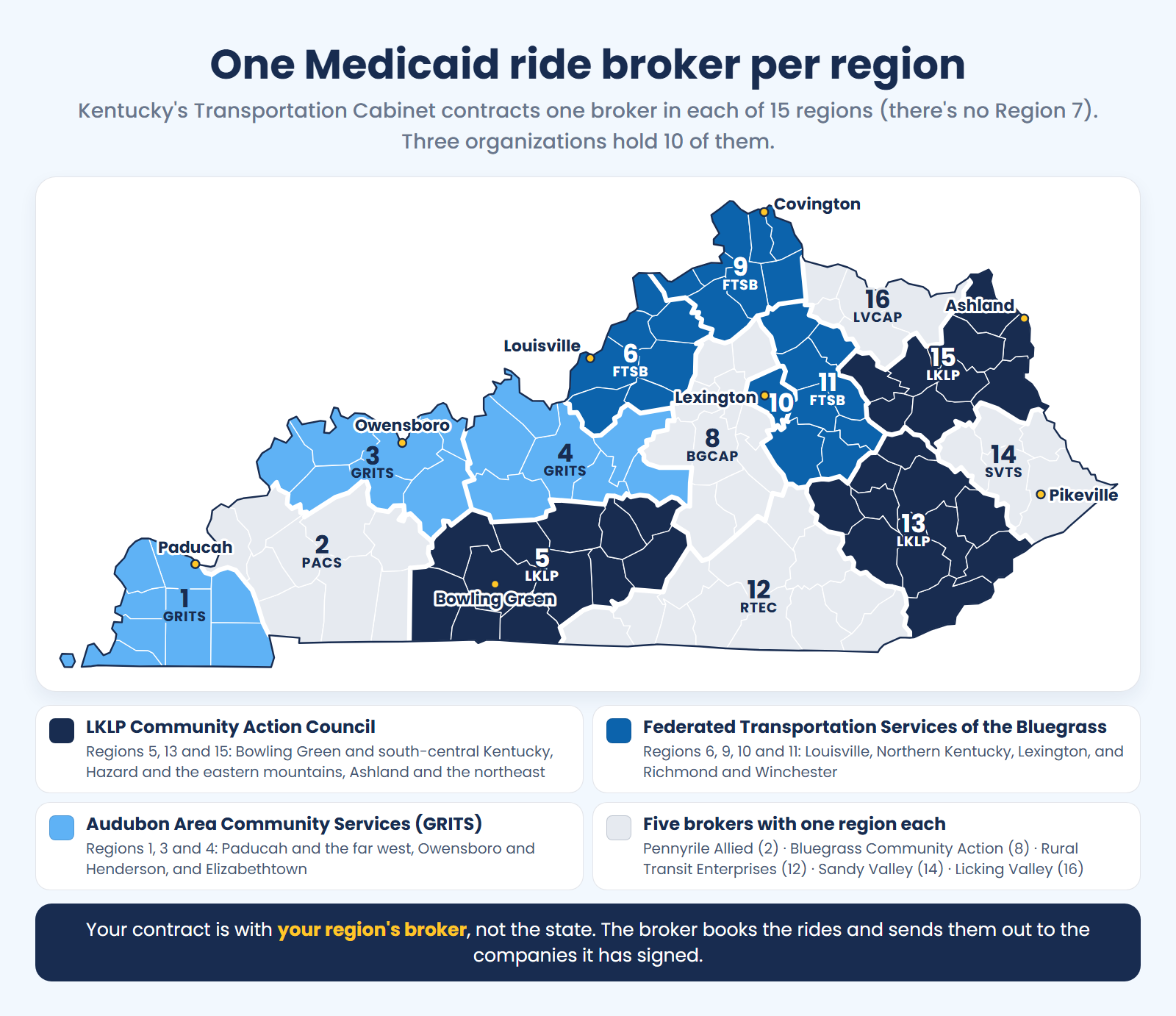
Three organizations hold 10 of the 15 regions. LKLP Community Action Council has Regions 5, 13 and 15, around Bowling Green, Hazard and Ashland. Federated Transportation Services of the Bluegrass (FTSB) has 6, 9, 10 and 11: Louisville, Northern Kentucky, Lexington, and Richmond and Winchester. Audubon Area Community Services, which runs its rides as GRITS, has 1, 3 and 4, around Paducah, Owensboro and Elizabethtown. Five more brokers hold one region each, and the numbers skip 7 because regions 6 and 7 were consolidated [24].
Here are all 15, as the Cabinet’s listing showed them in November 2026 [3]:
| Region | Broker | Counties | Toll-free line |
|---|---|---|---|
| 1 | Audubon Area Community Services (GRITS) | Ballard, Calloway, Carlisle, Fulton, Graves, Hickman, Marshall, McCracken | 1-844-575-9676 |
| 2 | Pennyrile Allied Community Services (PACS) | Caldwell, Christian, Crittenden, Hopkins, Livingston, Lyon, Muhlenberg, Todd, Trigg | 1-800-467-4601 |
| 3 | Audubon Area Community Services (GRITS) | Daviess, Hancock, Henderson, McLean, Ohio, Union, Webster | 1-800-816-3511 |
| 4 | Audubon Area Community Services (GRITS) | Breckinridge, Grayson, Hardin, Larue, Marion, Meade, Nelson | 1-844-870-4646 |
| 5 | LKLP Community Action Council | Adair, Allen, Barren, Butler, Edmonson, Green, Hart, Logan, Metcalfe, Simpson, Taylor, Warren | 1-800-245-2826 |
| 6 | Federated Transportation Services of the Bluegrass (FTSB) | Bullitt, Henry, Jefferson, Oldham, Shelby, Spencer, Trimble | 1-888-848-0989 |
| 8 | Bluegrass Community Action Partnership (BGCAP) | Anderson, Boyle, Casey, Franklin, Garrard, Jessamine, Lincoln, Mercer, Scott, Washington, Woodford | 1-800-456-6588 |
| 9 | Federated Transportation Services of the Bluegrass (FTSB) | Boone, Campbell, Carroll, Gallatin, Grant, Kenton, Owen, Pendleton | 1-888-848-0989 |
| 10 | Federated Transportation Services of the Bluegrass (FTSB) | Fayette | 1-888-848-0989 |
| 11 | Federated Transportation Services of the Bluegrass (FTSB) | Bourbon, Clark, Estill, Harrison, Madison, Montgomery, Nicholas, Powell | 1-888-848-0989 |
| 12 | Rural Transit Enterprises Coordinated (RTEC) | Bell, Clinton, Cumberland, Knox, Laurel, McCreary, Monroe, Pulaski, Rockcastle, Russell, Wayne, Whitley | 1-800-321-7832 |
| 13 | LKLP Community Action Council | Breathitt, Clay, Harlan, Jackson, Knott, Lee, Leslie, Letcher, Owsley, Perry, Wolfe | 1-800-245-2826 |
| 14 | Sandy Valley Transportation Services (SVTS) | Floyd, Johnson, Magoffin, Martin, Pike | 1-800-444-7433 |
| 15 | LKLP Community Action Council | Bath, Boyd, Carter, Elliott, Greenup, Lawrence, Menifee, Morgan, Rowan | 1-800-245-2826 |
| 16 | Licking Valley Community Action Program (LVCAP) | Bracken, Fleming, Lewis, Mason, Robertson | 1-800-327-5196 |
That’s the call from Phase 0: find your county’s row and call that broker this week.
Kentucky’s brokers also drive, under the federal waiver the program runs on [24]. When a rider doesn’t name a company, the rule assigns trips by coordination, then cost, then by “rotating certificate type 07 and certificate type 08 trips among providers, including the broker” [5]. Type 07 trips are for disoriented riders who may need an escort, and Type 08 trips for wheelchair riders.
Massachusetts also runs its Medicaid rides through regional brokers, but its brokers can’t drive riders themselves, so they subcontract. Kentucky’s broker contracts run a year at a time with up to four one-year renewals, and each region is bid on its own timeline [5][24]. When other states changed brokers, trips changed hands fast, as our 2026 log of broker changes shows. Our state-by-state map of who arranges Medicaid rides shows the rest.
What did Kentucky’s 2026 NEMT law change?
HB 2 wrote Kentucky’s regional broker model into its Medicaid law, effective April 14, 2026, the day lawmakers overrode the governor’s line-item vetoes [9]. The Act created KRS 205.5363 and ordered a study, and six parts of it matter to a subcontractor [8]:
- The model: the program must “Be administered under a regional brokerage delivery model.”
- A loss-ratio floor: brokers must reach a medical loss ratio of at least 85% for the year that began July 1, 2026, and 90% from July 1, 2029. A broker that falls short pays back the excess capitation.
- GPS: every vehicle on Medicaid trips needs a GPS device that lets the broker find it “at all times when the vehicle is being operated to provide nonemergency medical transportation services.” The cost “shall be borne by the regional broker.”
- A 2% withhold: 2% of each broker’s capitation is held back, and the broker can earn it back in full or in part on measures that include completed, canceled and delayed trips, average trip time and rider satisfaction.
- Facilities: a skilled nursing facility or hospital may drive its own residents or patients and be eligible for pay from the broker “at the same mileage rate” a driver under contract to the broker would get. That replaced a 2025 law that let facilities drive residents only after the broker had first chance, with no Medicaid pay [25].
- A study: the Medicaid Oversight and Advisory Board must explore “alternative administration and delivery models” and report by December 31, 2026, though the Legislative Research Commission can move that date [9].
The Act also lets DMS hold off on parts that need federal approval until the approval comes [9]. Ask your broker how it’ll handle the GPS devices before you sign.
Can I bill Kentucky Medicaid directly for NEMT rides?
No: Kentucky van companies invoice their regional broker, and the broker pays them. The broker takes the trip reservations and sends trips out to approved companies. The Cabinet’s provider page is plain about the money: “The transportation provider’s contract is with the Broker, not the Commonwealth,” and “Providers will invoice the Broker once the trips are complete” [4].
The Cabinet sets what you’re paid. Under 603 KAR 7:080, it sets provider rates for each certificate type in each delivery area, and those rates “shall be uniform for the same certificate types for all eligible providers, including the broker in each delivery area” [5]. Brokers get 45 days’ notice of a change, and the Cabinet’s fiscal 2023 report said subcontractor rates “are subject to quarterly review” [23]. Neither the rule nor the Cabinet’s provider page lists the rates themselves. Your subcontract has to state “The rates for services,” so ask your broker for the current rate for each certificate type and get it in writing before you sign. Our guide to what one van makes per month, by payer shows how a per-trip rate turns into a month.
If every deadline holds, a trip you run on March 3 gets paid around April 20. Invoice it by April 1, since an invoice dated after the first of the month waits for the next month’s billing. The broker reports to the Cabinet by April 7, the Cabinet pays the broker by April 15, and the broker pays you within three business days [5][6]. That’s up to about seven weeks from a trip to its check, so hold six months of fixed bills before you start. You have six months from each trip to invoice it.
You still need your own Medicaid number. The regulation defines an eligible provider as one that has “contracted with the regional broker, obtained a valid Medicaid provider number from the Department for Medicaid Services, and been approved by the cabinet” [5]. Stretcher trips are the one exception to the broker rule, and they’re ambulance work.
Uniform rates cut both ways. You can’t negotiate a better one, but a broker can’t lowball a new company either, at least on paper.
What licenses and requirements does a NEMT business need in Kentucky?
Kentucky has no NEMT license: you need a Taxi or DPV certificate from the Transportation Cabinet’s Division of Motor Carriers under KRS 281.630 [1]. That puts Kentucky with most of the states in our national guide to NEMT licenses. The statute lists 13 kinds of certificate, and none is for medical transportation. Each is “a certificate of compliance,” issued to “any qualified applicant” who meets the chapter’s rules.
Which one you need depends on the vehicle:
- Taxi: for a vehicle “designed or constructed with not more than eight (8) regular seats,” the usual sedan or minivan for riders who walk [1].
- DPV: for a vehicle built to the federal accessibility standard in 49 CFR part 38, with an integrated lift or ramp and up to 15 regular seats [2]. A DPV can carry riders who walk, too. The Cabinet’s page says, “The only real difference between the two authorities is that under DPV, all vehicles must be wheelchair lift or ramp equipped” [4].
The Cabinet’s NEMT steps name only Taxi and DPV authority, and a taxicab tops out at eight regular seats. So ask Motor Carriers which certificate fits an ambulatory van with 9 to 15 seats before you buy one. Both certificates renew every year for $250, plus $30 a vehicle [1].
Broker work adds a vehicle list. The broker program’s rule wants each vehicle to meet the Americans with Disabilities Act and carry two belt extensions, a belt cutter, an extinguisher, three triangle reflectors, first aid and spill kits, and maps or a GPS device [5]. Your company’s legal name goes on both side doors in 2-inch block letters. A van with a floor more than 12 inches up needs a step or a step stool, and the rule specifies the stool down to its legs and tread. It must “Not be milk crate or similar substitute.” (Presumably someone tried.) Every vehicle also needs a yearly inspection by an automotive technician.
What do other Kentucky guides get wrong?
Here’s what circulates about Kentucky, next to what the state actually requires:
| The claim you’ll read elsewhere | What Kentucky actually requires |
|---|---|
| ”you must comply with regulations set by the Kentucky Public Service Commission (PSC)“ | The Transportation Cabinet’s Division of Motor Carriers issues the Taxi or DPV certificate [4] |
| “NEMT Model: Managed care,” or Kentucky is “not fully brokered” | DMS contracts the Transportation Cabinet, which hires one broker per region, and every member rides through it except QMBs, KCHIP Phase 3 children and stretcher riders [11][5] |
| “Medicaid Fee-for-Service: Direct reimbursement from Medicaid for eligible trips” | Van companies “invoice the Broker”; only stretcher trips bill DMS or a health plan, and they need an ambulance license [4][24][26] |
| Kentucky’s brokers are “big players” like Modivcare | Eight Kentucky community action and transit agencies hold the 15 regions, and no national broker holds one [3] |
| Kentucky’s broker program has “16 Regions” | Fifteen regions numbered 1 to 16, with no Region 7, held by eight brokers [3] |
| “Enter the Medicaid Partner Portal Application (MPPA) system to register as an approved provider,” before any broker | The certificate and vehicles come first, then the broker signs page 12 of each Medicaid application, and then you file in the portal [4][13] |
| Drivers need “First Aid, CPR, and defensive driving” and are “typically 21+ or 25+ per broker policy” | The rule asks for first aid, blood-borne pathogens and passenger assistance training, and drivers 18 or older; the Cabinet adds “minimum trainings” [5][4] |
| Insurance “typically starts at general liability ($100,000)“ | Each vehicle’s auto floor is $100,000/$300,000/$50,000 at seven or fewer regular seats and $100,000/$600,000/$50,000 at eight or more [7] |
| “Build direct relationships with local nursing homes, adult day care centers, dialysis clinics, and hospitals for private-pay or facility-contracted rides” | Half right: most dialysis riders are on Medicaid, and “A subcontractor shall not solicit for assignment of nonemergency Medicaid trips,” so pitch only the rides a facility or family pays for [5] |
What do Kentucky cities and counties add?
Your city may add rules, and your city or county will likely add a tax. Under KRS 281.635, a first-class city, a city of 20,000 or more, any city in a county with either, and an urban-county government like Lexington-Fayette share “concurrent supervisory and regulatory power” over taxicab and DPV carriers operating from the city [28]. That power includes permits for their drivers. The statute keeps cities away from a vehicle operated “as a human service transportation delivery vehicle under a contract with the Transportation Cabinet.” Your contract is with the broker, though, so ask your city whether that covers your van on broker trips, and plan on its rules for your private-pay rides. Cities and counties can also charge up to $30 a vehicle a year [1].
Then there’s the occupational license tax. As of January 2026, 87 counties taxed payroll at 0.5% to 2.5%, per the Kentucky Association of Counties, and cities add their own, like Bowling Green’s 2% [29]. So ask each city and county you’ll work in how to register before your first private-pay ride, starting with Louisville Metro or the Lexington-Fayette Urban County Government in those cities.
A paid trip across a state line is interstate, which usually means federal operating authority, a USDOT number and $1.5 million of liability for a vehicle seating 15 or fewer, counting the driver [30]. That comes up fast in Louisville, Northern Kentucky and Hopkinsville, on the Indiana, Ohio and Tennessee lines. Our Indiana guide covers the Louisville crossing into Southern Indiana, and our Tennessee guide the Clarksville side of the line.
What are the NEMT insurance requirements in Kentucky?
Quote each van twice before you buy it: once at Kentucky’s floor of $100,000 per person, $300,000 per accident and $50,000 of property damage, and once at $1 million. The floor covers a vehicle with seven or fewer regular seats, and at eight or more the per-accident limit rises to $600,000 [15]. Your insurer files it with Motor Carriers on a Form E before the certificate issues, and the insurer stays on the hook until it gives the Cabinet 30 days’ notice of cancellation [7].
The broker program’s rule names no dollar amount. It asks only for “Proof of insurance” and “proof of Kentucky workers’ compensation insurance coverage” [5]. The law also bars a broker from “imposing any requirement on any subcontractor that is not provided for” in Kentucky’s motor carrier chapter or a regulation [41].
Our national model prices a new company’s wheelchair van at about $17,400 a year for about $1 million of auto liability: $4,350 at signing, then ten installments of $1,305. Our guide to what a brand-new company pays for coverage shows where those numbers come from.
Workers’ comp starts with your first employee. Kentucky requires it of every employer with one or more employees, counting family, temporary and part-time workers, and the Education and Labor Cabinet’s fines run $100 to $1,000 per employee for each day without it [17]. Your broker collects proof of it too, so ask what it accepts from a company where the owner is the only driver [4].
What do NEMT drivers need in Kentucky?
NEMT drivers in Kentucky don’t need a commercial driver’s license (CDL) for a typical van, but every Taxi or DPV driver needs a background check under KRS 281.6301. A CDL starts at a vehicle designed to carry 16 or more passengers, counting the driver [16]. Taxi and DPV drivers need a valid operator’s license from Kentucky or another state, and broker work wants a Kentucky license for the vehicle they drive [28][5].
The check is nationwide, paid for by you, finished before the driver starts, run by a company on the Cabinet’s approved list, and kept for three years [16]. Some convictions rule a driver out for good, like a Class A or B felony, a sex crime, leaving the scene of an accident or a death caused by negligent driving. Others count for three years, like driving on a suspended license, going 26 mph or more over the limit, or four speeding or points convictions.
Once you hire, budget about $16 an hour: the Bureau of Labor Statistics put Kentucky’s median wage for shuttle drivers and chauffeurs, the category NEMT drivers fall under, at $16.14 in May 2025 [31].
What training does a Kentucky broker require of drivers?
For broker work, 603 KAR 7:080 sets the driver file, and the Cabinet adds a statewide drug and alcohol random pool [5][4]:
- Age: 18 or older.
- License: a Kentucky license for the vehicle they drive.
- Driving record: no more than two moving-violation convictions in the last three years.
- Criminal record: no conviction for a sexual crime or a crime of violence. A driver or escort with any misdemeanor or felony conviction in the last five years needs approval from the broker, your company and the Cabinet.
- Drug tests: a pre-employment drug test, then random drug and alcohol testing, under a drug and alcohol policy your company develops.
- Training: first aid, blood-borne pathogens and passenger assistance, plus intellectual or developmental disability awareness if the Cabinet offers it.
- ID: a name tag and a company photo ID.
CPR isn’t on the rule’s list. The Cabinet’s page adds that “minimum trainings must be obtained as well,” so ask your broker which ones apply [4].
Drivers, not vans, are the hard half of three and three. On a 2025 demo, a Kentucky owner told me the company had one driver, “which right now is me,” and wanted to hire two or three more. Start recruiting drivers the week you buy van two.
Can a NEMT company run stretcher van trips in Kentucky?
Not on Medicaid trips: Kentucky’s Medicaid stretcher rides are ambulance work. The DPV definition says a DPV “shall not mean an ambulance” and “shall not mean a motor vehicle equipped with a stretcher” [1]. Kentucky’s ambulance license classes include no stretcher van. Non-911 work falls under Class IIa, “A ground ambulance provider operating at the ALS or BLS level, or both, to provide interfacility care and nonemergency care and transportation,” meaning advanced or basic life support [27].
Licensing starts with a certificate of need. The Kentucky Board of Emergency Medical Services (KBEMS) sends a new ambulance service to the state’s Division of Certificate of Need first, to decide whether the service is needed. Then come a medical director, protocols and an inspection [27].
Who pays depends on the rider’s plan. Members of a Medicaid health plan get stretcher rides through that plan, and members outside managed care get them fee-for-service [24]. Humana’s Kentucky Medicaid plan, for one, covers non-ambulatory stretcher rides with prior authorization, and no other non-emergency rides [32]. For fee-for-service members, DMS pays up to $55 a trip plus $2 a mile in 2026 [26].
Next door, Tennessee licenses stretcher vans as an “invalid service,” while Ohio, like Kentucky, sends stretcher riders by ambulance. Before you buy a stretcher van for private-pay work, get KBEMS’s answer in writing at 502-764-1503.
How do you become a Medicaid transportation provider in Kentucky?
Kentucky enrolls van companies through the broker, which signs their Medicaid application. The Cabinet’s order runs certificate and qualified vehicles first, then the broker for your county, then one Medicaid application per service type, then the Cabinet’s go-ahead [4].
Step one: call the broker for your county
Once your certificate is in hand and your vehicles are qualified, the Cabinet’s page says to “contact the Regional Broker for the county in which the transportation company intends to operate” [4]. Tell it you have your certificate and want to subcontract. That call is the Cabinet’s own step, so make it. The rule’s ban is on soliciting Medicaid trips [5], and a DMS rule adds that a company that self-refers or solicits a rider who has transportation of their own can be excluded from NEMT [22].
What if I have only one or two vans?
With one or two vans, you’re early for Kentucky’s broker lane, by the Cabinet’s own page. It says all new providers in the program “must maintain a minimum of three (3) active, approved drivers in the program to correspond with the minimum of three (3) operational, passenger vehicles” [4]. The regulation that runs the program, 603 KAR 7:080, lists no fleet or driver minimum in its text [5].
So before you buy van two to reach that number, call the Office of Transportation Delivery at (502) 564-7433 and ask how the Cabinet applies the minimum [4].
I wouldn’t buy vans just to hit the number. As I said on our episode about sustainable NEMT growth, “nobody wants to buy a couple vehicles, have them sitting here idle, paying insurance, paying drivers. That’s absolutely the worst position to be in.” Add vans as your own trips fill them.
What you can do early is get ready. The broker signs your Medicaid application, so nothing gets filed until it does. Have your certificate, NPI, driver files and a record of facility and private-pay trips ready for the day van three arrives.
Step two: pass the broker’s review
The broker reviews the contract with you, inspects your vehicles, and takes copies of your insurance, registrations, workers’ comp verification, certificate and fee receipt cards [4]. Every employee and driver goes into the statewide drug and alcohol random pool, and every safety-sensitive employee needs a background check and pre-employment drug and alcohol tests. Before your first trip you’ll sit through the broker’s orientation, and the Cabinet has to approve each subcontract [5].
Step three: file one MAP 811 per service type
Kentucky Medicaid’s provider application is the MAP 811, and you file one for each service type you’ll run, as Provider Type 56 [4]:
- Type 02, ambulatory, for-profit: specialty 263.
- Type 04, ambulatory bus, nonprofit: specialty 262, used by a nonprofit in place of Type 02.
- Type 07, escort: specialty 264, for disoriented riders who may need an escort.
- Type 08, wheelchair: specialty 265.
A for-profit company carrying all three kinds of riders files three, for Types 02, 07 and 08. Print each one, sign it, and take it to your broker for its signature on page 12. DMS’s checklist says, “Electronic or stamped signatures are not accepted,” and it wants verification of your NPI and taxonomy code [13].
Then upload each application in the Kentucky Medicaid Partner Portal Application (KY MPPA), with your certificate, which the Cabinet’s page calls your “license” [4]. Provider Type 56 isn’t on DMS’s list of provider types that owe the 2026 application fee [13].
Step four: give the broker your Welcome Letters
Once DMS approves you, print the Welcome Letter for each service type, which carries your Medicaid provider number, and give your broker a copy. The broker sends your file to the Office of Transportation Delivery and hears back when you’re in the system to begin service [4]. Don’t run Medicaid trips before your effective date: DMS’s application says services before it are “at your own financial risk” [13].
How long does it take to get into the broker lane?
Kentucky’s broker lane has no published clock. Neither the Cabinet’s page nor the regulation puts a time on the broker’s review or on Medicaid enrollment, so ask your broker how long its last new subcontractor took [4][5].
That’s the catch-22: the broker lane wants three vans and three drivers, and you need trips to pay for them. The facility and private-pay rides from the who-pays section are the ones that pay for vans one and two. Our guides to landing a nursing home or rehab as an account and turning a facility’s yes into its first booked ride cover that stretch. Our state-by-state guide to becoming a Medicaid ride provider shows how other states order these steps.
Don’t build the whole schedule on one payer
Once you’re in, Kentucky’s broker lane is steady, but 2027 could move it. The steady part is real. The Cabinet sets one rate per certificate type for everyone in a region, and brokers pay within three business days of the Cabinet. Riders can ask for you by name, and wheelchair and escort trips rotate among companies when nothing else decides [5][6]. Christopher Buell, who grew his first NEMT company to about 11 vans on private pay, said on our episode about calling facilities, “you should take a look at all brokers. Maybe your area is great.”
Four things could move it, and each is on the record:
- A study: HB 2 told the Medicaid Oversight and Advisory Board to report on other ways to run NEMT by December 31, 2026 [9].
- The waiver: DMS asked federal regulators to renew the waiver the program runs on through March 31, 2027 [24].
- Broker money: under the 2026 law, the loss-ratio floor rises every July through 2029, and 2% of each broker’s capitation rides on performance [8].
- Membership: that board’s June 2026 minutes record DMS’s chief financial officer stating that “roughly 20% of enrollees subject to the new requirement will not meet the new requirements beginning January 1, 2027,” meaning the new community engagement rules [33].
None of these has to cost you a trip, but each is a reason to keep facility and private-pay rides on the board, since those are the riders you’re allowed to go find.
However you dispatch, keep all three lanes on one schedule. Dispatch software like Duet puts your regional broker’s trips on the same board as your facility and private-pay rides. If your broker’s system can export a trip file, its trips usually come in by trip file import or bulk upload; ask us about your broker. You still hold the certificate, the broker contract and the Medicaid enrollment yourself.
How much does it cost to start a NEMT business in Kentucky?
Budget about $27,200 for one financed 2016-2019 wheelchair van and six months of bills, and about $80,200 for the three-van start the broker lane wants, before payroll. Kentucky’s inputs are its fees and its 6% usage tax. The rest comes from our national startup model. Its inputs are hypothetical but typical: a $33,000 van (the September 2026 dealer median for 2016-2019 wheelchair vans), 80% financed at 14% over 60 months, and $17,400 a year of insurance per van.
| Line item | One van | Three vans |
|---|---|---|
| LLC articles of organization [12] | $40 | $40 |
| EIN and NPI | $0 | $0 |
| ”NEMT license” | $0 | $0 |
| Taxi or DPV certificate, plus $30 a vehicle [1] | $280 | $340 |
| Medicaid application fee, Provider Type 56 [13] | $0 | $0 |
| Van down payments, 20% | $6,600 | $19,800 |
| Usage tax (6%), title and registration [14] | $2,010 | $6,029 |
| Equipment and lettering | $1,000 | $3,000 |
| Driver screening and training | $1,000 | $3,000 |
| Phone and basic marketing | $300 | $300 |
| Insurance due at signing | $4,350 | $13,050 |
| Six months of fixed bills | $11,604 | $34,632 |
| Total | About $27,200 | About $80,200 |
An older $20,000 van, if a lender will finance one, brings those totals down to about $22,400 and $65,700. Each van and driver you add to the one-van start costs about $26,500 with six months of its bills, and our guide to what a second van adds to a budget shows the method.
Payroll, workers’ comp, local license taxes and any local vehicle fee sit outside the totals. At Kentucky’s $16.14 median wage, every 100 hours a hired driver works costs $1,614 before payroll taxes [31]. Insurance is already the biggest cost: about $12,200 of the one-van total and $36,500 of the three-van one.
How do you fund a NEMT startup in Kentucky?
Small Business Administration (SBA) microloans, up to $50,000 through intermediary lenders, are the main federal option at this size [34]. Kentucky adds the Small Business Development Center, which offers no-cost coaching and help finding capital, and the Cabinet for Economic Development’s KSBCI 2.0 programs, which work only through participating lenders. Three Kentucky community lenders also make small-business loans: Community Ventures across the state, Mountain Association in Eastern Kentucky and Kentucky Highlands in 22 southeastern counties. None of them speeds up the broker’s paperwork, so borrow against van three’s date.
How long does it take to start a NEMT business in Kentucky?
Plan on about a month from forming the company to a first private-pay trip if a van is ready to buy, with up to 14 business days of it at Motor Carriers [2]. The broker lane has no published clock. The order:
- Week one: form the LLC, get your EIN and NPI, and make the broker and facility calls from Phase 0.
- Weeks one and two: buy and insure the van, have your insurer file the Form E, and finish the inspection and background checks.
- Weeks two to five: apply for Taxi or DPV authority and wait up to 14 business days.
- When the certificate and the van’s credentials arrive: run facility and private-pay trips.
- As those trips fill each van: add vans two and three, then go through the broker’s review, the MAP 811s and the Welcome Letters.
- Three to seven weeks after your first broker trip: your first broker payment, depending on the day of the month you ran it, if every deadline holds [5].
So decide on money. If you can run three vans and three drivers for six months on facility and private-pay money, call your broker the week your certificate arrives. If you can’t, buy one van, get the certificate, and let van three open the broker’s door.
Kentucky NEMT FAQ
Can I carry paying riders before my certificate arrives?
No. Acting as a motor carrier without a certificate, or running a vehicle without its motor carrier vehicle license, carries a fine of $500 to $3,500 under KRS 281.990 [1]. Motor Carriers takes up to 14 business days, so book your first paid rides for after it arrives [2].
Can I start a NEMT business in Kentucky with my own car?
Yes, for riders who walk, once the car is on a Taxi certificate like any vehicle you’re paid to drive: inspected, insured at the state floor and licensed at $30 a year [1][7]. The Cabinet’s private auto program won’t fit a company. It pays private individuals, never a business, the state employee mileage rate, 49 cents a mile from October through December 2026, and the rider can’t be a family member or live in the same household [35].
Can a Medicaid rider ask the broker for my company?
Yes, once you’re an approved subcontractor in the rider’s region. The broker program’s rule says a participant “may select an eligible subcontractor or the broker for the area,” and the broker schedules with a participating provider when the rider names none [5]. What you can’t do is ask Medicaid riders to pick you: the same rule bars subcontractors from soliciting Medicaid trips.
Do I have to supply escorts on Medicaid trips?
Sometimes. When a rider’s clinician recommends an escort, KRS 281.873 makes the transportation provider supply one escort per vehicle, who picks the rider up, stays with them and walks them to the appointment [6]. Helping a rider to and from the van is the driver’s job when it takes less than five minutes and, with other riders aboard, the driver can keep the van in sight. Otherwise, you supply an escort for that help too [6]. A parent, guardian or escort rides free [5].
Do I owe the 6% usage tax on a used van?
Yes. Kentucky’s 6% usage tax applies to the use of every motor vehicle in the state, secondhand ones included, and the county clerk collects it when you title the van [14]. Moving a van you already own into your own LLC, as a member, is exempt with the paperwork, per the Department of Revenue’s guide for county clerks.
Does a Cincinnati, Evansville or Clarksville company need a Kentucky certificate?
For trips that start and end in Kentucky, yes: KRS 281.630 requires a certificate to act as a motor carrier, and every certificate holder must keep a Kentucky address on file [1]. DMS lets out-of-state providers enroll in Kentucky Medicaid [13]. A paid trip across the state line falls under federal rules, which usually mean their own authority and insurance floor.
Does Medicare pay for NEMT rides in Kentucky?
Original Medicare doesn’t. CMS’s claims manual says Medicare covers no “non-ambulance forms of transportation, such as ambulette, wheelchair van, or litter van” [36]. Some Medicare Advantage plans add rides through their own networks: Humana’s 2026 group plan for University of Kentucky retirees, for one, covers trips for members with kidney disease or cancer through in-network providers [37]. Ask each plan who runs its rides.
What does a Kentucky NEMT company owe each year?
For one van, about $490 in state items after the first year: the $250 certificate renewal, $30 for the van, the $15 annual report, the $175 minimum limited liability entity tax and about $20.50 of registration [1][12][14][38]. On top come vehicle property tax, owed by whoever owns the van on January 1, local license taxes and any local vehicle fee.
Is Kentucky a good state to start a NEMT business?
It can be, if you start with trips you control. Kentucky had 825,850 residents 65 or older in 2024 [39], and its broker program carried 3,363,272 trips in fiscal 2025 [11]. The field is filling in: 192 active NPIs in Kentucky carry the NEMT van code, and 91 of them were first issued in 2023 or later, by our count of the federal NPI file [40]. An NPI is a registration, not a working company. The catch is timing, with the broker study HB 2 set for December 31, 2026 and the waiver period DMS requested ending March 31, 2027.
Key official sources
[1] KRS 281.010, 281.630, 281.631, 281.6185 and 281.990, official LRC statute PDFs (read November 1 and 10, 2026): the 13 certificates the department issues, none for medical transportation; a certificate of compliance for “any qualified applicant”; the taxicab’s eight regular seats; the disabled persons vehicle’s 49 CFR part 38 equipment, 15 regular seats and stretcher exclusion; DPV service to riders who don’t need the equipment; the $250 application and yearly renewal; a Kentucky address on file; $30 a vehicle a year and local fees of up to $30; inspections kept three years; and the $500 to $3,500 fine. https://apps.legislature.ky.gov/law/statutes/statute.aspx?id=56537, https://apps.legislature.ky.gov/law/statutes/statute.aspx?id=56533, https://apps.legislature.ky.gov/law/statutes/statute.aspx?id=56497, https://apps.legislature.ky.gov/law/statutes/statute.aspx?id=44156 and https://apps.legislature.ky.gov/law/statutes/statute.aspx?id=56538
[2] Kentucky Transportation Cabinet, Division of Motor Carriers, Passenger Vehicle page (undated; read November 1, 2026, rechecked November 10, 2026): the insurer’s Form E before applying, at least one vehicle available, inspections and background checks before applying, the Motor Carrier Portal, up to 14 business days, and 49 CFR part 38 for disabled persons vehicles. https://drive.ky.gov/Motor-Carriers/Pages/Passenger-Vehicle.aspx
[3] Kentucky Transportation Cabinet, Human Service Transportation Delivery brokerage listing (undated; read November 1 and 10, 2026): the 15 regions, their counties, brokers and phone numbers. https://transportation.ky.gov/TransportationDelivery/Pages/Human-Services-Transportation.aspx
[4] Kentucky Transportation Cabinet, Office of Transportation Delivery, How to Become a Non-Emergency Medical (NEMT) Transportation Provider (undated; read November 1, 2026, rechecked November 10, 2026): the steps from company to Welcome Letter, Taxi or DPV authority, the broker’s review and the statewide random pool, the four service types and specialties, one MAP 811 per service type signed by the broker, the certificate as the “license”, the contract with the broker and invoicing, the three-driver and three-vehicle minimum for new providers, the ban on soliciting Medicaid trips, and the office’s phone. https://transportation.ky.gov/TransportationDelivery/Pages/Non-Emergency-Medical-Transportation-Provider.aspx
[5] 603 KAR 7:080, Human service transportation delivery, official LRC text (history through a certification effective April 25, 2025; read November 10, 2026): eligible providers, the excluded riders, broker contract terms, payment deadlines and invoice rules, orientation, Cabinet approval of subcontracts, the documents and contract terms, driver standards, the ban on soliciting Medicaid trips, vehicle equipment and inspections, program hours, holidays and discharges, drug testing, rider choice and trip rotation, and uniform Cabinet-set rates with 45 days’ notice. https://apps.legislature.ky.gov/law/kar/titles/603/007/080/
[6] KRS 281.873 and 281.875, official LRC statute PDFs (read November 1, 2026): escorts and door assistance on human service transportation trips, and broker reports by the 7th, the Cabinet’s payment by the 15th and broker payment to subcontractors within three business days. https://apps.legislature.ky.gov/law/statutes/statute.aspx?id=44180 and https://apps.legislature.ky.gov/law/statutes/statute.aspx?id=14444
[7] KRS 281.655, official LRC statute PDF (read November 1, 2026): minimum insurance per vehicle by seat count, on file before a certificate issues, and 30 days’ notice before cancellation. https://apps.legislature.ky.gov/law/statutes/statute.aspx?id=55499
[8] KRS 205.5363, official LRC statute PDF (effective April 14, 2026; read November 1, 2026): the regional brokerage model, capitation rules, medical loss ratio steps from 85% to 90%, GPS on every vehicle used for Medicaid rides, at the broker’s cost, the 2% withhold and its measures, and broker payment to skilled nursing facilities and hospitals at the same mileage rate. https://apps.legislature.ky.gov/law/Statutes/statute.aspx?id=57034
[9] 2026 Ky. Acts ch. 179 (HB 2) and its bill record (read November 1 and 10, 2026): line-item vetoes on April 13, 2026 and the override on April 14, the repeal of KRS 311A.172, delay of sections that need federal approval, and the Medicaid Oversight and Advisory Board’s NEMT study due December 31, 2026, which the Legislative Research Commission may reassign and redate. https://apps.legislature.ky.gov/law/acts/26RS/documents/0179.pdf and https://apps.legislature.ky.gov/record/26rs/hb2.html
[10] Department for Medicaid Services, Monthly Membership Counts by County (coverage month August 2026, run August 10, 2026; read November 10, 2026): 1,350,962 members. https://www.chfs.ky.gov/agencies/dms/stats/KYDWMMCC20260810.pdf
[11] Department for Medicaid Services and Kentucky Transportation Cabinet, Medicaid Non-Emergency Medical Transportation, presentation to the Budget Review Subcommittee on Health and Family Services (November 5, 2025; read November 1 and 10, 2026): DMS’s contract with the Cabinet under a 1915(b)(4) waiver, one broker per region by competitive bid, the Cabinet setting subcontractor rates, the excluded groups, 3,363,272 trips and $174,953,006 of capitated payments in state fiscal year 2025. https://apps.legislature.ky.gov/CommitteeDocuments/372/35694/Nov%205%202025%20NEMT%20PowerPoint.pdf
[12] Kentucky Secretary of State, Business Filings Fees (read November 1 and 10, 2026): $40 for LLC articles of organization and $15 for the annual report. https://www.sos.ky.gov/bus/business-filings/Pages/Fees.aspx
[13] Department for Medicaid Services, Non-Emergency Transportation Provider Type 56 summary (revised June 2023), MAP-811 checklist and application (Rev. 03 2019) and Application Fee page, all read November 10, 2026: the KY MPPA portal, the certificate and FEIN documents, the broker’s signature on page 12, no electronic or stamped signatures, NPI and taxonomy verification, services before the effective date at the provider’s risk, enrollment open to out-of-state providers, and the 2026 fee list, which doesn’t include Provider Type 56. https://www.chfs.ky.gov/agencies/dms/DMSProviderSummaries/Non-EmergencyTransportationPT56.pdf, https://chfs.ky.gov/agencies/dms/MAPForms/Map811.pdf and https://www.chfs.ky.gov/agencies/dms/provider/Pages/AppFee.aspx
[14] KRS 138.460, KRS 186.040, 186.050 and 186A.130, and the Department of Revenue’s Motor Vehicle Usage Tax guide for county clerks (2025), all read November 10, 2026: the 6% usage tax collected at titling, the exemption for transfers between an LLC and its member, the $11.50 registration for passenger carrier vehicles plus the clerk’s fees, and the $9 title fee until January 1, 2027. https://apps.legislature.ky.gov/law/statutes/statute.aspx?id=44482, https://apps.legislature.ky.gov/law/statutes/statute.aspx?id=56142, https://apps.legislature.ky.gov/law/statutes/statute.aspx?id=56307, https://apps.legislature.ky.gov/law/statutes/statute.aspx?id=57802 and https://revenue.ky.gov/ClerkNetwork/Documents/Motor%20Vehicle%20Usage%20Tax%20(2025).pdf
[15] Kentucky Transportation Cabinet, form TC 95-594, Disabled Persons Vehicle Authority Application (rev. 05/2018; read November 10, 2026): the Form E filed by the insurer, insurance minimums for seven or fewer and eight or more regular seats, a yearly ASE inspection kept three years, the USDOT number trigger, and the $250 fee plus $30 a vehicle prorated. https://transportation.ky.gov/Organizational-Resources/Forms/TC%2095-594.pdf
[16] KRS 281.6301 and 281A.010, official LRC statute PDFs (read November 1 and 10, 2026): nationwide background checks for taxicab and DPV drivers at the certificate holder’s expense through an approved company, kept three years, with the disqualifying convictions; and the commercial motor vehicle line at 16 or more passengers including the driver. https://apps.legislature.ky.gov/law/statutes/statute.aspx?id=44160 and https://apps.legislature.ky.gov/law/statutes/statute.aspx?id=55026
[17] Kentucky Education and Labor Cabinet, Workers’ Compensation employer questions (read November 10, 2026): coverage from one employee, with family, temporary and part-time workers counted, and fines of $100 to $1,000 per employee for each day without coverage. https://elc.ky.gov/Workers-Compensation/Pages/Employer-Frequently-Asked-Questions.aspx
[18] Norton Healthcare, Hospital Patient Transportation Information (undated; read October 20, 2026): a wheelchair van at $45 or the meter rate, whichever is higher, paid at the time of transport. https://nortonhealthcare.com/patient-resources/hospital-transportation-information
[19] CMS Provider Data Catalog, nursing home Provider Information dataset (October 2026 release; read November 10, 2026): 266 Kentucky nursing homes with 25,380 certified beds, 39 of the homes in Jefferson County. https://data.cms.gov/provider-data/api/1/metastore/schemas/dataset/items/4pq5-n9py
[20] National PACE Association, PACE in the States (September 2026, from CMS data; read October 28, 2026): Kentucky’s nine PACE programs and their start dates. https://www.npaonline.org/docs/default-source/public-files/public_pace_in_the_states_9-26.pdf?sfvrsn=83e6fc30_1
[21] Broker transportation pages: Audubon Area Community Services (GRITS), Bluegrass Community Action Partnership and Rural Transit Enterprises Coordinated (read November 10, 2026): general-public fares per mile and trip minimums. https://www.audubon-area.com/services/transportation/, http://www.bluegrasscommunityaction.org/Home/TransportationServices and https://www.ridertec.org
[22] 907 KAR 3:066, official LRC text (effective June 18, 2024; read November 1, 2026): NEMT provided by the Transportation Cabinet under its agreement with DMS, a capitated rate set for each region, the note that lets a rider who owns a car qualify, and exclusion of providers who self-refer or solicit riders. https://apps.legislature.ky.gov/law/kar/titles/907/003/066/
[23] Kentucky Transportation Cabinet, Office of Transportation Delivery, NEMT summary for fiscal year 2023 (November 2023; read November 10, 2026): trips by certificate type, and quarterly review of subcontractor rates. https://chfs.ky.gov:443/agencies/dms/member/Documents/FY23%20Final%20NEMT%20Summary%20Report.pdf.pdf
[24] Department for Medicaid Services, NEMT Waiver Renewal Application 2025, Section 1915(b) waiver proposal KY-0006.R05.00 (read November 10, 2026): the period requested, April 1, 2025 to March 31, 2027; regions 6 and 7 consolidated; brokers providing rides by choosing to subcontract; regions bid on different timelines; and stretcher rides through each member’s health plan or fee-for-service. https://www.medicaid.gov/medicaid/section-1115-demonstrations/downloads/KY-0006.R05.00.pdf
[25] 2025 Ky. Acts ch. 85 (SB 27), section 2 (signed March 25, 2025; read November 10, 2026): facility transport of residents only after the broker’s chance to schedule, with no reimbursement from DMS or any health plan. https://apps.legislature.ky.gov/law/acts/25RS/documents/0085.pdf
[26] 907 KAR 1:061, official LRC text, and DMS’s Kentucky Medicaid Transportation Fee Schedule 2026 (revised January 9, 2026), both read November 1, 2026: $55 base and $2 a mile for non-emergency stretcher transport. https://apps.legislature.ky.gov/law/kar/titles/907/001/061/ and https://www.chfs.ky.gov/agencies/dms/DMSFeeRateSchedules/2026TransportationRates.pdf
[27] 202 KAR 7:545, official LRC text (effective October 22, 2025; read November 1, 2026), and the Kentucky Board of Emergency Medical Services’ EMS Agency Licensing page (read November 10, 2026): the Class IIa non-911 ground ambulance license, and the certificate of need as the first step to licensure. https://apps.legislature.ky.gov/law/kar/titles/202/007/545/ and https://kbems.ky.gov/Operations/Pages/EMS-Agency-Licensing.aspx
[28] KRS 281.635, official LRC statute PDF (read November 10, 2026): cities’ concurrent power over taxicab and DPV carriers and their drivers, the operator’s license rule, and the carve-out for human service transportation delivery vehicles. https://apps.legislature.ky.gov/law/statutes/statute.aspx?id=44162
[29] Kentucky Association of Counties, Data brief: 2026 county occupational taxes (June 25, 2026), and the City of Bowling Green’s Office of Occupational License page (both read November 10, 2026): 87 counties taxing payroll at 0.5% to 2.5% as of January 2026, and Bowling Green’s 2% rate. https://kaco.org/articles/data-brief-2026-county-occupational-taxes/ and https://www.bgky.org/finance/license
[30] 49 USC 13501 (GovInfo, 2023 edition; read October 6, 2026) and 49 CFR 387.33T (LII; read September 25, 2026): federal jurisdiction over passenger trips between states, and the $1.5 million floor for vehicles seating 15 or fewer including the driver. https://www.govinfo.gov/content/pkg/USCODE-2023-title49/pdf/USCODE-2023-title49-subtitleIV-partB-chap135-subchapI-sec13501.pdf and https://www.law.cornell.edu/cfr/text/49/387.33T
[31] Bureau of Labor Statistics, Occupational Employment and Wage Statistics, May 2025, shuttle drivers and chauffeurs (53-3053), Kentucky (read November 10, 2026): a median wage of $16.14 an hour. https://api.bls.gov/publicAPI/v1/timeseries/data/OEUS210000000000053305308
[32] Humana Healthy Horizons in Kentucky, Transportation services page (last updated March 25, 2026; read November 10, 2026): non-ambulatory stretcher services with prior authorization, and no coverage of other non-emergency rides. https://www.humana.com/medicaid/kentucky-medicaid/benefits/transportation
[33] Medicaid Oversight and Advisory Board, minutes of the June 24, 2026 meeting (read November 1, 2026): DMS’s chief financial officer on enrollees expected not to meet the new requirement from January 1, 2027. https://apps.legislature.ky.gov/minutes/moab/260624OK.PDF
[34] U.S. Small Business Administration, Microloans page (read October 19, 2026); Kentucky Small Business Development Center; Cabinet for Economic Development, KSBCI 2.0 loan programs; Community Ventures; Mountain Association; and Kentucky Highlands Investment Corporation (read November 10, 2026): microloans up to $50,000, the SBDC’s no-cost coaching and help with capital, KSBCI 2.0 through participating lenders, and the three lenders’ areas. https://www.sba.gov/funding-programs/loans/microloans, https://kentuckysbdc.com/, https://newkentuckyhome.ky.gov/Home/Smallbizlending, https://www.cvky.org/, https://mtassociation.org/ and https://khic.org/
[35] Kentucky Transportation Cabinet, Become a Private Auto Transportation Provider (read November 1, 2026); Kentucky Medicaid State Plan, Attachment 3.1-A, transportation pages; and 200 KAR 2:006, informational copy revised September 18, 2026 (both read November 10, 2026): private auto providers as individuals, never businesses, who can’t carry family or household members, paid the state employee mileage rate, 49 cents a mile for October 1 to December 31, 2026. https://transportation.ky.gov/TransportationDelivery/Pages/Become-a-Private-Auto-Transportation-Provider.aspx, https://www.chfs.ky.gov/agencies/dms/spa/25Att31APg813Att31BPg39AmountDurationandScopeofMedicalandRemedialCareandServicesoftheCategoricallyNeedy.pdf and https://finance.ky.gov:443/office-of-the-controller/office-of-statewide-accounting-services/Documents/MileageRate.pdf
[36] CMS, Medicare Claims Processing Manual, chapter 6, section 20.3.1 (read October 2, 2026, rechecked October 23, 2026): Medicare covers no non-ambulance transportation, such as an ambulette, wheelchair van or litter van. https://www.cms.gov/Regulations-and-Guidance/Guidance/Manuals/downloads/clm104c06.pdf
[37] Humana, 2026 Humana Group Medicare packet for the University of Kentucky retiree PPO (read November 10, 2026): $0 rides for members with chronic kidney disease, end-stage renal disease or cancer through in-network providers. https://assets.humana.com/is/content/humana/2026_University%20of%20Kentucky_AKpdf
[38] KRS 141.0401, official LRC statute PDF (effective July 15, 2026), and the Department of Revenue’s Motor Vehicle Property Tax page (both read November 10, 2026): the $175 minimum limited liability entity tax, and property tax owed by whoever owns the vehicle on January 1. https://apps.legislature.ky.gov/LAW/STATUTES/statute.aspx?id=57941 and https://revenue.ky.gov/Property/Motor-Vehicles/Pages/Motor-Vehicle-Property-Tax.aspx
[39] Census Bureau, American Community Survey 2024 1-year, table B01001, via Census Reporter (read October 19, 2026): Kentucky residents 65 and older. https://api.censusreporter.org/1.0/data/download/latest?table_ids=B01001&geo_ids=040|01000US&format=csv
[40] CMS, NPPES Data Dissemination file for July 2026 (data through July 12, 2026), from the NPI files page, counted November 10, 2026: active NPIs carrying the NEMT taxonomy 343900000X with a Kentucky practice location, and the year each was first issued (our count of the full file, organizations and individuals). https://download.cms.gov/nppes/NPI_Files.html
[41] KRS 281.878, official LRC statute PDF (effective July 14, 2000; read November 10, 2026): a broker may not impose any requirement on a subcontractor that isn’t provided for in KRS Chapter 281 or an administrative regulation for the human service transportation delivery program. https://apps.legislature.ky.gov/law/statutes/statute.aspx?id=14447
Last verified against the sources above in October and November 2026. Kentucky requirements, brokers, rates and the 2026 law’s rollout change; check the primary sources before acting, and treat this guide as education, not legal advice.
About the author
James O'Donnell cofounded Duet and leads its sales, partnerships, and growth services. He talks with NEMT operators every week, hosts the NEMT Growth podcast, and answers Duet's sales line himself. More about Duet's founders →
Starting in a nearby state?
Want more trips and less busywork?
See how Duet runs and grows NEMT businesses in a 30-minute demo.