Article
How to Start a NEMT Business in Massachusetts (2026)
MassHealth's two ride brokers take only companies with a year of their own service, so your first year runs on facility and private-pay trips.
By James O'Donnell, Cofounder and COO, Duet ·
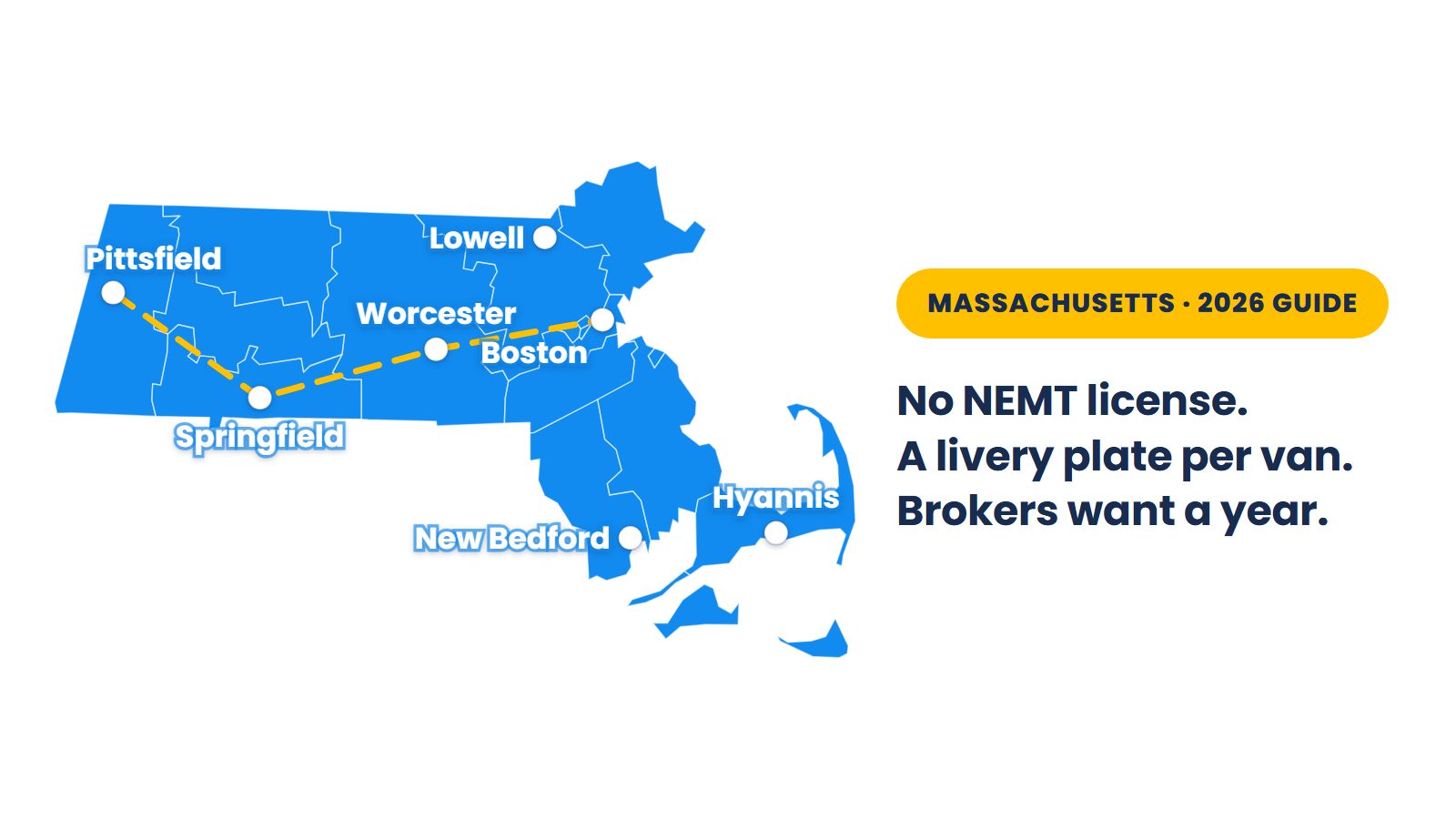
To start a NEMT business in Massachusetts, form an LLC ($500), register each van on a for-hire LIVERY plate at the Registry of Motor Vehicles (RMV), and ask every town where you’ll pick up riders whether it licenses vehicles for hire. Massachusetts has no NEMT license. MassHealth, the state’s Medicaid program, sends its rides through two brokers, MART and GATRA, both regional transit authorities, and both want a year of operating history before they’ll contract with you. So your first year runs on facility and private-pay trips. Budget about $22,900 to $50,500 for one used wheelchair van and six months of fixed bills.
Massachusetts at a glance:
- Medicaid rides: MassHealth’s rides go through the state’s Human Service Transportation (HST) Office and two brokers, which subcontract them to transportation companies. MART covers western, central and northeastern Massachusetts and metro Boston, and GATRA the southeast, Cape Cod and the Islands, split by ZIP code [1][2][3].
- The year: MART wants a year of your own service plus a facility contract, and GATRA a year of medical transportation [4][5].
- How trips are paid: each company bids its own prices every three months, town by town at MART, and the lowest-cost qualified company gets the trip [6][7][8].
- No NEMT license: a for-hire van built for 15 or fewer people, counting the driver, is a “Livery Vehicle,” and the Department of Public Utilities’ (DPU) passenger-carrier authority starts at 10 or more people, counting the driver, for charter, sightseeing or fixed routes [9][10].
- Towns: any city or town may license vehicles for hire, and Cambridge’s code names riders “on a mobile stretcher or motorized chairs” [11][12].
- Insurance: the brokers’ minimum is $250,000 per person, $500,000 per accident and $50,000 of property damage, and MART wants workers’ comp even from sole proprietors [13][14].
- Drivers: the brokers’ standard is 19 or older, with criminal record (CORI) and sex offender registry (SORI) checks, drug tests and securement training [13].
- Stretcher riders: there’s no stretcher-van category, and MassHealth sends riders who need a stretcher to a non-emergency ambulance [15][16][17].
In July, a new owner south of Boston, just getting going with a handful of ambulatory vans and few trips yet, told me on a demo that the brokers wanted experience before they’d sign the company up. I said that’s pretty common: they “want to see that you’ve been operating for … six months or a year.” And I’d already talked to “a couple of other people in Massachusetts who are in the exact same situation.”
MART, the broker for most of the state, puts it in writing and asks for more. Its FAQ, last updated in March 2025, says you must “OWN and OPERATE your own livery (human transportation) service for a minimum of 1 year and hold a contract with a facility/vendor” [4]. In Massachusetts, the facility account I’d tell any new owner to chase is also part of MART’s entry rule. GATRA wants “a minimum of 1 year providing medical transportation” [5]. The checklist runs on a two-year clock: riders and towns first, then what every paid trip needs, a year of your own trips, and MART or GATRA in year two.
I run Duet, which builds dispatch software and runs growth services for non-emergency medical transportation (NEMT) companies, and I talk to NEMT owners on demos every week, Massachusetts operators included. This is the Massachusetts edition of our national guide on how to start a NEMT business. Requirements change, so confirm against the linked sources before you spend money.
The one-page checklist: how to start a medical transportation business in Massachusetts
In Massachusetts, decide your riders and towns first and apply to MART or GATRA last, because that order wastes the least money. Each phase ends with what it puts at risk and the running total.
Phase 0: pick your riders, your vans and your towns
- Seats: every Massachusetts line counts the driver. A for-hire van built for 15 or fewer people is a livery vehicle, the DPU’s authority starts at 10 or more for charter, sightseeing or fixed-route service, and 16 or more takes a commercial driver’s license (CDL) [9][10][18].
- Weight: a van with a gross vehicle weight rating (GVWR) of 10,001 pounds or more needs a USDOT number even on trips inside Massachusetts, so read the door-jamb sticker before you buy [9].
- Stretchers: MassHealth sends riders who need a stretcher by ambulance, and the Department of Public Health (DPH) licenses ambulance services [16][17].
- Three calls this week: ask your town clerk or police licensing unit whether it licenses livery vans. Ask the five nearest nursing homes, rehab hospitals or day programs who books and pays for the rides MassHealth’s brokers don’t cover. Ask an insurance agent for a quote at the brokers’ minimum.
- Money at risk: none yet.
Phase 1: form the company MART will check
- File a certificate of organization with the Secretary of the Commonwealth’s Corporations Division: $500 by mail, or $520 online with the $20 expedite fee. An annual report follows every year at the same $500 [19].
- Get a free employer identification number (EIN) from the IRS.
- Keep your state taxes current from day one. MART asks for two certificates of good standing, one from the Department of Revenue (DOR), renewed every year, and one from the Secretary of the Commonwealth [4].
- Put up a website where families can request a ride and a Google Business Profile.
- Start visiting nursing homes, rehab hospitals and day programs now.
- Money at risk: about $820: $520 for the LLC and about $300 for a phone and basic marketing.
Phase 2: price insurance at the brokers’ bar before the van
- Get quotes on the exact van you plan to buy at the HST minimum: $250,000 per person and $500,000 per accident for bodily injury, and $50,000 for property damage [13].
- Have each agent quote workers’ comp that covers you too. MART’s contract requires it of every company, “including sole proprietors” [14].
- Ask whether the agent can issue MART’s certificate wording, with the Commonwealth, the Executive Office of Health and Human Services (EOHHS), the HST Office and MART as additional insureds [14].
- Money at risk: nothing new (about $820 so far).
Phase 3: register the van on a LIVERY plate
- Buy the van, then have a Massachusetts insurance agent stamp and sign your registration application. The stamp is valid for 30 days [20][21].
- Register it on a LIVERY plate: $90 for two years with seven seats or fewer counting the driver, or $12 a seat with eight to 14. Title it for $75 and pay the 6.25% sales tax [22][20].
- Get it inspected within 7 days of registration, for $35 [20][22].
- Money at risk: about $14,300 more with the van financed, so about $15,100 in. Most of it is $6,600 down on our national model’s $33,000 wheelchair van (2016-2019), $2,062.50 of sales tax and $4,350 of insurance at signing. The rest is about $1,000 for equipment, $200 for the plate, title and inspection, and about $113 for the yearly excise. Fixed bills then run about $1,934 a month.
Phase 4: ask every town where you’ll pick up riders
- Call the clerk or police licensing unit of every city or town where a van is garaged or picks up riders, and get the answer in writing before your first paid trip [11].
- Expect a yes in some places. Cambridge’s code reaches riders “who are ill or on a mobile stretcher or motorized chairs,” New Bedford’s any vehicle carrying people for a fee, and Brockton charges $15 a vehicle [12][23][24].
- A paid trip to or from Logan Airport’s terminals takes Massport’s operating agreement and a permit for each vehicle [25].
- Money at risk: whatever your towns charge, outside the running total. New Bedford’s livery license is $50 to apply and $100 to issue [23].
Phase 5: screen and train drivers to the brokers’ standard
- Run the checks in the HST Office’s standards, which MART’s contract carries: CORI before any contact with riders and every year after, SORI every year and driving records covering 7 years. Enroll drivers in the RMV’s free Driver Verification System and drug-test them at a federally certified lab [13].
- Book wheelchair securement training with a trainer certified by the Community Transportation Association of America (CTAA), the University of Wisconsin or another the broker approves, plus defensive driving and sensitivity training [13].
- Money at risk: about $1,000 for one driver’s screening and training in our model, so about $16,100 in.
Phase 6: sign the trips you control, then apply after a year
- Get a facility account in writing with a nursing home, hospital or day program. MART counts that contract toward its entry rule and checks it [4].
- Take private-pay riders. Most owners I talk to charge the card at least 24 hours before pickup.
- Ask your Council on Aging and the health plans’ ride vendors how they buy rides.
- Apply after a year. MART takes no new applications May 1 through July 31 [26].
- Money at risk: $1,934 a month of fixed bills with the van financed, until your trips cover them.
A company that never wants broker trips can skip the last step of Phase 6. It still needs the LIVERY plate and any town license.
Who pays for NEMT rides in Massachusetts?
Four payers buy NEMT rides in Massachusetts: MassHealth’s brokers; the SCO, One Care and PACE plans; facilities and programs; and families.
MassHealth is the volume, and two brokers arrange it
Two brokers arrange MassHealth’s rides for the HST Office, which runs transportation for six state agencies, MassHealth among them [2][27]. The rides cover MassHealth Standard, CommonHealth and CarePlus members who can’t use public or private transportation [27], and MassHealth counted 1,866,686 members on July 31, 2026 [28]. In fiscal 2025 the brokerage ran 8,067,349 trips for all six agencies’ riders and spent $356.3 million on them [29].
The SCO, One Care and PACE plans arrange their own rides
Members of Senior Care Options (SCO), One Care and PACE (Program of All-Inclusive Care for the Elderly) plans don’t ride through the HST brokerage; MassHealth tells them to call their plan [27][30]. Those plans held 120,624 members in July 2026 [28]. Commonwealth Care Alliance’s payment policy names its vendor, “Coordinated Transportation Solutions, Inc. (CTS),” Mass General Brigham’s 2026 SCO handbook names CTS too, and UnitedHealthcare’s 2026 SCO handbook names SafeRide [31][32][33].
One 2026 change gets misread: only members leaving SCO plans moved to fee-for-service [34].
Facilities are the stability, and MART’s way in
A facility account means trips the facility books and pays for itself, and in Massachusetts a written account is also part of MART’s entry rule. The facilities MART counts are “nursing homes; hospitals; DayHab programs; school systems/Head Start; other state or private agency programs; or veteran’s organizations” [4]. An assisted-living residence isn’t on MART’s list, so ask MART whether it counts before you rely on it. Adult day health programs arrange and provide their members’ rides to and from the center, so ask the program whether it buys rides [34]. MassHealth’s transportation rule covers those rides only when “arranged by special contract with the MassHealth Adult Day Health Program” [16].
Know which rides the brokerage already covers. MassHealth members can ride home from a hospital or rehab through the brokerage, and nursing homes can book curb-to-curb rides for their MassHealth residents through it too [27][30]. For patients and residents who aren’t on MassHealth, a ride home is just another trip, so ask each discharge planner and nursing home who pays for those rides.
A 13-vehicle operator on Cape Cod said on a 2024 industry podcast that the company started at the end of 2013 with two vehicles and grew by “introducing ourselves to the local nursing homes.” Don’t count on dialysis clinics the same way. In my experience most dialysis riders are on Medicaid, so in Massachusetts their rides come through MART, GATRA or a plan’s vendor, not the clinic.
Councils on Aging are worth a call too. Massachusetts has 350 of them, municipal agencies that may offer transportation for older adults [35]. Some buy rides with state grants. MassDOT’s FY26 Community Transit Grant awards went to 40 organizations for 47 projects, $5.48 million in all [36]. They include $15,000 for the Needham Council on Aging’s “Long-distance medical rides for older adults” and $100,000 for the South Shore Senior Transportation Collaborative, which works with ten Councils on Aging. Ask yours whether it buys rides from private companies.
Private pay is the margin
Massachusetts had 1,335,942 residents 65 or older in the Census Bureau’s 2024 survey [37]. Families who call you directly pay up front: most owners I talk to take a card at booking and charge it at least 24 hours before pickup, or send a payment link that’s due by then. No payment, no van.
Facilities and families pay from your first trip. MassHealth’s brokers pay from year two at the earliest.
Who is the NEMT broker in Massachusetts?
MassHealth’s NEMT brokers are two regional transit authorities: MART, the Montachusett Regional Transit Authority, for most of the state, and GATRA, the Greater Attleboro Taunton Regional Transit Authority, for the southeast, Cape Cod and the Islands. MassHealth’s November 2021 bulletin assigns MART to “HST Service Area 1 (Western Massachusetts) and HST Service Area 2 (Northeastern Massachusetts, including metropolitan Boston),” and GATRA to Area 3, southeastern Massachusetts [1].
This setup dates to July 1, 2021, when new contracts with MART and GATRA took effect and EOHHS cut the HST service areas from nine to three [38][39]. The state plan bars the brokers from driving riders themselves, so they subcontract: about 351 companies held MART contracts in fiscal 2025 and 75 held GATRA’s [7][29].
| Rider | Who arranges the ride | Where | Booking line |
|---|---|---|---|
| MassHealth member in MART’s towns | MART | Western and central Massachusetts, metro Boston and the northeast | (866) 834-9991 |
| MassHealth member in GATRA’s towns | GATRA | Southeastern Massachusetts, Cape Cod and the Islands | (800) 431-1713 |
| SCO, One Care or PACE member | The plan or its ride vendor | Wherever the plan operates | The plan’s member line |
The booking lines are the ones MassHealth gives members, as of October 2026 [27]. MART’s side includes Boston, Cambridge, Quincy, Worcester, Lowell, Lynn, Framingham, Springfield and Pittsfield; GATRA’s includes Brockton, Plymouth, Taunton, Attleboro, Fall River and New Bedford, plus Cape Cod, Martha’s Vineyard and Nantucket [3]. The line between them follows ZIP codes, not counties: Foxboro, Stoughton, Avon and Plainville in Norfolk County are GATRA’s, and so is North Marshfield, so check each of your towns on HST’s “Find your HST broker” lookup [3]. The brokerage serves fee-for-service members and members of the Primary Care Clinician (PCC) Plan, the accountable care organizations (ACOs) and the managed care organizations (MCOs) [30].
AI answers and some guides name Modivcare, MTM or Roundtrip as Massachusetts brokers, or call MART “MARTA” (that’s Atlanta’s transit system). MassHealth’s bulletins name only MART and GATRA [1][40]. Our state-by-state broker map shows how other states split the job. Broker contracts do change hands, and this year’s broker transitions show how fast. Ask the HST Office, (617) 847-3427, when the current contracts end before you plan years around either broker [27].
How does a MassHealth trip reach your company?
A rider’s doctor or other medical provider requests the ride first, and then the broker hands it to a company:
- The PT-1: the medical provider files MassHealth’s PT-1 request online through its Customer Web Portal, since MassHealth no longer takes it by fax or mail. MassHealth says processing generally takes one business day and can take up to three [41][27].
- The broker match: MassHealth assigns the member a broker by city or town, and “Only your broker can arrange rides for you” [27].
- The bid: every three months, companies submit a pickup fee and a mileage rate for each vehicle type to MART and GATRA. The broker gives each trip to the lowest-cost qualified company, and moves to the next lowest when the first can’t fit the rider’s schedule [6][7].
- The portal: MART posts trips in its vendor portal, where companies must accept or decline work every day, and MART “downloads fourteen (14) days of trips in advance” [8].
- Standing orders: a rider with a standing order stays with the chosen company “for three months, until new rates are set” [6].
- Will-calls: a rider calling for a ride home is picked up within an hour [8].
- No-shows: if the rider isn’t transported, “regardless of fault, no payment will be made” [42].
- Pay: MART pays by electronic funds transfer within 45 days of an approved invoice [8].
The portal, will-call and pay rules above are MART’s; ask GATRA for its own before you sign. In a town where many companies bid, your price decides whether trips come.
Can I bill MassHealth directly for NEMT rides?
No: since June 1, 2022, wheelchair-van companies can’t bill MassHealth directly. Its transmittal letters say that from that date “providers can no longer bill MassHealth directly for wheelchair van transportation,” and that a company “must be enrolled with one or both HST transportation brokers” [43]. The wheelchair-van rides MassHealth used to pay fee-for-service moved to MART and GATRA on April 1, 2022, and sedan rides already ran through the brokerage [1][40].
Two kinds of carriers still bill MassHealth themselves: ambulance services, which stay fee-for-service, and “other licensed carriers” such as a bus, train, plane or boat, with prior authorization [40][16].
Massachusetts does publish a wheelchair van rate. Its fee schedule, 101 CMR 327.00, sets $40.55 a trip plus $1.46 a loaded mile, or $55.15 for a 10-mile trip. That’s the schedule’s ceiling, since the rule pays the lowest of a company’s usual fee, its charge or the schedule [44]. The same rule covers workers’ comp rides, and it lets a governmental unit pay broker-arranged trips at different rates, which the schedule doesn’t cap [44]. Brokered trips pay the company’s own bid.
MART posts those bids. In its October through December 2026 rate sheet, by our count, the typical MART town’s lowest chair-car (wheelchair) bid for a 10-mile trip is $40.00, and the typical town’s middle bid is about $105. In Boston, the lowest of 113 town-wide rate lines is $39.75 and the median is $93.01 [45]. Those are bids, not payments: the lowest qualified bid gets the trip, so a higher bid gets trips when lower bidders can’t fit the rider’s schedule, or when the broker weighs a rider’s history with a company [6]. MART’s sheet names its own towns, not GATRA’s, so in GATRA’s area, Brockton included, ask GATRA about its rates [45].
Across the whole brokerage, fiscal 2025’s demand-response trips cost $41.03 on average, $38.90 at MART and $50.06 at GATRA [29]. That average mixes sedans, chair cars and longer trips; it’s not a rate card. Price against your towns’ low bids, not the fee schedule.
What licenses and requirements does a NEMT business need in Massachusetts?
Massachusetts has no NEMT license: a for-hire van built for 15 or fewer people, counting the driver, takes a LIVERY plate under 540 CMR 2.05, the RMV’s rule that says a “Livery Vehicle” “shall display a LIVERY registration number plate” [9]. The DPU’s authority starts at vehicles that carry “10 or more people including the driver,” DPH licenses ambulance services, and cities and towns license vehicles for hire under their own rules [10][17][11].
Here’s what circulates about Massachusetts, next to what the state and the brokers actually require:
| The claim you’ll read elsewhere | What Massachusetts actually requires |
|---|---|
| A “Massachusetts NEMT Provider License” at “$850 initial, $510 renewal” | No license has that name. A for-hire van takes a LIVERY plate, $90 for two years at seven seats or fewer counting the driver [9][22] |
| “NEMT businesses must follow regulations laid out by the Massachusetts Department of Public Utilities (DPU)” | The DPU licenses vehicles carrying 10 or more people, counting the driver, for charter, sightseeing or fixed-route service [10][46] |
| Brokers “such as Modivcare and Roundtrip,” or “MARTA” | MassHealth’s brokers are MART and GATRA, two regional transit authorities [1] |
| Register through the “Official MassHealth Provider Portal” | MassHealth hasn’t enrolled or paid wheelchair-van companies since 2022; you contract with MART or GATRA [1][43] |
| A broker wheelchair rate of “~$90” | Each company bids its own price every three months, town by town at MART, and the lowest qualified bid gets the trip [6][8] |
| Drivers “21 years or older,” with PASS training “around $750” | The brokers’ standard is 19 or older, with securement training from a CTAA, University of Wisconsin or broker-approved trainer [13] |
| Auto liability of “$25,000 per person / $50,000 per accident / $25,000 property damage” | The brokers’ minimum is $250,000/$500,000 and $50,000 of property damage; the state’s own floor is $25,000/$50,000 and $30,000 [13][47] |
| A stretcher van rate of “~$220” | No stretcher-van category exists; MassHealth sends stretcher riders to an ambulance [15] |
Does your van need a DPU license?
Not for door-to-door, pre-arranged trips in a van carrying fewer than 10 people, counting the driver. The DPU’s passenger-carrier page starts with vehicles that carry “10 or more people including the driver,” lists three kinds of service (charter, sightseeing and fixed route) and charges a $100 filing fee and $60 for each initial bus decal [10]. The charter statute draws the same line at “ten or more persons, including the driver” [46].
Two cases are worth a call to the DPU first. One is a larger van carrying 10 or more people on medical trips, which the page’s first line reaches but its three service types don’t name. The other is a shuttle between fixed stops, which state law treats as licensed route service whatever its size [46].
What does the RMV need for a livery van?
For a livery van, the RMV wants a LIVERY plate registration stamped by a Massachusetts insurance agent, then an inspection sticker within 7 days of registration [9][20]. It asks a for-hire vehicle’s seating capacity “including the driver” and prices the plate by seats [21]. The agent’s stamp is valid for 30 days, so get it no more than a month before you register [21].
A van with a GVWR of 10,001 pounds or more, or built for more than 15 people counting the driver, needs a USDOT number on in-state trips too [9]. Two narrow exceptions to the LIVERY plate can fit NEMT work: the registrar may issue wheelchair-symbol plates to an organization that regularly provides both care and transportation to people with disabilities and shows its name on the vehicle [48]. And a vehicle used only for Department of Developmental Services or Department of Mental Health programs may carry a passenger plate [9].
What do Boston, Cambridge and other towns require?
Every Massachusetts city and town may license “carriages and vehicles used therein” and charge a yearly fee for each license, and the law names no exemption for wheelchair vans or medical trips [11]. So each town decides in its own code. Here’s what the codes we read say on their face, and we found no ruling applying any of them to a NEMT van, so call before your first pickup:
| Town | What it licenses | Does it reach a wheelchair van? | Fee |
|---|---|---|---|
| Cambridge | Livery vehicles picking up riders in the city | Yes, by its words: riders “who are ill or on a mobile stretcher or motorized chairs” ride in licensed livery [12] | Not in the code; ask the License Commission |
| New Bedford | Any vehicle carrying people for a fee, plus each driver | Yes, on its face [23] | $50 to apply and $100 for the license; drivers $15 plus $50 |
| Brockton | The business of carrying people for hire within the city | Yes, on its face [24] | $15 a vehicle a year |
| Worcester | Taxi and livery owners and drivers, through the police | Unclear: its livery vehicle is “an unmarked luxury sedan” [49] | Set by city ordinance |
| Boston | Taxis, sightseeing automobiles, horse carriages and pedicabs | Unclear [50] | Ask the Hackney Carriage Unit |
New Bedford’s code cuts a driver’s license fee to $25 with a letter from GATRA saying the driver meets the suitability rules in GATRA’s contract with the driver’s employer [23]. Boston’s vehicle-for-hire ordinance is worded more broadly than its police unit’s list, so ask the unit before you carry private-pay riders there [50]. In Springfield, Lowell and any town not in the table, ask the clerk or police licensing unit.
Logan Airport has its own layer. A paid trip to or from the terminals is “Commercial Ground Transportation Service” under Massport’s rule, which takes an operating agreement and a permit for each vehicle, so ask Massport how it classes a wheelchair van [25]. I’d get every town’s answer in writing before trip one.
What if you drive riders into another state?
A paid trip across a state line is interstate, and Massachusetts borders New York, Connecticut, Rhode Island, New Hampshire and Vermont. That usually means federal operating authority, a USDOT number and $1.5 million of liability for a vehicle seating 15 or fewer, driver included [51]. Our licensing guide explains when a NEMT company needs federal authority to cross a state line.
What are the NEMT insurance requirements in Massachusetts?
Plan on the HST brokers’ minimum: $250,000 per person, $500,000 per accident and $50,000 of property damage, with workers’ comp that covers you too. MART’s contract requires vehicle liability “at a level that meets or exceeds the current HST minimum,” with the broker named as an additional insured, and workers’ comp on every driver [13]. Its certificates name the Commonwealth, EOHHS, the HST Office and MART as additional insureds on the auto policy, with a waiver of subrogation on workers’ comp [14]. Ask GATRA for its insurance terms before you buy.
Program routes are scheduled routes MART awards for state agency programs, such as DDS and day habilitation programs; a new company’s demand-response trips use the first row [13][8]. A combined single limit is one cap for bodily injury and property damage together, and PIP is personal injury protection.
| Coverage | Minimum | Applies to |
|---|---|---|
| Vehicle liability | $250,000 per person, $500,000 per accident, $50,000 property damage | Every vehicle on HST trips [13] |
| Program routes, 6 to 8 seats counting the driver | $500,000 combined single limit | Scheduled routes for state agency programs [13] |
| Program routes, 9 to 15 seats | $1,000,000 combined single limit | The same routes [13] |
| Program routes, 16 or more seats | $5,000,000 combined single limit | The same routes [13] |
| Workers’ comp | Required, sole proprietors included | Every MART company [14] |
| State compulsory floor | $25,000/$50,000 bodily injury, $30,000 property damage, $8,000 PIP | Every registered vehicle, on policies since July 1, 2025 [47] |
The Division of Insurance says the compulsory bodily-injury coverage “does not cover the injury or death of a passenger in your car” [52], so ask your agent to show in writing how your riders are covered.
When should you bind the policy?
Quote before you buy the van, and bind when you’re ready to register it: the RMV wants the agent’s stamp on the application, and the stamp is good for 30 days [20][21]. From the day you bind, you’re paying premiums on a van that can’t take a broker trip for a year, so line up facility and private-pay work first.
What will insurance cost a new Massachusetts company?
I don’t have Massachusetts premium data to give you, so start from our national model: $17,400 a year for a new company’s wheelchair van at about $1 million of liability, from operators’ quotes of $1,200 to $1,800 a month. Our insurance guide shows where our national premium figures come from. That model is a national estimate, not a Massachusetts quote, and the brokers’ minimum is lower per person, with workers’ comp on top.
Where you drive matters too. A western Massachusetts operator said on a 2023 industry podcast that insurers “ask for a copy of your trip records” and “want to know which … towns.” The same operator warned, “if you do work in the Boston area … your rates are going to be much higher,” and suggested asking your agent, “what zip codes should I avoid?” So a quote at the brokers’ minimum may come in under the model’s figure, while workers’ comp and Boston-area work can push your total above it. Keep trip records by town from your first ride.
Do you need workers’ comp in Massachusetts?
Yes, from your first employee. The Department of Industrial Accidents says the requirement “applies no matter the number of hours worked or the number of employees” [53]. State law lets LLC members and sole proprietors skip coverage for themselves, but MART’s contract doesn’t: workers’ comp “applies to all contracted transportation providers including sole proprietors” [53][14]. An employer caught without it gets a stop-work order and fines that start at $100 a day [53].
What do NEMT drivers need in Massachusetts?
Massachusetts asks a typical NEMT van’s driver only for a Class D license; MART and GATRA ask much more. The RMV’s license classes put vehicles built for 16 or more passengers, counting the driver, in Class C and vehicles of 26,001 pounds or more in Class B, both commercial licenses, so a typical wheelchair van is Class D [18]. The RMV’s fee schedule lists no for-hire or chauffeur license, but some towns license drivers: New Bedford licenses every driver of a vehicle for hire [22][23].
What do MART and GATRA require of drivers?
The HST standards in MART’s contract, revised July 1, 2025, set the driver file [13]:
- Age: 19 or older, with all required training done before HST work.
- License: a Massachusetts license, or one from a neighboring state, and at least a year of driving, including multi-passenger vehicles. MART adds a year of current driving in the US [8].
- Background: a CORI check with results verified before any contact with riders, then every year, and a SORI check every year. A positive SORI result bars the driver.
- Driving record: reports from every state the driver lived or was licensed in over the past 7 years. They should show no driving under the influence, reckless driving, leaving the scene of an accident, driving unlicensed or uninsured, driving on a suspended license, or multiple or repeated violations other than parking.
- License monitoring: enrollment in the RMV’s Driver Verification System, which is free.
- Drug and alcohol tests: at an independent lab certified by the National Laboratory Certification Program, with a drug test before any work with riders and drug and alcohol tests on reasonable suspicion and after accidents.
- Training before the first trip and every year: defensive driving, plus hands-on wheelchair lift and securement training from a trainer certified by CTAA, the University of Wisconsin or another the broker approves. Then human rights and sensitivity, sexual harassment, and the HST standards themselves, fraud reporting and privacy rules included.
CPR and first-aid certification appear in these standards only for Early Intervention routes and ambulances, and fingerprint checks only for companies serving Department of Developmental Services and day habilitation programs [13]. The trainings are on you: MART says “It is the transportation provider’s responsibility and financial obligation” to arrange them [14]. I’d train to that list from your first driver, so year two doesn’t start with a backlog.
Can a NEMT company run stretcher van trips in Massachusetts?
Massachusetts has no stretcher-van category, and MassHealth sends riders who must lie flat by ambulance. DPH licenses ambulance services under chapter 111C [17]. MassHealth’s transportation rule says a member with “continuous confinement to bed,” among other conditions, “always requires transportation by ambulance” [16]. And in a 2025 appeal, MassHealth’s Board of Hearings found that “MassHealth’s brokered transportation cannot fit a stretcher” [15].
One plan does list the mode. Mass General Brigham’s 2026 SCO handbook names “Stretcher Van” among the rides its vendor provides [32]. So before you carry anyone lying down, privately or for a plan, ask DPH whether your vehicle and crew need its license. Until then, script your intake: a caller who needs a stretcher is an ambulance trip.
How do you become a MassHealth transportation provider?
Van companies contract with MART or GATRA, not MassHealth, after a year of their own operation, and MART also wants a facility contract. MassHealth’s enrollment lists name “Transportation Brokers” and ambulance providers but no wheelchair-van type, and its $750 application fee for 2026 applies only to listed institutional providers: “All other provider types are exempt” [54].
What does MART require before you apply?
Driving for a taxi company, Uber, Lyft or another vendor doesn’t count: MART wants your own company to have owned and operated its service for a year, with a facility or vendor contract [4]. The facility can be any of those on MART’s list, and “Any information submitted on the application referencing work with these types of agencies must be reviewed and verified by MART” [4].
The rest of the file:
- Certificates: a DOR certificate of good standing, renewed every year, and a Secretary of the Commonwealth certificate [4].
- References: professional only. MART “does not accept personal references in any capacity” [4].
- The application: online only, through MART’s vendor management system [26].
- The window: effective May 1, 2026, MART “will not accept new provider applications from May 1 through July 31 each year,” and it reopens August 1 [26].
- The review: in the order received, with no meetings, and “a determination will usually be made within a week” once the application is complete [4].
- Before any trips: a signed contract, credentialing, a desk audit, vehicle inspections and mandatory vendor portal training, then a start “within two (2) weeks of said training” [14]. MART says “the contracting and onboarding phases typically take up to 90 days” [4].
- Ongoing: a federally required disclosure form every year, and MART’s checks against the “Office of the Inspector General Fraud and Prevention List” at application and every month [8].
MART doesn’t say when the year starts. Count it from when your company starts carrying paying riders, and confirm with MART before you count on it.
What does GATRA require?
GATRA’s minimum requirements start with “a minimum of 1 year providing medical transportation” and registration with the Secretary of the Commonwealth. It also wants a “Certificate of Good Standing” from the Secretary of the Commonwealth “which proves good tax standing,” and “an office or branch that operates in or near GATRA territory” [5]. There’s no facility-contract line. To get the application, email Inquiries@gatra.org with “application” in the subject line, and ask about timing when you write.
What about the plans’ ride vendors?
CTS arranges rides for Commonwealth Care Alliance’s members and Mass General Brigham’s SCO members, and SafeRide for UnitedHealthcare’s SCO members [31][32][33]. Ask each vendor whether it’s adding companies in your area and what it requires.
That’s the catch: both brokers want a year of your own service, and MART also wants a facility contract. A facility account fills that year with trips and gives MART the contract it checks. Our guides to landing your first facility account, the first trip after a facility says yes and pricing private-pay rides and getting paid up front cover that year. Our look at Medicaid ride enrollment in other states shows how other states order the same steps.
Pick your application month now: at least a year after your first paying rider, and for MART, outside May through July.
Don’t build the whole schedule on one payer
MART’s and GATRA’s bids reset every quarter, so keep broker trips in your schedule’s gaps. A company that wins a town’s trips this quarter can be underbid next quarter, and a standing-order rider stays with you only until new rates are set [6]. MART also ties volume to complaints: a company above 1% complaints relative to its scheduled trips gets a warning, and if complaints stay above 1%, its trip capacity is cut to 80%, then to 50% [8].
The 13-vehicle Cape Cod operator ran about 60% private pay and 40% broker work in 2024, by that operator’s estimate, and called private pay “much more profitable.” My own rule, from a July call with a one-van owner in North Carolina: “I would only ever layer in broker trips as a way to fill gaps.”
Here’s the shape a schedule can take. An owner-operator in Greater Boston, who drives and dispatches, told me on an August demo that the company’s main work is a day program’s morning and afternoon runs. Between the morning drop-off and the ride home, the company takes broker trips “between probably nine and 12,” because “we have to go back around 12:30, 12:45 to the facility again.”
I’ve also said on our podcast that “people have been extremely successful with broker volume, too,” and Massachusetts’ brokerage is big, with millions of trips in fiscal 2025 [29]. The two brokers run it under EOHHS’s contracts, which set most of their rules, and the one-year rule is on each broker’s own pages, so check them the month you apply.
Whatever the mix, dispatch it together. Dispatch software like Duet keeps your broker trips on one schedule with your facility routes and private-pay rides. Broker trip lists come in by trip file import or bulk upload, and each trip bills at the rate its contract sets. Your LIVERY plates and town licenses, each broker’s credentialing, portal and quarterly prices, and invoicing each payer through its own process stay with you.
How much does it cost to start a NEMT business in Massachusetts?
Budget about $22,900 to $50,500 for one used wheelchair van and six months of fixed bills, before town licenses, with insurance at our national model’s price, not a Massachusetts quote. The typical case, a 2016-2019 van at our national model’s $33,000, financed, takes about $27,700: the $6,600 down payment, about $9,500 of one-time costs and about $11,600 for six months of fixed bills. Paying cash for the same van takes about $50,500, and an older $20,000 van, financed, about $22,900.
Massachusetts’ inputs are its fees, its 6.25% sales tax and the excise estimate. Everything else, insurance included, comes from our national startup cost model, at about $1 million of liability. The price range for used wheelchair vans sits behind the van line.
| Line item | Massachusetts amount | Note |
|---|---|---|
| LLC certificate of organization | $520 online | $500 by mail; a $500 annual report every year [19] |
| EIN | $0 | Free from the IRS |
| “NEMT license” | $0 | No state license by that name |
| DPU authority | $0 | Not needed under 10 people counting the driver; $100 plus $60 a decal where its authority applies, at 10 or more [10] |
| MassHealth enrollment | $0 | Van companies contract with MART or GATRA instead [1] |
| USDOT number | $0 | On in-state trips, needed only at a GVWR of 10,001 pounds or more, or more than 15 people counting the driver [9] |
| Used wheelchair van, 2016-2019 | About $33,000, or $6,600 down if financed | National model: 80% financed at 14% over 60 months, $614 a month |
| Sales tax | $2,062.50 | 6.25% of $33,000 [20] |
| LIVERY plate, title and inspection | $200 | $90 plate for two years, $75 title, $35 inspection [22] |
| Motor vehicle excise | About $113 a year | Our estimate: $25 per $1,000 of value, capped at 10% of an assumed $45,000 list price [55] |
| Insurance due at signing | About $4,350 | National model: a quarter of the $17,400 year |
| Equipment and lettering | About $1,000 | National model |
| Screening and training | About $1,000 | National model; one driver |
| Phone and basic marketing | About $300 | National model |
| Six months of fixed bills | About $11,600 financed, $7,920 bought outright | $1,934 a month financed: a $1,305 insurance installment, a $614 van payment and $15 for a phone |
| Total, owner driving | About $27,700 financed, $50,500 bought outright | An older $20,000 van, financed, comes to about $22,900 |
Town licenses sit outside the totals. New Bedford charges $50 to apply and $100 for a livery license, plus $65 for each driver’s license, and Brockton $15 a vehicle a year [23][24]. After year one, the yearly items for one van come to about $690: the $500 annual report, $45 a year for the plate, the $35 inspection and the excise estimate.
Insurance is already the biggest cost in the financed case, about $12,200 of the $27,700. The cost that matters most in Massachusetts isn’t on the table, though: at least twelve months of fixed bills before a broker trip, about $23,200 with the van financed, unless facility and private-pay trips cover them. Add the months before your first paying rider and MART’s contracting, and the stretch runs longer than that.
How do you fund a NEMT startup in Massachusetts?
Small Business Administration (SBA) 7(a) loans, up to $5 million, and microloans, up to $50,000 through nonprofit intermediary lenders, are the main federal options, and the SBA doesn’t give grants for starting a business [56]. None of them shortens the year MART and GATRA want, so size the loan to a year of fixed bills, not just the van.
How long does it take to start a NEMT business in Massachusetts?
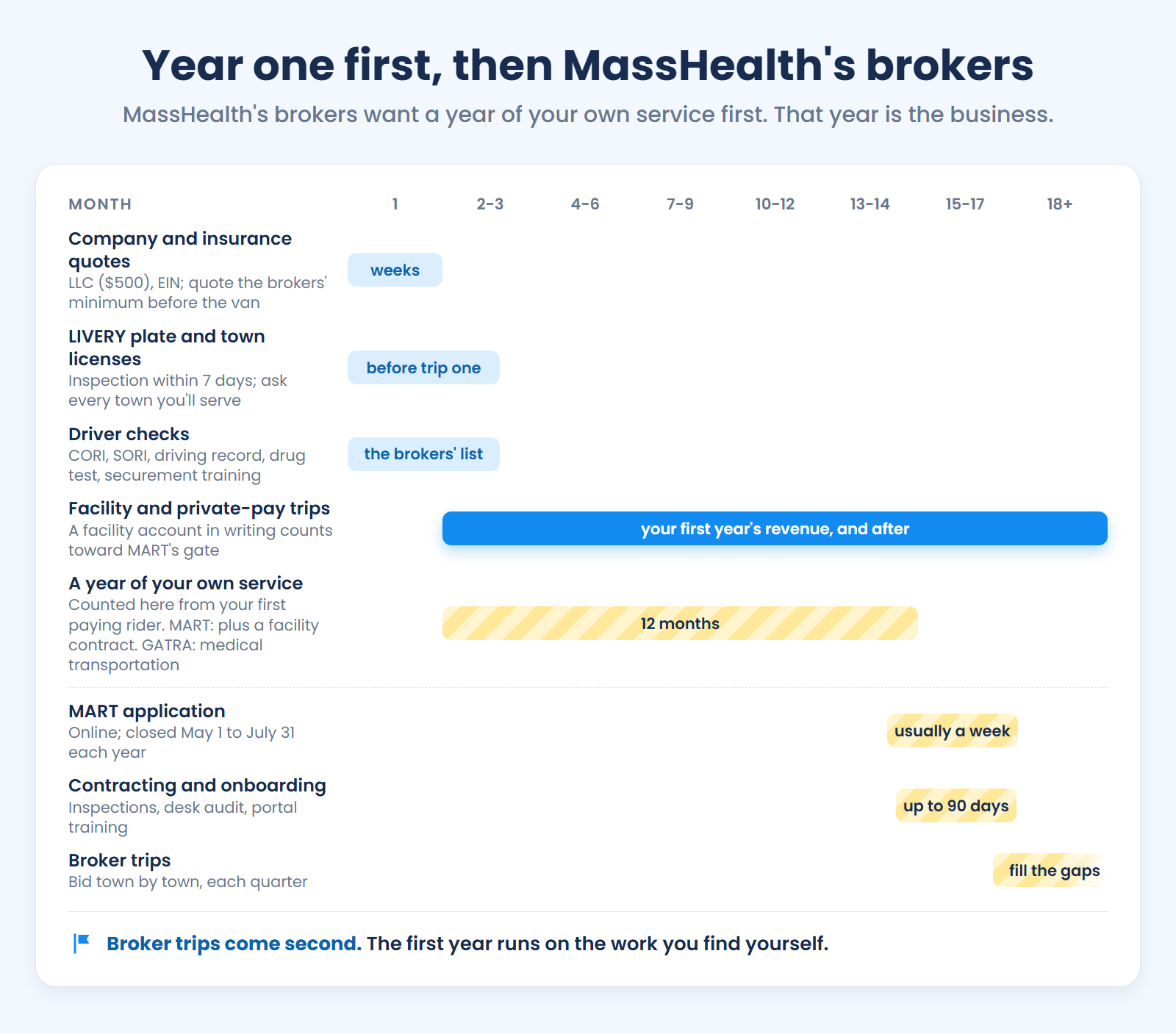
Plan on weeks for the company, the plate and insurance, a year of facility and private-pay trips, then up to 90 days of MART contracting. The year is each broker’s rule, and MART says its contracting and onboarding phases “typically take up to 90 days” [4][5].
- Month 1: form the LLC ($500, or $520 online), get the EIN and get insurance quotes at the brokers’ minimum before you pick the van.
- Months 1 to 3: buy the van, register it on a LIVERY plate with the agent’s stamp, get it inspected within 7 days, and ask every town you’ll serve about its license, in writing, before trip one. Screen and train drivers to the HST list: CORI, SORI, driving records, drug tests and securement training.
- From month 2 or 3: start carrying paying riders on facility and private-pay trips. Get a facility account in writing, because it counts toward MART’s entry rule, and keep trip records by town, because insurers may ask for them.
- Month 14 or 15: a year after your first paying rider, apply to MART online in any month but May, June or July, or email GATRA once you have a year of medical transportation. MART usually decides within a week of a complete application.
- Months 15 to 17: MART’s contracting and onboarding, typically up to 90 days: the contract, credentialing, a desk audit, vehicle inspections and vendor portal training, then a start within two weeks of the training.
- By about month 18: bid your prices each quarter, town by town at MART, and fill the gaps in your facility and private-pay schedule with broker trips.
From the week you buy the van and bind the policy, about $1,934 a month of fixed bills runs until your trips cover them.
The owner south of Boston at the top of this guide was told the brokers wanted experience first. The year MART and GATRA ask for is the business you’ll show them. Before you open MART’s application, name the facility whose contract MART will verify.
Massachusetts NEMT FAQ
Do you need a license to start a NEMT business in Massachusetts?
Not one called a NEMT license. A for-hire van built for 15 or fewer people, counting the driver, is a livery vehicle and needs a LIVERY plate from the RMV, and the DPU’s authority starts only at 10 or more people, counting the driver, for charter, sightseeing or fixed-route service [9][10]. Towns may license vehicles for hire under their own rules, and Cambridge’s and New Bedford’s codes do on their face [11][12][23]. MassHealth sends riders who need a stretcher by ambulance [15].
Is Modivcare or MTM the NEMT broker in Massachusetts?
No. MassHealth’s bulletins name two brokers, both regional transit authorities: MART for western, central and northeastern Massachusetts, including metro Boston, and GATRA for the southeast, Cape Cod and the Islands [1][2]. Members of SCO, One Care and PACE plans ride through their plan instead, and the plans use vendors such as CTS or SafeRide [27][31][33]. Answers that name Modivcare, MTM, Roundtrip or “MARTA” don’t match MassHealth’s own bulletins.
Did Massachusetts move NEMT to fee-for-service in 2026?
No. MassHealth’s December 2025 notice, “Starting January 1, 2026, you will get non-emergency medical transportation through MassHealth fee-for-service,” went to Senior Care Options (SCO) members who no longer qualified for their plan [34]. From that date, SCO plans take only members with Medicare Parts A and B as well as MassHealth Standard, so members with MassHealth alone moved to fee-for-service, and their rides moved to MART or GATRA. The brokerage itself didn’t change.
Does driving for Uber or Lyft count toward MART’s one-year requirement?
No. MART’s FAQ says driving for another company, whether a taxi company, Uber, Lyft or another vendor, doesn’t count: your company has to own and operate its own service for a year [4]. MART doesn’t say when that year starts, so count it from your company’s first paying rider and confirm with MART before you count on it.
Can a MassHealth rider ask for my company?
Not as a rule. GATRA’s FAQ says HST policies “do not allow for participants to choose their own vendors,” and only the broker can arrange a MassHealth ride [57][27]. The State Auditor’s 2025 review says brokers do weigh “the relationship between the member and the company” when matching rides, and a standing-order rider stays with the chosen company for three months [6]. Good service helps you keep a rider; it doesn’t let a rider book you directly.
Can I start a NEMT business in Massachusetts with a minivan or a sedan?
Yes. MART’s rate sheet has separate lines for ambulatory trips, its dial-a-ride and taxi rates, and for chair cars, its wheelchair rate [4]. A converted minivan can carry wheelchair riders on HST trips if it meets the HST van rules, which include “ramps that are rated for up to 600 pounds” and a listed securement system with four straps and a lap and shoulder belt [13]. Ambulatory bids run lower: in the October through December 2026 sheet, the typical MART town’s lowest dial-a-ride bid for a 10-mile trip is $19.25, by our count [45]. Either vehicle still needs a LIVERY plate.
Do I need a CDL, a hackney license or a DPU license to drive a 15-passenger van?
Not a CDL: a commercial license starts at 16 or more passengers counting the driver, or 26,001 pounds [18]. A van carrying 10 or more people, counting the driver, for charter, sightseeing or fixed-route service needs DPU authority, and the DPU issues its own motor bus driver certificates, $60 for one restricted to 14 passengers [10][58]. For medical trips in a van that size, ask the DPU. A hackney license is a city’s taxi license, so ask your city whether its rules reach your van.
Does Medicare pay for NEMT rides in Massachusetts?
Original Medicare doesn’t. CMS’s claims manual says Medicare doesn’t cover “any non-ambulance forms of transportation, such as ambulette, wheelchair van, or litter van” [59]. SCO plans, which since 2026 require both Medicare and MassHealth, arrange rides through their own vendors [34][32][33]. Some Medicare Advantage plans add rides as an extra benefit: KFF counted 22% of enrollees in individual plans nationally in a plan offering transportation in 2026 [60], so ask each plan who runs its rides.
Is Massachusetts a good state to start a NEMT business?
It can be, if you start with trips you control. The demand is there: 1,335,942 residents were 65 or older in 2024, and the HST brokerage ran 8,067,349 trips in fiscal 2025 for six state agencies’ riders, MassHealth’s among them [37][29]. So is competition: about 351 companies held MART contracts and 75 held GATRA’s that year [29], and trips go to the lowest qualified bid first [7][6]. The catch is the year both brokers want before they’ll contract with you.
Key official sources
[1] MassHealth Transportation Bulletin 19, Wheelchair Van Transportation and Brokered Transportation (November 2021; read October 23, 2026): MART for HST Service Area 1 (Western Massachusetts) and Area 2 (Northeastern Massachusetts, including metropolitan Boston) and GATRA for Area 3 (Southeastern Massachusetts); as of April 1, 2022, MassHealth will not directly enroll or pay providers for wheelchair van transportation, and providers contract with MART or GATRA or both; sedan transportation already provided through the HST brokerage; the HST Office’s phone. https://www.mass.gov/doc/transportation-bulletin-19-wheelchair-van-transportation-and-brokered-transportation/download
[2] HST Office, Providing rides through the HST Brokerage (no date on the page; read October 23, 2026): MART for western, central and northeastern Massachusetts and metro Boston, and GATRA for southeastern Massachusetts, Cape Cod and the Islands. https://www.mass.gov/info-details/providing-rides-through-the-hst-brokerage
[3] HST Office and MassHealth, Find your HST broker page and its Broker cities and towns spreadsheet (CSV posted June 2024; read October 23, 2026): the broker for each ZIP code and place, with Foxboro, Stoughton, Avon, Plainville and North Marshfield under GATRA. https://www.mass.gov/info-details/find-your-hst-broker and https://www.mass.gov/files/csv/2024-06/Broker%20cities%20and%20towns%20spreadsheet.csv
[4] MART, Application Phase FAQs on its brokerage site (modified March 7, 2025; read October 23, 2026): own and operate your own livery (human transportation) service for at least a year and hold a contract with a facility or vendor, which driving for another company doesn’t satisfy; the facilities that count, verified by MART; review in the order received, with no meetings; professional references only; certificates of good standing from the Department of Revenue, renewed yearly, and the Secretary of the Commonwealth; contracting and onboarding typically up to 90 days; a determination usually within a week of a complete application; DAR, taxi and chair car rates. https://hstrides.mrta.us/vendors/application-faqs/
[5] GATRA, Becoming a transportation provider through GATRA’s brokerage (posted October 30, 2025; read October 23, 2026): minimum requirements of a year providing medical transportation, registration with the Secretary of the Commonwealth, a Certificate of Good Standing from the Secretary of the Commonwealth, and an office or branch in or near GATRA territory; the application by email. https://www.gatra.org/becoming-a-provider/
[6] Office of the State Auditor, Audit of the Office of Medicaid (MassHealth), Review of Transportation Services, overview of the audited entity (May 8, 2025; read October 23, 2026): companies submit their prices to MART and GATRA every three months, rates made public after each quarter, standing-order riders kept by the selected company for three months until new rates are set, and brokers weighing the member’s relationship with the company and moving to the next lowest-cost company when the lowest can’t fit the schedule. https://www.mass.gov/info-details/audit-of-the-office-of-medicaid-masshealth-review-of-transportation-services-overview-of-audited-entity
[7] Massachusetts State Plan Amendment MA-21-0030, brokered transportation (effective July 1, 2021; read October 23, 2026): two regional transit authorities selected as brokers, brokers barred from providing rides directly, and brokers scheduling trips with the lowest cost qualified transportation provider. https://www.medicaid.gov/Medicaid/spa/downloads/MA-21-0030
[8] MART Brokerage Transportation Provider Amendment, Attachment H, Brokerage Transportation Provider Additional MART Performance Standards (in the amendment effective July 1, 2025; read October 23, 2026): a year of current driving experience in the US, daily accept or decline of work on the vendor portal, fourteen days of trips downloaded in advance, demand-response rates adjusted quarterly with towns added or removed each quarter, program-based routes awarded to companies, will-call return pickups within one hour, payment by EFT within 45 days of an approved finalized invoice, yearly federally required disclosures, monthly exclusion list checks, and capacity cuts to 80% and 50% for companies above the 1% complaint standard. https://hstrides.mrta.us/wp-content/uploads/2025/08/Attachment-H.pdf
[9] 540 CMR 2.00, Motor Vehicle Regulations, official mass.gov copy (Massachusetts Register #1552, July 18, 2025; read October 23, 2026): the Livery Vehicle definition and the LIVERY plate in 2.05, the passenger-plate option for vehicles used only for Department of Developmental Services or Department of Mental Health programs, and intrastate USDOT numbers at a GVWR of 10,001 pounds or more or more than 15 passengers including the driver in 2.22. https://www.mass.gov/doc/540-cmr-2-motor-vehicle-regulations/download
[10] Department of Public Utilities, Apply to be a passenger carrier in Massachusetts (no date on the page; read October 23, 2026): DPU operating authority for for-hire vehicles carrying 10 or more people including the driver, as charter, sightseeing or fixed route carriers, with a $100 filing fee and $60 for each initial bus decal. https://www.mass.gov/how-to/apply-to-be-a-passenger-carrier-in-massachusetts
[11] M.G.L. c. 40, section 22 (read October 23, 2026): cities and towns may make rules for the regulation of carriages and vehicles used in them and set an annual fee for each license. https://malegislature.gov/Laws/GeneralLaws/PartI/TitleVII/Chapter40/Section22
[12] Cambridge Municipal Code chapter 5.20, Public Transportation, on Municode (read October 23, 2026): vehicles carrying people who are ill or on a mobile stretcher or motorized chairs licensed as livery, and License Commission licenses for livery vehicles picking up in Cambridge. https://library.municode.com/ma/cambridge/codes/code_of_ordinances?nodeId=TIT5BULIRE_CH5.20PUTR
[13] MART Brokerage Transportation Provider Amendment, Attachment G, Transportation Provider Performance Standards (revised July 1, 2025; read October 23, 2026): the HST minimum vehicle liability and program-route limits by seating capacity, workers’ comp on drivers, wheelchair van and securement requirements, driver age, license, CORI, SORI, driving history, Driver Verification System and drug and alcohol testing rules, required trainings, first aid and CPR certification for Early Intervention and ambulance work, and fingerprint checks for DDS and day habilitation work. https://hstrides.mrta.us/wp-content/uploads/2025/08/Attachment-G.pdf
[14] MART, Contracting Phase FAQs on its brokerage site (modified August 29, 2025; read October 23, 2026): required trainings at the provider’s responsibility and expense, insurance certificate wording with the Commonwealth, EOHHS, the HST Office and MART as additional insureds, workers’ comp for all contracted providers including sole proprietors, and the start date after credentialing, a desk audit, vehicle inspections and vendor portal training. https://hstrides.mrta.us/vendors/contracting-faqs/
[15] MassHealth Board of Hearings, Appeal No. 2514108 (decision after a September 26, 2025 denial; read October 23, 2026): a member who requires a stretcher referred to a non-emergency ambulance service, and the finding that MassHealth’s brokered transportation cannot fit a stretcher. https://www.mass.gov/doc/appeal-2514108/download
[16] 130 CMR 407.000, Transportation Services, MassHealth Transportation Manual (Transmittal Letter TRN-39, December 27, 2021; read October 23, 2026): the conditions under which a member always requires transportation by ambulance, continuous confinement to bed among them; other licensed carriers; transportation to adult day health programs not covered except when arranged by special contract with the MassHealth Adult Day Health Program; and payment for brokered transportation under the selective contract. https://www.mass.gov/doc/transportation-regulations-1/download
[17] M.G.L. c. 111C, sections 1 and 6 (read October 23, 2026): the definitions of ambulance and ambulance service, and applications to the Department of Public Health to establish or maintain an ambulance service. https://malegislature.gov/Laws/GeneralLaws/PartI/TitleXVI/Chapter111C/Section1 and https://malegislature.gov/Laws/GeneralLaws/PartI/TitleXVI/Chapter111C/Section6
[18] 540 CMR 2.06, license classes, on LII (effective June 9, 2023; read October 23, 2026): Class B at a GVWR of 26,001 pounds or more, Class C for vehicles designed to transport 16 or more passengers including the driver, and Class D for other vehicles. https://www.law.cornell.edu/regulations/massachusetts/540-CMR-2-06
[19] Secretary of the Commonwealth, Corporations Division filing fees page and fee schedule (read October 23, 2026): an LLC’s certificate of organization and annual report at $500 each, plus a $20 expedite fee when filed online. https://www.sec.state.ma.us/divisions/corporations/general-information/corporations-filing-fees.htm and https://www.sec.state.ma.us/divisions/corporations/download/Fee_Schedule.pdf
[20] Registry of Motor Vehicles, Apply for a registration and title for a vehicle purchased from a dealer (read October 23, 2026): the 6.25% sales tax, a licensed Massachusetts insurance agent’s stamp and signature on the application, and an inspection sticker within 7 days of registration. https://www.mass.gov/how-to/apply-for-a-registration-and-title-for-a-vehicle-purchased-from-a-dealer
[21] Registry of Motor Vehicles, Registration and Title Application instruction guide (read October 23, 2026): the maximum seating capacity including the driver for for-hire vehicles, fees based on seats, and an insurance stamp valid for 30 days. https://www.mass.gov/doc/registration-and-title-application-instruction-guide/download
[22] Registry of Motor Vehicles, Schedule of Fees (revised May 2025; read October 23, 2026): livery registration at $90 for two years with seven seats or less including the driver seat and $12 a seat for 8 through 14 seats, the $75 certificate of title and the $35 annual inspection. https://www.mass.gov/doc/rmv-schedule-of-fees/download
[23] New Bedford Code of Ordinances chapter 24, Vehicles for Hire, on Municode (read October 23, 2026): no vehicle may carry people for a fee in the city unless licensed as a vehicle for hire, the $50 application and $100 class C livery license fees, and public vehicle driver licenses at a $15 application fee and $50, reduced to $25 with a GATRA suitability letter. https://library.municode.com/ma/new_bedford/codes/code_of_ordinances?nodeId=COOR_CH24VEHI
[24] Brockton Code of Ordinances chapter 21, on Municode (read October 23, 2026): a city council license for the business of transporting persons for hire from place to place within the city, at $15 for each vehicle licensed. https://library.municode.com/ma/brockton/codes/code_of_ordinances?nodeId=PTIIREOR_CH21TABUET
[25] 740 CMR 23.00, Massport commercial ground transportation at Logan Airport, on LII (read October 23, 2026): commercial ground transportation service to, at or from the terminals for compensation, operating agreements and vehicle permits. https://www.law.cornell.edu/regulations/massachusetts/740-CMR-23-02 and https://www.law.cornell.edu/regulations/massachusetts/740-CMR-23-03
[26] MART, Become A Transportation Provider on its brokerage site (modified October 14, 2026; read October 23, 2026): applications accepted only through the online platform, no new provider applications May 1 through July 31 each year effective May 1, 2026, reopening August 1, and the contracting phase after an approved application. https://hstrides.mrta.us/vendors/become-a-transportation-provider/
[27] MassHealth, Learn about non-emergency medical transportation for MassHealth members (no date on the page; read October 23, 2026): the HST Office manages transportation for six state agencies, including MassHealth; eligible coverage types; One Care, SCO and PACE members contact their plan; PT-1 processing, generally one business day and up to three; a broker assigned by city or town, and only that broker arranges rides; discharge rides through the brokerage since April 1, 2022; MART’s and GATRA’s booking lines. https://www.mass.gov/info-details/learn-about-non-emergency-medical-transportation-for-masshealth-members
[28] MassHealth, caseload snapshot and enrollment summary for July 2026 (read October 23, 2026): 1,866,686 members on July 31, 2026, and enrollment by plan type, including SCO, One Care and PACE. https://www.mass.gov/doc/masshealth-caseload-snapshot-and-enrollment-summary-july-2026-0/download
[29] HST Office, Annual HST and Brokerage Performance Report FY2025 (read October 23, 2026): 8,067,349 trips and $356,335,262.06 of trip expenditures in FY2025, demand-response trips at an average of $41.03 ($38.90 at MART, $50.06 at GATRA), and about 351 MART and 75 GATRA transportation providers. https://www.mass.gov/doc/hst-annual-broker-performance-report-fy2025/download
[30] MassHealth Nursing Facility Bulletin 170 (November 2021; read October 23, 2026): the HST brokerage serves fee-for-service, PCC Plan, Primary Care ACO, Accountable Care Partnership Plan and MCO members, not SCO, One Care or PACE members, and nursing facilities may request curb-to-curb rides for their MassHealth residents. https://www.mass.gov/doc/nursing-facility-bulletin-170-human-service-transportation-hst-brokerage-transportation-for-members-in-nursing-facilities/download
[31] Commonwealth Care Alliance, Non-Emergency Medical Transportation Payment Policy (approved February 5, 2025, effective December 1, 2025; read October 23, 2026): NEMT coordinated with CCA’s transportation vendor, Coordinated Transportation Solutions, Inc. (CTS). https://www.commonwealthcarealliance.org/ma/wp-content/uploads/2025/09/Non-Emeg-Medical-Transportation-Payment-Policy-Final-2-2025.pdf
[32] Mass General Brigham Health Plan, SCO 2026 Member Handbook (read October 23, 2026): rides through the plan-approved transportation provider, CTS, by modes including Wheelchair Accessible Vehicle and Stretcher Van. https://resources.massgeneralbrighamhealthplan.org/members/duals/sco/Member_Handbook_2026_sco.pdf
[33] UnitedHealthcare SCO 2026 Member Handbook (read October 23, 2026): non-emergency transportation arranged through SafeRide. https://www.uhc.com/communityplan/alphadog/CSMA26HM0320000_000
[34] MassHealth, 2026 SCO Eligibility Changes (published September 2, 2025, last updated December 8, 2025) and the notice Accessing MassHealth Transportation Services (December 2025), both read October 23, 2026: from January 1, 2026, SCO enrollees need Medicare Parts A and B and MassHealth Standard; members with only MassHealth Standard move to fee-for-service and get rides through a broker after a PT-1 request; adult day health programs arrange their members’ transportation. https://www.mass.gov/info-details/2026-sco-eligibility-changes and https://www.mass.gov/doc/accessing-masshealth-transportation-services-december-2025/download
[35] Executive Office of Aging and Independence, Find your local Council on Aging (read October 23, 2026): 350 Councils on Aging, all municipal agencies, which may offer transportation. https://www.mass.gov/info-details/find-your-local-council-on-aging
[36] MassDOT Rail and Transit Division, FY26 Community Transit Grant Program operating and mobility management awards (March 2026; read October 23, 2026): grants to 40 organizations for 47 projects totaling $5.48 million, including the Needham Council on Aging’s long-distance medical rides and the South Shore Senior Transportation Collaborative’s medical transportation with ten Councils on Aging. https://www.mass.gov/doc/state-fiscal-year-sfy-2026-community-transit-grant-program-awards-operating-and-mobility-management/download
[37] Census Bureau, American Community Survey 2024 1-year, table B01001, via Census Reporter (read October 19, 2026): Massachusetts residents 65 and older. https://api.censusreporter.org/1.0/data/download/latest?table_ids=B01001&geo_ids=040|01000US&format=csv
[38] EOHHS, Non-Emergency Human Service Transportation Task Force report (December 1, 2022; read October 23, 2026): new contracts with MART and GATRA in effect July 1, 2021. https://www.mass.gov/doc/non-emergency-human-service-transportation-task-force-report-1/download
[39] HST Office, Broker Procurement Presentation to the task force (February 14, 2022; read October 23, 2026): HST service areas consolidated from nine to three. https://www.mass.gov/doc/human-service-transportation-office-broker-procurement-presentation-21422-0/download
[40] MassHealth All Provider Bulletin 339, Upcoming Changes to MassHealth Nonemergency Wheelchair Van Transportation Services (February 2022; read October 23, 2026): wheelchair van services covered as fee-for-service brokered through HST selective contracts from April 1, 2022; PT-1 requests through the Customer Web Portal; ambulance services remaining fee-for-service; the brokers by service area. https://www.mass.gov/doc/all-provider-bulletin-339-upcoming-changes-to-masshealth-nonemergency-wheelchair-van-transportation-services/download
[41] MassHealth and HST Office, MassHealth Transportation Information for Providers (no date on the page; read October 23, 2026): PT-1 forms submitted online through the Customer Web Portal, no longer by fax or mail. https://www.mass.gov/masshealth-transportation-information-for-providers
[42] MART, Contracted Phase FAQs on www.mrta.us (modified February 1, 2024; read October 23, 2026): no payment when a client isn’t transported according to the schedule, regardless of fault. https://www.mrta.us/contracted-faqs/
[43] MassHealth Transmittal Letters TRN-40 (October 2022) and TRN-41 (March 2023), Transportation Manual (read October 23, 2026): effective June 1, 2022, providers can no longer bill MassHealth directly for wheelchair van transportation and must be enrolled with one or both HST transportation brokers. https://www.mass.gov/doc/trn-40-removal-of-wheelchair-van-service-codes-in-subchapter-6/download and https://www.mass.gov/doc/trn-41-removal-of-wheelchair-van-service-codes-to-subchapter-6-and-billing-for-specimen-collection-for-covid-19-diagnostic-testing-without-member-transportation/download
[44] EOHHS, 101 CMR 327.00, Rates for Ambulance and Wheelchair Van Services (effective September 26, 2025; read October 20, 2026): rates used by all governmental units, also applying to workers’ compensation, paid at the lowest of the usual fee, the charge or the schedule; $40.55 a wheelchair van trip and $1.46 a loaded mile; and selective broker contracts paying different rates under 327.04(2). https://www.mass.gov/regulations/101-CMR-32700-rates-for-ambulance-and-wheelchair-van-services
[45] MART, MassHealth Vendor Rates Sheet for October 1 through December 31, 2026 (CSV in a zip, Last-Modified October 13, 2026; read October 23, 2026): 76,778 rate lines by origin town and vehicle type (chair car, DAR and taxi, plus 62 ambulatory lines), with pickup fees, mileage rates and included miles, and no company names; the 10-mile figures in this guide are our computation from it. https://hstrides.mrta.us/wp-content/uploads/2026/10/MART_Rates_Report_10.01.26-thru-12.31.26-1.zip
[46] M.G.L. c. 159A, sections 1 and 11A (read October 23, 2026): local licenses for transporting passengers for hire between fixed and regular termini, and DPU licenses for charter service in vehicles carrying ten or more persons, including the driver. https://malegislature.gov/Laws/GeneralLaws/PartI/TitleXXII/Chapter159A/Section1 and https://malegislature.gov/Laws/GeneralLaws/PartI/TitleXXII/Chapter159A/Section11A
[47] M.G.L. c. 90, sections 34A and 34O (read October 23, 2026): compulsory limits for policies issued or renewed on or after July 1, 2025, $25,000 per person and $50,000 per accident for bodily injury, $8,000 of personal injury protection and $30,000 of property damage. https://malegislature.gov/Laws/GeneralLaws/PartI/TitleXIV/Chapter90/Section34A and https://malegislature.gov/Laws/GeneralLaws/PartI/TitleXIV/Chapter90/Section34O
[48] M.G.L. c. 90, section 2 (read October 23, 2026): plates with the International Symbol of Access for vehicles of organizations that substantially and regularly provide care and transportation to people with disabilities, at the registrar’s determination. https://malegislature.gov/Laws/GeneralLaws/PartI/TitleXIV/Chapter90/Section2
[49] Worcester Police Department permits and licensing page and the Chief of Police’s Taxi and Livery Rules (February 6, 2014), both read October 23, 2026: vehicles for hire licensed by the police department and the License Commission, a livery vehicle defined as an unmarked luxury sedan, and fees set by city ordinance. https://www.worcesterma.gov/police/permits-licensing and https://www.worcesterma.gov/police/document-center/taxi-livery-rules.pdf
[50] Boston Police Department, Hackney Carriage Unit page and Rule 403, Hackney Carriage Rules and Regulations (March 28, 2024), both read October 23, 2026: the unit regulates taxis, sight-seeing automobiles, horse and carriages and pedi-cabs; the hackney carriage definition and the city’s vehicle for hire ordinance. https://police.boston.gov/hackney-carriage-unit-2/ and https://police.boston.gov/wp-content/uploads/2024/03/Rule-403.pdf
[51] 49 USC 13501 (GovInfo, 2023 edition; read October 6, 2026) and 49 CFR 387.33T (LII; read September 25, 2026): federal jurisdiction over passenger trips between states, and the $1.5 million floor for vehicles seating 15 or fewer including the driver. https://www.govinfo.gov/content/pkg/USCODE-2023-title49/pdf/USCODE-2023-title49-subtitleIV-partB-chap135-subchapI-sec13501.pdf and https://www.law.cornell.edu/cfr/text/49/387.33T
[52] Division of Insurance, Basics of Auto Insurance (read October 23, 2026): the four compulsory coverages and the July 1, 2025 increase, and that compulsory bodily injury coverage does not cover the injury or death of a passenger in your car. https://www.mass.gov/info-details/basics-of-auto-insurance
[53] Department of Industrial Accidents, Workers’ Compensation Insurance Requirements (read October 23, 2026): coverage required of all employers no matter the hours worked or the number of employees, LLC members and sole proprietors not required to cover themselves, and stop work orders with minimum fines of $100 a day. https://www.mass.gov/info-details/workers-compensation-insurance-requirements
[54] MassHealth, Learn about provider application fees and ACA Program Integrity Provisions (read October 23, 2026): the $750 application fee for calendar year 2026 for the listed provider types, all other provider types exempt, and risk levels listing Transportation Brokers and Transportation-Ambulance Providers. https://www.mass.gov/info-details/learn-about-provider-application-fees and https://www.mass.gov/info-details/aca-program-integrity-provisions
[55] M.G.L. c. 60A, section 1 (read October 23, 2026): the yearly motor vehicle excise at $25 per $1,000 of valuation, with the value capped at 10% of the manufacturer’s list price in the fifth and later years. https://malegislature.gov/Laws/GeneralLaws/PartI/TitleIX/Chapter60A/Section1
[56] U.S. Small Business Administration, 7(a) loans, microloans and grants pages (read September 25, 2026): 7(a) loans up to $5 million, microloans up to $50,000 through nonprofit intermediary lenders, and no SBA grants for starting and expanding a business. https://www.sba.gov/funding-programs/loans/7a-loans, https://www.sba.gov/funding-programs/loans/microloans and https://www.sba.gov/funding-programs/grants
[57] GATRA, MassHealth PT-1 Trips FAQ (posted October 30, 2025; read October 23, 2026): brokers assign each trip on a low-cost, most appropriate basis, and HST policies don’t let participants choose their own vendors. https://www.gatra.org/masshealth-pt-1-trips-faq/
[58] Department of Public Utilities, Apply for a motor bus driver certificate (no date on the page; read October 23, 2026): motor bus certificates for drivers within Massachusetts, $60 for a certificate restricted to 14 passengers with a department road test. https://www.mass.gov/how-to/apply-for-a-motor-bus-driver-certificate
[59] CMS, Medicare Claims Processing Manual, chapter 6, section 20.3.1 (read October 2, 2026): Medicare covers no non-ambulance transportation, such as an ambulette, wheelchair van or litter van. https://www.cms.gov/Regulations-and-Guidance/Guidance/Manuals/downloads/clm104c06.pdf
[60] KFF, “Medicare Advantage in 2026: Premiums, Out-of-Pocket Limits, Supplemental Benefits, and Prior Authorization” (June 5, 2026; read October 2, 2026): 22% of enrollees in individual Medicare Advantage plans were in plans offering transportation benefits in 2026, down from 28% in 2025. https://www.kff.org/medicare/medicare-advantage-in-2026-premiums-out-of-pocket-limits-supplemental-benefits-and-prior-authorization/
Last verified against the sources above in October 2026. Massachusetts requirements, brokers, programs and rates change; check the primary sources before acting, and treat this guide as education, not legal advice.
About the author
James O'Donnell cofounded Duet and leads its sales, partnerships, and growth services. He talks with NEMT operators every week, hosts the NEMT Growth podcast, and answers Duet's sales line himself. More about Duet's founders →
Starting in a nearby state?
Want more trips and less busywork?
See how Duet runs and grows NEMT businesses in a 30-minute demo.