
Article
NEMT Vehicles: Choosing and Buying Your First Van (2026)
The van won't bring the trips. Line them up first, then buy the van they need, usually a rear-entry wheelchair minivan.
By James O'Donnell, Cofounder and COO, Duet ·
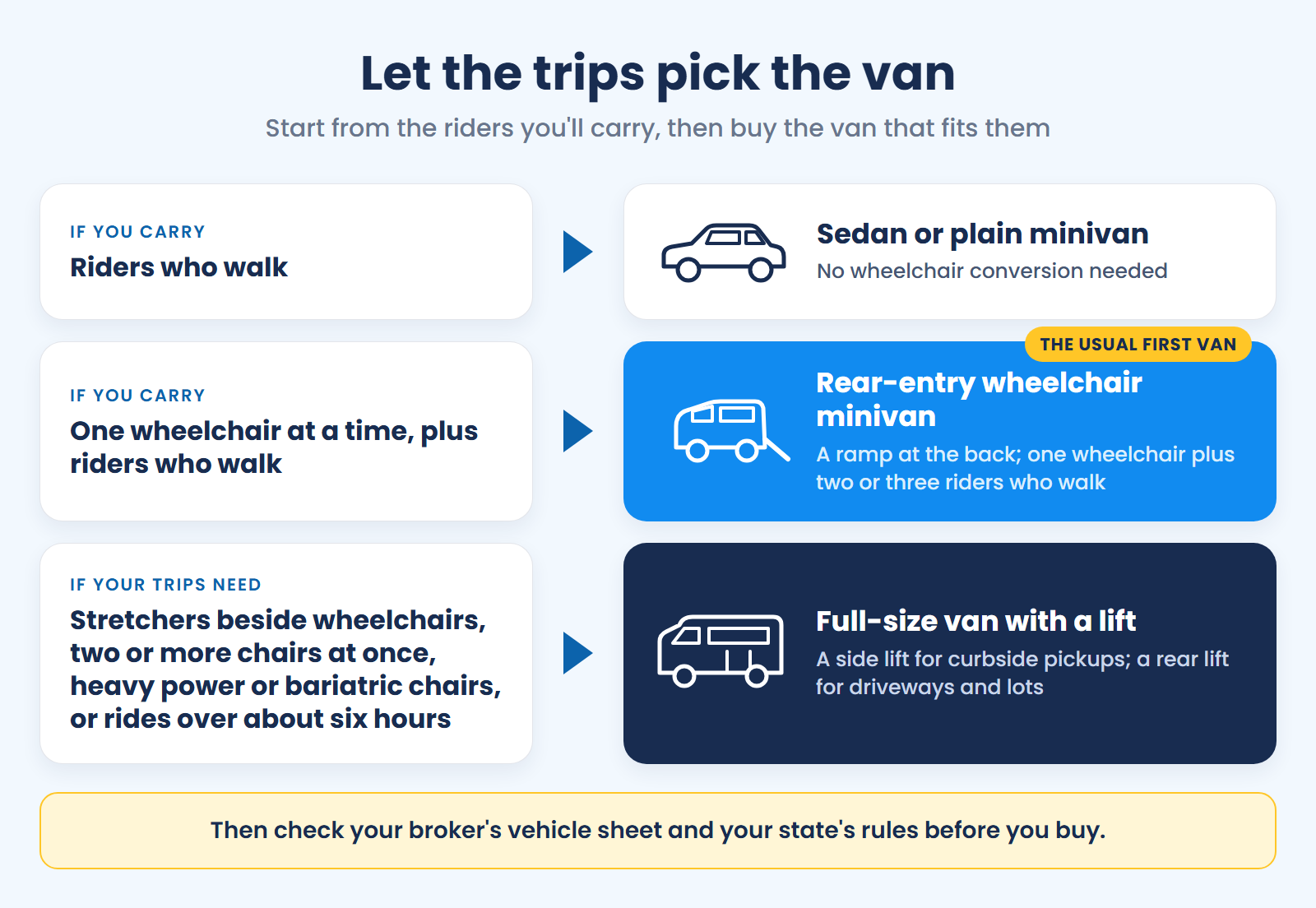
The usual first NEMT (non-emergency medical transportation) van is a wheelchair-accessible minivan, most often a rear-entry conversion that carries one wheelchair rider plus two or three riders who walk. New, a full-size van with a lift costs roughly $17,000 to $20,000 more than a commercial rear-entry minivan. It’s worth that when your trips need stretchers alongside wheelchairs, two or more wheelchairs at once, heavy power or bariatric chairs, or long-distance rides over about six hours. As of fall 2026, a used 2016-2019 wheelchair minivan lists for about $33,000 at dealers, and a new rear-entry conversion for about $63,000 to $71,000.
People ask me on software demos what vehicle they should buy. I’m not a van dealer, so my first answer is a question: what trips will it run? In July I talked with a man whose limo company in Texas had added two NEMT vehicles. “We’ve had the vehicles for two months,” he told me, and “we’ve done one ride.”
Let the trips you’ve lined up pick the van. For most new companies that’s a rear-entry wheelchair minivan, and the expensive mistakes are a van bigger than your trips need or a conversion built for personal use. Here’s the decision in the order you’ll make it: the trips, the size, the door, the rules, new or used, the price, paying, hybrid or electric, then the second van.
What trips will your first van run?
Your first trips decide the van, so before you shop, list the ones you’ve lined up or expect: who pays for each, and whether each rider walks, rides in a wheelchair or needs a stretcher.
Michael Shank of 42 North Transportation Consultants, who’s sold about 8,500 wheelchair vans and sells vans and financing, called skipping that step “one of the biggest mistakes” on our first podcast episode. Paul Muench’s answer set his whole fleet. “90% of our clientele is in a wheelchair,” he said of Gentle Turns, his Phoenix company, “and so all of our vans are wheelchair equipped.”
Each payer pulls the van its own way:
- Broker trips. Brokers, the companies states and health plans hire to hand out Medicaid rides, send a mix. In Indiana’s fee-for-service Medicaid program (riders covered without a health plan) from September 2018 to August 2019, 63.5% of ride requests were for riders who walk, 30.3% for wheelchair riders and 6.1% for stretcher riders. That one state’s mix is where the claim that a minivan can handle “up to 90%” of NEMT trips comes from: 63.5% plus 30.3% is about 94%, and the claim assumes every wheelchair fits a minivan.
- Facility trips. Facilities ask about wheelchairs first. A Virginia Beach owner who launched with a van for riders who walk said in a 2025 interview on another channel that every nursing facility or hospital she visits asks, “do you have a wheelchair van.”
- Private pay. Families pay for the rides they can’t give themselves, often because of a wheelchair, and they judge the van. I tell people that if I were starting my own NEMT company, I’d “buy a good clean vehicle, be a premium private pay service.”
My rule of thumb, not data: a fully booked wheelchair van can bring in over $100,000 a year in most places, and I’d be thrilled to see an ambulatory van (one for riders who walk) get there.
That doesn’t rule out starting with riders who walk, in a sedan or plain minivan with no conversion needed. MTM, a national broker, lists “Sedan, Passenger Vehicle, and Minivan” for them in its Virginia handbook, and the Americans with Disabilities Act (ADA) never requires a private company to buy an accessible car. Lean into wait-and-return rides, which is how I tell ambulatory-only owners to stand out from Uber and Lyft. If you haven’t lined up trips yet, the full order for starting a NEMT business puts that before the van.
Minivan or full-size van?
Buy a wheelchair minivan unless your trips need a full-size van with a lift: stretchers alongside wheelchairs, two or more wheelchairs at once, five or six walking riders plus a chair, heavy power or bariatric chairs, or long-distance rides over about six hours.
A rear-entry minivan “will accommodate one wheelchair and then you can have two or three ambulatory passengers in the second row,” Shank said. Two chairs fit in some, “but it’s very tight.” A bariatric rider and chair can come close to 1,000 pounds, he added, sitting right over a minivan’s rear axle. And Jeanine, who runs SailorGirl Transport in Florida, told us minivans “might work well” for trips “less than 6 hours.”
Rachel Scholler, who ran a Wisconsin NEMT company for 17 years, once sent a side-ramp minivan for a regular rider whose caregiver, it turned out, also used a wheelchair. “We ended up just sending a larger vehicle and transporting them all.”
Stretchers settle it fastest. On a June demo, I walked a Minneapolis-area owner with a wheelchair minivan through stretcher work in a minivan: “we do the stretcher trip, then we drive back to base, we unload the stretcher.” A Ford Transit keeps the stretcher aboard and still loads a wheelchair, and “a modern Ford Transit is going to feel like a premium vehicle.” For occasional stretcher calls, Shank can fit stretcher mounts in full-cut minivans, where the lowered floor runs to the front seats. And Broda built its Traversa, a reclining wheelchair it says is “WC19 crash tested,” to fit a standard wheelchair van (our episode on Broda’s Traversa chair has more). Check your state first: Texas requires an EMS (emergency medical services) provider license for any stretcher transport, North Carolina and Michigan treat stretcher work as ambulance work, and no Ohio license fits a stretcher van.
Count seats including the driver before you buy. A van designed for 16 or more people needs a driver with a commercial driver’s license (CDL) in every state, and more than 8 for pay makes it a commercial motor vehicle under federal safety rules on interstate trips. Michigan’s registration rules put a for-hire van with 9 or more seats under state bus authority, and Virginia’s insurance floor jumps from $350,000 to $1.5 million at 7 seats. More on what a bigger van can add to your licensing.
Rear or side entry, ramp or lift?
On a minivan, rear entry is the common NEMT choice; on a full-size van, put the lift where you load.
Shank, whose own sales are mostly rear-entry minivans, estimated that “probably 80% of the companies use a rear entry. They’re just easier to work with.” The rider rolls straight in instead of being turned to face forward. In April 2025 he also put rear entry at about $6,000 to $7,000 less, since a side-entry build lowers the whole floor from the firewall back.
Side entry fits cities whose taxi rules require it and puts the rider near the driver, but it needs room beside the van, and “you are pushing it to get 30 in out of that ramp,” Shank said. A Chicago owner, interviewed on another NEMT channel in December 2025, bought a side-entry van because it was the only one the dealer had. Riders in bariatric wheelchairs didn’t fit: “we had to ask facilities” to move riders “into a smaller wheelchair just to get into our vans.” That company runs rear-entry vans now.
John from Fenton Mobility, which upfits only full-size vans, said on our episode on what a manufacturer won’t usually tell you that where you load decides it. For “curbside pickups all the time,” a side lift sets the wheelchair on the sidewalk; with a driveway or a big lot, a rear lift works.
Manual beats powered on what can break. Paul’s vans all use a manual fold-down ramp, while a powered ramp that dies can strand you, because some vans lock the transmission until it’s stowed. Te’ya Miles, an Atlanta operator and coach, said in a 2023 video on her own channel that “the van will literally be stuck and I’m speaking from experience.” The ADA rule requires that interlock on lifts and rates them for at least 600 pounds, so ask about the rating if you carry bariatric riders.
What does a NEMT van have to pass?
Get each broker’s vehicle sheet in writing before you buy. NEMT vehicle requirements come in three layers: the ADA’s vehicle rule, which broker sheets usually adopt; each broker’s own equipment and inspections; and your state’s and local rules.
These are the numbers in the ADA’s vehicle rule, 49 CFR Part 38, that broker sheets adopt:
| Part of the van | What 49 CFR Part 38 asks for |
|---|---|
| Lift | Rated for at least 600 pounds. A platform at least 28 1/2 inches wide at the surface, 30 inches wide from 2 to 30 inches above it, and 48 inches long; edge barriers so wheels can’t roll off; an emergency way to lower it if the power fails |
| Ramp | A clear width of 30 inches; rated for 600 pounds if it’s 30 inches or longer (300 pounds if shorter); no steeper than 1:4 when it’s deployed to the ground; side barriers at least 2 inches high |
| Wheelchair space | A clear floor area of 30 by 48 inches, as close to the entrance as practicable; at least one such space on a van 22 feet long or shorter |
| Securement | Keeps the wheelchair from moving more than 2 inches in normal driving, plus a seat belt and shoulder harness for the rider at each wheelchair position |
| Door clearance | At least 56 inches from the top of the door opening down to the raised lift or the top of the ramp on a van 22 feet or shorter (68 inches on a longer one). And the same 56 inches of headroom from the lift to the wheelchair space |
MTM’s Virginia handbook requires “49 CFR § 38, Subparts A & B,” and Modivcare, another national broker, cites the ADA specifications in its manuals.
Then come the broker’s own checks, part of what brokers check before they send you trips:
- Inspections. MTM inspects Virginia vans before the first trip and every six months; Modivcare’s 2022 Kansas manual calls for a yearly one.
- Equipment. Between them, their lists include a fire extinguisher, a first-aid kit, a seatbelt cutter, two seatbelt extensions, a spill kit and reflective triangles.
- Lettering. MTM’s Virginia handbook wants your company name and phone number at least 3 inches high on both sides, and never the word “Medicaid.”
- Cameras, in places. Modivcare’s Mississippi manual requires inward- and outward-facing cameras that coach drivers in real time.
You’ll see claims that states cap a NEMT van at 10 years old. There’s no national age limit, and MTM’s Virginia handbook, Modivcare’s Kansas and Mississippi manuals and Georgia’s manual set none. Verida’s DC broker contract caps wheelchair vans at 8 years, but it’s on hold while MTM runs DC’s fee-for-service rides through Dec. 31, 2026. Where New York City’s Taxi and Limousine Commission (TLC) licenses the van, it wants this year’s or last year’s model for a new license.
Facilities set their own terms: University Hospital in Newark’s 2026 request for proposals asks the winning company for each vehicle’s registration, mileage and insurance. Private-pay trips answer to no payer’s sheet, only your state’s and local rules.
A few states change the van itself. In California, Medi-Cal’s vehicle rules (Medi-Cal is the state’s Medicaid program) have required a Vehicle Safety Systems Inspection (VSSI) certificate with NEMT enrollment applications since March 27, 2025. The enrollment rules of DHCS, the department that runs Medi-Cal, also call for two wheelchair positions, a second exit a wheelchair fits through and a lift or ramp rated for at least 450 pounds. Confirm with DHCS before buying a one-position minivan for Medi-Cal work. Ohio’s ambulette inspection, for its licensed wheelchair vans, checks door clearance, the ramp or lift and four-point tie-downs.
New or used, and what should a used van pass?
A used van can be the smart first buy, as long as it was built for commercial work and its conversion, paperwork and mechanics check out.
The trap is the personal-use conversion. A new provider buys a wheelchair van someone was using for personal use, and, as I put it to John on our July episode, “they slap a magnet on the door.” Only 7 of 157 used wheelchair vans listed at dealers in eight states on Sept. 25, 2026, said ADA, commercial or fleet. The rest didn’t say, which doesn’t prove they’d fail, but it’s why you check. Shank, who converts and sells used vans, is blunt: “the personal use vehicles are not ADA compliant.”
Before you put down a deposit, check six things:
- The build underneath. Seat bases and floor “pull tested,” John said, and “the shoulder brackets up on top” and “the grab bars” tested too.
- The labels and the invoice. A company that converted the van before its first sale adds its label near the original certification label on the driver’s door edge or pillar. A shop that converted it later under the federal disability exemption adds one saying it “may no longer comply” with every federal safety standard, and hands the owner a document listing which ones; ask the seller for it. A lift should carry a “DOT-Public Use Lift” or “DOT-Private Use Lift” label and a cycle counter you can read. And ask for the invoice that breaks out the vehicle and the conversion, a wheelchair-van dealer’s advice in a 2024 interview on another channel.
- The measurements. Door clearance, ramp width and the wheelchair space against the ADA table, and your riders’ widest chairs against the ramp.
- The straps. A full set of tie-downs at every wheelchair position, plus the seat belt and shoulder harness the ADA rule calls for.
- The mechanics. Records, rust underneath, a highway drive and the transmission: without good maintenance, Shank said in 2025, trouble starts past about 100,000 miles, and “you got to spend $3,000 to replace it.”
- Your own mechanic. Pay for a pre-purchase inspection.
Ray and Mac, who own The Doctor Ride in Charlotte and came on our podcast in June, told on their own YouTube channel what an inspection can’t promise. An inspector they paid “200 bucks” gave their used 2017 Ford Transit a thumbs up at the dealer. Almost right away the air conditioning failed, then the lift, then the air conditioning again; the lift and second air-conditioning repairs alone ran “over five grand,” and their warranty covered them. “If that was our only van,” one of them said, “we would have had to cancel rides for an entire week.”
On age, Tony Jackson, an Orlando operator with 35 years in the business, told us to skip anything “more than 10 years old,” and “a three-year-old van is fine.” The best deals I know of are at auction or from a NEMT company that’s closing, and Facebook Marketplace is worth watching. Buy new when a payer caps age.
What does a NEMT van cost in 2026?
As of fall 2026, a used 2016-2019 wheelchair minivan lists for about $33,000 at dealers, a new rear-entry conversion for $63,409 to $70,977, and a new Ford Transit with a lift for $79,999 on sale.
Here’s the fall 2026 picture by kind of van, from dealer listings, MobilityWorks Commercial’s Transit offer, BraunAbility’s pricing example and Chrysler’s Voyager page. Mind the third column: a median, a listing, a sale price and an MSRP (the maker’s suggested retail price) are different numbers.
| Van | Price | What the number is | Where and when |
|---|---|---|---|
| Cheapest used wheelchair minivans (2016 to 2019, high mileage) | $15,000 to $25,000 | Dealer asking prices, mostly at 79,000 to 200,000 miles; only 3 of 157 listings were under $15,000 | 157 dealer listings in eight states, Sept. 25, 2026 |
| Used wheelchair minivan, 2016 to 2019 | About $33,000 | Median asking price of 63 listings | Same sample |
| Used wheelchair van, 2020 or newer | About $62,600 | Median asking price of 94 listings | Same sample |
| New rear-entry wheelchair minivan (2026 Chrysler Voyager) | $63,409 to $70,977 | A commercial sale price ($63,409, offer ended Sept. 30) and a retail listing ($70,977) at one national dealer | MobilityWorks, Sept. and Oct. 2026 |
| New side-entry wheelchair minivan | $65,781 (manual ramp) to $88,685 (powered ramp) | A dealer listing’s total MSRP; the converter’s own worked example | A BraunAbility dealer, Sept. 25, 2026; BraunAbility, Oct. 2026 |
| New full-size wheelchair van with a lift (2026 Ford Transit) | $79,999 | Sale price after $2,700 of rebate and discount | MobilityWorks Commercial offer, Oct. 1 to Dec. 31, 2026 |
| Plain minivan for riders who walk (2026 Chrysler Voyager LX) | $41,395 | MSRP before destination | Chrysler, Oct. 2026 |
A used “wheelchair van” priced like a family minivan deserves a second look, because the conversion is a big part of the price: on one new side-entry Voyager, it was $21,996 of the $65,781. For tax and title, equipment, insurance and six months of bills, see what the whole launch costs, van included.
When should you order, and how should you pay?
Line up the trips and the drivers while the van is being found or built, pay as late as the dealer allows, and match the financing to how many miles NEMT puts on a van.
In 2025 Shank quoted about six weeks to build a minivan and 10 to 12 weeks for a Ford Transit, and he has buyers pay “when the vehicle is done,” so nobody’s making payments or paying insurance on a van still being built. Quote insurance on the van you’ll actually buy and bind it (switch it on) at the first step that asks for proof; some states, like Minnesota, Virginia and Ohio, want it on file before they issue your authority. More on when to bind the policy.
You can pay three ways:
- Cash. Rachel Scholler bought her vans outright, and she calls a $500 to $800 monthly payment before you have the work “not prudent, I don’t think, early on.”
- A loan. In Shank’s practice (he arranges financing), lenders wanted “5 or 10% down” in 2025, sometimes more, and for a business loan, “the last couple years of tax returns or the last three months of your bank statements.” MobilityWorks Commercial’s $0 down and “as low as 8.49%” on a 2026 Transit, for “well-qualified” NEMT buyers through Dec. 31, is a dealer’s best case.
- A lease. Buy the miles up front. One dealer’s Voyager lease, an offer that ended Sept. 30, ran $1,099 a month for 48 months with 20,000 miles a year and 40 cents a mile over. Say your van runs 2,500 miles a month, the fuel figure in our startup-cost guide: that’s 30,000 miles a year, 10,000 over the lease, or $4,000 a year. The same dealer’s Transit lease has unlimited miles at $1,799 a month for 48 months, with a $9,000 buyout.
On taxes, IRS rules can let a business write off a van’s cost in the year it’s placed in service, through Section 179 or the 100% bonus depreciation for property acquired after Jan. 19, 2025. The yearly caps on passenger-car depreciation don’t apply to a vehicle used directly to carry people for pay (IRS Publication 946), but your own numbers decide the rest, so ask your CPA.
Should your van be a hybrid or electric?
A hybrid minivan, often yes. Electric fits when your routes leave time to charge, or when a grant or an eco-friendly payer is behind it.
Every new Toyota Sienna is a hybrid, and Toyota rates the 2026 model at 36 mpg combined with front-wheel drive. Most of Paul Muench’s vans were Siennas in 2025, with a maintenance record he called “really solid” so far, and as I said on a call this summer, “That hybrid stuff is unbelievable.”
Electric sedans can sometimes work, because they can have enough range to make it through the day on one charge. Electric vans are more challenging unless you have a fixed route where you know you’ll have time to charge them. Ford rates its 2026 E-Transit cargo van at 143 to 159 miles a charge and says upfits change that. John, whose company sells a second battery for it, put an upfitted one without that battery at “roughly like 50 to 60 miles per charge” on our July episode. Kia and BraunAbility’s electric wheelchair taxi, based on Kia’s PV5, was a “production-ready concept” when they showed it in April 2026. The federal clean vehicle credits ended for vehicles acquired after Sept. 30, 2025.
There are two reasons to consider electric vans: you’re a nonprofit and can get a grant that will pay for them, or having them helps you win contracts from eco-friendly payers, which are often local governments and almost never brokers. Rey Leon runs the LEAP Institute, a grant-funded nonprofit in California’s San Joaquin Valley. When he came on our electric fleet episode in August 2025, its 19 Teslas, about 10 Chevy Bolts and one ADA van covered about 40,000 miles a month, charging overnight at its hub, on electricity he put at about 25% cheaper than gas. Brokers gave it “no favoritism.”
When should you buy the second van?
Buy van two when the first one is full and you’re turning trips away, and make it the van those turned-away trips needed.
Christopher Buell, owner of NEMT Alliance, gave the order on our podcast: get “that first van close to full-time,” hire a full-time driver, “and then buy a second van.” Or as I summed up The Doctor Ride’s own system on their episode, “you track the lost leads and if it was a capacity issue, you think about buying another vehicle.” Log each trip you turn down and what it needed. That list is van two’s spec.
Until then, one van can’t cover for itself. “When I have my van not available is when I get calls for trips,” a one-van owner in Northern California told me in July, on a day his van was in for service. My advice: make friends with another small operator nearby and pass trips back and forth.
Two vans also means two sets of records. Duet’s NEMT fleet management software keeps each van’s details, maintenance records and inspection history together. Before each shift, drivers tag each item on your checklist pass, flag or fail, and Duet records the time, location, driver and result. There’s no per-vehicle fee, so a parked van adds nothing to the bill. The maintenance and each broker’s inspection are still yours.
Back to the limo company in Texas: it had the vehicles before it had the riders, and two months in, it had one ride. Before you sign for a van, can you name the first ten trips it will run, who pays for each, and whether every one of those riders fits through its door? If you can, buy that van. If you can’t, the van can wait.
FAQ
How many miles does a NEMT van last?
Plan on about 150,000 miles from a minivan with diligent maintenance, by the count of Michael Shank, who sells wheelchair vans, and he says you can get more. Some owners do: a New York owner whose fleet is nearly all minivans said in a 2022 interview that one of her Toyota Siennas had almost 400,000 miles and still “purrs like a kitten.” The maintenance program decides which end of that range you land on.
Can I use my own car or minivan for NEMT?
For riders who walk, often yes, where your state and payers accept it. You’ll need commercial insurance on it, and brokers may want the vehicle owned by or leased to your company: Modivcare’s Mississippi manual allows “only its own leased or owned vehicles.” The car also has to suit the riders. A Detroit-area owner told me in July that a broker ended his contract after “a couple of clients just had an issue with getting in the car,” his Jeep. And a personal minivan can’t carry a wheelchair rider until it’s converted.
About the author
James O'Donnell cofounded Duet and leads its sales, partnerships, and growth services. He talks with NEMT operators every week, hosts the NEMT Growth podcast, and answers Duet's sales line himself. More about Duet's founders →
Want more trips and less busywork?
See how Duet runs and grows NEMT businesses in a 30-minute demo.