Article
How to Hire NEMT Drivers (With a Free Job Description)
Brokers and insurers decide who's allowed to drive. Good operators find out who should with one hard question and a day in the van.
By James O'Donnell, Cofounder and COO, Duet ·
To hire NEMT drivers, get each broker’s and your insurer’s driver rules in writing and put them in the job post. Screen by phone, then interview in person around one hard rider scenario. Make the offer conditional on the exclusion lists, the driving record, a background check and any drug test a payer requires. Put the new hire in the van for a day before paid training, and keep them off broker trips until the broker approves them.
Eugene Gindin runs Capital Area Transport Service, a five-vehicle wheelchair company in the DC area, and my cofounder Jing Zhu says he’s the best judge of drivers she’s met. On our April 2026 episode with him, he told me his riders are mostly over 60, some in constant pain, and they say things. So he asks candidates what they’d do when a rider starts “raising their voice, saying things, calling you names.” He wants “an honest answer,” because it shows “what things may trigger this driver.”
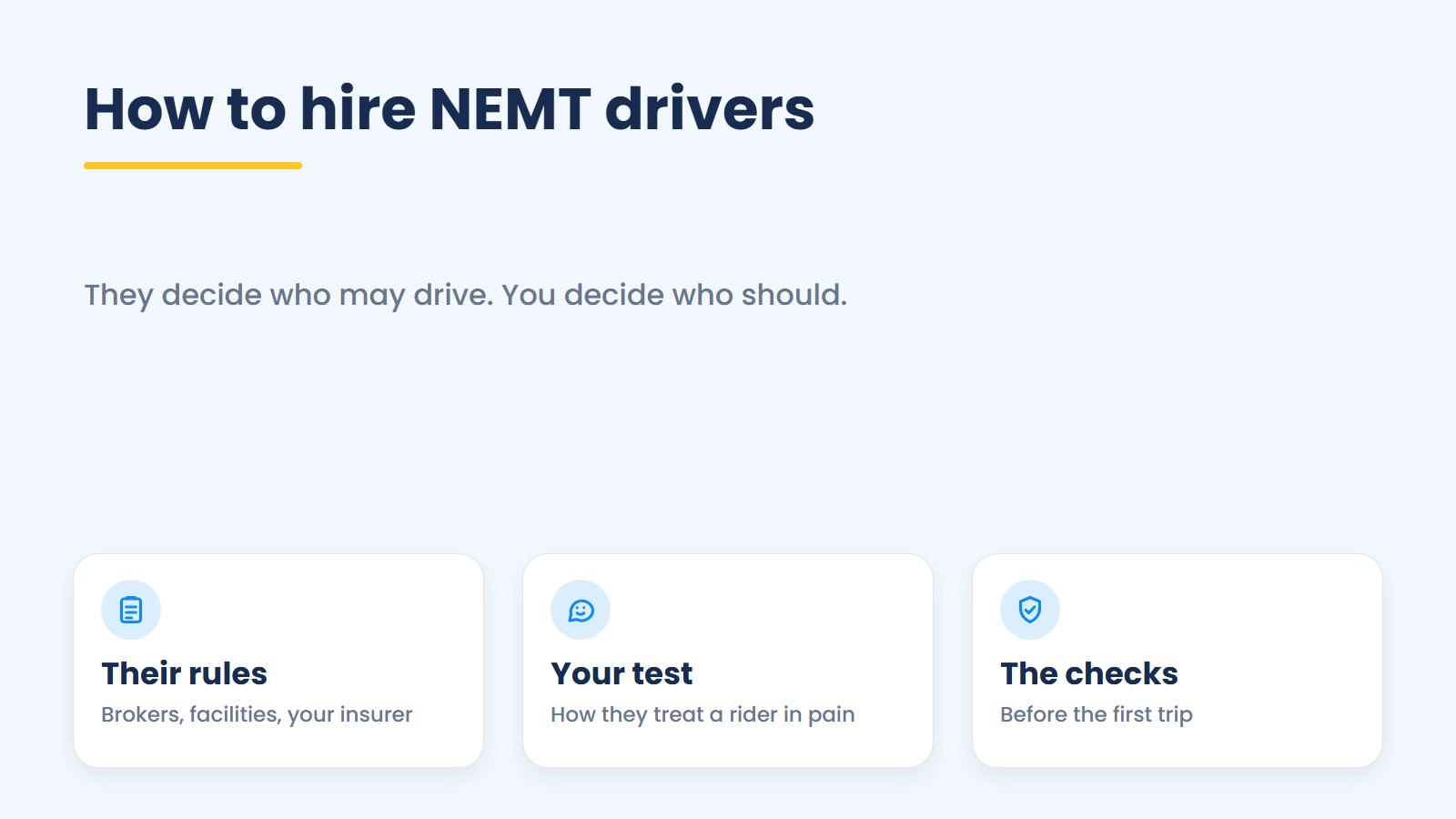
Most of what you’ll read about hiring NEMT drivers is a requirements list, and brokers and insurers write it for you. They decide who’s allowed to drive. Only you can test who should, so learn their rules before you post, then spend your interviews on how candidates treat riders. Three tests decide a hire: their rules, your own test (the interview and a day in the van), and the riders’ verdict.
This guide follows a hire in the order you’ll make it, which spends the least on the wrong person. First come when to hire, whose rules apply and who to look for. Then the job post, the interview, the checks, a day in the van and the first weeks, and last, how to keep good drivers. It goes deeper than the hiring section of our guide to running a NEMT business.
When should you hire a driver?
Hire the next driver once you’re turning down trips every couple of days, and hire one at a time. Rachel Scholler, who ran a rural Wisconsin NEMT company for 17 years, told me on our 2025 episode about her staffing and margins how she timed it. Once she saw trips getting turned down every couple of days, she’d “get ahead of that and have one or two more people.” Once her part-timers stopped saying yes to extra days, “it’s time to go hire a new person.”
Part-timers often fit better, because appointments bunch up. A Cincinnati owner with eight or nine vehicles said on a 2026 industry podcast that “a lot of appointments are at the same time,” so his drivers work 10 to 30 hours a week. A Santa Cruz, California owner said on a 2025 industry podcast that his trips didn’t cover his full-time drivers’ pay, so he covered it from his business loan for three or four months before switching to part-time. Before you post, check what a hired driver does to one van’s math.
Whose rules decide who can drive for you?
Your state, your brokers, your facility contracts and your insurer decide who’s allowed to drive for you, so get each one’s list in writing before you post. For Medicaid trips, federal law sets four minimums: each driver has a valid license and isn’t on the federal exclusion list, and each provider has a process for drug-law violations and a way to report drivers’ driving histories to the state. Beyond that, federal Medicaid law “does not establish additional basic driver and vehicle standards,” CMS, the federal Medicaid agency, wrote in 2023.
Above that, the minimum age is 18 in TennCare’s July 2026 health plan contract (TennCare is Tennessee’s Medicaid program), 19 in the 2025 standards of MART, a Massachusetts Medicaid ride broker, and 21 in Georgia’s October 2026 Medicaid manual. Tennessee has two layers: Verida, a ride broker, says in its provider manual for BlueCare Tennessee that TennCare “allows NEMT Drivers to be 18 years of age,” but Verida’s own minimum is 21. Georgia’s manual has no drug test, though Verida, now its statewide broker, asks on its Georgia provider page for “Current drug screens for all owners and drivers.”
Your insurer has a say, so ask your agent for its driver rules in writing. A New York owner with 22 vehicles said on a 2022 podcast that the insurer has to approve every driver the company hires.
Facility contracts add their own terms. University Hospital in Newark, New Jersey, asked in an April 2026 request for proposals for background checks under six months old at the contract’s start, monthly exclusion screening and uniforms with visible ID. That’s one hospital, so read each contract.
Private pay isn’t the lane without rules. It’s the lane where your state’s license rules, your insurer and you set the bar, because no broker checks a driver who only carries private-pay riders.
Who makes a good NEMT driver, and where do you find one?
Hire for patience, since you can teach the driving, and look for it among retirees, people on second careers, your best drivers’ referrals and, for volume, job boards. An owner in California’s Solano County said on a 2024 industry podcast, “I can teach you how to drive,” but “the one key skill set that you can’t teach an individual is empathy.”
Many of Rachel’s drivers were retired police officers and firefighters, found through local papers, senior centers and radio ads; “most of them had pensions,” and she found them “very dependable, very reliable.” Paul Muench, who told me about his first year building Gentle Turns in Phoenix, looks for retirees, including ex-military, who “want to continue to work some,” one or two days a week. The catch is dispatch: his dispatcher “needs to know which driver’s available on what day and what hours.”
Take referrals from your best drivers, but vet them. On his episode on hiring and paying drivers, Marqus Johnson, who runs a Tampa wheelchair and stretcher service and coaches other owners, says to ask what the referring driver gets out of it: “What is the incentive behind it?”
Job boards bring volume, and you do the sorting. Eugene may get 100 resumes from one post and cut 80 before he talks to anyone, by his estimate.
Owners split on experience: Marqus wants none, so he can train new drivers his way, while others start with experienced drivers or EMTs. Screen everyone the same way.
What goes in a NEMT driver job description?
The job post should describe caring for riders first, then your payers’ requirements, the physical work, the schedule and the pay. Uber already gets people from one address to another. We’re in the business of showing service and care to the riders. Say what that means: helping riders to the door, securing every wheelchair, staying patient with a rider in pain.
List the hard requirements from your payers and insurer, like the minimum age and the driving-record standard, and say the checks come after an offer. The ineligible screen themselves out before you pay for their applications. Two California owners said in 2024 that a vague Indeed post drew unqualified applicants, and Indeed charged them each time someone applied.
Set pay from local postings. For shuttle drivers and chauffeurs, the federal job category that includes nonemergency medical transporters, the Bureau of Labor Statistics’ May 2025 national median was $17.93 an hour. Then make applying take some work, because part of the way you attract good people is throwing barriers in front of the application process. One short written answer does it.
Decide before you post whether drivers will be W-2 employees or 1099 contractors. I’d hire W-2, because you’ll set their schedule, train them your way and tell them how to treat riders, and the IRS weighs “the extent of the right to direct and control the worker.” The Labor Department proposed replacing its own contractor rule in February 2026 and hadn’t finalized it by late October. Employees bring state labor law with them: Jing said on our podcast that a California provider, sued by a driver over lunch breaks, had to produce thousands of pages to prove the breaks happened, so keep break records from day one.
Get the free job description
I’ve put all of this, plus a notes box for you, in the free NEMT driver job description (.docx), with no email needed. To use it:
- Fill the bracketed blanks under “What you need” from each broker’s and your insurer’s written rules, using the stricter rule wherever two differ.
- Write your one application question under “How we hire.” The template’s example asks about a time the applicant helped someone having a hard day.
- Set the schedule and pay.
- Read the notes box at the end, then delete it before you post.
How do you interview NEMT drivers?
Screen by phone for the days and hours candidates can work, then meet in person, ask one hard rider scenario, and listen for an honest answer. Ask about availability on the phone. When it’s “a lot of can’ts,” Eugene said, “it’s difficult to really hire that person.” In person, the name-calling scenario tells him where a driver fits: “Can you put them in front of certain customers or can you not?”
Marqus watches the small things: “Do you show up early?” and “When I send you a text message, are you responding in a timely fashion?” A candidate who cuts him off mid-conversation has him “pushing back away from you.”
A Chicago owner said in a 2025 podcast interview that the final interview includes a test drive to a stop sign, to see whether the candidate rolls through it. Ask your agent first whether your policy covers a candidate behind the wheel. Then call their past transportation employers.
Some states limit when you can ask about convictions. California’s Fair Chance Act, for one, bars employers with five or more employees from asking before a conditional offer, except where a law requires the check. Medical questions wait too: “Don’t ask any medical questions before a conditional job offer has been made,” says joint guidance from the Federal Trade Commission (FTC) and the Equal Employment Opportunity Commission, so describe the physical tasks in the post instead. Family status never comes up, and age only as a payer’s or your insurer’s minimum.
Which checks do you run, and in what order?
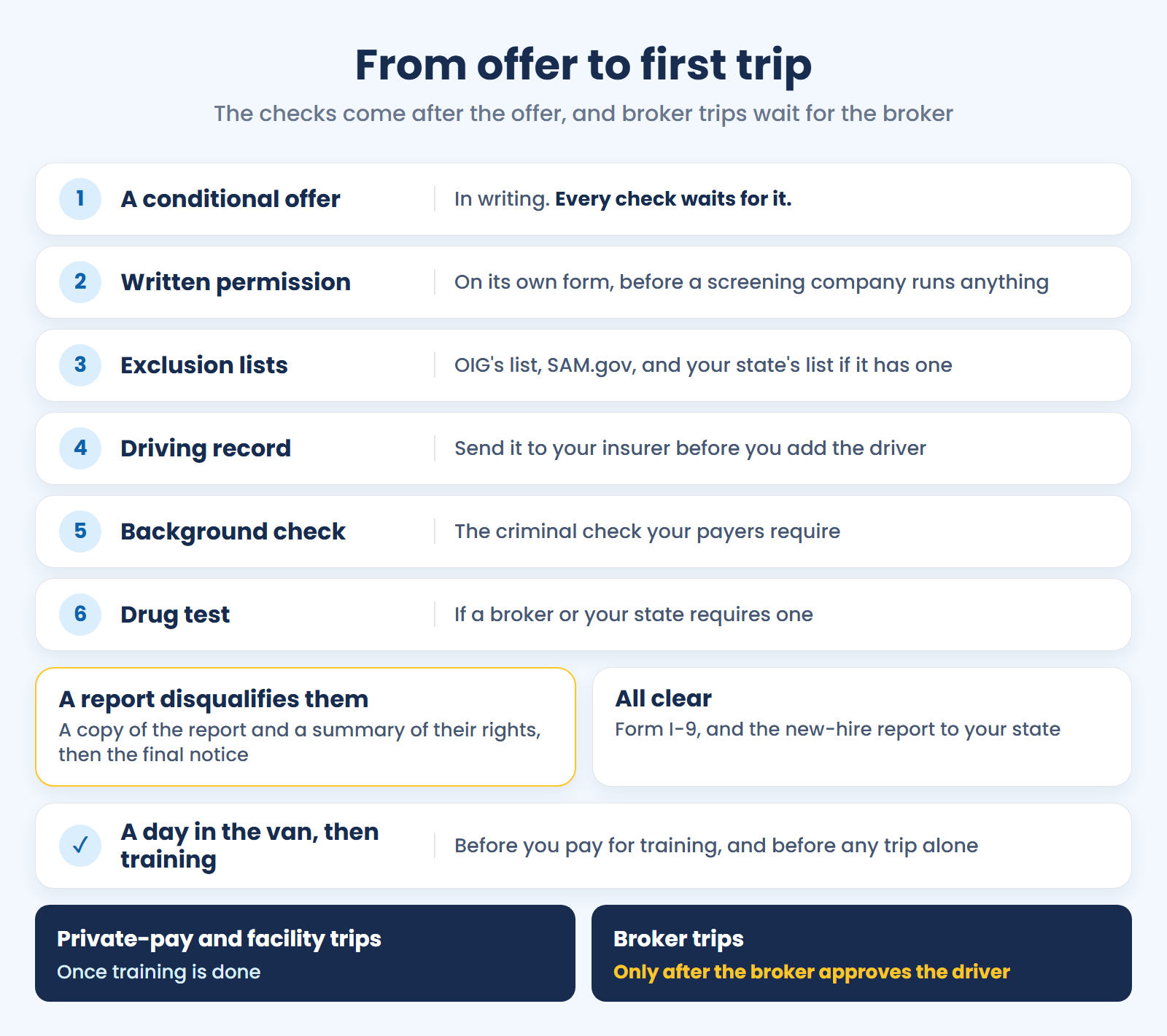
Make the offer conditional, get written permission, and run the checks before the first trip: the exclusion lists and the driving record first, since they’re quick and your insurer may want the record, then the background check and any drug test a payer requires.
- A conditional offer, in writing. Every check below waits for it.
- Written permission, on its own form. Before a screening company runs anything, the Fair Credit Reporting Act (FCRA) requires the applicant’s signed permission and a notice that, as the FTC’s guide for employers puts it, “must be in writing and in a stand-alone format.”
- The exclusion lists. Search the List of Excluded Individuals/Entities (LEIE), kept by the Office of Inspector General (OIG) at the federal health department. Then search the System for Award Management (SAM.gov) and your state’s list if it has one. OIG’s 2013 bulletin says excluded people can’t provide federally paid transportation. Providers “are not required by statute or regulation to check,” it says, but monthly screening “best minimizes” liability, and many broker contracts require the check.
- The driving record, then your insurer. A motor vehicle record (MVR) from a screening company falls under the FCRA; from your state’s DMV, federal privacy law lets you get it with the driver’s written consent. Send it to your insurer before you add the driver, since a driver’s claim can follow your premium for years. Applicants who say they have no tickets sometimes do, two California owners said in 2024.
- The criminal background check. A Richmond, Virginia owner put this check, the driving record and a urine test at about $100 to $120 a person in 2024, and MediTrans, a Louisiana broker, says to allow five to seven business days for its vendor’s check.
- A drug test, if a broker or your state requires one. Federal testing rules for commercial drivers cover only drivers who need a commercial driver’s license (CDL), so for a typical van, the test is your payer’s rule.
If a screening company’s report disqualifies them, the FCRA says to give them a copy of the report and a summary of their rights before you reject them. The FCRA sets no specific waiting period, but FTC staff wrote in 2011 that “some reasonable period of time must elapse.” California requires at least five business days for them to respond when it’s conviction history. Then send the final notice, which explains how to dispute the report.
If they clear, they finish Section 1 of Form I-9 by their first day of work, and you finish Section 2 within three business days, then report the hire to your state within 20 days or its shorter deadline. Then come a day in the van and training, private-pay and facility trips, and broker trips only once the broker approves them: MTM’s 2023 agreement says it “may not pay” for trips by uncredentialed drivers. What each broker wants varies. In Georgia, the state’s manual has the broker conduct the background check; in Louisiana, the State Police, an agency it authorizes or the FBI sends the results straight to the health plan or its broker. So ask each broker in writing for its list and how long its approval takes.
Who asks for what, as of October 2026:
| Check | Who requires it | Before the first trip? | How often it repeats |
|---|---|---|---|
| Valid license | Federal Medicaid law, brokers, insurers | Yes | At each renewal |
| Driving record | Brokers, many states, often insurers | Yes | Yearly, or continuous DMV monitoring |
| Criminal background | Brokers, many states, some facilities | Yes | Yearly at most brokers; five years in Tennessee |
| Exclusion lists | Federal Medicaid law, brokers, some facilities | Yes | Monthly (advised; some contracts require it) |
| Drug test | Most brokers, some states | Where required | Random, post-accident or on suspicion |
| Fingerprints | A few states and brokers | Where required | Varies |
| Training | Brokers and states | Yes, with some grace periods | Yearly, or every three years |
Most brokers re-check drivers every year, and MTM’s 2026 Rhode Island handbook wants renewals uploaded 10 business days before a credential expires. Duet’s driver profiles keep each driver’s details and documents, like their driver’s license, in one place with each credential’s expiration date, and Duet alerts you before a credential expires. You still order the re-checks and send the broker the paperwork.
Why put a new driver in the van before you train them?
A day riding along with you, before you pay for training, shows the new driver the job and shows you how they treat riders, which no check can. Paul makes it “the first thing” in his training, once a candidate’s driving record and attitude check out. “I want them to spend a full day with me when I’m out driving so they can see this is the level of service that we’re providing.” He watches for any “loss of self-control,” because drivers have to stay respectful even when others aren’t.
A Rockford, Illinois owner, profiled on Modivcare’s provider blog in 2022, runs background checks and fingerprinting once a candidate accepts the job. She also has new hires shadow a driver “for a couple of hours first to see if this is really a fit for them before we invest” in training that takes “an entire month.” Payers name their own courses: defensive driving and passenger assistance with wheelchair securement in most, first aid and CPR in some.
Pay them for the day, and run it on private-pay and facility trips, with the rider’s OK. Before anyone extra rides on a Medicaid trip, check your broker’s rules: MART lists “Transport unauthorized persons” among the violations it can fine, in its 2025 quality plan.
What should a new driver’s first weeks look like?
Pair a new driver with your best driver, ride with them yourself before they go solo, call their first riders, and deal with the first mistake the day it happens. Eugene’s trainer is “the best driver I want to put out there,” so new drivers copy the right example. The Santa Cruz owner rode every trip of his latest hire’s training week and rides 60 to 70% of a new driver’s trips in their first 30 days.
On a call I sat in on, the owners of a small private-pay service in the Southeast said they’d run more than 600 trips without a late pickup. Then their new driver, about 20 rides in, ran late without calling, and the rider they kept waiting got a free ride. They sat him down: “when stuff is going wrong, this is when we overcommunicate.” I told them their slow ramp made that one-on-one possible, and that with three new drivers at once, keeping their “super premium culture” would be “a lot harder.”
Call a new driver’s first few riders, because an unhappy rider may simply stop booking. A driver trainer told an industry podcast in 2026 that his mother, nearly 97 and in a wheelchair, refused to ride with a company again after one trip. Its driver talked to him several times and never once to her.
Rachel has let drivers go for yelling at a rider who’d thrown up, because now they’d run behind. “I have no tolerance for it,” she said. Her advice to owners: “people need to remember you’re in charge.”
Facility trips add an audience: the front desk. One brand-new driver who offended a front desk nearly cost one of our customers her biggest facility account.
How do you keep good drivers?
Pay at least the local going rate, keep hours steady, bend on time off, and back your drivers up with riders and dispatch. Rachel’s selling point was time off: some drivers spent two months a year in Arizona, another a month in Italy, and “we could always accommodate that.” Eugene wants his drivers to know that “I kind of have their back,” even in dealings with riders and dispatchers.
One warning from Jing on pay: when one of our customers paid drivers partly by the mile, drivers started pressing dispatch for the long-distance trips: “why did you take away my long-distance trip?”
A Maryland owner with a seasonal state contract told me that when the work slows, drivers “disappear,” and he’s recruiting again. Good drivers bring riders back, too: a Greensboro, North Carolina owner with five vans told a 2026 podcast that riders call asking, “can you send Mr. Johnny out.”
The broker’s checks tell you who’s allowed to drive, and Eugene’s question tells you who should. Only the riders can tell you whether you got it right, so this week, call a rider and ask how your newest driver was.
FAQ
Can a family member drive for my NEMT company?
Yes, if they pass the same checks as any other driver, and the broker approves them before they run broker trips. Hold them to the same rules, too. A New Jersey owner who once ran about 50 vehicles said on an industry podcast in 2026 that if she could redo one hiring decision, she’d hire fewer family and friends. She’d assumed they’d uphold her standards without being told, and she “gave a lot of grace.”
Do NEMT drivers need a CDL?
Not for a typical wheelchair van or minivan under federal rules. A commercial driver’s license (CDL) is for a vehicle designed to carry 16 or more people counting the driver, one rated at 26,001 pounds or more, or one hauling hazardous materials that need placards. States can ask for more: New York requires a CDL with a passenger endorsement for ambulette drivers, as our New York guide’s driver section explains, and TennCare’s July 2026 contract wants a Class D license with a for-hire endorsement, or a CDL.
Can I hire a driver with a criminal record?
Sometimes. Each broker and state program sets its own disqualifying offenses and look-back windows. MTM’s 2023 provider agreement allows a driver with a felony in the past seven years only with the approval of MTM’s client (the agency or health plan that hired MTM), while its 2026 Rhode Island handbook bars any felony in the past 10. In California, if you have five or more employees, you also have to weigh the person: its Fair Chance Act requires looking at the offense, the time since and the job before you reject someone over a conviction. The director of a Fort Wayne, Indiana nonprofit said in a 2026 podcast interview that when a great candidate has something very old on their record that bars Medicaid work, they put that driver on their contracts that aren’t Medicaid.
About the author
James O'Donnell cofounded Duet and leads its sales, partnerships, and growth services. He talks with NEMT operators every week, hosts the NEMT Growth podcast, and answers Duet's sales line himself. More about Duet's founders →
Want more trips and less busywork?
See how Duet runs and grows NEMT businesses in a 30-minute demo.