Article
NEMT Insurance: What It Costs and What Brokers Require
You don't pick your NEMT insurance limit. You control what you pay for it: when it starts, who shops it and your claims record.
By James O'Donnell, Cofounder and COO, Duet · · Updated
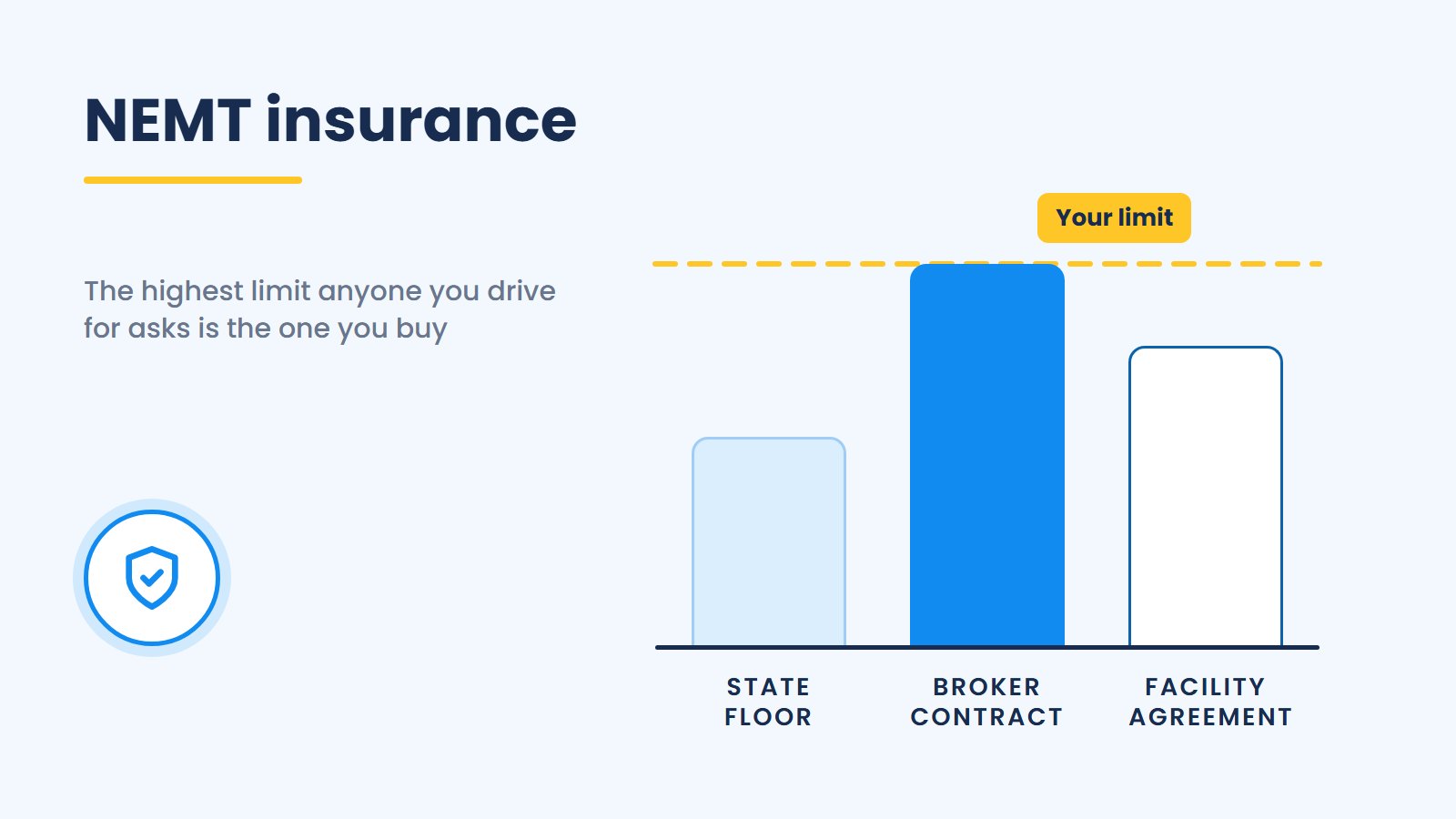
A NEMT company needs commercial auto liability on every van, general liability, and workers’ comp once it hires (the headcount that triggers it depends on the state). The limit is the highest one your state, your brokers and your facilities demand, which for most new companies means about $1 million in auto liability. A new company pays roughly $1,200 to $1,800 a month per wheelchair van in its first year, with a fifth to a quarter of the year’s premium due at signing.
New owners come to me paying insurance on an expensive van they financed, with no trips to put it on. And I’ve seen people’s insurance double after one accident.
You don’t pick that limit. Your state and whoever you drive for do. What you control is what you pay for it: when you switch the policy on (agents call that binding), who shops it, and the claims record behind every renewal. Here it is in the order you’ll buy it, and if you’re already insured, the shopping and renewal sections near the end are yours. The rest of the launch is in our step-by-step guide to starting a NEMT business.
What insurance does a NEMT company need?
Your state usually requires only commercial auto liability on each van, plus workers’ comp once you hire, and your contracts add the rest: general liability, sometimes sexual abuse and molestation (SAM) coverage, and physical damage on a financed van.
John Kecskes, who places NEMT policies as an insurance broker, called it “a two-part question” on our episode on lowering NEMT insurance premiums: the state’s rules, then your contracts’. (He’s an insurance broker, not a ride broker, so from here on I’ll say “agent” for anyone who sells you insurance, to keep them apart from the Medicaid brokers who hand out trips.) General liability and the other contract coverages “are going to cover you for things that happen outside of your car, especially if you’re doing wheelchair, stretcher type transports,” he said. And on a financed van, “you’re going to want to have comp collision,” the physical-damage cover that fixes the van itself.
| Coverage | What it pays for | Who usually requires it |
|---|---|---|
| Commercial auto liability | Injuries and damage from a crash, up to your limit | Every state, at its floor; most brokers and facilities, at a higher limit |
| General liability | Injuries and damage that don’t involve driving, like a rider who trips on the way into a clinic | Brokers and facilities |
| Workers’ comp | Your employees’ on-the-job injuries | State law, once you reach your state’s headcount (optional in Texas) |
| Sexual abuse and molestation (SAM) | Claims that a driver or staff member abused a rider | Some contracts, like Verida’s in Georgia; not on the published lists of MTM or SafeRide, two large brokers |
| Excess liability | A second layer above your auto or general liability limit | Some hospitals and county programs |
| Physical damage (comprehensive and collision) | Repairs to your own van | Your lender, on a financed van |
| Personal injury protection (PIP), no-fault and uninsured-motorist cover | Medical bills no matter who caused the crash; crashes with uninsured drivers | Some states, like Florida, Minnesota and Arizona |
Know what the policy won’t cover, too. Paul Muench, who runs Gentle Turns in Phoenix, told us on our episode about going from zero to five vans that his insurance “does not cover us for transferring people into a chair or a gurney.” His drivers assist, and the caregivers lead the transfer. Ask your agent before your drivers lift anyone. And if you add stretcher trips, budget for coverage of stretcher loading and unloading, a big extra cost of that service.
How much coverage do you need, and who sets the requirement?
The requirement is the highest limit your state or anyone you drive for asks for, which for most new companies means about $1 million in auto liability. Federal Medicaid law sets no minimum: the 2023 Medicaid transportation guide from CMS, the federal Medicaid agency, lists vehicle liability insurance among the standards a state “may also require.” So your state sets a floor, and each broker and facility sets its own bar, usually above it.
Te’ya Miles, who runs an Atlanta NEMT company and coaches new owners, ranks underestimating insurance right behind buying the van too soon. As she told me on our episode on the NEMT mistakes nobody warns you about, a $300,000 policy bought because it’s your state’s minimum “may not be the hospital’s minimum. That may not be that facility’s minimum. That may not be that broker’s minimum.”
Here’s how the floor and the payer bar compare in the 13 states our state guides cover. Three numbers like $100,000/$300,000/$50,000 mean per person, per accident and property damage; $1M/$2M means per occurrence and per year in total; a combined single limit is one number for injuries and property damage together. An additional insured is someone your policy also protects, usually the broker or facility.
| State | What state law requires of the van (Oct. 2026) | What Medicaid or a broker asks (Oct. 2026) | Workers’ comp starts at |
|---|---|---|---|
| Arizona | Livery vans: $250,000 per incident once a ride is accepted, plus uninsured-motorist cover; $750,000 at 9 to 15 seats counting the driver | AHCCCS (Arizona Medicaid) plan contracts: $1 million auto; $1M/$2M general liability on contracts of $50,000 or more | First employee |
| California | $750,000 at 8 or fewer seats counting the driver; $1.5 million at 9 to 15 | Medi-Cal: full commercial coverage on each van, no dollar figure; each health plan’s ride vendor sets its own | Every employer |
| Colorado | Wheelchair vans: no state permit, but the owner files a $100,000/$300,000/$50,000 certificate of insurance with the Department of Revenue; ambulatory riders who pay you need utilities commission authority: $500,000 at 8 or fewer seats | Medicaid rule: $300,000/$600,000 bodily injury and $50,000 property damage; MediDrive, the broker, adds an A-rated insurer | First employee |
| Florida | Effectively ordinary auto cover for a non-taxi van ($10,000 PIP, $10,000 property damage); some counties ask more (Palm Beach: $125,000/$250,000/$50,000 or $300,000 combined) | Medicaid enrollment: $100,000 per person, $200,000 per incident; health plans’ providers: $200,000/$300,000 | Four employees |
| Georgia | Most NEMT vans (10 or fewer people, medical, elderly or disabled riders only) are exempt from motor-carrier certification, so ordinary auto minimums apply | Verida: an insurer rated A- or better and $1 million abuse and molestation cover ($2 million aggregate); no published auto figure | Three employees |
| Minnesota | $500,000 combined single limit per vehicle for the state’s special transportation certificate, plus no-fault and uninsured/underinsured cover, filed by your insurer | MTM, which arranges ambulatory rides for 17 counties: $1 million each in general and auto liability, MTM named on both | First employee |
| New York | Ambulettes (wheelchair vans): $100,000/$300,000 plus $50,000 property damage for 7 or fewer passengers; $1.5 million above 7 | MAS, the statewide broker: proof of general liability, workers’ comp and disability cover, MAS as additional insured; its limits aren’t public | Virtually every employer |
| North Carolina | $1.5 million on file with the DMV for for-hire carriers with 15 or fewer seats | Medicaid policy: the same $1.5 million, as “a guide for minimum coverage” | Three employees |
| Ohio | $1.5 million for 15 or fewer seats counting the driver, for the state utilities commission’s operating certificate | SafeRide, one plan vendor: $500,000 auto plus $1M/$2M general liability | Every employer, through the state fund |
| Pennsylvania | $15,000/$30,000/$5,000 for a van that carries fewer than 16 passengers, plus $25,000 first-party medical and $10,000 wage loss, for the state utilities commission’s paratransit certificate | MTM, which books non-medical waiver rides for one health plan: $500,000 auto combined single limit and $500,000 general liability; county programs and Modivcare set their own | First employee |
| Texas | No floor above ordinary auto minimums ($30,000/$60,000/$25,000) for a van seating 15 or fewer, counting the driver | SafeRide, one plan vendor: $500,000 auto plus $1M/$2M general liability | Optional for most employers (skip it and you lose some defenses in court) |
| Virginia | $350,000 for 1 to 6 seats counting the driver, $1.5 million for 7 to 15, plus a $25,000 bond | Medicaid: the DMV amount for wheelchair and stretcher vans; brokers may require more | Three employees |
| Washington, DC | $1.5 million combined single limit for 15 or fewer seats counting the driver, under the regional transit commission (WMATC) | Verida’s DC contract, on hold during MTM’s protest: $1.5 million general liability, Verida as additional insured | First employee |
In Ohio, North Carolina and DC, and in Virginia for vans with seven or more seats counting the driver, the legal floor is already $1.5 million, above the $1 million in auto liability Kecskes calls “very standard.” In Arizona, Florida and Texas, and in Minnesota if you drive for MTM, the Medicaid or broker number is the higher one. Those state numbers are floors on a commercial policy, not permission to buy a personal one. As Frank Ciccarella, a NEMT consultant, said on our live episode on Oct. 1, 2026, you need “a transportation-based insurance program that covers things like loading and unloading.”
Then the bar depends on who’s paying for the trip:
- Broker trips. Brokers, the companies states and health plans hire to hand out Medicaid rides, set their own bars, and expect you to list the broker as an additional insured. MTM also wants to be the certificate holder, the party that gets proof of your coverage. MTM’s Minnesota page asks for general and auto liability of at least $1 million each, and its Rhode Island page $1.5 million each, so the same broker’s bar moves from state to state. Modivcare’s provider page lists the coverages without dollar figures, so ask. Our guide to how NEMT brokers work, state by state covers who hands out the rides where you are.
- Facility trips. Hospitals and nursing homes ask for a certificate of insurance and set their own limits, so ask each building for its numbers in writing. My cofounder Jing said on our private-pay episode that brokers, hospitals and nursing homes “want to see 1 million, 2 million, sometimes three million on liabilities.” The top end is real. University Hospital in Newark, which buys wheelchair, ambulance and nurse transport in one contract, asked in its April 2026 request for proposals for $2M/$2M in general liability, $1 million in auto and a $1 million excess layer, naming the hospital as additional insured. More on winning facility agreements.
- Private pay. Families paying you directly don’t need to see your paperwork, Jing said, though she’d still carry real coverage “just for your own safety and security purposes.” Your floor is your state’s, plus whatever you want between your business and a lawsuit. As I said on that Oct. 1 episode, a lot of brokers require $1 million, but you might be able to carry $300,000 where your state allows it, do private pay and sometimes make more money. The catch: the day you add broker work, you’ll buy the broker’s limits before it credentials you. More on starting with private pay.
So before you bind anything, ask your first broker or facility for its insurance requirements in writing, and buy the higher of that limit and your state’s floor.
What does NEMT insurance cost a new company?
Plan on $14,400 to $21,600 for your first year on one wheelchair van at about $1 million in auto liability. That’s roughly $1,200 to $1,800 a month in quotes and estimates for new operators from 2024 to 2026, with a fifth to a quarter of the year due at signing and the rest in about 10 monthly installments. The Doctor Ride, which started in Charlotte in 2025, put the commercial insurance on its financed wheelchair van at “about 17,315 bucks a year,” about $1,440 a month, in a November 2025 video on its YouTube channel.
Established fleets pay a fraction of that. Rachel Scholler, who sold her Wisconsin NEMT company in 2025 after 17 years, told me she was paying about $500 a month per vehicle when she sold, while her consulting clients are “getting quotes at 1,500, 1,800.”
The gap is the startup rate. Kecskes said the first thing an underwriter looks at is your loss history, and a brand-new company has none, so it can only describe what it plans to do. The kind of trip matters too: “wheelchair and stretcher are going to be your highest risk,” and “your ambulatory is going to be cheaper.” So does where you drive. “Florida’s tough,” he said, because of its no-fault status, which is also why vans there carry personal injury protection.
Say your quote lands at $1,450 a month, inside that range. Here’s how the bill arrives:
| Pay in installments | Pay the year up front | |
|---|---|---|
| Yearly premium ($1,450 a month × 12) | $17,400 | $17,400 |
| Due at signing | $4,350 (a quarter of the year) | $17,400 |
| After signing | 10 payments of $1,305 ($13,050 ÷ 10) | Nothing until renewal |
Paying the year up front takes $13,050 more at signing, and some carriers ask a new company for exactly that. The range is for insuring one van, so ask what each quote includes: general liability, an excess layer and workers’ comp can be separate lines, and workers’ comp is priced on payroll, not vans. If a premium-finance company carries your installments, its finance charge comes on top. For the rest of the launch budget, see what it costs to start a NEMT business.
Don’t budget off a quote on a van you haven’t picked, either. The two California owners behind the MJ Business Academy channel got a first quote of about $7,000 in 2019, before they’d bought their van. About five months later, van bought, the quotes came back at $13,000 to $21,000, and the carrier they chose wanted the whole year up front. Their agent’s explanation: insurers didn’t like writing new businesses, and as the owners remember it, only about two were writing new business in California. The $4,000-to-$12,000 yearly ranges you’ll see on agency and vendor websites sit closer to what established fleets pay: Rachel’s $500 a month is $6,000 a year.
When should you buy the policy?
Quote early on the van you’ll actually buy, then bind as late as your state and your first payer allow. Before you bind there’s no premium. From that day the down payment is due, then the installments, whether the van moves or not.
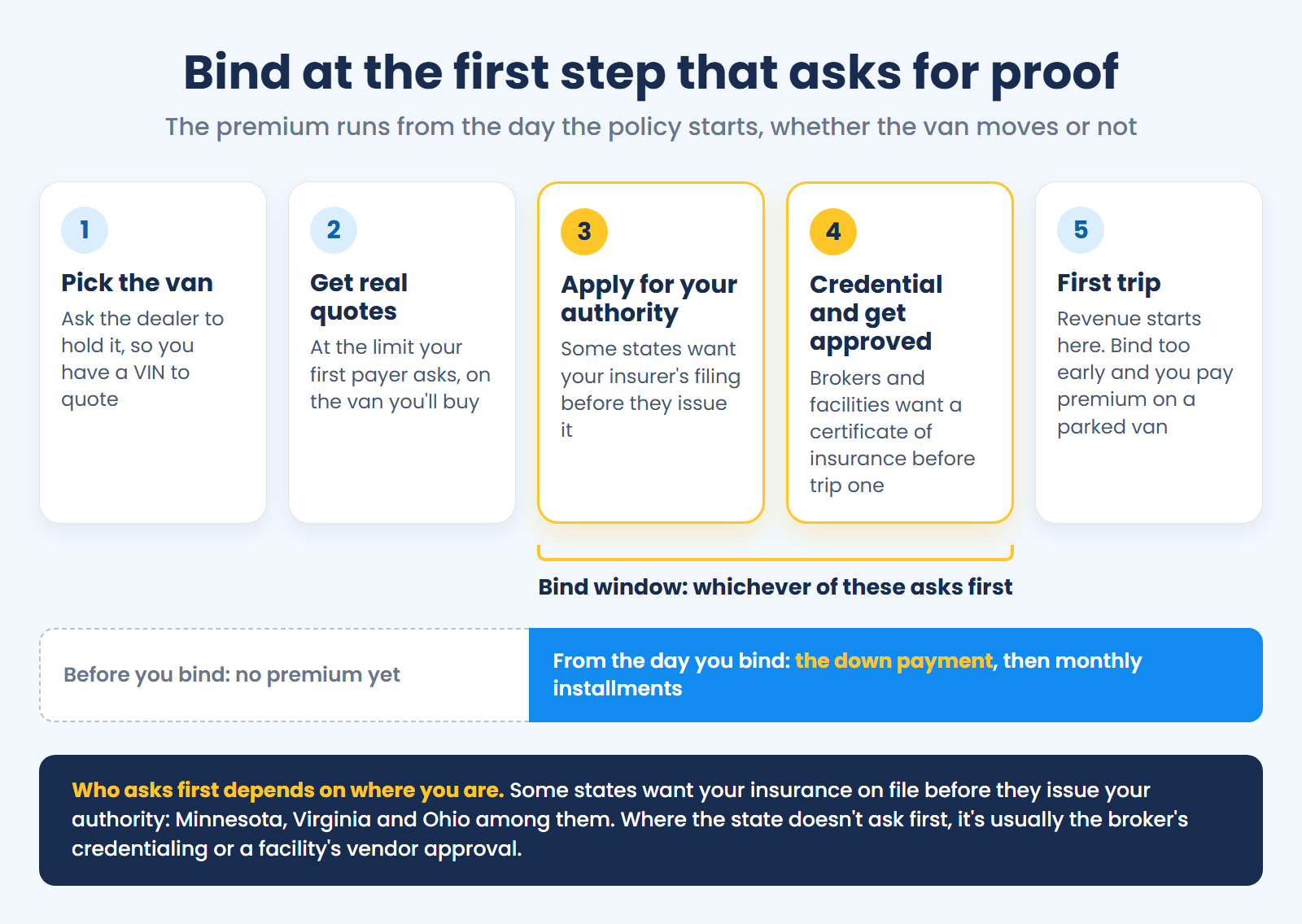
I asked Frank about the chicken-and-egg problem on that live episode: applications want to see that you’re insured, they can take six months or a year, and nobody wants to pay insurance on a van sitting in a parking lot that long. His answer: a quote “typically needs the VIN number off the vehicle” (its vehicle identification number), so pick the van and ask the dealer to hold it. Start the quotes early, because they don’t come back overnight; an NEMT insurance agent speaking at a 2024 workshop put a new company’s full quote at 10 business days. Then buy the policy last: insurance is “kind of one of the last things we want to do.”
A parked van still costs premium. One panelist on our 2025 panel at the NEMTAC conference (NEMTAC is the NEMT industry’s accreditation commission), back when the company had one van, described paying “$1,000 a month and my van didn’t move.” An agent the panelist met later asked why the carrier hadn’t deferred it and taken the payment down: “I didn’t know that I could do that.” If a van will sit, ask.
Some states won’t wait. Minnesota won’t issue its STS (special transportation service) certificate until your insurer files a Form E with the state. Virginia’s DMV issues the NEMT carrier certificate only after your insurer files, and Ohio’s utilities commission wants the insurance on file before its certificate too. Where the state doesn’t ask first, the first one asking is usually the broker, which wants your certificate of insurance when you sign and before your first trip, or a facility running its vendor approval. Bind at whichever comes first. And if the van and the policy are ready while a broker or facility is still approving you, put them to work on private trips, as long as your state’s authority covers them. As Frank said, “you can always do private trips, private pay.”
Who sells NEMT insurance, and how should you shop?
Buy through an agent who places NEMT policies every week, and keep each carrier to one agent, because a carrier works the first submission it gets and blocks the rest.
Few carriers write NEMT, and fewer take a one-van startup. In any given state, the agent at that 2024 workshop said, a new company might find two carriers that will quote NEMT at a price it can afford. Some programs won’t quote you yet at all: Amwins’ paratransit program wants three years in business and at least five vehicles. Specialists know which markets will. Corey Buster, who runs Lift Assist in Chico, California, said in a 2026 industry podcast interview that he “went with the first insurance broker that I had even talked to.” When he later switched to an agent who specialized in NEMT, “I cut my insurance premiums in half for all my vehicles.”
Specialists are out there, but they’re hard to find on Google. I met about ten of them at one NEMTAC conference. The fastest route is to ask other owners near you who they use.
Shop, but carefully. Kecskes competes with other agents for your account (“we compete as brokers,” he said), so weigh his advice with that in mind. This part holds up anyway: when several agents submit you to the same carrier, “they’re going to take the first submission that they get and then the market’s blocked.” In his experience that goes for 95% of carriers, and they “tend to look at those things unfavorably.” Frank’s rule is two or three quotes. Get them from different carriers: before anyone submits, ask each agent which carriers it will approach, so no two agents send you to the same one.
Then hand each agent a real file. Send loss runs (your claims history from past carriers) or a letter showing no claims, plus your vehicle and driver lists. Add “some sort of narrative” about what you do, where you run and the safety steps you’ll take; Kecskes calls sending the lists without it “quote and pray.” And read the whole proposal before you sign. A cheap one from a new carrier can cap loading and unloading claims at “$5,000 a claim,” he warned, “which is a huge blow,” and you’d have to buy that coverage somewhere else.
What raises or lowers your premium at renewal?
Your claims record sets your renewal price, and carriers read it as your loss ratio: the claims they’ve paid or set aside for you, divided by your premium. Once it climbs above about 40%, Kecskes said, “the carriers start getting cautious,” and you see price increases, carriers pulling out and fewer options.
Money set aside counts before anyone’s paid. A claim you’d expect to cost $3,000 might get $50,000 set aside, he said, and “until that claim is closed, that $50,000 is going to get used against you.” You can ask the adjuster to set less aside, but bring paper: “something in writing from a source saying, ‘Hey, no, this amount is too much and here’s why.’” Without it, he said, “it can be a losing battle.”
One claim can follow you for years. An operator on our NEMTAC panel had a claim in the first year: a driver who wasn’t paying attention went under a clearance that wasn’t posted. The premium jumped 42%, from $985 to $1,400, for “a whole year.” The owner tried to take that driver off the policy and the carrier wouldn’t, and shopping didn’t help, “because that’s on my record. So, everybody else was going to charge me that same thing, too.” The claim itself stays on your loss runs longer: an agent at Research Underwriters, a transportation insurance agency, said in a 2026 interview that a claim “runs with you for three years, sometimes five years.”
Christopher Buell, who’s spent decades selling NEMT to facilities, told me on our episode about calling facilities that his second NEMT company was doing well when a driver had an accident and “my insurance rates doubled.”
What you control:
- Start the renewal 90 to 120 days out. Kecskes called that window “the right answer,” because “the earlier you start, the more options that are going to be in front of you.”
- Report incidents the same day. “Late reporting usually leads to higher reserves and just worse outcomes,” Kecskes said. If a rider or anyone else is involved, “always report it.”
- Put cameras in. Some carriers give 1% to 3% off for interior and exterior cameras, a discount he called “very minimal.” They pay for themselves “the first time a claim happens,” when the footage shows who did what. His minimum is dual-facing cameras in every vehicle.
- Write your training down. After an accident, a panelist on our NEMTAC panel said, insurers ask, “Where is your training program? Show me a copy of it.”
Kecskes saved route notes for last and called them “seriously one of the most important”: a note after every transport, “even if everything went perfect.” Claims can surface months later, and then a note beats anyone’s memory.
Duet’s NEMT driver app builds part of that record as the day runs. Each status tap (on the way, picked up, dropped off) is logged on the trip with its time, and the pre-shift vehicle check records when and where each van was checked, by which driver, and the outcome. When a claim surfaces six months later, that’s the record you pull. Some of our customers’ drivers go further, as I told Kecskes on that episode, and write up every transport: the details, and whether it all went well or had a problem.
What’s still on you: your drivers have to make every tap and write the note. Busy drivers sometimes forget to tag a pickup or drop-off, Jing said on our dispatching episode, which is why she recommends a dash cam to back up the record: it’s “really important for your insurance.” The cameras and the training are yours to buy and run.
Back to the owner paying insurance on a van with no trips, and the one whose premium doubled. You can’t pick the limit, and nobody can promise you a claim-free first year, but the parked-van bill is mostly a timing choice. Before you sign for a van, say three numbers out loud: the limit your first payer requires, the policy’s down payment, and the monthly installment after it. If you can’t say all three, you’re not ready to buy the van.
FAQ
Does the federal $1.5 million insurance minimum apply to me?
Only if you carry riders for pay across state lines. The federal rule, 49 CFR 387.33, sets $1.5 million for interstate for-hire passenger carriers with 15 or fewer seats, counting the driver. A van that stays in one state answers to its state and its payers instead.
What happens if my NEMT insurance lapses?
Your trips stop. Ohio law says operations under your certificate “shall cease immediately” until a replacement policy is on file. DC’s contract with Verida has the broker remove a lapsed provider from service “immediately,” and MTM’s Rhode Island handbook lets it pull your trips if the renewal isn’t uploaded five days before the old certificate expires. Renew early.
How long do startup insurance rates last?
Sources disagree, so plan on year one costing the most. R.J. Morrison, from the ambulance side, said on our NEMTAC panel that new companies are “stuck paying the higher rates” for “the first five years.” A Virginia NEMT owner, interviewed in 2026, understood rates get “substantially better” after about a year. Your claims record is the part you control.
About the author
James O'Donnell cofounded Duet and leads its sales, partnerships, and growth services. He talks with NEMT operators every week, hosts the NEMT Growth podcast, and answers Duet's sales line himself. More about Duet's founders →
Want more trips and less busywork?
See how Duet runs and grows NEMT businesses in a 30-minute demo.