Article
How to Start a NEMT Business in New York (2026)
New York has one Medicaid ride broker, MAS, and its letter decides who gets in. Here's the order that wastes the least money.
By James O'Donnell, Cofounder and COO, Duet ·
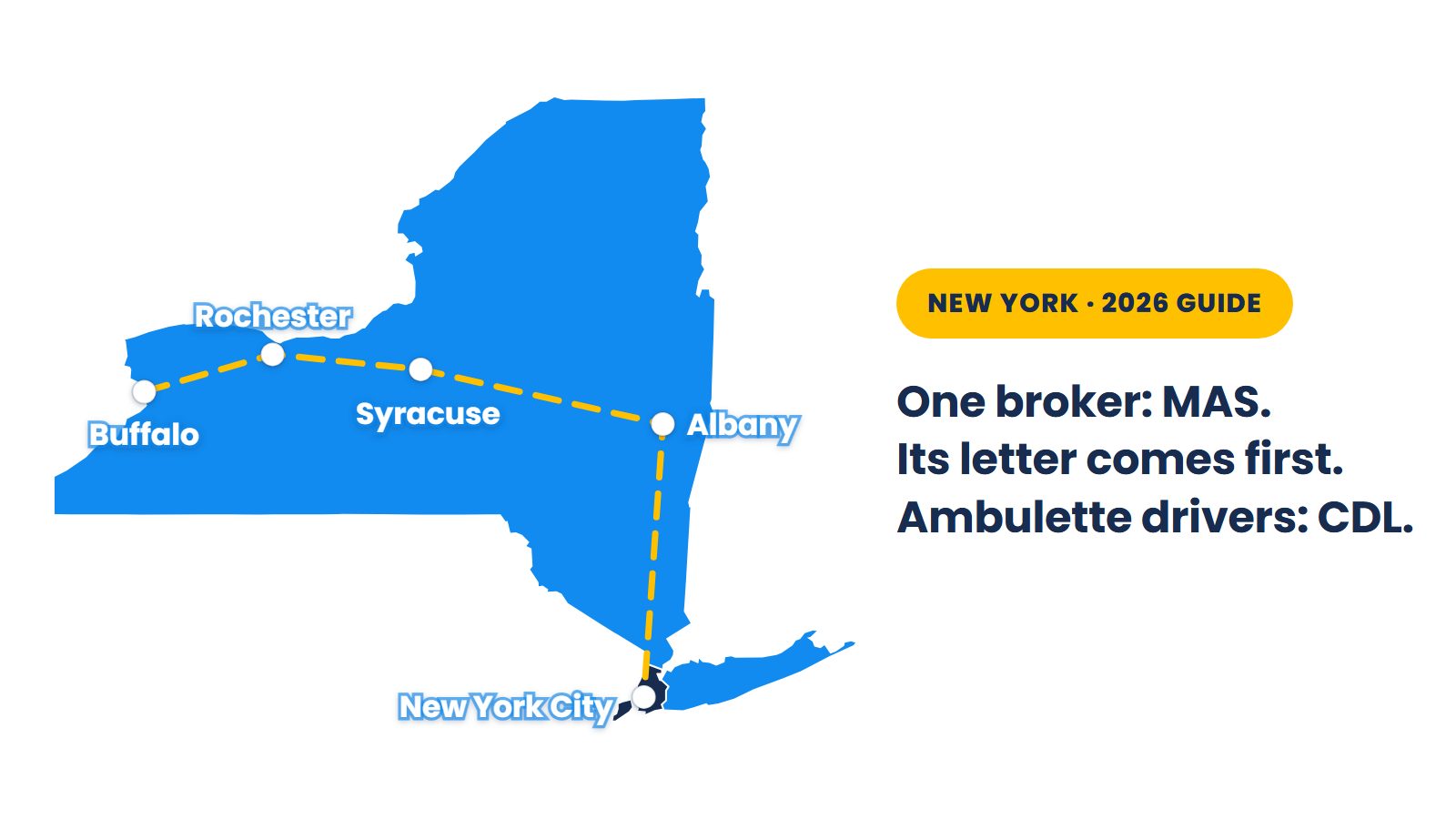
To start a NEMT business in New York, ask Medical Answering Services (MAS), the only Medicaid ride broker, for a letter of support, and form an LLC ($200 plus newspaper notices). eMedNY, the state’s Medicaid enrollment system, rejects applications without that letter. Medicaid wheelchair vans need NYSDOT authority and CDL drivers; cars need a local license. Budget $24,000 to $54,000 or more for one used wheelchair van, and six to nine months from MAS’s letter to its first Medicaid trip.
New York at a glance:
- New York NEMT license: none. Wheelchair and stretcher vans (ambulettes, in New York’s rules) doing Medicaid work need state Department of Transportation (NYSDOT) authority; cars need a New York City Taxi and Limousine Commission (TLC), county, city or town license where one applies.
- Who runs Medicaid rides: MAS, the single broker for all 62 counties since 2023.
- How you get in: MAS’s letter of support, then your NYSDOT or local license, then eMedNY enrollment ($750), then MAS’s contract.
- Insurance for a wheelchair van under NYSDOT authority: at least $100,000/$300,000 for injuries and $50,000 for property if it’s built for seven or fewer passengers, $1.5 million above that.
- Cost to launch one van: $24,000 to $54,000 or more, counting six months of fixed bills at national insurance rates; New York’s likely run higher.
- Time to the first Medicaid trip: four to nine months after MAS’s letter, the long end for wheelchair vans. MAS publishes no clock for the letter itself.
For more than ten years, New York’s health department turned away new ambulette companies in New York City, Nassau and Suffolk, judging those areas already had “an adequate number of existing ambulette providers” [1]. That ban ended on December 1, 2021 [1]. The gate in its place is quieter. After April 15, 2024, eMedNY began rejecting new applications from ambulette, taxi and livery companies without MAS’s letter of support, and MAS publishes no criteria for who gets one [2][3]. Local need has mattered before. A Rochester operator running 32 vehicles said on a 2026 industry podcast that when his wheelchair-van company added cars, the health department and MAS told him “they need a strong carrier in this area for car transports.”
So your first move in New York is a question to MAS: its letter of support decides whether a new company ever gets Medicaid trips, so ask about your county and vehicle type before you buy a van. The checklist below runs in the order the gates open, which is also the order that wastes the least money: MAS’s answer, the authority for your vehicle, the van and the policy, eMedNY, then MAS’s contract. The sections after it take the payers, the rules and the money, and end on the calendar. Private-pay and facility rides can start as soon as your certificate or local license issues (in New York City, once you know whether the TLC licenses your van), months before the first Medicaid trip.
I run Duet, which builds dispatch software and runs growth services for non-emergency medical transportation (NEMT) companies, and I talk to NEMT owners on demos every week, New York operators included. This is the New York edition of our national guide on how to start a NEMT business. Requirements change, so confirm against the linked sources before you spend money.
The one-page checklist: how to start a medical transportation business in New York
Start with a question to MAS, then form the company, file for the authority your vehicle needs, buy and insure it, and enroll with eMedNY and MAS. The six phases below are the decisions in the order you’ll make them, and each ends with the money it puts at risk.
Phase 0: pick your county and vehicle, then ask MAS
Email MAS provider relations your county and vehicle type this week, and ask whether MAS would issue a letter of support to a new company. eMedNY lists the address: tprelations@medanswering.com [2].
- If MAS sounds open, send its network application once you have your company’s legal name and EIN (Phases 1 and 2), since the form asks for both, and ask whether it wants your NYSDOT authority in hand first [3].
- Money at risk: a used 2016-2019 wheelchair van, about $33,000, the September 2026 dealer median in our national cost model, bought for a Medicaid lane MAS won’t open.
Phase 1: choose an LLC or a corporation
Price your county’s newspaper notices before you file an LLC, because New York makes every new LLC publish for six weeks and lists no such step for corporations.
- An LLC costs $200, then six weeks of notices in two papers the county clerk designates and a $50 Certificate of Publication, all within 120 days [4].
- Notices run from under $100 in some upstate counties to about $1,750 in Manhattan, per filing vendors’ September 2026 prices [5].
- A corporation costs $125, and the Department of State’s pages list no notices for it. Ask your accountant about the tax difference [4].
- Money at risk: up to about $1,900 in Manhattan, the gap between a $125 corporation and a roughly $2,000 LLC: $200 to file, about $1,750 of notices and the $50 certificate.
Phase 2: get the free federal numbers yourself
File for your NPI yourself, plus a USDOT number if you’ll need NYSDOT authority; both are free. Then run the exclusion checks MAS will run on you anyway.
- A Type 2 (organization) National Provider Identifier, free from CMS, the federal Medicare and Medicaid agency. eMedNY enrolls you by NPI, and New York now requires one of every enrolled Medicaid provider [2].
- Your free employer identification number (EIN), with the IRS letter that assigns it. eMedNY won’t take a W-9 instead [2].
- A USDOT number, which NYSDOT requires before it issues passenger authority [6].
- Exclusion checks of owners, managers and drivers against the four lists MAS uses: the federal Office of Inspector General (OIG) and SAM.gov lists, the state Office of the Medicaid Inspector General (OMIG) list and the Death Master File [3]. Run them monthly.
- Money at risk: $0 if you file yourself.
Phase 3: file for the authority your vehicle needs
File for the license that matches your vehicle the week MAS says yes, or sooner if MAS wants it before deciding: NYSDOT authority for wheelchair and stretcher vans, and a TLC, county, city or town license for cars.
- NYSDOT authority is a common carrier certificate or a contract carrier permit, filed online with a balance sheet and support letters from people or organizations in your counties. It usually takes 6 to 16 weeks [6].
- Money at risk: for a wheelchair van, mostly time, since NYSDOT lists no filing fee. For cars, it’s the local fees: $75 a livery car in Buffalo, $300 a vehicle in Suffolk or Westchester, and $1,500 plus a $5,000 bond for a New York City livery base.
Phase 4: quote the insurance, buy the van, qualify the drivers
Get two insurance quotes before you buy the van, and buy it once NYSDOT approves your application.
- Quote at your authority’s limits with the amount due at signing in writing, and ask MAS for its contract limits first [3].
- Build to 17 NYCRR 720.8, the ambulette equipment rule, and letter each van as 720.3 requires: your exact name on both sides in 3-inch letters, plus a number unique to the van on the front, the back, both sides and inside. If you’re buying a minivan conversion, check its emergency door against 720.8 first: at least 30 inches wide, and on a side if the ramp is in the rear [7].
- Every ambulette driver, you included, needs a commercial driver’s license (CDL) with a passenger endorsement and qualification under Article 19-A, the state’s bus-driver law [8].
- If you’re running cars instead: outside New York City, Medicaid enrolls taxi and livery companies alike as taxi, with Class E drivers and cars on livery plates, owned by the company or leased to it from a dealer or manufacturer [2][9].
- Money at risk: about $33,000 for the van, plus $14,400 to $21,600 a year of insurance in our national cost model, a quarter due at signing, and likely more in New York.
Phase 5: enroll with eMedNY and MAS, and book your own trips
File with eMedNY once MAS’s letter and your authority are both in hand, and book private-pay and facility rides while the state takes its 90 to 120 days.
- eMedNY’s portal wants the $750 fee, MAS’s letter, your authority, the IRS letter, driver and vehicle lists, and, if you rent, the lease and your latest cancelled rent check [2]. If you run the company from home, ask eMedNY before you file.
- In Nassau, Suffolk, Westchester, Monroe, Erie or Orange, OMIG wants a surety bond before it enrolls an ambulette company: $25,000 a year per ambulette or $100,000, whichever is lower. If you expect to bill under $500,000 in your first full year, ask for an exception in a letter with your application; OMIG decides. Anywhere in the state, the bond can come later, once billing passes $500,000 a year or $42,000 in a month [9].
- Once the state Department of Health (DOH) approves you, sign MAS’s contract [3].
- Put up a website and a Google Business Profile, and start facility visits the same week.
- Keep free-ride offers for private-pay riders. New York bars giving a Medicaid rider anything of value, free rides included, for choosing you [9].
- Money at risk: the $750 fee plus three to four months of fixed bills, about $1,300 to $1,900 a month in our national model.
Who pays for NEMT rides in New York?
Three payers fund NEMT rides in New York: Medicaid, through its single broker MAS, is the volume, facilities are the stability and private pay is the margin. Only Medicaid needs MAS’s letter, so pick your payer before your vehicle, and expect all three to work differently in New York City than upstate.
Medicaid covered 6,374,641 New Yorkers in July 2026, per the state’s enrollment databook, and 56 percent of them live in New York City [10]. Enrollment is down 7.1 percent since August 2025, but the spending is still big: the state’s share of Medicaid transportation came to $584 million in fiscal 2026, not counting federal dollars [10].
Facilities are the stability, in two ways. Some pay you directly, like a hospital or nursing home that contracts for discharges and transfers. Others steer Medicaid trips your way, because MAS honors a medical provider’s choice of company. CMS lists 345 dialysis facilities in New York [10], most of them sources of standing trips three times a week; for a Medicaid rider, those are still MAS trips.
Private pay depends on the county. On our private-pay webinar, digital marketing expert Harry Chambers said that in a market like New York City, people without a ride “hop on the subway or hop on the bus,” unless they use a wheelchair. So in the city, private pay leans on wheelchair riders. Medicaid follows the same logic: it pays for the most cost-effective mode that’s medically appropriate, and riders who use public transit usually aren’t authorized anything higher [9].
Upstate, Medicaid work can run on distance. A Hudson Valley operator, on a 2024 industry podcast, described daily methadone-clinic runs “like 90 miles away,” paid by the mile. That’s two hours of a driver’s day for a $300 trip, against $8 calls on her taxi side.
Who is the NEMT broker in New York?
Medical Answering Services (MAS) is New York’s single Medicaid NEMT broker, for all 62 counties. Plan your Medicaid business around its rules: it assigns the trips, checks the GPS and relays the approval number you bill with. The health department’s Medicaid transportation page, revised in February 2026, lists MAS for nine downstate counties and 53 upstate ones [1].
MAS already managed Medicaid rides everywhere but Long Island, New York City included since 2017. On August 1, 2023 it became the state’s broker, signing its own contracts with companies and negotiating their rates, and on December 1, 2023 it took Nassau and Suffolk from Modivcare [9][11], which is still New Jersey’s statewide Medicaid ride broker.
MAS arranges rides for almost every Medicaid member, whether the state pays the doctor directly or a health plan does, and since March 1, 2024 for most long-term care plan members too [9][12]. The exceptions are narrow: PACE programs (all-inclusive care for older adults), social adult day care trips under long-term care plans, and, per the 2023 manual, some managed care plans whose benefits still include transportation [12][9].
MAS calls network companies like yours transportation providers. Once contracted, you work in the MAS Transportation Provider Portal, where your contract, insurance certificates, drivers and trip roster live, and MAS’s public provider search lists network companies by ZIP code, the quickest look at who you’d compete with in your county [3].
Trips reach you by set rules. MAS’s FAQ lists Preferred Provider Opportunity (PPO) assignments first: standing pairings of a medical provider and a transportation company that DOH monitors, whose trips you can’t refuse or hand off [3][9]. Otherwise the rider’s choice of company comes first, then the medical provider’s choice, and last a random pick among qualified companies with open capacity [2][3]. That order is your lever: a clinic or dialysis unit that names you beats rotation, and so does a rider who asks for you, as long as you never offer anything for it. eMedNY says plainly that enrollment “is not a guarantee of trip assignments” [2]. You’ll also meet Form 2015, the practitioner’s justification for a ride above public transit. It’s renewed at least once a year, and it doesn’t replace MAS’s prior authorization [12].
For this year’s broker switches in other states, see our national broker tracker.
Can I bill New York Medicaid directly for NEMT rides?
Yes, for MAS-assigned trips: attest with GPS within 30 days, bill eMedNY within 90. MAS never pays you; the state pays through eMedNY once the trip’s prior-authorization number is on the claim.
A Medicaid trip gets paid in five steps:
- MAS assigns the trip. Any change needs approval before the ride, and the request has to come from the rider or the medical provider, not from you [9].
- You drive it with GPS on. The start, the end and every point between go to MAS, through MAS’s free GPS app or a GPS vendor MAS has cleared, a rule since April 3, 2023 [13].
- You attest within 30 days, confirming in MAS’s system that the trip ran as assigned. Missing GPS blocks the attestation, and GPS that doesn’t match the pickup, drop-off and mileage blocks the approval number [13][9].
- The approval number follows. MAS approved the trip before the ride; your attestation releases its 11-digit prior-authorization number [14].
- You bill eMedNY within 90 days. The claim carries that number, the plate, the driver’s license number and the ordering provider’s NPI, and eMedNY pays in weekly cycles [14].
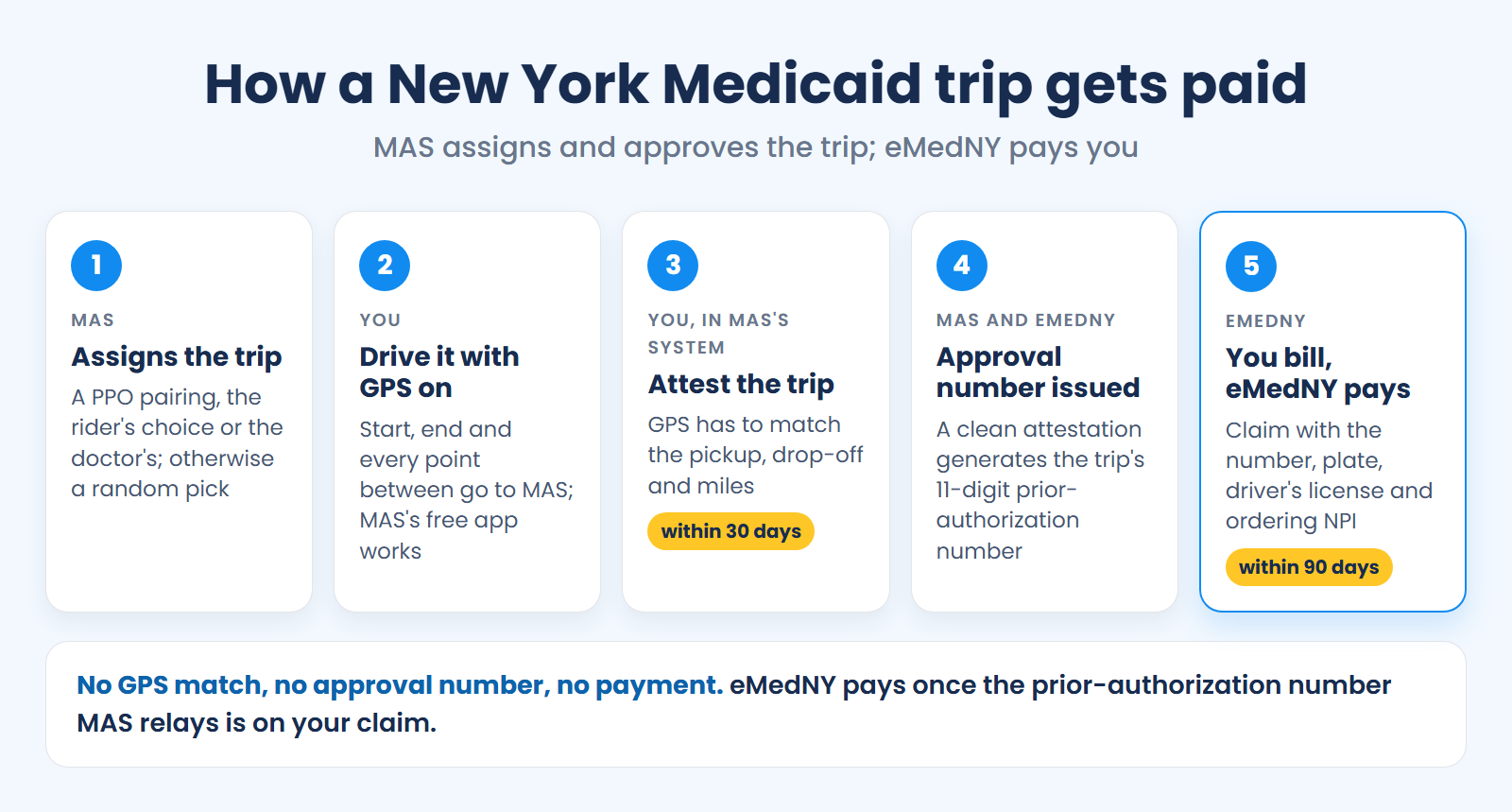
You’ll read that your software has to “handshake” with eMedNY or you don’t get paid. The GPS goes to MAS, and eMedNY only sees a claim carrying that prior-authorization number [13][14]. You’ll also read that timely filing is six months. It’s 90 days [14].
The default rates sit on eMedNY’s fee schedule, dated April 5, 2026. A New York City wheelchair trip pays $52.90 plus $3.60 a mile, so ten miles pays $88.90. New York City livery pays $22.97 plus $2.93 a mile, and an Erie County ambulette $41 plus $3.00. Upstate car rates vary by county and haven’t moved in years: Erie’s default taxi rate is $7.36 plus $2.66 a mile, Onondaga’s $3.01 plus $3.40 and Monroe’s $3.23 plus $3.47, all dated December 31, 2022, so a three-mile trip pays about $13 to $15 [15]. MAS negotiates rates with each company, and the manual says those rates “supersede the current fee schedule,” so ask MAS what your county pays [9].
DOH’s 2022 rate review put Medicaid’s 2021 average at $46.78 per one-way ambulette trip, against a self-reported cost of $79.61, or $70.85 without the costs DOH wouldn’t count [10]. Only 27 percent of companies completed its survey, so DOH called the results inconclusive and recommended no across-the-board increase [10]. That was before the 2024 increases, which took the New York City base from $37.90 to $52.90 [15].
The paperwork decides whether you keep the money. OMIG disallows any claim missing one of 11 trip-record fields for either leg, from the rider’s Medicaid ID to the driver’s signature [16]. In a 2017 decision, DOH upheld OMIG’s $1,102,553 overpayment claim against a Brooklyn ambulette company, extrapolated from $3,304.80 of errors in a 150-claim sample [16]. Run GPS on every Medicaid trip from day one, attest within 30 days and bill within 90.
What licenses and requirements does a NEMT business need in New York?
New York has no NEMT license, so the vehicle decides: NYSDOT authority for wheelchair vans, local licenses for cars. Transportation Law § 152 requires NYSDOT authority to carry passengers for pay as a common or contract carrier, and § 151 exempts sedans and station wagons, which NYSDOT reads as covering minivans seating fewer than 11 with the driver [17][6]. Medicaid enrolls an ambulette only with that authority and a DMV letter showing its drivers qualify under Article 19-A [2].
The internet gets New York wrong in a few specific ways:
| The claim you’ll read elsewhere | What New York actually requires |
|---|---|
| ”You need a New York NEMT Provider License ($850 initial, $510 renewal),” or “certification from the New York State Medicaid Office” | Neither exists. Medicaid enrollment through eMedNY costs the $750 federal fee and needs MAS’s letter; the operating license is NYSDOT authority or a TLC, county or city license [2] |
| “Regional transportation managers like MAS” run the rides, MAS covers “nearly all” or “most” counties, or the brokers are “MAS, MTM” | MAS is the only broker, for all 62 counties: its statewide broker contract started August 1, 2023, and it took Nassau and Suffolk from Modivcare on December 1, 2023 [1][9] |
| You submit a “letter of intent” to MAS | It’s a letter of support, which MAS decides on after its network application; eMedNY rejects new applications without one [2][3] |
| “Enrollment moratoriums are occasionally enacted” in New York City, Nassau and Suffolk | That ambulette moratorium ended December 1, 2021, though one eMedNY form still prints the old line, and New York’s August 2026 enrollment moratorium covers six other provider types, not transportation. Today’s gate is MAS’s letter [1][2] |
| “Complete mandatory vehicle inspections through the New York DMV” | Cars get the annual DMV safety inspection, but ambulettes are NYSDOT’s: at least every six months, and DMV won’t register one without NYSDOT’s report [17][7] |
| Drivers must be “at least 25 years old,” or 19 in New York City | Medicaid’s floor is 18. Ambulette drivers also need a CDL with a passenger endorsement and 19-A qualification, and the TLC licenses for-hire drivers from 19 [9][8][18] |
| Drivers need “Class E or commercial licenses depending on vehicle weight/capacity” | For an ambulette, size doesn’t matter: NYSDOT authority makes it a 19-A bus, and every 19-A bus driver needs a CDL with a passenger endorsement. Class E is for taxi and livery [8] |
| “Vehicle age limit for MAS approval is 10 years” | No age cap appears in the state’s Medicaid manual, MAS’s network manual or eMedNY’s chart. Age limits are local, like the TLC’s paratransit rule and Buffalo’s taxi rule [18][19] |
| “$25,000 per person / $50,000 per accident / $25,000 property damage” | Close for a for-hire car’s injury floor, but its property floor is $10,000. A NYSDOT ambulette files $100,000/$300,000 plus $50,000 if it’s built for seven or fewer passengers and $1.5 million above. MAS’s limits sit in its contract [20][3] |
| Insurance “typically ranging from $1.5 million to $5 million” | $1.5 million is NYSDOT’s floor only for vans built for more than seven passengers; $5 million is the TLC’s figure for vehicles seating 16 or more [20][18] |
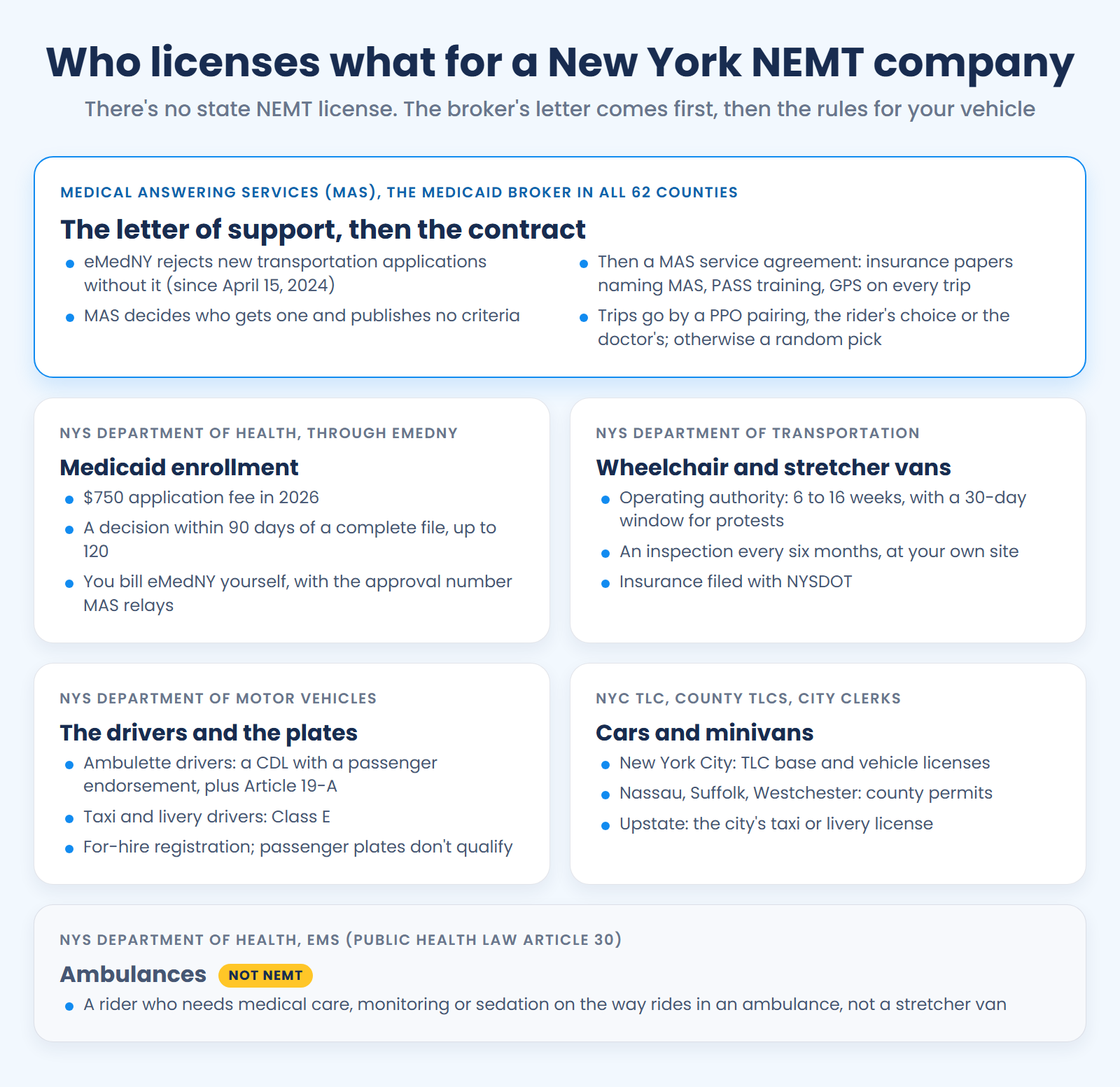
The ambulette license in New York: NYSDOT operating authority
File for NYSDOT operating authority the week MAS says yes, or sooner if MAS wants it first, because approval usually takes 6 to 16 weeks and includes 30 days when existing carriers can protest that your area doesn’t need you [6], an argument Pennsylvania’s utility commission stopped hearing in 2017.
- Two kinds. A common carrier certificate, the kind NYSDOT lists for ambulette service, requires a finding of “public convenience and necessity.” A contract carrier permit, for fixed-price work such as a health care facility’s contract, requires service “consistent with the public interest” [17][6].
- The process. You file online with a recent balance sheet and support statements from people or organizations in the counties you’ll serve, and a letter from a dialysis center or day program you’ve already met is exactly that [6]. NYSDOT publishes each filing in its Weekly Bulletin, where protests on fitness, need or public interest are due within 30 days [6]. Authority runs county by county, and inside your counties you can’t refuse Medicaid trips, so file for the counties you can actually serve [9]. Until the certificate issues, Section 152 bars even advertising the service [17].
- Every six months after. NYSDOT inspects each ambulette at a facility you provide, since it runs no inspection sites of its own. Section 144 charges $85 an inspection but excludes vehicles DOH authorizes for NEMT, so ask NYSDOT whether it’ll bill you [17][6].
John from Fenton Mobility, a Western New York wheelchair-van upfitter, called New York State DOT “very strict” on our episode on what a van manufacturer won’t usually tell you. He builds every van to that standard, so he has a stake in calling it strict. The rule behind it, 17 NYCRR 720.8, wants a lift or ramp rated for 600 pounds, positive wheelchair tiedowns and a 30-inch aisle to the emergency door [7]. Federal safety rules also reach in-state vans built or used to carry more than eight people for pay, driver included, or rated over 10,000 pounds [6].
An established carrier with NYSDOT authority and a 19-A program skips most of this. If you already run wheelchair minivans for private pay, write to NYSDOT’s passenger authority office now (operating.authority@dot.ny.gov or 518-457-6512). NYSDOT reads Section 151’s exemption as covering minivans seating fewer than 11, but its published guidance doesn’t say whether that includes a wheelchair service [6][17]. If it doesn’t, Section 152 bars running or even advertising the service until your certificate issues. Ask about drivers in the same letter: a minivan that needs no NYSDOT authority generally isn’t a 19-A bus, so Class E would cover it, and DMV’s Bus Driver Unit (busdriverunit@dmv.ny.gov) can confirm [8].
When should you buy the van?
Buy the van after MAS says yes and, for a wheelchair van, after NYSDOT approves your application but before it issues the certificate, which waits on that van’s insurance filing and inspection. NYSDOT schedules the inspection only after approval, and DMV won’t register the van without the inspection report [7]. If MAS wants your NYSDOT authority before it decides, ask whether NYSDOT’s approval letter is enough; if MAS insists on the certificate, the van comes before MAS’s answer, so weigh that $33,000 against what MAS told you when you first asked. Title the van to the company, or lease it from a dealer or manufacturer in the company’s name; ambulette and taxi companies can’t use vans registered to anyone else [9].
The man who sells the vans agrees. John from Fenton Mobility said on that same episode, “if they’re new, I would recommend getting the clients first before they’re buying their van.”
If you already own the van, check it before you count on it for Medicaid. It has to be titled to the company or leased the way above, and its emergency door has to pass 720.8 [7]. In New York City, if the TLC licenses your ambulette, an older van won’t qualify, because a new TLC paratransit license needs the newest or prior model year with under 500 miles [18].
New York City ambulettes and the TLC
In New York City, find out whether the TLC will license your ambulette before you buy a van, because a new TLC paratransit vehicle license requires the newest or the prior model year, with under 500 miles. Medicaid stopped requiring TLC licenses on January 28, 2016 for city ambulette companies with NYSDOT contract carrier permits [9], while the TLC’s paratransit base license asks for a NYSDOT common carrier certificate [18]. So in the city, the kind of authority you file for also decides your TLC exposure. NYSDOT issues contract carrier permits for fixed-price contract work, such as a health care facility’s contract, so ask NYSDOT whether you can hold one before you have that contract [6]. The TLC licenses paratransit bases ($1,500 for three years) and vehicles ($550 for two years, retired seven years after first licensing) [18]. Nothing public settles whether it requires them of a contract-permit ambulette, so ask DOH’s Medicaid transportation bureau (medtrans@health.ny.gov) and the TLC in writing before you file with NYSDOT [2].
Car services: the NYC TLC, county TLCs and city licenses
Ambulatory sedans and minivans seating fewer than 11, driver included, skip NYSDOT [17][6]. License them where they work: with the NYC TLC, a county TLC on Long Island or in Westchester, or the city or town upstate.
- New York City. Medicaid livery needs a TLC base [2]. A livery base costs $1,500 for three years and needs 10 affiliated cars (5 if one is wheelchair accessible) and a $5,000 bond, and new for-hire vehicle licenses go only to wheelchair-accessible vehicles [18]. My read: a small Medicaid start in the five boroughs is an ambulette start, with NYSDOT authority and wheelchair vans.
- Long Island and Westchester. Nassau registers every for-hire vehicle. Suffolk charges $300 a vehicle; Westchester $300 a vehicle, $600 a base and $200 for a medical-provider van waiver, each a year [19]. Medicaid taxi work there needs the county’s TLC paperwork with your eMedNY application: TLC registration for each vehicle in Nassau, the company’s TLC certificate in Suffolk and a base station permit in Westchester [2].
- Upstate. Cities and towns license taxis: Buffalo $115 for a taxi and $75 for livery, with a 10-year vehicle limit, and Rochester $55 plus $295 for a hackplate [19]. Medicaid taxi work upstate needs Class E drivers and cars registered with livery plates; if yours carry taxi plates, ask eMedNY or MAS whether they count before you re-register [2].
What are the NEMT insurance requirements in New York?
Under 17 NYCRR 750.1, a wheelchair van under NYSDOT authority must carry at least $100,000 per person and $300,000 per accident for injuries, plus $50,000 for property damage, if it’s built for seven or fewer passengers. Bigger vans need at least $1.5 million plus $50,000 [20]. MAS’s contract can require more [3]. Your insurer files it with NYSDOT, and a cancellation takes 30 days’ written notice to NYSDOT [6][20].
| What you run | Minimum you must carry | Source |
|---|---|---|
| NYSDOT-authorized ambulette built for 7 or fewer passengers | $100,000 per person and $300,000 per accident for injuries, plus $50,000 for property | 17 NYCRR 750.1 [20] |
| NYSDOT-authorized ambulette built for more than 7 | $1.5 million per accident, plus $50,000 for property | 17 NYCRR 750.1 [20] |
| For-hire car seating 7 or fewer passengers | $25,000/$50,000 for injuries, $50,000/$100,000 for death, $10,000 for property | Vehicle and Traffic Law § 370 [20] |
| Any for-hire vehicle seating 8 or more | $1.5 million combined single limit | Vehicle and Traffic Law § 370 [20] |
| NYC TLC car seating under 8 passengers | $100,000/$300,000 for injuries, $10,000 for property and $100,000 of no-fault coverage, cut from $200,000 on March 1, 2026 | TLC rules [18] |
| MAS’s provider contract | Proof of general liability, workers’ comp and NYS disability; the liability certificate, an ACORD form, names MAS as additional insured and shows your MAS provider ID; limits not public, so ask | MAS [3] |
Ask your agent how wheelchair positions count toward the seven-passenger line, because it decides $100,000/$300,000 versus $1.5 million.
Nobody publishes what New York premiums run, and the signs point high. The Rochester operator put his vehicle insurance at over $500,000 for 2026 across 32 vehicles, more than $15,000 a vehicle, and his is an established fleet. R.J. Morrison, a former Los Angeles ambulance operator, said on our 2025 NEMTAC panel that a new company is “stuck paying the higher rates” for about its first five years. Carriers are scarce, too: an insurance broker whose NEMT program covers 41 states said at a 2024 workshop that it doesn’t write New York.
Payroll rules start early. Virtually every New York employer must carry workers’ comp, and going without costs up to $2,000 for each 10 days. Disability and paid family leave kick in once you’ve had an employee on 30 days in a year. The 2026 minimum wage is $17 an hour in New York City, Nassau, Suffolk and Westchester, and $16 elsewhere [21].
Our guide to lowering NEMT insurance premiums covers how to shop for a policy at these limits.
What do NEMT drivers need in New York?
Put every ambulette driver, you included, through a passenger CDL and Article 19-A qualification. Under Vehicle and Traffic Law § 509-a, a vehicle that needs NYSDOT authority is a 19-A bus whatever its size, and DMV requires a CDL with a passenger endorsement for every 19-A bus driver [8]. Taxi and livery drivers in sedans and minivans need a Class E license, not a CDL, plus the TLC or local driver license where they work; in New York City that’s a TLC for-hire license [2][16].
For a wheelchair van, the minimum is a Class C CDL, which DMV’s license chart assigns to vehicles of 26,000 pounds or less that carry 19-A passengers. A first CDL or first passenger endorsement means entry-level driver training before the road test [8].
Skipping 19-A is expensive. OMIG disallows an ambulette claim when a driver who’s been with you more than 10 days isn’t on your 19-A roster on the date of service. That 2017 Brooklyn case included drivers who weren’t 19-A certified [16].
- Medicaid’s floor is 18 with a valid license [9].
- MAS adds Passenger Assistance, Safety and Sensitivity (PASS) training within three months of your MAS start, exclusion checks, a Social Security number for every driver and one provider per driver at a time [3].
- In New York City, if the TLC licenses your ambulette, each driver also needs a TLC paratransit driver’s license: 18 or older, with a commercial Class A, B or C license and active 19-A status. It costs $252 for three years, about $367 with fingerprints and a defensive-driving course. Livery drivers get a TLC for-hire license instead, from 19, after a drug test, a three-day course and wheelchair training [18].
What goes in an Article 19-A driver file?
Build each driver’s 19-A file before the first trip: a pre-hire driving abstract and physical, then yearly and two-yearly checks, three of which a certified examiner runs [8].
- Before hire. Driving abstracts from every state the driver lived or held a license in during the past three years, and a physical from the past two years.
- Every year. A new abstract, a record review with an interview and a defensive-driving observation.
- Every two years. A physical, a behind-the-wheel test and an oral or written test.
- Your side. DMV enrollment forms, at least one certified examiner per 100 drivers, files kept three years plus the current one, and an annual affidavit of compliance.
- Disqualifications. One year for 9 points in 18 months and five years for a DWI while driving a bus, among others [8].
You need that examiner even with one driver: DMV requires one for every 1 to 100 drivers, and you add them to your 19-A account on form DS-885CE [8].
Can a NEMT company run stretcher van trips in New York?
Yes, as ambulette service, for riders who need no medical monitoring and aren’t sedated. New York Medicaid calls it stretcher ambulette service and requires two staff on every trip, a driver plus an assistant riding in back [9].
- The line. No medical attention, monitoring or treatment on the way, and no sedated riders. A rider may use oxygen they give themselves, with the tank secured in the van, but your staff can’t help with it or offer oxygen, and the van can’t be stocked with its own oxygen or oxygen supplies [9].
- The equipment. A wheeled cot, the maker’s restraint straps and a cot retention device from the same maker. The van still has to meet NYSDOT rules, the TLC’s in New York City and local rules, and NYSDOT’s ambulette rule adds one line on stretchers: the gurney has to be secured parallel to the side of the van [9][7].
- The rates. The default stretcher base is $230 in New York City, Nassau and Suffolk, $200 in Westchester, $280 in Onondaga and $101 in Albany, Erie and Monroe, plus mileage in some counties [15].
Anything past that line is an ambulance trip under Public Health Law Article 30, which requires DOH certification, and the Star of Life emblem doesn’t belong on an ambulette [22][9]. Put that line in your dispatch protocols in writing, and price the second staffer into every stretcher trip.
How do you become a Medicaid transportation provider in New York?
Get MAS’s letter of support first; eMedNY rejects transportation applications without it [2]. The full order runs like this:
- MAS’s network application. Your company’s legal name and tax ID, county, modes, experience, weekly volume, owners’ and managers’ resumes, and your NYSDOT authority or local license if you have one [3].
- MAS’s letter. MAS’s provider relations team “will review your application and determine if a letter of support will be provided” [3].
- Your authority. A NYSDOT certificate or permit plus the DMV 19-A letter for ambulettes, or a TLC or local license for cars [2].
- eMedNY enrollment. The $750 fee, the attachments and a decision within 90 days of a complete application, extendable to 120 [2][23].
- MAS’s contract and credentialing, and then the trips [3].
How do you get a MAS letter of support?
Apply through MAS’s network application and ask MAS what it weighs, because MAS publishes no criteria for its letter of support [3]. You’ll hear it called a “letter of need,” issued only where an area is short of vans, but no published MAS, DOH or eMedNY rule says the letter turns on local need. MAS says only that it “secures an adequate network of transportation providers” [3].
Asking early is still smart. DOH can deny an enrollment based on “the current availability” of services [23], and it barred new ambulettes on those grounds from at least 2011 until December 2021 [1]. The broker law also tells MAS to evaluate the qualifications of current Medicaid transportation providers “on a priority basis,” so incumbents get looked at first [12]. So ask before you spend.
What does MAS require of providers?
Have MAS’s credentialing file ready before DOH approves you: insurance certificates naming MAS as additional insured, exclusion checks and working GPS. PASS training for every driver follows within three months of your MAS start [3]. Once you’re running, MAS holds you to:
- A documented inspection of each vehicle before every shift [3].
- On time means within 15 minutes of the scheduled time; same-day hospital discharges within three hours; returns with no set time within an hour of the rider’s ready call [3].
How long does New York Medicaid enrollment take?
Plan on four months or more from MAS’s letter to your first Medicaid trip with cars, and six or more with wheelchair vans, because DOH has 90 days from a complete eMedNY application and can extend to 120 [23]. MAS says enrollment “can take 90 days or longer,” and it publishes no turnaround for its own review or contracting [3]. The “30 to 120 days” you’ll read elsewhere covers only part of the wait. And eMedNY deletes an application you start but don’t submit within 45 days [2].
What to ask MAS provider relations
Put these questions to MAS in writing before you buy a van, and keep the answers in your file:
- Would you issue a letter of support to a new company in my county, for my vehicle type?
- Do you need my NYSDOT authority or TLC license before you decide?
- What insurance limits does your provider contract require?
- What do you pay in my county, and how does it compare with eMedNY’s fee schedule?
- How long do the letter review and contracting take right now?
- How long does your letter of support stay valid, given that my NYSDOT authority may take four months?
- How are Preferred Provider Opportunities set up in my county, and could a facility I serve become one?
- Do you accept a NYSDOT contract carrier permit for ambulette trips in New York City?
- I have no employees yet: will you accept a workers’ comp exemption, or do I need a policy?
MAS’s application asks how long you’ve been in business and your weekly volume, and a new company answers less than a year and zero [3]. The trips that change those answers come from facility contracts and private-pay families, and neither needs MAS. Our guides on winning facility contracts, getting the first trip from a facility meeting and private pay cover that stretch.
Don’t build the whole schedule on one payer
MAS assigns New York’s Medicaid trips, so build facility and private-pay work it can’t reassign. In New York one broker, a rotation and a rate sheet you don’t set decide how many Medicaid trips you run [2][9].
New York’s own record makes the case. Long Island’s broker changed in December 2023, when Modivcare’s region went to MAS [9][11], the same kind of switch Georgia’s companies lived through on April 1, 2026, when one broker took over all five of its regions. In May 2024, Long Island ambulette companies negotiating rates with MAS and DOH warned the state of closures, a trade association reported [11]. On January 8, 2025, the Attorney General announced cease-and-desist notices to 54 transportation companies, and that June a takedown of 25 companies, 16 of which will pay back more than $13 million of Medicaid money. OMIG names NEMT a 2026 audit focus [24]. And Monroe County’s default car rates haven’t changed since December 31, 2022, while the upstate minimum wage reached $16 in 2026 [15][21].
The Rochester operator’s answer is a payer order. Private-pay riders get priority, he said, and “we then fill in the blanks with Medicaid.” His read on newcomers, which he framed as his view from the outside: “Medicaid right now is valuing the smaller providers.”
MAS’s trips live in MAS’s system, and MAS provider relations can set you up with a free GPS app that meets the state’s GPS rule, so a small New York company can run Medicaid work without paid software [13]. Software earns its keep on the rest of the week: dispatch software like Duet puts facility and private-pay rides on one board, and a trip file import brings MAS trips onto the same board. The eMedNY claim, the rate talks and the facility visits stay with you. MAS trips are real volume and a fine way to fill a schedule. Just don’t let them be the whole schedule.
How much does it cost to start a NEMT business in New York?
Budget $24,000 to $54,000 or more for one used wheelchair van, including six months of bills at our national insurance rates; New York premiums likely run higher. The low end is our national model’s older, high-mileage $20,000 van, financed, upstate. The high end is a $33,000 used van bought outright in New York City, with Manhattan newspaper notices. It works only if the TLC doesn’t license your ambulette. If it does, the van has to be new, and one national dealer listed a new rear-entry minivan conversion at about $64,000 in September 2026, in our national cost model’s sample. Both count six months of insurance installments and a phone line, plus van payments on the financed one.
| Line item | New York amount | Note |
|---|---|---|
| LLC formation | $200, plus a $50 Certificate of Publication and six weeks of notices: about $50-$525 upstate, $225-$575 on Long Island, $425-$1,750 in NYC | Notices are vendor prices, September 2026 [4][5] |
| Business corporation (the alternative) | $125 | No newspaper step on the state’s pages [4] |
| EIN, NPI and USDOT number | $0 | Free from the IRS, CMS and FMCSA |
| New York NEMT license | $0 | It doesn’t exist [17] |
| NYSDOT operating authority | No filing fee published | Usually 6 to 16 weeks [6] |
| NYSDOT ambulette inspection | $85 each, twice a year, under § 144, which excludes DOH-authorized NEMT vehicles | Ask NYSDOT whether it bills you [17] |
| eMedNY application fee | $750 (2026) | Waived if already paid to Medicare or another state [2] |
| Ambulette surety bond (six counties) | $25,000 a year per ambulette or $100,000, whichever is lower | Face amount; you pay a premium. Under $500,000 of expected first-year billing, ask OMIG for an exception [9] |
| Local licenses | NYC livery base $1,500 per 3 years; Suffolk $300 a vehicle; Westchester $300 a vehicle and $600 a base, each a year; Buffalo $75-$115; Rochester $55 + $295 | NYC livery bases also need 10 cars and a $5,000 bond [18][19] |
| Used wheelchair van, 2016-2019 | About $33,000 median | Our national cost model, from September 2026 dealer listings |
| Sales tax, title and registration | About $2,500-$3,460 on that van, by county and registration class | A separately listed lift or conversion is tax-exempt [25]; used-van bills often don’t itemize it, so ask the dealer before you sign |
| Equipment and lettering | About $1,000 | National model; 17 NYCRR 720.3 wants your exact name on both sides and a unique vehicle number front, rear, both sides and inside, at least 3 inches high outside [7] |
| Phone, marketing, permits and screening | About $600 | National model |
| Commercial auto insurance | National model: $14,400-$21,600 a year for a new operator’s wheelchair van; the model’s $17,400 ($1,450 a month) puts $4,350 due at signing | No New York band is published, so expect higher |
| Driver screening and training | About $1,000 per driver | Plus CDL training and road-test fees for ambulette drivers, not priced here [8] |
| Working capital | Six months of fixed bills, about $7,900-$11,600 | Insurance installments, van payment, phone |
The low end is $13,767 of launch cash plus $10,152 of bills: 20 percent down on the $20,000 van, 8 percent sales tax, $100 of notices and for-hire plates. The high end is $46,160 plus $7,920, with a New York City for-hire registration, including the $400 city use tax where it applies [25]. You’ll read that a New York start takes “$50,000 to over $300,000”; that’s a fleet budget. One used van with six months of bills lands in the range above, and New York commercial auto is the line most likely to push it higher.
How do you fund a NEMT startup in New York?
Borrow against the slow timeline: New York’s help for a for-profit NEMT startup comes as loans and free advice.
- Free advice. New York’s Small Business Development Centers advise one-on-one at no cost, through 20 regional centers [26].
- Main Street Capital Loan Fund. Up to $100,000 at a fixed 9.90 percent for up to six years, interest-only the first year, for businesses under four years old, through the lender Pursuit [26]. Empire State Development’s page doesn’t say whether it’s taking applications, so ask Pursuit.
- Other loans. The New York Forward Loan Fund 2 lends up to $150,000 through community lenders, Pursuit lends $10,000 to $5.5 million, and SBA microloans go up to $50,000 [26].
- What you can’t get. Federal Section 5310 grants for senior and disability transportation as a direct applicant: a company that carries one rider or party at a time joins only as a paid contractor. The TLC’s Taxi Improvement Fund is for yellow medallions only, and the state’s Seed Funding Grant ended May 23, 2023 [26].
How long does it take to start a NEMT business in New York?
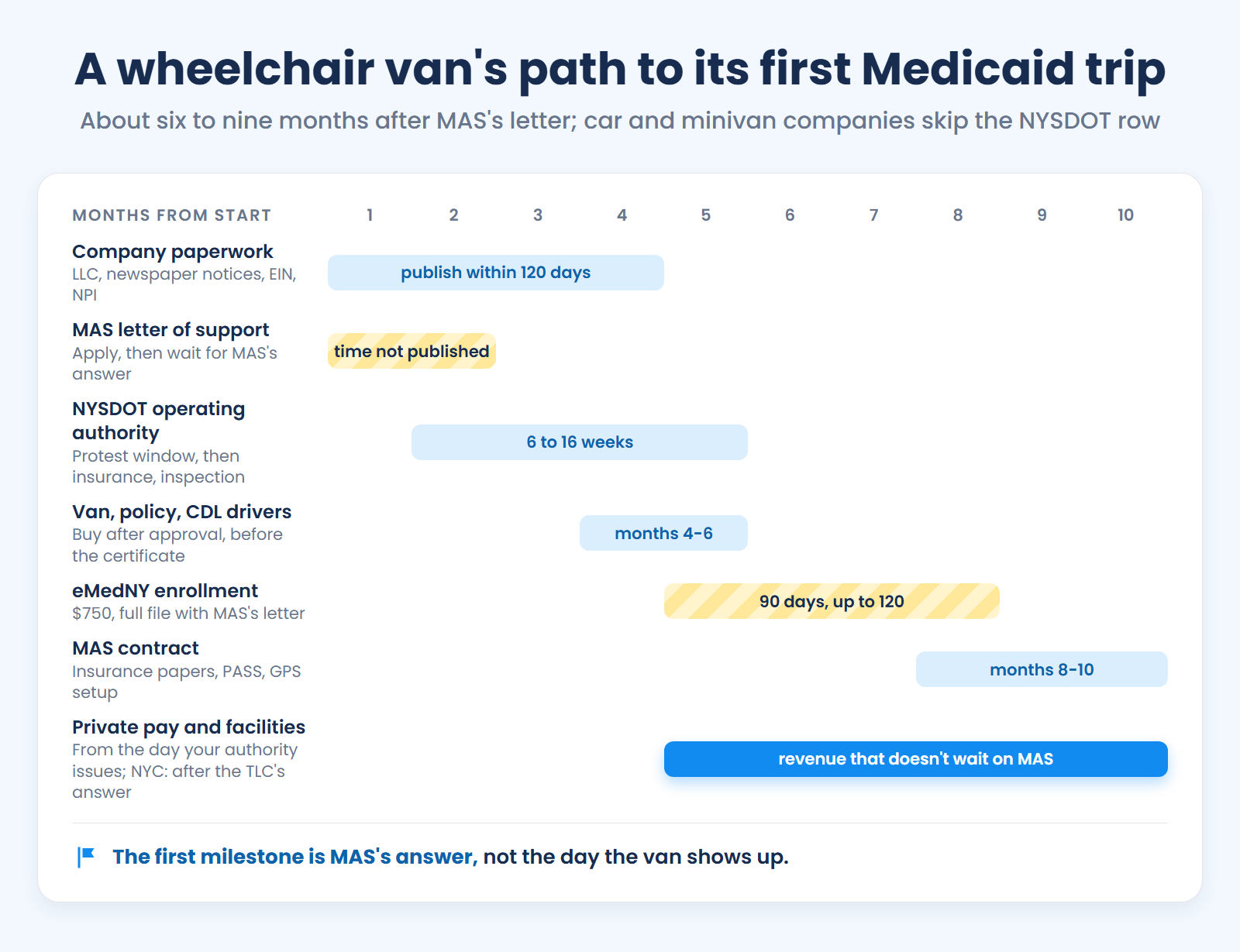
Count from MAS’s letter: about four to six months to a first Medicaid trip with cars, if your local license takes about a month, and six to nine with wheelchair vans. Most of that is eMedNY’s 90 to 120 days and, for wheelchair vans, NYSDOT’s 6 to 16 weeks. MAS publishes no clock for its letter, so add that wait on top, and ask how long its contracting takes now [3].
The wheelchair-van track, counted from the week MAS’s letter arrives:
- Before the letter. Email MAS, form the company, get your EIN, NPI and USDOT number, send MAS’s application, and start the notices.
- Week 1. File with NYSDOT, or earlier if MAS asked for your authority first, and start insurance quotes at its limits.
- Weeks 1 to 16. NYSDOT publishes your filing, the 30-day protest window runs, and approval usually lands between weeks 6 and 16 [6]. Use those weeks for your drivers’ entry-level training and CDL road tests [8].
- The next few weeks. Buy the van, get the insurer’s filing, pass NYSDOT’s inspection, register the van and enroll your drivers in 19-A. The certificate issues, and outside New York City private-pay and facility rides can start; in the city, get the TLC’s answer first [6][7].
- Months 2 to 9. File with eMedNY the week the certificate issues. Its 90 to 120 days, then MAS’s contract and credentialing, put the first Medicaid trip around months 6 to 9 [23][3].
Cars outside New York City move faster:
- First. The city or county license, livery plates and Class E drivers [2]. No city or county publishes a clock, so ask the clerk; private pay can start the day the license issues.
- The next 90 to 120 days. eMedNY’s review [23].
- Months 4 to 6. MAS’s contract and credentialing, then the first Medicaid trip [3].
Private-pay and facility rides are the revenue that doesn’t wait on MAS. An established NYSDOT carrier already authorized for wheelchair service in your counties (NYSDOT calls it transit-disabled service) joins the van track at step 5; one adding its first ambulette joins at step 4. An upstate taxi or livery company that already has its license, livery plates and Class E drivers starts the car track at step 2.
Budget per the cost table above, and save six months of fixed bills. eMedNY pays weekly once trips flow, but the first check lands weeks after your first attestation [14].
For at least a decade before December 2021, a new ambulette company in the city or on Long Island could buy a van and still never get a Medicaid trip. Today, a van without MAS’s letter can’t either. Put MAS’s answer at the top of your calendar, and the van’s delivery date after it.
New York NEMT FAQ
Is Modivcare still a Medicaid ride broker on Long Island?
No. Nassau and Suffolk moved from Modivcare to MAS on December 1, 2023, and MAS now covers all 62 counties [9][11][1]. A trade association reported at the time that companies already driving on Long Island stayed in place through the switch [11].
Can an ambulette company also run car trips for Medicaid?
Yes. An enrolled ambulette company can use sedans and minivans for ambulatory Medicaid trips, NYSDOT doesn’t inspect those cars, and local TLC licensing still applies where it exists [9]. A livery trip in an ambulette vehicle needs a 19-A-qualified driver [16].
Can I do Medicaid trips in a car registered in my own name?
Not on passenger plates. For ambulette or taxi work, the vehicle has to be owned by the enrolled provider or leased to it from a dealer or manufacturer, so a car in your name works only if you enrolled in your own name, as a sole proprietor [9][2]. Outside New York City, taxis need livery plates. New York City livery drivers can own their cars, under a TLC base [2][9].
What does New York Medicaid pay for an ambulette trip outside New York City?
On the April 5, 2026 default schedule, Erie County pays $41 plus $3.00 a mile, Onondaga $40 plus $3.75, Albany $43 plus $3.00, and Nassau and Suffolk $64 plus $3.00. County bases run from $31.33 to $64 statewide [15]. MAS-negotiated rates supersede the schedule, so ask MAS for yours [9].
Can I buy an existing ambulette company instead of starting one?
You can, but it doesn’t skip the gates. eMedNY enrolls the buyer as a result of the ownership change, and OMIG wants a surety bond when a new entity buys an ambulette company in New York City or the six bond counties [9]. Ask eMedNY and MAS what the purchase needs before you sign.
What happens if my LLC skips the newspaper notices?
After 120 days without proof of publication, the LLC’s authority to do business in New York is suspended until you file the proof. A bill to end the rule, S6483, is still in a Senate committee [4].
Will I need MAS’s approval again after I’m enrolled?
Yes, at revalidation. New York is revalidating every Medicaid provider by June 2028, and transportation companies need a MAS revalidation support letter to do it [2][3]. Once you bill $1 million in any 12 months, you also need a formal compliance program [24].
What if MAS says no?
Then eMedNY won’t enroll you for Medicaid trips, but private-pay and facility work needs no letter [2]. You still need the right authority for it: a TLC, county, city or town license for cars, and NYSDOT authority for wheelchair and stretcher vans unless NYSDOT confirms in writing that your minivan is exempt [17][19][6]. In New York City, get the TLC’s answer on your van before you run it [18]. Ask MAS what would change its answer, and ask again once you have trip history.
Is the New York market worth entering in 2026?
The demand is there: 6.37 million Medicaid enrollees in July 2026, $584 million of state Medicaid transportation spending (the state’s share) in fiscal 2026, 345 dialysis facilities and 3.76 million New Yorkers 65 and older [10]. The cautions: enrollment is down 7.1 percent since August 2025 [10], the state is going after transportation fraud [24], and MAS decides who gets in [2]. Enter with trip sources you control.
Key official sources
[1] NYS Department of Health, Medicaid Transportation page (February 2026) and Medicaid Updates of March 2011 and November 2021. https://www.health.ny.gov/health_care/medicaid/members/medtrans_overview.htm, https://www.health.ny.gov/health_care/medicaid/program/update/2011/2011-03.htm and https://www.health.ny.gov/health_care/medicaid/program/update/2021/no13_2021-11.htm
[2] eMedNY enrollment pages and form EMEDNY-424601 (August 2026), and DOH’s revalidation page. https://www.emedny.org/info/ProviderEnrollment/transportation/Option2.aspx, https://www.emedny.org/info/ProviderEnrollment/ffs.aspx, https://www.emedny.org/info/ProviderEnrollment/ProviderMaintForms/Additional_Requirements_for_Transportation_Enrollment.pdf, https://www.emedny.org/info/providerenrollment/ProviderMaintForms/424601_TRANSINF_Transportation_Information_Request.pdf and https://health.ny.gov/health_care/medicaid/integrity/provider_revalidation.htm
[3] Medical Answering Services provider pages and FAQ, provider search, network application, network manual and contracting FAQ. https://wp2.medanswering.com/transportation-providers/become-a-provider/, https://app.smartsheet.com/b/form/59526fc7d70b43959f1d761b1d981454, https://wp2.medanswering.com/how-to-revalidate-your-medicaid-enrollment/, https://masvmwp01.medanswering.com/wp-content/uploads/MAS-Transportation-Provider-Network-Manual-October-2023-v.1.1.pdf, https://masvmwp01.medanswering.com/wp-content/uploads/MAS-TP-Contracting-FAQ.pdf, https://wp2.medanswering.com/transportation-providers/faq-for-transportation-providers/ and https://wp2.medanswering.com/transportation-provider-search/
[4] Department of State LLC and corporation pages, LLC Law § 206 and bill S6483. https://dos.ny.gov/articles-organization-domestic-limited-liability-company-0, https://dos.ny.gov/certificate-publication-domestic-limited-liability-company-0, https://dos.ny.gov/certificate-incorporation-domestic-business-corporation, https://newyork.public.law/laws/n.y._limited_liability_company_law_section_206 and https://www.nysenate.gov/legislation/bills/2025/S6483
[5] LLC Publishers and URS Agents publication price lists (vendor prices, September 2026). https://www.llcpublishers.com/pricing and https://www.ursagents.com/new-york-publication-cost-estimates.html
[6] NYSDOT passenger authority pages, carrier guide and Weekly Bulletin (September 16, 2026); 17 NYCRR 820.1. https://www.dot.ny.gov/divisions/operating/osss/bus/passenger, https://www.dot.ny.gov/divisions/operating/osss/bus-repository/Passenger%20Carrier%27s%20Guide%20for%20Administrative%20Safety%20Compliance%202021_0.pdf, https://www.dot.ny.gov/divisions/operating/osss/repository/Application%20Notice.pdf, https://www.dot.ny.gov/divisions/operating/osss/bus/inspection, https://www.dot.ny.gov/main/publications/publications-repository/Bulletin%209-16-26.pdf and https://www.law.cornell.edu/regulations/new-york/17-NYCRR-820.1
[7] NYSDOT’s 17 NYCRR Parts 720 to 722 (January 2026) and DMV form MV-82.1P. https://www.dot.ny.gov/divisions/operating/osss/bus-repository/NYSDOT%20Passenger%20Vehicle%20Safety%20Regulations_0.pdf and https://dmv.ny.gov/forms/mv821p.pdf
[8] DMV’s Article 19-A guide (February 2026), packet, license chart and CDL page, and Vehicle and Traffic Law §§ 501 and 501-a. https://dmv.ny.gov/forms/cdl15.pdf, https://dmv.ny.gov/forms/ds700.pdf, https://dmv.ny.gov/forms/mv500c.pdf, https://dmv.ny.gov/driver-license/commercial-driver-license, https://www.nysenate.gov/legislation/laws/VAT/501 and https://newyork.public.law/laws/n.y._vehicle_and_traffic_law_section_501-a
[9] eMedNY, NYS Medicaid Transportation Policy Manual (August 2023). https://www.emedny.org/ProviderManuals/Transportation/PDFS/Transportation_Manual_Policy_Section.pdf
[10] DOH enrollment databook, Global Spending Cap and 2022 ambulette rate reports; CMS dialysis listing; ACS 2024. https://www.health.ny.gov/health_care/medicaid/enrollment/historical/all_months.htm, https://www.health.ny.gov/health_care/medicaid/regulations/global_cap/monthly/sfy_2025-2026/docs/4th_qtr_rpt.pdf, https://www.health.ny.gov/health_care/medicaid/data_rpts/docs/2022_ambulette_rate_report.pdf, https://data.cms.gov/provider-data/api/1/datastore/query/23ew-n7w9/0?conditions%5B0%5D%5Bproperty%5D=state&conditions%5B0%5D%5Bvalue%5D=NY&conditions%5B0%5D%5Boperator%5D=%3D&count=true&results=false&schema=false and https://api.censusreporter.org/1.0/data/show/latest?table_ids=B01001&geo_ids=04000US36
[11] LeadingAge New York (trade association), Long Island transition notice and May 2024 transportation update; State Comptroller’s 2017 bid-protest decision on New York City’s transportation manager; the state’s January 2022 HARP non-medical transportation guidance (DOH, OMH and OASAS). https://www.leadingageny.org/providers/nursing-homes/doh-notices-and-policies/long-island-transition-from-modivcare-to-mas-transportation-is-in-process/, https://www.leadingageny.org/providers/nursing-homes/doh-notices-and-policies/medicaid-transportation-update/, https://wwe1.osc.state.ny.us/Contracts/Bid_Protest/bpd_20160248.pdf and https://www.emedny.org/ProviderManuals/Transportation/PDFS/HARP_Guidelines_Non-Medical_Transportation.pdf
[12] MAS’s MLTC letter and FAQs (2024), DOH’s Form-2015 policy and Social Services Law § 365-h. https://wp2.medanswering.com/wp-content/uploads/2024/02/TP-MLTC-Email-v2.pdf, https://leadingageny.org/sites/leadingageny/assets/MLTC-FAQs-for-MAS-2.13.24-1.pdf, https://wp2.medanswering.com/wp-content/uploads/2022/06/2015-Policy-and-Procedure-May-2022.pdf and https://legislation.nysenate.gov/pdf/laws/SOS365-H/
[13] DOH’s GPS notice and FAQ (February 2023) and NYS Medicaid Update, May 2024. https://wp2.medanswering.com/wp-content/uploads/2024/05/NYS-GPS-Requirement.pdf and https://health.ny.gov/health_care/medicaid/program/update/2024/no05_2024-05.htm
[14] eMedNY Transportation Billing Guidelines (August 2026) and cycle calendar. https://www.emedny.org/ProviderManuals/Transportation/PDFS/Transportation_Billing_Guidelines.pdf and https://www.emedny.org/hipaa/news/PDFS/CYCLE_CALENDAR.pdf
[15] eMedNY Transportation Fee Schedules of April 2026 and July 2023. https://www.emedny.org/ProviderManuals/Transportation/PDFS/Transportation_Fee_Schedule.xls and https://www.emedny.org/ProviderManuals/Transportation/PDFS/Archive/Transportation_Fee_Schedule_-_2023-3.xls
[16] OMIG audit protocols (July 2026) and DOH’s Fast Help Ambulette decision (2017). https://omig.ny.gov/media/101261/download?attachment, https://omig.ny.gov/media/101266/download?attachment and https://www.health.ny.gov/health_care/medicaid/decisions/docs/fast_help_ambulette.pdf
[17] Transportation Law §§ 140, 144, 151, 152, 154 and 155. https://codes.findlaw.com/ny/transportation-law/tra-sect-140/, https://newyork.public.law/laws/n.y._transportation_law_section_144, https://codes.findlaw.com/ny/transportation-law/tra-sect-151/, https://newyork.public.law/laws/n.y._transportation_law_section_152, https://www.nysenate.gov/legislation/laws/TRA/154 and https://www.nysenate.gov/legislation/laws/TRA/155
[18] NYC Taxi and Limousine Commission rules, license pages and March 2026 insurance rule. https://www.nyc.gov/assets/tlc/downloads/pdf/rule_book_current_chapter_60.pdf, https://www.nyc.gov/site/tlc/businesses/paratransit-bases.page, https://www.nyc.gov/site/tlc/vehicles/get-a-paratransit-license.page, https://www.nyc.gov/site/tlc/businesses/livery-base.page, https://www.nyc.gov/site/tlc/vehicles/get-a-for-hire-vehicle-license.page, https://www.nyc.gov/site/tlc/drivers/get-a-tlc-drivers-license.page, https://www.nyc.gov/site/tlc/drivers/get-a-paratransit-drivers-license.page, https://www.nyc.gov/assets/tlc/downloads/pdf/rule_book_current_chapter_56.pdf, https://www.nyc.gov/assets/tlc/downloads/pdf/rule_book_current_chapter_59.pdf and https://www.nyc.gov/assets/tlc/downloads/pdf/amendment_of_rules_relating_to_insurance_coverage.pdf
[19] Nassau, Suffolk and Westchester TLC pages and rules, and Buffalo and Rochester license pages. https://www.nassaucountyny.gov/3791/Licenses-For-Taxi-Drivers, https://suffolkcountyny.gov/Portals/0/formsdocs/consumeraffairs/CA-TLC-2%20For-Hire%20Vehicle%20Registration.pdf, https://tlc.westchestercountyny.gov/images/stories/pdfs/2026/WCTLC_Fee_Schedule_06-30-2026.pdf, https://tlc.westchestercountyny.gov/images/stories/pdfs/2026/Medical_Waiver_Permit_Application_062026.pdf, https://www.buffalony.gov/DocumentCenter/View/11873/taxi-livery-application-_-requirements-2026?bidId=, https://www.cityofrochester.gov/departments/city-clerk/permits-and-licenses and https://www.nassaucountyny.gov/DocumentCenter/View/12858
[20] 17 NYCRR 750.1 as amended (December 2022) and 750.2, and DMV’s for-hire insurance page. https://dos.ny.gov/system/files/documents/2022/12/122122.pdf, https://www.law.cornell.edu/regulations/new-york/17-NYCRR-750.2 and https://dmv.ny.gov/insurance/increase-to-for-hire-insurance-minimum-and-maximum-liability
[21] Workers’ Compensation Board pages and Minimum Wage Order CR 142. https://www.wcb.ny.gov/content/main/coverage-requirements-wc/wc-coverage-required.jsp, https://wcb.ny.gov/content/main/Employers/violations-wclaw.jsp, https://apps.wcb.ny.gov/content/main/coverage-requirements-db/db-coverage-required.jsp and https://forms.labor.ny.gov/WP/CR142.pdf
[22] Public Health Law § 3001 and Article 30. https://newyork.public.law/laws/n.y._public_health_law_section_3001 and https://www.nysenate.gov/legislation/laws/PBH/A30
[23] 18 NYCRR 504.4 and 504.5. https://regs.health.ny.gov/content/section-5044-duties-department and https://regs.health.ny.gov/content/section-5045-denial-application
[24] Attorney General releases (2025) and OMIG’s 2026 Work Plan and compliance guidance. https://ag.ny.gov/press-release/2025/attorney-general-james-puts-medical-transportation-industry-notice-announces-new, https://ag.ny.gov/press-release/2025/attorney-general-james-secures-more-13-million-sweeping-takedown-transportation, https://omig.ny.gov/new-york-state-office-medicaid-inspector-general-2026-work-plan and https://omig.ny.gov/media/80796/download?attachment
[25] Tax Department Publication 718, TB-ST-590 and TSB-M-14(8)S, 20 NYCRR 528.5, and DMV fee schedules. https://www.tax.ny.gov/pdf/publications/sales/pub718.pdf, https://www.tax.ny.gov/pubs_and_bulls/tg_bulletins/st/motor_vehicles_and_boats.htm, https://www.tax.ny.gov/pdf/memos/sales/m14_8s.pdf, https://www.law.cornell.edu/regulations/new-york/20-NYCRR-528.5, https://dmv.ny.gov/forms/mv202.pdf and https://dmv.ny.gov/forms/mv202c.pdf
[26] NYS SBDC, Empire State Development and Governor’s loan pages, SBA microloans, NYSDOT’s Section 5310 guidance, the TLC Taxi Improvement Fund and ESD’s Seed Funding Grant report. https://nysbdc.org/, https://esd.ny.gov/main-street-capital-loan-fund, https://esd.ny.gov/content/pursuit-formerly-new-york-business-development-corporation, https://www.governor.ny.gov/news/governor-hochul-announces-150-million-new-york-forward-loan-fund-2-provide-flexible-loans-new, https://www.sba.gov/funding-programs/loans/microloans, https://www.dot.ny.gov/divisions/policy-and-strategy/public-trans-respository/2025%20FTA%205310%20Program%20Guidance%20Final.pdf, https://www.nyc.gov/site/tlc/about/taxi-improvement-fund-faq.page and https://esd.ny.gov/sites/default/files/200M-Seed-Fund-Final-Legislative-Report.pdf
Last verified against the sources above in September 2026. New York requirements, MAS’s network rules and broker arrangements change; check the primary sources before acting, and treat this guide as education, not legal advice.
About the author
James O'Donnell cofounded Duet and leads its sales, partnerships, and growth services. He talks with NEMT operators every week, hosts the NEMT Growth podcast, and answers Duet's sales line himself. More about Duet's founders →
Starting in a nearby state?
Want more trips and less busywork?
See how Duet runs and grows NEMT businesses in a 30-minute demo.