Article
How to Get Hospital Discharge Transportation Contracts
Hospitals want their beds back. Who to talk to about discharge rides, what to offer, the paperwork, and how to become their first call.
By James O'Donnell, Cofounder and COO, Duet ·
Last year I sat in on a sales call one of our customers made to a hospital. “People are waiting an hour and a half to get sent home,” the hospital said. “It’s bad for them, it’s bad for us. We’re happy to pay you more if you can show up in 15 minutes or half an hour instead of putting us off.”
To get hospital discharge work, skip procurement and find the case managers and discharge coordinators who book the rides. Offer to be their backup for nights, weekends and same-day discharges, prove you can get there within about two hours, and have your vendor paperwork ready for the rides the hospital pays for itself. It’s the backup-provider approach, applied to hospitals.
Search for how to get hospital contracts and, next to the good advice, you’ll be told to enroll with Medicare, call procurement and watch the bid boards. With a few vans, that’s the wrong door: Original Medicare doesn’t pay for wheelchair or stretcher van rides at all, and the people who book discharges don’t work in procurement. Hospital discharge work goes to the company that answers at any hour and gets there within about two hours, because what the hospital wants is its bed back. This guide follows the order you’ll live it, from why a hospital pays to the 2 a.m. calls that make you its first call.
Why would a hospital pay for a ride home?
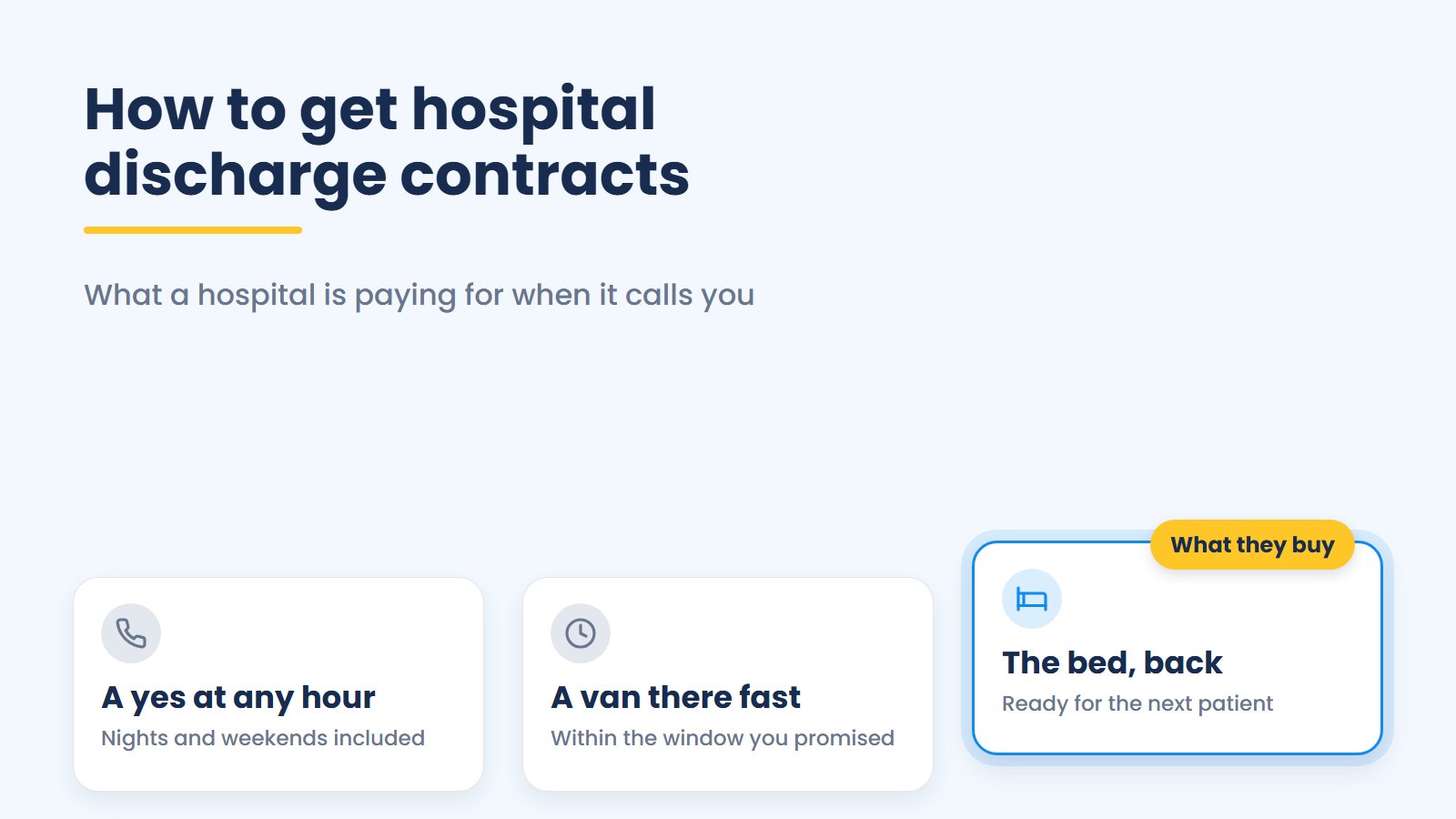
A hospital will pay for a ride home when a patient who’s ready to go has no ride, because that patient is holding a bed the next patient needs, often someone waiting in the emergency room (ER). When Josh Hagen of Careway Mobility asked me on a September episode of our podcast for “the fastest way a small company can start getting regular hospital discharge work,” I started there: “you are freeing up the bed. That’s what you’re selling.”
Medicare’s payment rule is why. For most Medicare patients in a general acute-care hospital, the hospital gets one set amount for the stay, “a predetermined amount per discharge,” so a night spent waiting for a ride brings in no extra Medicare money while the bed stays full.
KFF’s state health data put US community hospitals’ expenses at $3,297 for each inpatient day in 2024, with the days adjusted to count outpatient care. KFF calls it “only an estimate of expenses,” an average across all of a hospital’s days, not what one more night costs.
What a waiting patient really costs is the bed. In a 2012 study that modeled one academic hospital’s weekdays, moving the peak discharge time four hours earlier eliminated ER boarding, the hours admitted ER patients spend waiting for an inpatient bed.
Who pays for a hospital discharge ride?
Usually the patient’s coverage or family pays for a discharge ride, and the hospital pays when neither will and it needs the bed. Some hospitals will give you the cold shoulder, I told Josh, and say they “want the patient’s insurance to pay for it.” They mean it, so “it is a huge benefit if you can take common private insurances, you can take Medicaid if your state allows that.”
| Who pays | Who books the ride | Pickup window | What you’re paid |
|---|---|---|---|
| Medicaid, through the broker | Hospital staff, on the broker’s facility line | About three hours from the call, in many states | The broker’s rate for the level of service |
| The family (private pay) | The case manager, with the family | Whatever time you set with the family | Your private-pay price, often paid at pickup |
| The hospital | The case manager or transport coordinator | As fast as you can; one hospital asks for two hours | What you quote, or a contract rate |
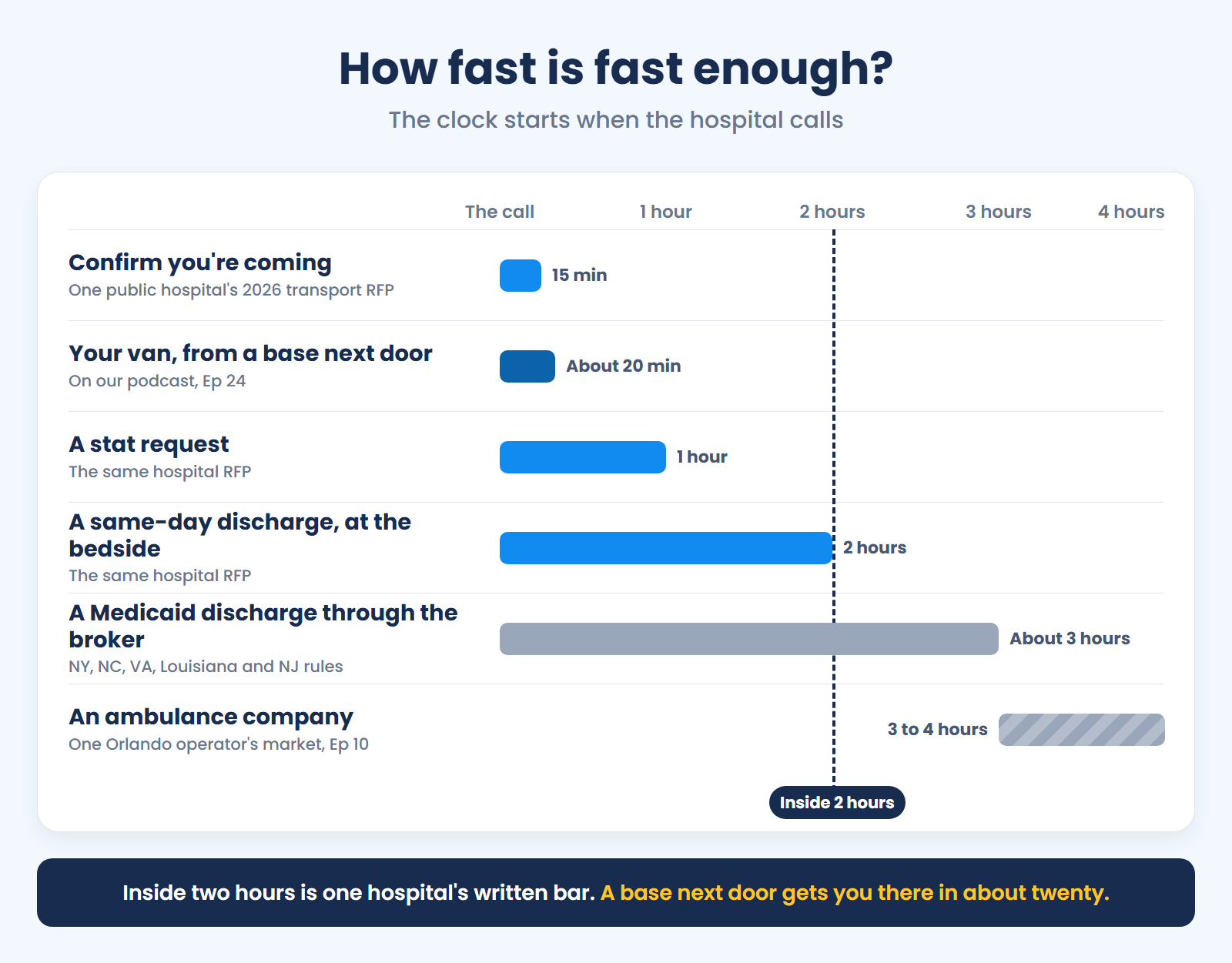
In the Medicaid lane, hospital staff call the broker’s facility line, and many programs give the van about three hours from the call. That’s the rule for MAS, New York’s statewide broker (2023 manual), North Carolina Medicaid (2025 policy), MTM in Virginia (2026 handbook), Louisiana’s managed care plans (2026 manual) and Modivcare in New Jersey (as of October 2026). Plan on the broker’s usual rate for the level of service; none of those documents pays extra for a discharge.
Who gets those trips isn’t always the broker’s call. New Jersey’s current broker contract says Modivcare “shall schedule nursing home and hospital trips using the facilities’ preferred providers,” and Indiana Medicaid’s transportation module, current as of October 2026, says that on hospital discharges home, Verida “will respect current preferred-provider relationships.” Join your state’s broker network if you can, and where a rule like that applies, ask each hospital to name you as its preferred company.
In the family lane, the hospital usually asks first whether the patient has a ride and can pay. UC San Diego Health’s discharge page tells families, as of October 2026, that a wheelchair van costs “$80 plus $5 per mile” and that “not all forms of medical transport are covered by health plans.” Norton Healthcare in Louisville tells families to pay “at time of transport.” The case manager often books the ride anyway, so be easy to book and know your private-pay prices.
The hospital pays when coverage won’t and it needs the bed. Next to a blocked bed, as I told Josh, “your transport is sort of a drop in the bucket,” so on a short-notice ride you set the price. A formal contract can cap it. University Hospital in Newark, N.J., wrote that lane into its 2026 transport request for proposals (RFP). When the Medicaid broker’s authorization is “delayed, denied, or unavailable,” it told bidders, its care coordination team “will issue a voucher,” and the hospital pays as the payer of last resort, at no more than the New Jersey Medicaid rate.
Don’t tell a hospital a federal rule makes it pay. The federal discharge-planning rule doesn’t mention transportation.
Who do you talk to at a hospital about transportation?
At a hospital, talk to the people who discharge patients: case managers, ER case managers above all, plus discharge coordinators, social workers and transport coordinators, both the ones who decide and the ones who make the calls. Not procurement: I told Josh to look for “someone in charge of discharge,” like an ER case manager, and “don’t go in for some admin deep in the hospital.”
You want both levels, because “usually the person nominally in charge is not the person picking up the phone and calling.” And “the exact titles are going to vary by the hospital.”
A Fort Worth owner told me this summer how he got in with a rehab hospital system’s case managers in his area: he sat down in front of every one of them himself. “Now we’re all on a group chat,” he said, and each one sends him transports from the hospitals they cover.
If you’d rather call ahead, the cold-calling script covers the front desk. Either way, leave each hospital with the names of one ER case manager, one discharge coordinator and whoever actually dials.
What do you say when you walk in?
When you walk into a hospital, don’t pitch: bring something small for the staff and ask how transport works there. My version: walk up to the front desk with donuts or cookies, and say you’re a local transport company and you were in the area. Then ask how they handle rides, down to whether it’s “you always call this guy on the weekends and you call this guy during the week.” While they’re eating a cookie, “most of them are going to be happy to tell you how it works.”
The snack is a reason to stop by and ask, not payment for trips. Federal anti-kickback law sets no minimum dollar amount for a gift meant to win Medicaid business, so keep it small and for the whole unit, never a thank-you for a referral, and skip lunches and gift cards. The HHS Office of Inspector General (OIG) lists free meals for hospital discharge planners among gifts that could disguise a payment for referrals, in its 2024 nursing facility guidance.
Then keep showing up. Tony Jackson, an Orlando operator with 35 years in the business, told me on our facility-contracts episode that he calls the case managers every day, once in the morning and again at 3:00, which he called the peak: “You got anything pending? I have somebody that can be there in one hour.” Offer the hour only if you can staff it.
This week, visit two hospitals with a box of cookies for the staff, and ask who calls for rides, who decides and who they call on weekends. After a couple, as I told Josh, “you’ll have a pretty good sense of how it works in your local market.”
What should you offer a hospital?
Offer to be a hospital’s backup for nights, weekends and same-day discharges, with a pickup window you can actually staff, ideally within two hours. As I told Josh, “If you can come in at 2 am and take somebody home, the hospital will happily pay you $250 because probably nobody else in your market is willing to do that.” Take the $250 as an example, not a rate card.
Speed is the other half. Tony tells case managers, “I can give you a two-hour turnaround.” That’s “the magic number,” he said, because in his market the ambulance companies take three to four hours. “Two hours is what they want to hear.”
Some hospitals write the clock down. University Hospital’s RFP gives contractors 15 minutes to confirm a request, says a “Stat Request” requires “transport within one (1) hour,” and says that for same-day transports, staff “must arrive at the patient’s bedside within two hours of receiving the request.” Two hours gets you in the door: it’s the bar that RFP writes down, and it beats the broker lane’s three hours and, in Tony’s market, the ambulance companies’ three to four. Faster can get you paid more: the hospital on that sales call offered to pay more for 15 minutes or half an hour.
There’s a Medicare reason the hospital needs you, too. Medicare won’t pay for an ambulance when another way of traveling would be safe, “whether or not such other transportation is actually available,” says its benefit policy manual. So when the clinicians clear a patient for a wheelchair or stretcher van, the hospital needs a van that’s available. Who needs an ambulance is always the clinicians’ call, never yours.
My rule, from an operator call in October: “ideally you want to always say yes.” Then quote a window you can actually hit, two hours or less.
The hard part is staffing it. “The painful, boring answer is you got to have vehicles available and drivers available,” I told Josh, and “it’s very much a trade-off against utilization.” On a tight schedule you’ll miss most same-day requests, and when you can’t reach one in time, “you just got to be okay turning those away.” If you can’t get there within about two hours in the hours you sell, don’t sell discharges yet; start with rehabs and nursing homes.
You don’t need overnight coverage to start, though. In that same 2012 study, 88% of the hospital’s weekday discharges in 2007 came between noon and midnight, so at that hospital an afternoon-and-evening backup would have seen most of them. Name the hours you cover and keep them, then add nights when you can, because the 2 a.m. discharge is the one few companies will take.
Check your fleet against the work, too. Of University Hospital’s 6,566 discharge transports in 2025, about 70% went by basic life support ambulance and about 26% by wheelchair van, according to a chart in its 2026 RFP. On demos I tell wheelchair and ambulatory fleets that with ER discharges, “a lot of time that’s stretcher,” and that assisted living and skilled nursing may fit them better at first. If you run wheelchair vans, ask the case managers which of their discharges go by wheelchair, and offer those.
What paperwork does hospital vendor credentialing ask for?
Before a hospital pays you itself, expect it to ask for a W-9, a certificate of insurance naming it as an additional insured, a business associate agreement if it has one, and proof your people are screened. Here’s what two public contracts asked for:
- A W-9. The IRS form that gives the hospital your taxpayer ID; University Hospital lists it among the forms due before award.
- A certificate of insurance. University Hospital asked for $2 million of general liability per occurrence and in aggregate, $1 million auto and $1 million excess, with the hospital as an additional insured. Los Angeles County’s master agreement for overflow transport (December 2024) asks ambulette contractors (some states’ word for wheelchair van companies) for $1 million each of general liability and auto, with the county as an additional insured on the general liability.
- A business associate agreement (BAA). Both contracts require one under HIPAA, the federal health privacy law. HHS says a hospital doesn’t need one to share information “to a health care provider for treatment purposes,” but whether that covers you is the hospital’s call, so ask its privacy office.
- Monthly exclusion checks. OIG’s 2013 bulletin says excluded people can’t provide federally paid transportation, “such as those provided by ambulance drivers or ambulance company dispatchers.” Providers “are not required by statute or regulation to check” OIG’s exclusion list. But OIG updates it monthly and says monthly screening “best minimizes” liability, so hospitals have reason to screen vendors’ staff too, and University Hospital requires monthly checks. Use OIG’s list (the LEIE), SAM.gov, which adds federal debarments, and your state’s Medicaid exclusion list where it keeps one.
- Background and health checks. University Hospital wants criminal background checks no more than six months old at the contract’s start, staff “free from any communicable disease,” and its flu-shot policy followed. Los Angeles County wants ambulette drivers with a valid California license and a current CPR card. If a hospital puts you through its vendor credentialing system, expect a TB test, a flu shot (or a declination) and other vaccines for anyone in patient-care areas, as one hospital system’s 2021 matrix asks.
Ask your insurance agent before you promise a certificate. A new owner in Northern Virginia said on an October operator call I was on that carrier after carrier “wasn’t allowing me to do contracts with like hospitals or senior homes.” The one that would was expensive.
A formal RFP asks for far more. University Hospital wanted five years’ transport experience, a New Jersey Department of Health license, Medicaid and broker participation and Medicare certification. Every bidder also needed at least 10 basic life support ambulances, three or four nurse-staffed specialty care units and 10 wheelchair vans, with no subcontracting. That’s written for an established ambulance company. Los Angeles County’s pool, by contrast, doesn’t make ambulette-only companies keep a dispatch line answered around the clock. Voluntary accreditation is a tiebreaker at most; here’s whether NEMTAC accreditation is worth it.
Have the packet ready before the first ride a hospital pays for: a W-9, a certificate of insurance ready to name the hospital, and monthly exclusion checks on everyone who works for you, drivers and dispatchers included.
What should you charge, and how fast do hospitals pay?
Charge at least your private-pay rate when the hospital pays, put wait time and who pays in writing, and expect a formal contract to set or cap your rate and pay 30 to 45 days after a clean invoice. Price matters least on a short-notice ride the hospital pays for, but the person who signs a standing agreement still watches it.
Wait time is where it gets touchy. Jeanine Johnson, who runs SailorGirl Transport in Sarasota, said on our long-distance episode that you get there and “the patient still got an IV running, they’re not dressed, they’re missing a prescription, the doctor has not formally discharged them.” So charge the wait time, she said, without coming across “as though you’re always nickeling and diming them.”
Agree on the rules first. Los Angeles County’s contract has crews get its dispatch office’s approval for any wait past the first 60 minutes, and it won’t approve wait charges after the fact. Christopher Buell, who grew his first NEMT company to about 11 vans with no broker work, charged extra for hospital trips in Little Rock’s ice: “I have to charge my ice fees. It’s in the service agreement,” he told me on our episode about calling facilities.
Some hospitals pay fast. Tony says “the hospitals pay you in 15 days instead of the 30 to 45.” An Indiana operator told my cofounder Jing and me this summer that his hospital contract paid in 15 days, while nursing homes wanted 30. Formal contracts run slower. University Hospital pays Net 45, after you’ve billed the patient’s insurance and then the patient, and caps every rate at the New Jersey Medicaid rate, private-pay rides included. Los Angeles County pays within 30 days of a complete, correct bill, after you’ve billed any insurance other than Medi-Cal or Medicare.
Before any ride the hospital pays for, get an email from someone with authority that says who pays, and put your wait-time rule in writing.
How do you become a hospital’s first call?
Take the hours and trips other companies won’t, stay close to the hospital and answer every call, and the daytime work usually follows. You won’t be the only company called: University Hospital’s May 2026 addendum lets it rank its vendors into first-call tiers by performance, response times included, and Los Angeles County’s contract says “more than one company may be called.” Aim to be the first call.
Four rules:
- Answer every call. “I almost never see somebody that’s 24 hours,” Christopher said, and “discharges happen every hour, every day.” A small-town Texas operator told me this summer that nursing homes and his local ER say other companies are hard to reach “after 8 p.m.”
- Take the trips nobody wants. In Little Rock, a lot of the hospitals had contracts with ambulance companies, Christopher said, “but the ambulance companies didn’t work when there was ice or snow … so they would call me.” It “started off as a trickle,” and by the end he was doing every hospital there. On our NEMTAC panel last year, one operator explained that when a hospital discharges a homeless patient back to where they were staying, “that is a discharge plan and I pick them up.” The advice from that panel: don’t be afraid of those trips, because the hospital is “going to give you more business.” As I told an owner on a demo this summer, take the odd hours, the odd patients and the long trips, and “they’re going to also call you first during the day, usually.”
- Stay close. “If you can be there in like 20 minutes because your base is next door to the hospital … boy, they will love you,” I told Josh. An operator with about 15 vehicles keeps drivers “staged at the hospitals waiting for calls to come in,” she told an industry podcast this year, and “work always comes in.” In October, an owner in North Texas with about 30 vehicles told an operator call I was on that a hospital had just agreed to base his crews in its ER, room and supply closet included. The hospital’s reason, as he relayed it: “we’re having problems moving patients out of the ER.” It hadn’t started when he told us.
- Don’t lose it at the bedside. If you’re running late on a discharge, Tony’s rule is to call and “let the bedside nurse know.” Marqus Johnson, a Tampa operator and coach, told me on our episode about turning drivers into a sales force about a driver on a wheelchair discharge who made the rider pick up all their own luggage and belongings. A hospital aide had to do it, and the company’s owner was very upset.
Answer the 2 a.m. call yourself when you can. When nobody picks up after two or three rings, Duet’s voice AI answers, day or night, weekends and holidays included. It collects the pickup, drop-off, time and the rider’s mobility needs and books the trip onto your Duet board. As of October 2026, it’s included with Duet’s software at no extra cost. You still need a driver who can roll at 2 a.m.
Before you walk into your first hospital, answer what its ER case managers will want to know. Who picks up your phone at 2 a.m.? And in the hours you sell, how long until a van is at the door? If your honest answers are “we do” and “inside two hours,” go buy the cookies. The hospital on that sales call already told you what it would pay extra for: half an hour.
Hospital discharge FAQ
How does a hospital name you as its preferred company with the broker?
It depends on the state. New Jersey’s broker contract says a facility chooses a preferred company inside Modivcare’s network, and Modivcare assigns the facility’s reservations to it; on less than 48 hours’ notice, Modivcare assigns the trip and the facility follows up with that company to make sure it’s available. Elsewhere, ask your broker’s provider relations team whether it honors a facility’s choice and how the facility tells it.
Does a hospital pay if a discharge is canceled while you’re on the way?
Count on it only if your agreement says so. Los Angeles County’s contract pays a dry run only when the van has arrived at the pickup, not when the call is canceled en route. Put your cancellation fee in writing, and say when it applies.
About the author
James O'Donnell cofounded Duet and leads its sales, partnerships, and growth services. He talks with NEMT operators every week, hosts the NEMT Growth podcast, and answers Duet's sales line himself. More about Duet's founders →
Want more trips and less busywork?
See how Duet runs and grows NEMT businesses in a 30-minute demo.