Article
What Goes in a NEMT Service Agreement With a Facility
A facility signs a page it can read. Spend it on getting paid: every fee, the due date, and what's owed if it ends.
By James O'Donnell, Cofounder and COO, Duet ·
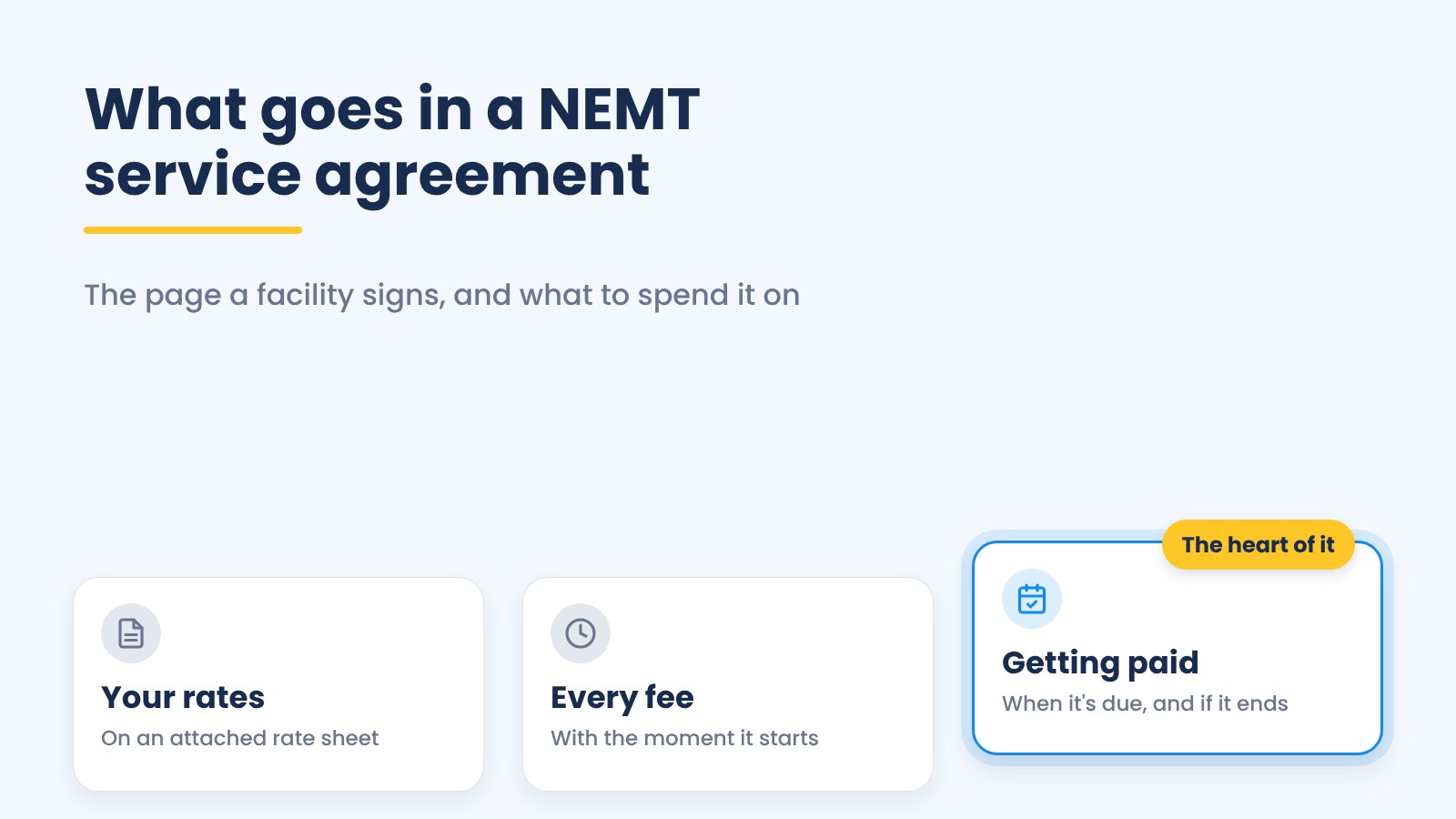
A NEMT service agreement is the short paper a facility signs that sets the terms for its trips with you. It says who’s paying and for how long, which trips you’ll run and how they’re booked, your rates on an attached sheet, every fee, when you’re paid, how it ends and what protects both sides. Keep it to one page if you can, two at most, plus the rate sheet.
Tony Jackson, an Orlando operator with 35 years in the business, told me on our episode about winning facility contracts about the one time a company he was with had to sue a facility. “It was for $70,000, but we end up getting 150,000 because it took so long and then the attorney fees,” he said.
Keep the agreement short enough to sign in one sitting, and spend its words on getting paid: every fee, when payment is due, and what’s owed if it ends. This guide follows the order a facility reads it: who and how long, which trips and how they’re booked, the money in the middle (rates, fees, payment, the ending), then the protections. Last comes what to check in a facility’s own contract. Adapt it to your business, and have a lawyer licensed in your state read your agreement before you use it.
Is a service agreement a contract?
Whatever it’s called, a service agreement is a paper you and the facility both sign, and it’s the one you’ll point to when an invoice goes unpaid. Christopher Buell, who’s spent decades selling NEMT to facilities, said on his episode of our podcast never to ask a facility for a contract, because people who won’t sign one will sign a service agreement. Our first-trip guide covers whether to ask for a contract at all; our guide to NEMT contracts has the short version of what goes in.
A short one gets read. An owner in Chesapeake, Va., told another industry show in December 2022 that a facility with a contract of its own saw her one-page agreement and said, “we like your service agreement.” It signed hers. Another company sent her its own contract, about 20 pages. On another industry show in June 2026, a Kansas City owner with three vehicles summed his up in one line: “Really all it is is outlining my responsibility to you.”
You’ll also read that a service agreement can be broken off with fewer consequences than a contract. Don’t write yours on that assumption: it’s the page you’ll hold up when a facility pays late.
Who signs it, and for how long?
Name whoever pays you, by its legal name, and sign for one year that renews unless either side says otherwise, with a look at the rates each year.
The payer isn’t always the building. Tony’s attorney-fees clause puts the fees on “the facility or the management company.” A Tampa operator said in a 2022 video that a nursing facility client changed its name and told him it didn’t have to pay. “It took like four months” to get his money. Put the payer’s legal name and address at the top, and ask your lawyer what the agreement should say if the building is sold or renamed.
Write the yearly look into the agreement. An operator in Mobile, Ala., said on another industry podcast in 2024 that your service agreement can promise a revisit “next year or 12 months” out, to re-sign or adjust. Gas prices may go up, he said, and so may what you pay drivers.
Which trips will you run, and how do they get booked?
List each level of service you’ll run, each priced on the rate sheet, and write down who can book, how much notice you need and how you’ll confirm.
Christopher’s advice is to “have as big a menu as possible … because you can charge for each stage of that.” A rider in their own wheelchair is one price for him, and “if I’m bringing mine, it’s going to be this.” List stretcher or bariatric only if you run them.
Booking usually follows the facility’s habits. One of the founders of a private-pay company in Charlotte said on another industry podcast in June 2026, “You’re going to have to conform to their operations and how they do stuff.” Public buyers spell theirs out. Los Angeles County’s 2025 overflow transport agreement pays only for trips its dispatch office requested. University Hospital in Newark’s 2026 request for proposals (RFP) wants each request confirmed within 15 minutes.
Where do your rates go?
Your rates go on a separate rate sheet attached to the agreement, so the agreement can let a price change take written notice instead of a new signature.
Facilities ask for the sheet early. A new owner in Northern California with one van told me on a demo in July that three front desks had asked whether he had a rate sheet. “I didn’t at the time,” he said. Expect to keep more than one, because facilities negotiate. As I said on our 2025 NEMTAC panel, “I’ll sometimes look in a customer’s account and they’ve got 30 different price sheets.”
Big buyers may not let prices move on notice. Los Angeles County’s yearly cost-of-living change takes a signed amendment, and University Hospital ties its rates to Medicaid’s. So revision on notice is your ask, and a facility may strike it.
Put your rates on their own sheet, attach it, and require 30 days’ written notice before any change.
Once it’s signed, that facility’s rate sheet goes into Duet’s billing software once: your rates by level of service, plus add-on fees like wait time or after-hours. Each trip records who pays, and the facility’s billing report comes out for any date range as a PDF, CSV or Excel file, or a QuickBooks file to import. You still send the invoice and collect it.
Which fees belong in writing?
Every fee a facility could argue about belongs in writing, each with the moment it starts, and the amounts go on the rate sheet.
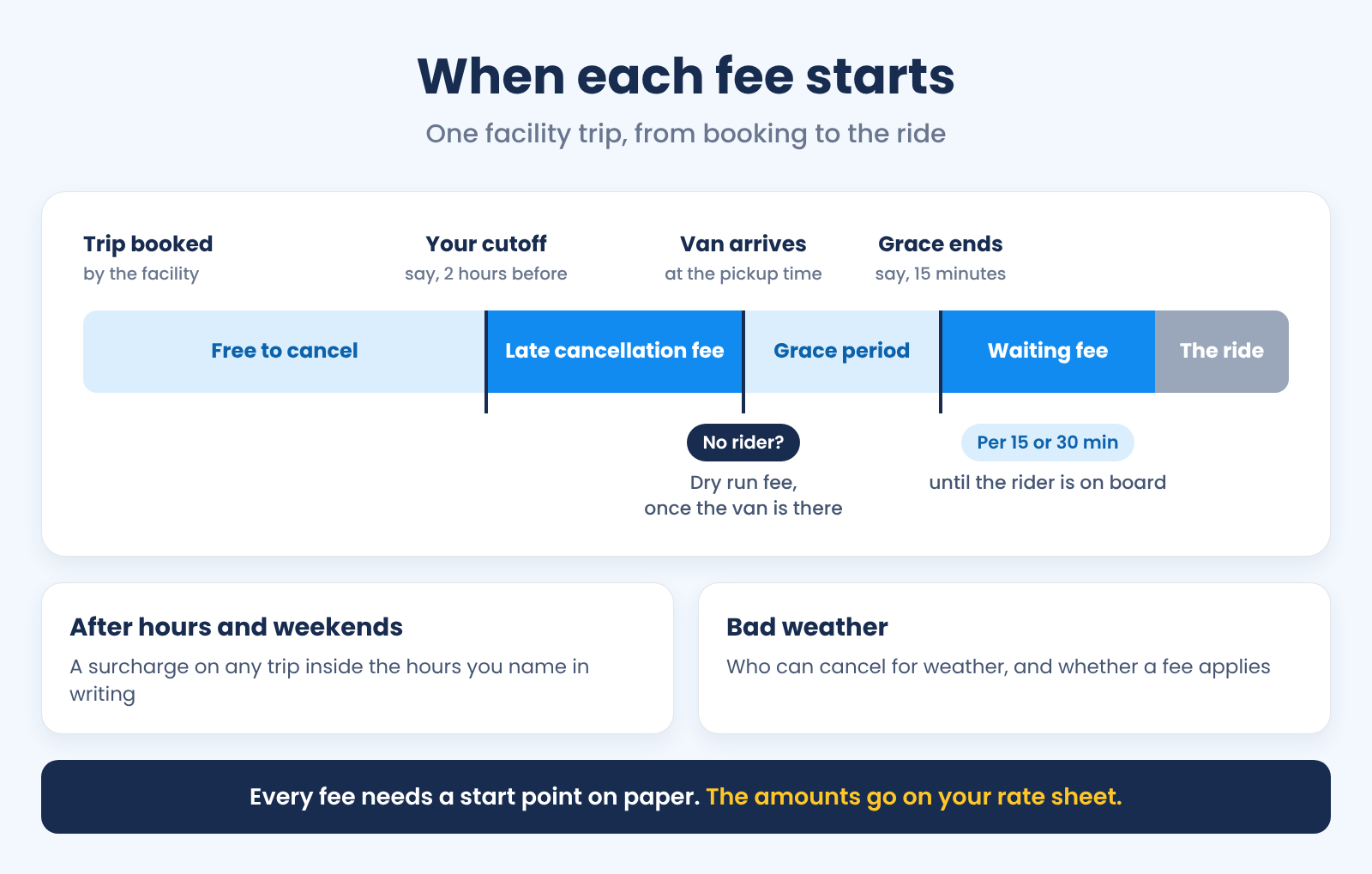
The facility can cancel free until your cutoff, say two hours before pickup, and pays a late cancellation fee after that. A dry run is a trip called off once your van is at the door, so its fee applies only after the van arrives. Waiting starts when a grace period ends, say 15 minutes after arrival, and bills per 15 or 30 minutes until the rider is on board. After-hours and weekend surcharges apply inside hours you name in writing. For weather, say who can cancel and whether a fee applies.
Public paper uses the same triggers. Three Nevada carriers’ 2026 tariffs, the price lists they file with the state, charge the full price for a cancellation less than 120 minutes out. Los Angeles County pays a dry run only if the van arrives, not “if the call is cancelled en route.” The City of Los Angeles’ 2022 set rates for wheelchair and stretcher vans and five Nevada tariffs start charging for waiting after the first 15 minutes. One Nevada carrier charges nothing when it cancels for weather. They’re examples, not norms. Our rates guide has posted wait and after-hours fees to compare.
Write each fee with its trigger: the cancellation cutoff (say, two hours), a dry run once the van arrives, and waiting after a set grace period (say, 15 minutes).
When do you get paid?
Write down when you’ll invoice, when payment’s due and what happens when it’s late, and decide your answer before a facility asks for 60 or 90 days. Terms usually come as net days: net 30 means payment’s due 30 days after the invoice.
Less than three weeks after that demo, the same Northern California owner had invoices past 30 days. “Net 60, net 30, or net, what do they do?” he asked me. “I feel like net 30 is relatively standard in NEMT,” I told him, but “some of them would rather do net 60.” Some owners “raise their prices a little bit,” I added, then offer “2% off if you pay within the 30 or so.” University Hospital’s RFP sets “Net 45 days” but “may accept shorter payment terms with additional discounts (e.g., 2%/30 days).” On that NEMTAC panel, the answer on that kind of discount was that facilities that missed the window got billed the agreement’s higher rate, and paid it.
The other route is a late fee. One Las Vegas carrier’s 2026 filed tariff reads, “A late fee of 1% will be charged monthly when a payment is not provided within 30 days of receipt.” Show that to your lawyer as one example, not a number to copy, because late-fee limits vary by state.
Then cap what you’re owed. Christopher said paper matters once it’s “serious work,” like a facility doing “10 trips a week” that wants “to pay you every 90 days.” That’s “a tremendous amount of money out of my pocket,” he said, so he wants it in writing. With a van or two, set a credit limit for each facility and write it in.
Write the payment clock: invoice twice a month, due in 30 days, with either a late fee your lawyer approves or a posted rate with 2% off for paying inside 30 days.
What happens when it ends?
Let either side end the agreement on 30 days’ written notice, with a short window to fix a problem first, and make sure ending it never wipes out what’s already owed.
Big buyers’ paper can run one way here. Los Angeles County can end its agreement for convenience on 10 days’ written notice, and its clause letting the county take back any payment for work done after the agreement ends “shall survive” it. Write your notice period both ways, and give your invoices a survival line of their own.
Two more points are for your lawyer. A cure period is a set number of days to fix a problem after written notice, before the other side can end the agreement over it. And governing law says which state’s law applies to a dispute.
With Tony’s $70,000 in mind, add one sentence saying that ending the agreement doesn’t cancel invoices already owed, or any collection costs the agreement puts on the facility.
What protects both sides?
The back of the agreement covers insurance, screening, privacy and who pays for whose mistakes, and it should promise only what you carry and do.
Put your insurance limits on an exhibit and match them to the facility’s. Big buyers also ask to be named an additional insured, a party your policy covers too. That goes policy by policy: University Hospital wants it on general, auto and excess liability, Los Angeles County on general liability. Before you sign, check who sets your insurance limit.
Tony’s pitch to facilities names the drivers’ screening and training: a background check, “I do fingerprints,” defensive driving training. “Most companies don’t do that,” he said. Put it in the agreement only if you do it.
Nursing homes have a reason to ask. Federal nursing home rules bar a home from engaging anyone a court has found guilty of abuse or neglect, and the guidance Medicare and Medicaid give inspectors counts contractors as staff. The federal health department’s inspector general says in its 2013 bulletin on exclusions that no statute or regulation makes providers check its list of excluded people and companies, though it suggests monthly checks. Warrant only the checks you’ll run, and see what a hospital’s vendor packet asks for.
A business associate agreement (BAA) is a vendor’s written promise, under HIPAA, the federal health privacy law, to safeguard patient information a health care provider shares with it. HHS’s guidance on business associates says a facility covered by HIPAA doesn’t need one to share a patient’s information with a health care provider for treatment. Whether that covers you is up to the facility’s privacy office, so write that you’ll sign a BAA if the facility requires one.
Indemnity is a promise to cover the other side’s losses when a claim grows out of your side’s work. In University Hospital’s RFP, the contractor is “responsible for any and all future claims” from its work. Ask for indemnity that runs both ways, and let your lawyer word it.
What if the facility sends its own contract?
If the facility sends its own contract, your job is to read it and check it for eight things before you sign.
It can happen with your very first facility. The Charlotte founders’ first facility sent them “a partnership agreement basically,” which made them “a preferred vendor,” and it was “a net 60 account.” With that facility as most of their early trips, they “had to like go without getting paid for a little while.” University Hospital’s RFP is the big-buyer version: its terms win any conflict, it bans other pickups while its rider is aboard, and objecting to its 45-day terms will likely disqualify a bid.
Check for these:
- Long payment terms. Net 60 or 90 means you float its trips for two or three months.
- Pay-when-paid. You’re paid only after the facility collects from insurance, Medicaid or Medicare. My cofounder Jing said on our dispatching episode that some facilities work this way, so some invoices take months.
- A multi-loading or subcontracting ban. Multi-loading means other riders in the van with theirs; subcontracting means handing a trip to another company.
- Unapproved or unpaid waiting. Waiting gets paid only when someone approves it first, or never.
- Exclusivity with no volume. A discount for being their only company, with no trips promised in return.
- Insurance above your policy. Limits higher than you carry. Call your agent before you sign.
- One-way indemnity. You cover their losses, and they cover none of yours.
- A one-sided exit. They can leave on short notice, you can’t, and nothing says unpaid invoices survive the end.
Push back on the two that would hurt most, usually the payment terms and the exit.
Plenty of facilities sign nothing at all. A family company in Santa Fe told another industry podcast in 2024 that it works with four facilities and has one official contract. “The other three are basically just verbal agreements that they’ll use us and they do.” As I told a new owner in Southern California in July, corporate buildings may need a signed agreement for their vendor list, but “at a small facility, this step may be totally unnecessary.” For a one-off trip before anything’s signed, get Tony’s email: the administrator or director of nursing, in writing, taking responsibility for that rider’s ride that day.
Before you send yours, read it once as the facility’s bookkeeper: what do I owe, by when, and what happens if I’m late? If any answer isn’t on the page, fix that first. The page exists to get you paid.
The facility in Tony’s story was sued over $70,000 and ended up paying $150,000. A week after it paid, it asked the company he was with, “can you start up again doing transportation with us?”
Service agreement FAQ
Is a broker’s provider agreement the same thing?
No. A broker’s provider agreement is the broker’s own form for the Medicaid trips it assigns you. Under WellTrans’s 2025 Indiana form, for one, the broker pays only for trips it has pre-authorized, and you agree to sign a business associate agreement. A facility service agreement is a private deal between you and the building, for trips the facility or a family pays for, so the two of you set the terms.
About the author
James O'Donnell cofounded Duet and leads its sales, partnerships, and growth services. He talks with NEMT operators every week, hosts the NEMT Growth podcast, and answers Duet's sales line himself. More about Duet's founders →
Want more trips and less busywork?
See how Duet runs and grows NEMT businesses in a 30-minute demo.