Article
How to Start a NEMT Business in Alabama (2026)
Alabama Medicaid has no ride broker. Riders pick their own van company, and the Public Service Commission wants a hearing first. Here's the order.
By James O'Donnell, Cofounder and COO, Duet ·
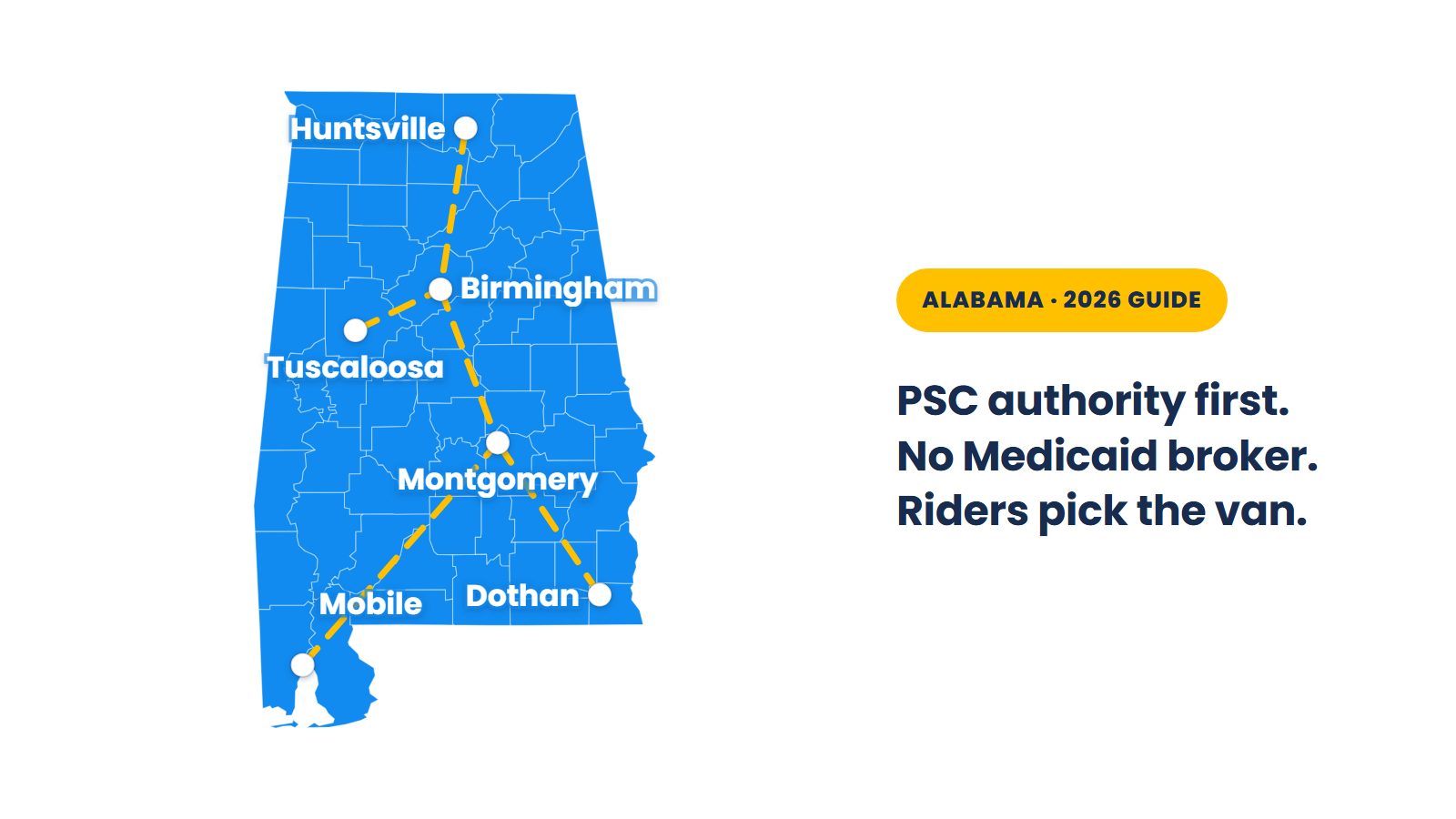
To start a NEMT business in Alabama, form an LLC ($228), insure each van and get Public Service Commission (PSC) authority ($100 plus $6 a van, decided at a hearing in Montgomery) before carrying paying riders past city limits. Then ask Alabama Medicaid’s ride program to list you. It uses no broker, and riders pick their own company, so line up facilities and private-pay families first. Budget about $22,700 for one financed used wheelchair van and six months of bills.
Alabama at a glance:
- PSC authority: required for most companies carrying paying riders between Alabama points, and decided at a hearing where existing carriers can protest. Trips wholly inside one city are exempt [1][2].
- No Medicaid broker: the Alabama Medicaid Agency runs its Non-Emergency Transportation (NET) program with its own staff, and each rider chooses a transporter [3][4].
- When NET pays: after the doctor’s claim for the visit is identified, through pay files on the 1st and 16th of the month [4].
- Insurance: plan on about $1 million of coverage per van. The PSC’s floor starts at $25,000 per person [5].
- Stretcher: ambulances only, under Alabama’s emergency medical services (EMS) rules [6].
- Cost: about $22,700 for one financed used wheelchair van and six months of fixed bills.
The owners of a Montgomery company say they got the Alabama Medicaid Agency’s notice on July 1, 2025, after ten years of averaging about 500 Medicaid trips a week. From August 1, every company carrying Medicaid riders would be paid one standardized flat rate: $35 for an ambulatory rider and $70 for a wheelchair rider within 25 miles, as the Alabama Political Reporter reported the notice [7]. The company had been getting $50 and $125, so the outlet put its cut at 30 to 45 percent. The owners also wrote of claims denied “a year later” because a doctor had billed the rider’s other insurance. The Agency said most transporters would come out ahead, and that it had “seen increased interest from potential transporters.”
In Alabama, Medicaid riders pick their own van company and the state pays only after the doctor bills, so build on facilities and families first. The riders are there: Alabama Medicaid counted 1,034,197 people eligible in September 2026, and about 955,000 Alabamians were 65 or older in 2024 [8][9].
I run Duet, which builds dispatch software and runs growth services for non-emergency medical transportation (NEMT) businesses, and I talk to NEMT owners on demos every week, Alabama operators included. This is the Alabama edition of our national guide on how to start a NEMT business. Requirements change, so confirm against the linked sources before you spend money.
The checklist runs in the order you’ll spend money. Then come the payers, starting with the money that reaches your bank first, and each gate, with what it costs.
The one-page checklist: steps to start a NEMT business in Alabama
Make three calls before you buy a van, then line up van one and file for Alabama PSC authority the week you form your LLC. The hearing is the step nobody can rush, so it starts first. Each phase ends with the money it puts at risk, figured for one used wheelchair van based in Birmingham.
Phase 0: make three calls before you buy
- The PSC’s Motor Carrier Services, 334-242-5176: ask which application fits a van company that runs on call rather than on a fixed route: Form 14, the passenger application, or Form 12, for a taxi carrier of five passengers or fewer. Ask how far out hearings are being set, and whether a van you’ve agreed to buy is enough to file with. The PSC asks you to request forms from that number or mcs.ued@psc.alabama.gov [5][10].
- The NET Central Office, (334) 353-5015: ask what it takes to be added to the NET Transporters Directory and which of your papers NET wants to see [11].
- Your city’s licensing office: ask whether your vans need a city permit. Huntsville, Tuscaloosa and Montgomery license them, and Birmingham’s and Mobile’s codes are worth a call before you buy [12].
- Money at risk: nothing yet.
Phase 1: form the company
- Reserve your company name online ($28), then file a Certificate of Formation with the Secretary of State ($200). The name reservation has to be attached [13].
- Get a free employer identification number (EIN) and a free national provider identifier (NPI) under the NEMT van taxonomy code, 343900000X.
- Get your city and county business licenses. In Birmingham, plan on about $60 for the city and $50 for Jefferson County at their minimums [14].
- Money at risk: about $640, counting about $300 for a phone and basic marketing.
Phase 2: line up van one, then file for PSC authority
- Pick van one before you file. Form 14 asks you to describe each van, down to the make, model, rated capacity and motor number, and it also wants a financial statement, a map of where you’ll run, your articles of organization and a notarized oath [2].
- Request Form 14, or Form 12 if Motor Carrier Services told you it fits, and file it with a cashier’s check or money order: $100 for common or contract authority, $200 for both. Common authority covers carrying the general public. Contract authority covers carrying under your own contracts, and its application needs at least one signed contract [1][2][38].
- Insure and register the van. Alabama won’t register a vehicle without liability coverage, and the van’s property tax is collected at the business rate before the plate issues [16][29].
- Fit wheelchair securements that hold the chair without “the active attention of the driver,” as the PSC’s rules require, and train every driver on wheelchair securement [10].
- Line up a public witness, such as a facility that’s ready to book you, in case an existing carrier protests.
- Money at risk: about $10,900 more, so about $11,500 in, mostly the down payment on our model’s older $20,000 wheelchair van and the insurance due at signing. That includes $100 to the PSC, plus $100 if Birmingham’s vehicle-for-hire permit reaches your vans. From here, fixed bills run $1,692 a month.
Phase 3: build each driver’s file while you wait
- A regular Class D license covers a typical wheelchair van, plus your city’s driver permit where it has one [12][17].
- Check each driver against the PSC’s driver rules and NET’s, including the federal exclusion list, before the first ride [3][10].
- Use the wait. Paid trips wholly inside one city’s limits or police jurisdiction don’t need PSC authority, so run them under your city’s own rules, meet facilities and line up private-pay families now [1].
- Money at risk: about $1,000 for one driver’s screening and training in our model, so about $12,500 in.
Phase 4: the week the Commission grants your authority
- Have your insurer file a Form E, its proof of your liability coverage, with the PSC. Then file your tariff, the price list of rates, fares and rules the PSC keeps on file for each passenger carrier. Your company can’t run trips past city limits until both are on file [2][5].
- Pay the PSC $6 for the van’s registration number, and letter both sides with your business name, city and PSC numbers [5][10].
- Money at risk: $6 more, still about $12,500 in.
Phase 5: your first month past city limits
- Book your first private-pay families and get two facilities ready to call you that week.
- Put up a website families can book from, claim your Google Business Profile and ask your first riders for reviews.
- Call the NET Central Office and the Medicare plans’ ride vendors the same week.
- Mark April 30 on your calendar: the PSC’s annual report is due by then every year [5].
- Money at risk: six months of fixed bills at $1,692 a month, counted from the week you bought the van, for a total of about $22,700.
Authority makes you legal past city limits. It doesn’t put anyone in the van, so the payers come next.
Who pays for NEMT rides in Alabama?
Start with facilities and private-pay families, who pay an Alabama NEMT company on terms it sets; Medicaid and the Medicare plans’ ride vendors pay on theirs. Families pay first, before the ride.
Families pay before the van rolls
Private-pay families pay up front, at the prices in your tariff, which has to show all your rates and fares [1]. Most private-pay owners I talk to take a card at booking and charge it at least 24 hours before pickup, or send a payment link due by then, and some take a small nonrefundable deposit to hold the slot. No payment, no van.
For a benchmark, a hospital system in north Alabama runs its own wheelchair vans, and its drivers collect the fare. Its 2020-21 fee flyer, still on its site, lists $40 for a one-way ride inside its county, $50 for an ambulatory and $70 for a wheelchair round trip in the county, and $250 for a round trip to Birmingham [18]. Our private-pay guide covers pricing and marketing.
Facilities pay on your invoice
Nursing homes, hospitals and rehabs can buy rides from you the week your authority issues. Alabama has 224 nursing homes with 26,504 certified beds and 99 hospitals in 2026 data from the Centers for Medicare & Medicaid Services (CMS) [19]. A Birmingham owner told an industry podcast in February 2026 that “the bulk of our work is facilities.” The same owner warned about late payers, “if people aren’t paying their invoices on time, which is a thing,” so put payment terms in writing. Our guide to nursing home transportation contracts covers who pays for a resident’s ride.
Two smaller doors are worth a visit. Alabama’s one Program of All-Inclusive Care for the Elderly (PACE) runs in Mobile, so ask who drives its members [20]. The VA’s Central Alabama system says eligible veterans can request free rides to VA appointments, wheelchair van rides included, so ask its travel office how it buys them [21].
Don’t count on dialysis clinics as accounts. Dialysis rides are great, but most dialysis riders are on Medicaid, so their trips come through NET, not the clinic.
Medicaid riders pay after the doctor bills
Medicaid riders bring the volume, but only riders “with full Medicaid coverage” can use NET, and each one picks the company [4].
Medicare plan members ride on the vendor’s cycle
Medicare Advantage plans for people on both Medicare and Medicaid pay for rides too, through their own vendors. CMS counted 148,290 Alabamians in these dual-eligible special needs plans in November 2026. In 2026 plan documents, most of the plans cover rides, often 24 or 36 one-way trips a year, and HealthSpring’s TotalCare Plus covers unlimited one-way trips of up to 70 miles [22][23]. Each plan’s ride vendor runs its own network, so ask each one how and when it pays.
Who is the NEMT broker in Alabama?
Nobody: as of November 2026, the Alabama Medicaid Agency runs its own ride program, and riders choose their transporter. Its rule says so plainly: “Alabama NET Program is operated by Agency staff as an administrative service” [3]. NET coordinators work from ten district offices covering all 67 counties, and five of the ten are run from the Central Office in Montgomery; the NET Coordinators’ List shows which one covers your county [11].
Every NET trip starts with the rider. A rider calls the Agency’s Recipient Call Center at 1-800-362-1504, option 4, at least five days before the appointment, or within 24 hours after an urgent or emergency visit, and gets a 7-digit request number. Riders “may ask for contact information for transporters available in their area,” and “The recipient may choose which transporter to use” [4]. A facility social worker can arrange the ride too [24].
No health plan arranges Medicaid rides either: the Alabama Coordinated Health Network coordinates care, and the Integrated Care Network does case management for long-term care members [25].
A Mobile owner walked through the rider’s side on an industry podcast in February 2024. Once you’re approved, “they add you to a list,” and riders who call get “my number or any other companies in the area number.”
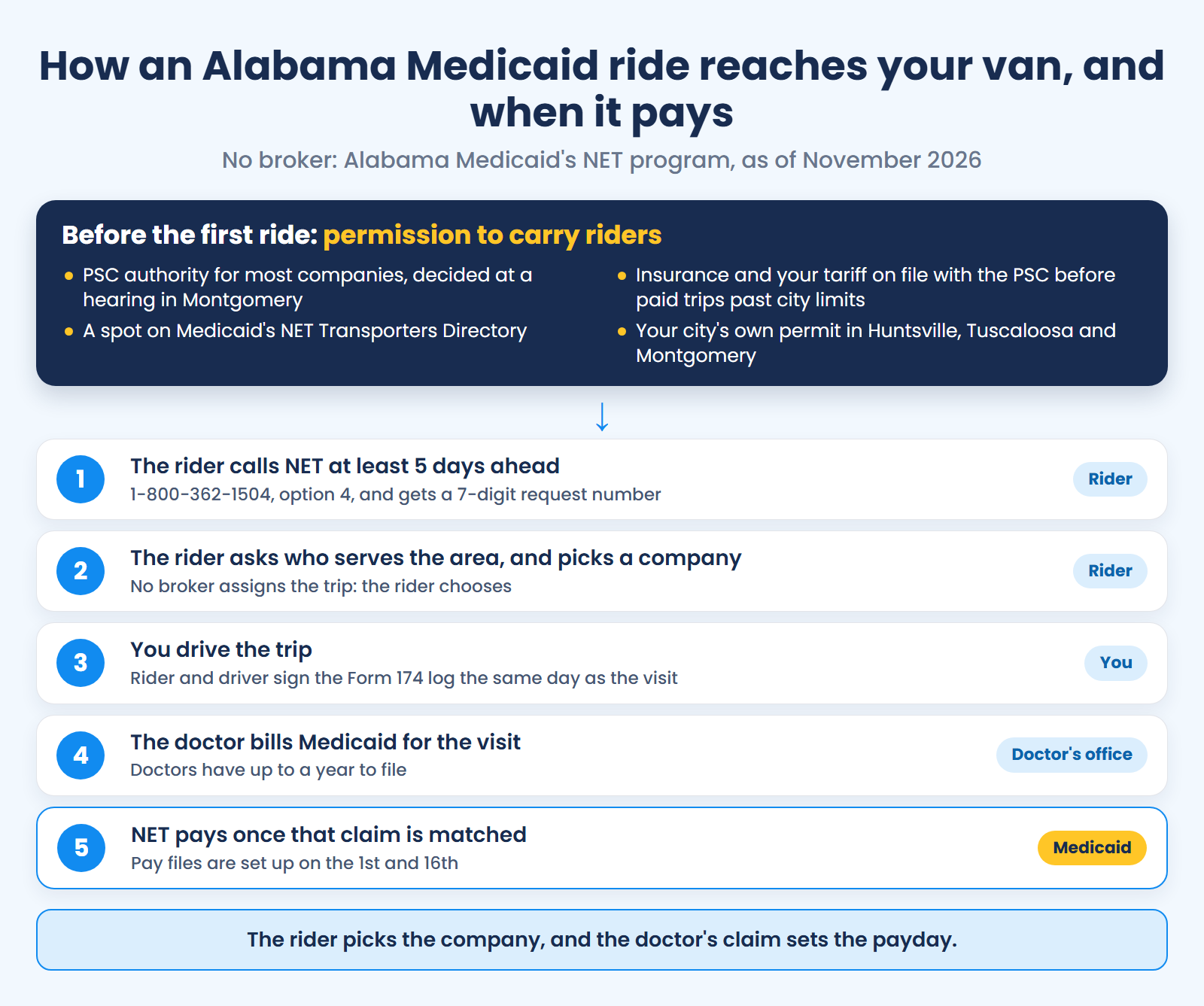
You drive the trip, and the rider and driver sign NET’s Form 174 log the same day as the visit. The doctor bills Medicaid for the visit, with up to a year to do it, and NET pays you once that claim is matched, through one of its twice-monthly pay files.
Our state-by-state map of who arranges Medicaid rides counts Alabama among seven states where a state or county program runs most rides. Maryland Medicaid has no broker either, but there 24 local programs pick the vendors. In Alabama, the rider picks.
Is Modivcare or MTM the NEMT broker in Alabama?
Neither, for Alabama Medicaid: the Agency’s own staff run NET [3]. Modivcare and MTM Health do book rides for some of Alabama’s Medicare Advantage plans, alongside SafeRide, per 2026 plan documents and notices and Modivcare’s own site [23]:
- UnitedHealthcare Dual Complete AL-S1: its vendor sheet lists SafeRide for routine transportation.
- Aetna Medicare Dual Extra Care: “We have teamed up with MTM Health to provide this benefit.”
- HealthSpring: its February 2026 notice moved Medicare Advantage rides from Modivcare to MTM Health, as its sole provider, on March 1, 2026.
- Viva Health: Modivcare’s own site lists a Viva Health ride line under Alabama, as of November 2026.
- Humana Dual Select: its 2026 document names no vendor; Customer Care “will confirm your benefits and guide you to the transportation provider.”
Plan years turn over January 1, so check each plan’s 2027 documents before you rely on a vendor in this list. Vendors change mid-year too, as HealthSpring’s March move showed; our tracker of 2026 broker changes follows the state-level moves.
Can I bill Alabama Medicaid directly for NEMT rides?
In effect, yes: Alabama Medicaid pays approved transporters itself, but only after the doctor’s claim for the visit is identified. No broker takes a cut. Conduent, the Agency’s payment vendor, “sets up transporter pay files on the 1st and 16th of each month,” and the money reaches banks on the 2nd and 17th [4].
The catch is the trigger: NET’s procedures treat the doctor’s claim as the proof that the rider went to the appointment. They add that “There is no specific reimbursement date for requests,” and NET staff can’t “override the system to manually pay” a claim. The doctor’s office has a year to submit its claim [4]. That’s how the Montgomery owners could learn of a denial a year after a ride, when a doctor billed other insurance instead.
Owners differ on how much that bites. The Mobile owner said in 2024, before the flat rate, “So when the doctor’s office bill, then it pays both of us.” Medicaid takes “a little longer to pay,” the owner said, and doesn’t pay as well, “but … it’s consistent.”
What does Alabama Medicaid pay transporters?
NET moved to one standardized flat rate on August 1, 2025, as the Alabama Political Reporter reported the Agency’s July 2025 notice. The reported rate is $35 for an ambulatory rider and $70 for a wheelchair rider within 25 miles, plus $0.70 and $1.05 for each mile beyond. Before that, “different transporters had negotiated different rates.” The Agency itself confirmed only “updated rules and rates for all Non-Emergency Transportation (NET) transporters,” so confirm the current figures, and how a trip is counted, with the NET Central Office before you price against them [7].
One Birmingham NET transporter told the outlet the new rate was a slight raise for it, though Medicaid doesn’t pay for “dead miles,” the miles driven without a rider aboard [7]. NET pays for one round trip per rider per date of service without prior authorization, and it won’t cover wheelchair van or minibus travel more than 30 miles outside the state line [3]. Our guide to what Medicaid pays for NEMT compares other states’ rates.
What paperwork proves a NET trip?
A NET transporter’s proof is the Form 174 trip log, a one-day sheet with a row for each NET rider. Every row records the time, the 7-digit request number, the destination and whether the rider uses a wheelchair, plus signatures from the rider and the transporter, endorsed “on the same date of the medical visit” [26]. The form doesn’t say where to send it, so ask the NET Central Office.
Two forms aren’t yours, but they decide if you get paid. Form 177 is a doctor’s certification that a rider needs a wheelchair, and NET needs it “on file to approve payment for all non-emergency wheelchair transportation requests,” emailed to NET by the doctor’s office. Form 173 is the dialysis center’s record of the days it treated a rider [26]. Our guide to billing Medicaid for NEMT covers trip records in other states.
What licenses and requirements does a NEMT business need in Alabama?
Most Alabama NEMT companies need Public Service Commission authority (Ala. Code 37-3-5), since the Motor Carrier Act names no wheelchair or NEMT van among its exemptions [1]. In the PSC’s words, “An APSC certificate or permit is required when passengers … will be transported by motor vehicle for compensation from one point in Alabama to another point in Alabama unless exempted by law” [5].
The exemptions that matter to a van company are narrow (Ala. Code 37-3-4) [1]:
- One city: vehicles for hire “operating wholly within the limits of a city or incorporated town or within the police jurisdiction thereof,” or between cities whose limits or police jurisdictions touch. A city’s police jurisdiction can reach past its limits, so ask the city where its line runs. Under the PSC’s rules, a paid trip that starts or ends outside every city’s limits and police jurisdiction falls under its authority [10].
- Ambulances: exempt wherever they run.
- Nonprofit and public institutions: carriers are exempt while carrying riders under a contract with one, though the PSC can require them to register, and they file quarterly reports. Ask the PSC whether its $10 nonprofit filing, Form 18, fits your contracts [5].
The PSC plainly expects wheelchair carriers: its rules set the chair-securement standard in Phase 2 of the checklist. Our guide to NEMT license requirements shows how other states compare.
How does the PSC hearing work?
Every passenger application except nonprofit and charter-bus ones “will automatically be set for hearing” at the PSC’s hearing complex in Montgomery, and you, an officer or an authorized full-time employee must attend [2]. Here’s the path:
- File: request Form 14 and send it with its fee, $100 per authority [2].
- Notice: the PSC tells the passenger carriers already operating, and any carrier that wants to protest must say so in writing at least seven days before your hearing [1][2].
- Hearing: you carry the burden of showing that you’re “fit, willing and able” and that there’s “a need for the proposed service which existing carriers can not or will not meet” [2].
- Order: after a protested hearing, an administrative law judge issues a recommended order, either side has 20 days to file written objections, called exceptions, and then the full Commission votes [1][2].
- Filings: once the order grants authority, “your company cannot operate until the required insurance and tariff filings are made” [2].
A protest turns the hearing into a contest. The PSC’s guidance warns that testimony from the applicant “and/or employees, family members, etc” of the applicant “by itself is typically insufficient,” so your mother’s glowing testimony won’t carry it alone. Bring a public witness, and the best one is the facility that’s ready to book you [2].
The PSC’s rules put a filed application on the next available monthly docket. Each docket shows the filing deadline for the next one, usually the last Friday of the month, and motor carrier applications are normally heard the last week of each month, except July and December [38]. Ask Motor Carrier Services at 334-242-5176 how far out hearings are being set, and the PSC’s Legal Division at (334) 242-5200 about your hearing’s status once you’ve filed [2].
Running without authority costs more than the filing. Anyone who knowingly and willfully violates the act can be fined up to $100 for a first offense and $500 for each one after, each day counting separately, and the PSC can ask a circuit court for an injunction [1].
What do other Alabama guides get wrong?
Here’s what circulates about Alabama, next to what the state actually requires:
| The claim you’ll read elsewhere | What Alabama actually requires |
|---|---|
| Modivcare holds Alabama Medicaid’s statewide brokerage contract, and trips come through its dispatch system | No broker: the Alabama Medicaid Agency’s own staff run NET, and riders choose their transporter [3][4] |
| Get certified by the Alabama Medicaid Agency, using the application forms on its website | The Agency adds approved transporters to its NET Transporters Directory and posts no transporter application form; the NET Central Office says what approval takes [4] |
| Alabama requires no state license for NEMT beyond a standard business license | Most NEMT companies need PSC authority under the Motor Carrier Act, decided at a hearing; trips wholly inside one city are exempt [1][2] |
| Alabama Medicaid requires a $1 million combined single limit | Medicaid’s NET rules set no insurance figure; the PSC’s floor is $25,000/$50,000/$10,000 at five seats or fewer, and the $1 million bar comes from buyers [3][10] |
| A broker pays you after deducting its fee, or you bill the state yourself within a year | NET pays approved transporters itself, through pay files on the 1st and 16th, after the doctor’s claim is identified; the one-year window is the doctor’s [4] |
| Pay a $100 enrollment application fee | Alabama Medicaid’s application fee is $750 for 2026 where it applies, and Provider Enrollment says whether a NET transporter pays it [27] |
| Add stretcher service once you’re certified | Stretcher transfers are ambulance-only under the state’s EMS rules, and NET pays for no stretcher rides [4][6] |
Do Alabama cities add their own permits?
Some do, and three name NEMT or wheelchair vans outright:
- Huntsville: a “dedicated wheelchair accessible vehicle” needs a city certificate of public convenience and necessity ($50 to file) and a business license, and each driver needs a chauffeur’s license at 21 or older [12].
- Tuscaloosa: the code defines “non-emergency medical transport” as a prearranged van of six to 15 seats. It needs a city permit and a mechanic’s inspection, and drivers need fingerprinted chauffeur’s licenses at 19 or older [12].
- Montgomery: the business license class for elderly and special-needs transportation names NEMT, starts at $132, and needs council approval and a background check from the Alabama Law Enforcement Agency (ALEA) from the past six months. The city’s vehicle-for-hire chapter can add a council permit, driver permits and a drug-testing program. It also lets an “alternative transportation service” charge a flat rate of no more than $30 a one-way trip inside city limits, so ask whether your vans count as one [12][14].
- Birmingham and Mobile: each city’s code reads both ways on whether a NEMT van needs its vehicle-for-hire permit, so call before you buy [12].
There’s no state or county privilege license for passenger transport. The Department of Revenue’s guide lists ambulance, taxicab, limousine, shuttle and ride-sharing businesses as “None” [16]. What the state charges instead comes per van at registration: the for-hire license tax, $47.50 at five seats or fewer and $60 at six to ten, plus property tax at the business rate [15][16].
What are the NEMT insurance requirements in Alabama?
Plan on about $1 million of coverage per Alabama van; the state’s floors start at $25,000 per person. The bar comes from buyers and cities, not from the state [12][28]:
| Who asks | What it asks |
|---|---|
| SafeRide’s provider application | $1 million of general liability per occurrence, $2 million aggregate and $500,000 of auto liability, with SafeRide as an additional insured |
| Birmingham’s vehicle-for-hire chapter | $1,000,000 for vehicles for hire other than taxicabs and a few on-demand services, naming the city as an additional insured |
| The PSC, five seats or fewer | $25,000 per person, $50,000 per accident and $10,000 of property damage, on a Form E |
| The PSC, six to 20 seats | $50,000 per person, $200,000 per accident and $30,000 of property damage, on a Form E |
| Alabama law, every registered vehicle | $25,000 per person, $50,000 per accident and $25,000 of property damage |
| Alabama Medicaid’s NET rules | No dollar figure |
Your insurer files the Form E with the PSC, and failing to keep coverage current will get the authority revoked [2][10].
Premiums are where the money goes. Our national budget prices a year at about $17,400 for roughly $1 million of coverage, $4,350 of it due at signing, and Alabama quotes will vary with the van, the drivers and the agent. The Birmingham owner from the podcast said finding a policy was “a feat in itself because not everybody covers it.” Get quotes before you buy the van, and have your insurer ready to file the Form E the week your authority issues. Our guide to NEMT insurance shows where the national number comes from.
Do you need workers’ comp in Alabama?
Not until you regularly employ five people, and LLC members count toward the five even if they opt out of coverage (Ala. Code 25-5-50) [30]. A plan, vendor or facility may still ask for a policy. New employers also pay unemployment tax at 2.7 percent of each worker’s first $8,000 of wages, at most $216 a worker a year.
What do NEMT drivers need in Alabama?
Alabama NEMT drivers need a regular Class D license, not a CDL, for a typical wheelchair van, plus the PSC’s and NET’s driver rules. A commercial driver’s license (CDL) starts at a vehicle designed for 16 or more passengers, counting the driver, or one rated at 26,001 pounds or more [17]. The Alabama Law Enforcement Agency lists Class D for private passenger, regular operators, and the state has no separate chauffeur class, though Huntsville and Tuscaloosa issue chauffeur’s licenses of their own.
The rest of the driver file comes from four places:
- The PSC’s rules, as written: drivers at least 18 who’ve passed a road test, listed three years of driving and work history and had no DUI conviction in the past year. The rules also call for a medical certificate under U.S. Department of Transportation rules from the last 24 months. Ask the PSC which of them apply to your vans [10].
- NET’s rule: no provider or driver excluded from federal health care programs or on the federal exclusion list, a valid driver’s license for every driver, and processes for handling drug-law violations and for disclosing each driver’s driving history (Ala. Admin. Code 560-X-18-.25) [3].
- Cities: chauffeur’s licenses in Huntsville and Tuscaloosa, and in Montgomery a driver permit at 18 or older, with the driver photographed and fingerprinted by the police [12].
- Ride vendors, national lists: SafeRide’s application asks for national background checks, sex offender registry checks, motor vehicle reports, pre-hire drug screens, and first aid, defensive driving and wheelchair securement training, and Modivcare’s list adds a hands-on wheelchair transport training certificate [28].
Can a NEMT company run stretcher van trips in Alabama?
No: Alabama keeps every stretcher transfer in a licensed ambulance, and Medicaid’s NET program pays for none of them. The state’s EMS rule says no one may “order, arrange, or conduct a transfer of a patient in a recumbent position” except a licensed emergency medical provider service, in an ambulance permitted for the level of care (Ala. Admin. Code 420-2-1-.24) [6]. NET’s procedures add that “NET does not reimburse for ambulance (stretcher) transport” [4].
Recumbent starts early. The rule counts a rider as recumbent when “reclining or leaning back,” or at 20 degrees or more from upright, so put that line in your dispatch rules in writing and send those riders to a licensed ambulance service. An ambulance license is a different business. It takes a separate license for each county with a ground ambulance base and proof of $1,000,000 of liability insurance. Within 60 days of a first license, you’d owe that county emergency response 24 hours a day, 365 days a year [6]. Questions go to the Alabama Department of Public Health’s Office of EMS at (334) 290-3088 [31].
A 2025 bill, HB374, would have let a non-emergency medical transport service carry patients on a stretcher, gurney or cot to non-emergency appointments. It was referred to the House Health committee and didn’t become law, and as of November 2026 the ambulance rule stands [32]. Next door, Georgia lets a non-ambulance stretcher van carry stable patients under its invalid car exemption, and Tennessee licenses invalid services for stretcher rides.
How do you become a Medicaid transportation provider in Alabama?
Alabama Medicaid’s procedures say approved transporters are added to its NET Transporters Directory without saying how approval works, so call the NET Central Office at (334) 353-5015 to get listed, then give riders a reason to pick you [4][11].
Step one: ask NET how to join its directory
Have your PSC authority, insurance, city license and NPI in hand when you call, and ask what NET wants beyond them. Its rule sets minimums for every provider and driver, including the exclusion checks and the driving-history process, and NET staff “Compile information on all certified and licensed transporters” [3]. The Mobile owner described an application where “you have to turn in certain credentials.”
Then call Alabama Medicaid Provider Enrollment at (888) 223-3630 and ask whether a NET transporter enrolls as a Medicaid provider and pays the application fee, which is $750 for 2026 and “will change yearly” [27]. Our guide to becoming a Medicaid ride provider in each state shows how other states order these steps.
Step two: apply to the Medicare plans’ ride vendors the same week
Each vendor runs its own application, and the requirements they post are national, not Alabama’s [28]:
- SafeRide: an online application that requires your NPI and EIN, asks if you’re approved for Medicaid rides, and restarts if you don’t finish it within 30 days. Its standards include a 95 percent ride acceptance rate.
- MTM Health: six steps, from a provider application and an interview through contracting, credentialing and training to a first trip.
- Modivcare: a transportation-provider form on its national site, with the driver list above and insurance limits that vary by state.
Ask each vendor how often it pays and whether its network needs a company in your counties.
How long does it take to get listed?
NET’s procedures give no timeline for joining its directory, so ask the NET Central Office and Provider Enrollment on your first call and write down what each says. Then plan your cash for a slow listing.
How do riders find you once you’re listed?
Getting on Alabama’s list makes you eligible; being the company a rider picks is what brings trips. Riders and facility social workers pick companies they know, so tell every facility, social worker and family you serve that they can ask for you by name. The Mobile owner put it simply: if your service is great, “the people that you transport, they’re going to request you.”
The list can matter more where companies are scarce. NET’s procedures warn that “Medicaid cannot guarantee that transporters are available in all areas of the state,” so in a thin rural county, being listed counts for more [4].
Approval on its own rarely fills a van. A central Alabama owner who started in 2024 heard from a hospital system’s corporate office that the company could work with any of its locations once the paperwork cleared, and then nothing came. I told the owner on a demo in July 2026 that the calls still come from the nurses at each location, so the approved list isn’t enough to get trips yet. Our guides to winning facility contracts and turning a facility meeting into a first trip cover that stretch.
When riders pick the company, your phone is the storefront, and a call you miss while you’re strapping down a wheelchair can be a trip that goes to the next name on the list. Duet’s voice AI answers your line 24/7, and your team still picks up first. When nobody answers after two or three rings, the AI collects the pickup, dropoff, time and the rider’s mobility needs, books the trip, texts the rider a confirmation and puts the trip on your Duet dispatch board. You still earn the name riders ask for, keep the Form 174 logs and drive the trips.
Don’t build the whole schedule on one payer
In Alabama, one payer can reset your book in a month, as NET’s 2025 rate notice and one lost hospital contract both showed. The Montgomery company got a month’s notice before its Medicaid rate changed.
A company running under ten vans from east-central Alabama lost a large hospital contract in 2025. One of the owners told me on a demo that September that most of their work had moved to one ride vendor’s side, “which a month ago it was the opposite.” Facility work isn’t guaranteed cash either, as the Birmingham owner’s warning about late invoices shows.
The hedge is a spread of payers, any one of which you could lose. In Alabama, brokers like the Medicare plans’ ride vendors work for other payers, not for Medicaid, and the Mobile owner started on broker work. As the owner put it, “Everybody starts off using brokers. Just don’t get stuck there.” Keep each payer small enough that you could lose it next month and still cover your van payments and insurance. Our guide on how much of your schedule one payer can be has a test for it.
How much does it cost to start a NEMT business in Alabama?
Budget about $22,700 to start in Alabama with one financed used wheelchair van and six months of fixed bills. With a 2016-2019 van, it’s about $27,500, and each added van and driver adds about $21,800 with an older van or $26,700 with a 2016-2019 one, before wages.
Why six months: the PSC sets your hearing and NET sets its own pace, so the runway has to cover the wait. The fees and taxes below are Alabama’s, figured for a company based in Birmingham; the van, insurance and running costs come from our national one-van startup budget.
| Line item | Alabama amount | Note |
|---|---|---|
| Name reservation and LLC | $228 | $28 online, then the $200 Certificate of Formation |
| State NEMT license | $0 | Alabama has none |
| State or county privilege license | $0 | ”None” for passenger transport businesses |
| Business privilege tax | $0 | No return until the tax calculates to more than $100 |
| EIN and NPI | $0 | Free from the agencies that issue them |
| PSC Form 14 | $100 | $200 for common and contract authority together |
| PSC registration number | $6 a van | One per van, and it stays with the van |
| Birmingham and Jefferson County licenses | $110 | At their floors; which Birmingham schedule fits NEMT isn’t settled |
| Birmingham operating authority permit | $100 | Only if the city’s vehicle-for-hire chapter reaches your van |
| Medicaid application fee | $0 in the total | $750 in 2026, set yearly, if NET approval turns out to need it |
| Used wheelchair van, older | About $20,000, or $4,000 down | National model: 80% financed at 14% for 60 months, $372 a month |
| Sales tax, title, registration and property tax | About $1,320 | 4.75% sales tax in Birmingham, $18 title, $60 for-hire registration, $290 of property tax at the business rate |
| Insurance due at signing | About $4,350 | A quarter of the model’s $17,400 year, priced near $1 million of coverage |
| Equipment and lettering | About $1,000 | National model |
| Screening and training | About $1,000 | National model; one driver |
| Phone and basic marketing | About $300 | National model |
| Six months of fixed bills | About $10,200 | $1,692 a month: $1,305 insurance, $372 van, $15 phone |
| Total, owner driving | About $22,700 financed | A 2016-2019 $33,000 van, financed: about $27,500 |
Insurance is more than half of it: about $12,200 of the $22,700 goes to the first six months of premium. Each extra $1,000 a year of premium adds $250 at signing and $75 a month. Anyone quoting a $5,000 Alabama launch hasn’t priced a year of commercial auto.
Say you start with three vans: that’s about $66,300 with older vans or $80,800 with 2016-2019 ones. You’ll also see per-van revenue promises like $80,000 to $130,000 a year; your number comes from your own rates, payers and hours, and our guide to what a NEMT business makes works through it.
Outside the totals: payroll, fuel, maintenance and lift repairs, workers’ comp once you reach five employees, and the city and county licenses that grow with your receipts. Shuttle drivers and chauffeurs earned a median $14.89 an hour in Alabama in May 2025, per the federal Bureau of Labor Statistics [33].
How do you fund a NEMT startup in Alabama?
Programs that serve Alabama small businesses include two SBA loan programs, the Alabama SBDC Network’s free advising, Innovate Alabama’s LendAL and DreamSpring [34]:
- SBA microloans: the Small Business Administration’s microloans run up to $50,000, about $13,000 on average. No microlender on SBA’s list is based in Alabama; three that serve the state are in Pensacola, San Antonio and Gulfport.
- SBA 7(a) loans: for loans approved from October 1, 2026 through September 30, 2027, the upfront fee is 0% on loans of $700,000 or less to businesses in a rural area.
- The Alabama SBDC Network: free, confidential advising at 10 Small Business Development Centers, 1-877-825-7232.
- Innovate Alabama’s LendAL: works with lenders to expand credit for businesses headquartered in Alabama or founded by people who live there.
- DreamSpring: a community lender that says it lends to start-ups in Birmingham, Mobile, Tuscaloosa, Montgomery, Huntsville and throughout Alabama.
None of them speeds up the PSC hearing or a NET listing, so borrow for the months you’ll actually wait.
How long does it take to start a NEMT business in Alabama?
The PSC’s rules put a filed application on its next available monthly docket, normally heard in the month’s last week except July and December, and NET’s procedures give no timeline, so ask both on day one how long each is running [1][2][38]:
- Before you file: make the three calls, form the LLC and pick van one.
- Filing: send Form 14 with its fee, and the PSC sets your hearing date.
- Seven days before the hearing: the last day for a carrier’s written protest.
- After a protested hearing: the judge’s recommended order, 20 days for written objections, then the Commission’s vote. A rehearing request has to come within 30 days of a decision.
- The order: your insurer’s Form E and your tariff go on file before the first paid trip past city limits.
- The same week: call the NET Central Office and the ride vendors, and ask each for its timeline.
While the application waits, run in-city trips under your city’s rules, sign facilities to agreements that start the day your authority issues, and take private-pay deposits for that first week. Budget per the cost breakdown above.
The Montgomery company in that July letter averaged about 500 Medicaid trips a week and still couldn’t set its own price or its payday. The facilities and families who book you by name are the part of the business no letter from Montgomery can reprice.
Alabama NEMT FAQ
What’s the phone number for Alabama Medicaid rides?
Riders call the Alabama Medicaid Agency’s Recipient Call Center at 1-800-362-1504 and choose option 4. The NET call center is open 8 a.m. to 4:30 p.m., Monday through Friday, except major state holidays [4]. Riders should have their Medicaid ID number, physical address and appointment date ready, plus the doctor’s name, address and phone number, and should say whether they’ll ride in a car or van and use a wheelchair.
Does Medicare pay for NEMT rides in Alabama?
Original Medicare doesn’t. CMS’s claims manual says Medicare covers no “non-ambulance forms of transportation, such as ambulette, wheelchair van, or litter van” [35]. Medicare Advantage plans can add rides, and most of Alabama’s 2026 plans for people on both Medicare and Medicaid cover them at no cost to the member, through vendors such as SafeRide and MTM Health [23]. Ask each plan who runs its rides.
Does Alabama Medicaid pay family members or friends to drive?
It can. NET reimburses mileage when a rider uses their own car or a relative, friend or volunteer drives, and the money goes to the rider on an electronic benefit transfer (EBT) Transportation card [3][4]. NET screens for free rides first: a rider with access to free transportation gets no reimbursement, except in evident hardship.
Does Alabama Medicaid pay for an escort, meals or lodging?
Sometimes. NET covers one escort per rider in need, and for riders 21 and older only when a physician’s statement documents the need. The escort can’t be an employee of the transporter, and an escort on a wheelchair van needs the Agency’s prior approval. When overnight travel is necessary, NET reimburses meals and lodging for the rider and one authorized escort, with receipts, up to $50 a person a day [3].
Does Alabama Medicaid pay for dialysis rides?
Yes, for riders with full Medicaid coverage. NET’s page tells riders with special ride needs for dialysis, radiation or other treatments to contact the NET program, and the dialysis center attests on Form 173 the days it treated each rider, against one request number a week [4][26]. The rider still picks the company.
Can a Columbus, Pensacola, Meridian or Chattanooga company take Alabama trips?
Yes, with the right authority for each trip. A paid trip between two Alabama points needs PSC authority, like any carrier’s [1]. A paid trip across the state line is interstate, which brings in federal motor carrier rules, including a $1.5 million liability floor for a for-hire van seating 15 or fewer, counting the driver [36]. For Medicaid, NET doesn’t cover wheelchair van or minibus travel more than 30 miles outside Alabama’s border [3]. Call the PSC at 334-242-5176 before you plan regular runs.
What does an Alabama NEMT company owe each year?
The PSC wants an annual report by April 30 and a current tariff on file [5]. Each van pays the for-hire license tax and business-rate property tax when it registers, and city and county licenses renew, growing with your receipts. The business privilege tax applies only once it calculates to more than $100, and the Secretary of State’s fee schedule lists no LLC annual report [13][16]. For one older van based in Birmingham, the state, county and city items come to roughly $460 a year at the minimum license fees, before insurance and payroll.
Is Alabama a good state to start a NEMT business?
It can be, if you start with trips you control. Alabama Medicaid counted 1,034,197 eligibles in September 2026, and 18.5 percent of Alabamians are 65 or older [8][9]. The field is thinner than next door: 286 active NPIs carry the NEMT van code with an Alabama practice address, against 1,230 in Tennessee and 1,700 in Georgia, and 160 of Alabama’s were first issued in 2023 or later [37]. An NPI isn’t a company, so treat those as rough counts. The catch is the front end: a PSC hearing before your first paid trip past city limits, and Medicaid money that waits on the doctor’s claim.
Key official sources
[1] Code of Alabama, Title 37, chapter 3, the Alabama Motor Carrier Act, on the Legislature’s site (read November 18, 2026): common and contract carriers defined (37-3-2); no operation for compensation except under the act (37-3-5); the exemptions for trips wholly inside one city’s limits or police jurisdiction, ambulances, and carriers under contract with nonprofit or public institutions, with no wheelchair or NEMT van named (37-3-4); rehearing requests within 30 days (37-3-7); exceptions within 20 days of a recommended order (37-3-9); notice to passenger carriers (37-3-10); the public hearing and the fit, willing and able test (37-3-11); tariffs showing all rates and fares (37-3-20); fines of up to $100, then $500, each day a separate offense, and court injunctions (37-3-25); and the $100 application fee (37-3-32). https://alison.legislature.state.al.us/code-of-alabama?section=37-3-4, https://alison.legislature.state.al.us/code-of-alabama?section=37-3-5, https://alison.legislature.state.al.us/code-of-alabama?section=37-3-11 and https://alison.legislature.state.al.us/code-of-alabama?section=37-3-25
[2] Alabama Public Service Commission, Form No. 14, Application for Passenger Motor Carrier, except taxi and charter bus (read November 18, 2026): $100 per authority or $200 for common and contract, the automatic hearing in Montgomery, protests at least seven days before it, the fit, willing and able and public-need showing, public witnesses, the administrative law judge’s recommended order and the Commission’s vote, the vehicle description, financial statement, map and notarized oath, no operation until insurance and tariff filings are made, and revocation for lapsed insurance. https://psc.alabama.gov/wp-content/uploads/2026/01/Form-14-Regular-Route-Passenger.pdf
[3] Ala. Admin. Code chapter 560-X-18, the Alabama Medicaid Agency’s transportation rules (revised March 16, 2024; read October 20, 2026): NET operated by Agency staff, free transportation first and mileage for a rider’s, relative’s, friend’s or volunteer’s vehicle, transporter information compiled by NET staff, EBT reimbursement, escorts, meals and lodging, one round trip per date of service, no wheelchair van or minibus travel beyond 30 miles of the state line, and the provider and driver requirements of rule .25. https://admincode.legislature.state.al.us/api/chapter/560-X-18
[4] Alabama Medicaid Agency, Transportation Services page, Non-Emergency Transportation (NET) Procedures of July 10, 2025, NET frequently asked questions and Medicaid Contacts page (read October 20, 2026; rechecked November 18, 2026): full Medicaid coverage, the Recipient Call Center and option 4, its hours, the five-day rule, the 7-digit request number and what riders need when they call, transporters’ contact information and the rider’s choice, the NET Transporters Directory, payment once the medical provider’s claim is identified, the one-year claim window, no specific reimbursement date, Conduent’s pay files on the 1st and 16th, no ambulance (stretcher) reimbursement, the EBT Transportation card, riders with dialysis and other treatments, and no guarantee of transporters in every area. https://medicaid.alabama.gov/content/4.0_Programs/4.5_Transportation.aspx, https://medicaid.alabama.gov/documents/4.0_Programs/4.5_Transportation/4.5_Non_Emergency_Transportation_Procedures_7-10-25.pdf, https://medicaid.alabama.gov/content/9.0_Resources/9.5_FAQ_Pages/9.5.25_FAQ_Transportation.aspx and https://medicaid.alabama.gov/content/10.0_Contact/10.1_Medicaid_Contacts.aspx
[5] Alabama Public Service Commission, Motor Carrier Services pages: Motor Carrier Section, Motor Carrier Applications & Forms, Insurance Requirements for Intrastate Authority and Transportation Contacts (read November 18, 2026): when a certificate or permit is required, the $100 Form 14 and Form 12 fees, the $10 nonprofit Form 18, $6 vehicle registration numbers, forms by request, the annual report due April 30 and the tariff on file, the insurance grid by seats, and Motor Carrier Services’ phone and email. https://psc.alabama.gov/motor-carrier-section/, https://psc.alabama.gov/motor-carrier-applications-forms/, https://psc.alabama.gov/insurance-requirements-for-intrastate-authority/ and https://psc.alabama.gov/transportation-contacts/
[6] Ala. Admin. Code chapter 420-2-1, the State Board of Health’s emergency medical services rules (revised April 14, 2022; read November 18, 2026): recumbent position and stretcher defined, recumbent transfers only by licensed emergency medical provider services in permitted ambulances (rule .24), a separate license for each county with a ground ambulance base, proof of $1,000,000 of liability insurance, and round-the-clock emergency response within 60 days of a first license. https://admincode.legislature.state.al.us/api/chapter/420-2-1
[7] Alabama Political Reporter, “Montgomery medical transport provider faces crisis over decreased Medicaid rates” (August 18, 2025) and “Non-emergency medical transporters express frustration with Alabama Medicaid Agency” (September 23, 2025), read November 18, 2026: the July 2025 notice of a standardized flat rate from August 1, 2025, the $35 and $70 rates within 25 miles and the per-mile additions as the outlet reported them, the earlier negotiated rates, the Montgomery owners’ letter, and the Agency’s and a Birmingham transporter’s statements. https://www.alreporter.com/2025/08/18/montgomery-medical-transport-provider-faces-crisis-over-decreased-medicaid-rates/ and https://www.alreporter.com/2025/09/23/non-emergency-medical-transporters-express-frustration-with-alabama-medicaid-agency/
[8] Alabama Medicaid Agency, Demographic Breakdown of Medicaid Eligibles for the Month of September 2026 (read November 18, 2026): 1,034,197 eligibles. https://medicaid.alabama.gov/documents/2.0_Newsroom/2.6_Statistics/2.6_Eligibility_by_County_September_11-6-26.pdf
[9] Census Bureau, American Community Survey 2024 1-year, table B01001, via Census Reporter (read October 19, 2026): 955,166 of Alabama’s 5,157,699 residents 65 or older, 18.5 percent. https://api.censusreporter.org/1.0/data/download/latest?table_ids=B01001&geo_ids=040|01000US&format=csv
[10] Ala. Admin. Code chapter 770-X-10, the Public Service Commission’s motor carrier rules (revised June 13, 2022; read November 18, 2026): the taxi carrier of five passengers or fewer, the PSC’s reading of the city exemption, vehicle markings, insurance limits by seats filed on Form E, driver qualifications and disqualifications for intrastate carriers of lightweight vehicles, and wheelchair securement. https://admincode.legislature.state.al.us/api/chapter/770-X-10
[11] Alabama Medicaid Agency, NET Coordinators’ List (dated July 9, 2026; read November 18, 2026): the NET Call Center, the Central Office numbers, and ten district offices covering all 67 counties. https://medicaid.alabama.gov/documents/4.0_Programs/4.5_Transportation/4.5_NET_Coordinators_List_7-20-26.pdf
[12] City codes via Municode, read November 18, 2026: Huntsville’s chapter 8, article IV (dedicated wheelchair accessible vehicles, the $50 certificate filing fee, business licenses, chauffeur’s licenses at 21); Tuscaloosa’s chapter 23 (non-emergency medical transport defined, permits, mechanic’s inspections, fingerprinted chauffeur’s licenses at 19); Montgomery’s chapter 6, article VIII (council permits, the alternative transportation service and its $30 flat-rate ceiling, driver permits at 18 with photographs and fingerprints, drug testing); Birmingham’s title 12, chapter 16, as codified through June 29, 2020 (its non-emergency medical transport definition, the vehicle-for-hire exclusion, the $100 operating authority permit fee and $1,000,000 of insurance for other vehicles for hire); and Mobile’s chapters 6 and 59. https://library.municode.com/al/huntsville/codes/code_of_ordinances?nodeId=COOR_CH8BU_ARTIVVEHI_DIV2LIVE_SDIGE_S8-151DEMENO, https://library.municode.com/al/tuscaloosa/codes/code_of_ordinances?nodeId=CO_CH23VEHI_ARTIVEHITRNECO_DIV3VEHITACA_S23-70IDVE, https://library.municode.com/al/montgomery/codes/code_of_ordinances?nodeId=COOR_CH6BU_ARTVIIIVEHI_DIV1TA_S6-370RACH, https://library.municode.com/al/birmingham/codes/code_of_ordinances?nodeId=PT1THCOGEOR_TIT12LIRE_CH16TAVEHI_ARTAGEPR_S12-16-1DE and https://library.municode.com/al/mobile/codes/code_of_ordinances?nodeId=CICO_CH6AMOTMETR
[13] Alabama Secretary of State, fee schedule (revised through August 23, 2023), Domestic LLC Certificate of Formation and name reservation form (read November 18, 2026): the $200 Certificate of Formation, the $28 online name reservation attached to it, and no LLC annual report on the fee schedule. https://www.sos.alabama.gov/sites/default/files/form-files/FeeSchedule.pdf, https://www.sos.alabama.gov/sites/default/files/2026-03/DomesticLLCFormation.pdf and https://www.sos.alabama.gov/sites/default/files/form-files/domesticEntityNameReservation.pdf
[14] Business license schedules filed with the Department of Revenue under Act 2025-408 (read November 18, 2026): Montgomery’s class 485991, which names non-emergency medical transportation, with its $132 floor, ALEA background check and council approval; Birmingham’s schedules; and Jefferson County’s license, $25 minimum plus a $25 issuance fee. https://www.revenue.alabama.gov/wp-content/uploads/2026/04/City-of-Montgomery.pdf, https://www.revenue.alabama.gov/wp-content/uploads/2026/04/City-of-Birmingham.pdf and https://www.revenue.alabama.gov/wp-content/uploads/2026/04/Jefferson-County.pdf
[15] Code of Alabama 40-12-246 (read November 18, 2026): the annual license tax on for-hire passenger vehicles, $47.50 at five seats or fewer and $60 at six to ten. https://alison.legislature.state.al.us/code-of-alabama?section=40-12-246
[16] Alabama Department of Revenue, Quick Reference Guide to state and county business privilege licenses (October 2022), vehicle valuation page, local tax rates report for November 2026, 2025 millage list, and 2026 business privilege tax instructions (read November 18, 2026): “None” for ambulance, limousine, shuttle bus, taxicab and ride-sharing businesses; the business assessment class for vehicles used for commercial purposes, collected before registration; Birmingham’s auto sales tax and millage; and no business privilege tax return while the tax is $100 or less. https://www.revenue.alabama.gov/wp-content/uploads/2022/06/Quick-Reference-Guide.pdf, https://www.revenue.alabama.gov/property-tax/vehicle-valuation/, https://www.revenue.alabama.gov/wp-content/uploads/2022/07/streport.pdf, https://www.revenue.alabama.gov/wp-content/uploads/2025/09/2025-Millage-Rates.pdf and https://www.revenue.alabama.gov/wp-content/uploads/2026/01/26fpptinstr.pdf
[17] Code of Alabama 32-6-49.3 and the Alabama Law Enforcement Agency’s driver license classes page (read November 18, 2026): a commercial motor vehicle at 26,001 pounds or designed for 16 or more passengers, including the driver, and Class D for private passenger, regular operators. https://alison.legislature.state.al.us/code-of-alabama?section=32-6-49.3 and https://www.alea.gov/dps/driver-license/license-and-id-cards/driver-licenses-classes-endorsements-and-restrictions
[18] Marshall Medical Centers, Marshall Mobility page and fee flyer (flyer of 2020-21; read November 18, 2026): one-way, round-trip and Birmingham fares, contract rates for long-term care facilities, and fees collected by the van driver. https://mmcenters.com/services/marshall-mobility and https://mmcenters.com/pdf/MMC-Marshall-Mobility.pdf?1713508498
[19] CMS Provider Data Catalog, Alabama nursing homes (July 2026 file, count rechecked for the October 2026 processing) and hospitals (read November 18, 2026): 224 nursing homes with 26,504 certified beds, and 99 hospitals. https://data.cms.gov/provider-data/api/1/datastore/query/4pq5-n9py/0?conditions[0][property]=state&conditions[0][value]=AL&conditions[0][operator]=%3D&properties[0]=cms_certification_number_ccn&properties[1]=number_of_certified_beds&properties[2]=processing_date&limit=1&count=true&results=true&schema=false&keys=true and https://data.cms.gov/provider-data/api/1/datastore/query/xubh-q36u/0?conditions[0][property]=state&conditions[0][value]=AL&conditions[0][operator]=%3D&properties[0]=hospital_type&properties[1]=citytown&limit=200&count=true&results=true&schema=false&keys=true
[20] National PACE Association, PACE in the States (September 2026; read October 28, 2026): Alabama’s one PACE program, in Mobile. https://www.npaonline.org/docs/default-source/public-files/public_pace_in_the_states_9-26.pdf?sfvrsn=83e6fc30_1
[21] VA Central Alabama Health Care System, Travel pay and transportation needs (updated October 9, 2026; read November 18, 2026): eligible veterans can request free rides to VA appointments, wheelchair van service included. https://www.va.gov/central-alabama-health-care/programs/beneficiary-travel-self-service-system/
[22] CMS, SNP Comprehensive Report for November 2026 (read November 18, 2026): 148,290 members in Alabama’s dual-eligible special needs plans. https://www.cms.gov/files/zip/snp-comprehensive-report-november-2026.zip
[23] Medicare Advantage plan documents and notices for 2026 (read November 18, 2026): UnitedHealthcare Dual Complete AL-S1’s plan page and vendor sheet, UnitedHealthcare Dual Complete AL-D001’s, Aetna Medicare Dual Extra Care’s, HealthSpring TotalCare Plus’s and Viva Medicare Extra Value’s summaries of benefits, HealthSpring’s February 26, 2026 provider notice, Humana Dual Select’s evidence of coverage, Modivcare’s Find Your Plan page, and Medicare Plan Finder’s transportation rows for Alabama plans, read in a browser: ride benefits and the vendors named. https://www.uhc.com/communityplan/alabama/plans/medicare/2026/dual-complete-hmo-pos-snp2, https://www.uhc.com/communityplan/alphadog/CSAL26HP0346208_000, https://content.medicareadvantage.com/2026/UHC_CSAL26HP0332372_2026_SB_SF20260204.pdf, https://content.medicareadvantage.com/2026/Aetna-Y0001-H3239-002-DS36-SB2026-M-SF20250923.pdf, https://www.healthspring.com/static/docs/medicare/plans/2026/sb-h4513-063-000.pdf, https://www.vivahealth.com/files/general/2026-extra-value-summary-of-benefits, https://www.healthspring.com/providers/news/2-26-2026-medical-transportation, https://assets.humana.com/is/content/humana/H5619093000EOC26pdf and https://www.mymodivcare.com/find-your-plan/
[24] Alabama Medicaid State Plan, Attachment 3.1-D, Methods of Providing Transportation (read November 18, 2026): rides arranged by calling the Agency or through a facility social worker, and NEMT provided under the administrative option. https://medicaid.alabama.gov/documents/9.0_Resources/9.8_State_Plan/9.8_A3.1-D_Methods_of_Providing_Transportation_2-15-22.pdf
[25] Alabama Medicaid Agency, managed care pages for the Alabama Coordinated Health Network and Integrated Care Networks (read November 18, 2026): care coordination and case management, with no transportation role. https://medicaid.alabama.gov/content/4.0_Programs/4.6_Managed_Care_Programs.aspx, https://medicaid.alabama.gov/content/5.0_Managed_Care/default.aspx and https://medicaid.alabama.gov/content/5.0_Managed_Care/5.2_Other_MC_Programs/5.2.4_ICNs.aspx
[26] Alabama Medicaid Agency, NET Forms 173 (Dialysis Validation), 174 (Transporter Trip Validation Log) and 177 (Wheelchair Use Certification, revised November 2025), read November 18, 2026. https://medicaid.alabama.gov/documents/4.0_Programs/4.5_Transportation/4.5_NET_Dialysis_Validation_Form_173_12-2-25.pdf, https://medicaid.alabama.gov/documents/4.0_Programs/4.5_Transportation/4.5_NET_Transporter_Trip_Validation_Log_Form_174_12-2-25.pdf and https://medicaid.alabama.gov/documents/4.0_Programs/4.5_Transportation/4.5_Form_177_NET_Wheelchair_Verification_Revised_11-14-25.pdf
[27] Alabama Medicaid Agency, Provider Enrollment contact page, Participation Requirements (effective January 1, 2026) and Providers Required to Submit an Application Fee (read November 18, 2026): Provider Enrollment’s phone line, the $750 application fee for calendar year 2026 that “will change yearly,” a provider-type chart with ambulance and no NET row, and a fee list that names non-emergency transportation. https://medicaid.alabama.gov/content/10.0_Contact/10.3_Provider_Contacts/10.3.4_Provider_Enrollment.aspx, https://medicaid.alabama.gov/documents/9.0_Resources/9.4_Forms_Library/9.4.16_Provider_Enrollment/9.4.16_PE_Participation_Requirements_12-12-25.pdf and https://medicaid.alabama.gov/documents/10.0_Contact/10.3_HP_Contact_Information/10.3.4_Provider_Enrollment/10.3.4_Providers_Required_to_Submit_an_Application_Fee.pdf
[28] Ride vendors’ national provider pages: SafeRide Health’s What to Expect as a NEMT Provider (undated; read October 9, 2026), on its application, insurance minimums, driver screening and training, performance standards and 30-day restart; MTM Health’s Welcome to Provider Onboarding (read October 28, 2026), on its six steps; and Modivcare’s Transportation Providers page (read November 12, 2026), on driver requirements and insurance limits that vary by state. https://www.saferidehealth.com/what-to-expect-nemt-provider, https://www.mtm-inc.net/driverswanted/ and https://www.modivcare.com/transportation-providers-contact-us/
[29] Code of Alabama 32-7A-4 and 32-7-6(c) (read November 18, 2026): liability insurance for every registered vehicle of at least $25,000 per person, $50,000 per accident and $25,000 of property damage. https://alison.legislature.state.al.us/code-of-alabama?section=32-7A-4 and https://alison.legislature.state.al.us/code-of-alabama?section=32-7-6
[30] Code of Alabama 25-5-50 and the Alabama Department of Workforce’s employer FAQ (read November 18, 2026): workers’ compensation from five regular employees, with opted-out LLC members still counted, and unemployment tax for newly liable employers at 2.70 percent of each employee’s first $8,000. https://alison.legislature.state.al.us/code-of-alabama?section=25-5-50 and https://workforce.alabama.gov/employers/faq/
[31] Alabama Department of Public Health, Office of EMS contact page (read November 18, 2026): the office’s phone line. https://www.alabamapublichealth.gov/ems/contact.html
[32] Alabama Legislature, HB374 of the 2025 regular session, as introduced (read November 18, 2026): its synopsis on stretcher transport by licensed ambulances under existing law, and Section 1 on non-emergency medical transport services carrying patients on a stretcher, gurney or cot. https://alison.legislature.state.al.us/files/pdf/SearchableInstruments/2025RS/HB374-int.pdf
[33] Bureau of Labor Statistics, Occupational Employment and Wage Statistics, May 2025, shuttle drivers and chauffeurs (53-3053), Alabama (read November 18, 2026): a median of $14.89 an hour. https://api.bls.gov/publicAPI/v1/timeseries/data/OEUS010000000000053305308
[34] Funding programs (read November 18, 2026, except SBA’s 7(a) fee notice, read October 23, 2026): SBA’s Microloans page and list of microlenders, SBA Information Notice 5000-881797 on 7(a) fees for fiscal 2027, the Alabama SBDC Network, Innovate Alabama’s SSBCI page and DreamSpring’s Alabama answer. https://www.sba.gov/funding-programs/loans/microloans, https://www.sba.gov/funding-programs/loans/microloans/list-microlenders, https://legacy.sba.gov/document/information-notice-5000-881797-fy-2027-7a-program-fees, https://www.asbdc.org/, https://innovatealabama.org/programs/ssbci/ and https://help.dreamspring.org/knowledge/does-dreamspring-provide-small-business-loans-in-alabama
[35] CMS, Medicare Claims Processing Manual, chapter 6, section 20.3.1 (read October 2, 2026): no Medicare coverage for non-ambulance transportation, such as an ambulette, wheelchair van or litter van. https://www.cms.gov/Regulations-and-Guidance/Guidance/Manuals/downloads/clm104c06.pdf
[36] 49 CFR 387.33, Financial responsibility, minimum levels, via the Legal Information Institute (read November 12, 2026; suspended since 2017, with 387.33T setting the same limits): $1.5 million for a for-hire passenger vehicle seating 15 or fewer, including the driver, in interstate commerce. https://www.law.cornell.edu/cfr/text/49/387.33
[37] CMS, NPPES Data Dissemination file for July 2026, from the NPI files page, counted November 18, 2026: 286 active NPIs carrying the NEMT taxonomy 343900000X with an Alabama practice location, 160 of them first issued in 2023 or later, against 1,230 in Tennessee and 1,700 in Georgia (our count of Duet’s extract of the full file, organizations and individuals). https://download.cms.gov/nppes/NPI_Files.html
[38] Ala. Admin. Code chapter 770-X-4, the Public Service Commission’s Rules of Practice (supplement of September 30, 2021; read November 18, 2026): contract carrier applications filed with one or more signed contracts, applications assigned to the next available monthly docket, with a filing deadline usually the last Friday of the month, and motor carrier applications normally heard the last week of each month except July and December. https://admincode.legislature.state.al.us/api/chapter/770-X-4
Last verified against the sources above in November 2026. Alabama requirements, Medicaid’s ride rules and rates, and health plans’ ride vendors change; check the primary sources before acting, and treat this guide as education, not legal advice.
About the author
James O'Donnell cofounded Duet and leads its sales, partnerships, and growth services. He talks with NEMT operators every week, hosts the NEMT Growth podcast, and answers Duet's sales line himself. More about Duet's founders →
Starting in a nearby state?
Want more trips and less busywork?
See how Duet runs and grows NEMT businesses in a 30-minute demo.