Article
How to Start a NEMT Business in Maryland (2026)
Maryland Medicaid has no ride broker. Its rides run through 24 local programs that hire vendors county by county. Here's what to build first.
By James O'Donnell, Cofounder and COO, Duet ·
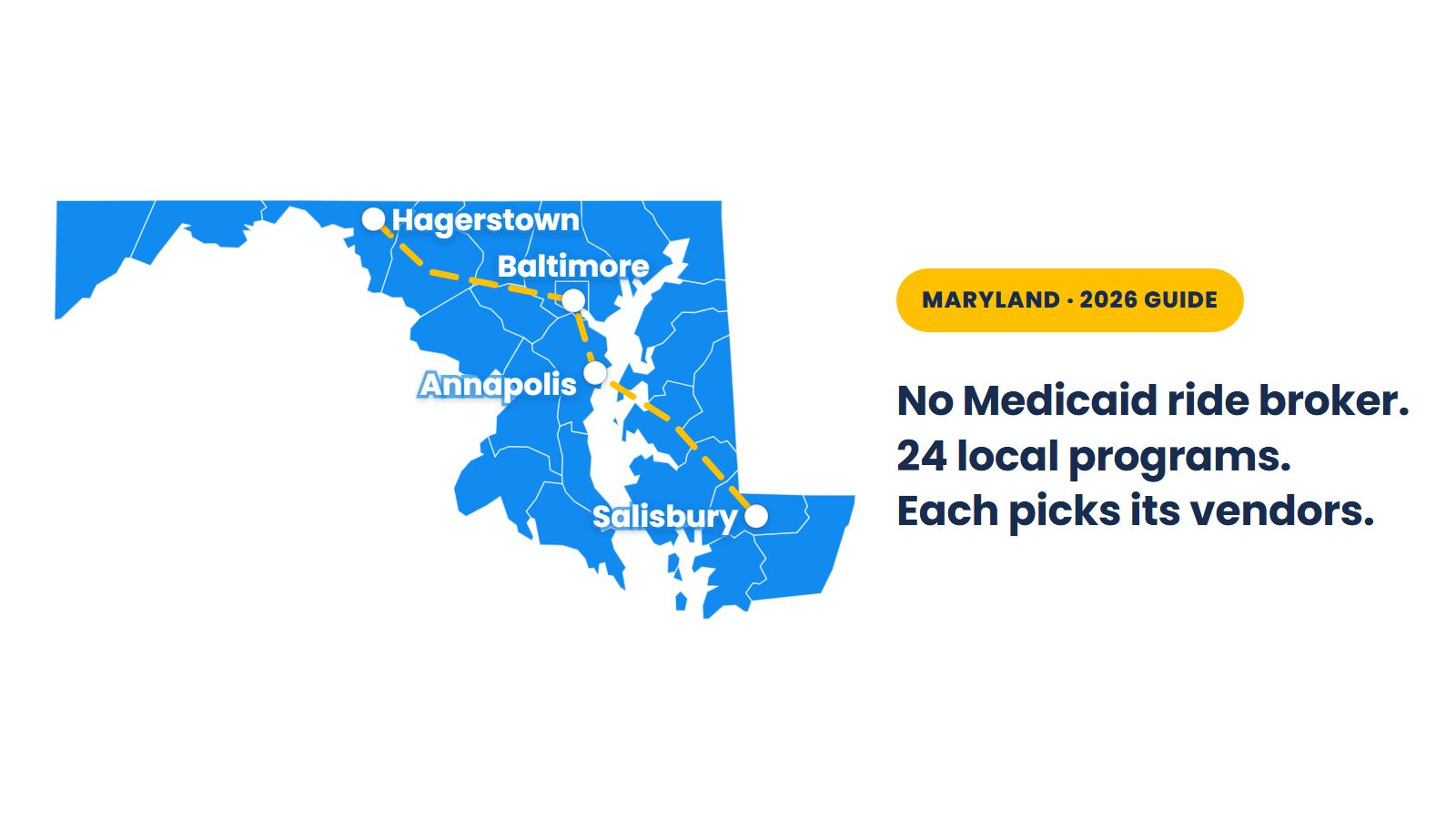
Maryland has no NEMT license, and Maryland Medicaid has no ride broker. Form an LLC ($100), buy, insure and inspect the van, and get the Public Service Commission’s (PSC) free motor carrier permit (2 weeks to 60 days) plus a PSC license for each driver. Medicaid rides run through 24 local programs, several of which want experience first, so start with facility and private-pay trips. Budget about $27,600 for one financed used wheelchair van and six months of fixed bills.
Maryland at a glance:
- No Medicaid broker: the Maryland Department of Health (MDH) funds 24 local programs, 23 local health departments plus Montgomery County’s Department of Transportation (DOT), and each arranges its own riders’ trips, as of October 2026 [1][2].
- A free permit, van first: the PSC charges nothing for its permit but grants it only for a van you already own or lease, insured and inspected [3][4]. From November 9, 2026, the PSC takes no paper carrier applications [5].
- Drivers: everyone who drives, owner included, needs a PSC passenger-for-hire license, with $51.25 of fingerprints [5][6].
- Insurance: the PSC’s floor is $120,000 for vans seating seven or fewer passengers, but Montgomery’s Medicaid contract wants $1 million of auto liability [7][8].
- Experience bars: Montgomery wants a year of non-ambulatory trips and two wheelchair vans, Garrett County’s 2024 bid wanted two years, Washington County’s 2026 solicitation asked for six of the last eight years (per copies of its listing), and Worcester’s 2024 request set no minimum [9][10][11][18].
- Stretcher riders: a 1995 Attorney General opinion treats stretcher vans as ambulance service, so plan on an ambulance license [12].
Two founders in Prince George’s County formed their company in June 2023, then went about four months with no trips while they sorted out licenses and insurance. One of them and a colleague told an industry podcast in July 2024 what came next: private-pay rides, a first big contract through a referral, then contracts with a few different hospitals. By that summer they were running eight vehicles. Their order is the Maryland order.
The question in Maryland isn’t which broker to sign with. It’s which county program you can get into, and what you’ll run on while you build the record it wants.
I run Duet, which builds dispatch software and runs growth services for non-emergency medical transportation (NEMT) companies, and I lived in Baltimore for a couple of years. This is the Maryland edition of our national guide on how to start a NEMT business. Requirements change, so confirm against the linked sources before you spend money.
The checklist runs in the order that wastes the least money. Then come who pays, how a Medicaid ride moves, the state’s rules, how county programs hire, and money and time.
The one-page checklist: how to start a non-emergency medical transportation business in Maryland
Call your county’s ride program and a few facilities before you spend anything, then buy, insure and inspect the van before you file with the PSC. Each phase ends with a running total from our national one-van budget, with Maryland’s fees swapped in.
Phase 0: find your county’s door and your first customers
- Your county’s program: ask your local health department’s transportation office, or Montgomery DOT’s Medicaid office, how it hires vendors and when its next solicitation posts.
- Five facilities: ask nearby nursing homes, rehabs and hospital discharge planners who books and pays for the rides their patients’ plans don’t cover.
- Your vehicle: a lift-equipped wheelchair van stays outside ambulance licensing and a stretcher van doesn’t, so decide before you shop [14].
- Money at risk: nothing yet.
Phase 1: form the company
- File articles of organization with the State Department of Assessments and Taxation (SDAT): $100, or $150 expedited, plus 3% if you pay online [15].
- Name a Maryland principal office and resident agent. An owner who lives in Maryland can be the agent [16].
- Order the $20 certificate of good standing that the PSC’s application asks for [15][7].
- Money at risk: about $420, counting about $300 for a phone and basic marketing.
Phase 2: get your federal IDs
- Get a free employer identification number (EIN) and a free NPI, a provider’s federal ID, under the NEMT taxonomy code, 343900000X. Montgomery’s, Garrett’s and Worcester’s documents don’t ask for an NPI.
- Get a USDOT number, a free federal carrier ID, if the van is rated 10,001 pounds or more or is built for more than eight passengers counting the driver [7].
- Money at risk: nothing new.
Phase 3: buy, insure and inspect the van, then file with the PSC
- Buy or lease the van first. The PSC grants authority only for an insured, inspected vehicle you already have, no more than 12 model years old [4][3].
- Pay the Motor Vehicle Administration (MVA) the 6.5% titling tax and the $200 title fee [17].
- Insure the van by VIN, with the PSC as certificate holder, and pass a Maryland safety inspection that’s still valid when the PSC grants authority [7].
- File Form 28 with your SDAT papers, insurance certificate, rate sheet, workers’ comp proof, vehicle list and a list of drivers with their PSC passenger-for-hire license numbers, not their MVA numbers [7]. The driver’s license form asks for your PSC carrier number, so ask the PSC how to list a driver whose license is still pending [6].
- After approval, the PSC stamps your vehicle list, the MVA issues for-hire tags (Class B, about $220 a year, unless it classes the van as a bus) and the PSC issues a decal [4][17].
- Money at risk: about $14,500 more with the van financed, so about $14,900 in: $6,600 down on our model’s $33,000 wheelchair van (2016-2019), $2,145 of tax, $420 of title and registration, $4,350 of insurance at signing and $1,000 for equipment. The permit is $0, the only free line in this phase [3].
Phase 4: license and train every driver
- Every driver, owner included, applies online for a PSC passenger-for-hire license and is fingerprinted at the state’s Criminal Justice Information System (CJIS) office for $51.25 [5][6].
- Train before the first trip. Montgomery’s contract, for one, wants First Aid, CPR and lifting training done before any service [8].
- Money at risk: about $1,050 more for one driver’s fingerprints, screening and training, so about $16,000 in, then about $1,934 a month of fixed bills until trips cover them.
Phase 5: run facility and private-pay trips, then go after county work
- Start facility and private-pay trips once you have the PSC’s written approval and licensed drivers [7]. The same week, put up a website that takes bookings, a cost outside these totals, claim your Google Business Profile, visit the facilities from Phase 0 and ask your first riders for reviews.
- Ask your county’s established vendors about subcontract work, which Montgomery’s, Garrett’s and Worcester’s contracts allow only with the county’s approval [8][10][18].
- Apply to your county’s program once you meet its bar.
- Money at risk: six months of fixed bills, about $11,600 with the van financed, for a total of about $27,600.
Who pays for NEMT rides in Maryland?
Medicaid pays through 24 local programs, facilities pay on their own paperwork, and families pay you directly. Only Medicaid sits behind a procurement.
Medicaid is the volume, and 24 local programs buy it
Maryland had 1,385,888 people in Medicaid and the Children’s Health Insurance Program (CHIP) in June 2026, a preliminary count from the federal Centers for Medicare & Medicaid Services (CMS) [13]. The 24 programs paid for 946,294 trips in fiscal 2019, and Baltimore County’s carried the most, 203,058 [2]. The state plan amendment CMS approved in May 2026 covers “both full fee-for-service recipients and managed care recipients” [19]. So a member of HealthChoice, Maryland Medicaid’s managed care program, rides through the same local program as everyone else. MDH’s template for plan handbooks says, “To see if you qualify for this service, contact your local health department” [20].
The plans aren’t required to cover rides, though some add narrow extras [20]. MedStar Family Choice offers cabs and bus tokens for listed visits, and Priority Partners arranges free rides for a short list of visit types [21]. Neither names the company that drives, and Wellpoint tells its Maryland members, “You’re responsible for your own ride” [21]. Ask each plan about its extras before you count on them.
Facilities are the stability
Hospitals, nursing homes and rehabs pay for the rides they arrange, with no county program in between. The Prince George’s founders won hospital contracts with a simple pitch: pay us “a few hundred for a trip” instead of leaving patients waiting two and three days to be discharged. They also learned that “the hospitals don’t particularly care for the smaller vans,” so they bought bigger ones.
Some hospitals drive their own riders. Meritus Health in Washington County said in May 2024 that it runs eight vans for free rides, with help from Maryland Physicians Care, a HealthChoice plan [22][20].
Don’t count on dialysis clinics as facility accounts. Dialysis rides are great, but in my experience most dialysis riders are on Medicaid, so in Maryland their trips go through the county programs.
Private pay is the margin
Families pay you directly, at your price, and Maryland had 1,099,752 residents 65 or older in the Census Bureau’s 2024 survey [23]. Original Medicare pays for no van ride, so a senior who isn’t on Medicaid rides on family money, a facility’s account or a Medicare Advantage plan’s ride benefit [24][25]. A Baltimore wheelchair-van owner told an industry podcast in 2022 that “the majority of my business is private pay,” built on word of mouth and visits to assisted living facilities. Most private-pay owners I talk to charge a card at least 24 hours before pickup, or send a payment link due by then. No payment, no van.
Who is the NEMT broker in Maryland?
Nobody: as of October 2026, Maryland Medicaid has no NEMT broker, and 24 local programs arrange its riders’ trips instead. The state plan’s Transportation Grants program “awards grants to local jurisdiction agencies, acting as agents of the State,” and the grantees “enter into contractual agreements” with the companies that drive [19]. MDH’s February 2026 notice names them, “the Local Health Departments (LHDs) and the Montgomery County Department of Transportation” [1].
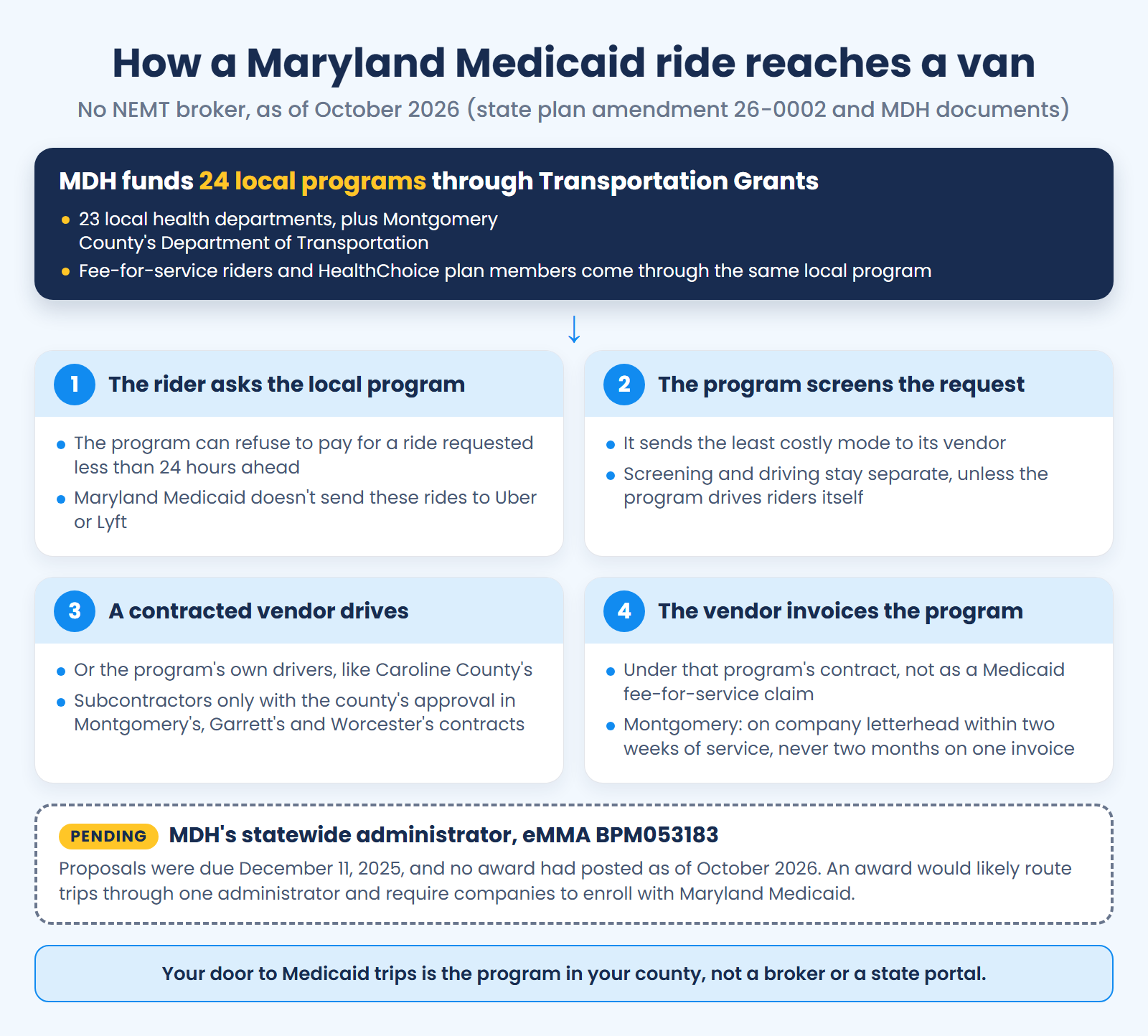
A rider, on fee-for-service Medicaid or in a HealthChoice plan, asks the local program, which can refuse to pay for a ride requested less than 24 hours ahead [26]. The program screens the request and sends “the least costly mode” to its vendor [19]. Screening and driving must be separate entities unless the program drives riders itself, and Caroline County’s health department recruited its own part-time drivers for non-emergency medical transportation in 2025 [19][27]. Elsewhere a contracted vendor drives and invoices the program, and Montgomery’s, Garrett’s and Worcester’s contracts allow a subcontractor only with the county’s approval [8][10][18].
Next door, Pennsylvania also runs its Medicaid rides county by county outside Philadelphia, while Virginia’s run through brokers. Our state-by-state map of who arranges Medicaid rides shows the rest.
You’ll still meet Maryland owners who run broker trips. A Bowie owner with four vehicles, serving Maryland, DC and Virginia, told me on a March demo that “most of our trips are coming from brokers.” The owner didn’t say which payers those trips came from, and Maryland Medicaid’s own rides don’t run through a broker.
What would MDH’s statewide administrator change?
An award would change the county doors: trips would likely flow through one administrator handling dispatching and claims statewide, much of what a broker does elsewhere, and companies would likely have to enroll with Maryland Medicaid [31]. MDH has been procuring a statewide NEMT administrator since September 2025, and no award had posted as of October 2026 [28][29]. The solicitation, BPM053183 on eMMA, the state’s procurement portal, was posted September 18, 2025, with proposals due December 11, 2025 [28].
The idea isn’t new, and it moves slowly: a 2022 request for one statewide contract never took effect [30][19]. In early 2026, the Department of Legislative Services (DLS), the legislature’s budget analysts, wrote that MDH’s request for proposals for a NEMT dispatching and claims processing system still awaited CMS review before publication, and put that system’s completion at 2030 [31]. DLS doesn’t name the eMMA solicitation, so it’s unclear whether the two are one procurement; ask MDH where it stands. DLS also flagged “a new requirement for providers to be enrolled in ePrep,” Medicaid’s enrollment system until MPRIME replaced it on October 13, 2026 [31][32].
Watch the agendas of the Board of Public Works, which votes on large state contracts, and MDH’s public notices. When other states have switched, trips changed hands fast, as our log of 2026 broker changes shows. Facility and private-pay trips don’t depend on any of it.
Can I bill Maryland Medicaid directly for NEMT rides?
No: Maryland Medicaid has no fee-for-service lane for wheelchair vans, so the local program that hires you pays you. The state plan funds the rides “as an administrative expense” through the grants [19]. The Code of Maryland Regulations (COMAR) chapter titled “Ambulance and Wheelchair Van Services” pays only Medicare’s ambulance copays and deductibles, and Medicaid’s 911 payments go to public and volunteer services [33]. Neither has a wheelchair-van lane.
So you invoice the program under its contract. Montgomery’s vendors bill on company letterhead within two weeks of service, never putting two months on one invoice, and the County verifies trips with the medical facilities before paying [8]. Its pay is “contingent upon receipt by the County of payment” from the State [8].
Don’t expect MPRIME, Medicaid’s provider enrollment system, to open the county door [32][19].
What licenses and requirements does a NEMT business need in Maryland?
Maryland has no NEMT license, but paid trips need a free PSC motor carrier permit under Public Utilities Article 9-201 and a PSC license for each driver. Section 9-201 requires a permit for “a passenger motor vehicle used in the transportation of persons for hire,” and none of its nine exceptions names medical transportation [34]. The application has no medical category either. You apply as a charter or contract passenger carrier, mark each vehicle wheelchair accessible or not, and get “all points and places within Maryland” [7].
Here’s what circulates about Maryland, next to what the state actually requires:
| The claim you’ll read elsewhere | What Maryland actually requires |
|---|---|
| ”Primary Brokers: MTM Health” | Maryland Medicaid has no NEMT broker; MDH’s grants fund 23 local health departments and Montgomery County’s DOT [1][2] |
| “Maryland is a broker state” | MDH’s statewide procurement had no award as of October 2026 [28][29] |
| “Go directly to state Medicaid … Department of Health and Human Services” | It’s the Maryland Department of Health, and a vendor’s door is the local program [19] |
| “Register your business at the Official Maryland Medicaid Provider Portal” | Local programs contract their vendors directly; enrollment is what the planned statewide system would add [31] |
| Providers “bill the state or county Medicaid agency directly on a Fee-For-Service basis” | You invoice the program that hires you, under its contract, not as a fee-for-service claim [8][19] |
| A Maryland NEMT license at “$850 initial, $510 renewal” | No such license exists, and the PSC permit costs $0 [3] |
| A “minimum of $1,000,000 in liability coverage,” or “$25,000 per person / $50,000 per accident” | The PSC’s floor is a $120,000 combined single limit for seven or fewer passengers; $1 million is Montgomery’s contract bar [7][8] |
| The PSC as “a division of the department of transportation" | "The Commission is an independent unit in the Executive Branch of State government” [35] |
Why does the van come before the PSC permit?
The PSC grants authority only to a company that already owns or leases an insured, inspected van. Its FAQ is blunt: “you must own or lease an insured vehicle before your operating authority can be granted” [4]. Form 28 agrees: the insurance certificate lists each vehicle by “year, make and complete VIN number,” and the inspection certificate “must be valid when PSC Authority is granted” [7].
So the van payments start first, and the PSC’s processing time is the gap you carry: “2 weeks to 60 days depending on the application,” per its page as of October 2026 [5]. Send a complete file, since an incomplete one “cannot be processed” [7].
Three rules come with the van:
- Age: no more than 12 model years old, a rule in force since July 1, 2018, with exceptions for some already-permitted vans that get semi-annual inspections, historic vehicles and anything over 10,000 pounds [3].
- Inspections: a certificate with the application and every year after, then every six months once the van passes 10 model years [3].
- Rates: your rate sheet goes to the PSC and the Office of People’s Counsel, and a change takes 14 days’ notice [7][3]. The sheet can set a range of maximum and minimum rates, and the rule doesn’t apply to transportation “by or through contract with a public authority” [3].
Does a county Medicaid contract exempt your van from the PSC?
Ask the PSC in writing: 9-201(b)(7) excuses only a van used “exclusively” under a county or State contract, and Montgomery wants the PSC certificate anyway. It covers a vehicle used “exclusively to provide transportation system services under a contract” with a county or municipal “governing body” or “a unit of State government” [34]. Subsection (c) requires a permit for any van not used that way exclusively, so one private-pay or facility trip puts it back under the permit [34].
Nothing in the section mentions Medicaid. The 2011 fiscal note on the bill behind it describes county and municipal transit [36]. Whether a health department’s NEMT contract counts is the PSC’s call, so ask its Transportation Division in writing before you plan around it; its line is 410-767-8128 [7].
The driver law has a similar carve-out for rides “solely provided by or on behalf of” government or certain nonprofits for Medical Assistance (Maryland Medicaid) clients. It still covers anyone who also carries other paying riders, so a startup with private-pay trips needs the license either way [37].
Do Montgomery and Prince George’s need WMATC authority too?
Yes: the Washington Metropolitan District includes both counties, and a paid trip between points in it that touches Maryland or DC needs a certificate from the Washington Metropolitan Area Transit Commission (WMATC), even one that never leaves Montgomery or Prince George’s. Montgomery’s Medicaid program asks for both. Form 28 tells applicants to show WMATC authority for “Montgomery and Prince George’s Counties,” and Montgomery’s contract wants both certificates [7][8]. WMATC’s order runs opposite to the PSC’s: a conditional grant first, then the van and a $1.5 million policy. Our DC guide covers what WMATC requires of a company already running vans in Maryland.
Do county or city codes add a license?
Ask before your first pickup: Howard County’s taxicab code excludes PSC-licensed vehicles, but Prince George’s, Annapolis and the City of Frederick define taxicabs broadly enough to reach a van [38]. Howard’s code governs taxicabs “excluding vehicles licensed by the Maryland Public Service Commission,” and Montgomery’s taxicab office says vans answer to the PSC “rather than Montgomery County” [38]. Prince George’s code counts as a taxicab any vehicle for hire built for nine or fewer, counting the driver, that carries the public where they direct, and its certificate costs $250 a year [38]. The City of Frederick’s taxicab permits go by lottery, with a $2,500 fee that’s refunded only if you aren’t picked [38]. We found no ruling applying these codes to a NEMT van, so get your county’s or city’s answer in writing. At BWI Marshall Airport, picking riders up takes a permit from the Maryland Aviation Administration [7].
What are the NEMT insurance requirements in Maryland?
Buy coverage to your first payer’s bar, $1 million of auto in Montgomery’s Medicaid program, not the PSC’s $120,000 floor. Montgomery’s insurance attachment asks for a $1 million combined single limit on business auto, general liability of $1 million per occurrence and $2 million in aggregate, and workers’ comp [8]. The County goes on your policies as an additional insured, and subcontractors carry the same limits.
Other programs set lower auto bars. Garrett County’s 2024 bid tied auto to Maryland’s minimums but asked for $1 million/$2 million of general and professional liability [10]. Worcester County’s 2024 request asked for “the minimum levels of insurance as required by the State of Maryland” plus workers’ comp [18].
For the record, the PSC’s floor for vans seating seven or fewer passengers is $50,000 per person, $100,000 per accident and $20,000 of property damage, or a $120,000 combined single limit [7]. Eight to 15 passengers take $250,000 combined [7]. A one-van operator working Maryland, DC and Virginia told me in July, “I’m allowed to have $120,000 total, but for right now, I’m at $300,000.” WMATC’s certificate takes $1.5 million for vehicles seating 15 or fewer, counting the driver, and so does for-hire interstate work in a vehicle that size [39].
Our national model prices a new company’s wheelchair van at about $17,400 a year for about $1 million of auto liability: $4,350 at signing, then ten installments of $1,305. Our guide to what a brand-new company pays for coverage shows where those numbers come from.
Workers’ comp starts with your first employee: every employer “with one or more employees is required by law” to carry it, with fines of up to $10,000 [40]. An LLC member who owns at least 20% can elect out, and the PSC wants your policy number or the exclusion form [40][7].
What do NEMT drivers need in Maryland?
Every paid driver needs a PSC passenger-for-hire license, with $51.25 of fingerprints, and a typical wheelchair van needs no commercial driver’s license (CDL). Public Utilities 10-103 bars driving for hire under a PSC permit without a for-hire driver’s license, and the PSC licenses drivers of vehicles that “carry 15 or fewer passengers” [37][5]. Applications have been online only since April 1, 2026 [5].
What the license takes:
- Fingerprints: a state and FBI check through CJIS, $51.25 at its Reisterstown Road office in Baltimore [6].
- Screening: the PSC can deny a license indefinitely for a crime of violence, and for some felonies within seven years or four moving violations within four years [3].
- Term: the PSC’s form has a box for a “Three-year License No.” [6], and the statute lets the PSC set a term of one to three years [37].
- Penalty: driving for hire without a license carries a fine of up to $500 [6].
The PSC’s 2024 renewal checklist lists no fee beyond the fingerprints, so confirm when you apply [6].
A CDL starts at a vehicle “designed to transport 16 or more passengers, including the driver,” or 26,001 pounds [41].
What does Montgomery’s contract add?
Montgomery requires two people in the van with every non-ambulatory rider, and its $50 wheelchair rate already includes the second one. The contract calls for “no less than two (2) persons in the vehicle while transporting a non-ambulatory patient” [8]. Its $50 for a one-way trip of up to 20 miles “Includes crew + attendant if applicable” [8]. At Montgomery’s minimum wage for employers with 10 or fewer workers, $15.95 since July 1, 2026, two staff cost $31.90 an hour before payroll taxes [42]. As I put it on our podcast, “you’re paying for that second attendant.”
Montgomery also wants First Aid, CPR and lifting training from everyone before service. On top of that, its contractors certify that wheelchair van staff have completed “First Aid training, Emergency Medical Technician training, and any other necessary Ambulance training and/or similar State of Maryland approved training acceptable to the County” [8]. Ask Montgomery DOT whether that means EMT training for all your wheelchair van staff before you hire. Those are one county’s terms: Garrett’s 2024 bid asked for Red Cross Standard First Aid or its equivalent, CPR, and a state and federal background check with fingerprints [10].
Can a NEMT company run stretcher van trips in Maryland?
Plan on an ambulance license: Maryland’s ambulance rules exempt lift-equipped wheelchair vans, not stretcher vans, and a 1995 Attorney General opinion treats stretcher vans as ambulance service under the Maryland Institute for Emergency Medical Services Systems (MIEMSS), except where WMATC exercises jurisdiction. Education Article 13-515 bars operating “an ambulance service in the State” without a license [14]. COMAR’s exemption covers only “Vehicles, typically referred to as wheelchair vans, equipped with a hydraulic lift” used just for riders in wheelchairs who don’t need ambulance equipment or crews [14]. A ramp van isn’t named, so ask MIEMSS’s State Office of Commercial Ambulance Licensing and Regulation (SOCALR) whether yours qualifies.
The opinion, 80 Op. Att’y Gen. 118, found “no difficulty concluding that ‘litter vans’ or ‘stretcher vans’ are within the definition of ‘ambulance’” [12]. It placed them under MIEMSS, except in Prince George’s and Montgomery “to the extent that the WMATC exercises jurisdiction” [12]. MIEMSS licenses ambulance companies through SOCALR [14].
One document muddies it: Montgomery’s rate card prices a “Non - Emergency Wheelchair Van / Stretcher” trip at $61.25 one way, with at least two crew members [8]. Montgomery sits inside WMATC’s territory, which may explain it, but the rate card doesn’t say what vehicle or license that line assumes. Before you spend a dollar on a stretcher van, get SOCALR’s answer in writing through MIEMSS at 1-800-762-7157, and Montgomery DOT’s if you’ll work there.
How do you become a Medicaid transportation provider in Maryland?
You become a vendor to your county’s program, and the programs with an experience bar want one to six years, so start with subcontract, facility and private-pay work. There’s no state application: each program signs its own contracts with the companies that drive [19].
Step one: find your county’s program
Call your local health department’s transportation line, often called Medical Assistance Transportation after Maryland’s name for Medicaid, or Montgomery DOT’s Medicaid office, this week. Ask how it hires vendors and when its next solicitation posts. MDH’s template for plan handbooks lists a transportation number for all 24 programs [20]. Plan pages print different numbers for five of them, so if a line doesn’t answer, try the health department’s main number [21].
Ask, too, whether the program buys rides at all, and for which modes, since a program may drive its own riders [19]. Then ask whether your facility and private-pay trips count toward its experience bar, and which vendors drive for it now: those are the primes to ask about subcontract work.
Step two: learn how your program hires
Programs that post their terms hire in three ways: an open solicitation in Montgomery, a continuous request in Cecil and yearly bids elsewhere. Montgomery’s says, “Applicants meeting the mandatory requirements specified in the Application Form will receive a contract,” running to April 30, 2030 [8]. Cecil County posted its continuous request for wheelchair vans on June 15, 2026 [11]. The rest are yearly bids, most with option years, on eMMA or a county’s own site; Queen Anne’s eMMA bid covers July 1, 2026 to June 30, 2027 [11].
A Montgomery contract gets you on the list, and riders and facilities still have to pick you, though the County “reserves the right to assign clients if necessary” [9]. Taxicab trips rotate among the taxi contractors, and the County’s notice says all other trips are “initiated by the end user” [9]. The County gives facilities a list of approved providers and guarantees no minimum number of trips [8]. It stops taking applications six months before April 30, 2030 [9].
What do Maryland county programs require?
Each program writes its own experience, insurance and term rules. Here’s what six recent solicitations ask. The Washington, Queen Anne’s and Cecil rows come from copies of their eMMA and OpenGov listings, so confirm them with each program:
| Program (document year) | How it hires | Experience asked | Insurance asked | Term |
|---|---|---|---|---|
| Montgomery DOT (2025) | Open solicitation; every qualified applicant gets a contract | One year of continuous non-ambulatory service and two wheelchair vans | $1 million auto; $1 million/$2 million general liability | To April 30, 2030 |
| Washington County (2026) | Solicitation on eMMA | Six of the last eight years | Not stated; ask | Not stated; ask |
| Queen Anne’s (2026) | Sealed bid | Not stated; ask | Not stated; ask | July 1, 2026 to June 30, 2027 |
| Cecil (2026) | Continuous request for wheelchair vans | Not stated; ask | Not stated; ask | Not stated; ask |
| Garrett (2024) | Sealed bid; more than one award possible | Two successful years and a permanent place of business | State auto minimums; $1 million/$2 million general liability | Eleven months plus two one-year renewals |
| Worcester (2024) | Proposals; more than one award possible | No minimum; experience is 10 of 100 points | State minimums plus workers’ comp | One year plus two extensions |
Of the six, Montgomery’s is the only one we found that publishes rates. Its wheelchair van pays $50 one way for the first 20 miles and $1.50 a mile after, as “maximum rates as set by the State of Maryland” [8]. Trips are prescheduled 24 hours ahead, wheelchair trips stay in Montgomery and DC unless approved, and will-call returns get picked up within an hour [8]. Elsewhere you quote. Garrett’s bidders priced a base rate per rider plus a per-mile rate for loaded miles only, and Worcester’s sent rate sheets, with no pay for waiting or no-shows [10][18]. Ask your program whether a state maximum caps what you can bid.
How long does it take to win county work?
Plan on a year or more before you can contract directly in Montgomery, which wants a year of non-ambulatory service and two wheelchair vans [9]. Eugene Gindin, who runs Capital Area Transport Service in the DC area, said on our podcast about growing a NEMT company that lasts that “the government contracts take long, but at least they have a definitive timeline.” The first one “takes the longest time,” he said, and then “that curve dramatically drops right after it because then you can show performance.” If you already meet a program’s bar, county work can come first.
How do you get county trips without a track record?
Subcontract under an established county vendor, with the county’s approval, while facility and private-pay trips build your own record. Montgomery’s contractors can’t hand work to another party “without the written approval of the Director, Office of Procurement,” and the prime stays responsible for its subcontractors [8]. Garrett’s bid allowed trips through a subcontractor its health department approved, and Worcester’s barred subletting without prior written approval [10][18].
That’s the road Eugene took. He used to go looking for primes on government contracts to sub under, and now “I get kind of requests to see if I want to be part of something.” Primes qualify to bid, he said, and some can show performance from the past. His rule of thumb, in vehicles, for when to think about bidding as a prime: “at a certain level, let’s say 10, you may start thinking of yourself as hey I can be a prime.”
Pick the prime carefully. I’ve known multiple cases where a prime on a Veterans Affairs contract got into a fight with the VA, the VA refused to pay, and the subs never got paid. A good prime on a five-year contract, though, can fill two of your vans all day, every day, for those five years.
That’s the catch-22: programs want a record, and a record needs trips. Facilities and private-pay families need no procurement, so that’s where your record starts. Our guides to winning facility contracts, landing hospital discharge work and private pay cover that stretch. Our state-by-state guide to becoming a Medicaid ride provider shows how other states order these steps.
Don’t build the whole schedule on one payer
Most county contracts run a year at a time, and the work can come in seasons, so keep facility and private-pay trips running beside them. A Frederick County startup operator with two vans told me in July that, just starting out, “we could do like 15 trips a day.” With “the state thing,” as the operator put it, the work comes in seasons: some months are full, and some stretches bring “almost 18 days … with nothing.” My advice was to start facility outreach “maybe like a month before your busy season ends,” because you spend that month talking to facilities, and their trips tend to start in the second and third months.
Leaning on one kind of payer caps a fleet too: the Bowie owner told me that with four vehicles, “I’m only able to really keep one fully on the road,” because most of the trips come from brokers. And MDH’s pending administrator could reshuffle every county’s door at once.
However you dispatch, keep all three lanes on one schedule. Dispatch software like Duet puts emailed trip requests, discharges a planner books in Duet’s facility portal and private-pay calls on one board. Duet then prices each trip at the rate you negotiated for that contract, with a clean invoice for each family. You still win each contract and submit each invoice through that payer’s own process.
How much does it cost to start a NEMT business in Maryland?
Budget about $27,600 for one financed used wheelchair van and six months of fixed bills in Maryland, with insurance priced at about $1 million of coverage. Paying cash for the same 2016-2019 van takes about $50,300, and an older $20,000 van, financed, about $22,700.
Maryland’s inputs are its filing fees, the free PSC permit, the titling tax and registration. Everything else, insurance included, comes from our national one-van startup budget.
| Line item | Maryland amount | Note |
|---|---|---|
| LLC articles of organization | $100 | $150 expedited, plus 3% online [15] |
| Certificate of good standing | $20 | For the PSC application [15][7] |
| Resident agent | $0 | When an owner who lives in Maryland serves [16] |
| EIN, NPI, USDOT number | $0 | Free from the agencies that issue them |
| ”NEMT license” | $0 | No state license by that name |
| PSC motor carrier permit | $0 | ”A charge may not be made” [3] |
| Medicaid enrollment for county work | $0 | Programs contract vendors directly [19] |
| Driver fingerprints | $51.25 | One driver, at CJIS [6] |
| Used wheelchair van, 2016-2019 | About $33,000, or $6,600 down | National model: 80% financed at 14% for 60 months, $614 a month |
| Titling (excise) tax | $2,145 | 6.5% of the price [17] |
| Title | $200 | Set by statute [17] |
| For-hire (Class B) registration | About $220 a year | $180 plus a $40 surcharge; $345 if the MVA calls your van a bus (Class P), so ask [17] |
| Safety inspection | The station’s price | Certificate good for 90 days; outside the totals [17] |
| Insurance due at signing | About $4,350 | A quarter of the model’s $17,400 year at about $1 million |
| Equipment and lettering | About $1,000 | National model |
| Screening and training | About $1,000 | National model; one driver |
| Phone and basic marketing | About $300 | National model |
| Six months of fixed bills | About $11,600 financed, $7,920 bought outright | $1,934 a month: $1,305 insurance, $614 van, $15 phone |
| Total, owner driving | About $27,600 financed, $50,300 bought outright | An older $20,000 van, financed: about $22,700 |
After year one, the yearly state items for one van come to about $520: the $300 annual report due April 15 and about $220 of registration [15][17]. An employer enrolled in MarylandSaves can have the $300 waived [15].
Insurance is the biggest line in the financed case, about $12,200 of the $27,600. A launch budget without it hasn’t priced Maryland.
How do you fund a NEMT startup in Maryland?
Small Business Administration (SBA) 7(a) loans, up to $5 million, and microloans, up to $50,000 through nonprofit lenders, are the main federal options [43]. Maryland’s casino-revenue small business funds add startup-sized lenders [44]. As of mid-2024, Maryland Capital Enterprises lent $500 to $150,000 on the Eastern Shore and in Baltimore City, Baltimore County and Anne Arundel, to borrowers a traditional lender had turned down [44]. FSC First made microloans of $5,000 to $50,000, aimed at Prince George’s [44]. The Maryland Small Business Development Center (SBDC) offers “FREE individualized consulting” [45].
Later, the Maryland Small Business Development Financing Authority (MSBDFA) lends up to $2 million against a government-funded contract, its program manager says, if eligible owners hold at least 70 percent of the company [44]. None of it speeds up a county’s experience bar, so borrow for the months you’ll actually wait.
How long does it take to start a NEMT business in Maryland?
Expect a few months to your first paid trips and a year or more to a county contract of your own; the PSC alone takes 2 weeks to 60 days. The steps that set the pace:
- The LLC: 6 to 8 weeks at SDAT’s standard speed, or 7 to 14 business days expedited [15].
- The van: quote the exact van, then buy, insure and inspect it close together, because the inspection certificate is good for 90 days and must still be valid when the PSC grants authority [17][7].
- The PSC: 2 weeks to 60 days from a complete application [5].
- Drivers: each license application goes in online, with fingerprints at CJIS [5][6].
- Trips: facility and private-pay work first, subcontract work once a vendor and its program agree, and a county contract of your own once you meet its bar.
The Prince George’s founders at the top of this guide ran that order. Have the record your county asks for, a year of non-ambulatory trips in Montgomery’s case, on your books before you apply.
Maryland NEMT FAQ
Do I need a license to start a NEMT business in Maryland?
Not one called a NEMT license. A company paid to carry riders needs the PSC’s motor carrier permit under Public Utilities Article 9-201, which is free, and every paid driver needs a PSC passenger-for-hire license [34][3][37]. Outside WMATC’s district, stretcher service is ambulance territory, licensed through SOCALR [12][14]. Some cities, Annapolis and Frederick among them, have taxicab codes worded broadly enough to reach a van, so ask yours.
Is MTM or Modivcare the NEMT broker in Maryland?
Neither, for Maryland Medicaid. As of October 2026, Maryland Medicaid has no NEMT broker: MDH funds 24 local programs that contract their own vendors [1][2][19]. You’ll still see MTM listed as a Maryland broker online, and Maryland owners who also serve DC or Virginia do run broker trips. MDH’s statewide administrator procurement, BPM053183, had no award as of October 2026 [28].
Do I need a Medicaid number or an NPI to drive for a county program?
Not in Montgomery’s, Garrett’s or Worcester’s documents. Montgomery’s application asks for PSC and WMATC certificates, insurance, training affidavits and driver records, but no Medicaid provider number or NPI, and Garrett’s and Worcester’s bids don’t ask for either [9][10][18]. That could change if MDH’s statewide system arrives with “a new requirement for providers to be enrolled” [31]. An NPI is free, so get one anyway.
Do Maryland county programs pay for no-shows or waiting time?
Not for no-shows: MDH told every program in March 2013 that paying vendors for no-shows wasn’t allowable [2]. Worcester’s 2024 request says wait time and no-shows “cannot be reimbursed for payment per State of Maryland regulations,” and Garrett’s 2024 bid pays only for loaded miles [18][10]. Montgomery’s rate card lists $28 an hour for waiting and traffic delay on taxi and ambulatory van trips, but not on any wheelchair van rate [8].
Does Maryland Medicaid use Uber or Lyft for rides?
No. The state plan says, “Maryland does not provide Transportation Services using Transportation Network Companies such as Lyft or Uber” [19]. It also bars a family member from being the paid provider, since family counts as “a primary resource for transportation” [19].
Does Maryland Medicaid pay for meals and lodging on long trips?
Yes, since January 1, 2026, when the trip requires it. State plan amendment 26-0002, approved May 20, 2026, covers meals and lodging when the need is “established prior to travel, supported by provider documentation, and approved by the local jurisdiction agencies.” In those cases it also covers the cost of an attendant who accompanies the rider, including the attendant’s meals and lodging [19]. It pays no gratuities, alcohol or entertainment. That money covers the rider’s expenses, so don’t count it as trip revenue.
Does Medicare pay for NEMT rides in Maryland?
Original Medicare doesn’t. CMS’s claims manual says Medicare covers no “non-ambulance forms of transportation, such as ambulette, wheelchair van, or litter van” [24]. Some Medicare Advantage plans add a ride benefit: 22 percent of people in individual plans were in one with a transportation benefit in 2026, the health policy group KFF found [25]. Ask each plan who runs its rides.
What do Maryland’s state filings cost for one van?
About $591 for one van and one driver: $100 for the LLC, $20 for a certificate of good standing, $51.25 of fingerprints, a $200 title and about $220 of registration, plus the 6.5% titling tax on the van’s price [15][6][17]. The PSC permit is $0, and so is Medicaid enrollment for county work [3][19]. With the van, insurance and six months of fixed bills, the total comes to about $27,600 financed.
Is Maryland a good state to start a NEMT business?
It can be, if you start with trips you control. Maryland had 1,099,752 residents 65 or older in 2024, and Original Medicare pays for none of their van rides, so families and facilities are a market of their own [23][24]. The catch is the Medicaid side: 24 local programs pick their own vendors, and several of them want a track record first.
Key official sources
[1] Maryland Department of Health, Public Notice for Non-Emergency Medical Assistance Transportation, 26-0002 (released February 25, 2026; read October 25, 2026): the grant model, with the local health departments and Montgomery County’s Department of Transportation as grantees. https://health.maryland.gov/mmcp/Documents/Public%20Notice/26-0002_NEMT_PublicNotice.pdf
[2] Maryland Department of Health, report to the budget committees on the Nonemergency Medical Transportation Grants Program (October 3, 2019; read October 29, 2026): paid trips by jurisdiction for fiscal 2017 to 2019, grants to 23 local health departments and Montgomery County’s Department of Transportation, and the March 2013 notice that no-show payments weren’t allowable. https://health.maryland.gov/mmcp/SiteAssets/pages/Reports-and-Publications/NEMTJCRfinal10-19.pdf
[3] COMAR 20.95.01, regulations .04, .05, .08, .11 and .26, on the Division of State Documents’ regulations site (read October 29, 2026): a permit before operating, no charge for a permit, 14 days’ notice of rate changes, the 12-model-year limit, inspection certificates every year and every six months past 10 model years, and driver screening standards. https://regs.maryland.gov/us/md/exec/comar/20.95.01.04, https://regs.maryland.gov/us/md/exec/comar/20.95.01.08, https://regs.maryland.gov/us/md/exec/comar/20.95.01.11 and https://regs.maryland.gov/us/md/exec/comar/20.95.01.26, with LII’s copy of .26 at https://www.law.cornell.edu/regulations/maryland/COMAR-20-95-01-26
[4] Maryland Public Service Commission, Obtaining Passenger Carrier Operating Authority FAQ (file dated September 8, 2022; read October 29, 2026): owning or leasing an insured vehicle before authority is granted, the stamped passenger vehicle list, for-hire tags from the MVA, the PSC decal, and inspections under COMAR 20.95.01.11(F). https://psc.maryland.gov/wp-content/uploads/sites/6/FAQs-for-Passenger-Authority-9-8-22.pdf
[5] Maryland Public Service Commission, Transportation Division page (read October 29, 2026): applications processed in 2 weeks to 60 days, paper driver applications ended April 1, 2026, no paper carrier applications from November 9, 2026, and licenses for drivers of vehicles carrying 15 or fewer passengers. https://psc.maryland.gov/regulated-utilities/transportation/
[6] Maryland Public Service Commission, For-Hire Driver’s License renewal packet and form TR 602 (revised October 30, 2024; read October 29, 2026): CJIS fingerprinting at $51.25, the three-year license number, and the fine of up to $500 for driving without a license. https://psc.maryland.gov/wp-content/uploads/sites/6/For-Hire-Driver-Renewal-Application-Packet-10-30-2024.pdf
[7] Maryland Public Service Commission, Form 28 carrier application packet (form TR5 Form-28 Rev. 08/23, posted as revised September 26, 2023; read October 25 and 29, 2026): no service before written approval and licensed drivers, WMATC proof for the Washington metropolitan area, BWI pickups, the documents an application needs, the USDOT trigger, charter and contract authority to all points in Maryland, the rate sheet, insurance minimums and certificate rules, workers’ comp proof, and the Transportation Division’s phone line. https://psc.maryland.gov/wp-content/uploads/2025/11/Form-28-Carrier-Application-Packet-Revised-9-26-23.pdf
[8] Montgomery County Department of Transportation, Open Solicitation #1171472, Medicaid Transportation Services, with its form contract, Appendix A rates and Attachment B insurance (undated; PDF created March 2025; read October 25 and 29, 2026): PSC and WMATC certificates, service standards, the two-person rule, training, rates, invoicing and payment, subcontracts only with written approval, insurance, and contracts expiring April 30, 2030. https://assets.montgomerycountymd.gov/files/dot-transit/resources/files/Open%20Solicitation_1171472_approved%20(1).pdf
[9] Montgomery County Department of Transportation, public notice and application form for Open Solicitation #1171472 (undated; PDFs created March 2025; read October 29, 2026): every qualified applicant receives a contract, the year of continuous non-ambulatory service and two wheelchair vans asked of wheelchair applicants, trips other than taxicab trips initiated by the end user, and no new applications in the six months before April 30, 2030. https://assets.montgomerycountymd.gov/files/dot-transit/resources/files/Public%20Notice%20for%20OS%201171472.pdf and https://assets.montgomerycountymd.gov/files/Application_Form_for_OS_1171472.pdf
[10] Garrett County Health Department, Invitation for Bids #24-0701, Medical Assistance Transportation, Ambulatory and Wheelchair (issued June 5, 2024; read October 29, 2026): two successful years of experience, multiple awards, the term and renewals, approved subcontractors, per-person base and per-mile pricing for loaded miles, training, background checks and insurance. https://garretthealth.org/wp-content/uploads/2024/06/FY25AMB_WHLCIFBMATransportation.a.docx-1.pdf
[11] Copies of county solicitations on procurement aggregators (read October 29, 2026): Washington County Health Department’s BPM056475 (posted April 2026; six years of experience within the past eight), Queen Anne’s County’s BPM057101 (posted May 19, 2026; July 1, 2026 to June 30, 2027) and Cecil County Health Department’s REI-CCHD #2027-003 for wheelchair vans (posted June 15, 2026; a continuous request). https://app.govly.com/public/opportunities/16399723, https://app.govly.com/public/opportunities/16581905, https://www.governmentcontracts.us/government-contracts/opportunity-details/08791159356614153.htm?catID=V and https://app.govly.com/public/opportunities/16705626
[12] Opinion of the Attorney General of Maryland, 80 Op. Att’y Gen. 118, Jurisdiction over “Litter Van” Services (August 2, 1995; read October 29, 2026): litter or stretcher vans within the definition of an ambulance and generally under MIEMSS, except in Prince George’s and Montgomery to the extent WMATC exercises jurisdiction. https://oag.maryland.gov/resources-info/Documents/pdfs/Opinions/1995/80oag118.pdf
[13] CMS, State Medicaid and CHIP Applications, Eligibility Determinations, and Enrollment Data, Maryland rows (read October 29, 2026): 1,385,888 Medicaid and CHIP enrollees in June 2026, preliminary. https://data.medicaid.gov/api/1/datastore/query/6165f45b-ca93-5bb5-9d06-db29c692a360/0?conditions%5B0%5D%5Bproperty%5D=state_abbreviation&conditions%5B0%5D%5Bvalue%5D=MD&conditions%5B0%5D%5Boperator%5D==&sorts%5B0%5D%5Bproperty%5D=reporting_period&sorts%5B0%5D%5Border%5D=desc&limit=6
[14] Education Article 13-515 and COMAR 30.09.01.02 and 30.09.03.03-.04 (read October 29, 2026): no ambulance service without a license, the definition of an ambulance, the exemption for lift-equipped wheelchair vans, and SOCALR as the MIEMSS office that licenses commercial ambulance services. https://mgaleg.maryland.gov/mgawebsite/Laws/StatuteText?article=ged§ion=13-515&enactments=false and https://regs.maryland.gov/us/md/exec/comar/30.09.03
[15] State Department of Assessments and Taxation, Articles of Organization for a Limited Liability Company (Rev. 05/2026), fee schedule (revised May 2024) and 2026 Form 1, annual report and personal property return, plus its Charter and Business Services page (all read October 29, 2026): the $100 and $150 filing fees and processing times, the 3% Business Express charge, the $20 certificate of good standing, the $300 annual report due April 15, and the MarylandSaves fee waiver. https://dat.maryland.gov/Documents/Accessible%20Documents/Charter%20-%20Create%20or%20Start%20a%20Business/Articles%20of%20Organization%20for%20a%20Limited%20Liability%20Company_0526-A.pdf, https://dat.maryland.gov/businesses/documents/fees.pdf, https://dat.maryland.gov/SDAT%20Forms/PPR_Forms/2026_Form1.pdf and https://dat.maryland.gov/businesses/Pages/default.aspx
[16] Corporations and Associations Article 4A-210 and 1-101 (read October 29, 2026): every LLC’s principal office in Maryland and resident agent, and a resident agent as an individual residing in Maryland or a Maryland corporation. https://mgaleg.maryland.gov/mgawebsite/Laws/StatuteText?article=gca§ion=4A-210&enactments=false and https://mgaleg.maryland.gov/mgawebsite/Laws/StatuteText?article=gca§ion=1-101&enactments=false
[17] Motor Vehicle Administration, taxable price bulletin (April 23, 2026) and safety inspections page, and Transportation Article 13-802, 13-913, 13-933 and 13-954 (read October 29, 2026): the 6.5% excise tax, the $200 title fee, Class B registration at $180 plus a $40 surcharge, Class P for buses, and inspection certificates good for 90 days. https://mva.maryland.gov/your-mva-guide/businesses/bulletins-businesses/taxable-price, https://mva.maryland.gov/title-registration/vehicle-emissions-safety-inspections/safety-inspections, https://mgaleg.maryland.gov/mgawebsite/Laws/StatuteText?article=gtr§ion=13-802&enactments=false and https://mgaleg.maryland.gov/mgawebsite/Laws/StatuteText?article=gtr§ion=13-913&enactments=false
[18] Worcester County, RFP #F738-25, Medical Assistance Transportation, Ambulatory and Wheelchair, for the Worcester County Health Department (due May 24, 2024; read October 29, 2026): the evaluation points, the term and extensions, rate sheets, no pay for wait time or no-shows, subletting only with prior written approval, and insurance. https://worcestermd.gov/sites/default/files/2024-04/Worcester%20F738-25%20RFP%20Ambulatory%20and%20Wheelchair.pdf
[19] CMS approval letter and approved pages for Maryland State Plan Amendment 26-0002 (approved May 20, 2026, effective January 1, 2026; read October 25, 2026): the Transportation Grants program’s grants to local jurisdiction agencies as agents of the State, funded as an administrative expense; grantee contracts covering fee-for-service and managed care recipients; no rides through Lyft or Uber; screening and transport by separate entities unless the jurisdiction drives; ambulance providers licensed by SOCALR; family members barred as providers; meals and lodging approved by the local agency; and the excluded services. https://www.medicaid.gov/medicaid/spa/downloads/MD-26-0002.pdf
[20] Maryland Department of Health, HealthChoice member handbook template (September 1, 2025 updates) and HealthChoice plan comparison chart (February 1, 2026), read October 29, 2026: NEMT among the services plans aren’t required to cover, riders sent to their local health department, each program’s transportation phone number, and the state’s nine HealthChoice plans. https://health.maryland.gov/mmcp/healthchoice/Documents/HC-Member-Manual-Template-2025.pdf and https://health.maryland.gov/mmcp/healthchoice/Documents/hc-mco-comparison-chart.pdf
[21] Health plan transportation pages (read October 29, 2026): MedStar Family Choice (information current as of June 9, 2026), Priority Partners and Wellpoint Maryland, on plan ride extras for listed visits and their own lists of county ride numbers. https://www.medstarfamilychoicemd.com/maryland-members/transportation, https://ppmco.org/faq_category/transportation and https://www.wellpoint.com/md/medicaid/benefits/extras/transportation
[22] Meritus Health, news release on its free transportation initiative with Maryland Physicians Care (May 28, 2024; read October 29, 2026): eight vans and more than 300 rides a week. https://www.meritushealth.com/about/news/with-support-from-maryland-physicians-care-meritus-develops-free-transportation-initiative-to-reduce-barrier-
[23] Census Bureau, American Community Survey 2024 1-year, table B01001, via Census Reporter (read October 29, 2026): Maryland residents 65 and older. https://api.censusreporter.org/1.0/data/show/latest?table_ids=B01001&geo_ids=04000US24
[24] CMS, Medicare Claims Processing Manual, chapter 6, section 20.3.1 (read October 2, 2026): Medicare covers no non-ambulance transportation, such as an ambulette, wheelchair van or litter van. https://www.cms.gov/Regulations-and-Guidance/Guidance/Manuals/downloads/clm104c06.pdf
[25] KFF, Medicare Advantage in 2026: Premiums, Out-of-Pocket Limits, Supplemental Benefits, and Prior Authorization (June 5, 2026; read October 2, 2026): 22% of individual-plan enrollees in plans offering a transportation benefit in 2026. https://www.kff.org/medicare/medicare-advantage-in-2026-premiums-out-of-pocket-limits-supplemental-benefits-and-prior-authorization/
[26] COMAR 10.09.19, Transportation Grants (adopted 1993, last amended 1994), from the Division of State Documents’ official text (read October 29, 2026): grantees’ screening and their right to refuse payment for a ride requested less than 24 hours ahead. https://regs.maryland.gov/us/md/exec/comar/10.09.19
[27] State of Maryland job bulletin #25-000086-0003, Patient/Client Driver, Caroline County Health Department (opened May 14, 2025; read October 29, 2026): a part-time contractual driver position providing non-emergency medical transportation. https://www.jobapscloud.com/MD/sup/BulPreview.asp?R1=25&R2=000086&R3=0003
[28] HigherGov’s copy of the eMMA listing for BPM053183, Non-Emergency Medical Transportation, Maryland Department of Health (read October 29, 2026): posted September 18, 2025, due December 11, 2025, status “Past Due,” no award or cancellation listed, and a five-year base with a two-year option. https://www.highergov.com/sl/contract-opportunity/md-non-emergency-medical-transportation-57416200/
[29] Maryland Board of Public Works, 2026 meeting agendas, January 7 through October 29, 2026 (read October 29, 2026): no item for non-emergency medical transportation or BPM053183. https://bpw.maryland.gov/Pages/meetingDocuments_year.aspx
[30] State of Reform, republished by Mostly Medicaid, “Maryland seeks Medicaid non-emergency medical transportation contractor” (September 13, 2022; read October 29, 2026): MDH’s 2022 request for proposals for a single statewide contract. https://mostlymedicaid.com/maryland-seeks-medicaid-non-emergency-medical-transportation-contractor/
[31] Department of Legislative Services, Analysis of the FY 2027 Maryland Executive Budget, M00Q01, Medical Care Programs Administration (2026; read October 29, 2026): the NEMT dispatching and claims processing project, the request awaiting CMS review before publication, estimated completion in 2030, and the risk of a new provider enrollment requirement. https://mgaleg.maryland.gov/pubs/budgetfiscal/2027fy-budget-docs-operating-M00Q01-MDH-Medical-Care-Programs-Administration.pdf
[32] Maryland Department of Health, Maryland Medicaid Provider Enrollment FAQ (October 2026; read October 29, 2026): MPRIME replacing ePREP on October 13, 2026. https://health.maryland.gov/mmcp/provider/Documents/Maryland-Medicaid-Provider-Enrollment-FAQ.pdf
[33] COMAR 10.09.13, Ambulance and Wheelchair Van Services, and 10.09.31, from the Division of State Documents’ official text (read October 29, 2026): Medicaid’s payment of Medicare ambulance copays and deductibles, and 911 transports by public and volunteer services. https://regs.maryland.gov/us/md/exec/comar/10.09 and https://raw.githubusercontent.com/maryland-dsd/law-xml-codified/publication/2026-10-26/us/md/exec/comar/10/09/13.xml
[34] Public Utilities Article 9-201 (read October 29, 2026): the motor carrier permit for passenger vehicles used for hire, its exceptions, and subsection (c). https://mgaleg.maryland.gov/mgawebsite/Laws/StatuteText?article=gpu§ion=9-201&enactments=false
[35] Public Utilities Article 2-101 (read October 29, 2026): the Commission as an independent unit in the Executive Branch. https://mgaleg.maryland.gov/mgawebsite/Laws/StatuteText?article=gpu§ion=2-101&enactments=false
[36] Department of Legislative Services, fiscal and policy note for Senate Bill 402 of 2011 (revised March 29, 2011; read October 29, 2026): the county and municipal transit contracts behind 9-201(b)(7). https://mgaleg.maryland.gov/2011RS/fnotes/bil_0002/sb0402.pdf
[37] Public Utilities Article 10-102 to 10-106 (read October 29, 2026): the for-hire driver’s license, the government and nonprofit carve-out and its limits, application requirements, and a term of one to three years. https://mgaleg.maryland.gov/mgawebsite/Laws/StatuteText?article=gpu§ion=10-102&enactments=false and https://mgaleg.maryland.gov/mgawebsite/Laws/StatuteText?article=gpu§ion=10-103&enactments=false
[38] County and city codes and pages (read October 29, 2026): Howard County’s taxicab subtitle, Prince George’s County Subtitle 20 (Taxicabs), the City of Annapolis’s chapter 7.48, the City of Frederick’s chapter 23 and Montgomery County’s taxicab office page. https://library.municode.com/md/howard_county/codes/code_of_ordinances?nodeId=HOCOCO_TIT14LIPEIN_SUBTITLE_1TACO, https://library.municode.com/md/prince_george’s_county/codes/code_of_ordinances?nodeId=PTIITI17PULOLAPRGECOMA_SUBTITLE_20TA_DIV1GEPR, https://library.municode.com/md/annapolis/codes/code_of_ordinances?nodeId=TIT7BULITARE_CH7.48TA_ARTIINGE, https://library.municode.com/md/frederick/codes/code_of_ordinances?nodeId=PTIITHCO_CH23VEHI_ARTITANGE and https://www.montgomerycountymd.gov/taxihotline
[39] 49 CFR 387.33T (LII; read September 25, 2026): the $1.5 million federal floor for for-hire interstate passenger vehicles seating 15 or fewer, including the driver. https://www.law.cornell.edu/cfr/text/49/387.33T
[40] Maryland Workers’ Compensation Commission, employer questions and answers (Form C-98, August 2018), and Labor and Employment Article 9-206 and 9-402 (read October 29, 2026): coverage for every employer with one or more employees, the fine for going without, and the election out for LLC members owning at least 20%. https://www.wcc.state.md.us/PDF/Publications/QandA_Emplr.pdf and https://mgaleg.maryland.gov/mgawebsite/Laws/StatuteText?article=gle§ion=9-206&enactments=false
[41] Transportation Article 16-803 (read October 29, 2026): a commercial motor vehicle at 26,001 pounds or designed to transport 16 or more passengers, including the driver. https://mgaleg.maryland.gov/mgawebsite/Laws/StatuteText?article=gtr§ion=16-803&enactments=false
[42] Montgomery County, minimum wage bulletin (February 27, 2026; read October 29, 2026): $15.95, $16.50 and $18.00 an hour by employer size from July 1, 2026. https://content.govdelivery.com/accounts/MDMONTGOMERY/bulletins/40be635
[43] U.S. Small Business Administration, 7(a) loans and microloans pages (read September 25, 2026): 7(a) loans up to $5 million, and microloans up to $50,000 through nonprofit intermediary lenders. https://www.sba.gov/funding-programs/loans/7a-loans and https://www.sba.gov/funding-programs/loans/microloans
[44] Maryland Department of Commerce, report on the Small, Minority, and Women-Owned Businesses Investment Account (as of June 30, 2024), its MSBDFA page, and the program manager’s home page (read October 29, 2026): the casino-revenue fund managers’ loan ranges and areas, and MSBDFA contract financing up to $2 million for government-funded contracts. https://commerce.maryland.gov/Documents/SMWOBA.Report.FY24.pdf, https://commerce.maryland.gov/fund/programs-for-businesses/msbdfa and https://mmgcapitalgroup.com/
[45] Maryland Small Business Development Center home page (read October 29, 2026): free individualized consulting and help finding funding. https://www.marylandsbdc.org/
Last verified against the sources above in September and October 2026. Maryland requirements, county programs and procurements change; check the primary sources before acting, and treat this guide as education, not legal advice.
About the author
James O'Donnell cofounded Duet and leads its sales, partnerships, and growth services. He talks with NEMT operators every week, hosts the NEMT Growth podcast, and answers Duet's sales line himself. More about Duet's founders →
Starting in a nearby state?
Want more trips and less busywork?
See how Duet runs and grows NEMT businesses in a 30-minute demo.