
Article
How to Become a Medicaid Transportation Provider (2026)
Medicaid trips usually take two approvals, your state's and each broker's. Here's which comes first where you drive, and why applications stall.
By James O'Donnell, Cofounder and COO, Duet ·
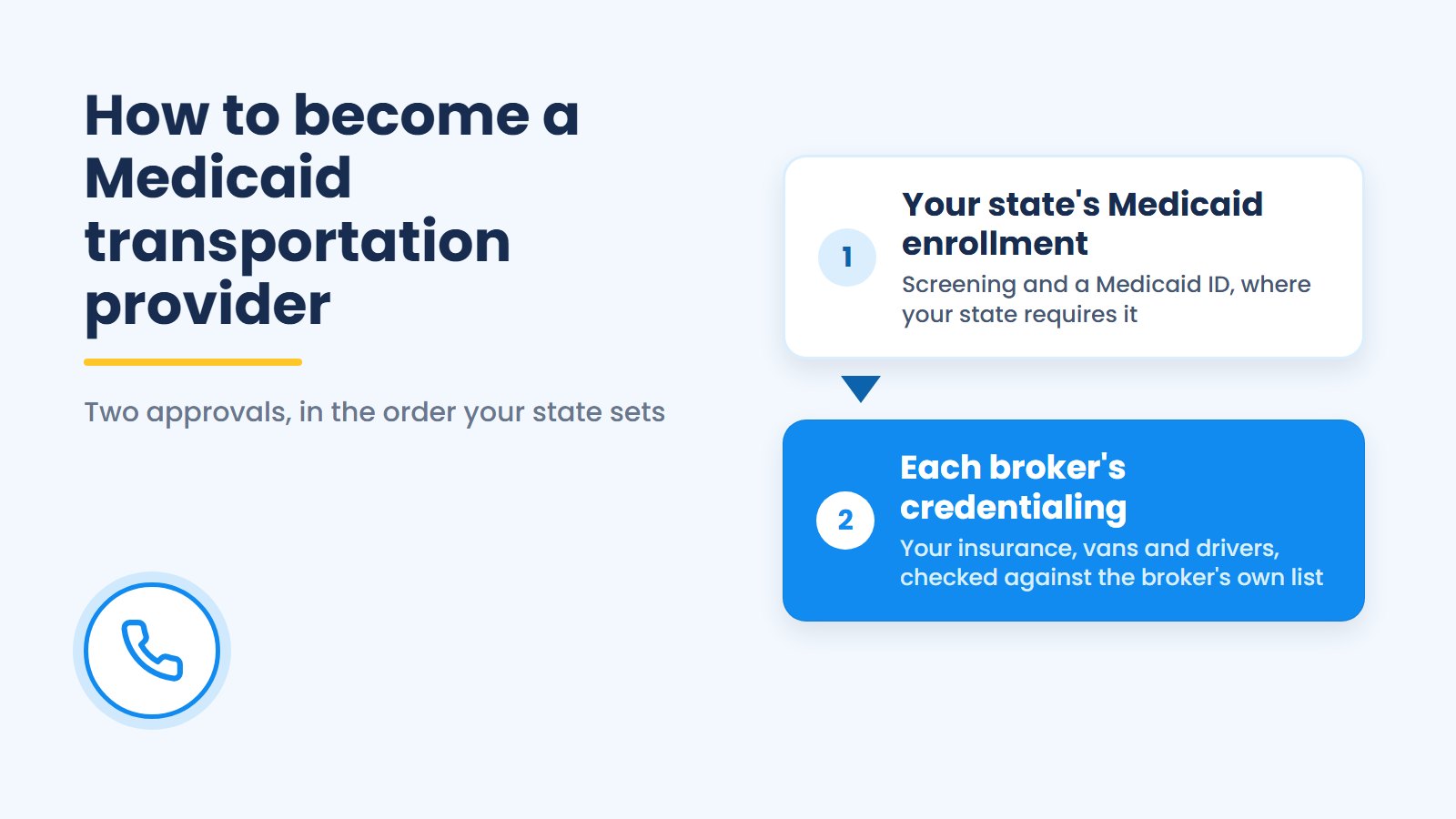
To carry Medicaid riders as a non-emergency medical transportation (NEMT) company, you usually need two approvals. Your state’s Medicaid program enrolls and screens your company. And each broker, the company a state or Medicaid health plan hires to arrange rides and hand them to companies like yours, credentials you before it sends a trip. Your state decides which comes first, and in a few states the broker is the only door.
An owner in West Michigan told me on a demo in August that he’d started his company the year before. He’d applied to the brokers and was still waiting to hear back, with no broker and no riders yet. “That’s pretty normal,” I told him. “It can take a really long time.” It’s a common problem, the one I sum up as “the broker’s been ignoring me for three months.”
A broker approves companies where it’s short on vans, not when your form arrives. So start your state enrollment early, ask each broker what it needs before you buy insurance, then follow up. This guide goes in the order you’ll do it, from finding out which door comes first in your state to keeping your approvals once you have them.
Do you have to be signed up with Medicaid before a broker will take you?
In most of the states we’ve checked, yes, the state comes first: brokers there need your state Medicaid enrollment, but New York wants the broker’s letter first, and Georgia, Pennsylvania and Virginia skip state enrollment for van work.
Two words get used loosely here. Enrollment is the state’s side: it screens your company and gives you a Medicaid provider ID. Credentialing is each broker’s or health plan’s own check of your company, drivers and vans before it sends you trips, though some brokers call theirs “enrollment” too. Which brokers you deal with depends on where you drive; our guide to who hands out Medicaid rides in each state names them.
One yes doesn’t bring the other. A founder I talked to in September got her “provider ID to do transportation,” set up the business and opened a bank account before she learned “you have to go through a broker from Medicaid.” She applied to one. “Application got denied,” she told me.
Where the state comes first, it says so. Texas takes Medicaid applications through PEMS, an online portal run by TMHP, the state’s Medicaid claims administrator. TMHP’s provider manual is blunt: “All providers must be enrolled in Texas Medicaid before enrollment can be approved for any other service or program, including, but not limited to, Medicaid managed care.”
New York runs the other way: MAS (Medical Answering Services), its statewide broker, has to give you a letter of support first. The state’s Medicaid enrollment system, eMedNY, says on its transportation enrollment page that “Any new application submitted after 04/15/2024 without the MAS support letter will be rejected and returned.” And Virginia skips state enrollment altogether. DMAS, Virginia’s Medicaid agency, tells providers in a July 2025 notice that “Currently, you do not enroll with DMAS directly for Fee For Service (FFS) or Managed Care Organization (MCO) NEMT programs.”
Federal rules allow all of this. CMS, the federal Medicaid agency, lets each state decide whether NEMT companies or their drivers enroll, and whoever a state does enroll, it has to screen.
Here’s the order in the 14 places we’ve written guides for, as of October 2026. In eight of them the state comes first: Arizona, California, Colorado, Florida, Michigan, Minnesota, North Carolina and Texas. New York wants MAS’s letter first. Georgia, Pennsylvania and Virginia don’t enroll van companies for broker or county work. Ohio depends on the lane, and in DC the documents we read don’t settle it.
The table keeps each office’s own name, because that’s what you’ll search for. Health First Colorado is Colorado’s Medicaid program, and Medi-Cal is California’s, run by DHCS. In Minnesota, DHS is the human services department, and MnDOT, the transportation department, issues the STS (special transportation service) certificate. ODM is Ohio’s Medicaid department, MATP is Pennsylvania’s county-based Medicaid ride program, DSS offices are North Carolina’s county social services departments, and DHCF is DC’s Medicaid agency. Fee-for-service riders are the ones Medicaid covers without a health plan.
| State | Apply first to | Trips then come through |
|---|---|---|
| Arizona | AHCCCS, the state’s Medicaid program | Each health plan or its ride vendor |
| California | Medi-Cal, through DHCS’s PAVE portal | Each Medi-Cal plan or its ride broker |
| Colorado | Health First Colorado, open to new NEMT companies again since Oct. 1, 2026 | MediDrive, the state’s broker |
| Florida | Florida Medicaid (AHCA) | Each health plan’s ride vendor, or a regional broker for fee-for-service riders |
| Georgia | Verida, the state’s broker; no separate state enrollment | Verida |
| Michigan | CHAMPS, Michigan’s Medicaid enrollment system | Each health plan’s ride vendor; for fee-for-service riders, a county office, or Modivcare in Wayne, Oakland and Macomb |
| Minnesota | DHS, alongside MnDOT’s STS certificate; no new companies in the seven-county metro until Jan. 27, 2027 | Each health plan; county programs and DHS for fee-for-service riders |
| New York | MAS, the state’s broker, for a letter of support; then eMedNY | MAS |
| North Carolina | NCTracks, the state’s Medicaid enrollment system | Each health plan’s ride vendor; county DSS offices for NC Medicaid Direct |
| Ohio | Depends on the lane: ODM for health plan work and wheelchair vans, not for county contracts | Each health plan’s ride vendor; county Job and Family Services offices; fee-for-service wheelchair riders can call you directly |
| Pennsylvania | Your county’s MATP provider; no state enrollment for van work | The county MATP provider; Modivcare in Philadelphia |
| Texas | Texas Medicaid, through TMHP’s PEMS portal | Each health plan’s ride vendor |
| Virginia | Each broker; DMAS doesn’t enroll NEMT companies | MTM for fee-for-service since Oct. 1, 2026, and each health plan’s broker |
| Washington, DC | Unclear: ask DHCF and the broker, in writing | MTM for fee-for-service through Dec. 31, 2026, and each health plan’s vendor |
If your state isn’t in the table, make two calls: ask the Medicaid agency whether NEMT companies enroll, and ask each broker whether its application needs a Medicaid ID. If it is, find your row and call the office it names before you spend a dollar.
What does the state check, and what does it cost?
Where your state enrolls you, it screens your company at a risk level it picks, up to fingerprints from every owner of 5% or more, and where it charges the federal application fee, that’s $750 in 2026.
Federal rules set three levels. At limited, the state verifies your licenses and checks you against federal databases. Moderate adds site visits before and after enrollment. High adds a criminal background check and fingerprints from everyone who owns 5% or more of the company, due within 30 days of the state’s request, and a missed deadline is grounds for denial.
CMS leaves the level for NEMT to each state. As of October 2026, Arizona, Colorado and Minnesota screen new NEMT companies at high risk, and Ohio does for a new wheelchair van company. North Carolina uses moderate for a van company, and Florida and Michigan use limited.
The fee isn’t automatic either. CMS set it at $750 for 2026 for providers a state treats as “institutional,” and each state decides whether NEMT companies count. You don’t pay it again if you’re already enrolled in Medicare or another state’s Medicaid, or paid the fee there. North Carolina adds $100 of its own. And the fee comes due again when you revalidate, which your state has to make you do at least every five years.
Many states also want your operating authority before they’ll enroll you. Arizona’s AHCCCS provider packet lists the vehicle-for-hire permit from ADOT, the state transportation department, and Minnesota’s DHS application wants a copy of your STS certificate. Ohio’s Medicaid rule for wheelchair van companies requires every vehicle to meet the permit rules of the state’s EMS (emergency medical services) board. Others don’t ask: North Carolina’s Medicaid transportation policy says “No certification, accreditation or license is required,” and in California and Texas a typical medical van needs no state operating authority. Our guide to NEMT license requirements covers each of these states.
If your state screens NEMT at high risk, line up every owner of 5% or more now, so the fingerprints can go in within 30 days of the request.
What does a broker check, and when should you buy insurance?
Each broker checks your company, every van and every driver against its own list, so get that list in writing, and ask where the broker is short, before you pay for a policy.
The lists overlap:
- Your company: a business license or operating authority and insurance, and often your Medicaid ID, an NPI (National Provider Identifier) and the broker’s name on your insurance certificate. MTM, for one, wants to be listed as certificate holder and additional insured on your liability and auto policies.
- Every van: registration, insurance and an inspection, sometimes by the broker’s own inspectors.
- Every driver: a background check, a drug screen and a driving record, plus training. Modivcare’s list includes PASS (Passenger Assistance, Safety and Sensitivity) wheelchair training, first aid and CPR, and defensive driving.
Get the list before you insure, because the policy bills whether or not the broker ever says yes. On a 2023 livestream, Te’ya Miles, the Atlanta operator behind That NEMT Girl, described a woman from one of her consultation calls who’d already bought commercial insurance, then learned the broker she wanted required two vehicles. “She only has one vehicle,” Te’ya said. As Te’ya put it in another 2023 video, “the moment that you activate the policy you’re responsible for that bill.”
Each broker also sets its own insurance limits and the exact wording it wants on the certificate, which our NEMT insurance guide covers. Inspections work the same way. In a 2025 YouTube interview, a senior director at one of the national brokers told owners to check the broker’s own inspection sheet before paying for an inspection of their own: “go by that sheet to see what is on there.”
Insurance can’t always come last, though. As I said on our live show on Oct. 1, “for a lot of these applications, like they want to see that you’re insured,” and Arizona’s packet lists vehicle insurance among its required documents. So get quotes early, and bind when an application asks for proof.
This week, before you bind anything, get each broker’s requirements sheet in writing and ask which counties, hours and vehicle types it’s short on.
Why hasn’t the broker called you back?
Brokers add companies where they’re short on vans, so a complete application can sit on file until there’s a need where you drive, and following up is how you find out.
Their own pages say so. Verida, Georgia’s statewide broker, reviews applications “to determine if there is a need for new transportation providers in the region where the applicant is located.” MAS decides “if a letter of support will be provided.” MTM’s network page says that without an immediate need it will “keep your information on file,” and its Rhode Island page, updated in July 2026, estimates 8 to 12 months before a new provider gets “the opportunity to become contracted.” Its Minnesota page, though, says MTM is “always seeking transportation providers.” And Modivcare’s join page points to a map of “priority areas where we urgently need support.”
Broker staff say it too. In that 2025 interview, the same senior director said the web form is “to get information and it’s not to say you’re going to become a provider.” MTM’s senior director of logistics said on an industry podcast in September: “If there’s an immediate need, we’ll be certainly reaching out. But if there’s less of a need, it really is just following up.”
So follow up, in this order:
- Call provider relations the day you apply. Say exactly what you can cover that they’re short on: which counties, which hours, which vehicle types. SafeRide’s application asks for the same things, down to how many rides a day you can take in each type of vehicle.
- Follow up about four weeks later. The director from that 2025 interview told owners to “wait at least four weeks and then reach back out.” After that, check in now and then, at what the advice on that September podcast called a respectful distance: not daily, not weekly. (Daily calls make you memorable, just not the way you want.)
- Find a person to call. Verida’s Georgia page lists a provider relations manager for each region. Once you’re in, MTM’s director said, the person to know is your vendor account manager.
None of this opens a network that’s full. MTM’s director said some markets are “saturated,” and that adding providers there “can almost risk the viability of others.” When the West Michigan owner asked whether I deal with the brokers, I told him I can’t help him get more trips from them, “because that’s sort of between them and you.”
Call provider relations the day you apply, and if nothing comes back, follow up once about four weeks later.
How long does it take to become a Medicaid transportation provider?
Plan on months, in two queues and a lag: your state’s enrollment clock, then each broker’s credentialing, then a wait before approval turns into trips.
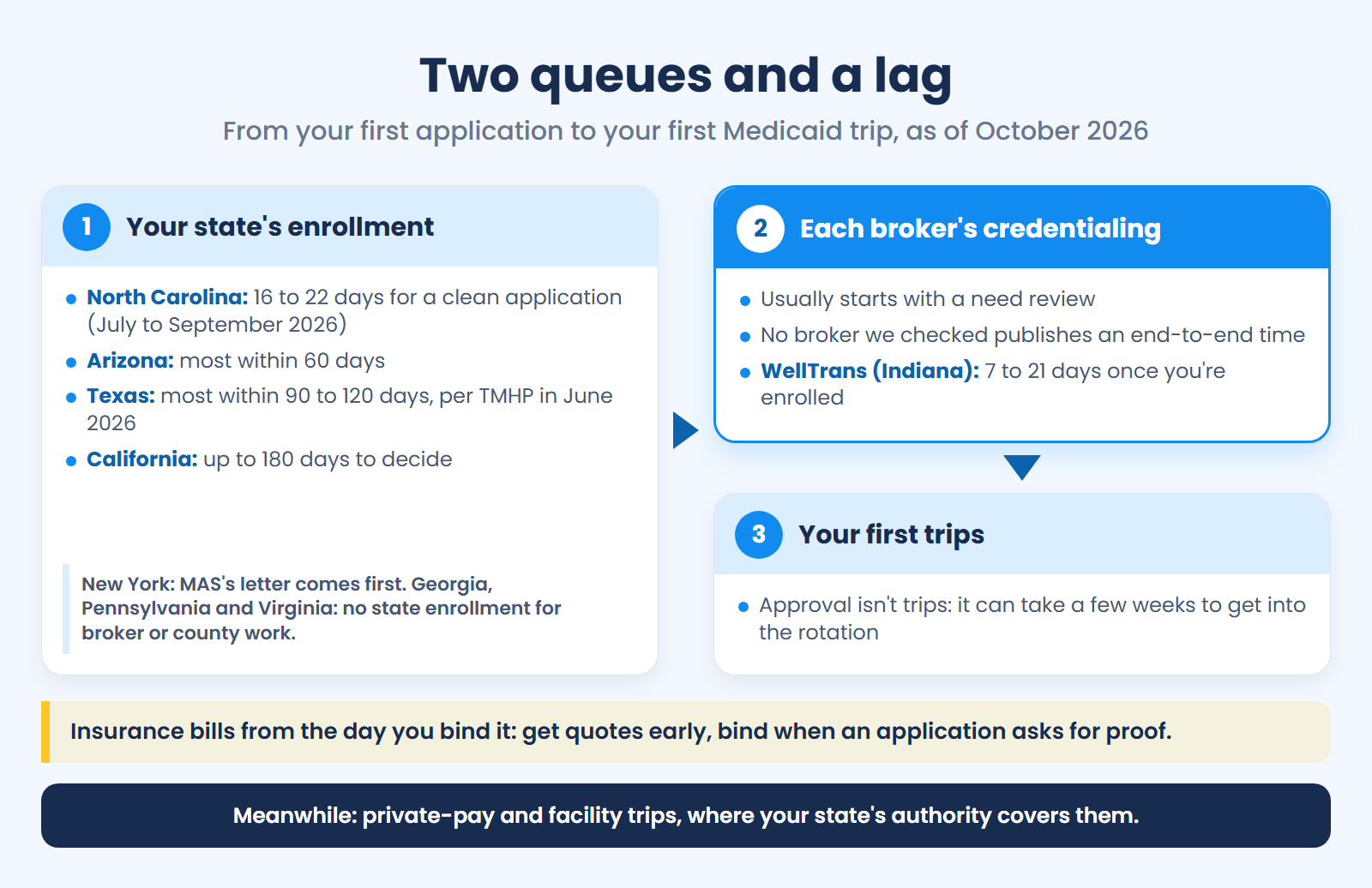
The state’s clock is the one you can look up. As of October 2026:
- Arizona: most applications processed within 60 days, per AHCCCS.
- Colorado: eight business days on average at the state’s fiscal agent, per HCPF, Colorado’s Medicaid agency, plus the site visit and fingerprints that high-risk screening adds.
- North Carolina: 16 to 22 days for a clean application, July to September 2026, per NC Medicaid.
- New York: a decision within 90 days of a complete application, a clock the state can extend, and it starts only once you have MAS’s letter.
- Texas: “up to 60 days” in TMHP’s manual, but in June 2026 TMHP said most applications were being processed within 90 to 120 days.
- California: up to 180 days for DHCS to decide, and through June 30, 2027, no approval by default if it runs past that.
In Georgia, Pennsylvania and Virginia the state doesn’t enroll van companies for broker or county work, so once you hold any operating authority you need, like Virginia’s DMV certificate, the broker’s queue is the rest of the wait.
The broker’s clock is harder to pin down. It usually starts with whether the broker needs you, and no broker we’ve checked publishes an end-to-end time, only pieces. WellTrans, an Indiana broker, says in its 2026 seminar deck that its credentialing “can range from 7-21 calendar days,” vehicle inspection included, once you’re enrolled in Indiana Medicaid, which “can take from 1-3 months.” Virginia’s managed-care contract gives the health plans’ brokers 30 days to process a complete packet, 15 to send a decision and 30 to sign a contract.
Approval doesn’t put you in the rotation right away, either. Te’ya said in a 2023 video that once a broker approves you, “you may be able to start seeing trips immediately or it may take your company a few weeks to become a cycle in their rotation of providers.”
In practice the range is wide. One of the co-owners of an Indiana company said in a 2026 interview that one broker took “about a week to get in.” Adam, who runs A.S. Reliable Transport in Indiana, needed close to four months, state registration included, before WellTrans gave him a first trip after his broker changed. The longest waits I hear about on calls are queues stacked end to end: a state backlog, then a network that’s full.
Put your state’s published clock plus a few months of broker time on the calendar (longer where a network is full), and don’t count on Medicaid revenue before then.
What can you run while you wait?
You can run private-pay and facility trips while you wait, where your state’s operating authority covers them, because neither needs Medicaid enrollment or a broker’s credentialing.
The authority is the catch. Ohio allows no for-hire trip before the certificate from PUCO, its utilities commission, and Virginia’s NEMT carrier certificate covers Medicaid trips only, so private trips there need common-carrier authority. Pennsylvania, Michigan and DC also want state authority before any private-pay or facility trip. In California, Florida, Georgia and Texas, a typical medical van needs none, and in Colorado neither does a van used only for wheelchair riders. Check your city and county either way.
It’s where I’d start anyway. As I said on our podcast in September, in 2026, in most areas, I’d go after private-pay riders and facilities first. A one-van owner in Charlotte told me on a demo in July that he’d had a hard time even reaching a broker, so he went private pay. “Private pay is doing me pretty good,” he said.
I’d still get the state’s Medicaid number where your state issues one. An owner in the Inland Empire who’d just gone full time with one van asked me on a demo in July whether he had to be signed up with Medi-Cal to work for a broker. “Usually they need that number,” I told him. A week later, on a call, I told him to apply for it even if he never ran a Medi-Cal trip, because “facilities will trust you a little bit more” once the state has vetted you.
Once a broker approves you, Duet takes in broker trips beside your private-pay and facility work. MTM, Modivcare and MediDrive trips arrive through direct integrations, and SafeRide, Verida and WellTrans trips come in by trip file import. Getting each broker’s approval, and keeping it, stays your job.
What keeps you credentialed once you’re in?
Staying credentialed is a calendar: brokers re-check your drivers every year, inspect your vans once or twice a year and want each insurance renewal uploaded before the old certificate expires.
The dates are in your contracts. MTM’s provider agreement form calls for a criminal background check on every driver “Pre-employment and annually thereafter” and a fresh driving record every year. MTM’s Virginia handbook has vans inspected before their first trip and every six months after, while Modivcare’s Kansas manual, updated in 2022, has Modivcare inspect them once a year. And MTM’s Rhode Island handbook wants each credential uploaded “no later than 10 business days (two weeks) prior to their expiration date.” If one isn’t in five days before it expires, trips tied to it “may be removed from the manifest.”
Lapses cost trips first. MTM says its system won’t assign trips to providers “whose credentials are not current or sufficient.” Its agreement pays nothing for trips run by uncredentialed drivers or vehicles, and under its Virginia handbook each expired driver or vehicle credential costs two points, where five points means a five-day suspension. A new owner, legal name or federal tax ID means a new agreement at MTM.
The state keeps its own calendar. It has to revalidate your enrollment at least every five years, and some states go faster: Arizona every four years, Minnesota every three, and Ohio every three for the providers it credentials. CMS also recommends that states have providers check their own staff against the federal exclusion list at hire and every month after. That’s the HHS Inspector General’s list of people and companies barred from federal health care programs, and brokers screen your drivers against it and other lists.
MTM’s senior director of logistics said it on that September podcast: “now it really is maintaining that credentialing. I can’t stress that part of it enough.”
Upload every insurance renewal at least 10 business days before the old certificate expires, the deadline MTM’s Rhode Island handbook sets.
“That’s pretty normal,” I told the owner in West Michigan, and it was true. The rest of the answer is a question. Can you name what each broker in your county is short on, and the person there who told you? If you can’t, that’s the call to make before you fill out another form.
FAQ
Should I pay someone to get me credentialed?
Maybe for the paperwork, never for the door. The federal broker rule bars transportation companies from paying a broker anything “to influence referrals or subcontracting,” and only the state and the broker decide whether you’re in. A service that fills out applications and chases missing documents can save you time. Before you pay, ask exactly what it’ll file and talk to owners who’ve used it.
Do I need an NPI?
Usually. An NPI is the 10-digit ID healthcare payers use. A company gets the Type 2, for organizations, from NPPES, the federal registry, which charges nothing for it. SafeRide’s application requires one, and MediDrive’s Colorado checklist lists one. Some states don’t require one to enroll, Arizona and North Carolina among them. Either way, an NPI doesn’t enroll you anywhere by itself.
Do my drivers have to enroll too?
In some states. Minnesota requires every driver to enroll individually with DHS, and Michigan enrolls drivers one by one in CHAMPS for fee-for-service work. Where the state enrolls only the company, or nobody, each broker still checks every driver against its own list before that driver carries its riders.
Is it the same for Medicare?
No. Original Medicare doesn’t pay for routine van rides: Part B covers ground ambulance “when traveling in any other vehicle could endanger your health.” Some Medicare Advantage plans offer rides as an extra benefit, which they don’t have to, so ask each plan which ride vendor it uses.
About the author
James O'Donnell cofounded Duet and leads its sales, partnerships, and growth services. He talks with NEMT operators every week, hosts the NEMT Growth podcast, and answers Duet's sales line himself. More about Duet's founders →
Want more trips and less busywork?
See how Duet runs and grows NEMT businesses in a 30-minute demo.