Article
How to Start a NEMT Business in Michigan (2026)
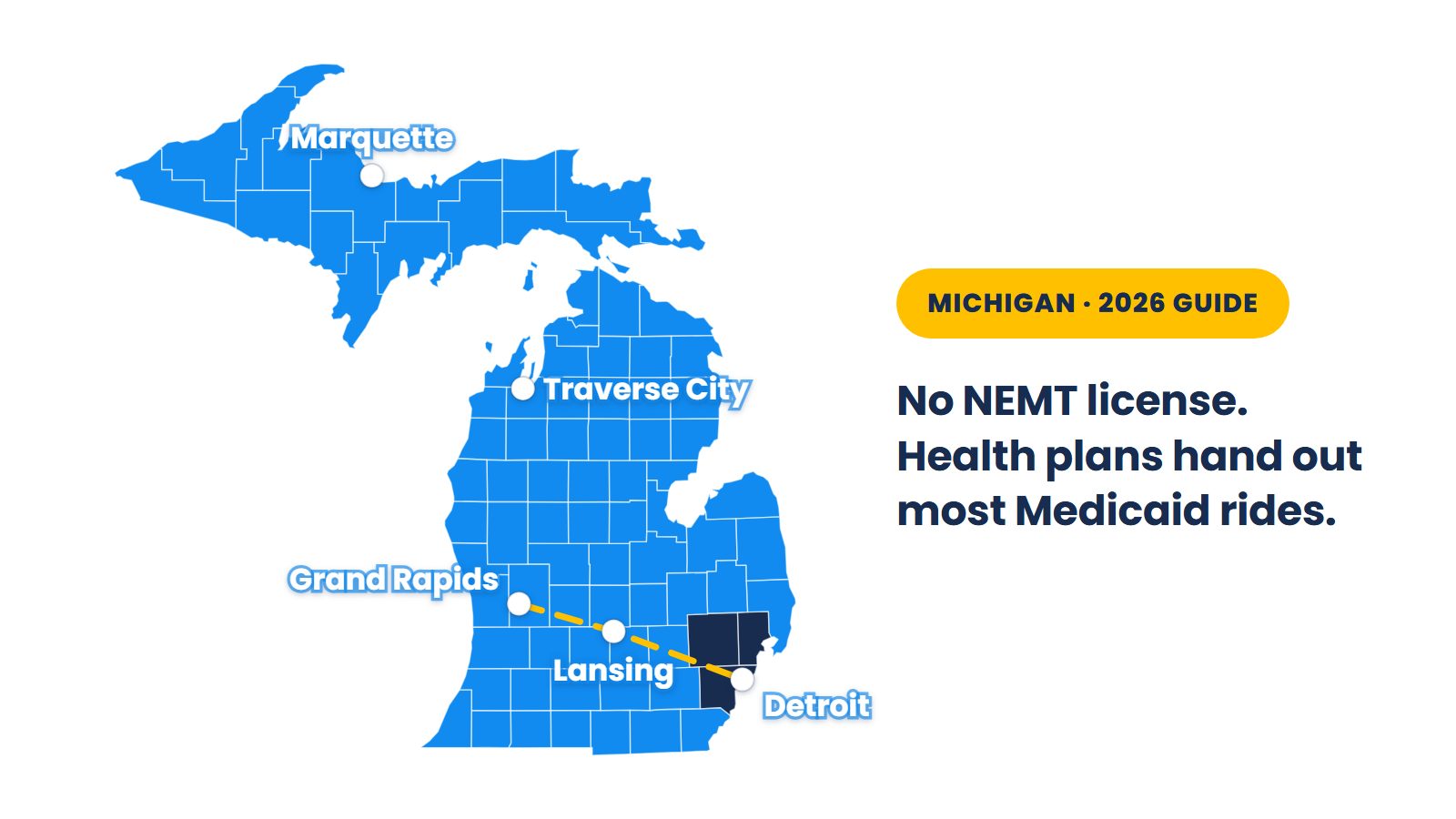
Michigan has no NEMT license, and its health plans, not one broker, hand out most Medicaid rides. Here's the order that wastes the least money.
By James O'Donnell, Cofounder and COO, Duet ·
To start a NEMT business in Michigan, form an LLC ($50), insure each van for at least $1 million and register it before its first paid ride: with LARA at 8 or fewer seats counting the driver, or with MDOT at 9 or more. There’s no NEMT license. Medicaid takes months, so your first paid trips come from facilities and private-pay families while you enroll in CHAMPS and apply to the health plans’ ride vendors, MTM, SafeRide and Modivcare. Budget about $22,000 to $50,000 for one used wheelchair van.
Michigan at a glance:
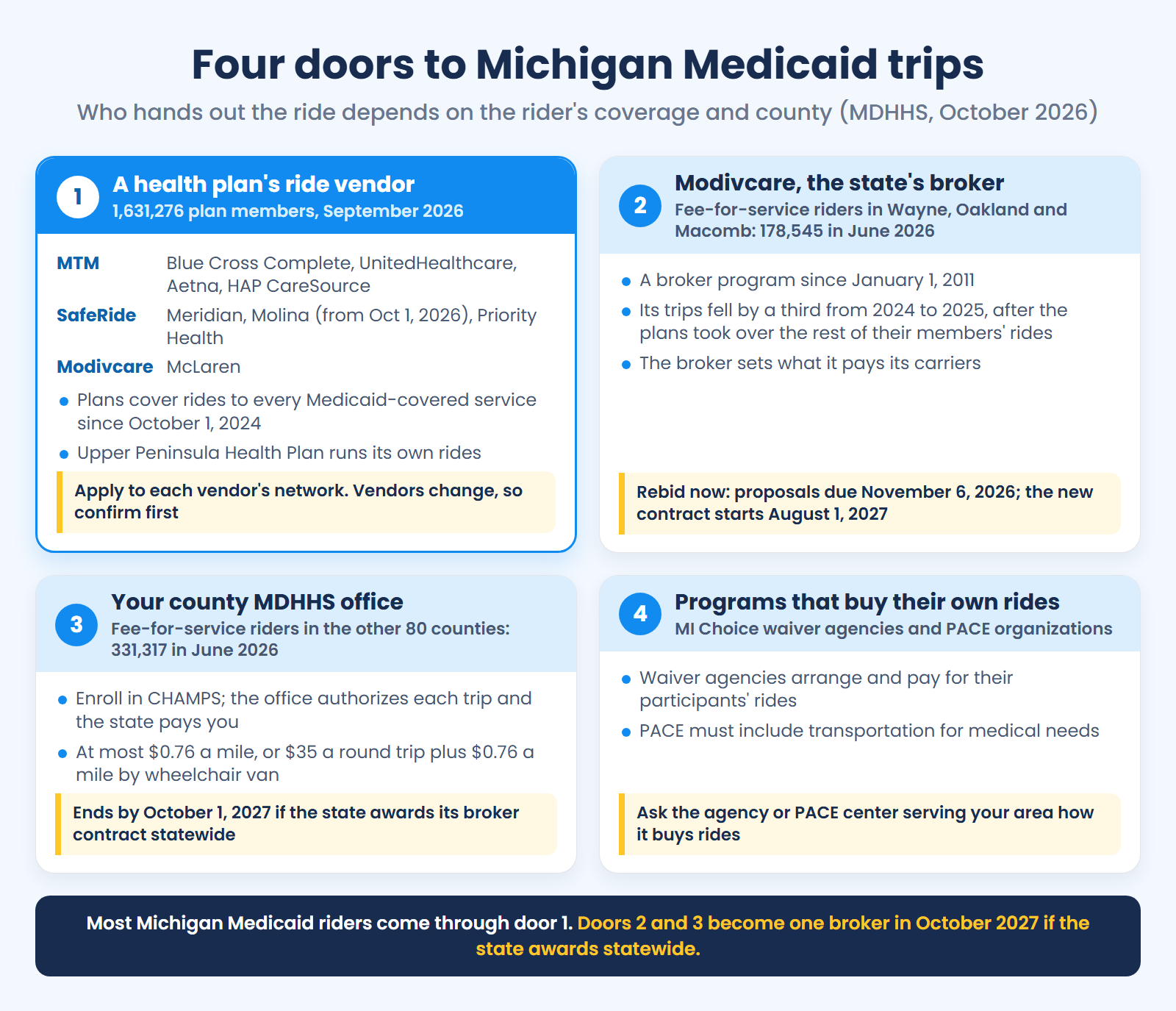
- Who runs Medicaid rides: mostly the health plans, through MTM, SafeRide or Modivcare. Fee-for-service riders, the members outside the plans, ride through Modivcare in Wayne, Oakland and Macomb, and through county offices of the Michigan Department of Health and Human Services (MDHHS) elsewhere [1][2][3].
- State registration: the Department of Licensing and Regulatory Affairs (LARA) at 8 or fewer seats counting the driver, $125 the first year for one vehicle, then $100 a year; the Michigan Department of Transportation (MDOT) at 9 or more [4][5].
- Insurance: $1 million combined single limit plus no-fault coverage; $1.5 million at 9 to 15 seats [4][6].
- Drivers: no commercial driver’s license (CDL) below 16 seats, and a $35 chauffeur license only for vans of 9 or more seats under MDOT [7].
- Direct billing: outside those three counties, county offices pay carriers enrolled in CHAMPS, Michigan’s Medicaid enrollment system, up to $35 a round trip plus $0.76 a mile in a wheelchair van [3][8].
- Stretcher: licensed ambulances only [9].
An owner getting ready to launch near Detroit told me on a July 2026 demo he’d spent “maybe four months, five months” chasing a Modivcare contract. He got it for all three counties and “accepted the rates, whatever base rates.” He had no van yet. His reason: “they control the Medicaid transportation in southeast Michigan.” He’d done the hard part. The door was just smaller than he thought. Modivcare’s state contract covers only fee-for-service riders in Wayne, Oakland and Macomb: about 179,000 people in June 2026, against about 739,000 plan members there in September [10][11]. Its trips fell by a third in 2025, and on August 27 MDHHS put it out for bid [10].
Michigan’s Medicaid rides run mostly through three health plan vendors, not the state broker, whose contract is being rebid. Medicaid’s doors open on other people’s clocks, so start with facilities and private pay, and add Medicaid through the vendors that serve your county’s plans; the Upper Peninsula’s plan runs its own rides [2][12]. The checklist below runs in the order that wastes the least money. After it, the guide takes Michigan’s Medicaid doors first, because they decide where you apply, then the state’s rules for your vans, insurance and drivers, then enrollment and why one payer isn’t enough, then the money and the calendar.
I run Duet, which builds dispatch software and runs growth services for non-emergency medical transportation (NEMT) companies, and I talk to NEMT owners on demos every week, Michigan operators included. This is the Michigan edition of our national guide on how to start a NEMT business. Requirements change, so confirm against the linked sources before you spend money.
The one-page checklist: how to start a medical transportation business in Michigan
Decide your riders and van size first: in Michigan, seat count decides whether LARA or MDOT registers you. The state registration and CHAMPS come after the van, because LARA wants an insurance certificate and CHAMPS asks each driver for a license and auto insurance [14][16]. Medicaid then takes months, so your first trips should come from facilities and families. Each phase below ends with the money it puts at risk.
Phase 0: pick your riders, your van size and your first trip sources
- Seats: count one for every 14 inches of seat width, rounding down, driver included. At 8 or fewer you register with LARA for $125; at 9 or more you need MDOT authority, with $1.5 million of insurance at 9 to 15 seats [4][5][6]. MDOT’s guide doesn’t say how a wheelchair position counts, so call its bus and limousine office (517-241-0679) before you buy a van near the line [5].
- Stretcher riders: leave them out; in Michigan they ride only in a licensed ambulance [9].
- Medicaid: this week, pull MDHHS’s monthly plan enrollment report for your county and note its two or three biggest plans. Their ride vendors are your first applications [2][11].
- First trips: line up at least one facility and one private-pay source for service that starts once you’re registered.
- Money at risk: none yet.
Phase 1: form the company
- File articles of organization for an LLC with LARA’s Corporations Division: $50, plus $25 for an assumed name if you’ll use one [13].
- Calendar the LLC’s annual statement, due each February 15: $25, dropping to $15 after September 30, 2027. Form after September 30 and you can skip the first February 15 [13].
- Get a free employer identification number (EIN) from the IRS.
- Money at risk: $50, plus $25 for a name.
Phase 2: register as a state vendor
- Register the company in SIGMA Vendor Self-Service, the state’s vendor system, then wait 3 to 5 business days before you start CHAMPS [14].
- Money at risk: $0.
Phase 3: buy the van, insure it, register it
- Buy the van once you know its seat count and have a first trip source. Our national startup cost model prices a used 2016-2019 wheelchair van at about $33,000, the September 2026 dealer median.
- Bind at least $1 million of combined single limit liability on top of Michigan no-fault coverage [4].
- Pay the 6% use tax, the $14.50 title fee and commercial plates, about $109 a year for a 4,600-pound minivan conversion if the Secretary of State taxes it by weight as a for-hire passenger vehicle [7][15].
- Register with LARA as a limousine carrier, the law’s term for a company paid to carry passengers in vehicles of 8 or fewer seats, driver included, through MiCLEAR, LARA’s online licensing system. At 9 or more seats, file MDOT’s Form 3184 instead [4][5][16].
- Screen every driver before the first trip: a national criminal background check, a sex offender registry check and a driving history report, repeated every year [4].
- Money at risk: about $15,200 in all: about $6,600 down on a financed van, about $2,104 in tax, title and plates, about $4,350 of insurance due at signing, $125 to LARA and about $2,000 for equipment, lettering, driver screening and training.
Phase 4: enroll in CHAMPS
- Enroll the company as an atypical agency, MDHHS’s category for non-medical providers like NEMT, and every driver as an individual, through MILogin, the state’s login [14].
- Money at risk: MDHHS names no application fee for NEMT [3].
Phase 5: open the Medicaid doors and keep booking your own trips
- Apply to MTM, SafeRide and Modivcare for your county’s plans and, outside Wayne, Oakland and Macomb, ask the county MDHHS office how it adds commercial carriers [2][10].
- Put up a website families can book from and a Google Business Profile, and keep visiting facilities.
- Money at risk: about $300 for a phone and basic marketing, then about $1,934 a month in fixed bills for a financed van, by our national model, while the doors open.
Who pays for NEMT rides in Michigan?
Medicaid is the volume in Michigan and its health plans hold most of it; nursing homes are the stability and families the margin.
Medicaid is the volume, and the health plans hold most of it
CMS, the federal Medicaid agency, counted 2,170,730 Michiganders in Medicaid and the Children’s Health Insurance Program (CHIP) in May 2026 [17]. MDHHS counted 1,631,276 people in a Medicaid Health Plan in September 2026 [11]. Since October 1, 2024, those plans have had to cover rides “for any Medicaid-covered service” [1]. Fee-for-service riders are the other lane: 509,862 people statewide with the ride benefit in June 2026 [10].
Facilities are the stability
Michigan Medicaid builds a nursing home resident’s routine rides into the facility’s daily rate. The Medicaid Provider Manual says: “Routine, non-emergency medical transportation provided for long-term care residents in a van or other non-emergency vehicle is included in the facility’s per diem rate. This includes transportation for medical appointments, dialysis, therapies, or other treatments not available in the facility.” [3] So the nursing home books and pays for those rides, and it’s the account to win.
Dialysis is different. Dialysis rides are great, steady standing-order work, but in my experience most dialysis riders are on Medicaid, so their trips come through the plans’ vendors or the fee-for-service lane, and a dialysis clinic isn’t a facility account. A nursing home resident’s dialysis trip is the nursing home’s.
Private pay is the margin
Private-pay families book directly, and Michigan has 1,987,859 residents 65 and older, 19.6% of the state, in the Census Bureau’s 2024 one-year survey [17]. Most private-pay operators I talk to take a card at booking and charge it at least 24 hours before pickup, or send a payment link due by then. No payment, no car. Some also take a small nonrefundable deposit to hold the spot.
Price can be the hard part. A Detroit owner who has run a small fleet since 2020 told me in July she’d dropped her price to “as low as, like, $57 for a round trip plus mileage,” and callers still wouldn’t book. My read: callers compare you with rideshare prices, so sell what they get, a driver who comes to the door and loads them safely.
Who is the NEMT broker in Michigan?
Modivcare, formerly LogistiCare, brokers Michigan’s fee-for-service rides only in Wayne, Oakland and Macomb, under a contract being rebid; most plan members ride with MTM, SafeRide or Modivcare. A broker is the company a state or health plan hires to assign Medicaid rides and pay for them. MTM, SafeRide and Modivcare do that for the plans, and Modivcare holds both kinds of contract here: the state’s in three counties and McLaren’s for its members [2][3]. The Medicaid Provider Manual draws the line: “Medicaid authorizes fee-for-service (FFS) NEMT services via local MDHHS offices, except in Wayne, Oakland, and Macomb counties. FFS transportation services in Wayne, Oakland, and Macomb counties are administered through a contracted transportation broker.” [3]
With most riders in the plans, our state-by-state guide to NEMT brokers counts Michigan with the plan-vendor states. Next door, Ohio’s Medicaid agency hires no broker and leaves rides to county offices and the plans’ vendors.
Which ride vendor does each Michigan Medicaid plan use?
MTM runs rides for four of Michigan’s nine Medicaid health plans, SafeRide for three and Modivcare for McLaren, while Upper Peninsula Health Plan runs its own. Here’s the map as of October 1, 2026, from MDHHS’s own chart, with statewide members from its September report, which also breaks them down by county [2][11]. Aetna’s entry, “MTM (Formerly A2C),” is Access2Care, which is moving to the MTM Health name [29]. Vendors change, so confirm before you build on any row.
| Plan | Ride vendor | Members statewide, Sept 2026 |
|---|---|---|
| Meridian Health Plan of Michigan | SafeRide | 314,079 |
| Blue Cross Complete of Michigan | MTM | 284,819 |
| Molina Healthcare of Michigan | SafeRide, from October 1, 2026 | 277,078 |
| UnitedHealthcare Community Plan | MTM | 241,501 |
| Priority Health Choice | SafeRide | 203,267 |
| McLaren Health Plan | Modivcare | 190,729 |
| Aetna Better Health of Michigan | MTM, listed as “MTM (Formerly A2C)“ | 46,728 |
| HAP CareSource | MTM | 37,169 |
| Upper Peninsula Health Plan | In-house: volunteer drivers, buses, taxis | 35,906 |
What happens when Michigan’s broker contract is rebid?
One broker will win either Wayne, Oakland and Macomb or the whole state: the state “will either award only the Wayne, Oakland, Macomb region OR statewide,” to one contractor [10]. MDHHS put the contract out for bid on August 27, 2026, and proposals are due November 6, 2026. Carriers get in through the bidders: MDHHS expects each one to show “a letter of intent (if an executed agreement is not currently available) for every transportation provider anticipated for the network” [10]. Service starts August 1, 2027 in the three counties and, under a statewide award, “no later than October 1, 2027” everywhere; MDHHS told bidders those “are the actual dates, not target dates.” [10]
A statewide award would also take the county offices out of NEMT: “The county offices will have no responsibilities for NEMT operations.” The winner “will be required to establish their own network,” though it “may consider adopting existing providers into their network.” [10] The contract runs to July 31, 2030, and our running list of 2026 broker changes follows rebids like this one.
Can I bill Michigan Medicaid directly for NEMT rides?
Yes, outside Wayne, Oakland and Macomb: Michigan’s county MDHHS offices pay CHAMPS-enrolled carriers directly, at mileage-based maximums. MDHHS told broker bidders that the county offices authorize those trips and recruit commercial carriers themselves [10]. Each trip needs the office’s approval first, and you bill it on an MSA-4674 Medical Transportation Statement within 12 months [3].
The maximums, effective July 1, 2026, are $0.76 a mile for a commercial carrier and $35 a round trip plus $0.76 a mile in a wheelchair-lift van or a Medi-Van, Medicaid’s class for vehicles whose drivers give door-to-door or curb-to-curb help [3][8]. An attendant adds $15, and MDHHS pays the lesser of the maximum or your usual and customary charge. Mileage has tracked the IRS standard business rate since May 1, 2025, and the $35 has been in place since at least January 1, 2019 [8]. Empty miles, waiting time and no-shows aren’t paid [3].
Say a rider lives 10 miles from the clinic, so the round trip is 20 loaded miles. In a wheelchair-lift van that pays at most $35 plus 20 times $0.76, or $50.20. In a sedan it’s 20 times $0.76: $15.20. Wheelchair-lift and Medi-Van riders also need a DHS-5330 medical verification on file [3].
No vendor has to approve you for this lane, but a statewide broker award ends it by October 1, 2027 [10]. If you’re outside the three counties, call your county MDHHS office this week and ask how it adds commercial carriers.
What licenses and requirements does a NEMT business need in Michigan?
Michigan has no NEMT license, but a for-profit company’s paid vans need LARA registration at 8 or fewer seats, driver included, or MDOT authority at 9 or more. Under the Limousine, Taxicab, and Transportation Network Company Act (2016 Public Act 345), a vehicle carrying passengers “for hire with a seating capacity of 8 passengers or fewer, including the driver” is a limousine, and its carrier registers with LARA [4]. Under the Motor Bus Transportation Act (1982 Public Act 432), 9 or more seats makes it a bus that needs MDOT’s authority [6]. MDOT’s FAQ answers the NEMT question: “Yes, a non-emergency-equipped vehicle carrying nine or more passengers, including the driver, is regulated under PA 432” [5].
Who pays doesn’t change it. None of the limousine act’s exemptions, which include governments, transit authorities, Michigan nonprofit corporations that provide transportation, funerals and employer commuting, covers medical or Medicaid trips [4]. In 2019, after a routine audit, LARA summarily suspended a Dearborn medical transportation company’s limousine carrier registration, citing no proof of insurance and no yearly driver background checks [20]. MDHHS’s broker solicitation says “Vehicles used for NEMT may be considered a limousine or bus” and makes the broker check that its carriers hold the certificate, so register even if you’ll run only Medicaid trips [10].
Much of what circulates online gets Michigan wrong; the phantom “$850” license comes from a directory template that repeats the fee for states that don’t issue a NEMT license either.
| The claim you’ll read elsewhere | What Michigan actually requires |
|---|---|
| Michigan is “like a non broker State” | MDHHS hires Modivcare for fee-for-service rides in Wayne, Oakland and Macomb and is rebidding that contract [3][10] |
| Modivcare brokers rides “for the majority of Michigan’s nine Medicaid Health Plans” | Modivcare serves one plan, McLaren. MTM serves four and SafeRide three [2] |
| A Michigan NEMT provider license that costs $850 to get and $510 to renew | No such license exists. LARA registration is $125 for one vehicle, then $100 a year [4] |
| An MDHHS NEMT provider certification you need before you can carry Medicaid riders | MDHHS screens NEMT providers through CHAMPS enrollment as atypical providers; there’s no separate certification [3][14] |
| Rules from the Michigan Public Service Commission, or Medicaid carriers that run without state for-hire authority | Every for-profit carrier’s paid van registers with LARA at 8 or fewer seats, driver included, or MDOT at 9 or more, whoever pays [4][5] |
| “you must pass the … MDOT … vehicle inspection” | Only at 9 or more seats. Smaller vans get a yearly licensed-mechanic inspection from age 5 [4][5] |
| Check your “city and county clerk’s office for local vehicle-for-hire or business operating permits” | Michigan law bars city and county licenses and fees tied to limousine service (MCL 257.2115) [4] |
| “stretcher-equipped ambulettes” | Only a licensed ambulance may carry a stretcher rider [9] |
| “MTM … merged together with verita” | MDHHS’s chart lists no Verida contract. The broker moving under MTM’s name is Access2Care, listed as “MTM (Formerly A2C)” [2][29] |
Which registration does your van need?
MDOT counts 14 inches per seat, driver included, rounding down, and nine positions put a van under the bus act. A van that “can hold 9 passengers, including the driver” is a bus even if you only let 8 ride; to register it with LARA, “the seating capacity of the vehicle must be physically reduced” [5].
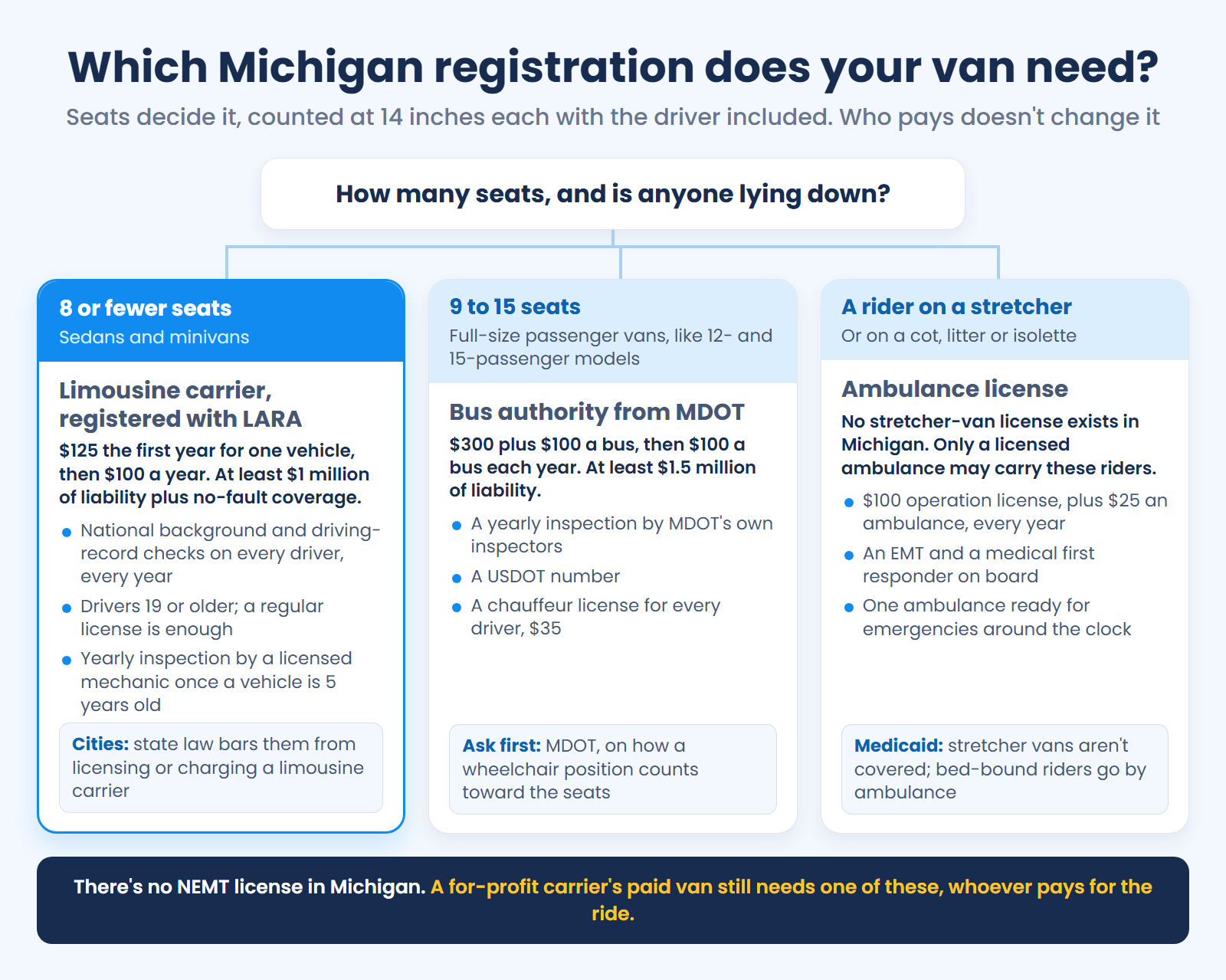
MDOT’s seating guide doesn’t say how a wheelchair position counts, so call its bus and limousine office (517-241-0679) before you buy a van near the line [5]. An MDOT bus also needs a U.S. Department of Transportation (USDOT) number and a yearly inspection by MDOT’s own inspectors [5].
What LARA’s limousine registration asks of you
LARA registers a limousine carrier through MiCLEAR for $25 plus $100 for the first vehicle, once you show a physical location and an insurance certificate [16]. Under the act, each vehicle from the second through the ninth adds $50, so three vans cost $225 the first year and $200 a year after [4]. LARA’s first-year fee table lists $175 for anywhere from 2 to 9 vehicles, so confirm the amount when you apply [16]. Registrations expire August 31 [4]. As the act reads today, LARA stops charging these fees on September 30, 2027, though you’ll still register [4]. The act also requires:
- Signage visible from at least 50 feet.
- Trip records (pickup, drop-off, duration, distance and fee) kept at least a year.
- A nondiscrimination policy, with no extra charge “because of his or her disability.” If you’ll price wheelchair rides above walking riders, ask LARA how this rule applies.
- A yearly safety inspection by a licensed mechanic once a vehicle is 5 years old, which covers the 2016-2019 vans our cost model prices from day one.
Can a Michigan city license your NEMT company?
Not as a limousine carrier: under MCL 257.2115, a local government “shall not impose a tax or fee upon or require a license for a limousine carrier” where it relates to that service [4]. The bar sits in the limousine act, so a 9-plus-seat bus carrier should ask its city clerk. Either way, check zoning for a home office or a lot.
What are the NEMT insurance requirements in Michigan?
Plan on a policy with at least $1 million of combined single limit liability covering every van, Michigan’s floor for a limousine carrier; 9 to 15 seats need $1.5 million. MCL 257.2119 requires that $1 million plus Michigan’s no-fault coverages, personal protection insurance (PIP) and property protection insurance (PPI), “as a condition of maintaining a license” [4]. A no-fault policy alone falls short. LARA puts it bluntly: “A Michigan No-fault insurance policy does not meet the requirements of the act.” [16] A bus with 16 or more seats needs $5 million [6]. A paid trip into Ohio or Ontario puts you under federal rules too, with a $1.5 million floor for vehicles seating 15 or fewer, driver included [27].
MDHHS’s 2013-2019 broker contract set the same bar for carriers: “automobile liability insurance with a minimum of $1,000,000 (one million dollars) per occurrence.” The 2026 solicitation names no carrier figure, so ask each vendor for its number [10][18].
No-fault also decides whose policy pays a hurt rider. Someone injured as “a passenger of a motor vehicle operated in the business of transporting passengers” gets PIP benefits “from the insurer of the motor vehicle,” with exceptions for some buses and taxicabs [21]. In a LARA-registered sedan or minivan, that means your policy pays first; an MDOT-certified bus is one of the exceptions, so ask your agent how it applies. You pick the PIP medical limit, $250,000, $500,000 or unlimited, on the insurer’s form; without a valid choice, the law can default to no limit [21].
For premiums, start from our national model: $1,200 to $1,800 a month for a new company’s wheelchair van at about $1 million of liability, from quotes reported in 2024 to 2026. On the national model’s $17,400 year, a quarter, about $4,350, is due at signing and the rest comes in 10 payments of $1,305. Our guide to what NEMT insurance costs a new company covers how to shop.
Workers’ comp starts when you regularly employ 3 people, or sooner once 1 employee has worked 35 or more hours a week for 13 weeks in the past 52 [22]. New employers pay 2.7% unemployment tax for two years. The minimum wage goes from $13.73 to $15.00 an hour on January 1, 2027, and an employer of 10 or fewer owes up to 40 hours of paid sick time a year [22]. Michigan’s median for shuttle drivers and chauffeurs, the federal job group that includes NEMT drivers, was $17.47 an hour in May 2025 [22].
What do NEMT drivers need in Michigan?
Michigan NEMT drivers need no CDL below 16 seats, and only drivers of vans seating 9 or more under MDOT authority need a chauffeur license. The Vehicle Code’s chauffeur definition takes in drivers for a bus carrier and leaves out limousine drivers. The license costs $35, and a CDL starts at 16 or more passengers including the driver, or 26,001 pounds [7].
What does Michigan’s limousine law require of drivers?
Michigan’s limousine law and Vehicle Code set these driver rules [4][7]:
- Age: 19 or older, above Medicaid’s floor of 18.
- Background: “a local and national criminal background check” each year, including “the national sex offender registry database.” The Michigan State Police’s criminal-history search (ICHAT) covers no other state’s records, so it can’t be the whole check [23].
- Driving record: more than 4 moving violations or 1 major violation in 3 years disqualifies.
- Convictions: a felony within 5 years for impaired driving, fraud, a sexual offense, using a vehicle in a felony, property damage, theft, violence or terror disqualifies, as does a sex offender registry listing.
- Drugs and alcohol: a zero-tolerance policy, and the carrier must “immediately suspend the driver” after a complaint.
- Record in the van: the carrier subscribes to the Secretary of State’s look-up service, $15 a record, and each driver keeps a current copy of his or her driving record in the vehicle [7].
Medicaid adds its own layer. For fee-for-service work each driver also enrolls in CHAMPS [14], and the Medicaid Provider Manual sets 18 as the minimum age, plus English and a license for the vehicle’s class [3]. From August 1, 2027, the broker contract adds Passenger Assistance Safety and Sensitivity (PASS) training or an approved equivalent, first aid and CPR, with hands-on CPR at least every other year, and twice-yearly vehicle inspections for its network [10]. Those are contract terms, not law.
Can a NEMT company run stretcher van trips in Michigan?
No: in Michigan, anyone carried by stretcher is a “nonemergency patient,” and only a licensed ambulance may transport patients. The Public Health Code defines a nonemergency patient as “an individual who is transported by stretcher, isolette, cot, or litter,” and bars the business of transporting patients “unless the person uses an ambulance licensed under this part” [9]. The state’s EMS rule allows stretcher, cot, litter or isolette transport only “in a licensed ambulance or aircraft transport vehicle.” A violation is a misdemeanor, with a fine of up to $1,000 for each day it continues [9].
Wheelchair vans are a different case. A rider who stays seated in a wheelchair isn’t a “patient” under the Public Health Code’s ambulance rules, so a wheelchair van needs no ambulance license.
Medicaid draws the same line. MDHHS’s broker solicitation says “Ambulance (ground or air) and Stretcher vans are not covered as NEMT vehicles,” and Medicaid covers non-emergency ambulance trips that the rider’s physician orders in writing [3][10].
The licensed route is an ambulance operation: a $100 license renewed yearly, plus $25 per ambulance each year [9]. A basic crew carrying a patient is an emergency medical technician (EMT) and a medical first responder, and you keep at least one ambulance ready for emergencies 24 hours a day, 7 days a week [9]. Put the screening question in your dispatch protocol in writing: will this rider need to lie down for the trip? If yes, it’s an ambulance trip.
How do you become a Medicaid transportation provider in Michigan?
In Michigan, register in SIGMA, enroll in CHAMPS, then apply to each plan’s ride vendor and, outside Wayne, Oakland and Macomb, your county MDHHS office.
Step one: register in SIGMA Vendor Self-Service
MDHHS wants your tax ID registered with the state as a vendor before you enroll, through SIGMA Vendor Self-Service [3][14]. Then “allow 3 - 5 business days to begin and complete the CHAMPS application”; try sooner and “you may get an error when validating your information.” [14]
Step two: enroll in CHAMPS
Enroll the company in CHAMPS through MILogin as an atypical agency, specialty “Non-Emergency Transportation Agency,” and each driver as an individual NEMT provider, with a license and auto insurance on file [14]. MDHHS says atypical providers “would not receive an NPI number” [14]. Get a national provider identifier (NPI) anyway, under taxonomy 343900000X: it’s free, and plan vendors may ask for one.
Screening is light: NEMT isn’t on MDHHS’s moderate- or high-risk lists, so it gets the “limited” tier, verifications plus a criminal background check, with no fingerprinting or pre-enrollment site visit required at that tier [3]. MDHHS charges the federal application fee to “institutional providers” and classes NEMT as atypical, so it names no fee for NEMT; confirm at 800-979-4662. You revalidate at least every five years [3].
Step three: apply to the plan vendors
Apply to MTM, SafeRide and Modivcare for your county’s plans [2]. Plans can set their own rules: MDHHS’s 2016 enrollment bulletin says “Medicaid Health Plans are allowed to develop their own requirements which may differ from Medicaid FFS requirements” [24]. Ask each vendor’s provider relations team whether its Michigan network is taking carriers, what insurance it wants and whether it needs an NPI.
Step four: get on the fee-for-service list
Fee-for-service riders inside Wayne, Oakland and Macomb go through Modivcare’s network; everywhere else, your county MDHHS office pays you directly [3]. The 2027 contract opens a window now. MDHHS expects bidders to show a letter of intent for every carrier they plan to use, so if one asks you for a letter before November 6, 2026, it can be your way into its network if it wins [10]. If you already work with a broker, ask whether it’s bidding.
Step five: programs that buy their own rides
MI Choice is a Medicaid waiver program run by waiver agencies. Those agencies authorize and pay for their participants’ medical rides, and their paid drivers must be trained “to cope with medical emergencies” [3][24]. Every Program of All-Inclusive Care for the Elderly (PACE) organization must include “Transportation for medical needs” [3]. Ask the waiver agency or PACE organization near you how it buys rides.
How long do CHAMPS and the vendors take?
Neither MDHHS nor the vendors publish a processing time [3][10]. In my experience many of these applications want to see you’re insured, and they can sometimes take six months to a year, so don’t pay insurance on a van that sits waiting for them.
That’s the catch-22: the Medicaid doors run on other people’s clocks, and a van’s bills start the day you buy it. Facilities and private-pay families need no enrollment, so they’re where your first trips come from. Our guides on signing facility contracts, turning a facility meeting into a first trip and building private pay cover that stretch.
Don’t build the whole schedule on one payer
Michigan’s Medicaid doors move, so keep the facility and private-pay trips you started with running beside them: the broker contract starts over August 1, 2027. MDHHS’s chart lists Molina’s members with SafeRide from October 1, 2026 [2]. Medicaid and CHIP enrollment fell from 2,405,020 in January 2025 to 2,170,730 in May 2026, by CMS’s updated counts [17], and MDHHS told broker bidders it can’t predict what federal work requirements will do to enrollment [10].
The Detroit owner who has run a small fleet since 2020 wants to “stay away from the brokerage,” she told me, because “it’s just not enough steady volume.” In her telling, the trips don’t pay enough to cover “the astronomical amount that they charge for insurance.” A van she ran on one program contract “has basically just been sitting” since that program ended. She’ll decide “at the first of the year” whether to keep going.
Michael Shank, president of 42 North Transportation Consultants in Grand Rapids, gave the bank’s side on our episode about picking NEMT vehicles. When 70 to 80 percent of a company’s trips come from brokers, “the banks get a little funny and wonky on that.” His reason: “if those trips dry up, you can’t make your payment.”
Book one facility and one private-pay source before the van payments start.
Then run every lane from one schedule. Dispatch software like Duet puts the plan vendors’ trips and the Detroit-area broker’s on one board with your facility and private-pay work. Modivcare and MTM are direct Duet integrations; SafeRide’s trips come in by trip file import, and any other trip list, a county office’s or a waiver agency’s, by import or bulk upload. Each trip bills at the rate its contract sets. The LARA or MDOT registration, CHAMPS enrollment, each vendor’s credentialing and rates, and invoicing each payer through its own process stay with you.
How much does it cost to start a NEMT business in Michigan?
Budget about $22,000 to $50,000 for one used wheelchair van in Michigan, counting six months of fixed bills. That’s the cash you need through month six; with a loan it counts the down payment and six payments, not the van’s full price. The low end, about $22,300, is an older $20,000 van financed with 20% down; the high end, about $49,800, is a 2016-2019 van at the $33,000 dealer median, bought outright. Financed, that van comes to about $27,100. Michigan’s own inputs are its fees, the 6% use tax and title and plate costs; the rest comes from our national model.
| Line item | Michigan amount | Note |
|---|---|---|
| LLC articles | $50 | Plus $25 for an assumed name, and a yearly statement each February 15 that drops from $25 to $15 after September 30, 2027 [13] |
| EIN and NPI | $0 | Free from the federal agencies that issue them |
| Michigan NEMT license | $0 | None exists |
| LARA limousine carrier registration | $125 the first year for one vehicle, then $100 a year | $50 more for each vehicle from the second through the ninth [4] |
| MDOT bus authority (9 or more seats) | $300 plus $100 a bus | Instead of LARA; renewed at $100 a bus before it expires March 1 [6] |
| Medicaid application fee | None named for NEMT | Charged to “institutional providers”; confirm at 800-979-4662 [3] |
| Used wheelchair van, 2016-2019 | About $33,000, or $6,600 down if financed | September 2026 dealer median; the national model finances 80% at 14% over 60 months, $614 a month |
| Tax, title and plates | About $2,104 | 6% use tax ($1,980), $14.50 title and about $109 a year of commercial plates for a 4,600-pound minivan conversion, if taxed on the for-hire schedule [7] |
| Insurance due at signing | About $4,350 | A quarter of the national model’s $17,400 year |
| Equipment and lettering | About $1,000 | Lettering visible from 50 feet [4] |
| Screening and training | About $1,000 | Includes $15 a record for Secretary of State driving records [7] |
| Phone and basic marketing | About $300 | National model |
| Six months of fixed bills | About $11,600 financed, $7,920 bought outright | $1,934 a month financed: a $1,305 insurance installment, a $614 van payment and $15 for a phone; $1,320 with no van payment |
| Total, owner driving | About $27,100 financed, $49,800 bought outright | An older $20,000 van, financed, comes to about $22,300 |
On the revenue side, the county offices’ maximum is the published yardstick: $50.20 for the 20-mile wheelchair round trip worked out above [8]. At that rate, the financed van’s $1,934 of monthly fixed bills takes 39 such trips a month to cover, about two a weekday, before fuel or a driver’s pay. Plan-vendor and broker rates are set by contract, and private pay is whatever you charge.
How do you fund a NEMT startup in Michigan?
Michigan’s help with a van loan runs through banks, not grants: the Michigan Economic Development Corporation’s (MEDC) Capital Access Program backs participating banks’ loans [25].
- SBA loans: Small Business Administration (SBA) 7(a) loans and microloans, covered in our national model.
- Capital Access Program: “Similar to a loan loss reserve fund,” the bank, the company and the state pay a small premium into a reserve behind loans of up to $5 million, at 13 participating lenders as of March 2025. The bank still makes the lending decision [25].
- Collateral Support: MEDC’s January 2026 success story says it worked with a bank on $395,612 of collateral support for four loans totaling $798,400, so a Grand Rapids NEMT company could finance new vehicles [25].
- Michigan Women Forward: a community lender whose site lists microloans from about $2,500 to $50,000 for Michigan businesses, start-ups included [26].
- Michigan Small Business Development Center: free coaching [26].
None of them speeds up the vendors, so size your loan payments for months without Medicaid trips.
How long does it take to start a NEMT business in Michigan?
Plan on months to the first Medicaid trip in Michigan: one Detroit-area owner spent four or five months getting into Modivcare’s network, and in my experience vendor and Medicaid applications can sometimes take six months to a year. On the state side, MDOT says a complete bus application “usually takes two weeks,” while LARA’s license page and MDHHS give no processing time [3][5][16].
Here’s the sequence, with the clocks that exist:
- Before you buy: pick your riders and seat count, form the LLC, register in SIGMA and line up a first facility or private-pay source.
- Van week: buy, insure and plate the van, then register with LARA through MiCLEAR, or file MDOT’s Form 3184 for 9 or more seats [5][16].
- Once SIGMA has had 3 to 5 business days and the van is insured: enroll the company and drivers in CHAMPS [14].
- The week your registration comes through: apply to the vendors for your county’s plans and, outside Wayne, Oakland and Macomb, get on your county MDHHS office’s list.
- After that: Medicaid volume builds on the vendors’ clocks, so facility and private-pay trips carry you.
The owner at the top of this guide did the hard part and got through one door, a shrinking one. In 2026 I’d go after facilities and private pay first almost anywhere, and Michigan is no exception. Before you sign for a van, name who will pay for enough trips to cover its $1,934 of monthly bills, and when each said yes. A vendor application isn’t a yes, and neither is a broker contract that starts over in 2027.
Michigan NEMT FAQ
Are Michigan’s ride vendors taking new NEMT providers?
Neither MDHHS nor the vendors post a Michigan network freeze or opening, so ask each vendor’s provider relations team directly. Ask by county and by vehicle type, and ask again in a few months if the answer is no. The state broker’s network has a public calendar: bidders for the contract starting August 1, 2027 are expected to show carriers’ letters of intent by November 6, 2026 [10].
How do NEMT companies get paid in Michigan?
It depends on the payer. Outside Wayne, Oakland and Macomb, county MDHHS offices pay enrolled carriers for the trips they authorize, on an MSA-4674 statement filed within 12 months of the ride [3]. The broker contract that starts August 1, 2027 requires the broker to pay 95% of approved carrier claims within 45 days [10]. Plan vendors pay under their own contracts, which aren’t published. Facilities pay under theirs, and private-pay riders pay by card before pickup.
Who arranges rides for people on both Medicare and Medicaid in Michigan?
For people in MI Coordinated Health, their plan does. These are Highly Integrated Dual Eligible Special Needs Plans (HIDE SNPs), Medicare Advantage plans for people on both programs. They’ve run since January 1, 2026 in the Upper Peninsula, southwest Michigan, Macomb and Wayne, and each “must provide non-emergency medical transportation” [19]. MDHHS says that on January 1, 2027, the program is “expected to extend to the entire State, contingent upon budget approval” [19]. The plans don’t publish their ride vendors, so ask each one.
Can I start a Michigan NEMT business with my own car or minivan?
Yes, once your company registers with LARA as a limousine carrier and insures the car for $1 million plus no-fault coverage [4][16]. It needs commercial plates as a vehicle that carries people for hire, and a licensed mechanic’s inspection every year once it’s 5 years old [4][15]. Plan vendors set their own vehicle rules, so ask each one before you count on Medicaid trips in a car [24].
Can I run a Michigan NEMT business from home?
Maybe. LARA’s initial-license page says “You must have a physical location to obtain a Limousine Carrier license” and doesn’t say whether a home qualifies, so ask its Licensing Division at 517-241-9221 [16]. CHAMPS has each driver list a home address as the practice location [14]. Check your city’s zoning rules for a home office too.
How does a driver get a Michigan chauffeur license?
Only drivers of vans seating 9 or more under MDOT authority need one among NEMT drivers; a van of 16 or more seats also needs a CDL [7]. The driver visits a Secretary of State office, passes a vision test and a 15-question knowledge exam and pays $35. There’s no road test for anyone already licensed [15].
Can a Michigan NEMT company take riders into Ohio or Ontario?
Yes, under federal law rather than Michigan’s. One metro Detroit owner told me most of his work comes from Ohio. A paid trip across a state or national border puts the carrier under the Federal Motor Carrier Safety Administration (FMCSA): operating authority, a USDOT number and a $1.5 million insurance floor for vehicles seating 15 or fewer, driver included [27]. Ontario’s government page also lists a Commercial Vehicle Operator’s Registration (CVOR) for U.S.-plated buses seating 10 or more [27]. Check FMCSA’s rules before the first trip.
Is the Michigan market worth entering in 2026?
Yes, with trip sources you control. The demand is there: 2,170,730 Michiganders in Medicaid and CHIP in May 2026 and 1,987,859 residents 65 and older [17]. So is the crowding: 1,051 organization NPIs carry the NEMT taxonomy at a Michigan practice address, 217 of them in Detroit, 99 in Southfield and 68 in Dearborn [28]. That measures how crowded metro Detroit is, not how many companies run trips. The cautions: enrollment has fallen since January 2025, MDHHS can’t predict what federal work requirements will do, and the broker contract starts over in 2027 [10][17].
Key official sources
[1] MDHHS bulletin MMP 24-33 (August 30, 2024): health plans cover rides for any Medicaid-covered service from October 1, 2024. https://www.michigan.gov/mdhhs/-/media/Project/Websites/mdhhs/Assistance-Programs/Medicaid-BPHASA/2023-Bulletins/Final-Bulletin-MMP-24-33-NEMT—Final.pdf?rev=dae9b0985db5457ab650ecae998d2d54&hash=CE11A9EA83A144D3D87AEB589FBEDB94
[2] MDHHS, Medicaid Health Plan (MHP) Non-Emergency Medical Transportation (NEMT) contact and process chart (revised October 1, 2026): each plan’s ride vendor. https://www.michigan.gov/mdhhs/-/media/Project/Websites/mdhhs/Assistance-Programs/Medicaid-BPHASA/Other-Prov-Specific-Page-Docs/MHP-NEMT-Contact-and-Process.pdf?rev=2cc01820a25149d38888b594545cffef&hash=DBBCDF5A3FD0EC54BB7D21B889F478E5
[3] MDHHS, Medicaid Provider Manual (October 1, 2026): the Non-Emergency Medical Transportation, General Information for Providers, Ambulance, MI Choice Waiver, PACE and Directory Appendix chapters. https://www.mdch.state.mi.us/dch-medicaid/manuals/MedicaidProviderManual.pdf
[4] Limousine, Taxicab, and Transportation Network Company Act, 2016 PA 345 (MCL 257.2101 to 257.2153): definitions and exemptions, registration and fees, driver screening, inspections, signage, records, local licenses, insurance and nondiscrimination. https://www.legislature.mi.gov/documents/mcl/pdf/mcl-Act-345-of-2016.pdf
[5] MDOT, Bus and Limousine FAQs, Bus and Limo page, Seating Determination (August 6, 2025) and Form 3184, Application for Certificate of Authority (08/2022): who needs authority, seat counting, fees, processing time, inspections, USDOT numbers and the office phone. https://www.michigan.gov/mdot/about/faqs/passenger-transportation/bus-and-limousine, https://www.michigan.gov/mdot/travel/mobility/pub-transit/bus-and-limo, https://www.michigan.gov/mdot/-/media/Project/Websites/MDOT/Travel/Mobility/Public-Transportation/Bus-and-Limo/Seating-Determination.pdf?rev=67d86329445e4e4b9433708f743e9822&hash=DEF11A315F74FD1EACAC489141E39D90 and https://mdotjboss.state.mi.us/webforms/GetDocument.htm?fileName=3184.pdf
[6] Motor Bus Transportation Act, 1982 PA 432 (MCL 474.101 to 474.141): the bus definition, exemptions, insurance, fees and renewals. https://www.legislature.mi.gov/documents/mcl/pdf/mcl-Act-432-of-1982.pdf
[7] Michigan Vehicle Code (MCL 257.6, 257.7a, 257.208b, 257.801, 257.806 and 257.811) and MCL 205.93: the chauffeur definition, the CDL threshold, driving-record look-ups, the for-hire registration tax, title and license fees, and the 6% use tax. https://www.legislature.mi.gov/documents/mcl/pdf/mcl-Act-300-of-1949.pdf, https://www.legislature.mi.gov/documents/mcl/pdf/mcl-257-6.pdf and https://www.legislature.mi.gov/documents/mcl/pdf/mcl-205-93.pdf
[8] MDHHS, Non-Emergency Medical Transportation billing page and rate schedule (effective July 1, 2026), the schedules effective January 1, 2019 and January 1, 2025, and Michigan State Plan Amendment 25-0005 (effective May 1, 2025): county-office maximums and the IRS-linked mileage rate. https://www.michigan.gov/mdhhs/doing-business/providers/providers/billingreimbursement/non-emergency-medical-transportation, https://www.michigan.gov/mdhhs/-/media/Project/Websites/mdhhs/Folder1/Folder77/NEMT_Rate_Schedule_Jan_2019_11-1-2019.pdf?rev=1e6714bdf42b4ed99219bdbe43526b32, https://www.michigan.gov/mdhhs/-/media/Project/Websites/mdhhs/Assistance-Programs/Medicaid-BPHASA/Other-Prov-Specific-Page-Docs/NEMT-Rate-Schedules---Historic/NEMT-Rate-Schedule-Effective-1-1-2025.pdf?rev=c566b1a37d2a4e8492a2859edc0b027f and https://www.medicaid.gov/medicaid/spa/downloads/MI-25-0005.pdf
[9] Public Health Code Part 209 (MCL 333.20901 and following), MCL 333.20199, and Michigan Administrative Code R 325.22113 via LII: patients, ambulance licensing, fees and staffing, penalties and the stretcher rule. https://www.legislature.mi.gov/documents/mcl/pdf/mcl-368-1978-17-209.pdf, https://www.legislature.mi.gov/documents/mcl/pdf/mcl-333-20199.pdf and https://www.law.cornell.edu/regulations/michigan/Mich-Admin-Code-R-325-22113
[10] MDHHS, RFP-491-260000002254, “NEMT Broker for Medicaid FFS Beneficiaries” (issued August 27, 2026; amended October 7, 2026), on SIGMA Vendor Self-Service: the statement of work, Appendices B and C, pricing and proposal instructions, and MDHHS’s answers to bidder questions. https://sigma.michigan.gov/PRDVSS1X1/Advantage4
[11] MDHHS, Medicaid and Healthy Michigan Plan Enrollees, September 2026 (JE02 report): enrollment by plan and county. https://www.michigan.gov/mdhhs/-/media/Project/Websites/mdhhs/Assistance-Programs/Medicaid-BPHASA/Monthly-MHP-Enrollment/JE02-(092026).pdf?rev=c6828133c160438caa37c522d311e4f4&hash=8749E2A80238031D1C923631393FD43C
[12] MDHHS, Medicaid Health Plan contract awards by Prosperity Region (April 8, 2024). https://www.michigan.gov/mdhhs/inside-mdhhs/newsroom/2024/04/08/mhp-awards
[13] MCL 450.5101 and 450.4207: LLC filing fees and the annual statement. https://www.legislature.mi.gov/documents/mcl/pdf/mcl-450-5101.pdf and https://www.legislature.mi.gov/documents/mcl/pdf/mcl-450-4207.pdf
[14] MDHHS, atypical provider enrollment guide, Current Atypical Provider Type Enrollment Grid (November 2024) and NEMT Individual Enrollment Instructions (October 2023): SIGMA first, atypical enrollment, NPIs and driver enrollment. https://www.michigan.gov/mdhhs/doing-business/providers/providers/medicaid/provider-enrollment/data/pe-pages/step-by-step-enrollment-guides/atypical, https://www.michigan.gov/mdhhs/-/media/Project/Websites/mdhhs/Medicaid-Provider-Assets/Provider-Enrollment-Assets/PE_Atypical_Matrix.pdf?rev=9dcdbc65ccb645c2a579def67082b53c&hash=50B295CDA5AF02A97CC60E2A75C456C3 and https://www.michigan.gov/mdhhs/-/media/Project/Websites/mdhhs/Medicaid-Provider-Assets/Provider-Enrollment-Assets/NEMT-Individual-Enrollment-Instructions.pdf?rev=a1d1d00118a1486eb68c6bca63e2f2af&hash=58C327BC1A9652E1F3BC3FBBA2EAA183
[15] Michigan Department of State, chauffeur’s license page and vehicle tabs and plates FAQ: testing, the $35 fee and commercial plates for vehicles that carry people for hire. https://www.michigan.gov/sos/all-services/chauffeurs-license and https://www.michigan.gov/sos/faqs/vehicles/vehicle-tabs-and-license-plates
[16] LARA, Transportation Company page and Limousine Carrier Initial License page: fee tables, the Licensing Division’s phone, MiCLEAR, the physical location and the insurance certificate. https://www.michigan.gov/lara/bureau-list/cscl/licensing/prof/tnc and https://www.michigan.gov/lara/bureau-list/cscl/licensing/prof/tnc/limousine-carrier/limousine-initial-license
[17] CMS Medicaid and CHIP enrollment data (Performance Indicator dataset, September 2026 release) and the Census Bureau’s American Community Survey 2024 1-year, table B01001, via Census Reporter: enrollment counts and residents 65 and older. https://data.medicaid.gov/api/1/metastore/schemas/dataset/items/6165f45b-ca93-5bb5-9d06-db29c692a360 and https://api.censusreporter.org/1.0/data/show/latest?table_ids=B01001&geo_ids=04000US26
[18] DTMB contract 071B4300041 with LogistiCare Solutions (December 1, 2013 to July 31, 2019), with its change notices: the carrier insurance bar. https://www.michigan.gov/-/media/Project/Websites/dtmb/Procurement/Contracts/Folder20/4300041-Rev.pdf?rev=18c4d05373c84c9d99091013f1731776
[19] MDHHS bulletins MMP 25-47 (November 26, 2025) and MMP 26-26 (July 1, 2026): MI Coordinated Health’s launch, regions and planned statewide expansion. https://www.michigan.gov/mdhhs/-/media/Project/Websites/mdhhs/Assistance-Programs/Medicaid-BPHASA/2025-Bulletins/Final-Bulletin-MMP-25-47-MICH.pdf?rev=4e27724595f943de84d2636de248f3f0&hash=2AE2CEDE187BED43FA92271A5327C2A7 and https://www.michigan.gov/mdhhs/-/media/Project/Websites/mdhhs/Assistance-Programs/Child-Care-Assistance/Final-Bulletin-MMP-26-26-MICH.pdf?rev=bda61f8565ab41e8b571ed12abe85924&hash=C6F10F06B01AECC636CCF59E890FE1AA
[20] LARA news release (August 2, 2019): summary suspension of a Dearborn medical transportation company’s limousine carrier registration. https://www.michigan.gov/lara/news-releases/2019/08/02/lara-shuts-down-ace-medical-transportation-llc-in-dearborn-for-multiple-violations
[21] Insurance Code chapter 31, Michigan’s no-fault law (MCL 500.3101 to 500.3179): passenger benefits and PIP limits. https://www.legislature.mi.gov/documents/mcl/pdf/mcl-218-1956-31.pdf
[22] MCL 418.115, MCL 408.934 and the Earned Sick Time Act (2018 PA 338); the Unemployment Insurance Agency’s tax page; and Bureau of Labor Statistics Occupational Employment and Wage Statistics, Michigan shuttle drivers and chauffeurs (May 2025): workers’ comp, minimum wage, sick time, unemployment tax and driver pay. https://www.legislature.mi.gov/documents/mcl/pdf/mcl-418-115.pdf, https://www.legislature.mi.gov/documents/mcl/pdf/mcl-408-934.pdf, https://www.legislature.mi.gov/documents/mcl/pdf/mcl-Act-338-of-2018.pdf, https://www.michigan.gov/leo/bureaus-agencies/uia/employers/about-taxes-and-ui/unemployment-insurance-taxes and https://api.bls.gov/publicAPI/v1/timeseries/data/OEUS260000000000053305308
[23] Michigan State Police, criminal history records page: what an ICHAT search covers. https://www.michigan.gov/msp/services/chr
[24] MDHHS bulletins MSA 16-05 (September 28, 2016) and MSA 16-28 (September 1, 2016): CHAMPS enrollment for fee-for-service NEMT, health plans’ own requirements, and MI Choice waiver agencies’ rides. https://www.michigan.gov/mdhhs/-/media/Project/Websites/mdhhs/Folder1/Folder28/MSA_16-05.pdf?rev=8cb103bcd0814269886d8d4d62e06628&hash=04EC717FBB3A200BD101483D9D322061 and https://www.michigan.gov/mdhhs/-/media/Project/Websites/mdhhs/Folder1/Folder39/MSA_16-28.pdf?rev=6ca4430379d44838ac63a88a8f99700a&hash=DA8B411D2C670C9237D6E2FF7A580A44
[25] Michigan Economic Development Corporation (MEDC), Capital Access Program fact sheet (March 5, 2025) and success story (January 7, 2026): loan-loss reserve terms, and Collateral Support for a Grand Rapids NEMT company’s vehicle loans. https://www.MichiganBusiness.org/49e5f5/globalassets/documents/reports/fact-sheets/capaccess.pdf and https://www.michiganbusiness.org/reports-data/success-stories/ride-yourway/
[26] Michigan Women Forward, business loans page, and the Michigan Small Business Development Center’s home page: the microloan range and no-cost coaching. https://miwf.org/business-loans/ and https://michigansbdc.org/
[27] 49 USC 13501, 49 CFR 387.33 via LII, FMCSA’s Form OP-1(P) instructions, and Ontario’s Commercial Vehicle Operator’s Registration (CVOR) page: federal jurisdiction over trips across state and national borders, the passenger-carrier insurance floor, operating authority and USDOT numbers, and Ontario’s bus registration. https://www.govinfo.gov/content/pkg/USCODE-2023-title49/pdf/USCODE-2023-title49-subtitleIV-partB-chap135-subchapI-sec13501.pdf, https://www.law.cornell.edu/cfr/text/49/387.33, https://www.reginfo.gov/public/do/DownloadDocument?objectID=106413101 and https://www.ontario.ca/page/commercial-vehicle-operators-registration-cvor
[28] CMS NPPES NPI Registry API (pulled October 7, 2026): Michigan organization NPIs with NEMT taxonomy 343900000X. https://npiregistry.cms.hhs.gov/api/?version=2.1&enumeration_type=NPI-2&taxonomy_description=Non-emergency+Medical+Transport&state=MI&limit=200
[29] MTM Health, Access2Care brand transition page (read September 28, 2026): Access2Care moving to the MTM Health name and its scheduling systems. https://www.mtm-inc.net/mtm-link-a2c-intro/
Last verified against the sources above in October 2026. Michigan requirements, plan vendors and the broker contract change; check the primary sources before acting, and treat this guide as education, not legal advice.
About the author
James O'Donnell cofounded Duet and leads its sales, partnerships, and growth services. He talks with NEMT operators every week, hosts the NEMT Growth podcast, and answers Duet's sales line himself. More about Duet's founders →
Starting in a nearby state?
Want more trips and less busywork?
See how Duet runs and grows NEMT businesses in a 30-minute demo.