Article
How to Start a NEMT Business in Indiana (2026)
Indiana's Medicaid rides sit behind IHCP enrollment and a broker, and its carrier certificate needs $1.5 million of insurance. Here's what to do, in order.
By James O'Donnell, Cofounder and COO, Duet ·
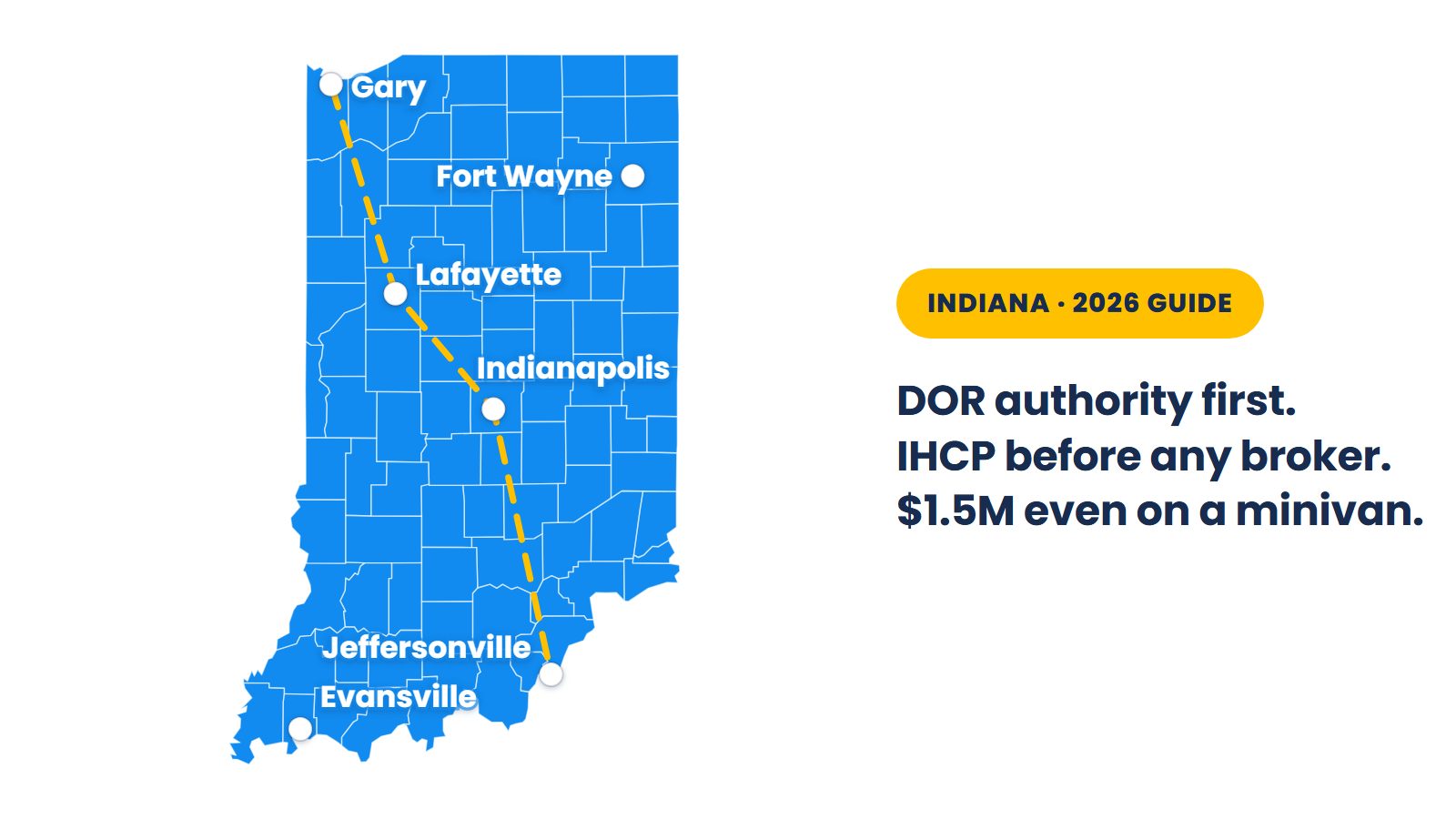
To start a NEMT business in Indiana, form an LLC ($95 online) and get the Department of Revenue’s motor carrier certificate ($100) with $1.5 million of auto liability. A for-profit company paid to carry riders needs it, whoever pays. About two to five months after you apply, you can run nursing-home and private-pay trips. Medicaid trips come later, after enrollment with the Indiana Health Coverage Programs (IHCP) and a contract with Verida, WellTrans or LCP. Budget about $22,500 to $50,200 for one used wheelchair van and six months of fixed bills, more once insurance is priced at $1.5 million.
Indiana at a glance:
- Medicaid rides: the state pays Verida, the fee-for-service broker, to arrange most rides for members outside the health plans, and the plans use WellTrans or LCP Transportation [1][2][3]. The plans that use WellTrans hold about 94 percent of managed-care members, by our estimate for July 2026 [4][5].
- IHCP first: Verida, WellTrans and LCP all want your IHCP enrollment first [1][6][7], which means high-risk screening, a $750 fee and a $50,000 surety bond [8][9][10], a guarantee you buy from a bonding company (one seller advertises three years from $1,063) [11].
- DOR authority: a for-profit carrier needs the Department of Revenue’s (DOR’s) certificate whoever pays, with $1.5 million of auto liability that your insurer files on a Form E, and a tariff, the price list DOR keeps on file [12][13][14].
- Nursing homes: since July 1, 2023 they arrange and pay for their Medicaid residents’ van rides, outside every broker [1][15].
- Drivers: Indiana’s chauffeur’s licenses have expired, and a commercial driver’s license (CDL) starts at 16 passengers counting the driver, or 26,001 pounds [16][17].
- Stretcher riders: ambulance work. Indiana’s emergency medical services (EMS) rules count anyone carried on a litter or cot as an emergency patient [18].
- Cities: as written, Indianapolis’s vehicle-for-hire code leaves out unmetered vans that carry only NEMT riders under DOR’s certificate, while Carmel’s, Gary’s and South Bend’s codes read broader [19][20][21][22].
- Rates: IHCP’s 2026 maximum for a wheelchair trip of up to 10 miles is $31.79, and each broker sets what it pays you in its own agreement [23][1][24].
An owner in the Indianapolis area told me in August that the company, more than a year in with fewer than ten vans, works with all three of Indiana’s Medicaid ride brokers: WellTrans, Verida and LCP. Broker work alone keeps the fleet at “Half, half of the capacity,” and Indianapolis, the owner said, has “a lot of NEMT here right now.” So the company is moving to nursing homes and private pay, and nursing homes had already asked for its documents.
That move fits how Indiana works. Medicaid’s trips sit behind IHCP enrollment and a broker, while nursing homes and families pay you directly, so get DOR’s certificate, build on those two, then apply to IHCP and the brokers. The checklist below waits to buy and insure the van and screen drivers until DOR’s order arrives; after it come who pays, the brokers, the rules, costs and timing.
I run Duet, which builds dispatch software and runs growth services for non-emergency medical transportation (NEMT) companies, and I talk to NEMT owners on demos every week, Indiana operators included. This is the Indiana edition of our national guide on how to start a NEMT business. Requirements change, so confirm against the linked sources before you spend money.
The one-page checklist: how to start a medical transportation business in Indiana
Decide your riders, vehicles and city first and the brokers last, because that order wastes the least money. Each phase ends with what it puts at risk and the running total.
Phase 0: pick your riders, your vehicles and your city
- Seats: DOR sorts carriers by the seats a vehicle was built with, counting the driver. Eight or fewer needs an Indiana ID number; 9 to 15 needs a USDOT number and brings the federal safety rules onto Indiana-only trips; 16 or more takes $5 million of insurance and a CDL [14][25][12][17].
- Stretchers: riders who travel lying down are an ambulance’s trip in Indiana, not a van’s [18].
- Your city: Indianapolis’s code leaves out unmetered vans that carry only NEMT riders under DOR’s certificate (get the city’s reading in writing), while Carmel’s, Gary’s and South Bend’s codes reach paid passenger trips as written [19][20][21][22].
- Three calls this week: ask DOR Motor Carrier Services (317-615-7200, option 3 then option 1, or passengerhhg@dor.in.gov) which tier fits your vans and whether it takes an application before you own one [14]. Ask the five nearest nursing homes who books and pays for their Medicaid residents’ rides. Ask WellTrans and Verida what they pay for your level of service in your county.
- Money at risk: none yet.
Phase 1: form the company and line up your first customers
- File articles of organization with the Secretary of State, $95 online or $100 on paper, and order the certificate of existence ($26 online) that DOR’s application asks for. A biennial report follows every two years, $31 online [26][27][12].
- Get a free employer identification number (EIN). DOR wants the IRS letter that confirms it, the 147C or the CP575 [14].
- Put up a website that turns a family’s search into a booked ride and a Google Business Profile.
- Visit nursing homes, rehab centers and hospital discharge planners now. DOR’s application asks for a “supporting witness” who needs the service and isn’t your relative, and that person’s name, city and state are printed on DOR’s order [28]. A rider you line up this month can be your witness; ask DOR whether a facility’s statement counts and how many statements it wants.
- Money at risk: about $420: $95 for the LLC, $26 for the certificate and about $300 for a phone and basic marketing.
Phase 2: apply to DOR for your carrier certificate
- Send DOR forms IOA-1, IOA-2 and IOAP-SUP, proof of your company and EIN, a recent bank statement and the “$100 non-refundable application fee” [14][28].
- Plan on waiting. DOR’s guide is blunt: “Applications take 30-60 days to process. During that time, you are not authorized to transport.” [14]
- IOA-1 asks how many vehicles you own or lease “that are, or can be, operational the day this form is completed” [28]. That’s why the van question goes to Motor Carrier Services before you buy.
- Money at risk: $100 (about $520 so far). If DOR says no, you’re out about $520, not a van.
Phase 3: while DOR reviews, pick the van and price its insurance
- Choose the van and get quotes on that exact vehicle at $1.5 million of auto liability, DOR’s floor for 15 or fewer seats counting the driver [14].
- If you’ll work with WellTrans, quote its other lines too: $1 million of general liability that covers sexual abuse and molestation, and $1 million of professional liability for wheelchair vehicles [24].
- Don’t sign yet. On our national one-van launch budget, a financed van costs $614 a month, and bought now it can’t take a paid trip.
- Money at risk: nothing new (about $520 so far).
Phase 4: when DOR’s order arrives, buy and insure the van, file Form E and your tariff, screen drivers
- An approved application gets a Permanent Order and 60 days to deliver two things: your insurer’s Form E and your tariff on Form IOA-T. Miss the window and the authority is dismissed [14].
- Write the tariff with every fare and charge you’ll ask a family or a facility to pay. It takes effect 30 days after you submit it, and that wait is your window to buy, title and insure the van [29].
- Title the van within 45 days ($15) and register it: $21.35 in the passenger class Indiana gives medical services vehicles, plus a $15 infrastructure fee and the yearly excise tax. Sales tax is 7%, so before you buy, ask DOR’s Tax Policy Division whether your van fits the public-transportation exemption [16][13].
- Once DOR has both papers, it grants the Certificate of Public Convenience and Necessity; keep a copy of its receipt in every van [14][12].
- Screen drivers now, not earlier: LCP wants background checks, drug screens and driving records less than six months old [7]. An Indiana State Police limited criminal history costs $16.32 online [30].
- Money at risk: about $15,300 with the van financed. That’s $6,600 down on that budget’s 2016-2019 wheelchair van, $2,310 of sales tax, $4,350 of insurance at signing, about $1,000 for equipment, about $1,000 for screening and training and about $51 for title and registration. You’re about $15,800 in, then $1,934 a month of fixed bills until your trips cover them.
Phase 5: run your first trips, then enroll with IHCP
- Run nursing-home and private-pay trips once the certificate is in hand and your tariff is in effect.
- Enroll with IHCP when you’re ready for Medicaid, or sooner if a facility you want requires it: $750 per service location, the $50,000 bond, fingerprints for anyone with 5% or more of ownership or control, and unannounced site visits [9][10][31]. Then credential with WellTrans, Verida or LCP.
- Money at risk: about $1,813 before fingerprint fees: the $750 fee plus a three-year bond premium that one bond seller advertises from $1,063 [11]. That’s about $17,600 in.
A company that never carries a Medicaid rider can skip Phase 5’s enrollment. It can’t skip DOR unless an exemption fits. If you already run under DOR’s certificate, Phase 5 is where you start.
Who pays for NEMT rides in Indiana?
Medicaid is Indiana’s volume; nursing homes, which buy their Medicaid residents’ van rides, are its stability; and private pay is its margin.
Medicaid is the volume, and three companies arrange most of it
Indiana’s Family and Social Services Administration (FSSA) counted 1,487,207 Medicaid enrollees in July 2026, and 1,249,241 of them, 84%, were in health plans [5]. Their non-emergency rides mostly run through three companies: Verida for fee-for-service members, and WellTrans or LCP for each plan’s members [1][2][3].
Verida’s side alone averaged 27,529 trips a month from April through June 2026, by the figures it gave the state’s NEMT Commission: 20,948 ambulatory, 4,699 in wheelchairs, and most of the rest fuel reimbursements and transit rides [32]. The plan vendors’ trips aren’t in those figures, and their plans hold most of the members.
Nursing homes buy their Medicaid residents’ rides
Since July 1, 2023, Indiana’s nursing facilities have been “responsible for coordinating and reimbursing transportation providers” for their Medicaid residents’ non-ambulance rides, and the cost sits inside the facility’s daily rate instead of going to IHCP [1]. A July 2024 bulletin says the carve-out covers the health plans’ brokers too, for rides since July 1, 2023: a nursing home arranges, provides or pays for its Medicaid residents’ ambulatory and wheelchair van rides, whatever plan the resident is in [15].
Mind the edges. Assisted living residents still book through Verida or their plan’s broker [15]. For fee-for-service members, an April 2024 bulletin sorts the trips around a nursing-home stay:
- The nursing home arranges and pays: the trip from home on admission, the trip to a hospital for an inpatient or observation stay, and the trip back to the same nursing home afterward [33].
- The receiving nursing home is responsible: a transfer from one nursing home to another [33].
- The hospital arranges it, through Verida: a discharge that becomes a new nursing-home admission [33].
That’s why the Indianapolis owner was sending paperwork to nursing homes: the facility, not a broker, picks the company and pays it. When a one-van Indiana owner told me in May that broker work wasn’t filling the schedule, I said “the facilities angle is the best possible way to build an NEMT business.” The bulletins don’t say whether a nursing home must hire an IHCP-enrolled company for these rides, or what it should pay per trip. So ask each facility what it needs from you and what it pays now; if the one you want requires IHCP enrollment, that’s your reason to enroll sooner.
Don’t count on dialysis clinics as facility accounts, though. In my experience most dialysis riders are on Medicaid, so in Indiana their trips come through Verida or their health plan’s ride vendor, not the clinic.
Private pay is the margin
Private-pay riders and their families call you directly and pay up front. Indiana had 1,218,401 residents 65 or older in the Census Bureau’s 2024 survey [34]. The Indiana twist is the tariff: you can’t charge a fare that isn’t in the tariff you filed with DOR. DOR’s guidance says “all fares and charges must be outlined in this section or you cannot charge the customers” [29][12]. So the base fare, mileage, wait time and no-show fee all go into it the first time. If a nursing home wants a rate of its own, ask Motor Carrier Services how that fits your tariff before you quote it.
The usual practice among the owners I talk to: take a card at booking and charge it at least 24 hours before pickup, or send a payment link that’s due by then. If it isn’t paid, the van doesn’t go.
Private pay isn’t easy everywhere in Indiana, though. A digital marketing expert said on an industry podcast in 2025 that in “a market like Indiana,” even “if you get somebody who searches for medical transportation, they’re really not trying to pay out of pocket.” The one-van owner said much the same in May: riders who can walk would rather take a rideshare, and wheelchair riders are most of the company’s trips.
Who is the NEMT broker in Indiana?
Indiana has no single NEMT broker: Verida arranges most fee-for-service Medicaid rides, and each health plan hires its own ride vendor, which in October 2026 means WellTrans for Anthem, CareSource and MHS, and LCP Transportation for UnitedHealthcare and Humana. IHCP’s transportation manual says most fee-for-service rides “are brokered by Verida,” while plan members get their rides through their health plan [1].
The plans run four programs: the Healthy Indiana Plan (HIP), Hoosier Healthwise, Hoosier Care Connect and Indiana PathWays for Aging, which covers Hoosiers 60 and older [35]. Here’s who arranges each rider’s trip:
| Rider’s coverage | Who arranges the ride | Booking line |
|---|---|---|
| Traditional Medicaid (fee-for-service) | Verida | 855-325-7586 |
| Anthem (HIP, Hoosier Healthwise, Hoosier Care Connect, PathWays) | WellTrans | 844-772-6632 |
| CareSource (HIP, Hoosier Healthwise) | WellTrans | 844-607-2829 |
| MHS (HIP, Hoosier Healthwise, Hoosier Care Connect) | WellTrans | 877-647-4848 |
| UnitedHealthcare (Hoosier Care Connect, PathWays) | LCP Transportation | 800-832-4643 |
| Humana (PathWays) | LCP Transportation | 800-936-2794 |
| Nursing-home residents, any program | The nursing home | Through the facility |
| Basic or advanced life support (BLS, ALS), any program, and fee-for-service stretcher trips | An IHCP-enrolled ambulance company | Directly with the ambulance company |
The lines are the ones the state and the plans give riders, as of October 2026; CareSource’s, MHS’s and UnitedHealthcare’s are member services lines that hand riders to the vendor [1][2][3][35]. UnitedHealthcare’s row rests on its 2024 provider manual and LCP’s 2026 site [3][7]. Nursing-home residents’ rides and BLS and ALS trips sit outside every broker [15]; IHCP sends fee-for-service stretcher trips straight to an ambulance company too [1], and for a health plan member’s stretcher trip, ask the plan.
Members aren’t trips, but the split is lopsided. By our math, the plans that use WellTrans hold about 94 percent of Indiana’s managed-care members, and LCP’s two plans about 6 percent [4][5]. That applies the federal Centers for Medicare and Medicaid Services’ (CMS’s) 2024 plan-by-plan enrollment to the state’s July 2026 program counts. LCP’s share is bigger in two programs: roughly two in five members of Hoosier Care Connect and PathWays combined, by the same math.
Verida is the company formerly called Southeastrans; the rename took effect January 1, 2023, so older pages and search snippets still show the old name [36]. WellTrans and LCP Transportation are both Indianapolis companies, and LCP says it was established in 1998 [37][7]. One recent change shows how these lines move: on January 1, 2026, MDwise left HIP and Hoosier Healthwise, Modivcare’s rides for MDwise ended, and CareSource and MHS, which pointed to LCP in their 2025 materials, now name WellTrans [2][38].
Both layers can change again. The state is rebidding all four managed-care programs in one solicitation, RFP 27-88343, with responses due November 6, 2026, and it’s extending the Hoosier Care Connect contracts to a maximum term through December 31, 2028 [39]. Verida’s current contract began July 1, 2024, and an FSSA official told the NEMT Commission in 2023 that it would be “a four-year contract with two optional one-year extensions” [40]. Our directory of every state’s Medicaid ride brokers shows how other states split the job.
How does a Medicaid trip reach your company?
A rider books the ride with Verida or the health plan’s vendor, and the broker assigns it to a transportation company in its network; with Verida, the rider can ask for yours by name. Riders book Verida at least two business days ahead, and a trip with less notice needs the rider’s healthcare provider to confirm it [1]. Each health plan sets its own booking rules in its member materials. Verida treats transfers between a hospital and an extended care facility as urgent, to be served within three hours of notice [1].
A member “may request that rides be arranged with their preferred provider” as long as that company is enrolled with IHCP, contracted with or being credentialed by Verida, and suited to the rider’s level of service [1]. When a hospital discharges a patient home, it calls Verida’s facility line, and Verida “will respect current preferred-provider relationships” [1]. That’s one more reason to know the discharge planners before you’re credentialed.
Indiana’s rule, as published, caps reimbursement at 20 one-way trips per member each calendar year without prior authorization [41]. On Verida’s trips, Verida gets any authorization, not you [1].
When you can’t run a trip, say so early. Ray Hagan, then a vice president at WellTrans, said in a podcast interview in early 2025 that “the sooner they tell that broker, the better the chance of getting that trip rerouted.”
The state publishes Verida’s numbers every month. In July 2026, riders cancelled 8.3% of scheduled rides and didn’t show for 1.0% [42]; our guide to normal NEMT no-show rates has earlier months. The same report’s vehicles-by-county table showed zero network vehicles for Benton, Brown, Crawford, Newton, Ohio and Warren counties [42]. It doesn’t say whether riders there get rides from vehicles listed in nearby counties, so it’s a fair question to put to Verida if you’re nearby.
Can I bill Indiana Medicaid directly for NEMT rides?
Not for brokered trips: Verida or the rider’s health-plan vendor pays you, under a rate agreement, and IHCP’s published fee schedule is the yardstick. On the fee-for-service side, IHCP’s manual is specific: providers on Verida’s trips “submit claims for reimbursement to Verida,” and clean claims in by Wednesday “will be paid within 14 days” [1]. Verida’s rate schedule “is based on the IHCP Professional Fee Schedule,” every provider signs a Verida rate agreement, and “Verida has the ability to negotiate higher and/or special rates with each provider individually” [1].
The yardstick itself, IHCP’s 2026 maximum fees [23]:
| Trip | Ambulatory | Wheelchair |
|---|---|---|
| Base trip, up to 10 miles one way | $12.71 | $31.79 |
| Each loaded mile past the first 10 | $1.67 | $1.67 |
| A 20-mile one-way trip | $29.41 | $48.49 |
| Each added rider in the same vehicle | $6.36 | $15.90 |
| Waiting, per half hour past the first 30 minutes | $7.43 | $7.43 |
Waiting pays only on trips of 50 miles or more one way, and parking and tolls aren’t covered [1]. An ambulatory rider in your wheelchair van bills at the ambulatory level, “not according to the vehicle type” [1].
At $31.79, the financed van’s $1,934 of monthly fixed bills takes about 61 short wheelchair trips to cover, before fuel or a driver’s pay. A fleet running at half capacity, like the Indianapolis owner’s, still owes every van’s full bill.
The plan vendors write their own terms. WellTrans pays “the lesser of its actual billed charges or the rates shown” in a negotiated grid by mileage band, wants invoices within 60 days of the trip, disallows anything past 90, and pays “twice per month” within 30 days of submission [24]. LCP publishes no rates or payment terms, and we found no published WellTrans or Verida rate either, so ask each one what it pays for your level of service in your county before you buy a second van.
The yardstick moves on January 1, 2027, when IHCP shifts transportation to “100% of the prior year’s (Jan. 1, 2026) Medicare fee schedule rates” [43]. IHCP has posted a preview of the 2027 NEMT fee schedule on its fee schedules page [43], so check whether your codes rise or fall before you sign a 2027 rate agreement.
A few trips skip the brokers. For fee-for-service members, stretcher, BLS and ALS trips go to IHCP-enrolled ambulance providers, who bill IHCP directly [1]. Hospital-to-hospital transports, wheelchair ones included, skip Verida too and are scheduled directly with a transportation provider, but the manual’s billing instructions for them are written for ambulance providers, so ask IHCP before you take one [1].
Waiver transportation is separate. The home- and community-based services (HCBS) waiver’s “Transportation” service covers rides to nonmedical community activities and enrolls as provider type 32 after FSSA certification, not as type 26 [44][8]. Since August 1, 2026, it has been under a statewide certification and enrollment moratorium for six months, which the IHCP can extend in six-month steps [45]. Type 26 NEMT enrollment isn’t part of it.
What licenses and requirements does a NEMT business need in Indiana?
Indiana has no license called a NEMT license, but a for-profit company carrying riders for pay needs the Department of Revenue’s motor carrier certificate, whoever pays for the ride. The statute says “a person may not operate a motor vehicle as an intrastate carrier upon an Indiana public highway to transport household goods or passengers for compensation until the person has obtained a certificate from the department” [12]. DOR’s tax bulletin, effective October 1, 2026, names NEMT companies outright: “Intrastate non-emergency medical transportation providers are regulated by the department’s Motor Carrier Services division as for-hire common or contract carriers of persons.” [13]
A nursing home’s trip and a family’s need it as much as a broker’s. IHCP asks the same of for-profit companies it enrolls, a Motor Carrier Services certificate or USDOT authority [10]. Without authority, DOR or the State Police can ask a judge to impound a van offered to the public for passengers for hire, and its driver commits a Class C infraction [12].
Here’s what circulates about Indiana, next to what the state actually requires:
| The claim you’ll read elsewhere | What Indiana actually requires |
|---|---|
| An “Indiana NEMT Provider License” from “the Indiana Department of Health or Transportation,” at “around $850” | No license has that name. A for-profit carrier needs DOR’s motor carrier certificate, $100 to apply, and IHCP enrollment is Medicaid’s own step [12][14] |
| “The Indiana Department of Transportation (INDOT) oversees the regulation of NEMT providers” | The Department of Revenue’s Motor Carrier Services division regulates them, as for-hire carriers [13] |
| Form E as the “Non-Emergency Medical Transportation Provider Certification” | Form E is your insurer’s proof of insurance, filed with DOR within 60 days of its order [14] |
| Verida as “a single statewide broker” | Verida arranges most fee-for-service rides; health plan members ride with WellTrans or LCP Transportation [1][2][3] |
| “The vendor application fee is $688 per submission.” | IHCP’s fee is $750 for 2026, per service location, at enrollment, revalidation and changes of ownership, and it isn’t yearly [9][10][31] |
| “A $50,000 surety bond may be required depending on specific program enrollment guidelines.” | IHCP requires a $50,000 bond lasting at least three years from every ambulatory and wheelchair company it enrolls, unless an exemption applies [10] |
| Liability insurance with “a minimum coverage limit of $1 million per occurrence” | DOR’s floor is $1.5 million of auto liability for 15 or fewer seats counting the driver, and WellTrans asks $1.5 million of auto plus $1 million of general liability [14][24] |
| Drivers with a “Chauffeur / Class D or CDL” license | Indiana’s chauffeur’s licenses expired in 2022 and 2024, there’s no Class D, and a CDL starts at 16 passengers counting the driver or 26,001 pounds [16][17] |
The $850 figure is the same phantom fee our licensing guide found for Colorado, Arizona and New York.
Does your company need DOR authority?
If you’re paid to carry riders on trips inside Indiana, assume yes unless one of the four exemptions that matter for NEMT fits [12]:
- Taxicabs: vehicles “used exclusively as taxicabs,” a taxicab being a vehicle built for no more than six passengers besides the driver, with no fixed route, going where the rider names at the time. Whether a NEMT sedan can use this is DOR’s call, so ask in writing.
- Government vehicles: vehicles run under the control of the federal government, the state or a local government.
- Government-funded nonprofits: a nonprofit corporation’s vehicles “if that corporation receives revenue for the transportation service from federal, state, or local governments.”
- Ambulances: vehicles certified as ambulances by the Indiana Emergency Medical Services Commission.
Your tier follows the seats the vehicle was built with, counting the driver. IOA-2 says “Modifications to vehicles should not be considered,” so a 15-passenger van converted for wheelchairs stays in the 15-or-fewer tier [28]. Eight or fewer counting the driver needs an Indiana ID number, and 9 or more needs a USDOT number [25].
What does DOR’s application take?
DOR’s process takes five steps:
- The application: forms IOA-1, IOA-2 (where you pick your seat tier) and the IOAP-SUP witness statement. Attach proof of your Secretary of State registration, the IRS letter with your EIN and a bank statement no more than 60 days old, on the bank’s letterhead, showing a positive balance [14][28].
- $100, non-refundable [14].
- Review: 30 to 60 days, with no transporting [14].
- A Permanent Order, then 60 days for your insurer’s Form E and your tariff on Form IOA-T, or the authority is dismissed [14]. The tariff’s “EFFECTIVE DATE is 30 days after the issued date,” and the issued date is the day you submit it [29].
- The certificate, with a receipt to keep in each vehicle and a renewal every year by November 30 [14][12].
If DOR rejects you, you can reapply up to three times a year, but three rejections in a row within 365 days means waiting until the following year [14]. The forms don’t say how many witness statements DOR wants, or whether anyone can object to an application, so ask Motor Carrier Services before you file.
What do Indianapolis and other cities require?
As Indianapolis’s code is written, a NEMT van with no meter that carries only NEMT riders under DOR’s certificate needs no city vehicle or driver license. Indiana lets any city or county regulate vehicles offered for public hire, except ride-hail companies, and townships can’t [46]. Indianapolis does it in Chapter 996 of its code, which reaches vans, minivans and “Wheelchair cabs” for 15 or fewer people, counting the driver, carrying riders for a fare [19].
The same section leaves out vehicles “without a taximeter” used “exclusively” for riders with a mental or physical disability or illness, older adults, or people who need nonemergency medical treatment. They have to run under a certificate of public convenience and necessity from the Department of Revenue [19].
Three things can pull a company back in: other paid work in the same van, a meter, or running under federal operating authority instead of DOR’s certificate. A covered company pays $208 a vehicle a year, $59 for each driver’s two-year license and a $65 initial inspection, and carries $100,000 of insurance [47][48][19]. Indianapolis has no general business license for a service company [48]. We found no city statement on how it reads the exclusion for NEMT, so get its answer in writing from Business and Neighborhood Services’ Business Licensing office, (317) 327-4316 or licensing@indy.gov [48].
Other cities’ codes read broader, and none of these has been tested on NEMT:
- Carmel licenses anyone who transports passengers “for compensation or as a contractual service, from any location in the City,” at $200 a vehicle a year, with $500,000/$500,000/$100,000 of insurance [20].
- Gary licenses vans and limousines offered for hire from a place in the city, though its online code runs only through 2009 [21].
- South Bend defines a taxicab as any vehicle carrying passengers for hire with 12 or fewer seats counting the driver [22].
None of those four codes has a license written for NEMT; Indianapolis names NEMT riders only to exclude unmetered vans that carry nothing else under DOR’s certificate [19]. In Fort Wayne or any city not named here, call the city before your first trip.
What if you drive riders into Illinois, Kentucky, Michigan or Ohio?
A paid trip across a state line is interstate. That usually means operating authority from the Federal Motor Carrier Safety Administration (FMCSA), a USDOT number and $1.5 million of liability for a vehicle with 15 or fewer seats counting the driver, unless the trip fits federal taxicab service [49]. DOR adds its own filing: interstate passenger carriers need a “Form E Indiana on file with the DOR’s MCS division,” its Motor Carrier Services, as well as the federal one [25]. Our Illinois guide answers the mirror question, what an Illinois company needs to carry riders into Indiana.
Part of Northwest Indiana sits in Chicago’s federal commercial zone, which names Hammond, Whiting, East Chicago and Gary, and Louisville’s zone reaches municipalities within 5 miles of its city limits [49]. For passengers, though, the zone helps only a company also running the whole route lawfully as intrastate service [49], so ask the federal motor carrier office in Indianapolis (317-226-5657, the number DOR’s IOA-1 lists) before you count on it [28].
The trips do cross the line. One of the co-owners of an Indiana company said in a 2026 interview that a broker sends them as far as Ohio.
What are the NEMT insurance requirements in Indiana?
Plan on $1.5 million of auto liability for every vehicle. It’s DOR’s floor for any carrier with 15 or fewer seats counting the driver, minivans included, and WellTrans’s auto bar too. WellTrans adds $1 million of general liability with sexual abuse and molestation cover, and $1 million of professional liability for wheelchair vehicles [14][24].
DOR’s guide sets “$1.5 million in commercial bodily injury and property damage (BIPD) if transporting fifteen passengers or less” and $5 million at 16 or more, and the statute ties the floor to the federal minimum [14][12]. WellTrans’s auto clause asks for the greater of a city’s taxi minimum or “$1,500,000 per accident,” and its agreement adds three more conditions [24]:
- Workers’ comp: coverage as Indiana law requires, with employer’s liability of $100,000 per accident, $100,000 per employee for disease and $500,000 for the disease policy limit.
- Additional insureds: WellTrans, Professional Management Enterprises, and the State of Indiana and FSSA.
- Carrier and wording: an insurer rated A- or better, and a certificate that describes your business as “for hire transportation.”
LCP’s checklist wants LCP named as an additional insured with 30 days’ notice of cancellation but publishes no amounts, so ask LCP for its agreement before you buy a policy [7].
When should you bind the policy?
When DOR’s order arrives, not before. Your insurer has the order’s 60-day window to file Form E, so a policy bound during DOR’s review pays premiums, about $1,305 a month at our national model’s price, on a van that can’t take a paid trip [14]. Once it’s on file, keep it there: “Lapses in insurance coverage are not permitted for any reason.” [28]
What will insurance cost a new Indiana company?
I don’t have Indiana premium data to give you, so start from our national model. For a new company’s wheelchair van at about $1 million of liability, it uses $17,400 a year, from operators’ quotes of $1,200 to $1,800 a month: about $4,350 at signing, then ten installments of $1,305. Our guide to what insurers charge a brand-new NEMT company shows where those numbers come from. Indiana’s $1.5 million floor sits above that model’s basis, so get real quotes at $1.5 million before you pick the van.
Do you need workers’ comp in Indiana?
Indiana’s law has no head-count threshold: it binds “Every employer,” and its exemptions include casual laborers, farm and agricultural workers and household employees [26]. An LLC’s members or managers may choose to cover themselves [26]. A contractor you hire files for a $15 certificate of exemption, and you keep a stamped copy [26]. If you can’t show proof when the Workers’ Compensation Board asks, it can charge $100 a day [26].
Contract drivers are a harder case under unemployment law, which treats paid work as employment unless, among other tests, it’s “performed outside the usual course of the business” [50]. Carrying riders is a NEMT company’s usual course, so ask your accountant before the first 1099.
What do NEMT drivers need in Indiana?
A typical Indiana NEMT driver needs a regular license plus whatever each broker requires. The state retired its chauffeur’s and public passenger chauffeur’s licenses, in 2024 and 2022, and a CDL starts only at 16 passengers counting the driver or 26,001 pounds [16][17].
Indiana’s for-hire endorsement costs $19 and asks for a driver 18 or older, licensed more than a year, who passes a written test. It covers vehicles “designed to transport fewer than sixteen (16) passengers, including the driver” that carry passengers for hire [16]. But the same title says “The following are not considered transporting for hire: (1) Operating a medical services vehicle,” and counts as one “A vehicle that is routinely used to transport patients who are not acutely ill or injured in a life-threatening manner.” [16]
As written, that likely means a NEMT van’s driver needs no endorsement. The statute doesn’t name NEMT, though, and an employer can’t put a driver to work in a way that needs the endorsement without one, so ask the Bureau of Motor Vehicles (BMV) before a driver runs any other paid work in your vans [16].
Two more lines apply by vehicle and city:
- Vans built for 9 to 15 people counting the driver: run for pay, they carry the federal safety rules (driver qualification, medical cards, hours of service and inspections) even on Indiana-only trips, and drivers 18 to 20 may drive them inside the state [12][51]. A minivan isn’t in that band.
- Indianapolis: if Chapter 996 covers your vans, the city still asks drivers for “a public passenger chauffeur or commercial driver’s license” [19], and the state no longer issues the first [16], so ask the city what it accepts.
IHCP’s enrollment keeps its own driver file: a copy of each driver’s license, each driver’s name, Social Security number and birth date, and your attestations on drug-law violations, driving histories and keeping the driver list current [10].
What do WellTrans and LCP require of drivers?
WellTrans’s Indiana driver form, revised August 4, 2026, sets standards in five areas [37]:
- Age: 21 or older.
- Yearly checks: a 10-panel drug screen, a motor vehicle report, a national criminal background check and a national sex offender check. The form also lists the federal exclusion checks: the Office of Inspector General (OIG) list, the Excluded Parties List System (EPLS) and the System for Award Management (SAM).
- Driving record: no more than two chargeable moving violations or at-fault accidents in three years, and no DUI or license suspension or revocation in five.
- Criminal record: no felony in five years, and no crimes of violence, substance abuse or sexual abuse.
- Training: the Passenger Assistance, Safety and Sensitivity (PASS) course from the Community Transportation Association of America (CTAA), in its wheelchair version for wheelchair drivers. Also first aid, CPR and automated external defibrillator (AED) use, defensive driving, and a CTAA course on riders who’ve experienced trauma. The form names other approved courses for some of these, not the trauma course.
Your company also sends WellTrans an OIG exclusion check on itself and its drivers every month [37].
LCP’s July 2026 checklist asks for a national criminal background check, a 10-panel drug screen and a motor vehicle report, each less than six months old [7]. It also wants first aid and CPR, PASS, wheelchair securement training for drivers, a sex offender registry check, OIG and SAM reports and E-Verify for every employee.
Can a NEMT company run stretcher van trips in Indiana?
Not in a van: Indiana’s EMS rules count anyone carried “on a litter or cot” as an emergency patient, so stretcher trips need an ambulance service certificate and a certified ambulance. The rule, 836 IAC 1-1-1(28), defines an emergency patient as someone acutely ill, injured or helpless who needs emergency care. It adds: “The term includes an individual who needs to be transported on a litter or cot, or in a vehicle certified as an ambulance under IC 16-31-3” [18]. Indiana’s EMS rules in 836 IAC 1 have no category for a non-ambulance stretcher service.
Medicaid draws the same line. IHCP sends fee-for-service stretcher trips “directly with an IHCP-enrolled ambulance provider” instead of through Verida, and its fee schedule lists the stretcher van codes as not covered [1][23]. Ambulances need $1 million of combined single limit insurance, and providing emergency medical services without a certificate carries a civil penalty of up to $500 per occurrence [18][26]. Ask the EMS Commission to confirm that no waiver exists before you price a stretcher.
Put the line in your intake script, in writing: a rider who travels lying down, or needs medical care on the way, belongs in an ambulance. The private-pay stretcher van you see advertised online is still ambulance work under that rule.
How do you become a Medicaid transportation provider in Indiana?
Enroll with IHCP as a transportation provider (provider type 26, specialty 264 for ambulatory riders or 265 for wheelchair riders), then credential with each broker whose riders you want; no broker will take you without the IHCP enrollment [1][10]. Verida’s network providers “must be enrolled as IHCP providers and must contract with Verida,” WellTrans calls IHCP enrollment “a prerequisite to becoming a provider with WellTrans,” and LCP’s checklist opens with your “IHCP Enrollment Letter and IHCP Provider Profile” [1][6][7].
That order is Indiana’s own. In Missouri, by contrast, van companies don’t enroll with Medicaid at all and the broker’s network is the only door, so advice written for a broker-only state skips the step Indiana puts first.
What does IHCP’s enrollment take?
Expect high-risk screening, a $750 fee and a $50,000 bond, filed on IHCP’s Provider Healthcare Portal or on paper [8][9][10]. For specialties 264 and 265, the details:
- High-risk screening: fingerprints for anyone with 5% or more of ownership or control, through the Indiana State Police and at that person’s cost, plus unannounced site visits before and after enrollment [8][10][31].
- The fee: $750 for 2026, per service location, at enrollment, revalidation and changes of ownership, not every year. It’s waived if you’re enrolled in Medicare or have already paid another state’s Medicaid program [9][10][31].
- The bond: an Indiana surety bond of at least $50,000 that lasts at least three years, on State Form 55382. 501(c)(3) nonprofits and companies owned or controlled by an Indiana-licensed hospital, a pharmacy or a licensed professional are exempt, and FSSA can waive it for underserved areas, though a waiver request holds your application until FSSA decides [10].
- Authority and insurance: DOR’s certificate or USDOT authority, for for-profit companies, and proof of insurance [10].
- Your business: transportation has to be your primary business and open to the general public [10].
- No NPI required: IHCP treats non-ambulance transportation companies as “atypical providers” that don’t need a national provider identifier. A broker or plan may still ask for one, and it’s free [10][38].
- Revalidation: at least every five years, at moderate screening [10][8].
IHCP publishes no processing time. Its application page says, “Please allow at least 15 business days for processing before checking the status of your submission,” and gives you 21 business days to fix errors before an application expires [31].
How do you become a Verida, WellTrans or LCP provider?
Pick the first broker by three tests: whose riders live around you, how each broker’s door works, and your own timing. On riders, WellTrans’s plans hold most managed-care members, LCP’s matter most in Hoosier Care Connect and PathWays, and Verida carries the fee-for-service members. So if you start with one, the riders point to WellTrans for most companies, and to Verida or LCP when your riders are mostly theirs.
Location matters too. Hagan put WellTrans’s 2024 requests at roughly 70 percent rural and 30 percent urban, yet 365 of Indiana’s 853 active national provider identifiers (NPIs) for NEMT vans list an Indianapolis practice address, by our count of the federal file for July 2026 [52]. An NPI is a registration, not a company running trips, but a company outside Indianapolis is more likely to be where WellTrans needs providers.
Each broker’s door works its own way:
- WellTrans: write through its provider page or info@welltransnemt.com, and it sends an introductory email “within one business day” [6]. Then comes the package: the network agreement, your motor carrier certificate and IHCP registration letter, insurance certificates, driver and vehicle lists, a vehicle inspection and portal training [37]. WellTrans says it targets “providers in needed areas” and takes direct applications [6].
- Verida: the “Request for Qualifications and Vehicle List Form” from Verida’s Indiana transportation providers page, a provider agreement, credentialing you must finish “within 60 days of signing a provider agreement,” and a rate agreement [1].
- LCP Transportation: an online application that asks how many vehicles you run by type, your home county and the other counties you serve, then the July 2026 checklist [7].
On timing, a one-van Indiana owner told me in May that WellTrans work came with no set schedule: “if they need me, they call me.” My rule of thumb, from a July call with a one-van owner in North Carolina, is “I wouldn’t even bother until I had three vehicles.” That’s my general rule, not an Indiana ruling, but Indiana’s enrollment costs don’t shrink with the fleet: one van pays the same $750 and the same $50,000 bond as three.
How long does credentialing take?
WellTrans says IHCP enrollment “can take from 1-3 months,” and its own credentialing then “can range from 7-21 calendar days,” vehicle inspection included [6]. Verida’s 60 days is a deadline on you, not a promise of speed, and LCP publishes no timeline [1][7]. After a broker change at the start of 2025, it took Adam, who runs A.S. Reliable Transport in Fort Wayne, close to four months to get a first WellTrans trip, registering with the state included; our 2026 broker log tells that story.
That’s the catch: brokers want companies that can run their trips, and the paperwork takes months. So run nursing-home and private-pay trips while you wait. Our guides on winning a nursing home’s or rehab’s business, getting a facility from yes to a first booked trip and setting and collecting private-pay fares cover that stretch. Our state-by-state look at Medicaid ride enrollment shows how other states order these steps.
Don’t build the whole schedule on one payer
Indiana’s January 2026 change showed how fast Medicaid trips change hands: CareSource’s and MHS’s HIP and Hoosier Healthwise riders moved from LCP to WellTrans [38][2]. MHS’s Hoosier Care Connect page names WellTrans too [3]. With those moves, LCP went from roughly a third of Indiana’s managed-care members to about one in twenty on the plans’ 2024 enrollment, or about 6 percent on July 2026’s program counts [4][5]. A company built on LCP’s trips would have had to credential with WellTrans to follow those riders.
The rebid and Verida’s contract term, both in the broker section above, set the next dates for change. I told the Indianapolis owner in August that brokers “could change their rates or stop giving you trips anytime,” and that “It’s a really good idea to diversify a little bit.”
Broker volume is real, though. In the same 2025 interview, Hagan said WellTrans “completed over 800,000 legs of transportation throughout the entire state” in 2024. The goal is more than one broker, plus trips of your own.
Then keep every lane on one schedule. Dispatch software like Duet schedules WellTrans’s and Verida’s trips beside your nursing-home and private-pay rides. Verida’s and WellTrans’s trips come in by trip file import, other trip lists by import or bulk upload, and each trip bills at the rate its contract sets. Your DOR certificate, IHCP enrollment, each broker’s credentialing and rates, and invoicing each payer through its own process stay with you.
How much does it cost to start a NEMT business in Indiana?
Budget about $22,500 to $50,200 for one used wheelchair van in Indiana, counting six months of fixed bills, and more once you price insurance at $1.5 million. The typical case, a 2016-2019 van at our national model’s $33,000, financed, takes about $27,400: the $6,600 down payment, about $9,200 of one-time costs and six months of fixed bills. Paying cash for the same van takes about $50,200, and an older $20,000 van, financed, about $22,500.
Indiana’s inputs are its fees and its 7% sales tax; the rest, insurance included, is our national model. The totals leave out fuel, your living costs, the yearly excise tax, fingerprint fees, IHCP enrollment and any city license.
| Line item | Indiana amount | Note |
|---|---|---|
| LLC articles of organization | $95 online | $100 on paper; a $31 biennial report online every two years [26][27] |
| Certificate of existence | $26 online | For DOR’s application [26][27][12] |
| EIN, USDOT or Indiana ID number, NPI | $0 | Free from the agencies that issue them |
| “NEMT license” | $0 | No state license by that name |
| DOR carrier certificate | $100 | Non-refundable; renew every year by November 30 [14] |
| Used wheelchair van, 2016-2019 | About $33,000, or $6,600 down if financed | National model: 80% financed at 14% over 60 months, $614 a month |
| Sales tax | $2,310 | 7% of $33,000; $0 if DOR agrees the public-transportation exemption fits [16][13] |
| Title and registration | About $51 | $15 title, $21.35 registration and the $15 infrastructure fee; the yearly excise tax, $12 to $532 by the van’s price class and age, isn’t in the totals [16] |
| Insurance due at signing | About $4,350 | A quarter of the national model’s $17,400 year, at about $1 million of liability; Indiana’s $1.5 million floor costs more |
| Equipment and lettering | About $1,000 | National model |
| Screening and training | About $1,000 | National model; one driver |
| Phone and basic marketing | About $300 | National model |
| Six months of fixed bills | About $11,600 financed, $7,920 bought outright | $1,934 a month financed: a $1,305 insurance installment, a $614 van payment and $15 for a phone; $1,320 with no van payment |
| Medicaid enrollment | Not in the totals | The $750 IHCP fee and a $50,000 bond, whose premium one seller advertises from $1,063 for three years: about $1,813 before fingerprints [9][10][11] |
| Total, owner driving | About $27,400 financed, $50,200 bought outright | An older $20,000 van, financed, comes to about $22,500 |
City licenses sit outside the totals too. In Indianapolis, an unmetered van used only for NEMT riders under DOR’s certificate pays nothing; if Chapter 996 does cover you, it’s $208 a vehicle a year, $59 a driver and a $65 inspection [47][48]. Carmel’s code charges $200 a vehicle a year plus $25 a driver, and Gary’s, as published online, $240 plus $120 a vehicle and $20 a driver [20][21].
So cross out the “$850” license, the “$688” fee and the “$1 million” insurance bar: the license doesn’t exist, the fee is $750 and the auto floor is $1.5 million. Insurance is already the biggest cost in our financed case, about $12,200 of the $27,400, and Indiana’s floor only makes it bigger.
How do you fund a NEMT startup in Indiana?
Small Business Administration (SBA) 7(a) loans and microloans are the main federal loan options, and “SBA does not provide grants for starting and expanding a business” [53]. Indiana adds the Indiana Economic Development Corporation’s Legend Fund, whose lending partners make loans of $5,000 to $1,000,000; Indiana’s State Small Business Credit Initiative (SSBCI) programs run until 2031 or until the money runs out [54]. The Indiana Small Business Development Center offers no-cost advising and is “Funded in part through a Cooperative Agreement with the U.S. Small Business Administration.” [54]
A former SBA lender at an Indiana community lender said in a 2026 video that SBA lenders typically want at least 10% down, more like 20% or 25% for a startup in a tough industry, and a credit score of 650 or above. None of these makes DOR or IHCP move faster, so borrow for the months you’ll actually wait.
How long does it take to start a NEMT business in Indiana?
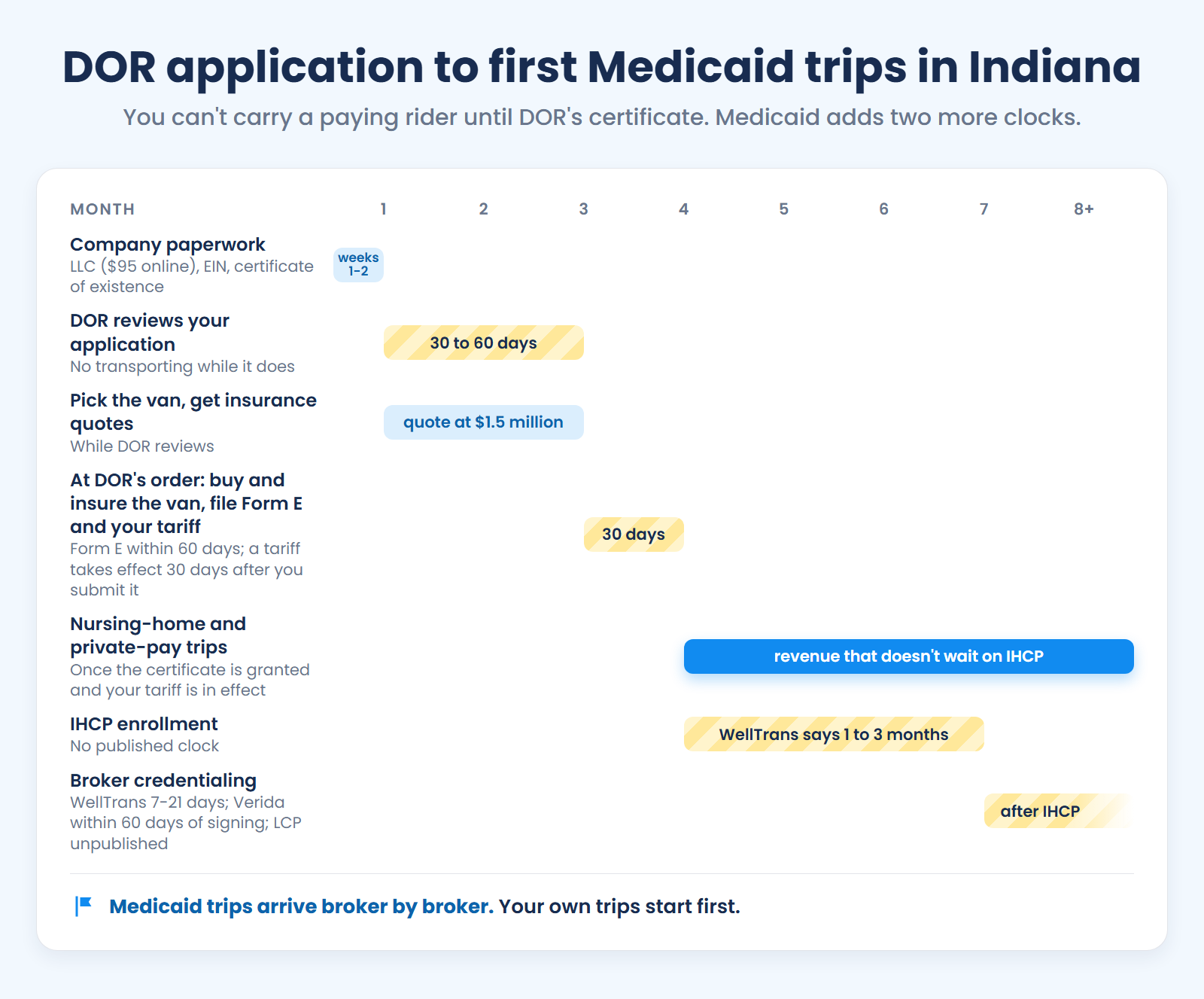
Your own trips can start about two to five months after you file with DOR, and Medicaid comes after that. DOR’s review takes 30 to 60 days with no transporting, the Permanent Order then gives you 60 days to file Form E and the tariff, and the tariff takes effect 30 days after you submit it [14][29]. Submit the tariff the week the order arrives and you’re at two to three months, plus however long DOR takes to issue the certificate once both papers are in; use the whole 60-day window after a 60-day review and it’s closer to five.
Medicaid starts after the certificate. IHCP publishes no processing time, and WellTrans puts IHCP enrollment at 1 to 3 months before its own credentialing begins [31][6]. Then each broker: WellTrans’s credentialing runs 7 to 21 days by its own estimate, Verida wants it finished within 60 days of signing its agreement, and LCP publishes no timeline [6][1][7].
Put the steps in this order:
- Weeks one and two: form the LLC, get the EIN and the certificate of existence, put up the website, and make the three calls.
- Filing day: send DOR the application and $100.
- The 30 to 60 days of review: no transporting. Pick the van, collect insurance quotes at $1.5 million, and line up nursing homes and families.
- When the order arrives: submit the tariff that week, which starts its 30-day clock. In those 30 days, buy, title and insure the van, have your insurer file Form E, and screen drivers. From here, fixed bills run about $1,934 a month.
- Certificate in hand, tariff in effect: run nursing-home and private-pay trips.
- When you’re ready for Medicaid: apply to IHCP. There’s no published clock, and WellTrans says 1 to 3 months.
- Each broker: WellTrans 7 to 21 days after IHCP, Verida within 60 days of signing, LCP unpublished. Medicaid trips arrive broker by broker, and your own trips started first.
The Indianapolis owner in the opening story is heading, more than a year in, where two owners of a private-pay company in rural Indiana started. When I talked with them in August, they said “we are only private pay,” with return riders’ trips already “booked for 2027” and a planned ceiling of seven to ten vans. I told them they don’t have to work with brokers.
In Indiana, the broker can wait until last. Before you send IHCP its $750, name the nursing home that will call you first, and the family that’s already booked its next ride.
Indiana NEMT FAQ
Do I need a license to start a NEMT business in Indiana?
Not one called a NEMT license, but a for-profit company carrying riders for pay needs the Department of Revenue’s motor carrier certificate, $100 to apply, with $1.5 million of auto liability on file, whoever pays for the ride [12][14]. Vehicles used only as taxicabs, government vehicles, government-funded nonprofits and ambulances are exempt [12]. Medicaid work adds IHCP enrollment, and Indianapolis’s code, as written, leaves unmetered vans used only for NEMT riders under DOR’s certificate out of its vehicle-for-hire rules [10][19].
Is Southeastrans still Indiana’s Medicaid ride broker?
Southeastrans is now Verida. The company changed its name effective January 1, 2023, and it’s still the fee-for-service broker [36][1]. Older pages and search snippets still print the old name. Health plan members don’t ride through Verida at all: their plans use WellTrans or LCP Transportation [2][3].
Do I have to enroll with IHCP before Verida, WellTrans or LCP will take me?
Yes. IHCP’s manual says providers “must be enrolled as IHCP providers and must contract with Verida,” WellTrans calls IHCP enrollment “a prerequisite to becoming a provider with WellTrans,” and LCP’s checklist asks first for your IHCP enrollment letter [1][6][7]. WellTrans can start credentialing right away once you’re enrolled, so file with IHCP before you apply to it.
Does Indiana require a surety bond for NEMT?
For Medicaid, yes. IHCP requires an Indiana surety bond of at least $50,000, lasting at least three years, from taxi, ambulatory, wheelchair, ride-hail and broker-fleet applicants [10]. 501(c)(3) nonprofits and companies owned by an Indiana-licensed hospital, pharmacy or licensed professional are exempt. DOR’s list of what the carrier certificate takes includes insurance and a $100 fee, not a bond [14].
How much does Indiana Medicaid pay for a NEMT trip?
IHCP’s 2026 maximum is $31.79 for a wheelchair trip of up to 10 miles one way and $12.71 for an ambulatory one, plus $1.67 a loaded mile past the first 10; IHCP has posted a preview of the NEMT fees that take effect January 1, 2027 [23][43]. Most trips run through brokers, though, and each sets your rate in its own agreement: Verida’s schedule starts from IHCP’s fees and can be negotiated higher, and WellTrans negotiates a grid by mileage band [1][24]. Ask each broker for its rate in your county.
Do Indiana NEMT drivers need a chauffeur license or a CDL?
Not for a typical NEMT van. Indiana’s chauffeur’s license expired in 2024 and its public passenger chauffeur’s license in 2022, and a CDL starts at 16 passengers counting the driver or 26,001 pounds [16][17]. Indiana law says operating a medical services vehicle isn’t transporting for hire, so the for-hire endorsement likely doesn’t apply; ask the Bureau of Motor Vehicles before a driver runs other paid work [16]. WellTrans wants drivers who are 21 or older [37].
Can I add NEMT to my home care agency in Indiana?
Not easily inside the agency. IHCP enrolls a transportation provider only if it makes “transportation services available to the general public” and shows that “its primary business function is the provision of transportation services” [10]. A home care agency doesn’t meet that test as written, which points to a separate transportation company. The waiver’s “Transportation” service is a different lane, under a statewide enrollment moratorium since August 1, 2026 [45]. Ask IHCP Customer Assistance, 800-457-4584, before you build either [9].
Is Indiana a good state to start a NEMT business?
It can be, if you start with trips you control. The demand is there: 1,358,600 Hoosiers were enrolled in Medicaid or the Children’s Health Insurance Program (CHIP) in June 2026 by the federal count, and 1,218,401 were 65 or older in 2024 [55][34]. So is competition: 853 active NEMT van NPIs, 6.3 for every 10,000 of those enrollees against 5.8 nationally, by our count, and 42.8% list Indianapolis [52]. An NPI is a registration, not a company running trips. Most Medicaid trips also take IHCP enrollment and a broker contract [10].
Key official sources
[1] Indiana Health Coverage Programs (IHCP), provider reference module Transportation Services, version 6.1 (published August 19, 2025; the current version on October 19, 2026): Verida brokers most fee-for-service NEMT and providers must enroll with IHCP and contract with Verida; the trips Verida doesn’t broker, including stretcher and ALS/BLS trips, hospital-to-hospital transports and nursing-facility residents’ rides; booking windows, preferred providers, hospital discharges and urgent transports; prior authorization; Verida’s form, 60-day credentialing deadline, Wednesday claims cycle and rate agreements; billing by level of service; mileage past the first 10 miles, waiting time and noncovered items; specialties 264 and 265; Verida’s booking line; and, in its revision history, the change of Southeastrans references to Verida. https://www.in.gov/medicaid/providers/files/modules/transportation-services.pdf
[2] IHCP Bulletin BT202608 (January 15, 2026; read October 8, 2026): MDwise no longer a HIP or Hoosier Healthwise plan from January 1, 2026, Modivcare’s NEMT for MDwise ended, and HIP and Hoosier Healthwise members of Anthem, CareSource and MHS riding with WellTrans, with each plan’s line. https://www.in.gov/medicaid/providers/files/bulletins/BT202608.pdf
[3] Anthem’s Indiana Medicaid transportation page (last updated August 27, 2026), Humana Healthy Horizons in Indiana’s transportation page (last updated April 7, 2026), UnitedHealthcare Community Plan of Indiana’s Hoosier Care Connect Care Provider Manual (2024 edition, the one UnitedHealthcare linked on October 19, 2026) and MHS’s Hoosier Care Connect transportation page (last updated December 31, 2025), all read October 19, 2026: each plan’s ride vendor and booking line. https://www.anthem.com/in/medicaid/extras/transportation, https://www.humana.com/medicaid/indiana/benefits/transportation, https://www.uhcprovider.com/content/dam/provider/docs/public/admin-guides/comm-plan/Indiana_Provider_Manual.pdf and https://www.mhsindiana.com/members/care-connect/benefits-services/transportation.html
[4] CMS, Managed Care Enrollment by Program and Plan, 2024, on data.medicaid.gov (read October 19, 2026): each Indiana plan’s 2024 enrollment by program, which our ride-vendor share estimates apply to FSSA’s July 2026 program counts. https://data.medicaid.gov/api/1/datastore/query/0bef7b8a-c663-5b14-9a46-0b5c2b86b0fe/0?conditions%5B0%5D%5Bproperty%5D=state&conditions%5B0%5D%5Bvalue%5D=Indiana&conditions%5B0%5D%5Boperator%5D=%3D&conditions%5B1%5D%5Bproperty%5D=year&conditions%5B1%5D%5Bvalue%5D=2024&conditions%5B1%5D%5Boperator%5D=%3D&limit=100&count=true&results=true
[5] FSSA, Monthly Medicaid Financial Report, July 2026 (read October 19, 2026): 1,487,207 enrollees, 1,249,241 of them in managed care, with counts for HIP, Hoosier Healthwise, Hoosier Care Connect and PathWays. https://www.in.gov/fssa/ompp/files/July2026MonthlyFinancialReporting.pdf
[6] CareSource and WellTrans, “WellTrans - NEMT Benefit Overview/Provider Credentialing”, IHCP Works 2026 seminar deck (first use August 31, 2026; read October 8, 2026): CareSource members booking up to two business days ahead; WellTrans targeting providers in needed areas and taking direct applications; an introductory email within one business day; IHCP enrollment as a prerequisite that “can take from 1-3 months”; and credentialing that “can range from 7-21 calendar days”, vehicle inspection included. https://www.in.gov/medicaid/providers/files/IHCP-Works-2026-CareSource-WellTrans-NEMT-Benefit.pdf
[7] LCP Transportation, New Vendor Credentialing Checklist (July 2026), home page, Our Story, Transportation Provider Network page and online Transportation Provider Application (all read October 19, 2026): IHCP enrollment letter and provider profile first; LCP as additional insured with 30 days’ notice of cancellation; an operating authority certificate; background checks, drug screens and driving records less than six months old; first aid, CPR, PASS and wheelchair securement training; OIG/SAM and E-Verify reports; member log-ins for UnitedHealthcare and Humana; “Established in 1998”; and the application’s questions on vehicles by type and counties served. https://www.lcptransportation.com/wp-content/uploads/2026/07/Updated-Vendor-Credentialing-7.7.26.pdf, https://www.lcptransportation.com/, https://www.lcptransportation.com/our-story/, https://www.lcptransportation.com/transportation-provider-network/ and https://lcptransprovider.paperform.co/
[8] IHCP Provider Enrollment Risk Category and Application Fee Matrix, version 6.5 (April 10, 2026; read October 18, 2026): specialties 264 and 265 pay the application fee, enroll at high screening risk and revalidate at moderate; waiver transportation enrolls under provider type 32, Waiver Provider. https://www.in.gov/dA/006ac49f3f/ihcp-provider-enrollment-risk-cat-and-app-fee-matrix.pdf?language_id=1
[9] IHCP Bulletin BT2025185 (December 23, 2025; read October 19, 2026): the $750 enrollment application fee from January 1, 2026, and IHCP Customer Assistance, 800-457-4584. https://www.in.gov/medicaid/providers/files/bulletins/BT2025185.pdf
[10] IHCP, provider reference module Provider Enrollment, version 7.1 (published September 8, 2026; read October 19, 2026): Motor Carrier Services certification or USDOT authority for for-profit carriers; a separate application fee for each service location, waived for providers enrolled in Medicare or already charged by another state’s Medicaid; fingerprints for 5% owners and unannounced site visits for high-risk providers; no NPI for atypical transportation providers; the general-public and primary-business rule; broker contracts on top of enrollment; the documents for specialties 264 and 265; the surety bond, its exemptions and waiver; driver information and attestations; online or paper applications; and revalidation every five years. https://www.in.gov/medicaid/providers/files/modules/provider-enrollment.pdf
[11] A surety bond seller’s Indiana Medicaid Transportation Provider Bond page (read October 19, 2026): the $50,000 bond for a three-year term, with premiums advertised from $1,063 for the term. https://www.suretybonds.com/states/indiana/medicaid-transportation-provider-bond
[12] Indiana Code 8-2.1-17-16, 8-2.1-22-1, -2.1, -12.5, -23, -29, -38, -40 and -46, and 8-2.1-24-18, in the General Assembly’s 2026 Code (read October 19, 2026): the taxicab definition, the certificate requirement and its exemptions, the certificate of existence and the receipt kept in each vehicle, tariffs, impoundment, the Class C infraction, the $100 filing fee, the federal-level financial responsibility floor, and federal safety rules for intrastate carriers, with drivers 18 to 20 allowed intrastate. https://iga.in.gov/ic/2026/Title_8.html
[13] DOR, Sales Tax Information Bulletin #12, Public Transportation (September 2026, effective October 1, 2026; read October 19, 2026): the public transportation exemption and its conditions, intrastate NEMT providers regulated by Motor Carrier Services, and the Tax Policy Division’s email. https://www.in.gov/dor/files/sib12.pdf
[14] Indiana Department of Revenue (DOR), Motor Carrier Services, “Getting Started with Household Goods or Passenger Authority” (read October 19, 2026): the Certificate of Public Convenience and Necessity under IC 8-2.1-22; 30 to 60 days to process with no transporting; passenger tiers counting the driver; $1.5 million of BIPD coverage at 15 passengers or fewer and $5 million at 16 or more; the application forms and documents; the $100 non-refundable fee; the Permanent Order and 60 days for Form E and the tariff; the certificate; yearly renewal by November 30; the three-rejection rule; and the Motor Carrier Services line and email. https://www.in.gov/dA/4fc2cac69d/mcs-goods-get-started.pdf?language_id=1
[15] IHCP Bulletin BT2024119 (July 30, 2024; read October 19, 2026): nursing-facility residents’ NEMT and BLS/ALS ambulance trips carved out of the fee-for-service and managed care brokers since July 1, 2023; nursing facilities coordinating, providing and paying for their Medicaid residents’ ambulatory and wheelchair van rides; assisted living residents still using the brokers. https://www.in.gov/medicaid/providers/files/bulletins/BT2024119.pdf
[16] Indiana Code 9-13-2-31 and -100, 9-24-3-4.5, 9-24-4, 9-24-5, 9-24-8.5-5 to -7, 9-17-2-14.5 and -14.7, 9-18.1-5-2 and 9-18.1-15-2, and 6-2.5-2-2 and 6-6-5-3, in the General Assembly’s 2026 Code (read October 19, 2026): the commercial motor vehicle definition, the medical services vehicle, the for-hire endorsement and its carve-out, the expired chauffeur’s licenses, the title fee and deadline, registration and the infrastructure fee, the 7% sales tax and the excise tax schedule. https://iga.in.gov/ic/2026/Title_9.html, https://iga.in.gov/ic/2026/Title_9/Article_17/Chapter_2.pdf and https://iga.in.gov/ic/2026/Title_6.html
[17] 49 CFR 383.5, definitions (GovInfo, 10-1-24 edition; read October 6, 2026): a commercial motor vehicle at 26,001 pounds or more, or designed to transport 16 or more passengers, including the driver. https://www.govinfo.gov/content/pkg/CFR-2024-title49-vol5/pdf/CFR-2024-title49-vol5-part383.pdf
[18] 836 IAC 1, Indiana Emergency Medical Services Commission rules (read October 19, 2026): an emergency patient includes anyone who needs to be transported on a litter or cot, and ambulance liability insurance of at least $1 million combined single limit. https://iar.iga.in.gov/code/current/836/1
[19] Revised Code of the Consolidated City and County, Indianapolis/Marion, chapter 996, Public Vehicles for Hire, on Municode (Supplement 47 Update 2, online August 21, 2026; read October 19, 2026): the vehicles it covers, the exclusion in 996-11(c)(8), the driver license requirement and the $100,000 insurance floor. https://library.municode.com/in/indianapolis_-_marion_county/codes/code_of_ordinances?nodeId=TITIVBUCORELI_CH996PUVEHI
[20] Carmel City Code, chapter 4, article 1, division IV, Taxicab and Limousine Service Regulations, on Municode (read October 19, 2026): the license for paid passenger transport from any location in the city, the $200 annual vehicle fee, the $25 driver application fee and the insurance limits. https://library.municode.com/in/carmel/codes/city_code?nodeId=wt7a9tgi
[21] Gary Code of Ordinances, chapter 46, article II, Taxicabs, Vans and Limousines, and section 20-1, fees, on Municode (online code codified through 2009; read October 19, 2026): vans and limousines offered for hire from a place in the city, and the $240 license, $120 vehicle and $20 driver fees. https://library.municode.com/in/gary/codes/code_of_ordinances?nodeId=PTIGEOR_CH46VEHI and https://library.municode.com/in/gary/codes/code_of_ordinances?nodeId=PTIGEOR_CH20FE_S20-1GE
[22] South Bend Code of Ordinances, section 4-61, Taxicabs, on Municode (supplement codified through February 9, 2026; read October 19, 2026): the taxicab definition, any vehicle carrying passengers for hire with a seating capacity of 12 or fewer including the driver. https://library.municode.com/in/south_bend/codes/code_of_ordinances?nodeId=SUHITA_CH4LI_ART4SPBURE_S4-61TACOVEDR
[23] IHCP Professional Fee Schedule With Cutbacks (last updated June 9, 2026; read October 19, 2026): 2026 maximum fees for T2003, A0130, A0425 with the U3 and U5 modifiers, T2007, T2004 and A0130 TT, and the stretcher van codes T2005 and T2049 listed as non-covered. https://www.in.gov/medicaid/providers/files/IHCP-Professional-Fee-Schedule-With-Cutbacks.xlsx
[24] WellTrans Provider In-Network Agreement (revised October 16, 2025; read October 9, 2026): the provider’s active Indiana Medicaid enrollment; no obligation to send a specific number of trips; vehicle, general liability, professional and workers’ comp insurance, additional insureds, A- insurers and the “for hire transportation” description; and Exhibit B’s negotiated rates, 60-day invoicing, 90-day cutoff and twice-monthly payment. https://www.welltransnemt.com/wp-content/uploads/2025/10/WellTrans-Provider-In-Network-Agreement_FINAL_10_16_2025.pdf
[25] DOR, Frequently Asked Questions, Motor Carrier Services (read October 19, 2026): a USDOT number for vehicles designed or used to carry more than eight passengers, including the driver, for pay; an Indiana ID number for intrastate carriers of eight or fewer; and a Form E Indiana on file for interstate passenger carriers. https://www.in.gov/dor/motor-carrier-services/frequently-asked-questions-motor-carrier-services/
[26] Indiana Code 16-31-3-1 and -17, 22-3-2-2, -9 and -14.5, 22-3-5-2.5, 22-3-6-1 and 23-0.5-9-19, -34 and -43, in the General Assembly’s 2026 Code (read October 19, 2026): the EMS certificate and its $500 civil penalty; workers’ comp for every employer, its exemptions, LLC members’ election, contractors’ $15 certificate of exemption and the $100-a-day penalty; and the LLC, biennial report and certificate of existence filing fees. https://iga.in.gov/ic/2026/Title_16.html, https://iga.in.gov/ic/2026/Title_22.html and https://iga.in.gov/ic/2026/Title_23.html
[27] Indiana Secretary of State, Regulatory Analysis for LSA Document #25-155 (read October 19, 2026): the online Enhanced Access fees, $20 for LLC articles of organization and $11 each for a certificate of existence and the biennial report. https://www.in.gov/sos/business/files/Regulatory-Analysis-Business-Entity-LSA-25-155-OMB-2024-73R.pdf
[28] DOR forms IOA-1 (R14 / 7-25), IOA-2 (R12 / 6-25) and IOAP-SUP (R2 / 6-25) (read October 19, 2026): vehicles that are, or can be, operational the day the form is completed; the tier by the seats a vehicle was manufactured with, modifications not counted; no lapse in insurance for any reason; the supporting witness, who needs the service, isn’t a relative and has a name, city and state published on DOR’s order; and the federal motor carrier office’s Indianapolis number. https://forms.in.gov/Download.aspx?id=2582, https://forms.in.gov/Download.aspx?id=7603 and https://forms.in.gov/Download.aspx?id=15971
[29] DOR Form IOA-T (8-25) and Motor Carrier Services “Tariff Guidance” (read October 19, 2026): what a tariff contains, that fares and charges not outlined in it can’t be charged, the 60 days to submit it after the permanent order, and its effective date 30 days after the issued date, the day it’s submitted. https://forms.in.gov/Download.aspx?id=16784 and https://www.in.gov/dA/2f5bfb6afa/mcs-goods-tariff-requirements.pdf?language_id=1
[30] Indiana State Police, Criminal History Services fees (read October 19, 2026): a limited criminal history for $16.32 online or $7.00 by mail. https://www.in.gov/isp/criminal-history-services/get-more-information/fees/
[31] IHCP provider enrollment web pages: Provider Enrollment Risk Levels and Screening, Provider Enrollment Application Fee, and Complete an IHCP Provider Enrollment Application (read October 19, 2026): fingerprinting through the Indiana State Police at the individuals’ cost, unannounced site visits, the fee “NOT an annual assessment”, “allow at least 15 business days for processing before checking the status”, and 21 business days to make corrections. https://www.in.gov/medicaid/providers/provider-enrollment/become-an-ihcp-provider/provider-enrollment-risk-levels-and-screening, https://www.in.gov/medicaid/providers/provider-enrollment/become-an-ihcp-provider/provider-enrollment-application-fee and https://www.in.gov/medicaid/providers/provider-enrollment/complete-an-ihcp-provider-enrollment-application/
[32] Indiana Medicaid NEMT Commission, minutes of August 18, 2026 (read October 8, 2026): Verida’s monthly averages for April to June 2026, including 27,529 trips, 20,948 ambulatory and 4,699 wheelchair. https://www.in.gov/fssa/ompp/files/NEMT-MinutesAug2026.pdf
[33] IHCP Bulletin BT202443 (April 11, 2024; read October 19, 2026): the fee-for-service trips a nursing facility arranges and pays for and recovers through its cost report, and hospital discharges that are new nursing-facility admissions arranged by the hospital through the fee-for-service broker. https://www.in.gov/medicaid/providers/files/bulletins/BT202443.pdf
[34] Census Bureau, American Community Survey 2024 1-year, table B01001, via Census Reporter (read October 19, 2026): Indiana residents 65 and older. https://api.censusreporter.org/1.0/data/download/latest?table_ids=B01001&geo_ids=040|01000US&format=csv
[35] IHCP Bulletin BT202493 (June 25, 2024; read October 18, 2026): PathWays for Aging, for Hoosiers 60 and older, and its members’ rides through WellTrans (Anthem) and LCP Transportation (UnitedHealthcare and Humana), with UnitedHealthcare’s member reservations line. https://www.in.gov/medicaid/providers/files/bulletins/BT202493.pdf
[36] IHCP banner page BR202252 (December 27, 2022; read September 27, 2026): “Effective Jan. 1, 2023, Southeastrans will officially change its name to Verida, Inc.” https://www.in.gov/medicaid/providers/files/banner-pages/BR202252.pdf
[37] WellTrans provider documents (read October 19, 2026): the Provider Credentialing Checklist (revised October 28, 2021), the Indiana Vehicle Inspection Form (August 2020), the OIG Verification Process (revised May 31, 2022), the Indiana Driver Form (revised August 4, 2026), with WellTrans’s Indianapolis address, and the provider training page: the application package, the vehicle inspection, monthly OIG exclusion checks on the company and its drivers, driver age, screening and training standards, and portal training before access. https://www.welltransnemt.com/wp-content/uploads/2021/10/Provider_Credentialing_Checklist.xlsx, https://www.welltransnemt.com/wp-content/uploads/2020/08/IN-Vehicle-Inspection-Form.pdf, https://www.welltransnemt.com/wp-content/uploads/2022/05/OIG-Verification-Process.pdf, https://www.welltransnemt.com/wp-content/uploads/2026/08/Indiana-Driver-Update-Form-08_04_2026.docx and https://www.welltransnemt.com/provider-training/
[38] CareSource’s Healthy Indiana Plan and Hoosier Healthwise 2025 Member Handbook and MHS’s Provider Manual 2025 (August 2025), both read October 19, 2026: before January 2026, CareSource sent members to LCP Transportation’s booking site and “MHS contracts with LCP Transportation Broker (LCP)”, and for claims LCP processed, the provider’s NPI was required when calling in an authorization. https://www.caresource.com/documents/in-hip-hhw-member-handbook-508.pdf and https://www.mhsindiana.com/content/dam/centene/mhsindiana/medicaid/pdfs/Provider-Manual-2025-508.pdf
[39] Indiana Department of Administration, Current Business Opportunities (read October 19, 2026): RFP 27-88343 for the Hoosier Healthwise, Healthy Indiana Plan, Hoosier Care Connect and PathWays managed care contracts, responses due November 6, 2026, and Hoosier Care Connect contracts extended to a maximum term through December 31, 2028. https://www.in.gov/idoa/procurement/current-business-opportunities/
[40] Indiana Medicaid NEMT Commission, minutes of August 8, 2023 (read October 19, 2026): the fee-for-service broker contract starting July 1, 2024 with Verida, “a four-year contract with two optional one-year extensions”. https://www.in.gov/fssa/ompp/files/NEMTMinutes_08-8-2023.pdf
[41] 405 IAC 5-30-1 on LII (filed January 22, 2025; read October 19, 2026): no more than 20 one-way trips per member each calendar year without prior authorization, and the trips exempt from the cap, including renal dialysis and nursing-home residents. https://www.law.cornell.edu/regulations/indiana/405-IAC-5-30-1
[42] Indiana Family and Social Services Administration (FSSA), SEA 480 report for July 2026 (Verida, Inc.; read October 19, 2026): NEMT-eligible fee-for-service members, missed trips as a share of scheduled rides, and network vehicles by county. https://www.in.gov/fssa/ompp/files/July2026-480Report.pdf
[43] IHCP Bulletin BT2026143 (August 27, 2026; read October 19, 2026): the Professional Fee Schedule moving to 100% of January 1, 2026 Medicare rates for transportation services from January 1, 2027, and the preview fee schedules, NEMT’s among them, on IHCP’s Fee Schedules webpage. https://www.in.gov/medicaid/providers/files/bulletins/BT2026143.pdf
[44] IHCP, provider reference module Home- and Community-Based Services Waivers, version 2.2 (published June 15, 2026; read October 19, 2026): the waiver Transportation service, for access to nonmedical community services and activities, and its FSSA-approved providers. https://www.in.gov/medicaid/providers/files/modules/ompp-hcbs-waiver.pdf
[45] IHCP Bulletin BT2026124 (July 23, 2026; read October 18, 2026): the statewide certification and enrollment moratorium on HCBS 1915(c) waiver providers from August 1, 2026, six months at first and extendable in six-month steps, with the waiver Transportation service on its list. https://www.in.gov/medicaid/providers/files/bulletins/BT2026124.pdf
[46] Indiana Code 36-9-2-1 and 36-9-2-4, in the General Assembly’s 2026 Code (read October 19, 2026): every unit except townships may regulate vehicles held out for public hire, except transportation network companies and their drivers. https://iga.in.gov/ic/2026/Title_36.html
[47] Indianapolis Revised Code chapter 131, license and permit fees, on Municode (read October 19, 2026): $208 a public vehicle for hire, $59 an operator license and a $65 initial inspection. https://library.municode.com/in/indianapolis_-_marion_county/codes/code_of_ordinances?nodeId=TITIORAD_CH131FE
[48] City of Indianapolis, Department of Business and Neighborhood Services, Business Licenses page, its Public Vehicle for Hire Owner License application and its Checklist for Taxi Company Owners (read October 19, 2026): the licenses listed by business type, the “Annual license fee of $208 per vehicle”, and Business Licensing’s phone and email. https://www.indy.gov/activity/business-licenses, https://us-east-1-indy.graphassets.com/ActDBC5rvRWeCZlNNnLrDz/QnEvP9TRQ4yvVjY9XIhC?dl=true and https://us-east-1-indy.graphassets.com/ActDBC5rvRWeCZlNNnLrDz/mtOO0jHjS9W962pjykCi?dl=true
[49] 49 USC 13501 and 13506 (GovInfo, 2023 edition; read October 6, 2026), 49 CFR 387.33T (LII; read September 25, 2026), and 49 CFR 372.233 and Appendix A to Part 372 (LII; read October 19, 2026): federal jurisdiction over trips across a state line, the commercial-zone exemption’s condition for passenger carriers, the $1.5 million floor for vehicles seating 15 or fewer including the driver, the Chicago commercial zone’s Indiana cities and the Louisville zone’s 5 miles. https://www.govinfo.gov/content/pkg/USCODE-2023-title49/pdf/USCODE-2023-title49-subtitleIV-partB-chap135-subchapI-sec13501.pdf, https://www.govinfo.gov/content/pkg/USCODE-2023-title49/pdf/USCODE-2023-title49-subtitleIV-partB-chap135-subchapI-sec13506.pdf, https://www.law.cornell.edu/cfr/text/49/387.33T, https://www.law.cornell.edu/cfr/text/49/372.233 and https://www.law.cornell.edu/cfr/text/49/appendix-A_to_part_372
[50] Indiana Code 22-4-8-1, the General Assembly’s 2026 chapter PDF (read October 19, 2026): service for pay is employment for unemployment insurance unless it meets every condition, including being outside the usual course of the business. https://iga.in.gov/ic/2026/Title_22/Article_4/Chapter_8.pdf
[51] 49 CFR 390.5, definitions (GovInfo, 10-1-24 edition; read October 6, 2026): a commercial motor vehicle includes one of 10,001 pounds or more, or one designed or used to carry more than 8 passengers, including the driver, for compensation. https://www.govinfo.gov/content/pkg/CFR-2024-title49-vol5/pdf/CFR-2024-title49-vol5-sec390-5.pdf
[52] CMS, NPPES Data Dissemination file of July 13, 2026 (downloaded August 7, 2026), from the NPI files page: active NPIs carrying the NEMT taxonomy 343900000X, by practice location, in Indiana and nationally, and by Indiana practice city (our count of the full file, primary or secondary taxonomy, organizations and individuals). https://download.cms.gov/nppes/NPI_Files.html
[53] U.S. Small Business Administration, grants page (read September 25, 2026): “SBA does not provide grants for starting and expanding a business.” https://www.sba.gov/funding-programs/grants
[54] Indiana Economic Development Corporation, SSBCI page, and the Indiana Small Business Development Center home page (read October 19, 2026): the Legend Fund’s $5,000 to $1,000,000 loans through participating lenders, the SSBCI programs running until 2031 or until the money runs out, and the SBDC’s no-cost advising, funded in part by the SBA. https://iedc.in.gov/ssbci and https://isbdc.org/
[55] CMS Medicaid and CHIP enrollment data, all states, June 2026 (preliminary, read October 15, 2026): the enrollment counts behind the per-10,000 comparison, including Indiana’s 1,358,600. https://data.medicaid.gov/api/1/datastore/query/6165f45b-ca93-5bb5-9d06-db29c692a360/0?conditions%5B0%5D%5Bproperty%5D=reporting_period&conditions%5B0%5D%5Bvalue%5D=202606&conditions%5B0%5D%5Boperator%5D=%3D&properties%5B0%5D=state_abbreviation&properties%5B1%5D=reporting_period&properties%5B2%5D=preliminary_or_updated&properties%5B3%5D=total_medicaid_and_chip_enrollment&limit=150
Last verified against the sources above in October 2026. Indiana requirements, health plans, brokers and rates change; check the primary sources before acting, and treat this guide as education, not legal advice.
About the author
James O'Donnell cofounded Duet and leads its sales, partnerships, and growth services. He talks with NEMT operators every week, hosts the NEMT Growth podcast, and answers Duet's sales line himself. More about Duet's founders →
Starting in a nearby state?
Want more trips and less busywork?
See how Duet runs and grows NEMT businesses in a 30-minute demo.