Article
How to Start a NEMT Business in Louisiana (2026)
Louisiana has no NEMT license, but every Medicaid health plan books rides through one broker that can say no. Here's what to do first.
By James O'Donnell, Cofounder and COO, Duet ·
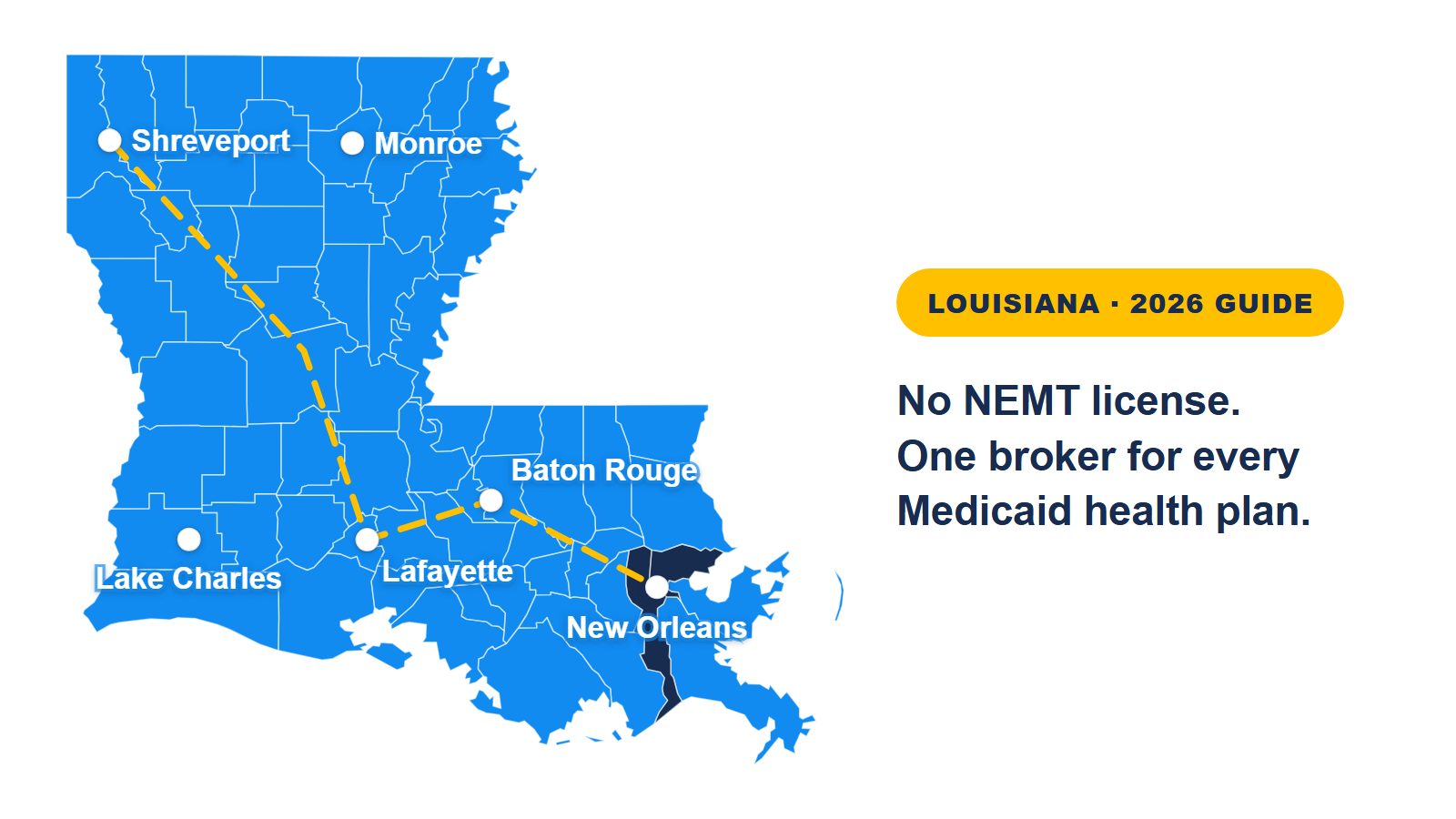
To start a NEMT business in Louisiana, form an LLC ($125), insure and plate each van “for hire,” and put drivers on Class D chauffeur’s licenses. There’s no state NEMT license. Every Healthy Louisiana health plan books its Medicaid rides through one broker, MediTrans, which can turn new companies away, so your first paid trips should come from nursing homes and private-pay families. Budget about $23,200 to $50,900 for one used wheelchair van, counting six months of fixed bills.
Louisiana at a glance:
- Who runs Medicaid rides: MediTrans for all five Healthy Louisiana plans, about nine in ten Medicaid enrollees; Verida for the small fee-for-service group [1][2].
- Getting in: MediTrans takes companies where its network needs them; the Louisiana Department of Health (LDH) then invites them into its Medicaid Enrollment Portal [3][4].
- State registration: no NEMT license, but “for hire” plates, issued by the Office of Motor Vehicles (OMV) after the Louisiana Public Service Commission (LPSC) grants an exempt certificate [5][6].
- Rates: LDH’s floor is $13.50 a trip leg plus $1.10 a mile ambulatory and $21.50 plus $1.30 by wheelchair van, unless you sign a contract for less; a 2026 law would raise it once funded [7][8][9].
- Insurance: MediTrans wants $1 million of auto liability; Medicaid’s floor is $25,000/$50,000/$25,000 or $300,000 combined [3][8].
- Drivers: a Class D chauffeur’s license, and a commercial driver’s license (CDL) only at 16 or more seats, driver included, or 26,001 pounds; Medicaid adds age 21 and yearly background checks and drug screens [8][10].
- Nursing homes: they pay for their Medicaid residents’ non-ambulance rides themselves [8].
- New Orleans: a $150-a-year Certificate of Public Necessity and Convenience (CPNC) per van, plus driver permits [11].
A one-van owner in south Louisiana told me on a call in August 2026 that she was “just starting.” Every trip came “from brokers, from [MediTrans].” She wanted private-pay and facility work but was still “trying to figure out how to get those,” and in the meantime she’d “been looking into some other brokers.” For her plan riders, there isn’t another one: LDH lists MediTrans for every Healthy Louisiana plan, and says it “does not require that each transportation broker accept every potential NEMT provider” [1].
That door is crowded, too. By our count of the federal government’s July 2026 provider file, 2,459 active national provider identifiers (NPIs) with a Louisiana practice address carry the NEMT van taxonomy, individuals included. That’s 19.4 for every 10,000 people in Medicaid and the Children’s Health Insurance Program (CHIP), against 5.8 nationally [12][13]. The count measures crowding, not companies running trips, and MediTrans says acceptance “depends on regional saturation and fleet type needs in your area” [3].
Her instinct works in states where the Medicaid health plans use different ride vendors, like Texas. In Louisiana, one broker books every Healthy Louisiana plan’s rides and can turn away new companies, so line up nursing-home and private-pay trips before you count on it. The checklist below runs in the order that wastes the least money: riders, then the van and state paperwork, then MediTrans. After it come who pays, the brokers and what they pay, licenses, insurance, drivers, getting in, costs and timing.
I run Duet, which builds dispatch software and runs growth services for non-emergency medical transportation (NEMT) companies, and I talk to NEMT owners on demos every week, Louisiana operators included. This is the Louisiana edition of our national guide on how to start a NEMT business. Requirements change, so confirm against the linked sources before you spend money.
The one-page checklist: how to start a medical transportation business in Louisiana
In Louisiana your first riders come before the van, and the van before MediTrans, which wants each van’s insurance, registration and inspection report before it activates you [3]. Each phase ends with the money it puts at risk.
Phase 0: pick your riders, your van and your parish
- Nursing homes: call the five nearest you and ask who books residents’ wheelchair rides. Louisiana Medicaid makes the home pay for them [8].
- MediTrans: this week, email providers@meditrans.com and ask whether it’s taking your vehicle type in your parish [3].
- The van: owned or leased in the company’s name. Medicaid won’t take stretcher vans, two-door vehicles, pickups or salvage titles [8].
- Money at risk: none yet.
Phase 1: form the company and get your numbers
- File articles of organization with the Secretary of State: $125 since October 1, 2026, plus $35 for each annual report [14].
- Get a free employer identification number (EIN) from the IRS and a free NPI under the NEMT van taxonomy, 343900000X.
- Get a business phone line first, because the public NPI Registry shows your practice location’s number [15]. A co-founder getting ready to launch with one ambulatory van in New Orleans told me in July 2026 he’d used his personal number, and the Monday after his NPI went live he “did not sleep from how many phone calls,” most of them sales pitches.
- Register for your city or parish occupational license tax, from $50 in New Orleans and Jefferson Parish [11][16].
- Money at risk: about $175.
Phase 2: quote insurance, then buy, plate and inspect the van
- Get commercial auto quotes at $1 million per occurrence, MediTrans’s minimum, before you sign for the van [3].
- Call the LPSC Transportation Division, (888) 342-5717, about the exempt General License Certificate, which takes a notarized MT-10 affidavit. Its 2008 sheet has carriers apply for a Medicaid provider number first, so ask what it wants from a company that isn’t enrolled yet, and whether you need its passenger authority instead [17][18].
- Title the van in the company’s name ($68.50 plus an $8 handling fee) and buy “for hire” plates at $6.25 a seat a year, $25 minimum. Sales tax is the state’s 5% plus your parish’s rate [6][19].
- Act 701 of 2026 ends state inspection stickers for most vehicles on January 1, 2027, outside the parishes in the federal Clean Air Act emissions program, but the health plan or its broker still inspects each van before service and yearly. Ask MediTrans what replaces the “Active LA inspection sticker” that LDH’s vehicle list still requires [8][20].
- In New Orleans, apply for a CPNC [11].
- Money at risk: about $14,300 on a financed $33,000 van, the 2016-2019 wheelchair van in our national startup cost model. That’s $6,600 down, about $2,310 in tax, title and plates at the model’s 7% (Louisiana’s 5% state sales tax alone is $1,650 on this van, before your parish’s rate), $4,350 of insurance due at signing and about $1,000 for equipment and lettering.
Phase 3: license, screen and train your drivers
- Put every driver through the Class D chauffeur’s test: $54.75, a knowledge test and a vision test [10].
- For Medicaid work, drivers must be 21 or older and pass a State Police or FBI background check and a five-panel drug screen before the first ride, then every year [8].
- Book Medicaid’s required driver training before the first ride, including in-person CPR [8].
- Line up workers’ comp before you hire drivers [21].
- In New Orleans, each driver needs a city permit, $110 with the background check and drug test [11].
- Money at risk: about $1,000 for screening and training, plus $54.75 for each chauffeur’s license.
Phase 4: book the trips you control
- Sign up the nursing homes that book their own residents’ rides, and ask how each wants trips confirmed and how it pays.
- Take a card when a family books a private-pay ride, and charge it a day or more before pickup.
- Put up a site families can find on Google and book from and a Google Business Profile.
- Money at risk: about $300 for a phone and basic marketing.
Phase 5: open the Medicaid door
- Once the van is insured and plated, send MediTrans its letter of intent [3].
- When Louisiana Medicaid’s invitation letter comes, register in LDH’s Medicaid Enrollment Portal [4].
- Before you sign the broker agreement, price a 10-mile leg at LDH’s floor, $24.50 ambulatory or $34.50 by wheelchair van, against your own cost per trip [7].
- Money at risk: $750 if LDH charges you the 2026 federal application fee, then about $1,934 a month in fixed bills for a financed van, by our national model, while you wait [22][23].
A company that will only carry nursing-home and private-pay riders can stop after Phase 4, once it has asked the LPSC whether it needs passenger authority.
Who pays for NEMT rides in Louisiana?
Medicaid is the volume in Louisiana, but nursing homes pay for their Medicaid residents’ van rides and private-pay families pay up front, and neither waits on MediTrans.
Medicaid is the volume, and MediTrans books nearly all of it
About nine in ten Louisiana Medicaid enrollees are in a Healthy Louisiana health plan, and every one of those plans uses MediTrans [1][2]. At the end of June 2026 the plans, which LDH’s papers call managed care organizations (MCOs), held 1,250,614 people, against 1,378,186 on Louisiana Medicaid at any point that month; the two reports count differently [2]. Riders outside the plans go fee-for-service through Verida, a small group.
Nursing homes pay for their Medicaid residents’ rides
Louisiana Medicaid puts a nursing home resident’s non-ambulance rides on the nursing home. The coverage chart in LDH’s manual for the health plans lists those trips as “Included in facility per diem,” and the manual spells it out: “Any nursing facility enrollee needing non-emergency, non-ambulance transportation services are the financial responsibility of the nursing facility” [8]. Residents of intermediate care facilities for people with intellectual disabilities ride on their facility’s daily rate too. So the nursing home books and pays you itself, including a resident’s trips to dialysis.
State law gives that account a reason to check your paperwork. R.S. 40:1257.3 says “No healthcare provider shall contract with or hire a transportation company to provide NEMT services if that company does not meet local, city, and state requirements” [24]. Bring your plates, insurance certificate and driver files to the first meeting.
Dialysis clinics themselves are the exception to the facility pitch. In my experience most dialysis riders are on Medicaid, so their trips come through MediTrans, not the clinic.
Private pay is the margin, thickest in New Orleans
Private-pay families book you directly and pay before the ride. I told the New Orleans co-founder in July that a lot of Louisiana is tough because it’s almost all Medicaid trips, then added, “But in New Orleans, there is enough private pay to sustain you.” Statewide, 819,864 Louisianans are 65 or older, 17.8% of the state, in the Census Bureau’s 2024 one-year survey [13].
Most private-pay owners I talk to take a card when the family books and run it at least a day before pickup, or send a payment link that has to be paid by then. If it isn’t paid, the van doesn’t roll. A few also take a small nonrefundable deposit to hold the slot.
Outside New Orleans, expect less of it, but don’t skip it. I told the south Louisiana owner that private-pay or facility work “can pay better for the same trips.”
Who is the NEMT broker in Louisiana?
MediTrans is the NEMT broker for every Healthy Louisiana health plan, and Verida handles the small fee-for-service group outside the plans [1]. A broker is the company a health plan or state hires to assign and pay for Medicaid rides.
LDH lets a company contract “with one or all of the transportation brokers,” but only MediTrans serves the plans, and LDH doesn’t make brokers accept every applicant. One factor it names is “the overall number of NEMT providers within the network” [1]. Our state-by-state map of who brokers Medicaid rides counts Louisiana with the states where each plan picks its own ride vendor.
It got this way one plan at a time. LDH announced in April 2022 that it intended to hire MediTrans as Louisiana Medicaid’s single broker, then canceled that bid on January 16, 2025 [25]. AmeriHealth Caritas Louisiana moved from Verida to MediTrans on November 1, 2025 [26]. When UnitedHealthcare left on March 31, 2026, LDH moved its members’ standing ride orders, the recurring trips set up for treatments like dialysis [8], to their new plans, noting that “all Medicaid MCOs utilize the broker MediTrans” [27]. So one broker for every plan came out of the plans’ own broker contracts, not a state award.
Here’s the map as of October 2026 [1][2][28]. Plans and brokers change, so confirm before you build on any row; our log of 2026 broker moves in other states shows how often.
| Plan | Ride broker | Members, June 2026 | What’s changing |
|---|---|---|---|
| Louisiana Healthcare Connections | MediTrans | 381,433 | No change announced |
| Healthy Blue | MediTrans | 299,750 | Leaves Louisiana Medicaid December 31, 2026; standing ride orders carry over |
| Aetna Better Health of Louisiana | MediTrans | 207,212 | No change announced |
| AmeriHealth Caritas Louisiana | MediTrans, since November 1, 2025 (Verida before) | 191,337 | No change announced |
| Humana Healthy Horizons in Louisiana | MediTrans | 170,882 | No change announced |
| Fee-for-service (“legacy”) Medicaid | Verida | A small group of members outside the plans | |
| UnitedHealthcare Community Plan | None | Left Louisiana Medicaid March 31, 2026 | |
| All five plans | MediTrans | 1,250,614 | Four plans from January 1, 2027 |
How does a Medicaid trip reach your company?
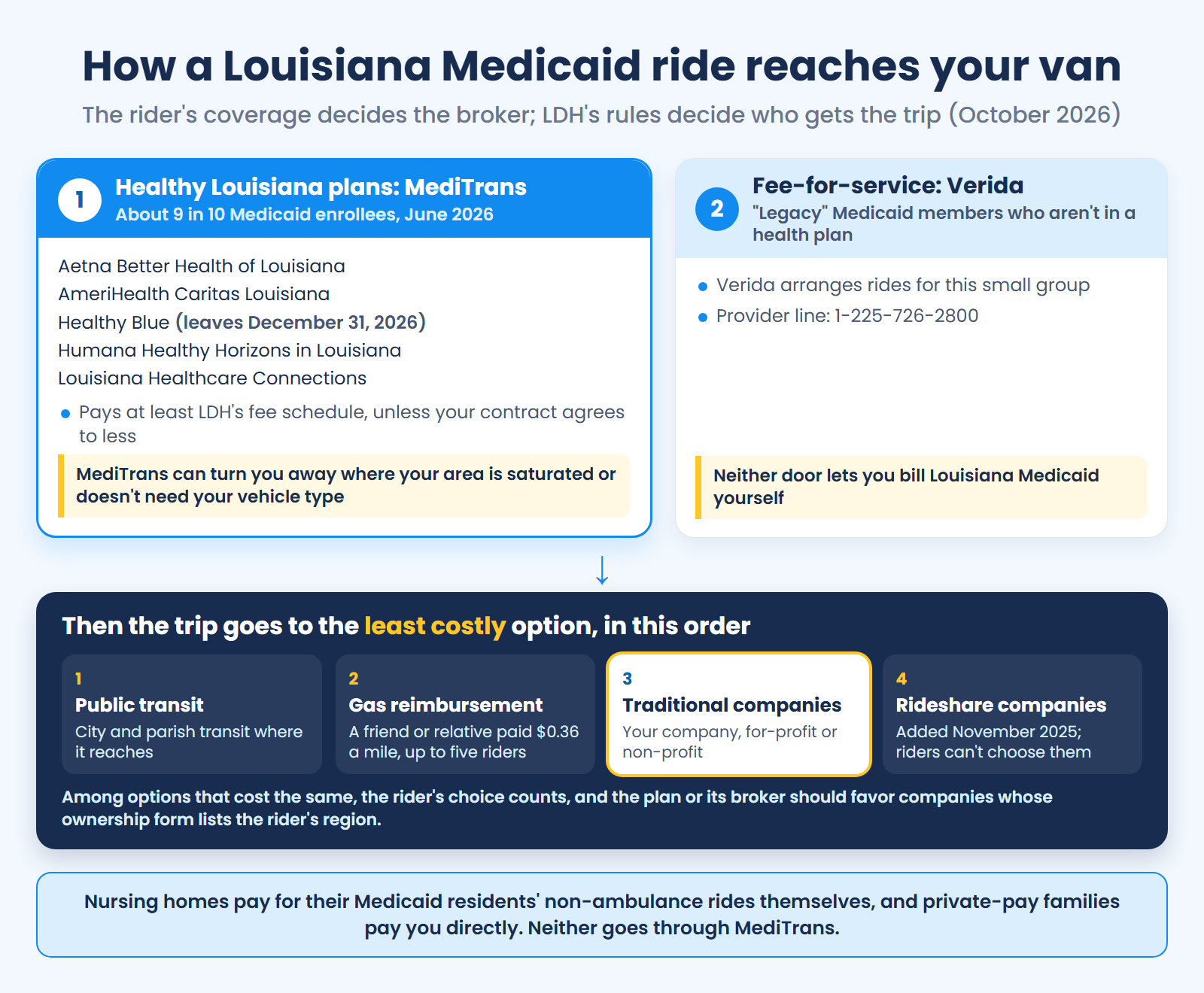
A Louisiana Medicaid trip comes through one of two doors, then goes to the cheapest way to get the rider there. Riders in any Healthy Louisiana plan, about nine in ten enrollees, book through MediTrans; the fee-for-service group books through Verida [1][2]. Either broker assigns trips on “the least costly means available, including the use of free and/or public transportation when possible” [1][8].
LDH’s manual tells the plans to consider four kinds of transportation provider, in this order [8][29]:
- Public transit: city and parish bus and train systems.
- Gas reimbursement: friends or family members paid $0.36 a mile to drive the rider [7].
- Traditional companies: for-profit and non-profit transportation companies, which is you.
- Rideshare companies: transportation network companies (TNCs), added by LDH’s November 2025 rule; a rider can’t choose one.
Among companies that tie on cost, the rider’s choice counts, and the manual tells plans to send the trip to companies whose ownership disclosure form lists the rider’s home region as their primary service region [8]. So list the LDH region where your riders are. Riders and medical offices are asked for 48 hours’ notice, though urgent trips like dialysis and chemotherapy can’t be refused for short notice [8].
What’s left for a traditional company, by my read, is the work a bus or a relative can’t do: wheelchair riders, riders who need help to the door, and riders with nobody to drive them.
Can I bill Louisiana Medicaid directly for NEMT rides?
No. Louisiana Medicaid pays a company only for trips a contracted broker scheduled, but LDH’s fee schedule sets the floor that broker pays, unless you sign a contract for less. LDH’s 2025 rule says NEMT services “shall only be reimbursed if scheduled by a contracted transportation broker” [29], and claims go to the broker within 365 days [1][8].
LDH’s provider page says a broker “may pay more than the minimum fee schedule rates; however, it may not pay less” [1]. The manual the plans work from makes it a floor you can sign away: payment can go below that published rate if “mutually agreed to by the MCO and the transportation provider in the provider agreement” [8]. Read the rate section of any broker agreement before you sign it.
Fee-for-service is no side door. It covers members outside the plans, whom LDH’s 2019 bulletin listed as people in the Take Charge Plus family planning or Medically Needy Spend Down programs or covered as refugees, and Verida arranges their rides [8][30]. LDH’s last posted Verida contract, for April 2024 through March 2025, capped what LDH would pay Verida to run the statewide fee-for-service program at $99,996 [31].
What does a Louisiana Medicaid trip pay?
LDH’s fee schedule, effective October 1, 2025, pays a base for each trip leg plus every mile from mile zero [7]:
| LDH fee schedule, effective October 1, 2025 | Base per trip leg | Per mile, from mile zero | Rate in effect since |
|---|---|---|---|
| Ambulatory (code T2003) | $13.50 | $1.10 | January 1, 2022 |
| Wheelchair van (code A0130) | $21.50 | $1.30 | January 1, 2022 |
| Wheelchair van, elevated level of care (code A0130) | $31.50 | $1.30 | October 1, 2025 |
| Gas reimbursement (code A0090) | None | $0.36 | October 1, 2015 |
Elevated level of care (ELOC) is door-through-door help for wheelchair riders, certified by a clinician for up to 180 days, and its line, new on October 1, 2025, is the only change since 2022 [7][8]. The other two bases went up $4 on January 1, 2022, from the July 2020 schedule’s $9.50 and $17.50, and haven’t moved since [7].
Say the rider lives 10 miles from the clinic. At the floor, each leg pays $24.50 ambulatory ($13.50 plus 10 times $1.10), $34.50 by wheelchair van and $44.50 at elevated level of care; the round trips pay $49, $69 and $89 [7]. A no-show pays nothing (“Scheduled trips in which no transportation of the enrollee occurs are not billable”), and nobody pays for extra passengers who ride along [8]. The bonus some operators counted on is gone, too: LDH’s American Rescue Plan Act (ARPA) payment of $500 a credentialed vehicle a month, for up to three vehicles, ended September 30, 2026, with the final payment October 31 [1].
What would Act 969 change?
Act 969 of 2026 tells LDH to set a minimum of $14.50 a trip and $2.10 a mile, “including wheelchair-accessible NEMT,” but only once “an Act of the Louisiana Legislature containing a specific appropriation of monies” for it takes effect [9]. LDH’s posted schedule still showed the 2022 rates on October 15, 2026 [7], and its NEMT line, (225) 342-9566, is the place to ask when a new one is coming [1].
Once funded, a 10-mile ambulatory leg would pay at least $35.50 instead of $24.50. The wheelchair base already tops $14.50, so the Legislative Fiscal Office’s note, working from LDH’s estimates, priced that side as a mileage raise alone, which would make the 10-mile wheelchair leg $42.50; it put the full-year cost at about $20.5 million [9]. The same law, when funded, would also bar Medicaid trips outside the rider’s home parish or a neighboring one without a medical-necessity determination [9].
What licenses and requirements does a NEMT business need in Louisiana?
Louisiana has no NEMT license, but each paid van needs “for hire” plates and a driver with a Class D chauffeur’s license, and OMV wants the Public Service Commission’s exempt certificate before it issues the plate. R.S. 45:181 bars carrying passengers for pay without “the appropriate driver’s license” and “‘for hire’ license plates,” at $100 to $500 per offense, 30 to 90 days in jail, or both [32].
The LPSC regulates passenger carriers, but R.S. 45:172(A)(3) exempts “vehicles operated by Medicaid or Medicare providers used exclusively for commercial nonemergency medical transportation” [5]. You still go through the LPSC to get plates. OMV’s hire-plate policy calls the NEMT vehicle “Exempt from regulation by the Louisiana Public Service Commission,” then says the owner “Must hold an Exempt General License Certificate in order to be issued a hire passenger license plate” [6]. The LPSC’s 2008 information sheet, still linked on its site, has you send a notarized “medical exempt affidavit (Sample No. MT-10)” and lists no fee, so ask the Transportation Division for today’s process [17].
Much of what circulates online gets Louisiana wrong, and some of it traces to a phantom license fee that turns up even for states with no NEMT license.
| The claim you’ll read elsewhere | What Louisiana actually requires |
|---|---|
| A “Louisiana NEMT Provider License” at “$850 initial, $510 renewal” | No such license exists. The state layer is the LPSC’s exempt certificate, “for hire” plates and chauffeur-licensed drivers [5][6][10] |
| “The LPSC regulates commercial passenger and NEMT carriers in the state.” | Vans used only for NEMT by Medicaid or Medicare providers are exempt; the LPSC step is the exempt certificate OMV needs before it plates the van [5][6] |
| “Publish a notice of intent to do business in your local newspaper” | The LPSC’s NEMT steps are a Medicaid provider number and a notarized MT-10 affidavit; no newspaper notice appears in them [17] |
| “Hire Taxi for sedans, Hire Bus for vans” | OMV has its own “Non-Emergency Medical Transportation Vehicle” class, at $6.25 a seat a year, $25 minimum [6][32] |
| “no special state transportation license is required beyond a standard Louisiana driver’s license” | Drivers need a Class D chauffeur’s license ($54.75) or a CDL [10][32] |
| A CDL for every NEMT driver | Only at 16 or more passengers counting the driver, or 26,001 pounds [10] |
| “minimum $1,000,000 liability coverage” as state law | The state floor is 15/30/25 and Medicaid’s is 25/50/25 or $300,000 combined; $1 million is MediTrans’s requirement [3][8][21] |
| “Modivcare (formerly LogistiCare) manages NEMT logistics for most Medicaid MCOs in Louisiana.” | MediTrans serves every Healthy Louisiana plan, and Verida serves fee-for-service [1] |
| “a single statewide transportation broker under contract with the state” | LDH canceled its single-broker bid in January 2025; each plan contracts with its own broker, and all five use MediTrans, four from January 2027 [1][25][28] |
| “Direct reimbursement for eligible NEMT trips.” | LDH pays only for trips a contracted broker scheduled [29] |
| A $500-a-vehicle monthly bonus, as if it were still paid | LDH’s ARPA bonus ended September 30, 2026 [1] |
What if you start with private-pay and nursing-home trips?
A company that isn’t a Medicaid or Medicare provider yet, or a van that also runs airport or casino trips, falls outside R.S. 45:172(A)(3), which covers Medicaid or Medicare providers and vans used only for medical trips [5].
Outside the exemption, a company that serves the public needs LPSC authority: the law bars anyone from operating “as a common or contract carrier without having obtained a certificate or permit from the commission,” at $100 to $10,000 a violation [5]. The LPSC’s Form T-75 packet charges $200 for a common carrier application, plus $10 a vehicle and $10 a driver a year, and requires $250,000/$500,000/$25,000 of liability [18]. A narrower carve-out covers passenger vehicles that run within their home parish, or do most of their work inside one city [5]. Which one fits a private-pay wheelchair van is the LPSC’s call, so ask before your first private-pay trip.
What do New Orleans and Jefferson Parish require?
New Orleans requires a CPNC for “all for-hire vehicles picking up passengers in New Orleans,” Non-Emergency Medical Transportation included [11]:
- Fees: $150 per CPNC a year and $50 per inspection; NEMT CPNCs expire June 30. Confirm current fees with the Ground Transportation Bureau at (504) 658-7170.
- Residency: the applicant, or every officer of a corporate applicant, lives in Orleans, St. Bernard, St. Tammany, Plaquemines, St. Charles, St. John the Baptist or St. James Parish.
- Insurance: 25/50/25 or $75,000 combined auto liability plus $100,000 of general liability, naming the City as certificate holder.
- Drivers: a two-year city permit and a drug screen, $110 in all with the federal background check.
- The van: registered as “FOR-HIRE” and inspected before the CPNC issues.
Louisiana Medicaid makes local permits a condition too: its manual names “The Certificate of Public Necessity (CPNC) and the Jefferson Parish NEMT permit” as examples [8]. LDH’s fee-for-service manual says Jefferson Parish’s Emergency Management Office issues that permit “for each provider, driver, and vehicle”; the parish’s Emergency Management pages show no fee or form, so call that office [16][33].
State law tells every city to regulate “each private passenger for hire vehicle” in it, and Baton Rouge’s Taxicab Control Board (225-389-3084), Shreveport’s Vehicle for Hire office and Lafayette ((337) 291-8200) license for-hire vehicles, so ask whether a wheelchair van falls under them [34].
One more layer for border runs: a paid trip across the Texas, Arkansas or Mississippi line falls under federal rules. Most companies then need operating authority from the Federal Motor Carrier Safety Administration (FMCSA), a U.S. Department of Transportation (USDOT) number and $1.5 million of liability for vehicles seating 15 or fewer, driver included [35].
What are the NEMT insurance requirements in Louisiana?
Plan on $1 million of commercial auto liability per occurrence, which MediTrans requires, plus general liability and workers’ comp or an approved waiver, with MediTrans listed as certificate holder [3]. Louisiana Medicaid’s own floor is $25,000 per person, $50,000 per accident and $25,000 of property damage, or $300,000 combined, and the floor for any car in the state is 15/30/25 [8][21].
Medicaid adds paperwork a broker will check, so give your agent this list. The certificate has to say the coverage “is for a Non-Emergency Medical Transportation Vehicle,” the policy needs a 30-day cancellation clause issued to the health plan, and LDH must be an additional insured on the auto and general liability policies. General liability is required wherever a local ordinance calls for it, and always for elevated-level-of-care work [8]. Let coverage lapse and “LDH or the MCO may recoup all payments for trips occurring during the period of violation” [8].
What will insurance cost a new Louisiana company?
For a new company’s wheelchair van at about $1 million of liability, our national model uses $1,450 a month, from new-company quotes of $1,200 to $1,800, with a quarter of the year, about $4,350, due at signing. Our guide to pricing a new NEMT company’s first policy shows where those numbers come from.
If personal auto is any guide, don’t expect Louisiana to come in under them. Louisiana drivers spent an average of $1,754.03 per insured car in 2023, second of 51 jurisdictions behind Florida, against $1,281.92 countrywide, in the National Association of Insurance Commissioners’ (NAIC) latest report [36]. Those are personal-auto figures, and NAIC warns that comparisons between states “should be treated with a high degree of caution.”
One Louisiana quote did come in lower. The New Orleans co-founder told me in July 2026 he’d been quoted about $650 a month for liability and auto on his one ambulatory van, when he’d braced for $800 to $900. “That seems really low, but maybe ambulatory makes it cheaper,” I told him. It’s one quote for one ambulatory van, not a rate to plan around.
Do you need workers’ comp in Louisiana?
Yes, once you have employees. R.S. 23:1168 says “An employer shall secure compensation to his employees” [21]. Going without costs up to $250 per employee for a first offense, capped at $10,000, and up to $500 per employee after that. A second failure can bring an order to stop operating, and a willful one a fine of up to $250 a day, a year in jail, or both [21]. MediTrans accepts a workers’ comp waiver from owner-operators without employees [3]. Louisiana has no state minimum wage law, so the federal $7.25 an hour applies to employers federal law covers [37].
What do NEMT drivers need in Louisiana?
Louisiana NEMT drivers need a Class D chauffeur’s license, not a CDL, until a van seats 16 counting the driver or tops 26,000 pounds; Medicaid adds age 21, a cap on moving violations, yearly background checks and yearly drug screens [8][10].
LDH’s manual, revised May 28, 2026, sets the Medicaid driver file [8]:
- 21 or older, with no more than two moving violations in the past three years;
- no conviction ever for driving under the influence or refusing a chemical test, and no ignition-interlock order, each a permanent bar;
- a criminal history check every year, run by the Louisiana State Police, an agency it authorizes or the FBI;
- a five-panel drug screen every year and on reasonable suspicion.
The plan also checks each driver’s official driving record monthly, and MediTrans wants a license held at least three years [3][8]. The state’s motor carrier safety rules reach in-state vehicles only at 16 or more people counting the driver, or over 26,000 pounds, so a typical wheelchair van that stays in Louisiana falls outside them [38].
How does a driver get a Louisiana chauffeur’s license?
A Louisiana Class D chauffeur’s license comes from the Office of Motor Vehicles after a knowledge test and a vision test, with no road test. It covers “any vehicle designed or utilized for the transportation of passengers for hire or fee,” and Act 66 of 2025 dropped it only for taxi drivers [10]. OMV’s steps [10]:
- Bring your driver’s license, proof of residency and proof of insurance for any vehicle you own.
- Study Chapter 10 of the Louisiana Driver’s Guide.
- Pass the chauffeur’s knowledge test and the vision test.
- Pay $54.75, plus a local fee of up to $6; time left on your regular Class E license counts toward it.
What training does Louisiana require before a driver’s first Medicaid ride?
Five courses, by LDH’s manual, before a driver carries any Medicaid rider [8]:
- Defensive driving: at least four hours, in person or online, renewed at least every three years.
- CPR: an in-person course ending in an active certification from a licensed instructor.
- Child passenger restraints: installing and using child seats under state law, renewed every year.
- Wheelchair securement and passenger assistance: wheelchair securement and Passenger Assistance Safety and Sensitivity (PASS) training every two years, with the securement training in person for any driver at a company with a wheelchair van.
- HIPAA: privacy and security under the federal health privacy law.
Drivers on elevated-level-of-care trips also take yearly courses, including two certifications from the education requirements of the Non-Emergency Medical Transportation Accreditation Commission (NEMTAC): Advanced Mobility Device Securement and Certified Transport Specialist [8].
Can a NEMT company run stretcher van trips in Louisiana?
Not for Medicaid: LDH’s manual says “Stretcher vans, two-door vehicles, and pickup trucks are not allowable vehicle types,” and stretcher riders go by ambulance instead [8]. Medicaid calls that non-emergency ambulance transportation (NEAT). It takes a Certification of Ambulance Transportation from the rider’s physician, a nurse or another listed clinician, good for up to 180 days, and an ambulance company licensed by LDH’s Bureau of Emergency Medical Services (EMS) [8].
For private pay, it’s unsettled. State law defines an ambulance as “any authorized emergency vehicle, equipped with warning devices,” run as a business “to transport a sick or injured individual,” and an ambulance service as one carrying people “who may need medical attention during transport” [39]. It names no stretcher-van category, and neither does the Bureau of EMS’s 2023 proposed licensing rule, which keeps the ambulance license at $100 plus $75 a vehicle [39]. A stable rider on a stretcher in a van without warning lights isn’t clearly inside or outside those words, so ask the Bureau of EMS before you buy one.
Either way, write the rule into your intake script: when a caller says the rider has to lie down for the trip, that’s an ambulance trip under Medicaid, and a question for the Bureau of EMS under private pay.
How do you become a Medicaid transportation provider in Louisiana?
You become a Louisiana Medicaid transportation provider through MediTrans, or Verida for fee-for-service riders, then register in LDH’s Medicaid Enrollment Portal when Louisiana Medicaid invites you. LDH says “All NEMT providers are required to register for the Medicaid Enrollment Portal” [1] and calls that enrollment “separate and apart from the credentialing process with any MCO” [4]. Since July 1, 2023, it has denied claims for trips by NEMT providers that weren’t enrolled [40]. Our national walk-through of Medicaid transportation enrollment shows how other states order these steps.
What gets a new company accepted?
Need, mostly. By its own account, MediTrans weighs how saturated your region is and which vehicle types it’s short of there [3]. So ask before you buy: email providers@meditrans.com with your parish and your vehicle type, and ask whether it’s taking that vehicle there.
A wheelchair van also opens facility doors that an ambulatory van can’t. The New Orleans co-founder, getting ready to launch with one ambulatory van, expected a facility to remember the company that couldn’t take its wheelchair rider: “they know you for only having an ambulatory.”
How do you apply to MediTrans?
MediTrans’s provider page lays out six steps [3]:
- Letter of intent: request the form from providers@meditrans.com and send it back; MediTrans says it replies within 3 to 5 business days.
- Background checks: every driver goes through MediTrans’s vendor, which takes 5 to 7 business days.
- Insurance: $1 million of commercial auto per occurrence, general liability and workers’ comp or a waiver, with MediTrans as certificate holder.
- Documents: upload each driver’s license, background clearance, defensive driving and CPR certificates and drug test, and each van’s registration, inspection report, insurance page, photos and accessibility paperwork.
- Training: an online orientation, the provider handbook and portal training.
- Activation: a provider ID and portal login, and trip offers that “will begin within 24-48 hours.”
How long does it take to get approved?
MediTrans says “Typically 2-4 weeks from Letter of Intent submission to activation, depending on how quickly you complete each step,” if it accepts you [3]. The New Orleans co-founder had his background checks and drug tests done the day we spoke in late July 2026, with orientation a week later. A viewer on our live episode in October 2026, apparently in Louisiana, said her approval had been pending “a few months.” Frank Ciccarella, a NEMT consultant who was our guest that day, said he’d ask for a face-to-face review: is something missing from the application, or does the broker not have “enough rides to give you”?
The state’s portal has its own clock: LDH tells applicants to “allow several weeks for application processing” [40]. Some new businesses owe the federal application fee, $750 in 2026, and get a letter if they do [22][23], and every provider revalidates at least every five years [40]. MediTrans’s estimate assumes it takes you. In my experience, Medicaid and broker applications can sometimes take six months or a year, so plan the first months around the nursing homes and families who can pay you sooner.
While you wait, nursing homes and private-pay families don’t ask for a broker contract. Our guides on how facility agreements get signed, the first trip after a facility meeting and pricing private-pay rides cover that stretch.
Don’t build the whole schedule on one payer
Every Healthy Louisiana plan uses MediTrans, so your second and third payers have to be facilities, starting with nursing homes, and private-pay families, not more brokers. Where a state has several brokers, some operators split their Medicaid work across four or five broker contracts so losing one doesn’t sink them. Louisiana’s managed care doesn’t offer that hedge, and Verida’s fee-for-service book is too small to be the second leg [1][31].
A MediTrans contract can move under you, too. Plans review every standing order at least once a calendar month for a cheaper option, and MediTrans warns providers that fall out of compliance that they’ll lose their standing orders [3][8].
Next door in Texas it’s different: each Medicaid health plan hires its own ride vendor, so a company can hold more than one contract. Georgia, farther east, runs its Medicaid rides through Verida as its single statewide broker, much as Louisiana’s plans all use MediTrans.
None of this argues against MediTrans. Where private pay is thin, as in my experience it is in much of Louisiana outside New Orleans, MediTrans is the main game: apply as soon as the van is insured and plated, and ask what vehicle type it needs. Nursing homes, which pay for their Medicaid residents’ rides everywhere in the state, carry the non-broker side there. And if MediTrans takes you, trip offers can start within a day or two of activation, by its own account [3].
Then run every lane from one schedule. Dispatch software like Duet puts your nursing-home and private-pay work on one board with your broker trips. Verida’s trips come in by trip file import, any other trip list by import or bulk upload, and each trip bills at the rate its contract sets. Your MediTrans credentialing, the LDH portal enrollment and invoicing each payer through its own process stay with you.
How much does it cost to start a NEMT business in Louisiana?
Budget about $23,200 to $50,900 for one used wheelchair van in Louisiana, counting six months of fixed bills. Those totals are cash out the door through month six, so a financed van counts as its down payment plus six payments.
In the middle, a 2016-2019 van at our national model’s $33,000, financed, takes about $28,100: the $6,600 down payment, about $9,900 of one-time costs and six months of fixed bills. An older $20,000 van financed with 20% down brings that to about $23,200. Paying cash for the $33,000 van takes about $50,900.
The totals count the $750 Medicaid application fee in case LDH charges it, and leave out fuel and your own living costs. Louisiana’s own inputs are its fees; the rest comes from our national model, including 7% for tax, title and plates, which leaves under 2% for your parish’s sales tax, so a higher parish rate adds to these totals.
| Line item | Louisiana amount | Note |
|---|---|---|
| LLC articles of organization | $125 | Since October 1, 2026; plus $5 by card, and $35 for each annual report [14] |
| EIN and NPI | $0 | Free from the federal agencies that issue them |
| Louisiana NEMT license | $0 | None exists |
| LPSC exempt General License Certificate | No published fee | A notarized MT-10 affidavit; ask the LPSC at (888) 342-5717 [17][18] |
| LPSC passenger authority | $200, only outside the exemption | Plus $10 a vehicle and $10 a driver a year; not in the totals [18] |
| Medicaid application fee | $750 if LDH charges it | The 2026 federal amount; LDH sends a letter if you owe it [22][23] |
| Used wheelchair van, 2016-2019 | About $33,000, or $6,600 down if financed | National model: 80% financed at 14% over 60 months, $614 a month |
| Tax, title and plates | About $2,310 | National model’s 7%, which leaves under 2% for parish sales tax after Louisiana’s 5% state rate ($1,650 here), title ($68.50 plus an $8 handling fee) and plates ($6.25 a seat a year, $25 minimum); add the rest of your parish’s rate [6][19][32] |
| Insurance due at signing | About $4,350 | A quarter of the national model’s $17,400 year |
| Equipment and lettering | About $1,000 | National model; Medicaid wants signs on both sides and the rear, not hand-written or spray-painted [8] |
| Class D chauffeur’s license | $54.75 per driver | Plus up to $6 in local fees [10] |
| Screening and training | About $1,000 | National model (PASS classroom, CPR, a drug test and a background check); Louisiana Medicaid also requires defensive driving, child-restraint and HIPAA courses, a five-panel screen and a State Police or FBI check [8] |
| Occupational license | From $50 | The minimum in New Orleans and Jefferson Parish [11][16] |
| Phone and basic marketing | About $300 | National model |
| Six months of fixed bills | About $11,600 financed, $7,920 bought outright | $1,934 a month financed: a $1,305 insurance installment, a $614 van payment and $15 for a phone; $1,320 with no van payment |
| New Orleans only | $150 CPNC and $50 inspection per van a year; $110 per driver | The driver permit runs two years; confirm fees with the Ground Transportation Bureau; not in the totals [11] |
| Total, owner driving | About $28,100 financed, $50,900 bought outright | An older $20,000 van, financed, comes to about $23,200 |
On the revenue side, LDH’s floor is the yardstick. At $69 for the 10-mile wheelchair round trip worked out above, the financed van’s $1,934 of monthly fixed bills takes 29 such round trips a month to cover, before fuel or a driver’s pay; at the ambulatory floor, it takes 40 [7]. You’ll see ambulatory rates quoted online at about $28 a trip plus $2 to $6 a mile with a rider aboard. LDH’s published floor is $13.50 plus $1.10, and anything above it comes from a broker’s contract or your own private-pay price.
If someone quotes you a Louisiana launch for a few thousand dollars, ask where the insurance is: the deposit alone is about $4,350, in the state with the second-highest average spending on personal auto insurance per insured car [36].
How do you fund a NEMT startup in Louisiana?
Louisiana’s help with a van loan runs through banks. The Louisiana Economic Development Corporation’s Small Business Loan Guaranty Program guarantees up to 80% of a loan, with a $1.5 million cap on the guarantee, and you start at a bank, which applies to the program for you. Loans under $100,000 have to create or keep at least one full-time job [41]. Small Business Administration (SBA) 7(a) loans and microloans are the federal options. None of them speeds up MediTrans, so borrow against the timeline you actually face.
How long does it take to start a NEMT business in Louisiana?
Nursing-home and private-pay trips can start once the van is plated and insured, and MediTrans estimates two to four weeks from your letter of intent to activation if it accepts you [3]. The other clocks are mostly unpublished: the LPSC certificate, OMV plates, insurance quotes and New Orleans CPNC publish none, and LDH says to allow several weeks for its portal [40]. The Secretary of State processes filings while you wait for an extra $60, or within 24 hours for an extra $35 [14].
- Before you buy: call nursing homes, ask MediTrans about your vehicle type and parish, form the LLC, get the EIN, NPI and a business phone, and collect insurance quotes.
- Van week: buy and insure the van, and ask the LPSC which certificate it will issue a company that isn’t enrolled in Medicaid yet. Its 2008 sheet starts with a Medicaid provider number application. Then title and plate the van, and in New Orleans apply for the CPNC.
- The next few weeks: license and train drivers, run the first nursing-home and private-pay trips, and send MediTrans your letter of intent.
- After MediTrans accepts you: finish its uploads and training; trip offers start within 24 to 48 hours of activation by its account, and Louisiana Medicaid’s portal invitation follows.
The hardest stretch is the first one. As I told the New Orleans co-founder, the challenge is going from zero trips to 10 a week, and every trip after that gets easier.
The owner at the top of this guide was looking into some other brokers. For her riders in a Healthy Louisiana plan, there isn’t one. The second payer she’s looking for is a nursing home’s front desk and a family that pays by card the day before. Before you send MediTrans a letter, name the nursing home and the family who’d pay you next week if it said no.
Louisiana NEMT FAQ
Do I need a license to start a NEMT business in Louisiana?
No state NEMT license exists [5]. What you do need: a company registered with the Secretary of State, “for hire” plates from OMV after the LPSC’s exempt certificate, or its passenger authority if you’re outside the exemption [5][18], Class D chauffeur’s licenses for your drivers, an occupational license from your city or parish, a CPNC for each van in New Orleans, and a NEMT permit in Jefferson Parish [6][11][33]. Medicaid work adds MediTrans’s credentialing and LDH’s enrollment portal.
Is MediTrans the only NEMT broker in Louisiana?
For Healthy Louisiana plan members, yes, and that holds after Healthy Blue leaves [1][28]. The exception is the small fee-for-service group outside the plans, whose rides Verida arranges; Verida’s provider line is 1-225-726-2800 [1].
Is Modivcare or MTM still a Louisiana Medicaid broker?
No. LDH’s provider page lists MediTrans for every Healthy Louisiana plan and Verida for fee-for-service, and LDH’s bulletins on UnitedHealthcare’s March 2026 exit and on Healthy Blue’s coming one say every Medicaid plan uses MediTrans [1][27][28]. Older guides and bulletins still name Modivcare, MTM or Southeastrans, which is Verida’s former name, so check the date on anything you read [33].
What happens to NEMT trips when Healthy Blue leaves Louisiana Medicaid?
They stay with MediTrans. Healthy Blue members pick a new plan between October 15 and November 16, 2026, or LDH assigns one, effective January 1, 2027, and the state’s eligibility system shows the new assignments by November 23, 2026 [28]. LDH says members with standing ride orders “will be transferred to the receiving MCO and remain in place,” and Healthy Blue’s provider call center stays open through June 30, 2028.
How much does Louisiana Medicaid pay for a NEMT trip?
Your MediTrans agreement sets it, and LDH’s fee schedule is the floor unless the agreement says less: $13.50 a trip leg plus $1.10 a mile ambulatory, $21.50 plus $1.30 by wheelchair van [7]. Ask for MediTrans’s rate sheet before you sign. Act 969’s $14.50 and $2.10 aren’t in effect until the Legislature funds them [9].
How long does MediTrans credentialing take?
Two to four weeks from your letter of intent to activation, by MediTrans’s own estimate, if it accepts you [3]. Either way you get a letter with its answer. If it says no, MediTrans keeps your information “on record for outreach in the event circumstances change,” so ask again when you add a vehicle type it needs.
Do NEMT drivers in Louisiana need a chauffeur’s license or a CDL?
A chauffeur’s license, yes; a CDL, usually not. Louisiana issues the Class D chauffeur’s license from age 17 with a parent’s consent, but Medicaid trips need drivers 21 or older, and MediTrans wants a license held at least three years [3][8][10]. A CDL starts at 16 passengers counting the driver, or 26,001 pounds [10].
Can friends and family get paid to drive Medicaid riders in Louisiana?
Yes, as gas reimbursement providers, at $0.36 a mile, one payment per trip however many riders are aboard [7][8]. The driver must be 18 or older with a valid Louisiana license, can’t live at the rider’s address and can drive no more than five named Medicaid riders, counted across all plans, unless more than five live in one household. LDH’s page adds that a rider isn’t eligible for NEMT at all if anyone in the household owns a working vehicle [1].
Is Louisiana a good state to start a NEMT business?
It can be, if you start with trips you control. The demand is there: 1,359,536 Louisianans were on Medicaid in September 2026 by LDH’s count, and the state has 819,864 residents 65 or older [2][13]. So is the competition: Louisiana has the sixth-most active NEMT van NPIs in the country by our count, and 932 of them were first issued in 2023 or later [12]. The cautions: that Medicaid count is down from 1,541,055 in October 2025, the fee schedule’s rates haven’t moved since 2022, and MediTrans takes companies where it needs them [2][3][7].
Key official sources
[1] Louisiana Department of Health (LDH), Medical Transportation Provider Resources page (read October 15, 2026): each health plan’s broker, Verida for fee-for-service, brokers needn’t accept every provider, portal registration, the fee schedule floor, the provider classes and gas reimbursement rules, claims to the broker, the ARPA bonus’s end and LDH’s NEMT contacts. https://ldh.la.gov/medicaid/medical-transportation-provider-resources
[2] LDH, Healthy Louisiana report 117A, enrollments by subprogram (June 2026), and Louisiana Medicaid Enrollment Trends report (September 2026): members by plan and total enrollees by month. https://www.ldh.la.gov/assets/docs/BayouHealth/Monthly_Reports/2026June/117A-max-2026-06.pdf and https://www.ldh.la.gov/assets/medicaid/MedicaidEnrollmentReports/EnrollmentTrends/2026/EnrollmentTrends_202609.pdf
[3] MediTrans, Transportation Providers page (read October 2026): the letter of intent and onboarding steps, insurance and driver requirements, the two-to-four-week estimate, acceptance by regional saturation and fleet type, trip offers after activation, standing orders and the workers’ comp waiver. https://meditrans.com/transportation-providers/
[4] LDH, For Medicaid Providers page (read October 2026): invitation letters, state enrollment “separate and apart” from plan credentialing, and five-year revalidation. https://www.ldh.la.gov/medicaid/for-medicaid-providers
[5] R.S. 45:162, 45:163, 45:171, 45:172 and 45:178 (Louisiana Legislature): Public Service Commission jurisdiction, the exemption for Medicaid and Medicare providers’ NEMT vehicles, the home-parish carve-out, the certificate requirement and its penalties. https://www.legis.la.gov/Legis/LawPrint.aspx?d=99912, https://www.legis.la.gov/Legis/LawPrint.aspx?d=99913, https://www.legis.la.gov/Legis/LawPrint.aspx?d=99923, https://www.legis.la.gov/Legis/LawPrint.aspx?d=99924 and https://www.legis.la.gov/Legis/LawPrint.aspx?d=99930
[6] Louisiana Office of Motor Vehicles, Policy 124.00, Hire Passenger Vehicles (revised February 7, 2013), and its registration, title and plate fee page: the NEMT vehicle class, its LPSC exemption and certificate, the $6.25 per seat plate fee, and the title and handling fees. https://public.powerdms.com/ladpsc/documents/366273 and https://expresslane.la.gov/omv/vehicles/vehicle-registration-title-plate-fees/
[7] LDH Medicaid NEMT fee schedule effective October 1, 2025, with the January 1, 2022 and July 1, 2020 schedules, on lamedicaid.com (the schedule page read October 15, 2026): base and mileage rates and their effective dates. https://www.lamedicaid.com/provweb1/fee_schedules/NEMT_Fee.htm, https://www.lamedicaid.com/provweb1/fee_schedules/NEMT_Rates.xlsx, https://www.lamedicaid.com/provweb1/fee_schedules/NEMT_Rates-01-01-22.pdf and https://www.lamedicaid.com/provweb1/fee_schedules/NEMT_Rates-07-01-20.pdf
[8] LDH, MCO Manual, Medical Transportation section (issued May 28, 2026): coverage by enrollment type, nursing facilities’ responsibility, the scheduling order, rider choice and region, notice and standing orders, the floor and its exception, no-shows and extra passengers, insurance, driver rules and training, vehicles, plates and inspections, stretcher vans, elevated level of care and ambulance certification. https://www.ldh.la.gov/assets/medicaid/Manuals/MCO_Manual.pdf
[9] Act 969 of 2026 (HB 1028), its bill history and résumé digest, and the Legislative Fiscal Office’s note of June 2, 2026: the $14.50 and $2.10 minimum, the appropriation trigger, the out-of-parish limit and the estimated cost. https://legis.la.gov/legis/BillInfo.aspx?s=26RS&b=HB1028, https://legis.la.gov/legis/ViewDocument.aspx?d=1481915, https://legis.la.gov/legis/ViewDocument.aspx?d=1484774 and https://legis.la.gov/legis/ViewDocument.aspx?d=1480100
[10] Act 66 of 2025 (HB 170), its fiscal note, and OMV’s FAQ page: Class D for vehicles carrying passengers for hire, the taxi exception, the $54.75 fee, the chauffeur’s tests and the CDL classes. https://legis.la.gov/legis/ViewDocument.aspx?d=1422274, https://legis.la.gov/legis/ViewDocument.aspx?d=1409414 and https://expresslane.la.gov/omv/resources/faqs/
[11] City of New Orleans: the Ground Transportation Bureau’s CPNC 101, CPNC and driver permit pages, and the Bureau of Revenue’s occupational license tax tables: the CPNC, its fees, residency, insurance and inspection, the driver permit and the occupational license minimum. https://nola.gov/next/ground-transportation-bureau/topics/cpnc-101/, https://nola.gov/cpnc, https://nola.gov/driver-permit/ and https://www.nola.gov/nola/media/One-Stop-Shop/Revenue/BOR-Occupational-LicenseTax-Tables.pdf
[12] CMS, NPPES Data Dissemination file of July 13, 2026, from the NPI files page: active NPIs carrying the NEMT taxonomy 343900000X, by practice location, in Louisiana and nationally (our count of the full file, primary or secondary taxonomy, organizations and individuals; downloaded August 7, 2026). https://download.cms.gov/nppes/NPI_Files.html
[13] CMS Medicaid and CHIP enrollment data, all states, June 2026 (preliminary), and the Census Bureau’s American Community Survey 2024 1-year, table B01001, via Census Reporter: enrollment counts and residents 65 and older. https://data.medicaid.gov/api/1/datastore/query/6165f45b-ca93-5bb5-9d06-db29c692a360/0?conditions%5B0%5D%5Bproperty%5D=reporting_period&conditions%5B0%5D%5Bvalue%5D=202606&conditions%5B0%5D%5Boperator%5D=%3D&properties%5B0%5D=state_abbreviation&properties%5B1%5D=reporting_period&properties%5B2%5D=preliminary_or_updated&properties%5B3%5D=total_medicaid_and_chip_enrollment&limit=150 and https://api.censusreporter.org/1.0/data/show/latest?table_ids=B01001&geo_ids=04000US22
[14] Louisiana Secretary of State, fee schedule effective October 1, 2026 (Act 921 of 2026): LLC articles, annual reports, the card fee and expedited processing. https://static.sos.la.gov/shared/fee_changes_2026.pdf
[15] CMS, NPI Registry public API (read October 15, 2026): a Louisiana NEMT organization’s record lists the telephone number of its practice location. https://npiregistry.cms.hhs.gov/api/?version=2.1&taxonomy_description=Non-emergency%20Medical%20Transport&state=LA&enumeration_type=NPI-2&limit=2
[16] Jefferson Parish Emergency Management page and the Jefferson Parish Sheriff’s Office occupational license tax page: the parish office named for the NEMT permit, and the $50 minimum occupational license. https://www.jeffparish.gov/263/Emergency-Management and https://jpso.com/343/Occupational-License-Taxes
[17] LPSC, General License Certificates for Non-Emergency Medical Exempt Carriers information sheet (2008, linked from the LPSC’s carrier regulations page): the exempt certificate and the notarized MT-10 affidavit. https://lpsc.louisiana.gov/docs/trans/Information-for-General-License-Certificates-GLC-for-Non-Emergency-Medical-Carriers.pdf
[18] LPSC, Form T-75 passenger packet (revised August 2024): application fees, insurance, vehicle and driver fees, and the Transportation Division’s phone numbers. https://lpsc.louisiana.gov/docs/trans/LPSC%20T-75%20Passenger%20Packet%20Updated%208-1-2024.pdf
[19] Louisiana Department of Revenue, state sales tax rate FAQ: the 5% state rate through December 31, 2029. https://revenue.louisiana.gov/tax-education-and-faqs/faqs/sales-tax-reform/what-is-the-state-sales-tax-rate/
[20] Act 701 of 2026 (HB 1085), its bill history, enrolled text and résumé digest: the end of periodic inspections for most vehicles and the Clean Air Act parishes. https://legis.la.gov/legis/BillInfo.aspx?s=26RS&b=HB1085, https://legis.la.gov/legis/ViewDocument.aspx?d=1480656 and https://legis.la.gov/legis/ViewDocument.aspx?d=1485579
[21] R.S. 32:861 and 32:872, and R.S. 23:1168, 23:1170, 23:1171.1 and 23:1172: Louisiana’s minimum auto liability, and the workers’ compensation duty and its penalties. https://www.legis.la.gov/Legis/LawPrint.aspx?d=88604, https://www.legis.la.gov/Legis/LawPrint.aspx?d=88614, https://www.legis.la.gov/Legis/LawPrint.aspx?d=83392, https://www.legis.la.gov/Legis/LawPrint.aspx?d=83395, https://www.legis.la.gov/Legis/LawPrint.aspx?d=83397 and https://www.legis.la.gov/Legis/LawPrint.aspx?d=83399
[22] Louisiana Medicaid fee-for-service provider enrollment page on lamedicaid.com (read October 2026): the application fee some businesses pay, the exemptions and the letter. https://www.lamedicaid.com/Provweb1/Provider_Enrollment/ProviderEnrollmentIndex.htm
[23] CMS, 2026 provider enrollment application fee, Federal Register (December 3, 2025): the $750 calendar-year 2026 fee. https://www.govinfo.gov/content/pkg/FR-2025-12-03/html/2025-21877.htm
[24] R.S. 40:1257.1 and 40:1257.3: NEMT defined, and healthcare providers barred from hiring transportation companies that don’t meet local, city and state requirements. https://legis.la.gov/legis/Law.aspx?d=1295999 and https://legis.la.gov/legis/Law.aspx?d=1296001
[25] LDH news release of April 12, 2022, with its January 16, 2025 cancellation note: the intended single-broker award to MediTrans and the canceled bid. https://www.ldh.la.gov/news/6586
[26] AmeriHealth Caritas Louisiana provider alert (September 26, 2025): the plan’s move from Verida to MediTrans on November 1, 2025. https://p1.amerihealthcaritasla.com/content/dam/amerihealth-caritas/acla/pdf/provider/newsletters/2025/change-to-nemt-broker-update.pdf.coredownload.inline.pdf
[27] LDH Informational Bulletin 26-3, revised March 6, 2026 (the copy posted by Magellan of Louisiana): UnitedHealthcare’s exit on March 31, 2026, and standing ride orders under MediTrans. https://www.magellanoflouisiana.com/documents/2026/03/03092026-ldh-bulletin-26-3-revised.pdf/
[28] LDH Informational Bulletin 26-12 (September 1, 2026) and LDH’s Medicaid Health Plan Transition 2027 page: Healthy Blue’s exit, the special enrollment period, standing ride orders, eligibility-system dates and the provider call center. https://www.ldh.la.gov/assets/docs/BayouHealth/Informational_Bulletins/2026/IB26-12.pdf and https://www.ldh.la.gov/medicaid/medicaid2027
[29] LDH final rules for LAC 50:XXVII, Chapter 5 (November 2021 and November 2025 compilations): the provider hierarchy, rider choice, TNCs, and payment only for broker-scheduled trips. https://www.ldh.la.gov/assets/medicaid/Rulemaking/FinalRules/November2021FinalRules.pdf and https://www.ldh.la.gov/assets/medicaid/Rulemaking/FinalRules/November2025FinalRules.pdf
[30] LDH Informational Bulletin 12-8 (revised February 25, 2019): the Medicaid members who arrange rides outside the health plans. https://www.ldh.la.gov/assets/docs/BayouHealth/Informational_Bulletins/12-08/IB12-8_revised_2.25.19.pdf
[31] LDH’s executed contract 2000828272 with Verida, Inc. (April 1, 2024 to March 31, 2025): the statewide fee-for-service broker and its $99,996 maximum. https://www.ldh.la.gov/assets/docs/BayouHealth/Contract_Amendments/2000828272-Verida-ApprovedContractPacket.pdf
[32] R.S. 45:181 and 45:183, and R.S. 47:466: “for hire” plates and the appropriate driver’s license, the penalty, and the plate tax per capacity passenger. https://www.legis.la.gov/Legis/LawPrint.aspx?d=99935, https://www.legis.la.gov/Legis/LawPrint.aspx?d=99937 and https://legis.la.gov/legis/LawPrint.aspx?d=102259
[33] LDH, Medicaid Services Manual, Chapter 10, Medical Transportation (fee-for-service pages issued July 14, 2025): Verida’s former name, and the Orleans CPNC and Jefferson Parish NEMT permit for each provider, driver and vehicle. https://www.lamedicaid.com/provweb1/providermanuals/manuals/MED_TRANS/MED_TRANS.pdf
[34] R.S. 33:4792 and the city pages of Baton Rouge’s Taxicab Control Board (with its directory entry), Shreveport’s Vehicle for Hire office and Lafayette’s municipal permits: local regulation of for-hire vehicles and the board’s phone number. https://legis.la.gov/legis/Law.aspx?d=91211, https://www.brla.gov/2032/Taxicab-Control-Board, https://www.brla.gov/Directory.aspx?did=295, https://www.shreveportla.gov/1127/Vehicle-for-Hire and https://www.lafayettela.gov/business-development/business-permits-and-licenses/municipal-permits/
[35] 49 USC 13501, 49 CFR 387.33 via LII, and FMCSA’s Form OP-1(P) instructions: federal jurisdiction over trips across state lines, operating authority and USDOT numbers, and the $1.5 million insurance floor. https://www.govinfo.gov/content/pkg/USCODE-2023-title49/pdf/USCODE-2023-title49-subtitleIV-partB-chap135-subchapI-sec13501.pdf, https://www.law.cornell.edu/cfr/text/49/387.33 and https://www.reginfo.gov/public/do/DownloadDocument?objectID=106413101
[36] National Association of Insurance Commissioners, 2022/2023 Auto Insurance Database Report (released February 13, 2026), Tables 4 and 5: average personal auto spending by state and NAIC’s caution on comparisons. https://content.naic.org/sites/default/files/publication-aut-pb-auto-insurance-database.pdf
[37] U.S. Department of Labor, state minimum wage laws page (updated July 1, 2026): no Louisiana minimum wage law; the federal $7.25. https://www.dol.gov/agencies/whd/minimum-wage/state
[38] LAC 33:V, Chapter 103 (Louisiana State Police copy, June 2023): when state motor carrier safety rules apply to in-state vehicles. https://Lsp.org/media/dyqbcrtb/lac-33-part-v-subpart-2-chapter-103.pdf
[39] R.S. 40:1131 and the LDH Bureau of Emergency Medical Services’ notice of intent for LAC 48:I, Chapter 60: the ambulance and ambulance service definitions, and the proposed licensing rule and fees. https://legis.la.gov/Legis/Law.aspx?d=97057 and https://ldh.la.gov/assets/oph/Rulemaking/noi/Title_48_Ambulance_Standards_NOI.pdf
[40] LDH Informational Bulletins 22-38 (revised November 14, 2023) and 25-14 (April 23, 2025): portal processing time, claim denials for NEMT providers not enrolled, and revalidation at least every five years. https://www.ldh.la.gov/assets/docs/BayouHealth/Informational_Bulletins/2022/IB22-38/IB22-38_revised_11.14.23.pdf and https://www.ldh.la.gov/assets/docs/BayouHealth/Informational_Bulletins/2025/IB25-14.pdf
[41] Louisiana Register (May 20, 2026), the Small Business Loan Guaranty Program rule of Louisiana Economic Development and the Louisiana Economic Development Corporation: the 80% guarantee, the $1.5 million cap, the lender-first process and the job requirement. https://admin.opportunitylouisiana.gov/wp-content/uploads/2026/05/LA-Register-Small-Business-Loan-Guaranty-Program-Rule.pdf
Last verified against the sources above in October 2026. Louisiana requirements, health plans, brokers and rates change; check the primary sources before acting, and treat this guide as education, not legal advice.
About the author
James O'Donnell cofounded Duet and leads its sales, partnerships, and growth services. He talks with NEMT operators every week, hosts the NEMT Growth podcast, and answers Duet's sales line himself. More about Duet's founders →
Starting in a nearby state?
Want more trips and less busywork?
See how Duet runs and grows NEMT businesses in a 30-minute demo.